XIII.—THE TWELVE APOSTLES
Reading edition
The earliest representations of the Twelve Apostles seem to have been, like those of the Four Evangelists, purely symbolical. They were represented as twelve sheep, and Christ, bearing a lamb in His arms, stood in their midst as the Good Shepherd; or Christ the Lamb of God was placed on an eminence and crowned with a cruciform nimbus, and the apostles were arranged on each side as sheep.
A little later the apostles were represented as twelve men, all alike, each with a sheep, and Christ stood in the middle, also with a sheep, which was often larger than theirs.
The Apostles’ Creed. “It is affirmed by Ambrose, ‘that the twelve Apostles, as skilful artificers, assembled together, and made a key by their common advice, that is, the Creed; by which the darkness of the devil is disclosed, that the light of Christ may appear.’ Others fable that every Apostle inserted an article, by which the Creed is divided into twelve articles; and a sermon, fathered upon St. Austin, and quoted by the Lord Chancellor King, fabricates that each particular article was thus inserted by each particular Apostle.
Peter (1). I believe in God the Father Almighty;
John (2). Maker of heaven and earth;
James (3). And in Jesus Christ his only Son our Lord;
Andrew (4). Who was conceived by the Holy Ghost, born of the Virgin Mary;
Philip (5). Suffered under Pontius Pilate, was crucified, dead, and buried;
Thomas (6). He descended into hell, the third day he rose again from the dead;
Bartholomew (7). He ascended into heaven, sitteth at the right hand of God the Father Almighty;
Matthew (8). From thence he shall come to judge the quick and the dead;
James, the son of Alpheus (9). I believe in the Holy Ghost, the holy Catholic Church;
Simon Zelotes (10). The communion of saints, the forgiveness of sins;
Jude, the brother of James (11). The resurrection of the body;
Matthias (12). Life everlasting. Amen.” (Apocryphal New Testament.)
From the sixth century every one of the apostles had his especial attribute, which was taken from some circumstance of his life or death. According to the canon of the mass, they follow in order, thus:
St. Peter, the keys or a fish.
St. Paul, the sword; sometimes two swords.
St. Andrew, the transverse cross.
St. James Major, the pilgrim’s staff.
St. John, the sacramental cup with the serpent; sometimes the eagle (the latter belongs to him only in his character of evangelist).
St. Thomas, a builder’s rule, sometimes a spear.
St. James Minor, a club.
St. Philip, the staff or crozier, surmounted by a cross, or a small cross in his hand.
St. Bartholomew, a large knife.
St. Matthew, a purse.
St. Simon, a saw.
St. Thaddeus (or Jude), a halberd or lance.
St. Matthias, a lance.
Although in sacred art the apostles are always twelve in number, they are not always the same. St. Paul is often substituted for St. Jude and frequently the evangelists St. Mark and St. Luke appear instead of St. Simon and St. Matthias.
St. Peter and St. Paul. Lat. SS. Petrus et Paulus. Ital. San Pietro or Piero, San Paolo. Fr. S. Pierre, S. Paul. Spa. San Pedro, San Pablo.
Even during their lifetime, the power and the influence of St. Peter and St. Paul as apostles and preachers of the Gospel were recognised; and they were acknowledged then as now to be the heads and founders of the Christian Church.
The precedence given to St. Peter, prince of the apostles and founder of the Church of Rome, has never been questioned, but still they are held to be “equal in faith, in merit, and in sanctity.”
In works of art they are seldom separated. They are found on each side of the Saviour or of the Virgin enthroned; or on each side of the altar; or on each side of the arch over the choir. Wherever they are together, not only as apostles but founders, their rank is next after the evangelists and the prophets.
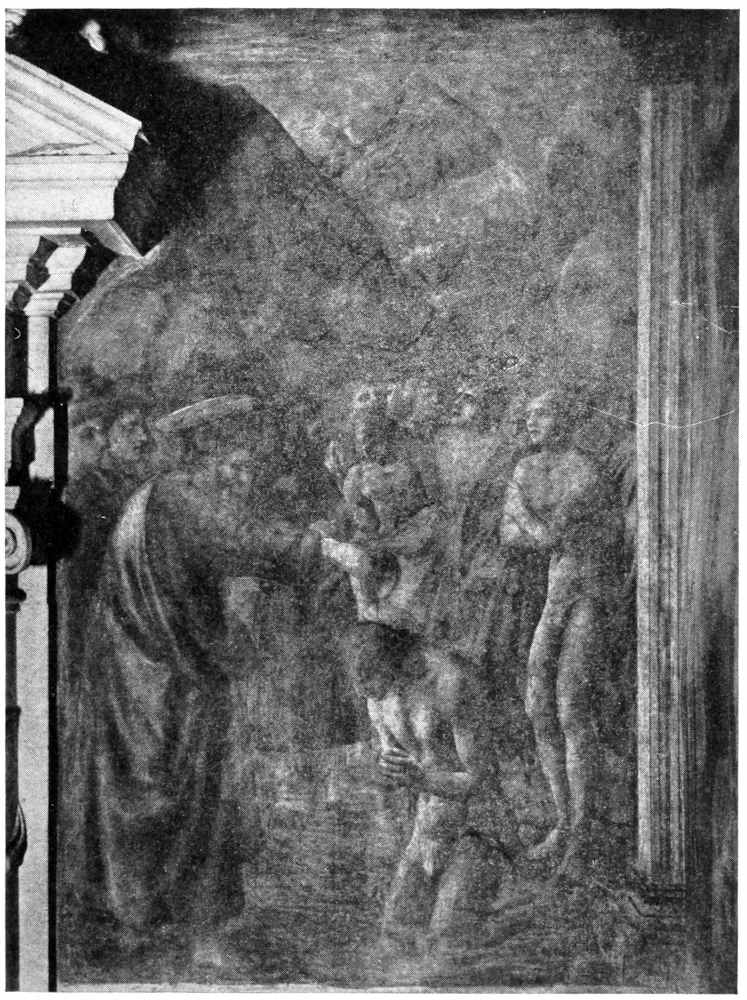
Photo. Alinari
ST. PETER BAPTISING.—MASACCIO
(Brancacci Chapel, Santa Maria del Carmine, Florence.)
Many legends are related of St. Peter. Among them that of Simon Magus is the most important, and it has been frequently illustrated in art (Acts viii., 9, 24).
Simon Magus was a famous magician among the Jews, who performed marvellous feats of sorcery and claimed to be a god. Privately he tried to buy from the apostles the secret of their power to work miracles, but was rejected by them with scorn.
The apostles vanquished him at every turn, and drove him out of Jerusalem; and he fled to Rome, where he became a favourite of the Emperor Claudius and afterwards of Nero. Simon claimed that he had the power to raise the dead, and when Peter and Paul came to Rome they challenged him to restore the life of a youth in the presence of the emperor. The magician failed utterly to make good his boast, but when Peter and Paul spoke to the boy he at once rose from the dead. Then the magician announced that he would fly to heaven, and jumping from a high tower he floated in the air for a time, sustained there by demons. At this, Peter fell on his knees and begged that the demons might loose their hold, which they did, and the magician, falling to the ground, was dashed to pieces.
When the first persecution under Nero broke out, the Christians finally succeeded in persuading St. Peter to flee from Rome and thereby save a life that was so precious to the Church.
As Peter was fleeing along the Appian Way, he suddenly encountered our Lord Himself going towards Rome, and bearing His cross. In wonder at such a vision, Peter exclaimed, “Lord, whither goest Thou?” (Domine, quo vadis?) and Jesus, bending His eyes sadly upon him, answered, “I go to Rome to be crucified again.” And thus saying, He vanished from sight. Peter felt this to be a sign that he was forsaking his duty and turned back at once to the city, where he continued to preach and baptise until he was taken with St. Paul and thrown into the Mamertine prison.
Here they converted the two centurions, Processus and Martinian, who guarded them, also many other prisoners. There was no water with which to baptise them, but at the prayer of St. Peter that water might be forthcoming, a spring broke through the stone floor and remains a fountain there to this day.
Tradition declares that St. Peter was crucified with his head downward at his own request, feeling himself unworthy to suffer the same death as his Lord.
When in devotional pictures St. Peter is accompanied by another apostle with no distinctive attributes, it may be supposed that it is St. Mark, who was his companion, amanuensis, and interpreter at Rome.
“St. Peter was generally represented blessing, St. Paul preaching,—the former with white hair and beard, the hair sometimes plaited in three distinct partitions; the latter with a lofty and partially bald brow, and long high nose,—as characteristic of the man of genius and the thorough gentleman, as the former is of the warm-hearted, frank, impetuous fisherman. The likenesses may be correct,—they were current, at least, in the days of Eusebius” (Lord Lindsay’s Sketches of Christian Art).
The dress of St. Peter in the mosaics and Greek pictures is a blue tunic with a white mantle, but in later pictures he wears a blue or green tunic with yellow drapery. In the earliest representations, he bears a scroll or book, later a cross in one hand and book in the other. It is not until about the eighth century that the keys become his peculiar symbol. Sometimes he has one great key, but usually he carries two keys, one of gold and one of silver—to absolve and to bind—or according to another interpretation one is of gold for the gates of heaven, the other of iron for the gates of hell. The legend that makes St. Peter the keeper of the gate of Paradise, having power to grant or refuse admission, found its origin in the delivery of the keys to St. Peter.
Although St. Paul was called to be an apostle after the ascension of Christ, yet he takes rank next to St. Peter as one of the “chief witnesses of the Christian faith.” The history of the “great apostle of the Gentiles” is given fully in the Acts, and the Epistles and the legends have not added much to it. It is related that he suffered martyrdom outside the Ostian Gate of Rome by being beheaded on the same day that St. Peter was crucified within the city. It is also said that a certain Roman matron, named Plautilla, a convert of St. Peter’s, wishing to see St. Paul for the last time, placed herself on the road where he passed to his martyrdom. As she beheld him, she wept and implored his blessing. The apostle gave it and then asked for her veil, that he might bind his eyes before being beheaded. He promised to return it to her after his death. Plautilla gave it readily, thus showing her faith, although her attendants refrained not from mocking at so ridiculous a promise. After his martyrdom, however, her veil, stained with his blood, was restored to her in person by St. Paul. The spot where he was beheaded is still venerated as the Tre Fontane, tradition saying that the severed head made three bounds on the ground, and at each place that it touched a fountain gushed forth.
In art the dress of St. Paul is, like St. Peter’s, a blue tunic and white mantle. He has a book or scroll in one hand, occasionally twelve rolls, representing his Epistles. His peculiar symbol is the sword—his attribute in a double sense—first signifying the manner of his martyrdom, and second typifying the “good fight fought by the faithful Christian.” When St. Paul is leaning on his sword it then expresses his martyrdom. When he holds it aloft it proclaims his warfare in the cause of Christ; when two swords are given to him, one is the attribute, the other the symbol.
St. Andrew (Lat. S. Andreas. Ital. Sant’Andrea. Fr. St. André) was the brother of Simon Peter, and he was the first who was called to be an apostle. Nothing further is told of him in the New Testament. Tradition relates that after the ascension of Christ, St. Andrew travelled into Scythia, Cappadocia, and Bithynia, converting multitudes to the faith. He returned to Jerusalem, and thence travelled into Greece and came at last to a city of Achaia, called Patras. Here, among many others, he converted Maximilia, wife of the proconsul Ægeus. He induced her to make a public profession of Christianity, and this so enraged the proconsul that he ordered St. Andrew to be seized and scourged and then crucified. There are many opinions as to the form of the cross upon which he suffered, but it is generally believed to have been a transverse cross, since called St. Andrew’s Cross, and it is said he was fastened with cords rather than with nails—a circumstance always adhered to in the representations of his death. Before suffering crucifixion, the legend relates that he saluted and adored the cross on his knees as something that had been consecrated by the sufferings of his Redeemer.[7] Some of his relics were brought from Patras to Scotland in the fourth century, and since then St. Andrew has been the patron saint of Scotland and of its chief order of Knighthood. He is also patron saint of the famous Burgundian Order, the Golden Fleece, and of Russia and its chief order, the Cross of St. Andrew.
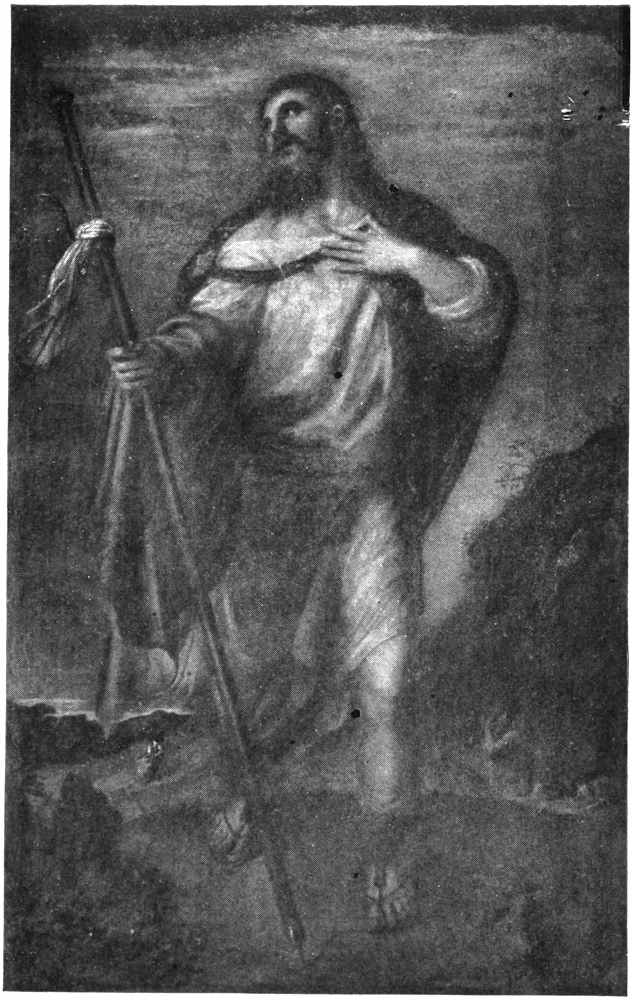
Photo. Alinari
ST. JAMES MAJOR.—TITIAN
(Church of S. Lio, Venice.)
St. Andrew is recognised in art by the transverse cross, and the devotional pictures represent him as a very old man with a certain brotherly resemblance to St. Peter. He has long, white, flowing hair and beard, the beard usually being divided. He is generally represented leaning upon the cross, holding the Gospel in his right hand.
St. James the Great. Lat. Sanctus Jacobus Major. Ital. San Giacomo, or Jacopo, Maggiore. Fr. St. Jacques Majeur. Spa. San Jago, or Santiago.
St. James Major (the Great or the Elder) was a kinsman of Christ’s, and, with his brother John the Evangelist and Peter, went everywhere with the Lord and was present at most of the events related in the Gospels. He was one of the three who were permitted to witness the transfiguration of Christ, and one of those who slept during the agony in the garden. No mention is made of him after the ascension, except the fact that Herod slew him with the sword.
The legends of the middle ages, however, have amply made up for this deficiency, and as military patron of Spain, he became one of the most famous saints in Christendom and a most popular subject in art.
In the Spanish legend, although James (their Santiago) is still the son of Zebedee and a native of Galilee, this Zebedee, instead of being a poor fisherman, becomes through the florid imagination of the Spanish chroniclers a very rich nobleman, whose son, always pure and heavenly-minded, is converted by Jesus, and follows Him and shares His labours until the end.
It is related that after the ascension James went first into Judæa, preaching, and then came at last to Spain.
One day as he stood on the banks of the Ebro, he saw in a vision the Blessed Virgin, who appeared to him surrounded by angels and seated on a pillar of jasper. She commanded him to build on that spot a church in her honour and told him that belief in her and in her glorious Son would in time drive paganism out of the land. St. James rose up from the ground where he had prostrated himself before her, and with faith strengthened by these words of the Holy Virgin, began forthwith to erect the famous church in her honour, which has been known ever since as the Church of Our Lady of the Pillar (Nuestra Señora del Pilar).
Many other curious legends are related of him—his encounter with the sorcerer Hermogenes, who sent his scholar Philetus to compete with him. James converted him, which so enraged Hermogenes that he bound Philetus by evil spells, so that he could not move hand or foot. Philetus sent his servant to St. James, praying for aid. The apostle sent his cloak by the servant, and no sooner had Philetus touched it, than he became free and hastened to his deliverer. Hermogenes sent his demons to take both the saint and his disciple; angels, however, intervened, and the sorcerer, now utterly vanquished by the power of the apostle, cast his magical books into the sea and declared himself also converted. Hermogenes having prayed for aid against the power of his own demons, St. James gave him his own staff to protect him, and thus armed, Hermogenes set forth to preach the Gospel, and became a faithful and worthy disciple from that time.
Soon after this the Jews, being roused to anger by the miracles and good works of St. James, beheaded the saint, and his disciples, fearing to bury his body, placed it in a ship—some say of marble—and angels guided it to the coast of Spain. Here the disciples took out the body and laid it on a great stone, and the stone yielded to his form like wax and softly closed around it. Then they knew that they had found its chosen resting-place.
But that country was governed at the time by a wicked queen named Lupa, who hated Christians, and who harnessed wild bulls to the stone, thinking they would dash it in pieces; but instead the bulls became as gentle as lambs (aussitot doux comme des moutons) and drew it slowly into the court of Lupa’s palace and there rested. At this marvel, she became converted and built a magnificent church to receive the body of James.
In after years the body was lost until the year A. D. 800, when its place of concealment was revealed to a friar. His relics were then removed to Compostella, and so many miracles were wrought at his shrine that thousands upon thousands of pilgrims visited it from all parts of Europe, and the military Order of Saint Jago, enrolled by Don Alphonso for their protection, became one of the greatest and richest orders in Spain.
The wonderful deeds enacted by Santiago in behalf of his chosen people would fill a volume. The Spanish historians chronicle thirty-eight instances in which Saint Jago descended from heaven and in person led their armies against the Moors. The first and most famous was in 939, when he visited the King of Castile in a dream the night before, assuring him of victory. As the army engaged in battle the next morning, the soldiers were thrilled by the sight of St. James at their head, mounted on a snow-white steed, and waving a white standard on high. Thus he led them on to victory, and from that day to this, “Santiago” has been the Spanish war-cry.
St. James’s place among the apostles is fourth in the series, but third after St. Peter and St. Paul. Often in art he is represented bearing a family resemblance to Christ, his kinsman. He has the same thin beard and the hair parted, flowing down on each side.
From the thirteenth century, he has been represented in the dress of a pilgrim of Compostella; he carries the peculiar long staff, from which is suspended a wallet or gourd of water; wears a cloak with a long cape; and has the scallop-shell on his shoulder or on his flapped hat. When the cape, hat, and scallop-shell are omitted, the staff remains his constant attribute, designating him as the first apostle who departed to spread the Gospel into other lands. He can always be recognised by the staff in Madonna pictures and when grouped with other saints.
St. John, who is fifth in the series of the apostles, is found under the head of the Four Evangelists.
St. Philip. Ital. San Filippo Apostolo. Fr. Saint Philippe.
Little is related of St. Philip in the Gospels. After the ascension, he preached in Scythia for twenty years, and then travelled to Hieropolis in Phrygia, where he found the people worshipping a great serpent or dragon, whom they believed to personify the god Mars.
St. Philip, filled with compassion for their ignorance, went into the temple, and holding up his cross commanded the serpent to disappear. Immediately it glided from beneath the altar, and as it moved it sent forth so dreadful an odour that many died, among them the son of the king; but Philip restored him and the others to life, and again, by the power of the cross which he always bore, he commanded the dragon to depart and from that time it was seen no more. This so infuriated the priests of the serpent that they crucified Philip, and when he was fastened to the cross they stoned him to death.
The Scriptures state that Philip had four daughters, who were prophetesses (Acts i., 9). In the Greek calendar his sister, St. Mariamne, and St. Hermione, his daughter, are commemorated as martyrs.
St. Philip, when he is represented alone or in the series of apostles, is a man of middle-age and kindly face, with scarcely any beard. His attribute, a cross, varies in form; sometimes it is small, and he carries it in his hand; again it is a high cross in the form of a “T” or a tall staff with a small Latin cross at the top of it. The cross of St. Philip has a threefold meaning: it may allude to his martyrdom; or to his conquest over the idols through the power of the cross; or when placed on top of the pilgrim’s staff it may refer to his sojourn among the barbarians, preaching the cross of salvation.
St. Bartholomew. Lat. S. Bartholomeus. Ital. San Bartolomeo. Fr. St. Barthélemi.
The origin of this saint is in doubt. According to some accounts, he was the son of a husbandman,—others say he was the son of a prince, Ptolomeus. He went into India after the ascension, carrying with him the Gospel of St. Matthew, and preached also in Armenia and Cilicia. He suffered a horrible death in Albanopolis, being first flayed alive and then crucified.
In devotional pictures and single figures, St. Bartholomew sometimes bears in one hand a book, the Gospel of St. Matthew, but his peculiar attribute is a large knife, the instrument of his martyrdom, and he is sometimes represented with his own skin hanging over his arm, as in Michael Angelo’s Last Judgment (Sistine Chapel, Rome).
St. Thomas. Ital. San Tommaso. Spa. San Tomé.
St. Thomas, called Didymus (the twin), is seventh among the apostles. He was a fisherman of Galilee, and he is recorded in the Gospel on two occasions. As Jesus was going up to Bethany, being then in danger from the Jews, Thomas said, “Let us also go, that we may die with Him” (John xi., 16). And after the resurrection, it was Thomas who doubted the reappearance of the crucified Saviour (John xx., 24-29).
After the ascension, St. Thomas travelled into the East, preaching the Gospel. A tradition has been accepted in the Church that he went as far as India; where he met the Three Wise Men of the East, and baptised them. He founded a church in India, and it was there that he suffered martyrdom.
After the thirteenth century, St. Thomas bears as his attribute the builder’s rule, shaped thus:

As he was neither a carpenter nor a mason, the reason of this attribute is found in one of the legends.
“When St. Thomas was at Cæsarea, our Lord appeared to him and said, ‘The King of the Indies, Gondoforus, hath sent his provost Abanes to seek for workmen well versed in the science of architecture, who shall build for him a palace finer than that of the Emperor of Rome. Behold, now I will send thee to him.’ And Thomas went, and Gondoforus commanded him to build for him a magnificent palace, and gave him much gold and silver for the purpose. The King went into a distant country and was absent for two years, and St. Thomas meanwhile, instead of building a palace, distributed all the treasures intrusted to him among the poor and sick; and when the King returned he was full of wrath and commanded that St. Thomas should be seized and cast into prison, and he meditated for him a horrible death. Meantime the brother of the King died; and the King resolved to erect for him a most magnificent tomb; but the dead man, after that he had been dead four days, suddenly arose and sat upright and said to the King, ‘The man that thou wouldst torture is a servant of God; behold I have been in Paradise, and the angels showed to me a wondrous palace of gold and silver and precious stones, and they said, “This is the palace that Thomas, the architect, hath built for thy brother King Gondoforus.”’ And when the King heard those words he ran to the prison and delivered the apostle; and Thomas said to him, ‘Knowest thou not that those who would possess heavenly things have little care for the things of this earth? There are in heaven rich palaces without number, which were prepared from the beginning of the world for those who purchase the possessions through faith and charity. Thy riches, O King, may prepare the way for thee to such a palace, but they cannot follow thee thither’” (Vos richesses pourront bien aller devant vous à ce palais, mais elles ne pourront vous y suivre).
The builder’s rule in the hand of St. Thomas represents him as the spiritual architect of King Gondoforus, and thus he has been chosen as patron saint of architects and builders.
“The Incredulity of St. Thomas” appears in all the early series in the life of Christ, and it is of frequent occurrence in the later schools of Italy and in the Flemish schools. Either St. Thomas is seen placing his hand, with an expression of doubt and fear, on the wounds of the crucified Christ, or his doubts having vanished, his eyes are cast heavenward in joy and thankfulness.
The legendary subject styled La Madonna della Cintola, where St. Thomas doubts the apotheosis of the Virgin, has been described in the Assumption of the Virgin.
St. Matthew the Evangelist comes eighth in the order of the apostles.
St. James Minor. Lat. S. Jacobus Frater Domini. Ital. San Jacopo or Giacomo Minore. Gr. Adelphotheos. Fr. St. Jacques Mineur.
St. James Minor, or the Less, also called the Just, is ninth in the series. He was nearly related to Christ, being the son of Mary, the wife of Cleophas, who was the sister of the Virgin Mary; and although only a cousin he was often spoken of as the “Lord’s brother.” He became first Christian Bishop of Jerusalem, and was reverenced for his piety, and wisdom, and charity. The Scribes and Pharisees, however, became so enraged by his teachings that they flung him down from a parapet of the Temple to the infuriated mob below, where his brains were beaten out with a fuller’s club.
St. James is generally represented leaning on this club, the instrument of his martyrdom. According to an early tradition, he so nearly resembled our Lord “in person, in features, and deportment,” that it was difficult to distinguish them, and this rendered necessary the kiss of Judas.
St. Simon Zelotes (or The Zealot). St. Jude (Thaddeus, or Lebbeus). Ital. San Simone; San Taddeo. Fr. St. Simon; le Zelé; St. Thaddée. Ger. Judas Thaddäus.
Very little is known of these saints. According to one tradition they were the same mentioned by Matthew as our Lord’s brethren or kinsmen. According to another tradition they were two brothers among the shepherds, who visited Christ at His birth. The painters who adhered to the first tradition represent Simon and Jude as young. Those who follow the latter represent them as very old. It seems generally agreed that they preached the Gospel together in Syria and Mesopotamia, and together suffered martyrdom in Persia. Tradition says that St. Simon was sawn asunder, and St. Thaddeus killed with a halberd.
In a series of apostles, St. Simon bears the saw and St. Thaddeus the halberd. Greek art represents Jude and Thaddeus as two distinct persons, Jude being young and Thaddeus old; and St. Simon is extremely old, with a bald head, and long white beard.
St. Matthias. Ital. San Mattia. Fr. St. Mathias.
St. Matthias, who was chosen by lot to fill the place of the traitor Judas, is the last of the apostles (Acts i.). He preached the Gospel in Judæa, and was martyred there by the Jews, either by the lance or by the axe. In the Italian series of the apostles his attribute is the lance; in the German sets he usually has an axe.
Judas Iscariot. Ital. Giuda Scariota. Fr. Judas Iscariote.
The Gospels do not speak of the life of Judas before he became an apostle, but the legends of the middle ages fill up the omissions of Scripture after their own fancy. As recounted by Mrs. Jameson, they picture Judas as a “wretch foredoomed, and prepared by a long course of vice and crime for that crowning guilt which filled the measure full. According to this legend, he was of the tribe of Reuben. Before his mother brought him forth, she dreamed that the son who lay in her womb would be accursed, that he would murder his father, commit incest with his mother, and sell his God. Terrified at her dream, she took counsel with her husband and they agreed to avert the threatened calamity by exposing the child. As in the story of Œdipus, from which indeed this legend seems partly borrowed, the means taken to avoid the threatened curse caused its fulfilment. Judas, at his birth, is enclosed in a chest, and flung into the sea; the sea casts him up, and being found on the shore, he is fostered by a certain king and queen as their own son; they have another son, whom Judas, malignant from his birth, beats and oppresses, and at length kills in a quarrel over a game of chess. He then flies to Judæa, where he enters the service of Pontius Pilate as page. In due time he commits the other monstrous crimes to which he was predestined; and when he learns from his mother the secret of his birth, he is filled with a sudden contrition and terror; he hears of the prophet who has power on earth to forgive sins; and seeking Christ throws himself at His feet. Our Saviour, not deceived, but seeing in him the destined betrayer, and that all things may be accomplished, accepts him as His apostle; he becomes the seneschal or steward of Christ, bears the purse and provides for the common wants. In this position, avarice, the only vice to which he was not yet addicted, takes possession of his soul and makes the corruption complete. Through avarice, he grudges every penny given to the poor, and when Mary Magdalene anoints the feet of our Lord, he is full of wrath at what he considers the waste of the precious perfume: ‘Why was not this ointment sold for three hundred pence, and given to the poor?’ This he said not that he cared for the poor, but because he was a thief. Through avarice, he yields to the bribe offered by the Jews. Then follow the scenes of the betrayal of Christ, and the late repentance and terrible suicide of the traitor, as recorded in Scripture.”
Separate representations of Judas Iscariot would have been regarded as “profane, ominous—worse than the evil-eye,” and the early artists, in the scenes from the Scriptures where Judas appears, give him a countenance as expressive of all the evil passions as their brushes were capable of. The legend says, however, that Judas was of comely appearance, and was recommended to the service of Pontius Pilate by his beauty of person.
In art Judas always wears a dirty, dingy yellow, a colour that in Spain is so associated in the mind with pictures of Judas, that it is held in abhorrence. In Spain and in Italy malefactors and criminals are garbed in yellow. Formerly the Venetians made all Jews wear yellow hats.
St. Barnabas. Ital. San Barnaba. Fr. Saint Barnabé.
He is usually called the Apostle Barnabas, because he was associated with the apostles in their calling, and is to be “considered as Apostolical, and next to them in sanctity.” St. Barnabas was a Levite, born in the island of Cyprus and a cousin of Mark the Evangelist. His life and character as recorded in the Acts are full of interest. After the conversion of Paul, he was the first to believe in his sincerity, and to present him to the other apostles, “who were afraid of him, and would not believe that he was a disciple.” Barnabas afterwards went with St. Paul to Antioch. There, however, they fell into a dispute concerning Mark and separated. Barnabas preached the Gospel in Asia Minor, Greece, and Italy, and it is said he was the first Bishop of Milan. It is related that “everywhere he carried the Gospel of St. Matthew, written by the hand of the evangelist, and when any were sick or possessed, he laid the sacred writing upon their bosom and they were healed.”
As he was preaching in a synagogue of Judæa against the Jews, they seized him and put him to death. Mark and the other Christians buried him in much sorrow.
In art he is represented as of lofty presence, holding in his hand the Gospel of St. Matthew, and he frequently appears in subjects taken from the Acts and the life of St. Paul.