XVIII.—THE FOUR GREAT VIRGINS OF THE LATIN CHURCH
Reading edition
ST. CECILIA, ST. AGNES, ST. AGATHA, AND ST. LUCY
St. Cecilia. Fr. Sainte Cécile. The name is the same in Italian, German, and Spanish.
St. Cecilia was of a noble Roman family, and brought up in the Christian faith. She early took a vow of chastity, shunning the pleasures of the world. She excelled in music and sang with such heavenly sweetness that angels came to listen to her. She played on all instruments, but as none sufficed to express the harmony which filled her soul, she invented the organ and consecrated it to the service of God.
When about sixteen her parents desired her to marry Valerian, a young Roman, rich and of noble birth. Cecilia accepted him, but beneath her bridal robe she wore a coarse garment of penance and renewed her vow of chastity; and by her eloquence persuaded her husband Valerian not only to respect her vow, but also converted him to the true faith, and he was baptised by the aged St. Urban who, being persecuted by the heathen, had sought refuge in the catacombs.
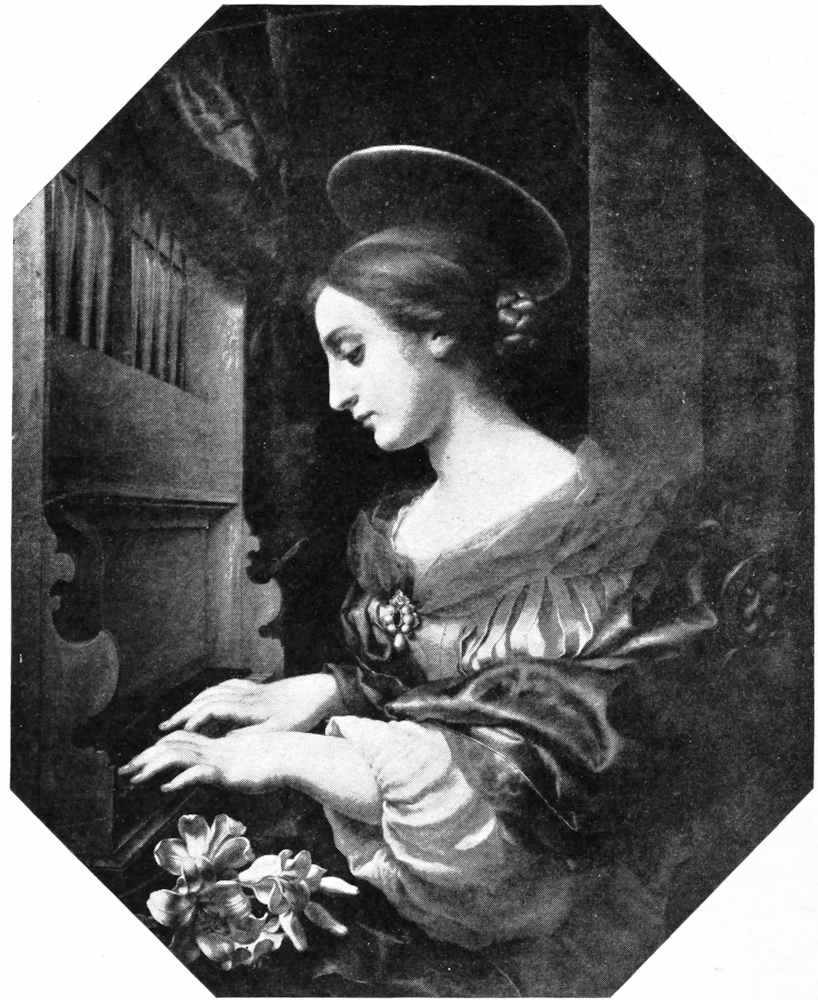
Photo. Alinari
ST. CECILIA.—CARLO DOLCI
(Dresden Gallery.)
Cecilia had told Valerian that she had a guardian angel, and upon returning to her chamber, he heard the most enchanting music and beheld the angel standing near her, with two crowns of roses gathered in paradise; with these the angel crowned them as they knelt before him, and told Valerian that whatever he asked for should be granted him. And Valerian replied: “I have a brother named Tiburtius whom I love as my own soul; grant that his eyes also may be opened to the truth.” And the angel answered with a heavenly smile, “Thy request, O Valerian, is pleasing to God, and ye shall both ascend to His presence bearing the palm of martyrdom,” and the angel vanished. Soon after, Tiburtius entered the chamber and perceiving the fragrance of the celestial roses, Cecilia explained all to him and he, too, was converted, and went straightway to St. Urban and was baptised. And all three went about doing good.
Soon after, they were denounced to the prefect as Christians, and the two brothers were cast into prison. They converted their jailer Maximus, who suffered martyrdom with them, and Cecilia buried them together in the cemetery of Calixtus. The prefect, coveting the wealth of St. Cecilia, commanded her to sacrifice to the gods, and when she refused, put her to many tortures; finally ordering her to be thrown into her own bath filled with boiling water. But she came out unharmed, as though “she had bathed in a fresh spring.” Then he ordered her to be beheaded, but the hand of the executioner trembled so that he inflicted three wounds in her neck, and fled. She lived three days, praying and distributing all she had to the poor, and died “singing with her sweet voice praises and hymns to the last moments.” She was buried by the side of her husband, and, according to her wish, her house was consecrated as a church. In the ninth century it was revealed to Pope Paschal where she lay buried, and he had her remains, also the remains of Valerian, Tiburtius, and Maximus, deposited in her church, now St. Cecilia in Trastevere. The little room containing her bath is now a chapel.
Until the beginning of the fifteenth century St. Cecilia is seldom represented with her musical instruments. She has the palm, and the crown of red and white roses, and occasionally an attendant angel. It is thus sometimes difficult to distinguish her from St. Dorothea, who has also the palm, the crown of roses, and the angel. But Dorothea usually carries a book, while St. Cecilia when she has anything besides the palm, carries a scroll of music. Then St. Dorothea, besides roses on her head, frequently has them in her hand, or in a basket. The angel with St. Dorothea carries fruit and flowers in a basket. The angel with St. Cecilia bears a garland, or some musical instrument.
When accompanied by musical attributes, St. Cecilia is readily distinguished. She is richly dressed, wearing jewels, with musical instruments near her or sometimes playing the organ.
St. Agnes. Lat. Sancta Agnes. Ital. Sant’ Agnese. Spa. Santa Inez. Fr. Sainte Agnes.
“The blessed virgin S. Agnes was much wise and well taught, as S. Ambrose witnesseth, and wrote her passion. She was fair of visage, but much fairer in the christian faith, she was young of age, and aged in wit, for in the thirteenth year of her age she lost the death that the world giveth, and found life in Jesus Christ” (The Golden Legend).
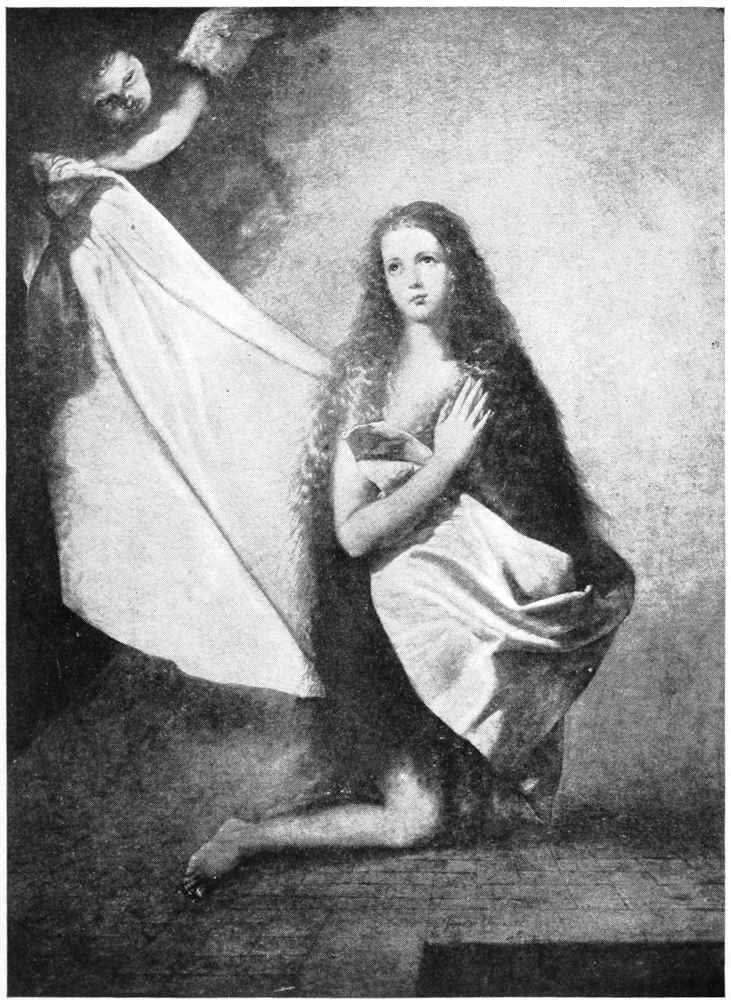
Photo. Alinari
ST. AGNES.—SPAGNOLETTO
(Dresden Gallery.)
The legend of St. Agnes is one of the oldest and most authentic in the Christian Church, and except for the evangelists and apostles there is no saint who is earlier depicted in art.
St. Agnes lived in Rome, and it happened that the son of the prefect Sempronius fell violently in love with her and desired to marry her, but Agnes refused. He then brought her rich presents and promised her all the delights of the world if she would consent to be his wife. But again she rejected him, saying she was betrothed to One greater than any earthly suitor. On hearing these words the prefect’s son fell ill with jealousy and disappointment.
Now the prefect loved his son, and went weeping to Agnes and to her parents and besought them to accept him. But Agnes made to him the same answer. Then the prefect found that she was a Christian, and enraged against her, subjected her to the most cruel tortures, but she remained firm. Then he ordered the soldiers to drag her to a place of infamy and “they stripped her of her garments; and when she saw herself thus exposed, she bent down her head in meek shame and prayed; and immediately her hair, which was long and abundant, became like a veil, covering her whole person from head to foot, and those who looked upon her were seized with awe and fear as of something sacred, and dared not lift their eyes. So they shut her up in a chamber, and she prayed that the limbs that had been consecrated to Jesus Christ should not be dishonoured. And suddenly she saw before her a white and shining garment, with which she clothed herself joyfully. And the whole place was filled with miraculous light.” Her lover entered, and as he approached her, was struck with blindness and fell lifeless. Agnes, melted to compassion, prayed that he might be restored to health, and her prayer was granted.
Then Sempronius, moved to gratitude, would have saved her, but the people clamoured for her death as a sorceress. So fagots were heaped up and set on fire and St. Agnes thrown in their midst, but the flames were miraculously extinguished and she stood unharmed, while the executioners around her were slain by the fire. She was at length put to death by the sword, and thus, looking steadfastly up to heaven, she yielded up her pure spirit and fell bathed in her own blood.
Her parents carried her body to a cemetery outside the city, and Christians assembled there day and night to pray. One day as her parents and others were praying by her sepulchre, “St. Agnes appeared before them all radiant of aspect; by her side was a lamb whiter than the driven snow.” She assured them of her perfect happiness and begged them to rejoice for her, and then vanished. Then the Christians ceased mourning for her and felt joy and thanksgiving instead.
Her pictures abound in every form and every school of art. As martyr she is seated, partly veiled, holding her palm in the right hand, with the other embracing her lamb. The lamb in later times is her invariable attribute, as the patroness of maidens, and maidenly modesty.
St. Agatha. Ital. Santa Agata. Ger. Die Heilige Agathe. Fr. Sainte Agathe.
A certain Christian maiden whose name was Agatha lived in the city of Catania, in Sicily. The Emperor Decius, who had strangled his predecessor Philip, reigned at that time, and sent his creatures throughout the empire to oppress and persecute the Christians. To Sicily he sent his emissary Quintianus, and made him king over the whole island.
Quintianus had not reigned long in Sicily when he heard of the great beauty of the maiden Agatha, and sent to have her brought before him; and tried to tempt her with presents, and flatteries; but she rejected him with disdain. Then Quintianus sent for a courtesan named Frondisia, who had nine daughters more wicked and abandoned than herself, and he delivered Agatha into their hands, saying, “Subdue this damsel to my will, and I will give ye great riches.”
Failing in this, because Agatha’s heart was fixed as firm as a rock in the faith of Jesus Christ, Quintianus sent for her again, and upon her refusal to abjure Christ, he ordered her to be most cruelly tortured, and then she was thrown into a dungeon and here St. Peter himself ministered unto her.
She was again brought before Quintianus, and after suffering many further tortures, her prayers were heard, and her pure spirit ascended to heaven.
When represented as patron saint either alone or grouped with others, St. Agatha bears in one hand the palm and in the other a dish or salver on which is a human breast, in allusion to the tortures inflicted upon her. The shears, as instrument of her martyrdom, are sometimes in her hand or beside her. When she wears the crown it is as the bride and martyr of Christ.
St. Lucy. Ital. St. Lucia. Fr. Sainte Luce, or Lucie.
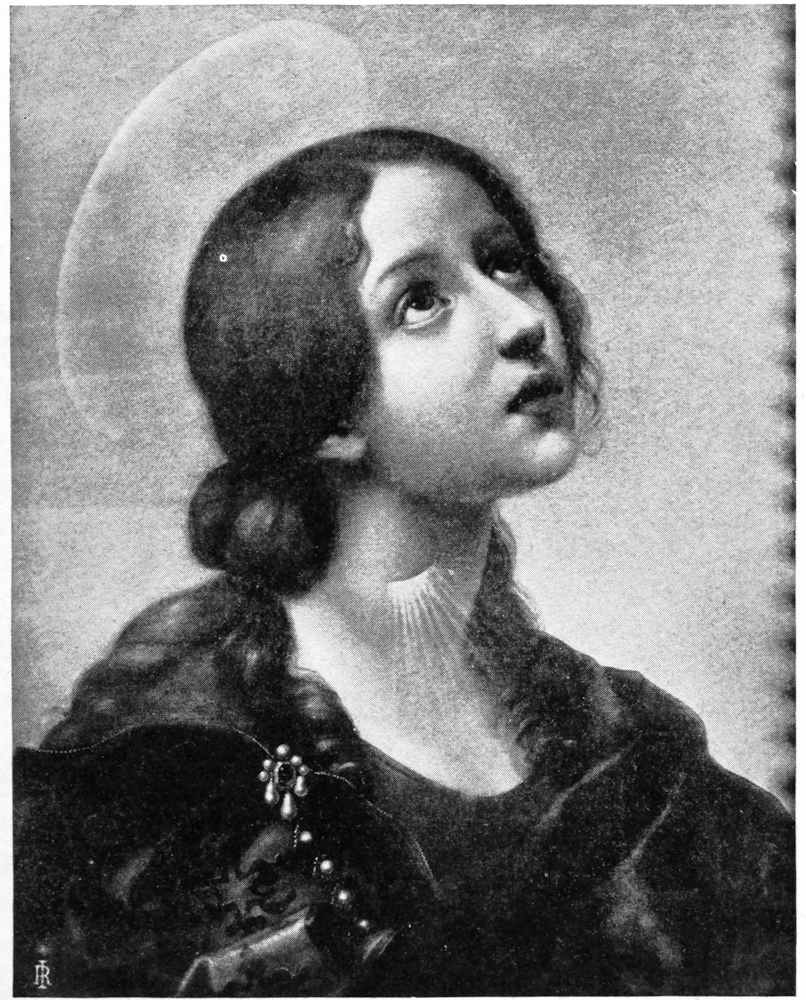
Photo. Alinari
SANTA LUCIA.—CARLO DOLCI
(Uffizi, Florence.)
Lucia was born in Syracuse, and dwelt there in the time of the wicked Diocletian, who sent one of his creatures, Pascasius, to be governor of Sicily. She was a Christian and had made a secret vow of chastity, but was betrothed at fourteen, against her will, to a pagan youth of great wealth. Her mother, being afflicted with a grievous malady, was induced by Lucia to go on a pilgrimage to the shrine of St. Agatha, which accordingly they did, and while praying beside the tomb, Lucia beheld a vision of St. Agatha, who appeared to her surrounded by angels, and said: “Well art thou called Lucia, who art indeed a light and mirror to the faithful,” and assured her that her prayers were heard and her mother healed.
Then Lucia persuaded her mother to permit her to remain unwed, and to give her dowry to the poor. When her lover heard this, in his rage he denounced her as a Christian. The governor ordered her to sacrifice to the gods, but she refused, and he then commanded that she be dragged to a place of shame, but when they tried to seize her she became immovable, and neither men, nor oxen with ropes, nor magicians could stir her from the spot.
Then a great fire was kindled around her, but she prayed and it did not harm her. Then one of the servants of Pascasius, to do him pleasure, pierced her throat with a sword or poniard.
The method employed by some of the early painters to express her name Lucia, light, by the emblem of an eye or eyes placed near her, seems to have occasioned the legend of the loss of her eyes, another instance of a symbol being converted into a fact, and a story invented to explain it.
The later legend relates that one of her suitors protested that he pursued her because of her beautiful eyes, and Santa Lucia, recalling the words, “If thine eye offend thee, pluck it out,” cut out her eyes and sent them to her lover on a dish, and the youth, full of remorse, became a Christian and her eyes were miraculously restored to her.
Devotional pictures of St. Lucia bearing her eyes on a dish are often met with. As her eyes were bored out with an awl, she often carries an awl in her hand. When she stands with her lamp, she is the type of celestial light and wisdom, the character given to her by Dante. Sometimes she has a sword or poniard in her neck—or a wound in her neck from which rays of light proceed, in allusion to her name.