X.—DEVOTIONAL REPRESENTATIONS OF THE VIRGIN MARY
Reading edition
In the most ancient examples, the maternity—the motherhood of the Virgin is not the paramount idea. She is represented without symbols, and veiled, occupying an inferior position on one side of her divine Son, with St. John the Baptist or St. Peter on the other.
Later, when the worship of the Virgin spread from the East and she was represented alone, without her Son, the apostles and saints who surrounded her taking secondary positions, she symbolised not only the divine Mother of Christ, but the second Eve, the mother of all the world, the Virgin of Virgins.
When she wears a crown over her veil or holds a sceptre in her hand she is the Queen of Heaven (Regina Cœli).
Attended by adoring angels, she is the Queen of Angels (Regina Angelorum).
Weeping or holding the crown of thorns she is Our Lady of Sorrow (Mater Dolorosa).
When she is merely veiled, with folded hands and a face of glorious beauty and sweetness, she is the Madonna, the Blessed Virgin, the Santa Maria Vergine.
It was in the days of chivalry that the title of Our Lady—Notre Dame, La Madonna, Unsere Liebe Frau—was first given to the Virgin.
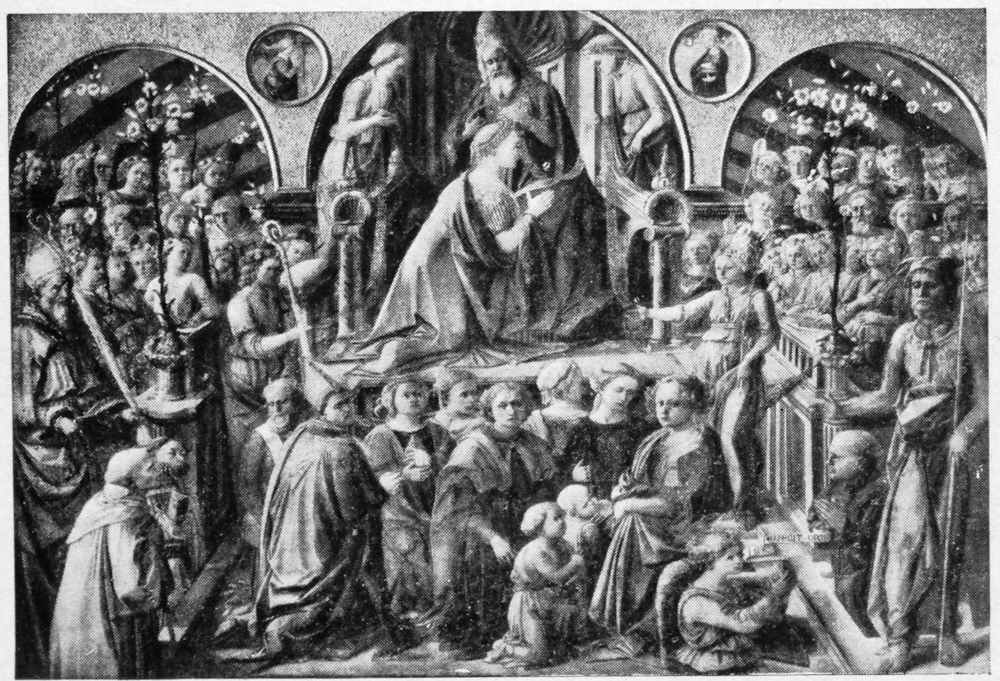
Photo. Alinari
CORONATION OF THE VIRGIN.—FILIPPO LIPPI
(Academy, Florence.)
The Coronation of the Virgin. (Lat. Coronatio Beatæ Mariæ Virginis. Ital. L’Incoronata, Maria Coronata dal divin suo Figlio. Fr. La Couronnement de la Sainte Vierge. Ger. Die Krönung Maria). In the earliest examples, Christ, with His mother seated on the same throne, and on His right hand, places the crown upon her head. Only the two figures are shown. Sometimes the Father looks down, and the Holy Ghost (as a dove) hovers between them. Later examples place the Virgin between the Father and Son, both in human form; each holds the crown in one hand, and places it on her head, while the Holy Spirit hovers above. Again, the Virgin is portrayed kneeling at the feet of Christ, who places the crown on her head; rejoicing angels are seen and paradise is disclosed beyond. Sometimes the whole army of blessed spirits, patriarchs, and martyrs are witnesses to this solemn and glorious ceremony.
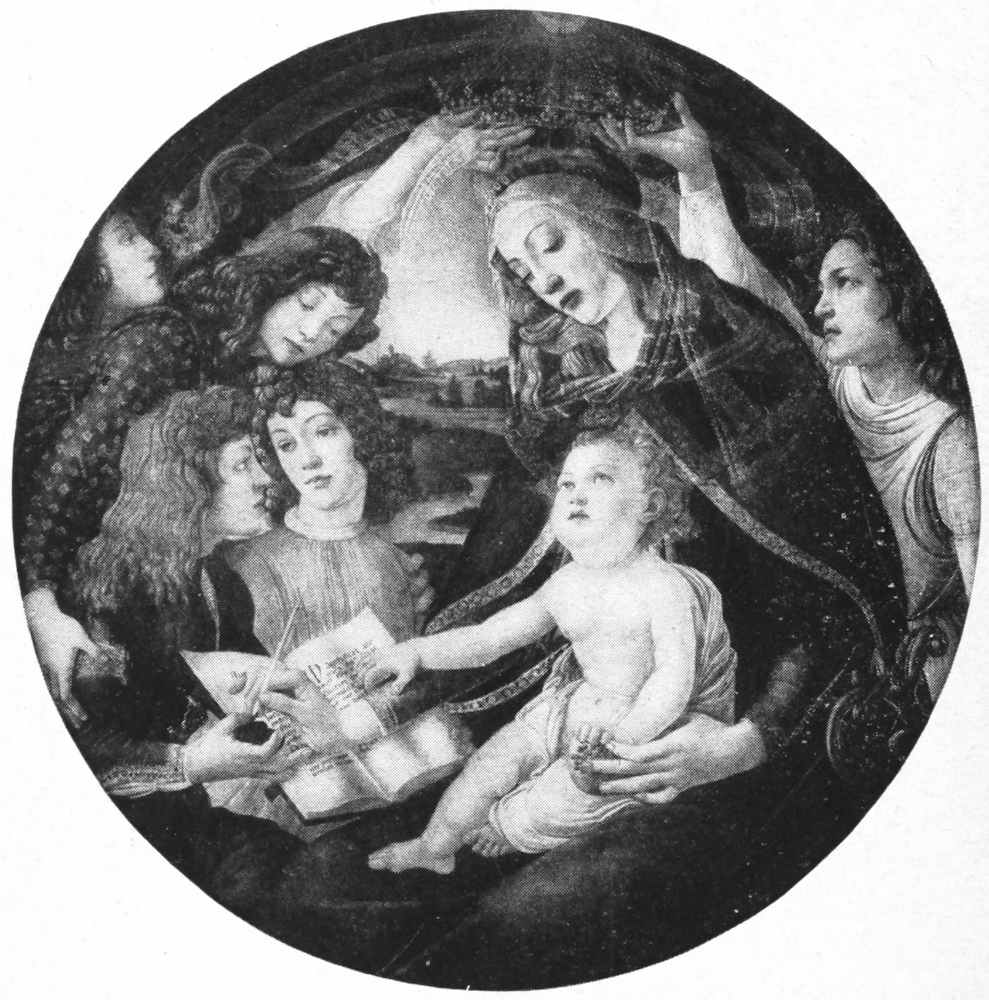
Photo. Alinari
THE MADONNA CROWNED—BOTTICELLI
(Uffizi, Florence.)
When not more than five or six saints are introduced, they are usually the patron saints of the locality or community.
Those pictures where the Madonna is holding her Child, while angels place a crown upon her head, are not Coronations in the accepted sense, but an acknowledgment of and tribute to the Virgin-mother of Christ, and Queen of Heaven (Mater Christi, Regina Cœli).
The Virgin of Mercy.[6] Our Lady of Succour. Ital. La Madonna di Misericordia. Fr. Notre Dame de Miséricorde. Ger. Mariä Mutter des Erbarmens.
Here she appears as intercessor, and in old pictures of the Day of Judgment she is seated by the side of Christ, or sometimes a little lower, but always on His right hand. She is usually seated, while the Baptist, who is generally placed opposite to her on the left of Christ, always stands or kneels.
As the Madonna of Mercy she rarely appears without the Child in her arms, her motherhood typifying her sympathy with all suffering humanity.
The Mater Dolorosa. Ital. La Madre di Dolore, L’Addolorata. Fr. Notre Dame de Pitié, La Vierge de Douleur. Ger. Die Schmerzhafte Mutter.
There are three distinct representations of the Madonna in this character. As Mater Dolorosa she is represented alone, either seated or standing, and sometimes only the head or a half-length figure of her is given. She is overcome with sorrow, her features are stricken with grief, and tears gush from her mournful eyes. Often a sword pierces her bosom—sometimes seven swords, in allusion to the seven sorrows.
In the Stabat Mater the position of the Virgin is invariably on the right of the crucifix—that of St. John on the left, the crucifix here being the mystical emblem of our belief in a crucified Christ. In this subject the Virgin is a wholly ideal figure, personifying the Church as well as the mother of Christ. Her head is bowed in resignation, her figure is shrouded in a violet or dark blue mantle. Sometimes she stands with outstretched arms and upward gaze, her faith struggling with her anguish.
La Pietà is the third, and consists only of the Virgin with her dead Son in her arms or at her feet; sometimes sorrowing angels are about, but otherwise the Mother is alone with her dead.
Another version, less poetically touching, represents the dead form half-emerging from the tomb, held in the arms of the sorrowing Mother, with St. John the Evangelist on the other side.
Our Lady of the Immaculate Conception. Lat. Regina sine labe originale concepta. Ital. La Madonna Purissima. Fr. La Conception de la Vierge Marie. Ger. Der Geheimniss der Unbefleckten Empfängniss Mariä.
This picture is not found in the early schools of art, but became one of the most popular subjects in the seventeenth century, after Paul V. had instituted the office for the commemoration of the Immaculate Conception in 1615 and in 1617 forbade any one teaching or preaching the opposite belief.
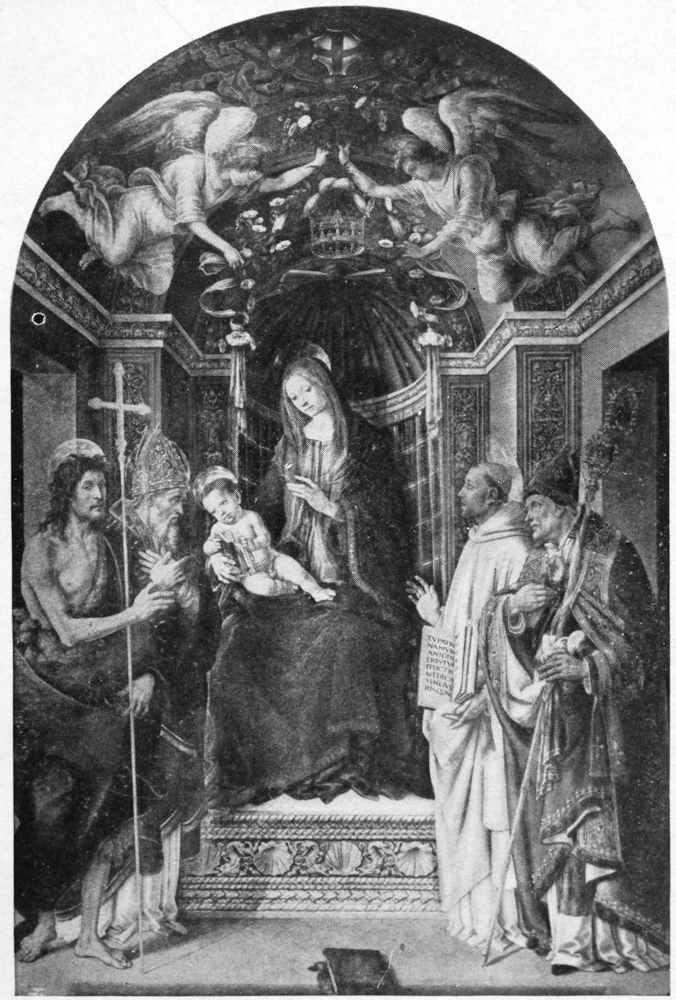
Photo. Alinari
THE MADONNA ENTHRONED.—FILIPPINO LIPPI
(Uffizi, Florence.)
This doctrine had been gaining ground from the eleventh century and had been agitated for several centuries before that, but there was always strong opposition to making it an article of belief. Even St. Bernard, in spite of his devotion to the Virgin, disapproved of incorporating it as a church office. It was a question of theological dispute for hundreds of years. In Spain it was the “darling dogma of the Spanish Church,” and forms the subject of some of the most beautiful pictures of the Spanish artists.
It was not until 1854 that the Immaculate Conception of the Mother of God was made an article of faith in the Catholic Church by Pope Pius IX.
In pictures of the Immaculate Conception, the Virgin is usually represented as the woman in the Apocalypse, “clothed with the sun, having the moon under her feet,” and on her head a crown of twelve stars. She is a maiden of twelve or thirteen years, with eyes reverent and sweet; her hair is golden, and her features beautiful. The sun is a glory of light around her, the moon with the horns pointing downward lies under her feet, and the twelve stars form a crown over her head. Her robe is of spotless white and her mantle blue. Around her are cherubim bearing roses, lilies, and palms, and below at her feet is the head of the bruised and defeated dragon.
Murillo, who achieved his greatest fame as painter of the Conception, sometimes makes the crescent moon a full moon, or, when a crescent, the horns point upward. He usually omits the starry crown, but is careful to follow the rules laid down as to the colours of the drapery.
The Virgin and Child Enthroned. Lat. Sancta Dei Genitrix, Virgo Deipara. Ital. La Santissima Vergine, Madre di Dio. Fr. La Sainte Vierge, Mère de Dieu. Ger. Die Heilige Mutter Gottes.
The many and beautiful pictures of this subject are purely devotional in character and in them Mary is exalted as the Mother of God. When she is represented with a book in her hand she is the Virgo Sapientissima, the Most Wise Virgin, or the Mater Sapientiæ, the Mother of Wisdom, and the book is the Book of Wisdom.
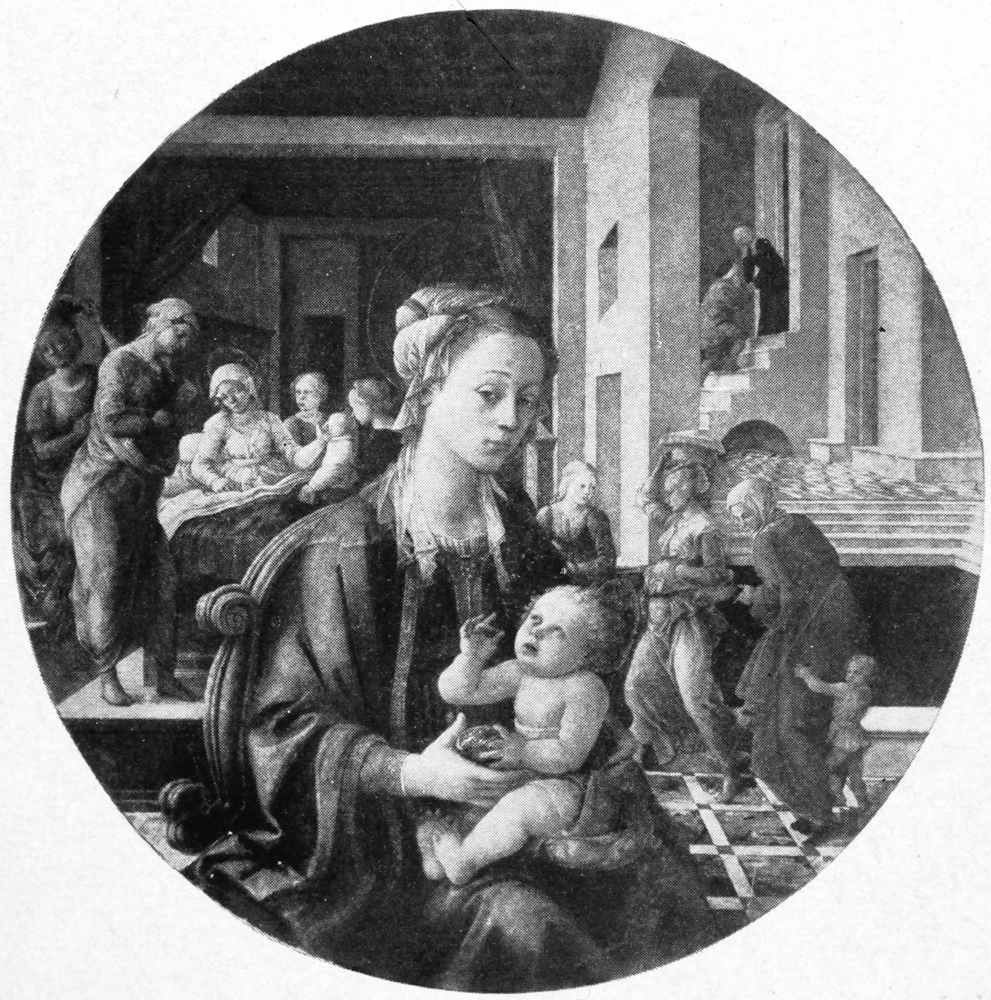
Photo. Alinari
THE VIRGIN AND CHILD.—FILIPPO LIPPI
(Pitti Palace, Florence.)
The artists hardly ever varied from the established rule as to the colours in which the Virgin-mother should be arrayed, and she nearly always has the red tunic with the blue mantle—as said before, red the colour of love and religious fervour, blue the colour of constancy and truth. In pictures of the Venetian and German schools she is often represented magnificently attired, her robe thickly broidered with gold and pearls, and her crown studded with jewels.
In the early pictures the divine Child is always clothed, and not until the beginning of the fifteenth century is he represented partially, then wholly, undraped.
The Madonna Enthroned is often attended by various saints, and the grouping of these saints has always some especial religious significance, as: St. Peter and St. Paul appear with the Virgin as chiefs of the apostles and founders of the Church; when St. John the Baptist and St. John the Evangelist attend the Virgin Enthroned the first expresses regeneration by the rite of baptism, the second regeneration by faith.
The Fathers of the Church appear as interpreters and defenders of the mystery of the Incarnation; St. Jerome and St. Catherine as patron saints of theological learning; St. Catherine and St. Barbara signify active and contemplative life; St. Nicholas and St. George with St. Catherine are prominent in the Venetian pictures, and all three were venerated as especial protectors of Venice.
St. George and St. Christopher stand by the throne of the Virgin of Succour as protectors and deliverers in danger.
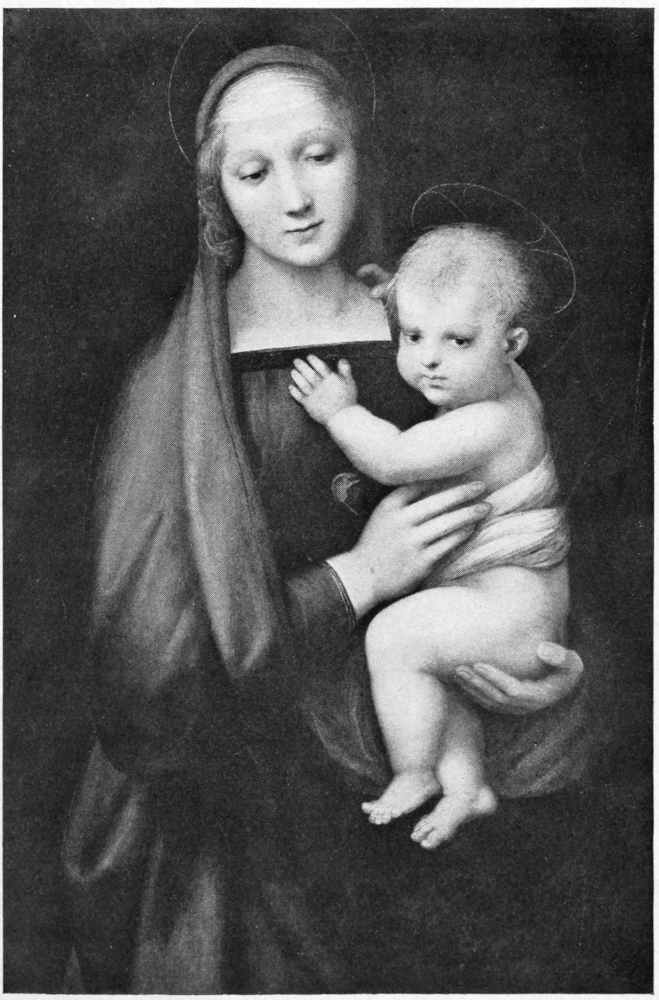
Photo. Alinari
THE MADONNA DEL GRAN-DUCA.—RAPHAEL
(Pitti Palace, Florence.)
Many of these Madonna pictures were votive offerings for public or private mercies, and frequently bear the name of those who offered them: as Raphael’s Madonna di Foligno presented by Sigismund Conti of Foligno.
Wherever the Virgin and Child appear attended by St. Sebastian and St. Roch the picture has been a votive offering against the plague.
Mater Amabilis. Ital. La Madonna col Bambino, La Madonna col celeste suo Figlio. Fr. La Vierge et l’Enfant Jésus. Ger. Maria mit dem Kind.
This treatment of the Virgin and Child makes the strongest appeal to the sympathies, for in it she is represented as the Mother only. As Mrs. Jameson expresses it: “Here Raphael shone supreme: the simplicity; the tenderness, the halo of purity and virginal dignity which he threw around the Mater Amabilis, have never been surpassed—in his best pictures never equalled. The Madonna del Gran-Duca [Pitti, Florence] and the Madonna Tempi [Munich] are perhaps the most remarkable for simplicity.”
A charming version of the Mater Amabilis is the Madre Pia where the Mother adores her Child. He lies extended upon her knee and she looks down upon Him with hands folded in prayer. Sometimes the Child looks up in His Mother’s face with His finger on His lip, expressing the Verbum sum—“I am the word.” One must distinguish this from a Nativity where the Mother adores her Child, but the presence of Joseph, the ruined shed or manger, the ox and ass, express the event. In the Madre Pia the locality and accessories are purely fanciful and ideal.
The constant introduction of St. Joseph, St. Elizabeth, and other relations of the Virgin (always omitted in a Madonna in trono) would be called a Holy Family, except for the presence of other sainted personages whose existence and history belong to an entirely different period, such as St. Catherine, St. George, St. Francis, or St. Dominick. When this occurs it removes the picture from the historical, and puts it at once with the imaginary and devotional subjects. Such a group is not a Sacra Famiglia, but a Sacra Conversazione.
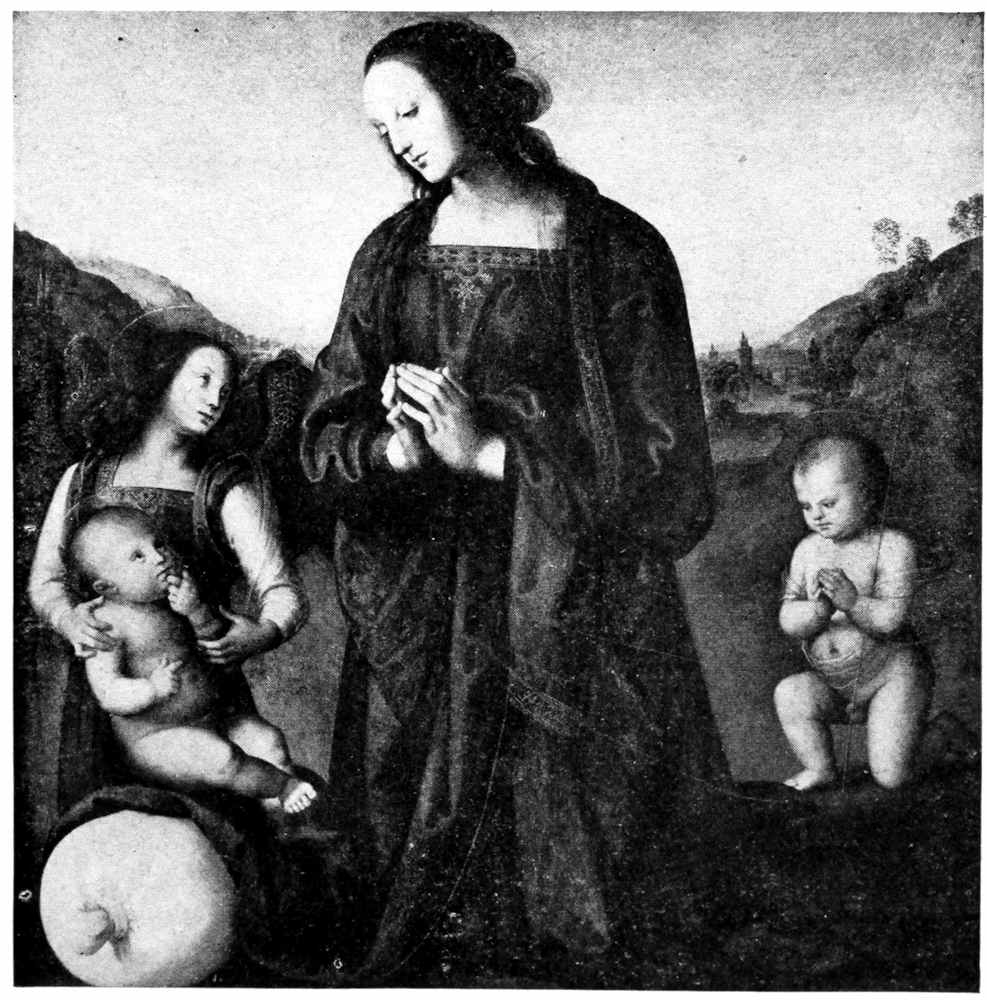
Photo. Alinari
THE ADORATION OF THE CHILD.—PERUGINO
(Pitti Palace, Florence.)