XI.—ST. JOHN THE BAPTIST
Reading edition
St. John the Baptist. Ital. San Giovanni Battista. Fr. St. Jean Baptiste. Ger. Johann der Täufer. (June 24.) St. John shares with Christ and His mother the distinction of having his natural birthday kept by the Church.
The history of this saint is given in St. Luke, and with the artists his life has frequently been the subject of a series including the Angel Appearing to Zacharias, St. John Preaching, His Baptism of Christ, Reproval of Herod, Daughter of Herodias Asks for St. John’s Head, Beheading of St. John, Daughter of Herodias Carries St. John’s Head to her Mother, etc.
According to the legends, the Blessed Virgin remained with Elizabeth until the birth of John, and in the historical pictures Mary is seen with a glory around her head presenting the child to Zacharias. The Greek legends say that St. John’s death took place two years before that of Christ, and that he descended into Hades and brought unto the departed spirits the tidings of their approaching redemption, and remained there until released by the Saviour’s death.
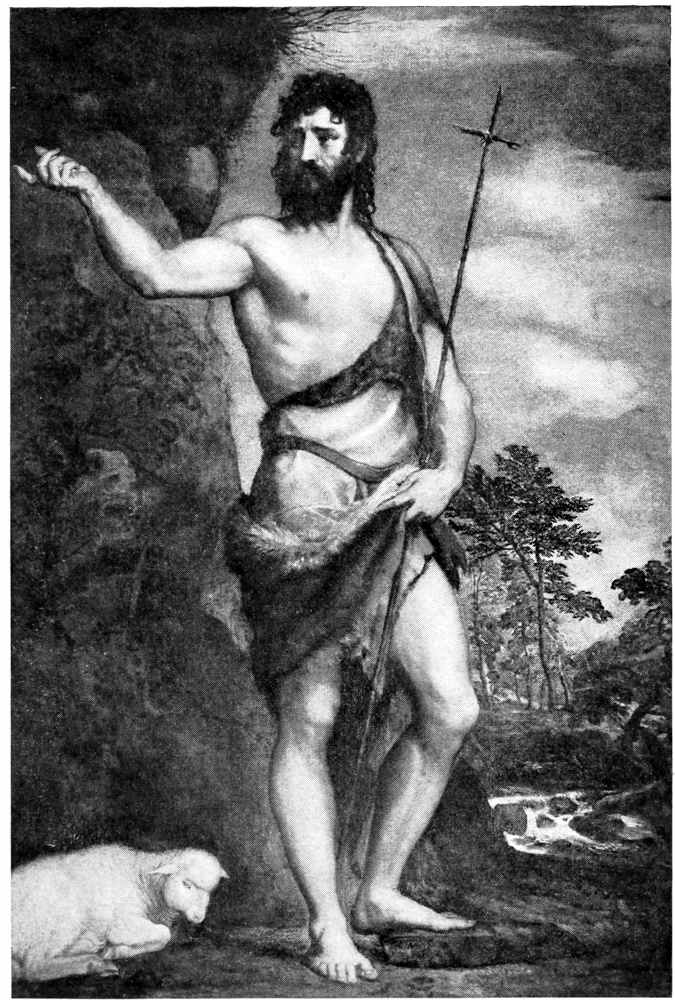
Photo. Alinari
JOHN THE BAPTIST IN THE DESERT.—TITIAN
(Academy, Venice.)
St. John forms a link between the Old Testament and the Gospel. In art he is usually represented as the Herald, the Forerunner of Christ, and as leaving his home while still very young to begin his life in the desert. In early art he is gaunt and wasted, with unshaven beard and hair, but often in later pictures he is smooth-faced, young, and beautiful, and wears a rich mantle over the garment of camel’s hair.
As Messenger, he wears “his raiment of camel’s hair, and a leathern girdle about his loins,” and bears a reed cross and scroll with the inscription Ecce Agnus Dei, or Vox clementis in deserto! The lamb is sometimes given, sometimes omitted.
He is introduced into pictures of the Holy Family as a witness to the divine nature of Christ and as such is represented at all ages from infancy to manhood. He is patron saint of all who are baptised and is usually represented in sculpture in baptisteries.