IX.—LEGENDS OF THE MADONNA
Reading edition
Anna, the mother of the Virgin, was early venerated as a saint in the East, but the parents of the Virgin were never represented in early art except in a series of the life of the Virgin. It was not until the beginning of the sixteenth century that the increased reverence for the Virgin Mary gave to her parents Joachim and Anna a more prominent position as patron saints, and from that time on they were frequent subjects in sacred groups.
A complete series of the history of the Blessed Virgin, as imaged forth by the early artists, always begins with the Legend of Joachim and Anna as it is related in the Apocryphal New Testament.
Joachim, a man of Nazareth, was of the royal race of David, and had for his wife Anna whose family were of Bethlehem. “Their lives were plain and right in the sight of the Lord and pious and faultless before men.” Thus they lived for twenty years without children. Now at a certain great feast of the Lord, when Joachim was about to offer his gifts, the high-priest opposed him saying, “It is not lawful seeing thou hast not begot issue in Israel.” Joachim, much concerned, found upon inquiry, that all the righteous except himself had raised up seed in Israel. He remembered Abraham, how that God in the end of his life had given him his son Isaac, and he would not be seen of his wife but retired into the wilderness where he fasted forty days and nights and vowed neither to eat nor drink until the Lord should look down upon him. And his wife Anna was sore distressed and mourned for her widowhood and her barrenness.
Then an angel of the Lord appeared to her saying, “Behold Joachim thy husband is coming with his shepherds; an angel of the Lord hath also told him that his prayer is heard.” And Anna stood by the golden gate and saw Joachim coming with the shepherds, and she ran to him and hanging about his neck, said: “Now I know that the Lord hath greatly blessed me.” And they returned home together. And when her time was come, Anna brought forth a daughter, and she said: “The Lord hath this day magnified my soul,” and she called the child Mary.
The Nativity of the Blessed Virgin. Ital. La Nascità della B. Vergine. Fr. La Naissance de la S. Vierge. Ger. Die Geburt Mariä. (Sept. 8.)
This is the next historical picture, and as Joachim and Anna were “exceedingly rich,” the scene is usually a chamber richly decorated. A glory sometimes surrounds the head of the child. Neighbours and friends are sometimes introduced who have come to tender their congratulations.
The Presentation of the Virgin. Ital. La Presentazione ove nostra Signora piccioletta sale i gradi del Tempio. Ger. Joachim und Anna weihen ihre Tochter Maria im Tempel; Die Vorstellung der Jungfrau im Tempel. (Nov. 21.)
“And when the child was three years old, Joachim said: ‘Let us invite the daughters of the Hebrews, who are undefiled, and let them take each a lamp, and let them be lighted, that the child may not turn back again, and her mind be set against the temple of the Lord.’
“And they did thus till they ascended into the temple of the Lord. And the high-priest received her, and blessed her, and said, ‘Mary, the Lord God hath magnified thy name to all generations, and to the very end of time by thee will the Lord shew His redemption to the children of Israel.’”
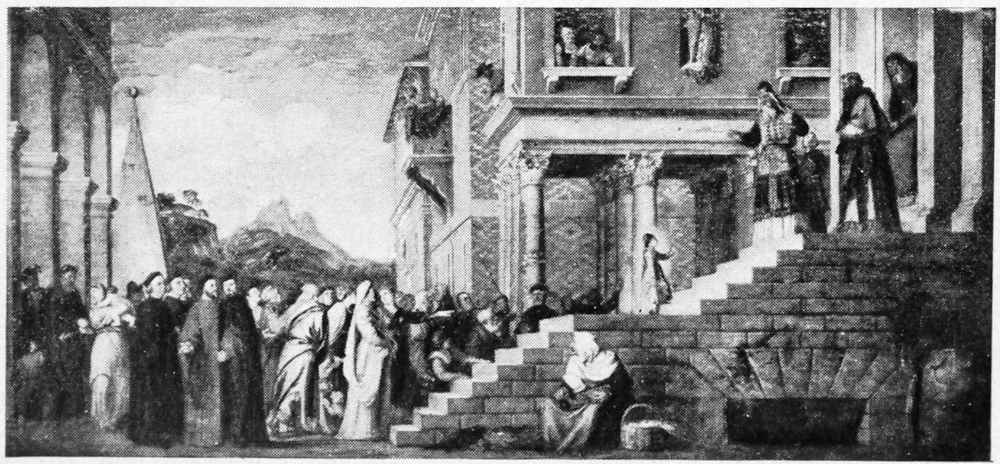
Photo. Alinari
THE PRESENTATION OF THE VIRGIN IN THE TEMPLE.—TITIAN
(Academy, Venice.)
“And he placed her upon the third step of the altar, and the Lord gave unto her grace, and she danced with her feet, and all the house of Israel loved her.” (Protevangelion, vii., 3-5.)
The theme does not vary. Mary, who should be portrayed as an infant of three years, is often represented as a child of ten or twelve. Sometimes she wears a blue, but more generally a white garment; her hair is long and golden, and she is seen ascending the steps which lead to the porch of the temple. These steps are always fifteen in number. In the account given in the Gospel of the Birth of Mary it says, “And there were about the temple, according to the fifteen Psalms of degrees [those Psalms are, from the 120th to the 134th, including both], fifteen stairs to ascend. For the temple being built in a mountain, the altar of burnt-offering, which was without, could not be come near but by stairs.” (Chap. iv., 32.)
The life of Mary in the temple is represented in various ways. She is seen instructing her companions, sometimes spinning or embroidering on tapestry. Often she is attended by angels, and it was believed that angels supplied her with celestial food. It has also been asserted that she had the privilege which was granted to no other woman, of going into the Holy of Holies to pray before the Ark of the Covenant.
The Marriage of the Virgin. Ital. Il sposalizio. Fr. Le Mariage de la Vierge. Ger. Die Trauung Mariä. (January 23.)
The legend of the Marriage of Joseph and Mary is founded upon the account given in the Protevangelion, which relates that “when Mary was twelve years of age the priests met in council to know what should be done with her, and the high-priest Zacharias entered into the Holy of Holies, and taking away with him the breastplate of judgment made prayers concerning her. And behold the angel of the Lord came to him and commanded him to go forth and call together all the widowers among the people, and let every one of them bring his rod, and he by whom the Lord should shew a sign should be the husband of Mary. And the criers went out through all Judæa, and the trumpet of the Lord sounded, and all the people ran and met together. Joseph also, throwing away his hatchet, went out to meet them; and when they were met they went to the high-priest taking every man his rod. The high-priest received their rods and went into the temple to pray. When he came forth and distributed them, there was no miracle until the last rod was taken by Joseph, and behold a dove proceeded out of the rod and flew upon the head of Joseph. And the high-priest said to him, ‘Thou art the person chosen to take the Virgin of the Lord to keep her for him.’ But Joseph at first refused, saying, ‘I am an old man’; then, fearing the wrath of the high-priest and the displeasure of the Lord, he took her unto his house, and said unto her, ‘Behold, I have taken thee from the Temple of the Lord, and now I will leave thee in my house; I must go to mind my trade of building. The Lord be with thee!’”
The painters have used for their text an old legend which relates that the suitors for the hand of Mary, among whom was the son of the high-priest, deposited their wands overnight in the temple, and the next morning the rod of Joseph was found to have budded forth in flower. The disappointed suitors broke their wands in a frenzy of wrath, and one of them, whose name was Agabus (a youth of noble family), fled to Mount Carmel and became an anchorite.
Marriage among the Jews being a civil contract instead of a religious rite, nearly all the early painters represent the ceremony as taking place in the open air in a garden or landscape, or in front of the Temple. Mary, a beautiful maiden attended by a train of virgins, stands on the right, and Joseph is on the left; behind him are gathered the disappointed suitors. This is the traditional treatment from Giotto down to Raphael.
In ancient art Joseph has been sometimes represented as very old, and again as not more than thirty. But in the best pictures of the Italian and Spanish schools he is middle-aged, with brown hair and short, curly beard, his face expressing infinite mildness and kindliness. The crutch or stick became his conventional attribute from earlier times, when he was depicted as very old, leaning upon a crutch.
The Annunciation. Ital. L’Annunciazione. Fr. L’Annonciation, La Salutation Angélique. Ger. Die Verkündigung, Der englische Gruss. (March 25.)
From the thirteenth century onward, the Annunciation became the expression of a theological dogma, and formed part of every altar-piece, whatever its subject,—whether a Nativity or Coronation, or the Last Supper—appearing in the predella below or the spandrils of the arches above; and was frequently painted or carved on the doors of a triptychon or tabernacle.
It is related in the Protevangelion (chap. ix., 7) that “Mary went out to draw water and heard a voice saying unto her ‘Hail thou who art full of grace, the Lord is with thee; thou art blessed among women.’ And she looked round to the right and to the left to see whence that voice came, and then trembling went into her house, and laying down the water-pot, she took the purple and sat down in her seat to work it. And behold the angel of the Lord stood by her, and said, ‘Fear not, Mary, for thou hast found favour in the sight of God.’”
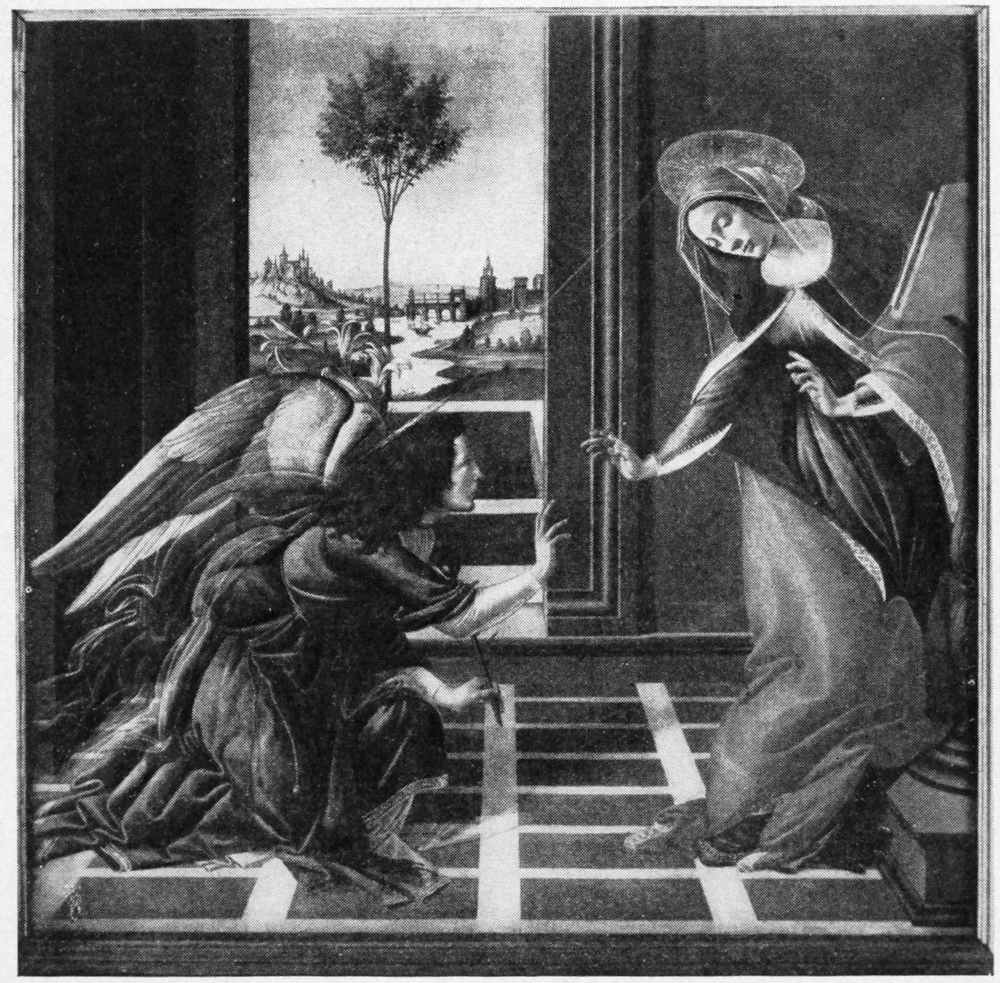
Photo. Alinari
THE ANNUNCIATION.—BOTTICELLI
(Uffizi, Florence.)
St. Bernard gives the following version of the legend. Mary was studying the book of Isaiah and as she came to the verse, “Behold, a virgin shall conceive, and bear a son” she thought within herself, “How blessed the woman of whom these words are written! Would I might be but her handmaid to serve her, and allowed to kiss her feet!” And at that moment the angel appeared and revealed to her that the prophecy was fulfilled in herself.
In early art the annunciation is treated as a religious mystery. The scene is usually a porch or portico with arcades. The Virgin stands, or if she is seated, it is on a sort of raised throne; the angel stands before her at a little distance; sometimes she is within the portico and he is without. Gabriel is the commanding figure, while the Virgin’s attitude—she is usually represented shrinking back with drooping eyes and hands folded on her breast—is always expressive of the utmost submission and humility. Gabriel is usually represented clothed in white, with large many-coloured wings, his flowing hair bound by a jewelled tiara. He holds the sceptre in his left hand, while the right is extended in benediction as well as salutation, “Hail! thou that art highly favoured! Blessed art thou among women!”
Sometimes the two figures were not in the same picture, but were placed each side of the altar, that of the Virgin being usually placed to the right. In some of the old pictures the figure of the angel is seen flying down from heaven.
From the beginning of the fourteenth century the increased reverence paid to the Virgin demanded that she be represented as the superior being, the Regina angelorum, and the angel is depicted bowing before her or kneeling as to a queen.
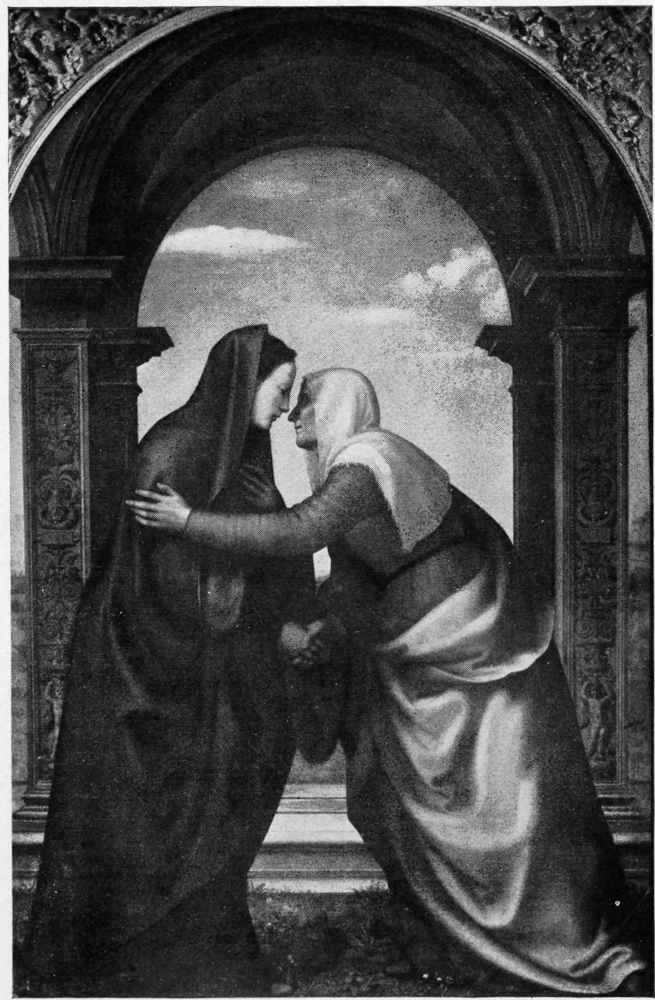
Photo. Alinari
THE VISITATION.—ALBERTINELLI
(Uffizi, Florence.)
When the annunciation is an event given in the series of the Life of the Virgin, the place is usually in the house. The fountain is rarely introduced. Gabriel either bears the lily or it is in some other part of the picture. Sometimes he has the olive, typical of peace, or a sceptre with a scroll inscribed Ave Maria! Gratia plena! The work basket, expressing the industry of Mary, is rarely omitted, and to typify her temperance a dish of fruit and a pitcher of water are frequently introduced.
The lily in the hand of the angel is not merely the emblem of purity but the symbol of the Virgin—“I am the rose of Sharon, and the lily of the valley.” A lily is often introduced in a vase near the Virgin or in the foreground of the picture. Sometimes the dove as the Holy Spirit hovers over the head of the Virgin or enters by the open window.
The Visitation. Ital. La Visitazione di Maria. Fr. La Visitation de la Vierge. Ger. Die Heimsuchung Mariä. (July 2.)
After the annunciation of the angel, we are told that “Mary arose and went up into the hill country with haste, to the house of her cousin Elizabeth, and saluted her.” This meeting of the two kinswomen is usually styled in art, the Visitation and, sometimes, the Salutation of Elizabeth. It is important in its religious significance as being the first recognition of the character of the Messiah. “Whence is this to me,” exclaims Elizabeth, “that the mother of my Lord should come to me?” (Luke i., 43.)
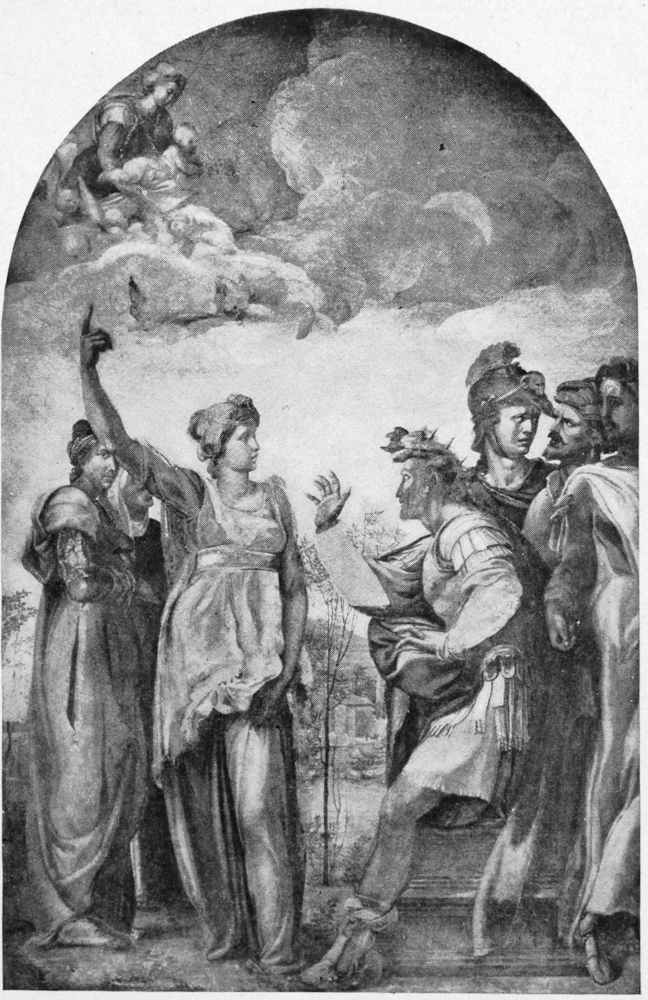
Photo. Alinari
SIBYL PROPHESYING TO AUGUSTUS CÆSAR THE COMING OF CHRIST.—B. PERUZZI
(Church of the Fontegiusta, Siena.)
In the representations of this scene the number of the figures, the locality and circumstance vary greatly. Sometimes only the two women are represented, without accessories of any kind. The scene is often a garden or open porch in front of a house, and this garden is noted in the traditions of the East. The legends relate that the Virgin, as she walked in the garden of Zacharias during her stay with her cousin Elizabeth, meditating deeply and reverently upon the holy destiny that was hers, happened to touch a certain flower that bloomed there with her most blessed hand—which, from being without odour before, became from that moment of a delicious fragrance.
The Nativity. Ital. Il Presepio, Il Nascimento del Nostro Signore. Fr. La Nativité. Ger. Die Geburt Christi. (Dec. 25.)
In the early Christian traditions this great event is preceded and accompanied by several circumstances which have often been rendered in art.
According to an old legend, the Emperor Augustus Cæsar betook himself to the sibyl Tiburtina, to ask whether he should accept the divine honours the Senate had decreed to him. The sibyl, after meditating some days, took the emperor aside and showed him an altar; and above the altar, in the opening heavens, he saw a beautiful Virgin holding an infant in her arms, and at the same time a voice was heard saying, “This is the altar of the Son of the living God.” Then Augustus caused an altar to be erected on the Capitoline Hill, with this inscription, “Ara primogeniti Dei”; and in later times the church called the Ara-Cœli, with its flight of one hundred and twenty-four marble steps, was built on this spot.
The sibylline prophecy is believed to have occurred a short time before the Nativity, about the time that there went forth from the Emperor Augustus a decree that all the Jews should be taxed who were of Bethlehem in Judæa.
It is related that Joseph therefore saddled his ass and took his wife to Bethlehem, the city from whence he came. As they were near there (within three miles), Joseph, turning about, saw that Mary was sorrowful, but when he looked again she smiled. And before they were come there Mary said: “Take me down, for I suffer.”
The Nativity, when treated historically, is represented in a stable or cavern, at midnight and in winter. The earlier pictures give Mary the appearance of suffering, but from the fourteenth century, this treatment was abandoned. “To her alone,” said St. Bernard, “did not the punishment of Eve extend.”
The attendants and Mary are represented in the “posture and guise of worshippers,” kneeling or bending over the Child, or pointing to the manger in which he lies. The Virgin is bathed in the light which surrounds the Child like a glory. Joseph is sitting or stands leaning on his staff and often holds a taper or light to show that it is night.
The angels who sing the Gloria in excelsis are never omitted. At first these were three in number, but in later pictures the mystic three became a band of angels.
The ox and the ass are always introduced as accessories,—according to the prophecy: “The ox knoweth his owner, and the ass his master’s crib” (Is. i., 3). The ox typified the Jews and the ass the Gentiles. The Jews were likened unto the ox because they bore the yoke of the law, whereas the ass represented the Gentiles because it bore Christ willingly, when He rode into Jerusalem.
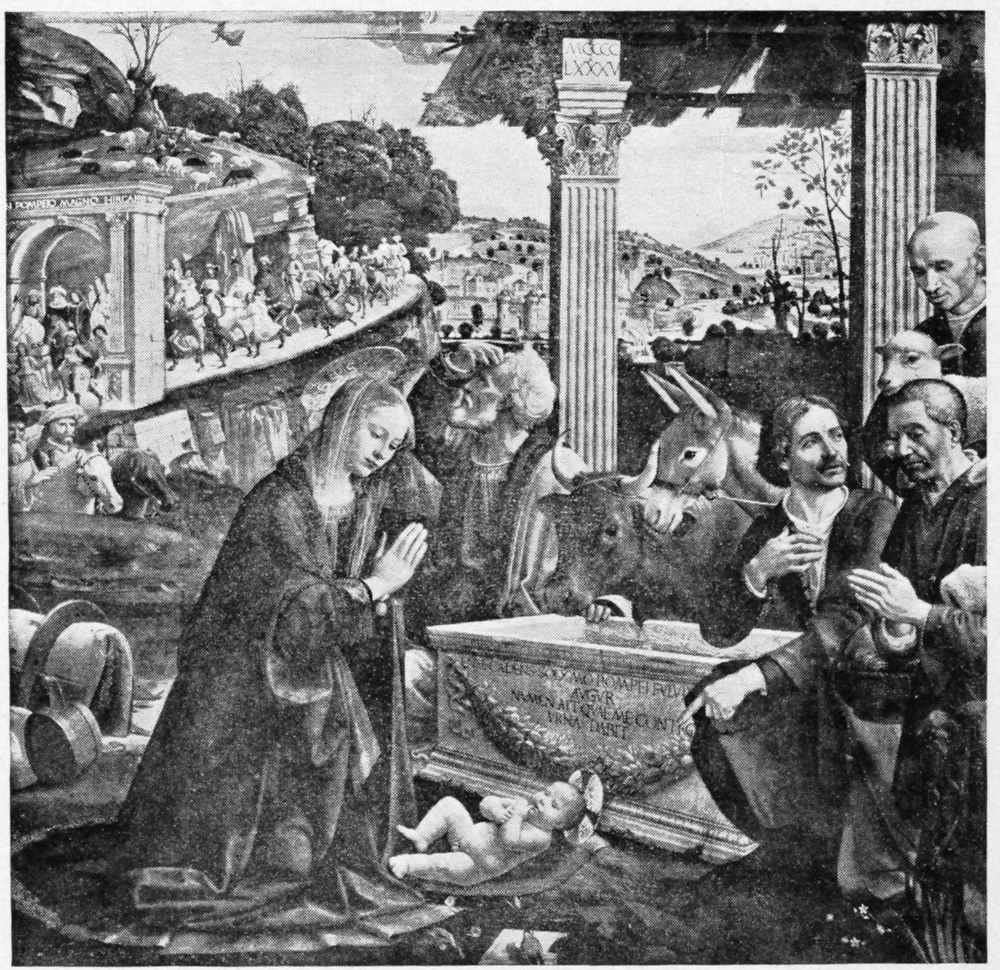
Photo. Alinari
THE ADORATION OF THE SHEPHERDS.—D. GHIRLANDAJO
(Academy, Florence.)
The shepherds are frequently in the background.
When other figures are introduced, they are saints or votaries for whom the picture was painted.
The Adoration of the Shepherds. Ital. L’Adorazione dei Pastori. Fr. L’Adoration des Bergers. Ger. Die Anbetung der Hirten.
“And it came to pass, as the angels were gone away from them into heaven, the shepherds said one to another, Let us now go even unto Bethlehem, and see this thing which has come to pass, which the Lord has made known unto us. And they came with haste, and found Mary, and Joseph, and the babe lying in a manger.” (St. Luke ii., 15-16.)
Being come, they tender their offerings of fruits, lambs, or doves, and with heads uncovered they acknowledge and worship the divine Child. In some pictures their women, sheep, and even their dogs accompany them. There is an old legend that Simon and Jude, afterwards apostles, were with the shepherds.
Sometimes the Infant sleeps and Joseph or Mary raises the veil from His face to show Him to the shepherds.
The flowers sometimes scattered by angels are supposed to have been gathered in heaven.
The Adoration of the Magi.[5] Ital. L’Adorazione de’ Magi, L’Epifania. Fr. L’Adoration des Rois Mages. Ger. Die Anbetung der Weisen aus dem Morgenland, Die heiligen drei Könige. (Jan. 6.)
This subject, the most extraordinary incident in the early life of our Saviour, has been set before us in every style and form of art, from the third century to the present time.
Magi, in the Persian tongue, signifies “wise men”; and they were in their own country kings or princes, from what country is not said. The prophecy of Balaam had been held in remembrance by their people. “I shall see him, but not now; I shall behold him, but not nigh; there shall come a star out of Jacob, and a sceptre shall rise out of Israel.”
When the Eastern sages beheld this wondrous and long-expected star, they rejoiced greatly; and taking leave of their relations and friends set forth on their long and perilous journey, the star going before them, until it stood over the place where the young Child was—He who was born King of Kings.
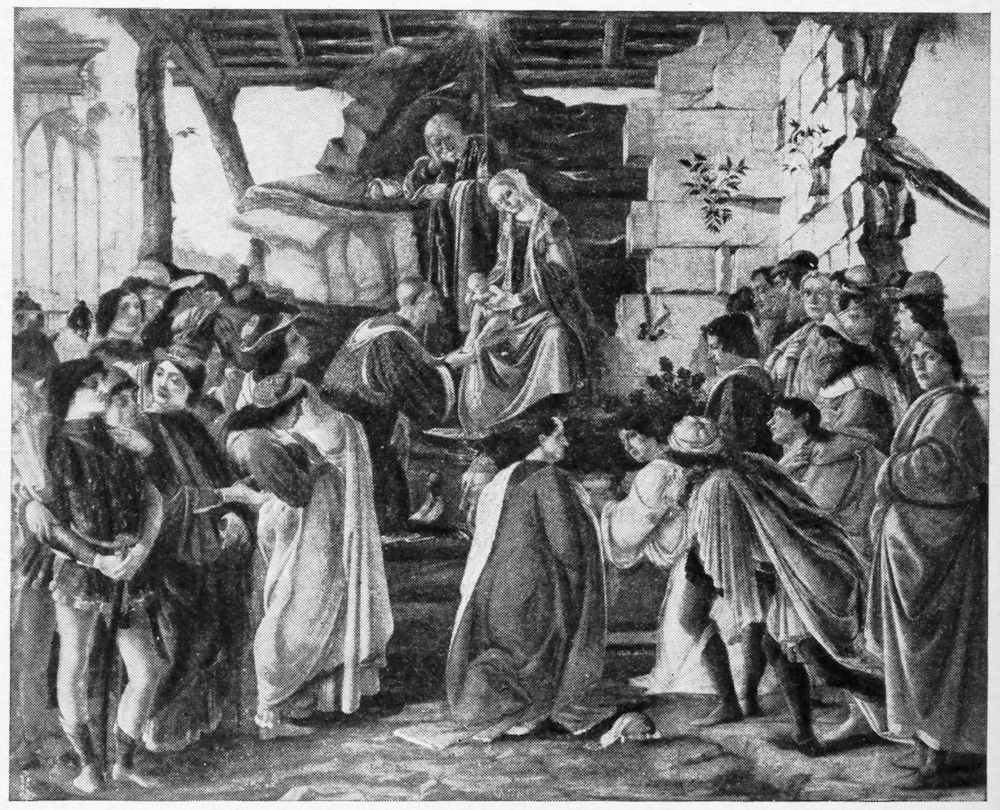
Photo. Alinari
THE ADORATION OF THE MAGI.—BOTTICELLI
(Uffizi, Florence.)
The artists made good use of the picturesque possibilities of the story, and in their hands it grew from a symbol to a scene of dramatic splendour. It is the oldest subject in Christian art, and taken in the early religious sense, it signified the calling of the Gentiles.
In the earlier representations the Virgin-mother is seated and holds the Child upright on her knee. The Wise Men, always three in number and all alike, approach in attitudes of adoration, and behind them are seen their camels’ heads, showing the land whence they came—the land of the East.
But in the fourteenth century legends the Three Wise Men or Kings became distinct characters, each with a name, and in the pictures they represent the three ages of man. Jasper or Caspar is very old, Melchior in the prime of life, and Balthazar young. Sometimes the latter or his servant is black, to indicate that Christ came to save all races of men. These pictures of the Magi reflect all the pomp and circumstance that was the custom of the times in which the artists lived, and the details vary with the nationality of the artist.
It is related that when they returned to the East they abandoned all their possessions and went about preaching the new gospel; that they were baptised by Thomas and put to death by the heathen. Their remains were discovered and removed to Constantinople by the Empress Helena, and after being carried to Milan during the first crusade were finally placed in the cathedral at Cologne by the Emperor Barbarossa, and repose there in a magnificent shrine. Wherever one sees the sign Drei Könige, or Trois Rois, in front of Continental hotels, or Three Kings above the doors of English inns, it refers to the Magi.
The Purification of the Virgin, the Presentation, and the Circumcision of Christ. Ital. La Purificazione della B. Vergine. Ger. Die Darbringung im Tempel, Die Beschneidung Christi.
The Virgin, after the birth of her Son, complied with all the requirements of the Mosaic law. The circumcision and the naming of Christ have often been painted to express the first of the sorrows of the Virgin. But the Presentation in the Temple has been selected with better taste for the same purpose, and the prophecy of Simeon, “Yea, a sword shall pierce through thy own soul also,” becomes the first of the Seven Sorrows.
It is related that, about 260 years before Christ, Ptolemy Philadelphus, desiring to have the Hebrew Scriptures translated into Greek for his famous library, asked the high-priest of the Jews to send him scribes and interpreters. In response to his demand, six of the most learned rabbis of the twelve tribes of Israel, seventy-two persons in all, were sent into Egypt, among them Simeon, a man full of learning. To him fell the book of Isaiah to translate. When he came to the verse, “Behold, a virgin shall conceive, and bear a son,” he doubted in his own mind how such a thing could be, and, fearing to give offence to the Greeks, he used the Greek word “a young woman” for the Hebrew word “virgin.” He had no sooner written it, however, than an angel leaned over the page and blotted it out, setting down the right word in its place. Completely dumfounded Simeon essayed again and again to substitute the word “young woman,” as seemed to him fitting and proper, and each time the angel effaced the word substituting the Greek word for “virgin” in its place.
Then it was disclosed to Simeon that the miracle that he had dared to doubt was not only possible, but that he “should not see death until he had seen the Lord’s Christ.” So for nearly three centuries he remained on earth, until all had come to pass. He was brought to the Temple on the very day that Mary came there to present her Son, and taking the Child in his arms, he exclaimed, “Lord, now lettest thou thy servant depart in peace, according to thy word.”
Anna, the prophetess, is often introduced. She also testifies unto Christ, but does not take Him in her arms as did Simeon, hence she was considered to typify the Synagogue, which prophesied the Messiah, but did not embrace Him when he came.
When represented in Greek art, this picture is often called the Nunc Dimittis.
The Flight into Egypt. Ital. La Fuga in Egitto. Fr. La Fuite de la Sainte Famille en Egypte. Ger. Die Flucht nach Aegypten.
There are many legends in connection with this journey that have been illustrated by the artists. One is that when it became known that the Holy Family had fled from Bethlehem, Herod sent his officers in pursuit of them. The Holy Family, knowing they were pursued, after travelling some distance, came to a field where a man was sowing wheat. And the Virgin said to the husbandman: “If any shall ask you whether we have passed this way, ye shall answer, ‘Such persons passed this way when I was sowing this wheat.’” And lo! in the space of a single night the seed had grown ready for the harvest! And next morning the officers of Herod came by, and inquired of the husbandman, saying, “Have you seen an old man with a woman and child travelling this way?” And the man, who was reaping his wheat in great wonder and joy, replied: “Yes.” And they asked him again, “How long is it since?” And he answered: “When I was sowing this wheat.” And at this the officers of Herod turned back.
Another very old tradition, taken from the First Gospel of Infancy (chap. viii.), relates that on their way they met two robbers who protected them from their confederates, and that they were the two thieves who were later crucified with Christ.
Another tradition is that both the ox and the ass went with the Holy Family into Egypt, and they are occasionally introduced in some pictures of this event, but generally the group is confined to Joseph, Mary, and the Child.
The Repose of the Holy Family. Ital. Il Riposo. Fr. Le Repos de la Sainte Famille. Ger. Die Ruhe in Aegypten.
This subject has been considered one of the most graceful and attractive in the whole range of sacred art.
The Riposo, so called is either the rest on the journey, or at the close of the journey, called the Flight into Egypt. Some of the features stamp the intention at once; as, the ass grazing in the distance; a wallet and pilgrim’s staff near Joseph; the date tree; the fallen idols; the Virgin taking water from a fountain—the fountain refers to a tradition that when the Holy Family came to Matarea they rested in a grove of sycamores, and here a fountain miraculously gushed forth for their refreshment.
In pictures of the Riposo angels often minister to the comfort of the Holy Family, and there is a legend that each night angels pitched a tent for their protection and shelter, and watched over and guarded them until morning.
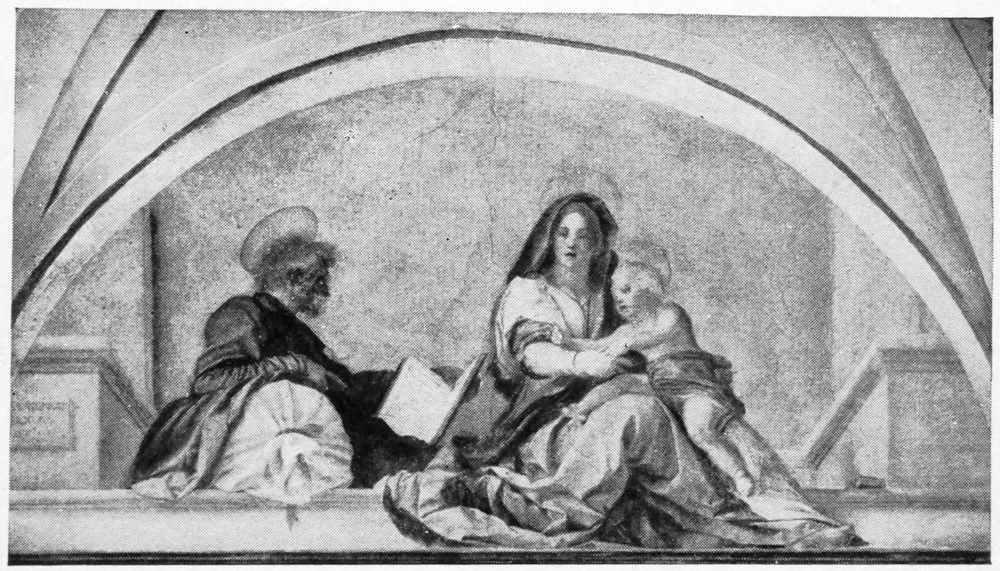
Photo. Alinari
REPOSE OF THE HOLY FAMILY—“MADONNA DEL SACCO”—ANDREA DEL SARTO
(Church of the Annunziata, Florence.)
When other figures than the Holy Family and attendant angels are introduced, it is not a Riposo, but merely a Holy Family.
When the Holy Family are seen as on a journey and the Saviour is represented as a child, walking, it is the return from Egypt that is pictured.
The Holy Family. Ital. La Sacra Famiglia, La Sacra Conversazione. Fr. La Sainte Famille.
After the return to Nazareth, until Jesus is twelve years old no event is recorded of the life of the Virgin or her Son. But under the title of Holy Family there are an endless variety of pictures representing the imaginary life of these exalted ones.
The simplest form is that of two figures, the Virgin and Child; frequently she is nursing the babe, sometimes she fondles him, pressing his cheek to hers, or they sport with a rose, an apple, or a bird, these mystic symbols being lightly used as mere playthings by the artists. Sometimes one or more attendant angels appear or the Infant slumbers on His mother’s knee. Sometimes Mary is represented watching over him, “pondering in her heart” the great destiny of her Child.
Where there are three figures, the third is generally St. John, although sometimes it is St. Joseph. Sometimes St. John and his mother, St. Elizabeth—the two mothers and the two sons—are represented. More rarely, four figures include St. Joseph and St. John. Five figures include all who have been named, and sometimes Zacharias makes the sixth.
Many of these pictures bear such names as La Vierge aux Cerises, La Vierge à la Diadème, La Vierge à l’Oreiller Verd, Le Ménage du Menuisier, Le Raboteur, etc.
The introduction of persons who could not have been contemporary, such as St. Francis or St. Catherine, makes the group ideal and devotional.
The Dispute in the Temple. Ital. La Disputa del Tempio. Fr. Jésus au milieu des Docteurs.
This subject is a scene of great importance in the life of the Redeemer, but it is quite as often made one of the series from the life of the Virgin.
The Death of Joseph. Ital. La Morte di San Giuseppe. Fr. La Mort de St. Joseph. Ger. Josefs Tod.
Some chronologers place the death of Joseph in the eighteenth year of the life of our Saviour, and others in his twenty-seventh year, when, as they assert, Joseph was one hundred and eleven years old.
Joseph’s popularity as a patron saint of power dates from the fifteenth century. A custom had come about of invoking him as mediator to obtain a blessed and peaceful end, and he became in a certain way the patron saint of death-beds.
Late in the sixteenth century the death of St. Joseph is represented as a separate subject in art, and became a popular subject in the churches and convents of Augustine canons and Carmelite friars whose patron saint he was, and also in family chapels consecrated to the memory of the dead.
The Marriage at Cana, in Galilee. Ital. La Nozze di Cana. Fr. Les Noces de Cana. Ger. Die Hochzeit zu Cana.
There is an old Greek tradition that the Marriage at Cana, which has often been represented in art, was that of John the Evangelist and Mary Magdalene, and that immediately after the wedding feast St. John and Mary separated and devoted themselves to an austere and chaste religious life, spent solely in the service of Christ.
In the Passion of our Lord, certain women who attended upon Christ during His ministry are represented as always near the Virgin, and sustaining her with their tenderness and sympathy. The Gospels mention three by name: Mary Magdalene; Mary, the wife of Cleophas; and Mary, the mother of James and John. Martha, the sister of Mary Magdalene, is also included. These women, with the Virgin, form the group of five female figures that is usually introduced in the scriptural scenes from the Life of Christ.
The Procession to Calvary (Ital. Il Portamento della Croce), and the Crucifixion are included in the Rosary as two of the mystical Sorrows. It was in the Via Dolorosa near the summit of the hill that the Virgin-mother and her women companions are said to have placed themselves, and where Mary in her anguish, seeing her divine Son, bleeding from the scourge, and sinking under His cross, fell fainting to the earth. This incident is called in French Notre Dame du Spasme, or du Pâmoison; in Italian La Madonna dello Spasimo, or Il Pianto di Maria and becomes one of the mournful festivals of Passion Week.
In the many celebrated representations of this scene, she is sometimes portrayed sinking to the earth, upheld by the women or St. John; sometimes she stands with clasped hands in dumb and motionless agony; sometimes she stretches out her arms to her Son who goes on His sorrowful way.
In the Crucifixion treated as a mystery Mary stands alone on the right of the Cross and St. John on the left. She looks up with an expression of mingled sorrow and faith or bows her head in sad submissiveness.
When the Crucifixion is treated as an historical event the Virgin is represented in a fainting attitude, sustained in the arms of the two Marys, assisted sometimes but not always by St. John; while Mary Magdalene is seen kneeling at the foot of the cross or with arms clasped around it.
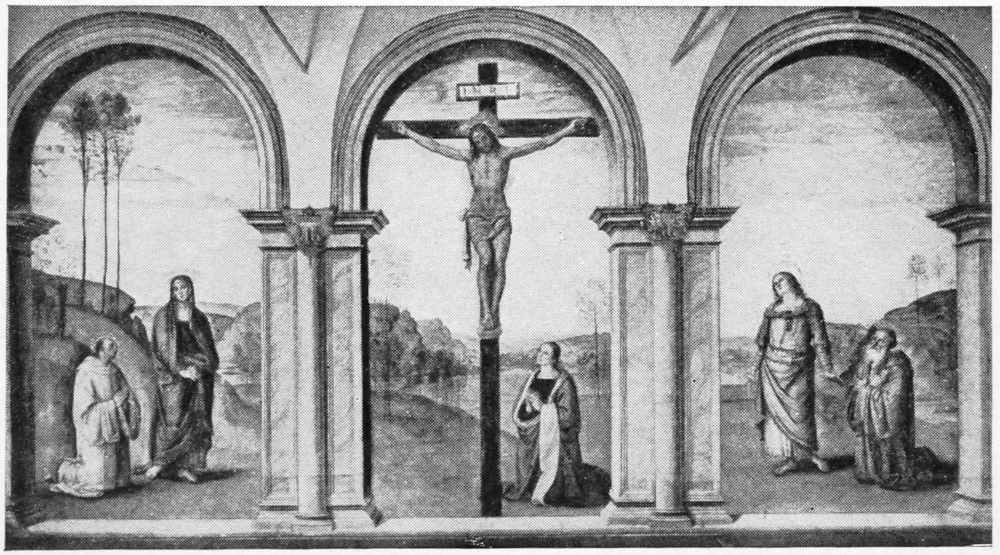
Photo. Alinari
THE CRUCIFIXION.—PERUGINO
(Convent of Santa Maria Maddalena dei Pazzi, Florence.)
The Descent from the Cross and the Deposition are two separate subjects in art. In the first the Virgin should stand. In the old legend it is said, that when Joseph of Arimathea and Nicodemus drew out the nails that fastened the hands of our Saviour to the cross, St. John concealed them from His mother. Then Nicodemus took out those which fastened His feet, and Joseph of Arimathea supported the body, and the head and arms of our Lord hung over his shoulder. The sorrowing mother took the bleeding hands in hers and kissed them tenderly, and then, borne down by the weight of her woe, she sank to the ground, mourning her Son.
The Deposition is that moment which succeeds the Descent from the Cross, when the dead form of Christ is deposed or laid upon the ground, resting on the lap of His mother, and lamented by St. John, Mary Magdalene, and others.
The Entombment follows and when treated historically the Virgin-mother is always introduced, although less conspicuously; either she faints, or stands by with streaming eyes and clasped hands, while the beloved Son is laid in the tomb. Then in fulfilment of the last command of his dying Master, John the Evangelist brought to his own house the Mother to whom he was in future to be as a son. This beautiful subject appears first in art in the seventeenth century.
The Apparition of Christ to His Mother. There is a very ancient tradition (mentioned by St. Ambrose in the fourth century, as being then generally accepted by Christians) that Christ, after His return from Hades, visited His mother before appearing to Mary Magdalene in the garden.
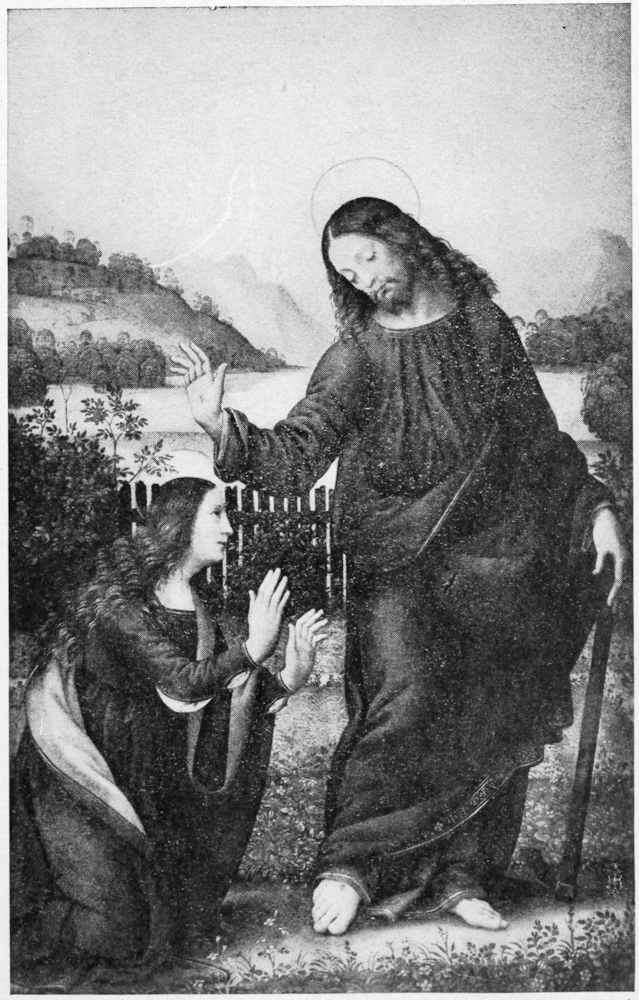
Photo. Alinari
THE SAVIOUR APPEARS TO MARY MAGDALENE—“NOLI ME TANGERE.”—LORENZO DI CREDI
(Uffizi, Florence.)
The story is thus related in Mrs. Jameson’s Legends of the Madonna: “Mary, when all was ‘finished,’ retired to her chamber, and remained alone with her grief—not wailing, not repining, not hopeless, but waiting for the fulfilment of the promise. Open before her lay the volume of the prophecies; and she prayed earnestly, and she said, ‘Thou didst promise, O my most dear Son! that thou wouldst rise again on the third day. Before yesterday was the day of darkness and bitterness, and, behold, this is the third day. Return then to me thy Mother: O my Son, tarry not, but come!’ And while thus she prayed, lo! a bright company of angels, who entered waving their palms and radiant with joy; and they surrounded her, kneeling and singing the triumphant Easter hymn, Regina Cœli lætare, Alleluia. And then came Christ, partly clothed in a white garment, having in His left hand the standard with the cross, as one just returned from the nether world, and victorious over the powers of sin and death. And with Him came the patriarchs and prophets, whose long-imprisoned spirits He had released from Hades. All these knelt before the Virgin, and saluted her, and blessed her, and thanked her, because through her had come their deliverance. But, for all this, the Mother was not comforted till she had heard the voice of her Son. Then He, raising His hand in benediction, spoke, and said, ‘I salute thee, O my Mother!’ and she, weeping tears of joy, responded, ‘Is it thou indeed, my most dear Son?’ and she fell upon His neck, and He embraced her tenderly, and showed her the wounds He had received for sinful men. Then He bid her be comforted and weep no more, for the pain of death had passed away, and the gates of hell had not prevailed against Him. And she thanked Him meekly on her knees, for that He had been pleased to bring redemption to man, and to make her the humble instrument of His great mercy. And they sat and talked together, until He took leave of her to return to the garden, and to show Himself to Mary Magdalene, who, next to His glorious Mother, had most need of consolation!”
This beautiful myth of the early ages has only been pictured as a matter-of-fact scene in art. The Virgin kneels; the Saviour, with His standard, stands before her; and generally Adam and Eve, the authors of the fall, or Abraham and David, the progenitors of Christ and the Virgin, are introduced, as the delivered patriarchs.
The Ascension, though one of the “Glorious Mysteries,” was also the seventh and last of the sorrows of the Virgin, who was then left alone on earth. All the old legends record her being present at this time and saying, as she followed with uplifted eyes the soaring figure of Christ, “My son, remember me when Thou comest to Thy kingdom! leave me not long after Thee, my Son!”
The Descent of the Holy Ghost is a strictly scriptural subject. It has been said that Mary, in her character of the divine Mother of Wisdom, did not need any accession of intellectual light, but that the Holy Spirit was sent to her as the Comforter.
When Mary is present she is usually placed either in front or in the centre on a raised seat and often holds a book (as the Mater Sapientiæ).
The Death and Assumption of the Virgin. Lat. Dormitio, Pausatio, Transitus, Assumptio, B. Virginis. Ital. L’Assunzione, Il sonno della Beata Vergine, Il transito di Maria. Fr. L’Assomption, La Mort de la Vierge. Ger. Das Absterben der Mariä, Mariä Himmelfahrt.
No subject has been more popular, nor more frequently represented in art than the Death and Assumption of the Virgin. The assumption was indeed the manifest expression of a dogma of faith—the glorification of the Virgin in the body as well as in the spirit, and as such it appears in all the edifices dedicated to her.
The two subjects are often combined. The death scene is portrayed below (Il transito di Maria), and the taking up into heaven of the body and soul of the Virgin Mary—the assumption—is given above.
It is related in the legend that when the time came for Mary to die, the apostles (who were scattered in various parts of the world) were all assembled by a miraculous power and brought to the door of Mary’s dwelling. When Mary saw them she blessed them and thanked the Lord, then kneeling down they prayed together, and after that she laid herself down in her bed prepared to die. About the third hour of the night a great sound smote on their ears, the chamber became filled with a heavenly fragrance, and Christ Himself appeared, followed by angels, patriarchs, and prophets, who surrounded the bed of the Virgin singing hymns of joy. And Jesus said to His mother, “Arise, my beloved, mine elect! come with me from Lebanon, mine espoused! receive the crown that is destined for thee!” And Mary replying, said: “My heart is ready; for it was written of me that I should do Thy will.” Then all the angels and blessed spirits who were with Jesus began to sing and rejoice. And the soul of Mary departed from her body and in the arms of her Son together they arose into heaven. The apostles gazing after her, said: “O most prudent Virgin, remember us when thou comest to thy glory,” and the angels who received her into heaven sang, “Who is this that cometh up from the wilderness leaning upon her Beloved? She is fairer than all the daughters of Jerusalem.”
There was but one absent among the apostles and when he came in haste soon after, he could not believe in the resurrection of the Virgin. It was this same Thomas who had doubted the resurrection of Christ. At his desire the tomb was opened before him and in it he saw lilies and roses. Then looking up in astonishment to heaven, he beheld the body of the Virgin, radiant in a glory of light ascending slowly towards the celestial regions.
It is related that in pity for his lack of faith she flung down to him her girdle—the same sacratissima cintola which is still preserved in the Cathedral of Prato.
The “angel of death,” usually supposed to be Gabriel, but more correctly Michael, sometimes offers her a taper—it being customary to place a taper in the hands of one who is dying.
The mystic Incoronata or Coronation, which represents the triumph of the Church, is distinguished by the presence not only of angels and patriarchs, but by fathers and doctors of the Church and martyrs and saints. It is a dramatic and historical event when it comes last in a series of the Life of the Virgin, where her death-bed or tomb is portrayed or the apostles and sorrowing women are introduced.