BOOK FIVE THE ROCK
Cedar Paul translation
On Judgment Day, before God’s throne, There stood at last, Napoleon. The Devil had his list begun Of crimes the Bonapartes had done, When God the Father, or God the Son, Cut Satan short before God’s throne: “Don’t bore us all to death with reading A German professorial pleading! If you’re bold enough to face him, In your kingdom you may place him.” —Goethe.
I
The sea spreads out into the vast distance. It is like a mirror of steel. The man on the rock, hands clasped behind, stares across the watery plain. He is lonely, so lonely.
One looking at him from a distance would see a fat man with short legs, a man of uncertain age. He is wearing a green coat, decorated with the star of the Legion of Honour; silk stockings; three-cornered hat in his hands. The head is large; the brownish hair makes a bush at the back; there is no sign of whitening. The short neck springs from powerful shoulders. The features are as if hewn out of stone, with a yellowish tint, like the marble of an ancient statue that has been darkened in the course of the ages; no wrinkles, but the classical profile is somewhat marred by the heaviness of the chin. The only beautiful features are the nose and the teeth. These last are perfect, and he has never lost a tooth. His hands, too, are beautiful. All through his campaigns he was scrupulous in his care for them; and, when correcting the letters and despatches he dictated, he generally used a pencil in order that he might avoid staining his fingers with ink.
The doctors have told us a good deal about his physical condition. “Pulse never more frequent than 62; bosom well padded, almost like a woman’s, and with very little hair; partes viriles exiguitates insignis sicut pueri.” He himself knows much about his body, he has studied his battle-field of his life in order that here, likewise, he may utilise his forces to the best advantage.
“I have never yet heard my own heart beating; it is almost as if I had none,” he says, half seriously. Moderation, he assures us, is the secret of his amazing faculty for work. “Nature has bestowed on me two valuable gifts: the capacity for sleeping whenever I want to; and the incapacity for committing excesses in drinking and eating.... However little a man may eat, he always eats too much. One can get ill from over-eating, but never from under-eating.” The alternation between campaigning and sedentary life enables him again and again to escape from the air of the study, and to fortify his constitution by long rides and drives. “Water, air, and cleanliness are my favourite medicines.”
With a body thus steeled, he can drive without stopping from Tilsit to Dresden, nearly five hundred miles, and be quite fresh at the journey’s end: can ride fifty miles from Vienna to Semmering, breakfast there, and be back at work in Schönbrunn the same evening; can gallop in five hours from Valladolid to Burgos, a distance of about eighty miles. After long rides and marches through Poland, he reaches Warsaw at midnight and receives the new authorities at seven next morning. These are the excesses he practises to restore the balance of his natural forces. After a long spell of sedentary life, he will start off on a ride of seven days, or will go out shooting for the whole day; after great exertions, he will keep his room for twenty-four hours. He believes that his energy has saved his life. He says to Metternich: “Sometimes death only comes from lack of energy. Yesterday, when I was thrown out of my carriage, I thought I was done for. But I had just time to say to myself that I would not die. Any one else in my place would have been killed.”
His muscles are powerful, but his nerves are sensitive. Accustomed to command, he cannot endure anything in the nature of compulsion. If his coat is at all tight, he tears it off; the same with shoes that pinch him in the slightest. On these occasions, he will box his servants’ ears. If he has to wear court dress, they watch out while they help him on with his coat. When his mind is busy (when is it not?) he will push away his breakfast, jump up from his chair, and stride about, talking, issuing orders. His handwriting is nothing more than a series of violent contractions of the hand which cannot keep up with the furious pace of his thoughts; a sort of involuntary shorthand, which in places has not been deciphered after a hundred years of study. He cannot endure the smell of paint or size; he always masks unpleasant odours by using eau-de-Cologne. If his nerves are utterly exhausted, he soothes them in a hot bath. When the war with England broke out, he worked continuously, with four secretaries, for three days and three nights, and then spent six hours in his bath dictating dispatches. This nervous irritability is the antithesis of his slow circulation. He thinks that, the constitution of his nerves being what it is, he would be in danger of going mad, “if it were not that my blood works so slowly.”
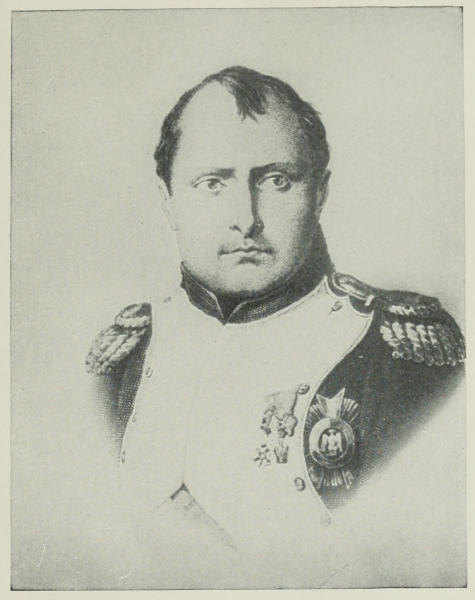
Napoleon as Emperor in 1815. Engraving by Robert Lefèvre, after a painting by Muneret.
But there is no evidence at all that his nervousness ever rose to the pitch of convulsions, that he suffered from epilepsy. This illness usually begins in childhood, and none of his schoolmates have reported that he had fits. Never was any one’s life more closely watched than Napoleon’s; and the documents upon which the assertion that he was an epileptic is based are scanty, confused, and untrustworthy.
As long as his body remained healthy, he was able to endure all the tensions and shocks to which he was exposed. It was when he was approaching forty that he began to show the first symptoms of a stomach trouble which was in those days summarily diagnosed as cancerous. Beyond questions, the tendency to it was inherited. During the last three years of warfare, he was put out of action in decisive hours by paroxysms of gastric spasm. His courage and resolution were practically unimpaired; had it not been for these attacks, the history of his decline would have been different.
II
The soul which governed this body was driven forward by three fundamental powers:
Self-confidence, energy, imagination.
“I am not as other men; the laws of morality and convention cannot be applied to me.” In these cold words, he emphasises the “I” with which he began his first political writing in the days of his youth. They are a plain acknowledgment of a fact, by a man of thirty to whom nothing is more alien than vanity. “I alone, because of my position, know what government is,” he said when he was Consul. “I am persuaded that no one save myself could govern France at this moment. Were I to die, it would be a great misfortune for the nation.” He utters such words seldom, and only when he is with an intimate; but these sayings show with what scientific aloofness he could contemplate the phenomenon, Napoleon. When, during the Russian disaster, he was asked who in spite of all would defend him in France, he replied: “My name.”
His contemporaries and posterity have held this fundamental feeling to be ambition. That view is mistaken. Common ambition distinguishes itself from Napoleon’s self-confidence as a restless, climbing animal does from a bird of prey whose free flight, by a law of nature, assumes wider and wider circles as it swings heavenwards. Napoleon’s aspiration is neither restless nor envious: it is nothing but his natural disposition which, as Consul, he once charmingly explained to his friend Roederer:
“I have no ambition whatever; or if I have, then it is so inborn, so intimately knit up with my very life, that it is as the blood in my veins. It does not incite me to outstrip my associates.... I have never had to fight for or against it; it does not urge me to greater speed than is natural to me, it comes out only when circumstances and my ideas demand.”
Already in the days when he was a general, ideas and circumstances forced upon him the conviction that he was the man predestined to rebuild France. It is nothing other than the conviction of his mission which makes him say to Roederer: “Circumstances have changed. I am now one of those who found States, not one of those who ruin States.” Another time, he speaks of Corneille, but he means himself when he says: “Whence did this man acquire his antique greatness? From himself, from his soul? Very well. Do you know what that is called, My Lord Cardinal? It is called genius. Genius is a flame, which comes from heaven, but seldom finds a head ready to receive it. Corneille is a man whom the world has recognised.” When his interlocutor observed that the poet had not seen the flame, so how could he recognise it, the Emperor answered scornfully: “Precisely for that reason I consider he is a great man!”
He thus, indirectly by anticipation, announces his own genius to the world, just as Goethe had announced his own.
The will-to-power, not as an endeavour or even as a question, but, rather, as simplicity, dwells within him close at hand. He calls interest the key to ordinary deeds; the will to govern the intellect, he describes as the strongest of all the passions: and the artistic urge of genius, he depicts in the following words: “I love power, yes, I love it, but after the manner of an artist: as a fiddler loves his fiddle in order to conjure from it tone, chords, harmonies.”
That is why it is his nature to command. “Wherever I may be, I command, or else I keep silence.” He might have added: “I negotiate,” for he had spent a quarter of his time in negotiating. Even as a young general of twenty-seven, he aroused the respect of all who came in contact with him. He never learned to obey; but to command came to him naturally at the very outset, just as a calf stands and walks in the first hour of its life. Because this power of commanding comes so naturally, he never acquires the art of asking; because he can command as no other, he is denied the gift of being able to ask favours.
His self-confidence confers on him a natural dignity that amazes and angers the legitimist world, which believes dignity to be consonant only with heredity and culture. The friends of his youth stand embarrassed when they recognise him as their commander in the field and yet realise the solitude which his position as leader entails. All his companions-in-arms speak of him with spontaneous homage. One of his intimates writes: “When he speaks, every one listens, for he speaks as an expert; if he is silent, his silence is respected; and no one would venture to say that he was silent because of ill humour. We all felt that between him and us there lived a great thought which was wholly occupying his mind and forbade familiar accost.” This statement is all the more surprising since it was made during a campaign, when tent life usually breaks down barriers. With absolute ingenuousness he once said, while playing and chatting with friends at Malmaison: “I have no sense of the ridiculous. Power is never ridiculous.”
An adept at analysis, the greatest psychologist of his epoch, he knows all about his own qualities, and is therefore able, by degrees, to elaborate these instincts into principles. “The goodness of a king,” he informs his brother Louis, King of Holland, “must always bear a regal stamp and must never be monkish.... The love which a king inspires should invariably be a manly love, wedded to reverence, fear, and esteem. If people speak of him as ‘a good man,’ his rule is a failure.” This love and fear which he himself inspires has the greatest practical results.
Nevertheless, the dignity which holds people at a distance is not assumed, for a leading element in it is a bewildering naturalness, which grows with the years and with his successes. His unsophisticated and frank realism, the sterling simplicity of his character, shows itself in a hundred gestures and words, and in the freshness with which he repeatedly makes fun of his own ardency. He expresses this in a profound saying: “A truly great man will rise superior to the events which he himself has brought about.” The greatest successes, whose fateful origin and consequences he fully grasps, he sums up to his intimates in a schoolboy’s laugh. Many have reported this, for between the boisterous gaiety of a soldier and the most delicate curl of the lip are many shades of good humour; he possesses all.
On the eve of his coronation he exclaims: “Is the result not truly delightful, to be named brother by the kings?” Or he sends his ambassador to St. Petersburg with the words: “Our brother in Russia is fond of luxury and festivity. Very well, then, give him his fill of them!” Sometimes his simplicity of manner infringes etiquette, and the legitimists blanch: “When I was an insignificant lieutenant,” he begins once at table with the kings in Dresden. General consternation! Every one gazes into his plate. Napoleon clears his throat: “When I had the honour of serving as lieutenant in the second artillery regiment at Valence....” Or he is sitting with the tsar in Tilsit, and, since he is ever eager to learn, he asks off-handedly across the table: “How much does your tax on sugar bring in yearly?” We are told that this question places all present in a state of grave embarrassment. Why? Because, as a big man of business, he calls money by its name; whereas the kings never mention it by name, though they are glad enough to reap the harvest!
Since he was not vain, he knew when he had made mistakes. His whole life long he was in the habit of saying that next day he might lose a battle; he frequently consulted his friends and his experts, and was inspired with the feeling of God-given necessity. How well Napoleon could bear to be told the truth, we can learn from Marmont—who, when he praises, is one of the most trustworthy of witnesses, for he wrote his memoirs long after the Emperor had publicly stigmatised him as a traitor. “Napoleon had a strong sense of justice, and would readily forgive an improper word or other sign of anger in one who had good grounds for complaint, provided of course he was alone with the offender.... He made kindly allowance for others’ weaknesses and could never resist the appeal of well-grounded sorrow. One who chose time and place, could say anything to him. He was always willing to listen to the truth. Though it did not invariably influence him, there was no danger in uttering it.”
He saw through the wiles of flatterers, and they gained nothing from him. Byzantine bombast, devoid of political value, infuriated him. “How could you depict the French eagle tearing the English leopard to pieces, at a time when I cannot safely send even a fishing-smack out to sea? Break up your moulds instantly, and never show me anything of the kind again!”
On the other hand, those who fearlessly speak the truth to him, impress him. He praises Chateaubriand, who has attacked him. In the days when he was Consul he was wont, after a sitting of the Council of State, to invite to dinner the man who had most vigorously opposed his wishes. In the Russian campaign, a captive general tells him some home truths about the burning of Moscow. Napoleon dismisses the prisoner in a rage; but presently has him recalled, and shakes the Russian’s hand, saying: “You are a brave man!” Méhul plays a trick on the Emperor, producing his new opera as the work of an Italian composer, and thus earning approbation. Paisiello also plays a trick by introducing into one of his own compositions an aria by Cimarosa, a composer whose work Bonaparte cannot endure. The Consul applauds; and when afterwards told of the deception, he only laughs.
Madame de Staël has been a worry to him for fifteen years, voicing Europe’s call for freedom. He suppresses her books, banishes her from Paris, continues to take measures against her even when he is in Russia, speaks of her as the dangerous driving-wheel which sets the salons in motion; but he pays this enemy the high compliment of dreading her, and acknowledges as much in many of his private letters.
In the Bavarian muster rolls, he comes across the name of a former regimental comrade, a declared royalist. He makes this man his military attaché. They have not met for fourteen years. Now, during the campaign, they meet, and the old companion introduces himself. The Emperor rides with him out of the press, dismounts, and sits down on a convenient stone; the other wishes to hold his horse. “Let be,” says Napoleon; “that’s not your business,” and beckons a chasseur to take the bridle-rein. The Emperor promptly becomes reminiscent: “Do you remember how, at the lieutenants’ mess in Besançon, you flung your table napkin down and shouted: ‘I will not sit beside an officer who belongs to the Jacobin Club!’ That is ancient history, and is of no consequence now.” He beckons his attendant staff and points to his interlocutor, saying: “Look at this fellow. Ability of the old school. He and I worked at equations together.” Then, coming down to practical matters: “Have you plenty of ammunition? What is your artillery like? How soon will you be ready?”
Unique, perhaps, in Napoleon’s life, is the scene at Erfurt in the year of 1813, when von Müller, the Weimar chancellor, braves his anger. Two privy councillors have written letters in cipher. These have been seized at the outposts. The writers have been arrested. Müller has been sent for. The Emperor has stormed at him, threatening to burn Jena, to shoot the culprits. Müller breaks in impetuously: “No, Sire, you will not commit this abomination! You will not tarnish your record for all time by shedding innocent blood!” In his excitement, the German presses so close that the Emperor anticipates a personal attack, and lays his hand on his sword-hilt. Müller is dragged back by a companion. A pause. “You are a bold man, but I see that you are a good friend. Berthier shall look into the matter once more.” The privy councillors are pardoned.
This scene, creditable to both participants, is another proof of Napoleon’s invulnerable dignity. It is invulnerable, unless the arrow is poisoned. A sense of honour is the vulnerable point of self-confidence. “If the French people expects certain advantages from me,” said Bonaparte when First Consul, “it must put up with my weaknesses, and the chief of these is that I cannot endure an affront.” It was he who said: “I am a man whom people may kill, but will not affront.” Bourrienne tells us that from Bonaparte’s earliest days he had no faith in law or morality, but always believed in honour. This compensated for his fundamental amoralism. The power exercised over him by his conception of honour distinguishes him absolutely from the condottieri of the Renaissance, with whom he ought never to have been compared. When he is Consul, betwixt night and morning he breaks off his intimacy with this very Bourrienne, who has been his private secretary for so long, because Bourrienne is involved in an unsavoury financial scandal. Years afterwards, he refuses to admit Bourrienne to the Legion of Honour, saying: “One who worships the golden calf may have money, but not honour.” When a bill signed by King Jerome goes to protest, Napoleon writes: “Sell your diamonds, your silver plate, your furniture, your horses—anything to pay your debts. Honour comes first!”
He was so sensitive on this point that after his coronation he summoned to his presence a notary who had long before advised Josephine against marrying a person of doubtful character; Napoleon wished to rehabilitate himself in this man’s mind. In exile at St. Helena, he remembered how his German teacher in Brienne had always treated him with contempt: “I should very much like to know whether Herr Bauer ever learned how I made good!”
He is a stickler for morality, just as he is for honour. “Nothing can be worse in a ruler than immorality. He makes it fashionable, and it poisons society.” Napoleon does not say this merely because he has been warned by the example of the Bourbons and the Directors. He has an inborn sense of decency, which is part of his dignity. No one has ever recorded having heard Napoleon, the soldier, tell an obscene story. Nor did he ever listen to one complacently. When he becomes First Consul, he forbids Josephine to have anything more to do with friends of hers who are leading gay lives. Years afterwards, when the empress allows Tallien to visit her, Napoleon writes to reprimand his wife, saying: “I can see no excuses for Tallien. I know that some poor devil has married her with her eight bastards, and I despise her even more than I did before. She was an amiable cocotte; now she is nothing more than a common woman.”
Talleyrand, who has had a liaison for many years, is told that he must marry his inamorata or quit Napoleon’s service within twenty-four hours. Berthier is made a prince, but the same condition is imposed on him, Napoleon saying: “This passion of yours has lasted too long, and is becoming ridiculous. You are a man of fifty, but may live to be eighty, and these thirty years are left you for marriage.” The revolution had encouraged nudity in mythological representations, but Napoleon wants nakedness to be draped. When, in one of the squares there is set up a fountain where there is a group of naiads with water spouting from their breasts, he has “these wet-nurses” removed as improper, and decrees that “the naiads were virgins.” His own women friends must not make themselves conspicuous. He lavishes money on them; but if they are actresses, he does not allow his liaison to be used as a reason for promotion. On the other hand, like any bourgeois he boasts of sharing his wife’s bedroom, saying: “It has a remarkable influence upon conjugal life, strengthens the man’s influence, guarantees his faithfulness, promotes intimacy and good morals; a couple will never become estranged if they spend the whole night together. As long as Josephine and I kept this custom, she was familiar with all my thoughts.”
One of the most sublime forms of his egotism is gratitude. This is not ordinary kindness, but the pride of a man who feels he is unique, and overwhelms with benefits any one who has ventured to be useful to him, lest he should possibly remain in the other’s debt. That was the consideration which really underlay his frequently declared policy, that he would never make use of any party, lest he should incur obligations. We must not look upon these things in a romantic light. But it is an actual fact that he was not content to promote only the friends of his youth, his fellow-students at the military academy. As soon as he rose to power, he found for the priest who had been headmaster at Brienne a sinecure at Malmaison as librarian—without any books! The sometime school porter became lodge keeper at his country house. A young lady of noble birth to whom, in his lieutenant days, he had once paid court for a whole evening, and who sixteen years later applied for help to the Emperor, received what she wanted, together with a post for her brother, and a friendly letter. He remembered many of his former associates in his will. Years after his brief intimacy with “Giorgina,” when he hears that she is in difficulties (though she has made no application to him), he provides her with a competency.
Hitherto we have been talking about money, or money’s worth. But the nature of his gratitude is different when he loves, as in the case of Josephine. When we consider his relationships with her, we realise the truth of Marmont’s tribute, which is all the more remarkable as coming from an enemy: “He had a grateful, kind, indeed affectionate, heart.” At the time of the coronation, he says to Roederer: “What right have I to put away a good wife merely because I have become a greater man than I was when we married?... Before all, I am a just man.” A little later, he writes to Josephine: “As far as I am concerned, I deem ingratitude the greatest weakness any one can have.”
III
Napoleon’s self-confidence, his self-esteem, his egotism, lies at the root of his wavering between revolution and legitimacy. Relying entirely upon himself, scorning all whose pride rests upon the accident of birth, he has nevertheless to take the egotism of others into account in so far as this egotism becomes embodied in achievement. And yet he is constitutionally incapable of suffering others to be on an equal footing with himself. For his own sake he has to choose the most capable to fill administrative and other positions, and yet he has to please the masses: he must stand for equality of all, and at the same time bear the individual in mind. These contradictions give rise to a tragical conflict.
Both the weapons he has chosen for his battle of life, namely, the spirit and the sword, he conceives of in a revolutionary sense. “Why is the French army the most dreaded in the world? Because the officers became émigrés; non-commissioned officers replaced them, and became generals. One can lead a people’s army with non-commissioned officers, for they have risen from the people.” For years, Napoleon refused to confer the grand cross of the Legion of Honour upon Metternich and Schwarzenberg. It was only after their gallant behaviour during the fire at Schwarzenberg’s mansion, that the Emperor relented, and conferred the decoration. The orders which his brother, the king of Holland, distributed with so lavish a hand, Napoleon would not allow to be worn in Paris. He sends his brother the following memorandum for kings:
“How can one give this indelible mark of appreciation to a man one does not know, to a person who may before long prove to be a rogue? Learn to know those who gather round your throne! The wish to distribute decorations should not be gratified suddenly, as one can gratify a desire to go out for a day’s shooting. Noteworthy achievements must come first.... You have as yet done nothing to deserve the honour of decorating others with your effigy....”
His egotism makes him emphasise the advantage of the lack of any ancestry to an original or unusual person. When flatterers suggest that one of his Italian forebears should be canonised, he calls the suggestion an idiocy. Metternich lays before Napoleon an ancestral tree manufactured in Vienna from records of the Buonaparte family in Tuscany. The Emperor says: “Take these papers away!” In the official gazette, Napoleon has the following notice inserted: “To all questions as to when the house of Bonaparte began, the answer is simple: on the Eighteenth Brumaire. How can one show so little tact and good breeding for all one owes the Emperor as to stress the question of his ancestry?” Once he is so angry because some one has contradicted him in this matter of his genealogy that he exclaims: “I shall not suffer any one to insult me by treating me as if I were a king!”
Then come transitions in which the cleavage begins to show itself. “I shall be the Brutus of the kings and the Cæsar of the republic:” which saying is certainly ambiguous. “I know of no aristocracy but the rabble which I have allowed to escape; and of no rabble but the aristocracy which I have created:” here there is hardly any ambiguity. “Tacitus is praised because he made the tyrants fear the people—and that was a very bad thing for the people:” which is open to but one interpretation.
No one, in the presence of such a man, can be satisfied with the facile assertion that Napoleon only pretended to believe in the principles of freedom until he attained to power, and then promptly betrayed them. On the contrary, we have here to do with a spiritual struggle. This is the one problem with which the self-confident man had to wrestle; a problem he never solved.
“I am the man of the people: its pulse beats in unison with my own.... The aristocracy remains always aloof, and never forgives.” Such utterances show us the original trend of his character. Inasmuch as he overcomes this trend, never becomes an ideologue, but gets the better of his inborn sympathies, he is a statesman of genius. Of course it is ridiculous when he, who only rewards merit, decorates his baby son’s cradle with the grand cordon of the Legion of Honour; or again, when he has the deposed king of Spain, who addressed him as “cousin,” informed through the intermediation of Talleyrand that the Emperor must be addressed as “Sire.” These weaknesses are grotesque, and yet they are superficial; he himself recognises them and spurns them if the mood is upon him. When he is hesitating whether he shall send Eugene, or perhaps better still Talleyrand (a man sprung from the old noblesse), to prepare the ground for the “imperial diet” at Erfurt, he suddenly, in virile fashion, ceases to bother about the question: “After all, what does it matter to me whether I am criticised? I will show them that I do not care.”
A more serious problem, both for him and for us, is when the origin and the laws of the right of succession to the throne come up for discussion. “It is false to call me a usurper; I have simply taken the unoccupied place which Louis could not keep for himself. Had I been Louis I should have hindered the revolution in spite of the amazing progress which has accrued to thought because of the change.... My strength is in my good luck; I am as new as the Empire.” Yet, in spite of this somewhat confused reasoning, he ventures a step farther, and writes to Brother Louis: “I hold myself responsible for everything that has happened since Clovis’ days down to the days of the Committee of Public Safety; and I shall consider everything that is deliberately said against the governments as an attack on myself.”
Thus we see that his egotism reaches so paradoxical an intensity in the championship of legitimacy, and that he sails so near the serious acceptance of rule by divine right (which is otherwise only used by him as a political formula), that he makes himself responsible for the actions of those very kings whose dethronement has opened the way to his rise!
All his life he restlessly hovered round this question of status. At Kaunitz Castle, during the night after Austerlitz, while at every minute Austrian and Russian colours, captive generals, and dispatches from the beaten commanders, are being brought to him, he thrusts everything aside because the courier from Paris has entered the room. Then he does the same with all the tidings from the capital, in order to read a letter full of gossip from a lady, who tells how the Fronde of the Faubourg has sworn never to put in an appearance at court. He is furious: “Ah! so these people fancy that they are stronger than I? Very well, gentlemen of the old aristocracy, we shall see! We shall see!” This is on the evening after the battle of Austerlitz!
Here we see such hatred as that which a man gradually comes to feel for a woman who stubbornly resists his wooing. He must win over the spirit of tradition, cost what it may. One evening, not very long before the scene just described, he takes Roederer from the drawing-room into the billiard-room, begins knocking the balls about, and then says, apropos of nothing in particular:
“Your Senate has no feelings for the aristocratic, no esprit de corps in favour of the imperial system.”
“Sire, it is devoted to your person.”
“That is not what I want. It must be devoted to my mantle, no matter who wears it. The mantle ought to be enough to guarantee the safety of the wearer. This is the aristocratic spirit, which is lacking to you ideologues!”
The whole problem of hereditary succession is implicit in these considerations; it logically develops therefrom, leading to the second marriage, and thus to the tragical issue. There are only two things which Napoleon cannot create unaided: children and ancestors. He therefore asks the world of legitimate rulers to enter into an alliance with him, which will settle his difficulty as far as offspring is concerned, and will also provide his children with an ancestry. He is not really a man of the people, but a nobleman; and who can complain because he regards himself as such?
“I am in a peculiar position. The genealogists want to trace my pedigree back to the deluge, while there are some who describe me as sprung from the lower middle class. Truth lies between. The Bonapartes are a good Corsican family, not celebrated, but certainly better than these coxcombs who believe themselves entitled to humiliate us.”
This is the tone of the sixteen-year-old lad, scion of the lesser territorial nobility, whom a handful of counts made fun of at the military academy and slighted at the boarding school in Paris. They are the very words which the young man had used in his letters and literary sketches when the noblesse of monarchical France had mortified him. Nothing can expunge the memory of his early mortifications. It may well be that, but for these never-to-be-forgotten affronts suffered at the hands of a few silly young marquises, his whole outlook upon the question of legitimacy would have been different; his court life, his marriage, his destiny, would have been different; and therewith the course of European history would have been other than it was.
His egotism finds expression in the struggle with France, just as it does in the struggle with the noblesse. He does not wholly belong to the high nobility, and therefore throughout life he remains critical of the pretensions of birth. In the same way, though formally he was a Frenchman, he was not French by blood, and he was therefore irritably critical of the French, just as he was irritably critical of the noblesse. He conquered both, but never felt perfectly secure in either of his conquests.
But he had more success with France than with the legitimists. Because he is not really a Frenchman, France never becomes his legitimate spouse; she remains his beloved mistress. He knows this; he wooes, gives himself, renounces; and from the perpetual uncertainty of his relationship to France, he derives the keenest joys of his life. “I have only one passion, only one mistress: France. I lie by her side. She has never been untrue to me; she pours out her blood for me, and lavishes her treasures upon me. If I need half a million men, she gives them!” When he chides his mistress, he does it as a jealous lover; he rules her “with an iron hand in a velvet glove”; he gratifies all her caprices; and he knows better than any one else how to allure her by the glamour of fame and fantasy. That is why she beams on him when he comes home victorious; that is why she gives him her children.
Yet lover and mistress remain critical of one another. Mutual jealousy persists. Neither of them ever forgets the wish to master the other. Hear his exclamation in the tone of a despotic lover: “I swear that I do everything for the sake of France alone! If I do not give her more liberty, it is because she does not need more!” He is standing in the middle of his drawing-room, scrutinising his guests sharply as he speaks to them with raised voice. Among intimates, he will often use harsher words: “Always the same old Gauls! The same frivolity, the same vanity! When, if ever, will these be replaced by a proper pride?”
The French, likewise, remain sceptical. Must they not, in confidential talks, say of this Italian the very thing that he once wrote to his brother Louis? “Since you ascended the throne, you have forgotten that you are a Frenchman, and have strained every nerve to persuade yourself that you are a Dutchman. The foreign environment tickles your fancy, but it is still foreign.” Roederer writes of Napoleon: “He is making a mistake. They are by no means so enthusiastic about him as they were about Lafayette (who did nothing practical for them). At bottom, they merely admire and respect him because he is useful to them.”
Such a liaison cannot fail to end tragically. The mistress discards her lover when he is no longer useful to her.
Tragical, too, is the ending of another embodiment of his egotism, its noblest incorporation. “I wish I could be my own posterity, and read what such a poet as Corneille would make me feel, do, and say.” From boyhood’s days down to the time of his exile, in the island where he was born and in the island where he died, his self-esteem is nourished on historical parallels. History, he said, was the only true philosophy. Had he not had his peculiar feeling for history, Napoleon’s career would have been very different; nay, it would have been impossible. His political calculations are fed from two sources, history and imagination; the first of these streams being intellectual, and the second passionate. It is history alone which gives him alighting places on his flight. In his own age he is unique; he travels alone; nowhere but in history can he find prototypes by whose example he can guide his impetuous progress. With Cæsar, the lieutenant begins to soar. At Rochefort, the Emperor ends the active phase of his existence by trusting too implicitly in the heroic example of Themistocles.
Between the opening and the close, we find numberless indications of the way in which his imagination remains at work, mirroring the great incidents of classical and modern history. Why is he opposed to Tacitus and Chateaubriand? Because they warn the people against tyrants. Why does he blame the assassins of Cæsar? Because he wishes to defend his own sentence upon the duke of Enghien. When he is First Consul, he actually thinks of writing a few chapters of Roman history, to prove “that Cæsar never wanted to become king, and that he was murdered because he wished to re-establish order by uniting all parties.” He goes on to add that Cæsar had been killed in the Senate House, and that in the Senate were forty Pompeians, personal enemies of the dictator. Napoleon’s unexpressed inference is that he must clean up the Senate, and he does so.
In the Roman style, he sketches the ideas for eight splendid bas-reliefs which, on triumphal arches, are to illustrate the doings of his reign; they are to be representations of fact, devoid of self-commendation, and only in a formal sense illustrations of historical egotism. He summons historiographers and imaginative writers from all civilised lands, and converses with them for hours, in order that, through their intermediation, he may win the approval of posterity. When his portrait seems to him too crudely lifelike, he says that Alexander never sat to Apelles; David must paint him “in a tranquil attitude, mounted upon a fiery steed.” It pleases him to write army orders when he is sitting in Frederick the Great’s study; at Sans Souci, to invite the biographer of the former master of the house to dine with him; in Lombardy, to visit the arch of Augustus, in Egypt, the pillar of Pompey, and on these monuments to inscribe the names of those who have recently fallen; in Madrid and Moscow, to study the environment and the habits of Philip and of Catherine. But his pleasure in these things is not purely æsthetic. The hours he devotes to them are heroical; they are Napoleon’s true recompense; they are realisations of his earliest dreams.
With his own hand, he is continually writing his own history. The young general records his first victories in orders of the day; with each new campaign, and after every battle, he adds to the long series; and the work is done with the hand of an artist, is wrought with an eye to immortal fame. When he is offered the crown of Italy, he surveys his own deeds of little more than five years ago as if they had come down in legend: “When, a few years later, we learned on the banks of the Nile that our aims had come to naught, we were bitterly distressed at this evil turn of fortune; but, thanks to the courage of our armies, we were able to appear in Milan at a time when Italy believed us to be still on the shores of the Red Sea.” Actually, in the interim, he had, before the eyes of all the world, trampled on the constitution of France, and even the meanest herd in the Apennines knew of his return from Egypt.
When he is carrying on a struggle with the pope he pens a long letter, and sends it to Eugene for the latter to copy, since ostensibly it is to be a letter from Eugene to the pope; therein Eugene is made to say that Napoleon can only be compared to Cyrus and Charlemagne.
At the height of his career, he says to his Austrian ambassador: “Don’t you make any mistake, I am a Roman emperor, in the best line of the Cæsars. Chateaubriand has compared me with Tiberius, who could only travel from Rome to Capri. A pretty idea! Trajan. Aurelian—that would be another story. They were self-made men, who shook the world out of old ruts. Do you not see the resemblances between my regime and that of Diocletian? The net so widely spread; the Emperor’s eyes everywhere; the civil authority omnipotent throughout an empire that is fundamentally warlike.... A man is born to be a Cæsar.”
This is not a proclamation, not a political letter, not an attempt to seduce any one. The words are spoken lightly, in a drawing-room, without emotion and without ulterior aim, with all the simplicity of a man aware of his own strength.
After victories and successes, this historical feeling for his own personality becomes as objective as the attitude of the chessplayer towards the pieces on his board. We seem to be contemplating a man whose fondness for the game is the only thing which makes him want to win; and who, as soon as he has won, can converse dispassionately with his defeated opponent about the mistakes they have made and the artifices to which they have had recourse. When he is talking to enemy generals whom he has taken prisoner or with whom he is negotiating, he will say: “You ought to have done this, that, or the other. There, you were in an advantageous position. That would have been an excellent move.”
Immediately after his victory at Wagram, he says to Count Bubna: “I am certain that you are damnably strong, for you can deliver shrewd blows. At what figure do you estimate my forces?... You appear to be uncommonly well informed! Would you care to have a look at my army?... No? Well, at least you had better study my position on this map. It was my own fault when I failed to win a victory at Aspern-Essling. I got the punishment I deserved.”
Only with regard to one matter does this detachment fail him—Waterloo. In St. Helena, an English surgeon ventured to say that people in England would be glad to hear his opinion of Wellington. The remark was followed by an embarrassing silence.
Fame is the supreme goal of his egotism; substantially, it is the only goal. All his energies are directed towards this end: his consciousness of his uniqueness; his historic sense; his sense of honour; his dignity; the boy’s dreams, the youth’s plans, the man’s deeds, the prisoner’s unrest. Posterity is the great confused picture which fills his imagination; and the desire of his heart would seem to be rather the Latin “gloria” which thinks of future generations, than the French “gloire” which suns itself in the smile of contemporaries. He is animated by a daimonic being’s eager wish for immortality, although he knows that he must share the fate of all mortal men. “Better never to have lived; than to exist, and pass without leaving a trace.”
He modifies the coronation oath by swearing, not only to protect the realm and the happiness of France, but also to rule for the glory of his people. On one of the battle-fields of Henry IV in Normandy he has a column erected with the inscription: “Great men love the fame of those who resemble themselves.” Frederick’s sword is “more precious than all the treasures of the king of Prussia”; but it is not only when he is campaigning that his thoughts turn towards the future. When he is having houses built for the unemployed, his order to the minister to whom the task is entrusted ends with the phrase: “We must not pass out of the world without leaving traces that will commend us to the thoughts of posterity.” At the close of his career as Emperor, he refuses to make peace on terms that will involve the renunciation of territories upon whose conquest part of his fame depends; and towards the end of his life he utters a melancholy parable, darkly significant, lonely as his own destiny:
“The love for glory is like the bridge which Satan tried to build across chaos in order to make his way into paradise. Glory is a connecting link between past and future, from which an abyss separates him. I leave to my son nothing but my name.”
IV
Energy is the second element in Napoleon’s make-up. How does this quality show itself?
First of all in calculation. Never a trace of the flash of genius; but, rather, continuous weighing, over-elaborating, discarding:
“I have known myself to argue with myself over the thoughts concerning a battle, and have contradicted myself.... When I have drawn-up a plan of battle I am the most pusillanimous of men. I magnify the dangers and the incidents, am in a terrible state of excitement even when I seem cheerful; I am then like a girl who is going to have a baby.” This is the mood of an artist during the conception of his work. He once described these feelings to Roederer in even franker terms:
“I am always at work; I think a great deal. If I appeared to be ever ready and equal to any occasion, it is because I have thought over matters for long before I undertake to do the slightest thing; I have foreseen all eventualities. There exists no guardian angel who suddenly and mysteriously whispers in my ear what I have to do or to say. Everything is turned over in my mind, again and again, always, whether I am at table or at the theatre. At night, I wake up in order to work.”
This constant deliberation builds up something within him which he names “the spirit of things:” the precision, which penetrates he touches; the thinking in numbers, to which he ascribes part of his success and for which he has to thank his mathematical training. There is nothing too small for this brain; for the sum total of millions of details is a plan whose scope is world embracing. If one of his officers writes to say that the Emperor’s instructions have been carried out, Napoleon waives this general statement aside and demands details. Nothing is so small but he wants to know all about it and judge its importance for himself. He writes to Eugene, who is in Italy:
“How is it possible that you are distributing three million seven hundred and forty-seven thousand rations of meat?... I can calculate a similar gross total for dried vegetables, wine, salt, and spirits. But I want calculations according to corps. I am robbed of fifty per cent., even as much as seventy per cent.... How can you allow them to calculate for one million three hundred and seventy-one thousand rations of hay? I should have to provide twelve thousand horses to eat it, not counting the Istrians and Dalmatians! You know I have only seven thousand.... The office charges are insane! Frs. 118,000 for four months! That equals frs. 400,000 a year! Such a sum should suffice for the whole of Italy!”
This is but one example among many. Thousands of such letters, hailing from every corner of the military and civil administration, personally dictated, are to be found in the volumes of correspondence, and must sadly disappoint those who expect to find only ideas and temperament in the letters. He is the man who, in the midst of his wars in Italy, writes home that they must concoct a letter, nominally written by a German patriot and dealing with Austrian politics, and have it circulated throughout Germany; again, in the throes of a campaign, he has to write to Murat, King of Naples, detailing how the latter is to behave at balls or when he visits the theatre, whom he is to invite and whom to exclude from his invitations. While the preparations are being made for the Erfurt gathering, he suddenly remembers that some one must be there to introduce the actresses to the gallant grand dukes. He never demonstrates more forcibly the way he formulates destinies in figures than by the following incursion into social life: “Each household should have six children, seeing that, on the average, three are sure to die. Of the three who survive, two should replace the father and mother; the third will serve for an unforeseen emergency.”
His precision of thought goes to such grotesque lengths!
A third means for expressing this energetic faculty is his tempo. “Activity! Speed!” he writes with his own hand at the foot of an order. The king of Prussia has depicted this peculiarity with especial felicity: “We need but see him ride: he always gives his horse rein, and never troubles about what may be happening in his rear!” But Napoleon negotiated better than he rode, for he never negotiated until after long reflection. “Not a moment must be lost,” is the slogan even when nothing presses for decision. The instinctive impetus of an overburdened but short life drives him forward; it seems as if he could not arrive quickly enough at the end of his career. He writes to Bernadotte, in the course of a campaign: “I have lost a whole day through you, and the fate of the world hangs upon one single day.”
The drive he imposes upon himself has its reaction upon those who serve him. He drives them, not only in the field, but also in circumstances which ordinary governments would take months to decide. He demands a treaty with Russia from Talleyrand, saying it is to be drawn up and ready in a couple of hours. To explain the reasons for his second marriage, he wants a circular letter sent to all his ambassadors and consuls; this is to be drafted “in the course of the day.” One night he is immersed in thoughts concerning the embellishment of Paris. Next morning he says to his Minister for Home Affairs: “I require that Paris shall have two million inhabitants by the end of ten years. I want to do something useful and great for the city. What do you suggest?”
“Provide the town with a good water-supply, Sire,” and the minister expounds a plan whereby the Ourcq water can be conveyed to Paris.
“Your proposal is good. Summon G.; he must send five hundred men to La Vilette to-morrow, in order to start work on the canal.”
Another of his weapons is memory. “I always know my position. I cannot remember a single Alexandrine, but I never forget a figure relating to my military situation.” This is the productive memory. Although he pronounces them abominably, he retains the names of all the important places—important from his point of view—in all the countries where he has fought. The Postmaster General reports that the Emperor is able to mention, offhand, distances which he himself has to hunt up in works of reference. On his way back to Paris from the camp at Boulogne, Napoleon encounters a troop of soldiers who have lost their way, asks the number of their regiment, whence they set out, and when. He tells them their line of march! “Your battalion will be at H. this evening.” At this time, two hundred thousand men were on the march close at hand!
His technique is to arrange things in his head “as in a wardrobe.” He says: “When I wish to put any matter out of my mind, I close its drawer and open the drawer belonging to another. The contents of the drawers never get mixed, and they never worry me or weary me. Do I want to sleep? I close all the drawers, and then I am asleep.”
Among the numerous heraldic emblems which might have tickled the fancy of an upstart—stars, tutelary deities, saints, beasts of prey—he finds none to please him. He chooses the bee, thus emphasising once more his opinion that a man of talent who aspires and works unceasingly, can achieve everything that can otherwise be achieved through what is vaguely spoken of as genius. He declares that genius is industry; meaning, of course, that genius is industry among other things. He says that work is his element, that for which he has been created. Had he left nothing behind him, had all his works perished, still his industry and his glory would have been an emblematic stimulus to the youth of countless generations after he had passed away.
Many witnesses testify to his amazing powers of continued work. Roederer, who was his close companion during the Consulate, writes as follows: “That which especially characterises him is the power and persistence of his attention. He can work for eighteen hours at a stretch, it may be at one piece of work, it may be at several in turn. I have never seen his mind flag. I have never seen his mind without a spring in it, not when he was physically tired, not when he was taking violent exercise, not even when he was angry. I have never seen him distracted from one affair by another, neglecting the matter in hand for one which he is about to work. Good or bad news from Egypt never interfered with his attention to the civil code, and the civil code never interfered with the steps it was necessary to take for the safety of Egypt. No one was ever more wholly immersed in what he was doing, nor did any one ever make a better distribution of his time among all the things he had to do. Never was any one more stubborn in rejecting the occupation or the thought which was not appropriate to the hour or the day; nor was any one ever more adroit in seizing an occupation or a thought when the right moment had come.”
He robbed hundreds of his fellow workers of health and youth, because he demanded too much of them when he demanded from them what he exacted from himself. His private secretary would be sent for at a late hour, and would get to bed at four in the morning; at seven, the poor man would find new tasks ready for him, and would be told that they must be finished within two hours. When Napoleon and his secretary were together all day, one dictating and the other writing from dictation, at meal times the chief would order food for two, and would share with his subordinate at a corner of the work-table, just as he would have shared with his adjutant on a boundary stone. During the Consulate he would sometimes begin a sitting with his ministers at six in the evening and keep it up till five next morning. In the three months at Schönbrunn, his official correspondence comprised four hundred and thirty-five letters occupying four hundred folio pages of print. This was only his political and administrative correspondence; in addition he wrote a great many private letters, and delivered innumerable orders by word of mouth.
These are the main forms of his energy. It is with their aid that he enters upon his duel with the world, availing himself of their interplay, and speaking of his genius as a talent for combination. In his plans and orders, he is fond of the phrase “at the given moment.” He is not hampered by any principle; is always willing to modify his scheme to suit the weather of destiny, to adapt his combinations to the slightest modifications of the situation. This man of iron will had a most supple intelligence. While forcing all those with whom he came in contact to bend before his resolves, he himself showed a wonderful elasticity in compliance with the will of circumstances.
“The weakness of a captain who, instead of forcing his way into port, preferred to let himself be chased on the open sea—this, and some of the trifling defects of our frigates, were the reasons why I failed to change the face of the world. Had Acre fallen, we should have made our way to Aleppo by forced marches, have enlisted Christians, Druses, and Armenians; have speedily reached the Euphrates: thence I should have gone to India, and should have stablished new institutions everywhere.”
Whether these vaticinations were historically tenable, may remain an open question; but his belief that he could have done what he describes, bears witness to his realism. In this world of figures and magnitudes, for Napoleon everything depends upon the individual behaviour of the individual man at his post. Since the failure of any one individual may give the totality of circumstances a new trend, he is always ready to adapt the trend of his own intelligence to changing circumstances. But he does not himself attribute his successes to this, saying that they were due to his having been born at the right moment, and that under Louis XIV. he would only have become a marshal like Turenne.
Napoleon’s energy is very little disturbed by the passions. His self-confidence and his sense of dignity made self-command easy to him, and, being habituated to surprise, he was always fully master of himself. “Since I am used to great events, they make no impression on me at the moment when they are reported; I feel the pain an hour later.” This sometimes makes him appear more stoical than he might wish people to believe him. When Hortense’s boy dies, he tells her to be composed, saying: “To live means to suffer; but the brave man is continually striving for self-mastery, and achieves it in the end.”
Nevertheless, he sometimes loses his temper. The fierceness of his passion is then proportional to his pride, the irritability of his nerves, and the impatience of his creative will—the will of one who needed a thousand hands to complete his work. The stories about his threatening an ambassador with his fist, and similar outbursts of violence, are fabulous; but there is trustworthy evidence as to the terrible moment when Berthier had infuriated the First Consul by his tactlessness. Led on by Talleyrand as Mephistopheles, Berthier, in the Tuileries, had urged upon the Consul the need of assuming the title of king. Bonaparte’s anger flashed from his eyes, his lips twitched, he seized the offender by the throat, and pushed him back against the wall, shouting: “Who put you up to raising my bile in this way? You will pay for it, if you dare to do anything of the kind again!”
Even amid his anger, his faculty for combination is at work, and he realises that the notion cannot have originated in the good Berthier’s mind. In its psychical significance the scene is unique.
Often he is a rough, irritable soldier, who furiously lifts a badly closing window off its hinges and hurls it into the street; lashes a groom with his whip; when dictating a letter, utters curses against the addressee, which his secretary suppresses; even before the vicars-general speaks in an unseemly way, asking, “Which of you leads this blockhead of a bishop by the nose?”
One of these vicars-general, who has been absent from duty for a long time, returns, and comes to report.
“Where have you been, misérable?”
“At home, with my people.”
“How dare you stay away so long when you know that your bishop is such a damned fool?”
More important are the occasions when he simulates anger to gain some political end. Occasionally he gives the show away afterwards. “You think I was in a rage?” he says in Warsaw. “You are making a mistake. While I have been here, my wrath has never exceeded bounds.” One day he is playing with his little nephew and gossiping with the court ladies, in the best of humours. The English ambassador is announced. Instantly his face changes like an actor’s, his features are convulsed, he turns pale, strides towards the Englishman and storms at him for a whole hour in the presence of numerous witnesses. He is genuinely angry with England and he is genuinely annoyed at being disturbed by this visit; but the wrathful mask, the scene he makes, the angry expressions he uses, are political expedients.
The frequency of such incidents made many people believe that Napoleon was a passionate man. Talleyrand has more insight: “He’s a perfect devil. He humbugs us all, even about his passions, for he knows how to act them, though they are really there!”
Self-command and coldness are so dominant in him that he never takes the vengeance that might seem appropriate to his irritable sense of honour and to the extent of his power. He never punished rivals or traitors unjustly. He only banished those whom he had good reason for wishing out of the way; and it was a point of chivalry with him to leave beaten enemies, great or small, unmolested.
Here is a scene with the Badenese envoy. The envoy asks compensation for the duke of Brunswick. The Emperor angrily refuses: not because the duke is supposed to have incited Prussia to make war against France; but because, long before this, during the first campaign against France in 1792, he had issued the famous manifesto of Coblenz, in which he had said that in Paris he would not leave one stone standing on another. “What harm had this city done to him?” fiercely enquires the Emperor two decades later, the man who in those days had been Lieutenant Bonaparte. “This affront must be avenged!”
V
Napoleon’s energy is most conspicuous in his role of conqueror. But in this case it finds a more spiritual expression than one would be led to anticipate from a soldier. “I have seldom drawn my sword; I won my battles with my eyes, not with my weapons.” To gain a knowledge of his soul, it is not important to understand the new forms of his art of war; of importance is to understand the way in which his whole being vibrated before, during, and after a fight. In this, too, he is wholly original.
Even courage, that fundamental virtue of the soldier, assumes in Napoleon a form peculiar to himself. During his youthful days, and again during the last campaigns he displayed so much personal courage that he can venture to say, “no soldier is proof against cowardice”; but such moments of panic fear must be utilised against the foe. What he believes himself almost alone to possess is “two-o’clock-in-the-morning courage”: courage in face of the unforeseen, the sudden; courage which demands presence of mind and power of determination. But he despises the “chivalrous” courage of the duel, which he crushingly describes as “cannibal courage.”—“Since you have both fought at Marengo and Austerlitz you do not need to give any further proofs of your courage. Women are fickle, and so is good luck. Go back to your regiments and become comrades again.”
The commander of armies clearly recognises the line of demarcation between humaneness and coldness. The same man who, in his study, could exclaim to Metternich: “Such a man as I does not care a snap of the fingers for the lives of a million men”; will say on the field of battle: “If the kings of the world could contemplate such a sight as this, they would hanker less after wars and conquests.” Another time he writes to Josephine: “The earth is strewn with dead and bleeding men; this is the obverse of war; the heart is tortured at the sight of so many victims.” Calculation and feeling are at cross purposes in this case, and he excuses himself for the duties imposed by his own craft: “He who cannot look upon a battle-ground dry-eyed, allows many men to be killed purposelessly.” This is what he wants above all to avoid. For the great aim, Europe entrusts him with a million men: his lesser aim, the taking of this trench or that bridge, must be thriftily achieved, for “he who heedlessly allows ten men to be killed where at most two need have died, is answerable for the lives of eight men.”
Since most of his wars are fought from political necessity, and are always conducted without hate, as soon as the fight is finished the foe ceases to exist. He writes from Schönbrunn: “I am appalled to learn that the eighteen thousand prisoners on the island of Lobau are suffering from hunger; this is inhuman and unpardonable. Have twenty thousand rations of bread sent there immediately; a similar amount of flour for the bake-houses.” But when, after the truce, soldiers are still being killed by the embittered Tyrolese, he is furious, and orders that “at least six of the larger villages are to be plundered and burned, so that the mountain folk may not soon forget the vengeance that has been exacted.”
War is for him an art, “the most noteworthy art, one which contains within itself all the other arts.” Like a true artist, he declares that, in the long run, this art cannot be taught: “You fancy that because you have read Jomini you are fitted to be a leader in war?... I have fought in sixty fights, and I can assure you that I have learned nothing from any of them. Cæsar used the same tactics in his last battle as he had used in his first.” In typical artist fashion, he contradicts himself in the definitions of those things in which he is a master. After the Spanish campaigns, he delivers the following lecture to one of his generals: “War is decided far more by the power of strategical calculation than by material forces.” At another time he will maintain that it is the superior numbers or the moral courage of the troops which constitutes the deciding factor. Sometimes he even goes so far as to say that inspiration decides an issue: “The result of a battle hangs on a thread and is mostly the outcome of a sudden thought. One approaches the enemy according to a prearranged plan, one comes to blows, one fights for a while, the critical moment draws near, a spark of inspiration flames up—and a small reserve division does the rest!”
More logically, but not less as the artist, he speaks of the decisive moment which, after a couple of engagements, one can find out for oneself without any difficulty. “Such moments are not more than quarter hours.... In every battle a moment comes when the bravest of soldiers would like to turn tail: it needs but a trifle, but a plea, to put heart into him again.” This power of suggestion has won him many a victory, for soldiers constitute the only mass to which he can speak with effect. The soldier understands him, because Napoleon is simple. The Emperor even describes war as “a simple art like everything that is beautiful.” By this contention he seems to uphold the idea that war is the highest of all arts. “The military profession is a freemasonry ... and I am the grand master of its lodge.”
He draws this personal influence from the history of his own rise, which is known to every soldier. As a young general, he had learned to put up with his dependence on the civil authority; and as emperor he still commiserates his royal adversaries because their generals’ activities are frustrated by civilian control. On the other hand, he knows the dangers of amateurishness, and writes to Joseph: “When the king himself commands, the soldier does not feel commanded. The army applauds him as when a queen is riding by. If one is not oneself a general, one must give the generals full power of command.”
Because he is the only ruler in Europe who has risen from the ranks, from youth upwards he remains familiar with details, and always understands how things look to an officer on the fighting front. “There is nothing connected with the art of war which I cannot do with my own hand: power, siege engines, artillery.” But he does not concern himself with these details unless it is necessary, and laughs at the romantic anecdote in a book where he is said, one night, to have taken over the duties of a sentry who had gone to sleep at his post: “That is a civilian’s idea, the sort of thing a lawyer would think of, and was certainly not written by a soldier.”
But he is a stickler for equality in the army, and in this matter remains true to the revolution until the very end of his career. No one is promoted unless his record in the service justifies the advancement. If Napoleon makes an exception in the case of his brothers, we must remember that after he has made them kings he continues to scold them as if they were subalterns. He writes to Jerome, commenting on a report from Silesia: “Besides, your letter is too clever for my taste.... What a man needs in war is precision, firmness, simplicity.” When Joseph plays the prince in Boulogne, and vies with Marshal Soult in the splendour of his receptions, Napoleon scolds him. “In the army, no one must put the commander in the shade. On review days, it is the general and not the prince who must give a dinner. At a review, a royal colonel is a colonel and nothing more. Discipline can tolerate no exceptions. The army is a whole. Its commander is everything. Keep to your own regiment.”
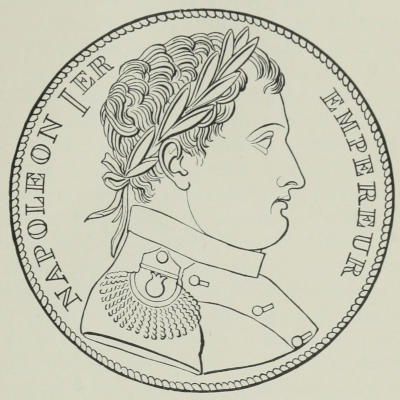
Napoleon as Emperor in 1815. Woodcut, after a medal.
Nevertheless, a wounded commander-in-chief has become a private soldier. At Eylau, where there have been heavy losses, the Emperor forbids a famous surgeon to go out of his way in order to care for a wounded general: “Your business is to attend to all the wounded, and not to any one in particular.” A German officer reports that after a fight Napoleon would often stand by the wounded and see that they were carefully lifted into the stretchers: “If this good fellow pulls through, there will be one victim the less.”
In all the memoirs, we read how in camp the Emperor would foregather with his men at the bivouac fire, ask whether their food was being properly cooked, and laugh at their replies. When they confided all their troubles to him, and often said “thou” to him, this was not the assumed good fellowship of a condescending monarch, but a genuinely paternal relationship. If he calls them “my children,” to them he is their “little corporal,” meaning the comrade who takes the responsibility. “I have received your letter, dear comrade,” he writes to a veteran grenadier who wishes to re-enter the service. “You need not speak to me of your deeds, for I know you to be the bravest grenadier in the army. It will be a pleasure to see you once more. The Minister for War will send you your orders.”
He never confides his plans to any one; but when it is a question of rewarding merit, he calls in Everyman as adviser. After a fight, he often forms a circle, speaks to the officers, the non-commissioned officers, and the rankers individually, asking who were the most valiant, rewarding then and there, allotting eagles with his own hand. “The officers pointed out, the soldiers confirmed, the Emperor approved,” relates Ségur as eyewitness.
It is true that Napoleon loves war, but as a fine art, just as he loves power. It is true that he laughs incredulously at a traveller who tells him a tale of a Chinese island where there are no weapons.
“What do you mean? But they must have weapons!”
“No, Sire.”
“Pikes, anyhow; or bows and arrows?”
“Neither the one nor the other.”
“Daggers!”
“Not even daggers.”
“But how the devil do they fight there?”
“There has never been a war on the island.”
“What, no war?”
It sounds to the traveller as if the very existence of such people under the sun outrages the Emperor. The thought stirs a soldier’s bile!
All the same, he looked forward to the coming of peaceful days, not with an ardent desire for them perhaps, but with the seer’s vision. He showed his superiority to all the modern commanders against whom he fought, in that he, the greatest soldier of the new times, declared the primacy of the spirit over the sword. When Canova made a statue of him in which he was shown with a threatening mien, he said contemptuously: “Does the man think I achieved my conquests with blows of my fist?” But, more than this, he himself defined a commander as something above and beyond a soldier. When First Consul, he said in the Council of State:
“In what does the commander’s superiority consist? ‘In his mental qualities: insight, calculation, decision, eloquence, knowledge of men.’ But all these qualities are what make a man shine in civil life.... If bodily vigour and courage sufficed the commander, any brave private could be a leader of armies. Everywhere, crude force now yields ground to moral qualities. The man with the bayonet bows before the man who possesses exceptional knowledge and understanding.... I knew perfectly well what I was about when, as the head of the army, I bore the title of Member of the Institute; and the youngest drummer understood what I meant.”
At a later date, he spoke more decisively.
“War is an anachronism. Some day, victories will be won without cannon and without bayonets.... Whoever troubles the peace of Europe, wants civil war.”
Remember that these are the words of Napoleon, the military commander.
VI
His energy is concentrated on human beings. Very rarely does he come into conflict with natural forces; and whenever he does so, he is beaten. But, in general, all he has to do is to compel men to conquer, for him, the mountains and the miles. Human beings are the material in working with which the energy and the imagination of this artist are destined to become weary; them he must overcome if he is to do his work at all. No mortal ever conquered more men than did Napoleon. He subjugated, not only armies and peoples, but something more: individuals, and the best of these.
To achieve his goal, he followed the road of contempt; and used as his means, glory and money. Self-confidence and experience had convinced him that every one acts only from self-interest; that some are driven to grasp at money through love of pleasure, or avarice, or clannishness; that others seek public recognition in order to gratify their vanity, their jealousy, or their ambition. Denying the force of ideal motives, Napoleon relied exclusively upon material means; and if the spur of ambition occasionally assumed the aspect of a desire for eternal glory, this occurred against his will, but the magic of his personality sometimes exercised a more puissant lure than the well-calculated material attractions offered by others. To quote Goethe: “Napoleon, who lived wholly for ideas, was nevertheless unable to grasp the nature of ideal motives; he repudiated the ideal, denied that there was any such thing, at the very time when he himself was eagerly trying to realise the ideal.”
Yet to Napoleon the Mephistophelian conception of men was as alien as it was to Goethe. He said: “Most people bear within themselves the seeds of good and of evil, of courage and of cowardice. Thus is human nature created: upbringing and circumstance do the rest.” Since, for twenty years, he needed this human nature, daily and in quantities of a hundred at a time, the subtlest knowledge of it was a primary condition of his success. Among all the materials which Napoleon bent to his uses, the human heart was the most familiar.
“I am a great friend of analysis.... ‘Why’ and ‘How,’ are such useful questions, that they cannot be uttered too often.” Coldly and clearly as a nerve specialist, he controls all psychical symptoms, utilises every method for the attainment of such control, and trusts especially to physiognomy—for he knows his Lavater. He is fond of reproving people. “According as they react, I discover the pitch of their souls. If I strike brass with a glove, it gives back no tone: but if I strike with a hammer, it rings out.” A person meeting Napoleon for the first time, is gripped by the magnetism of his glance.
By talking and questioning, he makes himself acquainted with the atlas of human types, an atlas he is ever enlarging. He questions so long that a stranger grows embarrassed, confused, and alarmed; he questions until his questions become ridiculous; but he must at all costs get the information he needs, even if he is not negotiating. In what way can the twenty minutes that a doctor sits at Napoleon’s table in St. Helena be put to the best use by the ex-Emperor?
“How many patients suffering from ailments affecting the liver had you on board? How many cases of dysentery? What is the fee for a consultation in England? What is the pension awarded to an army surgeon?... What is death, or how would you define it? When does the soul quit the body? When does a body first receive a soul?”
Another means is monologue. One of his intimates declares that the right of the Emperor to hold forth in monologue was the only real pleasure his high estate awarded him! We have testimonies concerning other men of action: but who ever talked so much as Napoleon! Since he always faces the world alone, he must continually hold forth that he may convey his suggestions to the world. His conversations often lasted from five to eight hours, some of them ten or eleven hours; and during the greater part of them Napoleon took the floor. We must admit that this was more in accordance with the Italian manner than the Roman; Italian, too, were the rapidity of his utterance, and his foreign accent: but he gesticulated little; and only when much moved did he unclasp his hands—generally they were clasped behind his back, as if he wished to throw out his chest against the world.
Upon all who serve him, he lavishes money with oriental profusion. But as far as his personal expenditure is concerned, he is thrifty. During the Consulate he says: “A man who has been through so many wars will have acquired a little property whether he will or no. I have a private income of from frs. 80,000 to frs. 100,000, with a house in town and a country mansion. What more do I need? If I should get out of humour with France, or France with me, I should retire from public life without a qualm.... But every one round me is stealing; the ministers are weak. Some people must be laying by vast sums.... What is to be done about it? France is corrupt through and through. It has always been like that; as soon as a man becomes a minister, he builds himself a palace.... Do you know what they are trying to make me pay for my installation in the Tuileries? Two millions!... It must be cut down to eight hundred thousand. I am surrounded by a pack of scoundrels.”
“Your great operations,” answers Roederer, “must cost you much more than these domestic defalcations.”
“All the more reason why I should watch over my personal expenditure.”
This conversation tells us how the head of the State, a man of thirty, regards money. He needs nothing for himself, and complains of the venality and profusion of those by whom he is surrounded; acknowledges that he has himself made money out of the wars; rails at the tradesmen who want to charge two millions for the equipment of a palace, when, as far as his own taste is concerned, he sees no reason for spending anything at all. Amid the frightful corruption which is a heritage of the revolution, he fights with the army contractors and war profiteers; but as soon as, by drastic punishments, he has succeeded in putting an end to this scandal, he assigns preposterous incomes to his marshals, some of whom receive more than a million francs a year. As Consul, he rids the State of the thieves who are making away with the national property; and then, as Emperor, he burdens this same State with extortionate salaries.
Still, there are a few persons who make money thanks to their relationship with him, though without his aid. “When I have nothing left,” he says to Talleyrand, “I shall turn to you. Tell me honestly, how much have you made out of me?”
“I am not a rich man, Sire, but all that I have is at your service.”
Napoleon’s way of dealing with men is modified by a hundred and one considerations. If we wish to study the variations of his technique, we must class his instruments in groups.
Generals and marshals are the easiest to keep dependent, for they have unceasing opportunities of winning military renown; and, since he pays them so liberally for their services, they grow more and more wealthy. By loading them with money, he gains two ends, spreading effulgence around himself, and keeping his most powerful officers in a state of dependence. It delights him to see these soldiers unused to money spending extravagantly, running into debt, and then turning to him for help in their difficulties. He leads them from profusion to want, and then back to profusion again. At the same time, he gives them little scope for originality, reserving important decisions for himself, so that even the commanders of armies rarely have a chance of proving themselves men of genius. He shrewdly regulates his public mention of them in his bulletins, both in respect of time and form, so that, through their vanity and jealousy, he can get his way with his generals.
The result is that their sentiments towards him are a mingling of hatred and love, whereby they are chained to his service more firmly than if the feeling had been one of pure affection. Perhaps only two of them are wholly devoted to him, Berthier and Duroc, whose love for him he compares with that of a child and a dog. Ney speaks of himself as a loaded musket which is fired when and where the Emperor orders. Napoleon, for his part, has a personal affection for those only who have risen with him, and in his memoirs he pays his tribute to them. He extols Desaix’s mental balance. Moreau has “more instinct than genius”; whereas Lannes has “more courage than sense,” though as time goes on he makes good in the latter respect. Kléber seeks glory only as a means of enjoyment. Masséna is not really courageous until he is under fire. Murat “has not a spark of intelligence, but what dash! He is a duffer and a hero.” Napoleon cannot break away from these witnesses of his rise, although almost all of them have learned the weight of his anger. In his tent, after Wagram, Napoleon thunders at Marmont for having made a mess of things, and a quarter of an hour later appoints him marshal.
Sometimes the Emperor’s misanthropy got the better of him. “In those moods, I begin to distrust even my companions-in-arms; that causes me intense suffering, and I do everything I can to rid myself of such horrible suspicions.” Yet he really knew. Lannes’ death touched him to the quick, but he never really uttered the moving farewell words which he publishes. Indeed, he confided to Metternich: “Lannes hated me. When I heard that, on being wounded, he had called out my name, I knew it was all up with him. He called on me as a dying atheist calls on God.”
The remembrance of friendships formed in youth does not prevent him from scolding the most exalted of his marshals like schoolboys when he considers they have behaved foolishly or have been wanting in courage. He says to Junot: “Your conduct was unprecedented, extraordinarily indiscreet.... You have a strange notion of your military duties. I don’t recognise you!” To a general in Lombardy: “Under your command, there has been very little honesty and a great deal of avarice; but I never knew until to-day that you were a coward. Leave the army, and never let me see your face again!” In Spain, one of his generals capitulated in the open field. Six months later, this man ventured to appear before Napoleon at a review. The Emperor stormed at him in full hearing of the troops; would not be appeased. The witnesses say that the scene lasted a whole hour. “A man may have to surrender a fortress. The fortune of war is uncertain, and defeat is always possible. Any one can be taken prisoner. The thing may happen to me to-morrow. But honour, before all! On the battle-field, a commander’s business is to fight: and if he capitulates instead, he deserves to be shot.... A soldier must know how to die. Have we not all to face death?... As a subject, you committed a crime in capitulating; as a general, a stupid blunder; as a soldier, your action was cowardly; but as a Frenchman, your surrender was dishonourable!”
He alarmed the diplomats of his day by a frankness which none of them trusted. “Tact, and putting all the cards on the table, will do better service in diplomacy than cunning. The tricks of the diplomats of the old school are out of date; all their rogueries have been exposed long since.... Nothing betrays weakness more than the attempt to deceive.”
Just before the renewal of the war with England, he tells the British envoy how many years it will take before France can face England at sea, but he explains how quickly he can increase his army to four hundred thousand. In Schönbrunn, he says to the Austrian negotiator: “That is my last word. If you defeat me, I shall propose more favourable terms; but if I gain the victory, I shall make them harder. What I want is peace.”
He studies every shade of expression when he wishes to influence the envoys of foreign powers. We see this especially when he is adapting his demeanour towards the Austrians with an eye to the Habsburg traditions. He waits for the formal reception on his birthday, and then, faced by the semicircle of the diplomats, he stops in front of Metternich to say: “Well, Monsieur l’Ambassadeur, what does your emperor want? Would he like me to come to Vienna?” This is calculated to intimidate the Austrian envoy, and at the same time to advertise Napoleon’s threatening attitude throughout Europe. But two days later, when Metternich comes to a private interview, the Emperor says: “To-day, we won’t play at being Emperor of the French and Austrian envoy. There is no audience now, so we need not make any fine speeches.”
Shortly before the conclusion of the first peace with Austria, he wishes to avoid meeting the defeated archduke in Schönbrunn, lest he should commit himself prematurely to peace terms. He therefore arranges that the meeting shall take place in a hunting lodge. “I shall spend only two hours there: one of them will be occupied in having dinner, and the other will be devoted to talk about the war and to mutual protestations of respect.” When the First Consul receives Count Cobenzl, he has personally arranged the stage in the Tuileries; writing-table in the corner; no chairs, so that they will have to sit on the sofa; only one lamp, no lights in the chandelier, although it is late in the evening. When Talleyrand ushers in the Austrian, the room seems almost dark, and the Consul, on the farther side of it, is scarcely visible; the stranger is perplexed, and has to sit exactly where his host chooses.
He is even more subtle in his dealings with the princes. During the years of his supreme power, he ceases to pay them visits. In Tilsit, he becomes the host within two days; in Dresden, though he is the king of Saxony’s guest, he plays the master. He avoids having anything to do with queens. When Queen Louise pathetically implores justice, he begs her to sit down. “Nothing interrupts a tragical scene more effectually than this. When people sit down, tragedy becomes comedy.”
In his dealings with the peoples he was less happy, and his only tolerable successes were secured with the French and the Italians. During the Consulate, he said in the Council of State: “My policy is to rule in accordance with the will of the majority. This, I think, implies the recognition of the sovereignty of the people. I became a good Catholic when I wanted to finish the war in Vendée; in Egypt, I was a Turk; when I wished to win over the Italians, I was an ultramontane. If I reigned over the Jews, I should rebuild Solomon’s temple. That is why I propose to talk about freedom in that part of San Domingo where the slaves have been liberated, while maintaining slavery in the other part of the island.”
His policy was not very successful in the negro republic; he did better in Poland, which he tried to win over by festivities and phrases; and better still with the Jews. These had been granted equal rights by the revolution, and on the Rhine many of them were doing harm by the practice of usury. Napoleon, who knew their value as traders, did not have recourse to crude prohibitions. He bethought himself of Jewish laws and customs; summoned to Paris their highest council, the Sanhedrin, which had not met for centuries; left the decision to this body, and was able to arrange that the supreme Jewish authority should forbid usury as sinful. But in Spain he made a complete mess of things, overlooking the risks he was running, and advising Joseph to make himself agreeable to the whole nation “by instilling fear into the rabble.”
The Germans puzzled Napoleon most of all. They had everything he lacked, and none of the things he had. He therefore, even in the midst of his successes, regarded them with a mixture of fear and admiration; they seemed to him uncanny. When he went to Erfurt and wished to influence the German princes by the drama, he told the managing director not to stage any comedies. “No one understands comedies on this bank of the Rhine. Corneille’s Cinna might be played, for therein great interests are portrayed; then a scene depicting royal clemency, which would certainly have a good effect.” He went on to misquote Cinna. Rémusat, having put him right, said: “In this sacred office, to which God’s grace has appointed the king, the past is justified, and the future is free. He who is advanced to this office, cannot be held culpable; whatever he does, he remains invulnerable.”
“Splendid!” exclaims the Emperor, “especially for the Germans, who always cling to the same ideas, and are still talking about the death of the duke of Enghien! We must broaden their moral outlook. That will be good for people with melancholy ideas, the sort of persons with whom Germany is filled.” It is as if he were talking about German music, of which he knows practically nothing; but really he is thinking of German philosophy. The one is as uncongenial to him as the other, for he is fond of Italian arias and the wisdom of Voltaire, but says that “Kant is an obscure writer.” This misconception of his prevents him from foreseeing the possibility that so slow-moving a people may one day become inspired with a passionate enthusiasm.
Perhaps the reason for the misinterpretation lies in the impracticability of understanding the masses of a foreign nation. In northern Italy, he did indeed make headway, for he was a young man, his ideas were naïve, the yearning of the oppressed was still fresh in him; and he was the herald of the revolution. But the dictator could no longer bring a torch to foreign peoples. Nevertheless, he continued to watch the sentiments of the masses. “A ruler should reign for the masses, without asking whether he is pleasing Mr. So-and-So.... Men of mark look from above, and have no party ties; one who belongs to a party, is a slave.” Such were his principles, but his actions told another story.
The masses, even in France, saw a man who made himself dreaded. They feared him for a decade, but became sceptical at his first failure. “A ruler should be dignified in his demeanour towards the people,” says Napoleon. “But he must not flatter the crowd, which will then think itself cheated if he does not give it everything. You ask me why I make threatening speeches? I make them in order to avoid having to do the things I threaten!”
But this severity is, in the long run, out of keeping both with his own simplicity of nature and with the instincts of the crowd. He could not seduce the masses by the offer of fame and money, so he showed them symbols: crowns and coronation ceremonies; courts and splendour and princes: but the people felt the growing distance between them and their ruler, and were not deceived.
When the people of Paris learned that the Emperor, in his theatre, would no longer allow King Henry to say, “I tremble,” but only, “I shudder,” because, though a king (being only a man) may tremble, he may not admit it—the crowd must either feel angry or become derisive. But the crowd did not hear the words in which the Emperor instructed Talma how to play Cæsar: