BOOK THREE THE RIVER
Cedar Paul translation
One who thoughtfully ponders the centuries, Surveys the whole in the clear light of the spirit; All that is petty has vanished from sight; Oceans and continents alone are of account. —Goethe.
I
About twenty men are seated round a large oval table. Some are quite young, some middle-aged, some elderly. They are plainly dressed, in accordance with the fashion of 1800, when wigs were no longer worn, and lace was out of date; those of them that are in uniform are not resplendent with gold braid, and they wear no orders. Some have the bold, self-confident look of the man of action; others, the thoughtful mien of the savant. From town and from countryside, from office and from laboratory, they come, but are unified by a common experience and a common aim. For ten years, they have been living through a revolutionary epoch; they meet to bring that epoch to a close. Around them is the chill splendour of the Tuileries, the palace of the last Bourbon kings. The golds and the reds of the rich carpets and the silken hangings are out of keeping with their bourgeois circumstantiality; the silvery sheen of the candles, reflected in rainbow tints from the myriad facets of the candelabras, recalls an era that scintillated with light and glowed with colour.
The Directors before them had been wont to entertain their lady friends in royal halls, but that was in the Luxembourg, the former meeting-place of the peers of France. The Tuileries seemed full of Ghosts. Did not a curse lie upon the place? The dictator had broken the spell. Two months after the coup d’état, he had come with his fellow Consuls to take possession of the palace, which exerted a magical lure upon his imagination. Yet when, seven years after the arrest of the last scion of the royal line, the first of the bourgeois rulers made his formal entry, the affair had a strong flavour of burlesque. The Parisians could not but laugh to see the numbers of the hackney carriages peeping out from beneath the slips of paper which had been carelessly pasted over them. This seemed to symbolise the ludicrous aspect of time’s revenges.
The Consul’s own mood was no less haphazard as he looked round with childlike curiosity. “Well, here we are in the Tuileries,” he said to one of his friends; “let’s see to it that we stay here!”
Several of those now seated at the oval table, had waited here of old—wearing powdered wigs, lace jabots, and pumps—tremulous with eagerness to learn whether His Majesty would receive them, and when. Some of them had sat at a similar table in the Luxembourg. There had been no stability about those deliberations. Laws had come and gone, urgency orders and exceptional provisions; transitional decrees had pushed foregoing decrees out of the way; three constitutions had risen and set, had shot up into the air swiftly and brilliantly like rockets, to vanish like these and to fall like rocket-sticks. The whole decade during which the new ideas had been trying to realise themselves in the concrete, had passed swiftly over Paris like a single night, amid a confusion of flashing lights and rumbling drums. The city had been like an armed camp with no fighting fronts and no battles, but perturbed by the to-and-fro march of armed political parties, deafened by the noisy wrangling between the old order and the new wishes, dazzled by the glare of venturesome ideas, confused by the clamour of disappointed hopes and the clash of warring ambitions—a titanic bacchanal of liberty, equality, and cozenage. Surveying the medley, looking down from the skies, were the shades of the two men whose books had set the whole in motion: Rousseau, with eyes of disgust; Voltaire, with a mocking smile.
But suddenly the tumult had been stilled. That little man at the head of the table had stilled it, the little general in the well-worn green uniform. Not that he, presiding over the Council of State, is in fact presiding over the State; the parties have withdrawn into their caves, satisfied or rancorous, but at any rate silenced. France, weakened by clubs and corruption, by the Terror and the demagogues, is turning back (like an adventuress weary of errant amours) to the arms of a strong man who can master her.
Enough, now, for Bonaparte that he should aspire to fulfil this masterful lover’s role. No longer did he need to fight for the position. The man for whom France was longing, must be a man of order; must be one who had never before held power, who belonged to no party, and who none the less enjoyed popular favour. He must, therefore, be a soldier and a conqueror. Moreau lacked the self-confidence and adroitness needed to make him a successful rival; the other great generals were dead or overshadowed; there were no civilian competitors. After Bonaparte’s outstanding military successes, it was easy for him to win supreme power in the State. He would have won it without a struggle had he not been so stubborn in his desire to observe constitutional formalities.
The attempt to be strictly constitutional had been a ludicrous failure, and had imposed artificial obstacles in his path. Yet this very fact was a token and a guarantee of his political talents. He was a man with a firm grip on the sword-hilt, but he was also a man who clearly understood the limits of the power of the sword. “Do you know,” he said in those days, “what amazes me more than all else? The impotence of force to organise anything. There are only two powers in the world: the spirit and the sword. In the long run, the sword will always be conquered by the spirit.” Napoleon was the greatest military commander of his day, but neither now nor later was it his habit to strike the table with mailed fist, neither in Paris at this juncture nor elsewhere when negotiating a truce or a peace or an alliance. He was a political genius, who prized the sword, indeed, but prized it only as one of the two powers. His ear was never deafened by the clash of arms. As now, so for fifteen years to come, he is ever on the watch for indications of public opinion; always listening to the voice of the people, a voice which defies calculation; a voice which Napoleon, a man of figures, vainly tries to calculate. Precisely because of his failure to do this, the attempt to reckon with public opinion is always alluring to the imaginative side of his nature.
Because Bonaparte believes in the power of the spirit more than in the power of the sword, he strives for order and peace more resolutely than for war and conquest. The history of the next ten years will prove it.
For him, order denotes equality, but not liberty. He adopts into his dictatorship the former of these two gods of the revolution. Except for a few vacillations, he will cherish equality to the end, despite appearances to the contrary. But liberty? What is liberty? “Both the savage and the civilised man need a lord and master, a magician, who will hold the imagination in check, impose strict discipline, bind man in chains, so that he may not bite out of season; one who will thrash him, and lead him to the chase. Obedience is man’s destiny; he deserves nothing better, and he has no rights!” These threatening words of the misanthropist disclose no more than half of his secret thoughts. Through all the phases of his rule, he is ever in search of the efficient man, and to such a man he grants power over thousands; just as he himself, through energy and diligence, through natural and acquired superiority, has won to power over millions. In spite of all, he is the son of the revolution; and in this sense he will remain the son of the revolution, whatever forms his power may assume.
In part, that is the explanation of the mysterious influence he wields. The wider his domain extends, the more plainly do all realise that they are living in a system which promises to every efficient man the gratification of his wishes, and guarantees to every efficient man place and power and wealth; which does these things because the Master has himself risen out of the crowd. He shows this, now, in his very first step. Sieyès has drafted a constitution. There is to be a grand elector, a president who can only represent and sign his name. With soldierly curtness, Bonaparte puts his pen through the item. “Away with this fat hog!” Instead, there is to be a First Consul, with plenary powers, and plenty of work. He is to be war lord and also director of foreign policy; he is to appoint all ministers and envoys, councillors of State and prefects, officers and judges. Thirty nominated senators are to elect their colleagues; but neither the Senate nor the Legislative Assembly nor the Tribunate is to have any power to initiate legislation. These bodies are merely brought into existence to give politicians a platform for their orations, and to provide senators with high salaries and opportunities for a resplendent life.
Although everything was dependent upon the will of one man, that one man insisted that those dependent on him should themselves be men, and not mere names. Neither birth nor pretentiousness nor prominence in a political party could lead to the front in the army or in civil life. Nothing but energy and capacity could ensure promotion. Such was the principle upon which Napoleon chose the members of the Council of State.
This last was a round table of experts, selected by the dictator on his own initiative. Among them was Laplace, whom, to honour the Institute, Napoleon had also appointed Minister for Home Affairs—an appointment the great mathematician held for a time, until he turned back from the mechanics of the State to the mechanics of the heavens. There, too, was Roederer, official and journalist, the most independent man to be encountered by Napoleon during twenty years, and the most valuable recorder of conversations. Tronchet, also, one of the finest jurists of the age, was there. In the council chamber, all alike were citizens, and addressed one another by that plain title. Royalists and Jacobins sat there side by side, under a regime of equality, since reason was enthroned.
When the minutes of the sittings are shown to the citizen-consul, he says: “It is essential to give a full and accurate report of the opinions expressed by legal luminaries, for their words are weighty; but what we soldiers and moneyed men think is of little account. In the heat of the moment I have often said things which an instant afterwards I saw to have been unjust. I do not wish to seem better than I am.” When he noticed that the councillors were simply echoing whatever he said, he was quick to call them to order: “You are not here, gentlemen, to agree with me, but to express your own views. If you do that, I can compare them with mine, and decide which is better.”
The sittings, often enough, do not begin before nine in the evening, for up till then the Consul has been dealing with the urgent affairs of the day. They may last till five o’clock in the morning. The councillors get very tired during the small hours. Perhaps the Minister for War goes to sleep. Napoleon shakes them up, exclaiming: “Do let’s keep awake, citizens. It’s only two o’clock. We must earn our salaries.” He, who presides, is indeed one of the youngest of the company, being now thirty. But in three campaigns he has learned how to watch over the interests of hundreds of thousands. Was not the management of an army which set out from the Alps, crossed the sea, and marched far into the desert—was not this the best school for the study of State administration? There, too, he had to think of money and bread, of rights and laws, of rewards and punishments, of rest and obedience and order.
During the very first night after the coup d’état, he had appointed two committees to draft a legal code; this was the first act of his dictatorship! The prevailing chaos had been the outcome of a lack of law. Down to the outbreak of the revolution, there had been no unified legal system in France. The revolution brought the promise of such a system; but even now, after eleven years, the promise was unfulfilled. That first summer, three great lawyers were set to work; four months later a draft of the Civil Code, subsequently rechristened the Code Napoléon, was ready; then the draft was discussed in the Council of State. In eighteen months the laws were voted. They passed into effect in 1804.
After more than a century, this Code is still the law of France; it was adopted in many of the lands conquered by Napoleon, having great influence on the legislation of Central and Southern Germany, Prussia, Switzerland, and Spain; and its influence spread still farther afield, to Central America and South America. All that is new and morally decisive in the Code Napoléon is revolutionary law. The law-book which the Dictator discussed in all its details for many months, the law-book, many of whose most contentious points were the direct outcome of his decisions, borrowed the fixed principles of reason that had been sketched in the first days of the revolution. Experienced and dispassionate minds, under Napoleon’s guidance, worked them up, purified them, and made them into a new system of the rights of man. In this system, there was no longer a hereditary nobility; all children had an equal share in inheritance; all parents became legally responsible for the maintenance of their children; Jews became equal with Christians before the law; civil marriage was open to all, and was dissoluble.
Concerning this matter, as concerning all matters of family law, his Corsican family feeling persistently influenced his judgments: “We know that adultery is not a rare occurrence, but an ordinary one; that it can happen on any convenient sofa.... Some sort of restraint must be imposed upon these women who commit adultery for trinkets or verses, for Apollo and the nine Muses.”
His sense of order leads him to be a thorough-going supporter of marriage. He even sees to it that women shall follow their husbands into transportation, “for how can we forbid a woman to do so when she is convinced of her husband’s innocence? Or is this conviction of hers to deprive her of her rights as married woman; is she to lose the title of wife, and to become the man’s concubine? Many men have only become criminals owing to their wives. Are we to forbid those who have been the cause of the misfortune from sharing that misfortune?” He also thinks highly of the custom of old Roman days, when, at marriage, the woman was formally described as passing from her father’s guardianship into that of her husband. “That would be excellent in Paris, where women do as they please. It would influence some of them, though not all.”
Therefore, though he favours divorce, it must not be too easy: “What would happen to the most intimate of natural ties if people were suddenly to become estranged? Unless we make divorce difficult, a young woman will be ready to marry a quite unsuitable man, for fashion, convenience, simply to get a roof over her head. The law must warn her against this.... In truth, there are only three valid grounds for divorce: attempted murder, adultery, and impotence.”
Such are the plastic thoughts of this expert in human nature, whose mathematical talents still leave him free to subsume facts under ideas; one who has an intelligence well fitted for the consideration of laws, seeing that it is equally swayed by theory and practice, by energetic activity and sceptical suspense. The conflict of trends within the legislator’s mind is obvious, and it was intensified by his thoughts concerning Josephine’s former infidelity and present faithfulness. (We know that she manifested a lively interest in the drafting of those sections of the Code that related to divorce! Napoleon at this time was already wondering whether, if his wife remained childless, he would not have to divorce her for reasons of State. Her own dread of this possibility led her to use her influence in favour of strengthening the marriage tie, whereas he was driven by self-interest to insist that marriage must not be indissoluble.)
It is a personal feeling, too, which drives him to avoid scandal, to save the honour of marriage. He opposes the interference of the law-courts in conjugal questions; prefers that such matters should be settled by mutual understanding, so that the veil shall not be stripped off. “The desire of both parties for divorce is an indication that divorce is necessary. It is not the business of the court to establish the fact that this mutual desire exists; the court has simply to pronounce the divorce when the desire exists.” His strong family feeling leads him to add that maltreatment, perversion, and adultery should be concealed beneath the formula of mutual desire; the need for divorce is to be settled at a family council, and the judge has merely to confirm this decision.
For the same reason, he introduces a semi-divorce, a judicial separation from bed and board. This is always to be arranged after a mutual private understanding, for it will be a barrier to the possibility of reconciliation if the grounds for the separation have been made public. His aim in all these matters is to maintain family life; he is a champion of order, an anti-revolutionist. His social sense is so strong that he maintains it would be necessary to punish an adulterous woman by criminal procedure unless she were punished by being divorced. Similar considerations regarding the sanctity of marriage lead him to raise the age at which marriage becomes permissible. At the revolution it had been lowered to thirteen for women and fifteen for men; he insists upon fifteen and twenty-one respectively.
For children, the Code promises all the things which the ensuing century is slowly to build up. Under the fatherhood of the man to whom they are born in lawful marriage, they have a secure position even before they enter the world. True, “the father cannot recognise the child as his own if he has been absent for fifteen months”—the figure is specified by Napoleon—“and has fought at Marengo.” But, a man of position as well as a man of the world, he concludes by saying: “I will sacrifice honour to truth, but why should I sacrifice the wife’s honour when no one will gain thereby? If the husband is not sure of his dates, he had better hold his tongue; the child’s interest is paramount.”
When some one proposes to restrict the elder children’s right to maintenance, he rejoins: “Is a father to have the right to drive his fifteen-year-old daughter out of the house? Let us suppose him to have an income of sixty thousand francs, can we allow him to say to his son: ‘You are old enough to tend for yourself; be off with you to work!’ If we limit this duty, we shall tend to make children entertain thoughts of putting their father out of the way.” The suggestion is made that adoption shall be feasible by simple declaration before a notary, with revolutionary speed. He opposes the plan:
“We are not concerned here with a trivial formality. Human beings are controlled through their imaginations; that is what distinguishes them from animals. The main defect of the newer legislation is that it makes no appeal to men’s imaginations. A soldier does not face death in order to earn a few pence a day, or to win some paltry order of merit. None but the man who touches his heart, can stir his enthusiasm! A notary cannot touch our hearts merely because we pay him a fee of twelve francs; that is why we need a legislative act. What is adoption? An imitation of nature, a sort of sacrament. By the will of society, the offspring of one human being’s flesh and blood is supposed to become the offspring of another’s flesh and blood. Could any action be more sublime? Thanks to it, two creatures between whom there is no tie of blood, become inspired by a natural mutual affection. Whence must this action come? Like the lightning, from on high!”
“In these sittings,” says Roederer, “the First Consul manifested those remarkable powers of attention and precise analysis which enabled him for ten hours at a stretch to devote himself to one object, or to several, without ever allowing himself to be distracted by memory or by errant thoughts.”
Bonaparte is filled with respect for the logicality and mental energy of the octogenarian Tronchet; and the old lawyer responds with admiration for the analytical faculty and the sense of justice of the young Consul, who, in the case of every ordinance, asks: “Is it just?” and “Is it useful?” He is never tired of enquiring how predecessors have solved the problems under consideration, paying special attention to Roman law and to the legal institutions of Frederick the Great.
Not only are thirty-seven laws discussed at this table; furthermore, the Consul propounds question after question concerning other matters. How is bread made? How shall we make new money? How shall we establish security? He makes all his ministers send detailed reports, and this is a great tax upon their energies. But he affects not to notice that they are overworked, and when they get home they often find letters from him requiring an immediate answer. One of his collaborators writes: “Ruling, administering, negotiating—with that orderly intelligence of his, he gets through eighteen hours’ work every day. In three years he has ruled more than the kings ruled in a century.” He spoke to every expert in the phraseology of the craft, so that none of them could ever plead in excuse that his questions had not been understood. Even the most hidebound royalists were amazed at the technical accuracy of his enquiries.
His unfailing memory was the artillery wherewith he defended the fortress of his brain. Ségur, returning from an official inspection of the fortifications on the north coast, sends in a report. “I have read your report,” says the First Consul. “It is accurate, but you have forgotten two of the four guns in Ostend. They are on the high road behind the town.” Ségur is astonished to find that Napoleon is right. His report deals with thousands of guns, scattered all over the place, but the chief pounces on the omission of two.
By slow degrees, the huge machine (which for ten years has been standing still or moving backwards) is set in regular motion once more. Throughout the last decade, all the reports from the provinces have been full of complaints regarding the lack of public safety, sanitation, and order; the louis-d’or used to exchange for twenty-four francs, but now the ratio is one to eight thousand; the Directory’s attempt to stabilise the franc has been an utter failure; the newly enriched have bought up the State domains, the Church lands, and the seignorial estates. No one is paying taxes. What is the new dictator going to do about it all?
Within a fortnight after the coup d’état, he had arranged for the establishment of tax-collecting offices in all the departments, for, as he put it: “Security and property are only to be found in a country which is not subject to yearly changes in the rate of taxation.” Two months later, the Bank of France came into being; next year, there were new boards to supervise taxation, the registration of landed property, and forestry. Whereas his predecessors had simply squandered the State domains, he used what was left of them to defray repayment of national debt. The funds rose from 7 to 17; he continued the process of debt cancellation, renovated the Chambers of Commerce, regulated the Stock Exchange, put an end to speculation in the depreciated currency, stopped the frauds of the army contractors and other war profiteers, and by these and similar measures restored manufacturing industry whose productivity had sunk to a quarter or half of its former level.
What was his magical spell?
At the head of affairs was himself, a man of indomitable energy, and incorruptible. Men of the same stamp, energetic, diligent, and bold, were put in charge of the ministries, the departments, and the prefectures. Favouritism was done away with; sinecures were abolished. Preferment was obtainable only by the efficient, and to them it came regardless of birth or party. All officials, down to the mayors, were appointed from above, and paid from above—“a hierarchy, all First Consuls in miniature,” to quote his own words.
There was no political opposition. “No reaction is possible,” he prophesied. “I have not relied upon the credit or upon the strength of a party, and am therefore indebted to no one.—The men of intelligence who, a little while ago, were perpetrating crimes, are now being used by me to upbuild a new social edifice. There are excellent workmen among them but the trouble is that they would all like to be master builders. Typically French, that trait; every one thinks himself competent to rule the country!” Being careful to satisfy all parties, he gives the two most coveted portfolios to two rogues, mutually hostile, but both men of remarkable ability. Having done this, he is able to say: “What revolutionist can fail to have confidence in the social system when Fouché, the Jacobin, is Minister of Police. What nobleman would be unwilling to live under Talleyrand as Minister for Foreign Affairs? I have one of them on my right, and the other on my left. I open a wide road, in which all can find room.”
To all the prefects and all the generals the order went forth: “No more clubs; no more parties. Tell the National Guardsmen and the citizens whenever you can, if a few ambitious fellows still feel the need to hate, that the rudder of State is now in strong hands, accustomed to overcome obstacles.” A few weeks after the coup d’état, he issued a great proclamation, commending the new constitution to the people. It closed with the simple and lofty words: “Citizens, the revolution has returned to the principles with which it began. It is at an end.”
II
It is not war.
“Returning to Europe after eighteen months’ absence, I find that war has broken out once more between the French Republic and Your Majesty. The French people summons me to the first position in the State.” In these terms, shortly after the coup d’état, he addresses the German emperor, just before marching against him. Napoleon writes as proudly as any monarch, as if before the journey he had already been the first man in the State; and he writes with the natural dignity to which, in large measure, he owes his success. That is his way. In this manner he puts his adversary in the wrong. But the emperor is unmoved. Well, Bonaparte’s plans were made long since; he has only to carry them out.
First of all he surrounds himself with a guard, every member of which must have been through four campaigns—as many as the commander, but no more. Then, while he sends Moreau to fight on the Rhine, he makes his own preparations for an adventure in Italy. If he were to come along the coast, as he did four years ago, they would be ready for him. He must find a new plan! At Dijon, in full view of the Austrian spies, he collects from the rawest levies a pitiful reserve corps, and smiles as he reads the mocking comments in the Viennese papers. Meanwhile, he prepares a force of 32,000 men, no more, but the finest soldiers under his command. They are for a bold venture of which no one dreams, any more than they dreamed of his Egyptian campaign. Did not Hannibal cross the Alps, bidding the mountains make way for him? But nowadays a general must get cannon through the passes! Cut down trees, then, and make huge sleighs on which to drag the ordnance over the snows!
Thus in the spring after the coup d’état an army climbs the Great St. Bernard, for the first time in two thousand years. The old monks in the hospice can hardly believe their eyes. The herdsman who guides the commander’s mule, prattling the while about his wishes and his troubles, will soon afterwards learn that he has been talking to a fairy godmother, will be enriched by the gift of a house and a farm. Even the common soldiers seem to realise the epic character of this campaign, and vie with one another in their zeal to drag the guns. They are following their tried and trusted leader; they are returning to that Lombardy whither, four years ago, he had led them as to the Promised Land; these reflections, and the urgency of the occasion, increase the mysterious suggestiveness of the expedition. So little do the Austrians realise what is impending, that their chief, writing to a lady friend in Pavia, tells her she is quite safe there; no need to leave. Twelve hours later, Bonaparte enters the town.
Nevertheless, the great blow seems to him a questionable success. When, in the middle of June, he attacks the Austrians in the plain, the enemy, whose forces greatly outnumber his, drives him back. Where is Desaix with the promised reserves? The affair begins to have the look of a general rout. The commander, by the roadside, flicks the dust nervously with his riding-whip, as he watches the beaten army pass by. “Stand firm! Wait a little! Reinforcements are coming! Only an hour!” But the flight continues. Has fortune, too, been routed? At length Desaix arrives, and hurls himself on the dismayed Austrians; the dragoons charge; the enemy’s lines are broken. The battle of Marengo, which Bonaparte had lost at five o’clock, was won by Desaix at seven—but Desaix fell in the hour of triumph.
Sad at heart, Napoleon remained on the field of battle. The best of his generals was dead; but an even more painful thought was that Desaix, not himself, had won the victory. He himself had been defeated. Maybe he was consoled by the knowledge that he alone had designed the whole campaign, and that he alone was responsible for the plan of battle in accordance with which Desaix had arrived in time to snatch success out of the jaws of failure. Perhaps he realised that this great battle, which opened and closed the campaign, had been won by him no otherwise than the Eighteenth Brumaire. Then, also, he had lost the day, and the crown of victory had been gained for him by another!
Yet in neither case can this judgment be maintained when all the circumstances are reviewed. Only three or four miles from the spot where this evening he dictates to Bourrienne the report of the battle, is the point on the map into which, four months earlier, he had thrust a pin, saying (to this same Bourrienne): “Crossing the Alps at the Great St. Bernard, I shall fall upon Melas, cut off his communications with Austria, and meet him here in the plains of the River Scrivia at San Giuliano.”
This was no time for reminiscences! Statesman as well as commander, he was already parleying with Vienna, acting on the principle: “We must fight and negotiate at the same time.” Now, on the battle-field, he writes again to Emperor Francis:
“The cunning of the English has neutralised the effect which my simple and frank advances must otherwise have had on Your Majesty’s heart. War has become actual. Thousands of Frenchmen and Austrians are no more.—The prospect of the continuance of such horrors is so great a distress to me, that I have decided to make another personal appeal to you.—On the battle-field of Marengo, amid grief and pain, surrounded by fifteen thousand corpses, I implore Your Majesty, it behooves me to give you an urgent warning. You are far from the scene, and your heart cannot be so deeply moved as mine is on the spot. You rule over many States.—Let us give our generation peace and tranquillity. If the men of later days are such fools as to come to blows, they will learn wisdom after a few years’ fighting, and will then live at peace one with another.”
This long letter, of which only a few of the most weighty sentences have been quoted here, is as brilliant as had been his plan for the battle of Marengo, and it was as fruitful as his victory. For the first time it gave plain expression to his longing for peace. In days to come, he will write half a dozen such letters after as many decisive victories. Is Bonaparte, the great military commander, a pacifist after all?
By no means, but he is not a swashbuckler either. His nerves always remain sensitive to the impressions of the battle-field; and he has an unfailing reserve of scepticism as regards successes won merely by the sword. He is fond of camp life, and he has a chessplayer’s love for the great game of war; but, before all, he is a statesman. It was in this very plain of Lombardy that the sense of statecraft first awakened in him. It was there that, with kings and countries as pieces, he began to play that other great game of chess, the diplomatic game. Delight in the use of spiritual force has taken possession of his soul. He will never renounce the sword, will never allow its edge to become blunted. It is as the wielder of the sword that he is acclaimed as the hero of Europe. But he also has the Golden Goblet, and does not wish to risk it anew every year.
He knows, too, that, while France is always eager for glory, an even greater need at the moment is tranquillity. Above all, the country has need of him, personally; but he has enemies in his rear. Before, it mattered little that he should be away for a year or two at a time; but now, when he is dictator, so long an absence would be fatal. These multiple considerations explain his letter to Emperor Francis—surely an unparalleled despatch from a conqueror on the battle-field. As soon as he has written it, he hastens to Milan.
What is Paris saying?
Is the capital satisfied at length? Is it not like Josephine, before whom one can pour out all the treasures of the world—to find only that she takes them as a matter of course, and holds out her hand for more? Paris is by no means enthusiastic about the new master. “For eleven years,” writes Roederer in his diary, “the Parisian’s first thought on waking in the morning had been: ‘When shall we be able to rid ourselves of tyrants?’ Now, the Parisians were saying: ‘Everything seems to be going on well. But these enterprises that are being started, this capital that is being invested, these houses that they are building, these trees that they are planting—what will happen to the lot of them, if the Man should perish?’—His supreme calling was not the general’s, but the statesman’s. His victories, indeed, had made him the cynosure of all eyes; but it was his talent for statecraft that had raised men’s hopes.” Thus the Parisians are uneasy, but wellwishing. One among them, however, foresees the future, and writes to Napoleon at the theatre of war:
“General, I have just returned from the Tuileries, and shall not attempt to describe either the enthusiasm of the French or the amazement of foreigners.... Will posterity believe the miracle of this campaign? Favourable, indeed, are the auspices that preside over your homecoming! Never has there been an empire that was not founded upon miracle. In this instance, miracle has become reality.”
Napoleon smiles, thinking: “In truth, Talleyrand is more than a flatterer; he is a soothsayer! But why does he give a name to my secret thoughts? Would he play the part of the Roman of old, who tempted Cæsar with a crown?”
Here is another missive from Paris. A police report from Fouché, who tells how Talleyrand had recently summoned a few intimates to discuss what had better be done should the Consul have a misadventure, or perchance be defeated. The news of Marengo had come while they were at supper! “So he was alarmed!” thinks Bonaparte. “There were stirrings of what remained of a conscience. Good friends! Fine confidants! Their alleged concern for my safety, is but the mask for their secret longing to rid themselves of their master!”
Is it a mocking smile or is it an expression of pensive anxiety that purses Napoleon’s lips? Certainly, he must be back in Paris as soon as possible! But this evening he goes to the Scala, where the heroine is the lovely Grassini—whose advances he had scorned a year or two back. Now she sings for his ear, has eyes for him alone; and though she may be piqued that his beckoning nod comes so late, the handsome Italian prima donna gives herself to the conqueror of Italy for the asking. She shall go to the Paris opera. As star, or as his mistress? Time will show!
Since in Germany, too, the enemy has been defeated, the subsequent peace of Lunéville is extremely favourable to France, the Rhine frontier being conceded, and the re-establishment of the Cisalpine Republic agreed to. Could more have possibly been achieved by a few weeks’ campaign? His colleagues and other false friends make ready to receive him as hero of the hour; they write to him about plans for a triumph. “I shall make an unlooked-for entry into Paris,” he rejoins, with malicious double meaning; “and I have no desire for triumphal arches or any kind of ceremonial. I have a sufficiently good conceit of myself to scorn such plummery. The only genuine triumph is public content.”
A little later, he writes in a vein that is equally modest, or equally proud: “I accept the offer to erect a monument in my honour and should like a site to be chosen. But I would rather leave the actual building of the monument to future centuries, should these confirm your good opinion of me.” It is as if he could sense the coming storm of iconoclasm, could foresee that in less than twenty years his idolaters of to-day will be rolling his eagles in the dust!
After his return, the dictator devotes all his energies to the consolidation of peace. He outsoars himself: for whereas formerly, by forced marches and crashing blows, he has imposed his will on one country after another, now, by shrewd negotiation, he cements peace with his sometime foes. Within two years of his seizure of power, France is at peace with Austria, Prussia, Bavaria, Russia, Naples, Spain, Portugal and even with England.
Nine legitimate and therefore ardently legitimist rulers now recognise the republic which they had been fighting for a decade. France, which two years before had been threatened by disruption from within and by dangerous impacts from without, had become the leading power on the Continent.
It is as First Consul, not as general and not as emperor, that Bonaparte leads the revolution to victory. In a Europe all the rest of which (except for Switzerland) is ruled by kings and princes, he not only establishes peace between the new ideas and the old forces, but also, unchallenged, compels his border States, Holland and northern Italy, to adopt the consular constitution. Neither Austria nor England attempts to interfere when, with a turn of the hand, he extends his grip over Piedmont, Genoa, Lucca and Elba. At the same time, when the compensation of the princes on the left bank of the Rhine is in question, the members of the oldest reigning houses of Germany throng around the great huckster, the man who has robbed them of their lands—thus teaching him to despise birth and heritage, nobles and crowns.
Only one chasm gapes in the structure he is building, but he will be able to close it.
At the opening of the revolution, Reason took the place of Christ. Indeed, this anti-Christian notion became extremely popular. Bonaparte stood almost alone in his rejection of it. Four years earlier, in Italy, he had granted the pope all kinds of things which Paris wished to refuse; and, for reasons of his own, he had always been chivalrous in his attitude towards the clergy. Now he wished to heal the breach that had existed for ten years between France and the Church. He did not do this because he was a believer. “Among the Turks, I was a Mohammedan; now I shall become a Catholic.” He knew that this oldest of the powers could not be conquered either by the sword or by the spirit. He must come to terms with it in order to make use of it. “Catholicism kept the pope in being for me,” he said later: “and, in view of my grip upon Italy, I continued to hope that sooner or later I should be able to bend him to my will. What immense influence I should then wield! What a means to have at my disposal in my dealings with Europe!”
It will be difficult to make Paris accept the rehabilitation of the Church! As a preliminary step, he is actually willing to present himself before the bishops in the guise of a philosopher: “I am aware that in no State can a man be truly virtuous and upright unless he knows whence he comes and whither he is going. Unaided reason cannot tell us these things. Without religion, we grope in the dark. But the Catholic faith throws a clear light upon the origin and the destiny of human beings.” Rome is dumbfounded for a time, when this and similar speeches are reported; but the shrewdest of worldly sages can find his master in the Vatican. When Cardinal Consalvi comes to Paris in order to discuss matters with Napoleon, and, at the first official audience, the consul wishes to browbeat him, the prince of the Church smilingly stands his ground. What a spectacle for Talleyrand, who looks on in silence! Still, agreement is reached on various important points, such as the celibacy of priests, the choice of bishops by Rome, and the re-establishment of the old canon law. But though these concessions are made to the Church, the payment of stipends by the State, which gives the latter decisive influence, is to remain.
A great ceremony in Notre Dame seals the agreement. The Consul, with the other State dignitaries, had wanted only to come for the Te Deum; but he found it expedient, after all, to attend Mass, stipulating that he was not to be expected to take the sacrament, “or to participate in all the rest of the hocus-pocus that makes a man ridiculous.” To his brother, he said on this occasion: “We’re going to Mass to-day. What will Paris say about it?”
“The audience will look on at the play, and will hiss if it does not please.”
“Then I shall have the church cleared by the guards!”
“But what if the grenadiers join in the hissing?”
“They won’t. My old war-dogs will be just as respectful in Notre Dame as they were in the Cairo mosques. They will keep their eyes on me, and when they see that their general is serious and well behaved, they will follow his example, saying to themselves, ‘Those are the orders of the day!’”
III
The ground is still unsteady beneath his feet. His consulship is for ten years only, and there are but eight years more to run. Then a rival may take his place. He is dependent on popular favour, which he must court, and which he despises. What sort of a position is that for the head of a State in his dealings with foreign potentates? They will not take him seriously, any more than if he were an American president. Turning these thoughts over in his mind, he makes a sign to the Senate.
Always compliant (being dependent on his good graces), the Senate now proposes to ensure that the First Consul shall hold office for an additional term of ten years after the expiry of the present term. Put out of humour by this suggestion, he jogs the senators’ thoughts and induces them to propose a lifelong tenure of the consulship. But, prudent as Cæsar, he says that the matter must be referred to the “people,” the source of all power. A plebiscite is taken, and there are nearly four million ayes against a handful of courageous noes. His powers are enlarged. He now has sole authority to sign treaties with foreign States; he alone appoints the senators, who are themselves entitled to dissolve the Chambers; and he is granted the right to appoint his successor. When he compares his position with that of other European rulers, and notices that they all wear crowns, he consoles himself with the naïve sophism: “Henceforward, I am as good as the other sovereigns, for they, likewise, rule for life only!”
By no means all among the millions who have voted for him are his whole-hearted adherents. Even in Paris, when he makes a triumphal entry into the Luxembourg, there is so little public applause that he says afterwards to his Minister of Police: “Why did you not work up opinion beforehand?”
Said Fouché: “We are still the children of the ancient Gauls, of whom it was said that they could neither endure liberty nor tolerate oppression.”
“What do you mean?”
“I mean, Citizen Consul, that, in your last steps, the Parisians fancy they see the loss of liberty, and a tendency towards absolutism.”
“I should not care to rule for six weeks, if I had but the shadow of power, and could not be master!”
“You have only to be humane, strong, and just, at one and the same time,” rejoins the fox (who never showed any of these qualities himself), “and soon you will win all hearts once again.”
“Public opinion is capricious. I shall know how to mend it,” said Bonaparte, turning his back on his interlocutor.
A two-minutes’ talk like this, and Napoleon has made up his mind. He dismisses Fouché, but not because he is afraid of the ex-cleric (whom he despises, rather). He abolishes the Ministry of Police, and transfers its functions to the Ministry of Justice, “for I wish to show Europe that my policy is peaceful, and that the French love me sincerely.” We must get used to such phrase-mongering, in which he cloaks his policy. To keep Fouché quiet, he makes the ex-minister a senator. When, on leaving office, Fouché discloses to the Consul a reserve fund of two and a half million francs, Bonaparte is amazed, and tells him to keep half the sum “as a token of personal regard.” In the anteroom, the departing Fouché grins over his mental arithmetic, adding the undisclosed residue of the reserve to the amount of the First Consul’s gift.
Such are Bonaparte’s methods with a dangerous man who knows too much. As for public opinion, he can take his measures to get that on his side. It is because he is determined not to be indebted to any party or any individual, that he demands a popular ratification of his appointment as Consul for life, just as he had asked for popular approval after the coup d’état. The result gives him assurance that the revolution is over. “This consultation of the people has a twofold advantage. Besides confirming the prolongation of the consular term, it throws light on the sources of my power, which otherwise might have seemed ambiguous.” The phrasing shows that he is aware of his dangerous position betwixt revolution and legitimacy. To the very last, he will be worried by this problem.
Like a Roman imperator, Bonaparte wishes to concentrate all the powers of State in his own hands; but whereas the Roman’s title to power was the commandership of the armies, Napoleon is supreme because of his supreme efficiency. That is why he bases his power, not upon the army, which loves him, but upon the people, to which he is hostile. He wants to be “tyrant,” in the classical sense of the term; but he wishes to be tyrant on a democratic footing, as the outcome of a free popular decision. The people, the source of power, is to transfer power to Napoleon. None knows better than he the weakness of any such fiction, but it is imposed on him by the spirit of the age. After all, Bonaparte can fearlessly quote in his own favour the revolutionary principle that power must go to talent instead of to birth, for where can a more talented man than himself be found? But instead of contenting himself with talent as the source of his power (the talent that has brought him victory in war and in peace, the talent that has enabled him to grasp the reins), he muddies this splendid source by a popular vote, feels morally compelled to do so, and even fancies that he is clarifying the waters by his action. If Bonaparte saves the revolution, he certainly kills the republic.
These ideas are not the outcome of calculating policy, but of the mood which seeks its stimulus in classical life. It is the same mood as that which draws him towards the East; the same mood as that which, on the day of the coup d’état, led him to make a fool of himself before the Councils. “Your place is among the men of Plutarch,” said the first who really understood Bonaparte in early youth. The Consul was not a democrat in the sense that he believed in popular sovereignty. What he lacked was such days as those of classical antiquity, when genius did not need to entrench itself behind representative assemblies, but held sway on its own initiative; or Asia, where, even in modern times, there are monarchs in the literal sense. In his work-room at Saint-Cloud there are two busts, Scipio’s and that of Hannibal’s. No other position than that of Roman emperor or that of caliph was suited to his temperament.
Immediately after the coup d’état, the Bourbons, with a childlike frankness, had made advances to him. The brother of the executed king, now Count of Provence, and in future days to reign as Louis XVIII, asked the son of the revolution to help him to the throne. The demand was thrice repeated, and a handsome reward was offered. The Consul made no answer to the first two applications. To the third he replied as follows:
“Sir, I have received your letter, and thank you for what you are so kind as to say about myself. You cannot seriously wish to come back, for your return would cost a hundred thousand lives. You must sacrifice your personal interests to the peace and happiness of France, and history will thank you for the sacrifice. I am not insensitive to the misfortunes of your family.... I shall be happy to do all in my power to contribute to the welfare and tranquillity of your retirement. Bonaparte.”
Very different is Napoleon’s reception of the Vendée royalists, for he hopes to win them over to his side. At first they fail to understand him when, after a long time of waiting, the man of destiny, wearing his old green coat, and with untidy hair, makes advances to them.
“Come over to my side. Mine will be the government of youth and enthusiasm!... You struck shrewd blows for your princes.... But your princes have by no means covered themselves with glory. Why were they not in Vendée to lead the fight? Was not that their place?”
“They were kept in London by political considerations,” answered the nobles.
“They should have crossed the Channel in the first fishing smack they could get hold of,” he answered passionately, and, so the report runs, “in a voice that seemed to come from the depths of his stomach.” Yes, my fine noblemen, from the depths of his stomach! The phrase carries with it the implications of an incident in universal history which was still recent, still vivid in Napoleon’s memory. That was the tone proper to the bold adventurer who, in a tiny frigate, had made his way across the storm-tost Mediterranean, through the enemy fleet, to reach the coast where power was his for the seizing. Hear how he mingles flattery and threats, the young wizard who has turned the whole continent upside down!
“What would you like to be? General or prefect? You and yours can have whatever you please, if you will come over to my side. Nothing? Would you think it a disgrace to wear the coat that Bonaparte wears?... Unless you will make peace, I will march against you with a hundred thousand men, and burn your towns to ashes!”
“If you do,” answers the count firmly, “we shall annihilate your columns.”
“You dare to threaten me?” he exclaims—this time “with a terrible voice.” But upon receiving a matter-of-fact answer, he is calm once more. The noble emissaries retire in disgust, having achieved nothing, having been perplexed by his foreign accent, and by the impetuous imagination, which leads him to complicate the issues to such an extent that it is often hard to follow his meaning.
None the less, the Consul induces a great many of the émigrés to return, disarming their hostility by making suitable provision for them. Forty thousand families promptly come back. At the same time, he negotiates with the Jacobins, although these, “with their metaphysics, are enough to ruin twenty governments.” He feels sure of the support of those who follow the middle courses of democracy, for the democratic masses feel safe under his rule, now that Paris is no longer a sort of civilian camp, and now that (a benevolent despot) he is doing all in his power to bring better times.
Consider these instructions issued to various authorities:
“If the cold should be sharp, as it was in 1789, you must have fires kept alight in the churches and market-places, so that as many people as possible can warm themselves.”—“The winter is very severe, meat is dear, we must provide work in Paris. Get on with the cutting of the Ourcq canal, with the construction of the Quai Desaix, with the paving of the back streets.”—“The law directs that all beggars shall be laid by the heels. Were we to do nothing more than this, our conduct would be barbarous and absurd. Arrest them, certainly, that you may give them work and food. We must have several homes of refuge in every department.”—“There are a great many out-of-work shoemakers, hatters, tailors, and saddlers. See to it that five hundred pairs of shoes are made every day.” He writes to the Minister for War saying that special orders for supplies for the artillery are to be issued. To the Minister for Home Affairs: “We must provide work, especially this month before the holidays. Issue an order that in May and June two thousand of the Saint Antoine workmen are to supply chairs, chests of drawers, armchairs, etc.... Send me your proposals to-morrow, so that a beginning may be made promptly.”
He reads a by-law that no one wearing a workman’s blouse is to walk through the Tuileries garden. Instantly he has the regulation cancelled, and gives express permission for such people to go through. He learns of a proposal to close the public reading-rooms: “I won’t allow anything of the kind. I have not forgotten my own experience, how useful it was to know of a well-warmed room where I could read the newspapers and recent pamphlets. I will not allow others who are as poor as I was then to be robbed of these comforts.” In the Théâtre Français, the stalls are to be very cheap on Sundays, “so that the people may enjoy the performance.” There are to be no gambling hells in France: “They bring families to ruin, and I should set a bad example were I to tolerate them.”
By his new education law, he establishes public elementary schools, middle schools, lycées, and technical colleges, throughout the country. There are to be six thousand free scholarships, and a third of these are to be reserved for the sons of specially deserving persons. Within three years, there are 4,500 elementary schools, 750 middle schools, and 45 lycées. He honours the Institute by choosing a third of his first senators from among its members. The Ministry for Home Affairs is instructed to draw up lists “of the ten best painters, sculptors, composers, musicians, architects, and other artists whose talents make them worthy of support.” He orders great frescoes to be painted, which shall depict striking incidents in his battles. He gives his reasons for this State regulation of art, saying: “People complain that we have no literature. That is the fault of the Minister for Home Affairs!”
But if he tranquillises persons of all occupations by bringing them prosperity, what opening will be left, in this nation of the ambitious, for the pursuit of fame? If there is to be no war and no court life, where will the French find an outlet for their vanity? He answers this question by founding the Legion of Honour.
The Legion will form a group of stalwart supporters, for those who have taken a solemn oath to resist any attempt at the restoration of the feudalist regime will not be so likely to side against Bonaparte. Besides, it is not to be merely an officers’ club, inasmuch as the aim is to provide distinctions for all who do good service. He therefore appoints a natural philosopher to the office of arch-chancellor; and when, in the Council of State, a warning reference is made to the kinship between these orders of distinction and the abuses which have been swept away, he answers with perfect seriousness:
“I doubt if there has ever been a republic without such distinctions. You declare that they are toys for children. Well, grown men are led by toys. I would not say that from a rostrum, but in a council of sages and statesmen I can speak my mind. I do not think that the French love liberty and equality; they have not been changed by ten years of revolution; they are what the Gauls were, fierce and fickle. They are accessible to only one sentiment, the love of honour. That is why we must have distinctions.... Soldiers must be allured by fame and pay.... Here is a new kind of money assessed at a different valuation from current coin. Its source is inexhaustible. With no other kind of money, is it possible to reward actions which are so sublime that they cannot be valued in current coin.” In these notable words, we hear the rippling of the three fountains of his soul: contempt for mankind, understanding of the masses, and the critical aloofness of the foreigner who has chosen a new fatherland.
IV
On Christmas Eve, 1800, the Consul was driving to the opera. Josephine and her daughter were following in another carriage. In a narrow street an empty cart partially blocked the way, and caused a halt. The cart was pushed aside, and the coachman whipped up his horses. The instant after the carriage had passed, an infernal machine hidden in the cart exploded. About twenty persons were killed, but no one in either Napoleon’s or Josephine’s carriage was hurt. On reaching the opera, Napoleon went straight to his box. When his wife arrived, he said calmly: “Josephine, those rascals wanted to blow me up; send for a copy of the music.” Outwardly unmoved, he listened to the performance of Haydn’s recent work, Creation.
Ordinarily, good music made him forget all his schemes; but this evening his brain was busily at work, pondering the causes and foreseeing the consequences of the attempt on his life. It mattered little who “the rascals” were, revolutionaries of the left or revolutionaries of the right. He knew well enough that he had plenty of enemies on both sides. The question was, whether it would suit him best to assume that his would-be assassins belonged to the right or to the left. His mind was soon made up on this point. Had the attempt been successful, the consequences for France would have been immeasurably great. Well, the consequences of the unsuccessful attempt should be no less momentous. It was a lucky chance, and he would make it solve the problem of personal power.
Next morning, when people came to offer congratulations on his escape, and when all were agreed in the opinion that the outrage must have been planned by the royalists, with assumed heat Napoleon declared they were absolutely mistaken. “This was the work of Septembrists, intellectuals, the non-commissioned officers of the revolution—persons with a bolder imagination and more culture than the masses, but in close touch with them, and always ready to spur on the workers!” When, in the Council of State, a proposal was made to institute special proceedings, Bonaparte objected on the ground that the method would be too slow. His speech was impassioned:
“Either we must do nothing at all, and, like Augustus, forgive the sinners; or else we must act promptly, take far-reaching steps which will guarantee social order once for all.... No ordinary criminal procedure will suffice; this is a matter for statesmanship.... Blood must flow. As many of the guilty must be shot as there perished innocent persons in the streets. Two hundred of these raging wolves must be seized and transported. They are always watching and waiting for their prey. All our troubles are due to these metaphysicians!”
Old Tronchet shakes his head. The attempt had been the work of émigrés and Englishmen.
“Are you proposing that I should transport noblemen or priests?” asked Napoleon angrily. “Vendée is quiet, and I do not want to banish the servants of the most widely spread religion in the world. I shall have to dismiss all the members of the Council of State, for, with two or three exceptions, every one of you believes in this fable of a royalist plot.... Do you think me a child? Am I to say that the country is in danger? Has France ever been in better case since the revolution, the army more victorious, the country more peaceful? A pretty thing that men who have never been among the true friends of liberty, should now display so much concern for liberty! Do not think to excuse yourselves by saying: ‘I defended the patriots in the Council of State.’ That might go down in a drawing-room, but it will not go down here, among the most enlightened men in France!” He abruptly closes the sitting. Do the councillors understand his drift?
These alarums and excursions are not the outcome of any sense of personal danger, for if that were his motive, if his own alarmed will-to-live were at work, he would seek out the real offenders as object for vengeance. The whole scene was statecraft. Whom can we frighten here at home? Whom can we pacify across the frontier? That is what the Consul is asking himself. Those are the considerations that guide his actions. Of course, there is a personal motive as well. He thinks that his own safety can best be guarded by draconian measures. “I did not sleep well o’ nights,” he said at a later date, “until I had had these leaders of the great towns sent across the seas. I was not afraid of the sort of conspirator who gets up at nine o’clock in the morning and puts on a clean shirt!”
At the same time, he is infuriated by an anonymous pamphlet, “Cæsar, Cromwell, and Bonaparte,” in which the writer advocates the establishment of a hereditary monarchy. Who is daring to disclose his own secret thoughts, even though the indiscreet pamphleteer is a sympathiser? When one of his confidants says that the only thing wrong with the pamphlet is that the disclosure is premature, Bonaparte lets the observation pass. But these two attempts, the attack on his body and the attack on his mind, have terrible consequences as far as freedom is concerned. The Tribunate and the Chambers are purged of a fifth of their numbers, Constant, Chénier, and other noted democrats being excluded; sixty-one out of seventy-three newspapers are suppressed; pamphlets and plays are subjected to a censorship. When the Council of State reminds him of the freedom of the press, he answers: “Do you think that, in such a situation, we can allow public meetings?... And is not every journalist an orator? Do not the subscribers to his newspaper really form a club? Calumny is like an oil spot, which always leaves traces.... In England it is different; there the Government is old-established; here it is new. People would write worse things about me day by day; saying, for instance, that I am so afraid of being poisoned that I dare not eat!... The only way of keeping the political parties in check is to deprive them of their battle-ground.”
Sound reasoning, appropriate measures. But the spirit of free thought stands weeping at the door; her fascinated gaze is fixed upon power enthroned.
V
The man who was certainly in part responsible for the before-mentioned pamphlet, perhaps its author, the man who had thus inflicted a grave injury upon the First Consul, was the very man who had been his main buttress on the Eighteenth Brumaire, and who had saved the situation that day—Brother Lucien. The most gifted of Napoleon’s four brothers, six years younger than the Consul, scaling the heights of ambition at an even earlier age than his great brother, though helped in his upward progress by that brother’s prestige, Lucien coveted the highest for himself. To stand in the shadow of Napoleon’s great name, to be under his protection, and even to be the object of his love—these were more galling to Lucien than Napoleon’s disfavour in later days. He never forgot the incidents of the coup d’état. He had been the king-maker. How, then, could he obey the man whom he had raised to the throne?
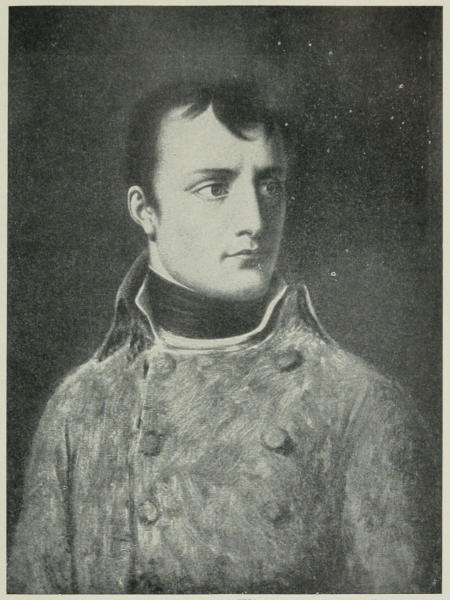
Bonaparte as First Consul. Painting by Girodet. Musée Nationale, Versailles.
(Photograph in the Kircheisen Collection.)
Needs must, however. Shortly after Brumaire, he becomes Minister for Home Affairs, a mere instrument of the master brain. Is it not natural that he should critically examine all that comes to him from the chief, wondering whether he can make a better job? Hostile to Josephine, he is hostile to her confidants. This brings him into conflict with Fouché, who is always ready to blame the Minister for Home Affairs for anything untoward, like the publication of the pamphlet.
By temperament, Lucien was as unscrupulous and amoral as his brother. Though very like his brother, he lacked the boldly calculating brain, and may even be said to have had semi-criminal traits beneath his smiling exterior. A Napoleon, like the other, but one degree more adventurer and several degrees less statesman. At twenty-five years of age, Lucien was powerful and yet embittered, his audacious spirit urging him to more and yet more hazardous adventures. His first wife was an innkeeper’s daughter; he sold monopolies; speculated in grain; lived beyond his means, instead of setting to work; bought the finest house in Paris, furnished it sumptuously, rebuilt it, and refurnished it; gave splendid banquets, indulged in amateur theatricals, wrote verses. All these extravagances were undertaken in the half-conscious desire to eclipse his brother.
Between two such men, in such a relationship, how can a breach be avoided! Lucien taunts the Consul, saying that he, Lucien, had won the victory on the Nineteenth Brumaire. In the first flush of his wrath, Napoleon has it in mind to banish Lucien; but, in the end, he is content to deprive the young man of ministerial office. This will put a term to the monetary scandals attaching to Lucien’s abuse of his position. Lucien goes to Madrid as envoy. His ability in this new post enables him to work successfully against England, and also to divert the flow of a good many millions into his own pockets. Being now a widower, he soon returns, and marries his lady love, a beauty whose reputation is of the same sort as Josephine’s in earlier days. The First Consul is furious, for he has been working to promote a marriage that would have brought political advantages.
Joseph, too, man of the world and good fellow, is inclining to join the ranks of the sceptics, now that, with his brother’s aid, he has risen to wealth and power; he frequents Madame de Staël’s circle, and speaks critically of the Consul. He is no longer content with the position of envoy in Rome, refuses the presidency of the Italian Republic and the chancellorship of the Senate; cannot forget that he is the eldest; looks upon himself as head of the family.
Louis still vacillates, the poet in his temperament taking charge from time to time. For years he is in love with one of Josephine’s relatives, and has no affection for Hortense, whom he is forced to marry. Years afterwards he will sing the love of his heart.
Jerome, the youngest, good-natured and frivolous, is brought up by his brother with paternal strictness. “I send you Citizen Jerome Bonaparte, who is to serve as a midshipman. As you know, he must be kept under strict discipline. See to it that he fulfils all his duties.”
His sisters, again; he has loaded them with money and honours, but they give him little thanks, and are incessant in their demands for more. There is Elise! She and Lucien, her favourite brother, vie with one another in escapades that are the talk of Paris. At amateur theatricals, they disport themselves in pink tights, and the Consul thunders: “Disgraceful behaviour! While I am wearing myself out trying to make people moral and respectable once more, my brother and my sister appear before the footlights almost naked!” But as soon as his back is turned, they laugh merrily, and follow their own bent.
Caroline, who has married General Murat, is already involving her husband and Bernadotte in intrigues against the Consul. The public learns nothing of these matters, but they come to Napoleon’s ears, and he says angrily that Murat deserves to be shot.
Pauline loses her husband in a colonial campaign. She does not regret the loss. By her second marriage, she becomes Princess Borghese in Rome. Her innocence is no more than a cynical pose, but her brother remains fonder of her than of any of the others. Even when the looseness of her life imperils his reputation, and he thinks it necessary to remonstrate, he words his remonstrances cautiously.
Uncle Fesch, at first a priest, and then an army contractor, now enters political life and resumes the clerical habit. Napoleon secures his appointment as archbishop and then as cardinal. All the Bonapartes exploit the man of power, that they may win money and position, lead a splendid life, and enjoy themselves, whereas in his life of superhuman toil there is little scope for pleasure.
Only his mother continues to hold aloof. Although she is not better pleased with Josephine now than formerly, although she is still the woman of Corsica and continues to talk an island dialect, he invites her, immediately after the coup d’état, to come and live with him in the Tuileries. She refuses, prefers to stay with Joseph. At the first great parade he holds in the courtyard of the palace, when she appears on the balcony among the highest State officials, she is very simply dressed, all in black, and yet looks prouder than Josephine, hard by, decked out in peacock array. Letizia mistrusts all this splendour, being now inured to the vicissitudes of life. When any one tries to flatter her by speaking of her son’s greatness and power, she sagely answers, in her Italian French: “Pourvou que cela doure.”
What is the source of these family dramas, some of which will end in farce, others in tragedy?
In Napoleon’s heart, had he been nothing more than a parvenu of the familiar type, he would, when pressed by his nearest and dearest for a share in his good fortune, graciously or ungraciously, but infallibly, have kept this dozen or so of men and women far from his circle of influence, for he would have been fain to conceal an origin which conflicted with his affectation of French nationalism. He is dictator of France, and yet every time his mother opens her mouth she reminds all the nationalists of his foreign birth. Here is the sister of a man who ranks with kings, and she plays the maddest pranks before the eyes of the monarchs of Europe, who naturally delight in pointing the finger of scorn at the ill-breeding of the upstart’s relatives. His brothers wallow in the practice of corrupt methods which it was a primary aim of the revolution to abolish. All this occurs in Paris, where irony has ever been the fundamental tone of criticism!
Yet he does not merely tolerate these embarrassing kinsfolk; he is continually showering honours on them, promoting them to high office, making them his representatives abroad.
Herein we see the working of his Italian blood, and, above all, of his island upbringing. Every Corsican family, patriarchal by tradition, is clannish to the core, while filled with sentiments of hatred and vengefulness towards the rival houses of the puny isle. Such traditions are older than those of many of the royal families, and as a result of them the urge towards the gratification of pride and towards the vindication of honour is more powerful than the desire for wealth. With this inborn clannishness is associated and intertwined the intense longing of a conqueror to preserve for the heirs of his body all that he has snatched for himself by the strength of his genius and through the favour of fortune. Nevertheless, destiny (tragical in its working, being conditioned by his innermost sentiments, and therefore inexorable) has made this man childless. The wife, into whose arms he has been driven by all the passion of love, the wife who has borne two healthy children in previous marriage, remains barren in her second union; and the infirmity of barrenness, but for which the history of Europe would have taken a different turn, is obviously a consequence of her devotion to the art of love, of the facile amorousness with which she won Bonaparte’s affection and held him for a time in thrall. For, when she first met him, she was little over thirty; and, as for him, in subsequent relationships with other women, he was able to procreate three sons. He urgently needs a legitimate heir. Even an heiress would serve his turn. There can be no doubt that Josephine’s failure to satisfy him in this crucial instance had a decisive effect on his plans.
In view of the plenitude of his powers, how could it be otherwise? During the first years of his rise, Roederer propounds the great theme: “The royalists are saying: ‘Who will be Bonaparte’s successor!’ If you die to-morrow, what will happen to us? You must nominate your successor.”
“What you suggest would not be a strong policy.”
“France would be more at ease if she knew who was to succeed you.”
“I have no children.”
“You could adopt one.”
“That would not meet the difficulties of the moment. I can see no other way out than that the Senate should appoint my successor. Only three of the senators and myself should know his name. But who is it to be?”
“They had better choose a lad of twelve.”
“Why do you want him to be a child?”
“A boy who can grow up in your school; one whom you can train and love.”
At length the Consul, driven into a corner, exclaims: “My natural heir is the French people.”
The man who speaks is not old. He is little more than thirty. Though he is appointed dictator for ten years only, he plainly foresees that he will be monarch. But he is already alarmed by the dangers of the position. When he looks round in search of an heir, his only hope is in his brothers. The best return they can make for the gifts he showers on them is that they should raise up heirs to his name, heirs who will at least have the advantage of Bonapartist blood. That is why Napoleon is so furious with Lucien, not because he has taken a wife with a bad name, but because he has taken a wife with no name. Lucien must get a divorce, and thus win freedom to marry a woman of royal blood.
Lucien refuses, quite as much owing to spite for his all-powerful brother as owing to affection for his wife. He is, indeed, fond of her; but he is so ambitious that he would sacrifice anything in the world for the sake of supreme power. After a stormy scene between the pair, Bonaparte comes into Josephine’s room, and his voice is shaken with emotion as he says: “It is all over! I have given Lucien his dismissal.”
Similar considerations explain the long-lasting quarrel with Louis, to whom Josephine looks for the salvation of her own line. He cannot endure Josephine’s daughter Hortense, who reciprocates the dislike and loves another man. Josephine, however, forces her to marry Louis, and the son of this ill-assorted union becomes Napoleon’s darling, and is looked upon as likely to be the heir. Thereupon, his sisters begin to intrigue, spreading abroad the report that Napoleon is really the father. Through these disputes, the unity of the family is shattered, at the very time when Europe envies it for its good fortune. Letizia sides with the young people who have been forced into a marriage; and also espouses the cause of the ostracised Lucien, whom she follows to Rome. There she can live happily, far from the glowing star that has sprung from her womb. There she can live as an Italian, a wealthy and respected associate of Rome’s leading families, and treated by the pope with all the honours due to a woman of royal blood.
What if Bonaparte were to divorce Josephine? His sisters, who hate “the old woman,” do what they can, and trot attractive beauties up and down in full view. As Josephine grows older, Napoleon’s relations with her become more tranquil, but he needs her friendship. He has ceased to be fastidious and has transient love affairs with one pretty actress after another, or makes this or that companion of his sisters the mistress of a few evenings or a night or two.
Georges, who, like all the rest, is afraid of him, describes him as “an amiable and considerate man,” who plays hide and seek with her, helps her to undress, and bends to her “childish caprices.” Since her Christian name is Josephine, he refuses to call her by it, and invents for her an Italian name. She is Giorgina. He asks her to tell him her own story, listens attentively, and nods approvingly—for he has taken care to learn all about her, and is pleased that she tells him the truth.
Sometimes the Consul’s servants catch sight of him in the evening, as, in his stockinged feet, he steals up a secret winding staircase to visit the lovely Duchatel. She is gentle, slender, and blonde—the type he prefers. Duchatel is one of Josephine’s ladies-in-waiting. He likes to play cards with her sometimes, talking to her in an undertone about matters of love, while the uneasy Josephine, at another card table, strains her ears to catch what he is saying. The lady-in-waiting retires. Napoleon follows, to find her in the place of assignation. His wife, beside herself, pursues them, rattles the door-handle. Napoleon comes to the door in a rage. Next day he threatens her with divorce, but he is softened by her tears.
These amours are but occasional. He is always up to the eyes in work. Besides, he has made up his mind to avoid what has proved disastrous to so many kings. He will not squander his resources on inamoratas, and he will not allow them to interfere in matters of State. As regards affairs of love, he is prematurely old. It is with a sense of shock that we find this man of thirty writing in a letter to a friend: “My old heart, which now knows human beings for what they are....”
Josephine is racked with anxiety about his conduct, just as formerly he was racked with anxiety about hers. She relies on dresses, hats, the arts of the toilet; spends more than the late queen of France; and has still so little reticence that, though she is the first lady in the land, she cannot refrain from telling her maid when the Consul has spent the night with her. He forgives her much. Sometimes she sits at the weary man’s bedside, reading to him in her lovely alto voice. He thanks her with his eyes. He is conservatively inclined, this man of the revolution. Rarely does he part with a general, dismiss an official. How, then, shall he divorce this woman whom he loves, despite her faults?
In the pleasant gardens at Malmaison, where during his year’s absence in Egypt she lived with her light-of-love, Hippolyte, he runs races with Bourrienne, Rapp, and a few men of letters, while Eugene and Hortense look on. When he trips and falls, he joins merrily in the others’ laughter. Then he gets into his carriage for the drive to Paris, saying:
“Now I can put my head in the collar once more.”
VI
“Bonaparte very seldom writes with his own hand. He dictates everything, while walking up and down his study; dictates to a young man of twenty named Méneval, the only one who has the entry to this study and the three other rooms of the private suite. No use approaching Méneval; nothing to hope in that quarter; indeed, no one would dare to try. But the First Consul himself jots down the memoranda that relate to his most important plans. This ... very special map, he locks up with his own hand, and always carries the key about with him. If he leaves his study, Méneval has to put the map away in a cupboard screwed to the floor. Of course the map might be stolen, but it would instantly be missed. Suspicion would at once fall upon Méneval and the underling, who cleans the study and lights the fire, so the underling would have to make a bolt for it.... All the secret memoranda concerning his military operations must be in it, and since the only way of overthrowing his power would be to destroy his plans, the theft of this map would bring everything to naught.”
Who writes the foregoing? A Bourbon spy? Or is it a traitor among the Consul’s intimates?
Neither the one nor the other. The young man of twenty named Méneval writes it; and it is dictated to him by his chief, the First Consul, who is walking up and down the study. Acting on Bonaparte’s orders, the Minister for Justice is sending a provocative agent to Munich, where the man is to get in touch with English agents of the Bourbons. The letter is to be part of the outfit. Many other details are given. We are told more about the royalist menial who cleans the study and lights the fire; what this fellow will get if he brings off the coup successfully; where he will spend the night during his escape. The commander is drafting the plan of a little campaign directed against himself.
He has good reason to be on his guard. Uneasy winter weeks are these, during which he collates the data sent in by a hundred spies in London, Vendée, and Paris itself. “Has the time come to strike?” his agents are continually asking. “Wait,” he replies, and quietly goes on gathering information. At length he has all the proofs in his hands. His deadly enemies of the extreme right and the extreme left, the royalists and the Jacobins, have joined forces for the destruction of their great enemy. Pichegru, the friend of the Bourbons, and Moreau, the champion of the republicans who are opposed to the dictatorship, are working together. Both the generals are his rivals. Now is the time to strike.
When the plot became public property, alarm spread across Europe. The legitimate rulers were amazed at Napoleon’s perspicacity, but put their trust in his enemies, whose number must be greater than the “Moniteur” was willing to admit. The English ambassador compromised! The great Moreau in jail!—Bonaparte hesitates a long time before arresting Moreau, having high esteem for the man who had shared his laurels. On the day of the arrest, the Consul sends repeatedly for news. Is his memory at work? Less than four years ago, he himself had a scare that night in Talleyrand’s house when he believed his own arrest to be imminent! The trial is distressing; Moreau’s complicity is clearly proved; but Napoleon thinks it better to pardon the victor of Hohenlinden on condition of withdrawal to the United States. Pichegru is found strangled in prison. Thirteen of the conspirators are executed. A man named Querelle, personally involved in the conspiracy, reveals that one of the Bourbon princes has been privy to the plot.
The Consul lends an eager ear. A Bourbon prince! Talleyrand draws attention to the fact that for a long time the duke of Enghien has been living close to the Rhine frontier—presumably in order to watch through a telescope what is going on in France. Would a man spend his time thus inertly in Baden, simply in order to make love to a cardinal’s niece? The duke of Enghien is a scion of the house of Condé; he is a Bourbon, and is in English pay. Most likely he is the Bourbon prince incriminated in the affair. At any rate, he is in touch with the agents who swarm in South Germany. An example must be made of this suspect of the blood royal. That will put an end to the reiterated attempts on the part of the exiled Bourbons to disturb the peace of France and to trouble the sleep of its master!
In a lengthy despatch, the Consul orders an attack on the little Badenese town of Ettenheim, just across the Rhine. The number of boats and the soldiers’ rations are prescribed with as much care as if the expedition were the siege of Mantua. Three hundred dragoons make a raid into Baden and carry off the duke. Four days later, he is brought in secret to the fortress of Vincennes.
Two of Napoleon’s confidants warn the dictator that no compromising documents have been found among the duke of Enghien’s belongings. But Talleyrand, who has ever an eye to his own future, advises court martial and the severest measures, knowing that the moral reprobation thus aroused will, in the end, prove disastrous to Napoleon. Brother Joseph is alarmed at the same thought. He reminds Napoleon of the veneration they had shared for the great Condé during their cadet days; of the verses they had recited about the hero of the seventeenth century. Was the only remaining descendant of that famous man to be slaughtered?
“I have made up my mind to pardon him,” answers the Consul. “But that is not sufficient. I feel that I am strong enough to have him fighting on my side.”
Joseph returns home, able to reassure Madame de Staël and his other quests.
The duke, who was two years younger than Napoleon, and who would probably have won renown but for the peculiar political circumstances which had brought Napoleon fame and power, was tried by court martial the same evening. With a brave and knightly bearing, he faced the twelve staff officers who formed the court, while a member of the Council of State, acting as prosecutor, asked the questions that had been drafted by Napoleon.
“Did you never have any dealings with English agents?”—“No.”—“Was it not your intention, if Pichegru’s conspiracy had been successful, to cross the Rhine and invade Alsace?”—“No.”—“Have you been in receipt of an English pension?”—“Yes.”—“Did you wish to enter the English service?”—“Yes, in order to free my country.”—“This means that you placed yourself at England’s disposal in order to take up arms against France?”—“How can a Condé return to his homeland except under arms?”
A death sentence follows, and next day at dawn the duke of Enghien is shot.
In one respect the treatment of the duke of Enghien was definitely illegal. The French had no right to kidnap him in foreign territory and to bring him across the frontier. Once he was on French soil, there was legal warrant for condemning him to death as a person who (according to his own admission) desired by force of arms to overthrow the extant form of State. With the primary reservation regarding the French raid into Baden, of course absolutely indefensible, the condemnation was technically just.
Nevertheless, as Talleyrand subsequently said of the affair, it was worse than a crime—it was a blunder. In time of revolution, hundreds are put to death who are more innocent than was this prince. Even though he may not have been privy to the plot, he would have hailed with delight the assassination of the usurper, and would, sword in hand (to quote his own words), have joined in the march on Paris to take vengeance on any of the regicides who remained alive. There would have been very little said about the court martialling and shooting of this young officer, had he not been a Bourbon, had he not been a symbol of that prince-ridden Europe whose system had been ended on French soil by the revolution. The shooting of the duke of Enghien was a challenge to a dozen thrones, and to the many millions of Europeans who believed in rule by divine right. It gave the signal for a rallying of forces against the dictator who had had neither part nor lot in the reign of terror, and who during his seven years as military commander and as statesman had never committed an outrage.
The day after the execution, a few tongue-tied and crestfallen guests were seated at his board. Josephine was doing her best to hide her fears, and Napoleon had been taciturn despite his tumultuous thoughts. Then, suddenly, he broke out: “At any rate, they will know now what we can do. Henceforward, I hope, they will leave us in peace.” After dinner, he walked up and down the room, explaining to the silent listeners his reasons and what he thought of it all. Continuing to pace the room, he went on to speak movingly of genius, of statesmanship, and above all of Frederick the Great, for whom he had so profound an admiration:
“Ought a statesman to indulge in feelings? Is he not an isolated individual, always alone though always in company? Policy is his telescope, which must neither reduce things in size nor magnify them. Even while he is attentively watching the course of events, he must be pulling the strings which move them. Often enough, ill-matched horses are harnessed to his chariot. Do you think he can allow himself to heed some of those feelings which may in other respects be of great importance to the welfare of society?... How often he will have to do things which seem quite out of keeping with the whole!... Try to get outside the limitations of your own epoch, enlarge your imagination instead of being content merely to blame, and you will see that those great personalities you had regarded as violent and cruel, are nothing but statesmen! They know themselves better than others know them; they are the best judges of their own conduct; if they have true ability, they will even know how to control their passions, for they will be competent to calculate the precise effect of these.”
Suddenly breaking off this monologue, which discloses some of the deepest recesses of his soul, he sends for the documents bearing on the conspiracy and has them read over to him.
“You see,” he says, “we have incontrovertible proof that the conspirators wanted to spread disorder in France, and hoped, through killing me, to slay the revolution! It was my business to defend the revolution, to avenge it! The duke was a conspirator just like another, and had to be treated in the same way as the others.... The madmen seek to kill me, though they would gain nothing by it, for a gang of fanatical Jacobins would take my place.... These Bourbons! If they ever do regain power, I will wager that their first concern will be with etiquette. If they were prepared to share in the rough and tumble of the battle-field, with its blood and its grime!... But how can they expect to win back a kingdom with a letter dated from London and signed Louis? All the same, letters like that will incriminate incautious recipients.... I have shed blood; I had to. Perhaps I shall shed more in the future. But always without passion, quite simply, because blood-letting is indicated. I am a statesman: I am the French revolution, and shall know how to protect it!” Abruptly he dismisses his guests.
Such is his mood; such are his motives, his views, the undercurrents of his feelings. But his notable inferences are not yet disclosed.
VII
A week after the court-martialling of the duke of Enghien a committee of the Senate comes to see the Consul, with a very remarkable twofold request: for the establishment of a State tribunal and the foundation of a monarchy. This is a cautious improvisation, to test the current of popular opinion. Can anything be more logical, or simpler? To scare the terrorists, to safeguard the head of the State, two things are requisite, a State tribunal and an heir!
As with all the decisions of his life, so also this premature resolve to become an emperor is an outgrowth of circumstances. In none of the decisive moments of his career, do we find evidence that he had a definite scheme of life, which he systematically endeavoured to realise. When he first invaded Italy, it was not in search of the crown of Milan, and still less in search of the crown of France. But, as he winged his soaring flight, the natural sequence was that wider and ever wider vistas of land and sea should unfold themselves before his eyes. What happened, was a fulfilment of his own guiding principle: “He will not go far who knows from the first whither he is going.” Improvisation, which, in amazing fashion, characterises so much of his activity, merely deprives him of the nebular glory of the mystical hero. As far as details are concerned, it leaves him free to make exact preparations, while restoring to him, as a whole, a liberty and a guilelessness which strengthen his genius.