BOOK TWO THE TORRENT (continued 3)
Cedar Paul translation
At the Luxembourg they are all uneasy, now that he is back. Every one of the Directors mistrusts him, and each of them is suspicious of his four co-Directors likewise. Which of them is intriguing with Bonaparte? Sieyès is on friendly terms with Lucien, Barras with Josephine, Gohier with both. What about Ducos? Is General Moulin to be relied on?—Immediately after reaching Paris Bonaparte had sent Moulin a Damascus blade with a diamond-studded hilt, and Moulin could not in decency refuse the gift.
Such are the secret thoughts of the Directors. Look at Bonaparte’s get-up when he first came to pay us his respects! Did any one ever see a general in such a rig? Much more like an adventurer! Mufti; green coat; round hat; Mameluke sword. The man wants to dazzle Paris into believing him a pasha. Did you notice that he has had his hair cut short? Wants to win people by an affectation of simplicity! Yet to-day he comes to call in great style. General on horseback, with all his aides. Brilliant uniforms. Paris agog. Very sinister, this change of aspect. Look at the way he sits and questions the five of us, as if he were a monarch holding audience.
“Why do you let the man impose on you?” say his enemies angrily to the Directors. “He made a frightful mess of the Egyptian campaign. Your proper course is plain enough. Have him arrested for deserting the army under his command! He’s got something up his sleeve, you may be sure!”
Bonaparte, meanwhile, receives visits from Jacobin leaders and Bourbon agents; gives advice to all and sundry, but tells no one what he really thinks; behaves like a man of family who has just returned from a long journey, and, with an air of good-natured boredom, allows his relatives to tell him all about their squabbles while he has been away. He has been home for two weeks now. The tension is increasing. Affairs of State are at a standstill, or nearly so; for the Five, who should be carrying on the work of government, are busied in intrigue. Amid the general confusion, the Councils have utterly lost prestige. The new constitution is rocking in the blast, but no one seems to know from which quarter the wind is blowing. Who is the real holder of power in the State? Who controls the army? General Moulin? General Bonaparte?
While no one can tell from day to day how the relationships between Napoleon and the government are likely to shape themselves, he goes to the Institute to deliver a lecture on the vestiges of the ancient Suez canal, and describes the Rosetta stone. On November 1st, there is a State banquet in honour of a victory won by Masséna. Where is Bonaparte? No doubt it is not to his taste to celebrate the triumphs of a brother-in-arms!
That evening he is closeted with Lucien and Abbé Sieyès. Talleyrand has at length brought him in touch with the ablest of the Directors. Sieyès and Bonaparte, the man who has rediscovered the constitution and the man who has rediscovered the secret of power, sit face to face; they vie with one another in ambition and in intellectual ability. “I have made the Great Nation,” says the general. “You could not have done so, had we not first made the Nation,” counters the abbé.
They discuss the details of the proposed coup d’état. On the critical day, they will spread the report that a Jacobin conspiracy is afoot. The Councils, in alarm, will transfer their sessions from Central Paris to Saint-Cloud. “As a measure of precaution,” Bonaparte will be entrusted with the command of the Paris garrison. Sieyès has come to an understanding with Ducos. Persuasion, threats, or money, will induce the other three Directors to resign. Barras will take money. But what about Gohier? “Make short work of it,” says Lucien. “Dissolve the Councils by force.” But at night Napoleon, when he is alone, turns matters over in his mind:
“Force! How silly it was to use force four years ago! We see where it has led! The supreme art is to maintain the appearance of legality. Without cannon or bloodshed, without arrests and parties, that is the secret of the ideal coup d’état. Otherwise you set up something that may last a year before it wears out. After ten years of revolution, the republic is heartily sick of it all. She is an amazon who has borne arms till she is tired, and now asks nothing better than to be led by a strong man. She is ready for me.
“Can I depend upon Sieyès? Behind that receding forehead of his, he thinks too much. For ten years he has been building constitutions, but he is nothing more than the ideologue whom a vigorous general can use before casting aside. Had I not arrived in the nick of time, he would have joined forces with Moreau. I shall turn the pair of them to account. I know I can trust Berthier, Bourrienne, Murat, Marmont, and Leclerc. Is Lucien faithful? For the time being. Bernadotte? His spiteful look betrayed his true feelings. Still, he will not come into the field against me. What about Talleyrand? A dangerous man, and for that very reason I must have him on my side. Moulin? No time to waste; there are too many generals in Paris. Watch out!”
Next evening he went to Talleyrand’s, for a private talk with that intriguer. They sat late, discussing plans. Suddenly there was a noise in the street. Trotting horses, which stop in front of the door. The patrol? “Bonaparte turned pale, and I fancy I must have done the same,” wrote Talleyrand in his Memoirs. Both men believe that they are about to be arrested. Lights out, and on tiptoe to the balcony. False alarm! An ordinary street scene, nocturnal revellers and police, nothing more. The conspirators breathe again. But why do not the Directors have them arrested on suspicion? The answer is simple. Bonaparte is already too commanding a figure to be touched!
On the 6th, there is a banquet at the Luxembourg. Bonaparte and Moreau are the guests, but the latter has the place of honour, and the hosts eye Bonaparte askance. He reciprocates his entertainers’ suspicions, and eats nothing but bread and eggs, handed him by a trusty servant. After half an hour, he makes his excuses, and goes back to his confederates, to talk over the plan for bringing about the downfall of the men with whom he has just been dining. Next evening, Talleyrand, Roederer, and Sieyès, dine with Bonaparte; Jourdan and Bernadotte, who are to be won over, have also been invited. After dinner, he asks Jourdan what is to happen. This simple question is evidence enough of the prevailing crisis. Two generals who have never before exchanged a word except about commonplaces, meet, and look one another in the face. “What is going to happen?” enquires one. The other significantly grips his sword-hilt. The plotters agree to take action in forty-eight hours. The parts to be played by members of the inner ring are assigned. Murat, Lannes, and Marmont are to inform the officers of the three branches of the service; Berthier will acquaint the general staff.
Lucien undertakes to manage affairs in the Council of Five Hundred. He is president for the month, having been elected in honour of his brother’s return. The president of the Council of Ancients is also a party to the conspiracy. The bedells will be told to overlook certain names when notices of the sitting are sent out. As soon as Bonaparte has been appointed commander of the Paris garrison, he will hand over the Tuileries to Lannes and the Palais Bourbon to Murat. Gohier and his wife will be invited to breakfast by Josephine—eight o’clock. Bonaparte will offer himself to Barras for luncheon, in order to put Barras off his guard. Joseph will persuade his brother-in-law Bernadotte to keep quiet, if Bernadotte will not actively participate. Roederer writes the proclamation. His son knows a friendly printer who will set it up and machine it—on the quiet.
“Was Brutus’ mood so paltry?” thinks Bonaparte. “But, in truth, we too wish to slay some one—Anarchy! A new era, a new century, to be ushered in by such petty and distasteful means! Camp life is cleaner!”
XIX
November 9th, a foggy autumn morning; the Eighteenth Brumaire is dawning. A bustle in the street opposite Bonaparte’s house; officers arriving on horseback and in carriages. Is the blow to be struck at last? Most of those present were with him in Italy. The house is too small for such a concourse. They stroll up and down in the garden, discussing their chances; lively and cheerful as if they were on the Rhine. Appearances must be kept up. No one must be able to say that uniformed officers were about so early. All goes well. Messengers come to confirm the carrying out of the programme; both Councils were summoned at seven o’clock, but undesirable members have not received notice. The initiates were the first comers, and, as soon as there was a quorum, Lucien in the Council of Five Hundred and his colleague in the Council of Ancients had proposed Bonaparte’s appointment to the command of the Paris garrison.
Here is the messenger with the commission, duly sealed! The formalities are being strictly observed. The general joins his faithful followers. Everything goes on as if they were in camp. With a great suite, he rides through the town, to the amazement of a huge crowd, which does not, however, show any political interest. A dragoon regiment which had been through the Italian campaign with Napoleon turns up on the Boulevard Madeleine without awaiting the orders of its colonel. Other officers follow with Ducos and Marmont. The latter summoned them at an early hour. When they said they could not come for lack of horses, he borrowed some from a riding-school.
The Tuileries garden is crowded. Many remain on horseback; but Bonaparte dismounts and enters the Council of Ancients. Is he going to make a speech to people whom he despises, in this dark and unfamiliar hall? Why does he not take the oath to the constitution, the constitution he is about to destroy? The law directs that a general appointed to a new command should take this oath. Evading the formality, he speaks from the rostrum:
“The republic is in danger.... Recognising this, you have passed a law that will save it. Do not search history for examples that may give reason for restraining your activities. No epoch in history is like the end of the eighteenth century, and in that end there is nothing like this moment.... We want a republic based on liberty and equality. We shall have it. With the aid of all the friends of liberty, I shall save the republic. In my own name and in that of my companions-in-arms, I swear it to you!”
“We swear it!” comes like an echo through the open doors of the hall. The Ancients move uneasily in their seats. “Companions-in-arms?” But Bonaparte has left the hall, drawing a breath of relief. These lawyers’-eyes; bespectacled eyes! Effete pygmies! Has he noticed that he spoke to them as if he were on the parade ground, and that they did not like his tone?
His words and his voice have a very different ring outside, when, having remounted his charger, he summons his troops to save the republic. Then comes a report from Lucien, who has meanwhile adjourned to the following day the sitting of the Council of Five Hundred. What is that you say? The Directors’ guard is on the way hither? Do they come as friends or foes? “Is Sieyès sending them?” Their colonel says no. The two men laugh.
In fact, Sieyès, pale of countenance, is still at the gate of the Luxembourg. For the last fortnight, our clever abbé has been taking riding lessons. It had been his design to ride at the head of his guard to join his new comrades. Before all the world, he would show his equality with these comrades by leaning from his saddle and embracing them. But the guard has started without his orders; their colonel has brought them to the Tuileries, riding hell-for-leather, too hot a pace for the abbé. Almost unnoticed, and much crestfallen, Sieyès drives after them in a carriage, with Ducos, who is pliable, by his side. Every one in the know is aware by this time what will happen to the other three Directors.
Moulin looks at the matter from a soldier’s standpoint. He estimates the opposing force at the Tuileries to be eight thousand strong, and his adjutants report to him that all the important points of the town are in Bonaparte’s hands. He writes, therefore, saying: “At your service.”
Honest Gohier is at home, blustering ineffectually. He had not thought it advisable to accept the strange invitation to an eight o’clock breakfast, and had been content to send his wife. Now, a sort of hostage, she is drinking tea with Josephine, while Bonaparte is betraying her husband—not, indeed, stealing his mistress, but stealing France. When the first news comes, Gohier sends to his colleagues, summoning them to a meeting of the Directory. No one turns up. Moulin has joined Sieyès and Ducos. Barras says he is in his bath.
When Talleyrand, the messenger of fate, visits Barras, the Director is shaving; he seems to be devoting the day to the arts of the toilet! But, at a glance or two from the other augur, he throws up the game, being content to ask for a safe-conduct. When his secretary brings this demand to Bonaparte, the general harangues the man publicly in the Tuileries garden: “What have you done with France, that I should let you off so easily? I gave you peace, and I find war.... What have you done with the hundred thousand Frenchmen who were the companions of my glory? They are dead! We can go no farther along that road, for in three years it leads to despotism! We want a republic based on equality and liberty, toleration and morality!”
Thus berated, the little secretary shakes in his shoes. In reality, Bonaparte is perfectly calm, but it suits him to simulate wrath in the presence of so many witnesses. In a couple of hours, all Paris will hear of it.
Here comes Gohier. He does not lack courage, anyhow. Bearding the man of power surrounded by his troops, Gohier reminds him of his duty to the Directory.
“The Directory no longer exists!” storms Bonaparte. “The republic is in danger, and I intend to save it. Sieyès, Ducos, and Barras have resigned.” As he speaks, a letter from Moulin is brought to him. “Are not you in league with Moulin? No? Well, here is his resignation too. You are the last. Do you intend to hold out all by yourself?”
Gohier is a stickler for the law, and refuses to give way. He goes back to the Luxembourg, and there he and his friends are kept under guard by five hundred men until all is over. Barras is waiting at home, uneasy till he has the answer to his message. What if Bonaparte were now to take vengeance? Who can depend on Josephine’s moods? Here is Talleyrand back again, with the safe-conduct and a bag of gold. As to this last, no one knows whether Barras had the fingering of the money, or whether Talleyrand kept it as messenger’s fee.
Thus the five heads of the republic were rendered powerless by General Bonaparte. But this was only the first day. To-morrow, at Saint-Cloud, greater difficulties may have to be faced. Lucien, who has been all over the place, and is fully informed, exclaims with well-grounded anger: “The whole job ought to have been finished in one day! You have left them too much time! The Five Hundred are already crying out that they have been tricked! To-morrow all will be in the melting-pot once more! The only thing to do is to send soldiers to clear out the Chambers, and to put the most dangerous members of the Councils under arrest.”
Certainly there may be complications to-morrow. Bernadotte had wanted the Jacobin Club to appoint him general of the opposing forces. “But the fellows were in too great a funk!” The generals unsympathetic to the coup d’état must be put under lock and key. Bonaparte’s associates urge this again and again, but in vain. He is resolute to maintain the semblance of legality.
“People would say I was afraid of the generals. No one shall have a right to accuse us of illegality. No parties; no force! The whole people must be associated with the decision through the votes of its deputies! No civil war! What begins with the shedding of civilian blood, will come to a shameful end!”
But at night, prepared for all eventualities, he has loaded pistols handy to his bedside.
XX
Next morning, an endless string of carriages and carts, an endless succession of riders and pedestrians, makes its way to Saint-Cloud, as if to see a great military review. Bonaparte, too, drives instead of going on horseback attended by a bevy of mounted officers. That might be provocative. He has made up his mind to observe constitutional formalities to the very last moment. Could any one say that there had been a breach of law the day before? Are not the Councils entitled to remove their sittings to a spot beyond the precincts of the town, if they think that this would be safer? Is it not within their competence to appoint a new commander for the Paris garrison? Had not the Directors the right to resign? Will any one pretend that the Jacobin peril, which is the occasion for these happenings, is imaginary? To-day, at public sittings, the Councils will alter the constitution. Three rulers will be provisionally appointed. Borrowing a title from ancient Rome, they can be called Triumvirs, or, perhaps better, Consuls. Then the Councils will be prorogued, everything being done in due form of law.
But the deputies hold other views. Like cloud-drifts hanging low, they flit through the valleys of this forsaken palace, discussing the situation, and giving vent to their protests. Since the hall that is being furbished up for the sitting will not be ready before one o’clock, they have plenty of time to foment their wrath.
In a small room fronting on the park, sit the three men who will be Consuls to-morrow. At least Sieyès and Ducos remain seated most of the time, but the third walks up and down impatiently, as his adherents come and go to report. He thinks: “How infernally slow civilians are! They have needed a whole morning to arrange a few benches. Then they must take an oath one by one, a thing which our recruits do in chorus, and get through it all in a couple of minutes! Why should I have to wait in a back room while these lawyers are deliberating in the council chamber?”
The Ancients meet upstairs in the Salle Apollo; the Five Hundred, downstairs in the Orangerie. Spectators, safe people, throng the hall of the Five Hundred. When, after the swearing-in, the discussions at length begin (Lucien is in the chair), the protests of the opposition gain weight from the circumstances. Speakers point to the threatening force of soldiery outside. When some of the orators exclaim: “No dictatorship! This Cromwell wants to bind us in chains!” almost all the delegates applaud. The reports that come to the back room are more and more unfavourable. The officers grow restive: “Chase the beggars out! What else have we got our men here for?”
Bonaparte’s only answer is a cold glance. Buckling on his sword, he silently mounts the stairs to the hall of the Ancients. Two or three of the stalwarts follow him, shaking their heads. Is he going to talk once more, as he did yesterday, instead of shooting? Amazed but curious, the president allows him to speak. Will he put up a better case than yesterday, speaking to the point, and not simply haranguing them about himself?
“Yesterday, I was sitting quietly at home when you summoned me.... To-day, I am overwhelmed with calumnies.... Since my return, all parties have been busied with my name.... The Council of Ancients must decide quickly. I am no intriguer. You know me. Have I not given proof and to spare of my devotion to the country?... Am I, a man whom even the great coalition could not conquer, to tremble before a few rioters? If I am a crafty schemer, you may well be all Brutuses!”
Uneasy stirrings; smiles. Why does he speak, instead of acting? He is not sure of his ground, for he goes on to say: “All France shall know what we have lived through.—Every one of the parties wishes to turn this crisis to its own account, and every one of them would like me to side with it. But I have come to the Councils. If you hesitate, and if liberty is overthrown, you will be answerable to the world and to posterity!” His periods grow ever more confused. The Ancients surround the rostrum, interrupting him, demanding names. Suddenly he turns, and waves his hand towards the doors, as if pointing to the soldiers, who are out of sight. He seems to be looking for an exit. He apostrophises the invisible soldiers:
“You, comrades, whom I see united in this circle, raise your bayonets with which we fought our way to victory together, raise them against my breast! But if an orator in foreign pay dares to call your general an outlaw, smite the wretch with the thunderbolts of battle! The god of battles and the goddess of good fortune are on my side....”
Will not a burst of laughter sweep the speaker away, and his coup d’état along with him? At length Bourrienne comes up to him from behind, takes him by the arm, and whispers in his ear: “Do stop, General. You really don’t know what you’re saying!” He turns, and follows Bourrienne from the hall. A deputy devoted to his interest takes the floor promptly, and does his best to put a good face upon the matter.
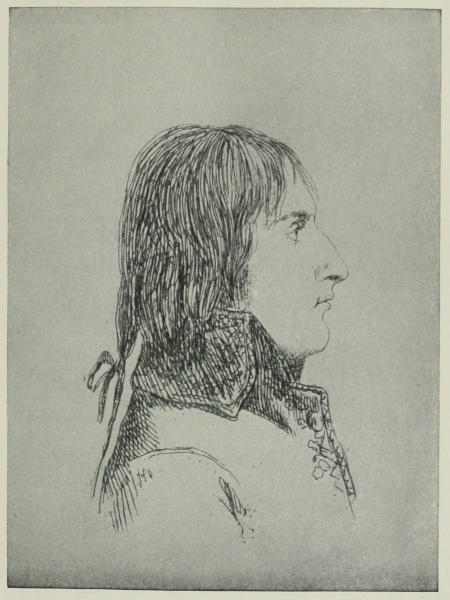
General Bonaparte in 1798, during the voyage to Egypt. Sketch by André Dutertre.
Outside, he draws a breath of relief. What could have been the matter with him? Why had his brain been clouded? Amid all the turmoil of battle, he is calm, fully master of himself; his decisions are well-rounded, brilliant, and cool, like polished marble spheres. Why is he unequal to the occasion on this day of days, when his whole future is at stake?
Because he is a man who knows how to command, but does not know how to beg. He can cajole, threaten, feign hesitation, lie; outdoing in these arts all the diplomatists with whom he negotiates treaties. He meets them as equals, but is always sustained by the feeling that, if he does not get his way by diplomacy, he can enforce his wishes by artillery fire. He can endure everything, except having to ask favours, and except having to submit to a law which is not of his own making. He wants order and legality, but not such as existed before he established them!
With titanic energy, as he already foresees, he will lead this country towards order, will found an orderly State after a decade of chaos. No one will be the worse for humble birth or for poverty, since all will have equal opportunities. But in these halls to-day sit lawyers, ridden by the spirit of faction, corrupt, outworn, besoiled by the grime of party politics. He is to implore them to be good enough to give him (and others) a power which has long been his, and which stands outside there, impatient to get to work!
He, who in the Institute could sit quietly among the savants, learning and questioning, is so little able to understand the mood of these legislative assemblies that he actually fancies the day already won. He sends a message to Josephine to tell her that all is going well; says a few encouraging words to his followers, and goes quickly downstairs to play a similar part before the Council of Five Hundred. It is just as well that his friends take the precaution to send into the hall with him four stalwart grenadiers, whose strength and loyalty can be thoroughly depended on.
No matter that this escort is quite out of keeping with his determination to be strict in the observance of parliamentary forms! Followed by his grenadiers, carrying hat and riding whip in his hand, he enters the hall of the Five Hundred. “Bonaparte!” All turn towards the door. The Jacobins shout: “Down with the tyrant! Down with the dictator! Outlaw him!” A few of the more hefty among the Five Hundred hurl themselves upon him; the grenadiers rally to his protection, encircling him, and sheltering him with their big bodies from the angry Jacobins’ blows. The combat sways to and fro for a while, a knot of struggling and shouting people. Then, step by step, the five force their way backwards towards the door. Outside, surrounded by his own supporters, he is for a moment too much discomposed to speak; but, rallying quickly, he makes for the back room.
During the Italian campaign, Bonaparte was under fire in the front ranks on several occasions. At Lodi, and again at Arcola, he had been in imminent peril. But here, he was for the first time involved in a rough-and-tumble affray where fire-arms and cold steel are against the rules. Towards the close of his career, he was to have a similar experience. In such a chance medley, he could not draw his sword. He must assume his antagonists to be unarmed, though some of them were in truth armed. To use his sword seemed to be in hopeless conflict with the fundamental principles of the coup d’état—as he envisaged it.
But at length he has to abandon these principles of his. In person, he has been rescued from the blows of his adversaries, but their fists have shattered his doctrine. Force has been used against him. He strides furiously up and down the room; his pride is touched to the quick; in his anger, he scratches his cheek till his finger-nails are bloody. Blood? In an instant he has recovered his composure. This blood will be most useful! Attempted assassination in the council chamber! He will show his soldiers how these villains have manhandled the commander of Paris! The pretence that the other side had been the first to break the law, frees him from the tyranny of his principles.
In the assembly hall, meanwhile, Lucien is fighting for him. “Hors la loi! Outlaw him!” cry most of the deputies. Lucien tries to still the clamour with voice and bell. The attempt is vain. A formal demand is made for a vote on Bonaparte’s outlawry, and every one knows what that means in revolutionary Paris. Since there is no other way out of the difficulty, Lucien, whose pose to-day is that of the defender of law and order, with an imposing gesture throws off his toga and storms out of the hall. None too soon!
He finds his brother with the troops. Napoleon had turned pale when the news had been brought of the vote of outlawry. Then, running to the window, he called to the troops: “To arms!” Going out, he mounted, and was quick to notice that the soldiers were not sufficiently moved, were not yet ripe for action. Night was falling, and all were waiting on events. Lucien came out, leapt into the saddle, and the two brothers rode up and down the front. Outside the railings were Sieyès and Ducos in a carriage, ready for flight to-day, or to become rulers to-morrow, as events might decide. The movement seemed to be without a head.
Then Lucien grasped the opportunity. He could make a better job of speaking to the soldiers than Napoleon had made of speaking to the deputies:
“Soldiers, as president of the Five Hundred I tell you that in the hall there the majority is being terrorised by a handful of armed Jacobins. These rascals are in English pay. They have dared to outlaw your general, who was appointed by the Councils. They actually tried to assassinate him. Look at the wounds! Use your bayonets to guard him against their daggers, so that the deliberations concerning the welfare of the country can be conducted in peace! Recognise as deputies none but those who come with me into the midst of your ranks. Drive out the rest, all who would stay in the hall!”
Napoleon listens with pinched lips. When Lucien has finished, he speaks in his turn, shouting: “Kill any one who resists. Follow me! I am the god of battles!” Lucien, who is afraid of another speech, hisses: “For God’s sake, hold your tongue!”
“Long live Bonaparte!” shout the soldiers, who regard the brothers as military and civil authority conjoined. But not a man moves. All is lost, if they will not march now. Lucien grasps at the last expedient. With a theatrical flourish, he snatches an officer’s sword and points it at Napoleon’s breast: “I swear that I will run my brother through, should he ever dare to threaten the liberties of France!”
The phrase has the desired effect. Murat orders the sounding of a general advance, summons a troop of soldiers to follow him, and shouts: “Lads, chuck the whole rabble of them out of the hall!” At length he has raised a laugh. With bayonets at the charge, but good-humouredly and without hurting any one, they thrust from the hall any of the deputies that are valiant enough to offer resistance. In the failing light, there is a confused scene in which red togas, birettas, and the caps of the guardsmen are intermingled. The last of the fleeing deputies escape through the windows.
The priceless Lucien now hastened upstairs to the Council of Ancients. Grossly exaggerating the injuries sustained by his brother at the hands of the Jacobin deputies, he induced the Ancients, in a panic, to appoint the three Consuls, and to adjourn their sitting until a late hour that night. Then the leaders foregathered in a small café for a meal, being all much in need of food.
That night, the most trustworthy among the deputies reassembled in the deserted hall at Saint-Cloud. By the light of a pair of candles, the thirty who were left to represent the people of France voted whatever they were told. While a hundred or so people of fashion, pretty women and their gallants, mockingly watched the midnight ceremony—while all went smoothly, society-at-large being quite undisturbed and the proletariat unruffled—the indefatigable Lucien insisted that the political mass should be worthily celebrated. At two in the morning, to the sound of drums, the three Consuls took the oath. “Long live the republic!” called a few weary voices.
At three o’clock, Consul Bonaparte drives back to Paris with Bourrienne. He looks straight in front of them, saying never a word. Not until he is at home, and Josephine is present, does he open his mouth:
“I say, Bourrienne, did I talk a frightful lot of nonsense to-day?”
“A fair amount, General.”
“Those idiots drove me crazy. I’m no good at speaking in public assemblies.”
Then, instead of going on to talk about the coup d’état, or to congratulate himself upon its amazing success (for from to-morrow onwards he will rule France) he alludes to personal enmities. Bernadotte’s conduct is what rankles!
“That fellow Bernadotte! He wanted to betray me! His wife—his wife has a great deal of influence over him. I should have thought I had done enough to placate him! You were there, and you know. I regret having gone so far to please him. He will have to clear out of Paris. There is no other way in which I can pay my score.... Good-night, Bourrienne. To-morrow night we shall sleep in the Luxembourg.”