BOOK THREE THE RIVER (continued 3)
Cedar Paul translation
Because this woman has never interfered in politics, has not now affected a knowledge she does not possess, but in simple camaraderie has spoken on behalf of her absent husband, and with princely demeanour has pleaded for her country. She has made use neither of cajolery nor anger, but has kept the golden mean between pride and deference becoming to a conquered monarch. Years afterwards, the Emperor remembered this woman who by her noble bearing had saved her country and her dynasty.
In Berlin, he meets another woman. Count Hatzfeld, who has been negotiating with the conqueror on behalf of Berlin, writes indiscreetly to one of the discredited generals, and gives him details concerning the strength of the French troops. His letter is intercepted. The Emperor, in a rage, declares he is to be shot as a spy. Berthier is depressed by the command; Rapp endeavours to soften Napoleon. Countess Hatzfeld is brought to see him; she falls at his feet. He invites her to Potsdam: “When I showed her the count’s letter she answered me guilelessly, with a sob, and with deep emotion: ‘Yes, that is certainly his handwriting.’ As she read the document the tone of her voice moved me to my innermost being. I pitied her. You see,” he concludes his report to Josephine, “I love good, simple, and gentle women.”
Love? There stands the man of might; the countess is naught to him as far as her womanhood goes; hardly has he noticed her figure or her dress. But these natural passions, womanly pleadings, tears, and silences, move him deeply. He throws the letter into the fire: “The proof I had has been burned. Your husband is safe.”
Thus does Napoleon the Conqueror deal with two German women whose husbands have fought against him. He deals leniently with them because their conduct appeals to his heart.
He dislikes Queen Louise. A politician, that woman, who has driven her country and her consort into a disastrous enterprise, who has egged this quiet-loving man into war when he could have had peace with honour. Napoleon execrates such a woman. Since she seizes every opportunity to spit fire at him, he determines to strip her of all her womanly dignity. He jeers at her in official bulletins: “She is a woman with beautiful features but little brain.... She must be terribly tortured by pangs of conscience for all the suffering she has brought upon her country. Her husband is a man of honour who desired happiness and peace for his people.”
He has made a triumphal entry into Berlin. His suite is brilliantly dressed, but he is as simply clad as ever, and his hat is adorned with a cockade worth about a penny. Nothing interests him so keenly as Sans Souci. He holds the sword of the great Frederick in his hands, and takes it away as a trophy more priceless than any other he could ever find in his whole life. He would not exchange it for the throne of Prussia. But he heartily despises Frederick’s descendants, and publicly attacks the queen:
“In the queen’s rooms was found the tsar’s picture, which he himself had given her. Also there was her correspondence with the king.... These documents go to prove how unhappy those princes can be who permit their wives to interfere in affairs of State. Notes and State papers reeked of musk, and lay beneath ribbons and laces and other fal-lals of the toilet.”
An unworthy tone! He seems to have forgotten the patriotic impulse of the queen. If, however, we compare these taunts with what the best and greatest of contemporary Prussian statesmen, the non-Prussian Baron vom Stein, wrote about Queen Louise, we can understand the Emperor’s humour, though hardly excuse it.
Serious considerations restrain him from destroying the house of Hohenzollern, though he had already drafted a decree to dethrone the king. Napoleon has to bear the tsar in mind. In Berlin he thinks in terms of Europe as a whole: “On the Elbe and on the Oder we have won our India, our Spanish colonies, and our Cape of Good Hope.” The grandiose words as yet only announce the start of the voyage; but with mighty strokes of the oar he is now to round the cape of his hopes. In the castle at Charlottenburg he dictates the greatest, most un-bloody, and most dangerous of all his declarations of war: Charlemagne closes all the harbours of Europe against English ships. If the island cannot be reached by his sword? Well, henceforward, Europe shall be placed out of her reach! All merchandise, parcels, postal communications, etc., from and to England and her colonies are to be held up; every Englishman at large on the Continent is now a prisoner of war.
How is the carrying-out of the scheme to be supervised? Hitherto, action has always followed close upon the heels of thought. Now, he has to make treaties with various States, and, first of all, with Russia and Austria. Austria has fragments of the sometime realm of Poland within her frontiers; but Russia wants them for herself; Poland, tossed between the two, pays allegiance to neither. As to a god, the Poles turn to the Emperor. He, the champion of the freedom of the peoples, must come to their aid and free them. What is to be done? How does Napoleon solve the Polish problem?
“Shall I set up the throne of Poland anew, and thus restore a great nation to life? God alone, who has the fashioning of all things in his hands, can solve this riddle.” Words of Delphic cunning, which he sends forth throughout Poland. God alone sees the smile with which he signs the proclamation! In addition he takes three measures. He demands that the Poles shall provide troops, for “not until you have an army of forty thousand men will you be worthy of the name of Nation.” Next he proposes to the Austrians an exchange of Galicia for Prussian Silesia. But the real key to the Polish problem he fishes out of the Bosphorus, for he tells the sultan to drive the Russians out of Moldavia, and to meet him, the Emperor, on the Dniester; thereby he hopes to bind, not only Russia, but also the trembling Austria, to the lower Danube.
There he sits in Sans Souci, the ancient candelabra in Frederick’s study scintillate over his head, Voltaire’s picture smiles sideways, through the wraith, at his great fellow-countryman. He sits alone at his game of chess, calculates the moves of his unseen opponent, his glance takes in wider and wider circles; suddenly the traits of his new ancestor suffer a change, the big blond beard vanishes, the nose is flatter, the eyes lose some of their confident glance, then become bolder again: instead of the great Charles, he is facing the great Alexander. Yes, now, indeed, he will conquer England in India! World dominion hovers before his eyes.
A new opponent leaps on to the board. Couriers bring the news of a revolt in Spain. He pales. The whole game is imperilled. Once more Napoleon sees clearly that he who would vanquish England must gain Russia’s friendship. But in order to conquer Russia or to win her over to his side, he needs a fulcrum. He has one ready to hand: Poland in revolt. Napoleon journeys to Warsaw.
While in imagination he had, during these weeks, been weighing the fate of continents, his heart had felt lonely. Yet he did not trouble himself about women. Only to his wife did he write gallant things: “I love you, and long for you.... These Polish women [in Posen] are all Frenchwomen in their hearts. But for me there is only one woman. Do you know who she is? I would tell you what she is like, only I should have to flatter her too much, so that you could recognise yourself in the description. Seriously, my heart can say naught but good of her. Oh, these long nights, all alone!”
Josephine, with the keenness of a foxhound, senses a rival under these cajoleries. But she has no reason, as yet, to be jealous, or to make so long a journey. He answers her that “the agitation of your letter tells me that you beautiful women know of no limits to your powers. What you wish must come to pass. I, on the other hand, recognise that I am the most enslaved of men. My master has no mercy on me, for my master is the nature of things.”
Hardly has he finished touching upon these airy trifles in weighty words, when a courier brings him tidings of the great consequences of a trifling affair: the beauty to whom Caroline had introduced him in the previous winter, and who was expecting a child before he went away, has been confined. At last! It is then proved that he does not lack the power which Dame Nature grants to other men! A great gift from above. A boy. He turns to his intimate and exclaims with the ingenuous delight of a youth: “Duroc! I’ve got a son!”
XIV
The brilliantly lighted ball-room forms a background where Poland displays her greatest beauty and her most precious jewels. This is the evening of evenings. In the old palace of Poland’s kings at Warsaw, the Emperor of the French is to be shown the calibre of the nation that has been suffering so long. Will he admire the national dance, its music and its figures? Will the eyes of the ladies ravish him, those eyes which are pools of Slavic melancholy? Will the flattery of the speeches or the idolising comparisons appearing in the newspapers make his heart as wax? Such, according to the sanguine, are the questions upon which hang the fate of the nation. The procession has passed by; he has spoken to many in cheerful vein; now he is standing in a recess, dividing his attention between his interlocutor and the dancers. He is thinking of Paris, where, for seven years, he has never failed to be in January.
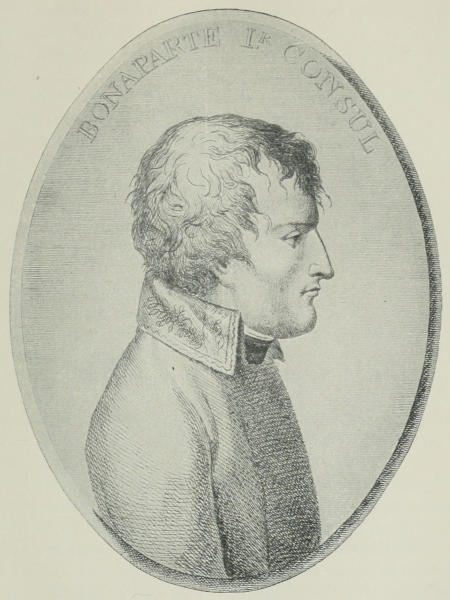
Bonaparte in 1802, as First Consul. Engraving by Alexandre Tardieu. After a drawing by Jean Baptiste Isabey.
Suddenly his gaze is focused on a special point, and he forgets to carry on the conversation. A hundred watchful eyes follow the glance of the huntsman. Who is the quarry? A little later he approaches a group, asks for the names of those composing it, and smilingly, with a courtliness of manner rarely shown by him on public occasions, he draws the lady of his choice out of the circle of her companions. She is a gentle, fair-haired beauty, dainty and small, has blue eyes, appears to be of a yielding disposition, and is eighteen years of age. She is simpler in her dress than any of the others, and her behaviour is correspondingly quiet and without display or the lures of coquetry. The Emperor chooses her as partner in a contra-dance, delights in her grace and her lovely voice, finds her broken French bewitching. While she smiles and is covered with confusion, her name is whispered from room to room throughout the palace: Countess Walewska.
“Who is she?” asks Napoleon later of his friend Duroc. She is the daughter of an ancient line, the family so impoverished that the lady has been married off to a wealthy old count whose youngest grandchild is ten years older than the new wife.
“I had eyes only for you,” he writes to the countess next day. “I admired only you, and longed to be with you alone. Send me an answer quickly, in order that the fire which is consuming me may be appeased. N.” But the messenger, Duroc, returns with neither answer nor tidings of any sort. The Emperor is nonplussed. Something quite new. Twelve years ago the brigadier general had had such a rebuff. But Napoleon, never. Have not all women, whether princesses or actresses, have not all the beauties, invariably come to him at his slightest nod of invitation? The more enchanting, therefore, is this lady who shrinks back so virginally from the unveiled desire of a man.
“Have I displeased you? I hoped the opposite. Or has your first feeling vanished? My passion grows. You rob me of my rest. Vouchsafe a little joy, a little happiness, to the poor heart that would fain worship you! Is it so hard to give me an answer? You now owe me two.” This second letter is unsigned. Suppose an amateur of such matters to come across it in a collection of love letters, would he dream of ascribing its authorship to Napoleon? Neither heavy nor dictatorial, neither emotional nor stilted, but romantic rather is the tone. Nevertheless, since worldly convention demands that she should pay no heed to his suit, again his missive remains unanswered. Terrible the position of the adjutant who for the second time has failed in the carrying out a movement ordered by his chief. The Emperor, controlling his passion, thinks:
“If neither my pleading nor my rank has any effect on this tender creature, I must try to gain my end by a half-promise, which I need not regard as binding.” He writes: “There are moments in life when high position is a heavy burden. That is borne in on me at this moment.... If only you would! None but you can overcome the obstacles which separate us. My friend Duroc will do what he can to make it easy for you. Oh, come, come! All your wishes shall be fulfilled! Your country will be even dearer to me, if you have compassion on my heart. N.”
Now we should recognise his wonted style, even without the capital N. Nevertheless, how amazingly the loneliness of the man of might breathes from these lines. The third love-letter is intelligently composed, and therefore achieves its purpose—but it discloses to us the tragical mask of destiny, the destiny of one who wishes to walk along the course he has planned for himself, and who is sacrificing his human happiness to this heroical monomania. He roams through the splendid palace, arms locked behind. For weeks his mood has been one of yearning, but always he has been alone. For months he has hardly been near a woman. Now, having fallen passionately in love, storm-tost, he dismisses his secretaries, will not discuss matters with his generals, refuses to admit deputations, will not go out riding. The whole mechanism he has constructed is stationary. The palace, the army, Paris, Europe—let them wait. He, more a slave than any other, refuses to-day to obey the nature of things; a man of thirty-seven whose wife, well past forty, no longer stirs his passion. Profoundly moved by a girl, twice rebuffed, he must devise lures from his other realms, must tempt her with the freedom of her country, in order that, after nearly a decade of quiescent feeling, he may spread upon the shoulders of a young woman the mantle of his yearning for tranquillity.
She, alarmed at the assault of this virile will, sits the same afternoon among her friends and relatives who are urging the sacrifice upon her, for Poland’s sake. In this mood, she at length goes to see him. The three evening hours she spends with him are spent in tears. By gentle arts he restores her to calm, and to her astonishment she finds that this dreaded man of iron is a tender wooer.
“Marie, sweet Marie, my first thought is yours!” she reads next morning. “I shall see you at dinner. I pledge you my word. Please wear the nosegay that I send; it will be a secret messenger of our feelings amid the crowd; thus we shall understand one another. If I lay my hand on my heart, you will know that it is wholly yours; for answer, press your flowers to your bosom. Love me, my charming Marie; do not take your hand away from the flowers.”
Not until three days later does she become his. Then she comes to see him every evening. But, as well as this, she must be present at every reception, for otherwise he stays away. What is she to him? The second creature in the world who asks nothing from him; his mother was the first. Never has he known another woman who did not expect his magician’s hand to shower on her the treasures of the universe: jewels, palaces, crowns, money. This woman wants nothing from him, and gives him everything. Countess Walewska is the quiet and loving companion whom Napoleon’s stormy soul has sought. It will be long before he will be willing to part from her. “She is an angel. It may justly be said that her spirit is as lovely as her features.”
Josephine wants to come? Now? He smiles. Since the Cairo days, Bonaparte has never had a mistress while campaigning, whereas his generals have had plenty of love-affairs. There can be no doubt that the story of this intrigue, distorted of course, will quickly be carried to Paris, and in a veiled form will find a way to Josephine’s ears. She is waiting there, waiting to be summoned to his side. Now, in the most graceful way in the world, he deceived the wife who had deceived him for years. The weather, the roads, the public insecurity, made it impossible. “How gladly should I be spending the long winter nights at your side.... If you are always weeping, then you lack courage and character. I cannot endure cowardly people. An empress must have courage!”
Now he betrays her. “I laughed when you wrote to me that you had taken a husband in order to be with him. In my simplicity, I had believed that woman was made for man; man for country, family, fame. Forgive my ignorance. One can always learn something from lovely women.... Besides, I could not think of any lady with whom I was exchanging letters. If there really were one, I can assure you she would have to be as beautiful as a newly opened rose. Does that apply to the lady of whom you speak?”
See how this ambiguous trifling amuses him. His heart is so light sometimes. He can play the gallant as if there had never been a revolution in the world. When, after a few weeks, he resumes a campaigner’s life, his farewell to his Polish inamorata is an au revoir.
Now Russia is open to him for the first time, a land like the desert. Endless steppes, covered with snow or mud; no bread, and hardly any roads. After a few skirmishes, the tsar slowly retreats. Can we follow him? Whither is he enticing us? Who will feed the army? There is nothing in this land to be seized, nothing such as there is in prosperous Germany, no storehouses. Had not a few hundred Polish Jews, shrewd speculators, seen the chance of striking good bargains, the regiments would have perished, at this early date, in the year 1807. When the Emperor, whose carriage has perforce been left behind, is riding towards Pultusk, he hears murmurs from the ranks. This is a sound he has almost forgotten; he heard it for the first and last time eight years ago at Acre. His generals report suicides among the men. Thousands of starving soldiers desert, to become marauders. The Emperor is dumbfounded at the news, but what can he do? “I know my Frenchmen,” he says. “It is difficult to march them on distant expeditions. France is too beautiful.”
It is not surprising, therefore, that when he compels the Russians to fight, for the first time he should fail to conquer in the open field. He is not actually beaten at Eylau, but both the contending armies sustain terrible losses, and the issue is indecisive. A first warning not to campaign against Russia! Report after the battle: the soldiers are rifling the potato clamps for food, and the horses are tearing straw from the roofs. The whole countryside is filled with invalided soldiers, and none of the colonels know how many men are left in their commands. The Emperor speaks:
“We shall stay here a couple of days more, and then withdraw a few miles. Post guards on all the bridges over the Vistula; no one must be allowed to cross, except the amputated. Don’t bother about stragglers; no punishments.” But these signs of the disintegration of his army trouble him more than in former days. A cramp of the stomach, from which he has already suffered at times, becomes more frequent, and he says: “I bear within me the germs of an early death, and shall die of the same trouble as my father.” Cancer is the family heritage: his grandfather, his father, his uncle, Lucien, and Caroline, all perished of this disease.
He writes to his brother: “We are living here amid snow and mud, without wine, bread, or brandy.” But this is a private missive. From Osterode, where he is housed in a barn among the soldiers, and eats whatever they can shark up for him (a comrade among his men, as he had been years before in Italy), his bulletins to Paris speak of a great victory, and of a Russian rout. The casualties are stated at a third of the true figures. The French army is in fine case, and can stay where it is for a year if thought best.
For the second time he must learn that his nerves are not made for waiting. Here, as in Egypt, this commander finds that there is something uncanny about standing still. Only once more in the whole course of his fifteen years as a conqueror will there be another such pause of two or three months in a place far from Paris. Both these epochs of tedious consideration, cautious negotiation, are filled out in the interludes of work by giving free rein to his pent-up emotions. They are filled out with idylls.
Finckenstein, a fortified Prussian castle, is now the scene of his activities, while he is awaiting the thaw on the roads and in the hearts of his adversaries. There are huge fireplaces, which are a delight to him, “for I love to look into the fire at night when I can’t sleep.” The place is roomy enough to house the envoys and couriers. For ten weeks, the world is ruled from here. In the great bedroom upstairs, he has had his iron camp-bed set up beside the huge four-poster.
No one knows that the Polish countess occupies the next room—or hardly any one except Constant, his valet, and Rustam, the Mameluke. She rarely goes out, and then only after dark. The time is passed in embroidery, reading, and waiting, until the door opens, and he enters, to devote himself to her for a time. He has his meals with her alone. In these two rooms are the commander’s headquarters, and here the Emperor has enshrined his idyll. There are no dynastic wishes to trouble him as in Paris, no jealousies, and no bargainings for jewels; there is no wish to shine; nothing but the desire to remain hidden from the world, a wordless wish in the eyes of this sweet girl of eighteen who has learned to love him.
“I know,” he says to her, “you would rather live without me. Yes, yes, don’t protest; I know it! But you are good and gentle; your heart is pure. You don’t want to rob me of the few hours of happiness which you can give me every day? To think that people regard me as the happiest of men!”
A dispatch comes to tell him that his nephew and heir, the son of King Louis, is dead. How the news affects him is shown by his moving words to Josephine; but he cannot tell his wife all the thoughts that now enter his mind at Finckenstein. That little cocotte in Cairo, what he had really hoped from her was a son. How if this beautiful woman, this noblewoman whom he loves, were to give him an heir? Would he then make her his empress? Why not? He looks at Walewska, but keeps his own counsel.
What is Paris saying?
With ear attent, he listens to the rumours that reach him across the Polish steppe. The funds are falling. Malicious jests are current on the boulevards. “Where are our brave lads?” ask the Parisians. Caution is needed! What begins as a gentle shower, may turn into a raging storm; and the man who knows how to control the thunder is far away. He offers the beaten Prussians a separate peace, and even proposes a conference, but Queen Louise holds firmly to the alliance with the tsar. Austria, too, is deaf to his voice.
Despite all, here and now, with enemies to right and to left of him, and without any firm standing-ground, he begins to dream once more of the conquests of Alexander. Messengers bearing heavily sealed letters ride forth from the courtyard of Finckenstein; strangers bringing dispatches arrive from remote lands and make their way to him across distant mountains. To this northern headquarters comes a Persian envoy, and the messenger of the King of Kings reverently bows his head to greet the sublime Emperor of the West. Next day, Napoleon and the Persian emissary come to an understanding. The Emperor will force the tsar to give back Georgia to the shah. In return, the shah will spur on the Afghans and the tribes of Kandahar to attack the English in India; he will equip an army for the invasion of Hindustan. If the Emperor wishes to send an army against India, his men shall have free passage across Persia.
Hardly has the Persian departed, when a gorgeously attired Turk rides in past the astonished sentries, bringing golden gifts and a dispatch. A bespectacled oriental expert translates it. Standing in front of the fire, the Emperor, having reduced the eastern bombast to sober proportions, dictates a letter to the sultan: “I regret very much that you ask for no more than five hundred men instead of several thousand.... State your demands clearly, and whatever you want shall be instantly done. Get into communication with the shah of Persia, for he, too, is an enemy of the Russians.... I offered your envoy the artillerymen and other soldiers you need, but he would not accept them, being afraid of hurting Mohammedan susceptibilities. I am so powerful, and I am so desirous for your victory (I wish this because of my friendship for you, and not on political grounds alone), that I can deny you nothing.”
The same day, he writes to Brother Louis, who has been sending urgent appeals from his new kingdom, a letter which may be regarded as a sort of general instruction for kings, and which occupies five pages of print. He also sends orders to Joseph, as to the latter’s conduct in Naples. To Jerome, who in Breslau is commanding a corps of pretty actresses instead of his soldiers, Napoleon writes to ask why his brother never sends complete reports, and why he has left six hundred men in Schweidnitz, four hundred in Brieg. “Let me know your exact plans, down to the smallest details, so that I can form an accurate picture of your situation.” He likewise sends a missive to all the bishops in France. They are to institute a public thanksgiving for the Emperor’s victories; but he aims, also, at exercising personal influence on each of his episcopal correspondents, for he has learned that the dispute between himself and the pope is making the ecclesiastics more and more uneasy in their consciences. Meanwhile he sends a dozen orders to Fouché: concerning Madame de Staël, and the extent of her influence; concerning the salons of the aristocratic quarter; and so on. He enquires about the two leading Parisian theatres; their condition, their finances, and their repertoire. “What has become of my librarian?” he asks in another letter. “Is he dead, or enjoying himself in the country? That would be a fine way of fulfilling his duties! I ordered him to send me all newly published books, and to let me have the publishers’ announcement lists, but I have not had a word from him.” Draft for a new historical university, where young people may learn about modern happenings as well as the story of ancient days. To the Minister for Home Affairs: “Literature needs encouragement. Let me hear your proposals for livening up the various forms of belles lettres.” Enquiries as to the building of a new Stock Exchange and of the Madeleine. How can six millions be best applied for the encouragement of manufactures, and what will be the best way of raising the money? Two millions are to be spent in renovating his palaces. Arrangements must be made for the Paris newspapers to publish articles ostensibly based on information from Bucharest and Tiflis, and describing Russia’s desperate situation.
He smiles, glancing at his demure little friend. “You marvel at my manifold activities? I have to keep watch on all my posts. Before, I was only an acorn. Now I am an oak, the ruler of nations. All eyes are fixed on me because I am in so outstanding a position. A man must play his part, and cannot always be natural. But, for you, I will become the acorn once more.” Simple words, tranquilly uttered. One more evening with her, and then he must take the field again, for May has come, and the idyll ends with the leaving of winter quarters and the extinction of the fires at Finckenstein. He will see her again. They are both sure of this. But were he to forget her, he could read the posy in the ring she gives him:
“If you cease to love me, forget not that I love you.”
XV
On the Memel, where it flows past Tilsit, a huge raft is anchored in mid-stream. The tree trunks and the planks are covered with carpets, and in the centre a tent gleams in the June sunlight, with the colours of France and of Russia flying above it. On the western and the eastern banks are ranged the guards of the two emperors. Boats set out from either shore. Napoleon and the tsar enter the peace-tent simultaneously. The soldiers, who were shooting one another only ten days back, cheer lustily, and those in front, who can see, pass the word to the thousands in the rear. The foes of yesterday have embraced, their masters have made friends.
Immediately after the great victory of Friedland, Napoleon, as was his way, had offered his hand to the vanquished. At the opening parleys, since the appropriate response had not been made by the sultan, he had given a hint that the tsar might well hope, some day, to establish the cross once more on the dome of St. Sophia. The words were carefully chosen, for he knew that the man to whom they would be reported next day, a romanticist and a mystic, would be amenable to their influence. Alexander had been prompt to take the proffered hand of friendship. Now the enemies of Austerlitz and Friedland stood face to face in amicable converse. Napoleon coldly scrutinised his only serious rival on the Continent, a young man with feminine lineaments, compact, delicately moulded, rosy; hearing and eyesight rather weak. In an instant he felt assured that the tsar was a man whom he could win over.
By the end of a fortnight, the sometime adversaries have not merely entered into an alliance, but have made friends. How has this come about?
“He is an amiable and pleasant fellow, a hero of romance,” says Napoleon of him at this time. Inasmuch as the Emperor is bored by novels, and has no use for heroes of romance in the practical world of his calculations, there is an undercurrent of criticism in these pretty phrases. But he adds: “A handsome young man, more intelligent than is usually supposed.” At a later date, Napoleon utters profound truths regarding Alexander: “The tsar is an attractive figure, well formed to exercise a victorious charm on those with whom he comes in contact. Had I been inclined to surrender to superficial impressions, I should have become devoted to him instantly. But there is something peculiar about him, which I can best express by saying that in all he is and does there seems to be something lacking. The strangest point about the matter is that it is impossible to foresee precisely what will be lacking in any given instance, for the defect is infinitely variable.” Thus, the man whose friendship is all-important to him seems to him utterly feminine. His final judgment takes the form of an overwhelming compliment: “Were Alexander a woman, I think I should fall passionately in love with him.”
It is not surprising that such a man should in a trice be mastered by the seductions of the man of power; nor is it remarkable that subsequently the tsar should forsake the Emperor, for the surrender and the abandonment are both feminine. No one has ever given a better description of Alexander than Metternich: “A mingling of masculine merits with feminine defects; favourite ideas, imperfectly thought out, initiate sudden impulses. As a result, sudden embarrassments. He gives his word too quickly, and then finds it very difficult to keep; not strong enough for ambition in the grand style, and not weak enough for mere vanity; the man of the world rather than ruler. There is a sort of periodicity in his enthusiasms and disenchantments, a periodicity of five-year terms during which an idea waxes and wanes. At the close of each cycle, a new one opens. To begin with, he is a liberal. Then he is filled with hatred for the Frenchman; then he passes under the Frenchman’s influence.”
Five years hence, the new period will come to an end, and the friends of to-day will be at war again.
Maybe Napoleon already foresees this in the splendid tent, where for two hours the emperors discuss the affairs of the world; certainly he foresees it during the long dinners and during the rides and drives together. Napoleon’s handling of Alexander is masterly. At first, the Emperor assumes the role of the cavalier, who cannot sufficiently extol the heroism of the Russians; then he conveys the implication that ere long he must surround himself with a bodyguard of his ministers, lest he should be carried away by the tsar’s charm. At table, in order to dazzle Alexander, he talks of his good luck—a thing to which the man of destiny rarely alludes. He tells an anecdote, for which this is the only warrant, of an incident that had happened in Egypt. He had fallen asleep beneath an ancient wall, which had suddenly crumbled to pieces without injuring him. Awaking, he found in his hand something which at first he believed to be a stone, but which, on examination, he saw to be a wonderfully beautiful cameo of Augustus. Could any playwright invent a more marvellous scene than this one invented by the Emperor, in an after-dinner hour, to stir the imagination of the mystical idealist, his companion?
Enthralled, the tsar listens to the man of wonders. If he could only know all that Napoleon knows! “I feel that I am not really emperor as you are, for I am dependent on my generals.” He asks a hundred questions about the art of war. Naïvely, when the two men are out walking together, the tsar asks: “What sort of position is this? How would you defend it, and how would you attack it?”—“I explained matters to him; and I told him that, if I were ever again at war with Austria, he should lead an army corps of thirty thousand men under my orders, so that he could learn the art of war.”
Was ever woman in such humour wooed? Soon an offensive and defensive alliance is concluded.
“The lands between the Elbe and the Memel” (this is a secret note to the treaty), “are to form the barrier between the two great empires, a barrier to render harmless all the pin-pricks which, in disputes between nations, are apt to precede the firing of the guns.” In this treaty, each party to the alliance gives only in order to take; and in a couple of words the tsar sacrifices Prussia, the Emperor Poland, although each of the two rulers has pledged a woman to maintain the integrity of her country. Almost grotesque is the calm with which, seated in a small room in an out-of-the-way and little known town hard by the shores of the Baltic, the two men pore over the map and cut pieces out of countries like Hotspur and Owen Glendower in the play. The Emperor gives Coburg, Mecklenburg, and Oldenburg, whose rulers have ties with the tsar, receiving the Ionian islands and Cattaro in return. Only when the tsar asks for the Bosphorus, does the Emperor demur. “Constantinople? That carries world dominion with it!” In the thorny thicket of these negotiations, we have stumbled upon the decisive word that slumbers beneath the treaties and notes. It is plain that when two men are dividing the world between them, they will in the long run come to blows.
The king of Prussia joins their company; and, since he lacks dignity and intelligence, he is ignored by both the emperors. Napoleon privately considers him a dullard, possessing neither talent nor character, and adversely criticises everything connected with him; even his dress, which is the uniform of a hussar, headgear and all complete. Since the king is anxious about the very existence of Prussia, he leaves no stone unturned to secure the safety of his State, and summons the queen to Tilsit. The Emperor, curious to see his beautiful foe, intimates that he would be pleased to receive the lady there. He uses the neutral zone as a pretext for not setting out to meet her; but he has a charming residence prepared for her reception. Then, with a brilliant suite, though himself dressed in the simplest attire, he rides forth to visit her, and is received by the queen, who stands at the head of the flight of steps to welcome him.
She is clad in white silk, adorned with ancient jewels, beautiful and bitter. With seemingly innocent words, Louise breaks down the unbearable constraint:
“Sire, I hope you will excuse these narrow steps.”
“What would one not excuse to reach such a goal,” he answers. But when he continues to speak in this complimentary tone, she says with dignity:
“Sire, have we come here to speak of trifles?”
Then she pleads as spouse and mother, and appeals to his “magnanimous heart.”
“You will be glad to be back in Berlin?”
“Not in all circumstances. It depends upon you whether we return home without sorrow in our hearts.”
“Madame, I should be only too pleased....”
When she moved to speak, he interjected:
“Madame, how came Prussia to venture upon this war?”
“The fame of Frederick the Great deceived us as to our strength.”
“How many times have I offered peace? Austria showed more wisdom after Austerlitz.”
“To-day, I beg you to establish a claim upon our gratitude.”
“Have you not, yourself, destroyed my friendship for Prussia?”
“Your heart is noble; it unites with other fine qualities, the possession of a great character.”
“Unfortunately, general considerations often stand in the way of special wishes.”
“I do not understand questions of high politics; yet I do not feel that I am foregoing any of my dignity as a woman if I assure you....”
He listens to her with growing interest. She notices “a kindly smile trembling at the corners of his mouth, which seemed to guarantee success,—when, at that moment, the king entered the room.”
The conversation has no political consequences, but the human appeal has been very great. “It was just as well that the king put in an appearance when he did,” the Emperor says to the tsar with a spice of coquetry. “I might have made her promises.... An exquisite woman. Instead of depriving her of a crown, one is tempted to lay one at her feet.” After another talk with Queen Louise, Napoleon writes to Josephine: “She is a bewitching woman, and is most amiable in her behaviour towards me. But you have no cause for jealousy.... I should have to pay dearly for it were I to play the gallant here.... She has been punished for her love of domination; but she has displayed much character in the midst of her misfortunes.... One has to concede that she said many sensible things.”
Even more amazing is his effect upon her, who had once called him an infernal monster. She writes: “His head is shapely, his lineaments are those of a thinker, his whole appearance reminds one of a Roman emperor. When he smiles, his mouth assumes a kindly expression....”
This is Napoleon’s greatest victory. What other woman has, after a few weeks’ acquaintance, been able to portray him more charmingly? And yet she has reasons enough to detest him, for, in spite of the humility of her attitude, he is as unyielding as iron. Soon, however, she arouses his irritability. When, at last, everything has been signed, and the Emperor, “in consideration of his friendship for the tsar,” has secured the kingdom of Prussia against dissolution (though monstrous cantles have been sliced off!), she cannot refrain from making renewed attempts to soften him. Finally, he sees her into her carriage, and she seizes this opportunity to ask him, for the last time, why so mighty a man should have foregone the chance of earning her eternal gratitude. He throws courtesy to the winds, and answers with ironical bitterness:
“What will you, Madame? I am to be pitied, for this is obviously the work of my evil star!”
XVI
What is Paris saying?
“Even were I ten thousand miles away from my homeland, I could not leave the field free for bad citizens to stir up my capital to strife!” He has now been ten months absent—longer away than ever before or afterwards.
He tightens up the home government all the more rigorously since he fears that his censorious Parisians are slipping out of his hands. This city, renowned for its biting wit, is not only venting its feelings in songs and jokes that are the delight of the boulevards; it is now assuming a sceptical tone, and is more amused than impressed by his expeditions. Yes, he is right, these Parisians need to be ruled by “an iron hand in a velvet glove.” Now they are to experience both again, only the velvet seems to have worn rather thin. Indeed, the whole tone of the capital has become lax and disorderly. Do they want to return to Directory days, when every one said and printed exactly what he pleased?
A new and more rigid censorship of newspapers and plays is introduced. Historical drama must deal only with matters of the remote past; and even Corneille, his ideal, is pruned of certain passages. Before every opera he must be consulted, not merely as to the general question of acceptance after it is written, but earlier, as to the choice of topic; religious subjects are forbidden, and mythology is recommended. With lavish means, on the imperial scale, a university is founded, modelled after the Jesuit schools he detests; the professors are exempt from military service, but to some extent celibacy is insisted on. Chateaubriand is attacked, and his “Mercure de France” is suppressed, because in opposition salons he has criticised the Emperor, and has quoted Tacitus the historian as having taken vengeance on Nero the tyrant.
Madame de Staël’s new requests for permission to return to Paris are rejected, “for she is able to make people think, people who had never learned or had forgotten how to think.” To the arch-chancellor he writes: “Summon Count R., and let him know that his wife’s boudoir is the talk of Paris.” To Fouché: “You are not policing Paris properly. Malicious gossip is ripe. Keep watch on the speeches that are being made at Citerni’s restaurant and in the Café Foy.” That young people may learn who pleases God, every child in France patters the following catechism: “We owe our Emperor Napoleon I. love, respect, obedience, loyalty, military service, ... ardent prayers for his welfare, ... because God has showered gifts on him in peace and war, and has made him God’s image on earth.”
He has moved a long way. When the heir of countless generations believes such things of himself, others (or some of them) can believe them of him. But it is only three years since the Emperor, on the day of his coronation, had said that every fishwife would laugh in his face were he to declare himself the son of God....
Is he no longer the same man? As of old, in personal matters he renounces display. He will not have money lavished on his study. Here, apart from the great writing table, there are only a small settee (on which he lounges when he is dictating, unless he wanders about the room), two tall bookcases, a couple of chandeliers, and the bust of Frederick the Great; in another simply furnished study, he has a bust of Cæsar. Looking through some bills, he says: “I was charged much less when I was lieutenant. Why should I pay more than any one else?” When the private theatre of the palace is to be done up, he remarks: “There must still be a lot of upholstered benches and candelabras that were supplied at great expense for my coronation. No doubt they are stored away somewhere.”
When Rémusat exceeds the Emperor’s wardrobe allowance of twenty thousand francs, he is dismissed, and his successor is handed a long inventory of requirements, a list personally drafted by the Emperor: “I think we can make a few more savings even than this. See to it that the tailor does his work properly. Lay the new clothes out for my inspection and approval on the day of delivery, and then put them away at once in my drawers.” In the case of uniform coats which are to be delivered every quarter, he remarks: “This coat must last three years.... In addition, forty-eight pairs of white breeches and waistcoats, at eighty francs a suit = frs. 3840. One pair of breeches and one waistcoat must be delivered every week, and they must last three years.... Also twenty-four pairs of shoes, to be delivered a pair every fortnight, must last two years = frs. 312.” Shirts are the only things he orders in large quantities, to be delivered a dozen every week, must last six years.
Here, in his intimate life, he is the same man as before; just as, when he is campaigning, he is the old Bonaparte—a man of few enjoyments. But upon the formalities of majesty, upon court ceremonial, upon all the outworn display of the world whose power he has broken, he will squander, not money alone, but, more precious, time, and, more precious still, human dignity and his own freedom.
He no longer laughs sarcastically when those who dwell in the aristocratic quarter frequent his court; he is genuinely pleased. His mood is difficult to understand. The men of birth who had mortified him in his cadet days by making fun of his poverty, now throng the court of this same Corsican, and their shadows on the shining parquet floor seem to mock the humility of their gestures. They are all back in the Tuileries now, the Montmorencys, the Montesquieus, the Radziwills, the Noailles, the Narbonnes, the Turennes, who for years had sworn the death of the upstart. The princes of the Confederation of the Rhine clank through the halls in their German uniforms; the Mecklenburger pays his court to the empress; the heirs apparent of Baden and Bavaria are privileged to hear the discussions at the Council of State. To the old nobility this was a pastime; to the Emperor it was policy, for he wished to make sure of the allegiance of their class.
But now there happens something which should never have happened. Napoleon, the man who counts his coats as he counts his soldiers; the man who in the army gives promotion only for good service, and will never make an inefficient soldier a lieutenant merely because he is some one’s son or nephew; the man who sits contentedly in a barn among his officers, or by the camp-fire among his grenadiers; the man who has expunged the privileges of birth from his legal code; the man who has contraposed the new idea of individual ability to the old idea of hereditary dignity, and has thus turned a whole continent upside down—this same Bonaparte, in the autumn of the year 1807, founds a new nobility, “because it is a part of human nature that a man should wish to hand down to his children, not property alone, but also tokens of esteem.” Counts and princes, dukes and majorats, were created, not, as before, in order to bestow a supreme dignity upon the bravest marshals, the ablest senators and ministers, but that the sons and grandsons of these new nobles, ne’er-do-wells, wealthy Parisian idlers, and degenerates, might enjoy the privileges which the men of a whole decade had fought and bled to abolish!
Even the Legion of Honour was now desecrated by its own creator, for these appointed knights, every one of whom had done good service to his country, were to be entitled to bequeath the semblance of this service as well as their property; and the great dignitaries were to bequeath their princely rank and appellation. Certainly, the bequest did not carry with it any special civic privileges, but none the less the new institution conflicted with the spirit of the Code Napoléon. “Liberty,” he wrote with too much truth in a private letter at the time of the issue of this decree, “liberty is only the need of the few whom nature has endowed with exceptional talent; and there is no danger in restricting it. The crowd loves equality. I do not injure the many when I distribute titles without raising the old question of birth; they are bourgeois crowns, which any one can win. Clever men impart their own movement to those whom they rule. My movement is an upward one, and therefore the nation must move upwards.... I know that these dukes whom I am endowing so richly that I make them independent of me, will endeavour to elude me, and that they are relying on what they call the caste spirit. But I can run quicker than they, and shall soon overtake them.”
Rarely has a great error had so grand a foundation. Not many months before, in his letters, he had positively cudgelled his brother for having founded a nobility in Holland; and, speaking of his own intention to do the same thing, had excused himself by saying that the Dutch were a trading people, and that in the militarist French Empire matters were on an altogether different footing. But in the very fact that he himself had transformed France into a militarist State, lay the first danger; and the second danger was the imperial crown, which, with inexorable logic, was now diffusing its ancient symbolical power athwart his realm.
Before, when he had been Consul, he could with impunity bestow civic crowns, gather honour and glory into a Legion, and transmit the stupendous momentum of his flywheel to the strongest of the lesser wheels in his country. But when he granted estates to the best among his followers, he had to supply titles to go with their estates, titles which were necessarily inheritable; and when to the second and third best he now gave titles without lands, the recipients naturally begged that the titles, too, should be hereditary. Thus in a generation, several thousand, and in three generations, as many as twenty thousand, would bear these new titles, not for services rendered, not for deeds splendidly performed, but with the semblance of superiority, and, if not with the political privileges attaching of old to birth and title, still with the social privileges which in former days had aroused revolt in the masses.
The treason and ingratitude which he is here laying up in store will in due time open his eyes to his mistake. In truth, the death sentence he passes on equality will prove to have been a more grievous blunder than the execution of the duke of Enghien. Then he was destroying a scion of the past; now he is creating forebears who will resuscitate that past.
The resolve issues from a moody mind; for this is a dark year in Napoleon’s soul, although nothing seems to be going awry. “You do not understand the nature of human motives,” he said at this period to an honest democrat. “You democrats are unable to draw distinctions between one another, whereas personal interest plays its part in what every one does. Look at Masséna. He has won an abundance of fame; but what he wants now is to become a prince, like Murat and Bernadotte. Soon he will get himself killed in the forefront of the battle, thanks to his eagerness to win this distinction. Ambition is what spurs the French!”
He grows colder in his manner, forbids his brothers to speak to him uninvited, is less regular in the arrangement of his work, needlessly extends sittings far into the night. Even at Fontainebleau, in the interludes between hunting and festivities, he will have nothing but tragedies staged; rises from his bed at midnight, and dictates to his secretaries till morning; can only soothe the increasing irritability of his nerves by spending hours in a hot bath. The cramps in his stomach trouble him more frequently and grow more severe.
He has periods of gloom like those from which he suffered in youth, speaks of the roaring of the sea and the moaning of the wind, has the candles shaded when he is listening to the mournful songs of Italian singers. None of his associates understand these moods; they can only wonder, and they guess at political motives. They do not realise that now, when the dream of his fancy is being fulfilled, he cannot but be disillusioned by the fulfilment, which comes otherwise than he had dreamed, and far too slowly. “You are just like all the rest of them,” he says roughly to one of his ministers who congratulates him on the treaty of Tilsit. “I shall not be master until I have signed the peace of Constantinople!”
Worldwide power! Asia! These are the thoughts that continue to pulse in his brain. If he, who is always studying the tragical figures of the heroes of antiquity in search of his own image, could find the true reflexion of his own soul, it would be in the verses at this time being written by a German poet to describe the inner aspect of the Faustian unrest which he, the Emperor, with ever more violent blows, is now producing in the countries of Europe.
But these dark hours are followed by others in which his mind recovers the wonted clarity of its calculations. Thus, to the tsar, the other ruler of vast territories, he writes this imaginative programme:
“An army of fifty thousand Frenchmen and Russians, with perhaps a few Austrians, could march to Constantinople, and thence hurl itself upon Asia. Once it had reached the Euphrates, England would lie at the feet of the Continent.... Within a month of our coming to an understanding, our armies can be at the Bosphorus: the influence will make itself felt as far as India.... Of course the arrangements could only be concluded in a personal interview with Your Majesty. Everything can be signed and sealed before the middle of March. By May 1st, our troops will be in Asia, yours in Stockholm. England will collapse beneath the weight of the events with which the atmosphere will be charged. It is true that Your Majesty and I have proposed to enjoy peace within our far-flung empires.... But it is always wise and politic to do what destiny commands.... That will make this crowd of pygmies bow their heads, the pygmies who cannot see that the prototype of the present age must be sought in the remote periods of history, and not in the newspaper articles of the century that has just closed.... In these few lines I am pouring out all my soul before Your Majesty.”
All his soul? Part of it, since the jewels are cut for the delectation of a muddle-headed idealist whose own dreams will be reflected with rainbow tints from their sparkling facets. But the undertaking has its elements of well-considered realism. At about this time he has an interview with a general who has been in India. This expert declares the scheme practicable, and the Emperor’s hesitations superfluous. Thereupon, the latter repeatedly strokes his visitor’s face with both hands, and “bubbles over with an almost childlike joy.”
Thus imaginative was Napoleon.
The present leads him once more to the shade of Charlemagne. The previous year he had thought of visiting Rome to have himself crowned Emperor of the West. The pope was to lose all temporal authority, and to content himself with a few millions as revenue; but the cardinals had vetoed the scheme. Thereupon he had rancorously exclaimed: “The whole of Italy will be subject to my laws. I will not disturb the independence of the Holy See, if Your Holiness will pay me the like consideration in temporal matters. No doubt Your Holiness is sovereign in Rome, but I am Emperor of Rome!” This threatening demeanour, this Carlovingian defiance, is in sharp conflict with the constitutional law on which his power is assumedly based. In Rome, as in India, he aims at the forcible realisation of things which only the vision of his great forerunners created.
More and more frequent become the signs which show that Napoleon’s historical fantasies are tending to outsoar the limits which, were he still an accurate calculator, he would regard as attainable—and terrible will be the ultimate result.
In Rome, for the time being, he is still the stronger; but so much has the habit of command grown upon him, so overweening has his belief in his unconquerable sword become, that he has lost sight of the moral canons which, ten years earlier, he (then a mere military commander with no experience in political matters) had with clear insight defended against the hectoring Directors, and had subsequently, though at considerable risk to his popularity, incorporated in the Concordat. Now he writes to Eugene that one of the cardinals has died leaving a history of the popes. “If it represents an attempt to set forth all the harm the popes have done to the Church and to Christendom, let it be published forthwith.”
Because the pope refused to exclude English ships from his ports, the Emperor occupied Ancona, relying “upon the protection of God, who crowns all my enterprises with his glory—If Your Holiness would like to give my envoy his papers, you are at liberty to do so. I should even prefer that you should receive the English, or the caliph of Constantinople.—In conclusion I pray to God that he may keep you for many years more at the head of our Holy Mother the Church. Your pious son, the Emperor of the French and the king of Italy, Napoleon.”
The year before, simultaneously with these burlesque menaces, he had sent warnings through Uncle Fesch that his own role resembled that of Constantine, and had touched upon the old struggle of the Middle Ages about investiture: “For the pope, I am Charlemagne, seeing that I have joined the crowns of France and Lombardy, and that my dominions border on the East.... On condition of good behaviour, I shall make no change in the outward semblance of things, but if the pope thwarts me I shall degrade him to the status of a Roman bishop, ... and shall introduce the Concordat into Italy: for whatever can make people happy in France, can make them happy in Italy as well; and what does not contribute to the happiness of life in one land, cannot do so in the other.”
This is truly Lutheran terminology! The man who lets his imagination riot when his temporal affairs are merged in historical mysticism, becomes circumstantially clear when religious mysticism is a cloak for worldly concerns. Napoleon’s reasoning inclined him towards Protestantism throughout life, and it was only on grounds of policy that he resisted the inclination to impose Lutheranism on France. Having determined to make short work of it with the Head Shepherd (since the pope hesitated to give England the go-by), he proposes to sweep away the hindrance that severs the North Italian and the South Italian kingdoms, that he may at length have all Italy for his own—the Italy of which he wrongfully calls himself king.
Now he writes to Eugene, the viceroy, in the style of his military decrees: “The present pope has too much power. Priests are not made to rule. Why will he not render unto Cæsar the things that are Cæsar’s, and refrain from troubling my States? Perhaps the time is not far distant when I ... shall summon the Churches of France, Germany, Italy, and Poland to a council, and settle matters without the pope.” He wants to secure a majority among the cardinals by the appointment of French cardinals, but the pope will not allow their number to be increased, and proposes to make up for this refusal by agreeing to crown Napoleon Emperor of the West. Now, however, what he had vainly asked for a year earlier has ceased to charm his imagination. Since it has become possible, he regards it as already achieved; and when the pope shows himself pliable in money matters, Napoleon makes this an occasion for further exactions. He threatens “to reunite this group of my crown lands with the Empire at once, and to revoke the gift of Charlemagne.”
In a word, having a large appetite, he will make one mouthful of all the Papal States. Thereupon the enraged pope breaks off the negotiations, the Emperor has Rome occupied, and in April the Papal States become a province.
Napoleon, who has ranged from Cairo to Vienna, and will range from Madrid to Moscow, Napoleon, who has often been in Italy, hesitates to set foot in Rome; caution or circumstance always keeps him away. He never confirms by actual inspection the image he has carried in his mind from boyhood upwards. Now for the second time his generals take possession of what he had been wont to regard as the Eternal City. No member of his entourage protests against the occupation. But his mother feels it to be a mistake, and her distress affects her health. Whereas formerly she had been content to say sceptically of her son’s great fortune: “if only it lasts!” now, with a presage of destruction, she confides her misgivings to her intimates:
“I foresee that he will bring disaster on himself and all his family. He should be content with what he has. He tries to grasp too much, and will lose all!”
XVII
“What the German peoples ardently desire is that persons who are not of noble birth but are talented shall have equal rights to your consideration and to office, so that there may be an end, once and for all, to any kind of subordination, and to all intermediaries between the ruler and the lowest classes of the population. The advantages brought by the Code Napoléon, publicity of legal procedure, and trial by jury, will be characteristics of your monarchy. To lay my whole thought before you: for the consolidation of this monarchy, I look more to the effects just named than to the results of the greatest victories. Your people must have a liberty, an equality, and a prosperity hitherto unknown in Germany. This way of ruling will be a stronger barrier between you and Prussia than the Elbe, than fortresses, than the protection of France. What nation would ever wish to go back to Prussian rule when it had once experienced the advantages of a liberal government?”
In these sentences (which are written as a private lesson, and are not penned with an eye to public effect), the Emperor expounds to his youngest brother the great mission that is being entrusted to the latter when he takes charge of the new kingdom of Westphalia. Jerome’s task was to plant the fundamental ideas of the revolution on German soil, a pioneer work, this introduction of the first glimmer of self-government in a part of western Europe where hitherto the inhabitants had known only how to obey. In Holland and Italy, ideas of self-government were by no means new. But as far as concerned the princes of the Confederation of the Rhine, although, acting under orders, they could introduce the new legal codes, they lacked the traditions and the talents that might have made it possible to initiate such changes from within. We can now understand the historic mission of the youngest of the Bonapartes. He was to make a great experiment in democracy; he was to transform four million Germans from subjects into citizens. Had this impetus been successful, the whole nation might have been spared resubjugation to princely arrogance after the War of Liberation.
But the young man of twenty-three who, coming at the end of this long family, had been reared as a prince, regarded his kingship as a gallant adventure, in which money and vital energy could be squandered. Youth was like champagne, which bubbles when the cork is drawn. He forsook the arms of his Württemberg consort for those of innumerable mistresses; ran into debt, became involved in manifold scandals, and procreated children all over the place; amused himself more than his subjects; and, by this traditional deportment of one born in the purple, succeeded for decades to come in discrediting the fine notion of the choice of the fittest. There was something to be said for the German view that, if they must have a prince to ride across fields and men, they would like him to be one who had inherited the position. Jerome, however, laughed at the world’s mockery, and even laughed at his great brother’s exhortations.
Napoleon had a predilection for his youngest brother, the sort of weakness that fathers are apt to have for the latest born of their sons. The brio of the young man’s life was in keeping with his own tempo. Besides, Jerome was always amiable, took nothing amiss. For instance, on one occasion he asked Napoleon to make him commander-in-chief, and showed no offence at a refusal couched in the following terms: “Are you serious? After you have been through six campaigns, and after you have had a half a dozen horses shot under you, you can ask me again!”
When Jerome went to war, he took his whole court with him—not the queen, indeed, but all the prettiest of her ladies. He issued proclamations in the style of the Roi Soleil. But he was not mortified to receive the following imperial admonition:
“I have read an order of the day issued by you, in which you make yourself ridiculous. You are king, and the Emperor’s brother! Fine qualities in war! In war, a man must be a soldier before everything. When I am in camp, I need neither ministers nor luxury. You must camp with the advance guard, be in the saddle day and night, march with the advance guard, so that you may get all the news without delay. If you don’t like that, you had better stay at home in your palace! You make war like a satrap! God in heaven, you never learned that from me! I ride in front of the skirmishers, and do not allow even my minister for foreign affairs to follow me.... You make vast claims; you have a certain amount of talent and a few good qualities, but these are put quite in the shade by your follies. Furthermore, you are insufferably conceited, and know absolutely nothing of public affairs.”
The king sticks the letter into his jabot with a laugh. But the Emperor? Cannot he realise, while he talks to his brother like a father, that every one to whom he gives unmerited power endangers the very essence of power? That these golden crowns and the extemporised coats-of-arms he provides for them create very unstable kings and princes? That homunculus escapes from the phial and makes fun of his master? This perennial weakness where his relatives are concerned leads him, at times, to assume what is a very unusual role for him, that of the good-natured man; for, though he begins by issuing orders to his brothers, he very often gives way to them in the end. “My brother, inclosed you will find the constitution of your kingdom”—thus he begins a missive of instruction in matters of high politics, with a sentence that might have been taken out of a comic opera. When he is in a friendly humour, he will end a letter full of reproaches with a paternal smile: “Mon ami, I love you, but you are so frightfully young!”
Napoleon is no longer young. Inevitably, as his plans grow, there must be an increase in that harshness which, in him, is mainly the outcome of overwork. When, twelve years earlier, he had come down from the Alps as a conqueror and his fame had spread before him across the plain of Lombardy, his youth had endowed the novelty of this campaign with a sort of romantic innocence which carried his contemporaries off their feet. Now, when the mountain torrent has long since widened into a river, bearing on its broad bosom ships freighted with the treasures of the world, and when the river is drawing near to the ocean in which its waters will soon mingle with all the waters of the earth; now, the gravity of this labour of Atlas has stamped its imprint upon his features, has written its message in his heart. Rare have become the hours of tranquillity, few the moments of merriment and sportive humour; and the heroical cynicism of his mission moulds him before the eyes of the world into a statue of bronze.
True, he had sent for his Polish countess. She was installed in the very street where Josephine had first charmed him, and where, again and again, a quaint superstition led him to house his lady friends. Walewska is munificently provided for, and Napoleon’s physician visits her every day. But, though there is no secret about the matter, she leads a retired life, does not use the box at the opera he has reserved for her, and seldom sees him now that she has come to Paris. This is an interlude between one idyll and the next. He has made up his mind that the child she is to bear him will be a son; and the event may have still greater consequences to-day than it would have had yesterday.
For the first of his illegitimate children, the one of whose birth he had received tidings in Berlin (when he had been reassured to learn that there was no justification for the common belief that he was sterile), has been put out of court by the mother’s unwise importunity. Shortly after his return to Paris, she had called. He would not see her, sending a message to say that he received no one whom he had not summoned. He provided her with a house and an income, and would have nothing more to do with her. But he had the boy brought to him, and playfully teased the little chap. For a moment, he even thought of adopting him. All had to be done secretly. The invisible master, whom he called the “nature of things” and on rare occasions “fate,” forbade him the unconcealed enjoyment of this most natural of scenes in our human life, one in which Napoleon could not play his part until he was nearly forty. At length he had a son of his body, who might become his heir. Yet he, Emperor of the West, could not step forward and say: “This is my son!” Wishing to give the boy at least half his own name, he called him Léon.
But the mother had become completely estranged from him, and Napoleon soon ceased to have any serious thought of making the child his successor. Perhaps he thought that the boy came of a bad stock; maybe he had a foreboding that this half Napoleon would become a half criminal and an outright ne’er-do-well.
All the more vigorously does his advance in years urge him towards a new marriage. There are long conversations between Napoleon and Josephine, between reason and sorrow; and after them it is not Josephine alone in whom the servants note the traces of tears. “How terrible to die childless!” he says on one occasion. Nevertheless his fondness for his helpmate increases. We know how difficult he found it to break with any of his collaborators; and his temperamental conservatism makes him cling to this first companion of his rise. “If I were to divorce her,” he says to Talleyrand who advises him to take this step, “the witchery of my home would be gone. I should have to go to school again in order to understand the ways and fancies of a young wife. The empress adapts herself to me perfectly, and understands me so well. Besides, it would be very ungrateful to divorce a woman who has done so much for me.” Such are the motives, tender and reasonable, respectable and convenient—in a word, thoroughly middle class—which make the man cleave to his wife.
But the difficulties grow in number, and the need for a decisive step becomes more urgent. While he ponders the moral impression which his divorcing Josephine will make in France (where she inspires far more personal affection than he does), he, as his manner is, lays his plans deliberately, that, at last, he may make an advance which no one anticipates, and will enable him to fulfil two wishes at once. He arranges for an interview with a man whom he has long needed, and whom he may now need more than ever. His mother is always interceding with him on Lucien’s behalf; now, Napoleon, who is travelling in Italy, sends for Lucien.
The conversation between the brothers is the most interesting of all Napoleon’s recorded conversations, and has been reported by Lucien with fidelity and picturesqueness. Napoleon is there portrayed to the life.
XVIII
Lucien was now just thirty-two. It was on a December evening when he had reached the castle of Mantua, after a journey during which the dread of imprisonment, aroused by his brother’s summons, had been continually present to his mind. On entering a room extravagantly lighted by numerous candelabra, he was blinded for a moment by the glare. Then he heard Rustam’s voice announcing him: “Sire, your brother Lucien!”
The man to whom the announcement is made does not stir. He is seated at a large round table, which is covered by a huge map of Europe, the biggest Lucien has ever seen. Supporting his head on his left hand, with the other hand he is thrusting coloured pins into the map, pins which presumably represent army corps or whole armies. It is so many years since Lucien has seen his brother, and Napoleon has changed so much, that the visitor is not quite sure whether he is looking at the Emperor, and he remains motionless for several minutes. At length the man sits up, yawns, rubs his back against the chair, takes up a small bell from the table, and rings it with one strong movement. The visitor advances a step or two:
“Sire, I am Lucien.”
The Emperor jumps up from his chair, dismisses the servant, and takes his brother by the hand affectionately, though with a certain amount of reserve. Lucien feels called upon to embrace Napoleon, who does not repel the advance, but accepts it with a passive coldness, as if no longer used to such intimacies. Then, taking the visitor by the hand once more, he pushes Lucien gently away to scrutinise him the better:
“So it’s you, is it? How are you? How is your family? When did you leave Rome? Have you had a pleasant journey? What about the pope? How is he? Does he like you?”
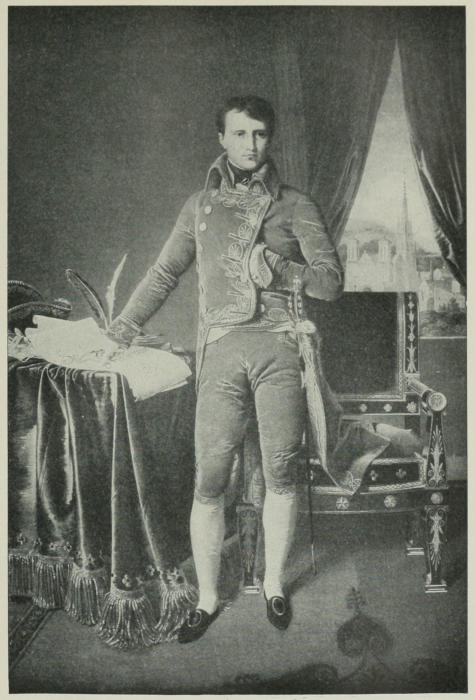
Bonaparte as First Consul. Painting by J. D. A. Ingres. Musée de Liége.
(Photograph by Braun, Paris and Dornach.)
Lucien notes the nervousness masked by this flood of questions, turns them off lightly, and says he is glad to find his brother in good health.
“Yes, I’m very well.” He pats his waistcoat, and adds: “I’m getting fat, and I’m afraid I shall get fatter still.” He looks keenly at Lucien, takes a pinch of snuff, and says: “As for you! Do you know that you are looking uncommonly well? You used to be rather too thin. Now, you are almost handsome.”
“Your Majesty is good enough to make fun of me.”
“No, no, it’s quite true. But let’s sit down and have a talk.” They seat themselves opposite the huge map, the Emperor fidgets with the pins, and Lucien waits for him to begin. But, since Napoleon does not open the ball, the younger man says, hesitatingly: “Sire....” At this moment, the Emperor sweeps all the pins flat, and says abruptly: “Well, what have you to say to me?”
Lucien replies that he hopes his brother has forgiven him.
“You can have my pardon soon enough. It depends entirely on yourself.”
Lucien expresses his willingness to do anything compatible with his honour.
“Well and good, but what sort of things will square with your honour?”
Lucien speaks of nature and religion.
“But politics, Sire; do politics mean nothing to you?”
Lucien demurs, saying that he has retired into private life.
“It rested entirely with yourself. You could have been a king just as well as your brothers.”
“Sire, my wife’s honour, my children’s position....”
“You keep on speaking of your wife, when you know perfectly well that she has never been your wife. Is not, and never will be, for I shall never recognise her.”
“Ah, Sire!”
“No, never, though the heavens should fall! Since you are my brother, I can forgive the wrong you have done me. But upon her my curse will rest!” There is a long tirade, until at length Lucien intervenes, laughing nervously, and saying:
“Moderate your words, Sire. There is a proverb: ‘La processione torna, dove esce,’” and Lucien thinks it expedient to add a French translation. When Napoleon continues to talk of his brother’s wife as a woman of bad reputation, and Lucien shows signs of taking offence, the Emperor tries to mollify him by admitting that these reports may be calumnious, but adds that nothing will induce him to recognise her. Besides, it is now a fundamental law, as firmly fixed as the Salic law, that no marriage in the Emperor’s family is valid without the Emperor’s consent. Lucien reminds him of the date of the marriage, and Napoleon answers: “Yes, but the law was passed because of what you had done!” This Napoleonic logic makes Lucien smile.
“What are you laughing at? I don’t see anything laughable in it! I know what you and your wife and my enemies say about the matter. You choose your friends from among my enemies. But no good Frenchman approves of what you have done. The only way in which you can regain popular esteem is by espousing my cause, like Jerome.”
Lucien, who is in the Emperor’s hands, has absolutely determined to let nothing affront him. But he is spurred into opposition, springs to his feet, and does not sit down again:
“Your Majesty is mistaken! When your courtiers approve your attitude towards me as thanks for the services I was so happy to render you, they are only acting after their kind. On my side, too, my servants tell me that I am right!”—At these words, Napoleon’s brow is furrowed, his eyes flash, and his nostrils work, “an unmistakable sign of rage in members of our family.” But Lucien has taken the bit between his teeth, and goes on: “What ought the nation to do for me? What gratitude does it owe me? It ought to look upon me as the saviour of the man who has saved it.... I am proud to think that it will rather be inclined to compare me with you than with Jerome. No, Sire, public opinion, which is mightier by far than all the kings in the world, assigns every one to his true place, whatever courtiers may say.”
Napoleon grows calmer. Instead of flying into a passion, as Lucien dreaded for a moment, he controls himself, and says quietly:
“Talleyrand is right. You speak of the affair with an ardour worthy of a political club. Such eloquence, Citoyen, is, believe me, long since out of fashion. I am well aware that you did me good service on the Nineteenth Brumaire; but as for having been my ‘saviour,’ of that proof is lacking. This much I remember clearly, that you disputed with me the unity of power which I needed for the saving of France, and that I and Joseph spent half a night before we could get you to pledge yourself to silence when these questions should be touched upon.... Finally, after the victory, you were inclined to oppose my personal elevation, and this conduct on your part releases me from all obligation to show gratitude.
“But you, do you owe me no gratitude? When you ‘saved’ me at Saint-Cloud, were not you yourself in mortal peril? I sent my grenadiers to save you from the hands of assassins. And if you, a bad brother, an unnatural brother, had really allowed that vote of my outlawry to be taken, do you imagine that I should have been such a fool as to accept the decree unresistingly? Had I not adherents enough, with God’s aid, to defend this head that was destined to wear so many crowns?” He goes on to speak for a whole hour of those days, and of Corsican compatriots who had helped him; suddenly gives the conversation an intimate turn; speaks of his generals and the extent of their devotion; refers to political conflicts in which the brothers had held divergent views, and shows how his view had been right. Then he changes the subject, saying abruptly:
“Enough. That is all ancient history, like your great day of the Nineteenth Brumaire. I did not summon you that we might deliver lectures to one another.” A long pause.
“Listen to me, Lucien, and weigh my words carefully, for, above all, let us avoid getting heated.... I am too powerful to have any desire to lose my temper. You have come to me trustfully. Corsican hospitality shall never be violated by the Emperor of the French. This virtue of our forefathers and fellow-countrymen is a guarantee for your absolute safety.” The Emperor strides up and down the hall for a long time, pulling himself together, and then turns to Lucien, whose hand he takes and presses:
“We are alone here. You see? We are alone. No one can overhear us. I am wrong about your marriage.... Knowing your wilfulness as I did, knowing your self-love—for everything, you know, depends on self-love, which regards itself as a virtue, just as we princes dignify by the name of policy everything which turns on our passions—I ought not to have interfered with your union. People slandered your wife to me, though some ventured to speak well of her, especially Mamma, who loves her, saying she makes you happy and is a good mother.... Lebrun, indeed, has sung her praises so often that Josephine once told the good fellow he must be in love with her himself. I was very much amused at my wife, who has more of a temper than people fancy. Still, I must say that Josephine never shows her claws to me! Well, I have no disrespect for your wife, but I detest her because this passion of yours for her has robbed me of the most capable of my brothers. However, her beauty will pass; you will be disillusioned; then, returning to political life, you will oppose my policy, and I shall have to take measures against you whether I like it or not; for—let me say this to you—unless you are on my side, Europe is too small for the pair of us!”
“You are making fun of me.”
“No, I’m in earnest; friend or foe! It is easier for you to-day than ever before. You need not be surprised: there has been a change in my family policy. You will see soon enough. Your children, which hitherto I have wanted to exclude, can now be of great use to me, but they must be dynastically recognised. The offspring of a marriage I do not recognise can have no right to the throne. Tell me, then, what would you do in my place?”
Lucien advises him to make the Senate pass a simple resolution to the effect that the children come within the right of succession.
“Of course I know that I can do that, but I must not. As you said just now, public opinion has to be conciliated. What would the family, the court, France, which all watch my slightest movements, say about such a step? A recantation of that kind would do me more harm than the loss of a battle.”
Lucien points out that he cannot possibly ask pardon for a marriage which had been entered into long before Napoleon’s accession to the throne. “Grant my request, Sire. You will have no more faithful servant than I. All the rest of my life will be an expression of my gratitude.”
The younger man goes on talking for a long time, and throughout his speech Napoleon is incessantly taking snuff, but spilling most of the tobacco, so nervous is he, growing more and more anxious; in his perplexity exclaiming at length: “Good God, you press me hard, and I am weak. But I shall not be so weak as to move the Senate to pass the resolution you ask for. I cannot recognise your wife!”
Thereupon Lucien, who is now almost beside himself, says: “Well, then, Sire, what do you really want of me?”
“What do I want? Simply that you should divorce your wife.”
“But you have always maintained that we are not married, so how can we get a divorce?”
“I expected you to say that. What do you think I can mean by asking you to procure a divorce? Obviously, thereby I recognise your marriage, but not your wife. The divorce will be the best thing for your children, just like all that you have hitherto refused to do, all that I have so much wanted you to do: to annul the marriage and divorce her.”
“That would be a dishonour for me and my children, and I will never do it!”
“Why is it, that with all your mother wit, you cannot see the difference between my earlier proposals and my present ones. In the former case, if your marriage had been declared null, your children would have become bastards!”
Lucien points out the difference between his children’s dynastic rights and their civic rights. “You can bestow your thrones upon whom you will, Sire, for you won them at the point of the sword. But no one shall cheat my children out of their share in the modest heritage of Carlo Bonaparte, for they are as legitimate as any one else’s both by canon law and by State law. The pope has even given one of my daughters the name of his mother!”
“Calm yourself!... Of course the divorce I ask for implies the recognition of your marriage. Nor do I wish to force an actual separation from your wife. She shall be honoured in accordance with her merits if she will make this sacrifice to my policy and to the future interests of France. I would even pay her a visit. But if she refuses, you and she will both be blamed for having sacrificed the true greatness of your children to your own egoism, and your children will curse your memory!”
Lucien answers mournfully.
“You are really incorrigible,” rejoins Napoleon. “You take everything so tragically. I am not asking for any tragedies! Think it over.”
After Lucien has again and again insisted upon his point of honour, and has several times wished to take leave, the Emperor once more brings up the distribution of the thrones. Eugene’s position in Italy is merely provisional, and he would much rather see Lucien installed there. Napoleon complains about Hortense, too. None of them are satisfied. “Pauline is naturally the most reasonable in the matter of ambition, for she is the queen of fashion. Besides, she grows more lovely day by day. Josephine is ageing, and is greatly distressed about a divorce.”
Lucien pricks up his ears. Napoleon goes on as if he were talking at random:
“Can you believe it? She always bursts into tears when her digestion is a little upset, for she fancies she is being poisoned by those who would like me to marry some one else. That is despicable. Still, in the end, I shall have to get a divorce. I ought to have taken the step long ago, and I should have had quite big children by now; for, I may as well tell you”—he speaks earnestly—“people are wrong in thinking it is my fault we have no children. I have several. Two I know of for certain.” He mentions, without naming her, Léon’s mother; and then, wonder of wonders, the Polish countess. “She is an exquisite woman, an angel.... You laugh to see that I am in love. Yes, I really am; but I never forget considerations of policy. She wants me to marry a princess. Of course, as far as feelings go, I would much rather raise my beloved to the throne. You, in your dealings with your wife, ought in like manner to be guided by considerations of policy!”
“Sire, I should act as you are doing if my wife were only my mistress.”
The Emperor grows more and more animated; speaks of a fixed intention to get a divorce; deplores having given the Bavarian princess to Eugene, who does not care for her and did not choose her for himself; remarks that he might long since have had Lucien’s daughter betrothed to the prince of Asturia “or some other great prince, perhaps even a great emperor.... Your divorce would have to precede mine, or be simultaneous. Then there would be less chatter about my divorce; for yours, in view of your obstinate refusal for so long previously, will certainly arouse more interest. Will you do me this service? I think you really ought to.”
Lucien looks at him so quizzically that the Emperor is amazed, eyes his brother up and down, and says: “Why not?”
Lucien smiles at the unreasonableness of the demand. Napoleon is embarrassed, but returns to the charge. Suddenly he addresses his brother as “my dear President” (Lucien having long ago been president of the Council of Five Hundred), and adds with emphasis: “Service for service, of course—and this time you will not find me ungrateful!”
Lucien sank “into a sort of reverie, which was by no means unpleasant,” so that for a few moments he hardly noticed what Napoleon was talking about. Before long he realised that the Emperor was saying, confidentially, that his only reason for wanting Lucien’s divorce was that this would probably minimise the effect of his own on public opinion. Lucien, as tactfully as he could, alluded to his own advantages, pointing out that his wife was a young woman and was not barren. Napoleon took no offence. “Your wife, oh, yes, your wife, didn’t I tell you? She will become the duchess of Parma, your eldest boy will be her heir, without having any claim of succession to your rights as a French prince. For this is only the first stage to which I shall raise you, until something better can be found: an independent crown.”
At the word “independent,” Lucien cannot restrain a smile, for he is thinking of the part his brothers have to play. Napoleon notices the expression on his face.
“Yes, independent. You will know how to reign.... You need only take your choice!” His eyes flash fire, and he bangs the enormous map with the flat of his hand. “I’m not talking at random. All this belongs to me or soon will. Even to-day, I can do what I please. Would you like to have Naples? I will take it away from Joseph.... Italy, the loveliest jewel in my imperial crown? Eugene is no more than viceroy. He hopes to become king, expects to outlive me, but he will be disappointed in this matter. I shall live to be ninety, for I cannot do with less than that for the complete consolidation of my empire. Besides, Eugene will not suit me in Italy, after I have divorced his mother. Would you care for Spain? Do you not see that it is ripe to fall into my hands, thanks to the blunders of the Bourbons you are so fond of? Would you not like to be king in the country to which you went as envoy? What would you prefer to have? It is for you to say. Anything and everything is at your disposal, if only you will divorce your wife before I divorce mine!”
Lucien is spell-bound for a time by the feverish haste with which Napoleon speaks. At last he says: “Not even your lovely France, Sire, would bribe me to this divorce; and besides....” He hesitates; but the Emperor guesses his thoughts, and says dryly, with an imperious air such as Lucien has never before seen him assume:
“Do you think that you, as a private individual, are in a more secure position than I upon my throne?... Do you believe that your friend the pope is strong enough to protect you against me if I should seriously propose to take measures against you?” After reiterating arguments and enticements, he says in a formal tone: “You may be quite sure of this: everything for the divorced Lucien; nothing for the undivorced!”
Lucien glances at the door, as a hint to the Emperor that he would be glad to be given his dismissal; but Napoleon takes him by the hand, and says “in a vague tone, and with a demeanour which might mean anything”:
“If I get a divorce, you will not be the only other one. Joseph is merely waiting for my divorce to arrange for his own. Madame Julie has been good for nothing but to bring girls into the world, whereas I urgently need boys. The only use of girls is to marry them off in advantageous alliances. Besides, your eldest girl is nearly fourteen, so you tell me; just the right age. Won’t you send her to Mamma? If you do what I want, I will get Mamma to arrange something good for her.... You are not afraid that we shall do any harm to your spoiled darling? Tell her we shall be good friends, and that I will not pull her ears as if she were a child.... I need more nephews and nieces! The divorced Josephine, the grandmother of Hortense’s children, will always be the enemy of my legitimate and my adopted sons.” Then, murmuring as if to himself, “It must be done. I have no other way of undermining the power of Louis’ and Hortense’s children.”