BOOK FOUR THE SEA (continued 3)
Cedar Paul translation
At the same date, Schelling writes: “I do not believe that Napoleon’s end is yet very near. If I am right, he will still be spared; and, even if all his helpers fall away from him, he will still live to drink the cup of humiliation to the dregs.” When, almost immediately afterwards, the Bavarians definitively changed sides, Hegel wrote: “In Nuremberg, the mob has welcomed the incoming Austrians with the most hateful jubilation.... Nothing more contemptible can be imagined than the mood and the conduct of the burghers.”
Three outstanding Germans, immediately after Leipzig!
Certainly, it is far from being a final defeat. Fighting, and fighting victoriously, the Emperor withdraws. In Erfurt, Murat presents himself, wishing to go back to his kingdom. The master allows him to do so, saying: “By next May, I shall have an army of a quarter of a million on the Rhine!” Thus does his intelligence work; such is the quality of his imagination; he can still think only in hundreds of thousands. In Mainz, his troops are attacked by typhus, and he hastens to move what is left of them across the Rhine. During the retreat, he works from three in the morning till eleven at night.
Meanwhile, the advancing allied headquarters are thronged by the princes who are deserting the cause of Napoleon. All is promptly forgotten and forgiven. But there is one honest man left who finds strong words to describe what is happening: “What do you think of these wretches’ behaviour?... They have had better treatment than they deserve.... All these princelets are weaklings, to whom a far more honourable existence has been conceded than their pitiful conduct would seem to justify.... The retention of their sovereignty, which consists in pretentiousness, pleasure seeking, and the lust for dominion, has cost them nothing more than the blood of their subjects.”
Such is Baron vom Stein’s judgment concerning his peers, the German princes.
XII
Letizia is sitting by the fire. In her hand is a letter from Mainz, in which her son answers her intercession for Louis by imposing certain conditions. But this is not what troubles her; she is thinking of the Emperor’s parenthetical allusion to the turn in his fortunes. He writes: “In this situation, when all Europe is rising against me, and my heart is so full of care....” She has never warned him of the impending dangers; they are both of them too proud for that. But she has often uttered her foreboding to intimates, with her phrase “Pourvou que cela doure!” She has never been disturbed by the thought of any disaster to herself. She thinks only of her dear ones. Who will help them when everything falls to pieces? To whom, she is now asking herself, can the Emperor look for support?
When he returns, she has to endure the recognition that the treachery begins among her own children. Murat, who is always led by a keener intelligence than his own (that of Caroline), signs a truce with England and enters into an alliance with Austria. Elise has an adviser, Fouché, who keeps away from Paris until the Emperor’s fall. “The only thing that could save us all would be the Emperor’s death.” Such are the ex-minister’s words to the Emperor’s sister. But Elise writes to her mother asking what dances are to be given that winter in Paris. Louis defies orders, and, being unable to stay in Austria any longer, comes to Paris without leave. Napoleon proposes to banish him to a distance of two hundred miles from Paris. The mother intercedes between the pair; there is a further interview, as a result of which Napoleon and Louis are once more estranged. Jerome has left his subjects in the lurch, and has fled incognito from Cassel. Joseph, despite the Emperor’s reiterated requests, persists in his refusal to undertake the defence of Paris. Lucien keeps his distance, still in a bad humour.
Such is the gallery of brothers and sisters, the relatives upon whom for a decade the Emperor has been trying to build up his dynasty. What can be the feelings of a mother who has always cherished the most tender affection for that one of her children who happened to be suffering most keenly?
But in Morfontaine a cheerful mood prevails. The company there consists of Joseph, the Spanish king without a country; Jerome’s wife, a queen in like situation, whose father has gone over to the allies; the sometime grand inquisitor of Spain says Mass in the chapel; there are two colonial bishops; German, Spanish, and Italian courtiers without a court—a brilliant company, like the audience at private theatricals, watching actors who will soon come down from the stage to take their place on the floor of the drawing-room. Only one of them hopes to draw a big fish out of the troubled waters, Bernadotte’s wife, Joseph’s sister-in-law, the woman to whom twenty years before the Emperor had given the go-by. She knows that her husband, commander of one of the allied armies, is already on the Rhine; she hopes that ere long, in Notre Dame, he will place Josephine’s crown on her pretty brown head.
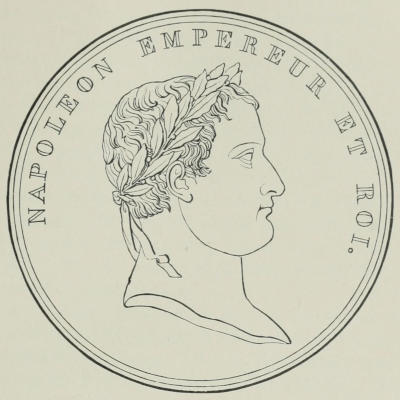
Napoleon as Emperor in 1809. Woodcut from a medal by J. P. Droz.
At this country-seat, more intrigues are carried on against Napoleon than Joseph is aware of; for Joseph is not himself an intriguer; he is merely easy-going and vain. The Emperor recognises this, now that it is too late, and says to Roederer:
“That has been one of my mistakes. I fancied I needed my brothers for the dynasty, but it is safe without them. It has been brought into being in the heart of the storm by the nature of things. The empress suffices.... Everything has been quiet for a year past. There is only disquiet when Joseph lives in Paris.... He cannot forget that he is the first-born. Was there ever anything more absurd? If he were talking of our father’s vineyard, that would be another story!... His interests are in women, houses, furniture. He likes to go out rabbit shooting, and to play blind man’s buff with the girls. I am tied to nothing; care not a jot for houses or for women; though I do feel a little concern about my son.”
Thus does his monomania make headway in these weeks of increasing peril. We see that all the rest, court included, has been nothing more than a game. He cares not a jot for anything outside the one passion of his soul—except that he is a little concerned about his son.
He now quickly makes up his mind to restore the Spanish crown to King Ferdinand, who is set at liberty; but the Cortes must approve the treaty. This is Talleyrand’s advice, for Talleyrand has now been recalled to the Tuileries. Insistence on ratification by the Cortes will delay matters. The traitor’s aim is to keep a French army in the south, so that France may be weakened for the benefit of the allies, for whose cause Talleyrand is now working. Joseph protests.
“My present situation makes it impossible for me to think of any sort of foreign dominion,” writes the Emperor to his brother. “I shall deem myself lucky if the peace treaty will allow me to keep the old boundaries of France. Everything is crashing round me. My armies have been destroyed, and it will hardly be possible to make the losses good. Holland is gone, and Italy is uncertain.... Belgium and the Rhine province are discontented; the Spanish frontier is held by the enemy.... How is it possible, at this crisis, to think of a foreign throne?” When the prefect of police advises him to leave a larger body of National Guards in Paris, during the campaign that is now imminent, he rejoins: “Who can guarantee that they will be faithful to me? Am I to leave so large a force in my rear?”
He is in despair. Surely there is no other word for the description of these thoughts? His family, his allies, his own capital, all seem untrustworthy to him. Thus completely has his mood changed since the battle of Leipzig. Count Lavalette, Postmaster General, one of the most honest men in Paris, who often came to see him at this time, found him one evening in a condition of great depression. Napoleon received Lavalette in his bedroom, standing in front of the fire, his hands stretched out towards the blaze. The visitor, though a stout-hearted fellow, advises peace, saying that the French are mutable. But when he ventures to mention the name of the Bourbons, on whom perhaps the Emperor’s mantle may fall, Napoleon turns away from the fire and silently throws himself on the bed. When, a few minutes later, the count draws near, he finds that Napoleon is sleeping.
These healthy reactions are a sign of returning courage. Napoleon’s overthrow is close at hand; he foresees the catastrophe; but when people talk to him about the Bourbons, to whose throne he has mounted and who may dispossess him in turn, he cannot be bothered with the topic. It bores him, and he goes to sleep.
Awakening reinvigorated, he recognises that the Bourbon sympathies of the northern provinces are a danger; he notes that the funds have fallen to fifty, and that the shares of the Bank of France have declined to half their former value; and he finds that the new National Guard, which after all he is obliged to call up, fails to materialise. He therefore gladly accedes to a proposal that issues from the allies in Frankfort. They are as disunited as he can possibly wish. Metternich, being a statesman, thinks it will be better not to occupy Paris. The tsar, being a romanticist, wants to take vengeance for Moscow by blowing up the Tuileries. In the end, Austria gets her way. The offer to France is that the country is to retain her natural frontiers; the Rhine, the Alps, the Pyrenees. The Emperor feels that he is saved. Without a moment’s delay he will accept the Frankfort proposal. Maret has actually drafted the dispatch.
Suddenly he changes his mind. Why? Perhaps he has been put out of temper by the opposition voiced in the Chambers. There, at length, the members are showing themselves refractory. “We will not vote further armaments unless the government agrees that they are to be used only for defence. The Emperor must pledge himself to carry out all the laws that protect liberty.” Thunders of applause greet these words. For the first time in fifteen years, an assembly has ventured to criticise Napoleon. In his hatred for all Chambers, the Emperor flies into a passion, forbids the printing of the speech, closes the House, receives a few of the deputies, scolds them:
“The throne is nothing more than a piece of wood covered with satin. I, and I alone, represent the people. I am the State. If France wants a different constitution, let her find another monarch for herself. Do you think my words proud? I utter them because I have the courage, and because France owes her greatness to me.” After this language in the vein of the Roi Soleil, on New Year’s Day he openly threatens the deputies, and says he will have them closely watched.
That very day, Blücher crosses the Rhine.
Thus, after twenty years of effort, and after six great wars, the more or less united powers of Europe and the old monarchical idea, incorporated in a Prussian field marshal, have made their way back across the boundary river of the revolution—and in the same hour, the heir of these modern ideas scatters their representatives and threatens imprisonment. With a similar logic, the manifestoes of the conflicting worlds have changed places. In Notre Dame, where for twenty years nothing has been heard but thanksgiving services, prayers are now offered up on behalf of the success of French arms. From the allies, on the other hand, who have so long heard talk of success of the French arms as heralding the liberation of conquered peoples, come assurances to conquered France that the invaders are “liberators.”
The legitimists have at length learned from their great foe the technique of his battles and his proclamations. But if they are able to turn the lesson to good account, it is only because of their preponderance of power, and because of the weariness of a nation, which, after twenty years of glory, now seeks nothing but repose.
To begin with, they weaken their position by asking too much; for when they offer nothing better than the old frontiers of 1792, the Emperor breaks off negotiations, and makes ready to repel their onslaught. In spite of all difficulties, he is able to strengthen his fighting front. His spirits are now steadily rising. When a pious count advises him to send the empress and her ladies to kiss the relics of Ste. Geneviève, Napoleon bursts out laughing, and says: “You’re a pretty bigot! I am going to fight it out!”
But to whom, in this stern moment, does he entrust the capital? Who merits all his confidence?
Joseph! Joseph, who understands nothing about war and has been keeping open house for the Emperor’s enemies, becomes lieutenant general of France and governor of Paris! This domestic peace treaty throws a glaring light upon the Emperor’s isolation, upon his lack of confidence in his supporters, and upon his family feeling. Shortly before leaving for the front, Napoleon has coldly ordered his brother to choose between openly declaring himself to be the friend of the empress-regent or continuing to be banished from Paris. “You can live in retirement at your country-seat, so long as I am alive. If I die, you will be killed or imprisoned. At Morfontaine, you will certainly be of no use either to your own people or to France, but at any rate you will not do me any harm. Make your choice. Feelings, whether friendly or hostile, are useless and out of place.”
The tone is that of a man fighting to save his crown. He reckons with the likelihood of death; burns a great many State papers; and provides for his natural sons. Little Léon is to receive a fixed income, Walewska’s boy is to have a big majorat. As for his legitimate heir, who is now nearly three years old, Napoleon has the child in his arms when he takes leave of the officers of the National Guard. “I entrust to you the dearest of my possessions. You are answerable!” Once more he urges tenacity on his brother; once more he leaves his wife regent of their son’s realm. Next morning he quits Paris.
He will not re-enter the city for more than a year, after devious wanderings.
XIII
In a few weeks he is beaten.
His first strokes are successful. Near Brienne, where he forces Blücher to retreat, and where he himself takes so active a part in the fight that he is obliged to draw his sword in self-defence, he recognises the tree under which “as a twelve-year-old youngster I used to sit and read Tasso.” A romantic encounter which links his later life with those early days when his dreams were first dreamed! His historical feeling concerning himself grows in such circumstances to legendary proportions.
Immediately thereafter, Blücher gains a victory over him near La Rothière. Paris is threatened. The Emperor’s strength seems broken. Caulaincourt, in a letter, begs him to yield; Maret does the same by word of mouth. Napoleon pays little heed to what Maret is saying; absently, he flutters the pages of a book by Montesquieu. Then, pointing to a passage, he bids Maret read aloud. “I know of nothing nobler than the determination of a monarch of our day to prefer to bury himself beneath the ruins of a throne rather than accept proposals to which no king should ever hearken.”
“I know of something nobler still!” exclaims Maret. “That you should sacrifice your glory and thereby fill the abyss wherein, otherwise, France will find her grave!”
“Very well,” answers the Emperor. “Make peace. Caulaincourt can conclude it, and sign the documents. I shall bear the shame. But do not claim from me that I myself should dictate my own abasement!” Maret writes to Caulaincourt in Châtillon, where he is negotiating anew with the enemy. Caulaincourt demands confirmation. Meanwhile the Emperor has veered about. He writes to Joseph: “Hold the gates bravely. Have two guns mounted and see that the National Guard takes up its position there.... Place fifty men at each gate armed with service muskets, one hundred with fowling pieces, and one hundred with pikes. Thus, each gate will be guarded by two hundred and fifty men.”
Crœsus has become a beggar! Only six months ago, nay, even three months back, Napoleon would have added three noughts to the figures! But now, encircled by the conglomerated forces of so many princes, two cannon and a hundred fowling pieces must suffice to save Paris! He sees the absurdity, for the same evening Maret finds him depressed. The minister, however, tries to persuade the Emperor to dictate the conditions of peace: Belgium and the left bank of the Rhine are to be free, Italy must be yielded up, everything which Bonaparte and Napoleon conquered must be given back in order that he may keep Paris and the piece of wood covered with satin. He will sign to-morrow, he says. Those who love him, tremble at thought of the moment when with one stroke of the pen he will lose all that his warlike deeds have won.
But fate guards him from this. News comes during the night. The enemy’s position is worse than it seemed the previous day. Once more the war lord’s imagination gets to work. When, next morning, Maret arrives with the papers for the Emperor’s signature, he finds his master brooding over the map. Napoleon hardly notices his entrance. All the minister can catch is a few hurried words:
“Other matters are to the fore! I am determined to smash Blücher!” When, at the self-same hour, Joseph’s letter arrives wherein he states that Paris is in peril, Napoleon, in the interludes of issuing army orders, dictates, from the depths of his heart, this rock-like answer:
“Should Paris be taken, I shall no longer continue to live.... I have commanded you to do all that is needful to safeguard the empress, the king of Rome, and our family.... I have the right to claim the assistance of my kin, for I have helped them so often in the past....
“If Talleyrand considers that the empress should in any case remain in Paris, this advice is secret treachery. Do not trust him! For sixteen years I have associated with him, and have often given him favours. But nothing is more certain than that he is the greatest enemy of our house, now that luck has forsaken us. Take my advice to heart. I understand events better than the young folk. If I lose the fight and die, you will be the first to hear of it.... I fancy that Madame Mère could find asylum with the queen of Westphalia. For God’s sake, do not allow the empress and the king to fall into the hands of the enemy! Austria would then lose interest in the war, and would take the empress to Vienna. England and Russia would make the French see things from their outlook, and our cause would be lost....
“Perhaps I shall conclude peace in a day or two.... Never since the world began has a sovereign allowed himself to be taken alive in an open city.... So long as I live, I must be obeyed. If I die, my reigning son and the regent his mother must not allow themselves to be taken, were it only for France’s honour. On the contrary, they must withdraw with the last of their soldiers and entrench themselves in the remotest village. Otherwise it might be said that I had sacrificed my son’s throne....
“I would rather know that my son had been killed than that he was being brought up in Vienna as an Austrian prince. I have never seen Andromache played without lamenting the fate of Astyanax, and I have always regarded it as a stroke of good fortune that his father did not live to see it. You do not know the French people. The consequences of these vast events are incalculable!”
This hunted man is panting for breath. For the first time since his youth, death or collapse seems close at hand; perhaps both. When he writes commanding Joseph to prepare for either eventuality, the two main elements of his soul are mingling, and both are scattering sparks. His calculating temperament is reckoning up the disastrous consequences that would ensue, should Austria’s ambition cease to be operative; but at the same time his idea of the destiny of his nearest and dearest takes a soaring flight. Were he to fall next day, this letter would remain to show that honour and glory had been the last flames of his heroic imagination. But to-day, as always, everything discloses a meditation upon the historical parallels which have throughout life been his spur to greatness.
Thus the letter is the burning-cold document of a statesman and poet, and only in this frame of mind is it becoming for a Napoleon to perish.
At the same time, he is a great military commander to the last. When he divides the remnants of his army into two halves, and begins by defeating Blücher with one of them in a brilliant advance, the six battles he fights in nine days, from Champaubert to Montereau, are still in the avalanche tempo of General Bonaparte. But that the names of these battle-fields are French, tells us the whole story; hitherto his victories have always borne foreign names. At Montereau he is an artillerist once more, training the guns with his own hand as at Toulon. He cries: “Forward, comrades! The cannon ball that will hit me has not been cast!”
He has settled accounts with Blücher. Now to deal with Schwarzenberg! But the Austrian is afraid of having his renown as commander dimmed, and is sedulous to avoid a decisive conflict; he actually writes direct to Berthier, suggesting that a truce be arranged in Châtillon. Enough for the Emperor to read this, and his lust for battle is redoubled. Another letter to Joseph, written with his own hand this time, breathing defiance, shrewd, bold:
“You have been talking to my wife about the Bourbons, but you should avoid such topics. I have no wish to take shelter behind my wife.... That would only sow dissension between us.... I have never tried to win the applause of the Parisians, for I am no stage puppet.... Besides, the real Paris is something very different from the passions of the three thousand persons who are raising all the clamour. Of course it would be easier to explain that one cannot levy any soldiers, than it is to make the attempt.... Je vous embrasse!”
It is many, many years since he has penned these words at the close of a letter. Not since the Marengo days has he written thus to any of his brothers or to any of his commanders—and Joseph is both. His heart is beating more vigorously. Next day, writing to Savary, who has informed him about a petition to the monarchs, and about the regency and fears and intrigues, his phrasing is more incisive, and bears witness to the excitement of a campaign:
“They shall learn that I am still the man of Wagram and Austerlitz! I will have no intrigues in the State.... Let me tell you that if a petition against the public authority is being circulated, I will arrest King Joseph and all the others who sign it!... I want no tribunes of the people! I myself am the great tribune!”
Meanwhile the allies are quarrelling. The tsar wants Paris to be placed under a Russian governor until the nation chooses Bernadotte or another; Austria will hear of nothing but a Bourbon restoration; Schwarzenberg wants peace to be made at once, and instead of joining battle is content to assume “a military attitude.” But Blücher, who has remarshalled his forces, simply cries “Forward!” and is on the march. When the allies once more send a proposal for the re-establishment of the old frontiers of France, the Emperor is enraged, saying: “I am so angry, that I feel dishonoured by the mere suggestion.” Being reminded that the enemy outnumbers him by three to one, he answers heroically: “I have fifty thousand men. Add myself, and you get a hundred and fifty thousand!”
Now, at the beginning of March, when he is to attack Blücher once more, for the command of his other army he puts his trust in Marmont, his earliest companion-in-arms.
But the spirit of revolt is rising. It had shown itself to Napoleon at Düben Castle in the previous autumn; during the winter it had been fomented in his brother’s circle; now it was to eventuate in treason under fire. Marmont, the first among men still above ground who had served under Napoleon, is also the first to betray him. Oudinot and Macdonald have lost the battle of Bar-sur-Aube. Now, at Laon, Marmont makes no more than a pretence of fighting, leaves his artillery in the town square, thus snatches victory from his master, and even allows himself to be surprised in his camp. “The Emperor would have been justified in cutting him down,” says Berthier, “but is so fond of him that, after making a scene, he has left him in command of his corps.”
What is more natural than that, during these days, his heart should go out to the friends of his youth? But Marmont is not the only traitor to whom he is lenient! Augereau, who had fought beside him at Rivoli, begins to make signals to the Austrians, fails to be at his post. The reprimand he receives is an affectionate one. Napoleon writes to him almost as if they were still brothers in the field, as of old.
“Six hours’ rest were not enough for you?... What pitiful excuses you are making, Augereau! No money! No horses! I command you to take the field within twelve hours of receiving this. If you are still the old Augereau of Castiglione, you can keep your command. But if you find the burden of your sixty years so heavy, hand over the command to the oldest of your generals. The country is in danger!... You should be the first in the firing line. We must all put on our seven-leagued boots, and must find the reckless courage of ’93. If the French soldiers see your plumes at the outposts, you will be able to lead your men whithersoever you please.”
Here we have General Bonaparte once more. The red of sunset reminds us of the glories of sunrise.
Owing to Marmont’s retreat, the Emperor is left unsupported at Arcis-sur-Aube, and has no more than a few thousand men with which to face a great army. Defeat is inevitable. During the height of the battle, a dust eddy sweeps across the field. A thousand dragoons are panic-stricken, and take to flight, shouting: “The Cossacks!” The Emperor gallops forward into the press. “Dragoons! Turn and fight! You are running away, but I stand firm!” He draws his sword and charges the enemy, followed only by his staff and the bodyguard. Six thousand Cossacks take to flight. It is years upon years since he has led a cavalry attack. His horse is shot under him, and he mounts another. Berthier reports that the Emperor was obviously hoping to find death on the field.
But death does not come for the asking. No more than Cæsar, Cromwell, or Frederick, is Napoleon destined for this swift, heroic end. Such men are something more than military commanders, and must live out their lives as leaders of nations,—even though they have to fight against their own nation. Henceforward the blows thicken, and each blow is symbolical.
But who can wonder if, at last, men forsake the despiser of men? He has made princes of his soldiers; should it surprise us that they prefer their princedoms to a soldier’s death? Need we wonder that a wife sprung from an ancient ruling house, married off to an upstart, should be quick to repudiate him and to become a Habsburg once more? That his brothers, in whom he has shown too much trust, should, when disaster comes, think of themselves rather than of the man to whom they owe everything?
When, in his last letters to Marie Louise, he asks her to write to her father, she complies with a bad grace, and, instead of following the example of Maria Theresa, she pens cold letters which can serve as hints to her father and his ministers. News reaches the allied headquarters that the English have landed in Bordeaux, and that the Bourbon flag has been hoisted there; a letter from the Emperor to his wife is intercepted, a letter in which he announces his intention to withdraw behind the Marne. It is enough; at length all are agreed for the march on Paris.
In this utmost danger, Napoleon has still a last bold shift. He will arm the peasants as a national reserve; they will be ready to his hand, for they hate the invading foreigners. But now tidings come that Marmont has allowed himself to be beaten once more, and is withdrawing to Paris with Mortier. Like one who hears that his house is on fire, the Emperor storms back towards Paris, entrusts the command of his troops to Berthier, and rides citywards with his bodyguard. Then, leaving everything behind, he jumps with Caulaincourt into a post-chaise, hoping it will not be too late to seize the reins of power. After how many victories has he not driven in such a carriage through the gates of his capital? Always his thoughts have circled round the problem, “What is Paris saying? How shall I find things there?” But now there is only one idea pulsing in his brain: Will three persons stand firm till I come; three to whom I can entrust the safety of the realm? The empress as regent, Joseph as governor of Paris, Marmont as leader of the strongest corps!
Night. Change of horses. A squad of soldiers led by an officer. The officer reports: “I am under Marshal Mortier’s orders, and am seeking quarters for the troops that are being withdrawn.”
“Troops being withdrawn? Where is the empress? Where is King Joseph?”
“Her Majesty, with the king of Rome, fled yesterday to Blois. King Joseph left Paris to-day.”
“Where is Marmont?”
“I don’t know, Sire.”
Beads of sweat form on the Emperor’s forehead; his lips twitch nervously; he is horrified at the news. He breaks out: “Forward! To-morrow the guards will be here. The National Guard is on my side. Once within the walls of Paris, I shall only leave the town as a conqueror or as a dead man!”
With difficulty, Caulaincourt persuades him to renounce this foolhardy design. The Emperor orders that Marmont’s corps is to take up its position behind the Essonne. Then he says to his minister: “Hasten to Paris! Go on negotiating for a treaty. I have been betrayed and sold. You have full powers. I will wait for you here. It is not far. Forward!”
He drives a hundred paces nearer, and can see the waters of the Seine. But what is mirrored therein? The enemy’s watch-fires! At the outposts, the invaders are cooking supper and singing songs; while the Emperor, on the left bank with two post-chaises and a few servants, watches them under cover of the darkness.
Then he has the carriage turned, and drives to Fontainebleau.
XIV
Next morning, Talleyrand is sitting in his bedchamber, submitting to the ministrations of his valet. This statesman of the revolution still has his wig dressed in the rococo style. The door is thrown open, and almost before the servant has time to announce him, Count Nesselrode hurries in to greet the friend of many years’ standing. He gets covered with powder from head to foot, Talleyrand informs us. Two hours later, the tsar himself comes to stay with his intimate friend as guest; he will not put up at the Elysée for fear of bombs. The moment for which Napoleon’s minister has worked indefatigably for six years has come at last, and the smiling victors shake hands with a sense of moral righteousness: virtue has triumphed! After knocking at the gates of Paris for two and twenty years, the legitimist monarchs have at length been admitted. This is their great moment. They have ridden into the city. A small party of Bourbon supporters has hailed them as liberators; the Faubourg Saint-Germain has rallied. Elsewhere in Paris, silence reigns. Every one is calmly waiting to see whether, on the morrow, Napoleon or Louis is to be called master.
The Emperor’s fate is sealed, for Joseph, in his cowardly flight and in spite of Napoleon’s warnings, has not taken Talleyrand along with him, but has left that cleverest and most dangerous of enemies in Paris. It is not fixity of purpose on the part of the nation that brings the Emperor to his doom; nor are the four allied foes unanimous as to his fate. He is ruined by the co-operation of faithless servants and treacherous friends, under the guidance of a man who is both—for Talleyrand, with the good graces of the tsar, takes upon himself the spiritual leadership of the next ten days. Now the intriguer is in his true element.
Yesterday he received another guest. Talleyrand by no means hates the Emperor, but has from the first sign of Napoleon’s decline, forsaken his master in order that he himself may climb. He has no wish to wreak vengeance on a prisoner, and, indeed, has no reason for revenge. Still, it would be convenient were the disturber of the peace quietly to disappear; and therefore he promises a goodly reward to a certain Maubreuil (a monarchist officer with an adventurous past) if this man “will carry out an important commission on the road to Fontainebleau.” But the adventurer’s heart fails him at the last moment, and he is content to attack Jerome’s brave young wife and carry off her jewels, instead of making an attempt on Napoleon’s life. Blücher, too, on his own initiative, has sent a detachment with definite orders to make an end of the Emperor.
“Well, what does France want?” asks the tsar of the abbé, as a man of wide experience. Talleyrand has long had in mind the restoration of the former king, but he thinks it best to ask whom Alexander would recommend. Somewhat diffidently, the tsar mentions the name of Bernadotte. Talleyrand smiles: “France does not want any more soldiers. If we wanted one we should keep the one we have already, the finest soldier in the world. No other, in his place, would find a hundred men to follow him.” Talleyrand says this to the conqueror, says it in plain words to the tsar; the defeated Emperor at Fontainebleau could have wished no greater tribute of admiration than such words from such lips in such a situation.
A day later, Talleyrand summons the Senate, and the legislature confirms the decision that the Emperor must abdicate. There is a general swing of opinion in this direction. Caulaincourt is the only one who puts up a fight for Napoleon, and tries to win over the tsar. For a moment, Alexander’s impressionable heart is touched; the image of his whilom friend rises before his mind; he wavers, and says that he will do his best with his allies to save the crown for the king of Rome.
But while the impotent Caulaincourt is trying to persuade the vacillating tsar, and is doing what he can to save the house of Bonaparte, at this same hour on the third of April, Talleyrand has summoned Marshal Marmont who, with his twelve thousand men across the Seine, is still a power, since the main body of the allies has not yet reached Paris.
See them sitting there, Napoleon’s companion-in-arms and senior officer, hobnobbing with the doyen of the Emperor’s ministers. The diplomat reasons coldly with the soldier, who hardly needs to listen to the arguments. He is hopelessly disillusioned, tired out. His faith had been shaken three years ago in Spain. His thoughts run this wise: “What is the use of trying to march with a dead man? The king is dead; long live the king! At the military academy, we were all monarchists. His defeat is a proof that the Bourbons have the right of it. The only choice is between being stood up in front of an old wall or taking one’s stand behind an old throne. The oath of allegiance? That has been abrogated. The ties of friendship? Only the other day, he was scolding me after the Laon affair.” Acting on the suggestion of his old acquaintance, Marmont writes to Schwarzenberg, the allies’ commander-in-chief:
“By the decree of the Senate, the army and the people have been released from their obligation of fealty to Napoleon. I am ready to promote an understanding between people and army, in order to avoid civil war.” Upon this pretext, which he subsequently endeavoured to fortify with the excuse of patriotism (the paltry argument of every turncoat), the Emperor’s senior marshal destroys the Emperor. Augereau, in a shameful proclamation, is quick to follow Marmont’s lead.
At the time when Talleyrand is winning over the marshals, the Emperor in Fontainebleau is reviewing his guards. To them he exclaims: “Never shall we allow any one to wear in Paris the white cockade of the émigrés.... In a few days we will attack the enemy in Paris!” The officers brandish their swords enthusiastically, shouting: “À Paris! Vive l’Empereur!” He waves his hand to them, and, smiling joyfully, he briskly mounts the steps, surrounded by his last ministers in their embroidered coats.
Soon afterwards, a carriage draws up in the courtyard. Caulaincourt steps out; he is pale, having passed the night in a vigil. He approaches the Emperor. Berthier enquires: “Well, my lad, how goes it?” The minister hesitates to answer, for he does not like Berthier’s tone. Are the very nearest going to fall away too? He finds the Emperor at work.
“What do they want of me?” asks Napoleon eagerly.
“Great sacrifices, that you may retain the crown for your son.”
“You mean that they refuse to treat with me! They want to make a helot of me, to hold me up as a warning to all those whose genius enables them to rule men and to make the born kings tremble on their ancient thrones!”
Bonaparte’s metallic tone! Such is the mood produced in the Emperor by the sight of his guards, by the perusal of his latest muster rolls, by the study of his maps. Now the minister mentions the most moderate of the tsar’s demands. Napoleon is to abdicate in favour of the king of Rome, and then the terms of a regency will be discussed. But there is talk of a Bourbon restoration. The Emperor leaps to his feet:
“They are mad! The Bourbons in France; they would not be able to hold their position for a year! Nine-tenths of the nation cannot endure them; my soldiers will never serve under them. They have lived for twenty years upon the alms of a foreigner, at war all the time with the fundamental principles of their homeland! The Senate consists entirely of regicides, or the sons of regicides. I was a newcomer, with nothing to take vengeance for; a man whose only business it was to upbuild.... No doubt they can draw profit out of the crash, can exile me and my family; but the Bourbons—never!”
Thus does his work roll before his mind as in a rhapsody, lighted up by his contempt for those whom he succeeded and who are now to succeed him. He becomes the soldier once more. “They demand my abdication. Will the crown then be secure for my son? I have still fifty thousand men. They will march with me to Paris. After the victory, the people shall decide. If, then, the French want to chase me away, I will go.” See the conflict in his soul. As statesman, he is willing to abdicate, that his son may reign; as soldier, he is still eager to fight, that he may retain all.
But while enthusiasm grows in the rank and file of his army, while the common soldiers are willing to give their lives for the Emperor, the marshals are malcontent. Although they have not yet heard of Marmont’s defection, they cherish like wishes, and would gladly shake off their allegiance to Napoleon if they could do so decently. This marked difference between the mood of the men and that of their leaders is once more a vengeance for the system of titles and monetary rewards with whose aid the military commander, when he had become an emperor, had transformed generals into marshals. Next day, the seniors among them are of one mind. Ney, Macdonald, Oudinot, and Lefèvre, in the most subservient way possible, speak to him of the advantages of abdication.
The Emperor shows them his maps, which are again beset with coloured pins; he points out to them that the enemy is in an unfavourable position, and enumerates his own resources. All is vain! The frame of mind they had shown in Düben Castle, intensified a hundredfold, blocks his way. Silently he dismisses them, for he wants to think over a plan. Mentally, he has mustered his forces, and the total of his additions does not seem to him a bad one. A conditional renunciation, therefore, will not betoken anything more than an armistice, a postponement.
A few hours after the audience of the marshals, he sends for Caulaincourt, and points to a holograph document on the table:
“There is my abdication. You can take it to Paris.”
The minister reads:
“Since the allied powers have declared that Emperor Napoleon is the only obstacle to the peace of Europe, Emperor Napoleon, faithful to his oath, declares himself ready, for the welfare of his country, which is inseparable from the rights of his son, from those of the regency of the empress, and from the maintenance of the laws of the Empire, to descend from the throne, to give up France and even life itself.”
What a style! A diplomatic document, involved in its phraseology, cautiously worded, ambiguous, penned for the inspection of diplomats of the old school. Nothing of Napoleon in it. The minister begs for the companionship of two of the marshals for so important a mission.
“Take Marmont and Ney,” says the Emperor, adding, “Marmont is my oldest comrade.”
“Marmont is not here.”
“Macdonald, then.”
Late that evening, three hours after the interview with Napoleon, the plenipotentiaries are at the Elysée confronting the allied princes and ministers. Most of the negotiations are carried on between the tsar and Caulaincourt. The latter’s contention that the French are heartily against the Bourbons has its effect; the parleys continue far into the night. Suddenly an announcement is made in Russian; the Frenchmen do not understand. Thereupon the tsar speaks: “You are relying, gentlemen, upon the unshakable loyalty of the troops towards the imperial regime. Well, I have just been informed that the advance guard, the sixth army corps, has deserted the Emperor. It has come over to our lines.”
The allies’ task has become easier; they now demand instant and unconditional abdication. Meanwhile the Emperor sends one courier after another from Fontainebleau to his minister. He writes:
“If they refuse to negotiate with me, what kind of a treaty will it be?... Bring back my act of abdication, I command you.... I will sign no treaty!”
Next day at six o’clock in the morning the Emperor is at work with Berthier. A captain is introduced, an adjutant of Mortier’s.
“Well, what news?”
“The sixth army corps has gone over to the enemy. It is marching to Paris.”
The Emperor seizes him by the arm and shakes it.
“Marmont? Are you sure? Did the troops know where they were being led?”
“During the night they were led into the Austrian camp. They were told that they were marching against the enemy.”
“My men have to be duped before they can be torn away from me! Did you see Marmont at the time he set out?”
“No, Sire.”
“The cavalry, too?”
“In close columns.”
“Where is Mortier?”
“He sent me to tell you that his corps will be loyal to you in life and in death. He awaits Your Majesty’s orders. The young guard is ready to die for you. All young France is ready!”
The emperor steps close up to the young officer, looks him straight in the eyes, and with a friendly gesture allows his hand to slip under the fringe of the epaulette so that it may rest on the captain’s shoulder. Thus does the ageing Napoleon find support once more in the young men of France.
When Caulaincourt brings the demands, he is accompanied only by Macdonald.
“Where is Ney?”
Silence. A pause. Then he is told the conditions. They probe him to the quick. To disavow the dynasty! For a decade the dynasty has been his goal.
“My personal withdrawal did not suffice? Must I, with my signature, disinherit my wife and my son? I cannot do this! I won their throne for them by my deeds!” The paradox has taken such deep root in his thoughts that he has ceased to be aware of his existence. Then he counts his troops again.
“I have twenty-five thousand men here; I can speedily bring up another eighteen thousand from Italy; Souchet has eighteen thousand, Soult forty. I shall fight!...”
The remaining troops are loyal, but the leaders are weary of the struggle. Why does he not place himself at the head of his guards? Because he can only think in terms of marshals, because the feudalist atmosphere is cutting him off from his stalwarts.
Here they all come again! They warn him, even Berthier joins with the others now, that Fontainebleau can easily be surrounded. He listens to them with dignified composure. Then he abruptly asks them whether they are prepared to march with him to the Loire; or to Italy, where they can join Eugene’s forces. Behind the proposal, we sense new plans of our adventurer. But the men who stand before him are marshals and Frenchmen; they breathe the words “civil war”; they advise him to abdicate. The island of Elba has been chosen for his dwelling place; he had better take what he can get! He dismisses them.
“None of them has either heart or reins! I am not so much beaten by fortune, as by the ingratitude of my brothers-in-arms. It is infamous. All is over!”
Without, in the drawing-room, groups of courtiers and dignitaries have assembled. Voices are hushed as though a king lay dead. All are awaiting the signature. The Emperor is well aware of this, he allows no one to enter his room, he will keep them waiting till morning. After a feverish, sleepless night, his negotiators find him sitting in his dressing-gown before the fire, a broken man and pitiable.
They bring him the deed which they have signed in Paris that night. He is to receive Elba, and two million francs as annual subsidy; he is to retain the title of Emperor; he is to have a guard of four hundred men. Talleyrand had warned the allies that this proximity of the lion to France was a menace; he suggested Corfu, and even mentioned St. Helena. Fouché endeavours to shield the Emperor from a slow descent from the heights; in elegantly phrased letters he suggests that Napoleon should go straight to America, where, as a free citizen, life could be started anew.—The farther away from the coasts of Europe, the better!
All this leaves the Emperor cold. He is visioning something different. He sees how Macdonald is standing the test; in his secret heart he is comparing this marshal with those others who have shown so much ingratitude; he feels now that he has not honoured the man enough. In this hour when he has to sign his abdication, Napoleon says:
“I have not sufficiently rewarded you. Now I can do no more. Take the sword which Sultan Selim gave me and keep it in remembrance.” While all are waiting for the signature, the Emperor sends for the gilded scimitar, and embraces the general as he presents it. Then Napoleon signs the act of abdication.
“The allied powers having declared that Emperor Napoleon is the sole obstacle to the re-establishment of peace in Europe, the Emperor, faithful to his oath, declares that he renounces, for himself and his heirs, the thrones of France and Italy, and that there is no sacrifice, not even that of life, which he is not ready to make for the interests of France.”
The deed is done! All breathe freely again. The generals and the courtiers leave Fontainebleau; Maret alone remains. They hasten to Paris; even Berthier throws himself into the arms of the provisional government. Talleyrand and Fouché are at the head of things.
But the Emperor remains another nine days in his palace, and he is not alone. Around him, unshaken, his guards are encamped; they still muster twenty-five thousand men. Who else is with him? His brothers have taken to their heels. What is Josephine doing, at Malmaison? After she has wept, and sworn that she will follow the forsaken Emperor, she receives Napoleon’s conqueror with sparkling eyes and adorned with all the pitiful appeal of a Niobe. The tsar wishes to play the part of a knightly cavalier, and succumbs to the renowned charms of the first empress. But Hortense, her daughter, receives the tsar’s visit coldly and off-handedly. As soon as he is gone, she hastens to Fontainebleau and remains with the Emperor till his departure.
At first, his mother is with him. But, wishing to see her in safety, he persuades her to go away with Jerome. They will meet again later. When the empress says good-bye to Letizia, she utters polite commonplaces and wishes her mother-in-law well. The old lady, who sees through Marie Louise, and knows that all she cares for is security and enjoyment, answers this daughter of the Habsburgs: “That will depend upon you, and upon your future conduct.”
The Emperor has no word from wife or son in reply to his numerous letters and messengers. While for himself he asks neither land nor money, for her he demands that, in addition to Parma, she should have Tuscany, or at least a strip of it which would bring her lands nearer to Elba and thus set up a link between man and wife. He writes to her advising as to the best halting-places on the route; Corvisart is to decide which waters will do her health most good; she is to take her personal treasure with her. Then he writes to the palace prefect that all the diamonds which are not her or his personal property must be given back to the treasury, for they belong to France.
Meanwhile the government has sent a confidential agent to the Tuileries with orders to seize the imperial treasure. All the gold and securities, valued at one hundred and fifty millions, were taken away; in plain words, stolen. These sums had been saved by Napoleon from his civil list during the fourteen years of his rule. His silver plate, all personal articles of value, his golden snuff-boxes, and even his handkerchiefs embroidered with the initial N., were taken at the same time. The order for this bears, among others, Talleyrand’s signature. The Emperor, who until yesterday was the wealthiest man in Europe, journeys to Elba with three million francs as his fortune!
He is profoundly disheartened. Can anything disillusion him further? Lucien writes to the pope the day after the abdication, and becomes a Roman prince. Murat, acting on the advice of Fouché (who holds the net of intrigues during these last weeks), has entered Rome, has advanced his troops towards Tuscany, invading Elise’s realm—always spurred on by Caroline, and always in alliance with England, which has occupied Tuscany. Elise, who at the last moment has staked on the wrong hazard, and has through a false calculation remained faithful to her brother, flees before her sister’s troops, brings a child into the world while lying up at a mountain tavern, and in Bologna is taken prisoner by the Austrians. The only two of the pack who have behaved decently are Jerome and his wife.
The last days pass in sinister silence. “If a carriage drives into the palace yard, all prick up their ears. Is any one coming to bid Napoleon farewell? No one comes while affairs are being wound up. But a day or two before the departure, a veiled lady arrives, late in the evening. No one knows her, and she is not admitted. Countess Walewska waits a whole night, and when she goes away in the morning she leaves a letter for him. He sends after her, but she has gone. He writes:
“Marie!... The feelings which animate you touch me profoundly. They are worthy of your lovely soul and the goodness of your heart.... Think affectionately of me! Never doubt me! N.”
As soon as he has recovered his old tranquillity of mind, the Emperor is promptly animated with new energy. Has he not an island as base of operations? Who knows what may come of it? Corsica, too, is an island in the Mediterranean! He orders a monograph and studies the geography and statistics of Elba. “The air is wholesome, the inhabitants are honest folk, and I hope that my good Louise will like the place well enough.” He chooses his four hundred men; but the whole guard wants to go with him, though this will involve leaving wife and children. Among them are men whose hearts he had won two-and-twenty years earlier when he had been captain in Toulon, men who had followed his fortunes from Cairo to Moscow, through sixty battles.
He cheers up. Discussing predetermination with the palace prefect, and how death has passed him by during the last battles, he adds:
“A violent death is cowardice. I can see no greatness in shirking responsibility in that manner, like one who has gambled away his fortune.... Suicide is incompatible with my principles and with the position I have occupied in the world.” They walk up and down the terrace in silence for a time, and then he says with a smile: “Between ourselves, a living drummer is better than a dead emperor!”
All the formalities have been accomplished; the allied commissioners who are to accompany him to Elba, four in number, have arrived; the start is fixed for noon. He writes in simple terms to tell his wife, and concludes: “Farewell, my good Louise. You can rest assured of the courage, the tranquillity, and the affection of your husband. N.” He adds as a postscript: “A kiss for the little king!”
The start will be an easy matter, for no one has come to take leave.
But there are to be leave-takings after all. The old guard is waiting for him in the palace yard, drawn up in a square. As he comes down the steps, thousands of eyes are fixed on him. He must say something. What can he say? For twenty years he has only spoken to these men just before a battle and just after a victory, to inspire them or to thank them. Well, he will thank them now, though there has been no victory; he will thank them for the hundred victories of the past. He steps forward. “Vive l’Empereur!” He enters the square, and says:
“Soldiers of my old guard, I take leave of you. For twenty years I have seen you always upon the path of honour and glory. During the last few weeks, you have been models of bravery and fidelity, just as in the years of good fortune.... But there would have been civil war. That is why I sacrificed all other interests to those of the country. I am going away.... You, friends, continue to serve France. Her happiness has been my only thought. My good wishes go with you. Do not mourn my fate. If I have determined to go on living, it is that I may increase your fame. I shall write the story of the great deeds we wrought together. Farewell, my children. I would gladly press you all to my heart. At least let me kiss your colours!”
The general holds out the colours. Napoleon embraces him, and kisses the flag. “Good-bye, comrades!” He gets into the carriage. “Vive l’Empereur!” He drives away.
The war-hardened veterans stand there, blubbering like children. Their father has gone away. Never had he spoken to them more movingly. The dignified pathos of ancient Rome, the ardent imagery of his manifestoes, the similes and the exaltations, have vanished with the fever of battle. This Emperor spoke like a commander, this commander spoke like a company leader. His words were manly, blunt, and restrained. When he kissed the colours, it was an unparalleled gesture; never before had he done anything of the kind. They will tell their grandchildren what the great Emperor, their “petit caporal,” has said to them this day. The grandchildren will tell their grandchildren in turn, and so the story will go down the generations.
But hardly has he left this soldierly atmosphere, in which he grew to manhood and then to greatness, when he has to face the mob. After the sobs of his old soldiers, come clamour, cries, and curses! As the train of carriages drives swiftly through Provence, the threatening shouts of the people deafen him: “Down with the tyrant! Kill the wretch!” In the villages where the horses are changed, women rage round his carriage, screaming at him, flinging stones, trying to force the coachman to shout “Vive le Roi!” At one of these villages, the crowd has prepared an effigy, a uniform coat stuffed with straw and smeared with mire and blood. Here they hail him with the cry: “Kill the murderer!” The carriages press on at top speed and the journey becomes a flight. Napoleon’s first flight.
With rigid face, the Emperor looks at the mob and listens to the cries of execration. Are these the same people who ran beside his carriage, eager to catch a glance from his eyes? They are indeed the same! What he is now experiencing, he had foreseen, with the seer’s vision of the misanthrope, at his first entry into Paris when the crowd had jubilantly welcomed him as conqueror. He sits huddled in a corner of the carriage, pale and silent; at each halt, the foreign commissioners jump out to guard the windows of his coach. Will he bear all this without making a sign? Will he draw his sword? He does not wear one now. In mufti, he can get away from his country, but not in his green uniform. Only once before has he had such an experience. It was on the Nineteenth Brumaire, when the radicals were shaking their fists at him. Then he did not draw his sword. Then, as now, he was powerless against the mob, for it was not his trade to beat the mutable many, nor was it his talent to persuade them. He is not a tribune; he is an emperor. One who can command as well as he, can do nothing but command. If he fights, it must be in a battle.
Movement! Air! In a lonely road, he has the carriage stopped, and one of the post-horses taken out of the traces. He fixes a white cockade on his plain round hat, and rides in front of the carriages, outstripping them, his servant following. Thus he makes his way to Aix, but halts short of the town, enters a wayside inn, and gives his name there as Campbell, a British colonel. This is his sixth name.
The little Provençal maid who waits at table prattles: “They’ll finish him off before he reaches the sea!” “Colonel Campbell” nods, saying “Of course, of course!” to all her utterances. Then, when he is left alone with his servant, his head droops on the man’s shoulder, he has a nap to make up for two sleepless nights. Kindly nature, this is your gift to the greatest of your warriors! When he wakes, the recent sounds and sights recur to his mind. With a shudder, he says in low tones:
“Never again! I shall be happier in Elba than ever before. The sciences now, nothing more. I do not want to wear another European crown. You have seen what the people really is. Was I not right to despise man?”
When the carriages reach the inn, he thinks it wise, warned by his previous experiences, to change his clothes once more. Since time presses, he puts on the uniform of an Austrian general which belongs to Commissioner Koller; surmounts it with the cap of Truchsess, the Prussian colonel; and has a Russian cloak hung round his shoulders by Shuvaloff. Thus bedecked in a carnival costume, pieced together from garments belonging to the three allied powers, a fool on the heath, does Emperor Napoleon escape from his country.
Fréjus at last! This is the port where he landed on his return from Egypt, a beaten commander, who had lost all the battleships of France, and ought to have been tried by court-martial! But how enthusiastic, then, had been his reception by this leaderless people, for the memory of his successful Italian campaign was still fresh. Then, he had driven through triumphal arches on the journey to Paris; the journey he had now been making in the reverse direction, in danger of being stoned, and escaping murder only by a mummer’s disguise! Fifteen years lie between, the rebirth of a State, the glory of a nation. Europe lies between, the clash of arms, dead soldiers rotting in their graves, the returning hero received with frenzied acclamations, a marshal rising from pothouse to palace, men of genius taking sides for and against the conquering nation—and a circlet of little golden leaves which the foreigner from the Mediterranean island had, with the simplicity of the self-made man, placed on his own brow.
XV
How big Corsica is! How high her mountains! Bastia is an admirable harbour; its fortifications can be seen through a spyglass. If taken from the eastern side....
When the ruler of Elba rides among the hills of his new home, the silhouette of his old home lies spread before him; everything looms larger across the water. Forty times bigger, ten times as many inhabitants; he has all the figures, to a unit, in his head. Elba is nothing more than a mole-hill.
On the clear May morning when he landed, he was welcomed by a deputation of peasants and petty burghers in Porto Ferrajo. Timidly they had paid their compliments to the man who was to reign over them. But their astonishment was great when, instead of inviting them to a banquet, he leapt into the saddle and rode off to inspect the fortifications. On the morrow, orders began to fly about the sleepy little isle: Pianosa was to have two more batteries; the mole must be lengthened; the roads improved. When first the four hundred grenadiers appeared in the land, the natives looked at them askance as men of a foreign race. Soon, however, the forces were increased by the creation of a foreign battalion, and a National Guard. Napoleon once more has an army of over a thousand men; soon he has a small flotilla likewise. What for? Just for him to see after and take care of. He has a Council of State; Bertrand and Drouot (the generals who have accompanied him into exile) and a dozen inhabitants of the island, are members; and, together with Napoleon who presides over the assembly, they discuss improvements in the iron mines and the salt pits. Have you no mulberry culture here? The silkworms bring in good money over there, in Lyons; and if the French government imposes a tariff upon our produce, we can easily sell to Italy.
Save! We are so poor, and France makes no move to pay the promised allowance. The white house is smaller than the one in Ajaccio, and very much simpler; but there is no money for building additional accommodation; and when the “grand marshal” Bertrand draws up a list of mattresses and other bedgear, his master underlines the mistakes,—for he has every detail of his establishment by heart.
Is this indefatigable man never to realise what a parody is his administration over the tiny island, the diminutive army, the small household? Never! Here in Elba, where in the best of spirits and health he throws himself whole-heartedly into his undertakings, he comes to realise that it was not the masses that had allured him. To order, to build, to press his finger into the wax of humanity, these things he must do, urged onward by the impulse of his artist’s soul. But, since humanity is not as wax, and since his constructions can never be finished and are always vibrant with life; since the opposition of material forces also takes a hand in the game, even when matter seems to have been conquered—he can only fulfil his mission by coercing and conquering the human spirit, by issuing orders and bringing suggestions to bear, by constant vigilance and constant upbuilding; in a word, by ruling. He has never been a dilettante or a parvenu; and, this being so, he drives the little wheel to-day with just as much precision and earnestness as he had driven the earth’s sphere in former days.
But soon, when most of his enterprises are in good going order, he feels he is becoming lazy, even when he is studying mathematics. This causes him to reconsider his position.
“It is by no means difficult to accustom oneself to a life of meditation,” he writes, “if one possesses within oneself the necessary reserves. I work hard in my study; when I emerge I have the delightful spectacle of my old grenadiers in front of me.... Born kings must suffer terribly when they are dethroned, for pomp and etiquette are the very marrow of their lives. For my part, I have always been a soldier, and became a king only by chance, so that these things have been nothing but a burden to me, whereas wars and camps come naturally. Out of my great past, I regret naught but my soldiers. After all my treasures and my crowns, my most cherished possessions are the couple of French uniforms they have allowed me to keep.”
These are the words of an unpretentious king. Do people not believe him? And does Europe laugh when, in his kingdom of Lilliput, he preserves the forms of kingship? Does Europe begin to suspect a secret in the island? The innate dignity, whereby long ago the young general had wrung respect from the bearers of inherited rank, to-day is still able to hold satirical visitors in check. Every one admires the natural simplicity of the lonely man who, despite the exiguity of his dwelling, still holds to the title of “Majesty.” He lives in his island sans palace or fittings, sans court or ministers, only surrounded with the aureole of his deeds.
This return home brings solace to his heart—for Elba is Italy. The peasant speaks to him in the language Napolione had learned at Letizia’s knee. The Mediterranean amid whose waters he was born and reared, the islands with their quiet shores, do they not all of them bring back memories of youthful days? Stone-pines, fig trees, and crags; the white houses among the vineyards; the sails, and the fishermen’s nets; pride of clan, and the headkerchief worn at church; all these things seem to take him gently by the hand and lead him back to the dreams of childhood. Now the storm-racked nerves relax, and at length know a spell of repose. In these wholesome months, the Emperor comes to look upon his career as a visionary flight into the land of childish imagination; and it is only when he contemplates the men of his old guard that he realises something did happen during the years that separate Corsica from Elba.
“The Emperor lives very contentedly on his island,” writes one who accompanied him there. “He seems to have forgotten the past. The management of his small household gives him occupation; he is now looking out for a suitable site to build his country-seat; we ride, and drive, and sail round the coasts as much as we please.”
Since he has plenty of time on his hands, and since thrift is essential, he examines everything, to the minutest details. Just as, in the Tuileries, he himself drew up the list of his clothing, so now, in Elba, he says to Bertrand: “My underlinen is in a lamentable state. Part of it has never been unpacked, and it has not been marked. Give orders that everything must be laid out in drawers and presses, and that no one is to be given anything belonging to our court without furnishing a receipt.... There are not enough ordinary chairs. Have a sample sent from Pisa; they must not cost more than five francs apiece.”
Europe laughs when it hears of this. Posterity stands bewildered before such energetic renunciation.
Once only do we hear a gentle sigh. He has climbed to the top of a hill whence he can look over the whole of his realm. Surveying the prospect, he says: “One must acknowledge that the island is very small.” Like distant thunder, the fate of a man seems to rumble in these words; for an all too great imagination, confined within the narrow limits of Europe and cribbed within the circle of the folk intelligence of the nineteenth century, is doomed at the outset to be crushed.
With the summer, comes his mother. She, alone, is happy. Her son is no longer threatened with assassination or with battles. Here, all is peaceful and warm; Elba is almost as lovely as Corsica. Daily intercourse with him renews for her the good old times. It is as well that she has come; for, from the millions which she alone has put by, she now brings her son what he needs; and when he receives her banknotes, may we not picture mother and son smiling at one another? On his name-day, she invites him to a little rustic feast.
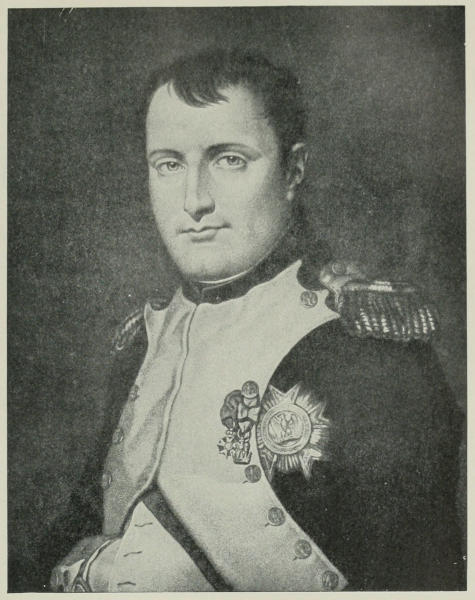
Napoleon as Emperor. Engraving by Bourgeois, after a painting by Jacques Louis David.
(From the “Corpus Imaginum” of the Photographic Society, Charlottenburg.)
A dozen and more St. Napoleon days she has spent in Paris: the guns would fire the salute from the Invalides, Masses would be said; Senate and ministers, the court and foreign diplomats, would throng the halls of the Tuileries. When, in the evening, the rooms were filled with guests, and, amid the strains of music, there came and went all that France possessed of great names, of beauty, and of precious jewels; when the fireworks filled the August night-sky with brightness, and thousands of tiny lamps formed the initial N.—Letizia, surrounded by the kings who were the fruit of her womb, would stand silent and proud, thinking the old words so full of ominous warning. But to-day she is blithe; to-day she compares this jocund festivity with the little town of Ajaccio; to-day, for the first time, she thinks: “All the same, we achieved something fine!”
Letizia had been able, while in Rome, to heal many wounds dealt in the heat of the fray. The pope, on his return, had pardoned the mother of his sometime foe. She was not surprised when the whole court, when even her secretary (a Corsican), speedily went over to the Bourbon king. Has she not always foretold it? Caroline, alone, is not permitted to appear before her.
Pauline, Princess Borghese, merry and brilliant, does not hang long in the wind. She has always been the most affectionate, and has been clever enough to prefer real diamonds and nights of love to uncertain thrones and crowns. She comes to the island, so that, with her mother, she may bring cheer to the Emperor. She shakes out a basketful of gossip and news for his delectation.
Hardly a word from his brothers. One letter comes from Lucien. What propositions can he be laying before his banished brother? Will he, who lives in princely fashion in Rome, with magnanimous generosity offer Napoleon money or bring his influence to bear in his imperial brother’s behalf? What does the “Prince of Canino” by the pope’s grace write in his letter? He owns smelting furnaces, and Elba has iron ore wherewith to feed them: he asks his brother to provide him with the minerals. Crowns and gold, he has refused; but iron, which his brother still possesses, he can make good use of. Maybe he, who is a poet, is enjoying the farce of these blast-furnaces! Is it not a kindness that one still thinks of the exile? Who else writes?
Josephine is dead. A few weeks after Napoleon’s departure, she died at Malmaison. No one knows if she ever wrote to him; what is certain is that she left debts amounting to three millions, which he had to pay. Hortense has been separated from her husband. She has become a duchess, and has made her most graceful curtsey before the Bourbon king, in the very room where she and her mother had held sway for so long. Little Léon, whom Letizia had for a time with her in Rome, resembles his father; he is reported to be courageous and full of pranks. These are all the members of Napoleon’s family about whom he has news.
An English vessel brings the unknown lady who visited Fontainebleau to the island. In a marquee, beneath the chestnut trees, the Emperor receives Countess Walewska. For two days and two nights they are inseparable. The Emperor only issues forth to give the necessary orders, and the four-year-old boy, dressed in the Polish national costume, plays in the meadow with the tall grenadiers. The Emperor would like to keep Walewska by his side, but he does not wish to provide the empress with an excuse for not coming to live with him. Thus, for the second time, he sacrifices on the altar of the Habsburg princess the phantom of his happiness. Walewska sails away. Her ship encounters bad weather, and the Emperor is filled with restless anxiety until he receives tidings that she has arrived safely at Leghorn.
How marvellously are the threads weaving themselves into the tissue of a legend! With wizard spells this man of forty-five links up epochs and customs. Here he is, a petty prince on a Mediterranean isle: he receives his beloved, the lady with whom he had lived in the imperial palace at Schönbrunn when he himself was an enemy and unknown to the proprietor; to-day he is once again this man’s foe, and another woman whom he had invited to his arms from the self-same palace has long since forsaken him; yet his natural son, born in a lonely castle in Poland, is playing beneath the trees of the southern land and wears the dress of a foreign folk which the Emperor had once promised to free. Who could believe that all this had come to pass within five years? A hundred years seemed likelier for the accomplishment of so many events. With such nets, what other fish could one expect to catch but the golden ones of the fairy tale? A thousand years ago a great emperor was banished and left forsaken on an island; but from a distant realm a beautiful, tragical woman found the way to him across the sea, and brought him his son.
In truth Napoleon is forsaken by wife and child. This loss cuts him no less, maybe even more cruelly, than the loss of power, for his conception of marriage is conservative and bourgeois. Constantly, even during the via dolorosa of his last journey through France, he has written to Marie Louise; he has planned a new house for her. But his letters remain unanswered. Believing that his correspondence has been intercepted, he at last writes to the grand duke of Tuscany, her uncle, begging for news; for “I trust that Your Royal Highness has preserved a little friendliness towards me, in spite of the events which have changed the sentiments of so many men.... If so, I beg that you will look favourably upon the tiny commune which feels the same towards you as does Tuscany....” Ay, thus writes the prince of this diminutive isle, a prince with no more than twenty thousand subjects, to the mighty grand duke! But the grand duke keeps silence.
When Napoleon realises the sluggishness of the human heart, his old defiance regains the ascendant. It is with a sense of relief that we hear his well-known voice ring out again, after the anguish of this grovelling letter—a letter that would never have been written but for his wife’s sake. He exclaims: “These sovereigns, who were wont to send me, in all solemnity, their delegations of ambassadors, who gave a daughter of their blood to share my bed, and who called me ‘Brother,’ are now cursing me as a usurper, and spit upon my picture since they cannot spit upon the original. They have bespattered the majesty of kings with mud! What is the title of emperor? Had I no other name to bequeath, posterity would laugh.... In classical days, the vanquished were robbed of their children, that these might be paraded before the people when the conqueror was celebrating his triumph....”
What must be the tenor of Napoleon’s thoughts when he learns how, on that shameful day of cowardice and confusion, the lad of four had refused to leave the palace of his father; of how, when the little king of Rome had met his grandfather for the first time, he had uttered the innocent words: “I have seen the emperor of Austria. He is not handsome.” This was precisely what Napoleon had wished to avoid. The fate of Astyanax has been prepared for the boy; and even though he is made much of, the child is well aware that he must no longer mention his father’s name. Though he has received the symbolical names of Napoleon Francis and thus embodies the unhappy union of two antagonistic worlds, the name of Napoleon is soon destined to be heard no more. For, when the young cuckoo is introduced into the Habsburg nest, he is called Francis, and nothing else. Later, when the empress’ secretary is leaving Vienna and presents himself to take farewell, the boy draws him into a window recess and says in a hurried whisper: “Tell my father I love him tremendously!”
What must be the tenor of Napoleon’s thoughts when he hears gossip about a certain Neipperg, an Austrian officer, a man of no account, and one whose only way into history is through the bedroom of a Habsburg princess—who would herself never have been heard of had it not been for her marriage to Napoleon. Thus terrible are the blows of fate, and his intimates think it natural enough when they see their master weeping over his boy’s portrait.
But now Pauline arrives, fascinating as ever, in the best of spirits. To amuse him, she mimics the grimaces that are made by the worthies of the island and their wives when, at the weekly receptions, the Emperor asks them how many children they have, and whether they think he ought to build a hospital. As the year draws on, Italians from the mainland come in increasing numbers. Persons with satisfactory recommendations—historians, poets, men of birth, and even Englishmen—secure a good reception; and he will talk to them for hours, though only of the past, with never a word about the future. He is delighted to hear such visitors rail at the Austrian regime which has now been set up once more, but he will pay no heed to conspirators who wish him to come to Italy as leader of a revolt. His thoughts range towards the other coast, and by slow degrees mature into plans.
What is Paris saying?
To him this is still the question of questions. The news brought to him in the journals twice a week, and the information he gleans from his visitors, lead him to turn new possibilities over in his mind. But it must not be supposed that Napoleon began the new epoch with a definite plan. When he landed in Elba, it was an open question in his mind whether he would ever quit the island. Still, the thought of future possibilities was intensified in him by the usual forebodings of an adventurer—the adventurer he had become since the failure at Moscow. “A living drummer is better than a dead emperor.” Slowly, as the conditions change, he makes plans and rejects them, renews and modifies his designs. They turn upon what is happening in Paris and in Vienna.
What is Paris saying about the Bourbons? Hardly is Napoleon away, when they make their “entry” after the usual manner of exiled kings who return; and though the newspapers, under duress of the censorship the Emperor had established, lie like troopers, in his remote island he can learn the ridiculous truth. Four persons are sitting in a small carriage. The Parisians, whose risibilities are easily touched, certainly have something to laugh at. The king is there, in an amazing rig-out, in plain clothes, but decked with gigantic epaulettes; a man so fat that he has three chins; and he smiles at the gaping crowd. Beside him is the duchess of Angoulème, her face tearful with reminiscence. On the opposite seat are the prince of Condé, a very old man, and the duke of Bourbon; they wear the uniforms of the good old days, which none of the younger onlookers have ever seen before. This carriage, freighted with the resurrected ghosts of those who had been laid to rest twenty-two years ago, was attended by Emperor Napoleon’s sulky-looking guard, men whose uniforms, shot and slashed, bore witness to the titanic struggles that had been waged in the interim.
The Emperor makes eager enquiries concerning the habits of his successor on the throne, and is gratified to learn that Louis has taken over his room without making any changes. The king’s demeanour is said to be far from regal. According to a German description of this date, Louis was “extremely obese, so fat that he can hardly walk. Wearing black satin boots, he is supported on each side, and would stumble over a straw. He is clad in a sort of blue soutane with a turn-over red collar and hanging golden epaulettes of an antique pattern.” This sort of thing keeps the Emperor amused for a whole hour. For a dozen years, England has been publishing caricatures depicting Napoleon’s camp manners in the palace of the Bourbons, and now this legitimate ruler, set up by England, is a veritable caricature of a monarch. What is Louis doing to show his good will towards the people?
He has granted a constitution? But soon comes news that this gracious gift exists only on paper. The old inequalities, the privileges of caste, which had cost the present king’s brother his head, are quietly stealing in through the back door. The nobles are not liable to military service, and men of humble birth have no chance of rising to high office. The new nobility is made a mock of. King Louis, a good old man, reasonable enough, is led by his brother, the gloomy count of Artois. Around the latter are concentrated the vengeful émigrés, who are demanding the return of their property; but the law guarantees the rights of the actual holders. The king, therefore, gives peerages and large pensions to the émigrés.
What is this? So the clergy is rising to power once more! The priests are on the side of the old nobility, and by threats of hell-fire induce the dying to execute wills in favour of the sometime owners of confiscated property. On Sundays, though the new constitution guarantees religious freedom, all business is suspended under threat of punishment. Religious processions again make their way through the streets. But there is a reaction against ecclesiasticism. When Christian burial is refused to an actress who has lived a gay life and is the darling of the Parisians, there is a riot, the first under the restored regime.
People are beginning to see how much they owed to their foreign liberator. With intense delight, the exile contemplates a caricature showing Louis riding pillion behind a Cossack, making his way into France over French corpses. When Wellington, the conqueror of Spain, comes to Paris as British ambassador, he meets angry glances when he walks the streets. What is the new regime doing for the thousands who may no longer remain soldiers? The officers are put on half-pay, and those who are not practising Catholics are cashiered. A new royal guard, consisting of gentlemen of noble birth, is richly endowed; the nobles’ military academy is reopened; but the schools for the orphans of members of the Legion of Honour are done away with. Disillusionment spreads through France more quickly than the Emperor had expected.
But the tone in Elba is not Jacobin. Napoleon does not abandon his system, although he recognises his mistakes: “France needs an aristocracy. For its foundation, however, time and memories are requisite. I made princes and dukes, and gave them land and wealth; but they were men of low birth, so it was impossible to make noblemen of them. I tried, therefore, to unite them by marriage with old families. Had I been granted the twenty years I wanted for the establishment of France’s greatness, I could have done much. Fate willed otherwise.”
On the whole, like a chessplayer when the game is finished, he frankly acknowledges the wrong moves that have led to his defeat. Nor is he cautious in the choice of persons to whom he pours out such confessions. He tells English visitors that he ought to have made peace after Dresden. But when they ask why he did not make peace in Châtillon, he answers proudly:
“I could not make a peace dishonourable to France. Belgium was part of France when I rose to power. Could I cede the lands I had conquered, and go back to the Bourbon frontiers? Never!... I am a born soldier. Suddenly, I found myself in the midst of the revolution. The throne was vacant. I took it, and kept it as long as I could. Now I am once more what I was to begin with, a soldier....”
Those who know the man will recognise from such thoughts that he is still unbroken. But what amazes us is the freedom with which he speaks of the past. Never, in Elba, does he show any desire to falsify his history. And yet, during the first months, he believes his career finished, and has no thought of trying a new coup de main. He even fancies that he would like to become a justice of the peace in England. “What would happen to me if I went to England? Would people throw stones at me? The London mob is a dangerous factor.” The Englishmen to whom he thus talks assure him that their country is hospitable. He makes a mental note of this assurance.
The Vienna congress is the first thing to set him in motion. Four monarchs, allied against one republic, were at length able, after a decade, to annihilate it; five monarchs, now all united, had assembled to reorganise Europe, and there was no longer an enemy worth considering to hold them in check; but four and a half conquerors (if the Bourbon ruler can be accounted as half) were soon to be disunited, thanks to the inborn jealousy with which each one of them regarded his fellows. Does the tsar want to take the whole of Poland as his share of the spoil; and does Prussia want Saxony? What will happen, then, to Galicia; and what about the worthy king of Saxony, Bourbon’s ally? A split is inevitable. By New Year, three months after the opening of the congress, the coalition has been broken up. Ministers and potentates who had so recently been celebrating their victory in a series of festivities, have begun to cheat one another. The Habsburg ruler is now allied with England and France against the Russians and the Prussians, by whose side the Austrians had a few months earlier been fighting against Napoleon.
Metternich’s levity, laziness, vanity, intriguing disposition (this is Stein’s description), dominated the situation: “he twists our excellent and victorious monarchs round his fingers.” A Saxon nobleman writes from Vienna: “The king of Prussia is the embodiment of wrath.... The king of Denmark is ... well-meaning and sometimes intelligent. The king of Bavaria looks like an uncouth and morose wagoner. The grand duke of Baden is huge, gloomy, vain, and robust.... The old duke of Weimar lives as jovially as ever he did.” The hopes of the man of Elba rise as he reads and hears all this. “My time will come,” he thinks, “when the congress goes up in the air!” Henceforward, he is in receipt of secret information concerning the currents of opinion in Vienna. The faithful Maret is able to arrange an intelligence service. But while the congress, a brightly lit pleasure ship, rolling for lack of ballast, is intriguing and enjoying itself, in the crow’s nest sits Napoleon’s old enemy, keeping anxious watch. He has his spies in Leghorn, who report every ship that sails to Elba, and tell him the names of the passengers.
Thus do the old adversaries eye one another across mountains and seas and across the documents of the diplomats, until it seems as if all these people of importance had come together in Vienna to furnish a lively setting for the game of chess the two experts are playing. Does either of them recall that night just before the Eighteenth Brumaire, when they had been scared by the clatter of hoofs from the mounted patrol, and had turned pale in their dread of arrest?
This much is certain, that at Vienna Talleyrand remains a shrewd judge of men. Regarding Murat as a dangerous personality, he would like to have the king of Naples shipped off to the Azores, nearly a thousand miles from the nearest continent. But his ruling passion, avarice, comes in the way. At the congress, Murat, driven into a corner in the defence of his kingdom, promises Talleyrand a large sum of money in return for the minister’s princedom of Benevento. Talleyrand therefore drops the plan against Murat, and concocts a new scheme. The Emperor is to be kidnapped. But the spies in Leghorn report that this will only be possible if one of the four captains who command his ships can be suborned.
When Napoleon gets wind of these intrigues, the adventurer’s blood of his Corsican home runs swiftly through his veins. He has the defences of Elba strengthened, and his artillerymen are trained in the use of hand-grenades. “I am a soldier, and am ready to face a firing squad. But I will not be deported! Before they can do that they will have to take my citadel by storm.” No attempt is made. In Vienna there is now a better understanding, and the likelihood of the rupture of negotiations diminishes. In France, however, disaffection to the Bourbons is growing. The general upshot is to stimulate the Emperor’s determination. His thoughts run as follows:
“If the congress closes with a peace festival after all the documents have been signed, the phalanx will have been reconstituted. But now, when it is still imperfectly consolidated, a touch will break it to pieces. France is murmuring against the Bourbons; Paris makes fun of them; every one detests the allies. There are a hundred signs to show that the old army is devoted to me—the Emperor. The Bourbons are fainthearts, and will run away. As soon as I regain my position, my son and heir will be sent back to me.”
Calculations, only calculations; and never has he reckoned more soberly. None the less, though he considers his figures with the utmost care, in the last resort he relies upon psychological reactions. “I count upon taking them by surprise. A bold deed upsets people’s equanimity, and they are dumbfounded by a great novelty.” He adds: “I am the cause of France’s unhappiness. I must effect a cure.” In the end of February, he sends for his treasurer. “Have you plenty of money? How much does a million in gold weigh? What is the weight of a hundred francs? How much does a box filled with books weigh?... Take a couple of packing cases, put all the gold coin you have at the bottom, and fill up the case with my books; my valet will give them to you. Discharge the present staff of servants; pack their trunks and pay them off. Everything must be kept strictly secret.”
In alarm, the man hastens to General Drouot. They exchange glances, but keep their own counsel. Next day, Napoleon orders that no ships are to leave the harbour. Everything has been quietly prepared; an expedition like that to Egypt, but on a small scale.
On the eve of his departure, he plays a game of écarté with the ladies; but he soon leaves the table and goes into the garden, whence he does not return. His mother, according to her own story, finds him sitting under a fig tree. After brief hesitation, he lays his hand on her forehead, and says, much moved:
“I will tell you all about it. No one else must know, not even Pauline.”
Then he goes back to his old tone, as if he were talking to Berthier:
“I must tell you that I am leaving next evening.”
“Where are you going?”
“To Paris.” A pause. “I should like your advice.”
The mother’s heart stops beating for a moment. How she has enjoyed the last six months; the period of quiet intercourse with her son. An end to the tranquillity and the security! But Letizia is a proud woman and a clever one. She knows that nobody can hold him back when he has made up his mind, and that the only effect of anxious dissuasion will be to disturb his composure. She says:
“Follow your destiny. It cannot be God’s will that you are to die from poison, or after an inactive old age; though it may well be his will that you are to die sword in hand. Let us put our trust in Mother Mary.”
On the last evening, the authorities are summoned by their sovereign. He announces his imminent departure. “I have been extraordinarily well pleased here. As a sign of confidence, I am leaving my mother and my sister. To your care, too, I entrust this country, to which I attach great importance.” The governor and the mayor express their lively regret. The tone befits the departure of a distinguished guest, who has been spending a few months in a lovely island for the benefit of his health, and is sorry that the time has come for his return home.