BOOK FOUR THE SEA (continued 2)
Cedar Paul translation
“I am conducting a purely political war,” Napoleon reiterates. “All I need is the fulfilment of our treaties. Had I taken London, I would not have offered to leave it so speedily. From here, however, I intend very soon to withdraw. If the tsar wants peace, he must let me know of his desire.... I am setting you free, but on condition that you make your way to St. Petersburg. The tsar will be glad to see an eyewitness of recent happenings in Moscow. You must tell him everything.”
“I shall not be permitted to enter his presence, Sire.”
“Appeal to Court Chamberlain Tolstoy. He is an upright man. If he fails you, get the tsar’s body servant to introduce you to his presence, or you must approach His Majesty during one of his daily walks....” The captain gets cold all over; it seems to him that he is being urged to commit a crime, an attempt on the tsar’s life. He can promise nothing; stammers.
The Emperor says: “Very well. I shall write a letter to your emperor and you must see that he gets it.” This last missive, which finds its way from one emperor’s hands into those of the other, is the strangest of the trio.
“My Lord Brother.... Beautiful, magical Moscow exists no more.... This deed is loathsome, and to no purpose. Did you wish to rob me of my means of support? They were in the cellars, to which the flames never penetrated. How could you consign to destruction the loveliest city in the world, a city it has taken hundreds of years to build; how could you lay it waste for so little gain!... Out of kindness, and in the interests of Your Majesty, I have now taken charge of the town which the Russian army had sacrificed. At least the municipal authorities and the militia should have been left in the city, as was the case in Vienna, on two occasions, and in Berlin and Madrid; Milan, likewise, acted thus when Suvaroff entered at the head of his army.... It is surely impossible that you, with your high principles and your good heart, can have consented to such abominations, for they are unworthy of a great ruler and a great nation. Your people were so busy getting the fire-engines away, that they abandoned one hundred and fifty pieces of ordnance.... I have warred against Your Majesty without bitterness. A sign from you, before or after the last battle, would have stayed my forward march; nay, for Your Majesty’s sake, I should have wished to forego my entry into Moscow.... If you have preserved any of your former friendship towards me, you will receive this letter favourably. In any case, you will be grateful to me for informing you of the recent occurrences.”
The letter of a tutor to his pupil, angry and threatening, written from the depths of his isolation, with intent to rouse the recipient. Thus might an impeccable moralist write to a ne’er-do-well! The whole epistle turns upon the two words “receive favourably”; this is the aim; on these words are built up the writer’s hopes. Will the letter fulfil its mission?
The advance of the invader, the threatening proximity of the foe, the burning of Moscow, have filled all hearts in St. Petersburg with despair. The court is for peace. Can a more favourable opportunity present itself? The enemy is becoming more embarrassed day by day. Emperor Napoleon is eager for negotiations. The madcap grand duke Constantine is in favour of a parley; the tsarina-mother, she who hates the upstart, who refused her daughter to him as bride, who railed at Alexander for weeks after the Tilsit meeting, even she advises the tsar to clasp hands once more in friendship with the Emperor. Now is the time!
But Alexander held firm. Two men were responsible for his unwonted steadfastness. One was a Frenchman, Bernadotte. He and the tsar had recently met in Finland, and Bernadotte had strengthened Alexander in his determination to persevere, had even handed back the Russian auxiliary corps which the tsar had lent for the conquest of Norway. Bernadotte’s hatred was so fierce, he had so inflexibly made up his mind to destroy Napoleon, and he so greedily coveted the crown of France which the tsar had promised him, that he would stick at nothing.
The other was a German, the best the nation had nurtured in its downfall and in its fight for freedom. Four years had passed since Napoleon pronounced a verdict of outlawry on Baron vom Stein. The baron spent them far from his homeland; and had become the tsar’s trusted adviser. In every respect he was Napoleon’s exact contrary. He was now to fight the Emperor to a decisive issue.
This time Stein would conquer.
VI
In many lands, among the many wise and energetic men, who for seventeen years had pitted themselves against the General, the Consul, and the Emperor, none proved equal to the task except Talleyrand and Stein: The former did so, because he succeeded in paralysing Napoleon’s productive will by the genius of his malicious cunning; the latter, because, to Napoleon’s amoral energy, he contraposed a moral energy which was wedded to fervour. Just as Stein embodied the virtues of the Germans, so Napoleon gathered into himself the talents of the Italian character; and yet, since neither Teutonic virtues nor Italian talents are mutually exclusive, but, rather, cut athwart one another, each man could understand the opponent so far, that Stein, had he been a Frenchman (Carnot’s blood brother), might have proved the mainstay of the Emperor. Pride and practical good sense would have brought the two men together.
But this mutual respect could never have bridged the abyss of alienation which must have continued, in spite of everything to hold them asunder. For, just as Napoleon lived entirely without feeling for a fatherland; just as he would gladly have made his career anywhere, and merely placed the French before other peoples because he chanced to be their emperor, so, on the other hand, Stein lived and wrought entirely for the sake of his fatherland; and his Teutonic solidity (firmly rooted in the native soil), the whole weight of his rich soul, remained estranged from the agility, the swiftness, which was so essential a part of Napoleon’s make-up, and which the Emperor utilised so adroitly. Here was a statesman whose one thought was Germany and the Germans, who wanted unity among the stocks speaking the same speech, even if such unity had to be achieved against the wishes of the weakling princes. Over the way stood the man who could only think in terms of Europe and Europeans, people whom he wished to weld together for a fight against the self-same princes.
A baron of the empire, and therefore an independent though petty prince, Stein was a worthy son of ancestors who for seven centuries had tilled and ruled the same fragment of German soil. Having left the home of his fathers for one reason only, that he might serve the nation, he regarded with mistrust, and soon with growing contempt, the other German princes, who were so eager to barter lands and liberties—their own and their subjects—for the favour of the world conqueror. Napoleon, sprung from an impoverished noble stock, a man who had in early youth been driven forth from the ancestral vineyard, despised these lickspittle princes as heartily as did Stein, and in secret he honoured none but the few irreconcilables.
But whereas the contempt with which he regarded the decadence of the European princes was mingled with amusement, Stein’s attitude towards them was purely one of rancour. Their innate impotence, which encouraged the self-confidence of the brilliant upstart, was a challenge to the self-respect of Stein, the man who would fain believe in the knightly order to which he belonged; and just as the Corsican used his own career as an argument to strengthen his conviction that a new and splendid epoch was in the making, the German could not fail to consider the behaviour of his fellow-princes as melancholy evidence of the collapse of the old order, and must perforce regard the king of Prussia with a contempt no less hearty than the hatred he cherished for the Emperor of the French.
Thus Napoleon’s pronouncement of outlawry against Stein was symbolic of the differences between the two men in respect of nationality, class, and epoch. Had the imperial baron been a king, he would, far more worthily than any Habsburg, or Hohenzollern, or other among the defeated monarchs, have embodied, in opposition to the son of the revolution, that idea of legitimacy for which the German nation was willing to battle with no less ardour than it would display in the fight against the foreigner. Apart from the duke of Brunswick and one or two of the younger princes, Stein stood alone in those days as saviour of the pride and dignity of the German rulers.
Now his great moment has come. From Madrid, the Emperor had sent forth his decree of banishment against the Prussian minister. Twice, for this, time was to exact vengeance. Now was the first occasion. Nothing but the sentence of outlawry had brought Stein into contact with the tsar, for whose soul he was wrestling with his old enemy. In all Alexander’s vacillations, no influence did more to strengthen him than the indomitable spirit of the German exile. When the Emperor, not long before, holding forth to the Russian general, had spoken with so much acerbity about Stein, it was because, from afar, he had sensed this influence, and because he was afraid of the imperial baron. He knew Stein to be a vigorous idealist, an undismayed monarchist; and he knew that in the decisive hour such a man was likely to exercise a potent suggestive influence upon the tsar, also an idealist, though irresolute and timid. Stein, knowing human character as he did, and knowing that the tsar, in a hazy fashion, was eager to live in accordance with the moral law, would dilate upon Napoleon’s contempt for morality and itch for dictatorship. Stein would not tempt Alexander with countries to be annexed, but with principles to be obeyed; and would rouse to action a modern monarch who would know better than the German princes how to defend rule by right divine.
This German was the only person at the tsarist court who had no axe to grind. Driven from his own home by the homeless Napoleon, he was ready betwixt night and morning to change his present hospitable asylum for any other. The tsar knew that Stein was not a place-hunter, but an independent foreigner whose counsel was not tainted by any thought of personal advantage; for this reason, he had more trust in the German baron than in his own Francophil minister. Perhaps he had heard of the splendid words uttered by the German when the news of the burning of Moscow had arrived. Stein, sitting at table, had raised his glass, and had exclaimed: “Three or four times, ere this, I have lost my baggage. We must get used to throwing away such things. Since we must die, let us be valiant.”
His enemy in Moscow will soon make up his mind to the same thing. He throws away the baggage of the past, and marches on; he makes up his mind to retreat. Not a word has come from St. Petersburg. Five weeks have been wasted, and the winter draws near! He has been waiting on events, waiting and listening; this is ill suited to his temperament, out of keeping with his energetic nature. The novels he has ordered from Paris have not yet come to hand, so he hunts up whatever can be found in the Kremlin. But he reads very little. After meals, which, contrary to his usual custom he protracts to the uttermost, he sometimes lies for hours, book in hand, but meditating with fixed gaze.
What is there to do in a burned city where nothing is left to organise! On one or two evenings, the Emperor has some French plays performed by a troupe of actors which had remained behind at the time of the evacuation. This reminds the holiday-making ruler of the charter of the Comédie Française, and he sends instructions for its amendment. Half the day is whiled away in issuing army orders which by no means appear to emanate from a wearied brain, and are far from being commonplace; on the contrary, they are as crystal clear as in earlier days. But since nothing remains to be hoped for, since provisions are dwindling and the cold season is imminent, he calls a council of war in mid-October, although he knows that only one way lies open to him.
Daru counsels: make the winter quarters here; await reinforcements from liberated Lithuania; in the spring, march upon St. Petersburg. The Emperor remains for long in a brown study. Then he says:
“That is the advice of a lion. But what will Paris say? Who can calculate the effect of six months’ separation? France may grow accustomed to my absence; Germany and Austria might turn it to account.” The only possible order is for the whole army to turn back. What trophies shall we bring back with us to Paris? The giant cross of gold from the church of St. John within the Kremlin walls is taken down from the cupola that it may be set up on the dome of the Invalides. But can we not devise some better revenge against the false friend? The Emperor orders the Kremlin to be blown up.
Eight miles away from Moscow he reins in, and waits for news of the explosion. The unending stream of the grand army flows steadily by the Emperor; it is flanked by the sick and the wounded; it is laden with booty, rested but undisciplined. At last come tidings: the explosion has missed fire. He is silent. But when Rapp expresses anxiety about the approach of winter, Napoleon rebukes him, saying: “Can’t you see how lovely the weather is, even to-day, on October 19th? Do you not recognise my star?”
Such words hardly ever fall from his lips, and this day he is full of cares. He realises that the baggage train is going to cause delay, and yet he has not the heart to order his men to leave their booty behind; they must have something to take home. Russian troops have encircled the French army, and recently they pressed so hard on Murat’s squadrons as to drive these back upon the town. On the eastward march, the Emperor had longed for nothing so much as a good action to take place; but now, on the westward march, there is nothing he dreads more than to have to put up a fight. Get to Smolensk as quickly as possible; we will find winter quarters there!
Is the beginning of his career falling into step with the end? Again, as in Egypt, the army marches with the baggage in the middle; again the troops have to defend themselves from the swarming enemy. Once the Emperor is saved from being made prisoner only by the presence of mind of one of his men. “Cossacks! Turn about!” cries Rapp, pointing to a thicket. The Emperor will not follow this advice. The adjutant, thereupon, seizes the bridle-rein and turns Napoleon’s horse round. “You must!” Never, in his whole life has he heard such an order addressed to him. What is he to do? Reason tells him to flee.
But the Emperor remains where he is, and draws his sword. Rapp, Berthier, Caulaincourt, do the same. They place themselves to the left of the road and await the riders, who are barely forty paces away. Then the officers of the suite cover Napoleon until the guard cavalry comes to the rescue and puts the Cossacks to flight.
New thoughts flit through his brain after this adventure. Shall Alexander harness him to a triumphal car? He procures a dose of poison from his physician, and wears it always in a black silk bag around his neck, in case he should be made a prisoner. Since the day when he was so nearly captured, the ambition of every Russian flying column is to procure the head of the “wicked infidel.” Russian headquarters issues a warrant against the Emperor; it is embellished with his picture, and orders the corps leaders to have “every man of small stature” among the prisoners brought before them for examination: any one of them may be Emperor Napoleon!
As in Egypt the heat of the march had killed hundreds of men, so now does the Russian cold devour them by thousands. Snow and ice bring down the horses, guns get stuck, munition wagons are blown up, cavalry soldiers must pad the hoof, frozen men line the roads.
Not more than fifty thousand reach Smolensk, one-tenth of all the invading host. They have no more supplies, and cannot winter here. The freezing army pushes forward. Thousands have thrown their weapons away; now, even the guard weakens. The Emperor comes among his grenadiers:
“You see the disorder of my army. These poor deluded men are throwing their muskets away. Are you going to follow this shameful example? If so, then there is no hope left to us! On you the whole future of the army depends!” He marches among them. A silent procession (thus described by one who met it): first come the generals, few of whom are mounted. Ghosts in rags, in scorched cloaks, lean, grey, with matted beards, bent and silent: prisoners of fate. These are followed by the Holy Legion, a legion composed of officers, most of them leaning upon sticks, their feet swathed in remnants of sheepskin. Then come the survivors of the cavalry guard.
Last of all three men on foot: to the right, the king of Naples, no longer concerned about his peacock splendours; to the left, the viceroy of Italy. In the middle walks a little man, wearing a Polish fur coat and a cap of red fox, and helping himself along with a birchen staff. Thus in silence he wends his way through Russia.
VII
What is Paris saying?
He does not know. For the first time since he was in Egypt, his calculations concerning Paris have no solid foundation in fact. Not to know what is going on in his capital: a dreadful position this, like that of a traveller who fancies that during his absence his wife may be betraying him! Writing to Maret in Vilna, he says: “For more than a fortnight I have had no courier, so that I am in the dark as to all that is going on ... in France and Spain.... The army is terribly disorganised. It would take at least a fortnight to set things straight, but we cannot possibly spare the time. Shall we be able to maintain our position in Vilna? Only if we are not attacked during the first week. Food! Food!... Make sure that there shall be no foreign envoys in Vilna, for the army is not in a fit condition to be seen. Send them all away.”
Here is the courier at last. Why does the Emperor turn pale? What terrible news can have come from Paris? Can anything have happened there worse than what he has just been living through? The fact is that, through English newspapers, through letters, and through rumour, France has long since learned the whole truth, which had been glossed over in the Emperor’s bulletins. Many of the Parisians are fickle, and many of them are easily reduced to despair. A good part of Paris has already given up the Emperor for lost. Alarmist reports and spiteful quips are rife on the boulevards. But what is this item?
A coup d’état had been planned, and had been frustrated. But what a background of discontent is revealed! Malet, who had been a general in the days of the republic, had years before been concerned in a conspiracy, imprisoned, and then committed to a lunatic asylum. Having received distorted news about the Emperor’s disasters and the burning of Moscow, he had escaped. With a number of accomplices, he had published a forged dispatch announcing Napoleon’s death. The conspirators had seized the Minister of Police; had declared a provisional government; had bamboozled the National Guard, the militia, the prefects, and even veteran generals. At length, however, two undismayed officers had seen through the cheat, had seized the conspirators, and from the balcony of the governor’s residence had shouted, “Vive l’Empereur.” Therewith the spectre had been laid.
In his tent, on which the snow is falling, the Emperor contemplates this document with dismay. More serious news even than that which recently arrived from Salamanca! The offenders had been shot; the whole affair had fizzled out. But for a time the conspirators had been masters of the Paris police, and one who controls the Paris police is master of France! No carriages would venture into the streets! When an elderly nobleman had asked what was afoot, a workman had laughed, saying: “Citizen, the Emperor is dead. At noon the republic will be proclaimed!” Greatly shaken by the tidings, the Emperor drops the newspaper containing these details, and says to his intimates:
“What about the dynasty? Did no one think of my wife, my son, all the institutions of the Empire? I must get back to Paris instantly!”
The dangerous possibilities revealed by this interlude, flash like lightning through his mind. “The workman who laughs—he is the people! I toil day and night for years at my great building; I break with the woman I love, and take an emperor’s daughter to wife, that our heir, the pledge of earthly immortality, may grow up in our palace. Then some foolhardy officer, a man no one has ever heard of, has merely to call out that the Emperor is dead, and instantly a clamour about ‘citizens’ and ‘republic’ rises once more from the people! The regent, the heir, the Council of State—all these count for nothing? The bottomless cask of the Danaids! But I will make a bottom for it. Like the Capets, I will have my son crowned in my own lifetime, and muster my faithful supporters in Paris!”
Fortified by the approach of danger, the Emperor grips the reins firmly once more. “He is pale, but his face is calm; nothing in his features gives any sign of trouble.” His health is better, too. Now the army nears the Beresina. Having received false intelligence to the effect that the auxiliary armies are close at hand, he draws his own forces more compactly together, and has the rest of the baggage train burned, that the horses may be freed to draw the remaining guns. If only the bridge is still standing! He writes: “Should the enemy have seized the bridge-head and burned the bridge in order to prevent our crossing, it would be very serious.”
Next day they come to the river. No bridge, no boats; two armies outnumbering the French are waiting on the other shore; between runs the broad river with marshy banks. Is there any way out of the difficulty?
He makes a shrewd plan, like those of his early days as general. He will decoy the Russians away. Out of eighteen hundred horseless cavalrymen of the guard, of whom only eleven hundred still have their weapons, he forms two battalions. Then he has all the regimental eagles burned, for even in this dread hour Napoleon thinks of honour and glory, and he will not risk the loss of colours to the enemy. After midnight, he at length lies down in his tent, where he overhears Duroc and Daru, who believed him to be asleep, discussing in an undertone the possibility of a catastrophe. The phrase “State prisoner” has caught his ear. He fingers the black bag he is wearing round his neck, and sits up in bed:
“You think they would dare?”
“I would not trust the enemy’s magnanimity,” says Daru, composedly.
“But France! What would France do?”
Daru’s answer is evasive; but when pressed, he says: “I think, Sire, the sooner you are in Paris, the better. When you are there, you will have a better chance of saving us all.”
“Then you feel I am a burden on you here?”
“Yes, Sire.”
“And you don’t want to be State prisoners?”
There is a long silence. Then the Emperor resumes:
“Have my ministers’ reports been destroyed?”
“Hitherto you have always refrained from giving us the order.”
“It must be done. Destroy the lot of them. We are in a very difficult position.”
This is the only admission of the kind made by the Emperor during all the weeks of the Russian campaign. It is the voice of a man who regards himself as a moriturus. But nature is more sensible than fate, and in a few moments he is fast asleep.
Next morning, while the enemy has been lured down stream and is being kept at a distance by artillery fire, the sappers, neck-deep in the freezing water and amid the drifting ice, hastily build two bridges. The crossing of the river takes two days more. With the cavalry, which swims the stream, the army still numbers about twenty-five thousand men. The Emperor, though the risk of his being taken prisoner is imminent, remains until all have crossed; and then, on the third day, surrounded by the old guard, he too makes his way over the river. But there are still stragglers to come, and these perish during the next few days betwixt ice and fire.
In the ensuing week the Emperor’s life is twice in danger. The first peril is from a Cossack attack. On the next occasion the trouble is an assassination plot in which one of his own Frenchmen is engaged. It is early on the morning of December 5th when Major Lapie meets the officers of the Prussian guard of honour in front of the Emperor’s tent. “Now then, gentlemen, the hour has come!” The senior captain is to cut down the Mameluke, and then to make an end of Napoleon. Presumably the conspirators have seen Schiller’s Wallenstein on the German stage! The Prussian wants the Frenchman to do the deed, but Lapie says he is not sure of his men. Then Caulaincourt, to whom the conspirators’ behaviour seems suspicious, comes forward, claps his hands, and says: “Now, gentlemen, it is time to start!”
That evening the Emperor, who has not heard a word of the affair, summons his marshals. “I shall be stronger when I can speak from my throne in the Tuileries than I am at the head of an army which has been destroyed by the cold.... Had I been a Bourbon, born to rule, it would have been easy for me to avoid making mistakes.” He takes the marshals aside by turns, asking each for his advice; he flatters, praises, and encourages; he smiles and charms. Obviously his design is to counteract the possibility of revolt.
Next, he tells Eugene to read them his latest bulletin, the first in which he admits disaster. “Men who had not been sufficiently steeled by nature to rise superior to all vicissitudes of fate and fortune, lost courage and equanimity, and could dream of nothing but misfortune and defeat. But those who were equal to the occasion were able to keep up their spirits, and regarded every fresh difficulty as a fresh opportunity for glory.”
The only reason why the army had wasted away was the rigour of the climate. “His Majesty has never been in better health.”
The unfeeling, metallic tone! Again we are listening to General Bonaparte who, having recovered confidence in his destiny, and having regained health, is able to use the old language. The incisive sentence at the close is, of course, added for the special benefit of Paris, which for several weeks has had no news as to his state of health. But, on the whole, the mood in which he ends the Russian campaign, exactly six months after it had begun, is one of heroic cynicism. The command of the army is handed over to Murat, who is to lead the survivors home. There are still nine thousand men under arms.
Now there is something new. The Emperor embraces every one of the generals present. Is this the last coup of a trickster who wants to strengthen their waning loyalty? Is he really overcome by his feelings? Every one of these soldiers, that evening, could feel the beating of the Emperor’s heart.
He gets into the sleigh with Daru and Caulaincourt, and the three drive away. To be on the safe side, he travels under an assumed name, that of his secretary, Rayneval. This is his fifth name. The fourth had been Napoleon.
When they are driving through the snows across the Polish plain, he suddenly has the sleigh stopped at a cross road. This must be near Countess Walewska’s mansion; he wants to go there. Napoleon is on the flight from Russia, his head full of world-shaking plans; he is forsaking his army because Paris needs him and he needs Paris—and now comes this lyrical thought, the painful recollection of a frustrated idyl. But the urgent warnings of his companions, who remind him that they are alone in a couple of sledges and that Cossacks are scouring the countryside, induce him to abandon his plan. He wraps his furs around him once more and goes to sleep.
Five days afterwards he leaves the sleighs waiting on the bridge near Warsaw, and at noon goes on foot with Caulaincourt into the town. Should any one recognise him, they will face it out, and declare that the interlocutor is seeing ghosts, or must be mad. Napoleon sends Caulaincourt to the embassy; but, in order to keep his own identity secret, he himself goes to an inn, which, of all names in the world, still calls itself the Hôtel de l’Angleterre. The low-ceilinged white-washed room is cold; there is only green wood, and the maidservant cannot get the stove to light; he must keep on his furs, his cap, and his big boots, while he tramps up and down the room, thrashing his arms like a coachman to keep himself warm. It is thus he is found by two Polish noblemen for whom he has sent through the embassy. They can hardly believe their eyes, but the ghost laughs at their astonishment.
“How long have I been in Warsaw? A week? No, only a couple of hours. It is but one step from the sublime to the ridiculous. How are you, Monsieur Stanislas?... Dangers? Not a bit of it. I thrive on excitement. The more I am tossed to and fro, the better I feel. The shadow kings grow fat in their palaces, but I put on flesh when riding my nag in the field.... So you’ve been anxious here? The army is in splendid condition. I have still one hundred and twenty thousand men! Gave the Russians a good hiding everywhere. They never ventured to stand up against me. The army will winter in Vilna. I am returning to Paris, and there I shall raise three hundred thousand soldiers! In six months I shall be back on the Memel.
“I have been through other fights! At Marengo I was beaten until six in the evening, but next day I was lord of Italy. At Aspern-Essling I made myself master of Austria, though the archduke believed he had held me in check there. It was not my fault that the Danube rose sixteen feet in one night. But for that, I should have finished off with the Habsburgs once for all. However, it was written in the stars that I was to marry an archduchess....
“The same thing in Russia. I can’t prevent its freezing there. Morning after morning, the report was that ten thousand horses had perished during the night. Bon voyage! Our Normandy horses cannot endure the cold like the Russians; the same with our soldiers.... Perhaps people will say that I stayed too long in Moscow; but the weather was beautiful, and I was waiting for peace. A great political drama! Nothing venture, nothing have. One step from the sublime to the ridiculous!... Who could have foreseen the burning of Moscow?... I never felt better in my life!”...
Such is the spate of words that for two hours flows from the mouth of a man who, after unspeakable losses, wishes to give the impression of desperate courage.
Napoleon becomes an adventurer. To impress these Poles, who will pass on what he says, he invents an army which has vanished long since; cold which really did nothing more than complete the destruction that other forces had begun; battles he never fought. He intersperses these figments with historical parallels of worldwide significance; treats what has just been happening as if it were ancient history; appeals to providence; and repeats no less than four times the cynically imposing aphorism about the sublime and the ridiculous, which blunts the edge of criticism. Great realist though he is, the world and what he is doing with it are becoming drama to him; and thus Napoleon, when his own fortunes are declining, is slowly mounting the ascent towards supreme irony.
The two Poles see nothing of all this. Their thoughts are concentrated upon their country’s debts, and they would fain get money from this man who is still numbered among the great ones of the earth. They seize their opportunity when at length there is a pause in the torrent of speech. He gives them an order on the treasury for six millions, which he thinks will buy support for him in Poland. Then his visitors wish him a happy journey, and, with secret scorn, watch the incognito drive away hastily in his sleigh.
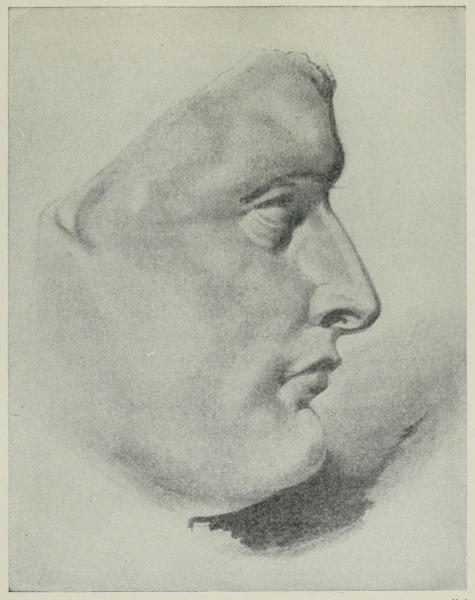
The Emperor’s profile. Sketched during Mass in the Tuileries. Germain Bapst Collection.
(Photograph in the Kircheisen Collection.)
Day and night, night and day, they glide swiftly westward; for Germany, too, is under snow. Day and night, night and day, questions, commands, and plans are churning in his brain. “Is England really invincible? Now, the English can trade freely in the Baltic; English goods can enter Cadiz, and can make their way into the Levant.” He must put off his scheme for the conquest of India, but will abate no jot of his other designs! Will the Confederation of the Rhine still answer to his nod? How will it be possible to explain this crash in Russia? The disaster cannot be hushed up indefinitely. Is there any chance of raising another hundred and twenty thousand men in France? Next year’s levies must be called up in advance. Make peace with the pope at once, and with Spain likewise, for he must feel safe at his back. A National Guard, that was the best thought of the revolution; in that way he will be able to raise a million armed citizens within three months.
Night. Change of horses. He thrusts out his head. “Where are we?”
“In Weimar, Sire.”
“Weimar? How is the duchess? And how is Herr Goethe?”
VIII
Forty bowed backs receive the beaten war lord on his return home. The sight of the court dresses which he has embroidered with his contempt revives his belief in the folly and the weakness of these men whose only wish is to be ruled. But his glance strays to the bars of the golden cage in which the son of liberty has locked himself up. He does not realise that the people of his capital are weary and disaffected; and instead of following the example of his own youth, instead of with disarming frankness acknowledging the faults he hopes to better, he postures as Cæsar before his servile officials, and rails at the weather god, though but yesterday he had boasted his power to make what weather he pleased throughout Europe.
During the nine days’ drive from Warsaw to Paris, the uncertain mood of the adventurer had given place once more to the steadily aspiring flame of the imperator. Although the Russian winter had set in later than usual, he carries off the reverse by saying: “The army sustained heavy losses, but that was because the winter began so early.... The king of Naples is not fitted for high command, and he lost his head after my departure.... All the same, I have three hundred battalions left, without bringing a single man back from Spain.”
Has his contempt for his fellows risen to such a pitch that he can serve up these fables to experienced men who have known the truth for months? But their consciences are uneasy. They feel responsible for the October putsch, or at any rate guilty for not having made an end of the whole business within the first quarter of an hour. On the other hand the Emperor, whose own heart accuses him, is glad to play the accuser, for it galls him that in the decisive hour they should have forgotten the empress and the heir to the throne. In memorable words, at the first reception in the Tuileries, he tries to hammer his point into the heads of his councillors.
“The apostles of the rights of man are really to blame for all that has happened. They declared rebellion to be a duty. They flattered the people, imputing to it a sovereignty it is incapable of exercising. They destroyed respect for law by establishing the supremacy of an assembly which knew nothing of administration and law, instead of holding fast to the nature of things! Any one who wishes to build up a State once more, must be guided by the very opposite principles. History depicts the human heart, and we must study history if we would learn the merits and defects of legislation.... When I undertook the reconstruction of France, my prayer was that I might be spared for a considerable number of years, seeing that what has been destroyed in a moment will take a long time to refashion. The State needs courageous officials. ‘The king is dead; long live the king!’ That was the watchword of our fathers. The phrase makes us realise the advantages of monarchy.”
Were it not for the prettily turned expression about history and the human heart, Emperor Francis might have subscribed to this speech, and it might have been an ornament to the pages of any of the familiar expositions of monarchical doctrine. Why should people go on quarrelling about such matters? The ancient dispute between tradition and revolution has been settled, now that the son of the revolution has acknowledged the supremacy of tradition. No matter whether an heir be named Bourbon or Bonaparte! When we compare the two fathers we see that they are very much alike! His marriage with the daughter of one who rules by right divine has complicated the problem, and has sophisticated his own genius.
Or does he believe no more than half of what he is saying? Before setting out on the Russian campaign, he had frankly explained his plans to Metternich: “The legislature belongs to me; all I need is to put the key of the deliberative chamber in my pocket. France is less suited for democracy than a good many countries.... When I get back, therefore, I shall transform the Senate and the Council of State into an Upper House and a Lower House, most of whose members I shall myself nominate. These will constitute a real popular representation, consisting only of experienced business men, without an ideologue among them. Then France will be satisfactorily ruled, even under a prince who is a mere figure head (and such will come), for whom the ordinary education of hereditary princes will suffice.”
These Cæsarist ideas betray the monarchist, but also the sceptic. Although, when he shows people his son’s portrait, they tell him that the little boy is the loveliest child in France, the flattered father knows perfectly well that dynasties last a long time whereas genius is fleeting. Foreseeing the decadence of his own blood, having studied that decadence in the annals of all princely houses, he wants to rid himself of waverers that he may fortify the position of his heir. For the very reason that he understands the contradiction inherent in monarchy, he wishes to build his own monarchy on a rock.
For the time being, his business is to buttress it anew with the power of the sword. What has been the fruit of the war games in which he moved his myriads over Europe? Those leather-bound muster rolls of his contained the death sentences of numberless youths, even though there were marshals’ batons to be won by a few among the best of them! Of the old guard, four hundred men, and of the cavalry guard, eight hundred men, made their way back to Königsberg; a few thousand officers and sergeants, broken men most of them, have survived the storms of war. Except for the auxiliaries, who are not under France’s orders, that is all that remains of the Emperor’s hosts. Marshal Ney, on his flight from Russia, seems like a hero out of a Greek tragedy when he reaches Prussia, and makes his way into the first Prussian government office on his route. When old acquaintances look at him incredulously, as if questioning who this man can be, he rejoins with a superb gesture: “I am the rear guard of the Grand Army.”
A new army must be made, and it must be made in a few weeks. The year 1813 will supply one hundred and forty thousand recruits, but where are the rest to come from? The Emperor has a magic wand, and can conjure up men whenever he needs them. The passing of a new law is all that is requisite for the levying of the National Guard and for the drafting of eighty thousand soldiers from the dependencies of France. Add one hundred thousand belonging to the oldest conscript levies; and call up the youngsters who should not, properly speaking, be enrolled until 1814. Soon he will have half a million under arms once more. “The French people,” he says to the Prussian envoy, “will follow me whatever I do, and, if needs must, I shall arm the women!”
With unbroken will, he charms into existence the innumerable machines without which he cannot ply his trade. But how shall he explain these unexpected measures to the people? The enemy is far from the frontier.
A stroke of luck! At the close of the year, Yorck, a Prussian general, acting on his own initiative, enters into an agreement with his Russian neighbours, declares the force under his command neutral, and thus opens the door to a change in the military situation for which the German nation has long been eager. The Emperor can use the incident in order to whip up the enthusiasm of the French. For the moment, the treason of his ally costs him no more than twenty thousand men; but it serves as the text for a manifesto in Paris, and for hectoring letters to the princes of the Confederation of the Rhine. He would not, says Napoleon, need their help at all, had not Yorck’s secession compelled his army to withdraw.
The summons of France is actually obeyed. The German princes, including the Habsburg ruler, once more collect money and levy troops. One of them is servile enough to send an assurance that he is “delighted to be able to give the Emperor opportunity for winning fresh laurels.” The king of Prussia cashiers Yorck, and assures the Emperor of his fidelity to the alliance. But Frederick William conveys a hint to the tsar, goes to Breslau, wobbles between the parties, what time a wave of enthusiasm is spreading far beyond Prussia’s borders, and threatening to sweep away the debile monarch. Youths, politicians, and poets are voicing the call of national sentiment. Stein is the man to treat with the tsar on behalf of his country, and in Königsberg the baron takes matters into his own hands.
The Emperor is ever on the watch. In a circular, he warns the princes against the intrigues of those “who by rebellion and revolution are trying to give Germany a new form. Should they succeed in infecting the Confederation of the Rhine with their doctrines, intolerable sufferings may await these territories.”
He feels the stirring of the new spirit. Now, for the first time, does the Emperor seem to become aware of the growth of a national sentiment among the Germans, as among the Spaniards. Shortly before the Russian campaign, he had said that hardly so much as a night watchman was needed to keep the Germans quiet. “Since Germany has no America, nor yet a sea, nor yet a great number of strongholds, nor even Englishmen as there are in Spain, there is nothing to be afraid of, and would not be though the Germans were as lazy, dirty, superstitious, and monk-ridden as the Spaniards. How could there be anything to fear from such honest, reasonable, cool-headed, and patient people, who have so little inclination to violence that throughout the war not one of our soldiers has been murdered in Germany?”
A wonderfully true picture of the Germans, and yet there is a slight miscalculation. He has overlooked the romanticism by which these people can be stirred, and without a knowledge of which they cannot be understood. Of course the Italian, with his fiery imagination, cannot grasp the nature of an imagination that works slowly and lacks ardour. Napoleon, who knows how monarchical the Germans are in their sentiments, believes that when he holds the princes in his hands he must be master of the German people.
Besides, were the Germans a people? Was this realm, which ten years earlier had been formally liquidated by the abdication of the last of its emperors, really anything more than a “metaphysical concept”? Only for a moment, only for two years, will the German peoples be united. Then, as soon as the enemy’s power has been broken, they will fall asunder once more. Not for half a century, and not until another Napoleon threatens them, will they at length become a nation—though even then, only a fragment. So atrophied was Napoleon’s own sense of nationality, that the quarrels and jealousies of the German princes made him believe that the Germans were disintegrated for all time; whereas, had he been able to understand the forces that were at work, he would have realised that the jealousies of the rival sovereign houses were the only obstacle to the reunion of these kindred stocks.
But the sublime breathing of history sometimes determines the rhythm of an epoch even in despite of the will of the genius that animates it. In sweeping curves, during these years, the spirit of liberty returns to her primal home in the hearts of the people. For, just as Bonaparte, in the name of liberty, had defeated the princes and stirred the peoples to revolt; so now, in the name of liberty, the peoples arose to defeat him, the prince of princes. Doubtless this great movement of destiny was complicated by numerous petty wishes, and blurred by minor circles. It is not the force of legitimism which now, after twenty years, is at last gathering strength to slay the spirit of revolt. Pallid, disunited, decadent, and with never a great figure among them, are the princes in the league they form against the one man who rules in virtue of his self-made power.
But the fact that the peoples of Spain and Germany are eager to force their princes into the fight, gives to the tragical collapse of the usurper a semblance of poetical justice, and that is why we who look on find it easier to bear the sight of the slaying of the lion by the spears cast by such a legion of hunters.
IX
Letizia looks anxiously at her son. His face is clouded, though he keeps his thoughts to himself. What can she do to help him? Intimates? Many of them, she sees plainly enough, are betraying him. He needs his brothers, that he may have the support of steadfast hearts, even though he thinks them lacking in intelligence. She therefore puts her trust in her other sons, writes to London and to Graz, smooths the path for reconciliation. One day, after a decade of estrangement, comes a letter from the ambitious Lucien, who says he is always at Napoleon’s service.
But the Emperor cannot believe that he, the mightiest of his family, needs any assistance from the others. Though he has always regarded Lucien as the most capable of his brothers, he proposes merely a formal promotion. In imperial fashion, he answers through his mother: “Please write to let him know in my name that his letter has awakened an echo in my heart. I think of raising him to the throne of Tuscany. He loves the fine arts. It will suit him to reign in Florence, and to revive the glories of the Medicis.” There is no place for Lucien at the centre of things! As for Louis, who also offers to devote his powers to the cause of France (in so far as he can honourably do this), and who sends a copy of his last volume of verse—the ex-king of Holland is met with a rebuff: “The idea you seem to have formed about my position is quite erroneous. I have more than a million men under arms, and two hundred million francs in my war chest. Holland remains French.... Still, I am ready to greet you in the spirit of one who brought you up as if he had been your father.”
The Emperor reads this answer to his mother before sending it. She tries to mitigate its harshness in a long covering letter; tells Louis how pretty his children have grown; urges him to come to Paris in any case. “The Emperor has forgotten to give me your poems. I will ask him for them, and will let you know what I think of them when next I write.”
Next day, the old lady finds a savage article in the “Moniteur,” in which she learns that the king of Naples will have to recall his envoys from Vienna. When she asks what this signifies, her friends reluctantly explain that Murat has been persuaded by Caroline to intrigue with the Habsburgs, so that the pair are now playing double. Letizia writes to upbraid her daughter. Joseph is out of humour, for he thinks that Napoleon is not supporting him properly in the Spanish war. She does her best to appease him through the instrumentality of his wife. Furthermore, she tries to mollify Jerome, whom the Emperor had sent home in disgrace. Finally, she gets to work on Hortense, who is doing all she can to hinder Louis’ coming to Paris.
Now a woman well over sixty, she does her utmost to keep the peace between her sons, daughters, sons-in-law, and daughters-in-law. But it seems to her that the greatness for which the world envies her family has brought in its train nothing but discord, jealousy, arrogance, ostracism, and betrayal. Her thoughts fly back to her native island, where her kindred always formed a united front against other clans. Moreover, her eyes, though old, are clear-sighted; and she sees that the star of the Buonaparti is paling.
The Emperor has little personal feeling about these matters. In his present situation, he regards them from a purely political outlook. No doubt he says to himself that Murat and Caroline are traitors; but his main concern is, how he can make sure of the support of Murat’s soldiers. He therefore writes in a conciliatory strain to Caroline; keeps her husband informed about the impending campaign; and asks for troops, which Murat ultimately agrees to send, for both he and Caroline think that Napoleon may prove victorious after all, and are afraid of being dethroned unless they keep in his good graces. At the same time, they wish to have a secure footing in the other camp, and therefore conclude secret treaties with England and with the ex-king of Sicily (whose dominions they themselves have filched).
Napoleon even seeks to conciliate Bernadotte, though he cannot but regard the crown prince of Sweden as a treacherous kinsman and an enemy of his house. He offers Pomerania as the reward of alliance and the prize of victory. But for Bernadotte, the bid is not high enough; this Frenchman prefers to join the coalition against France. His ambition is to reign there; France is worth more than Pomerania. Bernadotte enters into especially close relationships with Prussia. In Berlin he meets Madame de Staël, and these fellow-countrymen of the Emperor, united in their detestation of him, foregather among the oppressed Prussians.
A third enemy, whom the Emperor approaches with blandishments during these feverish weeks, is the captive pope. Pius VII. has been brought to Fontainebleau, and Napoleon gets to work on him through the instrumentality of prelates devoted to the imperial cause, adding personal suggestion until the old man gives way. How great will be the power of the Church (this is the Emperor’s theme) when Catholicism has been re-established throughout Germany! By trifling concessions upon matters of form, and by cunning devices, Napoleon is able to secure a new Concordat. Thanks to this reconciliation with the Church, he is able to recruit new Catholic soldiers in all the lands under his sway. When the pope, a week after signing the Concordat, wants to revoke it, the Emperor says with a smile: “Your Holiness, being infallible, cannot have made a mistake in entering into this arrangement!”
During these weeks, a desire for peace suddenly spreads throughout Europe. The pope wants peace on the Vistula, and Metternich wants it in London. Count Bubna, with whom Napoleon had negotiated years before in Schönbrunn, comes to Paris to advise peace, for Vienna can neither send nor refuse the troops which the Emperor has demanded. In February, peace can be had for the asking. Why does the man who needs peace most of all, make impossible stipulations?
For ten years, one war after another has been practically forced upon the Emperor as a consequence of his first victories. Now, when he is in grievous peril, and when his isolation is increasing, the will-to-war grows in him as in the early days of his career. When unconquered, he would gladly have laid aside the sword; now, after his defeat, he craves for new victories. But though his shield has been tarnished in Russia, though he would fain win fresh glories for himself and for France, these are but the pretexts of destiny. In very truth, he is stiff-necked, and will prove himself to be so at three congresses during this year 1813. The reason is that all the elements of his character are now rolling inexorably forwards; the reason is that, “in accordance with the nature of things,” he is advancing along a road on which he must march to the bitter end.
Forward! Since the war must be, the allies are arming everywhere. England makes treaties with Sweden and Prussia; to conciliate the latter, the tsar renounces his claims to East Prussia; Prussia calls Germany to arms; Austria makes a truce with Russia, tries to enter into an agreement with Saxony and Bavaria and even King Jerome. Emperor Francis withdraws his troops to Cracow, ostensibly to save them for the coming campaign.
“The first step towards desertion!” exclaims Napoleon, when this news comes to hand. He must now withdraw his own forces from the Vistula to the Oder. In Vienna, he once more offers Silesia. The offer is declined with thanks, for the Austrian role is to be one of armed mediation. While the whole world is thus preparing for the struggle, and when in the middle of March the first signal is given in Paris by the Prussian declaration of war, Talleyrand, in his open ambush, says with a smile: “The hour has struck; the Emperor Napoleon must become king of France.”
A remarkable flash of insight, on the part of one who cannot but hope that no step so sensible as this shall be taken—and who must, none the less, at bottom, wish for it. Nevertheless matters have gone too far; not the levying of troops alone, but the preparations in the minds of men. Every one knows that the last great combat is imminent, that nothing can avert it. The only one who could have called a halt, and will not do so, is driven onward in his own despite, and he is weary. There are new signs of this growing weariness.
First of all, there is the simplicity upon which he insists in his environment. “I want my journeys to be very differently arranged. I shall not take so many people with me; fewer cooks and less table furniture; no meal to consist of more than three courses.... I shall not take any pages with me; they are of no use whatever; only two bedmakers instead of four; two tents instead of four; and so on.” At the same time, he orders plans for a small palace, “a comfortable place rather than an imposing one (the two things are incompatible); ... my room must open on the garden; ... or, preferably, I must have a north room and a south room, according to the season; all arranged as in a well-to-do country gentleman’s mansion.... It is to be a holiday seat, or a dwelling for a man in his declining years.”
In 1805, when he was in the plenitude of his powers, he had said: “The war need not take long. I am still good for six years, but then it will be time to call a halt.” Now, when he takes the field once more, four months after his return from Russia, his mien is quiet and careworn as he steps into his travelling carriage in the courtyard at Saint-Cloud. He leans back among the cushions, with his hand pressed to his forehead. To Caulaincourt, his travelling companion, he acknowledges his distress “at having so soon to leave my good Louise and my lovely boy. I envy the poorest peasant in my dominions. By the time he grows old, he has already paid his debt to his country, and can stay at home with his wife and children. I am the only person whom an inexplicable fate leads back ever and again into the field.”
No more pages, he is in his declining years, wants to stay at home with wife and child—and this is only seven years after the programme just quoted! Are these fourth-act moods, these shadows that fall across his soul, merely the consequences of the Russian catastrophe? Are they not, rather, the essential causes of new defeats? The moods of a man growing prematurely old, one whose work is often interfered with by illness, one who is being increasingly mastered by the natural inclinations of a family man well on in the forties. He wants to spend at the domestic fireside the evening of a life which is not equipped for seven or eight decades like that of his mother or his brothers.
He is himself in the frame of mind with which he had reproached his marshals at Danzig less than a year ago, when he had declared they would rather have an easy life of it in their country seats than go campaigning with him. Is not such a longing natural in a man who has been working himself to death for twenty years, and who has chosen the bee for his escutcheon?
But those on whom the Parcæ bestow the ecstasies of youth, must pay for it by the oncoming of age. He has had such wonderful successes that he must not expect to garner also the joys of content in achievement. He has conjured up the gods; now they have come!
X
At the first review in Mainz, there are only one hundred and eighty thousand men instead of the three hundred thousand he had hoped to assemble there. The army is very short of cavalry; the equipment is inadequate, for it has been far too hastily got together; the best guns have been lost in Russia, or are tied up in Spain; the general staff has been decimated; the ambulance service is defective. He sees all that is amiss, but even this imperfect army reminds him of old times and old happiness. He recalls the April days in Cannes and Nice, seventeen years before, when he had taken over the command of half-starved and ragged soldiers, that he might lead them through the mountains to victory. With these memories surging up in his mind, he gathers his energies, and utters the darkly challenging words: “I shall conduct this war as General Bonaparte.”
Such is the signal, a mingling of impetus and self-restraint, with which he launches himself into the first battle. At Lützen, he exposes himself more than he has done for years. During the first day’s fighting, he does not sleep at all; on the second day, when everything is going well, he has his bearskin spread on the ground in the middle of Marmont’s corps; and when, an hour later, they wake him to let him know that all is going on well, he leaps to his feet with the ironical remark: “You see, the best things come to one while one is asleep.”
But hardly has the general won this victory than the emperor-politician resumes the ascendant. He sends letters in all directions; forces the vacillating king of Saxony to a decision, talks to the princes of the Confederation of the Rhine about providence and the fortune of war, that he may keep them up to the scratch; sends his ministers to the Russian outposts; abruptly and informally offers the tsar Poland in exchange for Prussia, and suggests other territorial rearrangements, until Alexander weakens; and he writes to Emperor Francis in terms of unusual self-commendation: “Although I personally led all the movements of my army, and was several times within range of grape-shot, I have not had even a graze.” The words and the actions are those of one who feels weak, and would fain appear strong. Henceforth the warnings of fate thicken.
True, he gains another victory at Bautzen, but does not take any prisoners. On the second day of the battle, he is riding under fire, accompanied by Caulaincourt and his friend Duroc—the latter having for a decade been his inseparable companion in the field. Men are being shot down in his immediate neighbourhood. He gallops to an adjoining elevation; adjutants follow him. Dust and smoke; a tree close at hand is smashed to splinters. He thunders past. On the hillock, a young officer comes up to him and stammers: “Marshal Duroc has been killed.”
“Impossible! He was at my side a moment ago!”
“The cannon ball which struck the tree, brought down the marshal as well.”
The Emperor slowly rides back into camp. He says:
“When will fate have a little discrimination? What will be the end of it all? Caulaincourt, my eagles are again victorious, but my star is setting.”
Duroc has not been killed outright, but he is dying. Terrible is the aspect of this shattered comrade. Greeting and farewell, both men in tears. Duroc murmurs: “I told thee at Dresden what would happen; the inner voice.... Give me some opium.”
This tone, the sudden use of “thee,” the last request of a man who has no fear of death. The Emperor walks unsteadily as he leaves the cottage.
From a farmyard, he contemplates for a while the spot where his friend had fallen, and then makes his way to the place where the guard is encamped, with his own tent in the middle. That evening, wearing his grey field-coat, he sits gloomily on a campstool, apart from his suite; he listens to the sounds of the camp, where the guardsmen are cooking supper and calling to one another; in the distance, the men of a yager corps are singing a song. Bivouac fires are glowing in the half-darkness of the May night; two burning villages flame like torches in the sky. An officer draws near, and hesitates to give his report. Before the words are spoken, the Emperor understands that Duroc is dead.
Next day, he orders the purchase of land where a memorial is to be erected, and he pens the inscription: “Here died, gloriously, in the arms of his friend the Emperor, struck down on the field of battle by a cannon ball, General Duroc, Grand Marshal of the Emperor Napoleon.”
General Bonaparte used to have no time for such feelings. He concealed his heart-ache, and stormed onward, even when he lost his wife’s love. Now it behoved him to push forward into Silesia, to follow up the Russians into Poland, to take advantage of the misgivings of the allies; and, by delivering blows in rapid succession, to fetter the vacillating Austrian to his side. In later years, he said frankly that his failure to do these things had been the greatest mistake in his life. Once more, the deliberations of the emperor are impeding the activities of the general. His private letters from France are full of reports concerning the clamour for peace. “What especially determined my course of action was Austria’s preparation for war, and the desire to gain time. This led me to interrupt the course of my victories.” In Silesia, at the beginning of June, he agrees to a six weeks’ truce, thus giving his adversaries time to attain complete unity at the congresses of Reichenbach and Prague.
Is he deceived as to the frame of mind of the wavering German princes? He knows them all. “The Saxons are just as German as the others, and would gladly follow Prussia’s example. The king is faithful to me, but I do not trust his troops.... Austria’s impudence is indescribable. While uttering honeyed words, she tries to snatch from me Dalmatia and Istria.... There never was anything so false as the court of Vienna. If, to-day, I were to grant Austria’s demands, she would ask to-morrow for Italy and Germany.” Now, when he sees that the Habsburg ruler is about to go over to the enemy, he realises too late that his marriage has been a mistake, for he has gained nothing by it, and has lost much. His own patrician family feeling had made him believe that there must be an imperial family feeling. The old tone of contempt for hereditary monarchs is at length heard once more. To his intimates, he again and again says frankly what he thinks of the kings who are kings by birth:
“Among those who are born to sit on the throne, the ties of nature count for nothing. The interests of his daughter and his grandson will not move Emperor Francis an inch from the calculations of his cabinet. These men have no blood in their veins, nothing but frozen politics! What pygmies they are, the kings by the grace of God—and the grace of Napoleon! My leniency has been my blunder. In Tilsit I could have crushed them, but I was too generous. History should have taught me that houses so degenerate deserve neither loyalty nor faith! Now, England is filling their coffers with gold. But I shall prove myself a better statesman than these born kings who never leave their golden cages!”
In this atmosphere of intrigue, when he has to rub shoulders with princes who dare not fight either for him or against him, traitors are his best confidants.
The Emperor therefore summons Fouché, to whom he says: “Your friends Bernadotte and Metternich are my worst enemies. Your Bernadotte can do us an immense amount of harm, for he is able to give my enemies the key to our policy, and he can explain to them the tactics of our armies.... His head has been turned because legitimate princes flatter him!” There we have it once more, the word whose mystical power explains half of Napoleon’s perpetual unrest. He can never refrain from a tremor when he speaks of the legitimate rulers, whom he regards with mingled contempt and envy. Whether he is mimicking them, or whether he is railing at them, he, who is an upstart, is always pondering this problem of birth.
Instead of listening to the call of the nations, which soon rises clear above the babble of the princes, he can only look on with malicious delight at the manœuvres of the chessplayers in the cabinets. He watches how England doles out subsidies to Prussia; how Alexander and Francis hold converse about the weakness of their ally, the king of Prussia; how Frederick William, in his dread of revolution, disbands the enthusiastic Landsturm, refuses to give high office to Scharnhorst the boldest and to Stein the ablest of his advisers, dismisses and banishes Schleiermacher for a speech voicing the popular sentiment. The Emperor sends Fouché on a secret mission (in plain words, as a spy) to the congress of Prague.
In Spain, meanwhile, though Napoleon in the north has been strengthening his position by two victories, Joseph has been utterly crushed by Wellington at Vittoria. The king of Spain has run away. When the princes learn in Prague that the south of France now lies open to an English invasion, their inclination to defiance is promptly strengthened. The Emperor, who had left the best of his generals to fight for Joseph in Spain, is beside himself with wrath. “He alone is to blame!” writes Napoleon to Paris. “The English reports show how utterly stupid was his command. Never was anything so absurd! Of course he is no soldier, but he is responsible.... Make the king understand that he is not to see any one till I come back.... Otherwise his house in Paris will become a centre of intrigue, and I shall have to put him under arrest, for my patience is at an end. I will no longer have my affairs imperilled out of consideration for idiots who are neither soldiers nor statesmen!”
His eldest brother is his closest intimate in the family,—and now the Emperor thinks that Joseph in a private house in Paris is more to be dreaded even than as king in Madrid! Will Napoleon at length learn his lesson, and, after this outburst, leave Joseph at peace? Hardly! For even little Jerome has an army once more, and is again making a mess of things; he gives one of the generals new marching orders, with the remark that he is acting on instructions from the Emperor. The latter hears of it too late. “I will not tell you in plain terms what I think of your conduct; enough that I will not tolerate it any longer! If you again make false representations of the kind, I shall publish an order of the day to the effect that in future no attention is to be paid to anything you say.... By such behaviour you may disturb the march of my whole army. It is sheer cheating!”
Soon afterwards Junot, one of the oldest of his comrades, becomes affected with megalomania; he loses a battle in Illyria, and then, in a fit of frenzy, throws himself out of a window. Bourrienne, who had for a time been cashiered on account of peculation, and had then been appointed chargé d’affaires in Hamburg, had, after all, to be dismissed once more for the old offence. “If he dares to interfere in public business, I will have him arrested, and make him disgorge his ill-gotten gains!” Bernadotte, the most faithless, has actually landed in Pomerania with his Swedes, has advised the allies to stand firm, and will deceive them as he has deceived others. To crown all, a sworn enemy of the Emperor is now to join the opposing combination. General Moreau, who had been exiled to America for his share in Cadoudal’s conspiracy, is on his way to join the foes of France, and will share with Bernadotte the distinction of fighting against his native land.
In this situation, on the horns of a dilemma, too cautious to turn his victories to account, and too powerful to accept the terms on which alone he would be able to make peace, the Emperor has recourse to his whilom methods. He invites Metternich to Dresden, and tries to win over the Austrian diplomat by suggestion. The interview is typically Napoleonic, lasting nine hours without a break. The Emperor gains nothing by it, but posterity gains a great deal.
Standing in the middle of the room, his sword buckled on and his hat under his arm, the Emperor receives the minister. After making formal enquiries about his father-in-law’s health, he forthwith assumes the offensive: “So you, too, want war. Well, you shall have it. I have crushed the Prussians at Lützen, and have beaten the Russians at Bautzen. You are waiting for your turn? Be it so, we shall meet again in Vienna. Men are incorrigible! Three times I have replaced Emperor Francis on his throne; I have promised always to live at peace with him; I have married his daughter. Even at that time I thought: ‘You are making a fool of yourself.’ Still, I did it; and now I regret it!”
We see that he is not disposed to be civil; that to his father-in-law’s envoy, on whom he wishes to make a good impression, he is blunter than he had been to Francis on the day after Austerlitz. Metternich speaks of world peace, which will only be possible if the Emperor is willing to accept a reasonable curtailment of his dominions. It will be necessary to give back Warsaw to the tsar and Illyria to the emperor of Austria, to set the Hansa towns free, to enlarge Prussia.
“What you are asking is that I shall dishonour myself. I will die rather than cede a hand’s breadth of soil. Your born kings can accept defeat twenty times over, and still go back to their palaces. I am the child of fortune, and I cannot do this! My power will not outlast the day on which I cease to be strong, on which I cease to be feared.... Through the cold of Russia I lost everything except honour.... Now I have a new army; you shall see it; I will hold a review for your benefit!” Here we have once more the pride of the born soldier facing those who are born kings; here we have General Bonaparte. When the minister ventures to declare that this army of which Napoleon speaks would be glad if peace were made, the Emperor cuts Metternich short with one of his amazing outbursts of frankness:
“It is not the army that wants peace! My generals want it! Really, I have no generals left. The cold of Moscow has demoralised them all. There, the bravest among them cried like children. A fortnight ago, I could still make peace; now, after two victories, I can no longer do so.”
“Europe and you, Sire, will never come to terms. When you have made peace, it has been nothing more than a truce. To you, success and failure are equally strong motives for war. This time the whole of Europe will fight against you.”
The Emperor laughs savagely:
“Do you think to destroy me by a coalition? How many of you are there, then, Messieurs les Alliés? Four, five, six, twenty? The more, the merrier!” He goes on to warn Metternich against counting on Germany, whose peoples he is holding together by the presence of his soldiers and whose princes are held together by their dread of Austria. He advises armed neutrality, so long as the negotiations are going on in Prague, whereas Metternich talks of armed mediation. These finesses of the old diplomacy are to mask the gulf between them. Then, for a whole hour, they dispute about the relative strength of the opposing armies, each claiming the possession of exact information about the other side.
“I have detailed and accurate lists of your forces,” says the Emperor. “I have had so many spies at work, that I know to a unit even how many drummers you have. But no one knows better than myself how much or how little value to attach to these secret service reports. My calculations are based on more exact data, upon mathematical inferences. In the last resort, no one has more than he can have.” The Emperor shows the Austrian envoy the muster rolls of the Austrian army, which till yesterday had been part of the French alliance. Metternich can see for himself whether the figures are accurate. The Emperor then spends hours upon a description of the Russian campaign. When the minister remarks that the imperial troops are composed of striplings, and asks what Napoleon will do when these children, like those who have gone before them, have been swallowed up by the war, the Emperor is overcome with wrath. He turns pale, his features are distorted, and he shouts at Metternich:
“You are not a soldier. You do not know what passes in a soldier’s mind. I grew to manhood on the battle-field. Such a man as I does not care a snap of the fingers for the lives of a million men!” He flings his hat into a corner of the room. Now, there is nothing assumed about his anger, and what he has just said is the revelation of an innermost truth. The man who turns pale at the sight of a dying horse, who cannot bear to see a human being pass away, remains and must remain impassive when, in his army lists, he adds up the figures, shifts the hundreds of thousands from column to column, and erases the myriads of slain. Is not war made with human lives, and does it not end with corpses? What is the use of reproaching a craftsman for using the tools of his trade? But as far as morals are concerned, the minister has the best of the argument, and he would have been glad if all France could have heard Napoleon’s words.
“France has no reason to complain,” says the Emperor more calmly. “To spare France, I have sacrificed Germans and Poles. In Russia I lost three hundred thousand men, but only a tenth of them were Frenchmen!” Meanwhile, he has picked up his hat for himself, a thing he has certainly not done for the last ten years; he has acted sensibly, as if he had still been General Bonaparte. Then he plants himself in front of the Austrian and says:
“It was exceedingly stupid of me to marry an archduchess. I was trying to weld the new with the old, to make Gothic prejudices square with the institutions of my own century. Now I can see the whole extent of my error! The blunder may cost me my throne, but I will bury the world beneath its ruins!”
This tragical admission is the climax of the interview, and the turning-point of the problem of war or peace. The rancour engendered in him by his own mistake spurs him on, regardless of prudential considerations, into the fight with a coalition whose forces outnumber his by three to one. Like a great gambler who realises that he has made an irretrievable blunder, he is impelled by the stubbornness characteristic of such natures as his to stake all upon a single throw. He will show that, blunder notwithstanding, he can still win.
By the time he dismisses Metternich, he has fully recovered composure. His hand on the door-handle, he says: “We shall see one another again before you leave?”
“I am at Your Majesty’s service. But I have no longer any hope of succeeding in my mission.”
The Emperor looks at him quizzically, and taps him gently on the shoulder: “Do you know what will happen? You will not make war on me!”
After three days’ negotiation, Metternich wishes to depart, but the Emperor is afraid of the final rupture. Napoleon summons the Austrian envoy several times, and then invites him to an early interview in the garden. The two men walk up and down.
“Now then, you must not assume this injured air!” In ten minutes they arrange for a prolongation of the truce, and talk about further conversations in Prague. Everything is left hanging in the wind; and in the memorandum he signs with Metternich, the Emperor recognises his father-in-law’s position of armed neutrality, which can only be a stage on the way to war. Then he drives off to Mainz, that he may see once more the wife who is daughter of that same Austrian ruler. He has appointed her regent in Paris again, but has expressly forbidden his ministers to submit certain kinds of documents for her consideration. “There are details with which a young woman’s mind must not be besmirched.”
Had the Habsburg archduchess been a staunch wife and an affectionate daughter, she would have journeyed on to Vienna, and would have brought about a reconciliation which there was really nothing to prevent except the two men’s wounded pride. She had a passably good understanding. Only a few weeks before, the Emperor, writing to Francis, had said: “She fills the post of prime minister to my great satisfaction.” We cannot for a moment suppose that now, at the height of the crisis, he can have failed to let her know all the hazards of the hour, were it only to ensure that in the event of a breach her feelings would be on his side. But the little goose made no move. Her only concern was to send costly gifts which would make an impression on her relatives.
In Prague, each party keeps the other in suspense; Fouché does his master harm by gossiping with all and sundry; Bernadotte cements his alliance with his new friends. When, at the last moment, it seems possible that the Emperor may give way, Alexander and Frederick William are so much alarmed at the prospect that they compel Metternich to make the terms more exacting, for they realise that so favourable an opportunity is not likely to recur. The Emperor now angrily draws back, and on the day after the expiry of the truce he receives his father-in-law’s declaration of war. No doubt, in the interval, he has secured reinforcements; but he can no longer trust the Confederation of the Rhine, and has to keep watch upon his German auxiliaries. He stands to arms in Saxony and Silesia, faced by Schwarzenberg in command of three armies, two of them, respectively led by Blücher and Bernadotte, holding Silesia and the north. With Schwarzenberg is Moreau, who has just arrived, and who, on his last visit to Germany, had been the conqueror of that country.
Thus paradoxical is the marshalling forces in the game of chess. Under the Emperor of the French, are fighting three German kings against a German general, who a little while back had been the Emperor’s subordinate in the war against Russia. Against Napoleon, are fighting two French generals. One of them is leading Prussian troops against the man who had for years pushed him to the front; nor is this general really a royalist, for he, too, is a son of the revolution. Blücher is the only true-hearted foe, for Blücher, whom Napoleon defeated seven years earlier, has never fought on the Emperor’s side, and has never espoused his cause. The one element in Napoleon’s favour is that three monarchs have their fingers in Schwarzenberg’s pie, three commanders who know as little about the trade of war as Brother Joseph did in Spain.
At the end of August, the Emperor opens the second Saxon campaign with a great victory near Dresden. But on the third day, when he might have followed up the allies and scattered them, he is seized by a violent attack of gastric spasm. For a whole hour he fancies he has been poisoned; his will is paralysed, and he withdraws instead of pursuing. Thereby he loses an army corps, and thus (according to the report of Daru, his daily companion) “causes the disaster of 1813.” In this first battle against the hated Bonaparte, Moreau falls. Is it an omen? When the Emperor hears the news, the rivalry of his youth flames up anew, and from his very soul he cries: “Moreau is dead! My star!”
His other army has been defeated by Blücher on the Katzbach. Once more, considerations of statesmanship outweigh those of generalship. How can I divide my adversaries? It will be better to spare Bohemia for the sake of Austria, for the defeat has aroused alarm there. He will make a surprise march on Berlin, and will thus lure the Prussians out of Silesia.
But what the tsar had said years ago is still true.... Miracles only happen when the Emperor is present, and he cannot be everywhere. He is thus hampered in his great enterprise. Lack of fighting spirit, difficulties of food-supply, and the frequency of desertion, are continually making it necessary for him to visit his flanking armies: so that in popular parlance, in consequence of his rushings to and fro, he is nicknamed the “Bautzen Messenger.” His armies suffer more and more from lack of food. They are so thickly set upon the ground that they have long since eaten the country bare.
Nevertheless, he has not nearly enough soldiers. Since the 1814 levies are already with the colours, he orders the Senate to call up also those of 1815, and even the men whose liability to service has nearly expired on account of advancing years—the very peasants whom, when setting forth on this campaign in a mood of self-pity, he had envied for their fortunate position. But when will the reinforcements arrive? Who will train them, and how long will it take? Vainly now, at the end of September, he sends an envoy to his father-in-law, to talk of peace; he is prepared to make great sacrifices, “if only you will listen.” But Francis remains firm, and is at length able to detach an important member of the Confederation of the Rhine: the king of Bavaria falls away. Thereupon the anxious chessplayer, round whom the clouds are gathering, says to his old comrade something which he has never before been willing to admit:
“Marmont, my game is going awry.”
With this admission, the Emperor’s genius spreads its wings and flies away.
XI
On Düben Heath is a Saxon fortress, Düben Castle. There, one morning, the Emperor is at work, planning the march on Berlin, the defeat of Bernadotte and Blücher, smashing blows which will finish off the enemy.
Then a number of generals are announced. He comes out of his study to meet them, knowing what they want, for his intimates have kept him informed of the growing discontent among the leaders, who wish to winter quietly on the Rhine. Marshal Ney has recently reported: “I am no longer master of my army.” One of the visitors begins to speak hesitatingly; a second puts forward dubious reasons; then, nodding to encourage one another, they all obsequiously beg him not to march on Berlin. Leipzig will be a better point of attack.
The Emperor listens to them in silence as he wonders: “Is my power vanishing?” At length he replies: “The secession of Bavaria is imminent. A movement on Leipzig, a backward movement, will arouse despair among the soldiers. But I will think over what you have said.” He spends the rest of the day alone, refusing himself to all visitors, brooding over his maps. Caulaincourt, on duty outside, listens for sounds from within, but can only hear the windows rattling in the October gale which is howling round the castle. At length he is allowed to enter. The Emperor walks up and down, and, speaking rather to himself than to Caulaincourt, he says: “The French cannot endure reverses.” Then he sinks into a reverie.
Next day he announces that they will go to Leipzig. It is October 15th: general animation; orders are issued; every one is delighted. Discussing with Marmont the latest steps of the Habsburg ruler, Napoleon says in conclusion: “I prefer a man of honour who simply keeps his word, to a conscientious man who does what he thinks right.... Emperor Francis has done what he believes to be the best for his subjects; he is conscientious, but he is not a man of honour.”
Next day begins the great “Battle of the Nations.” The Emperor has only one hundred and eighty thousand men against three hundred thousand of the allies; by the evening he has won only part of the battle-field. On the second morning Bernadotte arrives with reinforcements. The Emperor sees that things are going badly, and would like to withdraw, but he cannot make up his mind to a step that would give the impression of defeat. Once more he tries negotiation. General Merveldt has been taken prisoner; his sword is restored on parole; he is to go to Emperor Francis with proposals for an armistice.
“I will retire behind the Saale, while the Russians and the Prussians withdraw beyond the Elbe, and you Austrians go back into Bohemia; Saxony must remain neutral.” Then, livening up, he develops to this enemy general nothing less than a new plan for Europe. Hanover is to be returned to England; the Baltic coast is to be freed; any of the princes of the Confederation of the Rhine who wish to do so can leave the Confederation; Poland, Spain, and Holland are to be independent; the only reservation is as regards Italy, which must not become Austrian. “Be off with you! You have a splendid peace mission. Should fortune favour it, you will earn the love of a great nation. But if your side refuse peace, we shall know how to defend ourselves.”
General Merveldt departs in amazement, and his report seems incredible to his master. What! The Emperor Napoleon, in the course of war, between battles, is willing to renounce half Europe and chooses a prisoner to bring this offer? We did not know he was so weak.
The Emperor is anxiously awaiting his emissary’s return. Till far on into the night, therefore, he refrains from issuing orders for the morrow; he speaks of the ties of kinship, and of his wife and child. Suddenly he is attacked by his gastric trouble, and staggers against the wall of the tent, his face pale. They wish to send for his physician. “No! my tent is transparent. If I am up and about, every one is at his post.”
“At least lie down, Sire!”
“No, I will die standing.”
“Do let me fetch the doctor, Sire.”
“No, I tell you! I can send a sick soldier to hospital. But who can send me?” Terrible moments pass. “I’m getting better now. See to it that no one comes into the tent!”
Half an hour later, he issues orders, but not for a retreat. Instead, the army moves a little nearer to Leipzig. The enemy now outnumbers him by two to one.
When day comes, he takes up his headquarters in a windmill. The attack upon the French starts from three sides. It appears that, at the last moment, Bernadotte has persuaded the Saxons to turn their guns against France. “Infamous!” exclaims the Emperor, and all around echo the word. Saxon officers who remain faithful to him, break their swords. A dragoon belonging to the escort wheels his horse, and shouts: “We’ll do for them yet, the scoundrels! We Frenchmen, too, are here! Vive l’Empereur!” The whole escort follows him at the charge. Soon a young officer, who has seized one of the Saxon eagles, gallops back with it to the Emperor, and collapses from his wounds as he arrives. “These sons of France!” says Napoleon softly.
On the second day of battle, he loses sixty thousand men. He is beaten, but even the German critics say of the affair: “The allies did not secure an overwhelming victory, such as might have been expected from the enormous preponderance of their forces.”
During the hasty retreat of the defeated army through the town of Leipzig, the Emperor dictates orders for the withdrawal. “They had brought him a wooden stool,” writes an eyewitness. “On this, he now fell into a slumber of exhaustion, his hands loosely folded in his lap. In gloomy silence the generals were standing round the fire, while the soldiers were marching past a little way off.”
Next morning the pursuing enemy spread disorder in the streets; a bridge was blown up prematurely, so that the rear guard was forced to surrender; one of the marshals escaped by swimming across the river, another was drowned, several were wounded and taken prisoner. When, subsequently Macdonald came across Augereau, for whose corps he had been waiting, Augereau laughed him to scorn: “Do you think me such a fool as to let myself be slaughtered in a Leipzig suburb? I won’t do that for a madman’s sake!”
Here we have it for the first time, a sign that one of Napoleon’s oldest companions-in-arms has become completely indifferent to the Emperor’s fame; is animated by the mere will-to-live, reasonable enough in a private soldier, but unworthy of a marshal of France. On the very same day, another friend of Bonaparte’s youth writes to the Emperor, complaining that in the report of the previous day’s fighting his services have been overlooked, although for ten hours he had held a part of the plain for whose defence another man is now given the credit. “Never in my life have I served you more faithfully than I did on this occasion.... Sire, I could not suffer anything worse than to be forgotten at such a time.” The letter is signed, “Marmont.”
These two utterances on the day after Leipzig are the shadows of coming events. Marmont and Augereau will both desert the Emperor in the decisive hour.
Fifty miles away, Goethe is sitting in his room at Weimar. Napoleon’s picture has fallen from its nail. The poet has heard the sound of the Leipzig guns. The first news of the French defeat has arrived. Though none of the allied generals can say, yet, whether the Emperor may not be able to collect his forces once more, and to resume his career of victory, Goethe, who only a few months earlier had declared Napoleon to be invincible, already realises the full extent of the disaster. On the day of the retreat, as if everything had happened a hundred years before, and the whole matter had become legendary, he writes the following verses:
He who feels courage in his royal breast knows no shudderings, treads gladly the undermined road leading to the steps of the throne, knows the danger and nevertheless mounts confidently. The golden circlet’s tremendous burden, he does not try its weight; resolute and calm, he presses it gladly on his bold brow, and bears it lightly, as if it were a laurel crown. Thus didst thou. What seemed so far away, thou hast tranquilly learned to make thine own; and whatever fierce obstacles might block the path, thou sawest them, contemplated them, and understood them. A joyful day dawned, it summoned thee, thou wast summoned, and thus it came to pass.... And thou still standest despite all that has happened to thee, despite the foe, who, with war and death threatens thee from without and from within.... The peoples are agape, they chatter, they are full of vain imaginings— What do they care for, but games?... The false world, it wooes us for our treasure, for our favour, for our position, and, even if one makes one’s lover one’s equal, love does not suffice him, he wants the whole kingdom. So was it with this man!—And now, declare it abroad, even if it cost you your life: To every man, be he whom he may, there comes a last happiness and a last day.