BOOK FIVE THE ROCK (continued 2)
Cedar Paul translation
“When Cæsar utters his long tirade against kingship, saying, ‘for me, in whom the throne inspires nothing but contempt,’ he does not mean a word of what he says. He only talks like that because he knows that his Romans are standing behind him, and wishes to persuade them that the throne is an abomination to him. In reality, it is already the goal of his desire. Consequently those words ought not to be spoken with conviction.”
He wants to use religion, just as he uses the drama, that he may lull the masses to sleep. Here is what the newmade Consul says to the Council of State: “What I see in religion is, not the mystery of the incarnation, but social order. It associates with heaven an idea of equality, which prevents the poor from massacring the rich. Religion has the same sort of value as vaccination. It gratifies our taste for the miraculous, and protects us from quacks; for the priests are worth more than the Cagliostros, the Kants, and all the German dreamers.... Society cannot exist without inequality of property; but this latter cannot exist without religion. One who is dying of hunger when the man next him is feasting on dainties, can only be sustained by a belief in a higher power, and by the conviction that in another world there will be a different distribution of goods.”
Though he knows all this, and though he takes kindly measures for the relief of the poor, he can never free his mind from thoughts of the rabble and the mob. When he turns from contemplating the princes to contemplating the masses, his contempt for his fellows diminishes, but not enough. The masses, like the princes, are to be used for his own ends. He says: “The men of intelligence who have changed the world, have never done so by influencing the leaders, but have always set the masses in motion. He who influences princes is only an intriguer, and his results are second rate; but he who moves the masses, changes the face of the earth.” Democracy came between him and the people; and what he has to say about parliamentarism is not creative but critical:
“The republic is the political form which elevates the soul and contains the germ of great things: but, precisely because of its greatness, it will sooner or later perish; for it needs a unified authority to maintain its power, and this must lead either to despotism or to a patriciate. The latter is the worst of despotisms; Rome, Venice, England, and even France are instances. If the republic wishes to attain greatness, the central authority must be established upon a permanent parliamentary majority; ... but this can be secured only by corruption, which is the cancer of the peoples, and a terrible weapon in the hands of the central authority. The liberals have discovered the expedient of constitutional monarchy. That is a mezzo termine, which has its advantages, but only when the popular assembly, whose business it is to bridle the monarchical authority, is elected by universal suffrage.”
Napoleon recognised the existence of all the problems that confronted the nineteenth century; but he never understood the social problem, with which his own story began.
VII
Imagination, the third element of his personality, is the real driving force of his self-confidence and his energy. Continually at war with the calculating part of his nature, fantasy, in the end, brings this harbourer of opposites to destruction. The imaginative power, which links the poet to the statesman (enabling both unceasingly to dwell in the affective world of strangers as well as in their own), is also the source of his knowledge of men and his guide to the management of men. But always his energy interacts with other qualities. One who, for analytical purposes, would force the living whole of his character into the framework of a system, cannot avoid, from time to time, breaking threads that he may bind other threads together.
“I know not what I do, for everything depends on events. I have not a will of my own, but expect everything from their outcome.... The greater one is, the less can one have a will. One is always dependent upon events and circumstances.” Such words, casually introduced into a letter from husband to wife, express the distantly visible forms of his fantasy; for only the imaginative man, not tied to systems and principles, trusts himself to the movements of the moments, allows his spirit to roam freely, and discovers his course as he goes. In this sense, his whole career is improvisation, though in the converse way from that in which most people improvise. He calculated little things in advance with great precision; whereas his worldwide designs were originated, transformed, improvised, in accordance with circumstances and developments. “One who has become familiar with affairs, despises all theories, and makes use of them only like the geometricians, not in order to move forward in a straight line, but merely to keep heading in the same direction.”
This direction, this fundamental idea of the statesman, was, moreover, only possible in a man whose mind was simultaneously imaginative and mathematical. It is his most ardent vision and his coolest calculation; it is his political aim, his hope, his ambition: Europe. If this vision could be realised only by force of arms, that was because of the fierceness with which the first republic of Europe was again and again attacked by the European princes. We have seen how earnestly he strove for peace. No doubt he chose his means badly, his error being due to the time, the circumstances, and his own domineering character. But his mistakes as to method still leave undiminished the genius of the seer who looked forward towards an aim which was again to become an object of statesmanship a hundred years after his fall.
“There are in Europe more than thirty million Frenchmen, fifteen million Italians, thirty million Germans.... Out of each of these peoples, I wanted to make a united national whole.... That would have supplied the best chance of establishing a general unity of laws; a unity of principles and thoughts and feelings, of outlooks and interests.... Then it would have been possible to think of founding the United States of Europe after the model of the United States of America or of the Greek Amphictyonic League.... What perspectives of strength, greatness, and prosperity this opens up!... For France, unity has been wrought; in Spain, it has proved unattainable; to establish the Italian nation, I should have needed twenty years; to make the Germans a nation, would have required still more patience, and all I could do was to simplify their monstrous constitution. At the same time, I wanted to pave the way for the unification of the great interests of Europe, just as I had unified the parties in France.... The transient mutterings of the peoples troubled me little; they would have been reconciled to me by the result.... Europe would soon have become one nation, and any who travelled in it would always have been in a common fatherland.... Sooner or later, this union will be brought about by the force of events. The first impetus has been given; and, after the fall and the disappearance of my system, it seems to me that the only way in which an equilibrium can be achieved in Europe is through a league of nations.”
Here there is no talk of a dictatorial welding together of different stocks, or of an enthusiastic fraternisation. He speaks only of interests, and of a preliminary unification of these on a national and racial basis. The work of the nineteenth century was to inaugurate the preliminaries by the establishment of the nations. The twentieth century opens with the realisation of the Napoleonic idea.
VIII
The effects underlying his energy and his imagination are dominated by the clarity of his thought. Napoleon hated less, and loved more, than he would have been willing to admit. In this domain, we find the converse of what happens in the matter of his sympathies in war time, when a million men are coldly sacrificed, while one man wounded and bleeding touches him to the heart. Since his fantasy needs enormous masses, he is enraged when Joseph says: “I am the only person who cares for you.” Napoleon rejoins: “Nothing of the sort. I need five hundred million men to love me.” In these icy words glows the volcano which one of his school masters heard rumbling long ago.
Emotionally convinced of his mission to order the affairs of the nations, he deliberately rejects anything that may distract him from this aim, and nothing sustains him but his monomania. Even in the drama, he objects to the interweaving of love stories, saying: “Love is a passion which should only be the main theme of a tragedy, and never a subsidiary motif.... In the days of Racine, it was the whole content of a human life. That happens in a society where no great deeds are being done.”
If love becomes intrusive, he annuls it. “I have no time to be bothered with feelings and to repent them like other men.... There are two motives to action: self-interest and fear. Believe me, love is a foolish blindness!... I love no one, not even my brothers—Joseph a little, from force of habit, and because he is the elder. I am fond of Duroc, too; he is serious and resolute; I believe the man has never shed tears in his life!... Let us leave sensibilities to women. Men should be firm of heart and strong of will, or else they should have nothing to do with war or governance.” Another time: “The only friend I have is Daru; he is unfeeling and cold; that suits me.” Last of all, in St. Helena: “A man of fifty has done with love.... I have an iron heart. I never really loved; perhaps Josephine, a little; but then I was only seven-and-twenty. I incline to the view of Gassion, who once said to me that he did not love life well enough to give it to another being.”
Always half ashamed of his feelings; ever ready to make excuses for them; “perhaps,” “a little.” Yet this is the same man who said: “I am the slave of my way of feeling and acting, for I value the heart much more than the head.” This very feeling is his fantasy.
One in whom egotism is supreme, will be more inclined to jealousy than to love. His first letters to Josephine show him devoured by jealousy. Years later, as Consul, when he is inspecting his new bridge in course of construction across the Seine, he has to step aside with his companions for a moment to let a carriage pass. In the carriage sits Hippolyte, his sometime rival. That was long ago; everything has been condoned; the man’s name is never mentioned in his presence. But now, at a chance encounter in the street, Bonaparte grows pale and confused, and takes a little while to recover composure.
From time to time, he shows an involuntary kindliness. On one of the Italian battle-fields, he sees a dog howling over the dead body of its master. “The poor beast seemed to be asking for an avenger, or begging help. I was profoundly moved by the dog’s suffering, and at that moment I should have been very much in the mood to grant quarter to an enemy. I understood why Achilles surrendered Hector’s body to the weeping Priam. Such is man; so little can he count upon his moods. Impassively I had sent my soldiers into the battle; dry-eyed I had watched them marching past in an advance where thousands of them would meet their fate; then I was shaken to the depths by the howling of a dog.”
Affectionate tones are to be heard in many of his letters. To Cambacérès: “I am so sorry to hear that you are not well. I hope it is only a passing trouble. If you did not take so much medicine, you would be better already.... But anyhow, you must do your utmost to get well, if only because of my friendship for you.” To Corvisart: “Dear Doctor, I wish you would see to the arch-chancellor and to Lacépède: the former has been ailing for a week, and I am afraid he is in the hands of a quack; Lacépède’s wife has been ill for some time. Give them the benefit of your advice, and cure them as soon as you can. You will save the life of a man of note, and one who is very dear to me.”
Chénier, who has written against him for years, is assisted by him in poverty and given a secure position. Carnot, for ten years an enemy of the Emperor, is heavily in debt; Napoleon learns this, settles the debts, and refuses to hear of being given a note of hand; reckons up the pay which Carnot would have received as general in active service, makes this calculation the basis of a large pension; and when Carnot says he would like to do some work for his money, Napoleon commissions him to write a military treatise, lest his pensioner should have to undertake duties that might go against the grain.
During the Hundred Days, learning that some of the Bourbon princes are greatly distressed for lack of money, he sends them large sums anonymously. On one occasion his secretary is asleep, and he himself has nothing particular to do; he looks through a pile of begging letters, and writes in the margin of each the amount of an allowance which is to be given to the sender. Hundreds of officers whom, in fits of anger, he has sworn to have shot, remain at their posts—to forsake him in the end. When he orders Jerome to get a divorce, he is alarmed at his own harshness. After he has written to enforce his command with threats he sends a letter to his mother saying that she had better write to Jerome at once and get his sisters to write as well, “for if I have passed judgment on him, nothing can alter it, and his life will be spoiled.”
From his few friends, he demands blind devotion. Never is the self-centred nature of Napoleon more plainly shown than in the words the exile speaks to Montholon, from whom he has been temporarily estranged: “I love you like a son, for I believe that you love me only; otherwise you could not love me at all. According to my way of feeling, it is not in our nature to love several persons at once. People deceive themselves in these matters; they cannot even love all their children with the same intensity. For my part, at any rate, I want to be the supreme object of affection in the case of those whom I love and honour with my confidence. I cannot bear partings. They stab me to the heart, for my disposition is too sensitive; spiritual poison affects the body more powerfully than arsenic.”
Logically enough, he dislikes western views concerning the enlightenment of women. He always hankers after the East, and in this matter he is an oriental. “Nature intended women to be our slaves; and it is only because of our distorted outlooks that they venture to describe themselves as our rulers.... For one who can influence us in a good direction, there are a hundred who will only lead us into follies.... What a mad idea to demand equality for women! They are our property, we are not theirs; for they give us children, but we do not give them any. They belong to us, just as a tree which bears fruit belongs to the gardener.... In this difference, there is nothing degrading; every one has his privileges, and every one his duties. You, ladies, have beauty, attractiveness; but also dependence.”
IX
Throughout life, the imagination of this creator was troubled by the thought of the Creator. This ruler of men was greatly disturbed that there should be no one who ruled all men. It was not that he ever regarded himself as divine; he laughed at all mystical interpretations of his own power: but there was one great power which remained uncoercible—no matter whether it were called God, destiny, or death. How do self-confidence and fantasy escape from this snare?
First of all by the rejection of dogma. “My firm conviction is that Jesus ... was put to death like any other fanatic who professed to be a prophet or a Messiah; there have been such persons at all times. For my part, I turn from the New Testament to the Old, and there I find one man of mark, Moses.... Besides, how could I accept a religion which would damn Socrates and Plato?... I cannot believe that there is a god who punishes and rewards, for I see honest folk unlucky, and rogues lucky. Look at Talleyrand; he is sure to die in his bed!... How could I have remained independent if I had been subject to the influence of a confessor to threaten me with the pains of hell? Think what powers a confessor who is a rascal can exercise!...”
In this matter he is consistent; from childhood, when he would not go to Mass, until the end of his life, he rejected (for himself) all the religions. The man who, in his own life, would not recognise the existence of miracle, and ascribed everything that he was able to achieve to the working of the healthy human understanding, boldness, power of combination, knowledge of men, and imagination, could not possibly believe in the miracles recorded in the Bible. He was perfectly logical when he told one of his subordinates it was impossible that two million men could have quenched their thirst at the Wells of Moses.
Even more uncongenial to him is any dread of a great assize. He does not talk about morality; or at most, he does so with some political end in view. Only towards the last, on the island, he says once in an evening conversation with his intimates: “How happy should we be here if I could confide my troubles to God, and could expect from him happiness and salvation! Have I not a just claim to it? I, who have had so unusual a career, have never committed a crime, and need not fear to step before God’s judgment seat and await his sentence. Never has the thought of committing a murder entered my mind.”
For these reasons, he does not falter in the days of misfortune. Five years before the end, he expresses the hope that he will die without a confessor, but adds that no one can be certain what he will do in his last hours. In fact, this heart of steel was steadfast to the end.
Nevertheless, his ideas as to the nature of the creation developed, and just as the revolutionist became a legitimist, so the materialist became a theist. But these developments were not transformations; there was simply a broadening of the basis of his thought. Throughout life, he had a sense that things had come into existence by a natural process: “When out hunting, I had the deer cut open, and saw how like the beast’s internal organs were to those of a human being. Man is merely a more perfect creature than a dog or a tree. The plan is the first link in a chain whose last link is mankind.” It should be remembered that the Emperor had not read Goethe’s Zur Morphologie, or Lamarck’s Philosophie zoologique. He had actually refused to receive Lamarck.
Still more remarkable are his deductions concerning psycho-physical processes. In a Christmas discourse at St. Helena, he expresses his doubts as follows: “How can any one understand that God should sanction the caprices of a ruler who sends thousands of men into battle that they may die for him?... Where is the soul of a child; or that of a madman?... What are electricity, galvanism, magnetism? In these lies the great secret of nature. I am inclined to believe that man is a product of these fluids and of the atmosphere; the brain sucks them in and imparts life, and the soul is composed of them. After death, they return into the atmosphere, whence they are sucked up again by other brains.” After giving utterance to these Goethean motifs, he is alarmed at his own temerity. Breaking off suddenly, he says, as a soldier among soldiers: “Oh, well, my dear Gourgaud, when we are dead, we are simply dead.”
Side by side with this scepticism, there exists and expands a theism. To Laplace, who denies the existence of God, he says: “You should be more ready than any one else to admit that God exists, for you, more than most, have seen the wonders of creation. If we cannot actually see God with our own eyes, this is because he did not wish our understanding to reach so far.” On another occasion: “We believe in God because everything around us testifies to his existence.” In St. Helena: “I have never doubted the existence of God, for, even if my reason were incompetent to grasp him, still my inner feelings would convince me of his reality. My temperament has always been in harmony with this feeling.”
How shall such a spirit come to terms with destiny? Since his self-esteem makes it impossible for him to believe that any man can have beaten him, he is forced to ascribe his defeat to fate. But this sense of the workings of destiny is present in his mind before the final overthrow; it accompanies him throughout life, and appears to be an equivalent for the reverence, devotion, and faith by which other men live. With the aid of his belief in destiny, Napoleon wages a heroic struggle. In his strongest moments, he feels that he wears armour of proof: “I have a soul of marble. The lightnings were unable to destroy it, but broke on it in vain.” Once he expresses his defiance even more poetically: “Should the heavens fall down on us, we shall hold them off with the points of our lances!”
But these defiant moods are rare. In general, he is resigned to fate. There are hundreds of his sayings to bear witness to this. Here are three: “All that happens, is written; our hour is fixed, and no one can postpone it.... No one can escape his fate.” To the duchess of Weimar: “Believe me, there is a providence which guides all. I am merely its instrument.” To Johannes von Müller: “Fundamentally, all things are linked together, and are subject to the unsearchable guidance of an unseen hand. I have only become great through the influence of my star.” In such tropes we see awareness of God and a sense of dependence welded into pride in his own mission. At these times, a prophetical effulgence seems to radiate from him, but is obscured again and again by the self-confidence of his iron energy.
Yet Napoleon was far from believing in his star as another man may believe in a god or a talisman. He could not bear to have the greatness of his deeds minimised by insistence on his good fortune. He was, therefore, far less superstitious than other men of his type. Louis brings him a valuable knife, but hesitates to give it to him; Napoleon snatches it from his brother’s hand, saying: “Don’t bother, it won’t cut anything but bread!” He scolds Josephine because she consults fortune-tellers; but then, being curious, asks her to tell him all about the hocus-pocus. He wants to have the signing of the peace of Pressburg postponed for a few days, that it may take place after the reintroduction of the prerevolutionary calendar; but he does not order this, being content to use the unwonted phrase, “that would please me very much.” Schwarzenberg’s death, in 1820, is a great relief to him; for when a fire broke out in the Schwarzenberg mansion at the ball given in honour of Napoleon’s second marriage, the Emperor had interpreted this as a bad omen for himself; now Schwarzenberg’s death is a derivative for his own uneasy forebodings!
Apart from these trifles, in a life so packed with important happenings, we do not hear of a single day during twenty years on which he forms, postpones, or modifies a resolution on superstitious grounds. But he makes an adroit use of his “star” and his “destiny” for political or rhetorical purposes. Since he wishes to pose before Europe as the Man of Destiny, he tries to work upon suggestible minds like Alexander’s by such turns of phrase as the following: “It is wise and politic to do what fate commands, and to march on the road along which we are led by the irresistible course of events.” His mind is fond of playing with the kindred notions of destiny, circumstance, and chance; and while he regards destiny as involved in more or less obscurity, he believes himself able to calculate the chances of a coming battle with almost mathematical certainty. “In these matters one must be careful not to make a slip, for an overlooked fraction can modify the whole result.... To people of mediocre intelligence, chance will always remain a mystery; but to the clear-sighted, it becomes a reality.”
Sometimes he lumps them all together—talents, destiny, and power,—and shows himself an energetic fatalist when he says: “Against attempts on my life, I trust in my luck, my good genius, and my guards.”
In this virile spirit, he strides resolutely along betwixt life and death.
A modern tragedy depicts a man who wishes to die. Napoleon says that the portrait is well limned, but unnatural: “A man must wish to live, and must know how to die.” That is why, from youth upwards, he opposes suicide; first, in an essay; then, in an order of the day; then, with the reiterated argument that suicide is cowardice, especially in hours of misfortune. A careful study of the documents shows that the story of his having attempted suicide just before the first abdication is apocryphal. The leading memoirs make no reference to the matter, and such accounts as we have are at second hand and untrustworthy. There is no doubt that during his last battles Napoleon deliberately sought a soldier’s death; but he never tried to poison himself.
Yet it was not only in those last days at Fontainebleau, and after Waterloo, that he suffered from tedium vitæ. The weariness recorded in the diary of the lad of sixteen, and in the letter which the man of thirty wrote from Cairo to his brother, were little in evidence during the most energetic years of febrile activity. Those who trouble to ask whether persons of genius are happy, will have to agree that this man of genius, who was not fitted by nature for happiness, enjoyed during the climax of his career, hours of content, and even sublime moments. But there were periods of doubt:
“For the tranquillity of France,” says Bonaparte at Rousseau’s tomb, “it would have been better if this man had never lived.”
“Why, Citizen Consul?”
“He paved the way for the revolution.”
“Surely you are not the man to deplore the revolution?”
“Time will show whether it would not have been better for the peace of the world if neither Rousseau nor I had lived.”
Gradually these doubts fade. But what he never loses is the sense of daimonic loneliness, which increases as his soaring flight leads him to chillier altitudes. “There are times when life is hard to bear.” Since the sea has always been unfriendly to him, there is only one place where he really feels at home—the desert, which to him is the image of the infinite. The desert is the sublime vacancy which expands before him when the myriad-faceted pictures of ordinary life sink from sight.
But never was Napoleon more perfectly freed from the tyranny of his thoughts, never was he happier, than when seated alone in his box at the theatre, watching a tragedy being enacted.
Nothing else could restore his inner peace of mind; for, since he loved less than most, he was doomed to a tragical loneliness, the price he had to pay for his egotism. “There is neither happiness nor unhappiness,” he said. “The life of a happy man is a picture showing black stars on a silver background. The life of an unhappy man is a picture showing silver stars on a black background.” But it is not these heroic images which best characterise the loneliness of a soul. Even more poignant voices reach us from the familiar arena of the daily struggle:
“Don’t you understand, Caulaincourt, what is going on here? The folk I have got together want to enjoy themselves; the poor devils don’t realise that a man has to fight before he can get the repose he longs for. What about myself? Have not I a palace, a wife, a child? Do I not weary myself to the utmost with every possible kind of tension? Do I not day by day give my life to my country?”
He gives his life to his work, for that is what he means when he talks of his country. A human note, gently plaintive, and fraught with the lofty irony of the finale, sounds when he says on the island:
“The whole time I was bearing the world on my shoulders. ’Tis rather a tiring job!”
X
A volcano made the island, which was flung up from beneath the waters thousands upon thousands of years ago. Forth from the midst of the sea, projects the gloomy mass of rock. Steep, black, and deeply furrowed are the walls of lava that run down from the heights into the waves. The chasm above the harbour looks like the gate of hell to one who first sees it from a ship; and the traveller fancies that these dark ramparts must have been built by the hands of demons. Nothing betrays the work of man but the cannon placed among the rocks. When the voyager lands, the ground crunches softly beneath his feet, for the soil is made of disintegrated lava. He is treading the road of death.
An extinct volcano in the Atlantic Ocean, two thousand miles from Europe and nearly a thousand from Africa, guarded by British guns—such is the rock of St. Helena, on which this limitless life might have ended like a tragedy of Æschylus. But, owing to the mendacity of a moralising century, the malice of English oligarchs, and the dry spitefulness of a colonial governor, the island becomes the stage for a tragi-comedy.
The diligence of a few farmers and the energy of the East India Company had made the place pleasant enough. Hundreds of frigates had, by degrees, brought garden mould, building stone, and timber. But since no one would stay long on the rock unless under compulsion, there were twelve hundred negro slaves and Chinese to serve the five hundred whites who dwelt there for a few years at a time.
No one can stay there. On this island, no one reaches the age of sixty, and very few live to be fifty; the climate is deadly. We are in sunless tropics, where the fierce heat of the equator is variegated with cloud bursts, and where within an hour a damp sultriness may give place to a cold downpour. The skin of those who, just before, were dripping with sweat, is suddenly chilled by the storming south-east trade wind, whose vapours are arrested by the rock. One who, after a burning day, ventures abroad in the evening, will pant for breath as he walks. Those who stay for a year, suffer from dysentery, giddiness and fever, vomiting and palpitation. Above all, they suffer from liver disease. Whenever England tried to station a squadron at St. Helena, the sailors died by hundreds; the ships had to put out to sea, and to keep under sail. The officials and the planters fall sick. Unless they have the luck to live in one of the four or five sites protected from the wind, they and their families are soon compelled to seek some healthier place of residence.
The inhabitants will tell you that one of the most unwholesome regions is a chilly tableland seventeen hundred feet above sea level; a lonely place, on the windy side of the island, made specially insalubrious by the persistence of fogs. There grow sparse gum trees, blighted by the trade wind, gnarled and twisted, leaning away from the prevailing blast. The St. Helenians call the region Deadwood. Here is Longwood. That is the place selected by England as the one in which the sick foe can most certainly be killed. It was not a temporary asylum, chosen hastily and in an emergency; it was not originally intended for the Emperor; it was made ready for him while he was living elsewhere on the island, in poor case, but still in fairly good health.
Till yesterday, Longwood had been a stable, built fifty years before, and only at the last moment transformed into a dwelling-house. Negroes, and the carpenters of the “Northumberland,” fixed a wooden floor over the mud of the interior, neglecting to clear away the cattle dung. Soon after the Emperor’s entry, the planks rotted and broke, the stinking damp soaked through the flooring, and he had to move into another room. For himself and his followers, a home has been made out of a cow-shed, a wash-house, and a stable. In his bedroom, a dark and narrow corner, the brown nankeen which covers the walls is stained with saltpetre; smells from the kitchen invade it. In this last point it resembles the lodging he had in a café thirty years ago when he was lieutenant in Valence. But in that earlier abode his books kept dry; here they are attacked by mould. The dining-room is lighted through a glass door; the drawing-room is furnished with a worm-eaten mahogany suite; the servants’ quarters are flooded by the rain, for the roof here is made of roofing-felt.
The Emperor lives in two small rooms, each about fourteen feet by twelve, and ten feet high. The bedroom boasts a threadbare carpet, muslin curtains, a fireplace, painted wooden chairs, two small tables, a wash-hand-stand, and a sofa. The work-room has a bare table, under which two chairs are tucked; rough shelves closely packed with books, and an extra bed where he would rest sometimes in the daytime or which he would use on the nights when he was restless and sleepless. The bedroom contains some trophies rescued from his ruin; the little camp-bed he had used at Austerlitz, hung with green silk curtains; a silver lamp; and, on the wash-hand-stand, magnificent silver ewers and basins.
These rooms, and indeed the whole premises, swarm with rats, which kill the fowls, gnaw the leg of a sick horse, bite General Bertrand in the hand, and spring out of Napoleon’s three-cornered hat as he takes it from the sideboard.
Who lives in the house besides the rats? Three counts and one baron with their families (all of them officers, and accustomed to court life), two valets, and the rest of the Emperor’s staff with their dependents; nearly forty persons in all, when they first land. After six years, at the end of Napoleon’s life, the number has been reduced by half.
Las Cases and his young son hold out for a year. Marquis and émigré, older than the Emperor, a sprig of the Faubourg, count of the empire, it was not until the Hundred Days that Las Cases became one of Napoleon’s close associates. He was a man of the world, author of some works on geography; later he was to write his Memorial of St. Helena, which is said to have brought him thousands of pounds. He was shorter than the Emperor, and as lean as General Bonaparte had been. He was cultured, pleasant of temper, always ready to serve: certainly the most agreeable companion and secretary the prisoner had. He entertained the Emperor with witticisms the Parisians had made at Napoleon’s expense, thereby unfolding the comic obverse of a tragic career. Las Cases taught the Emperor English, thus widening the scope of the exile’s reading. When the two men exchanged notes in English, the count would underscore the Emperor’s mistakes. Las Cases, under various pretexts, finally abandoned the island, and left a vacant place which during the last years of the Emperor’s life was never to be filled.
For Bertrand, sometime governor of Illyria, and devoted to the Emperor, is touchy, and is too proud to write from dictation; in other respects, he observes a faultless passivity, except when he shows fear of offending his wife. This lady, a beautiful creole, half-English with the head of a young lord, had been loath to share Napoleon’s exile. At Plymouth, she had tried to throw herself overboard; she is miserable, thinks of Paris, and weeps over her youth; consorts much with the enemy. One day her place is empty at the Emperor’s board. Napoleon says that his house is not an inn; Bertrand is aggrieved at the reproach, and does not put in an appearance next day. Then the Emperor is so unhappy that he cannot eat, and pushes his plate away, saying softly and with deep melancholy: “If, in Longwood, they are going to fail in their respect for me, my lot is bitterer than if it had happened in Paris.”
Gourgaud is unbearable. The young general had been through the last campaigns as Napoleon’s adjutant. His affection for his chief has made him accompany the Emperor to St. Helena; but he is quite unable to overcome his feelings of wonder at his self-sacrifice. After a few weeks’ sojourn on the island he meets a charming lady, and writes in his diary: “O liberty, why am I a prisoner?” He is useful to the Emperor because of his erstwhile position on the general staff; he is conversant with the science of strategy, understands maps and mathematics. Not a day goes by, however, but Gourgaud is offended. Innate vanity and jealousy are increased a thousandfold by the narrowness of the circle; he becomes the incarnation of the grotesque, which, from the first day on the island, begins to encompass the Emperor about. Gourgaud has the temperament of a snarling dog; he cannot allow Las Cases to take precedence; Napoleon vainly tries to smooth the young man’s ruffled plumes, and only by resorting to command is he able to prevent a duel. “You followed me here in order to comfort my life, so you are brothers. Am I no longer here to care for you? And are you not aware that the eyes of strangers are upon you?”
The Emperor learns patience upon the rock. He also learns considerateness, especially where Gourgaud is concerned. A dozen times and more, he speaks to the young man in fatherly fashion; tries to persuade him to bear with his companions; cajoles him with the promise of a wealthy and beautiful Corsican bride. Another time he sends the general to a little festivity in the town: “You will meet the Baroness Stürmer there, and see Lady Lowe. At your age, it is always agreeable to consort with pretty women. You will go to sleep filled with pleasant thoughts, and by to-morrow morning you’ll feel fit for work once more. We’ll talk over the Russian campaign....” A voice from Tartarus! But next day Gourgaud again takes offence because in a picture of the group which has been painted by one of the valets, he appears in civilian dress. A few days later he reminds his master of an episode near Brienne: Gourgaud saved Napoleon’s life by cutting down a Cossack who was about to attack the Emperor. The Emperor pretends to have forgotten; Gourgaud is outraged, saying that all Paris was buzzing with talk of the incident. Napoleon smiles: “You are a brave man, but amazingly childish.”
Las Cases’ servant steals a diamond cross belonging to Gourgaud; in order to secure peace, the Emperor has to put the cross in his own pocket, and, later, present it to Gourgaud with the assurance that he had taken it himself. Again, Gourgaud complains that he is short of money and has not enough to keep his mother in comfort. The Emperor writes: “General! We are here on a battle-field. He who runs away because he does not receive enough money, is a coward!... I do not owe you any thanks. If you had remained in France you would have been executed, for you had a command in the ’15 campaign!” In rare moments only, does the rage in his heart find such vent. Napoleon does, indeed, tell Gourgaud that he is free to leave any day he pleases. But immediately afterwards the Emperor turns the conversation on to cannons, gun-carriages, and cartridges. Next day he says:
“My dear Gourgaud, how glum you look! Have a cold rub down; that’ll do you good. One must curb one’s imagination, otherwise one is liable to go mad; it is like the Danube: at the source of the river one can cross it in a bound.... When I die, I shall leave no family behind me but you. I am no longer wealthy, but I have a few million still. In addition you will inherit my writings. I know what I owe you. But, while we are here, I want my friends to cheer me, and not to make me sadder by pulling long faces.... Do you fancy that I have no terrible moments? At night I wake up and think of what I was and to what I have come.”
When such poignant words are uttered at the table of this tiny court, all sit silent and tremble. Each one feels that from this room, this house, this island, an echo like a belated rock-fall from the volcano must surely find its way to Europe’s shore. For a few days thereafter, intrigues are discontinued and enmities subside. But next week, over a trifle, the quarrels break out anew. Gourgaud can stand life on the island no more. He leaves at the end of two years. He makes friends with the English, and, when he bids farewell to Emperor and island, he sails away with letters of introduction from the governor who is the deadly foe of his master.
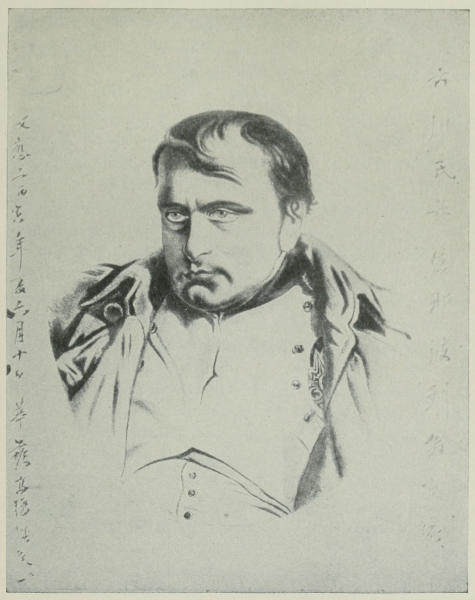
Napoleon at St. Helena. Watercolour painting, probably by a Japanese, with a marginal inscription in Chinese ideographs concerning the owner. Broadley collection.
Count Montholon is the most loyal of the exile’s companions. As a youngster of ten he had been instructed by Captain Buonaparte in mathematics. Later, he had served in two score battles under his master, and was much at the Emperor’s court. Many decades after Napoleon’s death, he proved his fidelity to the House of Bonaparte; for, just as now he offers up six years of his life to live with his exiled master on this rocky site, so, too, he devotes six further years to Napoleon’s nephew, sharing the third Napoleon’s captivity in a fortress. The only drawback in St. Helena is that the count’s wife does not get on with Madame Bertrand. One day the countess declares in the hearing of all that the Bertrands’ latest born is puny because the mother’s milk is good for nothing.
Meanwhile Madame Bertrand is reckoning that her eldest is sure to be made grand marshal as soon as Napoleon II ascends the throne. How much jealousy rages in these breasts because, meanwhile, under Napoleon I, Bertrand remains “grand marshal,” while Montholon superintends culinary affairs and Gourgaud attends to the Emperor’s stable. Besides, none of them have enough to do. Their duties cannot occupy more than two hours of the endless day. At last things come to such a pass in this ramshackle palace that the members of the little court can only communicate with one another in writing. Even Countess Montholon and her children have in the end to forsake the Emperor and the island.
Who is really loyal, loyal in his heart of hearts?
Three servants. Marchand, the valet, who has attended the Emperor for the last four years; and two Corsicans who, in the hurry of departure, Napoleon had pressed into his service, thereby linking up the island of his birth with the island of his latter days. These servants never have any dealings with the English foe, who would gladly draw their secrets from them. Cipriani has a special reason for his reticence: as sergeant he had seized Capri from the governor of Capri who to-day is governor of St. Helena. Santini occasionally asks for a day off in order to go shooting. But his sport is soon stopped when the fact gets known that he intends to shoot “that monster, the governor,” and then to put a bullet through his own head.
The Emperor sternly forbids his man to contemplate any such deed, for who in Europe would not immediately cast suspicion on himself? But when the servant has withdrawn, the master thinks indulgently: “We Corsicans are all like that!”
XI
A lean, middle-aged man with restless movements, red-haired, freckled, with a large brown patch on the cheek; his throat is stringy; he has pale golden eyebrows shading eyes which can look no one in the face; he is clad in a British uniform—such is the governor of the prison.
He lives in a fine country house, in the most sheltered part of the island, with a garden which is the oldest and most luxuriant in St. Helena. When he pays his first visit to Longwood, the Emperor says: “Execrable! A real hang-dog face, like that of a Venetian sbirro. He glared at me with the eye of a hyena caught in a trap. Perhaps he is my executioner.”
It was not Sir Hudson Lowe’s position which made him seem so obnoxious to the prisoner, who was on excellent terms with two or three army officers and with the admiral. But Lowe had been an English Fouché on the small scale, had been chief of the spy service in Italy, and had taken over his present delicate task in Fouché’s spirit. It was true that the peace of Europe depended on his watchfulness; and since, in Europe, people loved sleep more than greatness, one section of the public was hounding Lowe on to be brutal.
The English press was describing the prisoner in atrocious terms. One of the most noted of English journals pilloried him as the murderer of the Jaffa prisoners, described his sisters as whores, and spoke of Murat as a waiter; a special law was passed to make any attempt at freeing him a capital offence, with the proviso that the offender would be denied spiritual consolation on the way to execution; the prince regent was said to have “besmirched his name” by presenting some fowling-pieces to Napoleon. The honour of England is saved only by the Whigs; and by the formal protest of two members of the House of Peers, the duke of Sussex and Lord Holland. Lady Holland ventures to send the Emperor books and fruit; another noblewoman, who in earlier days had wanted to raise a corps of amazons against him, now boldly espouses his cause in London; a great English lawyer writes twenty-one theses to prove that Napoleon’s detention after peace has been signed is illegal; Thomas Moore and Lord Byron save England’s credit before the tribunal of history. Germany’s good fame is rescued by the fierce attacks upon Lowe in the German press, attacks that go on for years.
The governor is attacked because he has turned the whole island into a prison. He has issued regulations arranged in twenty-four paragraphs, informing the captains and crews of vessels that touch at St. Helena about all the things that are forbidden, under penalty; posters in the streets of Jamestown prohibit contact with the French; no one may approach Longwood without a written permit. Every movement of the prisoners is watched through a telescope; for six long years British officers keep their eyes riveted on the place of detention, but can rarely see anything more noteworthy than the lizards on the roof. Semaphores keep the governor informed as to all that is going on. They report: “General Bonaparte is out of bounds.”—“He is accompanied.”—“He is alone.”—One flag was kept in reserve for a terrible emergency, to announce the news that General Bonaparte had vanished. This blue signal was never hoisted.
The “bounds” are a twelve-mile ring round Longwood, subsequently restricted to an eight-mile ring; at 9 p.m. (or, when the restrictions are increased, at sunset), a cordon of sentries at fifty paces’ interval is posted. If Bertrand, who lives at Hutt’s Gate (a small villa about a mile away), is summoned by the Emperor after nightfall, he is escorted to Longwood by two soldiers with fixed bayonets—these bayonets, so runs the order, “must point at the Frenchman’s heart.”
The Emperor, who has for thirty years been accustomed to horseback exercise, may not go out of bounds unless accompanied by a British officer. He protests, “Not because I object to the red uniform more than another; after their baptism of fire, all soldiers are alike. But I refuse to do anything which involves the acknowledgement that I am a prisoner.” When in high spirits, as he was sometimes in the early days of his captivity, he would defy the regulations. Once he gave the English officer the slip, rode across country with Gourgaud, burst into a private plantation, saying to the owner: “Don’t let any one know that we have been here!” But during the latter part of his stay at St. Helena he kept within bounds, and, indeed, rarely left the grounds of Longwood. Sometimes he would order his horse for a ride; and then, when all was ready for the start, overwhelmed with bitterness at sight of the officer who was to accompany him, he would countermand the order and re-enter the house.
The result of this lack of outdoor exercise is that his health suffers more and more. The climate alone would have brought premature death, but confinement to the house quickens the pace of his maladies. For lack of movement, his legs swell. Furthermore, while Sir Hudson Lowe is giving dinner parties, for weeks at a time Napoleon cannot get even fresh water or milk. His stomach trouble grows much worse. The sick man would like a wider bed, but there is no room for one; he must content himself with rigging up a sofa beside his camp bed.
He and his companions have been deprived of their money. The letters he writes to France asking for funds are intercepted. Being positively in want, he has some of his silver plate put up to auction. When this is reported to the governor by semaphore, the inhabitants are forbidden to buy; Lowe himself purchases the articles at knock-down prices through an agent. Six months later, when the governor reads in the newspapers what Europe thinks of his conduct, he is greatly incensed, makes the regulations stricter than ever, supplies Longwood with uneatable meat and sour wine.
Like the villain in the folk-tale, Lowe is continually on the lookout for new ways of mortifying his prisoner. On the anniversary of Waterloo, he holds a great review close to Longwood. He invites “General Bonaparte” to Plantation House on the prince regent’s birthday. Another invitation is “to meet the countess” (Lady Loudoun, wife of the governor general of India). When the mail brings him a new lampoon against Napoleon, the governor sends it to one of the Emperor’s companions; but when a bust of the king of Rome, modelled by an admirer, arrives, he proposes to impound it, for documents may be hidden in its interior. He intercepts a letter from Napoleon to the prince regent, in which the prisoner begs for news of his wife and child; refuses to allow a Viennese traveller who has seen the little boy to visit Longwood; and when, through the kindly thought of a nurse and the loyalty of a valet, a lock of the boy’s hair at length reaches the Emperor by devious channels, Lowe sends home a detailed report concerning the obvious dangers of a conspiracy to liberate the caged eagle.
To begin with, the gaoler sees the prisoner a few times. “Throw away that cup of coffee,” says the Emperor after one of these interviews; “the man was near it.” From the first, Lowe does his utmost to shorten Napoleon’s life. When the Emperor’s vital energies begin to flag, the governor deprives him of the services of the English surgeon in whom Napoleon has confidence because this man, O’Meara, has refused any information beyond medical bulletins. O’Meara is one of those on whom Lowe has to keep a wary eye. It is not enough to surround Longwood with spies; the whole island is beset with them; they watch all the officers; and when they have nothing better to do, they watch one another. Soon a network of intrigue envelops the little house, whose interior is hung with yet another network—that of the jealousies which of old had been so rife in the Tuileries.
In the third year of the captivity, O’Meara reports to London that the Emperor’s liver trouble has been greatly aggravated by the climate, the dampness of his dwelling, the lack of exercise, and the vexations to which the prisoner is subjected. It is amazing that the illness does not advance with more rapid strides. This would happen, were it not for the energy with which the patient bears up, and were it not that his body has not been weakened by any excesses.—Since this report is shown to the British Minister for Foreign Affairs, and presumably to the prince regent as well, and since in spite of it the Emperor is kept for three years more at St. Helena instead of being sent to the Azores or some other suitable place, the bad faith of Napoleon’s custodians may be taken as proved—and Lowe was a worthy interpreter of his instructions.
The man’s animus, and the craftiness of his designs, are well shown by a passage in one of his reports. Lowe says he will arrange matters so that Napoleon will be able to resume horse exercise. Otherwise the prisoner might die of apoplexy, and that would be extremely inconvenient. Death from some lingering disorder would be better, for then the British doctors would have no difficulty in certifying that death was due to natural causes.
In the early days at St. Helena, the Emperor compiles a long official protest (it occupies twelve pages of print); it contains all his grounds of objection, and he has a private copy made upon silk, hoping that he will be able to smuggle it away to Europe. In this document he reiterates his refusal to allow himself to be addressed as “General Bonaparte,” for that implies a disavowal of his position as popularly elected Consul and Emperor. He remarks that he had proposed, as a reasonable compromise, to name himself Duroc or Muiron, after one of his two dead adjutants; but that England had refused to concede to him this “privilege accorded to persons of sovereign rank.” The governor had even attempted to address him as General “Buonaparte.”
In this tragi-comical fashion, after bearing seven names, he returns with the eighth, to the first name by which he had been known.
Soon there are actual hostilities. The lust of battle glows once more in the prisoner. He displays a vigour of hatred which in former days he had hardly ever shown in words, for then he had simply annihilated the objects of his wrath. Longwood, too, inaugurates a system of signals, though a less conspicuous one than that of the British, who use flags and semaphores. When the governor approaches, the Emperor, warned by his vedettes, hastens indoors, and tells his servants to say he is “not at home.” Once, however, he is taken by surprise in the garden; Lowe bluntly tells him that his establishment is too costly, and asks him to cut down expenses. The soldier flames in the Emperor.
“How dare you talk to me of such matters? You are nothing but a gaoler. You have only commanded brigands and deserters. I know the name of every English general who has won distinction. All I have ever heard of you is that you were one of Blücher’s quilldrivers, and a robber captain who never had the honour of commanding real soldiers.—Don’t send me any more food! I will take meals with those brave fellows of your 35th, over there; not one of them will refuse to share his rations with an old fellow-soldier. You can dispose of my life as you please, but not of my heart. That is still as proud on this rock as it was when all Europe was awaiting my orders.—You would stick at nothing. You would poison me if you had the courage, or were sent orders to do so!”
Without a word, the governor turns on his heel, mounts his horse, and gallops away. The Emperor compares past and present. “In the Tuileries, I should have blushed at such a scene.”
For ever, the governor remains on the watch, negotiates about details with the Emperor’s companions, but does not see the living Napoleon again. One day, however, Lowe makes another attempt, persists in spite of a refusal to admit him, wants to see with his own eyes that “General Bonaparte” is still there. The servant announces this importunacy. Then the governor hears the Emperor shout through the door:
“Tell him he can bring his executioner’s axe if he likes. But if he wants to enter my room, he must do so over my dead body. Give me my pistols!”
Lowe was able to satisfy himself as to the general’s presence when Napoleon lay dead.
XII
The Emperor rises as late as possible, so that the day may seem shorter. He rings; Marchand enters; Napoleon asks about the weather, slips on his white morning gown, and retains his headgear—a red chequered Madras kerchief he has been wearing all night. The red kerchief seems to be a whimsical parody of the turban he once dreamed of donning! Cold douche and rub—but of eau-de-Cologne, alas, there is none! Then Dr. O’Meara pays a visit. He speaks Italian with the Emperor, and gossips over the ludicrous happenings on the island. Sometimes there is no sugar to sweeten the coffee. Has the mailship come to port with fresh newspapers? Nothing as yet. Gourgaud arrives and writes from dictation. Where were we? The pyramids? The Emperor paces to and fro in the narrow room; a map of Egypt lies spread on the table.
He breakfasts with Gourgaud since the young man chances to be there. The talk is of artillery fire, and means of defence against it. In the afternoon, lounging on the sofa in the bedroom, he reads. The old home on the other island was certainly more comfortable. A couple of bound volumes of the “Moniteur” pass the hours. If he wearies of reading, his book will sink on to his knees, and his gaze will wander to Isabey’s portrait of wife and child. Nearby, on the white lacquered shelf, are two eagles, candlesticks, from Saint-Cloud. Between them is the marble bust of his son; and, hanging to the faded gilt frame of the mirror, four miniatures of the boy. There is also a picture of Josephine; and the gold watch of Rivoli, suspended by a chain made from the fair plaited hair of Marie Louise, hangs to the wall. There hangs also the silver alarum clock of Frederick the Great. Jetsam from the past, adorning his last, tiny bedroom!
He dressed for dinner in the old green coat; sported the decoration of the Legion of Honour; wore white silk stockings, and shoes with golden buckles. He was waited on at table by his Parisian servants in their rich liveries of green and gold. The table in his fusty dining-room was set with a dinner service of Sèvres depicting Napoleon’s battles, branched candlesticks, glass globes crowned with eagles. Cipriani carved for His Majesty and served his master with great ceremony. Conversation was usually carried on in monosyllables; it concerned the cost of various things in Paris; the price of the throne and the sceptre. After dinner, the company would pass into the drawing-room for a reading of Corneille; the same plays over and over again; the Emperor read with too much feeling to read well. Sometimes his hearers would nod: “Madame, you are asleep!” or, “Gourgaud, wake up!”
“At your orders, Sire.”
Occasionally he plays chess with Bertrand or reversi with Montholon. Then it is time to withdraw.
“What o’clock is it?”
“Eleven, Sire.”
“Another victory over time. One day the less!”
Thus passed more than two thousand days and nights. His campaigns in Italy and Egypt and his coup d’état had taken half the time!
The best way of getting through the weary hours is by reading and dictating. For five-and-twenty years he had had no time for reading; in earlier days he had devoured and annotated a whole library of books. What is he reading to-day?
The things which the young man had not had an opportunity of reading. In those days, standing outside the closed portals of the world, he gathered materials from all sides, went to first-hand sources: a practically minded student. Now, standing on the further side of the portals of the world, which have now closed behind him, he surveys the material: a sceptical philosopher. In those days, he searched history; now, he searches the poets, and especially relishes those passages from the poets which apply to his own case. An epic lies behind him; in the epics of others, he tries to find his prototype.
First of all, the Iliad. He sometimes browses over this till midnight. “Now, at length, I understand Homer. He is, like Moses, a child of his epoch: poet, orator, historian, lawgiver, geographer, theologian.... I am specially struck by the rough manners of the heroes as compared with their lofty thoughts.” Napoleon finds ease of heart in Homer. He cares less for the Odyssey. This seems to him no more than the story of an adventurer: he himself is more than that. Next in order of preference come Sophocles’ Œdipus, a tragedy of banishment; Æschylus’ Agamemnon; Milton’s Paradise Lost; the Bible. Corneille and Racine depict, in the French style, the heroes of antiquity, who for thirty years have been his models: unending are his readings of Cinna and Philoctète. Ossian rises out of the roar of the Atlantic: this he reads in an Italian translation. In addition, the satirists of the social life of Europe: Molière, whom in the ardent years of conquest and success the Emperor had scorned; and Beaumarchais’ Figaro and the Barbier de Séville. Finally, all the latest publications, whether memoirs or pamphlets, and, preferably, anything against himself.
The golden day for him was when the ship arrived with cases of books. In the course of his stay, he collected three thousand volumes; they were ranged on the bare damp shelves. Unfortunately, he reads so fast that a book hardly lasts him an hour, and the servant is kept busy carrying away armfuls of finished books which only a day before had been brought from the shelves. As soon as a book is read (or rejected) the Emperor flings it on to the floor.
In the early days on St. Helena, Napoleon’s actions were performed at his erstwhile speed, a speed which was many times faster than that of any of his associates. He forgot that now it was expedient to go slower. The consequence was that the few duties the prisoner imposed upon himself came to an end too quickly.
When, on taking leave of the imperial guard, he had promised that, during his reign in Elba, he would record their deeds, this had only been thought of as a way out of the threatened idleness. In the days of his first exile, he had begun no such record. Now, during the first year of his second exile, he dictates the whole of his memoirs. This work too, like all else in his life, is begun on the inspiration of the moment. Some pamphlets have arrived. In one of them, his landing at Cannes in the year ’15 is falsely described. He tells his doctor the true sequence of affairs; paces up and down, declaiming; motions to Montholon while continuing his tirade, and dictates, without a pause, the whole chapter dealing with his return from Elba. Separated from his archives by five thousand miles and more, lacking documents, from his unerring memory, and with an inspiration unsurpassed in the days of his greatest activity, he dictates the story of the Hundred Days. Then, suddenly, he breaks off. What’s the use of it all?
Another day, the report of an incident in the Lower House excites him: he thereupon dictates for fourteen hours without a rest. Those who take down his words, collapse, and replace one another at the task. Napoleon laughs them to scorn, and continues his dictation. Or, again, he sends for Montholon in the middle of the night to pen his recollections of more recent times.
Since he loves above all to dwell on his early victories, his friends at first advise him: “Perhaps Your Majesty might set about describing the Italian and Egyptian campaigns, and the days of the Consulate?” Set about describing! No one seems to notice, and least of all the Emperor, that these events are being spoken of as one might speak of the Thirty Years’ War. And just as, in those days, the man in whose heart and brain these things first took birth had projected his thoughts to the ends of the earth and had commanded his legions, so now, to the last instruments in his service, he communicates the details of his early campaigns, and in a few weeks describes how he conducted the wars from 1796 to 1799. Up and down, up and down, the Emperor paces, noticing nothing, wholly absorbed. Without, doors bang, people talk; the amanuensis is disturbed by these noises; not so Napoleon.
Las Cases, after taking down the description of the battle of Arcola, exclaims: “That’s finer than the Iliad!” The Emperor makes a wry face, and laughingly rejoins: “Bah! You still fancy yourself at court! I shall rewrite that chapter twenty times ere I shall be satisfied.” This expostulation is only a defence against flattery, for he has no intention of writing the chapter again; all he does is to make certain emendations when it is read over to him.
On the other hand, he dictates the events of Waterloo over and over again. Since, in spite of his historical objectivity, he cannot understand the result of this battle which undid him, he is always searching for new formulations. When, through the good offices of some sympathetic Englishmen, an opportunity occurs for smuggling documents to Europe, he works laboriously at the battle of Waterloo in order to dim England’s glory in the eyes of the European continent. But, he avers: “this task always makes me sad.”
In these memoirs, there are errors here and there. They are not due to lapses of memory, but to the author’s desire to emphasise his own place in history. Such errors are not more serious than those to be found in Cæsar’s works, are not serious errors at all. When he erroneously records that in his lieutenant days he received the gold medal from the academy of Lyons for his solution of a problem, and states that the money prize was of great use to his mother; when telling the story of his battles he ascribes to himself certain deeds which, in reality, had been performed by his generals (at Marengo, for instance); when he invents a treaty in which the tsar, before the Russian campaign, is made to propose the division of Europe we have inaccurate statements regarding the individuals concerned, but the broad facts are correct. It is true that, in accordance with his conception of the hero, he formally idealises the hero’s deeds; but he seems to us to lose more than he gains thereby. Since he is describing the period of his rise to power, he cannot materially falsify the facts: the immeasurable consequences of his first victory were bound to give rise, on the one hand, to a certain boastfulness, and, on the other, to detraction. But these volumes, which deal for the most part with the exploits of the commander, furnish but little real knowledge of Napoleon. Where we have to seek for the true Napoleon is in the memoirs of those who had the privilege of recording his conversations in exile.
Soon, indeed, his pleasure in dictation evaporates. Though he had intended to dictate in a few weeks the campaign of 1800 which had lasted but that amount of time, he postpones this labour, and tells Gourgaud to collect material bearing upon the Russian campaign. Then the young general, who had himself participated in the campaign of 1812, sets to work to read—not a Russian work dealing with the campaign, but an English work dealing with the life of the Emperor who is there, three rooms away, and could probably furnish full particulars!
Napoleon, the movement of whose mind was from events to ideas, and very rarely from thought to deed, is still true to type. When he reads news from Paris, he dictates rejoinders which demonstrate his expertise, and he compiles financial schemes. From his rock, from his little room, he answers the sounds coming from the outer world, although the sounds are no summons and his answer dies away into the void. He often proposes to write a treatise on the art of war, but he gives the notion up, “for the generals who in days to come get beaten will blame me, and say they were following my principles.... I could instruct them, for I am a good teacher; but I cannot have my principles of warfare set down in print.” He mistrusts every systematisation, for he is essentially a man who has learned by experience, by the unexpected. But if an isolated problem crops up in the course of a book he is dictating, then he deals with it in the precisest of terms. Thus, he makes Gourgaud calculate how much water a fire hose can deliver, for he wants to introduce the fire hose to combat the consequences of artillery fire.
Congenial society occasionally shortens the day. Or visitors come to see the Emperor. English travellers, men of learning, colonial magnates, are admitted to audience. On their return to Europe, they bear witness to his mental alertness. Napoleon himself desires such reports to be spread abroad, for they can do nothing but good to his cause now that Las Cases’ diary has aroused fresh sympathy for his plight.
“Scatter your complaints throughout Europe! I myself do not complain.” And he adds the orphic saying:
“I command, or else I hold my peace.”
His visitors tell him interesting things. An English admiral, whose vessel had been lying off the coast during the battle of Waterloo, assures the Emperor that Wellington had already given orders to ship the English army because Blücher did not arrive. When his companions inform him of the enthusiasm with which the enemy officers were filled after their interview with the Emperor, he says, assuming the role of the revolutionary: “Of course, these people belong to us. They all come from England’s third estate, and are the natural foes of their haughty aristocracy.”
All the men in the services are on his side. English sailors, on shore leave for a day or two, will prowl round the place all night. At the first opportunity, they pounce upon him, stuttering incoherent words, presenting him with flowers. The Emperor claps them pleasantly on the shoulder. When the garrison is changed, he receives the members of the officers’ corps, exactly as though they had been Frenchmen and he their army chief. They form a semicircle; he asks, “How many years’ service; how many wounds? I was greatly pleased with the 53rd regiment. I shall always be delighted to hear of good strokes of luck coming in its way. You are sad, Admiral Bingham, that these brave soldiers are leaving you. To comfort your heart, My Lady must bear you a little Bingham!” The army men laugh. The admiral blushes. When, next day, the transport hoists sail, the men give the prisoner three hearty cheers. A few months later, all Europe is agog with the anecdote.
On another occasion, he sees a medal displayed on the chest of a captain, half raises it, and reads: Victory at Vittoria. The Emperor allows the decoration to slip from his fingers, and passes without a word to the next visitor.
Each of England’s allies sends a commissioner to the island. They are there merely to gratify the curiosity of their sovereigns. The prisoner refuses them access to his presence, and, though they are here on this desolate rock with the sole purpose of seeing that he is in safe custody, during all the years of their sojourn they never clap eyes on him once. Here is a fresh focus of intrigue and boredom. The only one of the commissioners whom the Emperor allows his suite to make friends with is Monsieur le Marquis. This is the representative chosen by His Very Christian Majesty King Louis XVIII to keep watch on his formidable predecessor. The marquis sees that Napoleon gets all the most recent periodicals; the Emperor reciprocates by the loan of books. When tidings are brought announcing the assassination in France of a Bourbon duke, General Bonaparte sends his condolences to the marquis of the old nobility by the intermediation of Count Bertrand, who is also a sprig of the noblesse. A scene out of comic opera!
When the prisoner is in happy vein he seeks other pastimes. One evening he spends fluttering the pages of the official year-books of his reign, and says, like the bewitched tinker in the old folk-tale: “It was a fine empire. I ruled eighty-three million human beings; more than half the population of Europe!” He spends the whole of another evening with Las Cases chatting over old times. They laugh, the Emperor’s spirits rise, he orders champagne to be brought, and before they realise it the hands of the clock point to eleven. Napoleon says delightedly: “How quickly the time has gone! What agreeable hours! My dear fellow, you are sending a happy man to bed.”
Words which grip one perhaps more poignantly than any complaint could do.
He takes Montholon’s seven-year-old child on his knee and recites La Fontaine’s fable of the wolf and the lamb. The child has not fully understood, and makes a delicious muddle of lamb, wolf, and His Majesty. Another happy half hour in the Emperor’s life! Again, he strolls up and down the room in the evening after dinner, humming an Italian aria, and laughing gleefully, for he has just read that King Louis always speaks of him as “Monsieur de Buonaparte.” If he has a sleepless night, he makes Las Cases tell him anecdotes from the Faubourg; or he says to Gourgaud: “Let us exchange stories about love affairs. I never had enough time to spare for women. Otherwise they would have ruled my life for me.” If he gets bored in his bath, he takes the opportunity of demonstrating to Gourgaud why the pressure of the water upon a floating body is equal to the weight of the body. On one occasion, in the drawing-room, he has his own height and that of his companions measured against the door.
Sometimes he will not dress or go out in the morning, putting off both until the afternoon. On one of these occasions, after an exceptionally torrid evening, he does not re-enter the house till midnight, and says that he has won a real victory by staying out so long. Another day he goes up the stair-ladder into his valet’s garret, having been told that it is so nicely furnished. He is shown his own wardrobe, which is stowed away there, and is amazed to find what a lot of clothing he still possesses. He fingers the uniform he had worn as Consul (a gift from the city of Lyons), the spurs he had worn at Wagram, the cloak of the Marengo days. He makes no comment; goes down the stair-ladder in silence.
Amid these desperate attempts to kill time, does the prisoner come across no one whose situation moves him?
Yes, there is one. Of all the dwellers on this rock, the one whose lot touches the Emperor’s heart most profoundly is a slave, a Malay who passes by the name Tobias, has been kidnapped, sold into slavery, and cast up on this remote island. Napoleon comes across him working in the garden, or meets him in the road, is never weary of studying him, and gives him a gold coin whenever he sees him. The Malay thanks him in broken English: “Good gentleman.”
“Poor devil!” says the Emperor to his companion, obviously picturing himself in the position of this dusky piece of flotsam. “Snatched from his family, torn from his home, robbed of himself, sold into slavery! Was there ever a greater piece of wickedness? If a captain did it, he was a villain; but if the crew combined to seize poor Tobias, they were hardly responsible. Wickedness is always individual, never collective. Joseph’s brethren could not make up their minds to kill him, but Judas betrayed his master.”
After the next encounter with the Malay: “What a pitiful machine man is, after all! Not one bodily wrapping like another; not one soul that does differ from all the rest. Those who fail to recognise this, make a great many mistakes. Had Tobias been a Brutus, he would have hurled himself on death; an Æsop, and he would have been governor by now; a good Christian, and he would have blessed his chains. But he is only poor Tobias, so he is none of these things, merely bows his head in his simplicity and goes on with his daily task.”
The two continue their walk: “Certainly it is a long way from poor Tobias to King Richard. But the deed which brought the fellow here is no less shameful, for this man had his family, his friends, his own life. What a crime to have condemned him to slave on this island until the day of his death!” Suddenly, Napoleon stops short, and eyes Las Cases quizzically:
“I read from your face that you are thinking he is not the only sufferer of the kind on this island.” Las Cases nods assent, and the Emperor bursts out with a youth’s ardour: “There is no warrant for such a comparison! True, the violence done to us is more refined in its cruelty, but, in compensation, we are more distinguished victims.... The world has its eyes fixed on us. We are the martyrs of an immortal cause! Millions weep for us, the fatherland sighs, the spirit of glory mourns.... Adversity, too, has its heroism and its fame. Had I died on the throne, surrounded by all the emblems of power, I should have remained a riddle to many. To-day the wrappings have been stripped from me; thanks to my misfortunes, every one can judge me in my nakedness.”
Subsequently, the Emperor buys the slave, wishing to send him back to his own land and his own folk, but the governor forbids the repatriation: “It is plain to me that General Bonaparte is trying to win the hearts of the coloured population, in the hope of setting up a second negro empire, as in San Domingo.”
Tobias, therefore, remains a captive; a slave in a far country, like the Emperor.
XIII
“I am very old to make a journey of two thousand leagues. Perhaps I should die on the way; but, never mind, I should die nearer you.”
Thus writes his mother. The Emperor reads the letter again and again, when it is delivered to him a year after it was penned. The powers forbade the journey: who could tell, the old lady might concoct a plan for his escape! Letizia had been banished from France when the other members of her family were expelled. For the second time in her life, she is unable to go to her island home: the first time had been long ago when Corsica was in revolt; now, Europe stands in the way. She, therefore, goes to Rome, where the moral power of the pope upholds her; always making fresh attempts to secure her son’s removal to a more healthy abiding place. Although the tsar is favourable to such a transfer, Habsburg and England are determined Napoleon shall die; so there is nothing more to be done. Neither mother nor any of the brothers and sisters is allowed to send money to the exile.
When the monarchs assemble in Aix-la-Chapelle for the congress, Letizia writes to the princes: “A mother, more bowed with grief than words can tell, has long been hoping that the meeting of your imperial and royal highnesses would give her back her life. It is impossible that the captivity of Emperor Napoleon should not come up for discussion. Your magnanimity, your power, and your memory of earlier events, will surely incline Your Imperial and Royal Majesties to work for the liberation of a prince for whom you once professed friendship. I pray to God and to you, for you are God’s representatives on earth. Interests of State have their limits. Posterity, which confers immortality, admires a generous conqueror.”
No answer.
Later the captive learns that his mother has been accused of fostering a conspiracy in Corsica. She is said to have provided money amounting to millions. The pope is ordered to send his secretary of State to see the old lady and to make enquiries. Letizia gives the emissary the following message: “Tell the pope, and may the monarchs mark my words: If I were so fortunate as to possess all these millions they have credited me with, I should certainly not spend them in buying champions for my son’s cause. He has enough of them already. I would, rather, equip a fleet capable of rescuing him from the island where he is unjustly detained.”
What a feeling of pride and elation fills the son’s heart as he reads his mother’s words! But he never hears of Letizia’s bitter remark to an Austrian noble: “Why is my daughter-in-law amusing herself in Italy instead of joining her husband in St. Helena?”
Round what sun are the other planets turning? What an anticlimax!
Lucien and Joseph have gone to America, and are later joined by Jerome. They assume exotic titles. The Spanish revolutionaries have offered their ex-king the crown of Mexico. This piece of news excites the prisoner:
“Joseph will refuse. He is too fond of the pleasures of life to bother himself again with the burden of a crown—and yet, it would be a stroke of luck for England that the whole problem of Spanish America should be solved in this way. For if Joseph were to become king of Mexico a breach with France and Spain would be inevitable. For myself, his acquiescence would be weighty with consequences. He loves me and would use his position as a weapon to coerce England into treating me differently. Unfortunately, he is sure to refuse.” Thus quickly and hopefully does Napoleon, in the first year of his captivity, toy with every fresh opportunity.
The other brothers and sisters retire into obscurity. Jerome alone lives to be an old man, and, in the days of the third Napoleon, appears once more at court. The Emperor receives few letters from his brothers and sisters. Caroline begs her mother to send some money. Letizia refuses: “All I have belongs to the Emperor, from whom I have received all I possess.” To Lucien she writes: “When one is no longer king, one makes oneself a laughing-stock if one tries to live ostentatiously. Rings may adorn the fingers; but, if they fall off, the fingers still remain.” Hortense and Pauline once more play comedy as they had done at Malmaison.
Other tidings give Napoleon food for thought. Bernadotte becomes king. And Désirée? At last Napoleon’s early love wears a crown; she also lives to see the Second Empire. Countess Walewska, now a widow, marries a French nobleman. He approves the step, passes her situation in review, considers all he has done for her son, and then says complacently: “She is rich, and must have saved.” The tactless Gourgaud makes answer: “Your Majesty paid Madame Walewska ten thousand francs a month.” The Emperor blushes, and asks with embarrassment: “How do you know that?”
King Murat and Marshal Ney are both shot after court martial. Their master accepts their fate with soldierly fortitude. His only annoyance is that Murat should have been such a fool as to land in Calabria. He bears his brother-in-law no grudge. Even Marmont, who lives happily under the Bourbons, comes in for no more reproach than: “I am sorry for Marmont; I was really fond of him. He’s not a bad fellow. They appealed to him through his feelings. He fancied he was to be saviour of his country, and behaved like a madman. He would have done better to shoot himself.... Human nature is weak.”
And yet it is precisely Marmont who stifles every movement which might be of advantage to the exile. Murmurings against the Bourbon ruler spread throughout the land. But when, once more, the émigrés and the members of the new nobility are placed in great positions, notwithstanding their lack of qualifications for such posts, and a Richelieu is given high office in spite of his long absence from France and his ignorance of French affairs; when Lafayette, the veteran fighter for liberty, becomes leader of the proletariat and makes ready for a new revolution, gathering his forces in the clubs and even in the schools, and preparing among the troops “the men of the coming day,” to clear out the Bourbons, who can only maintain their position by the aid of foreign armies; when the radical provinces, eager to flaunt the tricolour cockade, rally in support of Napoleon II—it is Marmont, Bonaparte’s eldest comrade, who crushes the movement, and thereafter becomes minister.
The Emperor composedly reads that Louis XVIII. has dissolved the Chambers because many of the members favour Orleans or Napoleon. Executions for treason are the order of the day. But who is the most trusted associate of the Bourbon? A little nobody of a Corsican, whom Letizia once upon a time had made her private secretary—a sinecure job created to provide the man with a livelihood. Since all these events take place during the first year, the Emperor is filled with hope, and meditates upon the chances of a fresh revolution.
“What a cruel decree of fate that just at this moment I should be held prisoner! Who is there to set himself at the head of things? Who will be there to save thousands of the bravest from the scaffold?” He stays alone in his room until the morrow, when he speaks absently of Elba. Soon stranger ships heave in sight, the prisoner counts the shots. What is happening? The Emperor sends his friends to gather tidings; they hear nothing; but hope is strong. “What children we are, to be sure,” he exclaims next day. “And I, instead of giving a good example, am no better than the rest of you. Were I in America, I should think of nothing but my garden.”
Nevertheless, he would not have gone to America. He owns as much when he says: “If I were in America with Joseph, instead of suffering here, nobody would ever think of me, and my cause would be lost. I may have another fifteen years of life, but I am doomed to die here—unless France should summon me.”
These hopes are not unfounded. England considers it wise to increase the garrison from two hundred men to three thousand, in order to keep guard on one individual, although the cost of the troops in St. Helena is £320,000 a year. Still, there are possibilities, for the soldiers are whole-heartedly on his side. On one occasion six officers were arrested. They had come from Rio de Janeiro, and had planned to get the Emperor away in a kind of submarine. Again, two captains, travellers to India on a ship which has touched at the island, make him proposals for an escape: Napoleon listens attentively, but decides not to accept. On a third occasion, Montholon breaks in on the Emperor while he is at work with Gourgaud to remind his master that the passport of a certain individual expires in an hour’s time and a decision must be made. Montholon writes: “It had been proposed to take the Emperor to America for the sum of one million francs payable on landing. The Emperor’s word would suffice. Unfortunately I may not divulge any more of the scheme, lest I expose the originator, for whose loyalty to the Emperor we must be eternally grateful. The Emperor listened to me, and considered all I had to say: he paced to and fro several times in silence, asked Gourgaud and myself for our opinions. He took no part in the discussion. In the end, he said: ‘You must decline the offer.’”
There he stands, he has not been captive a year as yet, passably well in health, athirst for action, goaded by the pin-pricks of a mighty government and a puny governor. Before him opens out the possibility of escape, escape with the aid of English officers. The fact that risk is attached does not alarm one who is used to bold enterprises. There he is, dictating the story of his youth, when suddenly, at the end of his career, a friend makes proposals that are certainly not cobwebs of the brain. Napoleon is silent, he questions, he is silent again. Then: “You must decline the offer.” Why?
Because France is once more in a state of unrest, and so he decides to stay where he is. He is so sure of a change of feeling among the people that, later, when a ship is sighted and signals to the station, the Emperor says: “Perhaps the vessel brings news of my recall. If the prince regent dies, the young queen will summon me to England. She was always against my being sent to St. Helena.” When, on the outbreak of fresh revolts in Paris, his companions mention the possibility of France demanding his return, he concedes the point, adding:
“But what can they hope from my return? That I should again conduct wars? I am too old. That I should seek for fresh glories? I am sated with them.... It will be much better for my son that I should stay here. If Christ had not died upon the cross, he would not have become the Son of God. My martyrdom will give the crown back to my son, if he lives.”
Napoleon’s feeling for the dynasty is as deep as ever. His preoccupation with the thought of founding a line overpowers, in his maturer years, his impulse to action, to adventure, and even to win fame.
Though he is inspired with these lofty moods of hope and heroical renunciation, nevertheless despondency overwhelms him at times; then he becomes greatly depressed, and the most trifling upset in the household will seem an intolerable burden. When Bertrand stays away from dinner in a pet, the Emperor is out of sorts for days: “I know that I have fallen from my high estate, but that one of my nearest companions should rub it in is dreadful....” He groans. Las Cases offers to intervene. “No, I forbid it. I had to say that much. But now all is forgotten and I shall behave as though I had noticed nothing.” If travellers should wish to see him on such days, he refuses, saying: “Tell them, dead men do not receive visitors.” Occasionally Napoleon broods alone for the whole evening, sends at last for one of his companions, says a word or two, and dismisses him.
A quarrel arises between Montholon and Gourgaud as to whose room shall be furnished first, the Emperor has to mediate, the countess weeps, the Emperor proposes a game of chess. Dinner. A reading from the Book of Esther. Sometimes these scenes verge on the grotesque: a cow has escaped, the Emperor shows his vexation, Gourgaud sits glum throughout dinner because he is responsible for the cow, and is feeling aggrieved by his master’s anger. After dinner, the Emperor speaks of Islam and his preferences for the Mohammedan faith, then passes to a discussion of the trinity; finally he withdraws, making painful attempts to conceal his angry mood and muttering between his teeth: “Moscow! Five hundred thousand men!”
Gourgaud, who has left him overnight in an agreeable state of excitement, finds him next day in a gloomy temper: “What sort of an education will they give my son? Will they teach him to loathe his father? Hateful thought!” When Las Cases, who has copied out the chapter on Waterloo, deplores that victory should have been snatched from the Emperor’s grasp, Napoleon makes no reply, but says to Las Cases’ son in a voice which seems to come from a great distance: “My lad, go and fetch Iphigenia in Aulis; that will do us good.” Or he has Racine’s Andromache read to him.
I am come to the place where my son lies captive: for one moment only, allow my tears to flow with his! This is all that is left to me of Hector and of Troy. Permit me, Lord, to visit him once on every day....
But the Emperor breaks in on the reading with the cry:
“Enough! Leave me; I would be alone!”
XIV
With the growing inactivity and boredom, the moods of this tortured heart become more and more agonising; this many-toned instrument can no longer be controlled; discords arise.
He has been an emperor! How can he cease to play the part to which the society of a handful of courtiers and the degrading mockery of the enemy constrain him? In order to protest against the use of the title of general and against the illegality of his captivity, he drives out, at first, in full imperial grandeur, his carriage drawn by six horses, and an equerry in uniform riding at each door. His companions appear before him in general’s uniform or in court dress; no one opens conversation uninvited; when he takes his walks in the garden his suite does not approach till he gives a sign; visits are announced by an adjutant general, booted, and wearing a sword. When Gourgaud rises as Countess Montholon enters the room, he is reproved for this breach of etiquette.
Meanwhile he makes fun of the whole thing, mockingly calls Gourgaud “my grand master of the horse,” or announces at table: “I have been anointed by the pope; thereby I have become a bishop, and have the power to consecrate you as priests.” When he teases his friends about their all being in the “Dictionary of Weathercocks,” whose pages he is at the moment fluttering, Gourgaud ventures to say that the Emperor himself deserves a place in it. “Oh; and pray why?”