BOOK TWO THE TORRENT
Cedar Paul translation
So divine an illumination is always linked with youth and productivity; and, in very truth, Napoleon was one of the most productive men that ever lived.—Goethe.
I
The towering peaks form a white, serrated ridge that thrusts upward into the blue of morning. Gleaming with perpetual snows, dangerous as the adventure he has undertaken, the Alps look down threateningly upon the bay, and mock the teeming crowds of men. Invincibly does nature, in symbolic fashion, here call a halt to the commander; here she has interposed a barrier between the land of his fathers and his new fatherland.
But he, who never trusts in force alone, who always outbids force with prudence, has to good purpose been pondering the old problem. Hannibal crossed the Alps; he, Napoleon, will go round them. If we come to grips with the enemy at the weakest point, where the Apennines press close to the Alps and a slight depression facilitates an entry, we need not wait for the summer. The earlier in the year, the firmer the snows, and the less danger from avalanches. Forward, into the land of my fathers!
Delay will be fatal. Not that the enemy is a danger to him. His foes are asleep in winter quarters: the Austrians in the east of Lombardy; the Sardinians in the west of the Lombard plain; and the numerous petty republics and duchies, the fragments of Italy, are not expecting an attack until the thaw has come. But the French soldiers are hungry. Paris, on the verge of ruin, through depreciation of the currency, can send them nothing but almost valueless assignats; and all of these disappear into the greedy maw of the army contractors. “France would tremble,” said one of the generals in his letters home just before Bonaparte’s arrival, “could every one know how many are dying here of famine and disease.” What will the new commander do if he brings neither money nor bread with him?
“Soldiers, you are half starved and half naked. The Government owes you much, but can do nothing for you. Your patience, your courage, do you honour, but give you no glory, no advantage. I will lead you into the most fertile plains of the world. There you will find flourishing cities, teeming provinces. There you will reap honour, glory, and wealth. Soldiers of the Army of Italy, will you be wanting in courage and firmness?”
A faint cheer from the ranks answered the new commander when, at the first parade, he addressed his men in the foregoing words. But when they were all back in camp, one said to another: “General doesn’t look very weatherproof, with his yellow hide. Fine talk, that, about the fertile plains. He’d better let us have some boots first, so that we can march there!” The people of Israel must have grumbled in much the same fashion when Moses spoke of the Promised Land. The new commander encounters nothing but opposition.
Who knows him among the soldiers of this army, which has now been encamped for three years on the crests of the hills? Those of them who remain, that is to say: for a fourth of the men are in hospital; and an equal number have been killed, or taken prisoner, or have deserted! The officers? Will not they, like those captains in Auxonne seven years ago, be inclined to encounter this wonderful young man’s orders with passive resistance rather than ready obedience? Look at him as he sits there writing and calculating; his powdered hair is cut in a fringe over his forehead, but lengthens towards the back of the head to hang down over his shoulders; his coat is simple and scantily embroidered; he walks up and down and issues dictatorial orders, this foreigner whose French is still faulty. Not an officer in his staff is well-disposed towards him, except the three or four faithful followers whom he has brought with him. One of these latter tells us: “They looked upon him as a mathematician or a visionary.”
What if he be both at once, and for this very reason a man of genius?
At first, he seems to be nothing but a calculator. Consider one of his early letters to the Directors—for he promptly opens an epistolary campaign, carried on side by side with a campaign of cavalry and by guns, waged with the same ardour and the same success. “You are asking me to perform miracles, and I cannot do that.... Only with prudence and foresight can we achieve great ends. It is but a step from victory to defeat. In affairs of magnitude I have learned that, in the last resort, everything invariably turns upon a trifle.” But to Carnot, the great army organiser, to whom he can say much that is unsuitable for his official dispatches, he writes, gnashing his teeth: “Would you believe it, that I have not a single engineer officer here, not one who has ever taken part in a siege!... You can hardly conceive how furious I am that I have no artillery!” His actual resources totalled 24 mountain guns, 4,000 underfed horses, frs. 300,000 in silver, and enough food to supply his 30,000 men for a month on half rations. With these vestiges of an equipment, he is to conquer Italy!
Nevertheless, having undertaken the venture, he makes the best of the materials at his disposal. Getting to work like a hurricane upon this crowd of pitiful men who have run to seed, upon corps some of which have already begun to sing the royal anthem again, with indefatigable energy he succeeds in transforming them into a republican army.
Here are some of his doings on the third day after his arrival. Sending a hundred and ten workmen to make a road. Suppression of a mutiny in a brigade. Quartering of two artillery divisions. Orders to two generals in case of horse stealing. Answer to the requests of two others concerning their commands. Order to a general in Toulon to bring his men to Nice. Order to another general to call up the National Guard of Antibes. Order to a general to find the most efficient officers in the mutinous brigade. Address to the general staff. Review of troops, with orders of the day.—During the first twenty days, one hundred and twenty-three written orders relate solely to the provisioning of the troops; among them are numerous complaints concerning peculation, short weight, and inferior goods; and these orders are issued on the march, from twelve different headquarters, in the interludes between six skirmishes.
For hardly has he passed through the narrow defiles than, in accordance with his new principle, he has massed his forces to attack first one and then the other of the allied foes, and in two battles he defeats and separates them. In truth, these were mere advance-guard skirmishes, as becomes the nature of the French, and the previous training of these troops, which as yet know nothing of a great movement in open lines. At this stage of his campaign, speed and boldness are more important than elaborate strategy.
When he is on one of these breathless rides, in the deep mountain valleys, through the passes, amid the thunder of his own and the enemy cannon, suddenly the glass covering Josephine’s miniature (which he carries in the inner pocket of his tunic, and has kissed hundreds of times) shivers into fragments. Growing paler than ever, he reins in his charger, and says to Bourrienne: “The glass is broken. My wife is ill or unfaithful. Forward!”
Everything depends upon the fulfilment of his first old pledge. He knows that if, this once, he is able to do what he has promised, the army will believe him; and if it believes him, it will soon believe in him. In actual fact, a fortnight after his prophecy had been uttered, the army, which had won its first victories on entering the downward grades, found itself on the last elevation. The soldiers raised a hearty cheer. After the weary days in the narrow valleys, they at length caught sight of the plains of Piedmont lying at their feet, stretching out into the immeasurable distance, blossoming in the spring weather, offering all that they had gone short of for so long. The Po and other rivers were flowing towards the horizon, and at length the world of snows lay behind. “As if by a magician’s spell, they had been enabled to cross the gigantic barrier, which had seemed to them like the frontier of another world.”
“All this is yours!” Their commander has forced one of the two opponents, the king of Sardinia, to make truce, thus compelling the surrender of everything that grows on Sardinian territory. This first truce of his campaigns was secured by Bonaparte through cunning and bluff, for he threatened the enemy with the use of overwhelming forces, which he did not possess, and, indeed, could not have used, pressed as he was on both sides. The soldiers are amazed; their general is a man of his word! Literally, in a fortnight, he has fulfilled his promise.
Henceforward, the men under his command put their trust in Bonaparte. It is as Bonaparte that he begins to sign himself from the outset of the campaign. Since Italy is the enemy, he will have nothing more to do with an Italian name.
Ere long, he will change his name again.
II
Why was he victorious? How can we explain that during the next few weeks he was able to deliver blow after blow? What is the solution of this riddle?
First of all, he owes his success to youth and health. A body that can endure interminable riding without fatigue; the power to sleep at any moment, and to wake whenever he pleases; a stomach which can digest anything, and makes no complaint at being put on short commons; eyes that see and arrange everything.
But it is to the revolution that he is indebted for the fact that at the age of twenty-seven, when his splendid powers are in their first vigour, he has risen to a leading place, and can wield unrestricted dictatorship. Only, thanks to the new ideas of equality, in a world which prizes a man for what he does and not for his birth, can any one become a leader in the prime of youth and after so rough an apprenticeship.
Look at the men who are in the field against him. Archduke Charles, with his delicately shaped and decadent Habsburg nose, how can he, with his education, vie with the Corsican in indifference to hardships, rival Bonaparte in knowledge of men? How can Beaulieu, the Austrian commander, cope with the French general? The former is seventy-two; the latter, twenty-seven. General Colli suffers from gout, and has to be carried throughout the campaign. Alvintzy is in the middle sixties. The king of Sardinia is an old man. What can the excellent General Wurmser, who is deaf, and a slow, elderly gentleman, cautious in his movements, do against a commander who thinks nothing of changing his headquarters every day, who surrounds himself with young men, and who takes “Time is everything,” for his motto?
The oldest man in Napoleon’s circle is the faithful Berthier, now forty-two, whom the new commander has taken over from his predecessor because Berthier has a good knowledge of the country. For two decades he is to be Bonaparte’s slavishly devoted chief of general staff. Next to be mentioned comes Masséna, a man of ardent temperament, who had been a cabin boy and a vagrant, and had served fourteen years under the Bourbons without rising to the rank of sergeant major; now, within a few weeks, he was to become a general. Augereau, too, a deserter from three armies, boaster, adventurer, and great thief. Such were the men drawn from the dregs of society out of whom their commander, the youngest of them all, was soon to make heroes and generalissimos, and subsequently princes and dukes.
In every dispatch, he recommends for promotion those, and only those, who have displayed courage. Thus, after three battles, a grenadier rises to the rank of colonel, and will climb yet higher. On the other hand, many of the generals whom he has taken over with his command are dismissed with blunt censure: “Good enough for office work, knows nothing of war.” His subordinates do not necessarily incur his displeasure because they are beaten: “The fortune of war, dear Masséna, changes from day to day. To-morrow, or later, we shall win back what you have just lost.” But a division which has done badly is paraded to hear a rating. He says that he will have a mocking inscription worked upon its colours. Then the soldiers cry to him from the ranks: “To-morrow we will lead the van.” Next day, he has a thousand more enthusiasts among the troops. When they are victorious, in the orders of the day he calls them comrades and friends. Thus does he lead the sons of the people.
For it is a people’s army that he is leading; that is the second great factor of his success. This, too, he owes to the revolution. Indeed, the people’s army is an expression of the revolution. The soldiers on the Austrian side must be used thriftily, for they cost a great deal, and it is not easy to replace them. They are drawn from a larger number of nationalities than the German emperor himself rules. Six different languages are spoken in the army, and there is no community of thought to hold it together. But the French are fighting as a united nation of thirty millions, and their army will be capable of perpetual regeneration for twenty years to come.
What is the French army fighting for? The new freedom of the republic, and to spread throughout the world the few and simple ideas which animate it! The French are fighting for the world revolution, and nothing short of that. But the army is not in pursuit of purely ideal aims. It has to defend liberty against the environing forces of legitimate monarchy, against the legitimists who are more concerned with self-defence than with the cause of the fallen Bourbons. The French cannot achieve their end by simply defending their own frontiers. They are surrounded by kings and emperors who wish to keep their peoples from any attempt to imitate the French revolution, and are therefore trying to destroy the very focus of the new ideas. Thus France is forced to assume the offensive as a means of self-defence. Those who in such a fashion become conquerors in spite of themselves, are surely entitled to declare that their conquests are achieved in the name of liberty.
This brings us to the third factor of Napoleon’s success. While the commander is engaged in the attempt to conquer Lombardy, and then Italy, for France, he issues a series of manifestoes to tell the inhabitants of the territories he is invading that he comes to free them from the Habsburgs and the Sardinians, from dukes and patrician senates. Will not all who have been discontented with the old order be roused to action by the torrential force of such appeals? Have not the oppressed masses long had it in mind to rid themselves of their rulers? Have not the ideas of the revolution crossed the frontiers years ago, rousing, in many of the towns, students and burghers to revolt? Here in Italy were young people who longed for freedom; leaders who had been vainly clamouring for “Italia unità.” The revolt, though still in chains, was rattling its chains outside the kings’ palace doors. The malcontents were ready to welcome the invading army, and to believe in its mission.
The commander, a man of Italian blood, bearing an Italian name, and speaking Italian as his mother tongue, was not for them a French warrior. He was the herald of liberty and equality, and the two great words headed all his letters. How terrible would be the disillusionment, should the invader prove, after all, a foreign oppressor! The commander is well aware how much turns upon this. Will he be able to keep his famished army within bounds? Can he make his soldiers behave as well as if they were fresh from a well-provisioned garrison town?
“Looting is on the wane,” he writes home. “The thirst of an army which lacked everything has been quenched. There is an excuse for the poor devils. They have spent three years in the marches of the Alps, and now I have led them into the Promised Land! A famished soldier perpetrates excesses which make one ashamed of being a man.... I intend to restore order, for I will not remain in command of a robber band.... To-morrow I am going to have several privates and a corporal shot, for having looted the plate from a church. Discipline will be re-established within a day or two. Italy has been amazed at the valour of our soldiers, and shall be amazed at their good behaviour. There have been terrible moments; things have happened which have made me shudder. Thank God, the retreating enemy behaved even worse!”
He puts his men on their honour. “Swear to me”—thus runs one of his early manifestoes—“to spare the peoples you are liberating; otherwise you will be the scourges of the people! Your victories, your courage, the blood of our fallen brothers, will be lost; honour and glory, too! I and my generals would blush at leading an undisciplined army!” Hard to carry out, despite his adjurations. Throughout the campaign, he is hampered by this problem of looting. Again and again he issues orders to his generals telling them they are to shoot any one who fails to hand over his plunder within twenty-four hours, even if the stolen goods be horses and mules.
There are revolts and counter-attacks. Priests and nobles, agents of the princes, incite a town to resist. He is pitiless in his shootings, ruthless in his reprisals, whenever, in the conquered territory, any one raises a hand against the new master. But this becomes increasingly rare, for in the towns he is skilful in enlisting the civic sense on the side of a new order which assumes imposing lineaments. He understands (and this is an additional factor of success) the Italian temperament; knows how to appeal to the sense of historic veneration: “Peoples of Italy, the army of France comes to break your chains. It is a friend to all the peoples. Have confidence! Your property, your customs, your religion, shall be respected.” He goes on to speak to them of Athens, Sparta, classical Rome.
History inspires him. While with rapid strokes he is making history, history gives his spirit wings. In boyhood, he had studied Plutarch; as lieutenant, he had read the history of all times; now, from moment to moment, he turns the knowledge to account. Knowing who has ruled in every part of these territories, understanding how the governments he has overthrown came into being, he has appropriate measures for each area. Time-honoured figures are ever present to his imagination; he wants to resemble them, to outdo them. Thus, whatever he does is conceived in a historic setting; and he compels his army, the country with which he is dealing, and, soon, Europe as a whole, to breathe the same atmosphere. These first victories, which in reality are nothing more than big skirmishes, are by the magic of his words transformed into battles, and the battles are magnified into history. In this way, half of what he achieves is achieved by the power of words. To the lands he is freeing, to his soldiers, he invariably suggests that they have done the whole thing themselves. Read his proclamation to the army in Milan.
“Soldiers, like a torrent you have rushed down from the heights of the Apennines.... Milan is yours.... We are the friends of all the peoples; but, above all, we are the friends of the offspring of Brutus and Scipio and the other great men who are our models. To re-establish the Capitol, to set up there the statues of the heroes, to awaken the Roman people which for centuries has been paralysed by servitude—that is the fruit of your victories, that will amaze posterity. It is your title to immortal fame that you have given a new visage to the most beautiful land in Europe.... Then you will return to your homes, and your neighbours will point you out to one another, saying: ‘He was with the army in Italy!’”
Did a commander ever before make such alluring appeals to soldiers and peoples, to friends and foes? Who understood so well as Napoleon how to influence people through their imaginations instead of through a sense of obedience? At Arcola he shouts to his men: “Are you cowards, or are you the victors of Lodi?” In a month or two, he will be urging them onward by reminding them that they are the victors of Arcola. “We have crossed the Po, and have opened the second campaign,” he writes to the Directors. All his reports to Paris are penned with consummate art. What he writes is the truth, but it is so skilfully adorned that it develops a life of its own as soon as the government communicates it to the press, and when from France it makes its way into foreign lands.
With the pen, Bonaparte rounds off the victories he has won with the sword.
III
“I have received your peace treaty with Sardinia. The army has approved it.”
The Directors quake as they read the words. The arrival of this dispatch cancels the joy they had felt at the coming of so many captured colours. When, before, had a general in the field dared to write in such a fashion to his government? “For this letter, the young hero ought to be stood up before a firing squad,” cry his opponents. But the fame of his victories, the glory of his conquest of Lombardy, have already secured him so strong a position in the hearts of the people that no one dares attack him. Recently, when the governmental commissary, his fellow-Corsican Saliceti, came to his camp, Bonaparte ignored the official’s authority, and himself signed the truce with Sardinia. These negotiations were the first in which he proved his mettle as diplomatist. When the other side wanted to bargain, he took out his watch, named the hour at which he had decided to attack, and said they had better make up their minds quickly. “I may lose battles,” he said, “but no one will ever see me lose minutes either by over-confidence or by sloth.” With this truce, he for the first time dispossessed a king. Without asking for instructions, he entered into negotiations with the dukes, with Tuscany. Was he not, before long, to do the same thing with the pope? What was the best way of dealing with this dangerous conqueror?
“We will send him a partner,” thought the Directors, with a smile. “Let him share the supreme command with Kellermann, while Saliceti decides upon political issues.” Orders to this effect reached him at Lodi, on the day of battle.
That was the first real battle he had won. A colossal bluff and a bold movement enabled him to storm the bridge over the Adda and to defeat the alarmed Austrians. There were to be much greater victories in days to come; but, in the history of the man’s spiritual development, not one of them was to equal this in importance.
For now, after a battle which decided the first part of his campaign, having taken much booty and sustained only trifling losses, and having made himself master of a territory opened to him by an hour’s struggle on the bridge,—this evening, Bonaparte feels for the first time how obscure plans and brilliant exploits of war, dream and reality, are interconnected. The consciousness of his own powers makes him realise that boundless possibilities lie before him. That was the first time on which a word concerning such aims crossed his lips. To his friend Marmont he said: “I feel that deeds await me of which the present generation has no inkling.” Long afterwards, in retrospect, he declared: “That evening, after the battle of Lodi, I first became aware that I was an exceptional man; from then I date the awakening of an ambition to do the great things which hitherto had existed for me only as the fantasies of a dream.”
Such was his mood when the new orders came from Paris. What? The conquest of two or three continents was looming before his imagination—and he was to go halves with Kellermann? He strode up and down the room, pursing his lips, and then he issued his fiat to the government:
“If you put hindrances in my path, if you make my actions dependent upon the commissary’s decision, ... you must not expect any more good results from me.... Here it is indispensable that you should have absolute confidence in your commander. If I do not enjoy that confidence, I shall without complaint endeavour to win your approval in some other post. Every one has his own way of making war. General Kellermann has more experience, and would doubtless do it better; but, together, we should do it badly. I cannot serve the country unless I have your complete and undivided trust. Much courage, I know, is needed to write you this report, for it would be easy to charge me with ambition and pride! But you are responsible for my having to express my feelings.... I cannot serve jointly with a man who regards himself as the best commander in Europe. For the rest, one bad general is better than two good generals. With war, as with governance, it is a question of tact.”
The general does not seem inclined to yield up his place to any one. If the authorities in Paris insist on a divided command, is it not likely that he will march ahead on his own initiative, gain further victories with his unaided talents, then turn back to threaten France, and, as a condottiere, overthrow the government? The Directors think it will be better not to insist; with a smile, a wry one this time, they give way. After his first, noiseless victory over the government, Bonaparte feels he is master. Henceforward he behaves, substantially, as a king who is his own commander-in-chief, but who can only secure reinforcements and other requisites by reiterated adjurations. For months and years, therefore, his dispatches are still written in the tone of a subordinate; of one who does not threaten, but advises. Yet in reality he acts all the time as if he were already in the land of the sultan, towards which his masterful character draws him.
The Paris courier has been sent off. Bonaparte’s first “No” is on its way. Another restless night in camp, and then to Milan!
In everything, he imitates the Roman general celebrating a triumph. As of old, the prisoners lead the way, the only difference being that nowadays they are not in chains. They are followed by five hundred cavalrymen. The citizens, who are used to seeing brilliant uniforms, are astonished at the tattered tunics, the sorry screws, the jaded appearance of the riders; and they are still more amazed when they see the thin little man on the inconspicuous white nag, at the head of his weary-looking suite. How grey the whole procession looks in the light of this brilliant spring day. At the gate the venerable archbishop, with a train of counts and dukes, bids him welcome. He dismounts, but does not draw near to the reception committee; he merely listens with forced politeness to the words of greeting. The onlookers are wondering what answer he will make. For a few seconds he keeps his lips tightly pressed together, and then contents himself with a single sentence, to the effect that France wishes the Lombards well. Remounting, he salutes, and rides on.
Leaders and crowd are deeply impressed; no enthusiasm, only astonishment. Not a sign of arrogance about this conqueror; nothing but resolution, and a force of will before which all must bend. Was his conduct deliberately planned to produce such an impression, though never before had he experienced anything of the kind? Was he “play-acting”? If so, all the more remarkable his knowledge of men; all the more plain that he was a master of the ruler’s art!
Nevertheless, he is absent-minded to-day, for he has not all that he wants.
Now, the streets echo to the shouts of the crowd, who cannot restrain their expressions of astonishment as they watch the men who follow the commander—marching in a slack and almost disorderly fashion, clad in scarecrow uniforms patched with many colours. These Frenchmen seem in almost sorrier case than the prisoners!
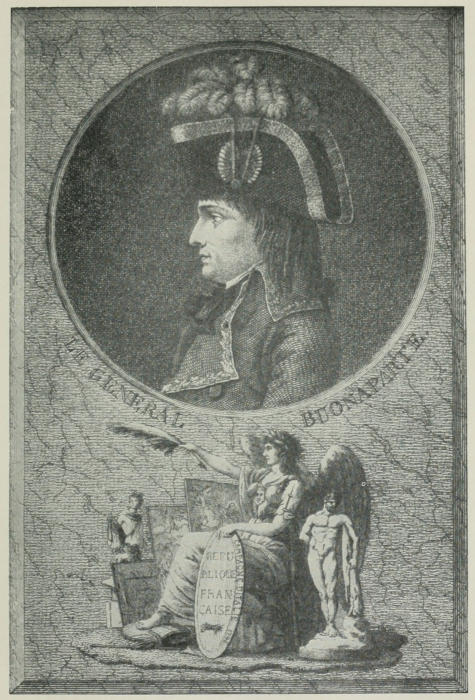
General Bonaparte in 1796. Engraving from the Kircheisen Collection.
The commander is taking his ease in the archbishop’s palace. He is having a bath. Hot baths are his one luxury, a luxury that he will continue to indulge in down to the day of his death, taking them hotter and hotter, staying in them longer and longer, as time goes on. Nothing can break him of the habit, for a hot bath is the only thing which really refreshes him, soothes his nerves. In the evening there is a reception. “You will be free, and in a safer position than the French. Milan will be the capital of this new republic, which has a population of five million. You shall have five hundred pieces of ordnance, and the friendship of France. From among you I will choose fifty men, who shall rule the country in the name of France. Adopt our laws, modifying them to suit your own customs.... Be sagacious and united, and all will go well. Such is my will. If Habsburg should again seize Lombardy, I swear to you that I will take up your cause, that I will never desert you. If your land perishes, I shall be no more. Athens and Sparta did not last for ever!”
Never since the days of Plutarch’s heroes did a commander talk like this. It was the conqueror’s first speech from the throne, and was compounded of all the elements with which, in his speeches and letters, he was to work upon the mind of Europe for twenty years to come. Everything is single and definite; there is so much fixity of purpose that every one wishes to comply. You are vassals, but free. I am your master, but I will protect you. Five hundred pieces of ordnance and the friendship of France. “Such is my will.” Then it is all over.
Through the May night, the wealthy town blazed with fireworks and resounded with music. The young commander-in-chief has moved on to the Palazzo Serbelloni; the banquet is over, and he stands at the window. The triumphal entry of which he dreamed in youth, towards which his virginal fancy strained, has now been accomplished. Does he look forward or back? With what is his mind busied?
“What do you imagine the Parisians are thinking of us?” he asks his adjutant. “Do you expect they are satisfied?” When Marmont makes the conventional reply, Napoleon goes on: “But Paris has seen nothing, so far. The future hides much greater victories. The goddess of fortune has not smiled on me that I may scorn her. The more she favours me, the greater shall be my demands. In a few days we shall reach the Adige; then Italy will be at our feet. Perhaps we shall cross the river, and press onward. Our age has produced nothing great. I want to set an example.”
IV
A royal couch in the Serbelloni Palace; never has he lain so soft before. But it is far too wide for one! Where is Josephine? What are triumphal entries and victories worth, without her? Fireworks and flags! Why has she not come? Is she really ill? Has she a lover?—He lies awake for hours.
From the very first this man, who inspired respect even in the veterans among the generals, imperilled that respect by his way of showing his wife’s picture to all and sundry, and when he was in the middle of a conversation about service matters. “You will come soon, won’t you?” So he wrote in one of his almost daily letters. “You must come to me. I want you on my heart, in my arms! Quick! Fly, fly!” He knows her frivolous disposition; that her senses are easily aroused; that she is always ready to give herself up to new impressions, new admirers. But now, now! What can be keeping her? He had expected her to come to Milan. His ambition had been to escape thither from the savagery of the campaign, that in one of the palaces of that city he might give her capricious charms a splendid setting worthy of her and himself.
But there is something which our great calculator has left out of his calculations. By his very feats of arms, he has kept her away from his side. For years in Paris she has been living in the half-world. Now, in this city which she loves, she wishes to shine forth in an assured position, as wife of the great commander whose name is in every newspaper, on every one’s lips. Does the little general really think she married him for love? When the first captured colours are exhibited, she drives out among the people, and, while she is loudly cheered, she thinks to herself how much more gratifying this is than to rough it in foreign towns surrounded by unmannerly soldiers. She seldom writes to him. His own words grow ever more urgent. “Have you a lover, have you taken up with some stripling of nineteen? If so, you have reason to dread Othello’s fist!” She laughs, and says to Tallien: “A queer fellow, this Bonaparte!”
Another day, in the middle of a letter to Carnot dealing with urgent affairs, he writes: “I am in despair. My wife won’t come here. I am sure she must have a lover, and that that is what keeps her in Paris. I loathe women, one and all!” Then comes a letter in which she grasps at an expedient. Since there is no other way of avoiding the dangers and the dirt of camp life, she writes to him that she has hopes....
Thunder and lightning! Have all the spirits of good fortune united to shower blessings on him? Among his successes, that was the only thing he lacked to complete his happiness. For, if destiny is to carry him to the lofty altitudes he foresees, to the heights he has resolved to scale, then his greatest need is to have heirs. But this battle is only planned, not yet won; new dangers are impending. He shudders. Is it true? Is it his child?
“I am sorry!”—the words are penned in his almost illegible handwriting on the commander-in-chief’s official stationery. “I have been pestering you with complaints, and you are ill. Love had robbed me of reason. Forgive me, but I think I shall never be reasonable again. My life is an unending dream; gloomy forebodings make it hard for me to breathe; I have lost all hope. Write me ten pages, for nothing else can console me. You are ill, you love me, you are with child, and I never see you. Who takes care of you? Hortense? I love the sweet girl more than ever when I think of her as taking care of you.... Soon you are to have in your arms a child as fascinating as yourself. If I could only spend a whole day with you. You know, if I saw a lover with you, I should instantly tear the man to pieces!”
But who is to help her through her time of trouble? There is no friendship in the world, only the ties of blood. “I am in despair,” he writes to Joseph under the same date. “My wife is ailing; I do not know whether I am standing on my head or my heels; dreadful forebodings rack my heart. Write to me, I implore you. Since early childhood, we have been bound together by kinship and affection. Do for her what I would so eagerly do for you.... You know how much I love her; know her ardent nature; know that I have never loved so passionately, that Josephine is the first woman whom I have adored. Her condition drives me crazy.... But as soon as she is well again, well enough to travel, she must come to me. I must have her in my arms; I love her to distraction, and cannot live without her. If she no longer loves me, there is nothing more for me in the world. Oh, mon ami, do not keep the courier more than six hours in Paris; send him back to me with an answer which will give me new life. Be happy! For myself, nature has doomed me to win none but outward victories!”
On the same day, he dictates, inter alia: Order to Berthier to occupy Alessandria; dispatch to the Directors concerning urgently needed reinforcements; ultimatum to the Genoese Senate anent the murder of soldiers; letter introducing Murat to the same Senate; plan to sell some cannon which are still left on the Riviera; order to Masséna to procure ammunition from the arsenal in Venice; order to Lannes to advance no farther; order to send all suspects to Tortona; order to send a division to Toulon; report to Kellermann that money and troops are on the way.
His letter has an effect. Joseph asks Josephine to come with him to Milan. What pretext can she find for refusing? She sighs, packs her trunks, sheds tears at a farewell festival in the Luxembourg, gets into the carriage. After all, to-morrow is the thirtieth of June, the season is at an end, and she has good company for the journey. Of course Joseph, her vis-à-vis, is a homely fellow, but Junot is a dapper young man; Fortuné, her lap-dog, is a darling, as ever. Then there is Charles, another young officer whose acquaintance she has recently made, and who has danced attendance on her ever since. Is he on the lookout for a career, or a conquest? What a choice Christian name, Hippolyte! How fine he looks in his chasseur uniform. He tells such amusing stories, has an expert knowledge of the latest shawls and wigs, and his legs are so well turned!
Milan. Bonaparte is away? More battles near Verona? No matter, this is a lovely place! Such a splendid palace; they all flock to pay their respects. But Hippolyte is hors concours; no one can rival the grace with which, sword clanking, he strides up and down the Corso. What a pity one has to be circumspect in one’s behaviour under so many prying eyes. But Hippolyte knows his way about, and has found a discreet staircase....
Suddenly there is a stir of excitement. The commander-in-chief is coming from Verona. For two days and two nights, the lava of this volcano overwhelms her.
V
Thrice do the soldiers of Emperor Francis try to relieve Mantua, which Bonaparte is besieging. Mantua is the key position. Old Wurmser, marching down beside Lake Garda with fresh troops, drives back the opposing forces. If Bonaparte is to make front against him, Mantua must be abandoned for a time. Meanwhile, however, the enemy has blocked the line of retreat upon Milan. A terrible reverse, and the French army is in the utmost danger. Bonaparte, hastening from Milan, rides under the hot July sun across the plain, busily inspecting one division of the army after the other, gathering all his strength, for the fate of the whole campaign is at stake. A period of the utmost activity, and of extreme tension.
“Since I left you,” he writes on one of these evenings, “I have been sad. I can only be happy when I am near you. I spend my whole time thinking of your kisses, your tears, your bewitching jealousy. The charm of the incomparable Josephine is perpetually rekindling the flames of my heart and my senses. When shall I be free, at length, free from cares and duties, free to devote all my time to you, with nothing in the world but to love you.... Since I have known you, I have come to respect you more day by day, which shows how wrong La Bruyère was when he said that love comes suddenly. Everything in nature runs its course, and increases by degrees.... Be less beautiful, less tender, and above all less jealous. Your tears inflame my blood.... Join me quickly, so that, before we die, we may be able to say: ‘We have had so many happy days!’ A million kisses, even for your horrid Fortuné!”
Neither now nor later could the commander-in-chief rid his home of this lap-dog. He tells us that on his wedding night the dog was in bed with Josephine. “I had to choose between sleeping beside the beast or not sleeping with my wife. A terrible dilemma, but I had to take it or leave it. I resigned myself. The dog was less accommodating. I have the marks on my leg to show what he thought about the matter!”
Amid the hurly-burly, the general’s lady arrives at Brescia. Almost immediately she has to be sent back to Milan. She has a narrow escape of being seized by the enemy, together with some recruits and cannon. Now she has an excuse, and, in the future, she will be slower to comply with his invitations.
During these weeks, Bonaparte for the first time loses courage, though it is only for a few hours of one night. Instead of simply issuing orders, he holds a council of war, much to the astonishment of his generals. In this critical situation, he proposes to retreat across the Po, but the mad Augereau thumps the table, shouting: “For the sake of your own fame, I insist that we attack.” He flings from the room. The counsels of the others are divided.
See him before the decision, brooding over his maps. He is alone. Moths are fluttering round the candles, and at last burn themselves to death. The midsummer night is sultry. As he listens to the drums and the shouting without, he thinks: “To-morrow will settle whether we can keep Lombardy. Perhaps it will be the turning point in my fame, my destiny. Shall I stake all on one card? What if Wurmser’s strength is greater than the reports say? Josephine is sleeping now, in the great bed. Or, who knows, she may be laughing softly in the embrace of some puppy who has bewitched her.”
He decides to fight. Next day, he is victorious at Castiglione.
Soon afterwards, he writes: “Three days without a letter from you; I have written daily. This separation is terrible; the nights are long and savourless, the days monotonous.” At this time, Josephine writes to Tallien in Paris: “I am bored to death.” He is busied in battles and victories; she is fêted and honoured. To both of them life seems wearisome: to him, because she is too far away; to her, because he is too near. Three days later: “The enemy has been beaten, my darling. Eighteen thousand prisoners, the others dead or wounded. Wurmser has only Mantua left. This is the biggest success yet: Italy, Friuli, and Tyrol are saved for the republic. In a few days we shall see one another again, that is the reward for labour and pains. A thousand glowing kisses!”
When the commander can draw breath, the statesman must turn every moment to account. In Modena he assembles deputies from all the States as far south as Bologna, and at a formal sitting he gives them a constitution, that they may unite to form henceforward one State, the new republic. Is he happy, now that he is at work State-building? His wife in Milan must be in love with some one, or she would write to him differently!
“Your letters are cold”—this is from Modena on the same day. “Their tone suggests that we must have been married for half a century at least. Friendship and winter, it is odious and spiteful. What more am I to expect of you? That you have ceased to love me? That is an old story. That you should hate me? Well and good. That is what I wish. Everything degrades, save only hatred. But indifference with a heart of marble, lack-lustre eyes, languid gait?... A thousand kisses, tender as my heart.”
Fresh crises call him northward once more. He comes, he fights, he is driven back. The gloomy November weeks, in which his fate again trembles in the balance, are not gladdened by any consolation from her. Far from it, for his most intimate friends, alive to all that goes on in Milan, venture cautious hints that my lady Josephine is having a merry time there. This is the day after the defeat at Caldiero. He sends to Paris a despairing appeal for reinforcements.
Complications thicken; courage wanes; every one turns for help to the chief. He seems to be thinking with thirty heads these days, when the battle of Arcola is impending. It is in a crazy mood of despair that he writes to her in the evening, his pen storming over the paper: “I no longer love you, I hate you. You are hateful, stupid, inept. You do not write to me, do not love your husband. What are you doing all day, Madame? What important business makes it impossible for you to write to the man who loves you?... Who is the fairy prince that claims all your time, so that you cannot write to your husband? Take care, Josephine: some fine night, the door will burst open, and I shall be there! Quite seriously, I am uneasy, my pretty one. Do write me four pages full of sweet words which will warm my heart with joy and happiness. In a few days I hope to clasp you in my arms, and to cover you with a million kisses, hot as the equator.”
How his heart flutters, uncertain whether she is still to be trusted, miserable if she be unworthy of trust. There is a crisis in his own soul as well as out there on the battle-field. Responsibility, uncertainty, storm in the heart of this man, who has perhaps already been dishonoured in his private life, and to-morrow may be dishonoured as a military commander—the man who still hopes to rule the world. During these days, when a suicide occurs among the troops, he issues an order: “The soldier must conquer the pain and the melancholy of the passions.”
Two days after the date of the letter last quoted, he is standing near Arcola on a bridge spanning the Adige. The enemy is bombarding this bridge. The French troops shrink back; there seems no way of forcing a passage across the river. At length, after repeated summonses, the soldiers advance once more, but there are calls from the ranks to Napoleon: “Do not go any farther, General. You will be killed, and then we shall be lost!” Marmont is a little in the van. Turning round to see if his men are following, he notices that the commander is in the arms of Muiron, the adjutant, apparently wounded. Around them a group of motionless figures. Now that the movement of the vanguard is arrested, the troops seek the shelter of the embankment. Bonaparte, who has recovered, stumbles and falls into the ditch at the foot of the dyke. His brother Louis and Marmont drag him out. A horse! Confusion, shots; Muiron covers the general with his own body, is hit, and falls. Bonaparte saves himself on horseback.
That evening in camp, he is greatly depressed. Second day’s fighting, and a vain attempt to storm the enemy’s position. This abominable river. Seems impossible to get across it. For a long time, the fortunes of the third day are no better than those of the first two.
At the eleventh hour, he has recourse to cunning. While the fight on the river rages uncertainly, he sends all the trumpeters and drummers he can get together, with part of the guard, in a wide half-circle to reach a position in the enemy’s rear. There the charge is sounded. The wearied Austrians are panic-stricken, and one of their divisions draws back. The French, encouraged by the rout of part of the foe, assume that all the opposing army is retreating, and act accordingly. Courage and ruse have snatched victory out of a morass of despair. The name of another village becomes famous. Arcola medals are struck in Paris. A picture is painted, showing the commander on the bridge of Arcola, waving imaginary colours.
The danger is over for a time. The enemy supports are withdrawn from Mantua, and soon the town must fall. Bonaparte makes a fresh disposition of his troops, and hastens to Milan. At length he will be able to administer the province from the capital, and have Josephine and hold her fast.
But Josephine is harder to catch than Wurmser. “I reach Milan, rush to your house, having thrown aside everything in order to clasp you in my arms. You are not there! You are gadding about somewhere, running away when I come to seek you. You care nothing about your Napoleon. A whim led you to give me your love, and now fickleness has made you indifferent. Inured to dangers, I know how to meet reverses of fortune.... Don’t put yourself about, amuse yourself, happiness is made for you, all the world is happy to have the chance of pleasing you, your husband alone is most unhappy.”
Next morning. “You have no reason to trouble yourself about the happiness or unhappiness of a man whom you do not love. But it is my fate to love you.... Take no part in the unhappiness of your husband, who lives only for you. It would be unjust if I were to ask you to love me as I love you. Who can expect delicate lace to weigh as heavy as gold.... My fault is that nature has denied me the charms which might bind you to me. What I do deserve is nothing more than this, that Josephine should show me a little consideration, a little respect, for I love her to the verge of madness, her and her alone. Farewell, adorable woman.... If I were certain that she could no longer love me, I would hide my pain, and would content myself with being useful to her whenever I could.... I open the letter once more, to send you a kiss. Ah, Josephine! Josephine!”
What a confession! With ardour and ambition he pushes forward to the goal, but the enemy has escaped, and what is to be done? Resignation must be the first aim after a failure, not raging and cursing. A man must retain his self-respect, and act prudently. A little mockery, embellished with courtesy, will have its due effect. Next day, he has turned things over in his mind. I must have her. How shall I lure her back? To extol my exploits does not move her in the least. What does influence her? Flattery and service. Such is his calculation. A miscalculation: for he, who is masterful with kings, fails to see that the charming Josephine would fear a master, even though she would not worship him; that nothing makes her more secure in her own position than his confessed passion.
Napoleon’s mistake is the outcome of his pride. His pride will lead him to the limits of what is humanly possible, but will in the long run mislead him into the greatest of his blunders. Now, it is pride that prevents his veiling a passion which he does not master because he does not wish to do so. After all his carefully planned phrases to the effect that he wishes to be of use to her, the foolish human heart drives him, with the gesture of a love-sick youth, to tear open his letter that he may “send a kiss.”
VI
What is Paris saying?
Paris is radiant, for, after long years, it once more has a hero to worship. Bonaparte’s picture is in all the shops; rhymed comparisons of him with the heroes of antiquity are in every one’s mouth; the actors speak of him when instructions are sent to announce a new victory; the colours he has taken from the enemy are on show at the Luxembourg; his reports, cut about by the Directors, appear in the “Moniteur.” Songs, medals, caricatures (a recent importation from across the Channel), enliven the boulevards.
He knows all this. He knows, likewise, that the rapid growth of his popularity is alarming the Directors, who feel that he has long ceased to be their creature. “The fellow’s perpetual victories will be the death of us,” they think, and put their heads together. A people’s army is invincible, but it is dangerous unless its officers are genuinely devoted to the government. For the last seven years, it has been the rulers’ way to threaten with the guillotine any general who has dared to meddle in politics on his own account. “A commander who does not comply with our orders, who makes light of the commissaries we send to his camp, must be dismissed, even if his name be Napoleon Bonaparte. Saliceti is too much under his thumb, being a fellow-Corsican, and having an uneasy conscience because he betrayed Bonaparte not very long ago. Let us send another commissary, Clarke, who is both prudent and ambitious.”
Elegant and high-spirited, himself a general, Clarke, while on the journey to Milan, looks forward to twisting Bonaparte round his fingers. That gawky little fellow in the threadbare uniform whom he had often met at Barras’ should be easy enough to deal with. But in the Palazzo Serbelloni, the envoy is abashed before the commander. Napoleon has not grown any taller, certainly; but the manner of his entries and exits, while all wait for his coming or make way for his going, suggests the ruler rather than the simple warrior. The commissary has a courteous reception, but he is far from being able to penetrate Bonaparte’s secret plans and report them to his masters. On the contrary, within a couple of days the commander-in-chief has full knowledge of the Directors’ private designs, about which Clarke ought to have kept his mouth shut. The commissary has bowed before the higher authority. “Here is the man of the future,” says he to himself; and promptly changes sides. Napoleon’s suspicions are now confirmed. He knows that the Directors are using his conquests as mere pawns in the game they are playing to secure peace with the Austrians. They have no intention of keeping Italy, and still less do they think of revolutionising it. Now that he is fore-warned, he will make all his preparations to thwart the government’s plans.
But he still has need of the Directors. “Reinforcements! Reinforcements! Not in name only, not on paper merely, but armed men in the flesh.... My best soldiers are wounded; none of my staff officers and generals are fit for active service. The new levies are raw and unsteady. The army is reduced to a handful of exhausted warriors. We are forsaken in the middle of Italy. The few brave fellows left to me, are marked out for death unless you send ample reinforcements. Soon may strike the hour of the valiant Augereau, the indomitable Masséna, Berthier, myself. What will happen then to the lads in the ranks? This thought makes me cautious. I no longer dare to defy death, for if I were to fall it would demoralise those who are the object of all my care.”
Could anything be more artfully phrased?
Yes, he has another string to his bow. When he does not threaten imminent destruction, he cajoles with gifts. Month after month, to this government whose only resources have for some time been piles of almost worthless paper currency, he sends a consignment of hard cash, gold extorted from princes and republics by the terms of truce. He is the first commander to send money home, instead of continually demanding money. And in addition he has little presents to spare for the Directors. “I am sending a hundred of the finest horses I can lay my hands on, to replace any you may have that are not really good enough to draw your carriages.”
He asks for the troops quartered in the southern provinces of France, and is told that they are needed for home service. “It is better,” he rejoins, “that there should be broils in Lyons, while we keep Italy, than conversely.” When told to leave all diplomatic negotiations to the commissaries, his answer runs: “For such matters, you do not merely need a one and only general; you must see to it that no one and nothing interfere with him in his work.... My advance is no less precise than my thought process.... We have to do everything with a weak army: thrust back the German troops; lay siege to fortresses; keep our lines of communication open; threaten Genoa, Venice, Tuscany, Rome, and Naples; show our strength here, there, and everywhere. For this, absolute unity of the military, political, and financial command is indispensable.... Unless the general remains the great centre, you will be exposed to incessant danger. I hope this language will not be ascribed to personal ambition. For my own part, I am unfortunately overburdened with honours, and my health has been so seriously undermined that I may soon have to ask you to appoint my successor. I can no longer mount a horse; nothing is left to me but courage.... I am continuing the negotiations. Troops! troops!—if you want to keep Italy. Bonaparte.”
The more popular he becomes, the more often does he tender his resignation, though his health is in truth excellent, and day after day he rides until his horse stumbles from fatigue. Woe to the Parisian lawyers if they run counter to his wishes! While he strengthens France’s power in Italy, he is consolidating his own influence in Paris; this is his new idea. Although he neither champions popular freedom nor believes Italy ripe for it, he insists upon the formation of the “Cisalpine Republic,” against the wishes of the Directors—among whom Carnot, at least, is a convinced democrat, though he wants to use Italy as a pawn in the French game.
This is the first occasion on which Bonaparte builds up an organism out of centrifugal forces. In days to come, he will repeat the process again and again, on an ever grander scale of creation, his aim being to establish a United Europe. He now welds together the half dozen petty States of northern Italy, prescribes their constitution, appoints and dismisses their officials. Throughout, he is the dictator, and yet all the time he acts on rational principles and allows for elasticity in matters of detail. He issues brilliant proclamations, announcing that these States are to be free whether they like it or not, and that they are to pay him promptly in hard cash for the privilege.
“The French Republic has sworn hatred of the tyrants, brotherhood with the peoples. This principle of the constitution is the principle of the army as well. The despot who has so long kept Lombardy enslaved, has done great injury to France.... The victorious army of an insolent monarch was compelled to spread terror among the conquered. But the republican army, while waging war to the death against its enemies, the kings, gives a pledge of friendship to the peoples it has set free. Respect for property, humanity, and religion—this is our animating principle. But the Lombards owe us, who are their brothers, a fair return.... Lombardy must support us with all her resources. We need provisions, for France is so far away that we cannot supply our requirements thence. We are entitled to them by the right of conquest; friendship must hasten to offer them to us. We have to requisition twenty million francs from the provinces. They are so rich that this will not be a serious burden.”
Then he takes whatever he wants out of the taxes, the countryside, the camps, the arsenals, and the domains. In the articles of every truce, he demands money, oxen, and pictures. If he sends pictures and statues to Paris, this will not, of course, stabilise the currency; but it will tickle the vanity of the Parisians, and win him popular favour. In a period of intense financial stringency, Bonaparte, with Italy as his source of supply, stocks the Louvre with precious works of art, contributing far more than the most resplendent of kings.
But all the time, while he is ruthlessly extorting money from the Italians, he is not less ruthless with Frenchmen who are trying to feather their own nests. In one of his early despatches, he writes: “The army consumes five times as much as it should, because the commissariat officers are falsifying their accounts.... Prodigality, venality, and peculation are rife. There is only one thing to do: a committee of three must be appointed, with power, during from three to five days, to shoot every dishonest administrator.” When the deliveries of hay are found to be short weight, he declares: “It is of the utmost importance that not one of these rascals shall escape. Too long have the army and the country been the victims of cupidity.” Innumerable are the documents bearing his signature which are directed against these plunderers. When the influx of women camp-followers exceeds all bounds, he issues the following order: “Any woman found among the troops without a permit twenty-four hours after the posting of this notice, will be blackwashed and publicly exposed for two hours.”
On the other hand, this strict disciplinarian was humane in his desire to put an end to some of the barbarities which still characterised war in those days: “The infamous practice of flogging men to make them disclose secrets, must come to an end. The only result of torturing people in this way is that the poor wretches say whatever they think will please their captors. I forbid the use of means that are equally repugnant to humanity and reason.”
VII
As a diplomat, he strengthens all the instruments of diplomacy: flattery and threats; lying and frankness—or sometimes, even in diplomatic negotiations, he will play the bluff soldier. He is especially shrewd in his dealings with the Vatican.
As thorough-going revolutionists, the Directors wish to put an end to the temporal power of the pope; for the Papal States are the focus of the religion which revolutionary France has rejected. The prospect of this moral success, to be gilded by the wealth of the Vatican, charms them more than all Bonaparte’s activities in the formation of border States. They insist upon his advancing against Rome. Now he will be able to see it close at hand, this city with which, from childhood onwards, his imagination has associated power, greatness, and fame. Like Cæsar, he will be able to pluck laurels from the Capitol, for the papal troops cannot stand against him for a moment.
But he holds his hand. For him, the pope is the only ruler who cannot be dethroned by big guns. He sees the idea behind the papacy, with its millennial influence on France and Europe; he knows the moral repercussions of martyrdom, and he has determined not to wage war upon the pope, unless it be a make-believe. “The influence of Rome is incalculable. It was a serious error to break with this power, which will profit by our mistake.”
He moves southward, and, literally, crosses the Rubicon, but there he stops. Because he is the stronger, he offers a truce; henceforward this will be his technique. The aged pope accepts the offer, for Bonaparte is wise enough to leave all ecclesiastical questions open. Pius VI promises to pay France several millions; to hand over one hundred pictures, busts, vases, or statues as the French commissioners shall determine. There are only two articles for which the commander-in-chief makes a specific demand: He wants the busts of Junius Brutus and Marcus Brutus from the Capitol. He is a Roman from Corsica; he crosses the Rubicon, spares Rome, and does not enter the city; but he requisitions the busts of the two heroes of antiquity.
When the pope fails to pay up, and makes difficulties, Napoleon sets out towards Rome a second time, but does not go to the city. After a trifling skirmish, he is willing to make peace. He will soon want to use his soldiers in the north. A pope on the run would carry his treasures with him, and what would there be left then for the poor Directors in Paris? On his own initiative, he actually pardons the French priests who have refused to take the oath of allegiance to the constitution and have sought refuge in Rome. He makes friends everywhere among the clergy, compares a “citizen archbishop” to one of the apostles, and writes as follows in several of his letters to high ecclesiastics: “The teaching of the Gospels is based on equality, and is therefore the most suitable for any republic.” What will they say to that in Paris, where Christ has been done away with?
Finally, he sends to the pope, who is on the point of taking to flight, an assurance that there is nothing to be afraid of. “Tell the Holy Father that I am not an Attila; and that even if I were, the Holy Father should not forget that he is a successor of Leo.” He thus dresses himself in historical trappings when he is dealing with the oldest of the thrones. But when the nuncio is slow to sign the new agreement, the polished man of the world is suddenly metamorphosed into a soldier, who tears up the draft and throws it into the fire. “We are not discussing terms of peace, Monsignore; there is merely a suspension of hostilities.” The other side is alarmed. He doubles his demands, and this time he gets what he wants. Thereupon the pope writes his “dear son” a letter, and gives the child of the revolution his blessing.
He never wraps up his doings in mystery, as the diplomats of those days were wont to do. An hour after his first truce has been arranged, he discussed recent happenings with the freedom of a historian in the next generation. Talking to the conquered Piedmontese over the dinner table, he says: “My attack on the castle of Cossaria was needless; but your movement of the 17th was a sound tactical manœuvre.”
At the end of the second campaign, he again shows himself a master in respect of both self-confidence and moderation. He has moved forward out of Lombardy in the beginning of March, and by the end of the month he is already in Styria, a few days’ march from Vienna. If the Army of the Rhine follows up his blow by similar victories, they will be able to dictate peace to Emperor Francis. Yet he chooses to halt, and to offer peace to the vanquished. True, the Army of the Rhine is still a good way off, whilst Austria and Hungary are arming themselves in frenzied haste. To stay where he is as a menace, this is the conqueror’s logic.
Bonaparte, however, is a statesman. The Directors want peace before the elections, and he still has need of the Directors. How would it be if he, he alone, the soldier, were to bring France the peace for which she has been waiting five years? Is he to share the glory of this achievement with his rivals in the Army of the Rhine? The fortune of war is uncertain, and none but the foolhardy will tempt it unless they must. Once more he has broken the troops of the Empire, cut off as they are from the Rhenish armies. For a year, Europe has been afraid of the new commander; it will become him now to make a gesture of peace, so that people may learn to revere the new statesman. Without courtly periphrases, and as an equal, he writes to the defeated Austrian leader, Emperor Francis’ brother:
“Commander-in-Chief, Sir! Our valiant soldiers are waging war and want peace. Has not the war lasted six years? Have we not killed enough people; have we not brought enough suffering upon mankind? Everywhere there is a reaction towards humaneness, and almost everywhere the enemies of France have laid down their arms. Your nation is the only exception. The omens of this new campaign are sinister. However it may end, each of us will slay a few thousands of the other’s soldiers; and yet, in the end, we shall make peace, for everything comes to an end, even the fiercest hatred.... You, who stand so near to the throne, uplifted above the petty emotions of statesmen and governments, are not you disposed to win for yourself the title of benefactor of mankind, saviour of Germany? I regard it as quite possible for you to save your country by force of arms. But, even then, Germany will be laid waste. If these lines could save the life of but one man, I should pride myself more upon my civic crown than upon the melancholy renown of the battle-field.”
This letter makes a strong appeal to Archduke Charles. A highly cultured man, declared enemy of all wars, and only acting as commander-in-chief from a sense of duty, with this document in his hand he will be able to make headway against the war party in Vienna and to influence the emperor. For what would happen should they refuse? Bonaparte would certainly publish his letter and their reply. He would have another chance of parading before Europe the humanist ideals of the republic, and contrasting with them the feudal militarism of the empire. He would lay the country waste with fire and sword, while censuring us before the world for our truculence. He is following up his letter by advancing his troops, and he has already occupied Leoben.
The emperor’s envoys arrive. The French commander meets them at the foot of the stairs, speaks of the emperor and the archduke with respect. When they beg for a ten days’ truce (during which Vienna will be able to continue preparations for war), he answers by inviting them to supper. After the meal, he agrees to a five days’ suspension of hostilities.
While comparative calm now reigns in Vienna, the Directors in Paris are much perturbed. Is this general of ours going to make the Great Peace all by himself? If he can do that, he will only have to come to Paris afterwards, and with one hand he will be able to push us from our seats. Most politely, therefore, they instruct him to await the coming of the envoy they are sending. All the more does Bonaparte press the other side for a decision. He knows what reports concerning him are current in Paris, and he cracks his whip over the Directors’ heads: “I should like to have a rest. I have justified your confidence in me; in all my undertakings I have hazarded my life; I have covered myself with more glory than the most fortunate man could wish; now I have advanced upon Vienna, leaving Italy’s lovely plains behind me, as I advanced once before in search of bread for the army which the republic could no longer feed. Calumny vainly attempts to discredit my intentions. My civic career, like my military career, will be unique and simple.”
Ironies, beneath whose mask the writer is moving towards unnamed goals.
Endless negotiations. But why should the matter drag on? Give us Belgium and Lombardy. You can compensate the dispossessed princes with possessions in the Holy Roman Empire! Habsburg accepts this principle, for neither the emperor nor any one of the German princes is concerned any longer about the Holy Roman Empire. It is very old, in poor health, and will soon be laid in the tomb. This plan will give France a finger in the pie across the Rhine. But how Habsburg is to be compensated for the loss of Lombardy, remains uncertain.
Opportune is the arrival of letters from Venice reporting insurrections against the French and the murder of a number of French soldiers. At length the day of vengeance has come! Venice, too, is outworn, and ripe for destruction. “Since the discovery of the Cape route to the Indies and the rise of Triest and Ancona, Venice has been on the decline,” he writes to the Directors, to soothe their conscientious scruples—i.e., for use in a justificatory campaign. “It will hardly survive the blow. This wretched and cowardly population, unfitted for freedom, without land or water, must, of course, be handed over to those to whom the hinterland is allotted. First of all, we shall take the ships, empty the arsenal, carry off the big guns, and close the banks; we shall also keep Corfu and Ancona.” Thus weakened, the Lagoons were to pass to Habsburg.
Bonaparte dealt in summary fashion with the old lords of the region, with the few patrician families which, as the successors of strong men, had ruled Venice for centuries, and had made of it one of the most reactionary States in the world. “You have stirred up the peasants against us,” he wrote to the doge while the negotiations with the Austrians were in progress. “Thanks to you, every one is shouting: ‘Death to the French!’ Hundreds of our soldiers have already perished through your machinations. Do not lie to me! You incited these disturbances. Do you imagine that because I am in the heart of Germany I shall be unable to enforce respect for the greatest nation in the world? I shall take vengeance for the blood of my companions-in-arms. War or peace! Unless you instantly hand over the ringleaders, I shall declare war.”
This is his tone when he wishes to terrify a dozen tottering old patricians. When the envoys from the Senate come to his camp, he pretends to fly into a passion: “I shall have no more constitution and no more Senate. For Venice, I shall be a second Attila. Make me no more proposals. I will be your lawgiver.” When the city is being handed over, the doge, a man of ninety, falls dead—the last doge of Venice. Bonaparte never forgot this scene.
Has he done with Italy now? Has not he got all he wants; has not he reached his end?
There is no end, for every step forward opens a new vista. Venice is merely a springboard, whence he can start his swim into the open sea. The islands first; then the Adriatic; and now he contemplates a more distant horizon. When he was in Ancona a while back, forcing his terms of peace upon Rome, he stood on the shore, looking seaward. There were the Ionian Islands, and beyond them lay Turkey. He wrote: “From this point, we could reach Macedonia in twenty-four hours; the place would be invaluable for our influence upon the destinies of the Turkish Empire.” As brigadier on the general staff he had thought of engulfing himself in Turkey. From Ancona he sends agents to open up relationships with powerful pashas in Janina, Scutari, and Bosnia.
Now, when he is in Leoben, he makes sure of the island possessions of Venice, arranges for the occupation of Corfu and Zante, “to control simultaneously the Adriatic and the East. No one will be able to save the Turkish Empire. We shall watch its death agony. The occupation of the Ionian Islands leaves us the choice between supporting Turkey and making sure of our own share of the spoils.”
The political reality underlying this is an attack on England. France has long looked forward to the acquisition of strongholds in the Mediterranean, and to thus imposing a barrier between England and India. In Bonaparte, this general aim acquires the impulsive energy of a personal ambition. He does not want the East that he may inflict a mortal wound on England as his arch enemy; he is in search of means to injure England that thereby he may win the East. Since his imagination always runs far ahead of his achievements, Europe, of which but yesterday he first seized a corner, is already beginning to seem too small for him. He says to Bourrienne:
“Only in the East have there been great empires and mighty changes; in the East, where six hundred million people dwell. Europe is a mole-hill!”
VIII
A high-arched room, in the baroque style; the walls are white, picked out with gold. On a long couch upholstered in green silk, a sixteen-year-old lieutenant, a spoiled darling, with the fawning manners of a page, is sitting between two women of ripe beauty. One of them is the youth’s mother; but when her smiling glance roves coquettishly over the surrounding group of smartly dressed officers, we gather that she is thinking far less of maternal obligations than of hours in which such boys as hers are engendered. Without words, she seems to add: “Creole women are adepts in the art of love!” Another connoisseur in the same art is the handsome general who stands behind her, craning forward over her shoulder that he may see far down into her corsage—as fashion and the lady’s pride in her charms make it easy for him to do. This is Masséna, whose talent as a soldier is to be ever prompt to attack, being too unrestrained and uncultured to count the cost; but his flaming impetuosity often saves his troops in moments of danger. His temperament is so ardent, that he must always have at least two women in his train; and his appetite for money is no less keen. Money and women—he steals both, whenever he has the chance.
All the qualities that Masséna lacks, you will find in the little man with the big head who stands in front of the ladies making conversation. He is ugly, touchingly grotesque in his movements, and at the moment intoxicated by his success in winning—no one knows how—the love of a pretty member of the Visconti family. This is Berthier, chief of general staff, unresting in his activity; a man who will do administrative work one day, and take a fortress by storm the next; a great student of maps, for he is one of the few among these officers who is well grounded in the theory of his profession.
There is Murat, theatrically decked out in green satin, twisting the huge plumed hat he holds in his hands. Of proletarian birth, like most of the men at this remarkable headquarters, he is fond of talking in asides. Now he laughs too loudly because the ribald Augereau, the avaricious and extravagant peasant’s son, has been telling him an after-dinner story. Murat, though he fears neither artillery fire nor the frowns of princes, is now painfully embarrassed because Josephine calls to him across the room. She wants to hear the joke!
But Joseph, a man of the world, who dreads what the enfant terrible may blurt out, nods meaningly to Murat, implying to him that for God’s sake he must hold his tongue. Elise is sitting in the embrasure of one of the windows. Not so good-looking as the other women, and finding her husband a bore, she is apt to be censorious, and would carry tales to Mother Letizia, who abhors Josephine’s loose morals.
Now comes the bright sound of laughter from the garden. That is Pauline’s birdlike voice. She is making the most of the days of freedom left to her before her marriage to General Leclerc, the husband chosen for her by Napoleon. She is playing blind-man’s-bluff with Hippolyte, and her pleasure in the game is doubled by the knowledge that she is annoying Josephine.
Here is the chief, coming slowly along the passage. For two long hours he has been walking up and down with the Parisian dramatist Arnault. This companion has been carefully chosen. The newcomer has asked many questions about the army and the battles. Bonaparte has answered them with a detailed report of his own doings, which he knows that Arnault will spread far and wide. Now he has steered the conversation to the topic of the governmental crisis, long drawn out. As the two come into the reception room, he says, ostensibly with indifference, and yet with emphasis enough to fix the words in Arnault’s memory: “I can hardly conceive any other way out of their difficulties than that they should bend before the power of one strong man. But where is such a man to be found?”
As Bonaparte enters, the officers rise to their feet, break off all conversation, and look expectantly at this man of twenty-seven, though most of them are older than he and all of them a good deal taller. Only the page continues to loll on the couch, for Eugene knows that his mother is unchallenged mistress of the house.
We are at Montebello, the huge castle near Milan, where Bonaparte is passing the summer. He is almost wholly the statesman now, for the war has been ended by the arrangement entered into at Leoben, and nothing more is needed than a formal ratification. He might be in Paris, receiving the adulation of which he dreamed in youth; but he prefers to stay in Italy. He will not return to Paris until the political consequences of his victories have assumed a concrete form, until the new States are consolidated and the Italian business over and done with. Meanwhile, during the many months he spends at Montebello, the life there is not so much that of a military headquarters, as that of a minor court.
But in no respect does he behave like an upstart. There are no pretences. In everything he will make his influence felt as one who is a child of the revolution that established a regime of equality. He has appointed sons of the people to the leading positions in his army; but he has no fear of what his noble guests, the dukes and princes of Italy, may think of it, should one of his valiant generals commit a solecism. He sees no reason for hiding his origin like a parvenu, although his adoption of French nationality might well incline him to conceal his Corsican birth. In actual fact, he parades it. Before the close of the previous year, he had summoned the whole family to Milan. Now, with lavish oriental hospitality, he has invited them all to Montebello, and those who seek his favour must show his relatives due honour. Half Italy pays court to him, for his name is already acquiring the mythical power of that of a man of destiny. Besides the numerous persons who wish to harness their fortunes to his chariot, not a few come from afar to ask the sage’s advice concerning family matters and private affairs.
He has found it hard to persuade his mother, proud and a woman of strict principles, to make friends with Josephine, whose reputation is an offence to her. Josephine reciprocates Madame Letizia’s dislike; but Napoleon, though he idolises his wife and can refuse her nothing, compels her to observe the outward forms of respect. Now, the friction between the two women has become even greater than at first. “This Creole says soft nothings to every man, and kisses every woman, instead of attending to her business of bearing children.” The Corsican mother has given birth to thirteen. Josephine’s barrenness dishonours Napoleon and his family. Letizia fancies that in the eyes of many of his adversaries she can read satisfaction and mockery because the great man cannot procreate a child. But it is not his fault. Josephine has led, and still leads, too loose a life. That is what is amiss.
When Letizia first met Napoleon again, after his battles and victories, she embraced him and said:
“You are thinner than ever! You are wearing yourself out!”
“Not a bit of it. I am really living, now!”
“Yes, for posterity....”
“Well, do you call that dying?”
When he leaves her, he says to her: “Do take good care of yourself, Mother. If you die, there will be no one left with any authority over me.” His Corsican clannishness is almost as strong as his cosmopolitan self-confidence.
Three sisters, three brothers, and Uncle Fesch are, in their various ways, enjoying themselves at Montebello. The fascinating Pauline, sixteen years of age, cannot forgive Josephine, who, in deference to Napoleon’s wishes, has interfered with her plans for a love marriage. She weds Leclerc in the castle chapel, and at the same time Elise and Bacciochi have to resolemnise their union in church, for the chief is eager to keep in the good graces of the Vatican. After the ceremony Letizia, who has no interest in these intrigues, returns to Corsica.
“This island, this province,” as Bonaparte now calls it, as if it were an island or a province like any other, has now been regained from the English, who had occupied it in response to Paoli’s call for aid. Bonaparte managed the affair from a distance, while busied in his campaign on the mainland. One foggy night, a couple of dozen Frenchmen, taking with them plenty of money and an abundance of weapons, landed in Corsica “to encourage the patriots,” circulate pamphlets, and so on. Napoleon also sent Saliceti, his friend and his opponent of earlier days. Thus, by proxy and from afar, he was able to achieve what he had thrice failed to do in person.
“Can it really be only four years?” thinks Signora Letizia, when those who had driven her and hers into exile receive her with acclamations. Is this the very citadel which was for so long the centre of Napoleon’s thoughts and feelings? Now, simply because he orders it, Elise’s husband is to be commandant there. For a long while, already, Lucien has been intendant of the forces. To Napoleon, in Italy, his native island now seems an ancient family seat, a romantic and medieval spot where his kindred can dwell when convenient. With a contemptuous smile, not long ago, he had read a letter from the Bourbon pretender, in which Louis offered him the title of duke, or even hereditary viceroy, of Corsica, if he would espouse the royalist cause.
In Montebello, Bonaparte first learns how to separate his private life from his public life—a lesson which those born in the purple learn from childhood upwards.
The guardianship of the castle, strangely enough, is entrusted, not to French soldiers, but to three hundred Polish legionaries. In several of his battles, there had been danger that he would be taken prisoner, so he has formed a bodyguard, forty strong. They are called guides, are chosen from among the tallest and best of his soldiers, and have a dare-devil for their leader.
The castle is thronged with orderlies and couriers. Envoys are flocking from all quarters. The lion of St. Mark and the key of St. Peter gleam on foreign epaulettes; Vienna, Leghorn, and Genoa are also represented at Montebello. Napoleon lives in state. Following the custom of the country, he keeps open house. Interested spectators are admitted to the gallery of the banqueting hall; and he drops a hint, lest they should forget to spread the news when they return home, that like them he drinks the wine of the country.
The reports of those who come to see him on service matters or other official business express astonishment that this young commander-in-chief is never embarrassed. He is dignified and yet perfectly natural; always the most simply dressed man in the company. None the less, he knows quite well how to keep people at a distance. Though nearly every one who comes to see him towers over him in stature, he never tries to appear taller than he is. Instead, those conversing with him are inclined to stoop a little, and thus seem to be paying court to him. Henceforward, throughout life, he is able from his natural defect to derive an advantage whose ultimate psychical consequences are incalculable. One of the visitors to Montebello wrote: “Should this man have the luck to escape death in battle, within four years he will be in exile or seated on a throne.” The writer was only three years out in his reckoning.
A student of his epoch, one who knows how fame is manufactured, he has in attendance an able journalist, the first publicity agent in history, whose business it is to blow Napoleon’s trumpet in Paris and subtly to discredit the Directors. Being a disciple of Plutarch, Bonaparte knows through whose agency the story of great men’s deeds is handed down to posterity; that is why the faces of poets, historians, artists, and men of science are so often seen at his Italian castle. A year before, a few days after the triumphal entry into Milan, and when overwhelmed with urgent business, he had found time to pen the following remarkable lines to a great astronomer:
“The sciences which are the glory of the human mind, the arts which beautify the world and bequeath great deeds to our offspring, must be cherished with especial care in free States. All men of genius, all those who are famous in the world of learning, are Frenchmen, no matter to what country they may belong.” Hitherto, such men have had to lead a retired life. Now, freedom of thought prevails; intolerance is a thing of the past, there are no despots left. The talented can foregather under his patronage, and fearlessly tell him all their wishes. Any such person who wants to go to France may be sure of a cordial reception, “for the French people would rather win a great mathematician, painter, or other man of note, than win the wealthiest of provinces. That is why, Citizen, I ask you to make these sentiments widely known among the great men of Milan!”
He commissions an attaché, who, like most of his tribe, has little to think about and nothing to do, to make a register of the art treasures in the possession of the petty States of Italy. In subsequent treaties, he demands the best of these for Paris.
For the Paris Conservatoire, he instructs experts to make copies of the best Italian music. Writing on this topic, he says: “Of all the arts, music has the strongest influence on the passions, and for that reason the legislator must make it one of his chief concerns. An inspired symphony composed by a master cannot fail to stir our feelings, and has far more influence than a treatise on morality, which convinces our reason without affecting our conduct.” When he becomes a member of the Institute, he flaunts this title at the head of all the letters he writes as commander-in-chief, and declares: “The true power of the French Republic must henceforward consist in this, that no new idea shall arise anywhere which is not the property of France.” In confidential talk he says: “The soldier must, above all, regard his commander as wiser and more cultured than himself; and the soldier will regard this title with respect for the very reason that its meaning is obscure to him.”
Such actions disclose, not the statesman alone, but the man born to rule, the prince who regulates every gesture, every word that he says or writes, with an eye to the legend as to his personality which he wishes to inculcate upon his people. But when the door is closed, and he is among intimates, he opens his heart.
Here is a description of Napoleon as he was in those days, penned by an exceptionally shrewd observer: “The power of the man impressed every one with whom he came in contact.... His demeanour was still rather ungainly at times; but there was something imperious in his nature, his glance, and his speech. Every one obeyed his orders. In public, he deliberately tried to heighten this impression. In private life, on the other hand, he was unconstrained, genial, and even confidential; with a taste for witticisms, which were never ill-natured, but were merry and discreet. Frequently, he shared in our amusements. He did not take his work too strenuously, not finding it necessary at that time to measure out his hours; and in leisure moments he was always accessible. But when he had withdrawn to his work-room, his door was closed to every unauthorised intruder, without distinction of rank.—He needed a great deal of sleep, like all people of nervous temperament and very active mind. I have often known him to stay in bed for ten or eleven hours at a stretch; but if it was necessary to wake him up, he was unperturbed, and could easily make up for the lost hours afterwards—or could store up reserves of sleep in expectation of a strenuous time. He had the precious faculty of being able to go to sleep wherever and as often as he pleased. Fond of vigorous exercise, he rode very often, and at a great pace, though he had an exceedingly bad seat.”
He has a taste for talking, and chooses politics or general questions of life as his theme; if the conversation flags, he suggests the telling of stories; should this be followed by a general silence, he spins a yarn of his own, pregnant and humorous.
The loveliest women set their caps at him in vain; he is wholly devoted to Josephine. Not, indeed, so frenzied in his adoration as he was a year back, when she betrayed or disillusioned him; it is she, and she alone, who has trifled away this passion for self-surrender. Now there is a moving note in his tone towards her; a fervent courtship, a smile, a petition: “You are sad,” he wrote to her while still in the field. “You do not write; are you longing to get back to Paris? Have you ceased to care for me? The thought makes me wretched. My life has become unbearable since I have known that you are not happy. Perhaps I shall soon make peace with the pope; then I shall join you at once.” Three days later: “The peace with Rome has just been signed. Bologna, Ferrara, and Romagna are ceded to us.—But there is not a word from you! Good God, how have I offended you?—I fear you know only too well how absolute is your power over me! For life, wholly yours.”
Now, at Montebello, he is for the first time tasting the joys of uninterrupted connubiality, while he is delighted to watch Josephine’s winning charm in social intercourse. Occasionally he steals time for a brief love festival. They drive across to Lake Maggiore; and when, among the rhododendron bushes beneath the baroque stone edifices on Isola Bella, Grassini, the heroine of La Scala, uplifts her thrilling voice and sings an appassionata by Monteverde, Napoleon sits wrapped in thought, his companion’s hand clasped in his own.