BOOK FOUR THE SEA
Cedar Paul translation
It is essential that this man shall be ruined!... But since, here below everything takes place by natural causes, the daimons trip him: thus, in the end, even Napoleon is overthrown.—Goethe.
I
The old struggle in Napoleon’s mind between mathematics and fantasy had ripened. The issue of the struggle was now to decide the history of his world dominion.
For now, at the climax of his career; fortified by his ties with the Habsburgs, ties for whose sake he had broken the familiar associations of years of married life; fortified by having a legitimate heir, whose birth gave firm anchorage to his adventurer’s dynasty; having gained the mastery over conspiracies, and having learned to dominate all the political parties—he was once more free as he had been eleven years earlier, when the victory of Marengo had safeguarded the tranquillity he needed for the internal development of France. True, England was unconquered; but Russia seemed still friendly. True, Spain was uncoerced; but Europe from Reggio to Hammerfest was allied to France, this being a euphemism for dependence on France. For the last time in his life, he was free to make a great decision.
Had he been nothing more than a mathematician, he would have been content with his calculations within the resuscitated realm of Charlemagne, and dreams of world dominion would have yielded place before the reality of the United States of Europe under France’s leadership. Had he been nothing but a visionary, he would have aimed, like a new Alexander, to march towards the Ganges; and England would have been merely a pretext for his onslaught on India. But he was both mathematician and visionary, and was therefore in danger of disavowing himself. For, as calculator, he failed to grasp an eminently real factor which could not be expressed in figures. The moods of un-uniformed men in Spain and in Germany could play no part in the cipherings of a military commander who thought in terms of army corps and big guns. Nevertheless such moods should have come within the scope of his visions as a seer!
Thus during these decisive years, after the birth of his heir, and before his next warlike designs have become active, his mind is alternately dominated by his two fundamental impulses, and the whole future depends upon which of the two will be supreme when the moment for action comes. Will his awakened fantasy warn him that it is dangerous to brave the anger of exasperated peoples, or will his calculating faculty disclose to him the danger that will await him on the distant road to the East? What will happen should he err in both respects? Then, indeed, his whole world will go up in flames.
He feels that his powers are ripening. In addition to the two energies we have been considering, a third is growing to maturity, the sense of destiny. Words unheard before, or rarely expressed, now find voice: “I feel that I am being driven towards an unknown goal. But as soon as I have reached it, as soon as I no longer have an inexorable mission, an atom will suffice to overthrow me. Till then, no human powers can effect anything against me. The days are numbered.”
Truly they are numbered; and through these prophetic words there already breathes the foreboding of an exit, although he does not know the way thither. Now, on the path towards the tragical catastrophe, the clarity of his inner vision is dimmed. Yet he himself speaks of the campaign against Russia as the “fifth act,” though the full significance of the term is not apparent to him. Tones like those of his youthful days resound in the new harmony. “I have got to the end of everything,” he had said when he was thirty, on the Nile. Now, at forty-three, he declares in the Council of State: “All this will last as long as I do, and no longer. Perhaps when I am dead, my son will think himself well off if he can be sure of an income of forty thousand francs a year.”
But at the same time his ardour increases. Since those days when it seemed to him that (thanks to the acceleration of genius) he had got to the end of everything, since the days of the Egyptian campaign, he had been guided by a religious faith that it was his destiny to become a second Alexander. Now, when for the first time he is equipped with means for the carrying out of his design, is he to annihilate his dream by figures, which are not more potent in the world than dreams? When the arch-chancellor wishes him a happy new year, he answers, as if suddenly rejuvenated: “I must grow wise if you are to be able to repeat this greeting thirty years hence.”
Napoleon never grew wise, but he was always clever. When he finds that his commercial warfare is reacting to the detriment of his own country, he disregards his own prohibitions, and grants licenses for the import of certain raw materials and dyes from England, in part because they are urgently needed for French industry, and in part because the articles in question are among the requirements of Parisian luxury. Soon, in all continental countries, huge sums are made by smugglers who import the very colonial produce which the Emperor wishes to prevent his chief enemy from marketing. These goods are then retailed at a great profit. Is the smartest dealer in Europe to be robbed of his gains by smugglers? He would rather have the business under his own control, so he imposes a fifty per cent. duty on all the colonial produce his agents can find on the Continent, and pouches these receipts for France. Since at the same time he has all English woollen textiles that he can lay hands on burned, he opens opportunities for illicit gains which are so large that for their sake people will ignore the risks of draconian punishments. He has to carry on a guerilla warfare, just as in Spain, though this time he is fighting the nation of shopkeepers with trade weapons.
It is likewise a war of decrees. Since Paris has prohibited all trading in English wares, London reciprocates by demanding from all neutral countries enhanced dues for permission to call at the blockaded ports. Paris counters this move by declaring that the vessels of neutrals which shall call at the ports of London or of Malta, run the risk of capture as prizes. London responds by sending her ships out under false colours, and Paris thereupon has all merchantmen trading in Mediterranean waters overhauled and searched. The American government forbids its citizens to have business dealings with Europe, or even to have any private intercourse with the Continent; but the Emperor promises all kinds of privileges to the Americans if they will cease to call at English ports. So paradoxical is the situation resulting from the endeavour to strangle overseas trade, by which Napoleon had hoped to extort the freedom of the seas!
The Emperor’s hopes are rising. The English pound sterling is still quoted at seventeen francs, the English banks are failing, and in parliament the opposition is against the continuance of the war. In spite of this, his peace proposals are rejected. The disturbances in Spain are at once the cause and the consequence of England’s defiant attitude.
There is still an army numbering a quarter million men stationed in Spain; and, despite all endeavours, Wellington’s thirty thousand are not driven out, for the bands of native insurrectionaries led by officers and monks carry on unceasing guerilla warfare against the French invaders. The Emperor’s quarrel with the pope stiffens the antagonism of the monks. While French children on the northern slopes of the Pyrenees are being taught that Napoleon is God’s vicegerent, Spanish children on the southern slopes are learning that the Emperor is the devil incarnate and that the murder of a Frenchman is a deed pleasing to the Almighty.
In so fanatical a land, where hardly any regular troops are left for the French to fight against, Napoleon’s generals feel out of their element. Disunion prevails. Masséna is sent against Portugal. At the same time, Napoleon deprives Joseph of four provinces. When the king journeys to Paris to demand the cancelling of the decree, the Emperor declares that his brother has ceded these lands. Napoleon places a general to administer each province, and appoints a marshal in supreme command. He carries out this Roman system of ruling through military governors thus ruthlessly and persistently because of his intense disappointment in the rule of the members of his family to whom he has allotted crowns, and, above all, in the behaviour of his brothers. Terrible battles, made more ghastly by famine and disease, are meanwhile forcing Masséna to retreat. The Emperor, in a fury, recalls him.
Will Napoleon at length realise that his presence is essential? Marshals, officers, and, above all, the rank and file of the army, eagerly await his coming. Full well does he know this; and yet he does not go. Does he fear assassination at the hands of some fanatical Spaniard? Or is it treachery at home that deters him; such conspiracies as those which called him back to Paris so suddenly when he was encamped near Astorga? Is he to get enmeshed in this southern corner of his empire at the moment when the whole is at stake? What is Spain to him? He chooses the oldest of his companions-in-arms: Marmont is sent to clear up the mess and bring the campaign to an end.
The second kingly brother had, with good reason, thrown up his job. Napoleon had deprived him of all the Dutch territory on the left bank of the Rhine; had insisted upon the removal of the rest of the protective duties against France; and (this was the worst of all) had angered the Dutch, who are traders and seamen, by the measures he had compelled them to take against England. The Emperor had expected both his brothers to run counter to the currents of national feeling in their respective kingdoms, underestimating alike the strength of popular sentiment and the sense of honour of the two men he had forced to become monarchs. It would have been easier for military governors to cope with the rising tide of nationalism and to dispense with a feeling obligation towards the people they ruled, than it was for kings burdened with historic crowns.
When Louis found it impossible to put up any longer with the Emperor’s tutelage, he abdicated in favour of his younger son, and fled by night from his kingdom for an unrevealed destination. Napoleon’s catchpolls sought him far and wide in Europe, to discover him at length in Austria. The Emperor was greatly enraged, yet he could not but see that he was himself more to blame than Louis. He therefore made no attempt to punish, but sent his own body physician to care for the fugitive, who had excused the flight on the ground of illness. To his mother, the Emperor wrote saying that there were tidings of Louis’ whereabouts. “You need not be anxious; but his conduct has been of a kind which can only be explained by his illness. Your very affectionate son, Napoleon.”
The wording of this subscription stands out among the numberless letters in which the dictator of Europe was accustomed to express his will to those who usually received these missives with trembling. The fugitive king, meanwhile, drawing a breath of relief, settled down to a literary life in Graz, writing in three volumes under the title Marie, ou les peines d’amour (1808), the story of the love affair which the Emperor had so ruthlessly frustrated. But when Joseph wished to follow Louis’ example, feeling that he would rather retire into private life than continue to play the part of king in a pack of cards, he was restrained from abdication by the iron hand of the Emperor. Napoleon considered that his democratically inclined brother would do more mischief as an intriguer in Paris than in his position as nominal chief and military commander; so Joseph had once more to put his hand to the task of war, for which, to the Emperor’s great annoyance, he was utterly unfitted.
The most frivolous members of the family, Jerome and Pauline, were amusing themselves with love affairs. Murat and Caroline were immersed over head and ears in old and new intrigues. As for Elise, she had so much printed in the Tuscan newspapers anent her reviews and hunting parties that the Emperor was even more annoyed by her craze for notoriety than by the things she actually did, and wrote to her, saying: “Europe pays very little heed to what the grand duchess of Tuscany is doing.”
The most dangerous man in his family circle has not yet become an object of his menaces. Since the old king of Sweden was on friendly terms with England, the Emperor had made him abdicate in favour of an uncle; and the new ruler, who is devoted to the cause of Napoleon, has declared war against England. Being old and childless, he thinks he cannot please the Emperor better than by appointing as successor one who is closely connected with Napoleon by marriage. Thus it is that Bernadotte, Joseph’s brother-in-law, who during the wars has made friends in Swedish Pomerania, is unexpectedly nominated crown prince of Sweden—as a result of a complicated intrigue, in which Fouché has played a considerable part. The Emperor would have found it difficult, in any case, to object to this selection of a French general as heir to a foreign throne; and it was practically impossible for him to interfere with the promotion of his sometime rival, the man who had nearly prevented the coup d’état of the Eighteenth Brumaire, and had subsequently become the husband of the woman whom Napoleon had once thought of marrying. “A good soldier,” growled the Emperor; “but with no talent for ruling; one of the old Jacobins, with a bee in his bonnet like the rest of them, and therefore he will never be able to keep his position on a throne.... Still, I could not interfere, were it only because it would be impossible to do anything more effective against the English than to set a French marshal upon the throne of Gustavus Adolphus.... I am glad to be quit of him.”
Is he really so carefree? Hitherto these folk whom he cannot trust have always been kept under his own eyes in Paris.
Bernadotte triumphans! Soon, at last, he too will wear a crown, and will not even have to thank this detested Bonaparte for the gift. To Napoleon, therefore, who till yesterday was Bernadotte’s supreme war lord, the crown prince of Sweden now writes a bitter-sweet letter, offering soldiers and iron, but asking for money. The Emperor smiles. He knows what is written between the lines, and makes no direct answer. He has Bernadotte informed that he does not correspond with royal princes. His old opponent will not forget the gibe. In less than two years, Bernadotte will take vengeance for it, and for all that has gone before!
Ruefully, the Emperor watches the flames that are springing up everywhere, the flames his family mania has lighted. He does not conceal from his intimates that he is disappointed with his kin and his nobles. Writing to one of them at this time, Napoleon says: “I ought never to have had Murat and my brothers crowned. Live and learn!... It was a mistake, too, to give back the confiscated estates to the émigrés. I should have kept the lands as State domains, and have been content to allow the former owners a modest income. I can’t stomach them, these people of the old regime; their light and airy graces are out of keeping with my serious temperament. I myself did not succeed to a heritage, but was content to take what belonged to no one. I ought to have been satisfied with the appointment of governors and viceroys. Some of my marshals, even, are beginning to dream of greatness and independence.”
At length he has realised that it is dangerous to play the emperor! His troubles are the fruit of his wish to safeguard a dynasty (this meaning that the spirits of revolt and of genius, from whose union Napoleon has sprung, are to be taught to walk in the paths of legitimate mediocrity). They are the outcome of the weak moments of a man who in his hours of strength believed in the immortality of deed and of fame, of a man who in these hours of strength felt no need of the perpetuation that is achieved by means of a family line. The brothers, and brothers-in-law, and marshals, who all shine by reflected light, will take vengeance ere long. When his star pales, and the skies of Europe are overcast, they will still try to shine across the Continent in the afterglow of his splendour!
Deeply ingrained in him was the illusion that his good fortune would be transmitted to his son. When, after the boy’s birth, a great reception was held, and all the notables came to offer congratulations, the Schwarzenbergs were among the guests. Schwarzenberg, as Austrian envoy in Paris, had done much to promote the marriage. The Emperor, full of gratitude, went up to Princess Schwarzenberg and, taking from his coat a scarab pin, presented it to her, saying:
“I found this scarab in the tomb of an Egyptian king, and have worn it ever since as a talisman. Please accept it; I no longer need such a mascot.”
He feels that the birth of his son has placed him above all possibility of danger, and that everything will go well with him in future. He can have no further need for an amulet!
These kings, these brothers, have been but a substitute for the sons that were lacking. Now, when he can feast his eyes on a son of his body, he recognises his mistake, and the disastrous consequences of Josephine’s barrenness are plainer than ever. Too many battles have been fought, too many years have passed, there has been too much self-restraint and self-denial, for it to be possible now to give this heir a great place in his system. The boy has been born too late. The tempo of Napoleon’s life has been so rapid. The man who at two-and-twenty was still a lieutenant, had become an emperor at thirty-four. Such a man should have had his first-born son long before the age of forty-one. He has recklessly expended his vital energies, and cannot look forward confidently to many years of power. How can he reasonably expect to establish the child securely as his successor?
It is, indeed, a poignant sight. Watch this man who is now growing old with fearful speed, as he dandles the long-desired infant on his knees, tries his own hat on the baby’s head, watches the child crawling on the floor while he sits at breakfast, and even (when the youngster grows a little older) allows him to run about the study. Napoleon is playing the war game, with little wooden rods representing soldiers dispersed over the floor, and is planning how to make an end of Wellington in Spain. The boy is brought to the door. According to the rule of the house, the governess may not cross this threshold, so Napoleon himself goes to the door for the child, sets him down among the mimic armies, and, with the tolerance of a grandfather, lets the child play riot with the battle. Laughing, he pulls faces at his infant son in front of the looking-glass; buckles round the body of the two-year-old the sword with which he has conquered Europe; and, with his actor’s instincts, feels that the boundaries between jest and earnest are being broken down. Imaginings are ripening into reality, while all that has seemed to him real is not more than an image and a parable.
He says that the child is “spirited and sensitive. Just what I want him to be.... My son is sturdy, and in splendid health. He has my lungs, my mouth, and my eyes.... I do hope he will turn out well.” In such simple fashion he writes to Josephine, and to her only. He insists upon her keeping up the old tone of comradeship, and scolds her when, after the divorce, she writes to him as “Your Majesty.” “You have written me an unkind letter. I am always the same; my feelings do not change.... I shall say no more until you have compared this letter with yours. Then you can judge for yourself which of us two is more friendly, you or I.” To no one else can he speak so simply, unless it be to Berthier, whom he often calls his “wife.” The only thing that annoys him with Josephine is that she is always running into debt. He thinks that she ought to be able to save half of her allowance of three millions. “Then in ten years you would have put by fifteen millions for your grandsons.... Let me know that you are quite well again. I am told that you are getting as stout as one of our good Norman peasant women.” But when Josephine continues to be spendthrift, he tells the steward of her property not to make her any further payments till evidence is forthcoming that she is no longer squandering money.
He sees very little more of her, however; and he will have nothing to do with the lady friends of earlier years. His attitude towards marriage is that of a respectable citizen, and that of an Italian. Besides, as a sovereign prince he wishes to set a good example to his subjects. Since Marie Louise makes no nationalist pretensions (for, being of a dull, easy-going, and fickle temperament, she has promptly come to regard herself as a Frenchwoman), the two get on very well together. He has always time to spare for her. When she is learning to ride, he walks patiently at her bridle. He, who has never waited before, will even wait when she is late for dinner. She is not afraid of him, and is saucy enough to tell the Austrian envoy that she thinks her husband is a little afraid of her. It is important to the Emperor that he should make a good impression upon the Hofburg. Regarding it as politically expedient that a report of his wife’s happiness shall be sent to Vienna, he brings Metternich to see the empress, and tells the envoy to stay until some one fetches him. Napoleon goes away, locking the door of the room after him. He does not release the prisoners for an hour, and then, with a sly laugh, asks Metternich whether he is satisfied, now, that the empress is happy.
These are nothing more than jests, but that he can find it possible to make them in a period of grave decisions indicates that there is a certain release of tension in his heavily laden heart. In truth, Marie Louise’s only service to him was that, during the years with which we are now dealing, her freshness did actually bring him such a solace.
But the marriage did not effect the desired release of political tension. Felix Austria, accustomed to gain advantages by these royal marriages, had hoped for a couple of provinces as dower, but had received nothing. All the more, therefore, must Emperor Francis feel rancorous on account of the humiliation inflicted upon him by the little Corsican; for, as soon as the gates of the Hofburg had closed behind Marie Louise, he could not but regard the marriage as detrimental to his dignity. To appease his legitimist misgivings, the Habsburg ruler had a search for Buonaparte ancestors made in musty old Tuscan documents, and when next he met his son-in-law was able to assure the latter that the Buonaparte lineage had been traced as far back as the eleventh century. At that time, said Francis, there had been members of the family in Treviso. Thereupon the first and last of the Buonaparti made the delicious answer:
“Thank you, Sire. I prefer to be the Rudolf of my race!”
Witty, but unwise, for such words from an upstart sovereign could not but rankle in the mind of this descendant of an ancient line! When, as would soon come to pass, the question whether the emperor of Austria was to take sides for or against his son-in-law was to be decided by Francis’ mood, the memory of this and similar slights may have played a considerable part. Napoleon recognised this when it was too late. “Had I but made myself agreeable to that simpleton, who knows but that in the plains of Leipzig there might have been a hundred thousand fewer men in the opposing army!”
All the same, the revolutionist admired many of the ways of the legitimate ruler. One day he caught sight of a letter his wife had addressed to her father as follows: “His Sacred Majesty, the Apostolical Emperor.” Napoleon considered this an excellent idea; and in private, no doubt, his thoughts turned to Alexander of Macedon who had declared himself to be the son of Jupiter.
The apostolical emperor was especially out of humour with his son-in-law on the pope’s account. Napoleon was continually tightening the bonds round the Holy Father. Pius VII. was kept at Savona. A man by no means learned in canon law, he was cut off from his advisers, and subsequently deprived of his papers, in order to make him pliable. A schism was threatening. Thirteen of the cardinals had failed to put in an appearance at the Emperor’s wedding, for the pope would not recognise the divorce which Fesch had pronounced. Now Napoleon has cases filled with the Vatican State papers brought to Paris, thus arousing the belief that he really intends to make this city the capital of Christendom; he summons a council at which the prelates of his European realm appear; he extorts a decree depriving the pope of the investiture in case of dissent, and ultimately compels Pius to agree to this—at any rate for France.
Europe is troubled by these matters, and split into factions. On the whole, the Russians and the Poles are glad that things are going ill with the Roman pontiff; the Prussians and the English are, of course, delighted; but what arouses general surprise is that the inhabitants of the Papal States are also on the side of the Emperor. This little country, now doubly robbed of its master, is glad to accept the Code Napoléon, modern education, a rational system of administration, vigorous road construction, and the draining of the Pontine marshes. Whereas the son of the revolution has long since brought back the old spirit of Rome to Paris, he now transplants young revolutionary practice from Paris to Rome. Thus does Napoleon build bridges.
The excommunicated Emperor cunningly tries to turn the curse against the pope. When, in newly annexed Holland, he receives the clergy in the presence of the Protestants, he rebukes the bishops as follows: “Are you of the religion of Gregory VII.? I am not. My religion is that of Jesus Christ, who said: ‘Render unto Cæsar the things which are Cæsar’s.’ In accordance with the same text, I render unto God the things which are God’s. I have received my sceptre from God. But I wear a worldly sword, and know how to use it! God erects thrones. I did not raise myself to my throne: God set me upon it! You poor mortals wish to resist? You will not pray for your monarch, because the priest of Rome has excommunicated him? Do you think I am the sort of man to kiss the pope’s toe?... Prove to me, imbeciles, that Jesus has appointed the pope his vicegerent, and that the pope has power to excommunicate a monarch!... Be good citizens, and sign the Concordat. You, Mr. Prefect, must take such measures as will prevent my hearing any more of these matters.”
To so preposterous a travesty of his own innermost thoughts has Napoleon come. He does not believe a word of what he is here thundering out; and in private mocks at this official doctrine, as he has always done. Nonetheless, to the circlet of golden laurels with which he had crowned himself before the eyes of the priest of Rome, there now attaches a vestige of divine right which makes the crown a heavy one to wear.
II
“Kindly inform me why the price of salt in the neighbourhood of Strasburg has risen one sou.”
Closely following upon the heels of this enquiry to the Ministry for War, comes a command to the Admiralty: two entire fleets are to be constructed in the course of the next three years, one Atlantic fleet and one Mediterranean fleet; the latter against Sicily and Egypt, the former against Ireland. As soon as the Spanish affair is in better case, preparations are to be made for an expedition to the Cape in 1812. An army of from sixty to eighty thousand men is to be got ready for an attack on Surinam and Martinique. “Having eluded the enemy cruisers,” the expeditionary forces are to share out the two hemispheres.
We see how closely at this date, when imaginative fantasies threaten to develop into adventures, the exact observations of the father of his country are allied to the rhapsodical plans of the world conqueror. For that is what Napoleon now attempts: he is actually trying to realise his old dream of world conquest.
“You want to know whither we are going? We shall have done with Europe; then, as robbers of robbers less bold than ourselves, we shall march to the attack, seize India, over which they have made themselves masters.... I must take India ... in the rear, if I am to strike successfully at England.... Just imagine Moscow occupied, the tsar conciliated or killed by his people, perhaps a new, dependent throne,—and tell me whether an army of Frenchmen, reinforced by auxiliary troops from Tiflis, cannot press forward to the Ganges, and thence, at a touch, destroy the whole structure of English commerce!... At one blow, France would have established the independence of the West and the freedom of the seas!” A witness reports that while he was voicing these ideas “his eyes shone with a wonderful light, and he went on to point out the reasons for the adventure, all the difficulties it entailed, the means of achievement, and the prospects of success.”
Shall the tsar be conciliated or killed? That is the question which troubles the Emperor the whole year round. Calculations and presentiments make him desire to have Alexander as his friend rather than his enemy. Napoleon has nothing to gain by a defeat of Russia. On the contrary! He dreads being forced into this war, and endeavours, as on former occasions, to avoid it; though only if the tsar, as previously agreed, shall participate in the great final struggle as an ally. Napoleon keeps the tsar under observation, and perceives that suggestions are having less and less effect upon Alexander. He therefore writes to a prince of the Confederation of the Rhine in these amazing terms: “This war will break out in spite of the tsar, in spite of me, and in spite of the interests of the two empires.”
Never before had the Emperor or the Consul declared, in such words, that war was unavoidable. Precisely because all rational need for the campaign was lacking this time, he found it necessary to proclaim the war with the tsar to be the work of fate. At the very first hand-clasp, in the peace tent on the Memel, the seed of this war was sown. During the days of intimacy which followed, when the encounter blossomed into friendship, that seed invisibly took root and grew. In later days, Talleyrand’s treacherous diplomacy cherished its growth; and when, at Erfurt, the emperors embraced, they could already feel between them the coils of the snake. That they did not become related by marriage was neither an accident nor the outcome of a conscious desire: it was consequent upon the mistrust which had invaded the tsar’s mind, a mistrust of which he could not rid himself and which was to prove well founded. Two men wishing to divide Europe between them, could not see with complacency the half in a rival’s hands. Their intentions were honourable at the outset; but they were impossible of fulfilment. The day of contest must inevitably come at last. “He alone is still weighing upon the pinnacle of my edifice. My rival is young; daily his strength is waxing; daily mine is waning.” This gloomy recognition spurs him ever onward.
It is useless to try to interpret such decrees of destiny as the outcome of political causes.
Somewhat earlier, the Emperor has asked the tsar to lay an embargo on all neutral ships, as he himself has done, and thus give England the death-blow. The tsar cannot agree to this, for it would fatally injure his own sea-borne trade; he will only continue, as before, to confiscate all the prohibited goods he discovers, but he needs colonial wares from the neutrals. Being unable to stop this leak in the East, the Emperor has to exercise redoubled care on the German coast, and he therefore annexes the mouths of the Weser and the Elbe with the Hansa towns and part of Hanover. “Circumstances demand these new guarantees against England.” Oldenburg is swallowed up with the rest, though the heir to this duchy has married Alexander’s sister.
The Emperor’s high-handed proceedings were a logical outcome of his policy, but they were necessarily an offence to the tsar. Alexander regarded them as a breach of the treaty of Tilsit, in which the integrity of Oldenburg had been guaranteed. He issued a circular to the powers protesting against this insult to his house, a remonstrance almost equivalent to a declaration of war. In this document he enquired what could be the use of alliances unless the treaties in which they were incorporated were strictly observed, so that the cabinets of Europe could not but smile at the concluding words of the circular, in which he described the alliance between Russia and France as permanent. His next step was a ukase in which he threw Russia open to colonial goods, while imposing prohibitive import duties on wine and silk, the products of French industry.
The maps lie spread on the tables in St. Petersburg and Paris. Where can either power best harass the other? The tsar proposes to make peace with Turkey. The Emperor incites Austria to seize Serbia, to advance towards Moldavia and Wallachia, promising not to interfere; this will keep Alexander busy. Metternich nods assent, but does not move. “What about Poland?” thinks Alexander. “Has not Napoleon already enlarged the duchy of Warsaw by the addition of Galicia? Is there any guarantee that he will not re-establish the kingdom of Poland?” Caulaincourt, French ambassador in Russia, who admires the tsar and wants peace, gives the desired guarantees. But the Emperor would only agree to a secret ratification. If the differences between France and Russia should culminate in war, he will need Poland for his operations against the tsar; Polish hopes must, therefore, be fostered. Penetrating this design, Alexander demands an open treaty, which shall put an end to Polish expectations.
When Masséna is defeated in Spain, the Emperor entertains fresh doubts. Caulaincourt, who is back in Paris, does his utmost to intensify these misgivings, dilates on the tsar’s will-to-peace, and ventures far in his defence of Alexander. The Emperor leads him on; hears all he has to say; asks a thousand questions concerning the tsar and the court, Alexander’s piety, the nobles, and the peasants; takes Caulaincourt by the ear, a sign of affability.
“You must be in love with him!”
“I am in love with peace.”
“So am I. But I will not allow any one to dictate to me. Evacuate Danzig, forsooth! Next I shall have to ask Alexander’s permission before I can hold a review in Mainz. You are a fool. I am an old fox, and know the people with whom I am dealing.... We must deprive this Russian colossus and his hordes of the power to inundate the south once more.... I shall advance northwards, and re-establish there the old boundaries of Europe.”
Quite unsubstantial reasons, masks, mere pretexts. Warningly Caulaincourt quotes Alexander’s words: “I shall learn from his own teachings, which are those of a master. Our climate will make war for us. The French are not inured to it as we are. Miracles only happen when the Emperor is present, and he cannot be everywhere.” Napoleon is greatly moved by these words; he tramps restlessly up and down the room; the conversation lasts for hours. Since he cannot refute Caulaincourt’s arguments, he makes vague answers behind which his titanic wishes loom.
“A well-fought battle will put an end to the fine resolves of your friend Alexander.... He is false, ambitious, and weak; he has the character of a Greek. Believe me, it is he, not I, who wants this war, for he cherishes a hidden design.... He is out of humour because I did not take his sister.” When Caulaincourt gives proofs to the contrary, Napoleon says: “I have forgotten the details.”—Forgotten! This is a new word in the Emperor’s mouth. He knows his position to be weak; himself a man of facts, he now brushes away those which he finds inconvenient.
He sends a more resolute envoy to the tsar. When a proposal comes from St. Petersburg that Warsaw shall be exchanged for Oldenburg, the Emperor says threateningly to the Russian ambassador, raising his voice so that every one in the room may hear: “Not one Polish village!”
But these political incidents and discussions are merely the forms of destiny. Schemes flash like lightning through his brain; his soul is devoured by wishes: and he will rather reveal these things to a dangerous enemy like Fouché than to a shrewd adherent like Caulaincourt. He cannot rid himself of the ex-Jacobin and ex-cleric. Last year, he had cashiered the Minister of Police, for Fouché was obviously intriguing with England. But Napoleon was as lenient as he had been at the time of the conspiracy which had brought him back hot foot from Astorga. Instead of banishing the man, the Emperor had appointed him senator—at the same time writing to him words which give a glimpse into the inferno of these struggles between the monarch and the spy: “Although I do not doubt your devotion, I find it necessary to have you watched all the time. This is a fatiguing necessity, and I should not be called upon to do anything of the kind.”
But though he dismisses Fouché from his ministerial post, and has the watcher watched, Napoleon cannot get on without him, and talks to him about the most private matters.
“Since my marriage, people fancy that the lion is asleep. They will soon learn whether I am asleep. I need eight hundred thousand men, and have them; I shall tow all Europe in my wake. Europe is nothing more than an old woman, and with my eight hundred thousand men I can make her do whatever I please.... Did not you yourself say to me: ‘You let your genius have its way, because it does not know the word impossible.’ How can I help it if a great power drives me on to become dictator of the world? You and the others, who criticise me to-day and would like me to become a good-natured ruler—have not you all been accessories? I have not yet fulfilled my mission, and I mean to end what I have begun. We need a European legal code, a European court of appeal, a unified coinage, a common system of weights and measures. The same law must run throughout Europe. I shall fuse all the nations into one.... This, my lord duke, is the only solution that pleases me....” Having said this, he suddenly sends Fouché from the room.
Here we have it plainly disclosed, Napoleon’s vision of the United States of Europe. The plan is recorded by one who, in his memoirs, would fain have discredited the Emperor—this plan with its extremely rational deductions and its daimonic inspiration. Europe is no longer a “mole-hill” as it was in the days of Milan and Rivoli, when he was nothing more than General Bonaparte, and when to the young man of genius all possible adversaries seemed too petty. Fifteen years later, Europe has become a plastic material; and Bonaparte is the emperor, the legislator, the great orderer, the enemy of the anarchy out of which he sprang, the modeller who would mould the clay into a splendid whole. Throughout the intervening years he has been marching along a predestined path; now he displays before us, in this statement of his aims, the productive consequences towards which he has been moving along that road of force through ever new hecatombs of slaughter. Behind him lie Charlemagne’s visions of a united Europe; in front of him glide new forms; and Cæsar, half way towards the realisation of his dream, is well aware that the spirit will ultimately overpower the sword. He has himself said this; and what he is now striving to establish by force with the aid of eight hundred thousand men, will some day come into existence as a voluntary amalgamation based upon reason and necessity. All the nations will fuse into one.
This, my lord duke, is the only solution that pleases me.
III
While Napoleon is pouring his thoughts into Fouché’s ears, Alexander is pouring gold into Talleyrand’s pockets, and no doubt Talleyrand is going shares with Fouché. The bank could have informed Napoleon to whom Count Nesselrode, the new secretary to the Russian embassy, was paying out such large sums of money. From month to month Talleyrand lets Russia know how the French preparations for war are advancing, and when they will be completed. The limping Mephistopheles must have smiled to himself, sometimes, when Russia paid him for his information with licenses for the import of English goods into Russian harbours—documents which he could sell for hard cash in Paris!
Is the tsar richer than the Emperor? Russia is still allied to France, but the Russian market has been closed to French goods, and the famous 1811 vintage has one purchaser the less. Since England and Spain have long ceased to be customers, French industry is in a bad way. But when the Minister for Finance urges peace because tranquillity is essential to the restoration of French finances, the Emperor cuts him short by saying: “Not at all! It is true that our finances are disordered, but that is why we need war!”
This argument was valid in the past, when the general had sent from Italy the money which the indebted Directory needed, and when, as Consul and Emperor he had made money by his wars. The French State, suffering more than any other from the effects of the blockade it had itself established, showed a deficit for the first time, though the deficit amounted to hardly more than fifty millions. Yet, even now, the Emperor refused to sanction any kind of State loan; “that would be immoral, for it would lay a burden upon later generations.” Nevertheless, he introduced indirect taxes and monopolies; nor did he act unwisely in doing so, since he expected to acquire fresh markets, and thereby more stable finances, from the Russian war. But victory was essential!
He enthusiastically lays his plans before the Chambers of Commerce. “England has harmed herself far more by her blockade than she has harmed any other country; she has taught us how to dispense with her products. In a couple of years’ time, Europe will have adapted herself to the new ways of feeding her populations. Soon, we shall have more than enough beet sugar and shall be able to do without cane sugar.... Every year I draw only nine hundred millions revenue from my own country; three hundred millions I put away, and store in the cellars of the Tuileries. The Bank of France is full of silver; the Bank of England has none. Since the peace of Tilsit, I have received more than a milliard francs in indemnities. Austria is bankrupt. England and Russia will soon follow suit. I alone have money!”
All the same, no one has much faith in his fine words. The more the Emperor’s plans for world conquest force the pace of recruiting, the more keenly does he keep watch upon the internal tranquillity of France. As the ruthlessness of his dictatorship increases, the mood of the citizens of France becomes gloomier and gloomier. Any criticism, even in the remotest corner of the realm, is immediately pounced upon and prosecuted. There are more than three thousand persons locked up in gaol without trial, because this one “hates the Emperor,” or this other has certain “religious outlooks,” or another has written, “in private letters, unfriendly expressions in regard to the government.” A new press bureau, with the absurd name of “Bureau of Public Opinion,” is established to manufacture political trends. When a Dutch newspaper publishes the statement that it is within the competence of the pope to excommunicate kings, not only is the journal suppressed, but the author of the offending article is arrested. In a certain book, an appreciation of the English constitution has to be deleted; another work has to be rechristened “Campaigns of Napoleon the Great,” whereas the author’s original title had been “History of Bonaparte.”
While oppression of thought is rampant, it is not inconsonant with the imperialistic spirit to find that such men as Monge and Laplace, Guérin and Gérard, are willing to accept baronial honours. And when the French version of The Robbers is prohibited in Hamburg, the last of the republicans recall with ironical bitterness the day twenty years earlier when the revolution had conferred the right of French citizenship upon its German author.
What cares the Emperor for the mood of these ideologues? Under the spell of the evolution of his own powers, his eyes fixed upon the goal of his life’s aspiration, he misjudges now, as earlier in his struggle with the pope, the moral impression he is making upon his contemporaries. Yet in the past he had never failed to take this into account; at each step, he had questioned public opinion. Now, he allows the newfangled Bureau to manipulate public opinion: “What do I care for the opinion of the drawing-rooms and the babblers! I recognise only one opinion, that of the peasants!” Certain it is that the peasants are his most faithful supporters, mainly because he rescued their lands from the dangers threatened by the revolution. Now that the Spanish war has swallowed up larger and larger armies, the peasants have to pay eight thousand francs for a substitute, simply to save the few remaining sons to carry on the work of agriculture on the lands of their fathers. Many thousands of these young men are trying to evade service; and those who in the early days of the war would have joyfully rallied to the colours, have now to be rounded up by mobile columns or forced into the ranks by threats against their families and the communes to which they belong.
Why should the Emperor be surprised at such a change of mood? Had not General Bonaparte set out to carry the ideas of the revolution to the peoples groaning under the yoke of emperors and kings? Did not the First Consul go forth to repel in his one campaign, did not the Emperor likewise go forth to repel in his three wars, the ever-renewed onslaughts of the allied monarchs? That by wars thus forced upon him he won more than freedom for the land of his adoption, that by the battles of Austerlitz, Jena, and Wagram he obtained new provinces from the enemy, was the outcome of his genius, and encouraged the people’s army to fresh deeds of valour. Even the rivalry with England was comprehensible to the French people; had it not been ever thus in the days of their fathers and grandfathers before them? But what could the peasant of Provence make of these purely political struggles in Spain and in Russia? The Emperor could not explain to him the plan for setting up a United States of Europe. Men had disappeared in the rivers of Andalusia, the names of which fell haltingly from a Frenchman’s lips. The peasant needed the support of his son’s young arm, now that the years were creeping onward. So it was that he purchased his son’s freedom from military service, and growled as he paid.
What had the German peasants to say when, addressed as “contingents,” they answered the call of their kings and accompanied the foreign Emperor into distant lands? Thousands of peasants from the valley of the Main were dispatched to Spain; Jerome sent thirty thousand Westphalians to the Oder; Saxons guarded the Vistula; Württembergers and Bavarians flowed in a steady stream eastward, for “if the princes of the Confederation of the Rhine” (thus writes the Emperor to one of these same princes) “give me the least cause to doubt their willingness to undertake a joint defence, then, I tell them frankly, they are lost. I prefer open enemies to untrustworthy friends.” Such is the crack of the master’s whip. He deals more politely with the Habsburg. All being well, Austria may even be rewarded for her aid by receiving Silesia.
Germany, composed as she is of many small and disintegrated fragments, serves Napoleon admirably in his jig-saw game with the nations. The three southern States have had their inhabitants and their lands bartered and exchanged at will; and, since Eugene has lost his throne to the Emperor’s son (the baby was made “King of Rome”) he is immediately installed as ruler in the hastily concocted “grand duchy of Frankfort.”
What of Prussia? Why should Prussia continue to exist? Had he not, in Tilsit days, merely preserved this kingdom to please the tsar? But he is about to destroy the tsar! By notices and decrees, the Emperor announces that now, just before the war with Russia begins, Prussia is to be parcelled up. Does he not know that for the last year Prussia has been the ally of Russia, and that in a secret treaty the tsar has promised Frederick William his assistance? The Emperor hears much of defiant songs, of volunteer corps, of discontent in the universities, of the Tugendbund. Beware! Remember Spain! Do not trust to the proverbial “tolerance and coldness of these north Germans”! Surely it would be wiser to utilise the Prussian army before destroying it....
The great-hearted Scharnhorst assures Frederick William that now is the time to strike. But Metternich, in Vienna, tricks the Prussian general when he proposes an alliance, and advises him to seek alliance with Russia rather than with the Habsburg emperor. For only if the man with whom he exchanges these words of false friendship, becomes an opponent, only if Prussia enters the war as Austria’s enemy, can Austria hope to enclose Silesia once more within her borders. At the same time Hardenberg bends before the Vienna wind, to-day as always. The king, who will take no risks, and who considers Napoleon absolutely unconquerable, at last makes up his mind to enter into alliance with the Emperor; his resolution comes too late to secure favourable terms. Silesia and Poland are already alive with troops, and Prussia is surrounded. In such circumstances it is natural that she should be treated as a vassal, should have to tolerate the passage of armies, should have to put up with requisitionings, should have to look on patiently while her eastern fortresses are manned by French soldiers and her auxiliary corps commanded by foreign marshals. Metternich writes to his master in gleeful mood: “Prussia need no longer be reckoned among the powers.”
And yet! And yet! Although Europe, from Capua to Tilsit, at the outset of 1812, is rallying to Napoleon’s standard, although his arm reaches from Finisterre to Bukovina, he feels how uncertain is the outcome of his campaign, and, as Count Ségur tells us, starts up from the conning of his interminable lists and calculations to exclaim in terror: “I am not ready to undertake a war in such far-off lands! I need three years more!”
But the machine rolls on; no master hand can stay it. An inner impulse urges him forward; the whole history of his rise to power impels him; all the shades of vanished years drive him on. He, who has built so many harbours wherein to seek refuge in times of storm and stress, is in the end tossed out upon the open sea, more roughly, more speedily than he had wished, and, with the wild determination of the adventurer, he now recklessly seizes the steering-wheel which for so long he has manipulated with statesmanlike care. “Do you not see,” he exclaims to his brother, “that I can only keep my seat upon this throne by means of the fame which brought me to it? That a private individual such as I, who has merely risen to become a ruler, dare not call a halt? That such a one is constrained to mount higher and ever higher, and is doomed to perish the moment he stops climbing?”
His soul is a-flicker with excitement, so that at one moment he is eager for the final struggle, and at the next dreads it. His letter to the tsar, with which, as heretofore, he begins the campaign, still preserves a friendly tone. At the same time he says to a Russian colonel who is on spy duty in Paris: “Since the tsar is young and I have yet many years to live, I had thought to preserve the peace of Europe by means of our good feelings towards one another. My feelings have not changed. Tell him this; and say, in addition, that if the fates decree that the two greatest powers of the world are to come to blows over girlish peccadilloes, I shall enter the lists as a gallant knight, without hatred and without enmity. I suggest to him the possibility of our meeting for breakfast together between our respective outposts.... I still hope that we shall not spill the blood of hundreds of thousands of brave men, simply because we cannot agree as to the colour of a ribbon!”
How his own unrest vibrates through these brilliant subterfuges, which he specially adapts to cajole Alexander’s feminine disposition! A grey gauntlet of steel is hurled from one world power to the other; the great fight between birth and genius is now to take place in all its grandeur. And he who, after two decades of dreaming, sees his dream descending out of the clouds earthwards, talks as if nothing more were at stake than a girl’s quarrel or the colour of a piece of ribbon—when in reality the fate of the world hangs in the balance!
IV
What is passing in Alexander’s mind? Estranged from the Russian nobility, railed at by his mother, cheated out of his hopes of setting up the cross once more on St. Sophia, deeply concerned about Poland (which his adversary threatens to liberate)—there are reasons enough, both in political and court life, why he should no longer regard Napoleon as his friend. After Tilsit, Metternich had said that it would take five years for the tsar’s feelings to swing to the opposite pole. That period had now elapsed, and although the tsar’s was one of those nervous temperaments in which moods decide actions, on his side, too, the struggle could assume allegorical greatness. But he lacked a grand aim and a lofty thought. He was not even fighting to win warlike renown against the master craftsman in the art of war. The impulses that drove him to the fight were merely the outcome of a confused mysticism, in whose waters he had drowned his old veneration for the magician of Tilsit.
Politically, he makes two successful moves in the game, one of these being intimately adapted to the peculiarities of human character, and therefore weighty with consequence. To cope with Napoleon, he needs tranquillity on his southern and his northern borders. He finds means to keep the sultan neutral; but in the case of Sweden he manages even better, for he is able to secure an alliance. He and Bernadotte meet on the frontier; and here, for the second time, the tsar of all the Russias succumbs to the charm of a French revolutionary. Sweden is in danger of English vengeance. Norway belongs to the Francophil Danes. The community of interests between Sweden and Russia secures expression when Russia, in return for a promise of help in the coming war, guarantees that Sweden shall have Norway.
But this prospect of territorial enlargement is not the thing that spurs Bernadotte to action. He, who is king in Napoleon’s despite, cares no more about his new subjects than those who had become kings by Napoleon’s favour cared about theirs. But the tsar, too, has an imagination. Looking forward to the winning of this game, he sees in broad outline what lies beyond. He sees, not only the Emperor’s defeat, but the Emperor’s destruction; and while Napoleon, at the head of the greatest army known to history, is slowly advancing to swallow up the tsar, Alexander is promising Bernadotte, the friend of Bonaparte’s youth, no less a prize than the throne of France.
To such heights, this summer, do the opposing eagles soar.
In Dresden, the Emperor treats all the princes to the spectacle of a review, just as he had done four years earlier in Erfurt. The only sovereign from among that company who is absent, is the one he is now to fight. But Alexander’s place has been taken by the Habsburg ruler. Only once before have Napoleon and Francis met, on the day after Austerlitz. Twice, since then, has the victorious Emperor of the French occupied the Austrian’s abandoned capital. When peace had been made between them, and the victor had wedded the daughter of the vanquished, the girl had been sent alone from Vienna to distant Paris.
Now Marie Louise sits between husband and father at the sparkling board, and to outward seeming all is well. The father-in-law is pledged in alliance, and the Emperor has appointed his wife regent of France. But vainly has he forbidden her to be so foolish as to attempt the outshining of her step-mother on these festal occasions. The empress from Paris sheds tears at the prohibition, while the empress from Vienna weeps because her pearls are smaller than those worn by Marie Louise. The old jealousies between the principalities and powers now find vent in family quarrels which the courtiers try to gloss over. When a health is drunk to the boy who should be a tie between all four of them, both the men and both the women drown their thoughts in their champagne, though each knows perfectly well what the others are thinking.
The December meeting in the windmill near Austerlitz, and the May meeting in the palace of the Saxon kings! Son-in-law and father-in-law will never set eyes on one another again.
Meanwhile, half a million men are being ranged between Königsberg and Lemberg. The master of these legions journeys to Posen, and announces the “Second Polish War,” for his ostensible aim is merely to wrest Poland from the tsar—most of the old kingdom, at any rate, as far as Smolensk. “There or in Minsk,” he tells a confidant, “the campaign will end. I shall winter in Vilna, organise Lithuania, and live at Russia’s expense. If, then, peace cannot be secured, I shall, next year, advance into the centre of the enemy’s land, and stay there until the tsar becomes pliable.” The whole disposition of Napoleon’s troops is made in accordance with this scheme. At Russia’s expense? What supplies can he get from Russia? Has he accurate information regarding the resources of this foreign land?
In Gumbinnen, he sends for a Prussian president. Speaking of the stores of grain he has collected in the German ports, and proposes to have sent to Kovno, he says:
“I presume there are plenty of mills in Kovno?”
“No, Sire; very few mills are to be found there.”
The Emperor looks at Berthier “dubiously.” This glance of the supreme war lord at his chief of general staff is a fore-shadowing of the disillusionments he is to experience in the unknown land beyond the Memel. It is not the mere lack of mills which disturbs him, but the fact that he is taken by surprise. For a whole year, the Emperor has been preparing the great campaign. Troops, parks of ammunition, reserve corps, fourteen hundred pieces of ordnance, siege trains, bridge-building materials, pontoons, have been assembled from seven realms, counting the Confederation of the Rhine as one. Eight Baltic fortresses are used as storehouses, to which hundreds of ships and thousands of wagons bring wheat and rice. Some of the wagons are drawn by oxen which are destined for the slaughter house at the end of their journey—a symbol of compulsory military service, in which a man serves only that he may die. Now Napoleon learns that he is about to enter a country without mills. He can build them, no doubt; but at what cost in time and men! Are other surprises awaiting him across the Russian border? It will be impossible to carry fodder for one hundred and fifty thousand horses. That is why he has waited till June, when the grass will be green. But what if the steppe should disappoint him here?
And what if his men’s spirit should disappoint him?
On the frontier, warning voices make themselves heard. He is told that these young recruits are hardly able to endure the long marches, and that the heat will be too much for them. In Dresden, Murat had vainly asked for furlough. Now, in Danzig, he and Berthier and Rapp are dining with the Emperor in gloomy silence. Napoleon, emerging from his thoughts of world conquest, suddenly asks Rapp: “How far is it from Danzig to Cadiz?” Rapp is bold enough to answer: “Too far, Sire!” Thereupon the master rejoins:
“I can see, gentlemen, that you no longer have any taste for fighting. The king of Naples would rather be back in his pretty kingdom; Berthier would like to be playing the sportsman in Grosbois; Rapp would fain be enjoying the sweets of Parisian life!”
The marshals answer never a word, for they will not deny that it is so. But that it should be so, is a new experience for Emperor Napoleon.
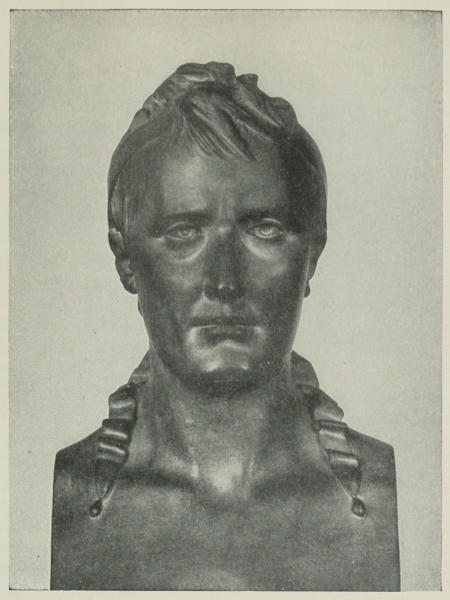
Napoleon as Emperor. Bust by Houdon, Musée de Dijon.
(Photograph by J. E. Bulloz, Paris.)
When he reaches the Memel, the symbolic significance of the Russian frontier captivates his imagination to such an extent that he is the first to cross the river, and he gallops several miles eastward before returning slowly to the bridge. Well, he is over now, and this time, in very truth, he has crossed the Rubicon. At his nod, three armies advance into the interior of Poland. The main army is under his immediate command, the second being commanded by Eugene, and the third by Jerome. Why does he venture to entrust a whole army to the leadership of this amateur (who made such a fool of himself in the last war), even with the safeguard of veteran generals as advisers? Napoleon thinks he can risk it. The enemy has at most three hundred thousand men.
Where is the enemy? In two armies, led by Barclay de Tolly and Bagration. They are somewhere in Lithuania, far away, and the total force is only one hundred and seventy thousand. Napoleon’s overestimate of the strength of his opponents was a disastrous error, for if he had himself had fewer mouths to feed, he would have had a much better chance of getting adequate supplies for his soldiers. Why is he so keen on superiority of numbers? General Bonaparte was used, with forty thousand men, to defeat an enemy that greatly outnumbered him, his method being to crush one wing of the foe after another. The cumbrous multitude he has collected for the present campaign is symptomatic of his own increasing age, and of the lust for power which makes him pile up weight, instead of equipping the spirit with wings. Is he no longer the commander of the days of Rivoli?
In a sense, he is still that commander, for, even with this gigantic array of troops, he will be a victorious invader. His first army will march from Tilsit upon Vilna, to take up a position between the Russian detachments, so that his second and third armies can separately defeat the enemy. But the Russian distances weaken his influence. Upon a front of such vast extent, he cannot show himself everywhere. Those who command under him are too independent of one another (Davoust and Murat nearly fight a duel), and yet they are too dependent upon him. Never did he suffer more than in this campaign from the lack of speedy means of communication. His was the central brain in all his undertakings, so that a telegraph would have been far more useful to him than to his opponents.
The Russians are aware of their own weakness. Neither of the two commanders ventures to stand firm. Both of them withdraw before the invaders, at first without any mutual understanding, to get into touch later, far in the rear. These are not the tactics of inspired leaders. Though the Russians do the right thing, it is merely because they are afraid of the forces that outnumber theirs, and because they dread the great name of Napoleon. They are but instruments in the hands of fate.
For a time, the Emperor pauses in his advance. In Vilna, he says: “If Monsieur Barclay imagines that I am going to run after him to the Volga, he is making a great mistake. We will follow him to Smolensk and the Dvina, where a good battle will provide us with quarters.... It would certainly be destruction were we to cross the Dvina this year. I shall go back to Vilna, spend the winter there, send for a troupe from the Théâtre Français, and another to play opera. We shall finish off the affair next May, unless peace is made during the winter.”
News from the outer world is satisfactory. At length the United States has declared war on England, and has gained some victories at sea. In England the opposition, which wants peace, is gathering strength. Even in Spain things are not going so badly. Forward! A good battle!
But where is the enemy? The Emperor goes scouting, accompanied by only one officer; there is no trace of the Russians. Uneasiness grows. Since the invaders are marching light, and therefore too quickly, part of the army, on bad roads and amid heat and rainstorms, gets separated from its commissariat, upon which everything depends. In Vilna he fails to find the tsar, though Alexander has been there just before. At this moment, news is brought that the supplies are delayed, for the commissariat wagons have stuck fast in a morass, and the vessels that are bringing other supplies have run aground in the river; moreover, ten thousand horses have perished, through gorging themselves upon rank grass. The shortage cannot be hidden from the troops, who scatter through the town, and plunder so recklessly that there will be no supplies left for the next comers.
The Emperor can get nothing from the inhabitants of this land either by threats or cajoleries; and yet he detests rapine, which leads to chaos. The Lithuanians note that even now he has not granted the Poles the promised kingdom. They do not hail him as a liberator, as the people of Lombardy had done long years before. They give no help; they give nothing; they are hardly willing to accept in payment the forged rouble notes, millions of which he has had printed in Paris. They pray.
What is to be done? Now is the time to win over the tsar. He writes: “All that has taken place is out of keeping with Your Majesty’s character, and with the personal consideration you have sometimes shown me in the past.... When I crossed the Memel, I had it in mind to send you an adjutant, as I have always done in previous campaigns.” But, since the tsar had refused to receive his last envoy, “I realised that the invisible providence whose power and dominion I recognise would decide this matter, as he had decided so many others.... Nothing, therefore, is left but to conclude with the request that you will remain convinced of the steadfastness of my kindly feelings towards you.”
Before writing this long and unctuous letter, in which nothing is genuine except the perplexity and the faith in destiny, he has had a conversation with a captured general who is to convey the missive. The way in which the Emperor hectors the prisoner, smacks of comic opera: “What does the tsar expect from this war? I have seized one of his best provinces without firing a shot, and neither of us knows what we are quarrelling about!” Then, as his way was, he spent an hour or more pointing out the Russians’ mistakes, asking why they had not defended Vilna, and talking to this captive just as if he had been berating one of his own generals in Spain. “Are you not ashamed of yourselves?” is the burden of his song. He waxes enthusiastic about the Poles, whom as a rule he frankly despises; but now it suits him to make much of their contempt for death. He says that he has thrice as many soldiers as the tsar, and much more money, so that he will be able to carry on the war for three years. These falsehoods are uttered in simulated anger, which he allows to flash out by fits and starts. The Russian meets bluff with bluff, saying that in Muscovy they have made preparations for a five years’ campaign. But now the turn has come for one of the Emperor’s bursts of frankness, in words suited to the ears of this officer blown him by a chance wind, but of course designed to impress the tsar, to whom they will be reported.
“I am the man of calculations. When I was in Erfurt, my reckonings convinced me that it would suit my book better to walk hand in hand with you Russians, instead of quarrelling with you. We might still have been good friends.... Then the tsar made peace with me, when his country wanted war; now he makes war on me, when his country wants peace. It puzzles me that so distinguished a man can have anything to do with such persons as some of his present advisers.... How can any one make war through a council of war? If at two in the morning a good idea enters my mind, in a quarter of an hour I have issued my orders, and half an hour later my outposts are executing it. But what happens among you?” Napoleon shows the prisoner a letter from the Russian general staff which his men have intercepted. “You can take it with you, for it will while away the tedium of your journey.... Tell the tsar I pledge him my word that five hundred and fifty thousand men have already crossed the Vistula. But I am a man of calculations, not a man of passion. I am still willing to enter into negotiations. What a glorious reign he might have had, if he had not broken with me!”
The general is alarmed by this flood of confessions. But in the evening, when he dines with the Emperor and three of the marshals, he is placed on an entirely different footing, for the Emperor proceeds to cross-question him like an explorer eager for information.
“Have you any Kirghiz regiments?”
“No, but we are making experiments with Bashkirs and Tartars, who are very like the Kirghiz.”
“Is it true that when the tsar was in Vilna, he went to tea every day with a pretty lady there? Let me see, what was her name?”
“The tsar is courtly to every lady.”
“Is it true that Baron vom Stein dined with the tsar?”
“All persons of note were invited to dinner.”
“How can the tsar tolerate such a man as Stein at his table! Does he think the fellow can be fond of him? Angels and devils cannot be good companions.... What is the population of Moscow? How many houses? How many churches?... Why are there such a lot of churches?”
“Because our people are very pious.”
“Nobody is pious nowadays. Which is the shortest way to Moscow?”
“All roads lead to Rome, Sire. You can choose your own route to Moscow. Charles XII. marched by way of Pultava.”
At this mischievous answer, the Emperor thought fit to turn the conversation. As for the general, he had wit enough to report in St. Petersburg that Napoleon was extremely nervous.
This nervousness increases mile after mile. The Emperor tries to join battle, but the Russians evade the issue. Barclay, who is waiting for a junction with Bagration, retreats aimlessly; Bagration does not come, for he believes that he is facing, not Jerome, but the main body of the invaders. Still, Bagration retreats. Jerome, who ought to follow him up, is too slow in his movements, so that Davoust, who is waiting for a junction with Jerome, has to let the enemy slip. The Emperor, in a rage, cashiers Jerome (who retires in dudgeon to Cassel), and gives the command to Davoust. Too late! His fondness for Jerome, the braggart, has cost him the chance of a decisive battle. As difficulties increase, the Emperor redoubles the pace of his advance; but as the tempo is quickened, the difficulties are redoubled. There is no means, now, of providing for the army. The retreating Russians burn their storehouses. No bread, no vegetables, nothing but meat. Dysentery breaks out. The horses eat the thatch from the roofs, and collapse in great numbers, so that their corpses line the road. During this advance in which there are no battles, the Bavarian leader estimates the losses of his corps at nine hundred men a day.
What is Paris saying?
Very little news comes to hand; hardly a word even from the empress. It seems as if the couriers were already being cut off. But here is a report from the Tuileries, written by the governess, to let him know how the child is getting on. He rejoins: “I hope to hear from you soon that the last four teeth have been cut. I have seen to it that the nurse shall get everything she needs. You can assure her of this.”
See the Emperor in the sun-parched steppe; before him rises the smoke of the burning villages he has yet to reach, behind him the stench of decomposing bodies. The strange food and the unaccustomed heat lead to a recurrence of his attacks of gastric spasm; he can no longer bear to ride, and, since wheeled traffic is constantly coming to grief, he covers great distances on foot, accompanied by the whole of his staff, pursued by the thought: Where is the fight to take place? Couriers arrive less frequently, and, when they do come, bring no news calculated to interest him in his present state of nervous tension. Yet here he is, pacing up and down within his tent; and the pen of his secretary, instead of, as usual, ordering masses of men to move from one place to another, hastens over the paper to record the master’s concern about the four teeth which are still lacking to an infant in a forlorn palace twelve hundred miles away. Soon the Emperor will be in Vitebsk. How far is it thence to Paris?
“Too far, Sire,” is re-echoed from unseen lips.
At last! We’ve got him! There stands Barclay, held in check for the moment by Murat! He thinks to escape to Smolensk on the morrow; such are the tidings! The hour has struck. But the Emperor is ill, irresolute. With unwonted consideration, he does not wish his exhausted army to go straight from the heat of the march into the heat of battle; with unwonted caution, he wishes to collect more troops than he really needs before beginning the attack, in order that the battle may be “another Austerlitz.” He waits till morning.
The Russian laughs. Under cover of the morning mists, he makes good his retreat; and when the air clears not a trace of the foe is to be seen, nor can a guess be made as to the direction he has taken. At midday the Emperor returns from the search, flings his sword on the table, and exclaims:
“Here I remain. Let us rally our forces. The campaign of the year ’12 is at an end.” When Murat urges him to continue the forward march, Napoleon answers: “In ’13 I shall be at Moscow; in ’14 at St. Petersburg. This war will last three years!”
It is time that the scattered army should be reorganised. Nearly a third of the forces has been struck off the lists, although no battle has taken place; the country has devoured them. Where are the auxiliaries—the Prussians under Macdonald, the Austrians under Schwarzenberg? Trustworthy news is lacking. Too far! What a country! How is one to pass the weary hours when there is no fighting? Wait? In Cairo there were a hundred men of science in his train, and the country was full of unsolved riddles.—The following letter bears witness to a sense of boredom the Emperor has not known since the days of his lieutenancy:
“Send us some entertaining books,” the secretary writes to the librarian in Paris. “If there are some good novels, new or old, which the Emperor has not read, or memoirs pleasantly written, we should be most grateful; for time hangs so heavily on our hands in this place.”
Can we not see him standing in front of his tent in his old green coat? He takes one pinch of snuff after another, and from time to time looks through his telescope across the plain. Then a grenadier approaches with a paper in his hand; the Emperor reads it, puts it away; the two secretaries gaze dumbly from the gloom of the tent, like two tamed animals awaiting the nod of their tamer. Rustam sits apart Turk fashion; for him alone is the weather never too hot. All movement is paralysed, activity is stopped, one can go neither forward nor backward. Napoleon calls towards the tent: “Méneval! Order some novels!”
News comes at last: England has secured a treaty with the tsar and with the Spanish regent. This arouses the Emperor: he sees in it the birth of a fresh coalition; perhaps, even, encirclement. Must he really lie up here till Europe rises against him or goes to sleep? Over there is Smolensk. The two Russian armies have doubtless by now met in the town. That is where the real Russia begins: surely they will not evacuate and burn the old town of the Blessed Virgin, as they have been doing in the Polish and Lithuanian wilderness! Should victory be achieved at Smolensk, then the march on Moscow or St. Petersburg can be undertaken at will.
He questions his generals. Many of them utter words of warning. But the Emperor replies: “Russia cannot continue this sacrifice of her towns. Alexander can only begin negotiations after there has been a big battle. No blood has yet been spilled. Even if I have to march as far as the holy city of Moscow, I am determined to force a fight and win!”
At last the two Russian armies have effected a junction; they plan a systematic retreat, preceded by a stubborn resistance; wave after wave of the weary French army breaks against the walls of Smolensk. The veterans think of Acre, thirteen years gone by.... In the end, the town falls, but it falls amid the flames; a heap of ruins is all that is left in the victor’s hands. Is the Emperor beginning to understand the moral strength of this people? Can he not see that day by day its mood becomes more fanatical, that it would rather burn its ancient holy things than leave them to the enemy? There remains nothing for a starving army to plunder.
The Emperor, indeed, is in sorry plight. King Lear upon the heath. Power crumbles in fragments from his body; every gesture melts in the air; from afar the laughter of the rational world comes echoing, to be lost in the void. An end must be made. A second message is sent to the tsar. No use writing, for that last letter from Vilna has remained unanswered. Once more a captured general is ushered into his presence, and once more the Emperor’s secret meditations are unveiled. In conclusion he says:
“Can you write to the tsar? No? Still, you can write to your brother at headquarters and tell him what I am saying to you. You will greatly oblige me if you tell him that you have seen me and that I have charged you to write to him. He would do me a real service if he himself would let the tsar know, or get the grand duke to do it for him, that my greatest wish is to conclude peace.... What are we fighting for? Of course, if you were the English, that would be a different matter! But the Russians have done nothing to me. You want to buy coffee and sugar cheaply? Very well. That can be arranged. But do you fancy it will be easy to beat me? Then get your council of war to consider the situation; if it thinks the Russians can achieve a victory, choose your battle-ground.... Otherwise I shall be compelled to take Moscow, and, in spite of every precaution, I shall perhaps not be able to save it from destruction. A capital which has been in the possession of the enemy, is like a woman who has lost her honour.... What do you think? If the tsar wishes to conclude peace, surely none will oppose him?”
As a young lieutenant, as a young general, he had never asked a favour; he could not; he knew only how to command. Even to kings he wrote in the tone of a commander, and the word “please” had only twice passed his lips during the course of this last decade: the first time, when he asked the pope to anoint him emperor; the second time, when he besought Francis of Habsburg for his daughter’s hand. Yet to-day, what a tone! What thoughts must be passing through the captive’s mind at the moment when his sword is given back to him!—Can this be the master of the world? Has he not begged me, a poor man, begged me and my brother, to do him a service? How came these things to be? Has he no other messenger? Coffee and sugar are to blame, it seems, for the fact that an army of hundreds of thousands of men is perishing in my land! And, as though the whole thing were some brilliant game of chess, the master player sends his challenge, while Little Mother Russia is suffering and weeping, and sees one of her cities after the other go up in flames, and the images of her saints reduced to ashes!
The letter to the captive general’s brother is duly written, passes Berthier’s censorship, is delivered—but is never answered. The Emperor is beside himself with rage: he passes through a period in which he makes impulsive and vacillating decisions. When Rapp asks whether the army is to go forward or to retreat, Napoleon answers: “The wine is poured out; it must be drunk to the last drop. I am for Moscow.... Too long have I played the emperor; it is time I became the general once more.” The eyes of the officer light up as he recognises the old ring in the voice!—We are at the beginning of September.
On the sacred soil of the heath near Borodino, Kutusoff, Barclay’s successor, must at length put up a fight. The armies now are of equal strength: this is the game the Emperor proposed. No one sleeps, for to-morrow, to-morrow at last, the battle will be joined! Then will golden Moscow lie at our feet, and all our troubles will be at an end. In the middle of the night, a courier arrives from Paris. The Emperor, bending over his maps, asks if there is anything urgent to attend to. Silently his secretary hands him a dispatch from Spain: Wellington has gained a decisive victory over Marmont in the fight near Salamanca. The Emperor reads the report, makes no comment, and resumes his interrupted work. At the eastern extremity of Europe, at the point where it loses itself in the Asiatic wastes, in a few hours he is to vanquish the Russians. This is no time to trouble his mind as to the significance of the victory of the detested Briton at the southern extremity of Europe. Day has dawned. To-day, as every day, the guards call the salute: “Vive l’Empereur!”
He shows them his son’s picture, which the courier that night had brought him from Paris. There they stand, the old war-dogs, never dreaming that France has been beaten in Spain, but admiring the portrait of the beautiful boy who is their leader’s very own son. When the picture is brought back to the tent, the Emperor says, speaking like a poet: “Hide it away. He is too young to look upon a battle-field.”
In fierce fighting, on this day of Borodino, salient points are taken, lost, and retaken. The guards shout. They want to decide the issue, here, on the Moskva, as they have so often done before. His generals beseech him to order the advance, and his intimates urge him to action, but he will not give the word. For the first time, when the fight is on, he will not stir from his place. He is feverish, panting for breath, racked with a cough, and his legs are swelled. He sits motionless on his horse, and cannot make up his mind to order the advance of the guards, although the fate of the day seems to hang on it. “Suppose there should be another battle to-morrow? What men shall I have left to fight it with?” At night the Russians withdraw. Next day, when the fallen are counted on the field, they number seventy thousand dead or half-dead—more than in any of his previous battles. The Emperor exclaims:
“Fortune is a strumpet. I have often said so. Now the truth is coming home to me.”
But the way to Moscow is open. Half a million men had been chosen for the invasion. One hundred thousand of them are still following him, when, from an elevation, with his back towards the setting sun, he first sees the city of a thousand cupolas, and upon the hill in its centre that fragment of the East, the Kremlin. Napoleon, as he gazes at the sight, is filled with weariness rather than with exultation, and he says in a low tone:
“Moscow! It is time!”
V
“Where are the keys of the city? Why are not the mayor and corporation here to hand them over?”
For the greater part of the afternoon he waits while the army marches past him, waits for the keys of the town. At Vienna and Milan, at Madrid and Berlin, he had ridden through the gates as a conqueror. Are these Tartars ignorant of the fine old Roman custom? From afar can be heard the noise made by Kutusoff’s soldiers, as the half-beaten army evacuates the Eastern side of the town, while Napoleon’s men are streaming in from the west. The advance guard of the French and the rear guard of the Russians are almost in touch. It is a silent entry, for the town is like a city of the dead; the houses are empty. “Still, there are plenty of houses,” think the weary campaigners; “we shall find food, and be able to sleep at our ease.”
The Emperor and his staff ride slowly through the streets whose silence is so ominous. The Kremlin is their destination. Here is the ancient fortress. The newcomers look with astonishment at its walls. All the gates are open, but there is no one there to act as guide. The golden and red halls are forsaken, as in the vision of a dream. The invaders make their way into a huge room where the windows are boarded up. The grenadiers knock the boards away with the butt ends of their muskets, and the Emperor recognises by the canopy that he is in the coronation room of the tsars of Muscovy; but the throne is veiled.
Peace is the only thing lacking to him in this moment of fulfilment. Where is the peace? He has nothing but a victory. Who has cheated him of its fruits? Only the vast, strange land; the steppe has cheated him to-day, as the desert cheated him thirteen years ago. Why did he not free the serfs in Lithuania, and thus win guides and new soldiers, as he had planned to do aforetime with the liberated Arabs? What if he were to adopt this policy now? The town is deserted, but there are peasants in the surrounding countryside. Why not summon them, make terms with them? We are masters here; this enigmatic realm can still offer much of what we desire!
Night comes, but sleep is coy. “Let us do some work, then, to distract our minds,” he says to Caulaincourt. He opens the map of Poland; satisfies himself that it was impossible to stay there; in six weeks he can be in St. Petersburg. The muster rolls (they are his Bible, which he always takes with him on a journey, and perpetually cons even in peace time) show him what forces are still at his disposal. His spirits rise as he looks at the columns of figures. “In a few weeks I could get together a quarter of a million men here. There are plenty of roofs to cover them, but what about food? The city seems to be in the middle of a desert!”
A red glare shows through the windows. Fire! Oh, well, we’re used to that. There were several fires here and there yesterday evening. But orderlies rush in, and generals arrive. A hundred messengers have reported the outbreak of fires all over the city. Not accidental fires, but prearranged, for the fire-engines have been broken or removed. Do these lunatics mean that Holy Moscow should go up in flames? What will the Emperor do? Ségur, who was with him in these dark hours, tells us what happened:
“It seems as if the encircling flames have spread to the Emperor’s mind. By turns, he leaps to his feet, sits down again, or tramps hastily through the rooms of the palace. His abrupt movements betray his terrible agitation. He abandons an urgent task, resumes it, abandons it once more, that he may fling the window wide. He exclaims:
“‘What a dreadful sight! Their own work! So many palaces! How stupendous a decision! Who could have expected anything of the kind? What men they are! They are Scythians!’
“Suddenly we are informed that the Kremlin has been mined. Some of the servants are panic-stricken; the guard quietly awaits orders. The Emperor smiles incredulously, but he continues to pace convulsively to and fro, halting at every window to watch the raging element as it seizes the bridges and the gates, simultaneously imprisoning him and besieging him. The air is full of smoke and flying sparks; the equinoctial gale increases the fury of the conflagration.
“Murat and Eugene arrive hotfoot, force their way to the Emperor, and urge him to flee. In vain! Napoleon, master in the palace of the tsars, is steadfast. He will not yield even to devouring flame. But suddenly comes the cry: ‘Fire in the Kremlin!’ The Emperor is to see the danger close at hand.
“A Russian military policeman has been seized in a turret of the arsenal. Brought before the Emperor, the man admits that he has fired the Kremlin, acting under orders. The Emperor makes a sign of rage and contempt. The prisoner is led out into the courtyard and is cut down by the grenadiers. This incident decides the Emperor’s action.
“We hasten down the northern staircase, and the Emperor orders us to guide him out of the town. But all the gates of the citadel are blocked by the flames. At length an alley-way leading to the Moskva is discovered between two rocks. Through this narrow passage we are able to escape from the Kremlin. But what has been gained? How can we cross the river? The soldiers, blinded by the sparks and deafened by the storm, do not know where they are, and the streets are hidden amid the smoke. The only way out of the inferno is through a winding street where the houses are on fire.
“Heedlessly the Emperor strides along this dreadful exit, undismayed by the crackle of the flaming beams and by the crash of the falling roofs.... We can hardly breathe, so intense is the heat. Our guide loses his way, and we should all have ended our lives in the flames had not some marauders belonging to the first army corps recognised the Emperor and found a way for him and the rest of us out of the smoking ruins.
“We meet Davoust. He has been injured on the Moskva, but has had himself carried back among the blazing houses, hoping to find the Emperor or perish with him. The general embraces Napoleon in a fever of delight. The Emperor responds in friendly fashion, but with that calm which never leaves him in the hour of danger.”
He awaits the end of the conflagration in the Petroffsky palace, a suburban retreat. On the fourth day, he returns to the Kremlin, where very little damage has been done. On the fifth day, his patience gives out. For the third time, he writes to the tsar. Even now, when he is in possession of the capital, he feels he is grasping at the air. He is so cut off from the enemy that once more he has to make use of a Russian prisoner (this time only a captain), in order to find a contact with the tsar. Napoleon receives the man in the throne room. Does he sense the heroic grotesqueness of the scene? An officer of no account, powerless, unknown, is the representative of Holy Russia; before him, in the storied hall of the tsars, stands the mighty Emperor of the French, the conqueror at whose slightest nod all Europe trembles. The Emperor speaks, chaffers, poses conditions with this man, as though the occasion were another Tilsit and the captain the tsar.