BOOK FOUR THE SEA (continued 4)
Cedar Paul translation
He goes on board, and at dawn seven little frigates, carrying a thousand men and a few guns, set sail for the French coast. He stands on the deck. The outlines of Elba, where he has lived so peacefully, and of Corsica, where many years before he had made stormy attempts to force his way upwards, fade into the distance. Slowly the coast of the French Riviera begins to show clearly through the mists of the first day of March. Let us look into the Emperor’s mind:
“What is the minimum? Defeat and death. What is the maximum? Europe? No use thinking any more about Europe! The dream of the United States of Europe is finished. I cannot get another million Frenchmen, and the foreign nations are not ready for my scheme. I must give France a constitution, and must accommodate myself to governing through Chambers. The time for dictatorships is over. Besides, we are not in Paris yet. What will the army do?”
His thoughts are coloured with the spirit of the time. He is a man of forty-five, with more past than future; no longer young enough to take the world by storm, but not too old for a desperate venture. Thus does Napoleon again draw near to French shores, in a mood betwixt courage and renunciation.
XVI
The mountains are calling, the valleys are echoing, as the procession of a thousand men who landed at Cannes wends its way through one Alpine village after another. An enthusiastic crowd encircles the old guard which has pursued its way along the road of history without jubilation and without sorrow, imperturbable as a rock. The peasants, these sons of the hills, in the self-same hamlets, had once before seen him, a lean, small, unknown general; in those days he had relieved them from the burden of maintaining an undisciplined soldiery, and had led the troops over the Alps to victory. These mountain folk were the first to see the miracle he wrought; they plumed themselves on the thought that from their villages the Emperor had gone forth. And now, of a sudden, he is among them again! Surely the procession of the thousand will work a spell, and seem to be the march of prophets and saviours?
They come from their mountain fastnesses; women and children bring up the rear; songs against the king are composed and sung; in the lesser towns, the bolder spirits force the city fathers to go forth to meet the new comer; for more than a hundred miles he encounters none but peasants.
Napoleon had reckoned upon this. He would not face a march through Aix and Avignon, through the monarchical provinces. He preferred to leave his few cannon behind in the snow-covered mountain paths, in order the quicker to reach Dauphiné. Here the peasants had received the most generous distribution of the nobles’ lands. They are full of anger now against king, priest, and émigré, who, after the lapse of twenty-five years, are contesting the peasants’ right to hold these lands. Was not the great revolution made to protect the poor? Was it not made by peasants in the country and workmen in the town? The Consul had not taken back anything from them; even the Emperor had only called up their sons; they have never ceased to look upon him as one of themselves, for their minds moved slowly and their hearts were constant. Now, the king had come back again, and forthwith the nobles had begun to squabble over the fields the peasant had tilled.
The souls of the countryfolk were heavy at the change of fortune. Fifteen years ago the mood had been similar when Napoleon, returning from Egypt in his little ship, had landed, and the whole of southern France had hailed him as saviour. What can have happened in the last ten months, to make these people receive with every token of joy the man whom they had so recently execrated? True, he had passed through another part of the country at that time; and the national misfortune had needed a scapegoat. His disfavour among the folk had been as brief as his defeat. But belief in him lasted as long as the years of his glory.
What will the first troops we meet do? He himself, when he took leave, had urged them to serve the fatherland. And the fatherland was the king! They wear the Bourbon’s white cockade, they eat the king’s bread, from the lips of patrician officers they have received a new and ugly picture of the erstwhile leader. Everything will depend on his power of suggestion. Uncertain feelings govern his heart as he strides inland from Cannes. To his left, lies the fort of Antibes. Does he recognise the tower wherein he was thrown when Robespierre fell? In just such a tower, the Bourbon will fling him, against just such a wall Europe will stand him, if he should fail on the morrow to accomplish what his glance and his word have so often succeeded in doing before.
Outside Grenoble, near La Mure, he has his first encounter with the royal troops. They have orders to exterminate him and his “band of brigands”; the officers have taken the oath to the king just as in former days they had taken the oath to the Emperor. The order to attack is given. Is the blood of brethren to be shed? That is what Napoleon has spent a lifetime in avoiding. Is this highway to be turned into a battle-field? He alights from his horse, takes ten strides towards them, and shouts:
“Soldiers of the fifth army corps! Don’t you know me? If there is one among you who wishes to kill his Emperor, let him come forward and do so. Here I am!” Saying which, he throws open his grey cloak.
A terrible pause. What will happen?
Those are our brethren! This is our general! We have seen him in so many battles, standing on a hillock, or sitting over the bivouac fire, or facing the musket shots and cannon balls! Must not nature and remembrance overpower the influence of recent vows? The soldiers cry: “Vive l’Empereur!” A general running to and fro ensues, guards and soldiers mingling; caps are stuck upon bayonet points—what does one more hole in the blue cloth matter? An hour later, two thousand instead of one thousand fall in behind their leader.
This encounter on the high road to Grenoble, this moment of time, his call, his aspect, were decisive. The man of action had won back to leadership through his own deed; the middle-aged warrior had regained life, power, and realm, by a look and a word. Thus he reaches Grenoble. By a manifesto he communicates his thoughts to the people:
“Frenchmen!... After the fall of Paris my heart was torn, but my spirit remained unshaken.... My life belongs to you, and must once more be made useful to you. In my exile, I heard your plaints and your cries.... You accused me of too long a slumber, saying I was sacrificing the interests of the country to my own repose. Encompassed by dangers, I have sailed over the sea. Now I am in your midst, to demand my rights, which are also your rights.
“Soldiers! We are not conquered!... Marmont’s treachery delivered the capital into the hands of the enemy, and disorganised our army.... Now I have come! Your general, who was elected to the throne by the suffrage of the people, and raised aloft on your shields, has returned to you. Rally to him!... Wear the tricolour cockade again, the cockade of our days of victory! Let the eagles which you bore at Ulm and Austerlitz, at Jena, Eylau, and Friedland, at Eckmühl and Wagram, at Smolensk and on the Moskva, at Lützen and Montmirail, once more wave on high!... Possessions, rank, and glory, for yourselves and for your children, have no worse foes than those princes who have been forced upon you by foreign powers.... Victory will guide us forward through the storms, and the eagles shall fly from one church steeple to the other until at last they alight on Notre Dame!”
Vive l’Empereur! The troops in Grenoble, together with the imperial nobles, come over. Seven thousand men follow him to Lyons. Lyons comes over. Masséna, who had been serving the king, journeys from Marseilles and pays homage to the Emperor.
“Where is Ney?” Embarrassed silence. “With the king?”
They tell him about the council of war in Paris. Since the terrible news was brought, the fat king and his lean court have sat there trembling. The “Moniteur,” which had lied in Napoleon’s favour for fifteen years, now lies on behalf of the king: the Emperor, it announces, is dead. Just as they are deliberating what to do, old Count Condé enters the room and asks his royal cousin whether on Maundy Thursday the king himself should not officiate at the washing of feet. The king is writing a manifesto to the army. But who is sitting by him, his mainstay, the true leader of the Bourbon army? What is the man’s name?
It is Marshal Ney. When, on the retreat from Moscow he had been cut off from the main body and appeared to be lost, his master had cried: “Ney is lost! I would give the two hundred millions from my cellars in the Tuileries, if I had him again!” Now he rises from among the royal plenipotentiaries gathered round the conference table; he swears to annihilate his sometime master. But when the breeze of general enthusiasm sweeps by him, he veers; his corps dons the tricolour cockade, and in Besançon he sends word to the Emperor that he would like to write a vindication of his conduct. But the Emperor waves the proposal aside, saying: “Tell him I love him the same as ever, and that to-morrow I shall embrace him.”
What a master-stroke! True, he forgives; but he leaves Ney on tenterhooks till the morrow. Next day, the marshal stammers: “I love you, Sire; but as a son of the fatherland ... I was forced to kneel down before that fat hog to receive the cross of St. Louis! Had you not come, we should have chased him away ourselves.”
“Marvellous! How vacillating he is, how pale!” These thoughts flit through the Emperor’s mind as he asks his questions.
The count of Artois has fled. The very morning of the flight, the guards had sworn to die with him; by midday, they had rallied to the Emperor. Such behaviour does not please Napoleon, and he keeps this portion of the guard at arm’s length. But there is one man who had remained loyal to Louis until the Bourbon was in safety; not till then does he change sides. This recruit, Napoleon welcomes, and with his own hand decorates him with the emblem of the Legion of Honour!
But what a change! The more this avalanche of soldiers grows as he marches forward towards Paris, the more peaceful do his speeches become. In one town after another, he addresses the municipal councillors and the citizens in the following words: “War is at an end. Peace and liberty! The principles of the revolution must be protected from the onslaughts of the émigrés. The treaties with Europe must be adhered to. France will win back her glory without war. We must be content to be the most esteemed nation, without trying to dominate other countries.”
Does the people grasp the significance of the new tone? If the nation understands, is there belief in its genuineness? Must one be content? Glory without war? To a high official, an old acquaintance whom he meets on the march and in whom at length he finds an intelligent listener after addressing dull-witted citizens and partisan officers, he gives this political explanation:
“The spirit of the people is changed. In earlier days, the nation thought only of glory; now it thinks only of liberty. In the past, I brought the nation glory; I will not withhold liberty now. Freedom can be enjoyed in full, when power rests upon a good constitution.... Only—no anarchy! That would bring us back to the days of the despotic republicans, when every one had a finger in the pie. I shall retain only so much power as is essential for governing properly.”
In the naïve closing sentence lies the new problem. He has broached the question; he is determined to stabilise the basic ideas of democracy. One thing is the same as on the Eighteenth Brumaire: no party politics! “I don’t want to write to them,” he says, when advised to forgive the turncoats. “They would believe that I was pledged to them. How are things in the Tuileries?”
“Nothing has been changed; not even the eagles have been removed.” He is gay, bubbling over with good humour. He laughs.
“I suppose King Louis found the eagles decorative! What are they playing at the theatre? How is Talma? Were you at court? I’ve been told that the Bourbons looked like parvenus, did not know what to talk about, nor how to behave.”
How inquisitive he is! How full of malicious joy! How he yearns for the air of Paris! He seeks his revenge in mockery, he whom the others had so long held up to ridicule. He is told of the parsimony of the court. He is shown the king’s effigy on a twenty-franc piece.
“Do you see? They’ve got it again: ‘God protect the king’! My device is: ‘God protect France’! They’ve left out those words. They were always like that: everything for themselves; nothing for France!” In the course of three minutes he enquires after twenty persons. When he is told that Hortense has been made a duchess, he answers simply:
“She should have called herself Madame Bonaparte. That name is worth more than all the rest.”
His words are symbolic of the new epoch. If he calls himself Bonaparte once more, grants a constitution, allows liberty, and does not grasp at more power than he actually needs, he can make himself king of France. Then, after the failure of his attempt at the unification of Europe, he will still be able to become the happy exemplar of a modern prince by God’s grace. He has always ruled as circumstances might dictate. Now, called to power for the second time, and after his imaginative flight towards far horizons, he will still prove himself a master. The road lies open.
The road to Paris is likewise open. The Bourbon king has run away, and the majority of the inhabitants are on the Emperor’s side. Any one who might still have dreaded a fight with the last royal troops, must have overestimated them. When the Emperor is yet a hundred miles from the capital, the remnants of the royal guard flee from the city. The Emperor’s army overtakes the king, but allows him to escape to a seaport, being content to take the silver he is carrying off with him in sixty carts, and to seize his cannon. France has a hearty laugh at this fat old gentleman, who had been escorted from England to Paris by enemy soldiers, and now makes all speed back to England with the soldiers of France chasing him.
Paris is calm. The town has long since forgotten how to take the initiative. During the twenty days between the Emperor’s landing in the south and his arrival at the capital, the thermometer of the press registers the following degrees: “The monster has escaped from his place of exile.”—“The Corsican werewolf has landed at Cannes.”—“The tiger appeared at Gap, troops were sent against him, the wretched adventurer ended his career in the mountains.”—“The fiend has actually, thanks to treachery, been able to get as far as Grenoble.”—“The tyrant has reached Lyons, where horror paralysed all attempts at resistance.”—“The usurper has dared to advance within a hundred and fifty miles of the capital.”—“Bonaparte moves northward with rapid strides, but he will never reach Paris.”—“To-morrow Napoleon will be at our gates.”—“His Majesty is at Fontainebleau.”
When, at length, without having had to fire a shot, the Emperor mounts the steps of the palace he had been compelled to leave thirteen months before, Paris is overawed by his soldiers, and the émigrés have fled with the king. All is quiet. He notes the fact, listens attentively, and says: “They have let me come, just as they let the others go.”
Now he has his first disappointment! The march on Paris had been glorious, and in after days he spoke of it as the most splendid experience in his life. But here, in the city which will ultimately decide his fate, the city whose favour he has wooed more assiduously than he ever fought for any realm, the city he has never wholly conquered, he encounters moral resistance. Those whose favour he courts are no longer in the arms of their new friend; but they are listless, as if, after excess of passion, their vital energy had run down. Still, here he is, and he must bestir himself.
He looks to Vienna for a sign.
A week after Napoleon’s landing in France, Metternich goes to bed at three o’clock, and is awakened at six by a messenger who hands him a despatch. He reads the inscription on the envelope, “General Consulate, Genoa,” angrily turns over and goes to sleep again. He does not open the missive till several hours later, to read: “Campbell, the English commissioner, has just called to enquire whether Napoleon has been seen in Genoa. He has vanished from the island of Elba.”
The bomb! Those who were yesterday still intriguing against one another, now become thick as thieves once more. The vows which have so often been broken are renewed. The first to think of declaring the man an outlaw is Baron vom Stein, whom Napoleon had outlawed five years earlier. The possibility is discussed, but father-in-law Francis of Habsburg cannot make up his mind to the step; he would like to ask Marie Louise first. Four years ago she was devoted to her husband. She has never breathed a word of complaint to her father or to any of her women friends. Why should she? Napoleon had done whatever she wanted; she had been courted and wealthy; he had been the most equable of husbands; the parents had shared in the games of the little boy. Will she now become the Emperor’s advocate?
The wife of Napoleon and the mistress of the Austrian officer prefers to take up her pen and write a formal declaration to the congress. She will have nothing to do with the Emperor, and she will put herself under the protection of the allies. Such is her answer to that hour when Napoleon had had to choose between the mother’s life and the child’s, and had decided in favour of the mother. Not until his wife has cast her vote against him, is the Emperor made an outlaw: “The powers declare that Napoleon Bonaparte has placed himself outside the bounds of civil and social relationships, and that as an enemy and disturber of the peace of the world he is consigned to public prosecution.”
The tidings leave him unmoved. He is used to being outlawed. When he left Corsica, he and all his relatives were under sentence of outlawry. The word “outlaw” had been shouted at him in the Orangerie at Saint-Cloud. The pope had pronounced the major excommunication against him. All three anathemas had glanced harmless from his coat of mail, so that he deemed himself impregnable. But this fourth ban will lay him low.
He still continues to hope in the Habsburg. Announcing his intention to summon the Electoral Colleges of the Empire to a great assembly, he speaks of the gathering, in Carlovingian terminology, as a Champ de Mai, for he intends to have the empress and his son crowned there. He thinks that this will ensure Austrian support, and writes to his wife:
“I am master of France. The people and the army are wild with enthusiasm! No one but the so-called king has run away to England.... I expect you here in April with my son.” The thought of his dynasty is ineradicable.
But even this most natural of feelings assumes a distorted form, for his feelings are in pawn to the old world. Writing to the man who has just outlawed him, he says: “At the moment when providence has recalled me to the capital of my States, it is my chief desire, the object of my tenderest inclination, to see my wife and son once more.” He goes on to speak of his wife, who must certainly reciprocate his longing. Then: “All my endeavours are directed towards the firm establishment of this throne which the love of my people guarantees and restores to me; and towards handing it down to my son in due time, based upon an imperishable foundation.... Since a lasting peace is essential to the attainment of this important and sacred aim, there is nothing nearer to my heart than to remain at peace with all the powers.”
Is this sublime, or is it ridiculous? Napoleon renounces war, and abandons his designs on Europe. He speaks truth when he says that he needs nothing more than France. The monarchs who had conquered him last year have formed a new alliance against him, and have declared him an outlaw. The sentence of outlawry has been signed by Emperor Francis, in the Austrian capital, with Marie Louise’s express authorisation. She had left him after the last defeat; had thrown up the regency which she had sworn to carry on faithfully; had taken the boy with her; had thrown herself into another man’s arms, and is still living with him: the Emperor knows these things. But now, instead of beginning the new era with a clear-cut severance from all that has overthrown and disappointed him, he begins by suing for the friendship of this old throne which had triumphed over his new one.
This is the ban, this is the outlawry, which will for the second time bring him to his doom.
XVII
The adventurer now becomes a rat-catcher, like the Pied Piper of Hamelin. Bourbon had been clever enough to invite the best talents to serve him; and as a result of this, when once the royalist national anthem had been sung, all went smoothly for him. Some of these men know not whether to go or to stay: they wait upon events. But Napoleon, who has always commanded, who has never canvassed for any one’s services, places the flute of the tempter to his lips: he knows that now is the time for suggestion and smiles. The loyal few, he restores to their posts, with a shake of the hand. Maret, Davoust, and Caulaincourt, form part of his ministry.
He knows all that those who have proved ungrateful have been doing, and he judges them by their record. Officials, officers, and court dignitaries, again flock to his levees. A count of the old aristocracy comes likewise. Napoleon had called this man back from exile and had made him senator; but at the Bourbon restoration the count had gone over to the king. Now, as the Emperor draws near, the count casts his eyes heavenward and seems to imply that his actions were dictated by God’s inscrutable will. The Emperor smiles. Not a word is exchanged. But the count comes no more to court. When, on the other hand, one of Marmont’s generals, a man who had delivered a decisive speech in the war council before the marshal’s defection, approaches Napoleon and begins to stammer out an explanation, the Emperor does not smile. He says, in an overbearing tone: “What do you want of me? Can you not see that I do not know you?”
Here is Oudinot: for twenty years he was Bonaparte’s companion-in-arms; now he comes back to the Emperor. “You see, Oudinot? You were worshipped as a god by the Lorrainers; two hundred thousand peasants were ready, even last year, to go through fire and water for your sake. To-day I have to protect you against these same peasants!”
Here is Rapp. He has wavered longer than the rest, and even now comes hesitatingly to his master. “You’ve kept us waiting a long time! Did you really want to take up arms against me?”
Rapp is an Alsatian, half a German, and as such he is more a man of duty than a man of feeling: “My duty, Sire, constrained me.”
“Diable! The soldiers would not have obeyed you; your Alsatians would have stoned you!”
But Rapp is nothing if not thorough: “You must admit, Sire, the position was a difficult one. You abdicate, you leave France, you advise us to serve the king, you come again....”
“Were you often here? How did they treat you? At first, I suppose, they flattered you. Soon they’d have chucked you out of doors. That is what your fate would have been.... Have you read Chateaubriand’s pamphlet? Is it true that I am a coward on the battle-field? They are always accusing me of ambition because they have nothing better to say. Does one get as fat as I, if one is constantly being spurred on by ambition?... Once again, General, we must serve France. Then we can be gathered to our fathers.”
In such a debonair and lively manner does he play with this doughty and decorous old comrade. But Rapp holds his own: “You must admit, Sire, that you made a mistake in not concluding peace after Dresden. You treated as nonsensical my reports concerning German sentiment....” The Emperor is quick with his repartee:
“You do not understand what such a peace would have meant!” Suddenly his tone changes into one more suitable to the camp than to this palace and to this hour; it is intimate and familiar, and goes home to Rapp’s heart: “Or were you perhaps afraid of beginning a fresh war, you who for fifteen long years had acted as my adjutant? When you returned from Egypt you were nothing more than a soldier. I have made a man of you. To-day you can have whatever you like to ask for.... I shall never forget your conduct before Moscow. At Danzig you achieved the greatest that any man could achieve. Ney and you, you belong to the tiny legion of those who have strength of character!” The Emperor embraces him, kisses him again and again. Then, pulling Rapp’s moustache, he says:
“Eh? One of the braves of Egypt and Austerlitz—and you wanted to forsake me! You shall take command of the army on the Rhine, while I am dealing with the Prussians and the Russians. In two months, I hope you will be receiving my wife and my son in Strasburg. From to-day, you are my adjutant!”
“At your orders, Sire!”
Had the Emperor ever seen Wallenstein’s Death performed on the German stage, as had, perhaps, that would-be murderer in Poland? He must have this fellow, Rapp, about him. The man is fundamentally honest, and is as brave as he is honourable; of all the Grand Army, he is the officer who was most frequently wounded. He only went over to the king from a sense of duty; he is not to be bought by the lure of promises. And yet, in a quarter of an hour, he is not only the Emperor’s man once more, but has accepted the posts of army commander and adjutant, as of old. Fidelity, Napoleon realised it well, is what the Emperor most urgently needs.
Ney’s case is a more difficult one. Remorse keeps Ney sleepless. With distraught countenance and extravagant words he addresses his master: “Perhaps you have heard, Sire, before I marched to Besançon, I said at the council of war—here, in the Tuileries, I promised the king—”
“Well, what did you promise?”
“To bring you in an iron cage, and place you before his throne—”
The Emperor stiffens. Then: “Foolishness! Such thoughts are unworthy of a soldier!”
“You are mistaken, Sire,” exclaims the Marshal yet more excitedly; “allow me to finish. I said it, yes—but—I wanted to hide my real feelings—”
The Emperor is incensed. Ney quickly withdraws, and only after the lapse of two months takes command in the campaign. Thus near to madness had these iron warriors been brought through their struggle between duty and inclination, when the one great will which mastered them had been withdrawn. Berthier, who also rallied to Napoleon, had gone through the same experience.
“The donkey,” exclaims the Emperor leniently, when talking of his old favourite. “He’s a good fellow. I ask nothing of him than that he should present himself before me in the uniform of the royal guard!” But Berthier, since the Emperor’s return, rushes all night through the rooms of his mansion, and at last throws himself headlong from a balcony, like Junot, to perish on the cobbles instead of dying in the battle-field.
Forwards! We have no time for loitering! Who else is there? Ah, Madame de Staël pops up again. This old opponent writes to him, admires his conduct, and promises that if he will restore the two million francs which France still owes her father, she will in future devote her literary gifts to the cause of France. The pity of it! Through making this stipulation, so splendid a woman must come down to history as beaten in the game! The Emperor mischievously replies that, to his great regret, he is not wealthy enough to fulfil her condition.
Who else is there? Marmont? Augereau? They are declared outlaws by the Emperor, because they sold the fatherland to the foreigner. And then, at long last, Talleyrand likewise! The lightning flashes that travel from Vienna to Paris and from Paris to Vienna strike a deadly blow at this hostile friendship which has lasted for eighteen years. Each man thinks in his secret heart: “A pity that so fine a brain should be working for the other side!”
What about the second of the Dioscuri? Fouché is back again! He takes up his service as Minister of Police in the twofold capacity of working for and against his master. He says of the Emperor: “Well, he’s here. We none of us exactly wished him back again; now we shall have to keep close watch on him.... The man has returned even madder than when he left. I give him three months!” Meanwhile, he corresponds with Metternich; but spies soon tell the Emperor, who angrily apostrophises him: “You are a traitor!” Lavalette, who is in waiting, hears the words through the half-open door. “Why do you consent to be my minister if you mean to betray me? I know that you are exchanging letters with Metternich through the intermediation of a bank official in Basle. I could have you hanged, and all the world would applaud my action.” Fouché’s answer has not been recorded!
The minister owed his present position to his radical outlook, for he had been a revolutionary in theory ever since Robespierre’s time. The Emperor needed him in the cabinet as a decoy for the democrats. But Fouché not only betrayed his master to Metternich, he likewise betrayed Metternich to the radicals; he wanted to set up a republic—with Fouché at the head. Carnot, who was a more violent antagonist of the king than even the Emperor himself had been, now, for the first time since the days of the Directory, entered the ministry.
But, as spiritual leader, the Emperor wins over his whilom enemy, Benjamin Constant, a friend of Madame de Staël. This old-time democrat, who had recently been thundering in the press against the brigand of Elba and comparing him to Attila and to Genghis Khan, is needed now that the Emperor proposes to govern through Chambers. Napoleon, therefore, invites Constant to an audience. The Emperor has not seen him for fifteen years. The interview, recorded by Constant, occupies four pages of print. We are shown, without periphrases, the last transformation of Napoleon, the statesman who was ever ready to adapt his course to the demands of practical politics.
“The nation again wishes for tribunes and assemblies. It has always wanted them, for it threw itself at my feet when I climbed to power.... I assumed less power than was actually conceded me. To-day, all is otherwise. The preference for constitutions, for elections, for speeches, is again to the fore. This is, however, the desire of a minority. The majority desires myself, alone.... I am not only the soldiers’ Emperor; I am also the Emperor of the workers and peasants.... Thus, in spite of all, the people comes back to me. I treat the people severely, I never flatter the people; and yet the people cries: ‘Long live the Emperor!’ This is because there are common bonds between us....
“It is otherwise with nobility. The nobles thronged my ante-rooms begging and receiving the posts they coveted.... But no common bond has ever existed between us. The horse submitted to the rider, it had been well trained; all the same, I felt it tremble beneath me.... Yes, I endeavoured to set up a world monarchy, and for this I needed unfettered power. Who, in my place, would not have wished to do likewise? Did not the world itself encourage me? Princes and subjects hastened to come beneath my sceptre’s sway.... But if France is to be the whole of my dominions, then a constitution is better....
“Tell me your ideas. Freedom of speech, free elections, responsible ministers, freedom of the press?... I am agreeable to all this. Especially the freedom of the press. To try and crush this any longer would be absurd.... I am the man of the people. If the people really wants freedom, I must give it.... I am no longer a conqueror; I can no longer be a conqueror. I know what is possible and what is impossible. My sole mission now is to set France on her feet once more and to give her a constitution adapted to the temperament of her people....
“I do not hate freedom, although I gave it a wide berth when I met it on my way. I understand liberty; I was nourished on this idea. The labours of fifteen years have been destroyed; if I wished to begin all over again, I should need twenty years and should have to sacrifice two million men.... I want peace; I can get it only through victory. I will not fill you with false hopes; I foresee a terrible war. In order to win through, I must have the support of the people. The people will ask for freedom in exchange for its support. Very well, the people shall have freedom.... My situation is a new one for me. I am getting older. At forty-five one is no longer the man one was at thirty. The repose of a constitutional king would suit me excellently. And I am sure that this state of things would meet with the approval of my son.”
Such were the basic ideas of Emperor Napoleon on his return from Elba; he was to become king of France. That his ideas are genuine and his intentions pure, is proved by the realism of his motives. We have not to do with a man who pretends to a change of heart; this is no hero who, in commune with his maker upon an island, has become a saint. Here we have the man himself, wishful to rule as circumstances permit; a man who has ever been mindful of public opinion. He recognises that he has to do with a new epoch. If he himself did not inaugurate such an epoch, at least, through his fall, he made its realisation possible. Napoleon feels that a land which has experienced the dictatorship of genius, can no longer revert to the dictatorship of inheritance. If the spirit of the revolution has become petrified into a single huge figure, a new structure must arise from its ruins, and the stone blocks that are used in the building must be so placed as to secure wider levels and a less tapering pinnacle. In very truth, the son of the revolution, even when he becomes a tyrant, cannot be succeeded by a king who reigns by God’s grace. He can only be succeeded by democracy.
For this reason, the Emperor deals more severely with the émigrés than he was wont; he confiscates estates; he disbands the royal guard; and does at the end of his career what he should have done at the start, namely, he abolishes feudal titles, thus ridding himself of the old nobility whose false compliments had cost him so dear. By these decrees he recreates the revolutionary spirit, and makes it stronger than it has been since his coronation, eleven years earlier. He issues the following declaration to the civil authorities:
“I have returned to-day for the same reason which brought me back from Egypt: because things are not going well with the fatherland.... I do not want to carry on any more wars. We have to forget that we were masters of the world.... In those days, I pursued the aim of creating a great United States of Europe, and I was compelled to neglect many points of home policy which would have secured the freedom of the citizens of France. Now I shall work for no other object than for France’s consolidation and tranquillity, for the protection of property, for the free interchange of ideas: the prince must be the first servitor of the State.” Among the hearers are many who, but a year ago, amid the thunder crashes of the catastrophe, had listened to other words uttered by these self-same lips: “I am the State.” Nevertheless they pin their faith to his new constitution, whose elaboration is entrusted to Constant.
When the constitution is placed before them, they are alarmed. “Additional Act?” Are we once more to be cheated? The democrats pour forth a hail of criticism. Simultaneously, news comes from Vienna: the powers declare war on Napoleon; no harm shall come to France. A signal! For twenty years, so the saying runs through the land, we have desired peace. At last we have got it. Is it once more to come to an end? “I cannot hide the fact from you any longer,” says a councillor of State to the Emperor; “the women are your declared enemies, and these opponents are always dangerous in France.” No one wants any more levies to be made. Instead of two hundred and fifty thousand men, only sixty thousand answer his call.
This decision of the powers is an expression of the mood of the princes, and not of the peoples they govern, for these, just like the French people, are eager for repose. The sentence of outlawry is not so much a political move as an insistence on a point of honour, and the expression of Emperor Francis’ desire to exact moral vengeance. But it gnaws at the foundation of Napoleon’s power. When he had first come back, France had been in his favour. Since, however, all the other States of Europe are against him, France will make no more sacrifices on his behalf. The funds, which had risen when he reached Paris, fall.
The Emperor is alarmed. An intimate, from whom he has asked news of the recruiting campaign, says to him: “Your Majesty will not be left unsupported.” To which the Emperor replies in low tones: “I was almost afraid I should be!”
His friends find him less active than of yore; he is fatter, his features are lax, he needs many hot baths, and lies in them a long time; he takes a great deal of sleep. “He seemed full of cares,” writes one of his circle. “The self-confidence of his speeches, his authoritative tone, had vanished.”
Only four weeks ago, at his first advent, he appeared rejuvenated and lively. Why this relapse?
First and foremost, his wife’s behaviour has shaken him. A semi-anonymous letter from Vienna, addressed to Lavalette, has fallen into his hands. Herein are described Marie Louise’s scorn for the Emperor, her love for Neipperg; and a number of shameful details are added. The Emperor is surprised holding this letter, in his dimly lighted study, crouched over the fire, silent.
When Méneval, who was to have accompanied Marie Louise on her return journey to Paris, comes back from Vienna, he finds the Emperor, in the very midst of these eventful weeks, lying on a sofa, sunk deep in reverie. For many hours that day, and for half the next, the secretary has to give his master a precise account of everything that is happening over there, of all he has observed. The Emperor spoke as though “overwhelmed by a calm sorrowfulness, and seemed so resigned that I was deeply moved. He was no longer confident of victory, and I felt that his belief in his good luck, which had sustained him during the march to Paris, had forsaken him.” Méneval has to describe every trait and gesture of the little son. The Emperor, an ageing man, paces to and fro in the garden on this day in May, alone; he has to rely on a stranger’s word to know what his boy is like, whether the child is growing up to resemble his father or his grandfather.
These things weigh him down. Tragically, the conflicts within him are renewed. Now that he wishes to be a democrat in response to the spirit of the time, now that his will-to-peace is great, the menace from without frustrates his attempts to establish democracy or maintain peace. If no one in Europe were to lift a finger in order to replace Louis on the throne, Napoleon might content himself with ruling within the boundaries of France, might introduce the freedoms he had promised. But the powers, which have no more lands to reclaim (since they have received back all that was ever taken from them, and now possess what they had had before the revolution), come forward as they had in ’92, because the wind blowing from this stormy corner of Europe threatens their inherited calm, and because none of the monarchs can sleep sound o’ nights so long as their Bourbon cousin is standing on the English shore of the Channel looking plaintively across the waters towards France, the land of his fathers.
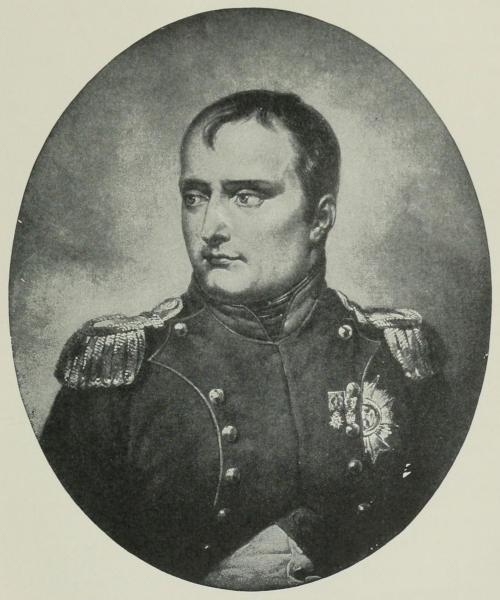
Napoleon as Emperor in 1814. Painting by Horace Vernet. Tate Gallery, London.
(From the “Corpus Imaginum” of the Photographic Society, Charlottenburg.)
Never had Napoleon taken up arms more reluctantly than he did when this war was forced upon him by the Vienna decree. Never had the rapidity and clear-sightedness of a dictator or the sympathy of public opinion been more necessary to him than in this terrible crisis. Just now, when every one wants peace, he is obliged to arm for war; just now, when he is to bestow liberties on the people, his actions are hampered at every turn. The struggle of the legitimists with this interloper (the upshot of which had been his own legitimisation), the struggle which had placed him on the throne, is resumed when, too late, he is cured of his longing to pose as legitimate monarch. Though he is reaching out towards liberty once more, he is now to sustain his final defeat.
Thus the great renewal gets no further than the Additional Act to the Constitutions of the Empire, which, as earlier with his great decrees, he leaves to the approval of the “sovereign people.”
Nevertheless, the sixty-seven articles evolved out of Constant’s head contain all the newer democratic elements; they are a great advance upon English constitutional law, and remain as a model for the whole of the subsequent century. No one henceforward can be imprisoned or banished without due form of law; religious belief and the press are to be free. The legislative body is changed into a Lower House, the Senate becomes an Upper House without the former privileges, all deliberations are open to the public, both Houses may initiate legislation and reject the budget, the ministers are to be responsible to parliament, the interpretation of the law devolves upon the Chambers.
A number of new laws, each a dagger in the dictator’s heart! Yet he yields in everything save two points which he carries, after a lively debate against Constant: the hereditariness of the peerage, into which “after one or two successful battles,” the nobility would again pour; and his right to confiscation, for “without this right I should be defenceless against the party factions. I am not an angel, but a man who cannot allow himself to be attacked without meting out punishment.”
These two concessions to him create as bad an impression as the words “Additional Act” had done. Since he will allow no discussion on the matter, but only consents to the empty form of a plebiscite, as he had done in the days when he wished to become consul for life and subsequently emperor, the democrats begin to grumble, and no one is aware how greatly the nation is to be congratulated on this latest work of its leader. Instead of the four million votes he had received of yore, his constitution receives only just over one and a half million votes, for most of the citizens abstain.
A few venture to protest. Honest Carnot says: “Your Additional Act has not pleased the people; it will not meet with acceptance. Promise me that you will amend it. I must tell you the truth, for your and our salvation hangs upon your tolerance.” His tone is upright, but wholly unprecedented. Since the days when Bonaparte was a lieutenant no one had ever spoken thus to him. He makes a gesture of annoyance, and Carnot continues: “This word alarms you, Sire? Yes, you must show tolerance in the face of the national will.”
“The foe is at our gates,” answers the veteran soldier. “First of all, help to chase him away. Then I shall have time to occupy myself with your liberal panaceas.” Even though he profoundly recognises the demands of the new age, he finds it impossible to deliberate with representatives of the people.
Napoleon knows only how to command!
XVIII
On a bright spring morning, the plain is lively as on days of high festival. The Parisians are flocking in crowds to the Champ de Mai. The whole town has come forth to this revival of the Carlovingian folk assembly. The old troops are there, and the new. The platforms are gaily decorated with tricolours. Six hundred deputies and several hundred peers are waiting for the Emperor, who is to take the oath to the new constitution before starting on his campaign. It is the first time for two or three years that the people of the gay city have had a chance of glutting their lust for merrymaking. Under the king, all had been sober and staid.
Now the procession is coming forth from the town; from afar can be heard the fanfare of the trumpets, and every one is expecting the hero of the occasion, the warrior Napoleon, to be dressed as beseems the posture of affairs, seeing that within a few days he will be fighting for throne and country at the head of his troops. Rumour has run through Paris saying that he still wears his old green coat, in which people love best to see him.
But what is the pageant which unfolds itself?
First comes the guard of honour, followed by the eagles and the colours; then heralds and pages, clad in many-coloured costumes, as if in an allegorical picture; then the Emperor’s coronation coach, drawn by eight horses. In it is seated a man picturesquely attired in white silk, almost overshadowed by a hat decked with huge ostrich plumes, and burdened by his vast coronation mantle; a solitary man, glittering with gold. Is this the Emperor?
The masses are dumbfounded, for they wanted to fraternise with their ruler returned from exile; they are stupefied by the spectacle of a Cæsar whose chill splendours seem to repel the cordiality they would fain exhibit. Painful indeed is the forlorn aspect of this middle-aged man, whose wife has not returned to him and whose son is far away, as he drives among the gaping crowds in his stately chariot.
When, after High Mass, the spokesman of the new Chambers confronts the Emperor, this citizen speaks in tones which ring athwart the plain: “Trusting your pledges, the deputies will sagaciously revise our laws, and harmonise them with the constitution”—the implication being that the representatives of the people are not yet satisfied, but want more than this Additional Act. Then the spokesman of the Chambers and the citizens expresses his hopes of victory, and wishes success to the eagles.
The Emperor has to hide his vexation. He announces the new constitution, and swears to observe it faithfully. Then the soldiers must acclaim the oath. But they can hardly recognise their master in this pompously attired ruler. They want the old green coat; their hero should be wearing the tricolour cockade, not gold and plumes. Their cheers lack enthusiasm. An eyewitness writes: “These were not the cheers of Austerlitz and Wagram. The Emperor could not fail to notice it.”
A week later, when he opened both Houses with a speech from the throne, he was careful to avoid everything which had put people out of humour at the Champ de Mai. The Lower House promises to devote its energies to the defence of the nation; but goes on to say: “Even the will of the victorious ruler would not induce the nation to transcend the bounds of defence.” The peers in the Upper House utter a like warning in their address, saying: “The French government will never be led away by the seductions of victory.” Napoleon stands there constrained to silence, but trembling with wrath. He would like to sweep them all away, but dares not even give them the lie.
Among the new peers is Lucien. He has come to join his brother after all. A glance and a hand-clasp have reconciled the brothers. For the first time in his life he is styled prince and imperial highness. He is the Emperor’s companion, delivers speeches, even gives lectures in the Institute, and receives large sums of money. Louis is ill, and does not come. Jerome is ready and willing. Hortense must replace the missing lady of the house, and her sons have once more become important to the man without a son. Napoleon appears on the balcony with his nephews, to show the crowd, to show France, that the Emperor still has heirs. Unseen, the spirit of irony contemplates this tragical conclusion to the history of his dynastic delusion.
Once he drives with Hortense to Malmaison, but goes alone into the room where Josephine died, to come forth from it in silence.
Next day he sets out for the war, hoping it will be his last war. It is.
Carnot, to whom at this late hour he divulges his plan, strongly advises him to wait until the army has been reinforced. Neither the Russians nor the Austrians can arrive before the end of July. The English and the Prussians will not venture to attack until their allies have joined them. During these six weeks, Napoleon could double his forces, transform France into an armed camp, fortify Paris on the side whence the onslaught will come. The Emperor shakes his head:
“I know all that. But it is essential that I should win a brilliant victory without waiting so long!”
He knows what is at stake. It is his way to assume the offensive. But the master of figures would have done well to wait awhile, and collect his forces. “I must win a brilliant victory soon!” Is not that the thought of a beaten champion? Perhaps it is; but the gloomy vaticinations of the ruined Cæsar are fortified by the memories of General Bonaparte. Not since his youth has he ventured to do what he now proposes, to advance with a small army, without reserves, mobile, swift. Such, then, is his plan. He will not give his four opponents time to get together. The two that appear to be ready must be separately attacked and defeated. That is the picture which hovers before his mind. What Napoleon, the Emperor, now begins at Charleroi, when his prospective opponents are the Prussians and the English, Bonaparte, the unknown general, had begun at Millesimo, when his prospective opponents were the Austrians and the Piedmontese. His last battle is the parallel of his first.
But during these twenty years, all the commanders of Europe have learned the tactics of the new master of the art of war; and he, during these twenty years, has worn out his machinery. Moreover, swift though his movements are in the days before Waterloo, he no longer possesses the old tempo. As in his recent campaigns, so now, anxious considerations hamper the boldness of his attack. Having taken Charleroi, he fails next day to make a mass onslaught on Blücher, sends Ney with half the army along the Brussels road against the English, only to learn with alarm in the afternoon that he is faced by the whole of the Prussian army. He sends to recall the marshal, writing: “The fate of France is in your hands.” Ney, instead of continuing his advance, must envelop the Prussian enemy. Too late! Ney has become involved in the fight with Wellington at Quatre Bras, can spare only one army corps, and sends it to a place where it can be of no use. This makes it impossible for him to gain a victory over the English, and he is driven back.
Napoleon, this same day, fighting with only half his army at Ligny, secures a victory.
The last victory! Blücher falls from his wounded horse, and is reported killed. Gneisenau retains composure, prevents the retreat from degenerating into a rout, and sends to let his ally know that they can form a junction at Wavre the next day. With an inertia which we should wonder at did we not know that Napoleon is ailing and prematurely old, the Emperor makes no move on the day after his victory. Too late he sends Grouchy with thirty thousand men to follow up the Prussians, not believing that they can reorganise their forces speedily, or that after the heavy losses they have sustained they will be able to effect a junction with the English. Yesterday, he had dealt with the Prussians singly; to-morrow he will be able to defeat the English, now cut off from their allies. His seventy thousand men will suffice. He fails to allow for Gneisenau’s imperturbability and for Blücher’s impetuosity.
For the first time, he underrates an opponent. At Friedland, Aspern-Essling, and Laon, he was not beaten. Nor was he beaten in Russia. At Leipzig, and at Arcis-sur-Aube, he was defeated; but it was because he had only a small army with which to meet the onslaughts of vastly superior forces; those of three great powers in one case, and those of four in the other. Never, yet, had any isolated commander been able to say: “I have defeated Napoleon.”
Now he thinks too much of his victory, and too little of his opponent. For the first time he fails to focus his lens accurately, with the result that one point escapes his reckoning. But it is not that he makes a wanton and ill-considered onslaught. Nor is the trouble on this occasion that family feeling makes him entrust leadership to inefficient hands. If he had kept Grouchy’s force with him, his enemy would have scarcely outnumbered him. But the course of the decisive battle shows that this error in calculation was not the main cause of the French defeat.
The final cause, as any one can recognise who studies all the elements in Napoleon’s fate, was the man’s advancing years.
His activity was undermined by his ailments, and that is why, on the morning of the battle of Waterloo, he failed to attack promptly. In the middle of June, the sun is above the horizon by four. If the Prussians were able to march upon the roads that had been softened by the recent heavy rains, the French veterans could have done the same—for the Emperor’s soldiers on this occasion were almost all of them tried men. But he waits till noon, that he may place his guns better when the ground becomes less sodden! At Jena, in October, in a Scotch mist, he had headed his troops, shouted to encourage them, attacking so early in the morning as to arouse many of his foes from their slumbers. To-day he waits till noon.
The loss of this half-day is to destroy him. He rides to an elevation bearing the fatal name of La Belle Alliance; he arranges his troops in three lines, rides along the front, shouts to his men in metallic phrases; he is going to break through the enemy and enter Brussels; he already has the proclamation to the Belgians in his pocket. He has only wasted half a day!
In the afternoon, when battle is already joined, news comes that Bülow’s corps is advancing. The Emperor turns pale, and sends Grouchy orders to come back. Will the orders reach him? If they do, will he be able to disengage himself from the enemy? Everything turns upon the fortune of the next hour. The English must be beaten before the Prussians can come to their aid. Napoleon delivers a great cavalry attack on the centre, but the English stand firm. Shall he use the old guard? Not yet! Not yet! Bülow is already beginning to fire. At all costs he must keep the line of retreat open, for otherwise there may be a catastrophe. But, in fact, the English forces are already half defeated. It is five o’clock, and the guard might have finished their defeat, for at this hour Wellington sent a message to his Prussian ally: “Unless your corps keeps marching, and attacks without respite, the battle will be lost.” This would have been the moment for an attack by the old guard, but once more caution makes the Emperor hold his hand at the critical moment. He sees that a second Prussian corps is about to attack.
A dread decision! A brilliant gamester staking his last coins, but to-day he must not be beaten. At length, towards seven, he sends the last five thousand guardsmen, the veterans, to the attack. Now, it is only a forlorn hope. “Vive l’Empereur!”
This cry has shaken half Europe. Is it not a century old? In a decade it has gained a legendary force throughout the Continent. But what is imperishable? Even the eagles of Marengo are not imperishable. Is the mythical energy of this cry, Vive l’Empereur, to subside with the setting of to-day’s sun? Yes, to-morrow it will be heard no more!
The second Prussian corps pours a deadly fire on the guard, which yields ground. The opposing force continues to grow; at eight, the third army corps appears on the scene, and a hundred and twenty thousand of the allies are now attacking half that number of Frenchmen. The battered French army takes to flight, and Bonaparte, in his last hour as a commander, is for the first time in his life commander of a routed army. After an hour on horseback in the open, exposed to the British fire, the Emperor rides into the centre of one of the two remaining French squares. When these, likewise, break up, he gallops across country protected only by mounted grenadiers. Though in bodily pain, he has to stay in the saddle until five in the morning, when he is able at length to secure a few hours rest in an old cart.
Is he discouraged?
By no means! What is Paris saying? This is the thought which continually drives him onward. He does not venture, as he had done last year, to assemble the guards in Laon or Soissons, or to betake himself to one of the fortresses. He thinks only of Paris, as the place from which more soldiers can be gathered. Calculations, as of old: “I can still mobilise a hundred and fifty thousand men; with the National Guard, there will be three hundred thousand in all. That will be enough to stop the advance of the enemy.” The last orders he sends to Paris end with the words: “Courage! Firmness!”
Two days later, he is once more in the Elysée, which he had left so recently. Has the whole campaign been a dream? In nine days he has lost the empire which he had fought nine years to win.
XIX
Not lost yet!
In the cabinet and in the Chambers, opinions are divided. He sits in council with his brothers and his ministers; he is worn out, but there is no sign of collapse. What does he propose? To work hand in hand with the Chambers? Far from it; he proposes dictatorship. In this national crisis, he needs, for a short time, full freedom of movement. Some of the ministers point out to him that the Chambers no longer trust him. Then Lucien takes the floor, and with all the fire of a youth urges the Emperor to dissolve the Chambers, declare Paris in a state of siege, take all power into his hands, get together the remaining troops—thus alone, now, can France be saved!
He listens. Sixteen years have passed since that November day at Saint-Cloud when this very Lucien had made the same proposal, and, with a single speech, had snatched his brother from the abyss. Then Lucien had raised Napoleon higher than he had wished. The Emperor approves the plan, but does not instantly act on it. Instead, he listens while Davoust, the Minister for War, refuses to place the remnants of the armed forces at his disposal. While they are disputing, news comes from the Chamber of Deputies. It has declared itself in permanent session, will regard any attempt to dissolve it as high treason, and will impeach any one who may dare to try. “I can see only one man between us and peace,” said old Lafayette from the rostrum. “If we rid ourselves of him, peace will be ours for the asking!”
Is this the cry of the people? Paris is perfectly calm, so it is nothing more than the cry of a liberated democracy. But it is also the cry of a society which loves change and bears adversity badly, for the House of Peers now passes a vote identical with that of the Chamber of Deputies. The Chambers demand that the Emperor shall appear before them. Why does he not go? Who would venture to oppose him openly? “I ought to have gone,” he said subsequently, “but I was tired out. I could have dissolved them, but I lacked courage; I am only a man, after all. My memories of the Nineteenth Brumaire terrified me.”
Now the Chambers send for the ministers. The Emperor replies that he has forbidden them to go. The Chambers rejoin that they will depose him unless the ministers come. He gives way. He sends Lucien and the ministers to the Chamber of Deputies, and they report that he has formed a commission to negotiate with the enemy. “The powers will not treat with him!” cry the Chambers. “They have outlawed him. He must abdicate. If he refuses, we shall depose him!”
While this is going on in the Chambers, the Emperor, much agitated, is walking to and fro in the garden with Constant. At length he is roused, and flames out:
“Not my own future, but that of France is at stake! Have they considered the consequences of my abdication? The army is grouped round me. Do they think they can fight the general dissolution with ideology? I could have understood it if I had been repelled when I landed three months ago. But to-day, when the foe is only a hundred miles from Paris, they cannot overthrow a government without suffering for it. A fortnight back, to repudiate me would have been a bold action. Now, I am part of what the enemy is attacking, a part of France which it is their business to defend. France will sacrifice itself if it sacrifices me! It is not liberty which would fain depose me, it is Waterloo—fear!... All I want now is to be the commander; but even if part of the troops were to fall away, I should promptly replace them by workmen, who can readily be moved to revolt.”
At this moment, the two men in the garden hear shouts from the avenue, “Vive l’Empereur!” Whose are these last voices raised for Napoleon? The workers from Saint-Antoine; men whose troubles he had remembered in days of need, men who cared little about the suppression of liberty, for equality had made them free. There they were, peering through the railings which separated the son of the revolution from them just as it had separated the kings, but shouting through the bars of the cage into which he had shut himself: “Dictatorship! National Guard! Vive l’Empereur!”
“You see?” said Napoleon to Constant. “I never loaded those fellows with honours. What have they got to thank me for? I left them poor men, just as I had found them. Nothing but instinct leads them to me. If I liked, these rebellious Chambers would be dissolved within the hour.... I need merely say the word, and all the deputies who oppose me would be butchered! But for one man, the price is too high. Blood must not flow in Paris!”
This mood of renunciation, which is akin to justice, this refusal to employ brute force in his extremity, just as he had refused (to begin with) sixteen years earlier, resembles the mood of Brumaire. But what was then the prudence of a statesman who did not wish to tarnish the origins of his long career of power, is now a prudence which does not beseem the adventurer he is to-day. Nevertheless, his unwillingness to use the bayonets with which, to-day, he could again have cleared the Chambers, is one more sign of his recognition of the new epoch, which wants more freedom and less force.
Meanwhile, the Chamber of Deputies is in secret session. Lucien has presented the imperial message. The deputies are willing to discuss matters. Some of them speak, in civil terms, of the abdication as a sacrifice necessary for France. Honest Carnot mounts the rostrum, and, in this moment of disaster, is almost alone in espousing the cause of the Emperor whom almost alone he had openly attacked in the days when all others had been subservient to the man of the hour. But now Sieyès, too, speaks in favour of the Emperor, speaks like a Roman of old: “Napoleon has lost a battle.... Let us help him to drive the barbarians from our country, for no one else is equal to the task. If, when he has done it, he wants to play the despot, we can hang him. But to-day we must march with him shoulder to shoulder!”
Lafayette springs to the rostrum once more: “Have you forgotten where the bones of our sons and our brothers whiten? In Africa, on the Tagus, on the Vistula, amid the snows of Russia. Two million have been the victims of this one man who wanted to fight all Europe! Enough!” In the small hours, the Chamber demands Napoleon’s abdication.
The Emperor hesitates. In the morning there is another cabinet council. Much agitated, he paces the room, uttering gibes about these Jacobins, foreseeing a new Directory. Then the commandant of the Palais Bourbon arrives with a message from the Chambers. He stammers when he attempts to discharge his commission, but at length manages to get the words out. If the Emperor does not abdicate, the Chambers will outlaw him. Savary and Caulaincourt come in. All present urge him to the step, for even Lucien has given up the game. The Emperor says:
“I have accustomed them to great victories, and now they do not know how to endure a single day of adversity. What will happen to France?” He adds in low tones: “I have done what I could.”
After this epilogue of six words, which tells the whole story, at noon he dictates his declaration to the people. He is making the sacrifice, his political life is at an end, he proclaims his son emperor as Napoleon II., the Chambers must establish a regency. To whom does he dictate these words? Who among his intimates can hold the pen firmly enough to write them down?
Lucien! The brother who for years from the enemy coast had gazed enviously at this city and this throne; who, if he had been a little less of a poet, might long since have collected the malcontents around him; and who might even now come to the front, not indeed as a second Napoleon, but at least as a second Bonaparte—and that would be something. Lucien sits there, a man of forty now. He had been no less ambitious than the Emperor, but had had to content himself with the modest career of a virtuoso and a Mæcenas. For four whole weeks, now, he has been an imperial prince! Smiling inwardly, he pens his great brother’s abdication; writes from dictation, still a mere hodman, but this time animated with a humorous sympathy which atones for the old discords.
For, in truth, it is the eternal recurrence of the similar. As before, come cries from the Chambers, “Outlaw him!” As before, five Directors, like those Bonaparte had once deposed, are appointed. They call themselves a provisional government. But when they proceed to elect from among their own number one to function as president of the Directory, who is chosen to take over the authority from Napoleon’s hands? Who, by his own vote, has decided his own choice as president?
Fouché.
But the Chamber has become less turbulent. Those who, yesterday, were thirsting for Napoleon’s blood, to-day send a deputation to thank him for his abdication. To these polite gentlemen the Emperor says: “I fear things will turn out badly, now that there is no head. I trust France will never forget that my sole object in abdicating was to promote the welfare of the nation, and that I have abdicated in favour of my son. Only under my dynasty, will France remain free and happy.”
At the very time when he is saying this, Fouché and the others are considering the possibility of having one of the Orleanist Bourbons, a member of the Brunswick family, or even the king of Saxony, as Napoleon’s successor. Moreover, the five Directors are appointed to form a government, not a regency; and, in his decrees, Fouché often speaks of the nation, but never of Napoleon II. The Emperor notes all this, but holds his peace. Slowly his dream of a dynasty vanishes, the dream for whose realisation he has fought half a lifetime. It has become for ever unattainable. When Lavalette comes to see him in the evening, he is in a hot bath, has been there for several hours.
“Where am I going? Why not to America?”
“Because Moreau went there.”
To the Emperor this answer seems surcharged with emotion, for he has serious thoughts of seeking an asylum in the United States, and he asks the government for a frigate. But the only answer is a request that he should leave Paris, for crowds are flocking round the Elysée, clamouring for a dictatorship. He burns a number of documents, and then betakes himself to Malmaison.
In the garden there, the garden that is full of memories of Josephine, he passes two whole days in a state of reverie. The few who remain faithful to him are there: his mother, Hortense, Caulaincourt, Lavalette, Lucien, even Joseph. But when the Emperor asks who will go with him, the answers are evasive. Letizia, indeed, will go gladly, but he thinks that at her age it would be dangerous. Lavalette has a daughter growing up, and his wife is expecting another child; perhaps he will follow later. Drouot, who shared the Elba exile, is wanted in France. The secretary had promised the day before to accompany Napoleon into exile, but now his mother, who is blind, has implored him not to leave her. “You are right; you must stay with your mother,” says the Emperor, turning away.
Pauline, before the last campaign, had pressed her jewels on him; now Hortense offers him a diamond necklace; a quixotic return of imperial gifts, a gesture suitable to the strange turn in his fortunes. He tells Hortense she will have a million, but no one knows if it will ever be paid. Lucien and Eugene get money, and he gives little Léon something for his mother—still dealing in hundreds of thousands.
But he does all these things like a man in a dream. He does not say a word about the last few weeks, but talks only of old times, and chiefly of Josephine. “I have promised the minister to go away. I shall start to-night. I am weary of myself, of France, and of Paris. Make your preparations.”
Whither away? Conjectures, deliberations. Spectral is the tone of the manifesto he now addresses to the army:
“Soldiers!... I am with you even though I am away. I know every corps. If any one wins a victory, I shall approve his courage.... Show, in days to come, that, before all, you serve your country, show it by obeying me; and show that I have earned your affection (if indeed I have earned it) by my ardent love for our common mother. One more storm, and the coalition will be shattered! Napoleon will know you by the blows that you deal out. Save the honour and the liberty of the French. Be what you have been for twenty years, and you will be unconquerable!”
The government suppresses the document, but could have published it without risk. No one could be more aloof, no living man could have become more completely a part of history, than this man who speaks of himself as if he were speaking of a stranger. He seems to be no longer present in the flesh.
Suddenly he is startled! The old sounds assail his ears. The noise of cannon shots reaches him from the plain of Saint-Denis; the foe is at the gates. Officers and soldiers, scarred and tattered, but hastily patched up, bring him the news, vague and dispersed like the sound of the firing. Instantly he returns to life. “In two detachments? You must attack and defeat them separately; first one and then the other.” At night he elaborates a plan for the defence of Paris. Next morning it seems as if the familiar sounds had rejuvenated him, and he writes to the five Directors as General Bonaparte had written of old:
“I offer to place myself at the head of the army. At sight of me, the soldiers will recover their courage, hurl themselves on the foe, and punish him. I pledge you my word as general, soldier, and citizen that I will not retain the command an hour after the victory has been won. I vow to conquer, not for myself but for France.”
It is impossible that after such words he should fail to conquer, unless he is slain in the first onslaught. In this mood of impending death, he writes his magnificent letter. Napoleon, in the garden, surrounded by his remaining officers, restlessly awaits the answer.
Fouché’s great moment has come. To this ex-master of his, to the man whom he so cordially detests, he does not even vouchsafe a written answer. The Emperor, who is trembling with eagerness to take up arms, and who has never since he grew to full manhood had to wait for another man’s permission, tears the response out of the returning messenger. It is curt: The Emperor is mistaken if he thinks the members of the government are such fools as to entertain his proposal; all they ask is that he should go away as soon as possible. Napoleon says bitterly: “I ought to have hanged him long ago. Now I must leave the job to the Bourbons.”
Mufti; a rapid gathering together of necessaries; Hortense sews her necklace for him into a black silk belt. For a few minutes he entertains the thought of Corsica, with Lucien as governor of the island. His mother’s eyes sparkle. But he knows that the scheme is impracticable. America is his last resource. The only thing lacking is the frigate for which he has been asking. All are aware that every hour increases the risk to his liberty. It is said that Wellington has demanded his surrender, and the number of the deputies in favour of his being handed over is steadily increasing. Lavalette urges him to start, but the Emperor is stubborn.
“I cannot leave without an order from the government to the captain.”
“Why not, Sire? Have the anchor weighed, promise the crew money, send the captain ashore if he won’t set sail. You may be sure that Fouché has already promised to hand you over to the allies.”
“Drive to the Minister for the Navy!”
The councillor drives to Decrès’, and finds him in bed. Decrès refers the messenger to Fouché, saying: “I can do nothing.”
Fouché cannot be found. The councillor gets back to Malmaison at one in the morning. The Emperor is awakened, gets up, still thinks the United States will be best, but hesitates. “Over there, they will grant me land, or I will buy an estate and till it. I shall end where mankind began. I shall live upon the produce of my fields and my herds.”
“But what if they propose to hand you over?” enquires the secretary.
“Then I shall go to Mexico. There I shall find patriots at whose head I can place myself.”
“The leaders there might turn against you.”
“All right; I shall leave them and go to Caracas. If I don’t like it, I shall go on to Buenos Ayres or to California. I shall sail across the seas until I find a city of refuge where I can be safe from the persecutions of my fellows.”
“But what if the English catch you, Sire?”
“I must risk that. A bad government, but a great nation, noble and generous. England will treat me properly. Besides, there is no choice. Am I to allow myself, like a ninny, to be taken prisoner here by Wellington, to be led in triumph through the streets of London like King John the Good of old? Since they have no use for my services here, I must go elsewhere. Ability will do the rest.”
“Your Majesty was not made for flight.”
“Flight! What are you talking about?” He looks at the secretary “questioningly and proudly.”
“The English must certainly be on the watch for you already. Your end ought to be the worthiest possible.”
“Suicide, like Hannibal? Leave that to weaklings and persons of disordered mind! Whatever fate may hold in store for me, I would never deliberately shorten my life by a single day.”
“I did not mean that, Sire. But what if you were to hand over liberty and life to the enemies of France in order to save France? That is how Napoleon the Great should act.”
“All very fine, but to whom am I to hand myself over? To Blücher? To Wellington? They have no plenipotentiary powers. They would simply take me prisoner, and do what they pleased with France and with me.”
“The tsar, perhaps?”
“You do not know the Russians! Still, I will think the matter over. To sacrifice my own person would be easy enough. The question is, whether it would help France?”
Almost every element that goes to make the statesman seems to have been eliminated from this all-too-human dialogue. Here is an adventurer hankering after fresh voyages in every corner of the world. Here is the man without a country, the ocean traveller without any earth under his feet, always on board, always driven hither and thither, a bold pirate fearless of death. Ay, fearless of death! The dry manner in which, once again, he waves aside the idea of suicide, the sober realism of his outlook, this grasp at the flying moment, the old-time dauntlessness of the islesman—what unconquerable vital energy!
Now he is to start. The last person with whom the Emperor has a quiet talk is his mother. But a soldier rushes in; he will not let any hold him back: the soldier is Talma. The call of his heart and his love of the tragical have urged him to come for a great farewell; he feels he must be there. Later he is to represent this leave-taking between mother and son, in all its dignified simplicity, in a pathetic scene on the stage. Then the Emperor invites young General Gourgaud, the scatter-brained idealist, into his dilapidated carriage. Bertrand and his wife, who had lived with him in Elba, and two others, accompany him. They drive to Rochefort, to the port where they hope to find a frigate. The pace is too slow for a fugitive. He still looks over his shoulder, listening for the call which shall summon him back at the eleventh hour. They meet two regiments marching northward. The men raise a cheer, and the Emperor discusses with the generals the possibility of overthrowing the government if he places himself at their head and marches on Paris.... Away again, at length the long drive is over, and he stands gazing at the Atlantic Ocean. Joseph is there, and urges Napoleon to charter a brig which is taking a cargo of spirits to America. The Emperor assumes the name of Muiron, his seventh name. This name calls up the vision of another coast, the Mediterranean with its many isles, and Corsica, and then Italy; and again he sees the young, small, lean general, with long hair falling on his shoulders and cold grey-blue eyes, and the bridge of Arcola where the fate of a man and a country hung in the balance; and he sees Lieutenant Muiron fling himself before the young general in the mêlée, he sees Muiron fall, and he knows that by this love-death the lieutenant’s name will be immortalised. It would seem that once again a new epoch is opening before the genius of energy, and that across the seas, in new zones, on uninhabited prairies, the adventurer will swing himself into the saddle, will watch the increase of his herds; maybe, even, will travel to Mexico and become the leader of a band of rebels!
But God is wiser.
He sees to it that this great life shall have an epilogue such as no man has ever lived through before, an epilogue which shall fitly round off its tragical poesy. Once more the Almighty stifles the adventurous impulse in the soul of Napoleon; once more there are days of questioning, negotiation, vacillation—ten days before the final decision.
The Emperor crosses to a small island. They think of chartering two fishing smacks which the English will never dream of searching for Napoleon; but in the end he rejects the plan. There are two American ships available. Negotiations are entered into with a Danish sloop. Enthusiastic youths from the naval training school propose to carry him off in an advice-boat. Sixteen midshipmen will spirit him out of the harbour at dead of night. They sit packed together in the little room, feverishly discussing the plan with Las Cases, the Emperor’s new confidant. The man to whom this madcap venture is proposed, talks over the situation coolly with his companions, asking each in turn for an opinion as to the best course. Most of them advise a return to the army, for there are still good prospects that the soldiers in the south will support him. He emphatically refuses:
“Nothing will induce me to light up a civil war. I will have no more to do with politics; I need repose; I shall go to America!”
But his self-respect makes him shrink from the thought of escaping in disguise.
News comes that the Bourbon has re-entered the land of his fathers, once more under the protection of allied troops. The path of escape seaward is now blocked by an English cruiser which bears the ominous name of “Bellerophon.” The Emperor has missed his chance. Here are his thoughts: “A return to Paris is impossible. The port is blockaded. Shall I allow myself to be seized like a pirate, and taken in chains to London? England has been my foe for twenty years. Next to the French, the English nation is the greatest and the most distinguished in the world. Have I not been an Emperor? Has not, from of old, chivalry toward a fallen enemy aroused universal admiration? In Corsica, they knife any one who violates the rights of hospitality.”
Making up his mind, he dictates the following letter to the prince regent:
“Your Royal Highness, Exposed to the factions which distract my country and to the enmity of the greatest powers of Europe, I have closed my political career, and I come, like Themistocles, to throw myself upon the hospitality of the British people. I put myself under the protection of their laws, and beg Your Royal Highness, as the most powerful, the most persistent, and the most generous of my enemies, to grant me this protection. Napoleon.”
Eight lines, three words of respect, neither arrogance nor humility, almost courtly. There is, however, one word which embodies the pathos of the step he is taking, and assumes that his adversary will give moral guarantees; that in this century, after such a life, Napoleon will be as welcome a guest in the enemy land, as of old in Persia had been—Themistocles. It is overwhelming self-confidence, based upon historical parallels, which determines the last great step of his career, as, in youth, it had determined his first advances to Paoli. Now, this self-confidence will be his ruin.
Next day, Las Cases hands the letter to the captain of the “Bellerophon,” and negotiates with Maitland for Napoleon’s reception on board. Admiral Hotham, Maitland’s immediate superior, was not a party to the negotiations, but had long since received orders to seize the fugitive if possible. In accordance with international law, this was quite in order, for England, with the other powers in Vienna, had decreed Napoleon’s outlawry. But it is an undisputed fact that Captain Maitland, supreme on his own ship, guaranteed his guest’s liberty, saying: “Napoleon will receive all proper attention in England. Our people are generous and democratic.”
No record was taken at the time of the terms of the understanding in accordance with which the man who had been the master of Europe went on board one of his enemy’s ships. Nevertheless, it was not an affair of hours, but, rather, of days; not the outcome of haste and desperation, but the logical conclusion of a long chain of reasoning. Napoleon’s own experience of the last twenty years had shown him that verbal agreements are untrustworthy, whereas written agreements are comparatively reliable. Yet he takes this last step, one of profound historical significance, without any written document having been signed, sealed, and delivered. In truth, he cannot await an answer from London. He trusts, however, not in the mere word of a captain in the navy, but in the moral effect of what he is doing. That is why, just before going on board the “Bellerophon,” he writes the above-quoted heroic lines, addressed to the ruler of the land in which he seeks hospitality, and the supreme commander of all its navies.
Then, in uniform, Napoleon boards the British vessel.
XX
Maitland stands on the quarter-deck. Napoleon raises his hat, a thing he has not always done to greet princes, and addresses the captain as follows: “I come to place myself under the protection of your king and your laws.” The British naval officers are introduced to him, and he asks about the sea-fights in which they have been engaged. Then, with the detachment of a man discussing ancient history, he talks about the English navy and the French, says that the English sailors are cleaner and more efficient, and argues with his host about certain punishments customary in the navy after a fight. Then he passes to generalities:
“I really cannot understand why your ships have defeated our French vessels so easily. The best of them were ours to begin with. A French ship is stronger in every respect than an English vessel of the same type. It has more and heavier guns, a larger complement.”
“I have already explained that to you, Sir. Our seamen have had more experience than yours.”
Napoleon does not move an eyelash. The conversation remains strictly academic; they talk of the nautical science of their respective countries.
“If you had tried to escape in a French frigate,” says Maitland, “you would have seen for yourself how well we can shoot.”
No repining! Here stands a gamester who has lost the game. All that the Emperor troubles to dispute is Maitland’s contention that two frigates with a few twenty-four pounders could not possibly have got the better of the “Bellerophon,” which carried seventy-four heavy guns. The captain proves that it would have been impossible. Napoleon examines the ship’s guns, praises what he sees, but has some criticisms to make here and there. Maitland declares afterwards, when alone with his own people, that he has been amazed by the extent of the Emperor’s technical knowledge.
The ship puts out to sea.
Meanwhile, the legitimate ministers and kings are discussing their course. Not a single member of this circle proves great enough to advise a great gesture, before Europe and before history. Ten days after leaving the roads of Rochefort, the “Bellerophon” anchors in Plymouth harbour. It is a fine morning in the end of July, and the water is thronged with rowing boats full of people anxious to catch a glimpse of the caged lion. Since no decision has yet arrived from London, civilian visitors are not allowed on board. But it is a great time for the crew. They can see Napoleon every day, and he converses with any of them that are able to speak French. The gaping crowds in the boats are the thousands who for twenty years past have heard nothing but abuse and mockery of “Boney”; have seen numberless caricatures of him, depicted as a hideous monster. Now, they are all animated with the same curiosity; they all want to feast their eyes upon this dread spectre.
For the most part, Napoleon stays in his cabin. He does not want to become a raree-show. A few days’ patience, and he will be able to go ashore, and live where he pleases. At length, however, feeling the need for fresh air, he comes up the gangway and mounts the poop. There he stands, the great defeated foe, in his old world-famous green coat; defenceless. Thousands of eyes instantly converge on him, so that it seems as if he must be consumed in their fire.
But the man with the simple, impenetrable countenance, who is thus pilloried, must radiate an aura of dignity and suffering, for an extraordinary thing happens. Thousands of heads are bared. As far as Napoleon’s gaze can reach, on the boats, the ships, throughout the harbour, not a man remains covered. The greeting is universal, but for one exception. Only one man among all those onlookers keeps his three-cornered hat on his head. It seems as if the whole nation were willing to pay the Emperor the homage which a pettifogging captain withheld.
Such was the judgment of the British nation, which in this tense moment cleared itself from all the contumely so soon to be heaped upon its name. The waiting lasted three days. On the fourth, British officers entered the Emperor’s cabin, and laid before him a paper containing the government’s decision. No direct answer had come from the prince regent.
The document was to the effect that it would not be consistent with the government’s duties towards England and her allies to allow General Bonaparte any further opportunity of disturbing the peace of Europe, and it would therefore be necessary to restrain his liberty to “whatever extent may be necessary for securing that first and paramount object.” St. Helena would be his place of residence, as it was healthy, and would admit of a smaller degree of restraint than might be necessary elsewhere. He could take with him three officers, a physician, and twelve servants.
Such was the reply of the modern Xerxes.
Napoleon, we are told, “laid the paper on the table, and, after a pause, began to protest in vigorous terms.” He said:
“I am not a prisoner of war!... I came on board the ‘Bellerophon’ of my own free will, after previous negotiation with the commander. I threw myself on your protection, and claimed the rights of hospitality. The tricolour was still waving over Rochefort and Bordeaux. I might have gone back to the army; or might for years have lived secretly among the people, who were devoted to me.
“Instead, I came to this country as a private person. I asked the commander of one of your warships whether he was disposed to take me and my train to England. He told me he had orders to this effect from his government. If I have fallen into a trap, your government has acted dishonourably and has dishonoured your flag.... St. Helena will kill me in three months. I am used to riding twenty leagues a day. What can I do on a little rock at the world’s end? I will not go!... If your government wishes to kill me, that can be done here.... I gave the prince regent an opportunity of performing the finest action of his life. I have been the greatest of his country’s foes, and I paid you the highest compliment in the world by voluntarily entrusting myself to your protection.... What you are proposing will be an everlasting disgrace to the whole British nation!”
The most characteristic point in this protest, which he renews in writing, is the moral indignation with which it thrills. International law is but lightly touched upon, for what he claims is a hero’s right. Such were the words spoken in the heat of the moment, in that small cabin, to the officers who had brought him notice of his doom, and who subsequently recorded them for posterity. Though spoken in haste, they have a historical ring and some of the sentences are modelled for imperishability. A soul has been wounded, a soul that is mourning, not so much on account of its own loss of freedom, as because the world fails to recognise greatness.
Thus, in the first moment of his doom, he recognises that which, a century later, cannot be more profoundly expressed by the great grandchildren of the men of those days, who have been brought up on contemplation of the legend of Napoleon’s career. Themistocles feels that he has been betrayed. Once again, one of these legitimate princes has failed to seize the opportunity of performing the finest action of his life. A man void of imagination, a weakling in possession of brute force, he crushed the great and splendid thing which has fallen into his hands.