BOOK FIVE THE ROCK (continued 3)
Cedar Paul translation
“Because you first of all recognised the republic, Sire, and yet, later, you were the crown.”
“You are right. Oh, well, the Empire was certainly the best of the republics!”
At the feast of Epiphany, he has a cake made for the children. Then he crowns little Napoléon Bertrand as king. When he is informed that there has been a complaint from the governor about the expenses of his household, and that, now that the price of meat has risen to forty sous, they must be more moderate in their consumption, he turns the matter off with a laugh, saying: “Parbleu! You might have answered that it costs us more than a crown.”
Never before has so much self-control been forced on him. Impassively he reads Lowe’s answer to a statement of grievances from Bertrand, who had said something about “the Emperor.” The governor writes that he is not aware of the presence of any emperor on the island.—The prisoner asks Gourgaud to order his horse to be saddled. Gourgaud replies that he has not seen the animal for three days, since the blacksmith insists on being paid three napoleons before he will send it back. The Emperor masters his anger, and says nothing more at the time; but next day he bursts out at Gourgaud: “Why did you insult me by talking to me about the blacksmith’s bill?” The day before, by a superhuman effort, he had managed to restrain his wrath, but by the torturing thoughts of the intervening hours his pride had been broken. The adjutant’s sullen reply had disturbed the Emperor’s equanimity quite as much as Austria’s desertion had done in earlier years.
A soldier and a southron, he is choked sometimes by the passion for vengeance. On one occasion, when uneatable meat is served at dinner, he contents himself with the remark: “I should trouble little about myself, if I could only feel sure that some day our humiliations would be proclaimed to the world, so that those who are responsible for them would be covered with shame!”
With a sublimity of spirit which grows in him now, he tries to moderate the natural rebelliousness of his disposition: “I am living here under a weight, so to speak; a weight which compresses the spring, but does not break it. Resignation—that is the dominion of reason, the real triumph of the soul.” This masterful man does his utmost to regulate his own conduct in accordance with the foregoing axiom. Subsequently he says: “Misfortune has its good side; it teaches us truths.... For the first time, I am able to contemplate history as a philosopher.”
For the first time, too, he is able to contemplate the present with a tranquil mind. During the early weeks of his stay on the island, when he was out walking with a pretty young Englishwoman, he conversed with her agreeably about various topics: how the climate was bad for the complexion; Ossian; the plantations. At this moment some negro slaves carrying heavy boxes crossed the path, and the lady called to them imperiously: “Get out of the way!”
The Emperor interposed: “But, Madame, please remember that the men are carrying burdens!”
Collapse of lady! Yet Napoleon Bonaparte himself would not have been so considerate in the days before he came to St. Helena.
In all matters now, except when he is playing the shadow emperor in pursuance of his feud with Lowe, Napoleon adopts a simplicity of life which outdoes that even of his poorest days as a lieutenant. When for some time there has been very little to eat, and the cook has had to eke things out with French beans, he eats them enthusiastically, praises the dish and the cooking.
“In Paris, I could get along with twelve francs a day. Dinner frs. 1.50; reading room; theatre in the evening, pit; I should hire a room for frs. 20 a month. I should only want one servant; and I should associate exclusively with people of like fortune. One can be happy in any station in life. When my mother sang lullabies over my cradle, there was not a word about what I was destined to become. I believe ‘Monsieur Bonaparte’ would have been quite as happy as ‘Emperor Napoleon.’ Everything in life is relative.”
His doctor has a fainting fit. Coming to himself, he finds that he is being attended to, not by a servant, but by the Emperor in person. Napoleon has lifted him on to the bed, has unfastened the collar of his shirt, and is kneeling beside him, administering vinegar.—When Cipriani, the Corsican servant, is dying, the Emperor asks the doctor whether a visit from the master would stimulate the man’s flagging forces.
“The excitement would kill him.”
“Oh, well, I suppose I had better not go.”
When playing reversi, he establishes a bank. For whose benefit? The money is to be used to buy the freedom of the most beautiful female slave on the island. One evening, his companions find him at work beside the lamp, slowly and carefully stitching the pages of a manuscript.
Sometimes, however, his dreams reawaken, and flutter against the bars of the cage. “I wish they would transfer me to a desert island, where I could have two thousand people of my own choice, with muskets and cannon. I should found a glorious colony, and should end my days happily in that model land. There I should not find it necessary to be at grips all the time with antiquated ideas.” Having said this apropos of nothing in particular, he passes on to the details of the scheme, dictating specifications—how much money and stores would be needed for the founding of his colony.
A chained sculptor, his plastic impulses must be content with such outlets in the world of imagination; but, side by side with these capriccios, he displays a heroic simplicity. One day, during the early weeks at St. Helena, he is out riding with Las Cases. “We came to a field that was being ploughed. The Emperor dismounted, and took the handles of the plough. With incredible speed, he drove a long and perfectly straight furrow. All this without saying a word until he had finished, when he told me to give the ploughman a napoleon. We remounted, and rode on our way.”
XV
“No one but myself can be blamed for my fall. I have been my own greatest enemy, the cause of my own disastrous fate.”
This admission, the profoundest of all those made by the exile shows that Napoleon has completely outgrown the cloudy Cæsarist fancies of his middle period. Had he been a believing Christian, the confession would have rounded off his atonement upon the rock. His sense of responsibility, however, is not directed towards God but only towards himself, and therefore the utterance represents a great man’s final settlement of accounts with destiny. But, at the same time, it is a last outburst of defiance, for his self-overweening esteem made it impossible for him to admit that there were any greater forces in the world than his own. Napoleon alone could overthrow Napoleon.
The remark was not the outcome of transient depression. During the closing years of his power, he had again and again spoken to his intimates about his faults and errors; now, upon the island, such admissions are frequent. Some of them are ardent, and some of them are cold; for even in these self-examinations there is an alternation between fantasy and realism. From time to time, we have the heartfelt cry of a penitent: “When I close my eyes, all my mistakes parade themselves before me, like figures in a nightmare.” Or, again: “I wanted too much.... I strung the bow too tightly, and trusted too much in my good fortune.”
But he will coldly reckon up the cases in which he has failed to understand men, coming at this late hour to views which the ablest observers had held while he was still on the throne. The reader who knows his story will require no comment on the remarks that follow.
“I considered Emperor Francis a good man; but he was only a blockhead, and in Metternich’s hands he became an instrument for my destruction.”—“I ought to have left Talleyrand at his post. What concern was it of mine that he was plundering the foreign chancelleries. I should have been content with having him closely watched. He served me well, as long as he could hope to make anything out of me. If I had kept him in office, I should still have been on the throne.”—“If only that man Fulton, with his steamboat, had been right, I should have been master of the world. But those idiots of savants made fun of his invention, just as they make fun of electricity. All the same, gigantic powers are hidden in steam and electricity!”
He regrets that at Tilsit he had decided to maintain the Hohenzollern dynasty. He regrets having crossed the Memel too early; having crossed it in 1812, before he had settled matters in Spain. He regrets that, in defiance of Carnot’s advice, he began the last campaign too early, and he regrets that at Waterloo he did not send the guard forward soon enough. Most of all, he regrets having, when his power was finally broken, entrusted himself to England, instead of to the tsar, or, better still, to the United States. Always, when he hears of crises in France, he regrets that he did not go to America.
“From that vantage ground I should have been able to guard France against humiliation from abroad, reaction from within; the dread of my return would have sufficed. In America I should have established the centre of a new French fatherland. Within a year, I should have had sixty thousand men grouped round me.... It would have been the most natural place of refuge—a land of vast expanses where a man can live in freedom. If I had had a fit of the blues, I should have mounted a horse, ridden hundreds of miles, enjoyed travel with the ease of a private individual, lost amid the crowd. In Europe I was too popular; bound up, in one way or another, with every nation.... As a fugitive, and disguised, I could certainly have escaped to the United States; but both expedients would have been undignified. I put my trust in the approach of danger, thinking that the nation would be forced to turn to me as its saviour; that is why I stayed as long as possible at Malmaison and in Rochefort. The destiny that brought me to St. Helena was the outcome of those feelings.”
This is the most productive of his meditations. The other mistakes of his career had entailed such complicated consequences that it was impossible for him to trace what might have been had he acted otherwise. But the final resolve at Rochefort had, as its inevitable upshot, brought him to this rock. In that respect, therefore, his mind was continually busied with alternative possibilities. Although, when in fancy he roams across the American prairies, he sometimes pictures himself as founding new States there, and sometimes as galloping through the wilds, we may ascribe it to the infinite variety of human passions that he should at the same time justify his final blunder on patriotic grounds.
His critical faculty is most keenly at work when he is pondering his dynastic aspirations. In the last days of the Empire, he had confided his doubts to a few choice spirits; now, when it is too late, he freely acknowledges his error. “I was a softy where my family was concerned; by sticking to their point they could get anything out of me. What terrible mistakes I made there! If my brothers had communicated a common impulse to the masses I placed under their rule, we should have been able to make our way to the ends of the earth!... I was not so lucky as Genghis Khan, whose four sons vied with one another in their father’s service. If I made any one king, he instantly regarded himself as king by divine right; the mere word was as infective as the plague. The new king was no longer my representative, but became a fresh enemy; instead of serving me, he wanted to make himself independent. I was the only stumbling block in his path. In the twinkling of an eye, they all became kings warranted genuine; under my protection, they all tasted the sweets of dominion. I alone bore the burden. Poor devils! Once I had been defeated, the enemy did not even bother to declare their formal deposition.”
That was as far as his penitence reached. However self-critical he might be, Napoleon never uttered a word of regret for having assumed a crown, or for having wished to found a dynasty. On the contrary, again and again he returned to his basic social idea: “I was the natural mediator in this struggle between the revolution and the past; my empire was in the interests of the rulers as well as in that of the peoples. My aim was the social rebirth of Europe; fate interfered before I had completed my task.” In line with his general conception of kingship, he deplores that the kings should have made an end of Murat. They would have done better to show the peoples that kings are above the law. Though the guillotining of King Louis had opened the road along which he himself had advanced to a throne, he condemned the act of regicide; not because he regarded the Bourbons as competent rulers, but because continuity seemed to him essential.
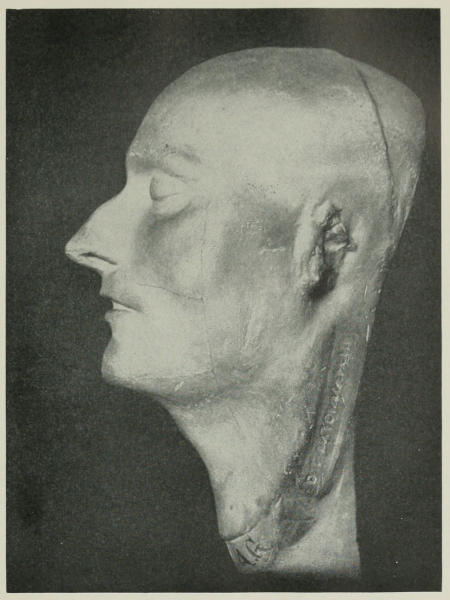
Death mask of Napoleon. By Dr. Antommarchi.
For he will never misunderstand Europe’s historical conditions; he will never try to establish offhand in Europe that which he dreams of establishing in the promised land of America or in the utopian island of his fancy. He always sees what is, as an outgrowth of what has been; always transforms the extant, instead of destroying it; he never wants to build entirely anew. Consequently, he does not discard the old forms, but uses them as a foundation for his new buildings. With a passion for ordering and arranging, and with a hatred for destruction, he feels how much can be done when the basis is secure. “When I rose to power, people thought I was going to be a Washington. Words cost nothing! In America, the role would have suited me well enough; there would have been no merit in adopting it on the western side of the Atlantic. In France, I could only become a Washington as a king among kings.”
That is the truth as he sees it. Since, at bottom, he despises the purple he has hung round his own shoulders, he would have been careful to avoid taking it to America, just as Washington had resisted the solicitations of his officers. By birth, he had been neither proletarian nor prince, but a member of a petty noble family which had fallen on evil days. Thus his position was an intermediate one, sandwiched between the classes. In his conversations with Englishmen about England, he displayed the naïveté of his class feeling, and his faith in the right of succession, for he closed an attack upon the British nobility in the following remarkable way:
“It is not a handful of nobles or rich men that makes a nation, but the mass of the people. True, as soon as the mob gains the upper hand it adopts an alias, and speaks of itself as the People; whereas, if it is conquered, a few poor wretches are hanged, and spoken of as robbers and rebels. ’Tis the way of the world: mob, robbers, rebels—or heroes. As the fortune of war may decide!”
After a reading of Voltaire’s La mort de César, he remarks that in youth he had himself wanted to write a “Cæsar.” One of his auditors, with a courtly double meaning, says that the Emperor has done so. Napoleon laughs the flatterer to scorn. “I? You poor babe! Yes, if I had been completely successful! But, in fact, Cæsar had no better luck than I have had—for he was assassinated!”
Closely associated with his self-criticism is his own estimate of his deeds. His historical sense, which is an integral part of his composition, leads him to an objective clarity in his contemplation of himself; perhaps an attitude of mind we may vainly seek for elsewhere in history before his day. Las Cases tells us that Napoleon talks of his career as if three hundred years lay behind him; and Countess Montholon movingly observes: “It seemed to me as if we found ourselves in another world, and I was listening to a Dialogue of the Dead.”
He stubbornly defends his alleged crimes, the poisoning of the plague-stricken in Jaffa, the execution of the duke of Enghien. One day he is seized with the impulse to confide to an English physician the whole story of the Enghien episode; since, as Consul, he ran the risk of being murdered, a counterstroke was necessary. Another time he deliberately sets himself to the task of finding out what O’Meara really thinks of him. The Emperor knows the doctor to be whole-heartedly devoted to his person, but of independent character. They are sitting over a jug of porter, drinking together. Napoleon suddenly puts his question:
“What sort of a man did you think I was before you came to know me? Speak your mind frankly!”
O’Meara gives the description of an amoral chimera, a man capable of any crime to achieve his end.
“I expected as much!” exclaims the Emperor. “Probably many Frenchmen think the same. They’ll be saying: Yes, he climbed to the top of the ladder of fame, by his own efforts; but in his climb he had to commit many atrocities.’” Thereupon he launches forth into vehement self-defence.
One night he summons Montholon in order to dictate the thoughts which throng his sleepless brain. He sets down how he was ever inclined to peace, how before a battle and after a victory he always entered negotiations. Or he compares the two revolutions, adding: “Cromwell achieved his aim when he was in the full maturity of his age, and attained to the highest rung of the ladder through cunning and hypocrisy. But Napoleon came to the fore as a stripling, and his first steps are illuminated with deeds of glory.... Whose blood have I shed? Who can boast that in my place he would have acted differently? What epoch confronted with similar difficulties has ever come through with such blameless results?... I believe it to be without parallel in history that a plain man should have attained to such amazing power without committing a single crime. In face of death itself, I could make no other declaration.”
Something now occurs which takes us wholly by surprise. Instead of, in the midst of this harangue, laying the blame for ill success on others, instead of allowing his inborn misanthropy to storm the heavens in resentment, he shows us that his days of exile have fostered his sense of justice. He who, for a lifetime, had declared that cupidity lay at the root of all men’s endeavours, and had dealt with his fellows on that presupposition, now becomes a cautious analyst; the man of power becomes a philosopher; Napoleon becomes tolerant.
Now, he declares that mankind is prone to gratitude rather than to ingratitude; the only trouble is, people always expect more thanks than the deed is worth. Las Cases informs us that his greatest censure nowadays is expressed by silence. He defends even those who were faithless: Augereau, Berthier, were not equal to the magnitude of their positions; he excuses his brothers. From the altitude of these judgments, he surveys the wide perspective with a tolerant eye. We seem to be listening to the imprisoned Socrates when we read:
“It is difficult to give people their due.... Do they even know themselves? Those who forsook me would never have believed, in the days of their good fortune, that a time would come when they would deny me.... Our last trials were more than human nature could endure. As a matter of fact, I was left in the lurch rather than actually betrayed, just as Peter denied his master.... Perhaps they have already shed tears of repentance. Who ever had more friends and more adherents than I? Who has ever been more beloved?... My fate might have been far worse!”
XVI
The Emperor’s companions keep diaries. He is well aware of this; he even has a look into one of them, but he reserves his thoughts. As a realist he calculates the monetary worth of these records, and he foretells what the writers will earn when they publish their books after his death; his only mistake is that he underestimates the amount. He bequeaths to each of his secretaries those portions of his writings which he has dictated to them severally. But he is correct in his estimate of the incalculable value the diaries will have for posterity in the study of himself.
Accustomed as he is to dictate, he shapes his sentences carefully even when conversing, so that his hearers may record his sayings with advantage. The value to future generations is thus enhanced, and these summaries of his thoughts raise him above his present wearisome existence. His passionate feeling for historical events drives him to this self-expression, no less than regard for those who shall come after.
Five days pass, sometimes, without his seeing anybody; he reads and he writes nothing. The future gives him no more food for thought. But during these periods of seclusion he surveys his life as a whole. Then his soul is shaken, and his lightning glance searches through and through his personality for a hundred hours at a stretch. Never has any man before him had to submit to such a scrutiny. The tension of his being is at these moments greater than at Austerlitz, more elemental than in the Council of State: he is a bound Prometheus, one who wishes to promote human happiness; and, shackled to the rock, he groans. Yet he is but a little man in an old green coat! The visions, the dreams, which for twenty years he was able and willing to conjure into reality, he now dissects into ideas. Thus, in the end, he becomes the severest commentator upon his own life story.
A book arrives. It is a collection of his manifestoes and decrees. He reads. Then he throws the volume aside, strides to and fro, and says to Las Cases:
“Every future historian will have to allow me my share.... Facts speak for themselves. I closed up the chasm of anarchy, and put an end to chaos. I cleansed the revolution from the filth it had accumulated, I ennobled the peoples, I stabilised the thrones. I encouraged all those who had talents, rewarded every merit, and widened the boundaries of fame and glory.... Could not historians protect me against many grave charges?... If I am accused of despotism, they can claim that dictatorship was necessary in the circumstances. Is it freedom I attacked? They can answer that anarchy was still threatening on our very threshold. Love of war? I was never the aggressor. Striving for world dominion? This arose accidentally, because of the conditions of the time. Too ambitious? Yes, true indeed. But my ambition was of the sublimest: to found the kingdom of reason, with full development and unrestricted enjoyment of all the human faculties. The historian may deplore that such ambition could not wholly attain its goal.” After a momentary silence, he concludes: “There, my dear fellow, in a few words, you have my entire story.”
Here he is on the defensive. But neither in such moods nor in any other do we ever hear him rave enthusiastically over his battles. In all the six years of his captivity, he does not seem, even once, to have sung the praises of General Bonaparte. If he is summing up what he achieved, he says:
“My fame does not rest upon my forty victorious battles, nor does it lie in the fact that I bent the monarchs to my will. Waterloo will wipe out the memory of so many victories; the last act makes one forget the first. What will never pass away, is my book of laws, the minutes of my Council of State, my correspondence with my ministers.... Through its simplicity my code of laws has had more effect than any civil codes before it; the schools I have set up, my methods of instruction, are creating a new generation; crime has decreased during my rule, whereas in England crime has become more prevalent.... I wanted to found a European system, a European code of laws, a European court of appeal; there would have been but one people throughout Europe.”
He reads in an English newspaper that Napoleon has hidden away vast treasures. He leaps to his feet, and dictates, to the man who happens to be his companion at the moment, these splendid sentences:
“Would you like to know about Napoleon’s treasures? Yes, they are vast, but they are not hidden away. The harbours of Antwerp and Flushing, where there is room for the largest fleets in the world, harbours which are open all through the winter; the waterworks at Dunkirk, Havre, and Nice; the huge docks at Cherbourg; the port of Venice; the high roads from Antwerp to Amsterdam, from Mainz to Metz, and from Bordeaux to Bayonne; the passes over the Simplon, Mont Cenis, La Corniche, and Mont Genèvre, which open up the Alps in four directions, and excel all the constructions of the Romans. Then there are the roads from the Pyrenees to the Alps, from Parma to Spezia, and from Savona into Piedmont; the bridges across the Seine, and the bridges of Tours and of Lyons; ... the Rhine-Rhone canal and the draining of the Pontine marshes; ... the re-establishment of the Church destroyed by the revolution; the setting up of new industries; the new Louvre; warehouses, streets, the water supply of Paris, the quays along the Seine; ... the revival of the weaving mills in Lyons; more than four hundred sugar factories; the repair and embellishment of the royal palaces at a cost of frs. 50,000,000, and the refurnishing of them out of Napoleon’s private fortune at a cost of frs. 60,000,000; the redemption of the only remaining crown diamond, the Regent, which had been pawned to Jews in Berlin for frs. 3,000,000; the Napoleon Museum, where all the works of art had been obtained by purchase or by the peace treaties; many millions for the support of agriculture and horse breeding.... These are the treasures of Napoleon, which represent an expenditure of milliards, and will outlast the centuries! These are the monuments which defy calumny.... Moreover, history will record that they were all erected while long wars were being waged, and without loans being raised to pay for them!”
There he is in his little room, in the narrow house, on the rock in the midst of the sea, defending his work, and, with a regal gesture, shaking things together pell-mell—main roads, sugar factories, crown diamonds, and the Catholic Church! Foreseeing the criticisms of history, he is fully aware of the truth about himself; though a century will elapse before posterity will begin to see in him something more than the military commander whose fame (as he says) was dimmed by the failure at Waterloo.
One evening, after dinner, the question assumes a personal aspect. An inquisitive member of his circle has asked when he was happiest, and all present give their ideas. Napoleon tells them that he was made content by his marriage and when his son was born, “I cannot say happy, but content.”
“When you were First Consul?”
“I was not yet sure enough of myself.”
“At the coronation?”
“In Tilsit, I think. By that time I had learned the vicissitudes of fortune; Preussisch-Eylau had been a warning to me, and nevertheless I had won a victory there; I had dictated the terms of peace; the tsar and the king of Prussia were paying court to me. But no, I am wrong, that was not the best. The happiest days I ever knew were after my first victories in Italy, when the masses surrounded me, shouting: ‘Evviva il liberatore!’ I was only twenty-six, but I foresaw what I might become. It was as if I were being lifted up into the air, and the world were disappearing beneath my feet!”
With a sudden transition, he hums an Italian song, and then stands up, saying: “Ten o’clock. Time for bed.”
How pale do these comparisons of happy moments seem in contrast with the fiery rhapsody of his deeds! It was in the work he did that was concentrated the life happiness of the man who enjoyed nothing but the completed action. He surveys his past; doubts this suggestion and that, saying that he was no more than “content,” and finally hears again the first chorus of evvivas. In imagination he is again the youth soaring upwards; and in the evening of his life, spent in this tropical exile, the vision of fame floats once more before his eyes. That was what the disciple of the classical heroes had set out to win—fame!
Fame, whose lure he had felt for the first time on the island of his birth, still allures him on the island to which he had been banished. Moreover, he knows that it is the glamour of warlike fame which has made him most widely known among men. He asks whether there can be any one in Paris who has never heard of Napoleon; he does not really mean Paris, but the world. When Las Cases tells him how, in the remotest valleys of Wales, shepherds had asked for news of the First Consul, or how yellow men in China had spoken of him in the same breath with Tamerlane, then the Emperor Napoleon forgets the shame and the weariness of his life on the rock, and knows his happiest moments. If he is in such a mood, some trifling item in the newspaper may arouse a flight of fancy:
“Yes, the reaction is doomed! Nothing can destroy great principles; they will endure for ever in the light of the wonderful deeds we have done! The first stains have been washed out in the waters of glory, and now the principles are immortal.... Adorned with our laurels, acclaimed by the peoples, sanctified by treaties with the powers, they are breathed from all lips and hearkened to by all ears.... They will rule the world; will become the faith and the morality of all the peoples; and, say what you will, this new epoch is associated with my name. I lighted the torch; friends and foes alike will acclaim me the leading champion, the greatest representative of the new principles. After my death, for the nations I shall still be the sun of their rights; my name will be the war cry of their struggle, the slogan of their hopes!”
Still, these heroics about himself lack the right conclusion. Politically he overestimates the value of his martyrdom; it has not been able to save the dynasty: but he does not foresee the effect which this last act of the drama will have upon the hearts of men. A soldier’s death looms before his eyes; he had sought it under fire on the last battle-fields; again and again he turns his own story over in his mind, in search of the romantic moment which would have been the most appropriate close; he often recurs to the subject in conversation. Like a playwright he looks for the fitting climax: “I ought to have died in Moscow. Till then my fame was undiminished.... If only heaven had sent me a bullet in the Kremlin! My dynasty would have been established; history would have compared me with Alexander and Cæsar. Whereas, as things have turned out, I am practically nothing.” On another occasion he thinks that death shortly before attaining the goal, would have had even more effect on posterity: “Had I fallen at Borodino, my death would have been like Alexander’s. A death at Waterloo would have been a good one. But perhaps Dresden would have been better. No, no, at Waterloo would have been best. The love of the people, their mourning!”
Once he summarises the whole as follows:
“Taking it all in all, what a ballad my life has been!”
XVII
Sunrise. A man stands at the door of a house where all the inmates are still asleep. He wears a white coat, red slippers, a broad-brimmed straw hat; he holds a spade in one hand, and rings a huge bell with the other, rousing the sleepers to work. A wall is to be raised, a ditch lengthened; land is to be reclaimed from the inroads of the sea; this is the scheme. Doors open, tent-flaps are flung back, and from all directions men flock to the master’s side. They are armed with shovels, rakes, axes; and are eager to carry out the Emperor’s commands.
He resembles the centenarian Faust.
The last year of his life has opened. He has made up his mind, come what may, to stay on this rock; and, since no one offers to make a verdant bower for him, he has decided, after yearlong feuds and resistance to his plans, to make a garden for himself. A half-circle of wall is to protect the growths from too much sun, from the trade wind, and from the watchful eye of the sentry. Cisterns are to store rain water; within the ramparts, earth is distributed for the flowers and the bushes; four-and-twenty large trees are planted; peaches, oranges, and, in front of his window, an oak. The trees have been imported from the Cape, and are brought to Longwood with the aid of the English artillery regiment—an old acquaintance of the Peninsular War. Chinese gardeners, Indian coolies, French servants, English stablemen, all help in the work; the doctor must take a hand too, with Montholon and Bertrand; and when the English officer on duty draws near, he sees the Emperor take a turf from his grand marshal’s hands, fit it into its place on the bank, and pat it down carefully. But since Napoleon knows that transplanted soldiers must be especially well treated in foreign parts, he waters the square of grass assiduously.
The work goes on for seven months; and, when it is finished, the garden, so swiftly brought into being on the rock, is regarded as a wonder. The governor’s daughter comes secretly to look at it. This is the last miracle wrought by Napoleon.
It is because he has become aware of the decline in his energies, that he has decided to beautify the place in which he is to pass the remainder of his days. He is overheard murmuring to himself Voltaire’s line: “See Paris once more? I cannot hope for that.” When his birthday comes round, he says it will be the last, gives the children presents; “at dinner, where we were all assembled, he beamed on us like a father in the family circle.”
That autumn, he takes his last ride, a long one, going out of bounds for the first time after four years.
He seldom dictates now, but has a fancy to do so sometimes at night when sleep will not come; dictates comments on the battles of Turenne, Frederick, and Cæsar; literary criticism upon Voltaire’s Mahomet and Virgil’s Æneid; remarks on suicide, which he had condemned long ago when he had been a lieutenant. His best secretaries, Gourgaud and Las Cases, have left the island long since. For a quarter of an hour at a time, he will stand drumming with his fingers on the door of the veranda, watching the gulls, or gazing at the clouds; he no longer scrutinises the ships through the telescope; he is only waiting for death.
The news of a fresh conspiracy against the Bourbons, originating in the army and widely supported by civilians, no longer excites him. During the last six months of his life, he rejects two schemes of rescue. “It is written in the stars that I am to die here. In America I should be assassinated, or forgotten. Nothing but my martyrdom can save my dynasty. That is why I prefer to stay in St. Helena.”
His mortal illness gains on him. The climate of the island is dangerous to persons whose livers are healthy when they first come; Napoleon, at thirty-five, had foretold that he would die of liver trouble like his father, and his liver complaint is greatly aggravated. He says that his stomach burns like fire; in some of the paroxysms, he rolls on the floor in agony. He complains of a pain in the gastric region, “like the stab of a penknife.” He shivers with cold, though he is burning within; when hot compresses are applied, they can never be hot enough for him.
He watches his symptoms, and studies their meaning; will not take any medicine until its action has been explained to him. He says ruefully: “I have got so fond of my bed that I would not exchange it now for a throne. What a pitiful creature I have become! I, who hardly ever needed sleep, pass my days in lethargy. It seems a desperate resolve merely to open my eyes. Often enough, I used to dictate on different topics to four secretaries at once. In those days, I was Napoleon.” His mood vacillates between heroic pathos and irony. When his valet reports that a comet is visible, the Emperor rejoins: “That was the sign before the death of Cæsar.” But when his doctor declares that there is no comet to be seen, the sick man says: “Well, people die without comets!”
His medical attendant is a Corsican named Antommarchi. Owing to the quarrel with the governor, the prisoner had no doctor for a year after O’Meara’s departure. At length Madame Letizia, after much effort, was able to arrange for the sending of this compatriot as his physician, together with two priests, a body servant, and a cook. Thus it is that, after years of silence, the Emperor hears trustworthy details about his mother. Once, during these last days, he says in simple words what she means to him: “All that I am and was, I owe to my mother; she taught me her own principles, and encouraged in me the habit of work.”
Now there are five Corsicans round the lonely man. Only two of them are any good: the body servant and the cook. Of the two priests, one is a deaf old man, partially paralysed, and unable to articulate clearly; the other, fresh from the seminary, is ignorant and uncouth. Antommarchi, too, is a young man, inexperienced but pretentious. Still, the sight of these islanders, men of his own race, revives memories of his Corsican home. Hence, towards the close, feelings reawaken which in early life he had stifled because of his determination to be a Frenchman. Napoleon dies as he was born, an Italian.
He often talks Italian, now, or intersperses his French with strange locutions literally translated from his mother tongue. When he reads an attack made on him by a senator who declares that in the day of the Empire France had chosen her master from among a people whom the Romans did not consider good enough, to use as slaves, Napoleon’s comment is that it is a great compliment to the Corsicans, “for the Romans knew that this people could not be forced to serve.... Besides, Corsica, lying between France and Italy, was an appropriate birthplace for a man who was to rule both.”
Then, suddenly, it is again his fatherland. “Ah, Doctor, where are the lovely skies of Corsica? If only I could have fled thither, the people would have received me with open arms, and would have become my family. Do you think that the allies could have mastered me in Corsica? You know our mountaineers, their courage and their pride! I am familiar with every ravine in the island, every stream!” He declares that he would fain have made much of this island (about which he never troubled after leaving it), would have signalised his love for it before all France. Only his misfortunes had prevented his carrying out these plans. He speaks of the spiritual greatness of the islanders, of their veneration for honour, of the blood feuds they hand down from generation to generation; he speaks of Paoli. “Everything is better there, the very smell of the ground. If my eyes were shut, I should recognise it; I have never come across it anywhere else.... No longer to own the house where one was born, to be homeless—this is to be without a fatherland!” Thus late, thus painfully, and thus indirectly, does this man without a fatherland make his great discovery; or thus late does he acknowledge his true feelings.
The Corsican doctor has no great sympathy with the Emperor; he does not credit Napoleon’s sufferings; he believes them to be simulated for political ends, in the hope of a removal to Europe; and is absent during the worst paroxysms. Thus the political use the Emperor has made of his ailments works out its own revenge; for now, when he is really dying, his own compatriot regards his sufferings as spurious. There is ample record of these differences between doctor and patient. Napoleon wishes to get rid of Antommarchi, and asks Lowe to have him sent back to Europe. This is a new triumph for the governor, to whom the quarrel between the great Corsican and the little is useful ammunition. Only four weeks before the Emperor’s death, his gaoler once more tries to force a way into his presence, and the consequent excitement is very bad for Napoleon.
The number of the faithful diminishes, as if to justify the misanthropist at the close of his life. Now, in the very last weeks, four of the servants and the old priest set sail for Europe; two others fall sick, and the last remaining members of his suite are meditating flight: Montholon is corresponding with the countess about the possibility of a substitute; Bertrand is about to yield to the continued solicitations of his family, and return to France. Montholon, to induce him to remain, has to assure him that when the Emperor talks of being seriously ill, this is not done merely to play upon Bertrand’s sympathies. When Bertrand finally decides to remain, the invalid is greatly encouraged. The only one who never thought of leaving, was Marchand, the valet. The Emperor says to him: “If this goes on much longer, no one will be left here but you and me. But you will look after me till the end, and will then close my eyes for me.”
What really cuts him to the heart is that the man who has been his close companion for so many years should now let long-hidden truths peep out. He has had an argument with Bertrand, who says: “It would have been the happiest day in my life if, after the deposition of the king, the Convention had raised the duke of Orleans to the throne.” The Emperor makes no immediate rejoinder, but afterwards says bitterly: “Bertrand, who owes everything to me, whom I made one of the grand officers of my empire!”
As his strength wanes, he looks round for something to lean on, and, for the first time in his life, he appeals to his relatives for help. Pauline is the dearest of them. Dictating a letter to her in the third person, he gives a bulletin of his condition, and ends as follows: “The Emperor earnestly hopes that Your Highness will acquaint influential Englishmen with his situation. He is dying on this dreadful rock, forsaken by all. His death struggle is terrible.”
In the middle of April, three weeks before the end, behind locked doors, he dictates his will to Montholon. Then the amanuensis has to redictate the document to the Emperor, for it must be in his own handwriting, that it may be above suspicion. The Emperor sits writing for five hours, in a cold sweat. The testament is characterised alike by statesmanlike greatness and by human feelings; it represents, as it were, a survey of his whole life.
XVIII
He begins his testament by declaring that he dies in the apostolical and Roman religion, in the bosom of which he was born,—the faith which he re-established in France, which he always protected, although, in his innermost soul, he never accepted its teachings. Then his thoughts turn to the glory of a hero’s grave, and, with a turn of phrase which shows that he regards himself as a Frenchman by choice rather than by birth, he writes: “It is my wish that my ashes shall be laid to rest on the bank of the Seine, in the midst of the French people, which I have loved so well.”
Next come thoughts of his son, upon whom are lavished all the hopes a man can entertain concerning what will happen after his own death, and for whom he wishes to concentrate such rights as he may possess, such treasures as he may own, and such teachings as he may utter. He tells his “beloved wife” that he retains for her the most tender sentiments, and beseeches her to watch over their son, since the lad is being brought up as an Austrian prince. She is never to forget that the young Napoleon was born a Frenchman. She must never allow the boy to become a tool in the hands of the triumvirs who oppress the peoples of Europe—among whom the greatest oppressor is the child’s own grandfather.
Then comes a last thrust at the enemy: “I am dying before my time, murdered by the English oligarchy and its hired assassins.” But, in the challenging tone of a tribune, he adds: “The English people will not be slow to avenge me.” He closes this part of his will by declaring that he had been defeated “through the treachery of Marmont, Augereau, Talleyrand, and Lafayette.” Though he adds, “I forgive them,” behind this mask of Christian charity the warrior’s steel glitters in the words: “May the France that is yet unborn forgive them as I do.”
Now, quite in the patrician style, he thanks his beloved mother and his brothers and sisters for the interest they have continued to feel in him. “I pardon Louis for the libel he published in 1820: it is full of false assertions and falsified documents.” Then come the actual bequests.
The main substance of what he has to leave consists of his savings out of the civil list during fourteen years, together with all the furniture, plate, etc., he had himself bought for his palaces; and also his Italian property. He estimates it as amounting to more than frs. 200,000,000, and points out that, as far as he is aware, no law has deprived him of it. Half of it is bequeathed to the surviving officers and men who had fought in the glorious campaigns from 1792 to 1815, in sums proportional to their rates of pay on active service; the other half is to go to the provincial towns and communes that had suffered in the two invasions. His aim, in these provisions, is to put the Bourbon government in the wrong for laying an embargo, at the time of his abdication, upon all his money and securities. These clauses in his will are to promote a Napoleonic sentiment among soldiers and civilians alike; his secret hope being that his testament will exercise an influence in favour of his dynasty, like Cæsar’s will when disclosed to the Roman populace by Mark Antony.
Now comes legacies to ninety-seven specified individuals. The list was drawn up in the course of ten days. “His mind is continually at work discovering new objects for his liberality; day after day he recalls the names of additional old servants whom he wants to remember in his will.” The bequests are to come from a special property of frs. 20,000,000, of whose ownership he feels more secure than of the great imperial treasure. Frs. 6,000,000 had been deposited in hard cash on leaving Paris in 1815.
Who are the legatees?
Montholon is to have frs. 2,000,000; Bertrand and the valet Marchand, about half a million each. The valet is the only one whom Napoleon honours with the name of friend, and he adds: “It is my wish that he should marry the widow, sister, or daughter of an officer of my old guard.” Marchand, Bertrand, and Montholon are to be the executors, and all three of them have to affix their seals to each page of the will. Thus the last document penned by Napoleon’s hand bears four seals: the Emperor’s eagle volant, the arms of the two counts of the old noblesse, and the plain monogram of the man of the people in whom the Emperor showed supreme confidence by appointing him one of his executors. “The services he has rendered me are those of a friend.”
Every one of the servants on St. Helena receives a competence; so do the three surgeons Larrey, Percy, and Emmery. Of Larrey, Napoleon adds: “He is the most virtuous man I have ever known.” Similar large sums, frs. 100,000 in most instances, are left to various generals who had been closely associated with him, to his secretaries, to two authors, the Elba guards, and the children of generals killed in battle. The stablemen, the valets, the orderly officers, the huntsmen, a house-porter, a librarian, the children or grandchildren of old family friends in Corsica; the children or grandchildren of his nurse (if in need, despite previous benefactions); the children or grandchildren of his sometime tutor in Auxonne; those of the general in command at Toulon under whom he had had his first experience of active service; those of the deputy who had helped him to get his plans put in force against Toulon; those of Muiron, “our aide-de-camp, killed at our side at Arcola, covering us with his body”—all are remembered. The next item to the Muiron bequest is a legacy “to the subaltern officer Cantillon,” who had been acquitted of the charge of attempting to assassinate Wellington. “Cantillon had as much right to assassinate that oligarch, as the latter had to send me to perish upon the rock of St. Helena. Wellington, who proposed this outrage, attempted to justify himself by pleading the interest of Great Britain. Cantillon, if he had really assassinated that lord, would have excused himself, and have been justified, by the same motives, the interest of France.”
This revolutionary outcry about Cantillon concludes the list of legatees. In the instructions to the executors, the following items are enumerated: the malachite furniture from Russia; the golden table service (which was presented to him by the town of Paris); a small farm on the island of Elba which had been purchased with Pauline’s money; a store of quicksilver at Venice, reckoned to be worth frs. 5,000,000; gold and jewels in a hiding-place at Malmaison; and so on, the fantastic inventory of a monarch and an adventurer.
To his mother, he leaves his silver night-lamp which has lighted many a sleepless night during his sojourn on St. Helena; each brother and sister receives a special bequest; Joseph and Lucien, as if no cloud had ever shadowed his relations with them, are mentioned calmly one after the other, each receiving “an embroidered mantle, vest, and small-clothes,” though the living Napoleon had given a crown to one and offered a crown to the other.
But the principal legatee of Napoleon is his son. First of all, the boy is to have all his “arms, field-beds, saddles, spurs, snuff-boxes, orders, books, body linen, which I have been accustomed to wear and use.... It is my wish that this slight bequest may be dear to him, as recalling to him the memory of a father of whom the universe will discourse to him.” Amid the inventories, which mention such items as two pairs of night-drawers and two pillow-cases, there flash out such entries as the following: “My sword, the one I wore at Austerlitz; ... my gold travelling box, the one I made use of on the morning of Ulm, of Austerlitz, of Jena, of Eylau, of Friedland, of the island of Lobau, of Borodino, and of Montmirail; ... four boxes found on the table of Louis XVIII. in the Tuileries on March 20, 1815; ... my alarm-clock, it is the alarm-clock of Frederick II. which I took at Potsdam (in box No. III); ... a blue cloak (that which I had at Marengo); ... a consular sword; ... a grand collar of the Legion of Honour.” Each list of items finishes with a charge to one or other of his confidants to take care of the articles named, “and to convey them to my son when he shall attain the age of sixteen years.”
Here is another entry: “Marchand shall preserve my hair, and cause a bracelet to be made of it, with a gold clasp, to be sent to the empress Marie Louise, to my mother, and to each of my brothers, sisters, nephews, nieces, the cardinal, and one of larger size to my son.”
Various persons and places are named in which his son is likely to be interested. “I wish my executors to make a collection of engravings, pictures, books, and medals which may give my son sound ideas, and destroy the erroneous ideas which the policy of a foreign land may have tried to impress on him. I want him to be able to see things as they really were.... My memory will be the glory of his life.... I do not expect my son to benefit by my mother’s will, for he is likely to be wealthier than her other children, but I hope that she will leave him some such precious legacy as her own portrait and my father’s, or some trinkets which he will know have come down to him from his grandparents.”
It may seem as if his life were ending with very simple thoughts, since he makes this touching reference to his parents; but in the next clause the abyss yawns. Those who are about his son, Bertrand’s children perhaps, or Montholon’s, are “to see to it that he resumes the name of Napoleon as soon as he comes of age, and is able to do so without inconvenience.”
After this sedulous care for the legitimate heir, there follows, at the very last, a clause of a few lines, §37, in which Napoleon writes: “I should not complain if little Léon were to enter the civil service, should he be so disposed. I should like Alexandre Walewski to serve France in the army.” The writer could not foresee that, some decades after the death of his legitimate son, Léon was to end his ne’er-do-well life in America as the husband of a cook; but that Count Walewski was to attain high distinction, as a diplomat under Louis Philippe, and as minister of State and senator during the second empire. By his talent and good looks, Marie’s son was to show that he had, in very truth, been a love child.
But there is a second testament for the legitimate heir. Two weeks before his death, towards three in the morning, the Emperor sends for Montholon, who has been tending him faithfully for the last few weeks: “When I entered the room, I found him sitting up, and the fire glancing in his eyes made me fear a fresh attack of fever. He perceived my uneasiness, and said kindly: ‘I am not worse, but my mind has been roused by discussing with Bertrand what my executors ought to say to my son when they see him ... it is better, therefore, that I should, in a few words, give you a summary of the counsels which I bequeath to my son. Write:’”
There follow twelve printed pages, containing the Emperor’s political testament. Not a word about war, but a great many words about peace; and, as regards Europe, we find almost all the leading thoughts of the century which opened with his rise to power. We are given a glimpse of a fancied second reign. He tells us how he would govern, loftily criticising his own previous work. He looks forward to new political forms, and, with a seer’s vision, contemplates the twentieth century. From the rock, he issues an appeal for the union of Europe, a manifesto on behalf of an understanding among the peoples to promote liberty, equality, civilisation, talent, and commerce. All these thoughts form themselves in the mind of the dying Napoleon during one of the last restless nights of his illness:
“My son should not think of avenging my death; he should profit by it.... The aim of all his efforts should be, to reign by peace: if he should recommence my wars out of pure love of imitation and without any absolute necessity, he would be a mere ape. To do my work over again would be to suppose that I had done nothing; ... the same thing is not done twice in a century. I was obliged to daunt Europe by arms; in the present day, the way is to convince her reason.... I have implanted new ideas in France and in Europe; they cannot retrograde: let my son bring into blossom all that I have sown....
“It is possible that the English, in order to efface the remembrance of their persecutions, will favour my son’s return to France; but in order to live in a good understanding with England it is necessary, at any cost, to favour her commercial interests: this necessity leads to one of these two consequences—war with England, or a sharing of the commerce of the world with her. This second condition is the only one possible in the present day; questions of foreign policy will, in France, for a long time, take precedence of questions of home policy. I bequeath to my son sufficient strength and sympathy to enable him to continue my work with the sole aid of a lofty and conciliatory diplomacy....
“Let not my son ever mount the throne by the aid of foreign influence; his aim should not be to fulfil a desire to reign, but to deserve the approbation of posterity. Let him cherish an intimacy with my family, whenever it shall be in his power. My mother resembles the great women of classical antiquity.... The French nation, when it is not taken the wrong way, is more easily governed than any other; its prompt and easy comprehension is unequalled; it immediately discerns who labours for, and who against it; but then it is necessary always to speak to its senses, otherwise its uneasy spite gnaws, it ferments and explodes....
“Let him despise all parties; let him only see the mass. Excepting those who have betrayed their country, he should forget the previous conduct of all men, and reward talent, merit, and services, wherever he finds them....
“France is the country where the chiefs of parties have the least influence: to rest for support on them, is to build on sand. Great things can only be done in France by having the support of the masses....
“I relied on the whole mass of the people without exception; I set the example of a government which favoured the interests of all.... To divide the interests of a nation is ... to engender civil war. A thing indivisible by nature cannot be divided; it can only be mutilated. I attach no importance to the constitution; but its fundamental principle should be universal suffrage.
“The nobility I created will not be a buttress to my son....
“My dictatorship was indispensable, and the proof of this is that I was always offered more power than I wanted.... It will not be the same with my son: his power will be disputed; he must anticipate every desire for liberty.... The aim of a sovereign is not only to reign, but to diffuse instruction, morality, and wellbeing. Anything false is an untrustworthy prop....
“The French people is animated by two equally powerful passions, which seem opposed, but which, nevertheless, are derived from one and the same feeling, namely, love of liberty and love of distinction. A government can only satisfy these two wants by the most exact justice.... In order to govern, it is not necessary to pursue a more or less perfect theory, but to build with the materials which are under one’s hand; to submit to necessities, and profit by them....
“The liberty of the press ought to become, in the hands of the government, a powerful auxiliary in diffusing, through all the most distant corners of the Empire, sound doctrines and good principles. To leave it to itself would be to fall asleep beside a danger.... Under pain of death, nowadays, one must either direct or hinder everything.
“My son ought to be a man of new ideas, and of the cause which I have made triumphant everywhere: ... to reunite Europe in the bonds of an indissoluble federation....
“Europe is moving towards an inevitable transformation: to endeavour to retard this progress, would be to waste strength in a useless struggle; to favour it, is to strengthen the hopes and wishes of all....
“My son’s position will not be free from immense difficulties. Let him do by general consent what circumstances forced me to work for by force of arms. If I had remained victorious over Russia in 1812, the problem of peace would have been solved for a hundred years to come. I cut the Gordian knot of nations; at the present day it must be untied.... It is no longer in the north that great questions will be decided, but in the Mediterranean; on the shores of the Mediterranean, there is enough to content all the ambitions of the different powers, and the happiness of civilised nations may be purchased with fragments of barbarous lands. Let the kings listen to reason; Europe will no longer provide matter for maintaining international hatreds. Prejudices are dispersing; interests are widening and becoming fused; trading routes are being multiplied. No longer can any one nation monopolise commerce....
“All that you say to my son, or all that he learns, will be of little use to him, unless he has in the depths of his heart that sacred fire and love of good which alone can achieve great things.
“I hope, however, that he will be worthy of his destiny.
“If they refuse you permission to go to Vienna....”
The document suddenly breaks off; Napoleon’s powers have flagged; like the utterance of an oracle, the soothsaying ends in the middle of a sentence. But what this man on his deathbed designed for the instruction of his poor little son, can serve to instruct Europe a century after it was written. The political problems of our own day, however we may attempt to solve them, are in truth solved here by the sovereignty of genius.
XIX
After this brilliant outpouring, the productive spring dries up. Agreeable visions float before his mind. It seems as if fate intends him to enjoy the euthanasia. The day after writing his political testament, he lies free from pain and care, surrounded by the mist-wreaths of hope:
“When I am dead, each of you will have the sweet consolation of returning to Europe. You will see again, the one his relatives, the other his friends; but for my part, I shall meet my brave warriors in the Elysian Fields. Yes,” he continued, raising his voice, “Kléber, Desaix, Bessières, Duroc, Ney, Murat, Masséna, Berthier; all will come to meet me: they will talk to me of the deeds we did together. I shall recount to them the later events of my life. When they see me, they will be inspired with their old enthusiasm, their old passion for glory. We shall talk of our battles to the Scipios, to Hannibal, Cæsar, and Frederick. What a delight that will be. If only people here on earth are not terrified at seeing so many soldiers put their heads together!”
Such is the dying man’s flight of fancy. In all the thousands of his recorded utterances, there is none that shows the naïveté of his mind more plainly than this reverie. He looks into a world peopled by the shades of the heroes, sees his generals there in familiar converse with those of ancient Rome, enters an idyllic paradise in which they talk of big guns. While Napoleon is speaking, the English doctor (whose ministrations the Emperor has at length consented to accept) enters the room.
At this moment, the music of flutes, to which he has, in fancy, been listening, breaks off; once more he hears the rattle of the drums. The statesman recurs to the present. Without transition, he passes into a new register, after his manner, and makes a formal oration which embodies what he wishes to be the official view of his death:
“Come nearer, Bertrand, and translate what I say word for word to this gentleman. My death is the results of injuries worthy of the hands that have inflicted them. I surrendered to the British people, that I might settle down at a British fireside. In defiance of international law, I was loaded with chains.... England overpersuaded the princes, and the world saw an unprecedented sight. Four great powers hurled themselves upon one solitary man. How shamefully you have treated me on this rock! There is no possible mortification to which you have not subjected me!... With cold calculation, you have slowly done me to death! The vile governor has been the executioner appointed by your ministers! I end like the proud republic of Venice! I bequeath the shame of my death to the royal family of England!”
After this outburst, he sinks back upon his pillows. The doctor stands there dumbfounded, and Napoleon’s companions are in little better case. What was it? An epilogue; a protest; a commination? Pure politics! In the evening, he has an account of Hannibal’s campaigns read aloud to him.
Next day, April 21st, a fortnight before the end, he sends for the Corsican abbate. Since this man’s coming, Napoleon has had Mass read every Sunday, but otherwise has had nothing to do with the priest. Now he says:
“Do you know what a ‘chapelle ardente’ is? Have you ever officiated at one before? Never? Well, now you will officiate at mine.” Details follow. “After my death, you will set up your altar at my bedside, and will say Mass with the usual ceremonies until I am under ground.”
In the evening, the priest spends nearly an hour with him. Since, we are told, Vignali was not dressed for the occasion, he can only have conversed with Napoleon, and cannot have confessed him. Napoleon has not communicated for forty years, and does not do so now.
The sick man is much wasted; for several weeks he has not been shaved; his face is sunken and dusky. Now he has his bed carried into the drawing-room, for he finds the bedroom too confined. He is racked by terrible attacks of gastric spasm. In the intervals of calm, he continues to speak of persons to whom he wishes to leave legacies. Sometimes he dozes and dreams. In these dreams, women appear to him; Marie Louise is not one of them: “I saw my good Josephine, but she would not put her arms round me.... She was unchanged, loving as always. She said we should soon meet to part no more. She assured me—— Did you see her too?” Just like the dream about his generals; from the paradise of children, from the land of faëry.
When he feels better, he has the latest newspapers read aloud. An attack on him in one of them excites him, and he has his will brought to him. Breaking the seals he has laboriously affixed, without saying a word he writes with tremulous hand:
“I had the duke of Enghien arrested and brought to trial because this trial was necessary for the safety, the interest, and the honour of the French people, at a time when the count of Artois, according to his own admission, was maintaining sixty assassins in Paris.”
Like two ghosts, they face one another; the dead Bourbon and the dying Bonaparte.
On the 27th., he asks for the will once more, and laboriously reseals it. He has inventories made of the contents of his boxes and cupboards; valuable documents are put into envelopes, on which he writes the inscriptions. All this is done in the intervals between attacks of vomiting. His companions have to affix their seals, and every one of them must verify a written record of the packets. So great is his mistrust of England.
Is there anything still to do? Various articles which have not yet been dealt with are lying on the counterpane. “I am very weak; there is not much time left; we must finish things off.” What is that? Hortense’s diamond necklace, which used to gleam from her neck on festal occasions in the Tuileries, and was sewn into his waistband the day he left Malmaison. This he gives to Marchand. There is a plain golden snuff-box. Toilsomely, with the point of a penknife, he scratches his initial N on the lid, and gives the box to the doctor, saying:
“I expressly demand that a post-mortem shall be made, and, in especial, that the stomach shall be examined. I believe that I am dying of the same illness as my father. Ask Louis to send you the report about that, and compare it with what you find at the autopsy. Then you may at least be able to spare my son this horrible illness. Tell him how he can guard against it, and how he can be saved from the dread of it which has so afflicted me.”
For six years he has been blaming the climate of the rock for his liver trouble; only a few days ago he had charged England with killing him in the unwholesome prison-house. By ordering a post-mortem examination, he is risking the collapse of this theory; indeed, that is what he expects. All is done for his son’s safety. He hopes that the lad can be saved from the family disorder.
Is everything ready? Can we start? Wait a moment! There is still lacking an official address to the authorities. He dictates the following letter:
“Monsieur le Gouverneur! Emperor Napoleon died on the ——, after a long and painful illness. I have the honour to inform you of the fact.... Please let me know what arrangements your government has made for the conveyance of his body to Europe, and also in respect of the members of his suite.”
“Count Montholon, you will sign that.”
Napoleon had dictated sixty thousand political letters. Perhaps this one, the formal report of his own death with the date left open, is the most remarkable of them all; for who would have expected that destiny would leave so much time and so much tranquillity of mind in face of approaching death to a man who had faced sudden death on sixty battle-fields? The lines above quoted seem rather a grotesque close to his domineering career, and we feel a hope that this gruesome epistle will not be his last.
It is not the last. On the 29th., after a feverish night, he dictates the drafts of two communications. One deals with the utilisation of Versailles; the other with a reorganisation of the National Guard. But these are not addressed, as they would have been before his abdication, to the Minister for Public Works and to the Minister for War. He dictates the superscriptions: “First Dream”; and “Second Dream.” Then he says: “I feel so wonderfully well now; I could go for a thirty-mile ride.” Next day, he becomes icy cold and sinks into a delirium, which lasts five days till the end.
But Napoleon Bonaparte’s vital energies do not subside so easily. During these five days, there is a lucid interval, and he seizes the opportunity for issuing orders and making declarations:
“When I lose consciousness, you must on no account admit an English doctor.... You will remain true to my memory, and will not do anything that might harm it. All my laws and all my actions were based upon the strictest principles. Unfortunately, the circumstances were so grave that I could not be lenient, and had to postpone many good things. Then came the disasters. I could not string the bow more tightly; ... that was why France never secured the liberal institutions I had intended to introduce. But the country credits me with my good intentions; it loves my name and my victories. You will do the same! Be true to our principles and to our fame!”
His thoughts are still circling round his work. With the mournful glance of a dying sculptor, he sees before him nothing but a fragment; and with his last breath he tells those around him what he had designed to fashion.
Next day, his mind is wandering once more amid memories of youth and of Corsica. But still, from time to time, there revives the wish to be useful to his son. His fantasy creates possessions on the island, and the faithful Marchand takes down from dictation these mind-wanderings that are so precise in their details:
“I leave to my son my house in Ajaccio with its outbuildings; two houses adjacent to the saltpits with their gardens; and all my estates in the Ajaccio district. These will bring him an income of frs. 50,000. I bequeath....”
This is Napoleon’s last command. He has won and lost half the world; but in his dying visions he sees the Corsican home of his ancestors, together with the son to whom he had intended to leave half the world as heirloom. The strains mingle; to keep his son from want, he bequeaths the lad a house which he does not own. Then his mind turns back from his kin. He is once more the soldier, on his first campaign, in Italy. Around him flit the wraiths of his earliest comrades. He shouts:
“Desaix! Masséna! Victory is ours! Quick! Forward! We have them....”
Next day the abbate goes to him unsummoned. Beneath a layman’s dress, the priest carries something he seeks to hide. He demands to be left alone with the dying man. After a while he comes out, saying: “I have given him extreme unction. Owing to the condition of the stomach, no other sacrament was possible.”
A terrible last night. Towards morning, when he is murmuring in delirium, Montholon hears the words:
“France!... Armée!... Tête d’armée.... Josephine!”
This is Napoleon’s last utterance.
Next moment, with amazing energy, he springs out of bed, overpowering Montholon, who is alone with him. The two fall to the floor, and he grips Montholon so fiercely that the count cannot even cry for help. Archambaud, who is in the next room, hears the noise, comes in, and releases Montholon. No one knows what enemy the Emperor was trying to strangle in this last fight.
The rest of the day he lies breathing quietly. By signs he seems to ask for water, but since he can no longer swallow they must be content with holding a sponge moistened with vinegar to his lips. Mist and rain drive fiercely round the house. A count of the old noblesse and a man of the people watch by the camp-bed of Austerlitz.
At five o’clock, the rage of the south-east trade wind is redoubled, and two trees of the latest planting are uprooted.
At this moment, the man on the bed is in the throes of a prolonged rigor. There is no sign of pain; his eyes are widely opened, staring into vacancy; the death-rattle is in his throat. As the tropical sun sinks into the sea the Emperor’s heart stops beating.
XX
On the study table, in the garish light of noon, lies the naked corpse of Napoleon. Five English surgeons, three English army officers, and the three Frenchmen, surround the extemporized post-mortem table, where Antommarchi is performing the autopsy. The Corsican doctor has removed the liver and incised it. He holds up the organ for the others’ inspection, and demonstrates, as if to a class of students. “You see, gentlemen, how this ulcerated part of the stomach has become adherent to the liver. What are we to infer? That the climate of St. Helena has intensified the gastric disorder, and has thus brought about the Emperor’s premature death.”
A vote is taken: England against France. The majority declare the viscera to be healthy, while the Corsican is ostentatiously thrusting his finger through the perforated wall of the stomach. Medical report.
The Emperor’s body was embalmed, and at the lying-in-state was covered with the gold-embroidered cloak of Marengo. The whole garrison, by its own wish, marched past. All who saw the body testify to the calm and serenity of the features. In mysterious fashion, his face, which, since the days of the coronation, had tended to assume the robust maturity of the Roman emperors, had now returned to the delicacy of youth.
The British authorities refused to allow the shipment to Europe. The grave was dug in a secluded valley, beside a spring shaded by two weeping willows. He was accorded the honours of a British general; salvos of artillery and musketry were fired over the grave, what time there fluttered in the breeze the colours on which were emblazoned the names of the English victories in Spain. The governor was present, and declared that he had forgiven the Emperor.
Six stone slabs from gun emplacements cover the tomb. A seventh was needed for the artillery officer’s grave; but, since it was not available at the moment, three glazed tiles were taken from the cooking-stove of a new house. The governor would not allow the inscription “Napoleon” to be placed on the tomb, but insisted upon “Napoleon Bonaparte.” There was, therefore, no inscription. The furniture of Longwood was sold by auction; the house was bought by a farmer, who turned the place into a mill; the two rooms in which the Emperor had lived for six years were restored to their former uses, becoming a byre and a pig-sty.
One thing only did England do in honour of the dead: a sentry was posted at the grave. For nineteen years, the guard was relieved at the proper intervals; then the dead Emperor was brought home to Paris.
Without waiting for this, all the others return to Europe. The governor was publicly horsewhipped in London by Las Cases’ son; he died in obscurity. Bathurst, who, as Minister for War and Plantations, had been responsible for the treatment of Napoleon, ultimately killed himself in an access of melancholia. All England was writing and talking about the barbarous treatment of the great exile.
The Corsican doctor goes to Italy. Lucien refuses to see him. In Parma, Marie Louise also shuts her door against him, but he sees her in her box at the theatre. In Rome, Antommarchi visits Letizia Bonaparte, and for three days she makes him tell her all his news. He leaves the silver lamp with her, and sails back to Corsica. Letizia sits by the fireside, weeping over the fate of her second son, Napolione.
She has still fifteen years to live. She outlives Elise; outlives Pauline, who dies with a mirror in her hands; outlives several of her grandchildren, and three popes. She is half paralysed, and has become blind. But she sits there facing her son’s bust, her spirit unbroken, mourning her dead.
Like a princess, she welcomes to her palace all those who have remained faithful to the Emperor. Her servants are the last persons in Europe to wear his colours; her carriage is the last to bear his escutcheon. She has news at times from Vienna and her grandson, but the young man is not allowed to visit her. When he is one-and-twenty, he dies. Now, Marie Louise writes to her. She does not answer the letter. At last she is told that she may return home, but she refuses to go, since the same right is not accorded to her children.
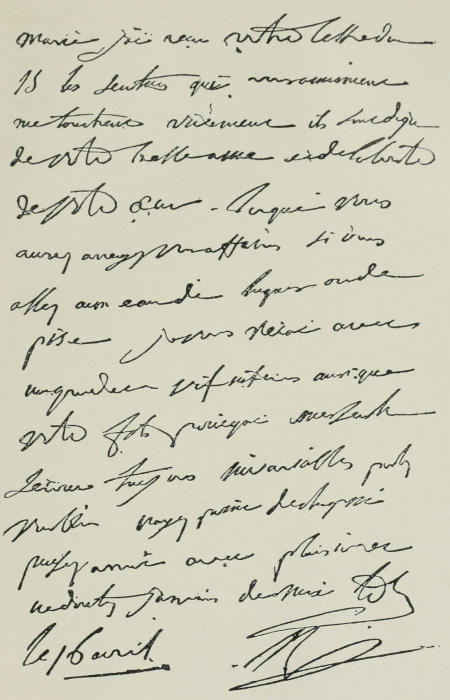
Letter to Countess Walewska
Nine years after the Emperor’s death, the Bourbon dynasty is overthrown, and the Orleans monarchy is established. The new king knows how strong the Bonapartists are, and he orders that the statue of Napoleon, which fifteen years before had been removed, shall be replaced on the Vendôme column. When Jerome brings his bed-ridden mother these tidings, she has a renewal of health and is able to leave her bed. For the first time after a long interval she makes her way into the drawing-room, and her blind eyes turn towards the bust. She says in a toneless voice:
“Once again the Emperor is in Paris.”