BOOK THREE THE RIVER (continued 2)
Cedar Paul translation
Was the desire to become emperor a mistake? What urged him towards the adoption of such a role?
First of all, the imaginative side of his nature, which for the second time is blinding the cold reason of the calculator. Thus was it in Egypt, and thus was it to be for a third time in Russia. His ideal drives him to take this step. He had grown to manhood amid dreams of the antique world; classical imagery had filled his mind; his dictatorial nature necessarily craved for the forms of Roman imperialism. A poetical temperament which makes him look upon the successive occurrences in his life as phases in the unrolling of a saga, and makes him feel, on the very evening after a battle has been won, that the battle has already passed into the realm of history; this engine, driven by the power of fantasy; this eye that looks upward and beyond to see how posterity will crown his deeds with fame—they need a symbol which no one has to-day, but which shone over Europe two thousand years ago.
Yet the mathematician in him also needs this symbol; the statesman needs it, that he may safeguard his country without perpetual wars. Lastly, and perhaps most passionately of all, the man with strong family attachments needs it; the man who feels he has won nothing, if what he has won be no more than an adventurer’s prize that will perish with the winner.
“The name of king is outworn. It carries with it a trail of obsolete ideas, and would make me nothing more than the heir of dead men’s glories. I do not wish to be dependent upon any predecessor. The title of emperor is greater than that of king. Its significance is not wholly explicable, and therefore it stimulates the imagination.” Here, in two or three sentences, are compendiously disclosed the impetuous and the hot, the cunning and the cold, motives of his soul.
Does he see the dangers, or does he overlook them? What are his antitoxins? “What is a throne? A piece of wood covered with satin!” When he has become emperor he will ask the question and answer it thus, more than once. But with this satin-covered piece of wood, as he knows, he can influence grown men, just as he could influence them with the toys of the Legion of Honour. Indeed, the glamour of the throne is stronger, and therefore he will take the establishment of his throne more seriously than he took the foundation of the Legion of Honour. It is an instrument of policy, a means for the management of men. In the real world, where no one can call familiar spirits to his aid, the private person, the poet or the philosopher, can raise his head heavenward without bearing the burden of a crown; but the statesman needs the insignia of power, for the dull populace cannot believe in the reality of power unless he who wields power wears the insignia.
Are we to suppose that he, who can calculate all eventualities, does not see the danger that lurks in the symbol of the crown? Does he not know that for thousands of years people have regarded the monarch as akin to God? If he is aware of this, how without disaster will he be able to harmonise the illusion with his political cynicism? If the crown is the gift of his genius, how can he bequeath it without bequeathing the genius?
Nevertheless, all his endeavours, like those of the emperors of ancient Rome, are now concentrated upon the bequest of power. He, whose own genius has taught him that genius is always aboriginal and primary; he who with his own eyes has seen hereditary power perish amid blood and grime, and whose inmost heart said aye to the act of regicide; he, who to-day reproaches the Bourbons, not with their origin, but with the cowardice that keeps them trembling in their mouseholes; he, Napoleon Bonaparte, who feels himself to be the one man of a millennium; he, a principle of whose rule it is to grant honour and wealth only to merit and courage and talent; he, who is the symbol of revolt incorporated in human flesh—believes that in the place he has fought and won for himself through the storms of eight years, he will be able to perpetuate his blood for the sole reason that it is his own!
He knows Plutarch and the story of the Cæsars. He has studied the history of the great kings of France and England and Prussia, and has learned to look with contempt upon their decadence. And yet he is ready and eager to restore the hereditary principle for the succession to this, the highest office in the State! Here, and here only, he wishes to combine the newest of the new with the old, so that, as he says later in a phrase both profound and tragical: “I might achieve that harmony which I regarded as essential for the tranquillity of the world, a solitary man, driven forward by the impetus of my own personality. That is why I dropped sheet-anchors everywhere.”
But side by side with these heroic words, which sufficed to class him with the heroes of Plutarch, were housed the simplest feelings of domestic life. For, when his confidant Roederer urged him to seek a new wife, who would bear him a son, Napoleon answered in great excitement:
“Hitherto I have always ruled justly. It might be to my interest to seek a divorce. But what right have I to put away a good wife merely because I have become a greater man than I was when we married? She would have followed me into exile or imprisonment. Now I am to divorce her? I am not strong enough to do that. A human heart beats in my bosom; my mother was not a tigress.” After Josephine’s death, he would be free to choose a new partner. But, as things are, what will be the best way of solving this problem of the succession? “My brothers, like myself, were born in petty circumstances, but they did not force themselves upwards unaided as I did. The man who is to rule France must either be born to greatness, or he must be one of those whose inborn strength enables them to distinguish themselves from the herd.”
In this last idea is implicit the disastrous error which in due time is to lead him to inevitable destruction.
For the nonce, however, all is done quietly and soberly, just as on two previous occasions. Wishing to be independent of the parties and to stand above them, he again demands a popular vote; and the very Frenchmen who twelve years earlier had destroyed, not only the king, but kingship, now re-establish both, doing this with even more enthusiasm than when, two years before, they had made Napoleon Consul for life. In a few days, everything is settled. First of all there are votes in the Chambers. In the Senate, only three adverse votes, those of personal enemies. In the Tribunate, Carnot is alone in recording his dissent, Carnot who admires Napoleon, but is a far-sighted devotee of the principle of freedom. The result of a plebiscite is overwhelmingly in favour of the adoption of the imperial title with hereditary succession. In May 1804, the new constitution is promulgated. It is short and businesslike, as if it were a mere paragraph modifying an old constitution.
He never affects to believe that his power has a mystical origin, or even that it really springs from the people. See him, a few days after he has been proclaimed Emperor, seated in a bow window one evening after dinner. He is astraddle on a chair, with his chin resting on the back. For a long time he is silent while Josephine and Madame de Rémusat are talking (the latter records the incident). Then he stands up, turns to Madame de Rémusat, and, after posing for a while as an easy-going and cheerful man of the world, of a sudden, with that free gesture which always amazed his associates and still amazes posterity, he tore off the veil, disclosed his motives, expounded his thoughts as if he had been writing a predecessor’s history:
“You were all very angry with me about the execution of the duke of Enghien. You seem still to be fond of traditional memories. My own memory goes back only to the time when I began to be something. What is a duke of Enghien to me? An émigré, more important than the others, and therefore one whom it is all the better to destroy.... Two years ago, power dropped into my hands in the most natural way in the world.... It is true that the duke compelled me to cut the crisis short. I had expected to carry on the Consulate for another two years, although its forms conflicted with the reality of things. France and I could have walked along arm-in-arm for a while longer, for France had confidence in me, and wanted everything that I wanted. But after this conspiracy, which was to set the Continent in motion, it was necessary to show Europe the error of her ways....
“The political parties I wished to conciliate, the royalists and the Jacobins, will not lose heart as long as they have somebody to dread. I realised, therefore, that no pact between them could be concluded, but that it would be possible to conclude one with them to my own advantage.... Now, they have been reduced to silence. Still opposed to me are the republicans, the cranks who believe that Europe will look on quietly while a republic is being established upon the ruins of a monarchy.... That is why I preferred the imperial dignity to a dictatorship, for in an empire people no longer feel that they are travelling in unmapped country....
“You will soon see what a lure court etiquette will exercise on the émigrés. The old familiar forms of address will win over the nobility.... You French love monarchy. It is the only form of government which really suits you. I will wager, Monsieur de Rémusat, that you feel a hundred times more at ease now that you call me ‘Sire’ and I address you as ‘Monsieur’.... Your vanity was always being bridled; the strictness of the republic would have bored you to death.... Liberty is no more than a pretext; equality is your hobby horse; the people are content to be ruled by a prince who comes from the army.... To-day, soldiers and people are on my side. A man who could not rule under such conditions would be an idiot.”
He broke off, resumed a formal demeanour, and gave Monsieur de Rémusat an order of no importance whatever in the dry tone of the absolute master.
These moments of confession; these quarters of an hour in which we stand opposite him, silently listening and watching, while he lounges on his chair, this newly made emperor of thirty-four in his well-worn green coat, looking askance up and down the room, rising to walk restlessly to and fro, pouring out his most intimate thoughts and then with a brusque transition cutting off all the springs of familiarity; when we see him in such movingly close proximity, in scenes full of nature and purpose, full of surrender to destiny and animus against the present—we can see and hear for ourselves even more than he frankly discloses in simulated self-forgetfulness. We become aware of his easy contempt for persons of noble birth, which is none the less conjoined with a secret wish to make a good impression on them; we discern programmes which he is always willing to adapt to changing circumstances; we observe the robust cynicism aroused in him by the folly of mankind, and see that it exists side by side with the foreign character traits of this Corsican, the very traits which enable him to rule the lovely Marianne with such gallant rigour.
Of course he discloses no more than half his motives, for he is here confining himself to political issues. Still, at the outset of the imperial epoch these political issues exert a predominant influence. It seems as if, to begin with, he regards the change of title with the utmost sobriety: “My brother will not hear a word of his new title,” writes Napoleon to Madame de Staël. “He says he is just the same man he was before, and at the same time he puts on great airs. The truly great man is the one who fully realises that such empty names, which only the system of society compels us to assume, make no difference to friendship, to family life, or to social relationships. I am certain that since I have been ‘Your Majesty,’ not one of those who live with me will have been able to detect any difference in me.”
Yet it is an event that now for the third time he takes leave of his name. It may be nothing that the leading persons in the country who appear at the first court reception address him and Josephine as “Sire” and “Madame,” and that the members of the noblesse, who on this same polished floor fifteen or twenty years earlier had said “Sire” and “Madame,” should feel their hearts revive as they bandy courtiers’ compliments. That may be nothing. Certainly, as regards essential nature, clothing, and deportment, the Emperor of to-day is no different from the Consul of yesterday.
But the proclamation, the thousand and one letters, memoranda, and decrees, will henceforward be signed with a new name. For eight years they have been signed with the rudiments of a “Bonaparte.” Now he signs with a name which he himself has never written since he was a child, and which his nervous hand will speedily compress into an initial N. and a flourish. Josephine has always addressed him as “General.” His brothers and his sisters have for a long time past spoken to him with the ceremonial “you” instead of the familiar “thou” (the change was initiated, not by the Consul himself, but by Joseph). Only his mother in rare moments of expansion has occasionally used her son’s Christian name; and she utters it in her own dialect as “Napolione.”
There is a profound significance in the newness of this name when, adding to it a brand-new title, he writes for the first time in his life:
Napoleon I., Emperor of the French.
VIII
With the first steps, the dilemma begins. The new coins he issues bear the legend: “Emperor according to the Constitution of the Republic”—this paradox will dog him for another four years. When the anniversary of the taking of the Bastille and the outbreak of the revolution comes round once more, he celebrates it with imperial pomp. The gesture may look sublime, but it is nothing more than a measure of political expediency. Even on this very first occasion, the anniversary of the day of liberation is postponed to a Sunday. A year or two later, the commemoration is completely ignored. With it vanishes the revolutionary calendar, for the old one is restored by degrees.
All flock to his standard. Ere long, one hundred and thirty of those who twelve years earlier had voted for the king’s execution, hold office under the Emperor. This is the revolutionary picture caricatured in France, while Europe looks on, watching how first the forms, and then by slow stages the content, for whose sake so much blood has been shed, are laid aside in the museum of history. What can Europe do but smile?
Still more broadly smiles the old noblesse. In the Faubourg Saint-Germain, which the emperor watches as closely as he watched the working-class quarter of Saint Antoine, anecdotes are rife concerning the new master in the old Tuileries. Now that he is called “Sire,” just like the last of the Bourbons, all the lorgnettes are turned on him, and he has become the focus of criticism. As far as his own personality is concerned, so great is his native dignity that he is practically above criticism; in Milan, already, when no more than a general of the French Republic, he ruled simply because he was there. But his relatives, with their childish curiosity and jealousy, and with their gossip about everything that goes on in the palace, soon become the targets of mockery. Magnified by rumour, and carried across the frontiers, this ridicule besmirches the master.
Henceforward England keeps in Paris, in addition to ordinary spies, a horde of quilldrivers, whose tales find credence whenever they are enlivened with wit. Caricatures pass from hand to hand, showing the little lieutenant being taught by the great Talma how to walk like an emperor—Napoleon, who has often taught Talma the best way of playing the royal roles in Corneille! How otherwise could old Europe defend herself against this saga which had become reality? The only resource was to degrade to farce what was being staged with all the crude seriousness of tragi-comedy.
For the Emperor needs a court! It is his way to do everything with due attention to detail; but the details of court life are beyond the range of his studies, and he has to call in the experts of the old regime. The sometime chamberlain at the court of the late king must lay aside his pen (literature had been the resource of his retirement), to resume his staff of office. Josephine, who at first is attended by no more than a few of the ladies of the former court, is at a loss as to the management of an empress’ train. What has become of Marie Antoinette’s lady-in-waiting? She is still alive, and keeps a school in Paris. Bring her forth from her obscurity! She comes, and in the same rooms, before the same mirrors, arranges the folds of the train round these Creole feet which know very different dances from those of the poor dead queen.
The Emperor organises his court with the same seriousness and the same precision as if he were organising the general staff of a new army. No one knows better than Napoleon the vanity of these things: “I am well aware that plenty of people are writing unfavourably about them. Even you, Monsieur Roederer, are not complaisant enough to suppose that I have a little common sense! You ought to understand without my telling you why I have given my new marshals, plain republicans though they be, the title of ‘Monseigneur’; it is only to safeguard my own imperial title of ‘Majesty’? The marshals, having grand titles of their own, cannot make fun of mine.” His very first undertakings as Emperor involve him in the toils of such contradictions.
The two ex-consuls (these are the only offices suppressed by the Emperor) become respectively arch-chancellor and arch-treasurer of the Empire. Talleyrand, as grand chamberlain, brings back the old arts and graces into the old house. How easy it would be for the Emperor to appoint none but gentlemen and ladies of the old regime to the leading offices at court! Instead, he chooses the scions of the proletariat and the bourgeoisie, the men who have risen with him: Berthier, Murat, Lannes, Ney, and Davoust. Fourteen generals, who in youth had been bakehouse lads, stable boys, waiters, cabin boys, or vagrants, must now exchange their campaigners’ uniforms for the gold-braided coats of the marshals of France, must double their military duties with offices at court, must wear lace ruffs and buckled shoes; their wives must learn how to curtsey in the grand manner, how to stand and sit properly, how to scratch at the door instead of knocking—all that Europe may see how the Emperor, who was himself a lieutenant, promotes his lieutenants according to merit. Marmont is there, still wearing his arm in a sling; he is decked out in silk and satin and gold; but the slit sleeve, with its reminiscence of martial glory, seems to mock the splendour of his breeches. The Emperor tactfully drops out of the ceremonial two details that were degrading to the dignity of the courtiers: the presentation of the shirt at the king’s levee, and the kissing of the ruler’s hand.
But how is the charm of the rococo court to be revived, now that a soldier sits upon the throne? True, that, after hours of deliberation, it is possible to decide what colours the empress and the highnesses (Napoleon’s relatives) must wear when they go out hunting. When, however, the time has come to bring down the stag, and the Emperor’s thoughts are wandering in other fields, no one else ventures to shoot, with the result that the stag escapes because the chief sportsman has so much else on his mind. The ceremonial “was conducted as if to the sound of drums; everything seemed to happen at the storming pace; and the dread which he inspired in all, drove away grace and ease.... Court life was cold and dull, was gloomy rather than dignified. Since we were following a prescribed ritual, our inner feeling was that we were only machines which some one had placed upon the new gilded couches.”
The Emperor is bored by ladies’ society. With blunt circumstantiality, he asks how many children they have had, and whether they suckle their own babies. He tries to make himself agreeable, but often fails, when his thoughts range to other matters. At Saint-Cloud, in a room full of ladies, he can find nothing to say but, again and again: “How hot it is here!”
All the same, every one attached to the court grows rich. He gives princely salaries to the court officials, and only shows thrift in his payments to some of the members of the old noblesse, maliciously implying that such work is nothing more than their duty. In general, he pays munificently, for “ambition is the mainspring of action. People work so long as they are aspiring upwards.... I have made senators and princes in order to promote ambition, and to make them dependent on me.” He thus uses both honours and money to attach people to his cause, making, not friends, but dependents.
He knows the value of money; and though at all the critical moments of his career he surprises us by improvisation, we are, in general, just as much astonished by the way in which he continually displays a bourgeois rationality and foresight. His own demands are moderate. The Emperor’s personal salary is fixed at twenty-five millions, the amount paid to the late king; but where as Louis had spent forty-five millions, Napoleon saves twelve. The whole court, resplendent though it is, does not cost a fourth as much as the Bourbon court. France, which has to foot the bill, owes this economy to the care and knowledge of the master, who once had to live on ninety francs a month, and even now declares that he could get along well enough with twelve hundred francs a year and a horse.
There was no change in his routine of life. The Emperor was called at seven, and held his first reception at nine. Most of the day, his secretaries were engaged in taking down from dictation. This dictation was at the speed of ordinary conversation, and must be transcribed with perfect accuracy. At night, when he had some difficulty in sleeping, Méneval must come to record his master’s night thoughts. His dinner took twenty minutes, and he hardly noticed what he was eating. He was much more plainly clad than his gaily bedecked courtiers; and when, on State occasions, he had to dress ceremoniously, he was always in a bad temper while being arrayed, and greatly relieved when he could doff his finery. When he entered Saint-Cloud after the place had been done up, he regarded it with disfavour, saying: “Rooms like this are suitable for a kept woman; they lack seriousness.”
He does not allow himself to be enslaved by anything, and never insists that his bed or his meals or the lighting shall be just so and no otherwise. Even the snuff-box that he always carries is no more than a toy. The only things which the Emperor finds indispensable are open fires, hot baths, eau-de-cologne, Chambertin, and clean linen twice a day.
Josephine is extravagant. Her seven hundred dresses and two hundred and fifty hats, her jewels, her shawls, and her hair-dressing, cost millions; and although the Emperor wants her to shine in all the splendours which he scorns for himself, he often grumbles at the preposterous totals of the bills.
His brothers and sisters squander money too. He gives them everything, and they are never satisfied. There is an absurd rivalry between the five couples (Lucien is still banished) and Josephine, whom all the others detest. Of the six grand dignitaries who draw fabulous salaries, four are his near relatives, by blood or by marriage. Joseph is grand elector; Louis, constable; Eugene, arch-chancellor of State; and Murat, high admiral. Since the brothers are to be styled Imperial Highnesses, the sisters have their noses put out of joint, and make a collective demand, complaining that Hortense, as the wife of Louis, has become Imperial Highness, while they are “nothing.” He eyes them for a moment, and replies with a witticism which deserves a place in universal history: “When I listen to you, I can almost believe that His Majesty our father of blessed memory must have bequeathed us crown and realm!”
Indeed, one could almost believe it. For when he complies with their demand, with a good nature he is not apt to show towards others, and when for ten years to come he showers honours and wealth, crowns and territories, upon these brothers and sisters who show no gratitude, who never obey him, and never cease to trouble him—we cannot but ask ourselves once more what can be the prejudice which blinds his eyes where they are concerned. His pride is great; he is lonely in his self-confidence; his path is that of a pioneer; in this instance as in others, his motives must be mixed; in part obscurely felt, in part coldly calculated.
He is half an oriental, and it tickles his fancy to bestow diadems as he used to bestow swords and snuff-boxes; but all the same, he warily contrives that power shall be given to those only on whom he can rely. Well, what is thicker than blood? Even his companions-in-arms seem to him less trustworthy than his relatives; but for his trust in them, his relatives will repay him with ingratitude, and in the end his sister will betray him. Because in this one respect he infringes his own principle of equality and departs from his determination to choose only the efficient, because he appoints brothers and nephews to high office and looks upon them as his heirs, he cannot give them the free hand which it is his way to give all his generals within the limits of their commissions. By treating his relatives as an all-powerful minister treats princes who are still under tutelage, he enrages them, and lays up a store of bitterness for himself.
Joseph is already animated by a mocking spirit. He tells his daughter to address His Majesty as “Consul”; holds disputations in democratic circles; refuses to become a minister of State; but accepts an allowance of two millions as an imperial prince, and lives at the Luxembourg, which his brother hands over to him. At length Napoleon loses patience. The ostensible cause of his anger is a trifle, but all the rage of his heart is now vented in this complaint:
“What on earth is Joseph thinking about? Does he imagine that he has been made prince in order to hobnob with my enemies and walk up and down the streets of Paris in brown surtout and round hat? I have sacrificed my own personal pleasures in order to become what I am. I am as well fitted as another to shine in society!... But things of that sort do not help a man to rule. Does he dream of disputing with me for the supreme power? My strength is builded on a rock!...
“Do you know what he ventured to say to me recently in the presence of two others? I ought not to have my wife crowned; the step would be opposed to his interest; it would give Louis’ children a better position than his, because they would be the grandsons of an empress! He had the impudence to talk to me about his rights and his interests! He wanted to touch me on the raw! He might almost as well have boasted he had slept with my mistress, or hoped to do so soon. My mistress! Power is my mistress! The conquest of that mistress has cost me so much that I will allow no one to rob me of her, or to share her with me!”
Thus does the volcano suddenly spout forth great rocks, in the midst of a conversation about trifles. But the rest of the conversation does not turn wholly on trifles. He speaks bitterly of his brothers and sisters, comparing them with Eugene and Hortense. “My stepchildren always side with me. If their mother is put out because I take a fancy for a pretty girl, they say to her: ‘Oh, well, he’s still quite young, you know. You mustn’t make a fuss. No doubt he has faults, but you must not forget how much he has done for us all.’”
But nothing will keep him from pushing his brothers’ advancement. When Joseph refuses all other occupations, Napoleon forces him into the army. “He must have military rank, get a nice wound, and win a good reputation for himself. I shall only give him easy jobs. Then he can win a battle, and I shall be able to promote him to a higher rank than all the other commanders.” It sounds like the education of a degenerate son by a great father.
Louis has an enthusiasm for poetry; he becomes chief of the imperial guard, so that he may have a dignified position; but he can stay at home when the guns begin to shoot.
Murat and Caroline are frightfully extravagant; their table service is of gold. “As for Caroline, my own sister, if I have to discuss anything with her, I must make longer speeches than at the Council of State....
“The whole lot of them are always thinking about my death. It’s rather nasty of them to be continually bringing that into my mind.... Were it not that I find some happiness in my home life, I should be miserable! Why are they always so suspicious of my wife? What has she more than they? Diamonds and debts!... She’s a good wife to me, and does them no harm! She’s rather fond of playing the empress, with her jewels, her dresses, and the whimsies natural to her age. I have never been blinded by love. But I am just. She shall be crowned, even if it costs me two hundred thousand men!”
Thus he is continually bickering with a family which he could reduce to nonentity in a moment, but from which he is unable to cut adrift.
Only one of them is incorruptible, asks for nothing, and holds aloof. Lucien writes from Rome:
“Mother thinks that the First Consul is wrong to take the Bourbons’ crown. She has uneasy presentiments which she will not confide to me. Her dread is that a gang of fanatics will assassinate the Emperor.”—While this dignified mother of the family, still a beautiful woman though well over fifty, is led by her knowledge of the world and her gloomy forebodings to keep herself to herself, while she holds her tongue and only mentions her anxieties to a few intimates, in the Tuileries her children are quarrelling about titles and precedence, disputing who is to sit at the Emperor’s right, debating whether they are entitled to walk out of the room in front of a sovereign prince!
Then Napoleon summons Madame Mère to Paris. But here is one who will not obey him. At first she makes excuses. When more urgent commands are sent, she sets out on the journey, but takes her time, and does not reach Paris for the most splendid festival that a mortal mother can ever have witnessed. She hears and reads all that a gaping world says and writes about the affair. Her only comment is: “Pourvou que cela doure!”
IX
Meanwhile, Letizia’s protector the pope has become more compliant, and is already on the way to Paris. What else could the Holy Father do? The man of might had summoned him, and the Emperor must be kept in a good humour. Besides, he who is to be crowned is an Italian. As one of the cardinals had put it, in the decisive conclave: “After all, we have this satisfaction, that we are taking vengeance on the Gauls by setting an Italian family to rule over these barbarians.” Napoleon is still regarded as a foreigner in France! But why does he not go to Rome for his coronation? Why is he not content to be anointed in Rome, as Charlemagne had been, and all the emperors of the west since Charlemagne’s day? What does he want a pope for at all?
In this matter, once more, he is trying to harmonise the new with the old. At first he is silent about details, and merely asks the pope “to give the highest religious consecration to the anointing and crowning of the first Emperor of the French.” For weeks, letters have been exchanged between Rome and Paris, but the exact nature of the ceremony still remains obscure. Pius VII. is in an uneasy frame of mind as he draws near to Paris, and his spirit is by no means one of benediction. Never before has a pope been summoned in this way, much as a great physician is summoned. When the Emperor meets the pope at the gate of the city, the Holy Father does not fail to note that Napoleon neither kneels to receive a blessing nor kisses hands in token of fealty. Paris is a town where people’s faith is unstable and where popes are held in little honour. The visitor is chilled.
But Josephine is different. All devotion, she confides to him that she and her husband were not married in church, and that therefore from the pope’s point of view they are not married at all. She is eager to grasp the opportunity of consolidating her union, which seems to her frail in view of her barrenness. Taking the hint, Pius insists upon a religious celebration of the marriage before he will crown her as empress. In the palace chapel, two days before the festival, Uncle Fesch, clad in purple, solemnises the union of the pair who eight years before had needed the intervention neither of priests nor civilian officials before coming together. There are no witnesses, not one who could laugh over this comedy in which cheating is still the order of the day—for even the Corsican uncle is not aware what is about to happen.
On December 2, 1804, in Notre Dame, an abundance of precious stones reflects the light of a myriad candles, so that the place looks more like a banqueting hall than a church. Everything has been prepared for weeks beforehand. A skilful museum director has even produced a colourable imitation of Charlemagne’s sceptre. Ancient parchments from the days of the Roi Soleil had been consulted, to ensure that the crowning of this revolutionist should vie in every respect with that of the legitimate monarchs of France. Ségur had studied the etiquette of the occasion with the utmost care; Isabey had rehearsed the whole affair with an array of dolls; the old palace, Paris, France, were in a fever.
The Emperor is in a pleasant humour. Early in the morning he makes sure that Josephine’s crown is a good fit. The great procession drives to the cathedral. Napoleon, robed in an antique imperial mantle, strides to the high altar leading the empress by the hand. Josephine’s charm helps to divest the great moment of a certain sense of embarrassment. Surrounded by attendant cardinals, the pope is seated, waiting. The organ peals forth.
Then, when the appointed instant has come, and all are expecting this man who has never bowed the knee to any one, to kneel before the Holy Father, Napoleon, to the amazement of the congregation, seizes the crown, turns his back on the pope and the altar, and, standing upright as always, crowns himself in the sight of France. Then he crowns his kneeling wife.
None but the pope had known his intentions. Informed at the eleventh hour, Pius had lacked courage to threaten immediate departure. Now, all he could do was to anoint and bless the two sinners. Moreover, the crown on the Emperor’s head is not a Christian crown at all, but a small pagan circlet of golden laurel leaves. All who describe the occasion agree in saying that the Emperor was pale but handsome. He resembled Emperor Augustus; and from now onwards, as if by some mystical power, his features grew more and more like those of the first emperor of Rome.
Thus, in this symbolical hour, Napoleon reduces to mockery the legitimate formalities he is affecting to copy. Furthermore, he makes a laughing-stock of the pope, who will not forget the slight. In an instant the cloud of Bourbon reminiscence has been scattered; the flavour of imitation and parody has vanished; and on the steps of a temple there stands a soldier, a Roman imperator, whom a dozen years before this day no one had ever heard of, who since then has performed no miracles but only done deeds, and has now crowned himself with the golden laurels of these deeds. But his mantle is broidered with golden bees, the emblem of activity.
Several incidents show that he has not, throughout this day of his coronation, wholly surrendered to the mood of a man who has made his own destiny.
When he was seated on the throne, crown on head, with the pope in front of him, he said in a low aside to his brother: “Joseph, if only Father could see this!” The remark, poignant at such an hour in the mouth of a man who was never wont to speak of his father, is fundamentally natural. The perfect simplicity, the unsophisticated innocence, of his course of action, lead his mind back to his origin. Memories of family feuds on the island, of the pride and ambition of the Corsican clans, direct his thoughts towards the stock from which he has sprung.
Semblance never holds his attention, which always reaches out to the core of reality. Thus he is not bewildered even in this amazing hour. When he wants to whisper something to his uncle, who stands just in front of him during Mass, he gives the cardinal a gentle dig in the back with his sceptre. As soon as all is over, and, alone with Josephine, he goes in to dinner, he says with a sigh of relief: “Thank God we’re through with it! A day on the battle-field would have pleased me better!” At their little dinner he tells her to keep on her crown, as if he and she were poet and actress, for, he says, she is charming, his little Creole woman as empress. Thus, in the most natural way in the world, he unmasks the whole masquerade, and we are at ease once more as we see the son of the revolution laughing his own empire to scorn.
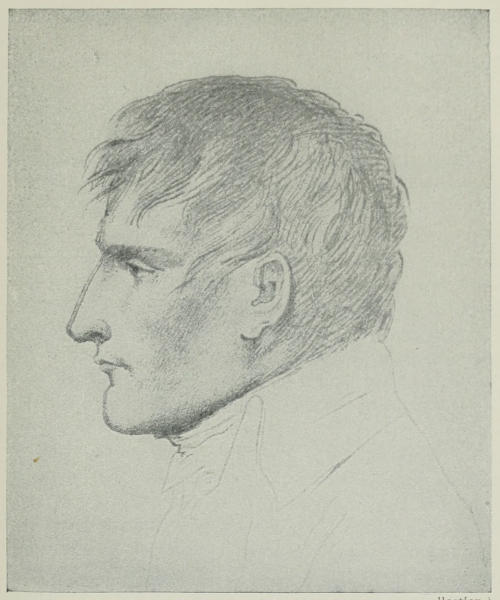
Bonaparte as First Consul. Pencil sketch by J. D. A. Ingres. Germain Bapst Collection.
(Photograph in the Kircheisen Collection.)
The freedom of spirit shown by the foregoing petty details is splendidly illuminated by an admission he made the same evening, when, to a confidant, he summed up the whole matter with sceptical emotion: “No, Decrès, I have come into the world too late. There is nothing great left for me to do. I do not deny that I have had a fine career, but what a difference between me and the heroes of antiquity. Look at Alexander, for instance. After he has conquered Asia, he declares himself to be the son of Jupiter, and the whole East believes him, save only his mother and Aristotle and a handful of Athenian pedants. But if I, nowadays, were to declare myself the son of the Father Eternal, every fishwife would laugh in my face. There is nothing great left for me to do.”
This was said a few hours after he had crowned himself emperor; said quite simply and quite truthfully. Is it not plain why the East has always allured him, and will continue to allure him? By nature he is endowed with immense powers, and is overburdened by their incredible weight. Nothing can be adequate to his aspirations, now that he has learned how readily people obey the man who can command obedience by his skill and by his deeds. He is strong in his own strength; what does Voltaire’s enlightenment, what does Rousseau, matter to him? How can he wish to establish democracy, to install popular government, when he knows the weakness of the popular instincts, and all the corruptness of the leaders of the people? To expand his sway, to spread his name widely and ever more widely, to leave more record of himself in the book of universal history than that half page of which he spoke a few years ago, to sacrifice life itself to the little golden circlet on his head, to do these things without enjoyment and without leisure and without pause—this is all that life now offers.
When, during these days, the sketch for an imperial seal is laid before him, and he sees a lion couchant, he draws his pen across the picture, and writes in the margin: “An eagle volant.”
X
But with a sinister energy the dangerous fluid of divine right radiates from the golden circlet, and slowly spreads its waves through the brain of the wearer, the chosen man. Vainly he endeavours to master and transform the millennial force that has been stored up in this crown, or to make light of it; it masters him, and from time to time forces him to quit the realm of his self-control. When, a year after his coronation as emperor, he crowns himself in Milan with the iron crown of the Lombards (for the border States, like France itself, are to become monarchies), his voice reverberates through the cathedral as he thunders the traditional formula of the Carlovingian kings: “God gave it to me, woe to him who touches it!” Of course, it is only the statesman who speaks, for sound political reasons saying something he does not believe. But, though he is well aware of the contradiction, he will not always be able to solve it with the same vigour as in Notre Dame.
In the first place, the new position makes it necessary to impose new fetters on the mind. The Ministry of Police is revived; and France is parcelled out into four great sectors, in which the most trusty members of the Council of State, each with an army of spies, keep watch upon the mood of the country, for he wants to collect “moral statistics.” Fouché is reappointed Minister of Police, and, since Napoleon’s ties with Talleyrand become increasingly close, the Emperor is by degrees enmeshed in the nets of the two great intriguers—though he is aware that they are playing a double game between himself and the Bourbons, and, by a second relay of spies, fruitlessly endeavours to keep watch and ward over his watchers.
Sinister figures, these two ex-clerics, whom he hates, who hate him, but whom he will never be able to shake off.
Fouché is a man of humble origin, pale, with a cold manner, taciturn, parchmenty. Though orders flash on his breast and a lace ruffle waves there, were it not for his piercing eyes he would look like a mummy in court dress.
Talleyrand is in all respects the man of noble birth. Lame though he be, the prettiest women pay court to him. His charm is that of a rolling sphere, whose living summit is everywhere and nowhere. The assertion that he betrayed his master only for the sake of France, is belied by his immeasurable avarice and venality. For the nonce, he continues to serve the Emperor; but, from the first, the two men have mistrusted one another. Once, indeed, Talleyrand made a sacrifice for Napoleon. Late in the evening, when the two were on a journey together, the Emperor summoned the minister to his bedside for a talk about public affairs. Suddenly Napoleon fell asleep, and Talleyrand sat on guard till morning, not stirring, lest he should wake his master. That is his version of the affair. But the man’s whole nature is so remote from any idea of sacrifice or sympathy, that we may suppose rather that his motive was the hope that Napoleon might reveal some important secret by talking in his sleep.
A dozen times every year, the name of Madame de Staël crops up. Afraid of her and her works, he keeps her away from Paris with an obstinacy which arouses wonder. Yet she says of him: “His look grows infinitely tender when he speaks to women.” Throughout Europe, the champions of the freedom of the spirit fall away from him; Byron, who had greatly admired him; Beethoven, who cancels the original dedication of the Eroica to Napoleon. With painfully mixed feelings the Emperor must have read the tribute of the mad tsar Paul, who had already acclaimed the First Consul as the suppressor of the revolution.
Since Marengo, he has been doing his utmost to maintain peace on the Continent, and for four years he has been successful. His hope is that the re-establishment of monarchy will appease the united princes, will assuage the anger they still cherish against France. The death of two men comes to thwart his plans. Tsar Paul is murdered, and this enemy of England is succeeded by a youthful son, an idealist, trained by French apostles of the enlightenment, a man with democratic leanings, gentle, muddle-headed, animated by the wish to be a better sovereign. Alexander, therefore, quickly comes to an understanding with England, where, after Fox’s brief predominance and death, a transient attempt at peace with France has been followed by a revival of the old jealous enmity. England fails to evacuate Malta as had been arranged, imposes new conditions, and is the first to break the peace. Once more there arises the menace of a European coalition under English leadership, a coalition that will aim at a Bourbon restoration, for talent enthroned in France sets so dangerous an example to all other countries.
Thus, a year after the coronation, the war with England is resumed, and will not end until Napoleon’s star sets. There is no campaigning, at first; simply a state of war, in which this great military commander cannot force a decision, and which, therefore, he cannot bring to a close. England has two notable advantages over her continental rivals, and over France in particular. It is an island realm; and it spreads athwart the world. Napoleon’s historical sense, growing ever more alert, shows England to him as a new empire of Alexander, extending like Alexander’s from homeland isles and peninsulas to Asia and to Africa, invincible so long as it remains a united whole. The dream of our new oriental splits upon this rock.
On this rock, too, are wrecked the mathematician’s calculations. The day after Aboukir, he had said that a decade would be needed for the rebuilding of France’s fleet. Half that time has elapsed, and England’s naval predominance has steadily grown. During the brief peace, the soldiers of the unsuccessful Egyptian campaign are brought back to France in English bottoms; England is confirmed in the possession of the Cape and other overseas colonies; and France has more urgent claims on her energies than the building of the new fleet.
Fundamentally, what was a ship to the Emperor? He was competent to design a big gun, to cast it, to place every screw; and to repair every wheel and every shaft of an ammunition wagon. He knew when every horse in a cavalry squadron would have to be re-shod, and how much it would cost; and he knew exactly how many loaves a field bakery could turn out a day. This far-reaching knowledge was one of the secrets of his predominance; made his subordinates zealous in their terror of his incessant control, whether in peace time or in war time; aroused respect for the all-embracing intelligence of the chief; and ensured the exact carrying-out of his military ideas.
But one who would know a ship, must grow up in a ship, just as one who would know ordnance must have passed his youth among big guns. Even though his admirals were astonished to find how quickly he made himself at home in naval matters, how shrewd were his questions, and how sensible were his orders, still their commendation of Napoleon was no more than the praise of a kindly expert who, tacitly, is criticising a talented amateur. Napoleon knew this well enough. Since he lacked a great admiral quite as much as a great fleet, and had never been willing to entrust the conduct of a campaign to any subordinate, he invented a new kind of war which was to enable him, after all, to get the better of England. The European ports from Hamburg to Taranto were to be closed to English ships, and thus the nation of traders was to be vanquished in a trade war. At the same time, he revived his plans of invasion; for, could he but set foot on the island, he would be the military commander, and in his own element.
Just as he had done before the Egyptian campaign, so now in Boulogne, he studies the possibilities of embarkation and disembarkation. On land, his fantasy has found satisfaction and his mathematical powers have gained conquests in ardent imaginings; and yet, all the time, his battles have been realities, have realised these imaginings. But here, at sea, he is an amateur, not an expert; is, for the first time, the onlooker instead of the man of action. In none other of his private letters do we find sentences akin to those which he writes from the coast to Josephine after a stormy night in which a gunboat has broken away from her moorings: “A wonderful sight! The minute-guns were firing; watch-fires were lighted along the coast. A raging, foaming sea; uncertainty and anxiety throughout the night. But a kindly spirit brooded over the ocean and the night. No lives were lost, and I lay down to sleep with the feeling that I had been witnessing a romantic and epic vision—so that I could almost believe that I had been looking on quite alone.”
A wonderful sight; but, alas, only a sight! The Ossianic note is sounded again, for the first time after fifteen years. Napoleon waxes romantic. How moving and how significant are the closing words of this artist, who suddenly feels that he has been robbed of the human material with which he works, and who is even a little alarmed (we cannot help but read this through the lines) at the unwonted sensation of being quite alone.
The unfamiliar element leads him astray. When a storm is threatening, he orders a naval review. Admiral Bruix does not carry out the order. The Emperor finds that no preparations are being made, and sends for the admiral. A terrible scene.
“Why did you not obey my orders?”
“Your Majesty can see that for yourself. You would not needlessly risk brave men’s lives in such weather!”
The Emperor, surrounded by his rigid officers, turns pale with wrath, and says: “Sir, I have given you an order. The consequences are no concern of yours. Do what you are told!”
“Sire, I cannot obey.”
An ominous pause. Napoleon strides towards Bruix, riding-switch in hand, threateningly, though the switch is not raised. The admiral draws back a step, and lays his hand on his sword-hilt. A petrified group.
“You will leave Boulogne within twenty-four hours, and betake yourself to Holland. Rear-Admiral Magon, carry out my orders.”
A naval review is held in a raging storm. A number of chaloupes are capsized, and their crews struggle in the water. The Emperor, to save himself, jumps into the first boat; all who can, follow his example. Two hundred bodies are washed ashore next day.
This incident, unique in Napoleon’s career, a blunder, an act of cruelty, a direct disobedience on the part of a subordinate, is a warning symptom. But there is a third indication.
A year before, an American inventor had come to Paris, and had offered the French admiralty two new inventions: one of them a ship to be propelled by steam power instead of by the wind; the other, a submarine boat which was to sink ships by the discharge of a kind of torpedo. “The man is a charlatan,” was Napoleon’s comment on Fulton, after an experiment in which the inventor’s “plunging boat” had secured a partial success; and he brushed the whole matter aside. If the American had brought him models of a machine gun and a field telegraph, he would have opened his purse.
Napoleon failed to conquer England because this was the one matter in which he was not confident of victory. Failure was inevitable because here, and here only, his self-confidence was at fault; because his belief in his own powers was weakened by his want of expert knowledge and by the inaccessibility of the foe. By land! Yes, if he could only get at this island by land! The thought brings back to his mind the scheme of five years ago, when he had planned an attack on India by way of Herat. But for such a scheme, quiet and time are needed.
His first aim is to keep the peace, to bring about which he has worked with his best powers for years. Immediately after the coronation, he writes in this sense to six monarchs, addressing each in a style appropriate to his correspondent’s character, thinking out the effect of every detail, and considering even the exact working of his signature. Note, for instance, how he writes to the shah:
“My reputation reaches so far, that you cannot fail to know who I am and what I have done; how I have made France supreme among the nations of the West; and how great an interest I take in the rulers of the East.... Orientals are full of courage and spirit, but their ignorance of certain arts and their neglect of military discipline put them at a disadvantage in war when they are faced by soldiers from the North.... Write me your wishes, and we will renew friendly and commercial relationships.... Written in my Imperial Palace of the Tuileries ... in the first year of my reign. Napoleon.” But, in the heading, the document sets forth a title which never existed, a title which Napoleon obviously uses to show the ruler of Persia that the writer is the general who made himself famous in the Egyptian campaign. The document purports to come from “Bonaparte, Emperor of the French.”
On his table, as he signs the letter to the shah, lies a letter to George III., though England and France are at war. It is penned with wonderful art, and is both moving and politic: “Does not all the blood that is being shed without apparent advantage to any one, touch the consciences of the governments? I am not ashamed to take the first step. It seems to me I have shown the world that I have no dread of war and its caprices. My heart, indeed, longs for peace; but war has never dimmed my fame. I implore Your Majesty not to deprive yourself of the good fortune of restoring peace to the world! Do not leave this precious task to your children. Never was there a more favourable opportunity of stilling angry passions. If this chance be missed, what will be the outcome of the war? During the last ten years, Your Majesty has won more territory and more treasure than all Europe possesses. What further could you expect from the war?”
How could the writer fail to smile at the realisation that the last argument could with equal force be turned against himself? The appeal is fruitless, for neither England nor the rulers on the mainland will tolerate the new power of France or its upstart emperor. A fourth coalition of the princes against the republic is imminent.
During the years of peace, he has been tolerably well content. His intimates at Malmaison have often described him as cheerful. Now he must take up arms once more, and resign himself to the knowledge that “it lies in the nature of things to continue this struggle between the past and the future, for the enduring coalition of our enemies makes it essential to attack them if we are to escape annihilation.” There is the simple truth, spoken without exaggeration and without bitterness. If he did not create this nature of things, at any rate he stabilised it. Even though the first wars of France in the revolutionary epoch were purely defensive, the subsequent campaigns became offensive, and were transformed into wars of conquest by the impetus of the people’s army and the outstanding genius of its commander.
Nevertheless, when he is thus challenged by opponents whom he has twice defeated, can we wonder that concrete plans which have hitherto followed his soaring imagination at a respectful distance, should now, likewise, begin to outsoar the boundaries of reason? In the opening years of the nineteenth century and here in the West, the Emperor might have kept the peace for another decade, that in the end he might measure his strength against England’s in Asia. But when Europe’s persistent desire for revenge upon revolutionary France spurs him into action, he conceives the great plan of a unified European realm. Now for the second time (and for the last time down to our own days) a great and saving work will be attempted, and the attempt will fail.
Thus it is that Napoleon’s crowning political thought issues out of a personal defensive. Now, when a new coalition is being formed, and formed against him, his ideal takes a fresh shape. For years his inward gaze has been concentrated on Alexander; now, instead, he sees the figure of Charlemagne. He goes to Aix-la-Chapelle, for a ceremonial visit to the tomb of the great Frankish emperor. “There will be no peace in Europe,” he says at this time to his trusted companions, “until the whole continent is under one suzerain, an emperor whose chief officers are kings, whose generals have become monarchs.... Would you tell me that this plan is but an imitation of the old imperial constitution? Well, there is nothing new under the sun!”
This gradual transformation of his ideal, and the sustenance of the new ideal by the historical imagination, has immeasurable consequences. Precisely because the adoption of the Carlovingian scheme involves for him a renunciation, he storms forward in pursuit of it as if he were fighting for a province. The haste with which he tries to reconstruct the empire of Charlemagne is new, is symptomatic of a fever which will drive him towards new goals before he has reached the old ones.
XI
Since the spring, his army has been assembled in Boulogne in readiness for the repeatedly postponed landing in England. But in the autumn, when the menace of a fresh Austrian attack becomes a certainty, with a change of plans which is decided on in a couple of days and is carried out in a fortnight, he directs all his forces eastward, and is across the Rhine in advance of the news of his first movement. Just before leaving the coast, he dictates to Daru the whole scheme of the attack on Austria, “the order and length of the marches, the meeting places of the columns, the attacks by storm, the movements and the blunders of the enemy—all this two months before the events, and at a distance of six or seven hundred miles from the scene of action.”
Austria had good reason for taking up arms once more. On the knob of the new king of Italy’s sceptre, the lion of Venice was graven. This, and the seizure of Genoa, were urgent warnings to the Habsburg ruler not to venture across the Alps a third time. Francis must be content to fight the matter out on German soil. England was liberal with proffers of money; and the inexhaustible forces of Russia were again available for the coalition, as they had been when it was victorious during Bonaparte’s absence in Egypt. The new tsar was determined to overcome Europe’s old prejudice against Russia, and, with an exchange of roles, to draw his sword against the tyrant of the West. The secret of Napoleon’s fighting technique had been learned, and this time the engineer should be hoist with his own petard.
But the soldier of genius can evolve new methods of victory. By forced marches he encircles the Austrians before they realise what is afoot, encloses them in an iron ring at Ulm, and compels the capitulation of an army which has not even a chance to fire a shot. “I have attained my end, and have annihilated the Austrian army by simple marches. Now I shall turn against the Russians. They are lost.”
The habit of success is making him thrifty of his words. “I had a rough time of it, rougher than necessary,” he writes to Josephine; “wet through day after day for a week, and my feet very cold.” Among the gold-bedizened marshals, who are for the first time parading their splendours on foreign soil, stands Napoleon to receive the capitulation of Ulm. He wears the uniform of a private soldier, a mantle weather-worn at elbows and skirt, a hat without a cockade. His arms are locked behind. Of the imperial purple there is no sign.
Once more, as on the evening after Marengo, he offers peace, sends an admonitory letter to the defeated Austrian emperor, writing as usual with the frankness which is so annoying to the diplomats of Europe: “You will understand that it is only right and proper if I take advantage of my good luck to impose, as condition of peace, that you should give me guarantees against a fourth coalition with England.... Nothing would make me happier than to combine the tranquillity of my people with your friendship, upon which I venture to make a claim, despite the number and strength of my enemies in your entourage.” At the same time, he marches on Vienna.
Then, while he is advancing at topmost speed, comes a blow. He learns that two days after his victory on land had come the sea-fight of Trafalgar, when England had almost annihilated the French fleet. Eighteen ships have been lost; Nelson is dead; the French admiral is a prisoner. Is this another disastrous hour, like the one when the news of Aboukir reached him in the desert? Courage! Then the situation was a hundredfold more difficult. We are not now cut off from Paris by the sea; we need no ships. With redoubled speed he marches on Vienna, which the enemy surrenders without a blow.
But the tidings of Trafalgar have renewed Francis’ fixity of purpose, and have made Alexander firmer than ever. Both try to win over Prussia, which hesitates, and protracts negotiations. Napoleon vainly tempts the tsar with the promise of Turkey. In Brünn there is a great game of hide-and-seek, in which each power tries to keep the others in suspense and is disavowed by its own plenipotentiaries. The Emperor is the only ruler who improvises a political idea. Two days before the decisive battle, for which preparations are already being made, he writes to Talleyrand, who is negotiating in Brünn:
“I should have no serious objection to handing over Venice to the elector of Salzburg, and Salzburg to the house of Austria. I shall take Verona ... for the kingdom of Italy.... The elector can call himself king of Venice if he has a fancy that way.
“The electorate of Bavaria would become a monarchy.... I will give back the artillery, the magazines, and the fortresses, and they must pay me five millions.... To-morrow, I think, we shall have a pretty big battle with the Russians. I have done my utmost to avoid it, for it is only useless bloodshed. I have exchanged a few letters with the tsar, and learn from what he writes that he is a good fellow, with bad counsellors.... Write to Paris, but don’t say anything about the battle, for that would make my wife anxious. You don’t need to worry. I am in a very strong position here, and my only regret is for the almost needless bloodshed which the battle will cost.... You write home for me; I have been in camp among my grenadiers for the last four days, and have to write on my knees, so I can’t manage many letters.”
Such is the Emperor’s mood just before the most famous of his victories. While he is studying his maps, noting the name of every Moravian village, the width of every stream, and the condition of every road, and while he does his best to keep himself warm by the camp-fire, he is thinking of the ministers in Paris who are awaiting his commands, and of his wife who may be anxious. In the same half hour, he drafts a new programme for the partition of four or five States, talks of new crowns, of war indemnities, and of handing over fortresses. Twice his laments for the useless bloodshed light up the written page like the rising sun of one of these December days. Need we be surprised that such a man conquers the legitimate princes, who at this moment are dining in their palaces?
In the evening, when he learned the enemy’s movements, he clapped his hands, and, “trembling with joy” (the words are his adjutant’s), said: “They are walking into the trap! They are delivering themselves into my hands! By to-morrow evening, their army will be annihilated!”
Then he sits down with his staff to supper in a peasant’s hut, and, an unusual thing with him, remains at table for some time after his meal, emotioned and musing. He goes on to speak at considerable length concerning the nature of tragedy. From this, he passes to Egypt: “If I had taken Acre, I should have donned a turban, have clad my soldiers in wide Turkish trousers. But only in the utmost need should I have exposed my Frenchmen to serious danger; I should have made of them a corps of immortals, the Holy Battalion. I should have fought the war with the Turks to a finish by the use of Arab, Greek, and Armenian levies. I should have won a great battle at Issus, instead of in Moravia, should have become Emperor of the East, and should have made my way back to Paris through Constantinople.” The concluding words, so one who heard the soliloquy tells us, were accompanied with a smile, as if to show his awareness that he was being carried away by a rapturous dream.
But is not the scene we are describing a dream? Must we really and truly believe that, little more than a century ago, a mortal man, the understudy of a demigod, stormed across modern Europe and remoulded it in accordance with his will? Did it not all happen in the Homeric age, when two princes in single combat would settle the fate of generations? Or, perhaps, he is a character in a fairy-tale, this man in the middle thirties, a little fellow, seated in a wattle-and-dab hut, on an unknown plain. He wears a greasy coat, a clammy shirt; stuffs potatoes and onions into his hungry mouth. Next day, by this one battle, he will renew the glories of Charlemagne, dead a thousand years since. Now, over night, his unbridled imagination wanders across Asiatic deserts, where a stone-heap successfully resisted him; dwells on that old frustrated plan; while his errant thoughts follow the wraith of the Macedonian to the Ganges.
Day dawns. A year ago, on the altar steps in Notre Dame, he had crowned himself with the circlet of golden laurels. In a fervent proclamation, he reminds his soldiers of that day, and concludes with the promise that for this once he will keep out of the firing line.
Never before has history recorded such words uttered by a commander. They have always been eager to declare their determination to defy death in the forefront of the battle. Napoleon, whose grenadiers have seen him in twenty fights and regard him as a heavenborn leader, can venture to tell his men that he will reward their valour by being careful of his own safety.
Then the Emperor defeats both his enemies, and makes famous for a thousand years an out-of-the-way spot of which no one had ever heard before—the plain of Austerlitz.
“Soldiers,” he says next day to the victors, “I am pleased with you.... Name your children after me, and if one of them should prove worthy of us, I will make him my own son and appoint him my successor!” That is the emotional note he keeps for the army. To his wife, he writes as simply as possible: “I have beaten the Russian and Austrian armies. Rather tired, after a week in the open, when the nights have been chilly. To-night I shall sleep in a bed, in Prince Kaunitz’ fine castle. I’m wearing a clean shirt, the first time for a week.... I hope to get two or three hours’ sleep.”
Quite a simple matter, these momentous happenings! It is but a new song in the rhapsody when, a day later, Emperor Francis comes to Count Kaunitz’ castle, to beg for an interview with the little Corsican lieutenant. But the bird has flown. When the two men meet at length, it is in a windmill. Napoleon greets his brother emperor courteously, saying: “I regret, Sire, that I must receive you here, in the only palace I have entered for two months.” What self-confidence in the soldier interviewing the man born in the purple; what subtle mockery in the mouth of one who knows that in his distant capital, at news of his splendid victory, flags will soon wave and songs resound.
But the distinguished guest, a man of sound sense and good breeding, knows how to parry the thrust: “Your present quarters are so profitable to you, Sire, that I think they cannot fail to please you.” Both smile; and unobtrusively they eye one another up and down, for, though they have fought for a decade, they have never met. Of the same age, they had both reached power at twenty-six or thereabouts, though in such different ways; and neither of them can foresee how close Napoleon’s will-to-peace is one day to bring them, or how widely Francis’ will-to-revenge will ultimately sever them.
“Yesterday I had the German emperor in camp with me and we had two hours’ talk.... He threw himself on my generosity. But I took good care of myself, as I am used to doing.... We have agreed to make peace promptly.... The battle of Austerlitz is the finest of all I have fought. We have taken forty-five regimental colours, more than one hundred and fifty guns, the flag of the Russian guard, twenty generals, and thirty thousand prisoners in all. More than twenty thousand killed—a ghastly sight!” Did the jubilant outburst of a conqueror ever come to a stranger close? He luxuriates in the figures of his gains, and then, suddenly, the corpses of the dead rise before his eyes! Henceforward, such references become frequent; he writes in simple and heartfelt words about bloodshed.
In the peace negotiations, the minister has a contest with his master. The day after Austerlitz, Talleyrand writes to the Emperor: “How easy would it be, now, to destroy the Habsburgs once for all. But it would suit our book better to strengthen them, to give them a fixed place in France’s system!” Napoleon, however, enforces the peace of Pressburg, in which the old German empire is shattered into fragments, while Austria vanishes from Germany and Italy. What is in the conqueror’s mind?
Europe! A league of States under French hegemony. Russia is Asia; England is detached, an island. The Continent must be unified, must consist of middle-sized and small powers overshadowed by the eagles of France, and democratically ranged side by side. Now, after Austerlitz, the new thought takes shape. The victory has put it within his power to realise the greatest aim of a European, the unification of Europe.
He did not set out towards this goal. It was a gradual growth, the fruit of circumstances. He did not deliberately provoke the wars that were fought when the new idea was in its inception. Since Marengo, his chief wish has been for peace. At that time, Austria had been loath to make peace. The Austrian renewal of the attack was a logical outcome of legitimist theory, for Habsburg and the revolution could not jointly rule Europe. Austerlitz had settled the dispute once more. Now it had become possible to reunite Charlemagne’s resurrected Europe. But neither the kings and emperors (who were only beaten, not convinced), nor he himself (who had gained all by the sword and not by persuasion), could march along the way of the spirit towards the unification of Europe. The determinisms of his own past left Napoleon no option but to create his United States of Europe by force. Not till ten years later did he come to see that he had been seeking to achieve a great end by false means.
When he came to understand this, it was too late; he was impotent, in the great epilogue of his exile.
XII
“Tell the pope that I am keeping my eyes open; tell him that I am Charlemagne, the Sword of the Church, his Emperor, and as such I expect to be treated.”
Thus threateningly he writes to Rome. If he must bow before this mole-hill, at least he will enforce obedience. His demeanour is infused with a new tone since Austerlitz and Pressburg. From conquered Austria, he writes in a dictatorial style which neither he nor Europe has hitherto known. The queen of Naples, despite his yearlong warnings, has permitted English ships to anchor in the bay. An army order is issued: “The Bourbon dynasty has ceased to reign in Naples.” Simultaneously, he writes to Brother Joseph: “I think I have already told you that I intend the kingdom of Naples to accrue to my family, so that, like Switzerland, Holland, Italy, and the three German kingdoms, it may belong to my federated States or, rather, to the French Empire.”
Henceforward he endeavours to make the plan a reality, the plan whereby Europe shall be governed by one emperor with kings as vassals. Paris, which now acclaims the conqueror, shall be the capital city of the Continent. The Emperor has, in the best sense of the term, “come home again.” He exclaims: “This campaign has made me fat! I believe that if all the princes of Europe were to ally themselves against me, I should develop an absurdly wide paunch!” In such a mood does he hurl himself from recent events into new adventures and allow them to run their course.
During the next few months he organises, from Paris, the following realms: Joseph becomes king of Naples; the princes of Bavaria and Württemberg are turned into kings; Baden is changed into a grand duchy; Eugene weds a daughter of the House of Wittelsbach; a Badenese hereditary prince marries a niece of Josephine’s; a Württemberg princess is reserved for his youngest brother; sixteen States of southern and western Germany are joined together to form the Confederation of the Rhine, vassals of the Emperor, liable for the payment of tribute and the provision of troops, and the sixteen German princes hasten to Paris to vow allegiance, hoping to get a share for themselves in the great mart; a dozen small principalities are wiped out; imperial fiefs are established for Talleyrand, Berthier, and Bernadotte.
Meanwhile Napoleon announces, curtly and conclusively: “Holland has no executive. She must have one. I will give her Prince Louis. We will frame a treaty.... For me the whole matter is settled: either thus, or annexation to France.... Not a minute must be lost.” Why “not a minute”? Holland has been dependent for years; she only needs a crowned vassal; her dependence is to be made clearer by the phrasing, “Napoleon bestows his brother on Holland.” The Dutch object? Then they shall be gobbled up; the choice is quickly made. Louis does not care for the honour; climate bad; health weak? “It is better to die sitting on a throne, than to live a mere prince in France.” Hortense must become a queen, Josephine is aglow for the consummation; the Dutch must present a solemn petition, and must be graciously received by the Emperor in the Tuileries. But Napoleon is so overcome by the irony of the situation, he is so contemptuous, that after the audience he cannot resist telling his little nephew (son of the new king of Holland), in front of the ladies of the court, the fable of the frogs who wanted a king.
What next? His sisters are complaining and intriguing. Are there no more kingdoms available? The pity of it. Oh well, a few grand duchies must be vacated! Through Murat’s promotion, Caroline becomes grand duchess of Cleves; Elise is made grand duchess of Tuscany; and the lovely Pauline Borghese weeps because she is nothing more than princess of Guastalla. “Why, it’s no more than a village! And I’m to be princess of that?” Still, she soon finds consolation in an ocean of diamonds and lovers.
None of the clan are equal to the occasion. King Joseph, in his first proclamation, compares the love of his subjects (who have never clapped eyes on him till yesterday) towards himself with the love of the French towards their emperor. He covers himself with ridicule, and makes the Emperor furious. King Louis utters piteous sighs because the war with England forces him to interfere with “his country’s” trade; and he sends, instead of troops, long letters to the Emperor filled with complaints. “Really, you are throwing unnecessary burdens upon me,” replies Napoleon, in a hectoring tone. “It is all due to your narrow-mindedness and your lack of interest.... I wish you were not always whining!... Leave wailing and complaining to women; a man must be determined.... You are governing far too gently. You allow me to bear the full brunt of the war expenses.... See to it that you raise an army of thirty thousand men. You only think of yourself; that is neither good nor magnanimous.... More energy!”
Elise, who dominates her husband, gives a constitution to Tuscany, holds reviews of the troops, changes her favourites every quarter, and amuses Napoleon by an assumption of the imperial style: “My people is content; the opposition is crushed; your commands, Sire, have been carried out. I am much pleased with the Senate; it is showing deference to my authority.”
Murat, for excess of zeal, draws upon himself a reprimand phrased with Napoleon’s customary bluntness: “I have seen decrees issued by yourself which are quite senseless. You seem to have lost your reason!... All you appear to have in mind is to reign and nothing more!”
Pauline, however, is immortalised by Canova, in a work which outlasts all the realms Napoleon has set up.
Young Jerome, who has gone to America in his capacity of midshipman, has meanwhile married a lady of the middle class without consulting his family. The Emperor, who has more crowns to dispose of than siblings to give them to, and cannot spare any of his brothers, is outraged by this marriage. He pursuades his mother to utter a prohibition. When the young man’s ship puts in to Lisbon, the vessel is surrounded; Jerome alone is permitted to land. Bidding the lady farewell, the youthful husband swears everlasting troth; he travels alone to Paris; is received by the Emperor with threats and lures; at length he gives up his spouse for the sake of princely honours and a post as admiral; maybe, even, he will become a king. The wife fruitlessly endeavours to land on the Continent; she journeys to England, where she brings a child into the world. There she meets Lucien, her companion in misfortune. He has been well received by the English, and settles in the island realm with his wife and children. He writes poetry. An epic. What is it called?
Charlemagne.
The only member of the family who is active, loyal, and, for the most part, judicious in his undertakings is Napoleon’s step-son Eugene. The Emperor loves him, publicly praises his work whenever possible, and now, when Eugene becomes viceroy of Italy and spouse of the Bavarian Princess, Napoleon writes: “You are working too hard, dear son. That is all very well for yourself, but you have a young wife who has hopes.... Why do you not go once a week to the theatre and occupy the royal box?... One can accomplish much business in a short time. I am leading the same kind of life as yourself, but my wife is getting on in years—also I have more business to deal with!” To his step-daughter-in-law, from whom he categorically demands a male heir (seeing that Hortense’s son has but one life, and the dynasty needs additional safeguards!), he writes: “Do not give us a daughter, please! Here is a recipe for you: drink some undiluted wine, daily—only you’ll never believe me!” When, in his despite, she gives birth to a daughter, he says: “If one begins with a daughter, one is destined to have a dozen children!”
How marvellously Napoleon, the great stylist, can accommodate his tone to every circumstance—to inspire dread or to flatter, to praise, to spur on, to punish, or to persuade. He pours this out upon a family which is ever acting in opposition to him, and expends himself thus in the interludes of all his other business.
The Emperor’s mother lives in Paris, as retired a life as her son will allow. She is watchful and conciliatory. He has installed her in the Trianon; gives her one million a year. No one understands why she is so thrifty. Some use the word “miserly.” But she maintains that “we Corsicans have experienced many revolutions; all this may come to an end; what will then happen to my children? It is better that they should come to their mother, than go to strangers who might leave them in the lurch.” From time to time she holds a reception, where she carries herself with natural dignity, and far more regally than many of her children who wear the royal crown. If any one haggles as to the price of the beads with which she works, she smiles and says: “No, you can’t impose upon me. I do not play the princess as my daughters do.” Though she is the mother of the Emperor, and of kings and princes, she laments that not a single trustworthy person is in her immediate entourage. She only unbends over a game of reversi with old friends of hers; or when she chats of an evening with her faithful servant, discussing “the happy days gone by.... They all say that I am the happiest of mothers. In truth I am always full of worry. Every news item makes me tremble lest the Emperor lie dead upon the battle-field.”
On Sundays, following the tradition of her patrician ancestors, she dines with her children at the Tuileries. She does not invariably obey the Emperor; and when he constrains her, she is resentful. No doubt he is aware that she is too proud to accept the relationship which circumstances have established between them; and whenever he looks in the mirror, he cannot fail to see his increasing personal resemblance to his mother, in forehead, mouth, eyes, and hands. Sometimes he teases her:
“Do you find life at court tedious? Look at your daughters! Why do you hoard your money? You ought to spend freely!”
“You’d better allow me two millions instead of one, if that is what you want. But it’s my nature to be thrifty.”
She has as keen an eye for the detection of flatterers as Napoleon himself, and gently warns him against them from time to time. Though she never asks anything for herself, she will often enough beg him to help the numerous Corsicans who come to visit her, and thus does her best for whilom family friends. Once, indeed, and late in the day, she puts in a plea for something she has much at heart. She would like Ajaccio to become the capital of Corsica, instead of Corte. A stirring of family pride! The Emperor issues a decree to this effect, understanding perfectly well what moves her, and says: “My mother was born to reign over a kingdom.”
But she cannot get him to do anything for Lucien. “I love him more than all the others,” she says, “because he’s not been so lucky.” The Emperor is adamant: “No feelings of affection can weigh against reasons of State. I will only accept as relatives, those who serve me. He who does not soar with me, ceases to belong to my family.”
XIII
At Paris, in his study, Napoleon has a silent witness of his activities; a bronze bust of Frederick the Great.
He had grown up in the days when the renown of the last of the famous commanders was still fresh; and, indeed, he had become lieutenant before the king died. Like all the generals of the day, in the art of war he was a disciple of Frederick. He had not yet come into personal contact with the Prussian army, but he still had considerable respect for it, although Frederick’s immediate successor had won no laurels against the soldiers of France. He knew Frederick William III. to be foolish and weak; and if, none the less, he tried to induce the Prussian ruler to enter into an alliance, and hoped to turn Prussia’s antagonism towards Austria and Russia to his own uses, it was because he continued to entertain an unavowed respect for the only foreign army in Europe which had covered itself with glory during the eighteenth century. But when Prussia showed him, not her strongest side, the military, but her weakest, the political, his respect waned.
In the previous year, before Austerlitz, he had offered Frederick William an alliance. After Trafalgar, when Francis and Alexander were courting Prussia, and after Austerlitz, when the indications were in favour of France, the weakling monarch continued to vacillate, always hoping to better his position by neutrality. Then, when the Emperor was stronger than ever before, the Prussian ruler seized the first pretext for making warlike preparations against France. Had not Napoleon violated Prussian neutrality last year by marching through Ansbach?
What has really decided the king’s attitude is the mood of the democrats, in conjunction with his dread of mortified national pride, and, in especial, with his uncertainty as to the loyalty of some of his bellicose generals. In Nuremberg, a bookseller had been tried by court martial and shot for publishing a lampoon against the French army and circulating it in places which, in accordance with the terms of the treaty, were legitimately occupied by French troops. The decision of the court was formally just; but the indignation it aroused, being moral, was juster. The Emperor realised this, and wanted to avoid war. He proposed a mutual withdrawal of troops. Through the mouth of his envoy, he explained that Frederick William had only to say whether the presence of French soldiers in Westphalia annoyed him. Then he wrote personally to the king: “I hold unalterably to our alliance.... But if your answer shows me that on your side you repudiate this alliance, and put your trust solely in the power of arms, then indeed I shall be compelled to make war. Nevertheless, battles and victories notwithstanding, my feelings will remain unchanged. Since I regard this war as a wicked one, I shall, even then, propose peace.”
In private, however, with mingled feelings of anger and contempt, he says hard things about Prussia. He cannot believe that country to be so mad as it seems. “Its cabinet is despicable; its sovereign a weakling; its court ruled by young officers who will risk anything.”
A fortnight before the outbreak of war, he still finds it impossible to believe in its coming.
He is mistaken. The men of noble birth who officer the Prussian army, the men who, under Frederick the Great, defeated France, and were subsequently defeated by France, want to rehabilitate themselves. The middle classes are inspired with ardent nationalist sentiments. The Prussians are ready to “risk anything”; their eyes are fixed on a protectress in whom they trust. The queen of Prussia is a passionate advocate of war, for the tsar is now allied with Prussia, and during his stay in Berlin she has recognised in him the manliness that is lacking in her husband. After Austerlitz, Alexander had promptly withdrawn into his own realm, to await a more favourable opportunity. Now the opportunity had come.
We learn from Talleyrand that Napoleon was full of secret disquietude at having to draw the sword once more. He had been dazzled by the feats of the great Frederick’s soldiers. Never before had he fought against an army famous in story. “I fancy we shall find them tougher metal than the Austrians.” All the more reason for getting quickly across the Rhine! A week after the beginning of the advance, he gains his first victory. At Saalfeld, the best of the Prussians fell, Prince Louis Ferdinand, the first and finest blossom shattered in the first storm.
Confusion prevails among the Prussians, and the king contributes to its spread. General Scharnhorst had advised him to attack two weeks earlier, but the irresolute ruler had waited for the French offensive. The duke of Brunswick is commander-in-chief; but instead of leaving the management of the campaign to this officer, at the last moment the king comes to the fighting front. “We don’t know whether the headquarters should be called royal or ducal.” The duke obeys the king when he ought to command. Questions of precedence necessitate the division of the forces into three army corps, for Prince Hohenlohe, who is a reigning prince, cannot possibly fight under a duke. Once more the enemy holds out the hand of friendship. Two days before the main battle, and while confident of victory, Napoleon writes:
“I do not wish to derive any advantage from the folly of your advisers, whose blunders in statesmanship amaze Europe.... Well, we are at war.... But why should we lead our subjects to slaughter one another? I care nothing for a victory that is bought with the lives of many of my children. If I were at the beginning of my career, and had reason to dread misadventure in battle, I should have no right to use such language. But, Sire, you will be defeated. You will sacrifice the quiet of your days and the lives of your subjects without the smallest justification.... I have nothing to gain from Your Majesty; I do not want and never have wanted anything from you. This war is unwise! I know that my letter may wound your royal sensibilities, but the circumstances make bluntness essential. I am telling you what I really think.... Restore peace to yourself and your territories. Even if I could never be your ally, you will always find in me a man, ... whose greatest wish it is never to shed blood by making war with princes who are not the adversaries of his industry, his commerce, and his policy.”
Louise, who has followed her husband to the front, is a woman with more peaceful instincts than is pleasing to the ambition of the generals on the headquarters staff. When the letter is read, however, she agrees with their scornful view that Napoleon writes as he does because he is afraid of a catastrophe to himself. Is she, then, unable to realise that destiny has placed her among these men to-day, that she may influence her weak-willed husband in the direction of a humane settlement of the dispute? She cannot see it! Napoleon is nothing but “an infernal monster risen out of the mire,” and to-morrow he must fall!
“My affairs march very well,” writes this monster, meanwhile, to his wife. “Everything is going just as I should like. The king and the queen are in Erfurt. If they want to see a battle, they will have this gruesome delight. I feel splendid. Although I am travelling from eighty to a hundred miles a day, I have put on weight. I go to bed at eight in the evening, get up at midnight, and remember when I do so that you have not yet retired to rest.” The last night before the battle he refuses to go to bed. At three in the morning, one of his officers urges him to take a nap, but he exclaims: “Impossible! I have my plans here” (he touches his forehead), “but nothing yet in my maps!” Then he quickly explains the whole plan. “Do you understand?... To horse with you and find me a place from which I can get a commanding view of the battle-field. I shall be there at six.” Then he throws himself on the camp-bed, and instantly falls asleep.
In the course of that night, the Prussian headquarters staff is informed by its scouts that remarkable movements are going on among the French troops. Oh, well, to-morrow will be time enough to discuss the matter! But before the day dawns, the Emperor has ridden along the front, has fired his guard with enthusiasm, has recalled the day of Austerlitz.
He defeats the Prussians near Jena, while simultaneously Davoust is routing a superior force of the enemy at Auerstädt.
When the valiant duke of Brunswick is fatally wounded, no one ventures to take over the command. They all lose their heads, and what is left of the army of the great Frederick flees in disorder through Saxony eastward.
“Chère amie, I did some fine manœuvring against the Prussians, and won a great victory yesterday. Twenty thousand prisoners, and we took about a hundred cannon and colours.... Have been camping here for a couple of days. I’m feeling splendid. Farewell. Take good care of yourself, and love me.”
In Weimar, he meets the reigning duchess. Charles Augustus, the duke, has been in a warlike frame of mind for the last twenty years. He is Prussophil, and, in defiance of advice, has joined issue with the Emperor. Now, as Prussian general, he is in full flight after the disaster at Jena. No one knows his whereabouts. The court has also fled from Weimar. Only the duchess and her minister, Goethe, remain behind. When the Emperor sees the lady for the first time, he says: “I am sorry for you! How could the duke ...!” But to his amazement (for he is always against women’s rule—in especial, when the woman happens to be a German) the duchess answers him with so much clarity, simplicity, and dignity, explains the duke’s friendship with Prussia in so steadfast a manner, that he is shaken, behaves courteously, returns in the evening in order to have a long talk with her, and, after having vowed the annihilation of her dynasty, promises her that nothing shall be done to injure the duchy. Why?