BOOK ONE THE ISLAND
Cedar Paul translation
The story of Napoleon produces on me an impression like that produced by the Revelation of Saint John the Divine. We all feel there must be something more in it, but we do not know what.—Goethe.
I
A young woman is sitting in a tent. Wrapped in a shawl, she is suckling her baby, and listening to a distant rumbling and roaring. Are they still shooting, though night has fallen? Maybe it is only the sound of one of those autumn thunderstorms whose echoes reverberate from the mountains; or perhaps it is nothing more than the murmur from the surrounding forest of pines and evergreen oaks, where foxes and wild swine have their lairs. She looks like a gipsy, sitting there with her white breast half covered by the shawl, brooding within the murky tent, uncertain what the fate of the day may have been. Now she hears the sound of hoof-beats. Is it he? He promised to come; but it is a long way from the fighting line, and the mists are rising.
The flap of the tent is thrown open, letting in a breath of night air. A man enters. An officer in a coloured tunic and wearing a plumed head-dress; a slim fellow, nimble of movement; a young patrician, in the middle twenties. He greets the woman ardently. Springing to her feet, she gives the nursling to her maid. Wine is brought. Taking the kerchief from her head, she stands before him, showing chestnut ringlets astray on a smooth, white brow. An eager question is on her well-shaped lips. Add to the picture that she has a long chin, a sign of energy; that her aquiline nose is thrown into relief by the firelight; and that on her hip there gleams the dagger which in this mountain land she never lays aside. We see a lovely amazon, daughter of an ancient race, sprung from men of action and resolution. The woman’s forebears, like the man’s, have for centuries been leaders and warriors; first across the water in Italy, and then in this craggy island.
But now, when all have gathered together against the hated enemy, have joined forces in the attempt to drive out the French, here, in the wildest part of the mountains, whither the brave girl of nineteen has followed the husband fighting for their fatherland; who, now, could recognise in her the brilliant patrician, the magnet of all eyes? Here, nothing but pride and courage show that she is of noble birth.
The man, full of life and vigour, ever in movement, tells her all his news. The enemy has been beaten, driven back towards the coast. There is no escape. Envoys have been sent to Paoli.
“There will be a truce to-morrow. Letizia, we are winning! Corsica will be free!”
Every Corsican longs for many children. It is a land where an affront is instantly avenged by a dagger thrust; where the vendetta is sacred; where family feuds last from decade to decade and from century to century. The man before us wants many children, to ensure that his race shall persist; and the woman has learned from mother and grandmother that children are tokens of honour. She had become a mother at fifteen; but the baby she has just been nursing was her first boy.
The thought of freedom glows afresh, for the officer is adjutant to Paoli, the leader of the people.
“No longer shall our children be the slaves of France!”
II
With the coming of spring, despondency prevails. The enemy has landed reinforcements; the children of the island take up arms once more; again the young wife accompanies her husband to the war; this time she carries a child beneath her heart, the child conceived during the storms of the previous autumn.
“Often, in search of news, I would steal forth from our mountain nook to the battle-field; I heard the bullets whistling, but I put my trust in Our Lady”—so she would tell the story in later years.
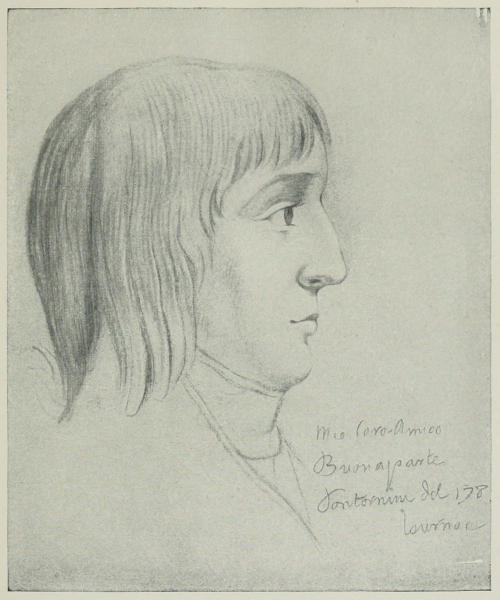
Buonaparte in 1783. The first known portrait, drawn by his fellow-countryman Pontornini. Musée Nationale, Versailles.
In May, the Corsicans were defeated. There was a terrible retreat through the dense forests and the rugged mountains. Among the multitude of men and the few women, rode Letizia, big with child, carrying her one-year-old boy in her arms, seated on a mule. They reached the coast safely. In June the defeated Paoli, accompanied by a few hundred of his faithful followers, had to flee to Italy. In July Paoli’s adjutant, Letizia’s husband, with other envoys, capitulated to the conqueror. The insular pride was humbled. But in August his wife brought the avenger into the world.
She named him Napolione.
This woman, who during the campaign had played the heroine and had shown a man’s courage, must now, in the great house by the seashore, become a prudent and thrifty housewife. Her young husband, fanciful by temperament, lived more on plans than on income. For years his energies were mainly devoted to the great lawsuit concerning his inheritance. As a student in Pisa, where among his fellows he was known as Count Buonaparte, he had lived well but learned little. After the birth of his second son, he cut his studies short. How was he to make a living? In troublous times, a man of the world takes the world as it is; comes to terms with the conqueror; all the more since the French, in order to secure their footing in the island, are inclined to show favour to the Corsican nobility.
Soon he becomes assessor in the new law-courts; superintendent of a nursery in which the king of France, eager to turn the new possessions to account, wishes to grow mulberries; and when the distinguished marshal comes to stay, no expense must be spared. There are still flocks of sheep in the hills and vineyards along the coast; his brother, archdeacon at the cathedral, is well-to-do; and his wife’s half brother, another priest, a merchant’s son, is skilled in worldly affairs.
By the time his proud and beautiful wife has reached her thirties, five boys and three girls have been born to her. This is well accordant to the notions of the islanders, for whom rivalries and vendettas are supreme virtues. But the rearing of eight children is a costly matter; so, day by day, the youngsters hear their parents talking about money. At length, however, the father finds a way out of his difficulties. Accompanied by his two eldest sons, now ten and eleven years of age, he sails to France, and journeys from Toulon to Versailles.
He brings recommendations from the marshal in Corsica. The Buonapartes’ Italian title of nobility is confirmed by the Herald’s College in Paris. To the Corsican official who has been loyal for a decade, King Louis makes a grant of two thousand francs. The two sons and one of the daughters are given scholarships in the Nobles’ Schools. One son is to be a priest; the other, an officer.
III
A taciturn boy, small, shy, and lonely, sits reading in a corner of the garden. It is his own plot in the school garden at Brienne, and he has made a fence round it. Really, only a third of the enclosure is his own, for he has fenced in the plots of neighbours on either side. They may come in too; but woe to any one else who disturbs his privacy! He rushes furiously at the intruder. A little while ago, when the boys had had a fireworks’ display, two of his schoolmates, who had been slightly burned, had run away to his garden for refuge. He had driven them out, flourishing a hoe at them.
No punishment will bring him to reason in this matter. The masters shake their heads and let him go his own way.
“The youngster is made of granite,” says one of them, “but there is a volcano inside.”
No one may touch this little kingdom of his in the garden, though part of it is usurped. He has an ardent feeling for his own independence. Writing to his father, he says: “I would rather be the first among the workmen in a factory than the last among the artists in the Academy.” Did he get the idea out of Plutarch? Certainly he has an enthusiasm for that author, the lives of the great men as sketched by Plutarch, especially the Roman heroes. Of these, he is always dreaming. No one tells us that he ever saw this boy laugh.
To his schoolfellows he seems half a savage, or at best a queer foreigner. He knows scarcely a word of French, and has little inclination to learn the language of the foe. What a tiny little chap he is, and what a ridiculous name! His coat is too long. No pocket-money, nothing to spend, and yet he claims to be of noble birth! The scions of the French nobility laugh. Who cares about Corsican noblemen?
“If you Corsicans are such brave fellows, why did you let yourselves be beaten by our unconquerable troops?”
“We were one to ten,” the lad angrily exclaims. “You just wait till I’m grown up, and I will pay you Frenchmen out!”
“Your father is nothing more than a sergeant, after all!”
An outburst of wrath from the boy, who challenges his tormentor. The young Napoleon is “kept in.” He writes to his father: “I am tired of explaining my poverty; of having to endure the mockery of these foreign boys, whose only superiority is in respect of money, for in nobility of feeling they are far beneath me. Must I really humble myself before these purse-proud fellows?” The answer from the island is: “We have no money. You must stay where you are.”
He stays five years; and, just as his revolutionary feeling is intensified by every slight, so does his self-confidence grow proportionally with the growth of his contempt for his fellows. The masters, indeed, monks one and all, have a good opinion of him, although he does not make much headway except in mathematics, history, and geography—subjects which appeal to a precise mind, a seeing eye, and also to the bitterness of spirit characteristic of one who belongs to a conquered race.
For always his thoughts turn back to his native island. In secret, he is angry with his father for having come to terms with the French. He has made up his own mind. He will get all he can out of the king at whose cost he now pursues his studies, so that in due time he may use the knowledge against his patron. He has a presentiment that some day he will set Corsica free. As yet all the lad of fourteen can do is to pore over books about his homeland, for he who would make history must first study history. He devours, too, all that Voltaire, Rousseau, and the great king of Prussia shortly before his death, have written on behalf of the liberation of Corsica.
Such a boy as this—solitary, suspicious, questing and rebellious, brooding rancorously over vast designs—what is he likely to become? Precociously thoughtful; endowed with a knowledge of men that is beyond his years. When Joseph, his elder brother, wishes to abandon the priestly career and to adopt the profession of arms, the youngster writes of him: “1. He lacks courage to brave the perils of the battle-field.—He will be a good garrison officer: well-grown and handsome, quick-witted and therefore inclined to pay frivolous compliments, with his talents he will always make a good impression in society. But in battle? 2. ’Tis too late to make a change. He might have got a rich benefice, and what an advantage that would have been to the family! 3. What branch of the service will he enter? The navy? (a) He knows nothing of mathematics; (b) his health could never endure life at sea. He is too light-minded for the sustained work that will be needed if he is to be an artillery officer.” These are the reflections of a fifteen-year-old observer, who sees in himself the qualities that his brother lacks; and it is a perfect description of Joseph, who was, indeed, his father’s son.
From this same father, Napoleon had inherited versatility and a vigorous imagination; from his mother came pride, courage, and accuracy; from both was derived his strong family feeling.
IV
“Only the sword-belt belongs to France; the edge is my own,” thinks the youth, as he first buckles on his sword. At sixteen he has become a sub-lieutenant—and he will don uniform a good many more times before he dies. He has qualified for this rank by a year in the Paris Cadets’ School, where he spent his time as he had spent it at Brienne, poring over books. A lad of Spartan tastes, he finds the prodigal expenditure of the sprigs of the French nobility (by whom he is utterly outshone) extremely distasteful. Since, however, nature sets him, even more than most young men, in the centre of his own world, he makes a virtue of necessity, and pens a memorial to the effect that luxurious living is unsuitable for budding soldiers. He must not get into debt, for he knows how poor they are at home. Now, when his father dies, the family affection of this Italian becomes intensified. Though little more than a boy, he begins to save money in order to help his mother.
After his examination, passed with fair credit, his superiors wrote of him: “Reserved and diligent, he prefers study to any kind of conversation, and nourishes his mind upon good authors.... He is taciturn, with a love for solitude; is moody, overbearing, and extremely egotistical. Though he speaks little, his answers are decisive and to the point, and he excels in argument. Much self-love, and overweening ambition.”
Clad in his new uniform, the little sub-lieutenant goes to join his regiment at Valence, compelled by his poverty to walk a great part of the way. Three impulses stir his youthful heart: to despise and make use of his fellow-creatures, most of whom are empty-headed and pretentious; to extricate himself from the clutches of poverty; to learn much in order that he may rule others. The means and the goal are one. He is to be a leader in the struggle on the island, and then to make himself master of Corsica.
How dull life is in this garrison town! Of course, a young man should learn to dance, should taste the pleasures of lively society. He tries this, but soon abandons the attempt, for his teeming pride makes him want to hide his poverty. However, any one who holds converse with members of the burgher class, lawyers and shopkeepers, hears strange talk, gets wind of things that the young viscounts in Paris never dream of. Is it really true? Has the spirit of Voltaire’s and Montesquieu’s, and Raynal’s writings actually climbed down so soon, to stalk among the provincial petty bourgeois? Is the movement which these prophets were conjuring up now seriously afoot? Can it be that the revolution is at hand?
Books clamour it abroad. Reading is free as breathing; and when a man has read all the books in the lending library, he can spare a franc or two now and again to buy a new book. True, the youth lodges in a café, and the clicking of the billiard balls in the next room is tiresome. But it would be still more tiresome to move. In personal habits, he is conservative.
What about his sentiments? Judge for yourselves. Like every young man of his generation, he is keenly interested in the State and society. There he sits in the room next the billiard-room; pale, lonely, in a hot and stuffy atmosphere. While his comrades, after their short hours of duty, scatter to seek distraction in gaming or the pursuit of women, the impoverished lieutenant bends over his books, reading with sure instinct about the things (and those only) that will be of use to him in days to come: artillery, its principles and its history; the art of siege; Plato’s Republic; the constitution of the Persian, the Athenian, the Spartan State; the history of England; the campaigns of Frederick the Great; French finances; the Tartars and the Turks, their manners and customs, and the topography of their countries; the history of Egypt and the history of Carthage; descriptions of India; English accounts of contemporary France: Mirabeau, Buffon, and Machiavelli; the history and the constitution of Switzerland; the history and constitution of China, India, the Inca State; the history of the nobility and the story of patrician misdeeds; astronomy, geology, and meteorology; the laws of the growth of population; statistics of mortality.
He did not simply flutter the pages of his books, but was an attentive reader. There is extant a whole series of copy-books containing Napoleon’s notes, penned in an almost illegible handwriting. The contents of these, reprinted, occupies four hundred pages. Here we find a map of the Saxon heptarchy with a list of the kings for three centuries; item, the varieties of foot-race in ancient Crete; item, lists of the Hellenic fortresses in Asia Minor; item, the dates of twenty-seven caliphs, with a note of the strength of their cavalry, and an account of the misconduct of their wives.
Especially frequent are memoranda concerning Egypt and India, including even the measurements of the Great Pyramid and a catalogue of Brahminical sects. He copies a passage from Raynal: “In view of the position of Egypt, lying betwixt two seas, and in fact betwixt the East and the West, Alexander the Great conceived the design of establishing the capital of his worldwide empire in that country, and of making Egypt the centre of world commerce. This most enlightened of the conquerors had realised that if there was any practicable way of amalgamating his conquests into one consolidated State, it was by this use of Egypt, created as a point of union between Africa, Asia, and Europe.” Thirty years later, he still had the words by heart. He had read them so often.
At this date, too, he begins original composition, drafting more than a dozen essays and projects: the placing of artillery; suicide; monarchical authority; the inequality of men; and Corsica, above all, Corsica—each were the topics. Rousseau, the most popular author of those days, is pulverised by Napoleon’s realism. The young officer is epitomising Rousseau’s views on the origin of the human race (in the Discours sur l’origine et les fondements de l’inégalité parmi les hommes), but abruptly he breaks off the epitome with the comment: “I don’t believe a word of this.” Then come a couple of pages filled with his own counterstatement. Human beings were not, to begin with, solitary; nor were they nomadic. They were happy, and lived apart, because they were not numerous enough to be forced into close contact. When the population grew more thick upon the ground, “then imagination came forth from the cave in which for so long it had been prisoned: self-confidence, passion, and pride reared their heads; there arose ambitious men with pale features, who took control of affairs, and mastered the multicoloured young popinjays, the Lotharios and lady-killers.”
Do not we already hear him rattling his chains, in the dark cavern where he himself is prisoned with his titanic imagination? Do not we see the fancy portrait of the young author, pale of visage, full of hatred for the brilliant lady-killers who are his messmates?
Away from these fellows, who are Frenchmen! His gaze is still fixed upon his native isle, and it is to the advantage of Corsica that he twists the new sociological outlooks. We read in one of the essays: “How absurd to declare that divine laws forbid us to shake off a usurper’s yoke! Were that so, then every regicide who has clambered into the vacant throne would be under God’s protection, whereas in case of failure he would have lost his head. With how much better right, then, can a people drive out a usurping prince! Does not this speak for Corsicans?... Thus we can shake off the yoke of France, just as we shook off the yoke of Genoa. Amen.”
Meanwhile, the fledgling genius wished to try its wings, and this urge led Napoleon to draft a novel on Corsica, and also some short stories. All were animated by hatred of France, but none of them were ever finished. Still he was learning his trade, spurred on by poverty, passion, and sentiment. Imagination rules the world, but cannons are the instrument whereby imagination realises its purposes. “I have no refuge but my work. I only change my linen once a week. Since I was ill, I have slept very little.... I eat only once a day.”
He studies ordnance and munitions of war, always thinking in figures, so that every one says that he is a born mathematician. Now, side by side with the drafts of works of imagination, he draws up specifications of all the localities in the island where he would place batteries, dig trenches, station troops—if he had but the power! Beneath the network of poetical thoughts with which he has covered the island, he spreads over his maps a second network, wherein crosses denote big guns. Maps, maps! In his room beside the noisy café, he restudies everything conceivable, copies whole speeches out of the report of the parliamentary proceedings at Westminster, and sketches the remotest parts of the earth. At the end of the last of his copy-books, the final entry runs: “St. Helena, a small island in the Atlantic Ocean. English colony.”
At this juncture he received a letter from his mother. Her powerful patron, the marshal, was dead; the house had lost its main prop; the mulberry orchard was no longer to be a means of livelihood; Joseph had no paid occupation; could the second son give any help? Shortly after this appeal reached him, he went home on furlough. Are we to consider him an unacknowledged conqueror, returning to the island of his plans and dreams? Read what he wrote in his diary:
“Always alone, though in the midst of men, I go back home that I may give myself up to my lonely dreams and to the waves of my melancholy. Whither, now, do my gloomy thoughts tend? Towards death. Yet I stand on the threshold of life, and may reasonably expect to draw breath for many, many years. For the last six or seven years I have been far away from my country. How great the joy—to see my own people once more!—What demon, then, is it that tempts me to self-destruction?—Since misfortune dogs my footsteps, and nothing gives me pleasure, why should I go on bearing a life in which, for me, everything goes awry?—What a tragedy in the homeland? My fellow-countrymen, in chains, kiss the hand that beats them.—Proud, buoyed up by a sense of his own worth, so lived of yore the happy Corsican, giving his days to the service of the State, and spending his nights in the arms of his beloved wife—the nights which nature and affection made divine for him. With the disappearance of freedom, those happy times have vanished like a dream. Frenchmen, not only have you stolen from us our greatest good, but now you are corrupting our morals! That is how I see my country, and yet I am powerless to help. Are there not reasons enough for quitting a world in which I must glorify those whom I hate?—If it were but the life of one individual which stood between us and our liberties, I should not be slow to act.—Life has become a burden to me, I have no enjoyment, nothing but pain,—and because I cannot live after my own fashion, everything is loathsome to me.”
V
After a year spent in Corsica, a year rendered gloomy by money troubles and family cares, he was still in this mood of despair when his furlough expired. He returned not to Valence, but to Auxonne. What did the change matter?
But, at last, recognition comes. His new general, who sees that this subaltern of nineteen is well informed, puts into his hands the task of carrying out some works upon the parade ground. “Difficult calculations are involved; and so, for the last ten days, I have been busied from morning till night at the head of two hundred men. This unusual preferment has given some of my superiors a spite against me. They are furious that so important a job should have been taken out of their hands and given to a lieutenant.”
The old depression recurs. Promotion will be desperately slow, and when he becomes a captain he will be retired on half-pay. He will return home, to be despised because he is a pensioner of the French. At long last, he will be buried in his native soil. Of that privilege, at least, the French cannot rob him! Were they, then, nothing but froth, the dreams of liberty revealed in the books he had read? If mighty France herself was unable to shake off the yoke of the nobility, to rid herself of venality and nepotism, how was poor little Corsica to shake off the French tyranny?
The young author fills his diary with new schemes. He would have had to pay heavily for it if the book had fallen into the hands of his superiors. “Draft for a memorial concerning monarchical authority. Set forth details as to the usurped power which kings enjoy to-day in the twelve monarchies of Europe. There are few of them who have not merited dethronement.” Thus does he vent his spleen in the faithful diary; whilst in public on every royal birthday, dressed in gala uniform, he must join in the cry: Long live the king!
Another year of his youth is spent in the dull routine of such service, while Napoleon holds his peace and waits, dividing his energies between imaginative writing and mathematics.
The year of destiny has opened. Into the most out-of-the-way regions of the slumbering province comes the presage of the trumpets that are about to sound. We are in the month of June 1789. The melancholy lieutenant feels that the day of vengeance draws near. Is the arrogance of those who have so long humiliated him, to bring destruction upon their own heads? May it not be that the call of the myriads is also the battle-cry of the island? He takes his Letters on Corsica; sends them to his admired exemplar Paoli, in exile; and writes:
“General! I came into the world when my country was perishing. My cradle was surrounded by men with the death-rattle in their throats, and by those whom despair had driven to tears.... With them, hope vanished. Slavery was the reward of our subjugation. To justify themselves, the traitors have heaped calumnies upon you.... When I read this, my blood boiled, and I resolved to scatter the mists. Now I shall blacken with the brush of shame all who have betrayed the common cause.... If I lived in the capital, I should find other means.... Owing to my youth, this undertaking may be fruitless; but I shall be helped by my passion for truth, my love for my country, and my enthusiasm. If you, General, will encourage in this work a young man whose coming into the world you saw, I shall gain confidence.... My mother, Madame Letizia, has charged me to remind you of the old days in Corte.”
We notice a new tone, a symphony of new tones: the soaring emotion of the epoch; the gesture of the tyrannicide; the whole equipment of scintillating words, not an uprush of feeling (as in the pages of his diary), but deliberately chosen with an eye to their effect. Only one thing is alarmingly original, quite peculiar to the writer: the decisive “I” at the opening of the letter, this “I” as a great thesis, fronting the world. Immeasurable self-confidence is breaking a trail; for now the drum-taps of a new era are sounding; an era which will give the palm, not to birth but to action, thus sweeping away the only hindrance that has hitherto been insuperable. An unprecedented claim is voiced, a claim which henceforward will never cease to be heard. But at the close of the letter, with a courteous turn of phrase, he slips back into the familiar, implying that he looks to Paoli for protection. What adroitness, what good manners, we find in all the letters of this adolescent, who in person is still rough and enigmatical!
Paoli, the survival from an earlier day, is annoyed by such arrogance, and answers with civil irony that young people should not try to write history.
Four weeks after the sending of the letter, young people begin to write history, for the first time in the eighteenth century. They storm the Bastille; the great signal has been given; and France leaps to arms. Even in the garrison town of our young lieutenant, the masses riot and loot, until the propertied classes join forces with the troops. Buonaparte is at his post with his battery in the streets, and helps to shoot down the people. This is the first time he has fired a gun in real earnest. He acts under orders from the king’s officers; but there can be no doubt that he acts whole-heartedly against the mob, which he despises no less than he despises the nobility.
In the depths of his soul, he regards this as nothing more than a dispute among foreigners. What does he care about Frenchmen who raise their hands against other Frenchmen? His brain is fired by a single thought: “Corsica’s hour has come!” Madness or enthusiasm, an ideal or merely a catch-word? What matter? Let us carry the message to our island. Apply for leave; and, in the turmoil of the new movement, be the first to reach home!
VI
Lieutenant Buonaparte landed on his island like a prophet carrying a new doctrine to a foreign coast. He was the first to bring the red cockade; to promise liberty, equality, and fraternity. Was not this a race of free mountaineers, who of old had been self-governing, but for twenty years had groaned under the heel of the oppressor—a conqueror who ruled through the instrumentality of the nobles and the Church, but did not understand the people?
What did it matter to the young Jacobin that until yesterday he had lived upon his patrician birth, that solely because of his rank he had been educated at the king’s cost? What was the king to him? At length the peoples were to be free to rule themselves. If the new France, just awakened, had proclaimed the right of self-government, Corsica, which the old France had loaded with chains, must proclaim its own freedom. Citizens, the hour has struck! To arms! Let every one wear the red cockade of the new era; let us form a National Guard, as they have done in Paris! Let us wrest the means of power from the king’s troops. I am an artillerist, and I will be your leader!
Twenty years of age, pale of countenance, with cold, blue-grey eyes, but with a mouth full of glowing phrases, such is the aspect of young Buonaparte as he hastens through the streets of Ajaccio. Every one in the little town knows him, and he is followed by a growing number of persons, some eager for liberty, and others in search of a change of any kind. To the crowd in the square, he seems a man bringing passionate hopes; his figure is that of a tribune of the people. In this half-oriental atmosphere, and among these quarrelsome families (so he says later), “a man soon learns to study the human heart.”
But there is a set-back. No reinforcements come from the mountains; and, when the regular troops put in an appearance, they scatter the revolutionists. Within a few hours, all have been disarmed, though, for prudence, no arrests are made. This is a further source of disillusionment. He is not even a martyr, but only a would-be popular leader who has been defeated; his position borders on the ludicrous. Yet the fever is still burning in his veins, and at all costs he must do something to cool himself. A statement of grievances to the National Assembly in Paris! First of all, in the florid style of the day, an ode to the new freedom, and then a spate of complaints and adjurations. To the gallows with the king’s servants! Arm the citizens of the island!—A committee promptly joins him in signing the document.
Weeks of waiting. What answer will come from Paris? Here is the courier at last. The island is to be a French province, having the same rights as the other provinces; in accordance with Mirabeau’s proposal, Paoli and all the champions of liberty are free to return home. The lieutenant is taken aback. A province? In spite of the new ideas, and indeed because of them, the Corsicans are to remain Frenchmen? A strange form of liberty! But there, already, is the procession, headed by the authorities, on its way to the cathedral, where the decree from Paris is to receive a blessing. Buonaparte is prompt to seize the rope which all are seizing. He pens fiery manifestoes to his fellow-citizens, seeks supporters in the new political club, and engineers his elder brother’s election to the town council. Meanwhile he continues to work at his history of Corsica, and reads to his mother choice passages of what he is writing.
“Can this be the great Paoli?” That is the question Buonaparte asks himself, when, after twenty years’ exile, the hero of his youthful enthusiasms returns amid popular acclamations. “His talk and his appearance are so humdrum, so politic, so unsoldierly.” But it was expedient to keep on good terms with Paoli, for he was to be the commander of the National Guard. In the mountains, the young artillery officer was for some time closely associated with the man who had been his father’s chief just before his own coming into the world.
When they were sitting together or riding together—the tried veteran and the darkly aspiring young Corsican,—the latter would eagerly expound to the former his plans for an armed rising, and even for the forcible severance of the island from the new France. On these occasions, Paoli would look at Buonaparte with mingled pride and alarm. He could not but feel that the author of the Letters on Corsica really had a claim upon him. But the young fellow had the devil in his body; and (which was worse) in his brain, for in the man’s brain was the image of the world throne in solitary splendour. Shaking his head, Paoli would exclaim:
“There is nothing modern about you, Napolione. You come from the age of Plutarch!”
For the first time in his life young Napoleon felt that he was understood. The Roman heroes of Plutarch were alone adequate to his aspirations. Paoli was the first to recognise the Roman in Buonaparte.
At length he has a phrase upon which his self-esteem can luxuriate. Now, from his country retreat, when at Paoli’s instigation he writes a manifesto, the superscription penned by his fevered imagination runs as follows: “23rd day of January in the 2nd year, from my study at Midilli.” Ridiculous or sublime? However this may be, as soon as he has issued the dictatorial pronunciamento the young man has to hasten back to his military duties in France, for his furlough, though renewed again and again, has finally expired. Is he to sacrifice this last firm standing-ground? To what end? Why should he stay in the island any longer? The first place is occupied!
VII
“I am in a peasant’s hut writing to you, after a long talk with the good folk.... It is four in the afternoon; the weather is fresh but mild; I thoroughly enjoyed walking. No snow yet, but there is snow in the air—Everywhere I have found the peasants staunch; ... they are all ready to die for the constitution—The women are royalists almost without exception. No wonder for that, seeing that Liberty is fairer than they, and eclipses them. In Dauphiné, the priests have taken the oath of fealty to the constitution; they laugh at the bishops.—‘Good society,’ as it is called (three out of four are aristocrats), affects admiration for the British constitution. It is true that Peretti threatened Mirabeau with a dagger. This is little to our credit. The Patriotic Society must make Mirabeau a present of our national costume: biretta, vest, knee-breeches and hose, cartridge pouch, stiletto, pistol, and musket. It will certainly have a good effect.”
Everything in this letter to Napoleon’s maternal uncle, the abbé Joseph Fesch, bears witness to observation and calculation, the elements upon which the politician’s influence is based: the weather, the State, travelling on foot, the conciliation of a man in high position, men’s motives—all have been the objects of careful consideration. Vanity and avarice, these are the weaknesses to which an appeal can be successfully directed. We see deep into his soul when, in a bluntly-worded letter dating from those weeks, he arraigns an opponent thus: “Your study of human nature has taught you the price of every man’s enthusiasm; for you, the difference between people’s characters was summed up in a few gold pieces more or less!”
Gold pieces! Where were they to be had? Louis, the brother of thirteen, had come back to France with him. When Lieutenant Buonaparte (he had the full rank now) and his brother got back to Valence, they had no more between them than eighty-five francs, to provide for food, clothing, and the boy’s education. They had to brush their own clothes.
Money! Not for enjoyment (he despises trivial pleasures), but to help him make his way in the world! Lyons Academy has offered a prize for an essay. Twelve hundred francs; one could for that sum equip half Corsica with weapons. “What truths and sentiments is it most important to inculcate upon men for their happiness?” The lieutenant smiles. The subject suits him very well. First of all, so to say, he leaves his card on the academicians who have chosen the theme. They are disciples of Rousseau. Our essayist opens by extolling the joys of nature, friendship, ardent idleness—three things which he neither knew nor prized. Suddenly the argument takes a political turn, against kings, and on behalf of the universalisation of the free enjoyment of possessions and rights. Then comes a sinister tone, as if the writer were contemplating in a mirror his own image as the pallid student of a few years before: “The ambitious man, pale of countenance, laughing sardonically, plays with crime, and intrigue is his chosen instrument.... If, at length, he gets his hand on the rudder of power, he soon wearies of the adulation of the crowd.... Men of great ambition have sought happiness, and have found fame.”
Sublime forebodings, worthy of any of the characters in Plutarch. Soon the author expresses himself more plainly. His ideal is Sparta; courage and strength are the outstanding virtues. A Spartan moved through life as a man moves in the plenitude of his powers. “He was happy because he lived in accordance with his nature. Only the strong man is good; the weakling is evil.” Another presage glows in the following utterance: “Men who are truly great are like meteors: they shine and consume themselves, that they may lighten the darkness of the earth.”
This was too much for the Lyons Academy, which declared the essay “unworthy of commendation.” A fresh disappointment! The effort had brought neither money nor renown. With indefatigable assiduity, none the less, he resumes work on his Corsican novel, and pens a dialogue on love.
What? Does this word, too, shed its lustre into the youth’s sombre mind? Are we to have an outpouring in the Rousseauist vein? Hearken to the words of our lieutenant, now twenty-two years of age: “I, too, was in love once, and learned enough of it to despise definitions, which only confuse the issue. I deny its justification; nay, more, I regard it as injurious to society and destructive to the happiness of the individual. Men could bless heaven if they were quit of it.”
Fanfares interrupt these political and social musings, fanfares from Paris! Louis XVI, attempting to escape, had been caught at Varennes and brought back. The people had triumphed, and the revolutionary movement was intensified. On the second anniversary of the taking of the Bastille, the Red lieutenant proposed a toast to the patriots. From the island came to him sounds of confusion, the heart-beats of anarchy—for during these wild years the ripples of turbulence spread from Paris in widening circles, to reach distant shores. In Corsica, too, civil war is imminent. Back there, for a second venture!
VIII
Now the lieutenant has to play the part of Coriolanus. Catch voices, catch men; for, since the people have come into power, it is necessary to cultivate popularity. Archdeacon Lucien Buonaparte has chosen this convenient hour for dying, and the family is in easier circumstances. Mother’s brother Fesch, another cleric, has been prevailed upon to join the Jacobin Club. Joseph can influence opinion in the town council. Is there any other man in the island competent to direct a battery? Of course the leader of the National Guard would have the real power in his hands. But suppose one should fail to secure election?
This time his furlough lasts only till the new year. Better be careful! He writes to his commanding officer: “Urgent circumstances have forced me to outstay my leave. But I have nothing to reproach myself with: more sacred duties, tenderer obligations, are my excuse.” He hopes that he will not be cashiered. No answer! Well, he must take the risk.
Now comes the election of the commandant of the National Guard. Kinsmen everywhere, but that does not suffice. His mother keeps open house for party friends; often sympathisers from the hills have to be put up for the night; this is the way to catch votes. “At that time,” writes a comrade, “he would for a season be taciturn and reflective; then he would be genial once more, pleasant to all comers, conversationally inclined, prepared to visit any one who might be of use, and doing his utmost to win adherents.” When the commissaries come, he has one of them forcibly detained in his house; and he arranges that the supporters of a rival shall have a thrashing. This is a Corsican election! But when the palpitating day draws to a close, Napoleon has gained his end. He is second in command, with the rank of lieutenant colonel.
Shall he seize the opportunity, this Italian, of sending in his papers in France? Shall he leave the French service? Better be careful, still! From the memoirs of great commanders he has learned that it is always wise to leave a line of retreat open. “In this difficult posture of affairs,” he writes to Valence, “a good Corsican’s post of honour is in his native country. That is why my own folk keep me from returning to France. Since, however, I am not one to compromise where duty is concerned, I had it in mind to resign my commission.” But, far from sending in his papers, he asks for arrears of pay, and actually speaks of France as “your nation.” In answer, he is cashiered by the French military authorities.
Thus he has become a soldier of fortune more speedily than he had wished. He is without firm standing-ground; his only rights are the revolutionary rights of a National Guardsman, the member of a force which may go to pieces directly a reverse is sustained. Hic Rhodus! He must take advantage of the latent civil war between the townsfolk of Ajaccio and the Guard; must fan the flames, so that, amid the general confusion, he may assume the role of saviour! Is not the citadel, now occupied by the king’s regular forces, a standing menace? Did not Frederick and Cæsar always begin by storming citadels? Seize the commander of the regulars, drive out this well-born booby, and thus, at one stroke, free the island! France, now involved in wars, will be unable to reconquer Corsica. The liberator will become a popular hero, and old Paoli will be no more than a legend.
On Easter Sunday, 1792, an open struggle occurred. Was the National Guard provocative; were the townsfolk playing double? Who began the affray? An everlasting problem! This much is certain, that Buonaparte, at the head of his battalion, tried to seize the fortress. But the garrison was not to be intimidated. Guns were trained on his men, and he had to withdraw. A complaint against the young officer was lodged in Paris; he was accused of armed rebellion, and a trial for high treason was impending. His exculpatory phrases deceived no one. Paoli, who had from the outset been somewhat alarmed at the zeal of his turbulent fellow-islander, hastened to proclaim his own loyalty to France, and to cashier the son of his old friend.
“If you turn against me, Paoli, I will turn against you,” thought Buonaparte. “You had better be careful what you are about! To Paris, post-haste. Not for nothing is there a revolution there!”
Through the streets of the French capital, these hot summer days, strolls our adventurer, for whom everything has gone awry. He has neither money nor position. In France, he is a lieutenant, but regarded more or less as a deserter; in Corsica, he is a cashiered lieutenant colonel. The gravest charges are likely to be brought against him, and to-morrow he may be actually starving. The Jacobins are his last hope, and he joins Robespierre’s faction, for nothing can save him but the fall of the dynasty. To him, the complete break up of the old order has become essential.
Life in Paris is costly. He pawns his watch, and, in spite of this, gets into debt—a thing he has hitherto been sedulous to avoid. Fifteen francs due to a wine-dealer! He proposes to his friend Bourrienne that the pair shall become house-agents. Does he envy those who sit in high places? No, he merely despises them. “Any one who sees at short range all that is going on, must admit that the peoples are hardly worth wooing for their favours. Here, human beings are perhaps even more base and calumniatory.—Enthusiasm is merely enthusiasm, and the French nation is outworn. No one seeks anything but his own advantage, and every one tries to push his way into the first rank.—Ambition undermines everything. To lead a quiet life, for oneself and one’s family, that is the only lot worth having, with a fixed income of four or five thousand francs—if imagination would but cease to torment one, would quiet down!”
Woe to him who is thus plagued by a lively imagination! What colossal possibilities may be cooling in this Parisian cauldron, may arise out of the chaos of this titanic time! Being an Italian, a foreigner, he can contemplate with equanimity the destinies of these Frenchmen, and, as a cold-blooded adventurer, can seek to turn their fortunes to his own account. The Jacobins are already coming to the front.
When the sansculottes storm the Tuileries, Buonaparte is among the onlookers. What are the thoughts of the man under the harrow? “Thank God, we are free once more.” But what does the army officer say? “I saw soldiers threatened by civilians, and was terribly shocked.—Had the king shown himself on horseback, he would have gained the victory; such was the mood that morning.” A few days earlier, when the king had been masquerading in the red cap of liberty, Napoleon had written: “What a fool! Why didn’t he use grape-shot? If a few hundred of the mob had been shot down, the others would have run away!”
Still, his main feeling was one of liberation. His opponents had been overthrown. The day after the storming of the Tuileries, he wrote to his uncle: “You needn’t worry about your nephews. They will know how to look after themselves.” The new government does the handsome thing by Napoleon. Not merely is the deserter taken back into the service, but he is promptly raised to the rank of captain. He has, however, no inclination to hasten to his regiment. What does it matter to him that the king of Prussia is on the Moselle? What does he care about the wars of France? “I am a Corsican! Back to the island!”
IX
Is it possible? Has not the fresh wind from the sea, has not even the pure breeze from the mountains, been able to dispel that partisan spirit into which, everywhere, the struggle of ideas tends to degenerate? Calumny, corruption, anarchy: these are the forms which the strife has assumed in the island. Saliceti, the Corsican delegate to the Convention in Paris, is Paoli’s mortal enemy, and is therefore friendly to the Buonapartes now that they have turned against Paoli. The Jacobin Club in Ajaccio is divided, but revolutionary feeling is in the ascendant; and Paoli, the only honest man in the island, is stigmatised as a traitor because he is a moderate.
Who holds the reins of power? Every one and no one. Mutual suspicion is ripe, for in Paris the guillotine has been set up, the king has passed by that red road, and no one knows who will be the ruler there to-morrow. In Corsica, all go armed, and not the mountaineers alone; but orders from the coastland break unavailingly against the crags of the interior. Every one, here, is his own king; every one, his own avenger. Can there be a better field for this adventurer, who has nothing more to lose? He makes a third attempt to become master of the island.
Brother Joseph, Brother Lucien, and Uncle Fesch, all have adherents, but Napoleon is the first to gather the scattered forces. He has the confidence of the deputy, who needs a skilled artillerist to help him in the next faction fight. For the same reason, the Club is inclined to court his favour. Might it not be a good move to accuse Paoli of treason against France? We know that he has been influenced by his twenty years’ enjoyment of British hospitality, and is it not in his mind to sell us to England? If Lucien were to go to Marseilles, and whisper the suspicion in the commissary’s ears, Saliceti would soon be shouting it in the Convention. A little island like Corsica is a hot-bed of intrigue. Since public life is controlled by two or three families, family life becomes merged in public life.
Ere long the Convention sends representatives to Corsica. Officers are appointed and dismissed without Paoli’s leave or advice. Buonaparte, now a captain in the French service, regains in the island his position as commander. Before this, his abilities and the affection of his soldiers have enabled him to usurp the command once more, and the official appointment is no more than an endorsement of an accomplished fact. His chances are improving.
Then comes a terrible order from Paris. Paoli is to be arrested. But his opponents have overreached themselves. The hearts of the islanders warm towards the veteran hero. All rally to his support, and he defies the order.
Young Buonaparte is at a loss. Always he has had his ear at the heart of the people, not in the spirit of a lover, but in the investigatory mood of a physician. He tries to gain time, seeks a middle course, publicly proclaims himself on the side of the maligned Paoli; but also explains that he is a supporter of the sagacious Convention. Yet the Convention mistrusts this supporter, and now issues a warrant for his arrest also. Paoli likewise suspects him of wanting to have a foot in both camps. In a Paolist manifesto we read: “Since the brothers Buonaparte have supported the slander, and have sided with the commission, it would be beneath the dignity of the Corsican nation to have anything more to do with them. Enough to abandon them to remorse and public execration.”
The enemies of the family raided the Buonaparte mansion, looted the place, and would have made short work of the inmates had not these already taken refuge with the commission.
Perhaps Buonaparte had wanted events to take this course. He had given the authorities in Paris plain proof that he was a staunch revolutionist. Certainly, they were now ready to show their trust in him. He, who a year before had led the Corsican volunteers against the French governmental artillery, was now made commander of this same artillery against the Corsican volunteers. Big guns! True, the others occupy the best positions, but at length he has power, ample power, with orders to protect the coast. Now then, Paoli, for our last duel!
But the old man, enjoying the full tide of popular favour, has also the best of it as a soldier. He holds the citadel. When Napoleon, acting this time as a Frenchman, makes his second attempt to storm that stronghold, he succeeds no better than before. A last endeavour is made to take the fortress from the islands. It is fruitless!
There is no longer a place for him and his in Corsica. They are banished by popular decree, and declared outlaws. The mother, so proud of her descent; her two sons, her two daughters, and her brother—all have been rendered shelterless by Napoleon’s unsuccessful attack on Paoli. They must escape from the island at a few hours’ notice. Through the silent woods, in whose recesses twenty-four years earlier she had found safety from the French, Letizia has now to flee towards the coast under the protection of the French. All her possessions are in the hands of her enemies. Nothing is left to her beyond the clothes she wears.
The artillery officer, twenty-three years of age, stands on the deck of the sailing ship that is bearing him to Toulon. Throughout the long June evening, he watches the coast recede; every cape, every ridge, is familiar to him. Thrice he has tried to conquer the island, as its liberator. Now he has been driven out by the Corsicans as a Frenchman. He is full of rage and of a thirst for revenge. The victories of France will strengthen him, and in days to come he will, after all, be master of Corsica!
But as he sails westward, and as the French coast draws near, our adventurer enjoys the sense of freedom that comes to him who is everywhere at home. Such is the happy lot of the man who has no country.
X
“How shabby their dresses are!” thinks Letizia Buonaparte, when her two half-grown girls come home from the market with their poor purchases. The refugees are living on the fourth floor of a confiscated house in Marseilles (the owner, a nobleman, has been guillotined). The mother is in the early forties. The three children with her are earning bread for the family as best they can; the two youngest are still in Corsica, cared for by relatives. Since the Buonapartes are “persecuted patriots,” they receive a part of their rations from the commandant. Letizia, who is proud as ever, makes no complaints.
Soon Napoleon, who is travelling, has the chance of putting some lucrative opportunities in his brother’s way, affairs connected with the supply of munitions of war. Maternal Uncle Fesch lays aside the priestly habit and becomes a man of business, in the silk trade. Then Joseph, who is of fashionable exterior, resembling his father in appearance, and, as the eldest, following the father’s example in styling himself Count Buonaparte,—wins the hand of one of the two heiresses of a Marseilles silk merchant. Napoleon entertains thoughts of marrying his sister-in-law Désirée, the late silk merchant’s other daughter.
He is on the move throughout this summer; now at Nice, with his regiment; now on the Rhone; now at Toulon. All the time, his soldier’s eyes are on the look out; his artillerist’s brain is noting the actual and the potential fortifications along this strip of coast. Soon he will make good use of the knowledge now acquired. Meanwhile he writes political dialogues. One of them in conversational form, appears as a pamphlet, printed at the public expense.
In this conversation, the manufacturer is of a familiar type. The well-to-do folk of Toulon, like their brethren in Marseilles, are, in fact, under Robespierre’s rule, afraid of losing their heads or even their property. Concern for their money-bags tends to make them ever more solicitous for the welfare of the sometime royal house, now in exile. At length, in the hope of saving their capital, they call the enemies of France to their aid, handing over the remnants of the navy to the English, who in return promise them protection.
This is a fearful blow for the young republic. On all fronts, France is at grips with the forces of reaction. Belgium has been lost; the Spaniards are advancing over the mountains; in Vendée, the Bourbon cause is gaining ground. Then comes the crowning disaster of Toulon. The republic calls up its last man for active service, enlists women, transforms the whole of France into an armed camp. Experts are doubly welcome.
Before Toulon, preparations are being made to drive out the English. As to how this is to be done, the Convention leaves that to the commander of the forces, originally a painter of pictures, in whom revolutionary enthusiasm is to make up for the lack of technical knowledge of the art of war.
Then it came to pass that young Captain Buonaparte, returning from Avignon whither he had been sent for a consignment of gunpowder, paid a visit to his fellow-countryman Saliceti, who introduced the young artillerist to the painter-general. After dinner, the dilettantes went for a stroll, and happened upon a 24-pounder, several miles from the sea. They began to boast of all that the gun would do. The expert assured them that, in its present position, it would be useless. He fired four shots to show them that the sea was quite out of range. Dumbfounded, they kept Buonaparte at Toulon, and set him to work.
“At last, one end of the rope is in my hands. Grip and hold fast!” thinks the lonely man with the strong will. With amazing activity, our captain has heavy guns brought from all possible places along the coast. In six weeks, he has more than a hundred pieces of ordnance at his disposal.
Now he will give a display of his talents as military commander. What is his plan? He will mount batteries on the tongue of land which divides the bay into twin harbours, and will thus cut off the hostile fleet from access to the sea. The British commander will not stay to be shot at in a mousehole with no outlet. He will set light to the arsenal and withdraw his forces from the town.
“Fantastical nonsense!” say the amateurs, mockingly. But Buonaparte, who has friends in the Convention, has a complaint lodged there against his chief. He also sends to Paris his scheme for the bombardment of Toulon, many pages of manuscript, containing, in addition, counsel of a more general nature: “Our fire must always be concentrated. If we can breach the wall, the balance will incline to our side, resistance will be fruitless, the place will be won. To live, we must divide; to strike, we must unite. Victory is impossible without unity of command. Time is everything!” Thus does a captain of twenty-four write to the central authorities.
He has a powerful ally in Paris, the younger Robespierre, who has the reputation of a man of talent, and is not completely overshadowed by his all-powerful brother. “Should you ever need a man of iron for street fighting,” said Joseph Robespierre to Maximilien, “a young man, a new man—then it must be this Buonaparte.” Indeed, the Corsican adventurer had already been asked whether he would become military guardian of the terrorists, but considerations of caution had led him to decline. Now his plan was approved, and the painter-general was recalled. Who would replace him?
Buonaparte gnashes his teeth. Another dilettante! The new general is a medical man. He spends his time nosing out conspiracies hatched by the nobility—and meanwhile the enemy occupies the precious tongue of land. From Paris there had come State carriages filled with “men of genius,” clad in brilliant uniforms, and resolved to end the siege of Toulon, to take the place out of hand. Buonaparte led them to an unprotected battery. When the enemy opened fire, and they looked round vainly for cover, their guide said gravely: “We do without cover, nowadays; we have patriotism instead.” This young man with blue-grey eyes is more interested in actions than in intentions. Further complaints, and a new change in command. This time the chief is a tried warrior, who is prompt to appoint Napoleon battalion commander, and to adopt the young artillerist’s plan for driving the enemy from the tongue of land.
When, finally, Toulon is stormed (still in accordance with Buonaparte’s designs), his horse is shot under him; and he is wounded in the calf by an English lance—this being his first and almost his last wound. Moreover, it is his first victory, although he is not the official commander; and it is a victory over England. The enemy retreats to the ships, fires the arsenal, and withdraws, all in one night, just as Napoleon had foretold.
Conflagration and death, battle and the terrors of a naval port in which thousands of treasonable burghers are trying to escape the avengers; amid all the fierce passions of this December night, through the reek and the cries, across heaps of corpses, and to the accompaniment of the agonised curses of drowning civilians and the exultant shouts of looting soldiers, a new star rises in the firmament—Napoleon’s fame.
XI
The popular festival held in Paris to celebrate the liberation of Toulon and fresh victories on the northern and eastern fronts, spreads Napoleon’s name among the masses. He is raised to the rank of brigadier general, and his chief, sending in a report in which the subordinate is given due credit as the originator of the plan of siege, adds (betwixt fear and admiration) the amazing sentence: “Even though the Convention were to slight him, he would still force his way to the front.” But five other young officers are likewise mentioned in despatches, and when for the first time Napoleon sees his own name in the “Moniteur” there can be no doubt that he is vexed at being merely one among so many. How hard it is to climb!
Already, however, there are some young fellows who have noted the rising of the new star. Marmont and Junot, unknown officers, want to join their fortunes to his. He appoints them his adjutants; Brother Louis, too, now sixteen years of age. He has a group!
Big guns! The Convention commissions him to fortify the whole stretch of coast from Toulon to Nice. Is not Genoa, Corsica’s ancient enemy, farther along the coast? He who takes Genoa, has the island in his hands. Is not Genoa full of diplomats and agents? This is the place for weather-breeding among the neutrals; here, any one with sharp eyes and keen ears can learn a great deal, and keep his information to himself. He gets himself appointed people’s commissary, which gives him precedence over the chiefs in Genoa. Ostensibly the appointment is made that he may help in the settlement of frontier questions.
In reality, this is the first step of Buonaparte the diplomatist. He intrigues with agents of various kinds, while taking note whether the representatives of France in that part of the world are genuinely revolutionary or only making a pretence of revolutionary fervour. At the same time, he keeps his eyes open to see where the cannons are. He comes back to Nice to write his report, and, without warning, he is arrested.
For, meanwhile, Robespierre had fallen, and had perished by the guillotine. There is a general movement of repudiation. Every one wishes to make out that only under compulsion did he hold converse with the tyrant. Those who wish to prove themselves guiltless, look round for victims. The best victims will be those who are not in Paris to make a fight for it. Quick, quick, lest we should be suspected of having belonged to Robespierre’s faction! General Buonaparte! He has just been on a secret mission to hostile Genoa. Lay the traitor by the heels! He was colloguing with Robespierre to bring about the destruction of our southern army. Hale him to Paris for trial!
Napoleon is in Fort Carrée near Nice. All his papers have been seized. It is his birthday. “To-day I am twenty-five,” he thinks, as he glances seaward through the grating. If he could lean out of the window, he would catch a glimpse of Corsica. How many attempts he has made there, only to be defeated! Was the destiny of a young aspiring soul ever before built upon such a series of catastrophes? What has Plutarch to say on this matter? Cashiered, banished, outlawed—as far as Corsica is concerned. Now, after all his plans, he is a prisoner of France. Next week, perhaps, he will be standing in the barrack yard, with his back against the wall, awaiting a score of bullets. What is to be done?
His faithful followers advise him to flee. He answers in an impassioned tone such as we rarely encounter in the sixty thousand of Napoleon’s letters. He thanks them for their friendly counsel, but says: “Men may treat me unjustly; no matter, so long as I am innocent. My conscience is the tribunal before which I judge my own conduct, and my conscience is untroubled. Do nothing, for you would only compromise me.” The one genuine phrase in this letter wherein he poses as a martyr, is the last. To Junot, the enthusiastic admirer, he speaks of motives which Junot will understand. In reality, since he knows that there is not a jot of evidence of complicity with Robespierre, he does not wish to compromise himself. Flight would be an admission of guilt.
Writing from prison to an influential diplomat, he says: “I am somewhat affected by the tragical death of the younger Robespierre, for I loved the man and believed him genuine. Nevertheless, had he been my own father I would have stabbed him had he wished to become a tyrant.” Is not that spoken like a true Roman? With even more circumspection, he writes to the Convention: “Although innocent of the charge, I shall never make any complaint against the committee, whatever it may decide.... But now hear me! Strike off my chains, and restore to me the respect of patriots! An hour afterwards, if the wicked clamour for my corpse, I shall be ready. I hold my life at little account, for I have risked it in the trenches too often. Nothing but the thought that I can serve my country enables me to endure my burdens cheerfully.”
A week later, he is free. Saliceti, his fellow-countryman in the Convention, had been his accuser. Now, when the Corsican deputy has got over his first fright and feels that his own neck is safe, he pledges his word that Buonaparte is innocent. But at the close of his statement, he adds a phrase which is an unconscious prediction of the young officer’s triumphs: “Besides, we need him in the army.”
XII
How he is shunned! Powerful friends, to whom he sends letter after letter, long epistles, make no answer. He writes beseechingly for little things, such as “a good surveying outfit for the army,” when he wishes to force an influential comrade to reply. All at once comes a signal from the island. Old Paoli has summoned the English to his aid. Corsica must be saved for France! Back to Paris, in order to fan the flames. The expedition is actually decided on, and he eagerly hopes to secure the command. In a fortnight the fleet is back at Toulon, having sustained a reverse. Fresh disappointment! Why did they not put him in charge? Had he not conquered Toulon, fortified the coast—all with an eye towards the campaign against Corsica?
Reaction is in full swing. Napoleon is suspect. The authorities offer him high command in Vendée, for this will separate him from his adherents. At the same time he is transferred to the infantry, as a “supernumerary.” How mortifying to a highly skilled artillerist!
The pale young man grew paler than ever, for he had made up his mind to refuse. He expostulated with the People’s Commissary for War, who, in reply, twitted him with his youth. Napoleon looked the commissary, who knew little of active service, straight in the eyes, and said: “A man matures quickly on the battle-field, and it is from the battle-field that I come.” Refusal to obey orders; expectation of dire consequences; just as it had been three years before.
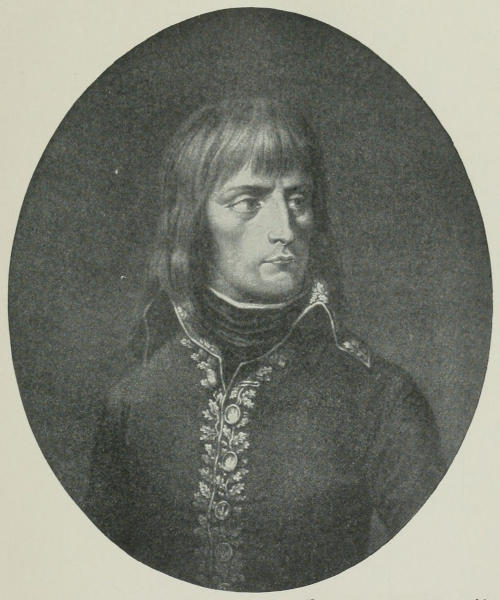
General Bonaparte in 1797. After a painting by Jean Guérin. Bibliothèque Nationale, Paris.
(From the “Corpus Imaginum” of the Photographic Society, Charlottenburg.)
What had I better do? Report sick? Apply for leave? The out-of-work general turns the possibilities over in his mind. Better stay where I am. Paris is the world’s navel. True, Marmont and Junot, who have joined him without leave, are also penniless. What’s Bourrienne doing? Speculating? Well, I can try that too, but assignats are falling. How badly you staged the last affair. Did you think you could make a coup d’état without cannon? But to Saliceti, who in his turn has had serious charges brought against him, and is being sheltered by a fellow-countrywoman, he writes: “You see, I might have paid you back in your own coin.... Who has played the better part, you or I? I might have taken vengeance on you, but have not done so.... Go in peace, to seek a refuge where you can, and meditate upon your country to better advantage. My lips will always be sealed about you. Take counsel with yourself, appreciate my motives ... they are noble and magnanimous.”
During these summer weeks, the flood of life is obscurely murmuring, is heavily pulsing against the shores. He is profoundly moved by Ossian, the book of melancholy passion; and he is stirred by the tragical end of plays he witnesses, hastening from the theatre that his mood may not be jarred by the subsequent farce. “How preposterous, in this new opera, to give a happy ending to Paul and Virginie by having the girl rescued!”—“But what is happiness?” asks the lady to whom he says this.
“Happiness?” answers Buonaparte. “The highest possible development of my talents.”
Just now they are lying fallow, that is what troubles him. He is a prey to increasing dejection and dumb rancour. When a comedy is being played (the wife of one of his friends reports this), every one else is laughing, but Buonaparte sits there in frozen silence. Sometimes he vanishes, to reappear with gloomy aspect at the other side of the stalls. Often enough his lips are twisted in an unsuccessful attempt to smile. He is an irresistible raconteur of campaign stories, but his laughter on these occasions is rough. He is often to be seen wandering through the streets, short in the leg, thin, sallow, sickly, irritable of mien, “awkward, hesitant, wearing an old round hat, from beneath which two badly powdered ‘dog’s ears’ project, scurf upon his collar, his ungloved hands are long and lean and dark, ill-fitting boots.”
He now plans a book traffic with foreign lands; but his first attempt, with a consignment to Basle, miscarries.
Sometimes he visits drawing-rooms, for, as he writes to his brother, every one here seeks distraction.... There are women all over the place, at the theatre, in the Bois, at the Library. The prettiest of girls are to be found in the studies of the learned. Indeed, it is right that women should rule here, for the men are infatuated, living only through and for women.
When Buonaparte is in the salon of Barras, the tribune (who outdoes himself in splendour and extravagance, so that all Paris talks; who can never have enough women round him), when he stands there among women famous for their beauty like Tallien and Récamier, he, who is small and gloomy and angular, can only make an impression by cleverness and caprice. Even then he seems a freak.
Always the solitary, he only “lets himself go” in his long letters to his brothers. He is educating Louis, and writes: “The lad is a good soldier. What especially pleases me is that he combines so many excellent qualities: ardour, spirit, health, talent, trustworthiness, good-nature.... He will certainly be the best of us four. Of course, none of us have enjoyed his advantages in the matter of education.” He is thinking of having Jerome, the youngest, sent to Paris. He is at odds with Lucien. This talented brother is his rival. Indeed, Lucien vies with Napoleon in his knowledge of men, was the first to understand Napoleon, did so already when he was seventeen while his brother was twenty-three. “In Napoleon,” wrote young Lucien to Joseph, “I detect an ambition which is not wholly selfish, but is greater than his love for the public welfare. In a free State he would certainly be a dangerous man. He seems to me inclined to become a despot. I think he would become one, were he king. At any rate, his name would be a terror to posterity and to sensitive patriots.” In Lucien’s mouth, such grandiose vaticination is no mere playing with words. His own ambition is so intense that in this age and country he regards a development of the kind as quite possible for his brother, and he is mortified at the prospect that Napoleon is likely to outshine him.
For the nonce, Napoleon is in low spirits. He envies Joseph, whom money and happiness have made independent. He offers Joseph support in the way of introductions and papers; advises him to use the depreciated currency for the economical purchase of an estate. Yet we find him already writing to his elder brother, apropos of a letter on political questions: “Your letter was too dry; you must learn to write better than that.”
A home! He wants a home of his own, like Joseph. More eagerly in each successive letter he urges Joseph to make sure for him of the wealthy sister-in-law, with whom he has been in affectionate correspondence for more than a year. When she is slow to make up her mind, he presses for a decision. His brother and one of his intimate friends have married well; comrades of his own age occupy prominent positions. Only he, with his surging thoughts and imaginative schemes, remains lonely and does nothing.
“If you are going away for a long time,” he writes to Joseph, “send me your portrait. We have lived so long in close companionship that our hearts are intertwined. No one knows better than you how wholly I am yours. As I write these lines, I am more moved than almost ever before, feeling that it will be long before we meet again. I cannot write any more. Farewell, mon ami.”
He is in a melting mood, and at times he seems utterly discouraged. “To clamber upwards from step to step, this is rather like an adventurer, like a man who is trying to make happiness.” Finally he says: “Life is a trivial dream, which fades away....”
XIII
Suddenly everything is in a flux. A new Minister for War has been appointed, and he is eager to effect changes on the Italian front. Does any one know of a new man to whom the command there can be entrusted? The enquiry passes from one to another, until some one recommends Buonaparte. He is summoned to the War Office. For years he has been making himself familiar with the Italian coast and the Italian frontier, and forthwith he expounds a detailed plan for a campaign in northern Italy, against Sardinia and Austria. It is substantiated by a display of intimate knowledge of the Alpine passes; of the weather and the snows; of seedtime and harvest; of the administration, the temperament, and the characteristics of the territories and the populations concerned. After the conquest of Lombardy, between February and July, the powerful position of Mantua must be wrested from the Austrians. Then the Army of Italy must move northward, and in Tyrol must effect a junction with the sister army, the Army of the Rhine. The joint forces will threaten Vienna and this will compel the emperor to accept a peace which will fulfil all that France has been expecting or imagining for years past.
Overwhelmed by the cataract that issues from this brain, the minister can only say: “Your ideas, General, are equally brilliant and bold. We must examine them closely. Write a report for the committee. You can take your time.”
“My plan is ready now. I can write it down in half an hour.”
“A notable design,” say the members of the Committee of Public Safety when the report has been read to them; “notable, even if impracticable.” In any case, such an intelligence as this must be utilised in the Operations Department. A few days afterwards he has a seat in this department, where everything is decided.
The great moment has come, the turning-point of his youth. At length he stands on the threshold of his career. The chance has come suddenly, for everything is sudden in this eruptive era. From now, when he is barely twenty-six, he will for twenty years, with unremitting vigour, move onwards towards his goal, drawing the chain of thought and action after him. Suddenly, twenty years hence, the chain will snap.
Napoleon’s work begins. With burning energy, attending carefully to little things because his aim is the greatest of things, he devotes himself to “affairs.” The veil is lifted, for here he finds the most secret reports concerning all the armies of the republic. At the same time, his daily association with the leading civilian figures in France gives him authority. The suggestive influence of his personality makes itself felt.
What is the first thing he aspires to gain for himself? Neither the command in Vendée nor the command of the Army of the Rhine. These are attainable, tangible magnitudes. Here, at the centre of all the real fronts, nothing allures him so much as the thought of a command which as yet lives only in his imagination; in a battle-ground which does not exist, but which he wants to create to-day, and which he will again want to create seventeen years hence. Asia! Directly he gets to work at the centre of things, he begins to emphasise the importance of galvanising Turkey into activity, of introducing artillery and the modern art of war on the Bosphorus, for in due time they can from that centre be used against the Russians and the Austrians. In fancy, he already sees himself conversing with the sultan, beyond reach of the eyes of these everlasting republicans, in an obscure and closed country into which the doctrine of liberty has never made its way—a land where a man can still do whatever he pleases. Twelve days after his entry into the ministry, he asks to be transferred to Turkey.
The application is refused. Powerful opponents are already beginning to be afraid of this man. They want to get him out of the War Office; to send him to the front. His protest takes a new tone. As if he were foreseeing all the successes that are still hidden in his own heart, he begins to dictate. “General Buonaparte, who commands the artillery under the most critical circumstances and has contributed to the greatest successes, expects from the justice of the members of the Committee that they shall reinstate him in his functions, and shall spare him the distress of seeing his position usurped by men who have always kept themselves in the background, ... but who now press forward to snatch the fruits of victories whose dangers they well knew how to avoid.”
In the third person, in the iron style of the historian. Roman.
It avails nothing. Once more the insubordinate officer’s name is struck from the lists, and for a second time he has to yield. But he feels that his hour draws nigh; nothing, now, can seriously shake his position. A fresh change of government is at hand. Announcing to his brother the impending transformation, he says that he himself is in the good graces of all the party leaders who will have military posts at their disposal. “The prospect is rosy. Even were it otherwise, a man must live in the present. He who has courage, despises the future.”
Because he despises it, it serves him. Henceforward, men will serve him for the same reason.
A fortnight after this letter had been written, a conflict broke out between the government and the moderates, who were backed by the royalists. Once more, there was fighting on the boulevards, as there had been three years earlier. The National Guard is four times as strong as the governmental forces. Either from caution or from cowardice, the general of the Convention parleys with the leaders of the Guard. He is declared a traitor, and placed under arrest. The Convention meets in a panic. It is defenceless, intimidated by the left-wing and right-wing revolutionaries, who, for various reasons, have joined forces.
In the evening, Buonaparte hastens to the Convention, for a successor to the arrested general is needed, and he learns that the name of one of his rivals has been proposed. The heart of the silent onlooker beats furiously. Will his name now be mentioned? If he is asked to take command, shall he accept a task which he had refused in the days when Robespierre was supreme? Does not every one who leads soldiers against the people make himself hated, precisely because of his success? “Appoint Buonaparte!” Yes, his name has come up. “I turned the matter over in my mind for nearly half an hour.” Such a mission will not bring renown, but it will bring power. He presents himself before the committee. It is past midnight; the tumult is expected to begin early next morning; everything must be ready within a few hours.
In this situation, he demands that he shall be absolutely free from civilian supervision. This seems a monstrous request to make of the revolution, one of whose new principles it is to lay especial stress upon supervision of the dreaded military arm. “If you appoint me, I shall be responsible, and must have a free hand. To-day, it was the fault of the people’s commissaries that the general found himself in so precarious a position. Do you expect that the people will give us permission to open fire upon the people?” The only man he will share the command with is Barras, who is the most powerful among the leaders, but is in his hands. The minutes are passing. There is no choice.—Buonaparte was entrusted with the defence of the government, a fortnight after his name had been erased from the list of general officers.
For seven years the Parisian populace, when roused to action, has had to encounter nothing more than extemporised opposition. That is why the revolution has always made headway. Buonaparte is the first to prepare for the struggle. In one night, he transforms the Convention into a fortress. Even the alarmed deputies are supplied with weapons. They are still more frightened when they hear talk of cannon.
A young cavalry officer, Murat by name, undertakes to bring forty big guns from the suburbs. Murat thus opens a great career on the same day as his chief. Out in the streets he finds the masses, who are likewise on the prowl for artillery. Buonaparte cannot protect the Convention without ordnance. There are hours of tension, during which he must tranquilly devote himself to the disposition of his slender forces. At length, at five in the morning, he hears the rattling wheels of his old friends the big guns. Murat’s men were mounted, and they have won the prize. Forward! Within two hours, everything must be ready.
In well-armed companies, the crowd advances threateningly. The lawyers in the Convention are shaking in their shoes. Speech after speech is made from the tribune, urging a parley, advocating the withdrawal of the troops. In the daylight, the situation is so menacing that the civilians utterly lose heart. They weaken; towards noon, some of the troops want to fraternise with the people. Night is falling. Now or never! Is the commander to allow the mob to triumph? In like circumstances, he had laughed at the weakness of King Louis. Shall he himself play the weakling, when he is in command of the guns?
It is probable that Buonaparte ordered the firing of the first shot, or perhaps extorted the order from Barras, although in his report, and subsequently, he declared that his opponents had this “crime against the French people” on their consciences. Anyhow, the firing begins. The big guns win the day; blood besprinkles the pavements; the crowd scatters; in two hours the streets are clear. That night, Napoleon writes to his brother: “At length it is over; my first wish is to send you news.... We posted our troops, the enemy attacked us in the Tuileries. We killed a lot of them, our own casualties being thirty killed and sixty wounded. We have disarmed the companies of the National Guard, and everything is quiet. As usual, I have escaped without a scratch. Brigadier General Buonaparte. Postscript. Luck is on my side. My compliments to Désirée and Julie.”
This is Napoleon’s first bulletin of victory. The enemy are Frenchmen; the battle-field is Paris; the offenders are revolutionists; most of the fatalities are on the opposing side; the signature, which in earlier and subsequent letters consists of nothing but the name, includes, to-day, the writer’s military title. Everything is calculated for effect. But his feelings break through, and in the postscript he discloses to his brother the two things he has most at heart: Luck and Woman.
At a later date he said: “I have two men within me, the man of the head and the man of the heart.”
XIV
On the tribune of the Convention stands Buonaparte with his officers, hailed by the acclamations of the assembly, to whom the youthful saviour is being presented. He scarcely notices the applause, for such triumphs of the moment seem of little value to him. Coldly surveying the hall, he thinks: “So you are the leaders of the nation. You trembled with fear when you heard the thunder of the guns! You shall not forget how to tremble! I have become your protector. I shall go on protecting you until you have become my humble servants.”
As a matter of course, he is appointed to the command of the Army of the Interior. He now has a great following: cashiered officers, who hope to climb in the footsteps of the cashiered general; officials who have dreaded the reaction; all who feel that they have been rescued. But the crowd must be learning to hate him; for, in that darkling hour, hundreds of unarmed citizens, idle spectators, women have perished. What is that to him? It is not his aim to be loved.
Now, when he suddenly has money and servants and carriages at his disposal, he wants nothing for himself, everything for his kin. His younger brothers are given good positions; his mother can once more live a life after her own heart, and gratify her taste for saving; Joseph has the offer of several posts; there are places for the most distant relatives. But the letters become rarer, and the very first of them sounds a new note: “I shall do everything I can to help you, shall spare no effort which can contribute to your happiness.” From brother, he has become protector, head of the family.
During these weeks, when he is tasting the joys of fulfilment, he becomes involved in the only passion of his life.
Désirée has missed her chance. Only a few weeks before, writing from the office of the general staff, he had implored Joseph to intervene on his behalf, to demand a prompt answer. “I am burning with desire to have a home of my own.” At the same time, in several of his letters, we find more frequent references to charming women, allusions which betray a happy prospect of success. He has come to know la femme de trente ans, in her power and her beauty. He has made advances to two such women, in quick succession: one of them a Corsican of noble birth, a friend of his mother’s; the other, a pretty cocotte, Chénier’s mistress. Both of them are considerably older than he, and neither of them favours his suit. But the atmosphere surrounding these practitioners of the art of love, the electric atmosphere of the new salon, has exercised its influence on him: “A kiss for the two ladies: for the first, on the lips; for the second, on the cheek.” Since he has hitherto known almost nothing of women, his lonely heart is susceptible.
Immediately after his appointment, the new generalissimo issues a decree against bearing arms. A search is made, and all weapons in civilian hands are confiscated. Now a boy of twelve, with engaging manners, turns up at the general’s office with a plea for the return of his dead father’s sword, which has been taken away from his mother. Napoleon concedes the point, and shortly afterwards the mother comes to thank him. What an elegant woman—wayward, gracious, captivating! Thirty or more; who can say? Not so much beautiful, as enthralling; slender; distinguished, but with a slightly foreign air; the dark skin of the Creole, for she was born in Martinique, though brought up in Paris; and during the days of the Terror she has learned to conquer by her charms.
When the general pays her a visit at the little house in an out-of-the-way suburb, his eyes, sharpened by his own experience of poverty, detect evidence of an endeavour to put a good face upon poor circumstances. This does not trouble him. An army officer, who now, at the age of twenty-seven, can for the first time dispose of means which enable him to live as he pleases, he prizes money, but he does not prize rich people. Just as in the life of affairs, men can only move him by their capacity, by what they can do; so women can only please him by their capacity—by their personal appearance, their nature, and what they can make of these.
Josephine makes a great deal, as she needs to do. From Martinique, her tropical home, she was able to save nothing when she lost her husband, Vicomte de Beauharnais. For years she was separated from him, but was reunited with him after her return to Paris from a prolonged visit to her native island. During the Terror, he was executed as a royalist; and she spent three terrible months in gaol, to be liberated after Robespierre’s fall on the very day when Buonaparte was imprisoned. Friends came to her assistance in her difficulties; but her position and that of her two lovely young children, Hortense and Eugene, was precarious.
In this genteel poverty, it is expedient for her to make the best use of her charms. In any case, she is a born coquette, and is urged towards amorous adventures by the spur of her own love of pleasure. At this time, she is Barras’ mistress, her handsome friend Tallien having taken up with a wealthy banker, handing over the man of might to Josephine. However, the two women hold Barras in joint control. The Committee of Public Safety supplies them with horses and carriages. But Beauharnais, being of gentle birth, knows how to give attractive dinner parties, and associates with members of both factions, although the counts and marquises who frequent her house leave their wives at home. She has become an adventuress of the revolution.
Well, what about Buonaparte himself? Any change in the political situation may cost him his position. What more is he, as yet, than an adventurer of the revolution? If Murat had failed to shark up those guns the other night, the general would have been shot. Life is insecure, both for him and for Josephine.
What can be easier than to befool this misanthropic and misogynistic man in whose dumb soul the schoolmaster at Brienne had long ago discovered the hidden volcano? For the first time in his life he is in the toils of a woman, an expert in love; he is consumed by his passion for the Creole beauty. To Josephine, it seems a stroke of luck, and in cold blood she decides on marriage.
“You have seen General Buonaparte at my house. He is to become a father to my orphaned children, a husband to my widowed self.... I admire the general’s courage, and I wonder how much he knows.... But, I must confess, I am alarmed at the energy which animates all his doings. In his questing glance there is something inexplicable, which intimidates even our Directors. What ought to please me most, the passionate ardour he displays, is the very thing which makes me hesitate. Now that I am past my first youth, can I hope that I shall be able to keep alive in him an affection so stormy that it borders on madness?”
This lady of refinement does not fully understand what threatens her, and yet in the depths of her soul she shudders at the foreboding that she is to become the play of elemental forces. For, if this man who covets all or nothing and cannot rest until he has all, this man who has never given himself up to any one person or any one thing because it has been his unceasing wish to gain every one and everything, if Napoleon now gives himself for the first and only time in his life, he will stake his whole being, and will fetter it to the personality of the woman whom he clasps in his arms.
“I am waiting for you; I am wholly filled with you; your picture and the intoxicating evening leave my senses no peace. Sweet, incomparable Josephine, what have you done to my heart? Are you angry with me? Do you look sad? Are you ill at ease?... But I find calm when I give myself up to my passion, that on your lips, at your heart, I may fan the flames which burn me. How plain it was to me last night that your picture can never replace the real you. At noon you will start; in three hours I shall see you; till then, mio dolce amor, a thousand kisses! But you must not give me kisses, for they burn my blood!”