BOOK TWO THE TORRENT (continued 2)
Cedar Paul translation
“In the carriage”—so his adjutant relates—“he would take marital liberties which were apt to be rather embarrassing to Berthier and me. But it was all so simple and natural, that there was no ground for offence.”
IX
What is Paris saying?
Since yesterday, there has been a watchman on duty there. Hitherto, the cabinet ministers had all been nothing more than lawyers; now, a statesman was at work in that innermost circle. Sprung from the old nobility of France, a bishop, then as a republican placed under the ban of the Church by the pope, Talleyrand had recently spent years of waiting in the United States. Now he was back in Paris, and had grasped a share of power. The recently elected Chambers were predominantly “right,” and had been railing against the Directors; the commander-in-chief in Italy wanted to revolutionise Europe; he wished to perpetuate the war; the rape of Venice was an infamy. Perhaps many of the accusations were only too true, but when the echoes of what was being said in the place of words made their way into the place of deeds, they could not fail to arouse the contempt of the man of might. He sent the Chambers a memorial, or, rather, a memento: “Speaking in the name of eighty thousand men, I warn you that the days when cowardly lawyers and pitiful chatterers could allow valiant soldiers to be butchered are over and done with!”
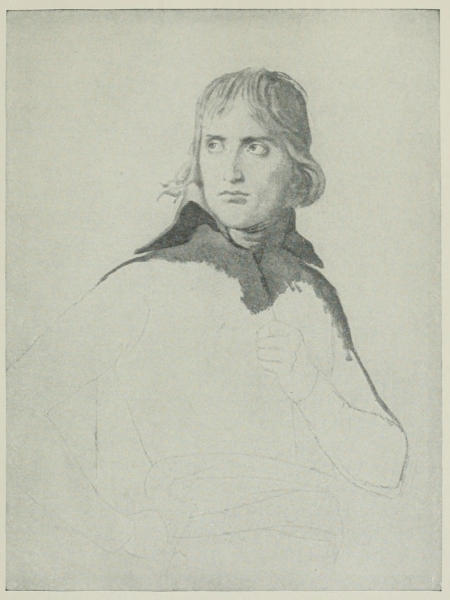
General Bonaparte. Unfinished portrait by Jacques Louis David. From the collection of the Duke of Bassano.
(Photograph by Braun, Paris and Dornach.)
At this date, Bonaparte had dispatched Augereau to defend the Directors, as he himself had defended them a year or two before; for the growing power of royalists and priests were becoming an ever greater menace to the new constitution of the Republic. If either of the Bourbon brothers should venture to set foot on French soil, all the malcontents would flock to his standard, and in a hand’s turn he would win his way to the throne. But the Bourbons stayed in their safe retreats, and the Directors could risk a little coup d’état. Now, they were five instead of three, and felt more self-confident.
Called to office after this coup, an expert was for the first time in charge of the Ministry for Foreign Affairs. From afar, he measured the strength of his only rival. Though he had never seen Bonaparte face to face, he knew him for the coming man. To begin with, at any rate, he was willing to play second fiddle, and set to work that he might win the confidence of one greater than himself.
In all respects, Talleyrand was Napoleon’s counterpart. Not a born negotiator; passionless, except for his avarice; cold and crafty, never natural and frank; always adapting himself to the mood of those he wished to use as his tools. His cynic’s head, his long, pointed, prying nose, now surmounted the gold-braided collar of the republic; they would surmount the imperial and the royal uniform; and then, for a fourth time in the service of the ruler of the French, he would don the livery of the bourgeois king. For forty years he served the man who happened to be in power; but never unreservedly, and therefore he was never tied to any ruler’s fortunes. Lamed by an accident in childhood, he was unable to enter the army, and became a priest, remembering that, in this guise, the great Richelieu had been master of France. Talleyrand was the only man in the country able to measure his strength against that of Bonaparte. Never would the man of destiny be able to shake off Talleyrand even when he had come to hate the subtle diplomat; and when the final breach between the two men occurred, it was at the very time when Talleyrand, with a smile, could limp across the body of the master he had cast down and enter the cabinet of the enemy. Talleyrand was the man who overthrew Napoleon; but, if we think of elemental forces, Napoleon was felled by his own hand.
Talleyrand’s breadth of view and utter lack of principle make their due impression on the distant Bonaparte. These September days, the commander has gone to Udine, to sign the peace whose preliminaries had been arranged in the spring. In this sprig of the old nobility, in this connoisseur of the rococo, in this cold nihilist, Napoleon sees the tool he will need. Hitherto, he has wanted none but soldiers. Now, when he has become a statesman, he wants and finds a statesman. While he is discussing matters with the Austrians, he sends the new Minister for Foreign Affairs a long letter (a letter of betrothal, we might call it), disclosing his whole political programme:
“The organisation of French power has only just begun—Despite our good opinion of ourselves,—we Frenchmen are still tyros in political matters. As yet we do not even understand the difference between executive, legislature, and judiciary. In such a State as ours, where all authority issues from the nation, where the people is sovereign—governmental power, in the full comprehensiveness I ascribe to it, must be regarded as the true representative of the nation, who rules in accordance with the constitution.”
“Does your heart express itself so openly, Bonaparte?” thinks the inscrutable recipient, smiling to himself as he reads.
“It is an immeasurable misfortune that, in the eighteenth century, a nation of thirty million persons should still be compelled to take up arms in order to save the country. These forcible means are a burden upon the legislator, seeing that a constitution for human beings must take human beings into account.”
“Is your aim so high?” muses the reader, with astonishment. “He is already sated with martial fame, and aspires, under the new constitution, to become dictator!” Talleyrand reads on:
“Why should we not make sure of Malta?—I had good reason for confiscating the estates of the Knights of Malta.—With Malta and Corfu in our hands, we should be masters of the Mediterranean. If we cannot dislodge England from the Cape, we must take Egypt. With twenty-five thousand men and from eight to ten ships of the line, the expedition could be risked. Egypt does not belong to the sultan. I wish you could find out what impression an Egyptian expedition would make upon the Porte.—The break-up of the huge Turkish Empire, day by day more imminent, must lead us to think of our trade in the East.”
As he sits in the Foreign Office, reading this, the diplomat raises his eyebrows yet higher. He feels that the writer is a man of genius, if not the very devil. A week or two later, comes another letter.
“If our doings are guided by a sound policy, which is nothing else than the calculation of combinations and chances, we shall for a long time to come be the Great Nation and the arbiter of Europe. The scales are in our hands, and, should fate be propitious, within a few years there may be great happenings. To-day, these may seem the vague anticipations of a visionary enthusiast; but a cold, pertinacious, and far-sighted man will be able to make them a reality.”
X
How slow these German diplomats are to make up their minds. For weeks we have been at it, discussing matters far on into the night, and still the titled negotiators hesitate to sign the document, though any reasonable man would come to a decision in an hour or two! Throughout, the Austrians are looking over their shoulders at the emperor in Vienna. In the room where the conversations take place, there is an empty throne on which the shadowy Francis is supposed to be sitting beneath the canopy. “Better carry that chair away before we begin,” says the commander. “I have never been able to see a raised seat without wanting to sit in it.”
His letters to the enigmatical Minister for Foreign Affairs, those fervid preludes, had been nothing more than the soliloquies of a man chafing at idleness, to whom weeks spent in thinking about peace seem wasted, even though the peace be one for which Europe has been longing for years. His patience is exhausted, and he assumes a menacing tone: “I have been too lenient with you,” he growls to the Austrians. “I might have made the conditions much harsher! You are frittering away my time. I stand before you as the equal in rank of any of your princes. Don’t talk to me about congresses.... With the means at our disposal, in a couple of years we Frenchmen can conquer the whole of Europe. Not that we want to do so. Our wish is to give our citizens peace, and quickly.... You tell me that this, that, and the other are your instructions. If, when the sun is shining, your instructions said that night had fallen, would you insist that it was dark?”
At last, to give them a salutary fright, he bursts into a rage, dashes a vase to the ground, and thus forces them to sign the peace in which every one gets what Napoleon had promised six months before in Leoben.
When Europe learns the news, there will be a sigh of relief. But what is going on in Bonaparte’s mind? The day after he has signed at Campo Formio the peace which ends a six years’ war, the peace he has fought for and won, he writes to the Directors, in the most matter-of-fact way: “It is absolutely indispensable to our government that we should speedily overthrow the English monarchy. Unless we succeed in doing this, we can be sure that the corruption and the intrigues of these active islanders will ruin us. The moment is favourable. Let us concentrate our energies upon increasing our navy, so that we may crush England. Then Europe will be at our feet.” He issues a manifesto to the navy: “Comrades! Now that we have established peace on land, let us conquer the freedom of the seas. Without your aid, the glory of the French name could be carried only through a corner of the Continent. With your help, we shall cross the ocean, and the fame of our nation will reach the most distant lands!”
His mind is full of titanic schemes. As he gallops along the causeway of his great deeds, fame vanishes behind him in the dust raised by his charger’s thundering hoofs, but fame ever looms in front of him, beckoning from the mirage of his fresh designs. In this spirit he hastens back to Milan, to Montebello, whence he is to give Italy her final orders; for now, carrying the peace treaty, he will go to Paris. In the tone of a prince speaking to his people, Bonaparte issues a proclamation to the newly formed Cisalpine Republic:
“Yours is the first nation in history to win freedom without partisan struggles, without a revolution, and without a blow. We have given you liberty, and you will know how to keep it!... Let your minds be full of the sense of your own strength, and of the self-respect proper to the free man.... Had the Romans of old used their powers as the French are using their powers to-day, the Roman eagles would still wave above the Capitol, and the human race would have escaped being dishonoured by eighteen centuries of slavery! To consolidate your liberties, and with the sole end of bringing you happiness, I have completed a task such as hitherto has only been performed by ambition and the will-to-power.... In a few days I shall leave you.... Your happiness and the glory of your republic will always be matters very dear to my heart.”
Is this a warrior blowing a trumpet? Is it a poet, into whose mouth the ecstasy of life puts words that are to arouse popular enthusiasm? During these very days, in the company of a diplomat belonging to this very country, he is strolling to and fro in the park of Montebello. His whole nature is straining towards Paris; his companion is a good listener, and a man of ability. Napoleon, in one of those bursts of frankness which genius sometimes allows itself, delivers himself as follows:
“Do you fancy that I have won my triumphs in Italy that I may help the lawyers of the Directory ... to achieve greatness? Or can you imagine that I want to stabilise the republic? What a ridiculous notion, a republic with thirty million inhabitants! With our customs! With our failings! France will soon forget these whims. The French need glory and the gratification of their vanity, but they do not understand the elements of freedom. Look at the army! Our victories have restored the French soldier to his true self. I am the idol of the soldiers. If the Directors, for instance, were to try to withdraw my commission, they would soon see who is master of the army.
“The people needs a chief, made resplendent by fame and victory; it does not want theories and governments, the phrases and the oratory of the ideologues. Give the masses a toy! They will play with it, and allow themselves to be led—provided always that the leader is adroit enough to hide his true aims! Here in Italy, it is not necessary for me to be so circumspect.... Still, the time is not yet ripe. For the present, it is necessary to yield to the fervour of the moment, so here we shall have two or three republics after the French model.... Peace is opposed to my interests.... If peace were firmly established, and if I were no longer at the head of the army, I should have to renounce the power and position I have gained, and should have to pay homage to the lawyers in the Luxembourg. If I leave Italy, it is only that I may play the same part in France. But that fruit, likewise, is not yet ripe. Paris is divided. There is a Bourbon party, and I cannot fight on its side. In due time I shall weaken the republicans, but I shall not do so to the advantage of the old dynasty!”
Such are Bonaparte’s real plans. What he says is true: “Everything has happened as I foresaw; and I believe that I am the only person in the world who is not surprised. So will it be in the future; I shall make my way whithersoever I will.”
A stream of confessions is forcing a way for itself. The words have come down to us in the memoirs of the man who heard them; of course the speaker would have denied them, had the hearer then ventured to repeat them. But it is true that he is far from being satisfied with what he has hitherto achieved. Seated beside Bourrienne in the carriage in which he is driving away from Italy after a stay of nearly two years, he says: “A few more campaigns like this, and we shall have made a fairly great name for ourselves, a name that will go down to posterity.” When his friend interposes that Bonaparte has already secured a notable reputation, the commander laughs him to scorn:
“You flatter me, Bourrienne! If I die to-day, ten centuries hence my record will not occupy more than half a page in universal history!”
XI
The Luxembourg palace has been transformed into an amphitheatre. Weapons and colours, the latest trophies, are displayed, side by side with the gold-blazoned slogans of the revolution, on the venerable walls within which, of old, the satellite peers used to circle round their central luminary, the king of France. Paris has assembled, and all are dressed in gala attire, as if for a May Day festival—though it is chill December. The front seats are filled with pretty women, friends of the men in power, for they want to get a close view of the little commander with the leathery yellow skin, the hero of the occasion.
“He has already been a week in Paris, and not a soul has set eyes on him. Why does he modestly shun the acclamations of his people?”
“There is the signal for the entry! Look, the five Directors are coming on to the platform!”
The chorus sings the anthem of liberty, the crowd joining in the refrain. A pause. The sound of clanking sabres and clinking spurs is heard upon the perron without. People crane from the windows, look down from the roofs. He is coming! He is coming!
Napoleon wears a field uniform, for this looks less pretentious. His mien is grave and unassuming, as with firm step he strides along the gangway to the dais. He carries a roll of paper, and three adjutants follow in his train. But, as well as these, hard upon the heels of the plainly uniformed little figure with the martial gait, comes a man wearing silk stockings, and resplendent in gold lace; he walks with a limp. At this moment, a cannon shot is heard, the first shot of a salute; the sometime lieutenant of artillery is being honoured in appropriate fashion. Thunders of applause shake the building, and are echoed outside by the thousands who are waiting to greet Napoleon on his departure. Quiet once more. Talleyrand is speaking. Brilliantly, smoothly, with undercurrents of meaning which few can understand, he praises the classical simplicity of their great general, the saviour of his country, who scorns pomp, and is a servant of the things of the spirit. The minister closes with the words: “All France will be free; save only him, perhaps—that is his destiny.”
Applause, as usual; but is there one among these thousands, even among those in the inner councils, who realises the profound truth of the closing phrase? Does any one of the auditors feel the poignancy of the satire?
Napoleon quietly comes to the front. What is he going to say?
“The French nation had to fight with its kings in order to win freedom.... Religion, feudalism, monarchy, have in turn ruled Europe for two thousand years. The era of democratic constitutions has only just begun. It has been your achievement to extend the domain of the Great Nation to its natural frontiers. You have done more. The two loveliest countries of Europe, renowned for science, art, and genius, see the spirit of freedom, buoyed up by hope, rising out of the tombs of their ancestors. These are the pedestals on which two mighty nations are uplifted. I have the honour to present you the treaty of Campo Formio, ratified by Emperor Francis.... As soon as the fortunes of the French nation are established upon the best organic laws, Europe, too, will be free.”
The soldierly voice is silent. For a moment, not a sound is to be heard. Then come salvos of applause. Are they applauding the speech? It lacks the charm of the popular orations and the speeches from the tribune with which the walls of Paris are often placarded. The hearers are astonished; many of them are positively amazed. Alarm and veneration are the prevailing sentiments. The applause is not for the speech, but for the man. He has spoken on many fronts, has harangued a crowd in Corsica, but has never before addressed society folk, or politicians.
His speech was that of a statesman. At first perhaps not a soul but Talleyrand understood it. All that he had said of their own epoch, seemed false. England and America had been democracies for many, many years. France had been fighting nearly a decade for her recognition as a democracy. Now, at last, recognition had come, in this peace with Germany. There was the tangible proof of it in the parchment which betokened peace on the Continent.
But the story was not finished—such was the implied menace that sounded, with a metallic ring, from the concluding words of the statesman hidden in the soldier. The Directors understood his meaning, knew that the threat was for them. But Barras pulled himself together, delivered a fulsome speech, and then, for the first and last time embraced the little general, whose wife he would infinitely rather have held in his arms.
Josephine, where was Josephine? Why was she absent on the great occasion? No one knows with certainty how or where she spent these weeks. She did not reach Paris until a month after Napoleon. When she came, she was serene, charming, rather tired. In Paris, she promptly resumed her old life, and took up the threads of some of her old amours.
Meanwhile, another woman had entered Napoleon’s orbit. She was handsome, but was too intelligent to please him. This was Necker’s daughter, Madame de Staël. An influential woman, as well as an interesting; it was at her suggestion that Talleyrand had been appointed Minister for Foreign Affairs. She besieged Bonaparte with letters; she would fain have harnessed him to her chariot wheels, but he jibbed at the prospect. Now, when she had met him in the flesh, he parried her advances with a few civilities; but he could not prevent this talented woman from seeing further into his mind than most men had succeeded in doing. Here is her pen picture of the commander, an early impression:
“His face is thin and pale, but not unpleasing. Being short of stature, he looks better on horseback than on foot. In social life, he has rather awkward manners, though he is by no means shy. When he is on the alert, he is a little contemptuous in his bearing; whereas his natural demeanour is a trifle common. The contemptuous pose suits him better.... When he is speaking, I am enthralled by an impression of his pre-eminence, though he has none of the qualities of the men of the study and of society. If he recounts his personal experiences, he often discloses the lively imagination of an Italian.... But I always become aware of a profound irony, which nothing escapes, neither the sublime, nor the beautiful, nor even his own fame.... I have known not a few men of note, some of them savage by disposition, but the dread with which this man fills me is a thing apart. He is neither good nor bad, neither gentle nor cruel. He is unique; he can neither inspire nor feel affection; he is more and less than a man. Character, mind, speech—all have a strange stamp. This very strangeness helps him to win over the French.
“He neither hates nor loves; for him, no one exists but himself; all other people are merely ‘number so-and-so.’ A great chessplayer, for whom humanity-at-large is the adversary he hopes to checkmate. His success is quite as much due to the qualities he lacks as to the qualities he possesses.... Where his own interest is involved, he pursues it as the just man seeks virtue; if his aim were good, his perseverance would be exemplary.... He despises the nation whose applause he seeks; there is not a spark of fervour intermingled with his craving to astound mankind.... I have never been able to breathe freely in his presence.”
If we discount in these sentences all that may reasonably be regarded as due to the mortified vanity of a notable and much admired woman, enough will still remain to be worthy of careful study. Each moment she tries to pierce his armour, only in the next breath to acknowledge herself his prisoner. She moves in a Rousseauist world of abstract virtue and goodness, with which a dictator can have nothing to do, and she therefore cannot regard Bonaparte with enthusiasm; but nevertheless she foresees his aim, which was not publicly disclosed till near the end of his career, and hers is the credit of having been the first to recognise his genius.
“Picture to yourself a little man,” writes a German at this date in one of his letters home. “No taller than Frederick the Great; very regularly and slenderly built; lean, but sturdy; a large head; high forehead; dark-grey eyes; thick, dark-brown hair; Grecian nose, so long that it almost hangs down over the mouth; his mouth is full of humaneness and grace; the firm chin is rather prominent. His movements are brisk, but he has a fine and dignified bearing. You may see him run down a long staircase in five or six strides, and yet, as he finishes the last stride, he stands before you as graceful as ever. Unless he is fixing his gaze upon some object he particularly wishes to examine, he is generally looking upwards. It was always a delight to me to contemplate his beautiful, deep, sensitive eyes, at once severe and kindly, like those of our own Frederick.”
XII
On the way to Paris, Napoleon had had to spend a few days in Rastatt, to discuss with the imperial envoys certain details connected with the carrying out of the peace treaty and the evacuation of Mainz. Here, expected with mingled curiosity and scepticism, he had assumed royal airs. He had alternately scolded and made much of the envoys, as best suited his plans at the moment, giving one of these Austrian counts a watch and the other a jewelled hat-buckle. “The two poor envoys were amazed that I had so much money to spend, for they were as poor as church mice.”
This oriental lavishness in present-giving, the outcome of kindliness quite as much as of arrogance, will be a persistent characteristic. He will become known as a caliph who loves to shower gifts, displaying a mingled disdain and generosity which throw a searching light upon his own spiritual make-up. But if he has to acknowledge some genuine service, then this same man (who from underlings exposed to danger demands scrupulous exactitude in the fulfilment of duty) will express his thanks in the most courtly fashion, as if he were one of Arthur’s knights, and the world a jousting-place. The warrior who has captured so many of the enemy colours is given one of the flags from Arcola, as a keepsake. He passes it on to General Lannes, writing:
“At Arcola, there was a moment when the fortune of the day was so uncertain that nothing but the utmost bravery on the part of the leaders could have saved the situation. Thereupon, bleeding from three terrible wounds, you left the field hospital, resolved to conquer or die. Again and again I saw you in the foremost ranks of the brave. You were the first ... to cross the Adda. Yours must be the honour of owning and guarding this glorious flag.”
He knows exactly how his words will affect the people of Paris. If he makes a public display of such expressions of approval, he is just as sedulous to draw near to the footlights when he has to censure or to condemn. That is one of the tricks of his trade.
Now, he is careful to behave in such a way that all Paris, every one of his opponents, the whole press, shall exclaim: “The modesty of true greatness!” Twice more, during these days, he makes ceremonial appearances, one of them being at a festival held in his honour by Talleyrand. He had hastened to pay his respects to the Minister for Foreign Affairs on the day after his return to Paris. Neither of them had as yet disclosed his ultimate plans, but Bonaparte, in his dealings with this scion of the old nobility, had not forgotten to speak of his own exalted antecedents. “You are the nephew of the archbishop of Rheims,” he had said in the first half hour. “One of my uncles, who helped in my education, is an archdeacon—in Corsica, you know, that means much the same as being a bishop in France.” In this way Napoleon implied that he was no parvenu whom a man of ancient lineage was, in his heart, entitled to despise. From the first, he looked upon Talleyrand as a possible antagonist.
He has bought the little house in which Josephine used to live. Here he leads a retired life, with his wife, who has at length arrived in Paris. His circle is small, consisting of his brothers and a few friends who come and go. He often wears mufti, drives out alone, avoids parties, is easy of access. When he is cheered at the theatre, he draws back into the recesses of his box. This is the man who, a little while ago at Montebello, was keeping up a princely state. “If I am seen three or four times at the theatre, people will cease to notice me,” he says to an intimate. “You expect me to be pleased by such public demonstrations? There would be quite as big a crowd to see me guillotined!”
He invites men of learning to his house; attends most of the sittings of the Institute, and is willing to read a paper there now and again; discusses mathematics after dinner with Laplace, and shows the astronomer new Italian methods of calculating orbits; argues with Chénier about poetry, and even metaphysics (if he can’t help himself!).
But he silently follows, all this time, every move made by the Directors, whose power is continually on the wane. Knowing them to be his secret enemies, he keeps out of their path, and has them watched by his brothers. He gathers information as to the relative strength of the various parties, and ponders his own course. “Paris has no memory. A new reputation drives out an old one; and if I linger here inactive, I shall be lost. I must not stay here.” Often he walks to and fro in the garden, arms locked behind, thinking.
“Too soon. Better wait until they have made a complete mess of things. Become their colleague, a member of the Directory, just when the pillars are crackling? A good thing that I am not yet forty, as the law demands. Meanwhile, I must capture the fancy of the crowd! How? There is peace throughout the Continent. Hardly a rival left to dread. Hoche, the most dangerous of them, is dead, thanks be! One of Josephine’s lovers; a handsome fellow, certainly. His passing troubled her little; she is inconstant by nature. Carnot thrust aside, Moreau defeated. Augereau, in command of the Army of the Rhine, is jealous of me; I must put a spoke in his wheel. The Corsican stalwarts have little influence now; but that woman who came to warn me against the risk of poisoning was stabbed next day; there are conspiracies. Too soon. I must leave Paris once more.
“Get to work against England? That would be the best plan, if only these idiots had not allowed the navy to get into so wretched a condition! I’ve been worrying them about the matter ever since the siege of Toulon. During the naval war of the last five years, we’ve lost half a dozen sea-fights. What about invasion? If only that were possible! Any one who could defeat England would be master of the world. Sail along the coast, study the possibilities, and then, if there seems no chance of a successful landing on the other side of the Channel, back to the Mediterranean! Only there, in the East, can I throw off all restraint, and keep France a-quiver with curiosity and excitement. Egypt’s the place, in the footsteps of Alexander; and there we can strike England a shrewd blow!”
After long preparations, the general visits Dunkirk and the Flemish coast. He asks questions wherever he goes, not forgetting to cross-examine fishermen and smugglers. Returning unexpectedly, he gives Josephine a fright, but it escapes his notice that she hastens to pen a few lines to the secretary of an old flame. In his campaigns, hundreds of spies have brought him secret missives; what would he say if he could read this one? “Bonaparte has come back this evening. Please tell Barras how sorry I am that I cannot come to supper after all. Say that he is not to forget me. You know better than any one what my position is.—La Pagerie Bonaparte.”
Thus undermined is the marriage in which he still puts his trust. Thus equivocal is the position of Barras, the impotent Director, who hates and mistrusts the mighty commander of the forces. Thus nonchalant is Josephine, as with carefree heart she makes her way through society, passing her time in women’s boudoirs and men’s bedrooms—and, among the men, she has to put up with Bonaparte, although when she signs her married name she prefixes to it her maiden name, as though she were still mistress of her own destinies and free to choose her lover.
No doubt Barras is cursing Bonaparte this evening, but next day the general writes to him and the other Directors a long report, which begins as follows: “Even with our best efforts, it will take us several years to get the upper hand at sea. The invasion of England would be a desperate venture; it will only be possible if we take the islanders by surprise.... We shall need long nights, so it must be in winter. Consequently we cannot make the attempt till next year. Before then, it is likely enough that hindrances will have arisen on the Continent. Perhaps the great moment has been lost for ever.”
After this amazingly perspicacious renunciation of his scheme for the invasion of England, he goes on to formulate a yet more amazing plan for achieving the same end by other means. Substantially, he proposes eight naval campaigns, ranging from Spain to Holland, all the political conditions and consequences being carefully considered. If, however, ships and money are not forthcoming, the next best expedient will be to attack English commerce, beginning in Egypt, whence Bonaparte could get back to direct further operations against England.
Enough for the Directors to hear the word Egypt, and they are ready to agree to this last plan. He shall have the command there, and all the help they can give. So dangerous a man as this—the farther away he is, the better! Best of all would be, to make an end of him!
The Egyptian plan is not new; it has been mooted at intervals for years. Talleyrand had brought it forward in connection with Bonaparte’s letter, though his comment had been: “The leader of this campaign would not need to be a man of exceptional military talent.” Was this remark prompted by a wish to keep Bonaparte in France, or was it nothing more than a spiteful innuendo? However that may be, the talented commander, when he read the words at a much later date, wrote in the margin: “Crazy!” But we anticipate. He drafted the terms of his own nomination as chief of the Army in the East: plenipotentiary powers; a commission to take Malta and Egypt, to drive the English from the Red Sea, to cut a canal through the Isthmus of Suez in order that France may be secure in the possession of the Red Sea.
With feverish energy he now devotes himself to preparations for the new undertaking. He has long been familiar with all the essentials of the problem. The Mediterranean is his home. In childhood, he was wont to contemplate the Moor’s head on the scutcheon of Corsica; sailing ships from Africa often visited the island; not long ago, he had deprived Genoa and Venice of their fleets; he was already in touch with Tunisians and Greeks, with Albanians and Bosnians. Over all these machinations brooded the spirit of Alexander, who had chosen Egypt as the centre of his world empire.
For the first time, during these weeks of waiting, do the elements of Bonaparte’s nature become formally compacted within him. What has been no more than a scheme of the unbridled imagination, the plan of one who aspires to resemble the most splendid exemplars of the ancient world, is now dissected, pondered, weighed in the calculating brain; it is refashioned, reconsidered; by degrees it is adapted to the actual possibilities of the situation. When preparing his Egyptian campaign, Bonaparte attempts, in the grand style, to unite the calculator with the dreamer, while it escapes his notice that there is an incalculable residue. His imagination, nourished upon dreams of the heroic age, blinds him to the fact that we are no longer living in the days of classical antiquity, that caliph and conqueror can no longer command millions of unthinking slaves, that even in distant Africa the peoples are awakening. Bonaparte is making ready for a titanic and insoluble conflict; and the more deeply he becomes involved in it, the more defiantly will he continue his vain attempts to solve it.
This man of genius, born two thousand years too late, is already spinning the threads of his own doom. With the hand of a demigod, he is sketching the outlines of his own fate.
XIII
“I am going to the East,” he writes to his brother, “with all the means to ensure success. Should France need me, ... should war break out and take an unfavourable turn, I shall come home, and public opinion will be more solidly on my side than it is now. But if the fortune of war should favour the republic, if another commander like myself should appear upon the scene, I shall, perhaps, be staying in the East, do the world more service than he can.” When Bourrienne asks how long they are to be away, Bonaparte answers: “Six months or six years.”
At the last moment, fate wants to give him another warning. In Rastatt, Austria refuses to cede the left bank of the Rhine; in Vienna, Bernadotte, who is French envoy there, is so provocative that a new war already seems imminent. Would it not be better to stay in Europe? But the Directors speed the departure, saying that matters have now gone too far to withdraw. In May, exactly two years after Napoleon’s entry into Milan, four hundred ships set sail from Toulon. Josephine waves farewell to her husband, and (doubtless with more concern) to Eugene. Not until the whole mighty apparatus has been set in motion at the master’s nod, does he disclose to his subordinates the goal of the voyage. All are on deck, watching the gradual disappearance of the European coast; but Napoleon, on the “Orient,” standing beside the mainmast among the eight-pounders, is not, like the others, looking back at Europe. His gaze is directed towards the south-east.
At the same hour, Nelson and three other British admirals, standing on the decks of their ships, are searching the seas with telescopes for a sign of the hated enemy, who is, it is supposed, about to sail for Sicily. Where is he to be found? Yesterday, Nelson’s fleet was scattered by a storm. Days pass before the ships can get together again, and the very storm which had detained Bonaparte for twenty-four hours in Toulon, saves the French. They reach Malta before the English fleet, and seize the important island by a coup de main. By the time the cat arrives, the mouse is gone. Under all sail, Nelson presses on to Egypt, but finds no one there, for he has outstripped the enemy. He tries the Syrian coast. Nothing! Back to Sicily. No one! “The Devil has the devil’s own luck,” says Nelson, cursing himself and the foe.
The French fleet is four weeks on the voyage, and Napoleon, who is a bad sailor, spends most of the time in bed. Is not this symbolic? Will the seasick general ever win to the command of the sea? He is restless lying down, and, to pass the weary hours, he makes Bourrienne read aloud to him.
For on board this fleet there are not only two thousand guns. A whole university is sailing to the East. Astronomers, geometricians, mineralogists, chemists, antiquarians, bridge-builders, road engineers, orientalists, political economists, painters, poets—one hundred and seventy-five learned civilians, with hundreds of boxes full of apparatus and books. Everything in this land of ancient story is to be meticulously studied. For France, Bonaparte is to win a colony, and for himself an African reputation. The soldiers have bluntly nicknamed these learned passengers, collectively, “the donkeys.” But Bonaparte prizes them, and his wrath breaks loose on any of his officers who grumble at the presence of so many “idlers.” He has chosen his experts with the utmost care, and has thought out every detail of what they are to do. He has brought a font of Arabic type, extracted with great difficulty from the State printing house. He has taken especial pains in the choice of books for the library with which the flagship is freighted for the voyage to Egypt. Novels are good for officers; and when he finds them reading novels, he laughs good humouredly. For himself, he has only Werther and Ossian, works of passion, his inseparable companions. On this journey, however, he seldom reads them.
What does Bourrienne read aloud to the chief? Travels in Egypt, which have been collected from various quarters, from Rome and elsewhere; Plutarch; Homer; Arrian’s account of Alexander’s campaigns; the Koran, which, logically enough, is housed among the political works, beside the Bible and Montesquieu.
After dinner, he is fond of holding sessions of “the Institute.” He uses the name jestingly, and yet in the discussions he takes it seriously enough. He propounds a subject for debate, and nominates the champions. Mathematics and religion are his favourite topics on these occasions, for he has always been both calculator and dreamer. There sits the famous Monge, a man with a crooked nose, a receding forehead, and a massive chin; Napoleon has admired him for years, and thinks more of him than of any of the others. Beside Monge is Desaix, whom Bonaparte has just summoned from the Army of the Rhine; he has a thick nose and thick lips, a somewhat negroid but kindly face, and the strategist rivals the mathematician in the shrewdness of his eyes. Look at Kléber, a man of fearless countenance, full of courage and resolution; beside him, Laplace, who peers earnestly at the company from beneath his eye-shade; next is Berthollet, with a head like a ram. Kléber runs atilt at geometry; but when one of the professors wishes to take up the cudgels on behalf of the things of the spirit, Bonaparte signs to him not to waste breath, and points with a smile to Berthier, who has fallen asleep in the corner over the Sorrows of Werther.
The weather is getting much warmer. Napoleon, wishing to breathe the night air, lies on deck till a late hour. His intimates are sitting round him in a circle, and discussion turns on the planets, on the question whether they are inhabited. Pros and cons are voiced by the disputants. This leads to the problem of the creation. The sons of the revolution, disciples of Voltaire, be they generals or be they professors, are agreed upon one point, that the universe and its origin are rationally explicable in terms of natural science, without reference to the idea of God. Napoleon lies there, listening in silence. Then, pointing to the stars, he interjects:
“You may say what you like, but who made all those?”
XIV
Bonaparte rides slowly across the desert sands to look upon the face of the Sphinx. The eyes of stone and the eyes of steel meet. Like the Sphinx, he knows how to be silent, but we can guess his thoughts.
“Alexander stood here. Cæsar stood here. They lived two thousand years after this image was sculptured, as I live two thousand years after them. Immeasurable empires, consecrated to the sun, extended around the Nile. Millions obeyed the will of one. What the ruler dreamed, was fashioned by his slaves with their myriad hands. Everything was possible to him. The king was the son of the gods. All obeyed him as the descendant of the original conqueror. Because that first conqueror named himself king, and son of the gods, all believed him. Here, in the East, it is possible to say to human beings, ‘I am your god,’ and all believe. Europe is a mole-hill.”
Soon, not many miles away, Napoleon makes ready for battle. Eight thousand Mamelukes, the best cavalry in the world, are ready to crush the invader. He rides up and down in front of his troops, points to the pyramids in the distance, and exclaims: “Soldiers, forty centuries are looking down on you.” The Mamelukes charge the French, but are driven back by artillery fire; their camp is soon in Bonaparte’s hands; they flee to the Nile, crossing the river in boats and by swimming; since it is notorious that they always have gold with them, the fight continues for hours on the bank and in the water until the victors have secured some of the treasure.
In Cairo, he knows how to win the support of the pashas and the sheiks. He gives out that he loves and venerates the Turks and the sultan. He is only attacking the Mamelukes, who are their enemies likewise. Periphrases, bowings and scrapings, elaborate metaphors—these come natural to him, the man of the Mediterranean who is half an oriental. They are devices for lying even more circumstantially than do the diplomats of Europe with their speedier and directer methods. Here he is following the oriental custom. While still on board the “Orient,” he had dictated to his interpreter a letter to the pasha of Egypt. It began as follows:
“Thou who shouldst be supreme over all the beys, but hast, as I know, neither power nor prestige in Cairo, thou wilt welcome my coming. Assuredly thou knowest that I have it not in mind to do anything against the Koran or against the sultan. Come, therefore, to my help, and join with me in cursing the godless race of beys!”
To approximate his own creed to the faith of Allah, he begins, like a conjuror, to juggle with the Trinity. First of all he explains that he has conquered the pope and the Maltese, and that for him the Koran is the word of God just as much as the Bible. But, at a later date, when the forces sent to dislodge his own are being disembarked, he argues as follows: “Allah is Allah, and Mohammed is his prophet. To the divan of Cairo, chosen from among the ablest, most learned, and most enlightened of men! The blessing of the Prophet be upon you!” He goes on to say that he has allowed these men to be landed in order that he may kill them all at one blow, “which will be a glorious sight for Cairo.” There were Russians on board the invader’s ships. “The Russians hate all who, like you and myself, believe in one God, for, in their own legends, they speak of three gods. They will learn, soon enough, that there is but one God, the father of victory, who graciously fights on the side of the good.”
Out of this potpourri of the religious, which ends on a more pagan note than he seems to be aware, he subsequently extracts unchristian France as a political instrument, saying that the religion of France is especially akin to Mohammedanism. He is continually appealing to the Koran as the basis of his thought. The holy book which he has included in the political section of his travelling library, shall be made to do him good service. When he dismisses a dangerous cadi in Cairo, he finds a justification for his action in the Koran: “All that is good comes from God; he gives us victory.... Whatever I undertake must succeed. All those whom I call my friends, thrive. But any one who helps my enemies, perishes.”
If he had but had the luck to have been born here in Egypt four thousand years ago, he would have gained the victory by the power of suggestion alone. But nowadays even these brown fellows are sceptical! He despises them, while showering them with superlatives; but, at the same time, he threatens to punish with the utmost rigour any of his soldiers who injure a native. The first order of the day to the Army in the East runs: “The peoples with whom we are now in contact do not treat their women as we treat ours. Nevertheless, any one who harms a woman is looked upon as a monster here as in Europe. Looting enriches very few, dishonours all, destroys the sources of aid, and makes us hated by those with whom it is to our interest that we should be friends.” No one is to enter a mosque, and groups must not even assemble round the doors. By cajolery and threats, by tolerance and intrigue, by Allah and the sword, by all the methods of the oriental, Bonaparte secures an authoritative position within a few weeks.
At length he can regard himself as master in the East. Is he any the happier for that?
Junot has received a letter about Josephine. If only this letter, like hundreds more, had been intercepted by the English! Then, at least, Napoleon could still have enjoyed the bliss of ignorance! For Junot feels it his duty to tell his commander and old friend all about the matter. It concerns Hippolyte Charles, as well as Josephine. Napoleon had cashiered the young man. Josephine had found him a job with an army contractor, and had lost sight of him for a time. But she has met him again, has come across him at a fashionable dancing school. Her old passion has revived. He has such graceful hips! He makes such elegant sallies! Now he has the added charm of wealth. Meanwhile, Josephine has bought a fine estate near Paris (though it is not yet paid for); the young dandy is living with her at Malmaison as master of the house....
Bonaparte walks up and down as he talks things over with Junot. He grows paler and paler; his face twitches; twice or thrice he strikes his forehead despairingly with his fist. Suddenly, turning upon Bourrienne, who is sitting in front of the tent, he says: “You are not a true friend! These women! Josephine! You ought to have told me. Junot, he is really my friend. Josephine—and I am more than two thousand miles away! How can she betray me like this? Damn these puppies and coxcombs! I’ll make short work of the lot of them. I will divorce her. Yes, a public, sensational divorce! I will write instantly. I know everything. If she is guilty, farewell! I will not be a mock for the flâneurs on the boulevards.”
Bourrienne tries to pacify him; tells him that fame is more important than family happiness. “Fame! What is that worth? I would give everything in the world, so much do I love her, if only Junot’s news were false.”
But the English may intercept and publish anything he writes, so in his letter to his brother Joseph he can do no more than hint at this private calamity. The missive has a peculiar charm, which is perhaps given to it by the writer’s enforced restraint, by the need for using veiled expressions. Tædium vitæ of genius at its climax. This private letter is penned the day after a victorious and virile despatch:
“No other country in the world is so rich as Egypt in maize, rice, vegetables, and meat. Barbarism reaches its highest level here. There is no money, not even for paying the troops. In two months I can be back in France. Look after my interests, I beseech you; I have a great deal of trouble at home; the veil has been torn off once for all—I have no one left in the world but you. Your affection is precious to me. Only one thing could increase my bitterness—if I were to lose you, if you also were to play the traitor. How terrible that all my affections should be concentrated upon one personality. You understand me? Make arrangements that as soon as I return home I shall have at my disposal a country house near Paris or in Burgundy, a place where I can spend the winter in absolute seclusion. Mankind has become loathsome to me. I need rest and solitude. Greatness bores me to death. The fount of feeling is dried up. At twenty-nine years of age, I find that fame is vanity. I’ve got to the end of everything. Only one resource is left to me, to become an absolute egoist. I shall keep my house in Paris, and not hand it over to any one! I have nothing more than what I brought into the world with me. I have never been unjust to you, that you must admit, though I have often wanted to be. You will understand. Kiss your wife for me, and Jerome. Bonaparte.”
This cynicism and misanthropy, the desire for vengeance and the demand for satisfaction, have at length, and for the first time, become merged in a symphony of melancholy. The melancholy note had been sounded twelve years before in his diary, but since then it has been silent. A heart that desired to give itself wholly, in which trust had been ever renewed despite many disillusionments, now seems to have been pierced through and through. Victory, glory, to be a second Alexander—all dust and ashes. If a man is deceived where he least deserves it, and where he has trusted with all the ardency of youth, what is greatness to him? He begins his letter with rice and vegetables, and ends with solitude and utter disheartenment. What is left for him in the world besides his brother? “I have got to the end of everything.”
XV
A blow quickened him back to life.
Returning from a ride in the desert, he entered Marmont’s tent to find that all his associates were greatly perturbed. What had happened? The French fleet had been destroyed. The day before, there had been a sea-fight in Aboukir Bay, and only four ships had escaped. All the rest had been sunk or captured by Nelson.
The officers stood in gloomy silence. The grenadier on sentry duty in front of the tent understood, every one understood, the meaning of this reverse. Napoleon’s face paled, but he recovered his composure instantly, realising that it was his business to restore the morale of the others. After a brief pause, he was ready with encouraging words: “So we are cut off in Egypt. Good. We must keep our heads above the stormy waters; the sea will soon be smooth once more.—Perhaps we are predestined to change the face of the East. Here we must remain, or achieve a grandeur like that of the ancients!”
A terrible reverse! What will Paris say? He is not admiral of the fleet, and was not present at the battle of the Nile, but the disaster will certainly affect his prestige. How are we to get home again? On Turkish ships? But will the sultan remain neutral any longer? He has been wavering between Russia and France, and will be likely, now, to turn against the French. England, too. The fleet annihilated; thirteen battleships gone. How many years will it be before we can again face England on the high seas? A decade, perhaps. Allah is Allah, but behind what cloud was my star hidden?
No, not my star! For, when he reports the defeat, he conceals nothing, but is careful to explain in his official despatches that fortune had delayed Nelson’s return until the French had been able to secure their footing in Egypt.
Weeks of uncertainty. This is a new phase in Bonaparte’s life. He must remain inactive, while he waits for news that will throw light upon the state of affairs in Europe. If England keeps good watch, perhaps no letter will be able to cross the seas. For the first time in his career, he begins to wonder how he can kill time. The administration of a whole army, the suppression of disturbances, the rehabilitation of crumbling fortresses—these are no more than variants of idleness. The hours hang heavily, and he becomes more nervous, more fanciful than of yore. Bourrienne tries to tranquillise the commander’s mind, saying: “Let us wait till we hear what the Directory proposes to do!”
“The Directory? A dung-heap! The Directors hate me, and will leave me here to rot!”
If he could only ride! But it is too hot, at any rate to ride in uniform, and an attempt to wear Arab clothing has been abandoned. Sometimes he goes for a ride, in spite of the heat. When, on his return, he finds that no despatches have come, he grows meditative:
“Do you know what I have been thinking, Bourrienne?—If I ever see France again, my greatest ambition will be to conduct a campaign on the Bavarian lowland. There I could win a great battle, and take vengeance for Blenheim. Then I should retire to my country seat, and lead a quiet life, perfectly contented.” The fire still glows; the kettle goes on simmering! In the plain of the Po, his restless spirit was yearning for the East; having made his way to Egypt, he craves for Bavaria; and always he thinks in terms of battles.
Now, when his future is so uncertain, when he is perhaps cut off from all chance of returning home, and when there is no longer a strong tie of personal affection to bind him to distant Europe, he opens negotiations with the shah of Persia and Tippoo Sahib, England’s enemies: asking the former for a right of way to India; and offering the latter an alliance, and deliverance from “The iron yoke of England.” The prospect of following in Alexander’s footsteps looms nearer. But when he comes to practical calculations he begins to doubt the possibility: “Only if fifteen thousand men can be left here, and I have another thirty thousand at my disposal, shall I be able to venture a march on India.”
Although all remains in the realm of fancy, such imaginative excursions fill Bonaparte’s happiest hours; he luxuriates in these vast plans. Four years later, he declares: “In Egypt alone did I feel free from the trammels of civilisation; and there I seemed to have the means of realising all my dreams. I pictured myself on the road to Asia, the founder of a new religion, mounted on an elephant, wearing a turban, and holding a new Koran which contained my own message. My plan was to weld the experiences of two worlds, to force history into my service, to attack the English power in India, and, through my conquests there, to reopen communications with Europe.”
Are these the visions of a poet? Or is it that the conqueror and the poet are close kin? In Egypt, he has a romantic name for himself, “Sultan El Kebir”—he is, in truth, always the sultan, more or less. El Kebir is his third name, as visionary as the whole campaign.
His lively imagination, his spleen on account of his wife’s infidelity—these combine with the influences of climate and lack of occupation to drive him into an amourette. A pretty young woman, the wife of a lieutenant, had sailed with the army from Toulon, in male attire. She was the illegitimate daughter of a cook, had herself been a dressmaker before marriage, was piquant, blonde, violet-eyed. He takes her to himself, and sends her husband back to France on official service. She soon learns to play Cleopatra’s part boldly and charmingly; graces the head of his table; drives out with him. But Eugene, her rival’s son, is adjutant, and his duty is to follow the carriage on horseback. This conjuncture is disagreeable to all parties, and so the young man is given furlough.
Eugene knows more than he cares to know about the scandal attaching to his mother’s name; Bonaparte has himself enlightened the youth. What a painful situation! His mother, not far on in the thirties, is a coquette, and makes his step-father (the hero of the nation!) ridiculous in all men’s eyes by her open and shameless intrigue with a young coxcomb who is but little older than her son. Eugene himself has to look on while Napoleon, commander-in-chief of the army and pasha of the new French colony, flaunts his mistress before the public gaze. The little dressmaker, who would probably find the handsome adjutant more to her taste than his step-father, laughs gaily, showing her white teeth. Anyhow, she has cut out the Creole countess, and she glories in the new spirit of equality. Napoleon Bonaparte is the central figure of the composition. All he asks of the young woman is that she shall give him a child.
An heir, that is what he has been wanting for years! If she will but provide one, he will marry her, for divorces can be arranged. One of his ruling passions is the desire to found a family. The mother would be of working-class origin? So are most of his generals! What matter, so long as the child is legitimate, and of the blood of Bonaparte? He believes in the equality of all who play an active part in the world; but he believes no less strongly in legitimacy. The hereditary succession of kingship is over and done with. The hereditary succession of efficiency is the new doctrine. Such is the fallacy by which his mind is enslaved.
After a while, he says savagely to one of his confidants: “The silly fool of a woman does not even know how to make children!” The gibe is retailed to her, and she exclaims mockingly: “It’s not my fault, you know!” Bonaparte hears of the rejoinder, and his face is shadowed. He has no proof to the contrary, nothing but the inner consciousness of a productivity such as no mortal has ever had before.
His spirit embraces the whole world in its grasp. But if nature has denied him the capacity for reproduction, the foundation of all activity has been shattered. His self-confidence would collapse.
XVI
In the Institute, the commander-in-chief sits as an equal among equals. He never tries, in argument there, to gain a victory by rank instead of reason. Yet many of the questions that are discussed relate to army matters of immediate practical importance, such as the filtering of Nile water, the erection of windmills, the search for ingredients needed to make gunpowder. On one occasion, Napoleon grew heated. Berthollet said quietly: “You are wrong, my friend, for you have lost your temper.” A naval surgeon supported Berthollet. “You men of science are as thick as thieves,” exclaimed Bonaparte. “Chemistry plays the cook for medicine, and plays the assassin for science!” The surgeon’s answer came pat: “But how, Citizen-General, would you define the conqueror’s art?” Within the republic of learning, this equality pleased the dictator, whom elsewhere hardly any one now ventured to contradict.
For weeks in succession, the orders of the day ended with the words: “No news from France.” Everything was at a standstill; widespread uncertainty prevailed. Amid the general inertia, the travelling university was an exception; the savants were hard at work, studying, advising, ever ready to help in the second line. As far as they were concerned, this time of waiting was a great opportunity for research. A thorough investigation of the country and its resources was in progress: the fishes of the Nile and the minerals of the Red Sea, the flora of the Delta and the constituents of the desert sand—all were now for the first time being elaborately scrutinised. The exploitation of the natron lakes and the Nile mud was under consideration. The physicians of the expedition were enquiring into the causes of oriental plague; and of trachoma, the terrible form of ophthalmia which is so frequent a cause of blindness in Egypt. A dictionary and a grammar were printed; some of the buried temples of Upper Egypt were disinterred; the Wells of Moses were discovered. One day, an engineer officer came back from Rosetta bringing with him a granite slab on which there was a polyglot inscription, chiselled in Greek and in two variants of the ancient Egyptian picture-writing. The riddle of the hieroglyphs had been unriddled.
What especially interested the commander, however, was the possibility of cutting a canal through the Isthmus of Suez. He made long journeys in the desert, always exposed to the danger of Bedouin raids; traced the line of the ancient canal; planned the course of a new channel. All his speculations were confirmed half a century later by Lesseps. Not like an adventurer whose schemes have miscarried, but in the spirit of a conqueror, he designed to separate the continents and link the seas.
Now at length! Some merchants on small vessels have managed to slip through the English lines. From them, Napoleon learns that the destruction of the French fleet off Aboukir has brought about a general transformation. The sultan has entered into an alliance with Russia, and the two powers have declared war on France. Achmed, the Turkish commander, is marching on Egypt through Syria. The malcontents in Cairo, encouraged by these tidings, rise in revolt. The insurrection is quelled by artillery fire, and the heads of the rebels are exposed on pikes as a warning. “This will have a salutary effect. Clemency is no good here.”
On the whole, the commander is more relieved than alarmed. If the Turks are marching southwards, so much the better; at length he will have a chance of beating them in open fight.
From most of his close associates he conceals his deeper cause for anxiety. When he left France to occupy Egypt, his aim was to secure a position that would help him in his scheme for the conquest of India. “With ships, we can cross the seas; with camels we can cross the desert.” He had allowed fifteen months for the conquest of Egypt and the consolidation of his power there, and for the preparation and equipment of his forces for the Indian campaign. That would need forty thousand men, as many camels, and one hundred and twenty field-guns. He had asked for extensive reinforcements; ships, guns, and men. These were to support his land army by sea.
The battle of the Nile had frustrated his fine schemes. The English were blockading the coast; the sultan had become his enemy; Egyptian sentiment was now hostile. But it was Napoleon’s way to adapt his plans to changing circumstances, and it seemed to him that he could derive advantage from the turn of events. The Turks and the English are going to make a joint landing? That threatens our very existence here? Well, then, let us attack to escape destruction! Seize all the magazines and ports from the Turks, arm the Syrian Christians, stir up the Druses! If we were to take the fortress of Acre, opinion in Cairo would veer round to our side. By June, we shall be in Damascus; shall thrust outposts forward into the Taurus; march eastward with 26,000 Frenchmen, 6,000 Mamelukes, and 18,000 Druses. Desaix will come direct from Egypt. The sultan will find it expedient to keep quiet. The shah of Persia has already agreed to our marching by way of Bassora and Shiraz. By March, if Allah favours us, we shall reach the Indus.
Once more, Bonaparte fashions a splendid dream out of pressing embarrassments. He sets out for Syria.
There are practically no roads. Sometimes he rides as many as forty-five miles in fifteen hours, invariably by night, without water, and almost always with the vanguard. When Jaffa falls, three thousand Turkish soldiers surrender. What on earth is he to do with them? Keep them prisoner? His own men are on short commons; and, besides, he would then have to spare thousands of Frenchmen to guard the Turks. Send them home? He has no ships. Exchange them? The Turks have no prisoners. Set them free? Then they will reinforce Acre, the next stronghold. What on earth is he to do? Council of war!
All are in favour of killing the prisoners. Only a few days before, the Turks killed one of our envoys! Our own troops would be infuriated if they were to go hungrier still because of these fellows. Bonaparte wavers, thinks matters over for three days, and finally agrees. The prisoners are marched down to the sea and slaughtered. Subsequent military critics, especially the Germans, have agreed that there was no choice.
Acre lies before us. There we shall find stores of new weapons. Then onwards towards the north! The great dream renews itself during these weeks. Now that Turkey has declared war, he is completely isolated, and forced into a life-and-death struggle. Everything is possible, for needs must when the devil drives. But he is not quite easy in his mind about the Indian scheme, for he mentions an alternative plan to one of his officers: “After I have seized Acre, I shall march upon Damascus and Aleppo, augmenting my army as I go, for I shall announce to the people the overthrow of the tyrannous pashas. Then, with overwhelming forces, I shall take Constantinople, make an end of Turkey, and found a new and great empire. This will bring me immortal fame. Perhaps I shall then make my way home through Adrianople or Vienna, after annihilating the house of Habsburg.”
Always the same visions, magnified now, when the situation grows desperate.
He reaches Acre. Not a big fortress, but well supplied with modern weapons, and defended by English officers and artillerists. Three successive attempts to storm the place are fruitless. English battleships arrive to support the besieged, and threaten the besiegers.
At last, after eight months, he has direct news from Paris! It is little to his taste. Talleyrand has not gone to Constantinople to treat with the sultan. Is the rogue hedging? The French Republic is at war with Naples and Sardinia. Moreau and Augereau, Bonaparte’s rivals, have high command. Why, in God’s name, do we squat here on the burning sands, inactive? Storm the place! Are our schemes to be wrecked against these miserable walls?
Who is in charge of the defence! Phélippeaux is there, a skilled engineer, one of Napoleon’s old comrades at the Cadets’ School in Paris, afterwards an émigré who had entered the English service!
Why can they not take the place by storm? Bonaparte has no patience for a slow siege, for starving his enemy into surrender. The whole idea is foreign to his impetuous temperament. A fortress, like a woman, must be taken by storm, or not at all. He cannot beg, serve, or woo; and he cannot wait. Now time presses, and to wait is out of the question. Storm!
The soldiers begin to murmur. Even among the officers there are mutterings which are the heralds of mutiny. “Let us have Kléber for our leader; he is humane and gentle.”
Bonaparte sits in his tent, thinking matters over. A terrible hour! Is England to be ever invincible, even on land, even here in the East? Is the siege to drag on for months? Impossible! Europe is full of the clash of arms. Turn back, without having won a victory? An unprecedented experience, an entirely new feeling; but there is no choice. The enterprise must be abandoned. Back to Egypt! It is only half the truth to say that Acre barred his march upon India. Who can tell whether, if the fortress had been taken, he would have pressed on towards the Indus notwithstanding the ominous news from Paris. We should have to reckon with incalculable feelings here. Every coincidence is symbolical. Before Acre and on the Po, France is at war with the same monarchical coalition. None but the son of the revolution can save the situation. Contrary to his usual custom, he does not ride in the van, but for hours after the columns have started southward, till nightfall indeed, he stays behind on an elevation to contemplate the stubborn fortress, his mind filled with a sort of ferocious melancholy.
A ghastly retreat. No roads, no water, the plague as rearguard. Is Bonaparte’s career to be ruined by the desert and the black death? Calm of aspect, he visits the sick in hospital, and encourages them wherever possible. The doctor points to fifty cases as hopeless. They must be put out of their misery, thinks Bonaparte; their path to death must be smoothed. With a royal assumption of responsibility, he orders a lethal dose of opium. The doctor demurs. It remains uncertain whether some one else carried out the order. “In such circumstances,” he says later, “I would have had my own son poisoned.”
Two thousand sick men and six thousand who are still in health make their way slowly through the desert. Every four of the healthy has to carry a comrade who is too ill to walk, for there are not enough horses to bear the sick and the maimed. The staff officers are all marching with the rest. This is by Napoleon’s command. An equerry asks him which horse he will ride. “Did you not hear the order?” retorts the commander, striking the man with his whip. “Every one on foot!”
At length the retreating army reaches Cairo. By entering with a triumphal display of captured colours, and by proclamations and marches, he makes a vain attempt to delude the people of Egypt.
What is Paris saying? What shall he tell Paris? We did not occupy Acre, because the plague was raging there! That was why we withdrew from the siege! In the Institute, a committee is appointed to substantiate this tale. A doctor stands up, and, in the presence of a hundred savants, refuses to attach his name to this fiction. The commander yields with a wry face, but bears no grudge against the stalwart, whom he promotes more than once in years to come.
The Turks now arrive by sea, intending to make an end of the French. Once more, the whole existence of the expeditionary force is at stake. The enemy is to land in Aboukir Bay, just a year after the battle of the Nile. He lets them land, and then inflicts a crushing defeat on them, though their army outnumbers his by two to one. After the battle, Murat meets him, and embracing him, says: “General, you are as great as the world, but the world is too small for you!” Bonaparte writes to Cairo: “You will have heard of the battle on the shores of Aboukir Bay, one of the finest I have ever seen! Of the army the enemy had landed, not a man escaped.”
At this time he notices among the Mamelukes who have entered his service a tall, handsome fellow with blue eyes, a Georgian named Rustam, who has five times been sold as a slave. Fidelity is written on his countenance. Napoleon gives him a sword with an enchased hilt and scabbard, and makes him his body-servant. For fifteen years, Rustam sleeps outside his master’s door.
After the victory at Aboukir, Napoleon enters into a parley with the admiral of the blockading fleet. Ostensibly he wishes to discuss an exchange of prisoners with the English. Really he is hungering for news; newspapers are worth more than king’s crowns. Some one manages to get hold of what he covets, and an adjutant brings them into his tent. The commander is asleep. “Here are newspapers, General. Bad news.” He sits up. “What’s happened?”
“Scherer has been beaten. We have lost nearly the whole of Italy.” Napoleon jumps out of bed, seizes the papers, and goes on reading them all through the night, with an occasional pause for an outburst of wrath. At dawn, he sends for his admiral-in-chief, is closeted with the seaman for a couple of hours, and then sets out for Cairo.
“I have made up my mind to return to France,” he says behind shut doors to the faithful Marmont. “You will come with me. Our armies in Europe have been defeated. God knows where the enemy will have got to by now. Italy is lost. What are they about, these incompetent idiots at the head of affairs? Stupidity and corruption! I have borne the whole burden single-handed, and by my victories have propped up a government which could never have maintained itself but for me. As soon as I leave, everything collapses. If I start at once, I shall get to Paris almost as soon as the news of my latest victory. My presence will restore confidence to the troops, and will reanimate the citizens with hopes for a happier future.”
“My future,” he thinks, as soon as Marmont has gone. “People will say I have abandoned the army in Egypt. It will get along all right under Kléber. I came here to found a colony. It is founded, and the Turks have been beaten. Help can only come from France, and no one but myself can send it. I have nothing more to gain here, but everything to win on the battle-fields of Europe. Thirty years! How many days before I can get away? The admiral says it is a bad wind for Toulon, and that English warships swarm in the Mediterranean. I’m afraid I can’t get to Paris in an air-balloon! But Paris is the heart of the world. I must risk the sea passage.”
XVII
They show no lights, the two small frigates which had once flown Venetian colours. The vessel freighted with the commander is the “Muiron,” thus rechristened in memory of the lieutenant who had died to save him at Arcola. Fifteen years later he is to do still more honour to this name. Here, off Cape Bon, is the most dangerous point. Literally, they sail through the English fleet, for they know the ships by their lights. An August night, but cold, for the mistral is blowing. They sit on deck in the starlight, feeling dull and rather depressed. Let’s liven things up with a game of cards; there’s just light enough to play! Bonaparte cheats, and is delighted that no one notices. Next morning, with mischievous glee, he owns up, and restores his ill-gotten gains.
What a different voyage from that of fifteen months ago! Only two ships now, and then there were four hundred. Half of the army is dead bones. True, France still holds the land of ancient story—but for how long? The hopes of striking an effective blow against England have been dashed. What has become of the plan for a landing at Dover? Gone to join the scheme for the invasion of India! He has had to steal away furtively from Egypt, for there might have been a mutiny had his impending departure become generally known among the soldiers of the army of occupation. Kléber was not appointed commander-in-chief until Napoleon had gone. The last order of the day had been dry and brief. The civilians had been sent to Upper Egypt, for Monge and Berthollet, who were in the know, and were now on board, might have blabbed the news to their colleagues. But poets were a nuisance! One of the fellows, keen-witted, had guessed what was in the wind, and had stolen aboard the frigate, whose destination was still undisclosed. Oh, well, let the beggar come along. He and his tribe are the brokers of fame, so we can’t do without them. After the last victory, Paris will be on our side.
For weeks, the two frigates are in continual danger. “What would you do, if the English fleet were to heave in sight? Fight? Impossible! Surrender? You would none of you like that any better than I should. The only other alternative is to blow up the ship.” A general silence. Monge, who is sitting beside the commander, grows pale. “That shall be your charge,” adds Napoleon, turning to him with a mischievous smile. A few days later, a ship is sighted, and is wrongly supposed to be an English man-of-war. The mathematician vanishes, and is found afterwards at the door of the powder magazine.
This incident gives us the measure of Bonaparte’s authority.
After a six weeks’ cruise in the Mediterranean, an island is sighted on a fine October morning, a familiar ridge of mountains is seen or the horizon. The captain of the frigate consults his chart. “That is Corsica,” says Bonaparte unhesitatingly. Does he order the seamen to clap on all sail and make for the island? No, they must find out, first, whether the place is still French. But a strong wind is blowing shoreward, and, even under light canvas, progress is rapid. His thoughts run swiftly, too.
“‘Still French?’ My question used to be, ‘French yet?’ Only six years ago. I was twenty-four then, and to be master of this island seemed to me the greatest thing in the world. Since then, I have had Italy at my feet; Egypt has been conquered; Paris smiles. All has happened as if by natural sequence. The wind is freshening. What will be the answer from the shore?” The signals show that the harbour is open to a French ship. The native island of the man without a country is home to him once more.
They land, and all Ajaccio crowds to the harbour; thousands who once cursed the name of Bonaparte are now eager to welcome him. He regards the throng cynically. Many address him with the familiar “thou”; and hundreds wish to shake hands with him. He accepts these demonstrations unmoved. But suddenly he hears a voice: “Figlio! Caro figlio!” Camilla is speaking, his old nurse, a vigorous peasantwoman, hardly fifty years of age. The sight of her is the only thing that stirs his emotions.
Napoleon makes for his ancestral home, which his mother has had set in order once more, though she is away just now. He summons those best fitted to give him the news he craves. There, beside the family hearth, he learns what has, during the last three months, happened to his creations. Mantua and Milan have gone, and with them most of Italy, won by his feats of arms three short years ago. Genoa is still French, though hard to keep. Masséna has been forced back through Switzerland! The English have landed in Holland! What is the first thing to do? Make for Nice! Instantly take the lead! Win back all in a storm of victories. “What’s that you say?” Two of the Directors forcibly removed! Only by such tricks can the shaky government still keep in power? General Moulin is one of the Directors? Moulin, who the devil is he? The other substitute? Sieyès, you say? Another coup must be impending—perhaps a forcible change of government. We must make all speed for Paris. On board! On board! Take a big rowing boat in tow!
Two days’ sail towards Toulon. Twilight when the coast is sighted. The lookout man reports English ships. “Put about!” orders the admiral. “Forward!” thunders Bonaparte. In case of need, we can make the shore in the big rowing boat! Once more his star blinds the enemy; once more he escapes capture by the English. Night falls. Impossible to land at Toulon? Let us make for Fréjus, then. Uncharted rocks there? Rocks everywhere! In sight of the French coast after a seven weeks’ voyage, we must run all risks to land!
Does this Italian love the country on which he now sets his foot? To him it is nothing more than the fiddle on which he can play a better tune than on any other instrument.
Next day, in the little town of Fréjus, Bonaparte’s name is on every one’s lips. Why is the harbour full of rowing boats, laden with sightseers? Why this popular rejoicing? What has the man done in Africa, that the inhabitants of the provincial town should greet him as if he were a Roman imperator celebrating a triumph? An official says something about quarantine. “We prefer the plague to the Austrians, and the Austrians are almost at our gates!” shouts the crowd, escorting him through the streets as a deliverer.
“France seems to be in a bad way,” thinks the man in the carriage, as he acknowledges the vociferations. “It looks as if every one had been waiting for me. A while back would have been too soon. To-morrow would have been too late. I have come at the right moment.”
He drives westward from Fréjus, and stays for a time in Aix, questioning every one he meets. At Aix, a copy of a letter comes into his hands, an old letter that had miscarried: “The Directory is waiting for you, General; for you and your brave companions!” This was written in the panic of rulers who are at their wits’ end for a saviour! What had he better do? Stay where he is for a time, and write before going to Paris. “Egypt is wholly ours, and safe from invasion.—I was cut off from newspapers till the end of July, but when I heard of your troubles I instantly set out for home. I had to take all risks, for my place was the spot where I could be of most use. Had there been no frigate, I should have wrapped myself in my cloak and should have sailed in the first cockle-shell I could find. With Kléber in command, Egypt is in good hands. When I left, the whole country was under water—the best Nile for fifty years.”
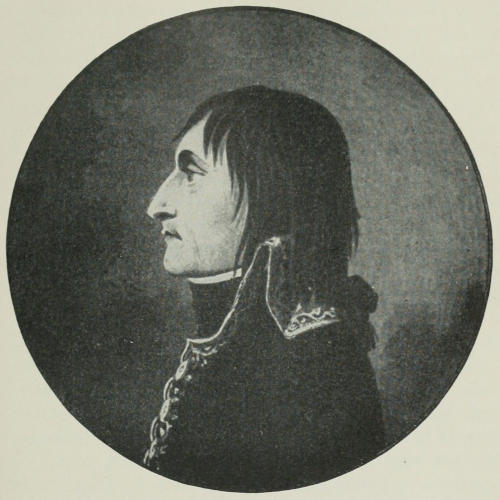
General Bonaparte in 1797. Drawing by Wocher in Basle. Town Library, Basle.
This carefully worded epistle goes as a herald to Paris. The people there must be told who is on the way. His northward journey is a via triumphalis; salutes are fired everywhere. Passing through Valence, he recognises among the onlookers the good woman who keeps the café where he used to lodge, the place with the billiard room; he gives her a keepsake from the East. In Lyons, he waits two or three hours to see the performance of a hastily extemporised drama, “The Hero’s Return.” Everything shows the powerful spell already exercised by his name. Perhaps the most signal instance is the sensational end of Baudin, one of the best of the deputies, who utters a shout of joy on hearing the news of Napoleon’s return, and drops dead from surcharge of emotion. The light that radiates from the commander is so strong that it kills.
Paris draws near. He is still gathering news. But about private affairs, about Josephine, he can ask no questions. Is he already a divorcé? Where are his brothers? The news of his coming has been noised abroad; why has no one come to meet him? She, where is she? Will she, after all, be waiting for him in the mirrored room, ready to welcome him with a smile? In the grey dawn he passes the octroi, drives along the outer boulevards, turns into his own little street. There is the house. A woman stands alone at the door. Who is it?
His mother.
XVIII
“Bonaparte’s landing is one of those events which at first we hesitate to believe. The news spread over night at theatres and in social gatherings. In the most obscure pot-houses, people were drinking to celebrate his return....” “Every one hails him with delight, for he brings us new hope....” “Glory, peace, and happiness follow in his train.”
These and similar items catch Bonaparte’s eye as he flutters the newspapers. Day by day he can read an abundance of details, mingled truth and falsehood, concerning his aspect, demeanour, and dress. Even the opposition press pins its hopes on him: “His Egyptian campaign has miscarried; but what matter? He is satisfied with having undertaken it, and it is difficult to say whither his rashness may lead. All the same, his bold ventures restore our courage.”—He is received with acclamation, and his plans are consolidated.
But his wife is away. When the news that he had landed reached Paris, she was dining with Gohier, the first of the five Directors. She and her host were equally alarmed. Both had uneasy consciences, and now the volcano was rumbling beneath them. Some time ago, Barras (who during this period seems still to have been an occasional recipient of her favours) had advised her to procure a divorce from the absent and almost vanished adventurer, and to marry handsome Hippolyte. She had received no letters from Napoleon. If he had written any, they must have miscarried. But her brother-in-law’s hostile attitude showed her what was in the wind. Barras was right. She would do well to act first.—Then Paris was electrified by the news of Napoleon’s great victory over the Turks. Perhaps it would be wiser, after all, to stay in her present safe harbourage. Unstable and frivolous, she had of late been coquetting with the thought of reconciliation. A glance at her own image in the mirror, a knowledge of the way she could turn men’s heads, sufficed to convince her of the possibility.
Now, at Gohier’s table, she pulls herself together, and her host tries to outdo her in self-command. They drink to the general’s return. She hurries home, packs up all that can set off her beauty to the best advantage, and in a trice is driving southward. As her carriage rattles past the barrier, she thinks: “Act promptly, and take the enemy by surprise—is not that the secret of his military success? On the return journey, I shall be with him day and night, and shall win him over before the tale-bearers can get at him!”
But she misses him, learns that he has passed her, and hastens back to Paris. She has lost three precious days, during which his relatives have told him all the scandal. True, some of his intimates warn him against applying for a divorce. In Paris, a cuckold is always a figure of fun. He is resolute, however: “I have done with her. What do I care about the chatter? It will only last for a day or two.” He has her trunks packed, and carried down to the porter’s lodge, so that she shall not enter the house. Could he give plainer proof that he dreads his own weakness?
She comes, breaks through the first line of defence, enters the fortress. He has locked himself in. She calls to him and pleads with him through the door. During her journey, the more she has come to realise that his name is in every one’s mouth, the more fervent have been her hopes for a reconciliation, and the more has her pride been humbled. But the citadel holds out. At length she decides to call up reinforcements for a final assault. Hortense and Eugene must come to her aid. They clamour, beseech, shed tears. Thus a night passes.
No dispassionate observer can fail to understand Josephine’s motives in making this ridiculous scene. What of Bonaparte himself, the man with so profound a knowledge of the human soul? Was he duped by a woman?
There he lies, returned after a long absence, with his head full of schemes for the conquest of a nation. Let us try to follow his thoughts. “They have deceived me one and all. The government, the political parties, my own companions-in-arms, were all endeavouring, during my absence, to exclude me from power, for they regarded me as a danger to themselves. As long as I was out of range, no one wanted me back; my brothers no more than the rest. This capricious woman, whose pretty whims I have never tried to restrain—would it be reasonable for me to expect that she should have spent a year and more thinking of no one but her absent husband, whose return seemed ever more unlikely as the days went by? When I am there, she is fascinating. If I make truce with her now, when the game is in my hands, she will agree to all my conditions, and I can exact guarantees for the future. What a lovely voice she has. There cannot have been any falling off in her charms, or she would not have so many admirers. What a fool, compared with her, was that little woman in Egypt, and even she could not give me an heir. Where shall I find a woman who will make a more perfect lover and a better wife than Josephine? Besides, she has had two children, and may yet have more.”
He opens the door and, heroic in his silence, suppresses, once and for all, the accusations with which his heart is filled. In this matter, as in others, he holds fast to his resolves. Next day she confesses that she is in debt to the tune of two million francs. He pays without a word.
It is hard for his brothers, and still harder for his sisters, to accept the situation; but they do not venture a remonstrance.
Nor is there time for the further discussion of family matters. Events are on the wing. His brothers have not been idle while he has been away. Joseph, after being envoy in Rome, is now on guard as one of the Parisian deputies. Lucien is leader of the opposition, although, being only twenty-four, he is under the legal age. A brilliant orator, dreaded in debate, a Hotspur with a taste for theatrical displays, burning with ambition, too headstrong for constructive work. He and Sieyès have been working at plans for a coup d’état on their own, but they lack the support of a great soldier whom the troops would follow. Now the soldier has come, and Lucien will keep his private wishes to himself. He, too, is a Bonaparte.
Dangerous, inscrutable, and cunning is Joseph’s new brother-in-law, Bernadotte. He is slow in coming to greet Bonaparte. When he does come, and Bonaparte speaks of the desperate situation of the republic, Bernadotte rejoins: “It will be able to make headway against its enemies both abroad and at home!” He looked searchingly at his interlocutor, and for a moment the masterful eyes of the two men clash. But Bonaparte, controlling his emotions as usual, attempts a diversion to political issues, speaks again of the dangers, and then passes severe strictures on the Jacobin Club. Thereupon Bernadotte breaks in: “Your brothers founded it!”
Bonaparte is still loathe to take offence, and replies: “Well, well, General, I would rather live in the woods than in a State where there is no security!”
Bernadotte, mockingly: “Good God! What security is lacking to you?”
Now, Bonaparte is about to make an angry rejoinder, but Josephine intervenes to keep the peace. And yet the hidden fact is that Josephine is, in a sense, the cause of the dissension. For Bernadotte has married Désirée Clary, to whom Napoleon had once paid court, with whom he had not found favour when he was still obscure, and to whom he had preferred Josephine when his fortunes were on the mend. Now he can forgive neither himself nor Bernadotte. Throughout his career, Bonaparte will try, by showering benefits on her, to atone to Désirée for what she has lost by not marrying him, though it was mainly her doing that they did not become man and wife. For her sake, he continually advances Bernadotte, who no less persistently betrays him.
All that his brothers and other intimates have told him about affairs in Paris during his absence, their picture of anarchical corruption and violent impotence, fills him with forebodings and urges him to speedy action. The number of the holders of power must be reduced, and their term of office must be lengthened. The government is a plateau; it must become a towering peak. A ten years’ triumvirate—that will be the best plan.