THE MUSIC OF THE NATIONS.
Reading edition
I.—THE 'KING' AND 'OU' OF THE CHINESE.
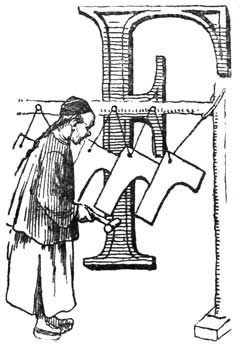
IVE hundred years before the birth of Christ, Confucius declared that 'Music gives finish to the character, which has first been established by its rules of proficiency.' Moreover, he said, 'Wouldst thou know if a people be well governed, and if its manners be good or bad, examine the music it practises.'
When we reflect that the speaker was the most famous sage of the Chinese, to whom temples are built in every town of the vast empire of China, and to whose memory the Emperor himself offers homage twice a year at the Imperial College in Pekin, we may understand what weight his opinions have carried in his own country.
Long before his time, however, music had been studied there as a science. It was imported by the first invaders of the Celestial Empire, who hailed from the borders of the Caspian Sea. The Yellow Emperor, or Huang Ti, who reigned two thousand seven hundred years before the Christian era, established a fixed base note from which musical instruments were to be measured, much as in the modern musical system we take a key-note and found our chords and scales upon it. The connection between musical and State affairs was so business-like in those days that the precedence of the various classes was fixed according to the musical grade: F, the base note of the oldest known scale, represented the Emperor; G, the Prime Minister; A, the loyal subjects, and so on.
The "Tse King."
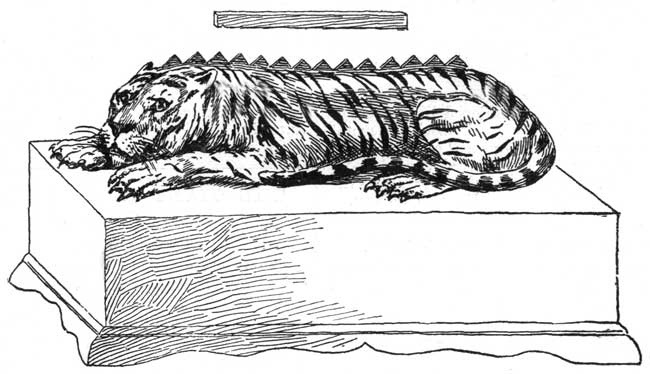
The "Ou" and playing stick.
Five hundred years later another Emperor, of a practical turn of mind, ordered that music should follow the sense of the words, and be simple and free from affectation, and he appointed a censor to see that his instructions were carried out. The latter, 'Couci' by name, declared that when he played upon his 'king,' the animals ranged themselves before him spell-bound by his melody.
We hear elsewhere of another ancient musician of China, whose music was 'so sweet that the very stars drew near to listen.' Later on in the history of the world we find this idea of the effects of music on animals and stars entertained both in Greece and India. The attention of the starry bodies can only be regarded as a beautiful myth, but the writer of this paper personally tested the animal love of music some years ago, when surrounded by a formidable herd of wild cattle in the Rocky Mountains.
The instrument known as 'king,' from which Couci drew such delightful sounds, is of very ancient date, and is made of a stone called 'yu,' which is of many colours, and looks like marble, being probably a form of agate intermixed with iron. The wonderful clearness and purity of the tone are supposed to result from long exposure to the sun and air.
'Yu' is most valuable when of whey colour; then light blue, dark yellow, orange, dark red, and pale green follow in order of merit. In all the colours it is essential that the stones be free from streaks or flaws of any kind. One of the chief attractions of the 'king' is that it always retains its pitch, not being influenced by cold, heat, damp, or dryness.
In construction the 'king' consists of sixteen stones hung in two rows of eight in an ornamental frame. Nowadays these stones are cut in oblong shape of varying thickness, tuned by slicing narrow shavings off the back and ends; but in former days they were fashioned like fishes, animals, or other quaint devices. The art of making 'kings' was lost for many centuries, but about 32 B.C. a specimen was fished up from the bottom of a pond which served as a model, and now every temple of importance has its 'king,' just as every church with us has its organ of some kind or other.
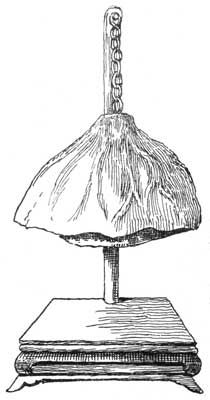
A smaller instrument of the same kind is also used in religious ceremonies, the 'the king,' made of one large block of 'yu,' suspended from an upright. It is played like the real 'king,' by being struck with a special stick or plectrum, and the tone, though less varied than that of the larger instrument, is equally deep and full.
Another curious Chinese instrument is the 'ou,' which is made of wood, and fashioned like a crouching tiger. It is hollow, and along its back run metal teeth, which are played with a small stick or brush. The 'ou' stands on a hollow pedestal, also of wood, which serves as a sounding board and increases the tone.
Helena Heath.