THE MUSIC OF THE NATIONS.
Reading edition
XI.-SOME SIAMESE INSTRUMENTS.
HE kingdom of Siam, though small compared with such huge countries as Hindustan and China, takes up the chief part of the great Malay peninsula. With the exception of Japan, no Eastern country has made such wonderful advancement in civilised improvements as Siam. Telegraphs, tramways, railways, and electric lighting form part of the equipment of this go-ahead kingdom. The army was many years ago modelled on the British system, and trained by European officers, and the King, a man of considerable cultivation, welcomes foreigners as teachers of Western ways.
Bangkok, the capital, is a curiously picturesque city, the architecture being of the most original design, whilst the decoration of the many temples, gilded minarets, roofs of gaily coloured tiles, and quaint pagodas, make quite a feast of colour to European eyes. The native costumes are in keeping with their surroundings, graceful in form and bright in colour. Many of the natives live practically on the water, as for miles above and below the capital, on both sides of the river, floating houses are moored, supported either on rafts or on bundles of bamboos.
Music has always played an important part in the national life, and the present King has greatly encouraged the art. Both men and women all over the country are more or less musical, and a great number play some form of instrument, often joining in concerted music. The Siamese have four kinds of bands, divided, as we divide our orchestras, into brass or stringed bands, each with a certain combination of instruments. Some years ago, at one of the London Exhibitions, the King of Siam sent over players of all the national music of his country, and their concerted performances excited great interest: the way in which they played together showed most careful training.
Ta'khay, or Alligator.
Saw Tai.
Saw Ou.
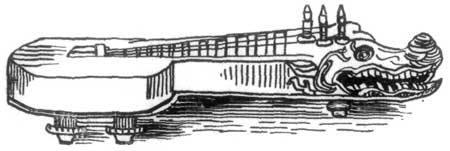
A very curious instrument is known as the Ta'khay, or Alligator: a glance at its form will readily account for its name. There seems a sort of satire in making one of the most silent of savage monsters a medium for the conveyance of sweet sounds. The Ta'khay is a stringed instrument of considerable power, and in tone is not unlike a violoncello. The three strings pass over eleven frets or wide movable bridges, and the shape of the body is rather like that of a guitar. It is placed on the ground, raised on low feet, and the player squats beside it. The strings are sounded by a plectrum, or plucker, shaped like an ivory tooth, fastened to the fingers, and drawn backwards and forwards so rapidly that it produces an almost continuous sweet dreamy sound.
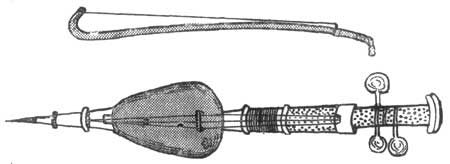
The other two illustrations are both of fiddles, one bearing the name of the Saw Tai, the other of the Saw Ou. The Saw Tai is the real Siamese violin, and is frequently of most elaborate construction. The upper neck of the one shown in the illustration is of gold, beautifully enamelled, while the lower neck is of ivory, richly carved. The back of the instrument is made of cocoa-nut shell, ornamented with jewels. The membrane stretched on the sounding-board, which gives the effect of a pair of bellows, is made of parchment, and has often, as in this special instrument, a jewelled ornament inserted in one corner. The Saw Tai has three strings of silk cord, which, passing over a bridge on the sounding-board, run up to the neck, being bound tightly to it below the pegs. The player sitting cross-legged on the ground holds the fiddle in a sloping posture, and touches the strings with a curiously curved bow.
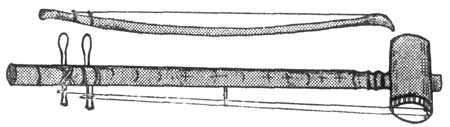
The Saw Ou, or Chinese fiddle, used in Siam, is suggestive of a modern croquet mallet, with pegs stuck in the handle, and has only two strings, fastened from the pegs to the head. It is played with a bow which the performer cleverly inserts between the strings.
Helena Heath.