A HUNDRED YEARS AGO.
Reading edition
True Tales of the Year 1806.
X.—WILLIAM PITT: BORN 1759, DIED 1806.
N May 28th, 1759, there was born at the pretty little village of Hayes, in Middlesex, a puny babe, who in after years was to be one of the greatest statesmen of his time.
The year of his birth was one of many British successes, both by sea and land; it was the year of the victories of Minden, in Germany, and of Quebec, in America, and of triumphs both in India and Africa, so that Horace Walpole in a letter of that time says, 'One is forced to ask every morning what victory there is, for fear of missing one.'
Pitt was a most precocious child, and was fond of reading stiff books of history and poetry at an age when other children barely knew their letters. Even whilst in the nursery he would declare that 'when he was a man he would speak in the House like his father!'
Lord Chatham, his father (the elder Pitt, as he is often called), was proud of the intelligent little fellow, and took pains to fit him for a Parliamentary career by teaching him elocution, and making him recite every day a passage from Milton or Shakespeare. Lord Chatham seems to have taken more interest in the education of his five children than was usual among parents of his day. We are told by Bishop Tomline that 'he seldom suffered a day to pass without giving instruction of some sort to his children, and seldom without reading a chapter of the Bible with them.'
William was so delicate that he was never sent to school, and at one time it was feared he would not have been reared; but a doctor prescribed liberal doses of port wine, and this 'pleasant medicine,' we hear, pleased the child, and he drank a great deal of it daily. Though at the time it seemed to suit him, yet there is little doubt it planted the seeds of the disease which was to carry him off before middle age.
At fourteen, William's tutors said that he knew more than most lads at eighteen and was quite ready for College, so he was sent to Oxford, where he amazed his tutors by his wisdom and learning. At seventeen he left the University with the degree of M.A., which was, at that time, unwisely given to the sons of peers without any examination.
He then studied for the Bar, and attended the Western Circuit, and at the age of twenty-one he put his foot on the first rung of Parliamentary fame, by becoming Member for Appleby. His success was almost instantaneous, and after his third speech, one of the Opposition remarked to Mr. Fox, who was Pitt's life-long rival, 'Mr. Pitt promises to be one of the first men in Parliament,' to which remark Fox answered generously, 'He is so already, sir!'
Pitt's voice was singularly clear and deep-toned, and he had been well trained as to the use to make of it, but his personal actions were too vehement, and one wag remarked, 'Mr. Fox, in speaking, saws the air with his hands, but Mr. Pitt saws with his whole body.'
At twenty-three Pitt became Chancellor of the Exchequer, and in the following year the young man became Prime Minister, the youngest Prime Minister who has ever sat in the House of Commons.
His administration was at first highly successful, but his genius was better fitted for peaceable and domestic government, than for the warlike policy which circumstances thrust upon him.
When in 1792 the French Revolution broke out and a war with France seemed inevitable, and when the power of Buonaparte became alarming to every government, Pitt succeeded in forming a coalition of Austria, Russia, and England, and felt perfectly confident of opposing a barrier to the ambition of 'the Corsican.'
But while the Russian troops were slowly coming up from Poland, Buonaparte swiftly assembled together a huge army, and defeated the Austrians at Ulm. The news of this defeat came to England in a roundabout way in a Dutch newspaper. Pitt received it on a Sunday, when all the public offices were closed. He knew no Dutch himself, and feverishly anxious to learn what had happened, he be-thought himself of Lord Malmesbury, who had been our Minister in Holland, and he took the paper to him to translate.
When Pitt was thus informed of the defeat of our ally, his grief was unbounded, and though a few days later he heard of the victory of Trafalgar, yet this was overshadowed later on by the French victory of Austerlitz, a disappointment which left Pitt a broken man.
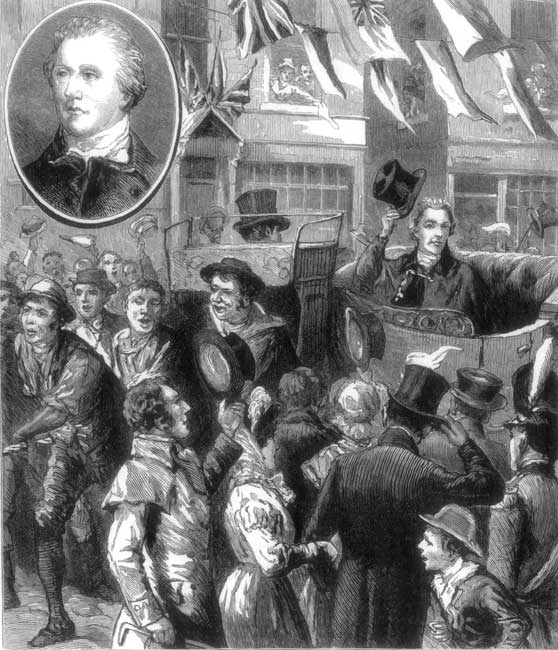
His last public speech was at the Lord Mayor's banquet after the battle of Trafalgar, when the crowd, carried away with the victory, took the horses out of Pitt's carriage and drew him along in triumph to the Mansion House.
The Lord Mayor proposed Pitt's health and hailed him as the 'Saviour of Europe,' but Pitt in his answer made use of the following memorable words: 'I thank you for the honour you have done me; but England is not to be saved by a single man. England has saved herself by her exertions, and will, I trust, save Europe by her example.'
Pitt had now but a few more weeks to live. He died on January 23rd, 1806, the twenty-fifth anniversary of the day when he first took his seat in Parliament, and his death was undoubtedly hastened by his distress at the state of affairs between France and England.
"The crowd drew him along in triumph."
He was awarded a public funeral, and on one of the monuments erected to his memory it is recorded that 'having for twenty years dispensed the favours of the Crown, yet he ever lived simply and died poor.'