PEEPS INTO NATURE'S NURSERIES.
Reading edition
XII.—ONE OF NATURE'S FAILURES.
We have now come to the last chapter of our series, and herein I propose to bring to your notice some curious facts which 'point a moral and adorn a tale' that should not be lost sight of.
Strange though it be, there are many creatures, among what we sometimes call the 'lower order of creation,' which give promise of great things during the earlier period of their lives, but later degenerate out of all recognition.
Let us take one or two of the more remarkable instances. Many of you, when at the seaside, must have found, clinging to rocks and shells, peculiar, tough, leathery and somewhat bottle-shaped bodies, popularly known as 'sea-squirts,' from their habit of squirting out water when touched. But how many of you have any idea that these same 'squirts' really belong to the great division of vertebrates or backboned animals? Yet such is the case, though not even scientific men were aware of this until the facts which I am about to relate were discovered.
But before I proceed, I might add that while some of these sea-squirts lead solitary lives, fast anchored to the rock or sea-weed, others form colonies, while yet others, and more distantly related forms, are transparent and swim, sometimes in countless millions, at the surface of the sea, covering an area of several miles. Some of the stationary forms make coats for themselves of sand, others build them houses to live in. While most are dull-coloured, some are, on the contrary, very brilliant. Their range in size is no less varied, some being almost microscopic, while others attain a length of as much as four feet.
But though so different in their adult stages, they all begin life as vertebrated or backboned animals, though in some this stage is more perfect than in others.
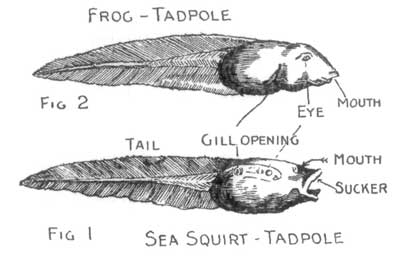
As you will see in the illustration (figs. 1 and 2) of one of these youngsters, the resemblance to the tadpole of the frog is most striking, and in some of the points wherein the sea-squirt differs from the tadpole, it represents a yet earlier structural stage which frogs have long since passed through, and no longer repeat in the course of their growth. Take the case of the eye, for example; this in the young sea-squirt lies embedded in the brain, and is only dimly able to perceive light received through the transparent head; but the eye of all the backboned animals is really an outgrowth of the brain which has forced its way to the surface; here we see it in its primitive or original condition. The mouth in the young sea-squirt, again, opens on the top of the head instead of in the front, which is here modified to form a sucker. But the gills, by which this little creature breathes, expel the water by which they are bathed through a single hole at the side of the head, as in the frog tadpole; while in the possession of a brain, a spinal cord, and a soft backbone, both sea-squirt and tadpole agree.
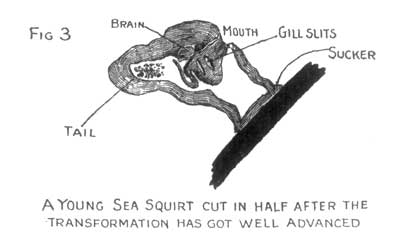
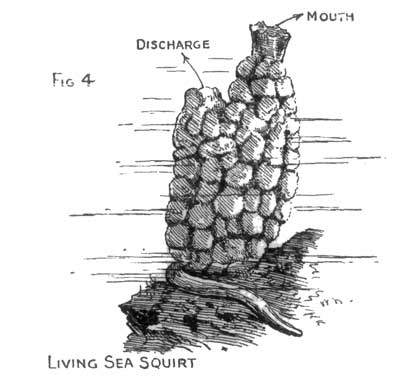
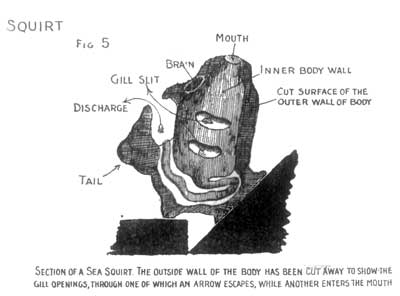
Thus, then, the captor of one of these baby sea-squirts though he knew nothing of the peculiar after-history of the creature, would yet be sure that he had here a very young or 'larval' stage of one of the backboned animals. But he would be surprised indeed, as he watched the career of this little creature, to find it grow daily more sluggish, and at last fix itself by the sucker at the front of its head, and there remain as if in 'the sulks.' From this time onwards the change for the worse grows rapidly. This creature, as if indifferent to the great possibilities before it, or caring nothing for the good name of its race, speedily degenerates. As it will use none of the good gifts of Nature, one by one she takes them away—eye and brain are the first to go; then the tail begins to grow less and less (you can see the last remnants of a tail in fig. 3), and finally there is neither head nor tail, power of sight, nor power of motion; all that remains is an irregular-looking leathery lump, which scarcely seems to be alive (fig. 4). It feeds by drawing water through a hole at its upper end into a great throat pierced by gill-slits (shown in fig. 5, which represents a sea-squirt with the outside wall cut away); the water passes out through the slits into a big chamber. From this chamber the water escapes by another hole (marked 'discharge' in fig. 5) to the outer world again; meanwhile, the food, consisting of microscopic animals, has been caught by a moving rope of slime running along the back of the throat, and so into the stomach. But what a fall! Think of it—a career full of promise, the equal of that of vertebrate animals, ending in an ignominious surrender of its birthright, and a drop to the level of the humble oyster!
W. P. Pycraft, F.Z.S., A.L.S.
"'Some one is lost in the snow, and Lassie knows it.'"