A HUNDRED YEARS AGO.
Reading edition
True Tales of the Year 1806.
IV.—A GOOD CONSTABLE.
A hundred years ago the streets of London were very insufficiently guarded. Of police, as we now understand the word, there were none, but at night the public buildings and principal thoroughfares were handed over to the care of aged and decrepit men, called 'Charlies,' who, being too old to work by day, were supposed to be able to take charge of the streets by night!
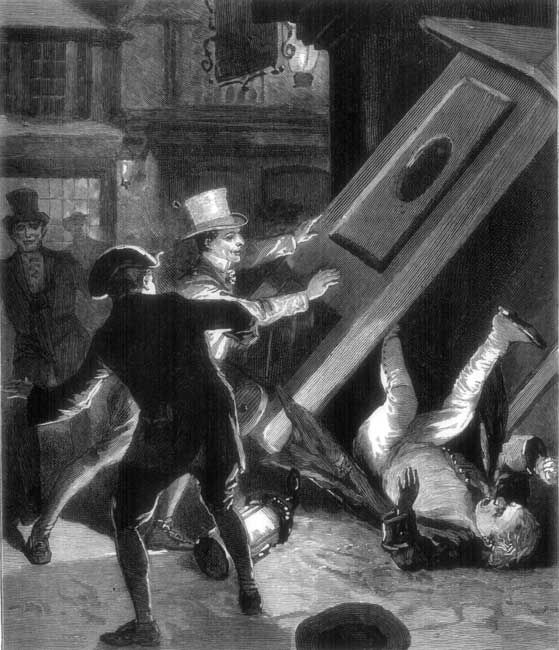
These 'Charlies' were furnished with staves and lanterns, which were often violently wrenched from them, for it was then a fashionable amusement of wild young men of the upper classes to 'go on the ran-dan,' as it was called—that is, to run up and down the ill-lighted streets, knocking down first one old Charlie and then another, and carrying off the staff and lantern as trophies. A young fellow who managed to upset a wooden watch-house, with a poor old man inside, was very proud of himself indeed, though, maybe, the old 'Charlie' was meanwhile being almost suffocated to death with the watch-house on the top of him.
Besides 'guarding' the streets, these old watchmen had to announce each hour as it struck, and to give the news of the weather; thus: 'Past one o'clock and a windy morning!' Once, when many Londoners were expecting an earthquake, which had been prophesied for that day, some jesters, returning from a noisy tavern-meeting, frightened the householders by calling out, as they passed along the streets, 'Past twelve o'clock, and a fine earthquake!'
It is needless to say that robbery and ill-doings of all kinds were of nightly occurrence, and no decent person was in the streets of the City after dusk except by necessity, for neither life nor property was safe from the ruffians who then roamed about.
So things went on until the time came when Mr. John Sewell, a bookseller, was appointed Constable for the Ward of Cornhill. He was a very energetic man, who had long been ashamed of the state of the City streets, and he determined, now that he was in office, to try and introduce some reforms. The first thing he decided upon was to serve as constable in person, instead of providing substitutes, which had been always done by former Head Constables.
His friends were shocked at the idea of a respectable bookseller acting as a common constable, but Mr. Sewell was not to be moved from his purpose, assuring them 'that the office of Constable was of too much importance to be executed by every one.'
He first of all put a stop altogether to the wooden watch-houses which were wheeled out every night, and placed against the Bank and other public buildings, and, instead, converted the back room of his shop into a guard-room. Here he and many of his friends would keep watch, when his turn for service came round, which was every fourth night, and they would go the rounds of his ward, seeing that every man was in his proper place. Mr. Sewell so arranged his men that every house in his ward was passed by one of them four times in the hour, and he would constantly pay surprise visits to be sure that all were attentive to their duties.
The public executions were his next care, for hangings were in that day, alas! of weekly occurrence. Instead of the ribald scenes and unseemly jokes which accompanied the progress of the unfortunate wretches to Tyburn, Mr. Sewell insisted that a solemn decency should now mark these processions. He had his watchmen dressed in long cloaks, with crape on their hats, which he provided at his own expense; and then, as they marched slowly, two and two, he himself led the procession from Newgate Prison to Holborn Bars, where his authority ended.
"Managed to upset a wooden watch-house."
It is also interesting, in these days of naval volunteers, to find that Mr. Sewell started a 'Proposal for a Marine Voluntary Association for Manning the Ancient and Natural Defences of Old England.'
Altogether, this old Cornhill bookseller was a wonderful man, and might have lived in this day instead of a hundred years ago.
"Scores of angry bees came buzzing round her."