Chapter XVIII
Reading edition
Mrs. Wright had been waiting in great anxiety for the return of Jack. Twenty times over she went to the end of the sandy path to see if the tide was going out, and returned in an anxious state of mind to make preparations for the drenched party. She reproached herself bitterly for carelessness. How could she have trusted so entirely to Julien? She ought to have known he was ignorant of the tides, if not of the caves. Her anxiety was almost more than she could bear by the time the tide had left the gorge. Then she stood on the beach to watch, and it was with a cry of delight that she saw the three coming towards her.
They were all glad of the hot meal which smoked upon the table in readiness for their return, and sat down in very cheerful spirits, in spite of their damp condition. But it was not so pleasant to be hurried off immediately afterwards to bed and warm blankets. Julien, who had not shown much appetite, and still looked pale and shivery, refused to go to bed. Jack would have compelled him, but the boy begged to be allowed to go home, as he felt ill. It really seemed the best thing to do; so, wrapping him up in a big coat, Jack took him to the Préfet's house, and handed him over to his mother's care, not forgetting to say a few words in praise of the courage the boy had shown.
'Now, Jack,' said Mrs. Wright, as he entered the warm kitchen on his return, 'if you want to do something to please me, my son, you will just go and take your wet things off, and turn in for a bit. I will bring you some hot cocoa in a minute.'
Jack laughed; then, stooping, he took his mother into his great arms, kissed her, and went.
The day of Estelle's departure was drawing near. The boat had been prepared, and Fargis had been amiable enough to offer to go with them, taking his usual crew. He realised that his trouble would be paid for, and probably handsomely paid for, into the bargain. The weather was in favour of the crossing, so Estelle and Jack had come for a last walk on the cliff before that sad day came. To Mrs. Wright and her son the loss of the child was a deep sorrow; to Estelle, though she was going home to her beloved Aunt Betty, to the kindest of uncles and aunts, to her most loving cousins, it was a wrench. She loved those dear ones at home deeply, truly. But she loved Goody and her dear, kind Jack. What should she do when she could not see them? Tears came into her eyes, and made the boats and the sea dim. She longed to ask Jack for one thing before she went away. Went away! Oh, why must there be these partings?
Meantime, Jack grieved over the loss of his 'little Missie.' He was sad, and would be sadder when the long winter evenings came, and he missed her at every turn; but there were other anxieties. He must face that English world again from which he had fled in the long years of the past. For Estelle's sake, and because it was his duty, he must take her back to her English home, and he was debating, painfully, bravely, what that journey would mean to him. What would it mean to his mother? She was the dearest and best tie he had in the world. For his sake she had made sacrifices to which few mothers would have consented, had borne hardships few would have faced so nobly. Had he any right, after all she had done for him, to expose her to any chance of evils which this return to England might bring upon him, and, through him, on her?
Estelle, looking up, saw the grief and perplexity in his face, and her heart smote her for her own selfish thoughts. She did not understand how he suffered, but she felt she must comfort him.
'Jack,' she said, swallowing down her tears, and speaking in as steady a voice as she could muster—dear Jack, you have been so good and kind to me! So good, I can't express it! Do let me do something for you. I know you have a secret, and I am afraid it is that, even more than my going, which is making you so miserable. I don't want to pry into it, dear Jack, but remember that my father is a rich man, and he is powerful, too. If you won't mind telling him about it, I know—I am quite, quite sure—he will do anything in his power for you. Think what you have done for me! And he loves me—he has only me now.'
Jack sat silent for some moments, his head on his arms, which were crossed upon his knees.
'Missie,' he said at last, raising his face, 'nobody can help me. I want no help such as your father, or any other rich, powerful man can give. I know you mean it kindly, little girl, but there are some things in which a man must stand and fall alone. Alone?' he added bitterly; 'yes, but he doesn't suffer alone! He drags his dearest and best down with him, let his remorse be what it may.'
'Remorse? Does that mean the man is sorry? Are you sorry for something you have done? Oh, Jack, if you are sorry, Aunt Betty told me once that was all that was wanted. Everybody forgives any one who is sorry.'
'I am not so very sure of that, Missie; but, in this case, there is no question of forgiveness. There is no one to ask it of, for one thing; and if there were, there are some things which can never be forgiven or forgotten.'
'Are there?' murmured Estelle, a little bewildered.
'How should you know—an innocent child like you?' returned Jack, shrinking into himself as if at some terrible recollection.
There was a long pause, while both sat thinking.
'Listen,' went on Estelle, at last. 'I will tell you a story. It is quite true, for I know the man. He is the son of our head gardener. He is a cross old man, and he is often not very nice to us children. But Aunt Betty wanted to make us more patient with him; so she told us what sorrows he had had. They have made him rather grumpy, but his son is very different. The story is all about a great wrong done to that son, and how he forgave it.'
She related the history of Dick Feet almost in the words in which her aunt had told it to the children on the lawn that August afternoon. Jack, listening but carelessly at first, gradually found an interest in it which touched him keenly, but he would not have interrupted the child for worlds. Not a word would he lose. It was so strangely like a story he knew only too well!
'And the grand part was,' wound up the little girl, her earnest eyes on Jack's anxious face, 'the grand part was that he never mentioned the name of the man who did it—not even his father and mother know who it was. He begged them not to mention it if he had by any chance let it out in his illness. But he never had. No one in all the whole world knows but Dick himself.'
'Was his name Dick, too?' muttered Jack to himself.
'Yes,' answered Estelle, who had heard the low murmur, 'his name is Richard Peet.'
'What?' cried Jack, almost starting to his feet in his excitement. 'Is Dick Peet alive?'
(Continued on page 342.)
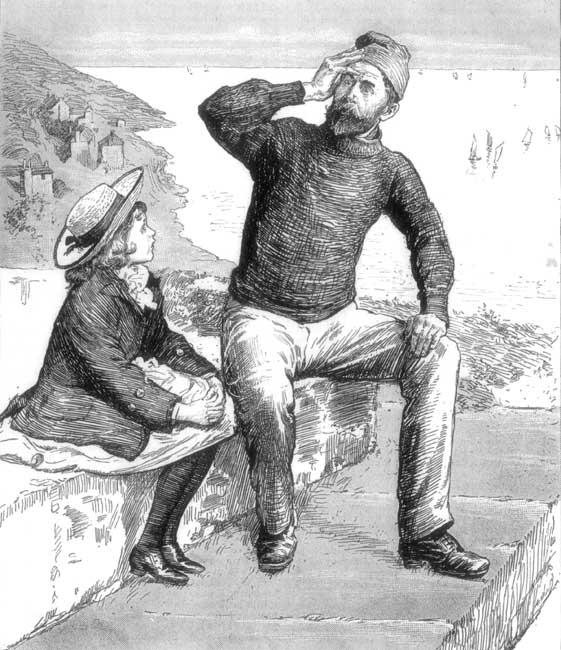
"'What! Is Dick Peet alive?'"
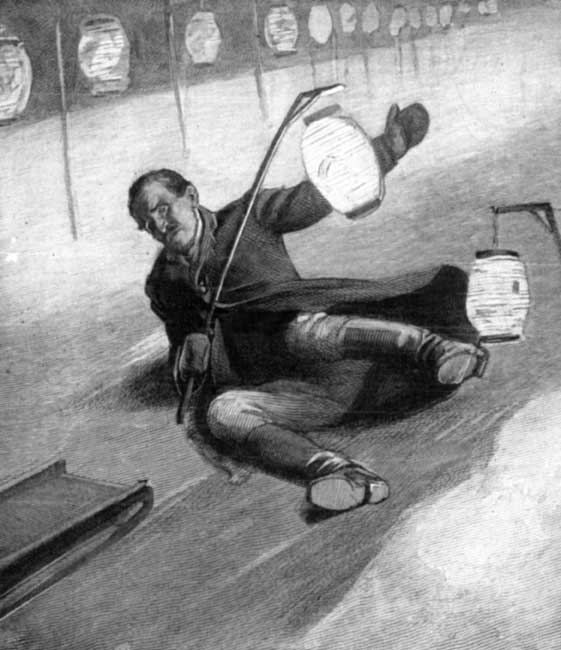
"My partner being the lamp-post!"