PEEPS INTO NATURE'S NURSERIES.
Reading edition
XI.—NURSERIES IN THE BIRD-WORLD.
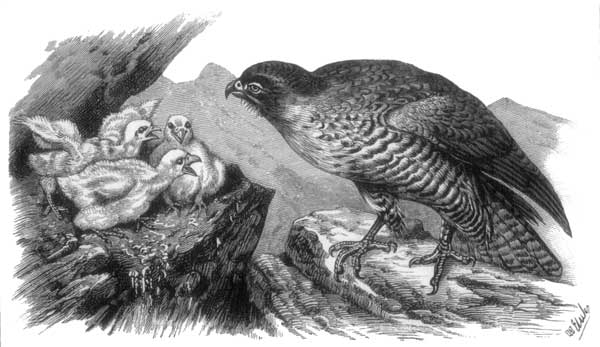
Fig. 1.—Peregrine Falcon, and young ones.
Our survey of Nature's babies so far has been a fairly extensive one, and many readers of Chatterbox have shown that they were impressed with the fact that in every case these have come into the world in a form quite unlike that of their parents. And they have probably also noticed that where this unlikeness was most striking, there, as a general rule, these young had to shift for themselves from the moment they were able to move. Though the majority of these young creatures are to be found in or around the coasts of Great Britain, many are difficult to obtain, and only in a very few cases have we met with any display of care on the part of the parents for their helpless children.
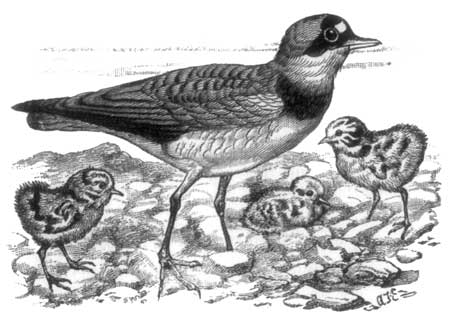
Fig. 2.—Ringed Plover, and young ones.
The unlikeness to the parents is most marked, as we have said, where the young are cast upon the world to look after themselves, often as microscopic creatures. The reason of this is because they have come from eggs which were so tiny that they could not contain enough food to support the growing body within until it had assumed its final shape. In consequence, the little creature had to start life in some more simple form, capable of feeding on the tiniest particles of food. This early development is unavoidable in cases where a single family may number some hundreds or thousands of individuals. But when only a few young ones make up a family, you will notice they are more or less jealously guarded by the parents, and they, furthermore, come into the world more nearly in the shape they are finally to assume.
Many of you, I hope, when you grow up, will be tempted to try and follow out these strange life-histories for yourselves. In this article I propose to describe some of the more interesting forms of young to be met with among the birds, because here, at any rate, you will be able to follow up the facts at once; and a very fascinating pursuit you will find it.
Birds, as every one knows, lay eggs, which, after a time, produce chicks, some of which, like ducks and chickens, for example, can run about and pick up food within an hour or two of their escape from the shell; but for a long time they are most carefully tended by their fond parents, who will brave many dangers in their defence. Now, the difference between the young chicken, or the young duck, and their parents is not very great, and this is because the egg from which they came contained a large supply of food, so that all the building up of the body could be carried on inside the shell. This food is represented by the yolk of the egg, of which there was an enormous store. That this is so you can see for yourselves, if you break an egg into a cup. The little spot in the top of the yolk represents the germ of life that is to form the chick; the rest of the yolk is to be used by that germ as food.
Fig. 3 Skylark, and young ones.
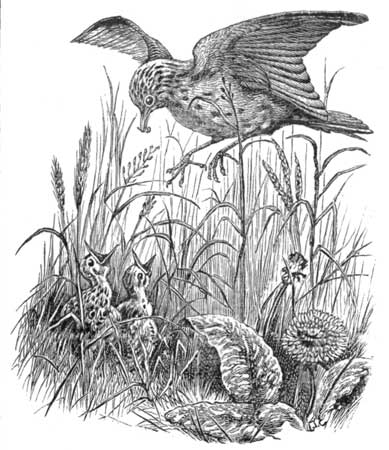
As you doubtless know, however, some young birds, like young rooks and sparrows, thrushes and skylarks, when they leave the egg, are perfectly bare, blind, and helpless, and have to be fed and brooded by their mothers for a long time. Other young birds, like young owls, falcons (fig. 1), and hawks, also leave the egg blind and helpless, but their bodies are covered with long woolly down. Until quite recently no one could say why these differences should be, but at last we are beginning to see a way out of the puzzle. There seems to be no doubt that once upon a time the young of all birds left the shell in a fully active state, and clothed in down; further, we know that these early birds were reared in nurseries amid the tree-tops, and climbed about the branches by means of their legs and beaks, aided by claws in their wings, till at last their feathers grew and replaced the down, and they were able to fly. In course of time some birds took to building their nests on the ground, perhaps because so many young perished every year by falling from the trees. On the ground this danger was overcome. But, among those which chose to stay in the trees, a change was introduced. They took to laying smaller eggs, containing less food; in consequence, the young were hatched before they had reached such a forward state of development as their cousins on the ground; and though this meant far more work for the parents, who had to feed their helpless and blind little ones, the change proved beneficial, because, being helpless, they remained quietly in the nest till their feathers grew, and then they were in no danger of falling, for they saved themselves by flight. These two devices proved so successful that they are followed still—probably always will be. The fact that many young birds which are quite helpless are now reared in nurseries on the ground, as in the case of young skylarks (fig. 3), is a fact of interest; for it shows that the parents have chosen this nesting site comparatively recently, and are of course unable to lay large eggs, which shall produce active young, like young chickens, at will. They have acquired the habit, so to speak, of laying small eggs, and cannot alter it by changing their nesting-place.
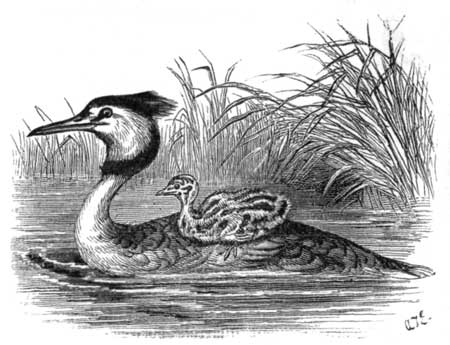
Most young birds which leave the eggs in a forward condition have the down which clothes them curiously striped. This is a device which enables the young bird to resemble the grass and herbage with which it is surrounded, and so escape the eye of prowling birds and beasts of prey. The dark stripes at a little distance look like shadows between stems of plants, while the lighter stripes represent streaks of light passing through foliage. When young birds live in the open, as on shingly beaches, then their down is mottled. How perfectly this harmonises with the surrounding stones only those who have tried to find young terns (fig. 4), or young ringed plover (fig. 2), for example, can tell. But this question of young birds is a big one, and must be taken up again on some future occasion.
W. P. Pycraft, F.Z.S., A.L.S.