THE GIANT OF THE TREASURE CAVES.
Reading edition
(Continued from page 167.)
The mysterious loss of their cousin Estelle plunged the three children into the deepest grief. Alan's sole consolation was that he was allowed to be of the search-party as soon as he was well enough. Marjorie had not this consolation. Georgie had some dim idea of creeping away all by himself to search all their haunts on the common, or in the woods round St. Cecilia's Well; but a timely remembrance of how stern his father could be prevented him. Finally, the thought of Aunt Betty, and how sorry she would be if he disobeyed orders and went wandering all about the country alone, made him give up the desire. But it seemed very hard to be obliged do so.
"It seemed as if the whole roof must be coming down."
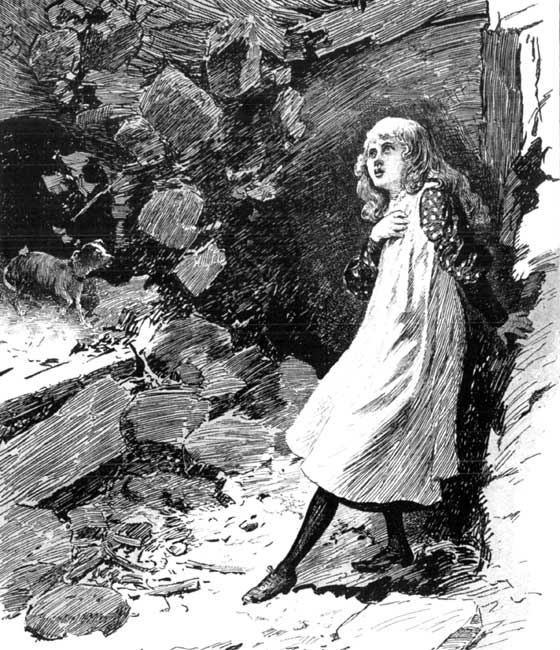
Marjorie was overwhelmed with grief, and shut herself up in her room that she might be alone, since she could not talk to her mother. Lady Coke being seriously ill, Mrs. De Bohun was unable to leave her for more than a few minutes now and then. It was a terrible time for them all, especially as day after day passed and no clue came to guide the searchers. Colonel De Bohun was constantly stirring up the police, or riding about the country, with Alan at his side, trying to gather some information. Nor were he and Alan alone in the search. The whole neighbourhood, rich and poor alike, were on the alert, in doing all in their power to help, though their efforts were fruitless. On hearing all that Alan had to tell, many believed that Estelle must have been crushed under the falling stones; or else, should she have succeeded in getting through the passage, she must have fallen into the sea, and have been swept away by the tide.
Colonel De Bohun consequently consulted the sailors at the coastguard station. The officer, who was a personal friend, said that the tide had been quite deep enough at the hour mentioned to have swept the little girl away, and the currents were very strong in and around the bay. The evening had been memorable to him, for a French fishing vessel had been daring enough to ply its nets in English waters—that is, within the three-mile limit—and he had sent the news to one of the revenue gunboats. The stranger had, however, been so cleverly handled that it had got away in time, and no chase had been made.
Meantime the Earl of Lynwood had to be informed. No one was surprised when a telegram was received telling them that he had started for home, and would be with them as quickly as train and boat could bring him. This news depressed the children even more. It seemed to them that all hope of finding Estelle must have been given up before so serious a step as sending for their uncle had to be taken. But this their father denied. He comforted them with hopes that their uncle might think of fresh measures which might be more successful in discovering some trace of their cousin.
Lord Lynwood's arrival certainly caused the search to be renewed with vigour; but, alas! as time went on, hope dwindled, and there was scarcely a person who believed the little girl to be alive. Lord Lynwood was almost the only person who refused to give up the search. It was quite possible, he said, that she had been carried off by Thomas or his companion, in spite of Alan's not seeing her with them.
Clinging to the idea, the Earl sent for detectives and put the matter into their hands. They had means for carrying out their researches at home and abroad, which must, he considered, lead to obtaining some information sooner or later.
Meanwhile, the Earl lingered on at the Moat House as long as his leave of absence allowed, hoping to see his aunt become a little stronger, and to give her what comfort he could by his presence. Her patient trust in Him Who could bring good out of evil was a great consolation to the saddened father in the sorrow that had fallen upon him.