A HUNDRED YEARS AGO.
Reading edition
True Tales of the Year 1806.
III.—THE CAPTURE OF BUENOS AYRES.
The long sea voyage was over at last, and the Expedition which had set sail from England in the previous autumn cast anchor in the bay outside Buenos Ayres on the 26th of May, 1806.
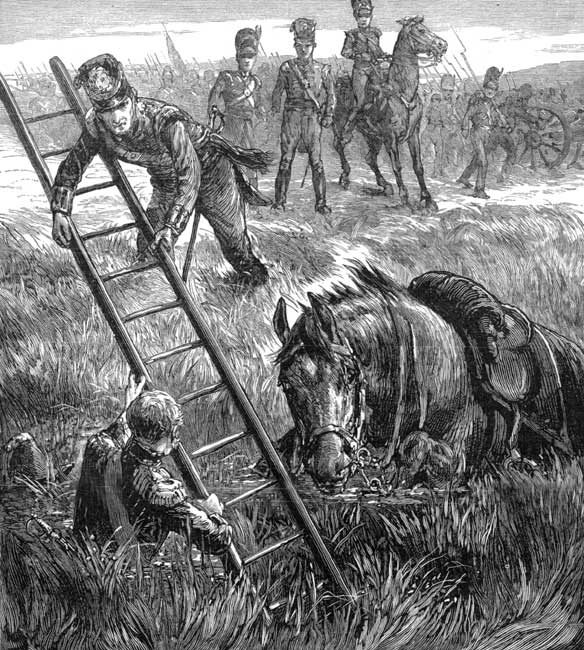
"He seized one of the ladders."
This city, the capture of which was the object of the Expedition, lay very dimly outlined in the western horizon, for the sea was too shallow to allow the larger vessels to approach within six or seven miles of the shore, and even when the troops had landed, three miles or more of a perfectly flat plain would have to be traversed before they could arrive at the city itself.
'Will the Spaniards fight, do you think?' asked Gerald Anstey, a young ensign of marines, as he stood on the deck of H.M.S. Narcissus, and strained his eyes towards the direction of Buenos Ayres.
'I expect so,' answered a brother-officer who was by his side. 'But hallo, Anstey! here is the General's orderly—what is up, I wonder?'
A trim private advanced towards Anstey, and said respectfully: 'The General wishes to see you in his cabin, sir.'
'The General! To see me!' ejaculated Anstey, turning to his friend in utter amazement. 'What can he want with me?'
'To consult you as to the best manner of landing the troops, perhaps,' laughed his friend, for Anstey was the youngest ensign in the regiment. 'But you had better make haste and present yourself, for Sir Popham Horne is not the man to be kept waiting.'
Anstey hurried away. On entering the General's cabin he saluted, and then waited to receive the orders of his commanding officer.
'Mr. Anstey,' said the General, looking up, 'I have sent for you, as junior officer, as I wish you, immediately on landing, to proceed to the Governor of Buenos Ayres and give him these dispatches, proposing to him the unconditional surrender of the town, as I am anxious to prevent useless shedding of blood. You will take a corporal and two men with you as guard, and of course a flag of truce, and I hope you may be successful in your mission.'
'I will do my best, sir,' said Anstey, quietly. Then the General returned to his map, and the young man left the cabin.
Meanwhile, the preparations for landing were being rapidly proceeded with, and some twenty-four hours later men and guns were all safely landed on the sandy shore, and all eager to march towards the city. First of all, however, they had to wait for the return of Anstey, and hear whether his terms had been accepted by the Spanish Governor. Towards sunset the young ensign came back, and great was the excitement among the whole force on hearing that the Governor had refused the terms offered by the British General, and that the march towards Buenos Ayres was to begin at dawn on the following day.
It seemed as if this march would present no great difficulty either to men or guns, as the plain to be traversed was an immense flat, green meadow, which promised an easy road for the cannon. But the 'green meadow,' which proved so satisfactory at first, became softer and looser as they got further inland, and finally it ended in a treacherous bog, which threatened to engulf both men and guns; and to make matters worse, the enemy, entrenched behind some trees at the little village of Reduction, a mile or so away, now opened fire on our troops, as they struggled to get across the morass.
It was soon evident that progress in that direction was an impossibility, and very reluctantly the General gave the order to retreat. But it was almost as impossible to retreat as to advance, for the ground, trodden by the feet of so many men and horses, was now but pulpy mud, in which the gun-carriages sank to their axles.
A British force, however, is not easily discouraged, and the men of all ranks worked with almost super-human energy, till at last the whole army had once more a footing on firm ground.
The General had been invaluable at this crisis; he was here, there, and everywhere where the difficulties were greatest, and was one of the last men to leave the morass, having insisted on seeing all the force safely over. He was then riding alongside the rearguard when his horse staggered, recovered itself for a moment, and then sank with the General heavily into the morass.
'All right! all right!' he called out cheerily to an officer who ran to his assistance; 'I am not hurt in the least.' The next minute, however, he called out in a very different voice, 'Help! help! I am sinking!'
It was indeed true! He had fallen on to a bad patch of marsh. The morass seemed now to be rapidly changing into a quicksand, in which the General and his horse who had gone to his assistance were gradually sinking.
Other men were about to rush in, when they were stopped by the loud tones of Anstey. 'Stop! stop!' he cried energetically. 'You can do no good rushing in like that, you will only get engulfed yourselves. I know these bogs—I have lived in Ireland.'
As he spoke he had seized one of the ladders which were fortunately carried with the force in case they should be wanted for scaling, and holding this out across the oozy patch, he let the General support himself by it for a moment. Then he laid the ladder flat, and crept along it till he reached the still sinking man: he caught him by the arm at once, and started to haul him out. Anstey's strength was well known in the regiment, and perhaps he was the only man who could have dragged out the General by sheer force of arm, but he did it somehow, and the cheers of the men simply rent the air as they saw their loved commander safe once more.
'Thank you, my lad,' said the General simply, as soon as he was on the ladder; 'you saved me from an ugly death. I shall not forget you.'
Nor did he. Later in the day Buenos Ayres was captured, with but slight loss to the British. Four thousand Spanish cavalry fled away inland, leaving the artillery and all the treasures of the city to be the spoil of the army, and that same evening Anstey was once more summoned before the General, and told that to him would be entrusted the honour of conducting to London the precious stones and jewels and the other treasures found in the city coffers.
On September 20th of the same year a strange procession might have been seen passing along Pall Mall to the Bank of England. First of all came eight waggons loaded with gold and precious stones, each waggon being preceded by a Jack Tar carrying a flag with the word 'Treasure' on it. Then came the field-pieces and the Spanish colours captured at Buenos Ayres, and last of all rode Gerald Anstey—the proud guardian of these valuable trophies.
The jewels, stones, and boxes, containing over a million dollars, were deposited at the Bank of England, and the colours and field-pieces were taken to the Tower of London, where those interested in such matters may still see them.
History, however, compels us to state that the capture of Buenos Ayres was but a short-lived triumph, as it was wrested from us in the following year.