PEEPS INTO NATURE'S NURSERIES.
Reading edition
IV.—THE LIFE HISTORY OF THE CRAB.
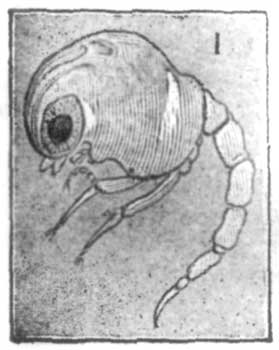
Fig. 1.—Young Crab: first stage.
HE more we study the living creatures around us the more wonderful they become; and in many ways this is especially true of what we may call the little people of the lower world. Most of us regard the crab as a creature good to eat, or, in the case of some of the smaller kinds, as something to be hunted for in rock-pools at the seaside; but only a very few appear to know anything of the crab in its infancy.
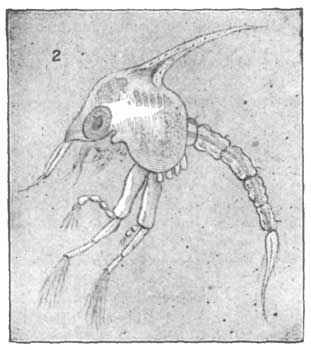
Fig. 2.—Young Crab: second stage.
What we may call the childhood of the crab makes a really curious story. Boys and girls, until they are quite grown up, are, as a rule at any rate, carefully nursed and shielded from the hardships of life; but with the young crab it is otherwise. From the moment of its birth it is called upon to enter life's battle alone; of brothers and sisters, mother and father and home, it knows nothing. And such a tiny little mite it is, too, needing a microscope to see it. Stranger still, at this early period of life it is not the least bit like a crab; for a crab, as most of us know it, is a creature with a shell broader than it is long, and long legs, and a pair of pincers which can give a most painful nip to unguarded fingers. As a youngster, however, he presents a very different appearance, as may be seen in fig. 1. That is what he looks like just after leaving the egg—a creature with a huge eye, a big round body, and a long, slender tail—a sort of compromise between a crab and a lobster, but without the familiar legs and pincers.
Fig. 3.—Last stage of Crab's Infancy: back view.
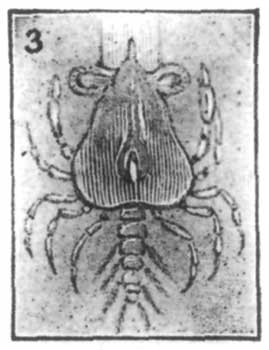
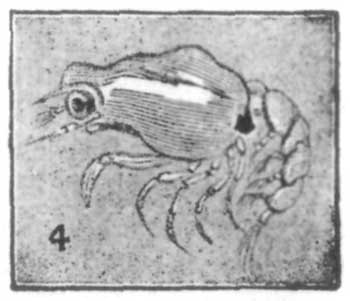
Fig. 4.—Side view of Fig. 3.
A little later he assumes a form which is certainly fantastic, for from the top of the shell (as you will see in fig. 2) there grows out a long, curved spine, while the legs have taken a shape suggesting jointed paint-brushes. Later still the eyes grow out from the head and are supported on short stalks, the legs and pincers appear, and lastly the long tail curls up, till at last it grows into a curious three-cornered shield and is carried tucked away under the body. As soon as this takes place he becomes at once the crab with which we are familiar, and changes no more except in size.
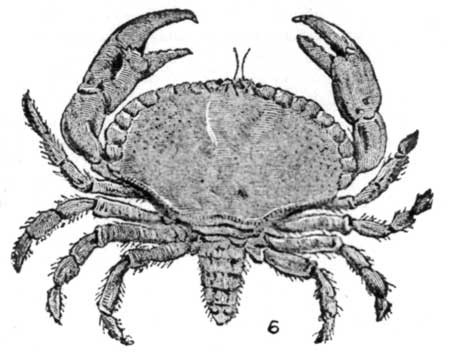
The strange flap hinged to the hinder edge of the body of the adult crab, and held close to its under surface, really answers to the long body of the lobster. To make this clear, look at the series of figures 3 to 6: fig. 3 shows the back view of the last stage of the crab's infancy, and fig. 4 a side view of the same, where you will note that the tail is already beginning to curl up. In fig. 5 you have the under side of the full-grown crab with all that remains of the hinder part of the body and the tail in the position in which it is carried during life, and in fig. 6 the upper side with the tail showing as if it were unfolded. If you compare figs. 5 and 6 with fig. 7 (a lobster), you can see that the hinder part of the body of the crab, with the tail unfolded, really does answer to that portion of the body of the lobster which lies behind the last pair of legs.
Fig. 5.—Full-grown Crab, under side, showing tail curled up.
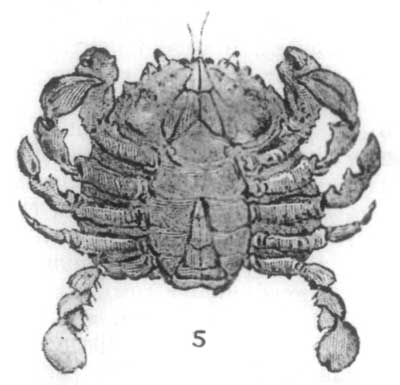
Fig. 6.—Full-grown Crab, upper side, with tail unfolded.
But there are some relatives of the crab which come into the world still earlier, and these in the early stages have a still more un-crab-like shape which is known as the nauplius stage of growth.
The crab, on leaving the egg, enters the world not in the form of a Nauplius, but as a 'Zoea,' as it is called; this is shown in figs. 1 and 2. By the time the stage shown in figs. 3 and 4 is reached, he has attained the dignity of what is known among scientific men as the megalopa stage. What a nauplius looks like you will see in fig. 8.
Fig. 7.—Lobster.
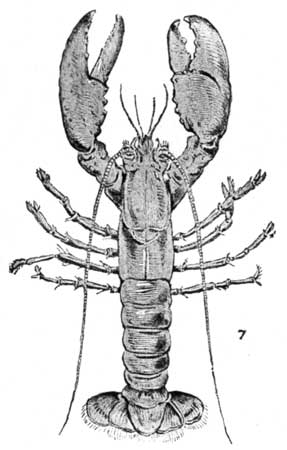
Fig. 8.—Nauplius.
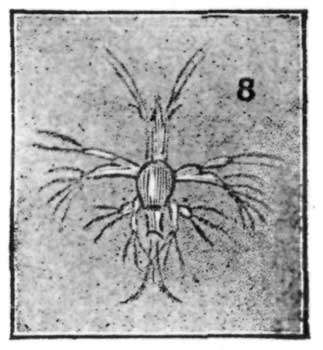
Fig. 9.—Swimming Foot of Crayfish, with the young ones attached.
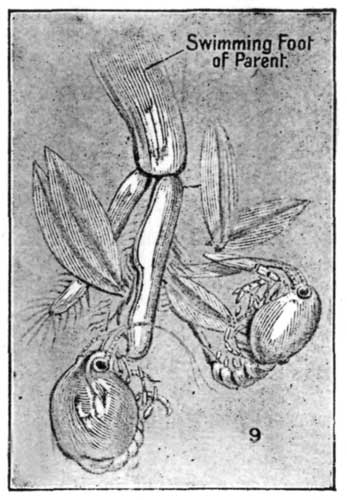
This curious order of things is true, however, only of salt-water members of the crab-tribe. With certain near relatives of the crabs and lobsters which have taken up their residence in fresh water, a different order of things prevails, for here we find some trace of maternal care. Thus, in the fresh-water crayfish the young not only leave the egg in a much more advanced stage, but they are carefully carried about by the mother, until they have learned to shift for themselves, which they do in a very few days. During this time they cling to the swimming legs of the parent by means of their pincers. When all is quiet they drop off one by one, and crawl about to gather experience and food. But at the least sign of danger the mother appears to give some note of warning, and in a moment they have scuttled back, and fastened hold of her skirts, so to speak; then, if need be, she hurries off to a place of safety. At this time these little crayfish are very tiny indeed; but to get an idea of what they look like, and how they hold on, look at fig. 9, which gives a picture of the swimming foot of a mother crayfish, and two of her youngsters hanging on to it.
It would seem that this great care is necessary, because in the swift-running streams where these creatures generally live, their young, if uncared for during their early days, would be swept away by the tide and carried out to sea, where they would speedily die.
W. P. Pycraft, F.Z.S., A.L.S.