THE COW-WAGGON.
Reading edition
During a recent visit at a Western ranch, we saw what was to us an entirely novel vehicle, a 'cow-waggon'—an immense canvas-covered van drawn by four horses. We also enjoyed the experience of a drive in one, lurching over the plain like a yacht in a rough sea.
The cow-waggon is fitted with all the necessary camping outfit used by the cow-boys on a 'round-up,' or cattle-herding expedition. Every bit of space is used, and in its ample canvas cavern are packed the beds, provisions, cooking utensils, tent canvas, and the odds-and-ends of the 'outfit.'
The back of the cow-waggon comes down and turns out on supports, making a shelf-table; behind the movable back are a cupboard and the cook's store-lockers, always well stocked, for the 'punchers' (men who brand the cattle) are men of mighty appetite. Meals served on the prairie by the cow-waggon cook are splendid. They consist of coffee and beans, bacon and beef, dried fruit and delicious rolls. The rolls and other 'sour-dough' dainties are baked in a Dutch oven. The term 'sour-dough' is another Western word. It was first used to denote the light bread baked by the cow-waggon cook, though the bread is usually excellent. A later use of 'sour-dough' is as a title for newly arrived miners in the Arctic goldfields of the Klondyke.
When the camping-ground is reached, a wide canvas is stretched over the cow-waggon; this spreads out on all sides, and is a shade 'in a weary land' for the tired puncher.
Cattle are on the move at sunrise, and it behoves the cow-boy to be also on the alert. The sun, coming up over the great stretches of plain, gives a similar impression to that of a sunrise at sea. If the round-up is in Alberta, the grass is fragrant with wild flowers, especially the dwarf-rose, and the morning air is melodious with bird-songs.
The 'puncher' comes out from his blankets and scans the hundreds of cattle dotted here and there in the shadow of the foot-hills. Presently an animal stretches out its hind legs and comes clumsily to its feet; others follow, and the herds are soon busily cropping the dew-laden grass. The puncher looks at his rope and his horse, sniffs the aroma of coffee, and promptly answers to the call of 'Grub.' There is a flourish of tin plates and cups, and of iron-handled knives and forks, and a rapid disappearance of the 'chuck.' Then to horse and the duties of the day.
A Cow Waggon Encamped and on the March.
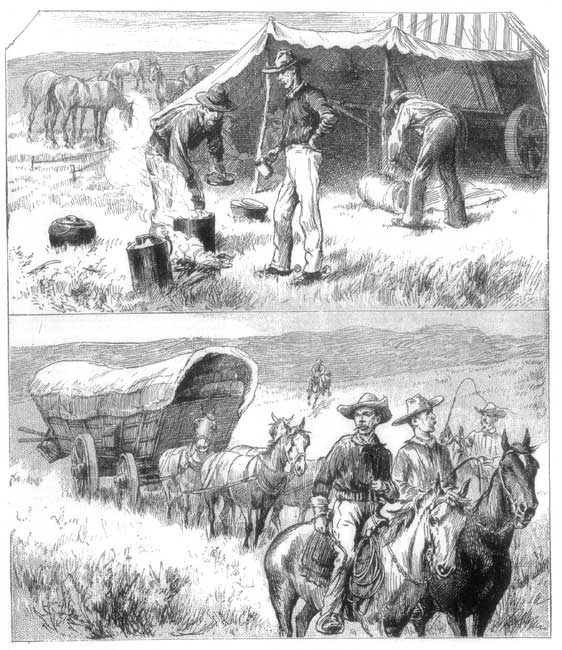
The 'outfit' is packed. The cook hitches up the horses and starts for the next camping-ground. The cow-boys pursue their business of 'cutting out;' cattle, with tails valiantly erect, snorting defiance, rush by the 'cow-waggon,' which, unmoved amid this mimic war, goes lurching over the plain.
Like many other institutions of the West, the cow-waggon will, in a few years, be a thing of the past. Wire fences, and the enclosure of the pasturelands, are getting rid of the need for it.
"'I will come with you at once.'"