A HUNDRED YEARS AGO.
Reading edition
True Tales of the Year 1806.
VI.—JOHN COLTON'S DILEMMA.
APE Colony in 1806 was a very different country from the Cape Colony about which, of late years, we have heard so much. It was then a quiet, sleepy place under Dutch rule, having been given up to Holland by the British, after the Peace of Amiens, in 1801. There were a few farms, sparsely scattered over the country, and farmed in a most slovenly manner by the Boers, or rather by their Hottentot slaves, for a true Boer then thought work of any sort beneath him.
One of these farms, however, bore a great contrast to the rest; it was about seventy miles from Capetown, and was known as the 'Garden Farm,' from the rare fact of its possessing a well-stocked garden and a large orchard of peach and apricot trees, all fenced in with a stout wooden railing to keep off the pigs and cattle that were allowed to root and rummage around the other homesteads at their own sweet will. The owner of this farm was an Englishman, named John Colton: but he was a naturalised burgher and married to a Dutch wife, so that every one—perhaps even Colton himself—had long forgotten that he had not been born and bred in his adopted country.
The year 1806 was, however, to change all this. Great Britain was at war with France, and as the Cape was then the great highway to India, it was felt that Capetown must be secured at all costs, for it was too important a place to be allowed to fall into the hands of Buonaparte.
So a British force of some five thousand men, under Sir David Baird, was at once sent out, and on a sultry January day was marching from Leopard's Bay, over scrub and veldt, towards Capetown.
All this, however, was undreamt of by honest John Colton as he sat with his wife on the verandah of his house, watching the antics of a puppy that was playing with the children in front of them.
Suddenly the man's quick ears caught the sound of horses' hoofs in the distance. He strained his eyes across the veldt, and, after a minute or two, could make out a man riding at utmost speed.
'There's something amiss somewhere,' he told his wife; 'maybe some one is injured, and he is coming here for help.' For accidents from wild beasts were common in those days, and John had a certain fame as a binder-up of broken limbs.
Now the rider had come up to the farm, but though he drew up, he did not dismount. 'You are to be in Capetown market-place, with horse and gun, by sunset on Thursday,' he said as he handed John an official blue paper. 'The British have landed, and General Janssens is summoning all the burghers. There will be a big fight, but we shall drive the red-coats into the sea.'
"He handed John an official paper."
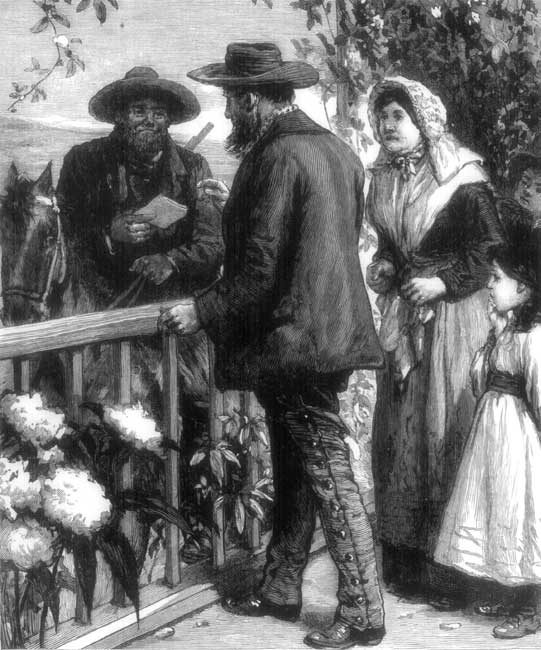
The man could not stop for a meal, though he was glad of the refreshment which Mrs. Colton handed to him in the saddle; and then he rode away as quickly as he had come, leaving Colton almost dazed by the news.
'The British have landed!' he repeated, looking at his blue paper, 'and I am to go to Capetown to fight them!'
'Oh, Jan!' said his wife, 'don't let those red-coats shoot you!'
John did not answer. He took down his gun from the wall and looked gloomily down the barrel; then he threw it on the table, and, looking at his wife, said sternly, 'I cannot fight against my own countrymen, and I do not wish to fight against yours.'
'But you are a burgher, Jan,' said his wife, timidly, 'and all the burghers are summoned.'
I shall go,' said John, shortly. 'I shall give myself up, but I cannot fight against my own people.'
'Don't go, Jan,' urged his wife. 'Hide yourself in the mountains, they will never find you there—and I will manage the farm till things are quiet again, and you can come back.'
'That would be acting as a coward, and I am no coward,' said the man. 'I must go to Capetown, but what may be done to me there I cannot say. It is a puzzling piece of business! I never thought to see the British here again.'
'They will put you in prison for life—or perhaps shoot you,' sobbed his wife. 'Jan! Jan! for love of me stay away!'
But John shook his head, and went on with his preparations for the long seventy-mile ride to the town. It was a great struggle, for he loved his home, and knew that very likely he might never see it again; but he felt he was doing right, and John was not a man to go against his conscience.
It was, however, a melancholy ride, and John felt more down-hearted than ever before in his life as he entered the market square of Capetown. Here all was in confusion, burghers were galloping hither and thither, and every one seemed too busy and excited to notice Colton as he rode wearily towards the Field Cornet's quarters to give himself up.
At last one man called out as he passed, 'A bad business this, friend! I little thought to see the red-coats in Capetown in my lifetime.'
'What has happened?' asked Colton, eagerly dismounting from his horse.
'Our burghers have had a battle with the British, but the red-coats outnumbered them, and General Janssens has retired to Lawry's Pass. Folks say he will have to make terms at once, or the guns will open on the town. Anyway, all fighting is at an end for the moment.'
John Colton said nothing, though in his heart he was almost singing for joy at this unexpected ending of his difficulties. In a few hours it was known that Capetown had surrendered to the British, and on January 8th, 1806, the 'red-coats' marched in, and John cantered back to his farm, where he lived hereafter in peace under the British flag.