STORIES FROM AFRICA.
Reading edition
XII.—DARKNESS AND DAWN.
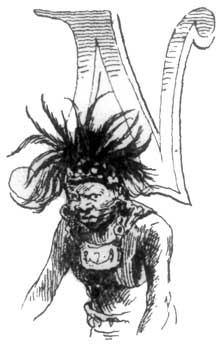
O one can rightly understand the African races without knowing something of the terror of witchcraft, magic, and ill-luck which hangs like a cloud over their lives. Differing from each other in many ways, the African tribes are alike in this, that their religion is one of fear, dread of unseen powers that work against man's peace and well-being unless propitiated by gifts, or defied by charms; and the result of this belief is to put unlimited power into the hands of those who profess to have intercourse with the spirit-world, and to foresee, or even to influence, the future of their neighbours. Therefore the European who comes to teach, to civilise, or to govern, finds his mightiest opponent in the witch-doctor, or medicine-man, who knows a little more than his neighbours, and makes capital out of their ignorance.
Some seventy years ago a party of these witch-doctors, who were making an excellent living among the Kaffirs by professing to make rain and find witches to order, met their match for once in the English Governor of the newly annexed province known as 'Queen Adelaide,' the genial and energetic officer of Peninsular fame, Colonel—afterwards Sir Harry—Smith.[5] The English 'father,' as he was styled by the Kaffirs, had acquired an extraordinary influence, by dint of much practical common sense and knowledge of humanity, a rigid military discipline, and last, not least, a stick with a very large knob at the end. Not that he ever used this stick to correct offenders, but it was always present on state occasions, and was reverenced as a sort of magic wand by the natives, for the words spoken by the 'father,' when he took that stick in his hand, were as the laws of the Medes and Persians. 'I shall wait for two hours before I touch my stick,' he said to a trembling, cringing chief, who had tried to stir up rebellion against the English rule. 'I must be quite cool; Englishmen are generous, but they must be just.'
It was a very anxious two hours that the chief spent, waiting for the touch upon the magic wand, and when he was summoned to the presence of the 'father,' and solemnly forgiven, he was cured of treasonable practices once and for all.
Colonel Smith started a vigorous campaign against rain-making and witch-finding, the latter being a practice not altogether unknown in England, where, three hundred years ago, it was not difficult to get rid of an obnoxious neighbour by a charge of witchcraft.
A poor man, robbed of his cattle and cruelly burnt by a chief who was rich enough to pay the witch-doctor, came to the 'father' to declare his innocence, and beg for redress. The knobbed stick, of course, came into action, and from behind it the judgment went forth that the chief should at once restore all the cattle taken from the injured man, with ten extra in compensation for his sufferings, and another ten as a fine to the English Government. East and west the news of the judgment was carried, in native fashion, the watchman on each of the low hills taking up and passing on the news of the 'father's' decision; so that, when the chief took no notice of the order, his evil conduct was known far and wide. Down came the cavalry upon the obstinate chief's territory; his cattle were driven off, and a receipt for them handed to him, that the whole affair might be thoroughly business-like and judicial. The astonished Kaffir had no resource but to cast himself humbly before the 'father' and the knobbed stick; and he became thenceforward the Governor's faithful friend and adherent.
The rain-makers were dealt with after another fashion. The Governor gathered a party of the most famous professors, and, in the presence of their clients and admirers, asked if they could really make rain as they declared. The wizards evidently felt that a bad quarter of an hour was coming. They hesitated; then, looking at the expectant faces of the people, who had doubtless paid many an ox for a shower, or the promise of one, they answered, as stoutly as they dared, that they possessed such power. The Englishman went on to exhibit various articles of English manufacture—his knife, his hat, his boots, and so on—asking, 'Can you make this?' And, as they all agreed in denying, he kindly explained how such things were made, without magic, in his country. Then, suddenly holding up a glass of water, he inquired—
'Is this like the water you cause to come?
'Yes,' agreed the chief doctor, cautiously.
'Very good.' Colonel Smith emptied the glass, and said amicably to the Kaffirs, 'Now, fill it again; put your rain into this glass.'
The rain-makers sought in vain for escape.
'Put more rain into the glass,' demanded the 'father,' sternly.
'We cannot,' faltered the baffled magicians, knowing their reputation gone for ever, while the Governor, addressing the people, announced that since none but God, the Great Spirit, could really make rain, any one who professed to do so henceforward would be promptly 'eaten up'—that is to say, deprived of his property by the 'father's' orders. He had the sagacity, however, to make his peace with the discomfited professors by sending for them afterwards, and providing each with some cattle and a little 'stock-in-trade,' as he calls it, to start them on a more honest way of life.
And if the African's dread of witchcraft makes him ruthless to the accused, he is equally pitiless in his terror of what he calls 'ill-luck.' An 'unlucky' child may, he believes, bring misfortune upon a whole village, and if mother-love triumphs sometimes over fear, and the little one grows out of babyhood without any neighbour knowing that it has cut its top teeth first, or is in some other way marked for misfortune, the secret may none the less leak out some day. And then the poor little bringer of 'bad luck' will quietly disappear, or will sicken and die of poison, administered by some terrified neighbour.
Two or three years ago, a frightened young mother brought her little one to a teacher in East Africa. The poor, precocious baby had been born with one tooth, and it showed some love and courage in the mother that she had come for help to the white friend who taught that it was wicked to kill babies for fear of bad luck. She could never hide it, she declared; the neighbours knew it already. Could the English 'Bibi' save the child?
The English 'Bibi' determined to test the faith of one of her Christian girls, a young wife who had no children of her own. She sent for her and asked the question, 'Rose, would you like a baby to take care of?'
Rose's beaming face was sufficient answer.
'But, Rose, it is a kigego (unlucky) baby.'
Rose met the information with disdain. 'I am a Christian; I am not afraid of a kigego.'
'But you must ask your husband first.'
The wife, in East Africa, is generally the more powerful influence in the house, and Rose would probably have been prepared to carry off the infant there and then. However, her husband proved to be quite of the same mind; and under the watchful care of the devoted foster-parents the poor little kigego will have every chance of bringing happiness into the house.
One more story of the triumph of light over darkness.
Under the banks of a river in West Africa there waited, some years ago, two or three canoes, concealed by the overhanging trees. A great man of the place was dead, and, according to the native custom, a little girl must be thrown alive into the river to drown. The few Christians had protested in vain against the murder, and, finding they could not prevent the deed, waited now in the shadow of the bank to save the child, if they could. They watched the poor little terrified creature flung into deep water, struggling and sinking. But, mercifully for her, one of the customs is to fasten a dozen or so of fowls about the neck of the victim, and the frightened birds, by their fluttering and flapping, kept her head above water until she drifted within reach of the rescuers. The little one was saved, and taken away from the neighbourhood, where her life would never have been secure.
And so, little by little, the sun rises upon the Dark Continent. One by one the old evil customs pass away. The Moorish galleys no longer hold the seas in dread; the slave caravan no longer leaves its terrible track of bleaching bones from Central Africa to the coast. Benin and Omdurman, and other 'cruel habitations,' have been thrown open and broken down. Wise heads have thought and planned, brave blood has been shed, noble lives laid down for the good of Africa, and, by slow degrees, the shadows are fleeing before the dawn.
Mary H. Debenham.