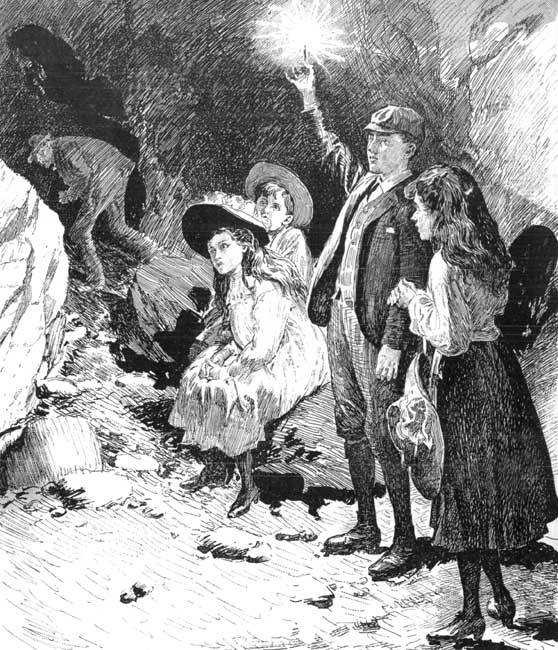
Chapter I
Reading edition
'You don't think they will come to any harm?' said the young governess.
When Miss Leigh spoke in that plaintive tone, Lady Coke knew that she was tired out with the noise and wilfulness of her young pupils, and that a 'row,' as Alan called it, was likely to follow.
'No,' said Lady Coke, smiling; 'they are accustomed to the management of the boat, and Thomas shall go with them. He knows the coast well, and is a first-class boatman.'
Her nephew, Colonel De Bohun, laughed. 'He is A.1. at his oar, but very deficient as a gardener,' he said. 'Your kindness in keeping him, my dear aunt, is a marvel to us all.'
'His mother is very poor,' returned Lady Coke, with a sigh. 'I wish he were a better son to her. He is her great trouble, I fear.'
'And yet you are not afraid to trust the children with him,' murmured Miss Leigh, in surprise.
'He is quite to be trusted on the water!' replied Lady Coke, with some decision. 'Children must have something to do to carry off their extra energy, and—— '
'"A boy is the most difficult to manage of all wild beasts!" So, at all events, an old writer tells us,' said the Colonel, with a smile. 'I am afraid, Miss Leigh, you find the girls are not much better. You ought to be glad to get rid of our noisy pack of youngsters for an hour or two.'
'Oh, if you are not afraid,' began Miss Leigh, in an injured tone.
She considered that her anxiety on behalf of her pupils was not being properly appreciated, and felt hurt. But further conversation was cut short by the boisterous rush of four children round the corner of the shubbery.
'Thomas can come!' shouted the eldest boy, who was racing ahead of the noisy party. 'I just managed to catch him as he was sneaking off up the Wilderness.'
'What?' exclaimed the Colonel, surprised.
'Sneaking off!' repeated Lady Coke. 'Alan, what a way of speaking! What do you mean?'
'He ran away as soon as he saw we wanted him,' said Georgie. 'He tried to hide in the bushes, and I am sure he did not want us to see him.'
'He was sneaking off. We could all tell that,' added Marjorie, a tall, handsome girl of thirteen. 'But what does it matter? If he can come with us now, it is no business of ours what he was doing.'
Meanwhile, Estelle, a small, slender child of eleven, who looked much younger, was clinging to her great-aunt's hand, and murmuring continually, 'Are we going, Auntie? I do so want to go on the sea!'
'Here is Thomas,' said Colonel De Bohun, as the young gardener came towards the group, with a sulky expression on his red face.
'I want you to take the children out in the boat, Thomas,' said Lady Coke. 'I hope you are not particularly busy this afternoon?'
'I am at your service, my lady,' he replied. 'I will get—— '
'I will help you!' cried Alan, eagerly. 'We will have the boat ready in a jiffy.'
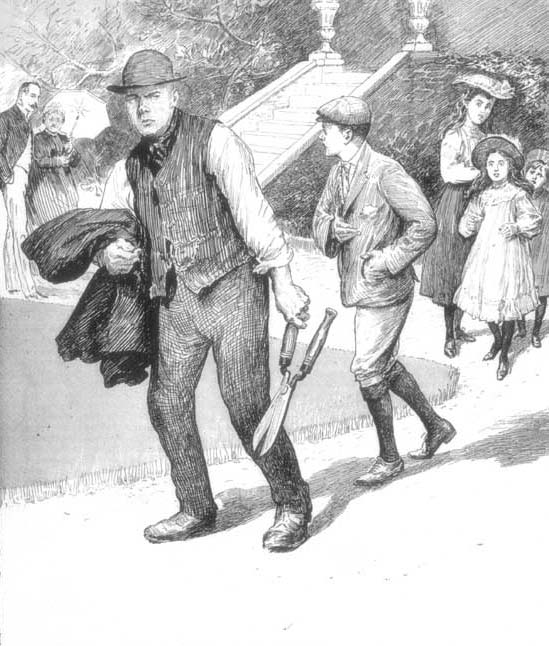
With an awkward touch of his cap, Thomas moved off, his sulky face revealing the wrath which was surging within. But no one was looking at him, nor was a second thought given to Alan's laughing assertion that he had been seen 'sneaking off up the Wilderness.' The wild joy of the children, and the many cautions as to their behaviour when on the water, which their elders impressed upon them, together with the preparations for the trip, made them all forget Thomas's queer manner. They were destined, however, before long, to remember it for many a day.
Colonel De Bohun made Alan fetch some cushions, that the boat might be made more comfortable for his cousin and his sister, and Lady Coke, drawing Marjorie aside, begged her to look well after Estelle, who was not so used to boating as she and her brothers were, and might endanger the safety of the young party by some sudden movement. Marjorie was to remember how easily a boat was upset.
Estelle had never till now lived near the sea-coast. Her life had been spent in the Highlands of Scotland, at her father's old castle, Lynwood Keep. Her uncle, Colonel De Bohun, had often begged the Earl of Lynwood to allow her to spend her holidays with her cousins, but the Earl could not bear to part with his little girl even for so short a time. Instead, he gladly welcomed the little cousins to Lynwood Keep, where Estelle was allowed to do everything she desired for their pleasure and entertainment.
The great sorrow of his life, the loss of his young wife when Estelle was five years old, had changed him completely. From being a cheerful, open-hearted, open-handed man, he had become silent and reserved, seldom seeing anybody, and keeping aloof even from his brother's children when they paid their yearly visit to Estelle, and the delights of her Highland home.
To only one person did he unbend. Estelle had become all in all to him. He felt he could not do enough for her. He must be both father and mother to the little motherless child, and to him she must look for everything. Except when she was at her lessons, he loved to have her with him, and wherever he went, on visits to his tenants, or walking over the property, she was always his little shadow, as well known and beloved as he. In the evenings they would sit together, talking over their uneventful day, or recalling that memory of wife and mother which was so sacred and so tender to them both, and which Lord Lynwood desired should never fade from his little girl's mind.
Such a life was by no means a healthy one for Estelle, as Lord Lynwood's aunt, Lady Coke, discovered during her visits to Lynwood Keep. She noticed how sensitive and excitable Estelle was growing. If Lord Lynwood came down in the morning looking worn and depressed, Estelle would watch him for a few minutes, and unconsciously put on the same look. Slipping her hand into his, and gazing up into his face with sympathetic eyes, she only increased his gloom; Lady Coke saw it, and felt sorry for them both. Any other child would have been spoilt by the indulgence which gratified every wish, but Estelle's gentleness and her great desire to be to her father all that her mother had been, prevented her from being either selfish or naughty.
She was not a strong child, and the accounts of her health and spirits which her governess, Mademoiselle Vadevant, gave Lady Coke, did not satisfy that dear old lady. She did not like to hear that Estelle was apt to cry on the slightest excuse; that she had no energy, no appetite; that she was listless in her play, never happy except when with her father, and soon grew tired with the least exertion. Every breath of wind appeared to give her a cold, and she slept badly. Lady Coke said little, but she thought deeply about all she heard and saw.
A few weeks after this visit of Lady Coke's, Lord Lynwood, to his great surprise, received a letter from a very influential quarter; his past services to the State were spoken of in the most flattering manner, and he was urged to accept office again. An appointment to the Court of Austria was offered to him in terms which made refusal almost impossible. Lady Coke was delighted when he showed her the letter, and warmly begged him not to throw away what had been offered to him in such a kindly spirit. She did not betray her own handiwork in the offer.
'It is the best thing that could have happened!' she exclaimed, smiling and pleased. 'The very best thing for you and Estelle.'
'Best for the child?' he repeated, blankly.
'Yes, even for Estelle,' replied his aunt, with decision. 'She ought to have many things which you cannot give her, with all your love; her mother would have understood. She must live in a warmer, sunnier climate. She ought to have the companionship of other children; some one to play with, and some one to work with as well as play.'
'Ah!' said the Earl, feeling as if a trap had been sprung upon him. 'And where is she to have all this?'
'Let her live with me,' replied Lady Coke, smiling. 'Her cousins are quite close, and she will be with them every day. I am sure you will soon see how greatly this plan will benefit the dear child, and will not grudge what will do her good.'
'I should not mind so much leaving her if she were with you,' admitted the Earl, after a long pause. 'But are you sure it will not be too much for you, dear aunt, to have so young a child with you always? Will she not tire you?'
'You little know how young I am still,' she interrupted with a merry laugh. 'I love the child, and you could not give me greater pleasure than by leaving her with me.'
The more the plan was talked over the more pleasant and possible it became, and when the Earl saw Estelle's delight on hearing that she was to share in Marjorie's lessons, and have her cousins to play with every day, he became reconciled to the parting with his little girl.
But when the day came for saying good-bye he almost repented. Estelle cried and clung to him till Lady Coke and Mademoiselle had great trouble in getting her away. They hurried her up to her room, where Mademoiselle gave her brilliant descriptions of how busy her father was going to be, and how happy she would be in his absence with her cousins. She would grow up to be a comfort to him, and must do all she could that he might not be disappointed in her on his return.
Then came the bustle of preparation for her own journey, and the excitement of her arrival at the Moat House. All three cousins were there to greet her, and she was welcomed with so many kisses, and such a chorus of delight, that for the moment everything else was forgotten. Each of the cousins had his or her favourite pet, or particular spot in the garden to show her, and Estelle felt herself at home at once.
Lady Coke's plan had worked well. The joy of the children, their perfect contentment when together, and Estelle's improved health and spirits were proof enough. The gardens of the two houses, which joined, the woods, the rocks, the sea, were more than enough to keep them all happy and occupied; and to Estelle was added the keen pleasure of an only child to whom everything was new.
(Continued on page 10.)
"Thomas moved off."
"Marjorie distinctly saw a man's figure."