MARVELS OF MAN'S MAKING.
Reading edition
IX.—THE MANCHESTER SHIP CANAL.[2]
HE merchants of Manchester were not satisfied with the means they had for receiving goods from abroad and dispatching their own in return. They wanted to be nearer to the sea; but as Manchester was much too large a place to be carried to the coast, it seemed more reasonable to carry the sea to Manchester, and so turn the town into an inland port. They had thought and thought about it for a very long time, without being able to hit upon any satisfactory plan, when, in 1882, a Mr. Daniel Adamson invited some friends to his house in the suburbs of Manchester, and made a proposal and a suggestion which led to the accomplishment of the great design. Mr. Adamson was a gentleman of great energy and courage, and though cities might stand in the way, he would bring the sea to Manchester when once he had made up his mind to do so. It was almost safe to say that he would have cut the canal with his own hands rather than fail in his determination. It is such men as he who make England prosperous.
Permission having at last been gained from Parliament, a number of steam dredgers arrived in the mouth of the Mersey, and work was begun. The distance from the starting-point to Manchester is thirty-five and a half miles, and over most of these the river itself was followed.
At Eastham, on the south side of the river, foundations were laid for three locks side by side, and these form the entrance of the water-road to Manchester. One or two points with regard to them must be mentioned. In the first place they are not locks in the ordinary sense, as the water that flows through them is tidal water; but they serve to keep that tide in the canal at one uniform level. As they are within reach of boisterous sea-water, there is an additional protecting gate in front of each, while between them and the shore there are three large sluices to regulate the passage of unusually heavy tides.
On passing through the Eastham lock, vessels bound for Manchester find themselves in a channel about one hundred and seventy-two feet wide and twenty-six feet deep, separated from the broader Mersey by a long embankment thirty feet wide at the top, and following the curves of the river for nine miles. But in that nine miles there are several sights to see, for Eastham is not left very far behind when, on the right, the river Weaver is reached. This is a broad river flowing into the Mersey, and its ancient rights could not be taken away, though it was absolutely necessary to control them. Consequently, all across its wide mouth a number of sluice-gates, sliding up and down on rollers, had to be erected. These are worked by hydraulic power, and are raised at suitable times, according to the condition of the tide, when the water, flowing from the Weaver across the canal, finds its way into the Mersey through long openings in the top of the embankment of which we have spoken.
Streams less important than the Weaver are treated in a less dignified way. Thus, a little farther on we come upon two small rivers which are carried under the canal in huge cast-iron pipes. At the busy town of Runcorn we reach the first railway bridge, and the canal is narrowed to ninety-two feet, flowing in a graceful curve between concrete walls. The railway bridge, as it stands to-day, was built by the Canal Company, for the old one was too low for ships to pass beneath. It is now seventy-five feet above the surface of the water, and all other fixed bridges that cross the canal must be equally high.
Ten long straight miles beyond Runcorn a vessel comes to a halt in front of the first lock on the canal proper. It is at a place called Latchford. We are twenty-one miles from Eastham, and at the end of the tidal course. Fourteen and a half more miles to Manchester—and in that distance we have sixty feet and six inches to climb! As we move slowly into the lock the hydraulic machinery is set in motion; the gate behind us is closed, and the one in front slowly opens. In rushes the foaming water, lifting our vessel as it rises in the lock, and in a few more minutes we are steaming on our way—sixteen feet above the level of the waters just left behind. We have mounted the first step in the watery stairway leading to Manchester's front door.
Some seven miles further on another lock is reached, and passing through this we shortly come in sight of what is, perhaps, the most interesting engineering feat performed in this great enterprise. It is the Barton swing bridge, and was constructed to carry the Bridgewater Canal across the one upon which we are travelling in imagination. About the year 1756 the young Duke of Bridgewater employed an engineering genius named James Brindley to make a canal from his coal-mines near Manchester to the town of Runcorn. With astounding skill, James Brindley carried out the work, finding his greatest difficulty at the point of which we are speaking. The river Irwell flowed directly across the course of his canal and at a considerably lower level. Friends advised him to lead his canal down to the river by a large number of small locks, and lift it again on the other side by similar means. 'That is the usual thing to do,' they said.
But Brindley preferred the best way to the usual way, and boldly carried his canal over the river on a stone bridge or aqueduct. It was the first time such a thing had been done in England, and it served its purpose for nearly one hundred and fifty years. Then the Manchester Ship Canal comes along the Irwell, and the stone aqueduct must be turned into a swing bridge, or how is any ship to pass?
'Very well,' said the owners of the Bridgewater Canal, 'but you must not let much of our water be lost, for we have little to spare.'
And this is how Mr. Leader Williams, the engineer, got over the difficulty. He built an island in the middle of the Ship Canal for the iron bridge to turn upon, leaving the two ends free. The bridge itself he made in the form of a long tank, nineteen feet wide and seven feet deep, the two ends being hinged so that they would open and close like doors. Strengthening iron girders, rising to a height of some twenty feet, form the sides of the bridge, while cross-girders close in the top. The two ends of the canal proper where it reaches the entrance to the bridge, are also provided with watertight doors. When the bridge is in position there is a narrow gap between its two ends and the canal. This is filled up and made watertight by a ponderous wedge, weighing twelve tons and shaped like a U, its sides and lower part thus corresponding in outline with those of the tank and canal. The wedge is further padded on each side with indiarubber which, when squeezed into place, effectually prevents any leakage. As soon as a ship is signalled on the Manchester canal, the doors at each end of the tank-bridge are closed, together with those at the ends of the canal. Then the U wedge is lifted from between them, and the bridge (weighing, with the water it contains, sixteen hundred tons) is swung round on its island pivot till the channels are open on either side. The ship passes by and the bridge is swung back to its original position. The towing-path (for all craft on the Duke of Bridgewater's canal are drawn by horses) is carried across the bridge on an iron shelf, nine feet above the water.
Beyond Barton the Salford docks are reached, and after passing one more lock, we sail triumphantly into the magnificent docks of Manchester to which this thread of silver leads.
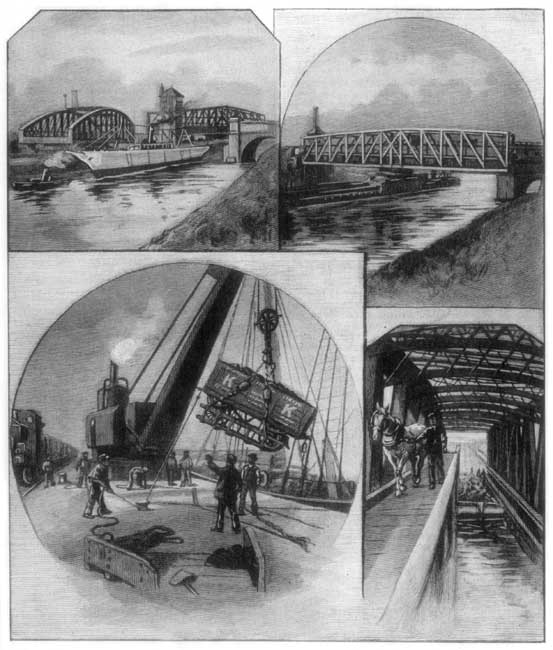
Barton Swing Bridge and Aqueduct. A huge Crane at Work.The Barton Aqueduct. Coming through the Aqueduct.
When first the canal was opened Manchester seemed to be taken by surprise, and hardly knew how to perform the part of a seaport; but that is all changed now. The docks are growing fast, and only in 1905 their Majesties the King and Queen opened a new dock two thousand seven hundred feet long, two hundred and fifty feet wide, making an area of fifteen and a half acres, and capable of accommodating ten of the largest steamships entering the canal.
Thus this great city, at a cost of fifteen million pounds, opened its gateway to the ocean, and receives at its doors rich freights of merchandise from all quarters of the earth, though it stands thirty-five miles away from the sound of the sea.
Iron-Smelting in India
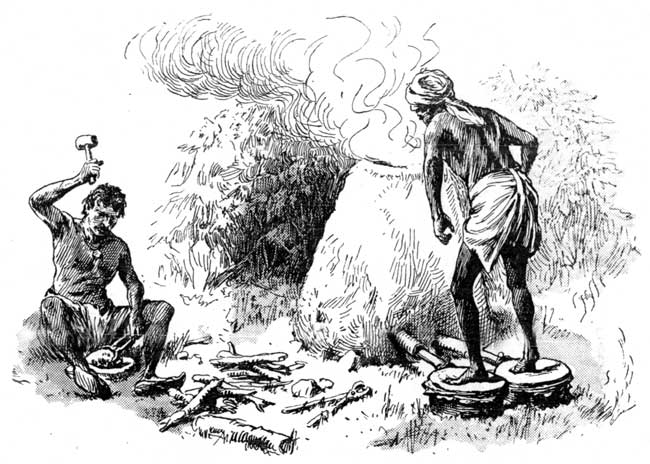
IRON-SMELTING IN INDIA.
In many parts of India iron is made in a very simple way, which has probably been followed for centuries without much change. The iron-worker builds a little furnace of clay, in the form of a tower which is narrower at the top than at the bottom. This tower is only four or five feet high, so that it is after all no bigger than the towers and castles which children build in the sand; but its builder makes good use of it, small though it is. The top of it is open, and at the bottom there are one or two openings in the side, through which the iron-maker can blow the air of a pair of bellows. These bellows are goat-skin bags, which have been made by sewing up whole skins. A hollow bamboo is fitted into the end of each bag, in order to form the pipes of the bellows and there is also another opening in each bag which may be closed very quickly by the man who blows the bellows. He works the bellows by pressing upon the goat-skin bags with his feet, so as to drive out the air through the pipe which is fixed in the end of each bag. He works two bags at one time, pressing first upon one and then upon the other. While he is pressing one bag, he raises the other, which is empty, and allows it to fill again through the hole which has been left in it for that purpose. In this way he contrives to have one bag filling with air, while he is squeezing the air out of the other.
The smelter, before he can make iron, must have iron ore and fuel, as well as furnace and bellows. The ore he has already dug from the ground and arranged in a little heap near his furnace. It is usually a rather dark-coloured stone, or a soft, red earth. The fuel is charcoal, which the smelter makes by burning wood in a heap more or less covered with earth, in such a way that the wood chars rather than burns away.
A very hot fire is needed to change the stony or earthy iron-ore into iron, or rather to burn out the iron which lies in the ore, and the clay furnace and the bellows are employed for the purpose of maintaining this hot fire. The smelter lights the fire inside the bottom of his furnace, and the tower acts as a sort of chimney. The pipes of the goat-skin bellows are joined on to clay pipes which pass into the bottom of the furnace, and lead the draught of air from the bags into the fire. The bellows-pipes themselves cannot be put into the furnace, because they would take fire.
When the smelter has got his fire well aglow, he places upon it a layer of charcoal, and above that a thin layer of iron-ore. On the top of these he puts another layer of charcoal and another of ore, and thus he goes on loading his furnace until he thinks that he has filled it sufficiently full. Then he works away at his bellows for three or four hours.
At the end of this time the charcoal and much of the ore are burned away, and there is not much left but glowing embers in the bottom of the furnace. The smelter breaks a hole through the furnace, and, poking with his tongs into the ashes, draws out a little red-hot ball of iron, scarcely as large as a cricket ball, which has been formed from the ore, partly by the heat of the fire, and partly by the help of the red-hot charcoal which has acted chemically upon the ore. This little ball of iron is well hammered, in order to knock out any ashes which may have lodged in it, and it is then ready to be worked up into an implement, or to be made into steel for a sword-blade or some other weapon.