MUSICAL SIGNS AND ABBREVIATIONS.
Reading edition
Signs denoting time or relative value of sound:
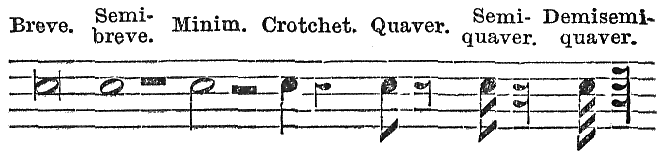
Each of these notes represents twice the duration of sound of that which comes next in order. The sign to the right of each note indicates a rest or silence equal to its sound duration.
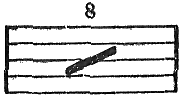
In time, the figure above a line drawn thus across the stave denotes the length of the pause in bars.
Accel. Accelerando. Gradually increasing the speed.
Adgo or Ado. Adagio. Slow; also name given to a slow movement or piece.
Ad lib. Ad libitum. Passages so marked may be rendered at the will of the performer.
And. Andante. Moderately slow: graceful; sometimes used as the name of a movement or separate piece.
Animo. Animato. Animated: with soul.
A tem. A tempo. In time.

Bar. A line drawn perpendicularly across the stave, separating the notes into measures of equal length; also the music comprised within two such lines.—Double Bar. The former of the two signs is used to mark the larger divisions of a piece or movement; in psalm tunes, hymns, chants, &c., to mark the end of a verse or sentence. The latter sign denotes the end of a composition.
Bind or Tie. Placed over two or more notes in the same position on the stave, to show they are to be played as one.

Breath-marks. In vocal music, signs used to show where breath should be taken.


Denoting common time; the former indicating four crotchets to the bar, the latter two minims to the bar.
Cal. Calando. Gradually slower, and with decreasing volume of tone.
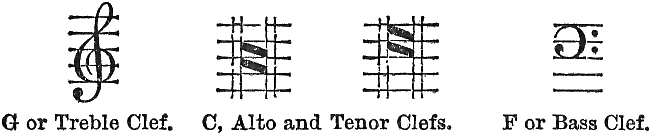
Clef. The sign placed at the beginning of a stave, determining the absolute pitch of the notes that follow it.
Crescendo. Gradual increase of tone.
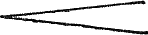
() Dash. When placed over or under a note, implies a very detached (staccato) style.

D.C. Da capo. From the beginning; indicating that the performer must return to the beginning of the movement, and conclude at the double bar marked Fine.
Decrescendo. Gradually softer.
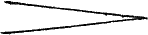
Dim. Diminuendo. Gradual decrease of tone.
(·) Dot. When added to a note or rest, lengthens it by one-half. When placed over or under a note, means that its duration should be cut short.
Flat. The sign which lowers the pitch of a note one semitone.

Double Flat. Used before a note already flat, lowering it another semitone. It is corrected by a flat and a natural.

f. Forte. Loudly: strongly.
ff. Fortissimo. Very loud.
fff. Fortississimo. As loud as possible.
f.p. Forte-piano. Loud, then soft.
Leg. Legato. In a smooth and gliding manner.
Lo. Loco. Indicating to return to the proper pitch after having played an octave higher.
mf. or mff. Mezzo-forte. Moderately loud.
mp. Mezzo-piano. Moderately soft.
Manc. Mancando. Dying away, decreasing.
Marc. Marcato. In a marked manner, emphasised.
M.M. Maelzel's metronome.
M.M. =80. Denoting that the beat of a crotchet is equal to the pulse of the pendulum of Maelzel's metronome, with the weight set at 80.

Natural. Restores a note, which has been raised by the sharp or lowered by the flat, to its original pitch.

Ott., Ova, 8va=Ottava. An octave—as 8va alta=ottava alta, (to be played) an octave higher; 8va bas. = ottava bassa, an octave lower.
p. Piano. Softly.
P.F. or pf. Piano-forte. Soft, then loud.
pp. Pianissimo. Very soft.
ppp. Pianississimo. As softly as possible.
Pause or Corona. When placed over a note or rest, indicates that it must be held longer than its natural length. When over a double bar, indicates where the piece is to be concluded after a repeat.

Pizz. Pizzicato. A direction to violinists to twang the string with the finger instead of using the bow.
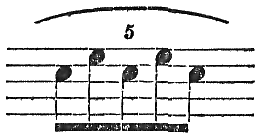
Quintuplet. A group of five notes played in the time of four.
4tte Quartette.
5tte Quintette.
Raddol. Raddolcendo. Gradually softer and sweeter.
Rall. Rallentando. Becoming gradually slower.
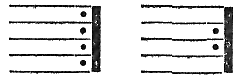
Repeat. When placed at the beginning and end of a passage or movement, indicates that the portion so marked is to be played over again.
Rit. Ritardando. Retarding, holding back the time.
Segno. The sign—as Al Segno, to the sign; Dal Segno, from the sign.

Sem., Semp. Sempre. Always, throughout—as sempre legato, smooth throughout; sempre ritardando, continually slackening the time.
7tte Septet.
6tte Sextet, or Sestet.
Sforzando. Denoting emphasis applied to a particular note or notes. Abbreviated sf., sfz.
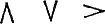
Sforzato-piano. A sudden forte followed by a diminuendo or piano. Abbreviated sfp., sfz.p.

Sharp. The sign which raises the pitch of a note one semitone.

Double Sharp. Used before a note already sharp, raising the pitch by a semitone. It is contradicted by a natural and a sharp.

Slur. Showing that the notes over which it is placed must be played in a smooth (legato) manner.

Sos., Sost. Sostenuto. Sustained; prolonging the tone for the full duration of time indicated.
Spir. Spiritoso. In a spirited or lively manner.
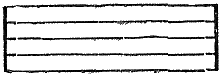
Stave or Staff. The horizontal and parallel lines on which the notes are placed, used to indicate their relative position as regards pitch.
Trem. Tremolando. With trembling or wavering; a note or chord played with great rapidity so as to produce such an effect.
3o Trio.
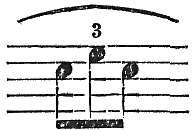
Triplet. A group of three notes performed in the time of two.
T.S. Tasto solo. One key alone: a direction to play a part in unison.