Front matter (continued 12)
Reading edition
Tarabooka, ta-ra-bōō′ka, n. a drum-like instrument.
Tara-fern, tä′rä-fern, n. a New Zealand brake, with a thickened edible rhizome.
Tarantass, tar-an-tas′, n. a four-wheeled vehicle having a boat-shaped body, without springs. [Russ.]
Tarantella. See under Tarantism.
Tarantism, tar′ant-izm, n. an epidemic leaping or dancing mania, somewhat resembling chorea—also Tar′entism.—ns. Tarantel′la, Tarentel′la, a lively Neapolitan dance in triplets for one couple—thought a remedy for tarantism; Taran′tula, Taren′tula, a species of spider found in South Italy, whose bite is much dreaded, and was long supposed to cause tarantism. [It. tarantola—Taranto—L. Tarentum, a town in South Italy where the spider abounds.]
Taratantara, tar-a-tan-tar′a, n. or adv. a word imitative of the sound of a trumpet.—Also Tantar′a, Tarantar′a.
Taraxacum, tar-aks′a-kum, n. the root of the dandelion, a tonic laxative in diseases of the liver.—n. Tarax′acine, a crystallisable substance extracted from the foregoing. [A botanical Latin word, coined from Gr. taraxis, trouble—tarassein, to trouble. Davic refers to Ar. taras-acon, a kind of succory, Latinised in Avicenna as taraxacon.]
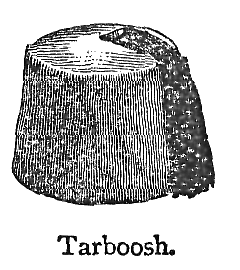
Tarboosh, Tarbouche, tär-boosh′, n. a red cap with dark tassel worn by Moslem men. [Ar. tarbūsh.]
Tardigrade, tär′di-grād, adj. slow in pace; belonging to the Tar′digrada, a group or suborder of mammals containing the two genera of sloth.—n. one of the Tardigrada. [L. tardus, slow, gradi, to step.]
Tardy, tär′di, adj. slow, late, sluggish: out of season.—advs. Tardamen′te (mus.), slowly; Tar′dily, slowly: reluctantly: late.—n. Tar′diness.—adj. Tar′dy-gait′ed (Shak.) slow-paced. [Fr. tardif—tard—L. tardus, slow.]
Tare, tār, n. any one of several species of vetch: (B.) an unidentified weed, prob. darnel. [Prob. tear.]
Tare, tār, n. the weight of the vessel or package in which goods are contained: an allowance made for it, the remainder being the net weight. [Fr.,—Sp. tara—Ar. tarha, thrown away.]
Tare, tār, obsolete, pa.p. of tear (2).
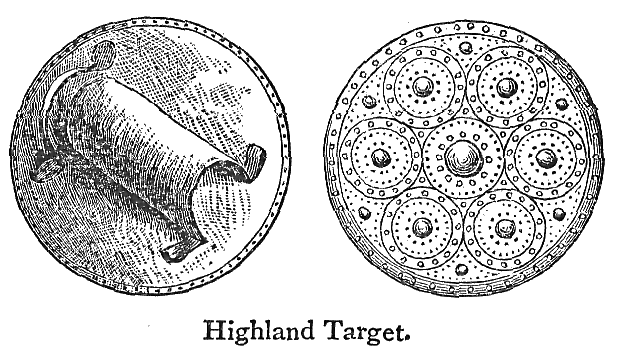
Target, tär′get, n. a small buckler or shield: a mark to fire at for practice or competition: any object of desire or ambition: the frame holding railway-signals: (her.) a bearing representing a buckler: (Scot.) a pendant, tassel—also Targe.—adj. Tar′geted, provided with a shield.—ns. Targeteer′, Targetier′, one armed with a shield, a peltast. [A.S. targe; Old High Ger. zarga, a frame, wall; Fr. targe is of Teut. origin.]
Targum, tār′gum, n. a general term for the Aramaic versions—often paraphrases—of the Old Testament, which became necessary when, after and perhaps during the Babylonian Exile, Hebrew began to die out as the popular language and was supplanted by Aramaic.—adj. Tar′gumic.—n. Tar′gumist, a writer of a Targum: a student of the Targums.—adj. Targumist′ic. [Assyr. ragâmu, to speak, whence targumânu, speaker.]
Tariff, tar′if, n. a list of the duties, &c., fixed by law on merchandise: a list of charges, fees, or prices. [Fr.,—Sp.,—Ar. ta‛rīf, giving information, from ‛arafa, to explain.]
Tarlatan, tär′la-tan, n. a fine, open, transparent muslin for women's dresses, often coarse in texture, made at Tarare in the department of Rhône.—Also Tar′letan. [Prob. Milanese tarlantanna.]
Tarn, tärn, n. a small lake among the mountains. [Ice. tjörn.]
Tarnation, tär-nā′shun, adj. and adv. a softened form of damnation, as Tar′nal, of eternal or infernal.
Tarnish, tär′nish, v.t. to soil by exposure to the air, &c.: to diminish the lustre or purity of, to stain, sully.—v.i. to become dull: to lose lustre.—n. a spot, stain, change in lustre of a mineral.—n. Tar′nisher. [Fr. ternir (pr.p. ternissant); terne, dull, wan—Mid. High Ger. ternen, Old High Ger. tarnjan, to darken; A.S. dernan, to cover.]
Taro, tä′rō, n. a plant of the arum family, widely cultivated for its edible roots in the islands of the Pacific. [Polynesian.]
Tarot, tar′ot, n. a kind of playing card used, and probably invented, in Italy about the middle of the 14th century, 78 to the pack: a game played with such.—Also Tar′oc. [Fr., so called prob. because tarotée on the back—i.e. marked with plain or dotted lines crossing diagonally—It. tarocchi.]
Tarpan, tar′pan, n. the small wild horse of the steppes of Russia. [Tatar.]
Tarpaulin, tär-paw′lin, n. strong linen or hempen cloth coated with tar or pitch to render it waterproof: a sailor's wide-brimmed storm-hat: (coll.) a sailor.—Also Tarpau′ling. [From tar, and prov. Eng. pauling, a cart cover; cf. Pall.]
Tarpeian, tär-pē′an, adj. designating a cliff—the Tarpeian Rock upon the Capitoline Hill at Rome, from which state criminals were thrown—from the Roman traitress Tarpeia.
Tarpon, tär′pon, Tarpum, tär′pum, n. a food-fish of America, of the herring family, common in the warmer Atlantic waters, and six feet long.—Also Jew-fish. [Amer. Ind.]
Tarradiddle, tar-a-did′l, n. a fib, a lie. [App. a coined word, the last part being the slang word diddle, to cheat.]
Tarragon, tar′a-gon, n. the herb-dragon, an aromatic plant used for flavouring vinegar, sauces, &c. [Sp. taragontia—Ar. tarkhūn—Gr. drakōn, a dragon.]
Tarras, tar′ras, n. (Spens.) terrace.
Tarre, tär, v.t. (Shak.) to set on, to encourage.
Tarriance, tar′i-ans, n. (arch.) act of tarrying, delay.
Tarrier, tar′i-ėr, n. old form of terrier: (slang) a rough fellow, a tough.
Tarrock, tar′ok, n. the young of the kittiwake: the tern: guillemot.
Tarry, tär′i, adj. consisting of, covered with, or like tar.—n. Tarr′y-breeks, a sailor.—adj. Tarr′y-fing′ered, thievish.—n.pl. Tarr′y-fing′ers, thieving fingers.
Tarry, tar′i, v.i. to be tardy or slow: to loiter or stay behind: to delay:—pa.t. and pa.p. tarr′ied.—n. Tarr′ier, one who tarries or delays.—v.i. Tarr′ow (Scot.), to hesitate, refuse. [M. E. targen, to delay (confused in form with tarien, to irritate)—O. Fr. targer (Fr. tarder)—L. tardus, slow.]
Tarsia, tär′si-a, n. an Italian mosaic, at first dealing with geometrical patterns in wood, but which developed into inlaid representations of architecture, views, figures, and drapery, and finally into foliaceous scrolls of modern marquetry. [It.]
Tarsier, tär′si-er, n. a small arboreal East Indian lemuroid, the malmag.—adj. Tar′siped, having the same tarsal structure as the foregoing. [Fr.]
Tarsus, tär′sus, n. the part of the foot to which the leg is articulated:—pl. Tar′sī.—adj. Tar′sal, relating to the tarsus or ankle.—ns. Tarsal′gia, pain in the tarsus: a neuralgic affection of the foot from which persons walking much sometimes suffer; Tar′sipes, a small Australian honey-sucking marsupial, of the family Phalangistidæ, about the size of a mouse.—adj. Tarsometatar′sal, pertaining to the tarsus and the metatarsus.—n. Tarsometatar′sus, the single compound bone of birds.—adj. Tarsotar′sal, mediotarsal. [Gr. tarsos, the flat part of the foot.]
Tart, tärt, adj. sharp or sour to the taste: (fig.) sharp: severe.—adj. Tart′ish, somewhat tart.—adv. Tart′ly.—n. Tart′ness. [A.S. teart—teran, to tear.]
Tart, tärt, n. a small pie, containing fruit or jelly baked in paste.—n. Tart′let, a small tart. [O. Fr. tarte—L. torta, fem. of pa.p. of torquēre, twist.]
Tartan, tär′tan, n. a woollen or worsted stuff checked with various colours, once the distinctive dress of the Scottish Highlanders, each clan having its own pattern. [Fr. tiretaine, linsey-woolsey—Sp. tiritaña, a thin woollen stuff—tiritar, to shiver.]
Tartan, tär′tan, n. a Mediterranean vessel with lateen sail: a kind of long covered carriage [Fr.,—Ar. taridah, a small ship.]
Tartar, tär′tar, n. a mixture of bitartrate of potash and tartrate of lime, being a deposit formed from wine, and known in its crude form as argol: a concretion which sometimes forms on the teeth.—adjs. Tar-tā′reous, Tar′tarous, consisting of, or resembling, tartar; Tartar′ic, pertaining to, or obtained from, tartar.—v.t. Tar′tarise, to impregnate or treat with tartar.—adjs. Tartral′ic, Tartrel′ic, derived from tartar.—n. Tar′trāte, a salt of tartaric acid.—Tartar emetic, a compound of potassium and antimony.—Cream of tartar (see Cream). [Fr. tartre—Low L. tartarum—Ar. durd, dregs.]
Tartar, tär′tar, n. a native of Tartary in Asia: an irritable person, or one too strong for his assailant.
Tartarus, tär′ta-rus, n. the lower world generally, but esp. the place of punishment for the wicked, according to Homer, a deep and sunless abyss, as far below Hades as earth is below heaven, and closed in by iron gates—(Shak.) Tar′tar: (Spens.) Tar′tary.—adj. Tartā′rean. [L.,—Gr. tartaros.]
Tartuffe, tär-tōōf′, n. a hypocritical pretender to religion, from the chief character in Molière's most celebrated comedy (1669).—adjs. Tartuff′ish, Tar-tuf′ish.—ns. Tartuff′ism, Tartuf′ism.
Tarve, tärv, n. (prov.) a curve, bend.
Tar-water, tär′-waw′tèr, n. cold infusion of tar in water, once used as a medicine for chest complaints.
Tascal, tas′kal, n. a reward for information about cattle-stealing.—Also Tas′call. [Gael, taisgeal.]
Taseometer, tas-ē-om′e-tèr, n. an instrument for measuring strains in a structure. [Gr. tasis, a stretching, metron, measure.]
Tash, tash, n. an Oriental silk fabric, with gold or silver thread.—Also Tass. [Hind, tāsh, tās.]
Tasimeter, ta-sim′e-tėr, n. an apparatus for detecting changes in pressure by the variations in the electrical conductivity of carbon.—adj. Tasimet′ric.—n. Tasim′etry. [Gr. tasis—teinein, stretch.]
Task, task, n. a set amount of work, esp. of study, given by another: work: drudgery.—v.t. to impose a task on: to burden with severe work.—ns. Task′er, one who imposes a task, or who performs it; Task′ing, task-work; Task′master, a master who imposes a task: an overseer:—fem. Task′mistress; Task′work, work done as a task, or by the job.—Take to task, to reprove. [O. Fr. tasque (Fr. tâche)—Low L. tasca, taxa—L. taxāre, to rate.]
Taslet, tas′let, n. a tass or piece of armour for the thigh—prob. the same as Tasset.
Tasmanian, tas-mā′ni-an, adj. of or belonging to Tasmania or Van Diemen's Land.—n. a native of Tasmania.—Tasmanian devil, or Dasyure (see Devil); Tasmanian Wolf, a nocturnal carnivorous marsupial of Tasmania. [From Abel Jans Tasman (c. 1602-59), the discoverer.]
Tass, tas, n. (prov.) a hay-mow, a heap. [O. Fr. tas, a heap, most prob. Teut.]
Tass, tas, n. (obs.) a pouch. [Tasset.]
Tass, tas, n. a drinking-cup or its contents. [Fr. tasse—Ar. tās, a cup.]
Tass, tas, n. a piece of armour for the thigh. [Tasset.]
Tassel, tas′el, n. a hanging ornament consisting of a bunch of silk or other material: anything like a tassel: the silk or ribbon-marker of a book: a thin plate of gold on the back of a bishop's gloves.—v.t. to attach a tassel to, to ornament with tassels.—adj. Tass′elled, adorned with tassels. [O. Fr. tassel, an ornament of a square shape, attached to the dress—L. taxillus, dim. of talus, a die.]
Tassel-gentle, tas′el-jen′tl, n. (Shak.) the tiercel or male goshawk—also Tass′el-gent—properly Tier′cel-gen′tle.
Tasset, tas′et, n. an overlapping plate from the cuirass protecting the thigh. [O. Fr. tassette—tasse, n pouch—Teut., Old High Ger. tasca, a pouch.]
Tassie, tas′i, n. (Scot.) a drinking-cup. [See Tass (3).]
Taste, tāst, v.t. to try or perceive by the touch of the tongue or palate: to try by eating a little: to eat a little of: to partake of: to relish, enjoy: to experience: (Shak.) to enjoy carnally.—v.i. to try or perceive by the mouth: to have a flavour of.—n. the act or sense of tasting: the particular sensation caused by a substance on the tongue: the sense by which we perceive the flavour of a thing: the quality or flavour of anything: a small portion: intellectual relish or discernment: the faculty by which the mind perceives the beautiful: nice perception: choice, predilection.—adjs. Tāst′able, that may be tasted; Taste′ful, full of taste: having a high relish: showing good taste.—adv. Taste′fully.—n. Taste′fulness.—adj. Taste′less, without taste: insipid.—adv. Taste′lessly.—ns. Taste′lessness; Tāst′er, one skilful in distinguishing flavours by the taste: one whose duty it is to test the quality of food by tasting it before serving it to his master.—adv. Tāst′ily, with good taste, neatly.—n. Tāst′ing, the act or sense of tasting.—adj. Tāst′y, having a good taste: possessing nice perception of excellence: in conformity with good taste.—To one's taste, to one's liking, agreeable. [O. Fr. taster (Fr. tâter), as if from Low L. taxitāre—L. taxāre, to touch repeatedly, to estimate—tangĕre, to touch.]
Tat, tat, v.t. to make by hand, as an edging with a shuttle by knotting and looping thread.—v.i. to make tatting.—n. Tat′ting, a kind of lace edging woven or knit from common sewing-thread. [Prob. Scand., Ice. tæta, to tease, tæta, shreds.]
Tat, tat, n. East Indian matting, gunny-cloth.
Tat, tat, n. a native-bred pony. [Anglo-Ind.]
Ta-ta, tä-tä, interj. (coll.) good-bye.
Tatar, tä′tar, n. a name originally applied to a native of certain Tungustic tribes in Chinese Tartary, but extended to the Mongol, Turkish, and other warriors, who swept over Asia under Genghis Khan. The term Tatars is used loosely for tribes of mixed origin in Tartary, Siberia, and the Russian steppes, including Kazan Tartars, Crim Tartars, Kipchaks, Kalmucks, &c. In the classification of languages Tartar′ic is used of the Turkish group.—adjs. Tatā′rian, Tatar′ic. [The Turkish and Persian Tátar became Tartar, because they were supposed to be like fiends from hell—Gr. tartoros.]
Tate, tāt, n. (Scot.) a small portion of anything fibrous.—Also Tait.
Tater, tā′tėr, n. a vulgar form of potato.—Also Tā′tie.
Tath, tath, n. (prov.) the dung of cattle.—v.t. to manure.
Tatter, tat′ėr, n. a torn piece: a loose hanging rag.—v.t. and v.i. to tear to tatters: to fall into tatters.—n. Tatterdemā′lion, a ragged fellow.—p.adj. Tatt′ered, in tatters or rags: torn.—adj. Tatt′ery, very ragged. [Ice. töturr (pl. tötrar), rags, a torn garment.]
Tattersalls, tat′ėr-salz, n. a famous mart in London for the sale of racing and other high-class horses, and one of the principal haunts of racing men—so called from Richard Tattersall (1724-95).
Tattle, tat′l, n. trifling talk or chat.—v.i. to talk idly or triflingly: to tell tales or secrets.—n. idle talk.—ns. Tatt′ler, one given to tattling; Tatt′lery, idle talk.—p.adj. Tatt′ling, given to tattling or telling tales.—n. (Shak.) the act of tale-telling.—adv. Tatt′lingly. [M. E. tatelen; Low Ger. tateln, to gabble; an imit. word.]
Tattoo, tat-tōō′, n. a beat of drum and a bugle-call to call soldiers to quarters, originally to shut the taps or drinking-houses against them.—The devil's tattoo, the act of drumming with the fingers on a table, &c.; in absence of mind or impatience. [Dut. taptoe—tap, a tap, and toe, which is the prep., Eng. to. Ger. zu, in the sense of 'shut.']
Tattoo, tat-tōō′, v.t. to mark permanently (as the skin) with figures, by pricking in colouring-matter.—n. marks or figures made by pricking colouring-matter into the skin.—ns. Tattoo′āge; Tattoo′er; Tattoo′ing. [Tahitian tatu.]
Tatty, tat′i, n. an East Indian screen or mat made of the roots of the fragrant cuscus-grass, with which door or window openings are filled up in the season of hot winds. [Hind. tātī.]
Tau, taw, n. the toad-fish: a tau-cross.—ns. Tau′-bone, a Τ-shaped bone, as the interclavicle of a monotreme; Tau′-cross, a cross in the form of a Τ—also Cross-tau and Cross of St Anthony; Tau′-staff, a staff with a cross-piece at the top like a crutch.—adj. Tau′-topped, having a handle like a tau-cross. [See T.]
Taught, tawt, pa.t. and pa.p. of teach.
Taunt, tawnt, v.t. to reproach or upbraid with severe or insulting words: to censure sarcastically.—n. upbraiding, sarcastic, or insulting words: a bitter reproach.—n. Taunt′er.—adj. Taunt′ing.—adv. Taunt′ingly. [O. Fr. tanter—L. tentāre, to tempt.]
Taupie, Tawpie, taw′pi, n. (Scot.) a thoughtless girl. [Ice. tópi, a fool.]
Taurus, taw′rus, n. the Bull, one of the signs of the zodiac.—adjs. Tau′rian, pertaining to a bull; Tau′riform, having the form of a bull; Tau′rīne, bull-like.—ns. Taurobō′lium, the slaughter of a bull in the Mithraic rites, or an artistic representation of the same; Taurom′achy, bull-fighting.—adj. Tauromor′phous, bull-shaped. [L.,—Gr.]
Taut, Taught, tawt, adj. tightly drawn: in good condition.—v.t. Taut′en, to make tight.—n. Taut′ness. [A form of tight.]
Tauted, taw′ted, adj. (Scot.) matted.—Also Taw′tie, Tau′tie, Tat′ty. [See Tat (1).]
Tautochronous, taw-tok′rō-nus, adj. isochronous.—n. Tau′tochrone.
Tautog, taw-tog′, n. a labroid fish of the United States Atlantic coast.
Tautology, taw-tol′ō-ji, n. needless repetition of the same thing in different words.—adjs. Tautolog′ic, -al, containing tautology.—adv. Tautolog′ically.—v.i. Tautol′ogise, to use tautology: to repeat the same thing in different words.—ns. Tautol′ogism; Tautol′ogist.—adjs. Tautol′ogous, tautological; Tautophon′ical.—n. Tautoph′ony, repetition of the same sound. [Gr. tautologia—tauto, the same, legein, to speak.]
Tavern, tav′ėrn, n. a licensed house for the sale of liquors, with accommodation for travellers: an inn.—ns. Tav′erner, an innkeeper; Tav′erning. [Fr. taverne—L. taberna, from root of tabula, a board.]
Tavers, Taivers, tā′vers, n.pl. (Scot.) tatters.
Tavert, Taivert, tā′vert, adj. (Scot.) muddled: fuddled.
Taw, taw, n. a marble chosen to be played with, a game at marbles, also the line from which to play.
Taw, taw, v.t. to prepare and dress, as skins into white leather.—ns. Taw′er, a maker of white leather; Taw′ery, a place where skins are dressed; Taw′ing. [A.S. tawian, to prepare; Old High Ger. zoujan, make, Dut. touwen, curry.]
Tawdry, taw′dri, adj. showy without taste: gaudily dressed.—adj. Taw′dered, tawdrily dressed.—adv. Taw′drily.—n. Taw′driness.—n.pl. Taw′drums, finery. [Said to be corr. from St Awdrey=St Ethelreda, at whose fair (17th October) laces and gay toys were sold.]
Tawie, taw′i, adj. (Scot.) tame.
Tawny, taw′ni, adj. of the colour of things tanned, a yellowish brown.—n. Taw′niness. [Fr. tanné, pa.p. of tanner, to tan.]
Taws, Tawse, tawz, n. (Scot.) a leather strap, usually fringed at the end, for chastising children.
Tax, taks, n. a rate imposed on property or persons for the benefit of the state: anything imposed: a burdensome duty.—v.t. to lay a tax on: to register or enrol for fiscal purposes (Luke ii. 1): to burden: to accuse: to examine accounts in order to allow or disallow items.—ns. Taxabil′ity, Tax′ableness.—adj. Tax′able, capable of being, or liable to be, taxed—adv. Tax′ably.—ns. Taxā′tion, act of taxing; Tax′-cart, a light spring-cart; Tax′er.—adj. Tax′free, exempt from taxation.—ns. Tax′-gath′erer; Taxim′eter (see Addenda); Tax′ing-mas′ter, an officer of a court of law who examines bills of costs; Tax′-pay′er. [Fr. taxe, a tax—L. taxāre, to handle, value, charge—tangĕre to touch.]
Taxiarch, tak′si-ärk, n. the commander of an ancient Greek taxis or battalion.
Taxidermy, taks′i-dėr-mi, n. the art of preparing and stuffing the skins of animals.—adjs. Taxider′mal, Taxider′mic.—v.t. Tax′idermise.—n. Tax′idermist. [Fr.,—Gr. taxis, arrangement, derma, a skin.]
Taxing, taks′ing, n. (Shak.) satire. [Tax.]
Taxis, tak′sis, n. (surg.) the art of putting parts in their natural place by means of pressure: orderly arrangement, classification: a brigade in an ancient Greek army.—ns. Taxol′ogy, the science of classification; Taxon′omer, a taxonomist.—adjs. Taxonom′ic, -al.—adv. Taxonom′ically.—ns. Taxon′omist, one versed in taxonomy; Taxon′omy, the laws and principles of taxology or orderly classification, also their application to natural history. [Gr.,—tassein, to arrange.]
Taxus, tak′sus, n. the yew genus of conifers.
Tayo, ta′yō, n. a garment like an apron worn by South American Indians.
Tazza, tat′sa, n. a shallow vessel mounted on a foot: a saucer-shaped bowl. [It.]
Tchick, chik, n. a sound made by pressing the tongue against the roof of the mouth and then drawing it back quickly, as in urging a horse on.—v.i. to make such a sound. [Imit.]
Tea, tē, n. the dried leaves of a shrub in China, Japan, Assam, and Ceylon: an infusion of the leaves in boiling water: any vegetable infusion.—ns. Tea′-bread, light spongy bread or buns to be eaten with tea; Tea′-cadd′y, a caddy or small box for holding tea; Tea′-cake, a light cake to be eaten with tea; Tea′-can′ister, an air-tight jar or box for holding tea; Tea′-chest, a chest or case in which tea is imported; Tea′-clip′per, a fast-sailing ship in the tea-trade; Tea′-cō′sy (see Cosy); Tea′-cup, a small cup used in drinking tea; Tea′-deal′er, one who buys and sells tea; Tea′-fight (slang), a tea-party; Tea′-gar′den, a public garden where tea and other refreshments are served; Tea′-gown, a loose gown for wearing at afternoon tea at home; Tea′-house, a Chinese or Japanese house for tea, &c.; Tea′-kett′le, a kettle in which to boil water for making tea; Tea′-lead, thin sheet-lead, used in lining tea-chests; Tea′-par′ty, a social gathering at which tea is served, also the persons present; Tea′-plant, the plant or shrub from which tea is obtained; Tea′-pot, a pot or vessel in which the beverage tea is made; Tea′-sau′cer, a saucer in which a tea-cup is set; Tea′-ser′vice, -set, the utensils necessary for a tea-table; Tea′-spoon, a small spoon used with the tea-cup, smaller still than the dessert-spoon; Tea′-stick, a stick cut from the Australian tea-tree; Tea′-tā′ble, a table at which tea is drunk; Tea′-tast′er, one who ascertains the quality of tea by tasting it.—n.pl. Tea′-things, the tea-pot, cups, &c.—ns. Tea′-tree, the common tea-plant or shrub; a name of various Australian myrtaceous and other plants; Tea′-urn, a vessel for boiling water or keeping it hot, used on the tea-table.—Black tea, that which in the process of manufacture is fermented between rolling and firing (heating with charcoal in a sieve), while Green tea is that which is fired immediately after rolling. Among black teas are bohea, congou, souchong, and pekoe; among green, hyson, imperial, and gunpowder. The finest black is Pekoe; the finest green, Gunpowder. [From South Chinese te (pron. tā), the common form being ch'a or ts'a.]
Teach, tēch, v.t. to show: to impart knowledge to: to guide the studies of: to exhibit so as to impress upon the mind: to impart the knowledge of: to accustom: to counsel.—v.i. to practise giving instruction:—pa.t. and pa.p. taught (tawt).—n. Teachabil′ity.—adj. Teach′able, capable of being taught: apt or willing to learn.—ns. Teach′ableness; Teach′er, one who teaches or instructs; Teach′ing, the act of teaching or instructing: instruction.—adj. Teach′less, indocile. [A.S. tǽcan, to show, teach; Ger. zeigen, to show; allied to L. docēre, to teach, Gr. deiknunai, to show.]
Tead, tēd, n. (Spens.) a torch, a flambeau. [L. tæda.]
Teagle, tē′gl, n. (prov.) a hoist or lift. [Prob. a form of tackle.]
Teague, tēg, n. an Irishman.
Teak, tēk, n. a tree in the East Indies and Africa, also its wood, remarkable for its hardness and durability. [Malayalam tekka.]
Teal, tēl, n. a web-footed water-fowl allied to the duck, but smaller. [Dut. teling, taling.]
Team, tēm, n. a number of animals moving together or in order: two or more oxen or other animals harnessed to the same vehicle; a number of persons associated for doing anything conjointly, playing a game, &c.—v.t. to join together in a team: to give work to a gang under a sub-contractor.—adj. Teamed (Spens.), arranged in a team.—n. Team′ster, one who drives a team.—adv. Team′wise, like a team, harnessed together. [A.S. teám, offspring; prob. teón, to draw.]
Teapoy, tē′poi, n. a small table for the tea-service, &c. [Hind. tīpāi—Pers. sīpāi.]
Tear, tēr, n. a drop of the fluid secreted by the lachrymal gland, appearing in the eyes: anything like a tear.—ns. Tear′-drop, a tear; Tear′-duct, the lachrymal or nasal duct.—adjs. Tear′-fall′ing (Shak.), shedding tears, tender; Tear′ful, abounding with or shedding tears: weeping.—adv. Tear′fully.—n. Tear′fulness.—adjs. Tear′less, without tears: unfeeling; Tear′-stained (Shak.), stained with tears; Tear′y, tearful, [A.S. teár, tǽr; Goth. tagr; cf. L. lacrima, Gr. dakru.]
Tear, tār, v.t. to draw asunder or separate with violence: to make a violent rent in: to lacerate.—v.i. to move or act with violence: to rage:—pa.t. tōre, (B.) tāre; pa.p. tōrn.—n. something torn, a rent: (slang) a spree.—n. Tear′er, one who, or that which, tears: (slang) a boisterous person.—p.adj. Tear′ing, great, terrible, rushing.—Tear and wear (see Wear); Tear one's self away, to go off with great unwillingness; Tear the hair, to pull the hair in a frenzy of grief or rage; Tear up, to remove from a fixed state by violence: to pull to pieces. [A.S. teran; cf. Ger. zehren.]
Tease, tēz, v.t. to comb or card, as wool: to scratch, as cloth: to raise a nap: to vex with importunity, jests, &c.: to torment, irritate.—n. one who teases or torments.—n. Teas′er, one who teases out anything: the stoker of a glass-works furnace.—adj. Teas′ing, vexatious.—adv. Teas′ingly. [A.S. tǽsan, to pluck; Dut. teezen, Ger. zeisen.]
Teasel, tēz′l, n. a plant with large burs or heads covered with stiff, hooked awns, which are used in raising a nap on cloth—also Teaz′el, Teaz′le.—v.t. to raise a nap on with the teasel:—pr.p. teas′eling; pa.t. and pa.p. teas′eled.—ns. Teas′eler; Teas′eling, the act of raising a nap on cloth. [A.S. tæsel, tæsl—tǽsan, to pluck.]
Teat, tēt, n. the nipple of the female breast through which the young suck the milk.—adj. Teat′ed, mammiferous. [A.S. tit; cog. with Ger. zitze; or perh. through O. Fr. tete, from Teut.]
Tebeth, teb′eth, n. the tenth month of the Jewish ecclesiastical, and fourth of the secular, year, corresponding to parts of December and January.
Technic, -al, tek′nik, -al, adj. pertaining to art, esp. the useful arts: belonging to a particular art or profession.—n. Technical′ity, state or quality of being technical: that which is technical.—adv. Tech′nically.—ns. Tech′nicalness; Techni′cian; Tech′nicist, one skilled in the practical arts.—n.pl. Tech′nics, the doctrine of arts in general: the branches that relate to the arts; Technique (tek-nēk′), method of performance, manipulation, esp. everything concerned with the mechanical part of a musical performance.—adjs. Technolog′ic, -al, relating to technology.—ns. Technol′ogist, one skilled in technology; Technol′ogy, the systematic knowledge of the industrial arts: a discourse or treatise on the arts: an explanation of terms employed in the arts; Technon′omy, the principles underlying technology. [Gr. technikos—technē, art, akin to tekein, to produce.]
Techy. See Tetchy.
Tecnology, tek-nol′ō-ji, n. a treatise on children. [Gr. teknon, a child, logia, discourse.]
Tectaria, tek-tā′ri-a, n. a genus of univalves with a turbinate or conic shell.—adjs. Tectibranch′iate, having the gills covered; Tec′tiform, roof-like: (entom.) ridged in the middle and sloping down on the sides. [L. tectum, a roof.]
Tectology, tek-tol′ō-ji, n. structural morphology according to which an organism is regarded as composed of individuals of different orders.—adj. Tectolog′ical. [Gr. tektōn, a builder.]
Tectonic, tek-ton′ik, adj. pertaining to building.—n.sing. and pl. Tecton′ics, building as an art: the shaping and ornamentation of furniture, weapons, &c. [Gr. tektōn, a builder.]
Tectorial, tek-tō′ri-al, adj. covering.—n. Tectō′rium, a covering: the coverts of the wing or tail of birds taken collectively.
Tectrices, tek-trī′sez, n.pl. wing or tail coverts of birds:—sing. Tec′trix.—adj. Tectri′cial.
Ted, ted, v.t. to spread or turn, as new-mown grass, for drying:—pr.p. ted′ding; pa.t. and pa.p. ted′ded.—n. Ted′der, an implement for spreading hay. [Scand.; Ice. tedhja, spread manure.]
Tede, Tead, tēd, n. (obs.) a torch. [L. tæda.]
Tedesco, te-des′kō, adj. German. [It.]
Te deum, tē dē′um, n. a famous Latin hymn of the Western Church, sung at the end of matins on all feasts except Innocents' Day, and on all Sundays except during penitential seasons—it begins with the words Te Deum Laudamus, 'We praise thee, O God:' a thanksgiving service in which this hymn forms a principal part.
Tedious, tē′di-us, adj. wearisome: tiresome from length or slowness: irksome: slow.—n. Tedios′ity, tediousness.—adv. Tē′diously.—n. Tē′diousness. [L. tædiosus.]
Tedium, tē′di-um, n. wearisomeness: irksomeness. [L. tædium—tædet, it wearies.]
Tee, tē, n. a mark for quoits, curling-stones, &c.: (golf) the raised sand from which the ball is played at the commencement of each hole.—v.t. to place the golf-ball on this before striking off.
Tee, tē, n. a finial in the form of a conventionalised umbrella, crowning a dagoba in Indo-Chinese countries.
Teem, tēm, v.i. to bring forth or produce: to bear or be fruitful: to be pregnant: to be full or prolific.—n. Teem′er.—adjs. Teem′ful; Teem′ing; Teem′less, barren. [A.S. teám, offspring.]
Teem, tēm, v.t. and v.i. to pour, empty.
Teen, tēn, n. (arch.) grief, affliction, injury. [A.S. teóna, reproach, injury.]
Teen, tēn, v.t. (Spens.) to excite, provoke. [A.S. týnan, to irritate, vex.]
Teen, tēn, v.t. (Spens.) to allot, bestow.
Teens, tēnz, n.pl. the years of one's age from thirteen to nineteen.
Teeny, tē′ni, adj. very small, tiny.
Teeny, tē′ni, adj. (prov.) peevish.
Teer, tēr, v.t. to stir, as a calico-printer's sieve.
Tee-tee, Titi, tē′tē, n. a South American squirrel-monkey.
Teeter, tē′ter, n. (U.S.) a see-saw.—v.i. to see-saw.
Teeth. See Tooth.
Teething, tēth′ing, n. the first growth of teeth, or the process by which they make their way through the gums.—v.i. Teethe, to grow or cut the teeth.
Teetotaler, tē-tō′tal-ėr, n. one pledged to entire abstinence from intoxicating drinks.—adj. Teetō′tal.—n. Teetō′talism. [Prob. from a stammering pronunciation of the word Total by Richard Turner of Preston in 1833.]
Tee-totum, tē-tō′tum, n. a toy like a small top, twirled by the fingers.
Teff, tef, n. an Abyssinian cereal-grass.
Tegmen, teg′men, n. a covering: (bot.) the endopleura or inner coat of the seed: (anat.) the roof of the tympanic cavity of the ear: the covering of the posterior wing of some insects;—pl. Teg′mina.—adj. Teg′minal. [L.]
Tegmentum, teg-men′tum, n. the scaly covering of the leaf-buds of deciduous trees.—adj. Tegmen′tal.
Tegulated, teg-ū-lāt′ed, adj. composed of plates overlapping like tiles.—adj. Teg′ular.—adv. Teg′u-larly. [L. tegula, a tile—tegĕre, to cover.]
Tegument, teg′ū-ment, n. an integument.—adjs. Tegumen′tal, Tegumen′tary. [L. tegumentum—tegĕre, to cover.]
Tehee, tē′hē′, n. a laugh.—v.i. to titter. [Imit.]
Teian, Tean, tē′an, adj. pertaining to Teos in ancient Ionia, or to the poet Anacreon, a native.
Te Igitur, tē ij′i-tur, n. the first paragraph of the eucharistic canon in the Roman liturgy.
Teil, tēl, n. the linden or lime tree: the terebinth. [O. Fr. teil—L. tilia.]
Teinds, tēndz, n.pl. the name given in Scotland to tithes, or, strictly, to that part of the estates of the laity which is liable to be assessed for the stipend of the clergy of the established church.
Teinoscope, tī′nō-skōp, n. an optical instrument consisting of two prisms so combined as to correct the chromatic aberration.
Teknonymy, tek-non′i-mi, n. the naming of the parent from the child.—adj. Teknon′ymous. [Gr. teknon, a child, onoma, a name.]
Tela, tē′la, n. a tissue:—pl. Telæ (tē′lē).—adjs. Tē′lar, pertaining to a tela, web, or tissue; Telā′rian, spinning a web.—n. a spinning spider.—adj. Tel′ary, pertaining to a tela, woven, spun. [L.]
Telamon, tel′a-mon, n. (archit.) a man's figure bearing an entablature. [Gr. telamōn, bearer.]
Telangiectasia, te-lan-ji-ek-tā′si-a, n. a dilation of the small arteries or capillaries—also Telangiec′tasis.—adj. Telangiectat′ic. [Gr. telos, the end, angeion, a vessel, ektasis, extension.]
Telautograph, te-law′tō-graf, n. a writing or copying telegraph, invented by Elisha Gray, for reproducing writings at a distance. [Gr. tēle, far, autos, self, graphein, to write.]
Teld, teld, (Spens.) told.
Teledu, tel′e-dōō, n. the stinking badger of Java.
Telega, tē-lā′ga, n. a Russian cart without springs.
Telegram, tel′e-gram, n. a message sent by telegraph.—adj. Telegram′mic, pertaining to a telegram, brief, succinct. [Gr. tēle, at a distance, gramma, that which is written—graphein, to write.]
Telegraph, tel′e-graf, n. an apparatus for transmitting intelligible messages to a distance, esp. by means of electricity.—v.t. to convey or announce by telegraph.—ns. Tel′egraph-cā′ble, a cable containing wires for transmitting telegraphic messages; Tel′egrapher (or tē-leg′-), Tel′egraphist (or tē-leg′-), one who works a telegraph.—adjs. Telegraph′ic, -al, pertaining to, or communicated by, a telegraph.—adv. Telegraph′ically, in a telegraphic manner: by means of the telegraph.—ns. Tel′egraph-plant, an Indian leguminous plant, the small lateral leaflets of whose trifoliate leaves have a strange, spontaneous motion, jerking up and down (sometimes 180 times in a minute), as if signalling, and also rotate on their axes; Tel′egraphy (or tē-leg′-), the science or art of constructing or using telegraphs. [Gr. tēle at a distance, graphein to write.]
Telekinesis, tel-ē-ki-nē′sis, n. the production of motion without contact, through supra-physical causes, beyond the range of the senses.—adj. Telekinet′ic. [Gr. tēle, far, kinēsis, movement.]
Telemeter, tē-lem′e-tėr, n. an instrument for fixing distances in surveying, &c.—adj. Telemet′ric.—n. Telem′etry. [Gr. tēle, far, metron, measure.]
Teleology, tel-e-ol′ō-ji, n. the doctrine of the final causes of things.—adjs. Teleolog′ic, -al.—adv. Teleolog′ically.—ns. Teleol′ogism; Teleol′ogist. [Gr. telos, issue, logos, a discourse.]
Teleosaurus, tē-lē-ō-sawr′us, n. a genus of fossil saurians belonging to the Oolitic period.—adj. and n. Teleosau′rian. [Gr. teleios, perfect, sauros, a lizard.]
Teleost, tel′ē-ost, adj. osseous.—n. an osseous fish—also Teleos′tean. [Gr. teleios, complete, osteon, bone.]
Telepathy, tel′ē-path-i, or tē-lep′a-thi, n. the supposed fact that communication is possible between mind and mind otherwise than through the known channels of the senses, as at a distance without external means.—adj. Telepath′ic.—adv. Telepath′ically.—v.t. Tel′epathise, to affect or act upon through telepathy.—v.i. to practise telepathy.—n. Tel′epathist (or te-lep′-), one who believes in telepathy. [Gr. tēle, far, pathos, feeling.]
Telepheme, tel′ē-fēm, n. a telephonic message. [Gr. tēle, far, phēmē, a saying.]
Telephone, tel′e-fōn, n. an instrument for reproducing sound at a distance over a conducting wire or cord, esp. by means of electricity.—v.t. and v.i. to communicate by telephone.—n. Tel′ephōner, one who uses a telephone.—adj. Telephon′ic.—adv. Telephon′ically.—ns. Tel′ephōnist, one who uses the telephone, one skilled in its use; Telephō′nograph, an apparatus for recording a telephone message.—adj. Telephonograph′ic.—n. Tel′ephony, the art of telephoning. [Gr. tēle, far, phōnē, a sound.]
Telephote, tel′ē-fōt, n. an instrument for reproducing images of objects at a distance by means of electricity.—ns. Telephō′tograph, a picture so produced; Telephotog′raphy, the art of producing such—still a dream of the future. [Gr. tēle, far, phōs, phōtos, light.]
Teleplastic, tel-ē-plas′tik, adj. pertaining to the materialisation of spiritualistic phenomena.—Also Telesomat′ic. [Gr. tēle, far, plassein, to form.]
Telerpeton, tē-lėr′pe-ton, n. a remarkable genus of fossil reptiles of the Mesozoic period. [Gr. tēle, far, herpeton, a reptile.]
Telescope, tel′e-skōp, n. an optical instrument for viewing objects at a distance.—v.t. to drive together so that one thing, as a railway-carriage in a collision, slides into another like the movable joints of a spyglass.—v.i. to be forced into each other in such a way.—adjs. Telescop′ic, -al, pertaining to, performed by, or like a telescope: seen only by a telescope.—adv. Telescop′ically.—adj. Tel′escopiform.—ns. Tel′escopist, one who uses the telescope; Tel′escopy (or tē-les′-), the art of constructing or of using the telescope. [Fr.,—Gr. tēle, at a distance, skopein, to see.]
Teleseme, tel′ē-sēm, n. a system of electric signalling for the automatic transmission of different signals, in use in large hotels, for police alarms, &c. [Gr. tēle, far, sēma, a sign.]
Telesia, tē-lē′si-a, n. the sapphire. [Gr. telesios, finishing—telos, the end.]
Telespectroscope, tel-ē-spek′trō-skōp, n. a combined astronomical telescope and spectroscope.
Telestereoscope, tel-ē-ster′ē-ō-skōp, n. an optical instrument presenting distant objects in relief.
Telestic, tē-les′tik, adj. pertaining to the final end. [Gr. telos, an end.]
Telestich, tel′ē-stik, n. a poem in which the final letters of the lines make a name.
Telethermograph, tel-ē-ther′mō-graf, n. a self-registering telethermometer.
Telethermometer, tel-ē-ther-mom′e-tėr, n. thermometer that records its temperature at a distance.
Teleutospore, tē-lū′tō-spōr, n. a thick-walled winter spore of the rust-fungi (Uredineæ), producing on germination a promycelium. [Gr. teleutē completion, spora, seed.]
Telic, tel′ik; adj. denoting a final end or purpose.
Tell, tel, v.t. to number or give an account of: to utter: to narrate: to disclose: to inform: to discern: to explain.—v.i. to give an account: to produce or take effect: to chat, gossip: to tell tales, play the informer:—pa.t. and pa.p. tōld.—adj. Tell′able, capable of being told.—ns. Tell′er, one who tells or counts: a clerk whose duty it is to receive and pay money; Tell′ership, the office of a teller.—p.adj. Tell′ing, having great effect.—adv. Tell′ingly, in a telling or effective manner.—n. Tell′-tale, one who tells tales: one who officiously tells the private concerns of others: an indication or an indicator, as an automatic instrument: a bird of genus Totanus, a tattler.—adj. given to reveal secrets, blabbing: apparent, openly seen: giving warning.—Tell off, to count off: to detach on some special duty. [A.S. tellan; Ice. telja, Ger. zählen, to number.]
Tellural, tel′ū-ral, adj. pertaining to the earth.
Tellurium, te-lū′ri-um, n. an element by some classed as a metal, placed by others among the metalloids, brittle and crystalline, of high metallic lustre, bluish-white in colour, with close analogies to sulphur and selenium.—n. Tel′lurate, a salt of telluric acid.—adjs. Tel′lūretted, combined with tellurium; Tellū′rian, pertaining to the earth.—n. an inhabitant of the earth.—adj. Tellū′ric, pertaining to, or proceeding from, the earth: of or from tellurium.—n. Tel′luride, a compound of tellurium with an electro-positive element.—adjs. Tellūrif′erous, containing tellurium; Tel′lūrous, pertaining to tellurium. [L. tellus, telluris, the earth.]
Telotype, tel′ō-tīp, n. a printing electric telegraph: an automatically printed telegram.
Telpher, tel′fėr, adj. pertaining to a system of telpherage.—n. Tel′pherage, a term coined by Prof. Fleeming Jenkin for a system of electric traction developed on an absolute automatic block system, the presence of a train on one section cutting off the supply of electric energy to the section behind, any mode of transport effected automatically with the aid of electricity. [Framed from tel(egraph)—Gr. tēle, far, pherein, to carry.]
Telson, tel′son, n. the last somite of the pleon or abdomen of certain crustaceans and arachnidans. [Gr. telson, a boundary.]
Telugu, tel′ōō-gōō, n. the language spoken in the north-western portion of the Dravidian area inhabited by the Telingas.—Also Tel′oogoo.
Temed, tēmd, adj. (Spens.) yoked in a team.
Temenos, tem′e-nos, n. a piece of land marked off from common uses and dedicated to a god, a precinct. [Gr.,—temnein, to cut off.]
Temerity, te-mėr′i-ti, n. rashness: unreasonable contempt for danger.—adj. Temerā′rious (obs.), rash, reckless.—adv. Temerā′riously.—adj. Tem′erous, rash.—adv. Tem′erously. [Fr. témérité—L. temeritas—temere, by chance, rashly.]
Temewise, tēm′wīz, adv. (Spens.) like a team.
Tempean, tem-pē′an, adj. pertaining to, or resembling, Tempe, a valley in Thessaly, praised by the classic poets for its matchless beauty: beautiful: delightful.
Temper, tem′pėr, v.t. to mix in due proportion: to modify by blending or mixture: to moderate: to soften: to bring to a proper degree of hardness and elasticity, as steel: to amend or adjust, as a false or imperfect concord.—n. due mixture or balance or different or contrary qualities: state of a metal as to hardness, &c.: constitution of the body: constitutional frame or state of mind, esp. with regard to feelings, disposition, temperament, mood: passion, irritation: calmness or moderation: in sugar-works lime or other substance used to neutralise the acidity of cane-juice.—adjs. Tem′perable, capable of being tempered; Tem′pered, having a certain specified disposition or temper: brought to a certain temper, as steel: (mus.) tuned or adjusted to some mean, or to equal, temperament.—adv. Tem′peredly.—ns. Tem′perer; Tem′pering, the process of giving the required degree of hardness or softness to iron or steel, by heating to redness and cooling in different ways. [L. temperāre, to combine properly, allied to tempus, time.]
Tempera, tem′pe-rä, n. (paint.) same as Distemper.
Temperament, tem′pėr-a-ment, n. state with respect to the predominance of any quality: internal constitution or state: disposition, one of the peculiarities of physical and mental organisation which to a certain extent influence our thoughts and actions—choleric or bilious, lymphatic, nervous, sanguine: the adjustment of imperfect concords, so that the difference between two contiguous sounds is reduced to a minimum and the two appear identical—a system of compromise in the tuning of keyed instruments.—adj. Temperamen′tal.—adv. Temperamen′tally. [L. temperamentum—temperāre.]
Temperance, tem′pėr-ans, n. moderation, esp. in the indulgence of the natural appetites and passions—in a narrower sense, moderation in the use of alcoholic liquors, and even entire abstinence from such.—Temperance hotel, one which professes to supply no alcoholic liquors; Temperance movement, a political agitation for the restriction or abolition of the use of alcoholic liquors; Temperance society, usually an association of total-abstainers from alcoholic liquors. [L. temperantia.]
Temperate, tem′pėr-āt, adj. moderate in degree of any quality, esp. in the appetites and passions, self-restrained: calm: cool, mild, moderate in temperature: abstemious.—adv. Tem′perately.—n. Tem′perateness.—adj. Tem′perative.—n. Tem′perature, constitution: proportion: degree of any quality, esp. of heat or cold in weather or climate: the thermal condition of a body which determines the interchange of heat between it and other bodies: state of a living body with respect to sensible heat.—Temperate zones, the parts of the earth of more cool and equable temperature lying between the tropics and the polar circles—the North Temperate Zone being the space between the tropic of Cancer and the arctic circle; the South Temperate Zone, that between the tropic of Capricorn and the antarctic circle.
Tempest, tem′pest, n. wind rushing with great velocity, usually with rain or snow: a violent storm: any violent commotion.—adjs. Tem′pest-beat′en; Tem′pest-tost (Shak.), driven about by storms; Tempes′tūous, resembling, or pertaining to, a tempest: very stormy: turbulent.—adv. Tempes′tūously.—n. Tempes′tūousness.—Tempest in a tea-pot, a great disturbance over a trivial matter. [O. Fr. tempeste—L. tempestas, a season, tempest—tempus, time.]
Templar, tem′plar, n. one of a religious and military order founded in 1119 for the protection of the Holy Sepulchre and pilgrims going thither—extinguished, 1307-14, in one of the darkest tragedies of history: a student or lawyer living in the Temple, London.—Good Templar, a member of a teetotal society whose organisation is a travesty of that of the Freemasons. [Orig. called 'Poor fellow-soldiers of Christ and of the Temple of Solomon,' from their first headquarters in the palace of King Baldwin II., which was built on the site of the temple of Solomon, close to the church of the Holy Sepulchre.]
Template, tem′plāt, n. a mould in wood or metal, showing the outline or profile of mouldings, and from which the workmen execute the moulding.—Also Tem′plet. [Low L. templatus, vaulted—L. templum, a small timber.]
Temple, tem′pl, n. an edifice erected to a deity or for religious purposes: a place of worship: in London, two inns of court, once occupied by the Knights Templars. [L. templum, prob. for temulum, a space marked out for religious purposes, dim. of tempus, a piece cut off.]
Temple, tem′pl, n. the flat portion of either side of the head above the cheekbone.—adj. Tem′poral, pertaining to the temples. [O. Fr. temple—L. tempora, the temples, pl. of tempus, time.]
Tempo, tem′pō, n. (mus.) time, relative rapidity of rhythm. [It.]
Temporal, tem′por-al, adj. pertaining to time, esp. to this life or world—opposed to eternal: worldly, secular, or civil—opposed to sacred or ecclesiastical.—n. Temporal′ity, what pertains to temporal welfare: (pl.) secular possessions, revenues of an ecclesiastic proceeding from lands, tithes, and the like.—adv. Tem′porally.—n. Tem′poralness.—adv. Tem′porarily.—n. Tem′porariness.—adjs. Tem′porary, Temporā′neous, for a time only: transient.—n. Temporisā′tion.—v.i. Tem′porise, to comply with the time or occasion: to yield to circumstances.—ns. Tem′poriser; Tem′porising.—adv. Tem′porisingly. [Fr.,—L. tempus, time.]
Tempt, temt, v.t. to put to trial: to test: to try to persuade, esp. to evil: to entice.—adj. Temp′table.—ns. Temp′tableness; Temptā′tion, act of tempting: state of being tempted: that which tempts: enticement to evil: trial.—adj. Temptā′tious, seductive.—n. Temp′ter, one who tempts, esp. the devil:—fem. Temp′tress.—adj. Temp′ting, adapted to tempt or entice.—adv. Temp′tingly.—n. Temp′tingness. [O. Fr. tempter (Fr. tenter)—L. tentāre, an inten. of tendĕre, to stretch.]
Temse, Tems, tems, n. a sieve.—v.t. to sift. [Cf. Dut. tems.]
Temulence, tem′ū-lens, n. intoxication—also Tem′ulency.—adj. Tem′ulent.—adv. Tem′ulently. [L. temulentus, drunk.]
Ten, ten, adj. twice five.—n. a figure denoting ten units, as 10 or x.: a playing-card with ten spots: ten o'clock in the morning or evening.—n. Up′per-ten (see under Upper). [A.S. tén, tíen; Ger. zehn, W. deg, L. decem, Gr. deka, Sans. daçan.]
Tenable, ten′a-bl, adj. capable of being retained, kept, or defended.—ns. Tenabil′ity, Ten′ableness, the state or quality of being tenable. [Fr. tenable, from tenir—L. tenēre, to hold.]
Tenace, ten′ās, n. at whist, a holding of the first and third best cards (major tenace), or the second and fourth best cards (minor tenace), in a suit. [Fr.]
Tenacious, tē-nā′shus, adj. retaining or holding fast: apt to stick: stubborn.—adv. Tenā′ciously.—ns. Tenā′ciousness, Tenac′ity, quality of being tenacious: the quality of bodies which makes them stick to others. [L. tenax—tenēre.]
Tenaculum, tē-nak′ū-lum, n. a surgical hooked instrument for drawing out a divided blood-vessel to be tied.
Tenaille, te-nāl′, n. (fort.) an outwork in the main ditch immediately in front of the curtain, of great use for protecting the ditch, covering the postern from the enemy's view, &c.—n. Tenaillon (te-nal′yon), a work to strengthen the side of a small ravelin, and to support the shoulder of the bastion. [Fr.,—L. tenaculum, a holder—tenēre, to hold.]
Tenant, ten′ant, n. one who holds or possesses land or property under another, the payments and services which he owes to his superior constituting his tenure: one who has, on certain conditions, temporary possession of any place, an occupant.—v.t. to hold as a tenant.—n. Ten′ancy, a holding by private ownership: a temporary holding of land or property by a tenant.—adj. Ten′antable, fit to be tenanted: in a state of repair suitable for a tenant.—n. Ten′ant-farm′er, a farmer who rents a farm from the landlord.—adj. Ten′antless, without a tenant.—ns.
Ten′ant-right, the customary right of the tenant to sit continuously at a reasonable rent, and to receive compensation for his interest from the incoming tenant, and for all permanent or unexhausted improvements from the landlord; Ten′antry, the body of tenants on an estate. [Fr. tenant—L. tenens, pr.p. of tenēre, to hold.]
Tench, tensh, n. a fresh-water fish, of the carp family, very tenacious of life. [O. Fr. tenche (Fr. tanche)—L. tinca.]
Tend, tend, v.t. to accompany as assistant or protector: to take care of, to be attentive to, to wait upon so as to execute.—ns. Ten′dance (Spens.), state of expectation: (Shak.) act of waiting or tending, also persons attendant; Ten′der, a small vessel that attends a larger with stores, &c.: a carriage attached to locomotives to supply fuel and water. [Contracted from attend.]
Tend, tend, v.i. to stretch, aim at, move, or incline in a certain direction: to be directed to any end or purpose: to contribute.—n. Ten′dency, direction, object, or result to which anything tends: inclination: drift. [Fr. tendre—L. tendĕre; Gr. teinein, to stretch.]
Tender, ten′dėr, v.t. to stretch out or offer for acceptance, esp. to offer to supply certain commodities for a certain period at rates specified.—n. an offer or proposal, esp. of some service, also the paper containing it: the thing offered, the actual production and formal offer of a sum due in legal money, or an offer of services to be performed, in order to save the consequences of non-payment or non-performance.
Tender, ten′dėr, adj. soft, delicate: easily impressed or injured: not hardy: fragile: weak and feeble: easily moved to pity, love, &c.: careful not to injure (with of): unwilling to cause pain: apt to cause pain: pathetic, expressive of the softer passions: compassionate, loving, affectionate: young and inexperienced: weakly in health: delicate, requiring careful handling: quick, keen: apt to lean over under sail.—n. Ten′der-foot, one not yet hardened to life in the prairie, mining-camp, &c.: a new-comer.—adj. Ten′der-heart′ed, full of feeling.—adv. Ten′der-heart′edly.—n. Ten′der-heart′edness.—adj. Ten′der-heft′ed (Shak.), having great tenderness.—ns. Ten′derling, one too much coddled, an effeminate fellow: one of the first horns of a deer; Ten′der-loin, the tenderest part of the loin of beef, pork, &c., lying close to the ventral side of the lumbar vertebræ.—adv. Ten′derly.—n. Ten′derness. [Fr. tendre—L. tener, allied to tenuis, thin.]
Tendon, ten′don, n. the white fibrous tissue reaching from the end of a muscle to bone or some other structure which is to serve as a fixed attachment for it, or which it is intended to move—funicular, as the long tendon of the biceps muscle of the arm; fascicular, as the short tendon of that muscle, and as most tendons generally; aponeurotic, tendinous expansions, as the tendons of the abdominal muscles—L. Ten′do:—pl. Ten′dines.—adj. Ten′dinous, consisting of, containing, or resembling tendons: full of tendons: sinewy.—ns. Tenog′raphy, the description of tendons; Tenol′ogy, that part of anatomy which relates to tendons; Tenot′omy, the surgical operation of dividing a tendon. [Fr. tendon—L. tendĕre, to stretch; cf. Gr. tenōn—teinein, to stretch.]
Tendril, ten′dril, n. a slender, spiral shoot of a plant by which it attaches itself for support.—adj. clasping or climbing.—adj. Ten′drilled. [O. Fr. tendrillons, tendre—L. tener, tender.]
Tenebrous, ten′e-brus, adj. dark: gloomy—also Ten′ebrose.—n.pl. Tenebræ (ten′e-brē), an office held by Roman Catholics on Good Friday and the preceding two days, consisting of the matins and lauds of the following day. During it the church is gradually darkened by the putting out of all the candles but one, which for a time (as a symbol of our Lord's death and burial) is hidden at the Epistle corner of the altar.—adj. Tenebrif′ic, producing darkness.—ns. Tēneb′rio, a genus of beetles, including the meal-worm; Tenebros′ity, darkness. [L. tenebrosus—tenebræ, darkness.]
Tenement, ten′e-ment, n. anything held, or that may be held, by a tenant: a dwelling or habitation, or part of it, used by one family: one of a set of apartments in one building, each occupied by a separate family.—adjs. Tenement′al; Tenement′ary.
Tenendum, tē-nen′dum, n. that clause in a deed wherein the tenure of the land is defined and limited. [L., neut. of tenendus, ger. of tenēre, to hold.]
Tenesmus, tē-nes′mus, n. the term applied in medicine to a straining and painful effort to relieve the bowels when no fæcal matter is present in the rectum, the effort being caused by some adjacent source of irritation.—adj. Tenes′mic.
Tenet, ten′et, n. any opinion, principle, or doctrine which a person holds or maintains as true. [L. tenet, he holds—tenēre, to hold.]
Tenfold, ten′fōld, adj. ten times folded: ten times more.
Tenioid=Tænioid.
Tenné, te-nā′, n. (her.) an orange-brown tincture. [Tawny.]
Tenner, ten′ėr, n. (slang) a ten-pound note.
Tennis, ten′is, n. an ancient game for two to four persons, played with ball and rackets within a building specially constructed for the purpose: lawn-tennis (q.v.), a modern imitation of the former.—ns. Tenn′is-ball, a ball used in the game of tennis; Tenn′is-court, a place or court for playing at tennis. [Skeat suggests O. Fr. tenies, pl. of tenie, a fillet—L. tænia.]
Tenon, ten′un, n. a projection at the end of a piece of wood inserted into the socket or mortise of another, to hold the two together.—v.t. to fit with tenons.—ns. Ten′oner, a machine for forming tenons; Ten′on-saw, a thin back-saw for tenons, &c. [Fr. tenon—tenir, to hold—L. tenēre.]
Tenor, ten′ur, n. continuity of state: general run or currency: purport: the higher of the two kinds of voices usually belonging to adult males: the part next above the bass in a vocal quartet: one who sings tenor.—adj. pertaining to the tenor in music.—ns. Ten′or-clef, the C clef, placed on the fourth line; Ten′orist. [L. tenor—tenēre, to hold.]
Tenpenny, ten′pen-i, adj. worth or sold at tenpence.
Tenpins, ten′pinz, n. a game played in a bowling-alley, the aim being to bowl down ten pins set up at the far end.
Tenrec, ten′rek, n. a genus of Insectivora, of one species, 12 to 16 inches long, with squat body and hardly any tail, found in Madagascar and Mauritius.—Also Tan′rec. [Malagasy.]
Tense, tens, n. time in grammar, the form of a verb to indicate the time of the action. [O. Fr. tens (Fr. temps)—L. tempus, time.]
Tense, tens, adj. strained to stiffness: rigid.—adv. Tense′ly.—ns. Tense′ness, state of being tense; Tensibil′ity, Tensil′ity, quality of being tensile.—adjs. Ten′sible, Ten′sile, capable of being stretched.—ns. Ten′sion, act of stretching: state of being stretched or strained: strain: effort: strain in the direction of the length, or the degree of it: mental strain, excited feeling: a strained state of any kind; Ten′sion-rod, a rod in a structure holding together different parts; Ten′sity, tenseness: state of being tense.—adj. Ten′sive, giving the sensation of tenseness or stiffness.—n. Ten′sor, a muscle that tightens a part. [L. tensus, pa.p. of tendĕre, to stretch.]
Tenson, ten′son, n. a competition in verse between two troubadours before a tribunal of love, also a subdivision of the chanson composed at such.—Also Ten′zon. [Fr.,—L. tensio, a struggle.]
Tent, tent, n. a portable lodge or shelter, generally of canvas stretched on poles: a plug or roll of lint used to dilate a wound or opening in the flesh—v.t. to probe: to keep open with a tent.—ns. Tent′-bed, a bed having a canopy hanging from a central point overhead; Tent′-cloth, canvas, duck, &c. suitable for tents.—adj. Ten′ted, covered with tents.—ns. Ten′ter, one who lives in a tent; Tent′-fly, an external piece of canvas stretched above the ridge-pole of a tent, shading from sun or shielding from rain; Tent′ful, as many as a tent will hold; Tent′-guy, an additional rope for securing a tent against a storm.—adjs. Ten′tiform, shaped like a tent; Ten′ting (Keats), having the form of a tent.—ns. Tent′-mak′er, one who makes tents; Tent′-peg, -pin, a strong peg of notched wood, or of iron, driven into the ground to fasten one of the ropes of a tent to; Tent′-peg′ging, a favourite cavalry exercise in India, in which the competitor, riding at full speed, tries to bear off a tent-peg on the point of a lance; Tent′-pole, one of the poles used in pitching a tent; Tent′-rope, one of the ropes by which a tent is secured to the tent-pins, generally one for each breadth of the canvas; Tent′-stitch, in worsted and embroidery, a series of parallel diagonal stitches—also Petit point; Tent′-work, work produced by embroidering with tent-stitch. [Fr. tente—Low L. tenta—L. tendĕre, to stretch.]
Tent, tent, n. a Spanish wine of a deep-red colour. [Sp. tinto, deep-coloured—L. tinctus, pa.p. of tingĕre, to dye.]
Tent, tent, v.t. (Scot.) to take heed.—v.i. to be careful.—n. care, watchfulness. [Same as Intent.]
Tentacle, ten′ta-kl, n. a thread-like organ of certain insects for feeling or motion.—adjs. Ten′tacled; Tentac′ūlar; Tentac′ūlate; Tentaculif′erous.—n. Tentac′ūlite, a genus of annulated tapering shells, found abundantly in Silurian and Devonian strata. [Fr. tentacule—L. tentāre, to feel—tendĕre, to stretch.]
Tentation, ten-tā′shun, n. old form of temptation.
Tentative, ten′ta-tiv, adj. trying: experimental.—n. any attempt, conjecture.—adv. Ten′tatively. [Fr.,—Late L.,—L. tentāre, to try—tendĕre, to stretch.]
Tenter, ten′tėr, n. a machine for extending or stretching cloth on by hooks.—v.t. to stretch on hooks.—n. Ten′ter-hook, a sharp, hooked nail, anything that gives torture.—Be on tenter-hooks, to be on the stretch: to be in suspense or anxiety. [Fr. tenture—L. tentura—tendĕre, to stretch.]
Tenter, ten′tėr, n. one who has charge of something.—adj. Ten′ty, attentive.
Tenth, tenth, adj. the last of ten: next in order after the ninth.—n. one of ten equal parts.—adv. Tenth′ly, in the tenth place.
Tentigo, ten-tī′gō, n. morbid lasciviousness.—adj. Tentig′inous.
Tentorium, ten-tō′ri-um, n. a sheet of the dura mater stretched between the cerebrum and the cerebellum.—adj. Tentō′rial. [L., 'a tent'—tendĕre, to stretch.]
Tenture, ten′tūr, n. hangings for walls.
Tenuity, te-nū′i-ti, n. thinness: smallness of diameter: slenderness: rarity.—v.t. Ten′ūate, to make tenuous.—adj. Tenūiros′tral, slender-billed, as a bird of the Tenūiros′tres, a large division of passerine birds including humming-birds, nuthatches, &c.—adj. Ten′ūous, thin, slender. [L. tenuitas—tenuis, thin, slender; cf. tendĕre, to stretch.]
Tenure, ten′ūr, n. a general name for the conditions on which land is held by the persons who occupy and use it. [Fr. tenure—Low L. tenura—L. tenēre, to hold.]
Tenuto, te-nōō′tō, adj. (mus.) sustained—opp. to Staccato. [It.]
Teocalli, te-ō-kal′li, n. one of the temples of the aborigines of Central America, which were erected on the top of a four-sided pyramid, and the remains of which are chiefly found in Mexico.
Tepefy, tep′ē-fī, v.t. to make tepid or moderately warm:—pa.t. and pa.p. tep′efīed.—n. Tepefac′tion, act of making tepid or lukewarm. [L. tepefacĕre—tepēre, to be warm, facĕre, to make.]
Tephrite, tef′rīt, n. a name applied to certain modern volcanic rocks.—adj. Tephrit′ic.—ns. Teph′ritoid, a variety of tephrite; Tephi′roite, a reddish silicate of manganese.
Tephromancy, tef′rō-man-si, n. divination from the inspection of the ashes of a sacrifice.—Also Teph′ramancy. [Gr. tephra, ashes, manteia, divination.]
Tepid, tep′id, adj. moderately warm: lukewarm.—ns. Tepidā′rium, an intermediate chamber in a Roman series of bathrooms, moderately hot: a boiler in which the water was heated: any room containing a warm bath; Tepid′ity, Tep′idness, lukewarmness; Tep′or, gentle heat. [L. tepidus—tepēre, to be warm.]
Ter, tėr, adv. thrice. [L.]
Teramorphous, ter-a-mor′fus, adj. monstrous in form or nature. [Gr. teras, a monster, morphē, form.]
Teraphim, ter′a-fim, n.pl. a Hebrew word of uncertain derivation, denoting a certain kind of images, idols, or household gods, of a human figure, associated with divination, and commonly used in the popular worship:—sing. Ter′aph. [Heb.]
Teratology, ter-a-tol′ō-ji, n. the study of malformations or abnormal growths, animal or vegetable.—adj. Teratogen′ic, producing monsters.—n. Teratog′eny, the production of monsters.—adjs. Ter′atoid, monstrous; Teratolog′ic, -al, pertaining to teratology.—ns. Teratol′ogist, one skilled in teratology; Teratō′ma, an anomalous congenital tumour, often containing many different tissues.—adj. Teratō′matous.—n. Teratō′sis, monstrosity. [Gr. teras, teratos, a monster.]
Terbium, ter′bi-um, n. a rare metal found in certain yttrium minerals.—adj. Ter′bic.
Terce, tėrs, n. (Scots law) a widow's right, where she has no conventional provision, to a liferent of a third of the husband's heritable property: the office of the third hour, which should be said between sunrise and noon. [Tierce.]
Tercel, tėrs′el, n. Same as Tiercel.
Tercentenary, tėr-sen′te-nā-ri, adj. including or relating to an interval of three hundred years.—n. the 300th anniversary of anything.—adj. Tercenten′nial.
Tercet, ter′set, n. a triplet.
Tercine, ter′sin, n. (bot.) a layer of the primine coat of an ovule.
Terebene, ter′ē-bēn, n. a light-yellow liquid, obtained by treating oil of turpentine with sulphuric acid, used as a disinfectant.—adj. Tereb′ic, pertaining to turpentine.—n. Ter′ebinth, the turpentine-tree.—adj. Terebinth′ine. [L.,—Gr. terebinthos.]
Terebra, ter′ē-bra, n. a Roman engine for making a breach in a wall: the borer or ovipositor of various insects.—adj. Ter′ebrant.—n. a borer, a bore.—v.t. Ter′ebrāte, to bore.—adj. provided with a borer.—n. Terebrā′tion. [L.]
Terebratula, ter-ē-brat′ū-la, n. a genus of deep-sea Brachiopods, from the form of the ventral valve of their shell termed Lamp-shells.—n. Terebrat′ulid, one of this genus.—adj. Terebrat′ūliform.—n. Terebrat′ulite, a fossil terebratulid.—adj. Terebrat′ūloid (also n.).
Teredo, tē-rē′do, n. the ship-worm, a worm very destructive in boring into wood.—Also Ter′edine. [L.,—Gr. terēdōn, from teirein, to wear away.]
Terek, ter′ek, n. a kind of sandpiper, of the genus Terē′kia.
Terentian, ter-en′shi-an, adj. pertaining to the Roman comic poet Terence, P. Terentius Afer (b. 195 B.C.).
Teres, tē′rēz, n. a terete muscle.—adjs. Terete′, cylindrical and tapering, columnar; Tereticau′date, round-tailed. [L. teres, terĕtis, smooth, terĕre, to rub.]
Tergal, ter′gal, adj. pertaining to the back, dorsal.—adjs. Ter′gant (her.), turning the back, recursant; Tergif′erous, bearing on the back.—n. Ter′gite, the tergum or back of one of the somites or segments of an arthropod, &c.—adj. Tergit′ic.—n. Ter′gum, the back, dorsum, or notum, as of an arthropod:—pl. Ter′ga. [L. tergum, the back.]
Tergeminate, ter-jem′i-nāt, adj. thrice double.—Also Tergem′inal, Tergem′inous.
Tergiversation, tėr-ji-vėr-sā′shun, n. a shuffling or shifting: subterfuge: fickleness of conduct.—v.i. Ter′giversate, to practise or use evasion.—n. Ter′giversātor. [L., from tergum, the back, versāri, to turn.]
Term, tėrm, n. any limited period: the time for which anything lasts: the time during which the courts of law are open: certain days on which rent is paid: that by which a thought is expressed, a word or expression: a condition or arrangement (gener. in pl.): (alg.) a member of a compound quantity.—v.t. to apply a term to: to name or call.—n. Term′er, one who attends a court term, often with the sense of a shifty rogue: one holding an estate for a term of years—also Term′or.—adj. Terminolog′ical.—adv. Terminology′ically.—n. Terminol′ogy, doctrine of terms: the terms used in any art, science, &c.—adj. Term′less, having no term or end: (Spens.) unlimited, boundless.—adv. Term′ly, term by term.—Be on terms with, to be on friendly relations with; Bring to terms, to compel to the acceptance of conditions; Come to terms, to come to an agreement: to submit; Eat one's terms (see Eat); In terms of, in the language peculiar to anything, in modes of; Keep a term, to give the regular attendance during a period of study; Major term, in a syllogism, that which is the predicate of the conclusion; the Minor term, that which is the subject of the conclusion; Make terms, to come to an agreement; Speak in terms, to speak plainly; Stand upon one's terms (with), to insist upon conditions. [Fr. terme—L. terminus, a boundary.]
Terma, ter′ma, n. the terminal lamina of the brain.—adj. Termat′ic.—n. the termatic artery. [Gr., 'a limit.']
Termagant, tėr′ma-gant, n. a boisterous, bold woman.—adj. boisterous: brawling: tumultuous.—n. Ter′magancy, state or quality of being a termagant: turbulence.—adv. Ter′magantly. [M. E. Termagant or Tervagant, a supposed Mohammedan idol, represented in the old plays and moralities as of a violent character—O. Fr. Tervagant, Tervagan—It. Trivigante, perh. from the moon as wandering under three names of Selene (Luna) in heaven, Artemis (Diana) on earth, and Persephone (Proserpine) in the lower world.]
Termes, tėr′mēz, n. a genus of pseudoneuropterous insects. [Termite.]
Terminate, tėr′min-āt, v.t. to set a limit to: to set the boundary: to put an end to: to finish.—v.i. to be limited: to end either in space or time: to close.—adj. Ter′minable, that may be limited: that may terminate or cease.—n. Ter′minableness.—adj. Ter′minal, pertaining to, or growing at, the end or extremity: ending a series or part: occurring in every term.—n.pl. Terminā′lia, an annual Roman festival in honour of Terminus, the god of boundaries.—adv. Ter′minally.—n. Terminā′tion, act of terminating or ending: limit: end: result: the ending of words as varied by their signification.—adjs. Terminā′tional, pertaining to, or forming, a termination; Ter′minātive, tending to terminate or determine: absolute.—adv. Ter′minātively.—n. Ter′minātor, one who, or that which, terminates: the boundary between the illuminated and dark portions of the moon or of a planet.—adj. Ter′minātory. [L. terminus.]
Terminus, tėr′mi-nus, n. the end or extreme point: one of the extreme points of a railway, &c.: the ancient Roman god of boundaries:—pl. Ter′mini (ī).—ns. Ter′miner (law), the act of determining; Ter′minism, the theological doctrine that there is a limit in the life of each man and of mankind for the operation of grace; Ter′minist, one who believes in terminism.
Termite, ter′mīt, n. the white ant.—ns. Termitā′rium, Ter′mitary, a mound of termites.—adj. Ter′mitine. [L. termes, termitis, a wood-worm.]
Tern, tėrn, n. a long-winged aquatic fowl allied to the gull.—n. Ter′nery, a place where terns breed. [Allied to Dan. terne, sea-swallow, Ice. therna.]
Tern, tėrn, adj. threefold: consisting of three: growing in threes.—n. that which consists of three things or numbers together: a prize in a lottery got by drawing three favourable numbers.—adjs. Ter′nal, threefold; Ter′nary, proceeding by, or consisting of, threes.—n. the number three.—adj. Ter′nāte, threefold, or arranged in threes.—adv. Ter′nātely.—n. Ter′nion, a section of paper for a book containing three double leaves or twelve pages. [L. terni, three each—tres, three.]
Terne, tėrn, n. an inferior tin-plate for roofs and the inside of packing-cases. [Fr. terne, dull.]
Terpene, ter′pēn, n. one of several isomeric oily hydrocarbons. [Terebene.]
Terpsichore, tėrp-sik′ō-rē, n. one of the nine muses, who presided over choral song and dancing.—adj. Terpsichorē′an, relating to Terpsichore, or to dancing. [Gr. terpsichorē, delighting in dancing—terpsis, delight—terpein, to enjoy, choros, dancing.]
Terra, ter′a, n. earth.—ns. Terr′a-cot′ta, a composition of clay and sand used for statues, hardened like bricks by fire; Terr′aculture, agriculture; Terr′æ-fil′ius, a person of humble origin: formerly the title of a scholar at Oxford who composed annually a satirical lampoon in which considerable license was allowed; Terr′a-fir′ma, a term frequently employed to denote continental land as distinguished from islands: (coll.) land as distinguished from water; Terr′a-japon′ica, pale catechu or gambier; Terr′a-mara (-mä′ra), an earthy deposit containing fertilising organic or mineral matter, any deposit containing prehistoric remains.—adjs. Terrā′nēan, being in the earth; Terrā′nēous, growing on land.—ns. Terrā′rium, a vivarium for land animals; Terr′a-ros′sa, a name given to a ferruginous red earth extensively developed in the limestone districts of south-eastern Europe, esp. in Istria and Dalmatia. [L. terra, earth; L. cocta, pa.p. of coquĕre, to cook; L. firmus, firm; It. amara, bitter; rosso, red.]
Terrace, ter′ās, n. a raised level bank of earth: any raised flat place: the flat roof of a house:—pl. (geol.) comparatively level strips of land near the sea, lakes, or rivers, with a sharp descent at the edge towards the water, showing an ancient water-level.—v.t. to form into a terrace. [Fr. terrasse—It. terrazza—L. terra, the earth.]
Terrain, ter′ān, n. (geol.) any series of rocks continuously related: any tract considered in relation to its fitness for some purpose. [Fr.,—L. terrenum.]
Terrapin, ter′a-pin, n. the popular name of many species of fresh-water and tidal tortoises of the family Emydidæ, natives of tropical and the warmer temperate countries. [Supposed to be Amer. Ind. in origin.]
Terraqueous, ter-ā′kwē-us, adj. consisting of land and water.—Also Terrā′quēan. [Coined from L. terra, earth, aqua, water.]
Terreen, ter-ēn′, n. less common form of tureen.
Terremotive, ter-e-mō′tiv, adj. seismic.
Terrene, te-rēn′, adj. pertaining to the earth: earthy: earthly.—adv. Terrene′ly.—n. Terren′ity. [L. terrenus—terra, the earth.]
Terrestrial, te-res′tri-al, adj. pertaining to, or existing on, the earth: earthly: living on the ground: representing the earth.—adv. Terres′trially.—n. Terres′trialness.—adj. Terres′trious, terrestrial. [L. terrestris—terra, the earth.]
Terret, ter′et, n. one of the two round loops or rings on a pad-tree, through which the driving reins pass.—Also Terr′it.
Terrible, ter′i-bl, adj. fitted to excite terror or awe: awful: dreadful.—ns. Terr′ible-in′fant, an inconveniently outspoken child—the Fr. enfant terrible; Terr′ibleness, state of being terrible: terror, dread.—adv. Terr′ibly. [L. terribilis—terrēre, to frighten.]
Terricolous, te-rik′ō-lus, adj. terrestrial.—Also Ter′ricole, Terric′oline. [L. terra, earth, colĕre, to inhabit.]
Terrier, ter′i-ėr, n. a name originally applied to any breed of dog used to burrow underground, but now applied to any small dog—varieties are the Fox terrier, Scotch terrier (sometimes Skye terrier), Dandie Dinmont (from the stout Borderer in Scott's 'Guy Mannering'), the Irish terrier, Bedlington, &c.: a hole or burrow where foxes, rabbits, &c. secure themselves. [Fr. terrier—terre, the earth—L. terra.]
Terrier, ter′i-ėr, n. a register or roll of a landed estate. [O. Fr.,—L. terrarius—terra, land.]
Terrify, ter′i-fī, v.t. to cause terror in: to frighten greatly: to alarm:—pa.t. and pa.p. terr′ifīed.—adj. Terrif′ic, creating or causing terror: fitted to terrify: dreadful.—adv. Terrif′ically. [L. terrēre, to terrify, facĕre, to make.]
Terrigenous, te-rij′e-nus, adj. produced by the earth.
Terrine, te-rēn′, n. an earthenware vessel for containing some dainty: a tureen for soup. [Fr.,—L. terra, earth.]
Territory, ter′i-tō-ri, n. the extent of land around or belonging to a city or state: domain: (U.S.) a portion of the country not yet admitted as a State into the Union, and still under a provisional government.—adj. Territō′rial, pertaining to territory: limited to a district.—v.t. Territō′rialise, to enlarge by addition of territory: to reduce to the state of a territory.—ns. Territō′rialism, a theory of church government according to which the ruler of a country has the natural right to rule also over the ecclesiastical affairs of his people; Territorial′ity, the possession of territory.—adv. Territō′rially.—adj. Terr′itoried, possessed of territory. [L. territorium—terra, the earth.]
Terror, ter′or, n. extreme fear: an object of fear or dread—(Milt.) Terr′our.—adj. Terr′or-haunt′ed, haunted with terror.—n. Terrorisā′tion.—v.t. Terr′orise, to terrify: to govern by terror.—ns. Terr′oriser, one who terrorises; Terr′orism, a state of terror: a state which impresses terror: an organised system of intimidation; Terr′orist, one who rules by terror.—adjs. Terr′orless, free from terror: harmless; Terr′or-smit′ten, -strick′en, -struck, seized with terror, terrified.—v.t. Terr′or-strike, to smite with terror.—King of Terrors, death; Reign of Terror, or The Terror, the period of fever in the first French Revolution, during which the king, the queen, thousands of victims—the innocent and the guilty—the Girondists, Danton, Madame Roland, and at last Robespierre, were hurried to the guillotine. [L. terror—terrēre, to frighten.]
Terry, ter′i, n. a pile fabric with uncut loops.
Tersanctus. See Trisagion.
Terse, tėrs, adj. compact or concise, with smoothness or elegance: neat.—adv. Terse′ly.—ns. Terse′ness, conciseness, brevity; Ter′sion, act of wiping. [L. tersus—tergēre, tersum, to rub clean.]
Tertial, ter′shal, adj. of the third rank among the flight-feathers of a bird's wing.—n. a tertiary flight-feather.
Tertian, tėr′shi-an, adj. occurring every third day.—n. an ague or fever with paroxysms every third day. [L. tertianus—tertius, third—tres, three.]
Tertiary, tėr′shi-ar-i, adj. of the third degree, order, or formation: pertaining to the series of sedimentary rocks or strata lying above the chalk and other secondary strata, and abounding in organic remains—the Cainozoic: (ornith.) tertial.—n. one who, or that which, is tertiary.—n.pl. Ter′tiaries, a class in the R.C. Church, who, without entering into the seclusion of a monastery, aspire to practise in ordinary life all the substantial obligations of the scheme of virtue laid down in the Gospel. [L. tertiarius—tertius.]
Teruncius, te-run′shi-us, n. an ancient Roman coin, ¼ as, weighing 3 oz.
Teru-tero, ter′ōō-ter′ō, n. the Cayenne lapwing.
Tervy, ter′vi, v.i. (prov.) to struggle.
Terza-rima, ter′tsa-rē′ma, n. a form of Italian triplet in iambic decasyllables, in which the middle line of the first triplet rhymes with the first and third lines of the next triplet, as in Dante's Divina Commedia and Longfellow's translation of it.—n. Terzet′to, a musical composition for three voices. [It., terza, fem. of terzo, third, rima, rhyme.]
Tesho-lama. See Lama.
Tessera, tes′e-ra, n. one of the small square tiles or cut stones used in forming tessellated pavements:—pl. Tess′eræ—also Tessel′la:—pl. Tessel′læ.—adjs. Tess′ellar, composed of, or like, tessellæ; Tess′ellar, Tesserā′ic, Tess′eral, made up of tesseræ.—v.t. Tess′ellate, to form into squares or lay with chequered work.—adj. Tess′ellated.—n. Tessellā′tion, tessellated or mosaic work: the operation of making it. [L. tessella, dim. of tessera, a square piece.]
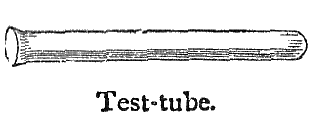
Test, test, n. a pot in which metals are tried and refined: any critical trial: means of trial: (chem.) anything used to distinguish substances or detect their presence, a reagent: standard: proof: distinction: a witness, testimony: the hard covering of certain animals, shield, lorica.—v.t. to put to proof: to examine critically.—ns. Test′-pā′per, a bibulous paper saturated with some chemical compound that readily changes colour when exposed to certain other chemicals; Test′-plate, a white plate or tile on which to try vitrifiable colours by heat: a glass plate with a series of finely ruled lines used in testing the resolving power of microscopic objectives; Test′-tube, a cylinder of thin glass closed at one end, used in testing liquids.—n.pl. Test′-types, letters or words in type of different sizes for testing the sight.—Test Acts, acts meant to secure that none but rightly affected persons and members of the established religion shall hold office—especially those of 1673 and 1685. [O. Fr. test—L. testa, an earthen pot.]
Test, test, v.t. to attest legally and date.—v.i. to make a will.—adj. Tes′table, capable of being given by will, capable of witnessing. [Fr. tester—L. testāri, to testify.]
Testa, tes′ta, n. the outer integument of a seed.
Testacea, tes-tā′sē-a, n.pl. shelled or crustaceous animals.—adjs. Testā′cean (also n.), Testā′ceous, consisting of, or having, a hard shell.—ns. Testacell′a, a genus of molluscs belonging to the Pulmonifera, and represented in Britain by three species; Testaceog′raphy, descriptive testaceology; Testaceol′ogy, conchology. [L. testaceus—testa, a shell.]
Testament, tes′ta-ment, n. that which testifies, or in which an attestation is made: the solemn declaration in writing of one's will: a will: a dispensation, as of the Mosaic or old and the Christian or new, one of the two great divisions of the Bible.—n. Tes′tacy, state of being testate.—adjs. Testamen′tal, Testamen′tary, pertaining to a testament or will: bequeathed or done by will.—adv. Testamen′tarily.—adj. Tes′tāte, having made and left a will.—ns. Testā′tion, a witnessing, a giving by will; Testā′tor, one who leaves a will;—fem. Testā′trix; Testā′tum, one of the clauses of an English deed, enumerating the operative words of transfer, statement of consideration, money, &c. [L. testamentum—testāri, to be a witness—testis, a witness.]
Testamur, tes-tā′mur, n. a certificate that one has passed an examination at an English university—from the opening word. [L., 'we testify.']
Tester, tes′tėr, n. a flat canopy, esp. over the head of a bed. [O. Fr. teste (Fr. tête), the head—L. testa, an earthen pot, the skull.]
Tester, tes′tėr, n. a sixpence—also Tes′tern.—v.t. Tes′tern (Shak.), to present or reward with a sixpence. [O. Fr. teston—teste (Fr. tête), the head, from that of Louis XII. on it.]
Testicle, tes′ti-kl, n. a gland which secretes the seminal fluid in males, a testis, one of the stones.—adjs. Tes′ticond, having the testes concealed; Testic′ular, pertaining to a testicle; Testic′ulate, -d, shaped like a testicle.—n. Tes′tis, a testicle, a rounded body resembling it:—pl. Tes′tes. [L. testiculus, dim. of testis, a testicle.]
Testiere, tes-ti-ār′, n. complete armour for a horse's head. [O. Fr.]
Testify, tes′ti-fī, v.t. to bear witness: to make a solemn declaration: to protest or declare a charge (with against).—v.t. to bear witness to: to affirm or declare solemnly or on oath:—pa.t. and pa.p. tes′tifīed.—ns. Testif′icāte (Scots law), a solemn written assertion; Testificā′tion, the act of testifying or of bearing witness; Tes′tifier. [L. testificāri—testis, a witness, facĕre, to make.]
Testimony, tes′ti-mō-ni, n. evidence: declaration to prove some fact: proof: (B.) the two tables of the law: the whole divine revelation.—v.t. (Shak.) to witness.—adj. Testimō′nial, containing testimony.—n. a writing or certificate bearing testimony to one's character or abilities: a sum of money raised by subscription and presented in any form to a person as a token of respect.—v.t. Testimō′nialise, to present with a testimonial. [L. testimonium—testāri, to witness.]
Testing, tes′ting, n. the act of trying for proof: the operation of refining gold and silver: chemical analysis.—Testing clause, in a Scotch deed, the last clause which narrates when and where the parties signed the deed, before what witnesses, by whose hand written, &c.
Testril, tes′tril, n. (Shak.) same as Tester, a sixpence.
Testudinal, tes-tū′din-al, adj. relating to, or resembling, the tortoise.—adjs. Testū′dinate, -d, Testudin′eous, arched, vaulted, resembling the carapace of a tortoise.—n. Testū′do, a cover for the protection of Roman soldiers attacking a wall, formed by overlapping their oblong shields above their heads: any similarly shaped shelter for miners, &c.: an encysted tumour: the fornix: a kind of lyre, the lute. [L. testudo, -inis, the tortoise.]
Testy, tes′ti, adj. heady: easily irritated: fretful: peevish.—adv. Tes′tily.—n. Tes′tiness. [From O. Fr. teste (Fr. tête), the head.]
Tetanus, tet′a-nus, n. an involuntary, persistent, intense, and painful contraction or cramp of more or less extensive groups of the voluntary muscles: lockjaw: the state of prolonged contraction of a muscle under stimuli repeated quickly.—adjs. Tetan′ic; Tet′aniform; Tetanig′enous.—n. Tetanisā′tion.—v.t. Tet′anise.—adj. Tet′anoid.—n. Tet′any, a rare and little understood disease of the nervous system, occurring both in children and adults, characterised by recurring attacks of tonic spasm of various muscles, particularly those of the fingers and toes, associated with defective hygienic conditions, imperfect ventilation, poor diet, and in children with rickets. [L.,—Gr.,—tetanos, stretched—teinein, to stretch.]
Tetchy, Techy, tech′i, adj. touchy, peevish, fretful.—adv. Tetch′ily, in a tetchy or fretful manner.—n. Tetch′iness, the state of being tetchy or fretful. [Touchy.]
Tête, tāt, n. a head, head-dress.—n. Tête-à-tête (tāt′-a-tāt′), a private confidential interview: a sofa for two.—adj. confidential, secret.—adv. in private conversation: face to face. [Fr.]
Tether, teth′ėr, n. a rope or chain for tying a beast, while feeding, within certain limits.—v.t. to confine with a tether: to restrain within certain limits. [M. E. tedir, acc. to Skeat, prob. Celt., Gael. teadhair, a tether, W. tid, a chain. The Low Ger. tider, Ice. tjóðir, are prob. borrowed.]
Tetrabranchiate, tet-ra-brang′ki-āt, adj. having four gills.—n.pl. Tetrabranch′iāta.
Tetrachord, tet′ra-kord, n. a series of four sounds, forming a scale of two tones and a half.—adj. Tet′rachordal. [Gr. tetrachordos, four-stringed—tetra, for tetara=tessares, four, chordē, chord.]
Tetrachotomous, tet-ra-kot′ō-mus, adj. doubly dichotomous, arranged in four rows.—n. Tetrac′tomy, a division into four parts. [Gr. tetracha, in four parts, temnein, to cut.]
Tetract, tet′rakt, adj. having four rays.—Also Tetrac′tinal, Tetrac′tine. [Gr., tetra-, four, aktis, a ray.]
Tetrad, tet′rad, n. a group of four: (chem.) an atom, radical, or element having a combining power of four.—adjs. Tet′rad, Tetrad′ic.—n. Tet′radite, one who attaches mystic properties to the number four, one born in the fourth month or on the fourth day of the month.
Tetradactyl, tet-ra-dak′til. adj. having four fingers or toes—also Tetradac′tylous.—n. Tetradac′tyl, a four-toed animal.
Tetradecapod, tet-ra-dek′a-pod, adj. having fourteen feet.—n.pl. Tetradecap′oda, fourteen-footed crustaceans.—adj. Tetradecap′odous.
Tetragamy, te-trag′a-mi, n. marriage for the fourth time. [Gr., tetra-, four, gamos, marriage.]
Tetragon, tet′ra-gon, n. a figure of four angles.—adj. Tetrag′onal. [Gr. tetragonon—tetra-, four gōnia, an angle.]
Tetragram, tet′ra-gram, n. a word of four letters: the Tetragrammaton: (geom.) a quadrilateral.—n. Tetragram′maton, the name JeHoVaH as written with four Hebrew letters, regarded as a mystic symbol: similarly some other sacred word of four letters, as the Latin Deus. [Gr., tetra-, four, gramma, a letter.]
Tetragynous, tet-raj′i-nus, adj. (bot.) having four styles or pistils—also Tetragyn′ian.—n.pl. Tetragyn′ia.
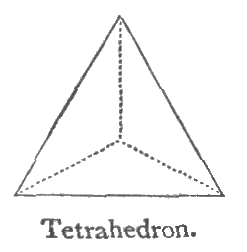
Tetrahedron, tet-ra-hē′dron, n. a solid figure enclosed by four bases or triangles.—adjs. Tetrahē′dral, having four sides: bounded by four triangles; Tetrahexahē′dral.—n. Tetrahex′ahēdron, a solid of twenty-four triangular faces. [Gr., tetra-, four, hedra, a base.]
Tetralogy, te-tral′ō-ji, n. a group of four dramas, three tragic and one satiric, exhibited together at the festivals of Dionysos at Athens: any series of four related dramatic or operatic works.
Tetramera, te-tram′e-ra, n.pl. a division of beetles with four-jointed tarsi.—adj. Tetram′eral, four-parted.—n. Tetram′erism, division into four parts.—adj. Tetram′erous, having four parts. [Gr., tetra-, four, meros, part.]
Tetrameter, te-tram′e-tėr, adj. having four measures, each of two iambic or trochaic feet.—n. a verse of four measures. [Gr. tetrametros—tetra-, four, metron, measure.]
Tetrandria, te-tran′dri-a, n. the fourth class of the Linnæan classification of plants, containing those with four stamens in a flower.—adjs. Tetran′drian, Tetran′drous. [Gr., tetra-, four, anēr, andros, a man.]
Tetrao, tet′rā-o, n. the chief genus of the family Tetraonidæ, which also includes quails and partridges. From these the grouse (forming a subfamily, Tetraoninæ) are distinguished. The genus Tetrao is represented by the Capercailzie and the Blackcock or Black Grouse. [L.,—Gr. tetraōn, a pheasant.]
Tetrapetalous, tet-ra-pet′a-lus, adj. (bot.) having four distinct petals or flower-leaves.
Tetraphyllous, tet-ra-fil′us, adj. having four leaves: consisting of four distinct leaves or leaflets. [Gr., tetra-, four, phyllon, a leaf.]
Tetrapla, tet′ra-pla, n. a Bible consisting of four different versions in parallel columns, originally the edition of the Old Testament published by Origen, containing four Greek versions (those of Aquila, Symmachus, Theodotion, and the Septuagint). [Gr. tetraplous, fourfold.]
Tetrapod, tet′ra-pod, n. an insect distinguished by having but four perfect legs.—adj. four-footed, with four legs—also Tetrap′odous.—n. Tetrap′ody, a group of four feet. [Gr., tetra-, four, pous, podos, foot.]
Tetrapolitan, tet-ra-pol′i-tan, adj. pertaining to a Tetrap′olis or a group of four towns.—Tetrapolitan Confession, the Confession which the four cities of Strasburg, Constance, Memmingen, and Lindau presented to the Diet of Augsburg (11th July 1530), and, properly speaking, the first Confession of the Reformed Church.
Tetrapterous, te-trap′te-rus, adj. having four wings.—Also Tetrap′teran. [Gr., tetra-, four, pteron, a wing.]
Tetraptote, tet′rap-tōt, n. a noun with but four cases. [Gr., tetra-, four, ptōsis, a case.]
Tetrarch, tet′rärk, or tē′, n. under the Romans, the ruler of the fourth part of a province: a subordinate prince: the commander of a subdivision of a Greek phalanx.—ns. Tet′rarchate, Tet′rarchy, office or jurisdiction of a tetrarch: the fourth part of a province. [Gr., tetra-, four, archēs, a ruler.]
Tetrasemic, tet-ra-sē′mik, adj. (pros.) equivalent to four short syllables, as a dactyl, anapæst, or spondee. [Gr., tetra-, four, sēma, a sign.]
Tetraspermous, tet-ra-sper′mus, adj. four-seeded. [Gr., tetra-, four, sperma, seed.]
Tetraspore, tet′ra-spōr, n. a reproductive body, composed of four spores or germs, found in algæ.—adjs. Tetraspor′ic, Tet′rasporous. [Gr., tetra-, four, spora, seed.]
Tetrastich, tet′ra-stik, n. a stanza, &c., of four lines, a quartet.—adjs. Tetrastich′ic, Tetras′tichous. [Gr., tetra-, four, stichos, a row.]
Tetrastyle, tet′ra-stīl, n. a temple or other building having four front columns in its portico: a group of four pillars.—adj. having four pillars. [Gr., tetra-, four, stylos, a column.]
Tetrasyllable, tet′ra-sil-a-bl, n. a word of four syllables.—adjs. Tetrasyllab′ic, -al, consisting of four syllables.
Tetratheism, tet′ra-thē-izm, n. the belief in four elements in the Godhead—the three persons of the Trinity and a divine essence out of which each of these originates. [Gr., tetra-, four, theos, God.]
Tett, tet, n. (obs.) a plait.
Tetter, tet′ėr, n. a popular name for several eruptive diseases of the skin.—v.t. to affect with such.—adj. Tett′erous. [A.S. teter.]
Tettix, tet′iks, n. a cicada: an ornament for the hair of that shape. [Gr., 'grasshopper.']
Teuch, Teugh, tūh, adj. a Scotch form of tough.
Teucrian, tū′kri-an, adj. relating to the ancient Trojans (Teucri) or to the Troad.—n. a Trojan.
Teuton, tū′ton, n. one of the ancient inhabitants of Germany, esp. of a tribe living north of the Elbe who invaded Gaul, along with the Cimbri, and were cut to pieces by Marius near Aix in 102 B.C.: one belonging to that division of the Aryans including High and Low Germans and Scandinavians.—adj. Teuton′ic, belonging to the race so called, including Germans, Scandinavians, English, &c.: also to their language.—ns. Teuton′icism, Teu′tonism, a Germanism; Teutonisā′tion, the act of Germanising.—v.t. and v.i. Teu′tonise, to Germanise, to adopt German ways.—Teutonic Knights, one of the three military-religious orders of knighthood founded during the period of the Crusades, their distinguishing habiliment a white mantle with a black cross. [L. Teutones—Goth. thiuda, a nation. Cf. Dutch.]
Tew, tū, v.t. to make anything ready, to work up: to beat, mix, pound: to taw, as leather: to scourge, drub.—v.i. to work, to bustle, to potter about.—n. trouble, worry.
Text, tekst, n. the original words of an author: that on which a comment is written: a passage of Scripture on which a sermon is supposed to be based.—ns. Text′-book, a book containing the leading principles of a science; Text′-hand, a large hand in writing—so called because it was the practice to write the text of a book in large-hand; Text′-man, Tex′tūalist, one ready in citing Scripture texts: one who adheres to the text.—adj. Tex′tūal, pertaining to, or contained in, the text: serving for a text.—adv. Tex′tually.—ns. Tex′tuary, a textualist; Tex′tus, the authoritative text, esp. of the Bible.—Textus receptus, the received text of the Greek Testament. [L. textus—texĕre, textum, to weave.]
Textile, teks′til, adj. woven: capable of being woven.—n. a woven fabric.—adj. Textō′rial, pertaining to weaving. [L. textilis—texĕre, textum, to weave.]
Texture, teks′tūr, n. anything woven, a web: manner of weaving or connecting: disposition of the parts of a body.—adj. Tex′tūral. [L. textura—texĕre.]
Thack, thak, n. a Scotch form of thatch.—Under thack and rape, safely secured under thatch and rope, snug generally.
Thairm, thārm, n. (Scot.) an intestine: catgut, a musical string.
Thalamus, thal′a-mus, n. the receptacle of a flower, the thallus of a fungus: an inner room, nuptial chamber:—pl. Thal′amī.—adjs. Thal′amic, pertaining to the optic thalamus, a part of the brain near the origin of the optic nerve; Thal′ami-flō′ral, having the parts of the flower inserted on the thalamus or receptacle.—n. Thalā′mium, the layer of reproductive cells in the apothecia of lichens:—pl. Thalā′mia. [Gr., 'chamber.']
Thalassic, tha-las′ik, adj. pertaining to the smaller seas—opp. to Oceanic: (zool.) pelagic.—ns. Thalassoc′racy, Thalassoc′raty, the sovereignty of the seas; Thalassog′rapher, a student of the phenomena of the ocean.—adj. Thalassograph′ic.—ns. Thalassog′raphy, the science of the ocean, oceanography; Thalassom′eter, a tide-gauge. [Gr. thalassa, the sea.]
Thaler, tä′lėr, n. a dollar, in Germany a silver coin worth about 3s. [Ger. Cf. Dollar.]
Thalia, thā-lī′a, n. one of the nine muses, who presided over pastoral and comic poetry.—adj. Thālī′an. [Gr. Thaleia, Thalia—thallein, to bloom.]
Thalictrum, thā-lik′trum, n. a genus of perennial herbs of the Crowfoot family, the meadow-rues: a plant of this genus. [Gr. thaliktron—thallein, to bloom.]
Thallium, thal′i-um, n. a metal closely resembling lead in colour and softness, but slightly heavier, first discovered in 1861, and so called from the presence of an intense green line in the spectrum of the flame in which it is volatilised.—adjs. Thall′ic, Thall′ious. [Gr. thallos, a green shoot.]
Thallus, thal′us, n. a vegetative body showing little or no differentiation into leaf, stem, and root, and characteristic of the Thall′ophytes or lower Cryptogamia, including algæ, fungi, and lichens.—adjs. Thall′iform, of the form of a thallus; Thall′ine, Thallod′ic, pertaining to a thallus.—n. Thall′ogen, a thallophyte.—adjs. Thallog′enous, belonging to the thallogens; Thall′oid, Thall′ose, resembling a thallus.—ns. Thall′ōme, a thallus; Tham′nium, the branched shrub-like thallus of fruticulose lichens. [Gr. thallos, a young shoot.]
Thalweg, tal′vāh, n. the deepest part of a valley. [Ger., thal, valley, weg, way.]
Thammuz=Tammuz (q.v.).
Than, than, conj. when, as, if compared with—a word placed after the comparative of an adjective or adverb between the things compared. [A.S. thonne, in its use a relative or conjunctive adverb, equivalent to our when, used after comparatives to introduce the standard of comparison; closely allied to thone, accus. masc. of def. art. Cf. The.]
Thanatoid, than′a-toid, adj. looking like dead: deadly.—adj. Thanatognomon′ic, indicating death.—ns. Thanatog′raphy, an account of one's death; Thanatol′ogy, the scientific consideration of death; Thanatophō′bia, a morbid dread of death; Thanatop′sis, a view of, or reflection upon, death; Thanatō′sis, death of a part, gangrene. [Gr. thanatos, death.]
Thane, thān, n. a member of a class in the old English community that stood distinctly below the old nobility (eorlas, &c.), but above the mere landowners or ceorls—a kind of nobility of service rather than blood.—ns. Thā′nage, Thane′dom, the jurisdiction or the dignity of a thane; Thane′hood, Thane′ship. [A.S. thegen, thegn, a servant, nobleman—thíhan, to grow; cog. with Ice. thegn, a man, warrior, Ger. degen, a soldier, servant, Gr. teknon, child.]
Thank, thangk, v.t. to express gratitude for a favour.—n. (usually in pl.) expression of gratitude for favour received, often elliptically=My thanks to you.—adj. Thank′ful, full of thanks: grateful.—adv. Thank′fully.—n. Thank′fulness.—adj. Thank′less, unthankful: not expressing thanks or favours: not gaining thanks.—adv. Thank′lessly, in a thankless manner: unthankfully.—ns. Thank′lessness, the state of being thankless: ingratitude; Thank′-off′ering, an offering made to express thanks for mercies received; Thanks′giver, one who gives thanks, or acknowledges a favour; Thanks′giving, act of giving thanks: a public acknowledgment of divine goodness and mercy: a day set apart for this, esp. that in the United States on the last Thursday of November: a form of giving thanks, a grace, that form preceding the last two prayers of morning or evening prayer or of the litany—the General Thanksgiving; Thank′worthiness, the state of being thankworthy.—adj. Thank′worthy, worthy of, or deserving, thanks.—n. Thank′-you-ma'am, a ridge or hollow across a road—from the sudden bobbing of the head of a person in a vehicle crossing it. [A.S. thanc, thonc, will, thanks; cog. with Ger. dank; from the root of think.]
Thapsia, thap′si-a, n. a genus of umbelliferous plants round the Mediterranean. [L.,—Gr., a plant that dyed yellow, prob. Thapsia garganica, brought from Thapsus, Sicily.]
Thargelia, thar-gē′li-a, n.pl. one of the more important ancient Greek festivals, held at Athens in honour of Apollo; in the month of Thargelion (May-June).
That, that, pron. demons. and rel.—as a demons. (pl. Those) it points out a person or thing: the former or more distant thing: not this but the other: as a rel., who or which.—conj. used to introduce a clause: because: for: in order that. [A.S. thæt, neut. of the article the (ðe, ðeó, ðæt, usually replaced by se, seó, ðæt); cog. with Ger. das, dass; Gr. to, Sans. tat. Cf. The.]
Thatch, thach, v.t. to cover, as a roof, with straw, reeds, &c.—n. straw, &c., used to cover the roofs of buildings and stacks.—ns. Thatch′er; Thatch′ing, the act or art of covering with thatch: the materials used for thatching. [A.S. thæc, thatch, whence theccan, to cover; cog. with Ger. decken, L. tegĕre, Gr. stegein, to cover.]
Thaumasite, thaw′ma-sīt, n. a dull white mineral calcium compound. [Gr. thaumazein, to wonder.]
Thaumatrope, thaw′ma-trōp, n. a variation of the Zoetrope (q.v.). [Gr. thauma, wonder, tropos—trepein, to turn.]
Thaumaturgy, thaw′ma-tur-ji, n. the art of working wonders or miracles.—adj. Thauman′tian (Ruskin), wonderful.—ns. Thaumatog′eny, the doctrine of the miraculous origination of life; Thaumatog′raphy, description of natural wonders; Thaumatol′atry, undue wonder-worship; Thau′maturge, a wonder-worker.—adjs. Thaumatur′gic, -al, wonder-working.—n.pl. Thaumatur′gics, wonderful, especially magical, performances: feats of legerdemain.—ns. Thaumatur′gism, thaumaturgy; Thaumatur′gist, a wonder-worker; Thaumatur′gus, a wonder-worker: a worker of miracles, applied to certain saints. [Gr.,—thauma, a wonder, ergon, work.]
Thaw, thaw, v.i. to melt or grow liquid, as ice: to become so warm as to melt ice.—v.t. to cause to melt.—n. the melting of ice or snow by heat: the change of weather which causes it.—adj. Thaw′y, inclined to thaw. [A.S. tháwian; cog. with Ger. thauen, to thaw, to fall in dew.]
The, the, or (when emphatic) thē, demons. pron. usually called the definite article, used to denote a particular person or thing: also to denote a species. [A.S. the, rarely used as nom. masc. of def. art., but common as an indeclinable relative. Cf. That.]
The, the, adv. used before comparatives, as, 'the more the better.' [A.S. thý, by that, by that much, the instrumental case of the def. art.]
Theandric, thē-an′drik, adj. pertaining to the union and co-operation of the divine and human natures. [Gr., theos, a god, anēr, andros, man.]
Theanthropos, thē-an-thrō′pos, n. the God-man, Christ as having both a divine and human person.—adjs. Theanthrop′ic, -al, being at once divine and human: embodying deity in human forms.—ns. Thean′thropism, Thean′thropy, the ascribing of human qualities to deity, also of divine qualities to man; Thean′thropist, one who believes in theanthropism. [Gr. theos, a god, anthrōpos, man.]
Thearchy, thē′ärk-i, n. a theocracy: a body of divine rulers.—adj. Thear′chic. [Gr. thearchia—theos, a god, archein, to be first, to rule—archē, beginning.]
Theatin, thē′a-tin, n. a member of a R.C. religious brotherhood founded in 1524, taking its name from Theate (It. Chieti), of which one of its first founders, John Peter Caraffa, was bishop.
Theatre, thē′a-tėr, n. a place where public representations, chiefly dramatic or musical, are seen, a play-house: any place rising by steps like the seats of a theatre: a building adapted for scholastic exercises, anatomical demonstrations, &c.: scene of action, field of operations: the drama, the stage.—adjs. Theat′ric, -al, relating or suitable to a theatre, or to actors: pompous: artificial, affected.—v.t. and v.i. Theat′ricalise, to adapt to dramatic representation: to make stagy.—ns. Theat′ricalism, Theatrical′ity, staginess, artificiality.—adv. Theat′rically, in a theatrical manner: in a manner suiting the stage.—n. Theat′ricalness.—n.pl. Theat′ricals, dramatic performances.—v.i. Theat′ricise, to play a part.—ns. Theat′ricism, theatricality, affectation, staginess; Theatromā′nia, a craze for play-going; Theat′rophone, a telephone connected with a theatre. [Gr. theatron—theaomai, I see.]
Theave, thēv, n. (prov.) a ewe of the first year.
Thebaine, thē′ba-in, n. an alkaloid obtained from opium.—Also Thebā′ia.
Theban, thē′ban, n. a native of Thebes: (Shak.) a wise man.—adjs. Thebā′ic, Thē′ban.—n. Thebā′id, the district around Egyptian Thebes.—Theban year, the Egyptian year of 365¼ days.
Theca, thē′ka, n. a sheath, case, or sac, a spore-case: a case for a corporal-cloth:—pl. Thē′cæ.—adjs. Thē′cal, Thē′cate.—ns. Thē′caphore, a receptacle bearing thecæ; Thē′caspore, a spore produced in a theca.—adjs. Thecaspō′rous; Thecif′erous, bearing thecæ; Thē′ciform, thecal in use or form.—n. Thē′cium, the part of the apothecium containing the organs of the fruit in lichens. [Gr. thēkē.]
Thecla, thek′la, n. a genus of butterflies, containing the hair-streaks.
Thee, thē, pron. objective of thou. [A.S. the, dat. accus. of thu (cf. Thou).]
Thee, thē, v.i. (Spens.) to prosper, to thrive. [A.S. theón, thión, to thrive, to grow; Ger. ge-deihen, to increase.]
Theft, theft, n. act of thieving.—adj. Theft′ūous, thievish.—adv. Theft′ūously. [A.S. theófth, thýfth—theóf, thief.]
Theine, thē′in, n. a bitter crystallisable volatile principle found in tea.—ns. Thē′ic, a tea-drunkard; Thē′ism, a morbid state resulting from over-much tea-drinking.
Their, thār, poss. adj. pron. of or belonging to them. [A.S. þára, gen. pl. of the def. art. (replaced the older hira).]
Theirs, thārz, poss. of they. [Like hers, ours, yours, a double genitive containing a plural suffix r + a sing. -s. These forms were confined in the 13th and 14th centuries to the Northern dialects, and are probably due to Scandinavian influence.]
Theism, thē′izm, n. belief in the existence of God with or without a belief in a special revelation.—n. Thē′ist, one who believes in God.—adjs. Thēist′ic, -al, pertaining to theism, or to a theist: according to the doctrines of theists. [Gr. theos, God.]
Them, them, pron. objective of they. [A.S. ðám, dat. pl. of the def. art. (this replaced the older heom, hem). It is the result of two cross influences; the th is taken from Old Norse þeim, the e from A.S. hem.]
Theme, thēm, n. a subject set or proposed for discussion, or on which a person speaks or writes, a thesis, a brief essay: a verb in its radical form unmodified by inflections: (mus.) subject, a short melody developed with variations: an administrative division under the Byzantine empire.—n. Thē′ma, that which constitutes a subject of thought.—adj. Thēmat′ic.—adv. Thēmat′ically.—n. Thē′matist, a writer of themes. [Fr. thème—L. thema—Gr. tithēmi, I place, set.]
Themis, them′is, n. daughter of Uranus and Gē, mother of the Hours and the Fates, the personification of the order of things established by law, custom, and equity. [Gr.]
Themselves, them-selvz′, pron. pl. of himself, herself, and itself. [Them and self.]
Then, then, adv. at that time: afterward: immediately: at another time.—conj. for that reason, therefore: in that case.—adj. being at that time.—n. a specific time already mentioned.—By then, by that time. [A doublet of than.]
Thenar, thē′nar, n. the palm of the hand or the sole of the foot.—adj. of or pertaining to the thenar. [Gr. thenar—theinein, to stretch.]
Thence, thens, adv. from that time or place: for that reason.—advs. Thence′forth, from that time forth or forward; Thencefor′ward, from that time forward or onward. [M. E. thenne-s, thenne (cf. Then), with the gen. ending -s—A.S. ðanan. Cf. Hence and Whence.]
Theobroma, thē-ō-brō′ma, n. a small tropical American genus of trees of the sterculia or kola-nut family. The best-known species, Theobroma cacao, yields the cocoa and chocolate of commerce.—n. Theobrō′mine, an alkaloid principle, similar to theine and caffeine, existing in the chocolate nut. [Gr., theos, a god, brōma, food.]
Theocracy, thē-ok′ra-si, n. that constitution of a state in which the Almighty is regarded as the sole sovereign, and the laws of the realm as divine commands rather than human ordinances—the priesthood necessarily becoming the officers of the invisible ruler: the state thus governed.—ns. Thē′ocrat, Theoc′ratist.—adjs. Theocrat′ic, -al. [Gr. theokratia—theos, God, kratein, to rule.]
Theocrasy, thē-ō-krā′si, n. the mixed worship of polytheism: a mystic intimacy with deity reached through profound contemplation. [Gr. theos, a god, krasis, a mixing.]
Theocritean, thē-ok-ri-tē′an, adj. after the manner of Theocritus (3d century B.C.), the greatest of Greek pastoral poets: pastoral, idyllic.
Theodicy, thē-od′i-si, n. a name given to the exposition of the theory of Divine Providence, with a view especially to the vindication of the sanctity and justice of God in establishing the present order of things, in which evil, moral as well as physical, so largely appears to prevail.—adj. Theodicē′an. [Gr. theos, God, dikē, justice.]
Theodolite, thē-od′ō-līt, n. an instrument used in land-surveying for the measurement of angles horizontal and vertical, being neither more nor less than an altitude and azimuth instrument, proportioned and constructed so as to be conveniently portable.—adj. Theodolit′ic. [Ety. unknown; Gr. theasthai, to see + hodos, way + litos, smooth; theasthai + dolichos, long, &c.]
Theogony, thē-og′ō-ni, n. the birth and genealogy of the gods, esp. as told in ancient poetry.—adj. Theogon′ic.—n. Theog′onist, a writer on theogony. [Gr. theogonia—theos, a god, gonē, genos, race—genein, to beget.]
Theology, thē-ol′ō-ji, n. the science which treats of God, and of man's duty to Him—Natural, as discoverable by the light of reason alone; or Positive or Revealed, based on the study of divine revelation.—ns. Theol′ogaster (-gas-), a shallow fellow who pretends to a knowledge of theology; Theol′ogate (-gāt), the course of study for R.C. priests; Theol′oger, a theologian; Theolō′gian, one well versed in theology: a divine, a professor of or writer on divinity, esp. in R.C. usage, a theological lecturer attached to a cathedral church—also Theolō′gus (-gus).—adjs. Theolog′ic, -al, pertaining to theology or divinity.—adv. Theolog′ically.—n. Theolog′ics, theological disputation.—v.t. Theol′ogise, to render theological.—v.i. to make a system of theology.—ns. Theol′ogiser, one who theologises; Theol′ogist, a student in the science of theology: a theologian; Thē′ologue (-log), a theologian, esp. a theological student. [Gr. theologia—theos, God, logos, a treatise.]
Theomachy, thē-om′a-ki, n. a fighting against the gods, as by the Titans and giants: (Bacon) opposition to the divine will.—n. Theom′achist. [Gr. theomachia—theos, a god, machē, a battle.]
Theomancy, thē′ō-man-si, n. divination by means of oracles, sibyls, and other persons inspired immediately by some divinity.—adj. Thēōman′tic. [Gr., theos, a god, manteia, divination.]
Theomania, thē-ō-mā′ni-a, n. a madman's belief that he himself is God, or that God dwells in him.—n. Theomā′niac, one who shows theomania. [Gr., theos, God, mania, madness.]
Theomorphic, thē-ō-mor′fik, adj. having the form or likeness of a god.—n. Theomor′phism. [Gr., theos, a god, morphē, form.]
Theopaschite, thē-ō-pas′kīt, n. a by-name applied to such as accepted the formula, that, in the passion of Christ, 'God had suffered and been crucified.' It was applied to the Monophysites.—n. Theopas′chitism. [Gr., theos, God, paschein, to suffer.]
Theopathy, thē-ōp′a-thi, n. religious emotion aroused by meditation about God.—adj. Theopathet′ic.
Theophany, thē-of′a-ni, n. a manifestation or appearance of deity or the gods to man, esp. the appearance of God to the patriarchs in the form of an angel or in human form: the incarnation and second coming of Christ.—adj. Theophan′ic. [Gr., theos, God, phainomai, I appear.]
Theophilanthropy, thē-ō-fil-an′thrō-pi, n. a deistical system of religion drawn up under the French Directory in 1796, and designed to take the place of Christianity.—adj. Theophilanthrop′ic.—ns. Theophilan′thropism; Theophilan′thropist; Thē′ophile, one who loves God.
Theopneusty, thē′op-nūs-ti, n. divine inspiration.—adj. Theopneus′tic. [Gr., theos, God, pneustos, inspired—pnein, to breathe.]
Theorbo, thē-orb′ō, n. a large lute with two necks, one above the other, formerly used for the bass.—n. Theorb′ist. [It. tiorba.]
Theorem, thē′ō-rem, n. a proposition to be proved.—adjs. Theoremat′ic, Theorem′ic.—n. Theorem′atīst.—adjs. Theoret′ic, -al, pertaining to theory: not practical: speculative.—adv. Theoret′ically.—n.pl. Theoret′ics, the speculative parts of a science.—n. Thē′oric (Shak.), theory, speculation.—v.i. Thē′orise, to form a theory: to form opinions solely by theories: to speculate.—ns. Thē′orīser; Thē′orist, a theoriser: one given to theory and speculation; Thē′ory, an explanation or system of anything: an exposition of the abstract principles of a science or art: speculation as opposed to practice. [Gr. theōrēma—theōrein, to view—theasthai, to see.]
Theosophy, thē-os′ō-fi, n. immediate divine illumination or inspiration claimed to be possessed by specially gifted men, who also possess abnormal control over natural forces.—ns. Thē′ōsoph, Theos′opher, Theos′ophist, one who claims to believe in immediate divine illumination.—adjs. Theosoph′ic, -al, pertaining to theosophy.—adv. Theosoph′ically.—v.i. Theos′ophise, to practise theosophy.—n. Theos′ophism, theosophical tenets.—adj. Theosophi′stical, theosophical. [Gr. theōsophia—theos, God, sophia, wisdom.]
Theotechny, thē-ō-tek′ni, n. the scheme of divine intervention, the art of introducing deities into poetry.—adj. Theotech′nic. [Gr., theos, a god, technē, art.]
Theotocos, thē-ot′ō-kos, n. the mother of God, a title of the Virgin Mary repudiated by Nestorius—it being not God the Logos but only the human nature which had a mother and suffered pain and death.—Also Theot′okos. [Gr., theos, God, tiktein, tekein, to bring forth.]
Therapeutæ, ther-a-pū′tē, n.pl. a traditional ascetic sect, allied to the Essenes, living chiefly on the Lake Mareotis, near Alexandria.
Therapeutic, ther-a-pū′tik, adj. pertaining to the healing art: curative.—adv. Therapeu′tically.—n.sing. Therapeu′tics, that part of medicine concerned with the treatment and cure of diseases.—n. Therapeu′tist, one versed in therapeutics. [Gr. therapeuein, to take care of, to heal.]
There, thār, adv. in that place—opp. to Here, at that point—it is used to begin sentences when the subject comes after the verb.—interj. expressing certainty, alarm, &c., and in interjectional phrases equivalent to that, as 'There's a good boy.'—advs. Thereabout′ or -abouts′, about or near that place: near that number, quantity, or degree; Thereaft′er, after or according to that; There′among, among them; There′-anent′ (Scot.), concerning that matter; Thereat′, at that place or occurrence: on that account; There′away, from that place or direction, thence: in those parts, thereabout; Thereby′, by that means: in consequence of that; Therefor′, for that, this, or it; Therefore (thėr′fur), for that or this reason: consequently; Therefrom′, from that or this; Therein′, in that or this place, time, or thing; Thereinaft′er, later in the same document; Therein′to, into that place.—n. There′ness, the property of having relative situation or existence.—advs. Thereof′, of that or this; Thereon′, on that or this; Thereout′, out of that or this: outside; Therethrough′, through that, by that means; Thereto′, Thereun′to, to that or this; There′tofore, before that time; Thereun′der, under that; Thereupon′, upon or in consequence of that or this: immediately; Therewith′, with that or this, thereupon; There′withal, with that or this: at the same time, over and above. [A.S. ðær, ðer; conn. with the stem of the.]