Front matter (continued 4)
Reading edition
Semolina, sem-ō-lē′na, n. the particles of fine, hard wheat which do not pass into flour in milling: an article of food consisting of granules of the floury part of wheat.—Also Sem′ōla, Semōli′nō. [It. semola—L. simila, the finest wheat flour.]
Semostomæ, sē-mos′tō-mē, n.pl. a sub-order of Discomedusæ, containing jelly-fishes.—adj. Sēmos′tomous, having long oral processes. [Gr. sēma, a mark, stoma, mouth.]
Semoted, sē-mō′ted, adj. (obs.) separated: remote.
Semotilus, sē-mot′i-lus, n. an American genus of leuciscine fishes, including the chub and dace. [Gr. sēma, a mark, ptilon, a feather.]
Semper idem, sem′pėr ī′dem, always the same. [L.]
Sempervirent, sem-pėr-vī′rent, adj. evergreen. [L. semper, always, virens—virēre, to be green.]
Semper vivum, sem′pėr vī′vum, n. a genus of polypetalous plants, including the house-leek. [L.]
Sempiternal, sem-pi-tėr′nal, adj. everlasting: endless—also Semp′itern.—v.t. Sempiter′nise, to perpetuate.—n. Sempiter′nity.—adj. Sempiter′nous.—n. Sempiter′num, a durable twilled woollen material. [L. sempiternus—semper, ever, æternus, eternal.]
Semple, sem′pl, adj. a Scotch form of simple, esp. meaning of low birth, the opposite of Gentle.
Semplice, sem′plē-che, adj. (mus.) simple, without embellishments. [It.]
Sempre, sem′pre, adv. (mus.) in the same style throughout. [It.,—L. semper, always.]
Sempster, sem′stėr, Sempstress, sem′stres, n. a woman who sews. [Seamstress.]
Semuncia, sē-mun′shi-a, n. a Roman coin of four drachmas weight, the twenty-fourth part of the Roman pound.—adj. Semun′cial.
Sen., sēn, an abbreviation of Senior.
Sen, sen, n. a Japanese copper coin the hundredth part of a yen or dollar.
Señal, se-nyal′, n. (Amer.) a landmark. [Sp.]
Senary, sen′ar-i, adj. containing six: of or belonging to six.—n. Senā′rius, in Latin prosody, a verse of six feet. [L. senarius—seni, six each—sex, six.]
Senate, sen′āt, n. a legislative or deliberative body, esp. the upper house of a national legislature, as of France, the United States, &c.: a body of venerable or distinguished persons: the governing body of the University of Cambridge.—ns. Sen′ate-house, a house in which a senate meets; Sen′ator, a member of a senate: in Scotland, the lords of session are called Senators of the College of Justice.—adj. Senatō′rial, pertaining to, or becoming, a senate or a senator.—adv. Senatō′rially, with senatorial dignity.—ns. Sen′atorship; Senā′tus, a governing body in certain universities.—Senātus academicus, the governing body of a Scotch university, consisting of the principal and professors; Senātus consult, a decree of the senate of ancient Rome. [L. senatus—senex, senis, an old man.]
Sence, sens, n. an obsolete form of sense.
Sench, sensh, v.t. to cause to sink.
Sencion, sen′shi-on, N. (obs.) groundsel. [L. senecio.]
Send, send, v.t. to cause to go: to cause to be conveyed: to despatch: to forward: to compel: to throw: to hurl: to authorise: to grant: to drive: to dismiss: to commission: to diffuse: to bestow.—v.i. to despatch a message or messenger: (naut.) to pitch into the trough of the sea:—pa.t. and pa.p. sent.—n. (Scot.) a messenger, esp. one sent for the bride: a present: the impulse of a wave on a ship.—ns. Sen′der, one who sends: (teleg.) the instrument by which a message is transmitted; Sen′ding, despatching: pitching bodily into the trough of the sea; Send′-off, a start as on a journey.—Send for, to require by message to come or be brought; Send forth, or out, to give, put, or bring forth; Send to Coventry, to cut: to exclude from society. [A.S. sendan; Ice. senda, Goth. sandjan, Ger. senden.]
Sendal, sen′dal, n. a thin silk or linen. [O. Fr.,—Low L. cendalum—L. sindon—Gr. sindōn.]
Seneca-oil, sen′ē-kä-oil, n. crude petroleum.—Seneca's microscope, a glass globe filled with water.
Senecio, sē-nē′si-o, n. a genus of composite plants—ragwort, &c.—adj. Senē′cioid.
Senega, sen′ē-ga, n. the seneca snakeroot, the dried root of Polygala Senega, good for snake-bites.
Senegal, sen′ē-gal, n. a small African blood-finch, the fire-bird.
Senescence, sē-nes′ens, n. the state of growing old or decaying: decay by time.—n. Senec′titude.—adj. Senes′cent, growing old: decaying with the lapse of time. [L. senescens, -entis, pr.p. of senescĕre, to grow old—senex, old.]
Seneschal, sen′e-shal, n. a steward: a major-domo.—n. Sen′eschalship. [O. Fr., (Fr. sénéchal)—sin-s, old, skalks, a servant.]
Senex, sē′neks, n. a South American hawk: a Brazilian swift.
Seng-gung, seng′-gung, n. the teledu or Javan badger.
Sengreen, sen′grēn, n. the house-leek: (her.) a figure resembling it. [A.S. singrene; Ger. singrün.]
Senhor, se-nyōr′, n. the Portuguese form corresponding to the Spanish señor and Italian signor.
Senile, sē′nil, adj. pertaining to old age or attendant on it: aged.—n. Senil′ity, old age: the imbecility of old age. [L. senilis—senex, senis, old.]
Senior, sēn′yor, adj. elder: older in office.—n. one older than another, the elder of two persons in one family bearing the same name: one older in office: an aged person: one of the older fellows of a college, a student in the fourth year of the curriculum.—v.i. Sē′niorise, to lord it over.—n. Sēnior′ity, priority of birth, or of service: a body of seniors—also Sē′niory (Shak.). [L., comp. of senex.]
Senna, sen′a, n. the purgative dried leaflets of several species of cassia. [Fr.,—Ar. sena.]
Sennet, sen′et, n. (Shak.) a particular set of notes on the trumpet or cornet.
Sennight, sen′nīt, n. a week. [Seven night.]
Sennit, sen′it, n. a sort of flat, braided cordage.—Also Sinn′et.
Senocular, sē-nok′ū-lar, adj. having six eyes.
Senonian, sē-nō′ni-an, n. (geol.) a division of the upper Cretaceous in France and Belgium.
Señor, se-nyōr′, n. a gentleman: in address, sir: as a title, Mr:—fem. Señora (se-nyō′ra), a lady: in address, madam: as a title, Mrs.—n. Señorita (sen-yō-rē′ta), a young lady: in address, miss: as a title, Miss. [Sp.]
Sens, sens, adv. (Spens.) since.
Sensation, sen-sā′shun, n. perception by the senses: the change in consciousness which results from the transmission of nervous impulses to the brain, feeling excited by external objects, by the state of the body, or by immaterial objects: a state of excited feeling.—adjs. Sen′sāte, -d, perceived by the senses; Sensā′tional, pertaining to sensation: having sensation: intended as a literary work to excite violent emotions: adhering to a philosophical sensationalism.—ns. Sensā′tionalism, the doctrine that our ideas originate solely in sensation, and that there are no innate ideas: sensualism: sensational writing; Sensā′tionalist, a believer in sensationalism: a sensational writer.—adj. Sensātionalist′ic.—adv. Sensā′tionally.—adjs. Sen′sative; Sensatō′rial, pertaining to sensation.—Sensation novels, novels that deal in violent effects, strained emotion, and usually improbable situations.
Sense, sens, n. a faculty by which objects are perceived: perception: discernment: understanding: power or soundness of judgment: reason: opinion: conviction: import: immediate consciousness.—ns. Sense′-bod′y, a sense-organ in acalephs supposed to have a visual or an auditory function; Sense′-cap′sule, a receptive chamber for sensory perception, connected with the ear, eye, and nose; Sense′-cen′tre, a centre of sensation.—adj. Sensed, chosen as to sense or meaning.—ns. Sense′-el′ement, an external sensation, as an element of perception; Sense′-fil′ament, a filament having the function of an organ of sense.—adjs. Sense′ful (Spens.), full of sense or meaning, reasonable, judicious, perceptive; Sense′less, without sense: incapable of feeling: wanting sympathy: foolish: unreasonable.—adv. Sense′lessly.—ns. Sense′lessness; Sense′-or′gan, any organ of sense, as the eye, ear, or nose; Sense′-percep′tion, perception by means of the senses; Sense′-rhythm, Hebrew parallelism; Sense′-skel′eton, the framework of a sense-organ; Sensibil′ity, state or quality of being sensible: actual feeling: capacity of feeling: susceptibility: acuteness of feeling: delicacy: mental receptivity.—adj. Sen′sible, capable of being perceived by the senses or by the mind: capable of being affected: easily affected: delicate: intelligent, marked by sense, judicious: cognisant: aware: appreciable: sensitive: amenable to.—n. Sen′sibleness.—adv. Sen′sibly.—adjs Sensifā′cient, producing sensation; Sensif′erous, Sensif′ic, Sensificā′tory; Sensig′enous, giving rise to sensation; Sen′sile, capable of affecting the senses.—ns Sen′sion, the becoming aware of being affected from without in sensation; Sen′sism, sensualism in philosophy; Sen′sist, a sensationalist.—n. Sensitisā′tion.—v.t. Sen′sitise, to render sensitive, to render capable of being acted on by actinic rays of light.—n. Sen′sitiser.—adj. Sen′sitive, having sense or feeling: susceptible to sensations: easily affected: pertaining to, or depending on, sensation.—adv. Sen′sitively.—ns Sen′sitiveness, Sen′sitivity, the state of being sensitive: keen sensibility: the state of being delicately adjusted, as a balance: (chem.) the state of being readily affected by the action of appropriate agents; Sensitom′eter, an apparatus for testing the degrees of sensitiveness of photographic films.—adjs Sensō′rial, pertaining to the sensorium, sensory; Sensoridigest′ive, partaking of digestive functions and those of touch, as the tongue of a vertebrate animal.—ns Sensō′rium, Sen′sory, the organ which receives the impressions made on the senses: the nervous centre to which impressions must be conveyed before they are received: the whole sensory apparatus of the body, the nervous system, &c.—adj. Sen′sual, pertaining to, affecting, or derived from the senses, as distinct from the mind: not intellectual or spiritual: given to the pleasures of sense: voluptuous: lewd: carnal: worldly.—n. Sensualisā′tion.—v.t. Sen′sualise, to make sensual: to debase by carnal gratification.—ns Sen′sualism, sensual indulgence: the doctrine that all our knowledge is derived originally from sensation: the regarding of the gratification of the senses as the highest end; Sen′sualist, one given to sensualism or sensual indulgence: a debauchee: a believer in the doctrine of sensualism.—adj. Sensualist′ic, sensual: teaching the doctrines of sensualism.—n. Sensual′ity, indulgence in sensual pleasures: lewdness.—adv. Sen′sually, in a sensual manner.—ns Sen′sualness; Sen′suism; Sen′suist.—adj. Sen′suous, pertaining to sense: connected with sensible objects: easily affected by the medium of the senses.—adv. Sen′suously.—n. Sen′suousness.—Sensitive flames, flames easily affected by sounds; Sensitive plant, one of certain species of Mimosa—from the peculiar phenomena of irritability which their leaves exhibit when touched or shaken; Sensuous cognition, cognition through the senses.—A sensitive person, one sensitive to mesmeric influence; The senses, or Five senses, sight, hearing, smell, taste, and touch. [Fr.,—L. sensus—sentīre, to feel.]
Sent, sent, n. (Spens.) scent, perception.
Sent, sent, pa.t. and pa.p. of send.
Sentence, sen′tens, n. opinion: a judgment pronounced on a criminal by a court or judge: a maxim: (gram.) a number of words containing a complete thought: sense: meaning: matter.—v.t. to pronounce judgment on: to condemn.—n. Sen′tencer, one who sentences.—adj. Senten′tial, pertaining to a sentence: comprising sentences.—adv. Senten′tially.—adj. Senten′tious, abounding with sentences or maxims: short and pithy in expression: bombastic, or affected in speech.—adv. Senten′tiously.—n. Senten′tiousness, brevity with strength.—Master of the Sentences, the great 12th-century schoolman, Peter Lombard (died 1160), from his work Sententiarum Libri IV., an arranged collection of sentences from Augustine, &c. [Fr.,—L. sententia—sentīre, to feel.]
Sentient, sen′shi-ent, adj. discerning by the senses: having the faculty of perception and sensation: (phys.) noting those parts which on stimulation give rise to sensation.—n. the mind as capable of feeling.—ns Sen′tience, Sen′tiency.—adv. Sen′tiently, in a sentient or perceptive manner.
Sentiment, sen′ti-ment, n. a thought occasioned by feeling: opinion: judgment: sensibility: feeling: a thought expressed in words: a maxim: a toast: emotion: an exhibition of feeling, as in literature or art: (pl., phren.) the second division of the moral faculties.—adj. Sentimen′tal, having or abounding in sentiments or reflections: having an excess of sentiment or feeling: affectedly tender.—v.t. Sentimen′talise, to talk sentiment.—ns Sentimen′talism, Sentimental′ity, quality of being sentimental: affectation of fine feeling; Sentimen′talist, one who affects sentiment or fine feeling: one guided by mere sentiment: one who regards sentiment as more important than reason.—adv. Sentimen′tally. [Fr.,—Late L.,—L. sentīre, to feel.]
Sentine, sen′tēn, n. (obs.) a sink. [L. sentina.]
Sentinel, sen′ti-nel, n. a soldier or soldier-marine at a point with the duty of watching for the approach of an enemy, or guarding the gun-park, camp, magazine, or other locality: a sentry.—adj. acting as a sentinel.—v.t. to watch over, as a sentinel.—adj. Sen′tinelled, furnished with a sentinel.—Sentinel crab, a crab of the Indian Ocean with long eye-stalks. [Fr. sentinelle—It. sentinella, a watch, prob. the L. sentinator, one who pumps bilge-water out of a ship—sentina, the hold of a ship. Others explain Fr. sentinelle as a dim. of sentier, a path—Low L. semitarius—L. semita, a footpath.]
Sentisection, sen-ti-sek′shun, n. painful vivisection—opp. to Callisection.
Sentry, sen′tri, n. a sentinel: a soldier on guard to observe the approach of danger: a watch-tower.—ns Sen′try-box, a box to shelter a sentry; Sen′try-go, any active military duty. [Prob. a corr. of sentinel—Low L. semitarius—L. semita, a path.]
Senvy, sen′vi, n. (obs.) mustard-seed. [O. Fr. seneve—L. sinapi—Gr. sinapi, mustard.]
Senza, sen′tsa, prep. (mus.) without. [It.]
Sep, sep, an abbreviation for sepal.
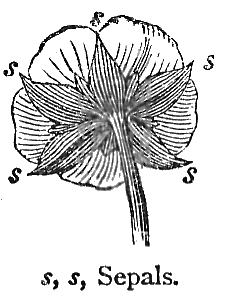
Sepal, sep′al, or sē′pal, n. a leaf or division of the calyx of a flower.—adjs. Sep′aline, Sep′aloid, Sep′alous.—n. Sepal′ody, change of petals into sepals. [Fr. sépale—L. separ, separate.]
Separate, sep′a-rāt, v.t. to divide: to part: to withdraw: to set apart for a certain purpose: to sever.—v.i. to part: to withdraw from each other: to become disunited.—adj. separated: divided: apart from another: distinct.—n. Separabil′ity.—adj. Sep′arable, that may be separated or disjointed.—n. Sep′arableness.—advs. Sep′arably; Sep′arately.—ns Sep′arateness; Sep′arating-disc, an emery-wheel for cutting a space between teeth; Separā′tion, act of separating or disjoining: state of being separate: disunion: chemical analysis: divorce without a formal dissolution of the marriage-tie; Separā′tionist; Sep′aratism, act of separating or withdrawing, esp. from an established church; Sep′aratist, one who separates or withdraws, esp. from an established church, a dissenter: a name applied by the Unionists to those Liberals in favour of granting Home Rule to Ireland.—adj. Sep′arātive, tending to separate.—ns. Sep′arātor, one who, or that which, separates: a divider; Sep′arātory, a chemical vessel for separating liquids of different specific gravities; Sep′arātrix, the line separating light from shade on any partly illuminated surface; Separā′tum, a separate copy of a paper which has been published in the proceedings of a scientific society.—Separate estate, property of a married woman over which her husband has no right of control; Separate maintenance, a provision made by a husband for the sustenance of his wife where they decide to live apart. [L. separāre, -ātum—se-, aside, parāre, to put.]
Sepawn=Supawn (q.v.).
Sephardim, se-fär′dēm, n.pl. the Spanish-Portuguese Jews, descended from those expelled from Spain in 1492—as distinguished from Ashkenazim, or German-Polish Jews.—adj. Sephar′dic.
Sephen, sef′en, n. a sting-ray of the Indian Ocean, valued for shagreen.
Sephiroth, sef′i-roth, n. in the cabbala, the first ten numerals identified with Scripture names of God.
Sepia, sē′pi-a, n. a fine, brown pigment used as a water-colour—from the ink-bag of a few species of cuttle-fish: Indian or China ink: a genus of cuttle-fishes.—n.pl. Sēpiā′cea, a group of cephalopods, same as Sēpiidæ.—n. Sēpiadā′rium, a genus of cuttles.—adjs. Sēpiā′rian, Sē′piāry, Sēpidā′ceous, Sē′pioid; Sē′pic, done in sepia, as a drawing.—ns. Sē′piost, Sepiostaire′, Sē′pium, cuttle-bone. [L.,—Gr. sēpia, the cuttle-fish.]
Sepiment, sep′i-ment, n. a hedge, a fence. [L. sæpimentum, a hedge.]
Sepose, sē-pōz′, v.t. (obs.) to set apart.—v.i. to go apart.—n. Sēposi′tion.
Sepoy, sē′poi, n. a native soldier, whether Hindu or Mohammedan, in the British army in India. [Hind. sipāhī, a soldier—Pers. sipāhī, a horseman.]
Seppuku, sep-puk′ōō, n. the hara-kiri. [Jap.]
Seps, seps, n. a genus of scincoid lizards. [Gr.]
Sepsis, sep′sis, n. putridity, rot: a genus of dipterous insects. [Gr. sēpsis, putrefaction.]
Sept, sept, n. in Ireland, a subdivision of a tribe: an enclosure, a railing.—adj. Sep′tal, belonging to a sept: partitional. [Probably a corr. of sect.]
Sept.=Septuagint; September.
Septan, sep′tan, adj. recurring every seventh day.
Septangle, sep′tang-gl, n. a figure with seven angles and seven sides.—adj. Septang′ūlar, having seven angles. [L. septem, seven, angulus, angle.]
Septaria, sep-tā′ri-a, n. a genus of shipworms—Teredo.
Septarium, sep-tā′ri-um, n. an ovate flattened nodule of argillaceous limestone or ironstone—turtle-stone:—pl. Septā′ria.—adj. Septā′rian.
Septate, -d, sep′tāt, -ed, adj. divided into compartments.
September, sep-tem′bėr, n. the ninth month of the year.—adj. Septem′bral.—n. Septem′brist, one of the perpetrators of the atrocious massacres in the prisons of Paris, Sept. 2-7, 1792.—September thorn, a British geometrid moth. [L. septem, seven.]
Septempartite, sep-tem-pär′tīt, adj. divided into seven parts.
Septemvir, sep-tem′vir, n. one of a board of seven men associated for certain duties.—n. Septem′virate, the office of septemvir.
Septenarius, sep-te-nā′ri-us, n. in Latin prosody, a verse consisting of seven feet.
Septenary, sep′te-nā-ri, adj. consisting of seven: lasting seven years: occurring once in seven years.—n.pl. Sep′tenaries, the number seven, the heptad. [L. septenarius—septem, seven.]
Septenate, sep′te-nāt, adj. (bot.) having seven parts.
Septennial, sep-ten′i-al, adj. lasting seven years: happening every seven years.—n. Septenn′ate, a period of seven years.—adv. Septenn′ially.—n. Septenn′ium.—Septennial Act, a statute of 1716 fixing the existence of a parliament at seven years. [L. septennis—septem, seven, annus, a year.]
Septentrion, sep-ten′tri-on, n. (Shak.) the north.—adjs. Septen′trion, -al, northern.—adv. Septen′trionally.—n.pl. Septentriō′nes, the constellation of the Great Bear, or the seven stars near the north pole-star, called Charles's Wain.
Septet, Septette, sep-tet′, n. a work for seven voices or instruments: a company of seven musicians.
Sept-foil, sept′-foil, n. a plant, the roots of which are used in medicine, tanning, &c.: a figure of seven equal segments of a circle used in the R.C. Church as a symbol of her seven sacraments, the seven gifts of the Holy Spirit, &c. [Fr. sept—L. septem, seven, foil—L. folium, a leaf.]
Septicemia, sep-ti-sē′mi-a, n. sepsis, blood-poisoning—also Septicæ′mia.—n. Sep′tic, a substance that promotes the putrefaction of bodies.—adjs. Sep′tic, -al, promoting putrefaction.—adv. Sep′tically.—adj. Septicē′mic.—n. Septic′ity, tendency to promote putrefaction.—adj. Septif′erous, conveying putrid poison. [Formed from Gr. sēptikos, putrefying, haima, blood.]
Septicidal, sep-ti-sī′dal, adj. dividing the partitions, as when fruit splits asunder—also Sep′ticide.—adv. Sep′ticidally. [L. sæptum, a fence, cædĕre, to cut.]
Septifarious, sep-ti-fā′ri-us, adj. turned seven different ways.
Septiferous, sep-tif′e-rus, adj. having a septum or septa, septate.
Septifluous, sep-tif′lōō-us, adj. flowing in seven streams.
Septifolious, sep-ti-fō′li-us, adj. seven-leaved.
Septiform, sep′ti-form, adj. sevenfold, having seven parts: like a septum, septal.
Septifragal, sep-tif′rā-gal, adj. (bot.) breaking away from the partitions, said of the valves of a pod. [L. septum, a partition, frangĕre, fractum, to break.]
Septilateral, sep-ti-lat′ėr-al, adj. having seven sides. [L. septem, seven, latus, lateris, a side.]
Septillion, sep-til′yun, n. the product of a million raised to the seventh power, or a unit with forty-two ciphers affixed: in the United States, France, &c., the eighth power of a thousand.
Septimanarian, sep-ti-mā-nā′ri-an, n. a monk on duty for a week. [L. septimanus—septem, seven.]
Septime, sep′tēm, n. the seventh position assumed by a fencer after drawing his weapon from the scabbard. [L. septimus, seventh—septem, seven.]
Septimole, sep′ti-mōl, n. a group of seven notes to be played in the time of four or six: sign .—Also Sep′tōle.

Septinsular, sept-in′sū-lar, adj. consisting of seven islands. [L. septem, seven, insula, island.]
Septisyllable, sep′ti-sil-a-bl, n. a word of seven syllables.
Septomaxillary, sep-tō-mak′si-lā-ri, adj. combining characters of a nasal septum and a maxillary bone.—n. a bone in some birds uniting the maxillopalatines of opposite sides.
Septonasal, sep-tō-nā′zal, adj. forming a nasal septum.—n. a bone of this kind.
Septuagenarian, sep-tū-aj-e-nā′ri-an, n. a person seventy years old.—adj. Septūag′enary, consisting of seventy.—n. one seventy years old. [L. septuagenarius—septuageni, seventy each—septem, seven.]
Septuagesima, sep-tū-a-jes′i-ma, n. the third Sunday before Lent—the seventieth day before Easter (the common but dubious explanation).—adj. Septuages′imal, consisting of seventy: counted by seventies. [L. septuagesimus—septem, seven. The name, like Quinquagesima and Sexagesima, was most probably adopted on a false analogy with Quadragesima, the Latin name of Lent.]
Septuagint, sep′tū-a-jint, n. the version in Hellenistic Greek of the Old Testament, said to have been made by 72 translators at Alexandria by command of Ptolemy Philadelphus (284-247 B.C.)—usually expressed by LXX.—adj. Septuagin′tal. [L. septuaginta—septem, seven.]
Septuary, sep′tū-ā-ri, n. (obs.) something composed of seven.
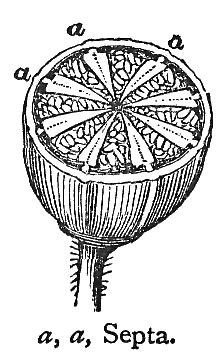
Septum, sep′tum, n. (bot., anat.) a partition separating two cavities: one of the radial plates of a coral:—pl. Sep′ta.—adj. Sep′tulate, having imperfect or spurious septa.—n. Sep′tulum, a little septum or small partition. [L.,—sæpīre, sepīre, to enclose.]
Septuple, sep′tū-pl, adj. sevenfold.—v.t. to make sevenfold: to multiply by seven.—n. Sep′tūplet, a septimole. [Low L. septuplus—septem, seven; on the analogy of quadruple.]
Sepulchre, sep′ul-kėr, n. a place of burial: tomb: a burial vault: a recess in some early churches in which the reserved sacrament, &c., were laid from Good Friday till Easter.—v.t. (Milt.) to place in a sepulchre: to bury or entomb.—adj. Sepul′chral, pertaining to a sepulchre, or to monuments erected for the dead: (fig.) deep, hollow in tone.—n. Sep′ulture, act of burying the dead: interment: burial.—v.t. to entomb. [Fr.,—L. sepulchrum—sepelīre, sepultum, to bury.]
Sepurture, sep′ur-tūr, adj. (her.) raised above the back and opened, of a bird's wings.
Sequacious, sē-kwā′shus, adj. inclined to follow a leader: attendant: manageable: pliant: observing logical sequence or consistence.—ns. Sequā′ciousness, Sequac′ity, disposition to follow. [L. sequax, sequacis—sequi, to follow.]
Sequel, sē′kwel, n. that which follows, the succeeding part: result, consequence: (obs.) descendants: (Scots law) thirlage. [Fr.,—L. sequela—sequi; Gr. hepesthai, to follow.]
Sequela, sē-kwē′la, n. that which follows: an inference, a corollary:—pl. Sē′quelæ.
Sequence, sē′kwens, n. state of being sequent or following: order of succession: a series of things following in a certain order, as a set of three or more cards in order of value: that which follows: consequence: (mus.) a regular succession of similar chords: in liturgics, a hymn in rhythmical prose, sung after the gradual and before the gospel.—adjs. Sē′quent, following, succeeding; Sēquen′tial.—n. Sēquential′ity.—adv. Sēquen′tially. [Fr.,—L. sequens, pr.p. of sequi, to follow.]
Sequester, sē-kwes′tėr, v.t. to separate: to withdraw from society: to seclude: to set apart: (law) to place anything contested into the hands of a third person till the dispute is settled: to hold the property of another till the profits pay the demands: to take possession of the estate of a bankrupt in order to distribute it among the creditors: to confiscate.—v.i. to renounce any interest in the estate of a husband.—n. (Shak.) the act of sequestering: an umpire.—adjs. Sēques′tered, retired, secluded; Seques′trable.—v.t. Sēques′trate (law), to sequester.—ns. Sēquestrā′tion, the Scotch legal term for bankruptcy: the act of sequestering, esp. the seizure of any one's property for the use of the state during dispute, or for the benefit of creditors: state of being separated: seclusion from society; Sēquestrā′tor, one who sequesters another's property: one to whom property is committed during dispute. [O. Fr. sequestrer—Low L. sequestrāre, -ātum—L. sequester, a depositary—sequi, to follow.]
Sequestrum, sē-kwes′trum, n. a necrosed section of bone.—n. Sequestrot′omy, the operation of removing such.
Sequin, sē′kwin, n. a gold Venetian coin of the 13th century=9s. 4d. [Fr.,—It. zecchino—zecca, the mint; of Ar. origin.]
Sequoia, sē-kwoi′a, n. a small genus of gigantic evergreen coniferous trees belonging to California—Wellingtonia. [A Latinised form of the name of the Cherokee chief Sequoiah.]
Sera, sē′ra, n. a lock of any kind:—pl. Sē′ræ. [L.]
Sérac, sā-rak′, n. a name for the cuboidal masses into which the névé breaks when passing down a steep incline. [Swiss Fr.]
Seraglio, se-ral′yō, n. the ancient residence of the Sultan at Constantinople, enclosing within its walls a variety of mosques, gardens, and large edifices, the chief of which is the Harem: a place where women are kept, a place of licentious pleasure: an enclosure. [It. serraglio—Low L. serāre, to lock up, from L. sera, a door-bar. The word was confused with Pers. serai, a palace.]
Serai, se-rä′i, n. a khan, a caravansary: a seraglio for women. [Pers. serai, a palace.]
Seralbumin, sēr-al-bū′min, n. albumin of the blood.
Serang, se-rang′, n. the skipper of a small East Indian vessel, the boatswain of a lascar crew. [Pers. sarhang, a commander.]
Serape, se-rä′pe, n. a Mexican shawl worn by men, often gay-coloured.
Serapeum, Serapeium, ser-a-pē′um, n. a temple of Serapis, esp. that near Memphis.
Seraph, ser′af, n. an angel of the highest rank in the traditional angelology of the church, due to Dionysius the Areopagite, who places the seraphim at the head of the nine choirs of angels, the first rank being formed by the seraphim, cherubim, and throni:—pl. Seraphs (ser′afs), Seraphim (ser′af-im), celestial beings on either side of the throne of Jehovah, seen in prophetic vision by Isaiah, and by him alone (vi. 2-6): a geometrid moth.—adjs. Seraph′ic, -al, pertaining to, or becoming, a seraph: angelic: pure: sublime: refined.—adv. Seraph′ically. [Heb. Serāphīm—sāraph, to burn.]
Seraphine, ser′a-fēn, n. a coarse-toned musical reed-instrument, played with a key-board—the precursor of the harmonium.
Serapias, se-rā′pi-as, n. a genus of orchids.
Serapis, ser-ā′pis, n. Apis honoured by the Romans under the attributes of Osiris: a genus of gasteropods: a genus of hymenopterous insects.
Seraskier, ser-as′kēr, n. a Turkish general, esp. the commander-in-chief or the minister of war.—n. Seras′kierate, the office of a seraskier. [Turk.,—Pers. sar, ser, head, Ar. ‛asker, army.]
Serb, serb, adj. Servian.—n. a Servian.
Serbonian, ser-bō′ni-an, adj. relating to a dangerous bog in Egypt, hence to any difficult situation.
Serdab, ser′dab, n. a secret chamber within the masonry of an ancient Egyptian tomb in which images of the deceased were stored. [Ar. serdāb.]
Sere. Same as Sear.
Sere, sēr, adj. (obs.) separate, several, many.
Sere, sēr, n. (obs.) a claw.
Serein, se-rang′, n. a fine rain which falls from a cloudless sky. [Fr.]
Serena, sē-rē′na, n. the damp, unwholesome air of evening.
Serenade, ser-e-nād′, n. evening music in the open air, esp. given by a lover to his mistress under her window at night: a piece of music suitable for such an occasion.—v.t. to entertain with a serenade.—ns. Serenā′der, one who serenades; Serenä′ta, an instrumental work for performance in the open air; Ser′enāte (Milt.), a serenade. [Fr.,—It. serenata, sereno, serene—L. serenus.]
Serene, sē-rēn′, adj. calm: unclouded: unruffled: an adjunct to the titles of certain German princes—a translation of Durchlaucht.—v.t. to tranquillise.—n. the chilly damp of evening: blight.—adv. Serēne′ly, calmly, coolly.—ns. Serēne′ness; Seren′itude; Seren′ity, state or quality of being serene, calmness, peace.—v.t. Serenise′, to make bright: to glorify. [L. serenus, clear.]
Serenoa, sē-rē′nō-a, n. a genus of dwarf palms in Florida.
Serf, sėrf, n. a slave attached to the soil and sold with it: a labourer rendering forced service in Russia: a menial.—ns. Serf′age, Serf′dom, condition of a serf. [Fr.,—L. servus, a slave.]
Serge, sėrj, n. a strong twilled fabric, once of silk, now usually of worsted.—n. Sergette′, a thin serge. [Fr.,—L. serica, silk—Seres, the Chinese.]
Sergeant, Serjeant, sär′jent, n. a non-commissioned officer of the army and marines next above a corporal, overlooking the soldiers in barracks, and assisting the officers in all ways in the field: a bailiff: a constable: a servant in monastic offices: a police-officer of superior rank.—ns. Ser′geancy, Ser′geantcy, Ser′geantship, office of a sergeant; Ser′geant-at-arms, an officer of a legislative body for keeping order, &c.; Ser′geant-fish, the cobra, so called from the lateral stripes; Ser′geant-mā′jor, the highest non-commissioned officer, employed to assist the adjutant: the cow-pilot, a fish; Ser′geantry, Ser′geanty, a kind of feudal tenure on condition of service due to the king only; Ser′jeant-at-arms, an officer who attends upon the Lord Chancellor with the mace, and who executes various writs of process in the course of a Chancery suit: a similar officer who attends on each House of Parliament, and arrests any person ordered by the House to be arrested; Ser′jeant-at-law, formerly in England the highest degree of barrister, once with exclusive audience in the Court of Common Pleas, their proper dress a violet-coloured robe with a scarlet hood, and a black coif, represented in modern times by a patch of silk at the top of the wig.—Grand sergeanty, a tenure of lands by special honorary service to the king; Petit sergeanty, a tenure of lands by a rent or tender. [Fr. sergent—L. serviens, -entis, pr.p. of servīre, to serve.]
Serial, sē′ri-al, adj. pertaining to, or consisting of, a series: appearing periodically.—n. a tale or other composition appearing in successive parts, as in a periodical: a publication issued in successive numbers, a periodical.—n. Sērial′ity.—advs. Sē′rially, Sē′riately, in a series or regular order.—adj. Sē′riāte, arranged in a series.—adv. Sē′riātim, one after another.—n. Sēriā′tion.
Serian, sē′ri-an, adj. Chinese—also Ser′ic.—ns. Ser′ica, a genus of melolonthine beetles; Sericā′ria, a genus of bombycid moths, containing the mulberry silkworm.—adjs. Ser′icate, -d, silky, covered with silky down; Sericeous (sērish′i-us), pertaining to, or consisting of, silk: (bot.) covered with soft silky hairs, as a leaf.—n.pl. Seric′ides, a section of melolonthine beetles.—ns. Ser′icin, the gelatinous substance of silk; Ser′icite, a variety of potash mica.—adj. Sericit′ic.—ns. Sericocar′pus, a genus of composite plants of the United States; Sericos′tōma, the typical genus of caddis-flies; Serictē′rium, a spinning gland; Ser′iculture, the breeding of silkworms—also Ser′iciculture; Sericul′turist. [Gr. Sēres, the Seres, an Asiatic people who supplied the Greeks and Romans with their silk.]
Sericon, ser′i-kon, n. in the jargon of alchemy, a red tincture—opp. to Bufo, a black.
Seriema, ser-i-ē′ma, n. a long-legged, crested Brazilian bird.—Also Caria′ma.
Series, sē′ri-ēz, n.sing. and pl. a succession of things connected by some likeness: sequence: order: (math.) a progression of numbers or quantities according to a certain law.—Arithmetical series, a series whose terms progress by the addition or subtraction of a constant difference; Geometrical series, a series whose successive terms progress by a constant multiplier or divisor—the common ratio; Reciprocal series, a series each of whose terms is the reciprocal of the corresponding term of another series. [L.,—serĕre, sertum, to join.]
Serif, ser′if, n. the short cross-line at the ends of unconnected Roman types, as in H, l, d, y, &c.—Also Cer′iph and Ser′iph.
Seriform, sē′ri-form, adj. noting a section of the Altaic family of languages, comprising Chinese, &c.
Serilophus, sē-ril′ō-fus, n. an Indian genus of broadbills. [Gr. sērikos, silky, lophos, a crest.]
Serin, ser′in, n. a small fringilline bird like the canary.—n. Serinette′, a bird-organ. [Fr.,—L. citrinus, citrine, yellow.]
Seringa, se-ring′gä, n. a name of several Brazilian trees yielding india-rubber. [Port.]
Seringhi, ser-ing-gē′, n. a musical instrument of the viol class used in India.
Serinus, sē-rī′nus, n. a genus of birds of the fringilline family, including canaries. [Fr. serin.]
Seriola, sē-rī′ō-la, n. a genus of carangoid fishes, the amber fishes.
Serious, sē′ri-us, adj. solemn: in earnest: important: attended with danger: weighty: professedly religious.—adjs. Sē′rio-com′ic, -al, partly serious and partly comical.—adv. Sē′riously, gravely, deeply: without levity.—n. Sē′riousness. [Fr. serieux—L. serius, akin to severus, severe.]
Seriph. See Serif.
Serjeant. See Sergeant.
Sermocination, ser-mos-i-nā′shun, n. (obs.) speech-making: (rhet.) a form of prosopopœia in which one answers a question he has himself asked.
Sermon, sėr′mon, n. a discourse on a text of Scripture delivered during divine service: any serious address, any serious counsel, admonition, or reproof.—v.t. to tutor, to lecture.—ns. Sermol′ogus, a volume containing sermons by the Church fathers; Sermoneer′, a sermoniser; Ser′moner, a preacher; Ser′monet, a little sermon.—adjs. Sermon′ic, -al, having the character of a sermon.—n. Ser′moning, the act of preaching: a homily.—v.i. Ser′monise, to compose or preach sermons: to lecture: to lay down the law.—v.t. to preach a sermon to.—ns. Sermonī′ser, one who preaches or writes sermons; Sermō′nium, a historical play, formerly acted by the inferior orders of the Roman Catholic clergy; Sermun′cle, a little sermon. [L. sermo, sermonis—serĕre, to join.]
Seroon, se-rōōn′, n. a crate or hamper in which Spanish and Levantine figs, raisins, &c. are usually packed.—n. Ser′on, a bale of about 200 lb. of Paraguay tea wrapped in hide. [Sp. seron.]
Seropurulent, sē-rō-pū′rōō-lent, adj. composed of serum mixed with pus.—adj. Serosanguin′olent, pertaining to bloody serum.
Serotine, ser′ō-tin, n. a small reddish vespertilionine bat. [L. serotinus—sero, late.]
Serotinous, sē-rot′i-nus, adj. (bot.) appearing late the season. [L. serotinus—sero, late.]
Serous, sē′rus, adj. resembling serum, thin, watery: secreting serum.—n. Seros′ity. [Serum.]
Serpent, sėr′pent, n. any member of the genus Ophidia, more popularly known as snakes—any reptile without feet which moves by means of its ribs and scales: a snake: a person treacherous or malicious: one of the constellations in the northern hemisphere: (mus.) a bass musical wind-instrument, entirely obsolete except in a few Continental churches, a tapered leather-covered wooden tube 8 feet long, twisted about like a serpent.—v.i. to wind along: to meander.—v.t. to girdle, as with the coils of a serpent.—ns. Serpentā′ria, the Virginia snakeroot; Serpentā′rius, the secretary-birds: the constellation Ophiuchus; Ser′pent-charm′er, one who charms or has power over serpents; Ser′pent-charm′ing, the art of charming or governing serpents; Ser′pent-cū′cumber, a long-fruited variety of the musk-melon; Ser′pent-dē′ity, the god of the Ophites, Abraxas; Ser′pent-eat′er, the secretary-bird: a wild goat in India and Cashmere; Ser′penteau, an iron circle with spikes to which squibs are attached, used in a breach.—n.pl. Serpent′es, the second order of the third class of limbless reptiles.—ns. Ser′pent-fish, the snake-fish; Ser′pent-grass, the alpine bistort.—adjs. Serpent′iform, ophidian in structure: snake-like; Ser′pentine, resembling a serpent: winding, tortuous: spiral: crooked.—n. a kind of firework: a 16th-cent. form of cannon: a mineral composed of silica and manganese, generally occurring massive, colour some shade of green, also red and brownish-yellow.—v.i. to wind or wriggle like a serpent.—adv. Ser′pentinely.—adjs. Serpentin′ic, Ser′pentinous.—adv. Serpentī′ningly, with a serpentine motion.—v.t. Ser′pentinise, to convert into serpentine.—v.i. Ser′pentise, to wind: meander.—adj. Ser′pent-like, like a serpent.—ns. Ser′pent-liz′ard, a lizard of the genus Seps; Ser′pent-moss, a greenhouse plant from the West Indies; Ser′pentry, serpentine motion: a place infested by serpents: serpents collectively; Ser′pent-star, a brittle star; Ser′pent-stone, snake-stone, adder-stone; Ser′pent's-tongue, the adder's-tongue fern; Ser′pent-tur′tle, an enaliosaur; Ser′pent-withe, a twining plant of tropical America; Ser′pent-wood, an East Indian shrub; Ser′pent-wor′ship, one of the most ancient and widespread forms of primitive religion, and still existing amongst many savage peoples; Sea′-ser′pent (see Sea).—Serpentine verse, a verse which begins and ends with the same word.—The old serpent, Satan. [L. serpens, -entis, pr.p. of serpĕre, to creep; akin to Gr. herpein.]
Serpet, ser′pet, n. (obs.) a basket.
Serpette, sėr-pet′, n. a hooked pruning-knife. [Fr.]
Serpigo, sėr-pī′go, n. (Shak.) a skin eruption, herpes.—adj. Serpig′inous (-pij′-). [L. serpĕre, to creep.]
Serplath, ser′plath, n. (Scot.) 80 stone weight.
Serpolet, ser′pō-let, n. the wild thyme. [Fr.]
Serpula, ser′pū-la, n. a genus of sedentary Chætopod worms, living in twisted calcareous tubes fastened to shells and rocks in the sea, or even to other animals, such as crabs.—adj. Serpū′lian.—n. Ser′pulite, a fossil of the family Serpulidæ.—adjs. Serpulit′ic, Ser′puloid. [L. serpĕre, to creep.]
Serr, ser, v.t. (obs.) to crowd or press together.
Serra, ser′a, n. a saw, or saw-like part [L.]
Serradilla, ser-a-dil′a, n. a Port. bird's-foot clover.
Serranus, ser-rā′nus, n. the genus containing sea-perches or sea-bass.—n.pl. Serran′idæ, the family of fishes containing among its genera Sea-bass, Rockfish, &c. [L. serra, a saw.]
Serrasalmo, ser-a-sal′mo, n. a genus of characinoid fishes, with compressed belly fringed with projecting scales. [L. serra, a saw, salmo, a salmon.]
Serrate, -d, ser′rāt, -ed, adj. notched or cut like a saw: (bot.) having small sharp teeth along the margin.—n. Serrā′tion, state of being serrated.—adj. Serratiros′tral, saw-billed, as a bird.—ns. Ser′rāture, a notching like that between the teeth of a saw; Serrā′tus, one of several muscles of the thorax.—adj. Ser′ricorn, having separate antennæ.—n.pl. Serrif′era, a group of insects, including the sawflies and horntails.—adjs. Serrif′erous, having a serra or serrate organ; Ser′riform, toothed like a saw; Ser′riped, having the feet serrate; Serriros′trate, having the bill serrated with tooth-like processes.—n. Ser′ro-mō′tor, a steam reversing-gear, in marine engines.—adj. Ser′rous, like the teeth of a saw: rough.—n. Ser′rula, one of the serrated appendages of the throat of the mudfish:—pl. Ser′rulæ.—adjs. Ser′rulate, -d, finely serrate.—ns. Serrulā′tion, the state of being serrulate; Serrurerie′, ornamental wrought-metal work. [L. serratus—serra, a saw.]
Serried, ser′rid, adj. crowded: pressed together.—v.t. Ser′ry, to crowd. [Fr. serrer, to crowd—L. sera, a door-bar.]
Sertularia, ser-tū-lā′ri-a, n. a common genus of Hydroids in which the branched horny investment of the plant-like colony forms a sessile cup around each polyp.—adj. Sertulā′rian. [L. serĕre, sertum, to plait.]
Serum, sē′rum, n. the watery part of curdled milk, whey: the thin fluid which separates from the blood when it coagulates. [L.]
Serval, sėr′val, n. a South African animal of the cat tribe, yellowish with black spots, valued for its fur—the Bush-cat, Tiger-cat. [Ger.]
Servant, sėr′vant, n. one who is in the service of another: a labourer: a domestic: one dedicated to God: (B.) a slave: one of low condition or spirit: a professed lover: a word of mere civility, as in 'your humble' or 'obedient servant' in letters, petitions, &c.—v.t. to subject.—ns. Ser′vant-girl, Ser′vant-maid, a female domestic servant; Ser′vant-man, a male servant; Ser′vantry, servants collectively; Ser′vantship, position or relation of a servant.—Servant out of livery, a servant of a higher grade, as a major-domo or butler; Servants' call, a whistle to call attendants; Servants' hall, the room in a house where the servants eat together. [Fr., pr.p. of servir, to serve—L. servīre, to serve.]
Servatory, sėr′va-tor-i, n. (obs.) that which preserves.
Serve, sėrv, v.t. to be a servant to, to work for and obey: to attend or wait upon: to work for: to obey: to be subservient or subordinate to: to wait upon at table, &c.: to do duty for: to treat, behave towards: to render worship to: to aid by good offices: to minister to a priest at mass: to comply with: to requite: to handle, manipulate: to furnish: (naut.) to bind with small cord: (law) to deliver or present formally: to furnish: to cover, of stallions, &c.: to deliver the ball in tennis.—v.i. to be employed as a servant, to discharge any regular duty: to be in subjection: to suffice, to avail, to be suitable or favourable.—n. in tennis, the act of the first player in striking the ball, or the style in which this is done.—ns. Ser′vage (obs.), servitude: the service of a lover; Ser′ver, one who serves: an attendant on the priest at the celebration of the Eucharist: the player who strikes the tennis-ball first: a salver, any utensil for distributing or helping at table.—Serve an office, to discharge the duties of an office; Serve a process or writ, to formally communicate a process or writ to the person to whom it is addressed; Serve an attachment, to levy such a writ on the person or goods by seizure; Serve an execution, to levy an execution on the person or goods by seizure; Serve a sentence, to undergo the punishment prescribed by a judicial sentence; Serve one a trick, to play a trick on one; Serve one out, to take revenge on some one; Serve one right, to treat one as he deserves; Serve one's time, to complete one's apprenticeship; Serve out, to deal or distribute; Serve the purpose of, to answer adequately an end for which something else is designed; Serve the turn, to suffice for one's immediate purpose or need; Serve time, to undergo a period of imprisonment, &c.; Serve up, to bring to table. [Fr. servir—L. servīre, to serve.]
Servian, ser′vi-an, n. a native of Servia: the language of Servia, belonging to the southern division of the Slav tongues, its nearest congeners Bulgarian, Slovenian, and Russian.
Service, sėr′vis, n. condition or occupation of a servant: a working for another: duty required in any office: military or naval duty: any liturgical form or office, public religious worship, religious ceremonial: a musical composition for devotional purposes: labour, assistance, or kindness to another: benefit: profession of respect: order of dishes at table, or a set of them: official function, use, employment: that which is furnished: a tree of rarely more than 30 feet high, with leaves and flowers like the Rowan-tree, but the former downy beneath—also Sorb.—ns. Serviceabil′ity, Ser′viceableness.—adj. Ser′viceable, able or willing to serve: advantageous: useful: capable of rendering long service, durable.—adv. Ser′viceably.—ns. Ser′vice-berr′y, a berry of the service-tree: (Scot.) the fruit of the white beam: a North American shrub, the shadbush; Ser′vice-book, a book of forms of religious service: a prayer-book; Ser′vice-box, a form of expansion joint, used in street-mains of steam-heating systems; Ser′vice-clean′er, a portable air-compressing pump and receiver for service-pipes; Ser′vice-line, one of two lines drawn across the court twenty-one feet from the net, in lawn-tennis; Ser′vice-mag′azine, a magazine for storing ammunition for immediate use; Ser′vice-pipe, a smaller pipe from a main-pipe to a dwelling; Ser′vice-tree, a tree of the pear family, with close-grained wood and an edible fruit; Ser′ving-mall′et, a piece of wood having a groove on one side to fit the convexity of a rope; Din′ner-ser′vice, a full set of dishes for dinner; Tā′ble-ser′vice, a set of utensils for the table; Wild′-ser′vice, a small species of service-tree, cultivated in England for its fruit and wood.—Service of an heir (Scots law), a proceeding before a jury to determine the heir of a person deceased.—Active service, service of a soldier, &c., in the field, against an enemy; At your service, a phrase of civility; Have seen service, to have been in active military service: to have been put to hard use; Plain service, in Anglican usage, an office which is simply read. [Fr.,—L. servitium.]
Servient, ser′vi-ent, adj. subordinate.
Serviette, ser-vi-et′, n. a table-napkin. [Fr.]
Servile, sėr′vīl, adj. pertaining to a slave or servant: slavish: meanly submissive: cringing: obedient: (gram.) secondary or subordinate.—n. a slave, a menial.—adv. Ser′vilely.—ns. Ser′vilism, the spirit of a servile class; Servil′ity (obs. Ser′vileness), state or quality of being servile: slavery: obsequiousness; Ser′ving-maid, a female domestic servant; Ser′ving-man, a male servant: a professed lover.—adj. Ser′vious, obsequious.—ns. Ser′vīte, one of a mendicant order of monks and nuns founded in Italy in the 13th century; Servit′ium (law), service; Ser′vitor, one who serves: a servant: a follower or adherent: a male servant, a menial: soldier: formerly in Oxford, an undergraduate partly supported by the college, his duty to wait on the fellows and gentlemen commoners at table; Ser′vitorship, the office or condition of a servitor; Ser′vitūde, state of being a slave: slavery: state of slavish dependence: menial service: compulsory servitude: (law) a burden affecting land or other heritable subjects, by which the proprietor is either restrained from the full use of his property or is obliged to suffer another to do certain acts upon it: service rendered in the army or navy: (obs.) servants collectively; Ser′vitūre (Milt.), servants collectively.—v.i. Ser′vulate.
Sesame, ses′a-mē, n. an annual herbaceous plant of Southern Asia, whose seed yields the valuable gingili-oil.—adjs. Ses′amoid, -al, denoting certain small bones found in the substance of the tendons at the articulations of the great toes, and in other parts of the body.—n. Ses′amum, the genus to which sesame belongs.—Open sesame, the charm by which the door of the robbers' cave flew open in the tale of 'Ali Baba and the Forty Thieves' in the Arabian Nights. [Fr.,—L.,—Gr.]
Sesban, ses′ban, n. a shrub of the bean family, with yellow flowers, native to Egypt.—Also Jyntee. [Fr.,—Ar. seisebān.]
Seseli, ses′el-i, n. a genus of umbelliferous plants, usually perennial, with erect branching stems—including the mountain meadow-saxifrage. [Gr.]
Sesha, sā′sha, n. the king of the serpents in Hindu mythology, having a thousand heads, the buttresses of the world.
Sesia, sē′shi-a, n. a genus of clear-winged moths. [Gr. sēs, seos, a moth.]
Sesquialteral, ses-kwi-al′te-ral, adj. one and a half more—also Sesquial′terate, Sesquial′terous.—n. Sesquial′tera (mus.), the interval of a perfect fifth, having the ratio of 2 to 3: a rhythm in which three minims are made equal to a preceding two. [L. sesquialter.]
Sesquiduple, ses-kwi-dū′pl, adj. of two and a half times.—adj. Sesquidū′plicate, being in the ratio of 2½ to 1, or 5 to 2.
Sesquipedalian, ses-kwi-pē-dā′li-an, adj. containing a foot and a half: often humorously said of a very long word—also Ses′quipedal.—ns. Sesquipedā′lianism, Sesquipedal′ity. [L. sesquipedalis—sesqui, one-half more, pes, ped-is, a foot.]
Sesquiplicate, ses-kwip′li-kāt, adj. noting the ratio of a cube to a square.
Sesquitertia, ses-kwi-ter′shi-a, n. (mus.) a perfect fourth, an interval having the ratio of 1 to 1⅓, or 3 to 4.—adjs. Sesquiter′tial, Sesquiter′tian, -al.
Sesquitone, ses′kwi-tōn, n. (mus.) a minor third, an interval equal to a tone and a half.
Sess, ses, n. Same as Cess.
Sessa, ses′a, interj. (Shak.) prob. a cry to urge to swiftness in running.
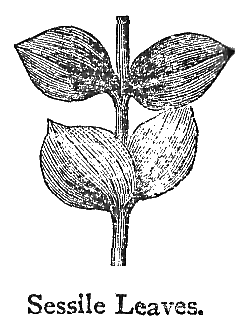
Sessile, ses′il, adj. (bot.) growing directly from the stem, without a foot-stalk, as some leaves. [L. sessilis, low—sedēre, sessum, to sit.]
Session, sesh′un, n. the sitting of a court or public body: the time it sits: the period of time between the meeting and prorogation of Parliament: the act of sitting, esp. the enthronement of Christ at the right hand of God the Father: (Scot.) the lowest Presbyterian church court, the kirk-session.—adj. Ses′sional, pertaining or belonging to a session or sessions.—n. Ses′sion-clerk, the official who officially records the transactions of a kirk-session.—Court of Session, the supreme civil court of Scotland. [Fr.,—L. sessio, sessionis—sedēre, sessum, to sit.]
Sesspool. Same as Cesspool.
Sestertius, ses-tėr′shi-us, n. a Roman silver coin, a quarter denarius, worth 2½ asses: a brass coin under the Empire, worth 4 asses—also Ses′terce:—pl. Sester′tii.—n. Sester′tium, a money of account equal to 1000 sestertii. [L., 'two-and-a-half'—semis, half, tertius, third.]
Sestet, Sestette, ses′tet, n. the last six lines of a sonnet forming two stanzas of three lines each: (mus.) same as Sextet. [It. sestetto—sesto—L. sextus, sixth.]
Sestina, ses-tē′na, n. an old French form of verse, originally consisting of six stanzas of six unrhymed lines, with a final triplet, the same terminal words being used in each stanza, but arranged differently. Modern sestinas are written on two or three rhymes.—Also Ses′tine. [It.,—L. sextus, sixth.]
Sestole, ses′tōl, n. (mus.) same as Sextuplet (q.v.).—Also Ses′tolet.
Set, set, v.t. to make to sit: to place: to fix: to put in a condition for use, to make ready, to arrange, prepare, furnish, draw up: to render motionless: to determine beforehand: to obstruct: to plant, place so as to promote growth: to place a brooding fowl on a nest containing eggs: to fix in metal: to put and fix in its proper place, as a broken limb, &c.: to assign, as a price: to sharpen: to spread, as sails: to pitch, as a tune: to adapt music to: to frame, mount, or adorn with something fixed: to stud: to point, as a dog: to accompany part or the whole of the way: (Scot.) to let to a tenant: to compose, put into type: (prov.) to become, as a dress, &c.—v.i. to sink below the horizon: to decline: to become fixed: to congeal: to begin the growth of fruit: to have a certain direction in motion: to acquire a set or bend: to point out game: to apply (one's self):—pr.p. set′ting; pa.t. and pa.p. set.—n. Set′-back, a check to progress: an overflow.—adj. Set-by′ (Scot.), proud, reserved.—ns. Set′-down, a rebuke, snubbing; Set′-off, a claim set up against another: a counterbalance: an ornament; Set′-out, preparations: a display of dishes, dress, &c.: a company, clique; Set′-to, a conflict in boxing, argument, &c.; Set′-up, bearing of a person.—adj. hilarious, tipsy.—Set about, to begin; Set abroach, to tap and leave running: to give publicity to; Set against, to oppose; Set agoing, to make begin to move; Set apart, to separate from the rest, to reserve: (B.) to promote; Set aside, to put away, to omit or reject; Set at ease, to quiet, content; Set at naught (see Naught); Set at work, to put to a task; Set before, to put in front of one; Set by, to put aside: (B.) to value or esteem; Set by the compass, to note the bearing by the compass; Set down, to lay on the ground: to put down in writing: to fix in one's mind: to attribute, charge: to lay down authoritatively: to give a severe rebuke to; Set eyes on, to see, fix one's eyes on; Set forth, to exhibit, display: to praise, recommend: to publish: (B.) to set off to advantage: to set out on a journey; Set forward (B.), to further, promote; Set free, to release, put at liberty; Set in, to put in the way: to begin; Set in order, to adjust or arrange; Set little, much, &c., by, to regard, esteem little, much, &c.; Set off, to adorn: to place against as an equivalent; Set on (B.), to attack; Set on, or upon, to instigate: to employ: to fix upon: (B.) to attack; Set one's face, to turn one's self resolutely towards; Set one's hand to, to sign; Set one's self, to bend one's energies toward anything; Set one's self against, to discountenance, oppose; Set one's teeth, to set one's teeth together, as in a strong resolution; Set on fire, to apply fire; Set on foot, to set agoing, to start; Set out, to mark off, to assign: (Bacon) to publish, to adorn: to equip, to furnish: to recommend: to prove: to start; Set over, to appoint as ruler over; Set sail (see Sail); Set the fashion, to lead or establish the fashion; Set the teeth on edge (see Edge); Set to, to affix: to apply one's self; Set up, to erect, to exalt: to begin: to enable to begin: to place in view: (print.) to put in type: to begin a new course: to make pretensions. [A.S. settan; cog. with Ger. setzen, Ice. setja, Goth. satjan; settan is the weak causative of sittan, to sit.]
Set, set, adj. fixed: firm: determined: regular: established: having reached the full growth: (B.) seated.—n. a number of things similar or suited to each other, set or used together: a group of games played together: the full number of eggs set under a hen: the couples that take part in a square dance, also the movements in a country-dance or quadrille: a number of persons associated: direction, drift, tendency: act of setting: a young plant ready for setting out, a cutting, slip: the appearance of young oysters in a district in any season: a mine or set of mines on lease, a distance set off for excavation, a system of pumps in a mine (also Sett): a tool for dressing forged iron: any permanent change of shape or bias of mind: fit, way in which a dress hangs: the pattern of a tartan, &c.: bearing, carriage, build.—n. Set′-square, a triangular piece of wood having one of its angles a right angle, used in mechanical drawing.—Set fair, a barometric indication of steady, fair weather; Set piece, a piece of theatrical scenery with a supporting framework, as distinguished from a side-scene or drop-scene; Set speech, a speech carefully premeditated.
Seta, sē′tä, n. a bristle, stiff hair, a prickle.—adj. Sētā′ceous, consisting of bristles: bristle-shaped.—n. Setā′ria, a genus of grasses with flat leaves and tail-like bristly spikes.—adjs. Sētif′erous; Sē′tiform, having the form of a bristle; Sētig′erous (tij′), bearing bristles; Sētip′arous, producing bristles; Sētose′, Sē′tous, bristly. [L. seta, a bristle.]
Seton, sē′tn, n. (surg.) an artificially produced sinus or channel, through which some substance, as a skein of cotton or silk, or a long flat piece of india-rubber or gutta-percha, is passed so as to excite suppuration, and to keep the artificially formed openings patent: also the inserted material. [Fr. séton (It. setone)—Low L. seto—L. seta, a bristle.]
Settee, se-tē′, n. a long seat with a back, esp. a sofa for two. [Prob. a variant of settle (3).]
Settee, se-tē′, n. a single-decked Mediterranean vessel with long prow and lateen sails. [Prob. It. saettia.]
Setter, set′ėr, n. one who sets, as music to words: a dog which crouches when it scents the game: one who finds out the victims for thieves.—Setter forth, one who proclaims or promotes anything; Setter off, one who decorates; Setter on, an instigator; Setter out, one who expounds; Setter up, one who establishes.
Setter, set′ėr, v.t. (prov.) to cut an ox's dewlap, and treat with a seton.—ns. Sett′ering, the foregoing process; Sett′er-wort, the fetid hellebore.
Settima, set′ti-ma, n. (mus.) the interval of a seventh—(obs.) Set′timo. [It.,—L. septem.]
Setting, set′ing, n. act of setting: direction of a current of wind: the hardening of plaster: that which holds, as the mounting of a jewel: the mounting of a play, &c., for the stage: act of adapting to music.
Settle, set′l, v.t. to set or place in a fixed state: to fix: to establish in a situation or business: to render quiet, clear, &c.: to decide: to free from uncertainty: to quiet: to compose: to fix by gift or legal act: to adjust: to liquidate or pay: to colonise.—v.i. to become fixed or stationary: to fix one's residence or habits of life (often with down): to grow calm or clear: to sink by its own weight: to sink to the bottom: to cease from agitation.—adj. Sett′led, fixed, firmly seated or decided: quiet, sober.—ns. Sett′ledness; Sett′lement, act of settling: state of being settled: payment: arrangement: a colony newly settled: a subsidence or sinking of a wall, &c.: a sum newly settled on a woman at her marriage; Sett′ler, one who settles: a colonist; Sett′ling, the act of making a settlement: the act of subsiding: the adjustment of differences: sediment: dregs; Sett′ling-day, a date fixed by the Stock Exchange for the completion of transactions—in consols, once a month; in all other stocks, twice a month, each settlement occupying three days (contango-day, name-day, and pay-day). [A.S. setlan, to fix—setl, a seat.]
Settle, set′l, v.t. to decide, conclude: to fix, appoint: regulate: to pay, balance: to restore to good order.—v.i. to adjust differences or accounts: to meet one's pecuniary obligations fully. [A.S. sahtlian, to reconcile, saht, reconciliation—sacan, to contend. Confused in both form and meaning with the preceding.]
Settle, set′l, n. a long high-backed bench for sitting on: (B.) also, a platform lower than another part.—n. Sett′le-bed, a bed which is folded or shut up so as to form a seat by day. [A.S. setl—sittan, to sit; Ger. sessel.]
Setule, set′ūl, n. a setula or little bristle.—adjs. Set′ūliform, Set′ūlose.
Setwall, set′wawl, n. the common European valerian. [O. Fr. citoual—Low L. zedoaria—Pers. zadwar.]
Setwork, set′wurk, n. in plastering, two-coat work on lath: boat-building in which the strakes are placed edge to edge and secured by inside battens.
Seven, sev′n, adj. and n. six and one.—adj. Sev′en-fold, folded seven times: multiplied seven times.—n. Sev′en-night, seven days and nights: a week, the time from one day of the week to the same again—also contr. Sennight (sen′nīt).—adj. Sev′enth, last of seven, next after the sixth.—n. one of seven equal parts.—adv. Sev′enthly.—Seven cardinal, chief, or principal virtues (see Cardinal); Seven champions of Christendom, St George for England, St Andrew for Scotland, St Patrick for Ireland, St David for Wales, St Denis for France, St James for Spain, St Anthony for Italy; Seven deadly sins, pride, covetousness, lust, anger, gluttony, envy, and sloth; Seven dolours of the Blessed Virgin Mary (see Dolour); Seven free arts (see Arts); Seven gifts of the Holy Ghost, wisdom, understanding, counsel, ghostly strength or fortitude, knowledge, godliness, and the fear of the Lord; Seven sages, or wise men, Solon of Athens, Thales of Miletus, Pittacus of Mitylene, Bias of Priene in Caria, Chilon of Sparta, Cleobulus tyrant of Lindus in Rhodes, and Periander tyrant of Corinth; Seven Sleepers, seven Christian youths at Ephesus who took refuge in a cave about 250 A.D. in the persecution of Decius, were walled up by their pursuers, fell into a deep sleep, and only awoke in 447 under Theodosius II.; Seven stars, the Sun, Moon, Mercury, Venus, Mars, Jupiter, and Saturn: the constellation Ursa Major: the Pleiades; Seven wise masters, the most common title given to a famous medieval collection of stories grouped round a central story of the birth, education, and trials of a young prince. Accused like Joseph, he is sentenced to death, but each one of the seven viziers gains a day, out of the fated seven during which the prince may not open his mouth, by two tales against women. At the end of the seventh day the prince is free to speak, and quickly clears his character; Seven wonders of the world, the Pyramids of Egypt, the Hanging (i.e. terraced) Gardens of Babylon, the Temple of Diana at Ephesus, the Statue of Jupiter at Athens by Phidias, the Mausoleum, erected by Artemisia at Halicarnassus, the Colossus at Rhodes, and the Pharos of Alexandria; Seven years' war (1756-63), the third and severest struggle for the possession of Silesia between Frederick the Great and the Empress Maria Theresa, together with the allies on both sides; it gave Silesia to Frederick, and to England the mastery of North America and India. [A.S. seofon; Dut. zeven, Ger. sieben, Goth. sibun, Gr. hepta, L. septem.]
Seventeen, sev′n-tēn, adj. and n. seven and ten.—adj. and n. Sev′enteenth, the seventh after the tenth. [A.S. seofontíene—seofon, tíen, ten.]
Seventy, sev′n-ti, adj. and n. seven times ten.—adj. Sev′entieth, last of seventy: the ordinal of 70.—n. a seventieth part.—The Seventy, the Jewish sanhedrim: the disciples sent out in Luke x.: the authors of the Septuagint—often LXX. [A.S. seofontig—seofon, seven; Dut. zeventig, Ger. siebenzig.]
Sever, sev′ėr, v.t. to separate with violence: to cut apart: to divide: (B.) to keep distinct.—v.i. to make a separation, to act independently: to be rent asunder.—adj. Sev′erable.—n. Sev′erance, act of severing: separation. [Fr. sevrer, to wean—L. separāre, to separate.]
Several, sev′ėr-al, adj. distinct: particular: different: various: consisting of a number: sundry.—n. a woman's loose outer garment, capable of being worn as a shawl, or in other forms.—adv. Sev′erally.—n. Sev′eralty, sole tenancy of property. [O. Fr.,—L. separāre, to separate.]
Severe, sē-vēr′, adj. serious: grave: austere: strict: not mild: strictly adhering to rule: free from florid ornamentation, simple: sharp: distressing: inclement: searching: difficult to be endured.—adv. Sēvēre′ly.—ns. Sēvēre′ness; Sēver′ity, quality of being severe: gravity: harshness: exactness: inclemency. [Fr. sévère—L. severus.]
Sèvres, sā′vr, n. Sèvres porcelain.
Sew, sō, v.t. to join or fasten together with a needle and thread.—v.i. to practise sewing.—ns. Sew′er; Sew′ing; Sew′ing-cott′on, cotton thread for sewing; Sew′ing-machine′, a machine for sewing and stitching upon cloth, leather, &c., operated by any power.—Sew up one's stocking, to put one to silence.—Be sewed, or sewed up, to be stranded, of a ship: (coll.) to be brought to a stand-still, to be ruined: to be tipsy. [A.S. síwian, séowian; Old High Ger. siwan, Goth. siujan.]
Sew, sū, v.t. (Spens.) to follow, to solicit. [Sue.]
Sewel, sū′el, n. a scarecrow.—Also Shew′el. [Prob. related to shy.]
Sewer, sū′ėr, n. an officer who set down and removed the dishes at a feast. [O. Fr. asseour—asseoir, to set down—L. ad, to, sedēre, to sit. Skeat makes it from M. E. sewen, to set meat, sew, pottage—A.S. seaw, juice.]
Sewer, sū′ėr, n. an underground passage for draining off water and filth.—ns. Sew′age, refuse carried off by sewers; Sew′erage, the whole sewers of a city: drainage by sewers; Sew′er-gas, the contaminated air of sewers.—Open sewer, a sewer of which the channel is exposed to the air. [O. Fr. seuwiere, a canal—L. ex, out, aqua, water.]
Sex, seks, n. the distinction between male and female: the characteristics by which an animal or plant is male or female, gender: the female sex, women generally, usually with the definite article.—adj. Sex′less, having no sex.—n. Sex′lessness.—adj. Sex′ūal, pertaining to sex: distinguished or founded on the sex: relating to the distinct organs of the sexes.—v.t. Sex′ūalise, to distinguish as sexed.—ns. Sex′ūalist, one who classifies plants according to the differences of the sexes; Sexūal′ity, state or quality of being sexual.—adv. Sex′ūally.—Sexual affinity, the instinctive attraction of one sex for another; Sexual organs, the organs of generation; Sexual selection, that province of natural selection in which sex comes into play. [Fr. sexe—L. sexus—secāre, to cut.]
Sexagenarian, sek-sa-je-nā′ri-an, n. a person sixty years old.—adj. Sexag′enary, designating the number sixty.—n. a sexagenarian: something containing sixty.—ns. Sex′agene, an arc or angle of 60°; Sexages′ima, the second Sunday before Lent (see Septuagesima).—adj. Sexages′imal, pertaining to the number sixty: proceeding by sixties.—adv. Sexages′imally. [L. sexagenarius—sexaginta, sixty.]
Sexangle, sek′sang-gl, n. a figure with six angles, a hexagon.—adjs. Sex′angled, Sexang′ular.—adv. Sexang′ularly.
Sexcentenary, sek-sen′te-nā-ri, n. that which consists of 600: a 600th anniversary.—Also adj.
Sexdigitate, seks-dij′i-tāt, adj. having six fingers or toes.—n. Sexdig′itist.
Sexennial, seks-en′yal, adj. lasting six years: happening once in six years—also Sextenn′ial.—adv. Sexenn′ially. [L. sex, six, annus, a year.]
Sexfid, seks′fid, adj. (bot.) six-cleft.
Sexfoil, seks′foil, n. a plant or flower with six leaves.
Sexisyllabic, sek-si-si-lab′ik, adj. having six syllables.—n. Sex′isyllable, a word of six syllables.
Sexivalent, sek-siv′a-lent, adj. (chem.) having an equivalent of six. [L. sex, six, valens—valēre, to have strength.]
Sexlocular, seks-lok′ū-lär, adj. six-celled.
Sexpartite, seks′pär-tīt, adj. divided into six parts. [L. sex, six, partitus, divided.]
Sext, Sexte, sekst, n. (eccles.) the office of the sixth hour, originally said at midday: (mus.) the interval of a sixth.—adj. Sex′tan, recurring every sixth day. [L. sextus, sixth—sex, six.]
Sextain, seks′tān, n. a stanza of six lines.
Sextans, seks′tanz, n. an ancient Roman bronze coin, worth one-sixth of the as.—adjs. Sex′tantal; Sex′tic, of the sixth degree. [L.,—sex, six.]
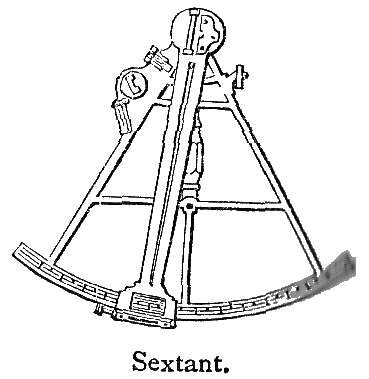
Sextant, seks′tant, n. (math.) the sixth part of a circle: an optical instrument having an arc=the sixth part of a circle, and used for measuring angular distances.
Sextet, Sextette, seks-tet′, n. (mus.) a work for six voices or instruments: a musical company of six.
Sextile, seks′til, n. the position of two planets when at the distance of the sixth part of a circle (60°), marked thus *. [L.,—sex, six.]
Sextillion, seks-til′yun, n. a million raised to the sixth power, expressed by a unit with 36 ciphers attached: 1000 raised to the seventh power.
Sexto, seks′to, n. a size of book made by folding a sheet of paper into six leaves.—n. Sex′to-dec′imo, a size of book made by folding a sheet of paper into sixteen leaves: a book of this size.
Sexton, seks′tun, n. an officer who has charge of a church, attends the clergyman, digs graves, &c.: a burying-beetle.—ns. Sex′ton-bee′tle, a coleopterous insect of the genus Necrophorus; Sex′tonship, the office of a sexton. [A corr. of sacristan.]
Sextuple, seks′tū-pl,—adj. sixfold: (mus.) having six beats to the measure.—v.t. to multiply by six.—n. Sex′tūplet (mus.), a note divided into six parts instead of four.
'Sfoot, sfōōt, interj. (Shak.) a minced imprecation. [Abbrev. from God's foot. Cf. 'sblood.]
Sforzando, sfor-tsän′dō, adj. (mus.) forced, with sudden emphasis. Abbrev. sf. and sfz., or marked , .—Also Sforzato (sfor-tsä′tō). [It., pr.p. of sforzare, to force—L. ex, out, Low L. fortia, force.]


Sgraffito, sgraf-fē′tō, n. (same as Graffito, q.v.): a kind of decorative work in pottery and superimposed metals, in which clays, &c., of different colours are laid one upon another, and the pattern is produced by cutting away the outer layers:—pl. Sgraffi′ti.
Shabby, shab′i,—adj. threadbare or worn, as clothes: having a look of poverty: mean in look or conduct: low: paltry.—adv. Shabb′ily.—n. Shabb′iness.—adj. Shabb′y-genteel′, keeping up or affecting an appearance of gentility, though really shabby. [An adj. formed from shab, an old by-form of scab—thus a doublet of scabby.]
Shabrack, shab′rak, n. a trooper's housing or saddle-cloth. [Fr.,—Ger. shabracke—Pol. czaprak.]
Shack, shak, v.i. to tramp or wander about.—n. a tramp, a vagabond.
Shack, shak, v.i. to shed or fall out, as ripe grain from the ear: to feed on stubble: (U.S.) to hibernate, to go into winter quarters.—n. grain, &c., fallen on the ground: liberty of winter pasturage: a hastily-built cabin, a rickety house.—ns. Shack′-bait, such bait as may be picked up at sea; Shack′le, stubble. [Shake.]
Shackle, shak′l, n. a curved bar, as of iron: a link or staple: a link securing two ankle-rings or two wrist-rings together, and so (pl.) fetters, manacles: a hinderance.—v.t. to fetter: to tie the limbs of: to confine.—ns. Shack′le-bolt, a bolt having a shackle on the end: (her.) a bearing representing a fetlock for hobbling a horse; Shack′le-joint, a peculiar kind of articulation seen in the exoskeleton of some fishes. [A.S. sceacul, scacul, a shackle—sceacan, to shake; cog. with Old Dut. schakel, a link of a chain, Ice. skökull, the pole of a cart.]
Shad, shad, n. a fish of the herring kind, but having the upper jaw deeply notched, and ascending rivers to spawn.—adj. Shad′-bell′ied, flat-bellied—opp. to Pot-bellied: sloping away gradually in front, cut away.—ns. Shad′-bird, the common American snipe: the sandpiper; Shad′-bush, the June-berry or service-berry; Shad′-fly, a May-fly; Shad′-frog, a large and very agile American frog; Shad′-wait′er, the pilot-fish or round-fish. [A.S. sceadda.]
Shaddock, shad′ok, n. a tree of the same genus as the orange, having larger leaves, flowers, and fruit. [Named from Captain Shaddock, who introduced it to the West Indies from China about 1810.]
Shade, shād, n. partial darkness: interception of light: obscurity: a shady place: protection: shelter: a screen: degree of colour: a very minute change: (paint.) the dark part of a picture: the soul separated from the body: a ghost: (obs., poet.) a bodily shadow: (pl.) the departed spirits, or their unseen abode, Hades.—v.t. to screen from light or heat: to shelter: to mark with gradations of colour: to darken: (Spens.) to foreshadow, represent.—adjs. Shā′ded, marked with gradations of colour: sheltered; Shade′ful, shady; Shade′less, without shade.—n. Shā′der.—adv. Shā′dily.—ns. Shā′diness; Shā′ding, the act of making a shade: the effect of light and shade, as in a picture; Shā′ding-pen, a pen with a broad flat nib.—adj. Shā′dy, having, or in, shade: sheltered from light or heat: (coll.) not fit to bear the light, of dubious honesty or morality. [A.S. sceadu—scead, shade.]
Shadine, sha-dēn′, n. the menhaden, or American sardine.
Shadoof, sha-dōōf′, n. a contrivance for raising water by means of a long rod pivoted near one end, the shorter arm weighted to act as the counterpoise of a lever, the longer carrying a bucket which is lowered into the water—much used on the Nile for irrigation purposes.—Also Shaduf′. [Ar. shādūf.]
Shadow, shad′ō, n. shade caused by an object: darkness: shelter: security: favour: the dark part of a picture: an inseparable companion: a mystical representation: faint appearance: a ghost, spirit: something only in appearance.—v.t to shade: to cloud or darken: to shade, as a painting: to represent faintly: to hide, conceal: (coll.) to attend like a shadow, watch continuously and carefully.—ns. Shad′ow-fig′ure, a silhouette; Shad′owiness, the state of being shadowy or unsubstantial; Shad′owing, shading: gradation of light and colour.—adj. Shad′owless.—n. Shad′ow-stitch, in lace-making, a very delicate kind of ladder-stitch used in fine open-work.—adj. Shad′owy, full of shadow: dark: obscure: typical: unsubstantial: (rare) indulging in fancies.—Shadow of death, approach of death: terrible disaster. [A.S. sceadu; cog. with Old High Ger. scato, and perh. Gr. skotos, darkness, skia, shadow.]
Shafiite, shaf′i-īt, n. a member of one of the four principal sects of the Sunnites, or orthodox Muslims. [Ar. Shāfi'ī, the name of the founder.]
Shaft, shaft, n. anything long and straight, as the stem of an arrow, &c.: a long arrow, anything like an arrow in form or effect: the part of a column between the base and capital: the stem of a feather: the pole or thill of a carriage: the handle of a tool of any kind.—adj. Shaft′ed, having a shaft or handle.—ns. Shaft′-horse, the horse that is harnessed between the shafts of a carriage; Shaft′ing (mach.), the system of shafts connecting machinery with the prime mover.—Make a shaft or a bolt of it (Shak.), to take the risk and make the best of it—the shaft and the bolt being the arrows of the long-bow and the cross-bow respectively. [A.S. sceaft; prob. orig. pa.p. of scafan, to shave.]
Shaft, shaft, n. a well-like excavation sunk into a mine for pumping, hoisting, &c.: the tunnel of a blast-furnace. [Prob. in this sense from Ger. schacht, a shaft; cog. with foregoing.]
Shag, shag, n. woolly hair: cloth with a rough nap: a kind of tobacco cut into shreds.—adj. rough, hairy.—v.t. to roughen, make shaggy.—v.i. (Spens.) to hang in shaggy clusters.—adjs. Shag′-eared (Shak.), having shaggy or rough ears; Shag′ged, shaggy, rough.—n. Shag′gedness.—adv. Shag′gily.—n. Shag′giness.—adjs. Shag′gy, covered with rough hair or wool: rough: rugged; Shag′-haired, having long, rough hair. [A.S. sceacga, a head of hair; Ice. skegg, beard, skagi, cape (in Shetland, skaw).]
Shagreen, sha-grēn′, n. the skin of various sharks, rays, &c., covered with small nodules, used for covering small caskets, boxes, cigar and spectacle cases, &c.: a granular leather prepared by unhairing and scraping the skin of horses, asses, &c.—formerly Chagrin′.—adj. (also Shagreened′) made of, or covered with, shagreen. [Fr. chagrin—Turk. sāghrī, the back of a horse.]
Shah, shä, n. the monarch of Persia. [Pers.]
Shaheen, sha-hēn′, n. a peregrine falcon. [Pers. shāhīn.]
Shahi, shä′i, n. a Persian copper coin. [Pers. shāhī, royal.]
Shairl, shārl, n. a fine cloth woven from the hair of a Tibetan variety of the Cashmere goat.
Shairn, shārn, n. (Scot.) cow-dung.
Shaitan, shī′tan, n. the devil, any evil spirit or devilish person. [Ar.]
Shakal, shak′al, n. the same as Jackal.
Shake, shāk, v.t. to move with quick, short motions: to agitate: to make to tremble: to threaten to overthrow: to cause to waver: to give a tremulous note to.—v.i. to be agitated: to tremble: to shiver: to lose firmness:—pa.t. shook, (B.) shāked; pa.p. shāk′en,—n. a rapid tremulous motion: a trembling or shivering: a concussion: a rent in timber, rock, &c.: (mus.) a rapid repetition of two notes: (slang) a brief instant.—n. Shake′down, a temporary bed, named from the original shaking down of straw for this purpose.—adj. Shāk′en, weakened, disordered.—ns. Shāk′er, one of a small communistic religious sect founded in Manchester about the middle of the 18th century, so nicknamed from a peculiar dance forming part of their religious service; Shake′-rag (obs.), a ragged fellow; Shāk′erism.—adv. Shāk′ily.—n. Shāk′iness.—adj. Shāk′y, in a shaky condition: feeble: (coll.) wavering, undecided: of questionable ability, solvency, or integrity: unsteady: full of cracks or clefts.—Shake down, or together, to make more compact by shaking; Shake hands, to salute by grasping the hand: (with) to bid farewell to; Shake off the dust from one's feet, to renounce all intercourse with; Shake the head, to move the head from side to side in token of reluctance, disapproval, &c.; Shake together (coll.), to get friendly with; Shake up, to restore to shape by shaking: (Shak.) to upbraid.—Great shakes (coll.), a thing of great account, something of value (usually 'No great shakes'). [A.S. sceacan, scacan.]
Shakespearian, shāk-spē′ri-an, adj. pertaining to, or in the style of, Shakespeare, or his works—also Shakespē′rian, Shakspear′ean, Shakspē′rian.—n. a student of Shakespeare (1564-1616).—n.pl. Shakespeariā′na, details or learning connected with Shakespeare and his writings.—n. Shakespea′rianism, anything peculiar to Shakespeare.
Shako, shak′ō, n. a military cap of cylindrical shape, worn mostly by infantry, and generally plumed. [Hung. csako.]
Shale, shāl, n. clay or argillaceous material, splitting readily into thin laminæ.—adj. Shā′ly. [Ger. schale, a scale.]
Shale, shāl, n. a shell or husk. [A.S. sceale.]
Shall, shal, v.t. (obs.) to be under obligation: now only auxiliary, used in the future tense of the verb, whether a predictive or a promissive future (in the first person implying mere futurity; in the second and third implying authority or control on the part of the speaker, and expressing promise, command, or determination, or a certainty about the future. In the promissive future 'will' is used for the first person, and 'shall' for the second and third). [A.S. sceal, to be obliged; Ger. soll, Goth. skal, Ice. skal, to be in duty bound.]
Shalli, shal′i, n. a soft cotton stuff made in India, mostly red.
Shalloon, sha-lōōn′, n. a light kind of woollen stuff for coat-linings, &c., said to have been first made at Châlons-sur-Marne in France.
Shallop, shal′op, n. a light boat or vessel, with or without a mast. [O. Fr. chaluppe; Ger. schaluppe; prob. of East Ind. origin.]
Shallot, sha-lot′, n. a species of onion with a flavour like that of garlic.—Also Shalot′. [O. Fr. eschalote, formed from eschalone, escalone, whence Eng. scallion (q.v.).]
Shallow, shal′ō, n. a sandbank: a place over which the water is not deep: a shoal.—adj. not deep: not profound: not wise: trifling.—v.t. to make shallow.—v.i. to grow shallow.—adjs. Shall′ow-brained, -pā′ted, weak in intellect; Shall′ow-heart′ed, not capable of deep feelings.—adv. Shall′owly (Shak.), simply, foolishly.—n. Shall′owness. [Scand., Ice. skjálgr, wry; cf. Ger. scheel.]
Shalm. Same as Shawm (q.v.).
Shalt, shalt, 2d pers. sing. of shall.
Sham, sham, n. a pretence: that which deceives expectation: imposture.—adj. pretended: false.—v.t. to pretend: to feign: to impose upon.—v.i. to make false pretences:—pr.p. sham′ming; pa.t. and pa.p. shammed.—ns. Sham′-fight, a fight in imitation of a real one; Sham′mer, one who shams.—Sham Abraham (see Abraham-man). [Shame.]
Shamanism, sham′an-izm, n. a name applied loosely to the religion of the Turanian races of Siberia and north-eastern Asia, based essentially on magic and sorcery.—n. Sham′an, a wizard priest.—adj. Shaman′ic.—n. Sham′anist.—adj. Shamanis′tic. [Perh. Hind. shaman, idolater.]
Shamble, sham′bl, v.i. to walk with an awkward, unsteady gait.—n. a shambling gait.—adj. Sham′bling. [Skeat refers to Dut. schampelen—O. Fr. s'escamper, to decamp.]
Shambles, sham′blz, n.pl. stalls on which butchers exposed their meat for sale, hence a flesh-market: a slaughter-house. [A.S. scamel (Ger. schämel), a stool—Low L. scamellum, for L. scabellum, dim. of scamnum, a bench.]
Shame, shām, n. the feeling caused by the exposure of that which ought to be concealed, or by a consciousness of guilt: the cause of shame, a person or thing to be ashamed of: disgrace, dishonour: (B.) the parts of the body which modesty requires to be concealed.—v.t. to make ashamed: to cause to blush: to cover with reproach: to drive or compel by shame.—adj. Shame′faced (properly Shame′fast, A.S. sceam-fæst), very modest or bashful.—adv. Shame′facedly.—ns. Shame′facedness, Shame′fastness, modesty.—adj. Shame′ful, disgraceful.—adv. Shame′fully.—n. Shame′fulness.—adj. Shame′less, immodest: done without shame: audacious.—adv. Shame′lessly.—n. Shame′lessness.—adj. Shame′-proof (Shak.), insensible to shame.—ns. Shā′mer, one who, or that which, makes ashamed; Shame′-reel, the first dance after the celebration of marriage, the bride being the best man's partner, the best maid the bridegroom's.—For shame, an interjectional phrase, signifying 'you should be ashamed!'—Put to shame, to cause to feel shame. [A.S. sceamu, scamu, modesty; Ice. skömm, a wound, Ger. scham.]
Shammatha, sha-mä′tha, n. the severest form of excommunication among the ancient Jews. [Heb.]
Shammy, sham′i, same as Chamois.—v.t. Sham′oy, to prepare leather by working oil into the skin.—n. Sham′oying.
Shampoo, sham-pōō′, v.t. to squeeze and rub the body, in connection with the hot bath: to wash thoroughly with soap and water.—ns. Shampoo′; Shampoo′er. [Hind. chāmpnā, squeeze.]
Shamrock, sham′rok, n. the national emblem of Ireland, a leaf with three leaflets, or plant having such leaves, sometimes supposed to be the Wood-sorrel, but the name is more frequently applied to some species of Clover, or to some common plant of some of the nearly allied genera, as the Bird's Foot Trefoil or the Black Medick. The Lesser Yellow Trefoil is the plant usually sold in Dublin on St Patrick's Day. [Ir. seamrog, Gael. seamrag, trefoil, dim. of seamar, trefoil.]
Shan, shan, adj. pertaining to the Shans, a number of tribes of common origin, who live on the borders of Burma, Siam, and China.
Shand, shand, n. (obs.) shame: (Scot.) base coin.—adj. worthless. [A.S. sceand, scand.]
Shandrydan, shan′dri-dan, n. a light two-wheeled cart: any rickety conveyance.—Also Shan′dry. [Ir.]
Shandygaff, shan′di-gaf, n. a mixture of bitter ale or beer with ginger-beer. [Ety. dub.]
Shanghai, shang-hī′, n. a long-legged hen with feathered shanks, said to have been introduced from Shanghai in China: (U.S.) a tall dandy.—v.t. (naut. ) to hocus a sailor and ship him while insensible: (U.S.) to get a person by some artifice into a jurisdiction where he can lawfully be arrested.
Shangie, shang′i, n. (Scot.) a shackle.
Shangti, shang′tē′, n. a Christian name in China for God. [Chin. shang, high, ti, ruler.]
Shank, shangk, n. the leg below the knee to the foot: the long part of any instrument, as of an anchor between the arms and ring: the part of a tool connecting the handle with the acting part: the part of a shoe connecting the sole with the heel.—v.i. to be affected with disease of the footstalk: to take to one's legs (with it).—v.t. (Scot.) to despatch unceremoniously.—adj. Shanked, having a shank: affected with disease of the shank or footstalk.—ns. Shank′-ī′ron, a shaping-tool for shoe-shanks: an iron plate inserted as a stiffening between the leather parts of a shank; Shank′-paint′er, a painter or small rope for fastening the shank of an anchor, when catted, to a ship's side. [A.S. sceanca, leg—sceacan, to shake; Dut. schonk, Low Ger. schake.]
Shanker, shangk′ėr, n. the same as Chancre.
Shanny, shan′i, n. the smooth blenny.
Sha'n't, shant (coll.), a contraction of shall not.
Shanty, shant′i, n. a mean dwelling or hut, a temporary house: a grog-shop. [Perh. from Ir. sean, old, tig, a house; others derive through Fr. chantier, a timber-yard, from L. cantherius, a rafter.]
Shanty, shant′i, n. a song with boisterous drawling chorus, sung by sailors while heaving at the capstan, or the like—also Chant′y, Chant′ie.—n. Shant′yman, the leader of such a chorus. [Prob. from Fr. chanter, to sing.]
Shape, shāp, v.t. to form: to fashion: to adapt to a purpose: to regulate: to direct: to conceive.—v.i. (Shak.) to take shape, to become fit:—pa.p. shāped, (B.) shāp′en.—n. form or figure: external appearance: that which has form or figure: an appearance: particular nature: expression, as in words: a pattern: (cook.) a dish of rice, jelly, or the like cast in a mould and turned out when it has grown firm.—adjs. Shā′pable, Shape′able; Shaped, having a varied ornamental form; Shape′less, having no shape or regular form: (Shak.) effecting nothing.—ns. Shape′lessness; Shape′liness.—adj. Shape′ly, having shape or regular form: symmetrical.—ns. Shā′per, a metal planing machine, the tool with reciprocating motion; Shā′ping, representation, imagination.—Take shape, to assume a definite form or plan. [A.S. sceapan, scapan, to form, make; Ice. skapa, Ger. schaffen.]
Shard, shärd, n. dung. [Ety. dub.]
Shard, shärd, n. (Spens.) a boundary, division: (obs.) the leaves of the artichoke whitened. [Perh. from Ice. skardh (Ger. scharte, a notch), and ult. conn. with A.S. sceran, to divide.]
Shard, shärd, n. a fragment, as of an earthen vessel: the wing-case of a beetle.—adjs. Shard′-borne (Shak.), borne on shards, as beetles; Shar′ded (Shak.), provided with elytra or wing-cases. [A.S. sceard, a fragment—sceran, to divide.]
Share, shār, n. a part cut off: a portion: dividend: one of a number of equal portions of anything: a fixed and indivisible section of the capital of a company.—v.t. to divide into parts: to partake with others.—v.i. to have a part: to receive a dividend.—ns. Share′-brok′er, a broker or dealer in shares of railways, &c.; Share′holder, one who holds or owns a share in a joint fund or property; Share′-list, a list of the prices of shares of railways, banks, &c.; Shār′er.—Share and share alike, in equal shares.—Deferred shares (see Defer); Go shares, to divide equally; Ordinary shares, shares forming the common stock of a company. [A.S. scearu—sceran, to shear.]
Share, shār, n. the iron blade of a plough which cuts the ground.—v.t. to cut, cleave.—n. Share′-beam, the part of the plough to which the share is fixed. [A.S. scear—sceran, to shear.]
Shark, shärk, n. a common name for most of the Elasmobranch fishes included in the sub-order Selachoidei—voracious fishes, mostly carnivorous, with large sharp teeth on the jaws—most numerous in the tropics. [Perh. L. carcharus—Gr. karcharos, jagged.]
Shark, shärk, n. a sharper, a cheat or swindler: an extortionate rogue.—v.i. to live like a swindler.—v.t. to pick up (with up or out).—ns. Shark′er; Shark′ing. [Prob. from preceding word.]
Sharn, shärn, n. (Scot.) dung of cattle. [A.S. scearn; cf. Ice. skarn.]
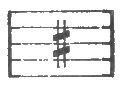
Sharp, shärp, adj. having a thin cutting edge or fine point: peaked or ridged: affecting the senses as if pointed or cutting: severe: keen, keenly contested: alive to one's interests, barely honest: of keen or quick perception: vigilant, attentive: pungent, biting, sarcastic: eager: fierce: impetuous: shrill: (phon.) denoting a consonant pronounced with breath and not voice, surd—as the sharp mutes, p, t, k.—n. an acute or shrill sound: (mus.) a note raised a semitone in the scale, also the character directing this: a long and slender sewing-needle—opp. to a blunt and a between: a small sword or duelling sword: a sharper, cheat: (pl.) the hard parts of wheat, middlings: an oysterman's boat—also Sharp′ie, Sharp′y.—v.t. (obs.) to sharpen.—v.i. to play the sharper, cheat.—adj. Sharp′-cut, cut sharply or definitely: well-defined: clear.—v.t. Sharp′en, to make sharp or keen, pungent or painful, active or acute.—v.i. to grow sharp.—ns. Shar′pener, one who sharpens; Sharp′er, a trickster: a swindler: a cheat.—adjs. Sharp′-eyed, sharp-sighted; Sharp′-ground, ground to a sharp edge; Sharp′-look′ing (Shak.), hungry-looking.—adv. Sharp′ly, quickly: to the moment: (mus.) above the true pitch.—n. Sharp′ness.—adjs. Sharp′-nosed, having a pointed nose: keen of scent, as a dog; Sharp′-set, ravenous.—ns. Sharp′-shoot′er, an old term applied in the army to riflemen when skirmishing or specially employed as marksmen; Sharp′-shoot′ing.—adjs. Sharp′-sight′ed, having acute sight: shrewd; Sharp′-vis′aged, having a thin face; Sharp′-wit′ted, having an acute wit.—Look sharp, to show eagerness, to act quickly. [A.S. scearp; Ice. skarpr, Gr. scharf.]
Shaster, shas′tėr, n. a text-book, an authoritative religious and legal book among the Hindus.—Also Shas′tra. [Sans. çāstra—çās, to teach.]
Shatter, shat′ėr, v.t. to break or dash to pieces: to crack: to disorder: to render unsound.—v.i. to break into fragments.—n. a fragment: impaired state.—adjs. Shatt′er-brained, -pā′ted, disordered in intellect; Shatt′ery, brittle. [Scatter.]
Shauchle, shawh′l, v.i. (Scot.) to walk with shuffling, loose gait.—v.t. to distort, deform. [Perh. conn. with Ice. skjálgr, wry, squinting.]
Shave, shāv, v.t. to cut off the hair with a razor: to pare closely: to make smooth by paring: to cut in thin slices: to skim along the surface: to strip, swindle.—v.i. to remove hair by a razor:—pa.p. shāved or shā′ven.—n. the act of shaving: a paring: a narrow miss or escape: a piece of financial knavery.—ns. Shave′-grass, the scouring-rush; Shave′ling, a monk or friar, from his shaven crown; Shā′ver, one who shaves: a barber: a sharp or extortionate dealer: (coll.) a chap, youngster; Shā′ving, the act of shaving: that which is shaved or pared off; Shā′ving-bā′sin, -bowl, -brush, a basin, bowl, brush, used by persons shaving.—Close, or Near, shave, a very narrow escape. [A.S. sceafan, scafan; Dut. schaven, Ger. schaben, L. scabĕre, to scrape, Gr. skaptein, to dig.]
Shavie, shā′vi, n. (Scot.) a trick or prank.—Also Skā′vie. [Perh. Dan. skæv, crooked; cf. Ger. schief, oblique.]
Shaw, shaw, n. a thicket, a small wood: (Scot.) a stem with the leaves, as of a potato. [A.S. scaga; Ice. skógr, Dan. skov.]
Shawl, shawl, n. a wrap made of wool, cotton, silk, or hair, used particularly by women as a loose covering for the shoulders: a kind of mantle.—v.t. to wrap in a shawl.—ns. Shawl′-dance, a graceful Oriental dance in which the dancer waves a scarf; Shawl′-matē′rial, a textile of silk and wool, soft and flexible, usually with Oriental designs, employed for dresses and parts of dresses for women; Shawl′-patt′ern, a coloured pattern, supposed to resemble an Eastern shawl, and applied to material of plainer design; Shawl′-pin, a pin used for fastening a shawl; Shawl′-strap, a pair of leather straps, fitted to a handle, used for carrying shawls, rugs, &c.; Shawl′-waist′coat, a vest or waistcoat with a large staring pattern like that of a shawl. [Pers. shāl.]
Shawm, Shalm, shawm, n. a musical instrument of the oboe class, having a double reed enclosed in a globular mouthpiece. [O. Fr. chalemie—L. calamus, a reed-pipe.]
Shay, n. See Chay.
Shayak, sha′yak, n. a coarse Tripoli woollen cloth.
Shaya-root, shā′ä-rōōt, n. the root of the so-called Indian madder, yielding a red dye.—Also Ché-root, Choy-root. [Tamil chaya.]
She, shē, pron. fem. the female understood or previously mentioned: sometimes used as a noun for a woman or other female. [Orig. the fem. of the def. art. in A.S.—viz. seó, which in the 12th century began to replace heó, the old fem. pron.]
Shea, shē′ä, n. the tree yielding the Galam butter or shea-butter.—Also Shē′a-tree and Karite.
Sheading, shē′ding, n. one of the six divisions or districts of the Isle of Man. [Shed.]
Sheaf, shēf, n. a quantity of things, esp. the stalks of grain, put together and bound: a bundle of arrows, usually 24 in number: any bundle or collection:—pl. Sheaves (shēvz).—v.t. to bind in sheaves.—v.i. to make sheaves.—adj. Sheaf′y. [A.S. sceáf—A.S. scúfan, to shove; Ger. schaub, Dut. schoof.]
Sheal, shēl, v.t. (Shak.) to shell, as peas.—n. Sheal′ing, the shell, pod, or husk, as of peas. [Shell.]
Sheal, Shiel, shēl, n. (Scot.) a hut used by shepherds, sportsmen, &c.: a shelter for sheep.—ns. Sheal′ing, Sheel′ing, Shiel′ing. [Either Ice. skáli, a hut, or Ice. skjól, a shelter; both cog. with sky, shade.]
Shear, shēr, v.t. to cut or clip: to clip with shears or any other instrument: (Scot.) to reap with a sickle.—v.i. to separate, cut, penetrate: in mining, to make a vertical cut in the coal:—pa.t. sheared, (obs.) shore; pa.p. sheared or shorn.—n. a shearing or clipping: a strain where compression is answered by elongation at right angles: curve, deviation.—ns. Shear′-bill, the scissor-bill, cut-water, or black skimmer; Shear′er; Shear′-hog, a sheep after the first shearing; Shear′ing, the act or operation of cutting with shears: what is cut off with shears: (Scot.) the time of reaping: the process of preparing shear-steel: (geol.) the process by which shear-structure (q.v.) has been produced; Shear′ling, a sheep only once sheared; Shear′man, one whose occupation is to shear cloth; Shears (pl. and sing.), an instrument for shearing or cutting, consisting of two blades that meet each other: a hoisting apparatus (see Sheers): anything resembling shears, as even a pair of wings (Spens.); Shear′-steel, steel suitable for the manufacture of shears and other edge-tools; Shear′-struc′ture (geol.), a structure often seen in volcanic rocks, due to the reciprocal compression and elongation of various parts under great crust movements; Shear′-wa′ter, a genus of oceanic birds allied to the petrels, and varying from 8½ to 14 inches in length. [A.S. sceran; Ice. skera, to clip, Ger. scheren, to shave.]
Sheat-fish, shēt′-fish, n. a fish of the family Siluridæ, the great catfish of central Europe.
Sheath, shēth, n. a case for a sword or other long instrument: a scabbard: any thin defensive covering: a membrane covering a stem or branch: the wing-case of an insect.—v.t. Sheathe (th), to put into a sheath: to cover with a sheath or case: to enclose in a lining.—adj. Sheathed (th), provided with, or enclosed in, a sheath: (bot., zool., and anat.) having a sheath, vaginate.—ns. Sheath′ing (th), that which sheathes, esp. the covering of a ship's bottom; Sheath′-knife, a knife carried in a sheath from the waist.—adjs. Sheath′less; Sheath′-winged, having the wings encased in elytra: coleopterous; Sheath′y, sheath-like.—Sheathe the sword, to put an end to war. [A.S. scéth, scǽth; Ger. scheide, Ice. skeithir.]
Sheave, shēv, n. the wheel of a pulley over which the rope runs: a sliding scutcheon for covering a keyhole.—n. Sheave′-hole. [Shive.]
Sheaved, shēvd, adj. (Shak.) made of straw.
Shebang, shē-bang′, n. (Amer.) a place, a store, a saloon, a gaming-house: a brothel.
Shebeen, she-bēn′, n. a place where intoxicating drinks are privately and unlawfully sold.—ns. Shebēē′ner, one who keeps a shebeen; Shebēē′ning. [Ir.]
Shechinah, shē-kī′na, n. Same as Shekinah.
Shecklaton, shek′la-ton, n. Same as Checklaton.
Shed, shed, v.t. to part, separate: to scatter, cast off: to throw out: to pour: to spill.—v.i. to let fall, cast:—pr.p. shed′ding; pa.t. and pa.p. shed.—n. a division, parting, as of the hair, and in watershed.—ns. Shed′der; Shed′ding. [A.S. sceádan, to separate; Ger. scheiden.]
Shed, shed, n. a slight erection, usually of wood, for shade or shelter: an outhouse: a large temporary open structure for reception of goods. [Shade.]
Sheeling. See under Sheal.
Sheen, shēn, n. brightness or splendour.—adj. (obs.) bright, shining.—v.i. (arch.) to shine, glitter.—adj. Sheen′y, shining, beautiful. [A.S. scéne, scýne, fair; Dut. schoon, Ger. schön, beautiful; prob. from the root of A.S. sceáwian, to look at.]
Sheeny, shēn′i, n. (slang) a sharp fellow, a cheat, a Jewish dealer.—adj. cheating.

Sheep, shēp, n.sing. and pl. the well-known ruminant mammal covered with wool: leather made from sheep-skin: a silly and timid fellow.—ns. Sheep′-bīt′er (Shak.), one who practises petty thefts; Sheep′-bīt′ing, robbing those under one's care, like an ill-trained shepherd-dog; Sheep′-cote, an enclosure for sheep; Sheep′-dog, a dog trained to watch sheep: (slang) a chaperon.—adj. Sheep′-faced, sheepish, bashful.—ns. Sheep′-farm′er, Sheep′-fold, a fold or enclosure for sheep: a flock of sheep; Sheep′-head, Sheep's′-head, a fool, a stupid and timid person: an American fish of the family Sparidæ, allied to the perches, so called from the shape and colour of the head; Sheep′-hook, a shepherd's crook.—adj. Sheep′ish, like a sheep: bashful: foolishly diffident.—adv. Sheep′ishly.—ns. Sheep′ishness; Sheep′-louse, a parasitic dipterous insect; Sheep′-mar′ket, a place where sheep are sold; Sheep′-mas′ter, a master or owner of sheep; Sheep′-pen, an enclosure for sheep; Sheep′-pest, the sheep-tick; Sheep′-pox, a contagious eruptive disease of sheep, variola ovina; Sheep′-run, a tract of grazing country for sheep; Sheep's′-eye, a modest, diffident look: a loving, wishful glance; Sheep's′-foot, a printer's tool with a claw at one end for prizing up forms; Sheep′-shank (Scot.), the shank of a sheep—hence something slender and weak: a nautical knot for temporarily shortening a rope; Sheep′-shearer, one who shears sheep; Sheep′-shearing; Sheep′-shears, a kind of shears used for shearing sheep; Sheep′-sil′ver, money formerly paid by tenants for release from the service of washing the lord's sheep; Sheep′-skin, the skin of a sheep: leather prepared from the skin of a sheep: a deed engrossed on sheep-skin parchment; Sheep′-steal′er; Sheep′-steal′ing; Sheep's′-wool, a valuable Florida sponge; Sheep′-tick, an insect which attacks the sheep, sucking its blood and raising a tumour; Sheep′walk, the place where the sheep pasture; Sheep′-wash, a lotion for vermin on the sheep, or to preserve its wool—also Sheep′-dip; Sheep′-whis′tling, tending sheep.—Black sheep, the disreputable member of a family or group. [A.S. sceáp; Ger. schaf.]
Sheer, shēr, adj. pure: unmingled: simple: without a break, perpendicular.—adv. clear: quite: at once. [Ice. skærr, bright; Ice. skírr, A.S. scír.]
Sheer, shēr, v.i. to deviate from the line of the proper course, as a ship: to turn aside.—n. the deviation from the straight line, or the longitudinal curve or bend of a ship's deck or sides.—ns. Sheer′-hulk, an old dismasted ship with a pair of sheers mounted on it for masting ships; Sheer′-leg, one of the spars.—n.pl. Sheers, an apparatus for hoisting heavy weights, having usually two legs or spars spread apart at their lower ends, and bearing at their tops, where they are joined, hoisting-tackle. [Perh. Dut. scheren, to cut, withdraw.]
Sheet, shēt, n. a large, thin piece of anything: a large, broad piece of cloth in a bed: a large, broad piece of paper: a sail: the rope fastened to the leeward corner of a sail to extend it to the wind.—v.t. to cover with, or as with, a sheet: to furnish with sheets: to form into sheets.—ns. Sheet′-copp′er, -ī′ron, -lead, -met′al, copper, iron, lead, metal in thin sheets.—adj. Sheet′ed, with a white band or belt.—ns. Sheet′-glass, a kind of crown-glass made at first in the form of a cylinder, cut longitudinally, and opened out into a sheet; Sheet′ing, cloth used for bed-sheets: the process of forming into sheets; Sheet′-light′ning, lightning appearing in sheets or having a broad appearance; Sheet′-work, press-work.—A sheet (or Three sheets) in the wind, fuddled, tipsy; In sheets (print.), not folded, or folded but not bound. [A.S. scéte, scýte, a sheet—sceótan (pa.t. sceát), to shoot, project.]
Sheet-anchor, shēt′-angk′ur, n. the largest anchor of a ship, shot or thrown out in extreme danger: chief support: last refuge. [Shoot and anchor.]
Sheik, Sheikh, shēk, n. a man of eminence, a lord, a chief: a title of learned or devout me n. [Ar. sheikh—shākha, to be old.]
Sheiling, shēl′ing, n. Same as Shealing.
Shekel, shek′l, n. a Jewish weight (about half-an-ounce avoirdupois) and coin (about 2s. 6d. sterling): (pl.) money (slang). [Heb. from shāqal, to weigh.]
Shekinah, Shechinah, shē-kī′na, n. the Divine presence which rested like a cloud or visible light over the mercy-seat. [Heb.,—shākhan, to dwell.]
Sheldrake, shel′drāk, n. a genus of birds of the Duck family Anatidæ, having the hind-toe free:—fem. Shel′duck. [A.S. scyld, a shield, and drake.]
Shelf, shelf, n. a board fixed on a wall, &c., for laying things on: a flat layer of rock: a ledge: a shoal: a sandbank:—pl. Shelves (shelvz).—adj. Shelf′y.—Put, Lay, on the Shelf, to put aside from duty or service. [A.S. scylfe, a plank, Ice. skjálf, a bench.]
Shell, shel, n. a term applied to the hard outer covering or skeleton of many animals, to the internal skeleton of some invertebrates, and to the outer covering-of the eggs of various animals: any framework: the outer ear: a testaceous mollusc: any frail structure: a frail boat: a rough kind of coffin: an instrument of music: a bomb: a hollow projectile containing a bursting charge of gunpowder or other explosive ignited at the required instant by means of either time or percussion fuses: the thin coating of copper on an electrotype: an intermediate class in some schools.—v.t. to break off the shell: to remove the shell from: to take out of the shell: to throw shells or bombs upon, to bombard.—v.i. to fall off like a shell: to cast the shell.—ns. Shellac (she-lak′, shel′ak), Shell′-lac, lac prepared in thin plates for making varnish, &c.—v.t. to coat with shellac.—ns. Shell′-back, an old sailor, a barnacle; Shell′-bark, either of two North American hickories.—adj. Shelled, having a shell, testaceous.—ns. Shell′er, one who shells or husks; Shell′fish, a popular term for many aquatic animals not fishes, esp. oysters, clams and all molluscs, and crustaceans such as crabs and lobsters; Shell′-gun, a cannon used for throwing shells, esp. horizontally: Shell′-heap, a prehistoric accumulation of shells, &c., pointing back to a race that lived on shellfish; Shell′-ice, ice no longer supported by the water beneath; Shell′-jack′et, an undress military jacket; Shell′-lime, lime procured from the shells of shellfish by burning; Shell′-lime′stone, a limestone largely consisting of shells; Shell′-marl, a white earthy deposit, resulting from the accumulation of fragments of shells; Shell′-mound, a shell-heap; Shell′-or′nament, decoration in which any shell-form is prominent.—adj. Shell′proof, proof against, or able to resist, shells or bombs.—ns. Shell′-room, a magazine on board ship where shells are stored; Shell′-sand, sand consisting in great part of fragments of shells, and often containing a small proportion of organic matter, a very useful manure for clay soils, heavy loams, and newly-reclaimed bogs; Shell′work, work composed of or adorned with shells.—adj. Shell′y, consisting of a shell: testaceous.—Shell out, (slang), to hand over, as money. [A.S. scell, scyl; Dut. schel, Ice. skel.]
Shelta, shel′ta, n. a secret jargon of great antiquity spoken by Irish tinkers, beggars, and pipers.—Also Shelrū, Cainnt cheard, Gam cant, Bog-latin. [Shelrū, a perversion of the Irish béulra, language.]
Shelter, shel′tėr, n. that which shields or protects: a refuge: a retreat, a harbour: protection.—v.t. to cover or shield: to defend: to conceal.—v.i. to take shelter.—n. Shel′terer.—adjs. Shel′terless; Shel′tery, affording shelter. [Orig. sheltron—A.S. scyld-truma, shield-troop—scyld, shield, truma, troop—trum, firm.]
Shelty, Sheltie, shel′ti, n. a Shetland pony. [Perh. a dim. of Shetland pony.]
Shelve, shelv, v.t. to furnish with shelves: to place on a shelf; to put aside.—n. Shel′ving, the furnishing with shelves: the act of placing on a shelf: shelves or materials for shelves.
Shelve, shelv, v.i. to slope, incline.—n. a ledge.—n. Shel′ving, a shelving place: (rare) a bank.—adj. Shel′vy, sloping, shallow. [Prob. ult. from Ice. skelgja-sk, to come askew—skjálgr, wry.]
Shemitic. Same as Semitic.
Shend, shend, v.t. (Spens.) to disgrace, to reproach, to blame, also to overpower, to surpass:—pa.t. and pa.p. shent. [A.S. scendan, to disgrace—A.S. scand, sceand (Ger. schande), shame.]
She-oak, shē′-ōk, n. one of several shrubs of the Australian genus Casuarina.
Sheol, shē′ōl, n. the place of departed spirits. [Heb. she'ōl, a hollow place—shā'al, to dig out.]
Shepherd, shep′ėrd, n. one who herds sheep: a swain: a pastor:—fem. Shep′herdess.—v.t. to tend as a shepherd: to watch over, protect the interests of, or one's own interests in.—ns. Shep′herdism, pastoral life; Shep′herdling, a little shepherd; Shep′herd's-crook, a long staff, its upper end curved into a hook; Shep′herd's-dog, a dog specially trained to help in tending sheep, the collie or Scotch sheep-dog, &c.; Shep′herd's-flute, a flageolet or the like; Shep′herd's-nee′dle, an annual plant, called also Venus's comb; Shep′herd's-plaid, -tar′tan, a woollen cloth made with black and white checks: this form of pattern itself; Shep′herd's-pouch, -purse, an annual cruciferous plant, with compressed, somewhat heart-shaped seed-vessel; Shep′herd's-rod, -staff, a small kind of teasel.—Shepherd kings (see Hyksos).—The Good Shepherd, a title of Jesus Christ (John, x. 11); The Shepherds, a sect of fanatical shepherds in France about 1251 A.D., eager to deliver the imprisoned Louis IX. [A.S. sceáp-hyrde. Sheep and herd.]
Sheppy, Sheppey, shep′i, n. (prov.) a sheep-cote.
Sherbet, shėr′bet, n. a drink of water and fruit juices, sweetened and flavoured. [Through Turk. from Ar. sharbat, a drink—shariba, he drinks.]
Sherd, shėrd, n. See Shard.
Sherif, Shereef, she-rēf′, n. a descendant of Mohammed through his daughter Fatima: a prince or ruler: the chief magistrate of Mecca. [Ar. sharīf, noble, lofty.]
Sheriff, sher′if, n. the governor of a shire: (English law) the chief officer of the crown in every county or shire, his duties being chiefly ministerial rather than judicial: (Scots law) the chief magistrate and judge of the county: in the United States the office of sheriff is mainly ministerial, his principal duties to maintain peace and order, attend courts, guard prisoners, serve processes, and execute judgments.—ns. Sher′iffalty, Sher′iffdom, Sher′iffship, the office or jurisdiction of a sheriff; Sher′iff-clerk, in Scotland the registrar of the sheriff's court, who has charge of the records of the court; Sher′iff-dep′ute (Scot.), the sheriff proper, so called since the abolition of the heritable jurisdictions in 1748 to distinguish him from the earlier heritable Sher′iff-prin′cipal, whose title is now merged in that of the Lord-lieutenant; Sher′iff-off′icer, in Scotland, an officer connected with the sheriff's court, who is charged with arrests, the serving of processes, &c.; Sher′iff-sub′stitute, the acting sheriff in a Scotch county or city, like the sheriff-depute appointed by the crown, but unlike the sheriff-depute forced to reside within his judicial district, and forbidden to take other employment; Un′der-sher′iff, the deputy of an English sheriff who performs the execution of writs. [A.S. scir-geréfa—scir (Eng. shire), geréfa, a governor; cog. with Ger. graf, a count.]
Sherris, sher′is, n. (Shak.). Same as Sherry.
Sherry, sher′i, n. a name derived from Xeres or Jerez de la Frontera, near Cadiz, and applied to the better kind of white wines grown in the neighbourhood of Xeres.—Sherry cobbler, a cobbler made with sherry.—Natural sherry, a sherry having from two to four per cent. of spirit added to make it keep.
Shet, shet, adj. (U.S.) freed from.
Shetlander, shet′land-ėr, n. a native or inhabitant of Shetland.—Shetland lace, an open-work ornamental trimming made with woollen yarn for shawls, &c.; Shetland pony, a small sturdy and shaggy horse, usually nine to ten hands high, a shelty; Shetland wool, a thin but strong undyed worsted, spun from the wool of the sheep in the Shetland Islands, much used for knitting fine shawls, &c.