Front matter (continued 18)
Reading edition
Valet, val′et, or val′ā, n. a man-servant, esp. one who attends on a gentleman's person.—v.t. to act as valet to.—n. Valet de place, in France, one who offers his services as guide, messenger, &c. for hire, esp. to strangers. [O. Fr.,—vaslet, later also varlet—Low L. vassalettus, dim. of vassalis, a vassal.]
Valetudinarian, val-ē-tū-di-nā′ri-an, adj. pertaining to ill-health: sickly: weak—also Valetū′dinary.—n. a person of weak health.—ns. Valetū′dinariness, Valetūdinā′rianism, the condition of a valetudinarian: weak health; Valetudinā′rium, an ancient Roman hospital. [L. valetudinarius—valetudo, state of health—valēre, to be strong.]
Valgus, val′gus, n. a bow-legged man: a form of club-foot—talipes valgus:—pl. Val′gi (-jī). [L.]
Valhalla, val-hal′la, n. (Scand. myth.) the palace of immortality for the souls of heroes slain in battle: an edifice forming the final resting-place of the heroes of a nation. [Ice. valhöll, 'the hall of the slain'—valr, the slain, conn. with A.S. wæl, slaughter, Ice. höll, hall.]
Valiant, val′yant, adj. strong: brave: intrepid in danger: heroic.—n. (obs.) a valiant person.—ns. Val′iance, Val′iancy.—adv. Val′iantly, bravely.—n. Val′iantness, courage. [Fr. vaillant—L. valens, valentis, pr.p. of valēre, to be strong.]
Valid, val′id, adj. strong: having sufficient strength or force: founded in truth: sound: conclusive: (law) executed with the proper formalities: legal: rightful.—v.t. Val′idate, to confirm, give legal force to: test the validity of.—ns. Validā′tion; Valid′ity.—adv. Val′idly.—n. Val′idness. [Fr.,—L. validus—valēre, to be strong.]
Valise, va-lēs′, n. a travelling bag, generally of leather, opening at the side: a portmanteau. [Fr.,—L. valise (It. valigia, Sp. balija), orig. unknown.]
Valkyr, val′kir, n. (Scand. myth.) one of the nine handmaidens of Odin, serving at the banquet of Valhalla—also Valkyr′ia, Wal′kyr.—adjs. Valkyr′ian, Walkyr′ian. [Ice. valkyrja—valr, the slain, kyrja—kjósa, to choose. Ger. Walküre.]
Vallar, val′ar, adj. pertaining to a rampart.—Also Vall′ary. [L. vallum.]
Vallate, val′āt, adj. cup-shaped: circumvallate.—Also Vall′ated.
Vallecula, va-lek′ū-la, n. a groove or furrow.—adjs. Vallec′ular, Vallec′ulate.
Valley, val′i, n. a vale or low land between hills or mountains: a low, extended plain, usually watered by a river:—pl. Vall′eys. [O. Fr. valee (Fr. vallée)—val, a vale.]
Vallisneria, val-is-nē′ri-a, n. a genus of the natural order of plants Hydrocharideæ. [Named after Antonio Vallisneri (1661-1730), an Italian naturalist.]
Vallum, val′um, n. a rampart, entrenchment: (anat.) the eyebrow. [L., 'a rampart.']
Valonia, va-lō′ni-a, n. the large acorn-cup of a species of oak which grows round the Levant, used in tanning. [It. vallonia—Gr. balanos, an acorn.]
Valour, val′ur, n. intrepidity: courage: bravery.—adj. Val′orous, intrepid: courageous.—adv. Val′orously. [O. Fr. valour—Low L. valor—L. valēre, to be strong.]
Value, val′ū, n. worth: that which renders anything useful or estimable: the degree of this quality: esteem, regard: efficacy: importance: excellence: price: precise meaning: (mus.) the relative length of a tone signified by a note: (paint.) relation of one part of a picture to the others with reference to light and shade and without reference to hue: (math.) the special determination of a quantity.—v.t. to estimate the worth of: to rate at a price: to esteem: to prize.—v.i. (Shak.) to be worth.—adj. Val′uable, having value or worth: costly: deserving esteem.—n. a thing of value, a choice article—often in pl.—ns. Val′uableness; Valuā′tion, the act of valuing: value set upon a thing: estimated worth; Valuā′tor, one who sets a value upon: an appraiser.—adjs. Val′ued; Val′ueless.—n. Val′uer, one who values.—Value in exchange, exchange value: (pol. econ.) economic value (i.e. the amount of other commodities for which a thing can be exchanged in open market) as distinguished from its more general meaning of utility; Value received, a phrase indicating that a bill of exchange, &c., has been accepted for a valuable consideration.—Good value, full worth in exchange. [O. Fr. value, prop. the fem. of Fr. valu, pa.p. of valoir, to be worth—L. valēre.]
Valve, valv, n. one of the leaves of a folding-door: a cover to an aperture which opens in one direction and not in the other: one of the pieces or divisions forming a shell: (anat.) a membraneous fold resembling a valve or serving as a valve in connection with the flow of blood, lymph, or other fluid—also Val′va.—adjs. Val′val, pertaining to a valve; Val′vāte, having or resembling a valve or valves: (bot.) meeting at the edges without overlapping, as the petals of flowers; Valved, having or composed of valves.—ns. Valve′-gear, the mechanism for working a valve; Valve′let, Val′vūla, Val′vūle, a little valve: (bot.) formerly used of the pieces which compose the outer covering of a pericarp.—adj. Val′vūlar.—n. Valvūlī′tis, inflammation of one of the valves of the heart. [Fr.,—L. valva, a folding-door.]
Vambrace, vam′brās, n. a piece of plate-armour to protect the forearm.—adj. Vam′brāced (her.), having armour on the forearm. [Also vantbrace, vantbrass—Fr. avant-bras—avant, before, bras, arm.]
Vamose, va-mōs′, v.i. (slang) to be off, to be gone. [Sp. vamos, 1st pers. pl. pres. indic.—L. vadimus, we go—vadĕre, to go.]
Vamp, vamp, n. the upper leather of a boot or shoe.—v.t. to repair with a new vamp: to patch old with new: give a new face to: (mus.) to improvise an accompaniment to (coll.).—v.i. to improvise accompaniments, to travel, proceed.—n. Vam′per, one who vamps or cobbles up anything old to pass for new.—Vamp up, to patch up, to improvise, to cook up.—In Vamp, in pawn. [Corr. of Fr. avant-pied, the forepart of the foot—avant, before, pied—L. pes, pedis, foot.]
Vampire, vam′pīr, n. in eastern Europe, an accursed body which cannot rest in the kindly earth, but nightly leaves its grave to suck the blood of sleeping men: an extortioner.—n. Vam′pire-bat, the name of several species of bats all supposed to suck blood—the real blood-suckers only in Central and South America, attacking cattle, horses, and sometimes human beings asleep.—adj. Vampir′ic.—n. Vam′pirism, the actions of a vampire or the practice of blood-sucking: extortion. [Fr.,—Servian vampir; the word is common in the Slavonic tongues.]
Vamplate, vam′plāt, n. the iron plate through which the lance passed, serving as a protection to the hand when the lance was couched. [Fr. avant-plat—avant, before, plat, plate.]
Van, van, n. the front: the front of an army or a fleet: the leaders of any movement. [Abbrev. of vanguard.]
Van, van, n. a fan for grain, &c.: a vane, wing: a test for ascertaining the value of an ore by washing a small quantity on a shovel.—v.t. to separate ore in this way.—ns. Van′ner, an ore-separator; Van′ning. [Fr.,—L. vannus.]
Van, van, n. a large covered wagon for goods, &c.: a light vehicle, covered or not, used by tradesmen in delivering goods: a carriage in a railway-train for carrying luggage, for the use of the guard, &c. [Short for caravan.]
Vanadium, van-ā′di-um, n. a rare metal somewhat resembling silver in appearance, very brittle and infusible, and unoxidisible either by air or water.—ns. Van′adāte, Vanā′diāte, a salt formed by vanadic acid combined with a base.—adjs. Vanad′ic, Vanā′dious, Van′adous, pertaining to or obtained from vanadium; Vanadif′erous, yielding vanadium.—n. Van′adinite, a compound of lead vanadate and lead chloride. [Named from Vanadis, a Scandinavian goddess.]
Vancourier, van′kōō-ri-er, n. a precursor. [Fr. avant-courier—avant, before.]
Vandal, van′dal, n. one of a fierce race from north-eastern Germany who entered Gaul about the beginning of the 5th century, crossed the Pyrenees into Spain (leaving their name in Andalusia=Vandalitia), next under Genseric crossed the Strait of Gibraltar, and carried devastation and ruin from the shores of the Atlantic to the frontiers of Cyrene: any one hostile to arts or literature, a barbarian.—adjs. Van′dal, Vandal′ic, barbarous, rude.—n. Van′dalism, hostility to arts or literature. [Low L. Vandali, Vinduli—the Teut. name seen in Dut. Wenden, the Wends.]
Vandyke, van-dīk′, n. one of the points forming an edge or border, as of lace, ribbon, &c.: a painting by Vandyke: a small round cape, the border ornamented with points and indentations, as seen in paintings by Vandyke of the time of Charles I.—adj. pertaining to the style of dress represented in portraits by Vandyke.—v.t. to cut the edge off in points.—n. Vandyke′-brown, a reddish-brown pigment, a species of peat or lignite.—adj. Vandyked′, notched with large points like a Vandyke collar. [Anthony Van Dyck (1599-1641), a great Flemish painter.]
Vane, vān, n. a flag or banner: a thin slip of wood or metal at the top of a spire, &c., to show which way the wind blows: a weather-cock: the thin web of a feather: one of the blades of a windmill.—adjs. Vaned, furnished with vanes; Vane′less. [Older form fane—A.S. fana; Goth. fana, cloth, Ger. fahne; akin to L. pannus, Gr. penos, a cloth.]
Vanessa, va-nes′a, n. a genus of butterflies, e.g. the Vanessa atalanta or Red Admiral, Vanessa antiope or Camberwell Beauty. [Perh. intended for Phanessa—Gr. Phanēs, a mystic divinity.]
Vang, vang, n. (naut.) one of two guy-ropes from the end of a gaff to the deck to steady the peak. [Dut.]
Vanguard, van′gärd, n. the guard in the van of an army: the part of an army preceding the main body: the front line. [Formerly vantgard—Fr. avant-garde—avant, before, garde, guard.]
Vanilla, va-nil′a, n. the dried aromatic sheath-like pod or fruit of a tropical epiphytal orchid, a favourite confection.—adj. Vanill′ic. [Latinised from Fr. vanille—Sp. vainilla—vaina—L. vagina, a sheath.]
Vanish, van′ish, v.i. to pass away from a place, leaving it vacant or empty: to disappear: to be annihilated or lost: (math.) to become zero: (Shak.) to exhale.—n. Van′isher.—adv. Van′ishingly.—n. Van′ishment.—Vanishing point, the point of disappearance of anything. [Through Fr. from L. vanescĕre, to pass away—vanus, empty.]
Vanity. See Vain.
Vanner. See Van (2).
Vanquish, vangk′wish, v.t. to conquer: to defeat in any contest: to confute.—adj. Vanq′uishable, capable of being vanquished.—ns. Vanq′uisher; Vanq′uishment. [Fr. vaincre (pa.t. vainquis)—L. vincĕre, to conquer.]
Vantage, van′tāj, n. advantage: in lawn-tennis, same as advantage: (Shak.) opportunity, convenience, excess, addition.—v.i. (Spens.) to benefit, profit.—ns. Van′tage-ground, -point, superiority of place, opportunity, &c.
Vantbrace, Vantbrass, n. See Vambrace.
Vanward, van′wawrd, adj. (rare) situated in or pertaining to the van or front.—n. the advance-guard of an army on the march. [Van and ward.]
Vapid, vap′id, adj. having the spirit evaporated: spiritless: insipid.—adv. Vap′idly.—ns. Vap′idness, Vapid′ity. [L. vapidus.]
Vaporole, vā′pō-rōl, n. a thin glass capsule, containing a volatile drug wrapped in cotton-wool and enclosed in a silk bag, to be crushed in the fingers so as to permit inhalation.
Vapour, Vapor, vā′pur, n. the gas into which most liquids and solids are convertible by heat: the condition of a body when it becomes gas by heat: water in the atmosphere: anything vain or transitory: (pl.) a disease of nervous weakness in which a variety of strange images float before the mind, temporary depression of spirits, dejection.—v.i. to pass off in vapour: to evaporate: to boast: to brag.—v.t. to make to pass into vapour: to cause to dissolve into gas, thin air, or other unsubstantial thing: (rare) to depress, dispirit: (obs.) to bully.—adjs. Vā′porable, Vā′porisable, capable of being converted into vapour.—n. Vaporā′rium, a Russian bath.—adjs. Vaporif′erous, producing vapour; Vaporif′ic, converting into steam or other vapour; Vā′poriform, existing in the form of vapour.—n. Vaporisā′tion.—v.t. Vā′porise, to convert into vapour.—v.i. to pass off in vapour.—adj. Vā′porish, full of vapours: hypochondriacal: peevish.—n. Vaporom′eter, an instrument for measuring the pressure of a vapour.—adjs. Vā′porous, Vā′porose, full of or like vapour: vain: affected with the vapours: unsubstantial, vainly imaginative.—adv. Vā′porously.—ns. Vā′porousness, Vaporos′ity; Vā′pour-bath, an apparatus for bathing the body in vapour of water.—adj. Vā′poured, full of vapours: affected with the vapours.—ns. Vā′pourer, one who vapours, a boaster; Vā′pouring, windy or ostentatious talk.—adv. Vā′pouringly.—adj. Vā′poury, full of vapour: affected with the vapours: peevish. [Fr.,—L. vapor.]
Vapulation, vap-ū-lā′shun, n. (rare) a flogging.—adj. Vap′ulātōry. [L. vapulāre, to be flogged.]
Vaquero, va-kā′rō, n. a herdsman.—n. Vacqueria (vak-e-rē′a), a farm for grazing cattle. [Sp.,—Fr. vacher, a cowherd—L. vacca, a cow.]
Vara, vä′ra, n. a Spanish-American linear measure, about thirty-three inches. [Vare.]
Varangian, va-ran′ji-an, n. the name given by the Slavic Russians and the Greeks to one of those Northmen or Värings who made settlements on the east side of the Baltic in the second half of the 9th century, and laid the foundations under Rurik of the kingdom of Gardarike out of which grew the subsequent Russia.—Varangian Guard, a trusted bodyguard of the emperors of Constantinople from the end of the 10th century down to the close in 1453.
Varanus, var′a-nus, n. the typical genus of Varanidæ, a family of eriglossate lacertilians, a monitor.—n. Var′an, a varanoid lizard.—adj. Var′anoid.
Vare, vār, n. a wand of authority. [Sp. vara, a pole—L. vara, a trestle, forked stick—varus, crooked.]
Varec, var′ek, n. a Breton impure sodium carbonate. [Fr.,—Ice. vágrek, vágr, a wave, rek, drift.]
Vareuse, va-rėz′, n. a kind of loose jacket. [Fr.]
Vargueno, var-gā′nō, n. a form of cabinet made at Vargas in Spain, having a box-shaped body with lid, resting on columns, and opening at the bottom so as to serve as a writing-desk.
Variable, vā′ri-a-bl, adj. that may be varied: changeable: liable to change: unsteady: (bot., zool.) of a species embracing many individuals and groups departing more or less from the strict type: (math.) quantitatively indeterminate: (astron.) changing in brightness.—n. (math.) a quantity subject to continual increase or decrease: a quantity which may have an infinite number of values in the same expression: a shifting wind.—ns. Variabil′ity (biol.), tendency to depart in any direction from the mean character of the species; Vā′riableness.—adv. Vā′riably.—v.t. Vā′riate, to vary.—v.i. to change.—adj. Vā′riated, varied, diversified: varriated.—n. Variā′tion, a varying: a change: change from one to another: successive change: the extent to which a thing varies: (gram.) change of termination: (mus.) a manner of singing or playing the same air with various changes in time, rhythm, or key: (astron.) deviation from the mean orbit of a heavenly body: (biol.) departure from the mean character of a species.—adjs. Variā′tional, pertaining to variation; Vā′riative, tending to variation.—Variable species, any species with marked rate of variability. [Fr.,—L. variabilis.]
Variance, vā′ri-ans, n. state of being varied: an alteration: a change of condition: (law) a discrepancy: difference that arises from, or produces, dispute.—n. Vā′riant, a different form of the same original word: a different reading, e.g. in a manuscript.—adj. diverse, variable, inconstant.—At variance, in disagreement.
Varicella, var-i-sel′a, n. chicken-pox—applied also loosely to various eruptive diseases, as swine-pox, hives, or varioloid.—adjs. Varicell′ar, pertaining to varicella; Varicell′oid, resembling varicella.
Varicocele, var′i-kō-sēl, n. an enlargement of the veins of the spermatic cord, or sometimes of the veins of the scrotum. [L. varix, a dilated vein, Gr. kēlē, a tumour.]
Varicoloured, vā′ri-kul-urd, adj. diversified in colour.—Also Varicol′orous. [L. varius, various, color, colour.]
Varicorn, vā′ri-korn, adj. having diversiform antennæ.—n. a varicorn beetle. [L. varius, various, cornu, a horn.]
Varicose, var′i-kōs, adj. permanently dilated or enlarged, as a vein, the actual dilatation being called a varix—most often in the sub-mucous veins of the rectum (constituting hæmorrhoids or piles), in the spermatic veins (giving rise to varicocele), and in the veins of the lower extremities—also Var′icous.—adjs. Var′icāted, marked by varicose formations (said of shells); Var′icosed.—n. Varicos′ity, state of being varicose.—Varicose veins, a condition in which the superficial veins, usually of the leg, are swollen for no apparent physiological reason. [L. varicosus, full of dilated veins—varix, a dilated vein—varus, bent, crooked.]
Variegate, vā′ri-e-gāt, v.t. to mark with different colours.—ns. Variegā′tion, in plants, a condition in which other colours are exhibited in parts where green is the normal colour; Vā′riegātor. [L. variegatus—varius, various, agĕre, to make.]
Variety, va-rī′e-ti, n. the quality of bring various: difference: many-sidedness, versatility: a collection of different things: one of a number of things nearly allied to each other: one or more individuals of a species, which, owing to accidental causes, differ from the normal form in minor points:—pl. Varī′eties.—adj. Vārī′etal (biol.), having the character of a zoological or botanical variety.—adv. Varī′etally.—ns. Varī′ety-show, a mixed entertainment comprising dances, songs, negro-minstrelsy, farces, short sketches, &c.; Varī′ety-thē′atre, a theatre devoted to variety-shows.—adj. Vā′riform, varied in form.—v.t. Vā′rify, to variegate. [L. varietas—varius, various.]
Variola, vā-rī′ō-la, n. smallpox.—adjs. Varī′olar, Variol′ic, Varī′olous.—ns. Variolā′tion, inoculation with the virus of smallpox; Vā′riole, a shallow pit or pitted marking, a foveole; Varī′olite, a rock covered with pea-like pustular forms, held in India as a preventive of smallpox and worn sometimes as an amulet round the neck.—adjs. Variolit′ic, pertaining to variolite; Vā′rioloid, resembling smallpox: resembling measles.—n. modified smallpox. [Low L.,—L. varius, various, spotted.]
Variometer, vā-ri-om′e-tėr, n. an instrument used in measuring magnetic intensity. [L. varius, various, Gr. metron, measure.]
Variorum, vā-rī-ō′rum, adj. a term applied to an edition of some work in which the notes of various commentators are inserted. [From the full Latin 'editio cum notis variorum.']
Various, vā′ri-us, adj. varied, different: several: unlike each other: changeable: uncertain: variegated.—adv. Vā′riously.—n. Vā′riousness. [L. varius.]
Variscite, var′i-sīt, n. a mineral very like a greenish turquoise found in Brittany. [From L. Variscia, Voigtland, part of Saxony.]
Varix, vā′riks, n. abnormal dilatation or tortuosity of a vein:—pl. Var′icēs. [L.,—varus, bent.]
Varlet, vär′let, n. a footman: a low fellow: a scoundrel.—n. Var′letry (Shak.), the rabble, the crowd. [O. Fr. varlet, formerly vaslet, from a dim. of Low L. vassalis.]
Varmin, Varmint, var′min, var′mint, dialectal variants for vermin.
Varnish, vär′nish, v.t. to cover with a liquid so as to give a glossy surface to: to give a fair appearance to.—n. a sticky liquid which dries and forms a hard, lustrous coating: a glossy, lustrous appearance: any gloss or palliation.—ns. Var′nisher; Var′nishing; Var′nishing-day, a day before the opening of a picture exhibition when exhibitors may varnish or retouch their pictures after they have been hung; Var′nish-tree, a name given to trees of several distinct natural orders, the resinous juice of which is used for varnishing or for lacquering. [Fr. vernis—Low L. vitrinus, glassy—L. vitrum, glass.]
Varriated, var′i-ā-ted, adj. (her.) battlemented with solid projections and crenelles, both pointed bluntly, but in the latter case reversed. [So named from the resemblance to vair.]
Varsal, var′sal, adj. (coll.) universal.
Varsity, var′si-ti, n. (coll.) university.
Varsovienne, var-sō-vi-en′, n. a dance imitated from the Polish mazurka, the music for such. [Fr., fem. of Varsovien—Varsovie, Warsaw.]
Vartabed, vär′ta-bed, n. one of an order of Armenian clergy devoted to teaching.—Also Var′tabet.
Varuna, var′ōō-na, n. an ancient Indian Vedic god of heaven and day—latterly, rather the deity that rules over the waters.
Varus, vā′rus, n. the same as talipes varus: a knock-kneed person. [L.]
Varus, vā′rus, n. acne. [L.]
Varvels, värv′elz, n. same as Vervels.—adj. Var′veled (her.), provided with vervels or rings.
Vary, vā′ri, v.t. to make different: to diversify, modify: (mus.) to alter or embellish a melody, preserving its identity: (Shak.) to express variously: to change to something else: to make of different kinds.—v.i. to alter or be altered: to be or become different: to change in succession: to deviate (with from): to disagree: (math.) to be subject to continual increase or decrease:—pa.t. and pa.p. vā′ried.—n. (Shak.) change.—adj. Vā′ried.—adv. Vā′riedly.—n. Vā′rier, one who varies. [Fr. varier—L. variāre—varius.]
Vas, vas, n. (anat., zool.) a vessel containing blood, &c.:—pl. Vā′sa.—adjs. Vā′sal, pertaining to a vas; Vas′iform, having the form of a duct; Vasomō′tor, serving to regulate the tension of blood-vessels, as nerves; Vasomō′tory, Vasomotō′rial. [L.]
Vasalium, va-sā′li-um, n. vascular tissue proper.
Vascular, vas′kū-lar, adj. of or relating to the vessels of animal and vegetable bodies.—n.pl. Vasculā′res, a division of the vegetable kingdom embracing plants with vessels or ducts.—v.t. Vas′cularise.—n. Vascular′ity.—adv. Vas′cularly.—adjs. Vasculif′erous; Vas′culiform.—ns. Vas′culose, the substance, closely allied to cellulose, that makes up the greater part of the vessels of plants; Vas′culum, a botanist's specimen-box. [Fr. vasculaire—L. vasculum, dim. of vas, a vessel.]
Vase, vāz, or v[ä]z, n. a vessel of stone, metal, glass, or earthenware, anciently used for domestic purposes and in offering sacrifices: an ornamental vessel generally of an antique pattern: a sculptured, vaselike ornament: (archit.) the body of the Corinthian capital.—n. Vase′-paint′ing, the decoration of vases with pigments, esp. the decoration of the pottery of the ancient Greeks.—adj. Vā′siform.—Etruscan vases, Greek vases so called mistakenly because found in Etruscan tombs; Portland vase, a famous Græco-Roman cameo-glass with reliefs in opaque white glass on a dark-blue ground, 9¾ inches high, now preserved in the British Museum. [Fr.,—L. vasum or vas.]
Vaseline, vas′e-lin, n. a yellowish, almost tasteless and inodorous, translucent substance obtained from petroleum, used as a salve, liniment, lubricant, &c. [Formed from Ger. wasser, water, and Gr. elaion, oil.]
Vasiform, Vasomotor. See Vas.
Vassal, vas′al, n. one who holds land from, and renders homage to, a superior: a dependant, retainer: a bondman, slave: (Shak.) a low wretch.—adj. (Shak.) servile.—v.t. to enslave, to dominate.—ns. Vass′alāge, state of being a vassal: dependence: subjection: a fee, fief: (Shak.) vassals collectively; Vass′aless (Spens.), a female vassal; Vass′alry, vassals collectively. [Fr.,—Low L. vassalis—Bret. gwaz, a servant; cf. W. gwas, a youth.]
Vast, vast, adj. of great extent: very great in amount: very great in degree, mighty: (Shak.) vacant, desolate.—n. immensity: (coll.) a large quantity: (Shak.) the darkness of night.—ns. Vastid′ity (Shak.), immensity, desolation; Vas′titude.—adv. Vast′ly.—ns. Vast′ness; Vas′tus, one of the great muscles upon the front of the thigh.—adj. Vas′ty, large, enormously great. [Fr. vaste—L. vastus, waste, vast; cf. A.S. wéste, waste.]
Vat, vat, n. a large vessel or tank, esp. one for holding liquors.—v.t. to put in a vat.—n. Vat′ful, the contents of a vat. [Older form fat—A.S. fæt; Dut. vat, Ice. fat, Ger. fass.]
Vatican, vat′i-kan, n. an assemblage of buildings on the Vatican hill in Rome, including one of the pope's palaces: the papal authority.—ns. Vat′icanism, the system of theology and ecclesiastical government based on absolute papal authority, ultramontanism; Vat′icanist, one who upholds such a system.—Vatican Codex, a famous uncial MS. of the Greek Testament, of the 4th century, in the Vatican library at Rome; Vatican Council, the Twentieth Ecumenical Council, according to popish reckoning, which met 8th December 1869 and proclaimed the Infallibility of the Pope. [Fr.,—It. Vaticano—L. Mons Vaticanus, a hill in Rome.]
Vaticide, vat′i-sīd, n. the killing of a prophet: one who kills a prophet. [L. vates, vatis, a prophet, cædĕre, to kill.]
Vaticinate, va-tis′i-nāt, v.t. to prophesy.—adj. Vat′ic, prophetic, oracular, inspired—also Vatic′inal.—ns. Vaticinā′tion, prophecy: prediction; Vatic′inator, a prophet. [L. vaticināri, -ātus, to prophesy—vates, a seer.]
Vaudeville, vōd′vil, n. originally a popular song with topical allusions: a play interspersed with dances and songs incidentally introduced and usually comic.—n. Vaude′villist, a composer of these. [From vau (val) de Vire, the valley of the Vire, in Normandy, where they were first composed about 1400 A.D.]
Vaudois, vō-dwo′, n. a native of Vaud: the dialect spoken in Vaud.—adj. pertaining to Vaud or its people.
Vaudois, vō-dwo′, n. one of the Waldenses (q.v.).—adj. Waldensian.
Vaudoo. See Voodoo.
Vault, vawlt, n. an arched roof: a chamber with an arched roof, esp. one underground: a cellar: anything vault-like: a leap or spring by means of a pole or by resting the hands on something: the bound of a horse: a jump.—v.t. to shape as a vault: to arch: to roof with an arch: to form vaults in.—v.i. to curvet or leap, as a horse: to leap: to exhibit feats of leaping or tumbling.—n. Vaul′tage (Shak.), an arched cellar: vaulted work.—adj. Vaul′ted, arched: concave overhead: covered with an arch or vault.—ns. Vaul′ter, one who vaults or leaps; Vaul′ting (archit.), vaulted work; Vaul′ting-horse, a wooden horse used in gymnasiums for vaulting over.—adj. Vaul′ty (Shak.), arched, concave. [O. Fr. volte (Fr. voûte)—L. volvĕre, volutum, to roll.]
Vaunce, väns, v.i. (Spens.) to advance.
Vaunt, vawnt′, or vänt, v.i. to make a vain display: to boast.—v.t. to make a vain display of: to boast of.—n. vain display: boast.—ns. Vaun′ter; Vaun′tery, vaunting.—adj. Vaunt′ful.—n. Vaun′ting.—adv. Vaun′tingly. [O. Fr. vanter—Low L. vanitāre—L. vanitas, vanity—vanus, vain.]
Vaunt, vänt, n. (Shak.) the first part. [Van.]
Vaunt-courier, vänt′-kōō′-ri-ėr, n. (Shak.). Same as Vancourier.
Vaut, vawt, v.i. (Spens.) same as Vault.—adj. Vau′ty, vaulted.
Vavasour, vav′a-sōōr, n. in feudal times, one who held his lands not directly of the crown but of one of the higher nobility.—n. Vav′asōry, the tenure or lands of a vavasour. [O. Fr.,—Low L. vassus vassorum, vassal of vassals—vassus, vassal.]
Vaward, vā′wawrd, n. and adj. Same as Vanward.
Veadar, vē′a-dar, n. the name of the intercalary or thirteenth month of the Jewish year, which must have been inserted about every third year. [Heb., 'the additional adar,' from ve, and, and adar, so called because it was introduced in the calendar after the month Adar.]
Veal, vēl, n. the flesh of a calf.—n. Veal′-skin, a skin-disease marked by white shiny tubercles on the ears and neck.—adj. Veal′y, like veal or like a calf: immature. [O. Fr. veël (Prov. vedel)—L. vitellus, dim. of vitulus; Gr. italos, a calf.]
Vector, vek′tor, n. (math.) any directed quantity, as a straight line in space, involving both its direction and magnitude.—n. Vectitā′tion, a carrying.—adj. Vectō′rial. [L.,—vehĕre, vectum, to convey.]
Veda, vā′dä, n. the four holy books of the Hindus—Rigveda, or Veda of praises or hymns; Sâmaveda, or Veda of chants or tunes; Yajurveda, or Veda of prayers; and Atharvaveda, or Veda of the Atharvans:—pl. Vedas (vā′däz).—n. Vedan′ta, a system of Hindu philosophy based on the Vedas.—adjs. Vedan′tic, Ve′dic. [Sans. veda, knowledge—vid, to know; cf. Wit.]
Vedette, ve-det′, n. a mounted sentry stationed at the outposts of an army to watch an enemy. [Fr.,—It. vedetta—vedere, to see—L. vidēre, to see.]
Veer, vēr, v.i. to change direction, as the wind: to alter, of the course of a ship: to change one's mind.—v.t. to turn, shift: to change a ship's course by turning her head away from the wind.—n. and adj. Veer′ing.—adv. Veer′ingly. [Fr. virer (Prov. virar)—Low L. virāre, to turn—L. viriæ, armlets.]
Veery, vēr′i, n. the tawny thrush of North America.
Vega, vā′ga, n. a tract of flat land, a tobacco-field in Cuba. [Sp.]
Vegetable, vej′e-ta-bl, n. an organised body without sensation and voluntary motion, nourished by roots fixed in the ground: a plant for the table.—adj. belonging to plants: consisting of or having the nature of plants: derived from vegetables.—adj. Veg′etal, of the nature of a vegetable: pertaining to the vital functions of plants and animals, as growth, reproduction, &c.—ns. Veg′etaline, a substitute for ivory, &c., made by treating woody fibre with sulphuric acid, mixing with various ingredients, and pressing into any required form; Vegetal′ity, vegetable character, the vegetal functions collectively.—adj. Vegetā′rian, pertaining to those who abstain from animal food: consisting of vegetables.—n. one who holds that vegetables are the only proper food for man.—n. Vegetā′rianism, the theory and practice of a vegetarian.—v.i. Veg′etāte, to grow by roots and leaves: to sprout: to lead an idle, aimless life.—n. Vegetā′tion, process of growing, as a plant: vegetable growth: plants in general.—adj. Veg′etātive, growing, as plants: producing growth in plants: pertaining to unconscious or involuntary bodily functions as resembling the processes of vegetable growth: without intellectual activity, unprogressive.—adv. Veg′etātively.—n. Veg′etātiveness.—adj. Vegete (vej′ēt), vigorous.—n. Veg′etive (Shak.), a vegetable.—Vegetable kingdom, that division of natural objects which embraces vegetables or plants; Vegetable marrow, the fruit of a species of gourd, so called from its marrow-like appearance; Vegetable mould, mould consisting mostly of humus; Vegetable physiology, that department of botany which treats of the growth and functions of plants. [O. Fr.,—Low L. vegetabilis, animating—L. vegetāre, to quicken—vegēre, to be lively; akin to vigēre, to be vigorous. Cf. Vigour.]
Vehement, vē′he-ment, adj. passionate: furious: very eager or urgent.—ns. Vē′hemence, Vē′hemency, the quality of being vehement: violence: great ardour or fervour.—adv. Vē′hemently. [O. Fr.,—L. vehemens, from ve, out of, mens, mind; acc. to Vanicek, from vehĕre, to carry.]
Vehicle, vē′hi-kl, n. any kind of carriage or conveyance: that which is used to convey: (med.) a substance in which a medicine is taken: (paint.) a liquid used to render colours, varnishes, &c. fit for use.—adjs. Vehic′ūlar, -y, pertaining to or serving as a vehicle.—v.t. Vehic′ūlate (rare), to ride in a vehicle.—n. Vehicūlā′tion.—adj. Vehic′ūlātōry. [L. vehiculum—vehĕre, to carry.]
Vehmgericht, fām′ge-richt, n. one of the dread medieval German tribunals, empowered by the emperors to try cases in which the penalty was death and to execute the punishment on the guilty—also Fem′gerichte, or simply Vehme, Fehme:—pl. Vehmgerichte (fām′ge-rich-te).—adj. Vehm′ic. [Ger.,—fehme, fehm, a criminal tribunal, gericht, judgment.]
Veil, vāl, n. a curtain: anything that hides an object: a piece of muslin or thin cloth worn by ladies to shade or hide the face: a cover: a disguise: an obscuration of the clearness of the tones in pronunciation: in fungi, the partial covering of the stem or margin of the cap—applied also to the indusium of ferns.—v.t. to cover with a veil: to cover: to conceal.—n. Veil′ing, the act of concealing with a veil: a veil: material for making veils.—adjs. Veil′less, wanting a veil: uncovered; Vē′lar (philol.), denoting sounds (gw, kw, &c.) produced by the veil of the palate or soft palate; Vē′lary, pertaining to a sail.—n. Vēlā′tion, a veiling: concealment, mystery.—Eucharistic or Sacramental veils, the linen or silk cloths used to cover the eucharistic vessels and the elements during the celebration of Mass or Holy Communion.—Take the veil, to become a nun. [O. Fr. veile (Fr. voile)—L. velum, a curtain—vehĕre, to carry.]
Veilleuse, vā-lyėz′, n. a shaded night-lamp.
Vein, vān, n. one of the vessels or tubes which convey the blood back to the heart: one of the horny tubes forming the framework of an insect's wings: (bot.) one of the small branching ribs in a leaf: a seam of a different mineral through a rock: a fissure or cavity: a streak in wood or stone: a train of thought: a course: tendency or turn of mind: mood or humour.—v.t. to form veins or the appearance of veins in.—n. Vein′age, veins collectively.—adj. Veined, full of veins: streaked, variegated: (bot.) having vessels branching over the surface, as a leaf.—n. Vein′ing, formation or disposition of veins: streaking.—adj. Vein′less, having no veins.—n. Vein′let (bot.), a little vein or vessel branching out from a larger one.—adjs. Vein′ous, Vein′y, full of veins.—ns. Vein′stone, the earthy part of a lode; Vein′ūle, a very small vein. [Fr. veine—L. vena, perh. from vehĕre, to carry.]
Velamentum, vel-a-men′tum, n. a membrane or membraneous envelope—also Velā′men.—adj. Velamen′tous, veil-like.
Velarium, vē-lā′ri-um, n. an awning which could be drawn over the Roman amphitheatre: the marginal membrane of certain hydrozoans:—pl. Velā′ria.
Velatura, vel-a-tōō′ra, n. a method of glazing a painting by rubbing on colour with the hand. [It.]
Veldt, velt, n. in South Africa, the name given to unforested or thinly-forested grass country.—Also Veld. [Dut. veld, field.]
Vele, vēl, n. (Spens.). Same as Veil.
Velia, vē′li-a, n. a genus of semi-aquatic water-bugs.
Velitation, vel-i-tā′shun, n. a slight skirmish.
Velite, vē′līt, n. a light-armed Roman soldier. [L. veles, velitis.]
Vell, vel, v.t. (prov.) to cut the turf from.
Vell, vel, n. (prov.) rennet.
Velleity, ve-lē′i-ti, n. (rare) volition in its lowest form: mere inclination. [Low L. velleitas, irregularly formed from L. velle, to wish.]
Vellenage, vel′en-āj, n. (Spens.) slavery—the same as Villeinage. [Villain.]
Vellet, vel′et, n. (Spens.). Same as Velvet.
Vellicate, vel′i-kāt, v.t. and v.i. to twitch.—n. Vellicā′tion.—adj. Vell′icātive. [L. vellicāre,-ātum, to pluck.]
Vellon, ve-lyōn′, n. a Spanish money of account.
Velloped, vel′opt, adj. (her.) having pendant wattles. [Prob. jelloped for dewlapped.]
Vellozia, ve-lō′zi-a, n. a genus of plants of the natural order Hæmodoraceæ, found in Brazil, Madagascar, &c. [Vellozo, Brazilian botanist.]
Vellum, vel′um, n. a finer kind of parchment prepared by lime-baths and burnishing from the skins of calves, kids, or lambs. [O. Fr. velin—Low L. (charta, paper), vitulina, of a calf—L. vitulus.]
Veloce, ve-lō′che, adv. (mus.) with great rapidity.
Velocipede, vē-los′i-pēd, n. a light vehicle originally moved by striking the toes on the road, now with a treadle—its developments are the bicycle and tricycle.—ns. Veloc′iman, a velocipede driven by hand; Velocipē′dean, Veloc′ipēdist, one who rides on a velocipede. [Fr.,—L. velox, velocis, swift, pes, pedis, foot.]
Velocity, vē-los′i-ti, n. swiftness: speed: rate of change of position of a point per unit of time.—n. Velocim′eter, an apparatus for measuring velocity.—Initial velocity, the rate of movement of a body at starting, esp. of a projectile. [L. velocitas—velox, swift.]
Velum, vē′lum, n. a velarium: the ciliated disc-like fold of the integument with which some embryo molluscs are provided:—pl. Vē′la.—adj. Vē′lāte, having a velum.—n. Vēlā′tion, formation of a velum.—adjs. Vēlif′erous, Vēlig′erous, having a velum.
Velure, vel′ūr, n. velvet: a silk or plush pad for smoothing or giving lustre to silk hats—also Velours (ve-loor′).—v.t. to dress with a velure.—n. Veloutine′, a corded fabric of merino and fancy wool.—adj. Velū′tinous, velvety. [O. Fr. velours, velous (Fr. velours)—Low L. villosus, velvet—L. villosus, shaggy.]
Velvet, vel′vet, n. a cloth made from silk, with a close shaggy pile: a similar cloth made of cotton: the velvet-like covering of a growing antler: (slang) money gained by gambling.—adj. made of velvet: soft like velvet.—ns. Vel′veret, a poor quality of velvet, the web of cotton, the pile of silk; Velveteen′, a fustian made of twilled cotton with a pile of the same material: a kind of velvet made of silk and cotton mixed throughout; Vel′vet-flower, the love-lies-bleeding.—n.pl. Vel′vet-guards (Shak.), velvet trimmings, applied metaphorically to the citizens who wore them.—ns. Vel′veting, the nap of velvet: (pl.) velvet goods collectively; Vel′vet-leaf, the Indian mallow; Vel′vet-pā′per, flock paper; Vel′vet-pile, any material with a long, soft nap; Vel′vet-scō′ter, a kind of black duck with large white spot on the wings; Vel′vet-work, embroidery on velvet.—adj. Vel′vety, made of or like velvet: soft: soft in taste or touch.—Stand on velvet, to place one's bets in such a way as not to loose in any event. [From Low L. velluetum—Low L. villutus—L. villus, shaggy hair.]
Vena, vē′na, n. a vein.—Vena cava, the largest vein in the body, entering the right auricle of the heart.
Venal, vē′nal, adj. that may be sold or got for a price: held for sale: mercenary.—n. Venal′ity, quality of being venal: prostitution of talents or services for a reward.—adv. Vē′nally. [Fr.,—L. venalis—venus, sale; Gr. ōnē, purchase.]
Venal, vē′nal, adj. pertaining to a vein or veins: contained in the veins. [L. vena, a vein.]
Venatic, -al, vē-nat′ik, -al, adj. pertaining to hunting.—adv. Venat′ically.—adj. Venatō′rial. [Venery.]
Venation, ve-nā′shun, n. the way in which the leaves of plants are arranged: in insects, the distribution of the veins of the wings. [Vein.]
Vend, vend, v.t. to give for sale, to sell: to give for money: to make an object of trade.—ns. Vendee′, the person to whom a thing is sold; Ven′der, -dor, one who sells; Vendibil′ity.—adj. Vend′ible, that may be sold: that may be disposed of as an object of trade.—n. something salable.—n. Ven′dibleness.—adv. Ven′dibly.—n. Vendue′ (rare), a public auction. [Fr. vendre—L. vendĕre—venus, sale, dăre, to give.]
Vendace, ven′dās, n. a variety of the whitefish, found in Great Britain only in the Castle Loch at Lochmaben. [O. Fr. vendese, vandoise (Fr. vandoise); orig. unknown.]
Vendémiaire, vong-dā-mi-ār′, n. the first month in the French Revolutionary Calendar, from 22d September to 21st October. ['The vintage-month,' Fr.,—L. vindemia, vintage—vinum, wine, demĕre, to take off—de, off, emĕre, to take.]
Vendetta, ven-det′ta, n. the practice—not yet entirely extinct in Calabria and Corsica—of individuals taking private vengeance on those who have shed the blood of their relatives. [It.,—L. vindicta, revenge—vindicāre, to claim.]
Veneer, ve-nēr′, v.t. to overlay or face with another and superior wood: to cover with a thin coating of any substance other than wood: to disguise with artificial attractiveness.—n. a thin coating, as of wood: false show or charm.—ns. Veneer′-cut′ter, a machine for cutting veneers from the block of wood; Veneer′ing, the act or art of overlaying an inferior wood with thin leaves of a more valuable kind: the thin leaf thus laid on. [Formerly fineer; corr. from Ger. furniren—O. Fr. fornir (Fr. fournir), It. fornire, to furnish.]
Venefical, vē-nef′i-kal, adj. poisonous, using sorcery—also Venefi′cial, Venefi′cious.—v.t. Ven′enāte, to poison.—adj. poisoned.—n. Venenā′tion.—adjs. Venenif′luous; Ven′enous. [L. veneficium, a poisoning—venenum, poison, facĕre, to make.]
Venerable, ven′e-ra-bl, adj. that may be venerated: worthy of veneration, reverence, or honour: rendered sacred by religious or other associations: aged.—n. Ven′erableness.—adv. Ven′erably. [L. venerabilis—venerāri, to venerate.]
Venerate, ven′e-rāt, v.t. to honour or reverence with religious awe: to reverence: to regard with the greatest respect.—adjs. Ven′erant (rare), Ven′erātive, reverent.—ns. Venerā′tion, the act of venerating: the state of being venerated: the highest degree of respect and reverence: respect mingled with reverence and awe: awe; Ven′erātor, one who venerates. [L. venerāri, -ātus.]
Venereal, vē-nē′rē-al, adj. pertaining to or arising from sexual intercourse: exciting desire for sexual intercourse: curing venereal diseases.—adj. Venē′reous, lascivious: stimulating sexual desire, aphrodisiac.—n. Ven′ery, sexual intercourse. [L. venereus—Venus, Venĕris, the goddess of love; conn. with L. venerāri.]
Venery, ven′ėr-i, n. the act or exercise of hunting: the sports of the chase.—ns. Ven′erer, a gamekeeper, hunter; Veneur (ve-nėr′), a person having an oversight of the chase. [O. Fr. venerie—vener—L. venāri, to hunt.]
Venesection, vē-nē-sek′shun, n. the section or cutting open of a vein for letting blood: blood-letting. [L. vena, a vein, sectio, cutting.]
Venetian, vē-nē′shan, adj. of or belonging to Venice.—n. a native or inhabitant of Venice: a strong tape for Venetian-blinds: a domino.—n. Venē′tian-blind, a blind for windows formed of thin slips of wood, so hung as to admit of being set either edgewise or overlapping.—adj. Venē′tianed, furnished with Venetian-blinds.—ns. Venē′tian-glass, a delicate and beautiful glass made by the craftsmen of Venice into mirrors, cups, goblets, &c., its forms reflecting its Oriental origin, famous since the middle ages; Venē′tian-style, the type of the Renaissance architecture developed in Venice, highly decorative and original.
Venew, ven′ū, Veney, ven′i, n. (Shak.) a bout at fencing, a thrust, a hit. [Venue.]
Venge, venj, v.t. (Shak.) to avenge, to punish.—adj. Venge′able (Spens.), revengeful: deserving to be revenged.—n. Venge′ance, the infliction of punishment upon another in return for an injury or offence: retribution: (Shak.) harm, mischief.—adv. (Shak.) extremely, exceedingly.—adj. Venge′ful, vindictive, retributive: revengeful.—adv. Venge′fully.—ns. Venge′fulness; Venge′ment (Spens.), vengeance, penal retribution; Ven′ger (Spens.), an avenger.—With a vengeance (coll.), violently: exceedingly. [O. Fr. venger—L. vindicāre.]
Venial, vē′ni-al, adj. pardonable: excusable: allowed.—adv. Vē′nially.—ns. Vē′nialness, Venial′ity.—Venial sin (see Mortal). [Fr.,—L. venialis, pardonable—venia, pardon.]
Veni Creator, vē′nī krē-ā′tor, n.—more fully, 'Veni Creator Spiritus'—a hymn of the Roman Breviary, used at Whitsuntide, ordinations, &c.—not to be confounded with the Veni Sancte Spiritus, Et emitte coelitus, the 'Golden Sequence.'
Venison, ven′i-zn, or ven′zn, n. the flesh of animals taken in hunting, esp. the deer. [Fr. venaison—L. venatio, a hunting, game—venāri, to hunt.]
Venite, vē-nī′tē, n. in liturgics, the 95th Psalm. [From its opening words, 'Venite exultemus.']
Vennel, ven′el, n. (Scot.) an alley, a narrow street. [Fr. venelle, a small street.]
Venom, ven′um, n. any drink, juice, or liquid injurious or fatal to life: poison: spite: malice.—adj. (Shak.) venomous, poisonous.—v.t. to infect with poison.—n. Ven′om-duct, in a poisonous animal, the duct conveying venom from the sac or gland where it is secreted to the tooth or venom-fang whence it is discharged.—adjs. Ven′om-mouthed, having a venomous mouth: (Shak.) slanderous; Ven′omous, poisonous: spiteful: mischievous.—adv. Ven′omously.—n. Ven′omousness. [Fr. venin (It. veneno)—L. venenum.]
Venose, vē′nōs, adj. (bot.) having well-marked veins, veined.—n. Vēnos′ity, the state or quality of being venous: (med.) a condition of the blood in which the venous blood is unnaturally abundant.—adj. Vē′nous, pertaining to or contained in veins: veined.—adv. Vē′nously. [Vein.]
Vent, vent, n. a small opening to let air, &c., escape: the flue of a chimney: the opening in the top of a barrel allowing air to pass in as the liquid is drawn out: a gimlet used to extract a little liquid from a barrel for sampling purposes: discharge: escape: passage into notice: publication, utterance, voice: the anus of birds and fishes: (mil.) the opening at the breech of a firearm through which fire is conveyed to the charge, the touch-hole.—v.t. to give a vent or opening to: to let out, as at a vent: to allow to escape: to publish: to pour forth.—ns. Vent′āge (Shak.), a vent, a small hole; Ven′tail (Spens.), same as Aventail; Vent′-bush′ing, -piece, a copper cylinder inserted through the walls of a cannon over the seat of the charge and preventing the escaping gases from injuring the metal near the vent; Vent′er, one who vents or publishes.—adj. Ventic′ūlar.—ns. Vent′-peg, -plug, a plug for stopping the vent of a barrel; Vent′-pipe, an escape-pipe.—Give vent to, to allow to escape or break out. [Altered form of fent, M. E. fente—O. Fr. fente, a slit.]
Vent, vent, n. scent: (hunting) the act of taking breath.—v.i. to sniff, snort: to take breath: (Scot.) of a chimney, to draw.—Vent up (Spens.), to lift so as to give air. [O. Fr.,—L. ventus, wind.]
Vent, vent, n. the act of selling, sale: market. [O. Fr. vente—Low L. vendita, a sale—L. vendĕre, -dĭtum, to sell.]
Ventanna, ven-tan′a, n. a window. [Sp.]
Venter, ven′tėr, n. the belly, abdomen. [L.]
Ventilate, ven′ti-lāt, v.t. to fan with wind: to open to the free passage of air: to cause fresh air to pass through: to expose to examination and discussion: to make public.—adj. Ven′tilable.—ns. Ventilā′brum, flabellum; Ventilā′tion, act or art of ventilating: state of being ventilated: free exposure to air: supply of air: act of examining and making public: public exposure.—adj. Ven′tilātive.—n. Ven′tilātor, that which ventilates: a contrivance for introducing fresh air. [L. ventilāre, -ātum—ventulus, dim. of ventus, the wind.]
Ventose, ven′tōs, adj. windy.—n. the sixth month of the French Revolutionary Calendar, 19th February to 20th March.—n. Ventos′ity, windiness: empty pride. [L. ventosus—ventus, wind.]
Ventral, ven′tral, adj. belonging to the belly: (bot.) denoting the anterior or inferior surface: in the body, situated opposite the dorsal or back aspect.—n. in fishes, one of the posterior fins.—advs. Ven′trad (zool., anat.), to or toward the belly, or ventral surface or aspect of the body; Ven′trally.—adj. Ven′tric.—n. Ven′tricle, a small cavity within an animal body, as in the heart or brain: (Shak.) the womb.—adjs. Ven′tricōse, Ven′tricous, swelling out in the middle: bellied; Ventric′ūlar. [L. ventralis—venter, the belly.]
Ventriculite, ven-trik′ū-līt, n. one of a genus of fossil sponges found in the cretaceous system, and often giving their shape to flint nodules.
Ventriloquism, ven-tril′ō-kwizm, n. the act or art of producing tones and words without any motion of the mouth, so that the hearer is induced to refer the sound to some other place—also Ventrilocū′tion, Ventril′oquy.—adv. Ventrilō′quially.—v.i. Ventril′oquise, to practise ventriloquism.—n. Ventril′oquist, one who practises ventriloquism.—adjs. Ventriloquis′tic, Ventrilō′quial, Ventril′oquous. [L. ventriloquus, speaking from the belly—venter, the belly, loqui, to speak.]
Ventripotent, ven-trip′ō-tent, adj. (rare) of great gastronomic capacity. [L. venter, belly, potens—posse, to have power.]
Ventrosity, ven-tros′i-ti, n. the state of having a pot-belly.
Venture, ven′tūr, n. chance, luck, hazard: that which is put to hazard (esp. goods sent by sea at the sender's risk): an undertaking whose issue is uncertain or dangerous.—v.t. to send on a venture: to expose to hazard: to risk.—v.i. to make a venture: to run a risk: to dare.—n. Ven′tūrer.—adjs. Ven′tūrous, Ven′tūresome.—advs. Ven′tūrously, Ven′tūresomely.—ns. Ven′tūrousness, Ven′tūresomeness.—Venture on, upon, to dare to engage in.—At a venture, at hazard, random. [Short for adventure.]
Venue, ven′ū, n. (Shak.) a hit in fencing: a bout or match: a lunge, thrust. [O. Fr.,—L. venīre, to come.]
Venue, ven′ū, n. (law) the place where an action is laid: the district from which a jury comes to try a question of fact: in England, usually the county where a crime is alleged to have been committed.—Change of venue, change of place of trial; Lay the venue, to specify the place where the trial is to be held. [A particular use of preceding word, but confused with O. Fr. visne, neighbourhood—L. vicinia, neighbourhood.]
Venus, vē′nus, n. (Roman myth.) the goddess of love, originally of spring, patron of flower-gardens, but identified with the Greek Aphrodite: beauty and love deified: sexual commerce, venery: the most brilliant of the planets, second in order from the sun.—Venus's flower-basket, a beautiful glass sponge; Venus's fly-trap (see Dionæa); Venus's girdle, a tæniate ctenophoran.—Mount of Venus (palm.), the elevation at the base of the thumb. [L., orig. personified from venus, desire; akin to venerāri, to worship.]
Veracious, ve-rā′shus, adj. truthful: true.—adv. Verā′ciously.—n. Verac′ity, the quality of being veracious: habitual truthfulness: truth. [L. verax, veracis—verus, true.]
Veranda, Verandah, ve-ran′da, n. a kind of covered balcony or open portico, with a roof sloping beyond the main building, supported by light pillars. [Hind. varandā, perh. from Pers. barāmadah, a porch—bar, up, āmadan, to come; by others derived from Old Port, varanda, a balcony—vara, a rod—L. vara, a rod.]
Veratrum, vē-rā′trum, n. hellebore.—adj. Verā′tric.—ns. Verā′trin, -e, a poisonous ointment used to relieve neuralgia.—v.t. Verā′trise, to poison with veratrin. [L.]
Verb, verb, n. (gram.) the part of speech which asserts or predicates something.—adj. Ver′bal, relating to or consisting in words: spoken (as opposed to written): exact in words: attending to words only: literal, word for word: derived directly from a verb.—n. a part of speech, a noun derived from a verb.—n. Verbalisā′tion.—v.t. Ver′balise, to turn into a verb.—ns. Ver′balism, something expressed in words or orally; Ver′balist, one skilled in words: a literalist; Verbal′ity.—adv. Ver′bally.—ns. Verbā′rian, a coiner of words; Verbā′rium, a game played with the letters of the alphabet.—adv. Verbā′tim, word for word: (Shak.) orally, verbally.—ns. Ver′biāge, abundance of words: wordiness: verbosity; Ver′bicide, the perversion of a word, as if the killing of its natural meaning: one who so mangles words, a punster; Ver′biculture, the deliberate cultivation or production of words; Verbificā′tion, the act of verbifying.—v.t. Ver′bify, to verbalise.—ns. Verbigerā′tion, the morbid and purposeless repetition of certain words and phrases at short intervals; Ver′bo-mā′niac, one crazy about words and their study, a dictionary-maker.—adj. Verbōse′, containing more words than are necessary: wordy: diffuse.—adv. Verbōse′ly.—ns. Verbōse′ness, Verbos′ity.—Verbal definition, a definition intended to state the meaning of a word, apart from the essence of the thing signified; Verbal inspiration, that view which regards Holy Scripture as literally inspired; Verbal note, in diplomacy, an unsigned memorandum calling attention to a neglected, though perhaps not urgent, matter. [Fr. verbe—L. verbum.]
Verbena, ver-bē′na, n. a genus of plants of natural order Verbenaceæ, cultivated for their fragrance or beauty: vervain.—adj. Verbenā′ceous. [L. verbenæ, leaves, twigs, &c.]
Verberate, ver′bėr-āt, v.t. to strike.—n. Verberā′tion. [L. verberāre, -ātum, to scourge.]
Verdant, vėr′dant, adj. green: fresh (as grass or foliage): flourishing: inexperienced: ignorant.—n. Ver′dancy.—adv. Ver′dantly.—ns. Ver′derer, -or, an officer in the old English royal forests who had charge of the vert (q.v.); Ver′dūre, greenness: freshness of growth.—v.t. to cover with verdure.—adjs. Ver′dūred; Ver′dūreless; Ver′dūrous. [Fr. verdoyant—L. viridans, -antis, pr.p. of viridāre, to grow green—viridis, green—virēre, to be green.]
Verde-antique, verd-an-tēk′, n. a beautiful stone of a dark-green colour with patches of white, and sometimes black and red—a mixture of serpentine with limestone dolomite or magnesite, much prized by the ancient Romans. [O. Fr.]
Verdict, ver′dikt, n. the finding of a jury on a trial: decision: opinion pronounced.—Open verdict, a verdict upon an inquest which finds that a crime has been committed without specifying the criminal; Special verdict, a verdict in which specific facts are found and put on the record. [O. Fr. verdit—Low L. veredictum—L. vere, truly, dictum, a saying.]
Verdigris, ver′di-gris, n. a basic acetate of copper, the greenish rust of copper, brass, or bronze: a bluish-green paint got artificially from copper-plates.—v.t. to coat with verdigris.—Also Ver′degris. [M. E. verdegrese, verte grece—O. Fr. verd (vert) de gris—verd, green, de, of, Gris, Greeks—L. Græcus, Greek. Vert de gris has been wrongly explained as 'green of gray'—gris, gray, or as 'green of copper'—L. æs, æris, copper.]
Verditer, ver′di-tėr, n. a light-blue pigment, essentially a hydrated cupric carbonate—Green verditer is the blue pigment changed to green by boiling. [A corr. of Fr. verd-de-terre=earth green.]
Verdoy, ver′doi, adj. (her.) charged with flowers, leaves, or vegetable charges, as a bordure. [Fr. verd, green.]
Verdun, ver-dun′, n. a 16th-cent. form of rapier. [From the French town Verdun.]
Verecund, ver′ē-kund, adj. (obs.) modest.—adj. Verecun′dious.—n. Verecun′dity.
Veretilliform, ver-e-til′i-form, adj. rod-like, virgate.—Also Veretill′eous.
Verge, verj, n. a slender green branch, a twig: a rod, staff, or mace, or anything like them, used as an emblem of authority: extent of jurisdiction (esp. of the lord-steward of the royal household): the brink, extreme edge: the horizon: a boundary, limit: scope, opportunity: in gardening, the grass edging of a bed or border.—ns. Ver′ger, one who carries a verge or emblem of authority: the beadle of a cathedral church: a pew-opener or attendant in church; Ver′gership; Vergette′ (her.), a pallet. [L. virga, a slender branch.]
Verge, verj, v.i. to bend or incline: to tend downward: to slope: to tend: to border upon.—n. Ver′gency.—adj. Ver′gent. [L. vergĕre, to bend, incline; cf. valgus, wry.]
Veridical, vē-rid′i-kal, adj. truthful, truth-telling: true.—adv. Verid′ically.—adj. Verid′icous, truthful. [L. verus, true, dicĕre, to say.]
Veriest. See Very.
Verify, ver′i-fī, v.t. to make out or show to be true: to establish the truth of by evidence: to fulfil: to confirm the truth or authenticity of: (Shak.) to affirm, support, strengthen:—pa.t. and pa.p. ver′ifīed.—n. Verifīabil′ity.—adj. Ver′ifīable, that may be verified, proved, or confirmed.—ns. Verificā′tion, a verifying or proving to be true: the state of being verified; Ver′ifīer. [L. verus, true, facĕre, to make.]
Verily, ver′i-li, adv. truly: certainly: really.
Verisimilar, ver-i-sim′i-lar, adj. truth-like: likely: probable.—adv. Verisim′ilarly.—ns. Verisimil′itude, similitude or likeness to truth: likelihood; Verisimil′ity (obs.).—adj. Verisim′ilous. [L. verisimilis—verus, true, similis, like.]
Verity, ver′i-ti, n. the quality of being true or real: truth: a true assertion or tenet: (Shak.) honesty:—pl. Ver′ities.—adj. Ver′itable, true: according to fact: real: actual.—adv. Ver′itably.—Of a verity, certainly. [L. veritas—verus, true.]
Verjuice, ver′jōōs, n. the expressed juice of green or unripe fruit: sourness of temper.—v.t. to make sour or acid. [Fr. verjus—vert, green (cf. Verdant), and Fr. jus, juice.]
Vermeil, Vermil, ver′mil, n. (Spens.) same as Vermilion: silver-gilt.—adj. Ver′meil-tinc′tured (Milt.), tinged bright-red.
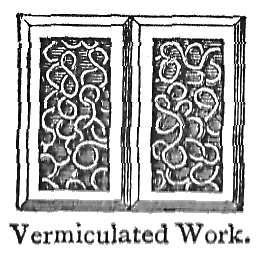
Vermes, ver′mēz, n.pl. worms: the name given by Linnæus to one of the classes in his zoological system, in which he included all the invertebrate animals, other than Insecta, whether of worm-like form or not.—ns. Vermeol′ogist, one skilled in vermeology; Vermeol′ogy, the knowledge of worms, helminthology.—adjs. Ver′mian, Vermi′ceous, worm-like; Ver′micidal, destroying worms.—n. Ver′micide, a worm-killer.—adjs. Vermic′ūlar, Vermic′ūlate, -d, pertaining to or like a worm (esp. in its motion): inlaid or formed so as to imitate the track of worms: crawling like a worm.—v.t. Vermic′ūlate, to form inlaid work which resembles the motion or track of worms.—ns. Vermiculā′tion; Ver′micule, a little worm.—adjs. Vermic′ulose, Vermic′ulous, wormy; Ver′miform, having the form of a worm; Vermif′ugal, expelling worms.—n. Ver′mifuge (med.), a substance that destroys intestinal worms or expels them from the digestive canal.—adjs. Ver′migrade, wriggling like a worm; Vermiv′orous, devouring worms, feeding on grubs. [L. vermis, a worm.]
Vermicelli, ver-mi-chel′i, or -sel′i, n. the stiff paste or dough of fine wheat-flour made into small worm-like or thread-like rolls. [It., pl. of vermicello—L. vermiculus, dim. of vermis, worm.]
Vermilion, ver-mil′yun, n. a bright-red pigment obtained from cinnabar, but generally made artificially from mercury and sulphur: any beautiful red colour: (obs.) the kermes or cochineal insect, also the product of cochineal.—adj. of the colour of vermilion.—v.t. to dye vermilion: to colour a delicate red.—n. Ver′mily (Spens.), same as Vermilion. [O. Fr. vermillon—vermeil—L. vermiculus, a little worm, hence (in the Vulgate) the 'scarlet' worm, dim. of vermis, a worm.]
Vermin, ver′min, n.sing. and pl. a worm: a name for all obnoxious insects, as bugs, fleas, and lice; troublesome animals, such as mice, rats; animals destructive to game, such as weasels, polecats, also hawks and owls: any contemptible person, or such collectively.—v.i. Ver′mināte, to breed vermin.—ns. Verminā′tion; Ver′min-kill′er.—adj. Ver′minous, infested with worms: like vermin.—adv. Ver′minously. [Fr. vermine—L. vermis, a worm.]
Vermuth, Vermouth, ver′mooth, n. a mild cordial consisting of white wine flavoured with wormwood, used as a stimulant for the appetite. [Ger. wermuth, wormwood; cf. A.S. wermōd.]
Vernacular, ver-nak′ū-lar, adj. native: belonging to the country of one's birth.—n. one's mother-tongue.—n. Vernacularisā′tion, the act of making vernacular.—v.t. Vernac′ularise, to make vernacular.—ns. Vernac′ularism, a vernacular word or idiom, the use of such; Vernacular′ity, an idiom.—adv. Vernac′ularly.—v.t. Vernac′ulate, to express in a vernacular idiom.—adj. Vernac′ulous, scurrilous. [L. vernaculus—verna, a home-born slave.]
Vernal, ver′nal, adj. belonging to the spring: appearing in spring: belonging to youth.—adv. Ver′nally.—adj. Ver′nant (Milt.), flourishing as in spring.—v.i. Ver′nāte, to flourish.—n. Vernā′tion, the particular manner of arrangement of leaves in the bud.—Vernal equinox, the equinox on or about 21st March (see Equinox); Vernal grass, a common British meadow grass about a foot high, and sown among hay for its flavour and agreeable odour. [L. vernalis—ver, spring.]
Verner's law. See Law.
Vernier, ver′ni-ėr, n. a contrivance for measuring very small intervals, consisting of a short scale made to slide along a graduated instrument. [So called from Pierre Vernier (1580-1637) of Brussels, its inventor.]
Veronese, ver-ō-nēs′, or -nēz′, n. of or pertaining to Verona in Italy.—n. an inhabitant of Verona.
Veronica, vē-ron′i-ka, n. a portrait of our Saviour's face on a handkerchief—from the legend that St Veronica wiped the sweat from the face of Jesus, on His way to Calvary, with her handkerchief, whereupon His features were impressed on the cloth: a genus of plants, popularly known as Speedwell. [Veronica, not L. vera, true, Gr. eikōn, image, but identical with Berenīcē, the traditional name of the woman cured of the issue of blood—a corr. of Gr. pherenikē, victorious—pherein, to bear, nikē, victory.]
Verré, Verrey, ve-rā′, adj. Same as Vairé.
Verrel, ver′el, n. a corruption of ferrule.
Verricule, ver′i-kūl, n. a tuft of upright hairs. [L. verriculum, a net.]
Verruca, ve-rū′ka, n. a wart, a glandular elevation: one of the wart-like sessile apothecia of some lichens.—adjs. Verrū′ciform, warty; Ver′rūcose, Ver′rūcous, covered with little knobs or wart-like prominences: warty; Verrū′culose, minutely verrucose. [L. verruca, a wart.]
Verrugas, ve-rōō′gas, n. an endemic disease of Peru, characterised by warty tumours on the skin. [Sp.,—L. verruca, a wart.]
Versability, ver-sa-bil′i-ti, n. aptness to be turned round.—adj. Ver′sable.—n. Ver′sableness. [L. versāre, to whirl about.]
Versal, ver′sal, adj. (Shak.) abbrev. of universal.
Versant, ver′sant, adj. familiar, conversant: (her.) with wings erect and open.—n. the general slope of surface of a country. [Fr.,—L. versāre, to whirl about.]
Versatile, ver′sa-til, adj. capable of being moved or turned round: changeable: unsteady: turning easily from one thing to another: (bot.) swinging freely on a support: (ornith.) reversible, of toes.—adv. Ver′satilely.—ns. Ver′satileness, Versatil′ity, the quality of being versatile: changeableness: the faculty of turning easily to new tasks or subjects. [Fr.,—L. versatilis—versāre, freq. of vertĕre, to turn.]
Verse, vers, n. a line of poetry: metrical arrangement and language: poetry: a stanza: a short division of any composition, esp. of the chapters of the Bible, originally confined to the metrical books, applied first to whole Bible in 1528: (mus.) a portion of an anthem to be performed by a single voice to each part.—v.t. to relate in verse.—ns. Vers-de-société (same as Society-verse; see under Sociable); Verse′let; Verse-mā′ker; Verse-mā′king; Verse′-man, a writer of verses; Verse′-mong′er, a scribbler of verses; Verse′-mong′ering, verse-writing, esp. of poor verses; Ver′ser, a versifier; Ver′set (mus.), a very short organ interlude or prelude; Ver′sicle, a little verse: in liturgy, the verse said by the officiant.—adj. Versic′ūlar, pertaining to verses.—ns. Versificā′tion, the act, art, or practice of composing metrical verses; Ver′sificātor, Ver′sificātrix, a male, female, maker of verses; Ver′sifīer.—v.i. Ver′sify, to make verses.—v.t. to relate in verse: to turn into verse:—pa.t. and pa.p. ver′sifīed.—n. Ver′sion, the act of translating or turning from one language into another: that which is translated from one language into another: account: statement: a school exercise, generally of composition in a foreign language.—adj. Ver′sional, pertaining to a version or translation.—n. Ver′sionist, a translator.—adj. Ver′sūal, of the character of a verse, pertaining to verses or short paragraphs. [A.S. fers—L. versus, vorsus, a line, furrow, turning—vertĕre, to turn; influenced by O. Fr. vers.]
Versed, verst, adj. thoroughly acquainted, skilled (fol. by in): (math.) reversed.—adj. Versé (her.), reversed or turned in an unusual direction.—Also Renverse. [Fr. versé—L. versatus, pa.p. of versāri, to turn round.]
Versicolour, ver′si-kul-ur, adj. having diverse or having changeable colours.—Also Versicol′oured. [L. versāre, to change, and colour.]
Versiform, ver′si-form, adj. varying in form.
Verso, ver′sō, n. a left-hand page: the reverse of a coin or medal.
Verst, verst, n. a Russian mile, 3500 feet in length, or almost two-thirds of an English mile. [Russ. versta, a verst; perh. vertietĭ, to turn, cog. with L. vertĕre, to turn.]
Versus, ver′sus, prep. against, in legal phraseology—abbreviated v. and vs. [L.]
Versute, ver-sūt, adj. crafty, wily.
Vert, vert, n. in forest law, every green leaf or plant having green leaves which may serve as a covert for deer: a power to cut green trees or wood: (her.) a green colour represented by parallel lines sloping diagonally from the dexter chief to the sinister base. [Fr. vert—L. viridis, green.]
Vert, vert, n. a familiar word for convert or pervert.—v.i. to become such.
Vertebra, ver′tē-bra, n. one of the segmented portions of the spinal column:—pl. Vertebræ (ver′te-brē).—adj. Ver′tebral.—adv. Ver′tebrally.—n.pl. Vertebrā′ta, a division of the animal kingdom containing all animals having a backbone or its equivalent.—n. Ver′tebrāte, an animal having an internal skeleton with a backbone.—adjs. Ver′tebrāte, -d, furnished with joints: having a backbone.—n. Vertebrā′tion, the formation of vertebræ;. [L.,—vertĕre, to turn.]
Vertex, vėr′teks, n. the top or summit: the point of a cone, pyramid, or angle; (astron.) the zenith: (anat.) the crown of the head:—pl. Ver′tices.—adj. Ver′tical, pertaining to the vertex: placed in the zenith: perpendicular to the plane of the horizon.—n. a vertical line.—adv. Ver′tically.—n. Ver′ticalness.—Vertical angles, opposite angles formed by intersecting lines; Vertical circle, a great circle of the heavens passing through the zenith and the nadir. [L., eddy, summit—vertĕre, to turn.]
Verticillate, ver-ti-sil′āt, adj. (bot.) arranged round the stalk in a ring or whorl, as leaves or flowers, whorled.—n. Ver′ticil, a whorl. [Low L. verticillatus—verticillus, dim. of vertex.]
Vertigo, ver′ti-gō, or ver-tī′gō, n. a sensation of giddiness: dizziness.—adjs. Vertiginate (ver-tij′-), Vertig′inous, turning round: affected with vertigo: giddy.—adv. Vertig′inously.—n. Vertig′inousness. [L.,—vertĕre, to turn.]
Vertu, old spelling of virtue.—adj. Ver′tuous (Spens.), possessing virtue or power.
Vertumnus, ver-tum′nus, n. an ancient Roman divinity of gardens and orchards, a spring god.
Verulamian, vėr-ū-lā′mi-an, adj. of or pertaining to St Albans, or Francis Bacon, Baron Verulam, Viscount St Albans (1561-1626). [L. Verulamium, an ancient British city near the site of St Albans.]
Veruled, ver′ōōld, adj. (her.) ringed, as a horn, in a different tincture.—n. Ver′ules (her.), a bearing consisting of a series of concentric rings, one within another. [Virole.]
Vervain, ver′vān, n. a plant of the genus Verbena—credited with efficacy in love-philtres, good against witches, &c. [O. Fr. verveine—L. verbēna.]
Verve, verv, n. the enthusiasm which animates a poet or artist: animation: energy. [Fr.]
Vervelle, ver-vel′, n. the loop that secured the camail in medieval armour. [Fr.]
Vervels, verv′elz, n.pl. small rings attached to the ends of the jesses of a hawk, through which the leash is passed that fastens the hawk to its block.—adj. Verv′elled. [Fr. vervelle.]
Vervet, ver′vet, n. a South African monkey.
Very, ver′i, adj. true (now used chiefly in an intensive sense): real (so in B.): actual—sometimes used in superlative form Ver′iest.—adv. in a high degree.—In very deed, of a truth, certainly. [Older form veray—O. Fr. verai (Fr. vrai), from L. verax, veracis, speaking truly—verus, true; cf. Ger. wahr.]
Vesalian, vē-sā′li-an, adj. connected with the name of the anatomist Andreas Vesalius (1514-64).
Vesania, vē-sā′ni-a, n. insanity.
Vesica, vē-sī′ka, n. (anat.) a bladder, sac, esp. the urinary bladder:—pl. Vesicæ (vē-sī′sē).—adjs. Ves′ical, of or pertaining to a vesica; Ves′icant, blistering.—n. a substance that vesicates or raises blisters.—v.t. Ves′icāte, to raise blisters on:—pr.p. ves′icāting; pa.p. ves′icāted.—ns. Vesicā′tion, the act or process of raising blisters on the skin; Ves′icātory (same as Vesicant); Ves′icle, a small bladder or blister: a small cavity in an animal body; (bot.) a bladder-like cell; Vēsic′ūla, a vesicle.—adj. Vēsic′ular.—adv. Vēsic′ūlarly.—n. Vēsicūlā′tion, formation of vesicles.—adjs. Vēsicūlif′erous, bearing vesicles; Vēsic′ūliform; Vēsic′ūlose, Vēsic′ūlous, Vēsic′ūlāte, pertaining to or full of vesicles: full of interstices: having little glands on the surface.—Vesica piscis (a fish's bladder), a symbol of Christ, an oval aureole surrounding the entire upright figure, supposed to contain an allusion to the sacred Christian emblem, the ichthys. [L., bladder.]
Vesper, ves′pėr, n. the evening star, Venus: the evening: (pl.) the last but one of the seven canonical hours: evensong, evening service generally.—adj. Ves′peral, pertaining to the evening or to vespers.—n. Ves′per-bell, the bell that summons to vespers.—adjs. Ves′pertine, Ves′pertinal, of or pertaining to the evening: (bot.) opening in the evening: (zool.) active in the evening.—Sicilian vespers (see Sicilian). [Fr.,—L.; Gr. hesperos.]
Vespertilio, ves-pėr-til′i-ō, n. a Linnæan genus of mammals, of order Primates—the modern order Chiroptera.—adj. Vespertil′ionine.
Vespiary, ves′pi-a-ri, n. a hornet's nest.—adj. Ves′piform, Ves′pine, wasp-like.
Vessel, ves′el, n. a vase or utensil for holding something: a hollow structure made to float on water, used for conveyance, &c.: a tube in which fluids, as blood, &c., are contained: a person considered as an agent of God.—The weaker vessel, a phrase colloquially applied to a woman, in allusion to 1 Pet. iii. 7. [O. Fr. vessel (Fr. vaisseau)—L. vascellum, dim. of vas, a vase.]
Vest, vest, n. that which is put on as dress: a garment: a waistcoat: formerly a cassock-like garment: a kind of close jacket worn by women, an extra piece or trimming on the front of the bodice of a woman's gown, often V-shaped: a knitted or woven undergarment: (arch.) a vestment.—v.t. to clothe: to invest: (law) to give fixed right of possession.-v.i. to descend or to take effect, as a right.—adj. Ves′ted, clothed, wearing robes of ceremony: not contingent or suspended, hence (law) already acquired: denoting a present absolute right.—n. Ves′tiary (obs.), a wardrobe: (rare) garb, clothing:—pl. Ves′tiaries.—n. Ves′ting, cloth for men's waistcoats.—Vest in interest, to devolve as matter of right without reference to immediate right of possession. [Fr. veste—L. vestis.]
Vesta, ves′ta, n. among the Romans, the chaste goddess that presided over the family, in whose temple the sacred fire was continually kept burning: the fourth planetoid discovered in 1807: a match or waxlight:—pl. Ves′tas.—adj. Ves′tal, pertaining to or consecrated to the service of Vesta: chaste: pure.—n. in the ancient Roman religion, one of the six patrician virgins consecrated to Vesta: a virgin, a nun, a woman of spotless chastity.
Vestibule, ves′ti-būl, n. an open court or porch before a house: a hall next the entrance to a house: (anat.) a small bony cavity forming part of the ear—also Vestib′-ūlum.—v.t. to furnish with a vestibule.—adjs. Vestib′ūlar, Vestib′ūlāte. [Fr.,—L. vestibulum—traced by some to ve, apart, stabulum, abode; by others to vestis, garment, as being the place where the outer clothing is put on or off in entering or leaving a house.]
Vestige, ves′tij, n. a track or footprint: traces or remains of something: (biol.) an organ or tissue which still survives but has lost the utility it possessed, but corresponding to a useful part in an organism of lower type.—adjs. Vesti′gial, Vesti′giary.—n. Vesti′gium (anat., biol.), a vestige. [Fr.,—L. vestigium—vestigāre, to track.]
Vestiment, ves′ti-ment, n. (Spens.)=Vestment.
Vestiture, ves′ti-tūr, n. the hairs, scales, &c. covering a surface.
Vestlet, vest′let, n. a tubicolous sea-anemone of genus Cerianthus.
Vestment, vest′ment, n. something put on, a garment: a long outer robe: (pl.) articles of dress worn by the clergy during divine service and the administration of the sacraments—amice, alb, girdle, maniple, stole, chasuble, &c.: covering of the altar. [L. vestimentum—vestīre, to clothe—vestis, a garment.]
Vestry, ves′tri, n. a room adjoining a church in which the vestments are kept and parochial meetings held, any small room attached to a church: in English parishes, a meeting of the ratepayers to elect parish officers, to assess church-rates, and to manage the property of the parish, the incumbent acting as chairman.—adj. Ves′tral.—ns. Ves′try-clerk, an officer chosen by the vestry who keeps the parish accounts and books; Ves′tryman, a member of a vestry.—Select vestry, a board consisting of representatives of the ratepayers, as opposed to the common vestry or assembly of all the ratepayers. [Fr.,—L. vestiarium—vestiarius, belonging to clothes—vestis, a garment.]
Vesture, ves′tūr, n. clothing: dress: a robe: integument.—v.t. to clothe, robe.—adjs. Ves′tūral; Ves′tūred.—n. Ves′tūrer, one who has charge of ecclesiastical vestments.
Vesuvian, vē-sū′vi-an, adj. pertaining or relating to Vesuvius, a volcano near Naples.—n. a kind of match used in lighting cigars, &c.—n. Vesū′vianīte, a mineral allied to garnet, sometimes called pyramidal garnet, found in volcanic and primitive rocks, and so called because frequent in masses ejected from Vesuvius—also Idocrase.—v.t. Vesū′viate, to burst forth like an eruption.
Vet., vet, n. (coll.) an abbreviation from veterinary (surgeon).
Vetch, vech, n. a genus of plants, mostly climbing, some cultivated for fodder, esp. the tare.—n. Vetch′ling, a name of various vetch-like plants.—adj. Vetch′y, abounding with vetches: (Spens.) consisting of vetches. [O.Fr. veche (Fr. vesce)—L. vicia, akin to vincīre, to bind.]
Veteran, vet′e-ran, adj. old, experienced: long exercised, esp. in military life.—n. one long exercised in any service, esp. in war.—v.t. Vet′eranise, to make veteran.—v.i. (U.S.) to re-enlist for military service. [L. veteranus—vetus, veteris, old.]
Veterinary, vet′e-ri-na-ri, adj. pertaining to the art of treating the diseases of domestic animals: professing or practising this art.—n. one skilled in the diseases of domestic animals.—Also Veterinā′rian. [L. veterinarius—veterina (bestia), a beast of burden.]
Vetiver, vet′i-vėr, n. the dried roots of the cuscus-grass, with an odour like sandalwood—making baskets, fans, and mats,
Veto, vē′tō, n. any authoritative prohibition: the power of rejecting or forbidding:—pl. Vetoes (vē′tōz).—v.t. to reject by a veto: to withhold assent to.—Absolute veto, a veto without restriction. [L. vetāre, to forbid.]
Vettura, vet-tōō′ra, n. an Italian four-wheeled carriage.—n. Vetturino (vet-tōō-rē′nō), one who drives or lends for hire a vettura:—pl. Vetturi′ni. [It.,—L. vectura, a carrying—vehĕre, to convey.]
Vetust, vē-tust′, adj. old. [L. vetustus—vetus, old.]
Vex, veks, v.t. to harass: to torment: to irritate by small provocations: to agitate: to contest.—v.i. (obs.) to be vexed.—n. (Scot.) a trouble.—n. Vexā′tion, a vexing: state of being vexed: trouble: a teasing annoyance: uneasiness.—adj. Vexā′tious, causing vexation or annoyance: harassing: full of trouble.—adv. Vexā′tiously.—n. Vexā′tiousness.—adj. Vexed, amazed.—n. Vex′er.—adj. Vex′ing.—adv. Vex′ingly, so as to vex or annoy.—n. Vex′ingness.—Vexatious suit (law), a suit begun without justifiable cause. [Fr. vexer—L. vexāre, to shake, annoy—vehĕre. to carry.]
Vexillum, vek-sil′um, n. in the ancient Roman army, a standard, the troop serving under such a standard: (eccles.) a processional banner: (bot.) the large posterior petal of a papilionaceous flower—also Vex′il; the web or vane of a feather:—pl. Vexill′a.—adjs. Vex′illar, Vex′illary.—ns. Vex′illary, Vex′illātor, a standard-bearer.—adj. Vex′illate, having vexilla.—n. Vexillā′tion, a company under one vexillum. [L., 'an ensign'—vehĕre, to carry.]
Via, vī′a, or vē′a, n. a highway, a road, a route—via London=by way of London: a natural passage of the body.—n. Viam′eter, an odometer.—adj. Viat′ic.—n.pl. Viat′icals, military baggage.—Via dolorosa, the Way of Calvary (see Station); Via lactea, the Milky-Way or Galaxy; Via media, the midway course or mean between popular Protestantism and Roman Catholicism which Newman almost down to 1845 succeeded in believing that the Anglican divines of the 17th century had taken up.—Primæ viæ, the first or main passages, the alimentary canal, the bowels; Secundæ viæ, the lacteal or chyliferous vessels.
Via, vē′a, interj. away! off! either in command or defiance. [It.,—L. via, way.]
Viable, vī′a-bl, adj. capable of living.—n. Viabil′ity. [Fr., through Low L.—L. vita, life.]
Viaduct, vī′a-dukt, n. a road or railway carried by a structure over a valley, river, &c. [L. via, a way, ducĕre, ductum, to lead, bring.]
Vial, vī′al, n. same as Phial, v.t. to keep in a vial.—n. Vī′alful.—Pour out vials of wrath, to inflict judgment (Rev. xvi. 1): to storm, rage.
Viand, vī′and, n. food, articles for food—usually in pl. [Fr. viande—Low L. vivanda (for vivenda), food necessary for life—L. vivĕre, to live.]
Viaticum, vī-at′ik-um, n. (orig.) provisions for the way: (R.C. Church) the eucharist given to persons in danger of death: a portable altar.—n. Viā′tor, a traveller, wayfarer: a summoner, apparitor. [L.,—via, a way.]
Vibex, vī′beks, n. a purple spot under the skin in certain fevers:—pl. Vibī′ces. [L.]
Vibraculum, vī-brak′ū-lum, n. one of the long whip-like appendages of the cells of some Polyzoa:—pl. Vibrac′ūla.—Also Vibracūlā′rium.
Vibrate, vī′brāt, v.i. to shake: to tremble: to move backwards and forwards: to swing: to pass from one state to another.—v.t. to cause to shake: to move to and fro: to measure by moving to and fro: to affect with vibratory motion.—adjs. Vī′brant, vibrating: sonorous; Vī′bratile, having a vibratory motion: (zool.) adapted to or used in vibratory motion.—ns. Vībratil′ity; Vībrā′tion, a vibrating: state of being vibrated: tremulousness, quivering motion.—adj. Vībrā′tional.—n. Vībrā′tiuncle, a small vibration.—adjs. Vī′brātive, Vī′brātory, vibrating: consisting in vibrations: causing vibrations.—ns. Vī′brātor (elect.), a vibrating reed used to open and close the electric current: (print.) a vibrating reed used for distributing the ink; Vi′broscope, an instrument for registering vibrations. [L. vibrāre, -ātum, to tremble.]
Vibrato, vē-brä′tō, n. a pulsating effect in vocal music, caused by rapid variation of emphasis on the same tone. [It.]
Vibrio, vib′rī-ō, n. a name given with much laxity to various kinds of more or less screw-shaped Bacteria—also to small nematoid worms, such as cause ear-cockles in wheat.—n. Vib′rion, a motile bacterium. [L. vibrāre.]
Vibrissa, vī-bris′a, n. a whisker, as of a cat: a rictal bristle in birds: bristle, hair, as in the nostril:—pl. Vibriss′æ (-ē). [L., 'a hair in the nostril.']
Vibrogen, vib′rō-jen, n. (bot.) active cellular tissue arranged in layers in the cortex of certain tendrils, causing circumnutation.
Viburnum, vī-bur′num, n. a genus of plants of the order Caprifoliaceæ, the species being shrubs with simple leaves, natives chiefly of the northern parts of the world.—Viburnum opulus is the Guelder Rose or Snowball Tree; Viburnum tinus, the Laurustinus. [L., 'the wayfaring tree.']
Vicar, vik′ar, n. one who holds authority as the delegate or substitute of another: a parson of a parish where the tithes are impropriate to a layman or to a chapter, he receiving only the smaller tithes or a salary: (R.C. Church) a bishop's assistant who exercises jurisdiction in his name.—ns. Vic′arāge, the benefice or residence of a vicar; Vic′ar-apostol′ic (formerly one to whom the pope delegated some remote portion of his jurisdiction), now usually a titular bishop appointed to a country where either no sees have been formed or the episcopal succession has been broken; Vic′ar-chō′ral, an assistant, cleric or lay, at an English cathedral, esp. in connection with the music; Vic′ar-forāne′, an ecclesiastic to whom a bishop gives a limited jurisdiction in a town or district of his diocese—in effect, a rural dean; Vic′ar-gen′eral, an official performing the work of an archdeacon under the bishop: in the English Church, an officer assisting the bishop, the chancellor of the diocese.—adjs. Vīcā′rial, pertaining to a vicar: substituted; Vīcā′riāte, having vicarious or delegated power.—n. (also Vic′arāte) vicarship, delegated power.—adj. Vīcā′rious, filling the place of another: performed or suffered in place of or for the sake of another.—adv. Vīcā′riously.—ns. Vīcā′riousness; Vīcā′rius, a vicar; Vic′arship, the office of a vicar; Vic′ary, a vicarage.—Vicarious sacrifice (theol.), the suffering of Christ accepted by God in lieu of the punishment to which guilty man is liable.—Vicar-of-Bray, one who turns his coat without difficulty to suit the times—from Simon Aleyn, who kept the vicarage of Bray from 1540 to 1588, during the reigns of Henry VIII., Edward VI., Mary, and Elizabeth; Vicar of Christ, a title assumed by the pope, who claims to be the representative of Christ on earth as the head of His Church. [L. vicarius, supplying the place of another—vicis, change, alternation.]
Vice, Vise, vīs, n. an iron or wooden screw-press, fixed to the edge of a workboard, for holding anything tightly while being filed, &c.: (Shak.) a grip, grasp.—v.t. to screw. [Fr. vis (It. vite, screw)—L. vitis, tendril of a vine, anything spiral.]
Vice, vīs, n. a blemish or fault: immoral conduct: depravity of manners: a bad trick or habit in a horse: mischievousness: the stock buffoon in the old English Moralities or moral plays.—n. Vicios′ity.—adj. Vicious (vish′us).—adv. Vic′iously.—n. Vic′iousness.—Vicious circle, syllogism, circular or erroneous reasoning; Vicious intromission (see Intromit). [Fr.,—L. vitium, a blemish.]
Vice, vīs, prep. in the place of: also a prefix denoting in the compound word one who acts in place of or is second in rank to another.—n. a vice-chairman, &c.: one who acts in place of a superior.—ns. Vice′-ad′miral, one acting in the place of, or second in command to, an admiral; Vice′-ad′miralty, the office of a vice-admiral—(Vice′-ad′miralty courts, tribunals in the British colonies, having jurisdiction over maritime causes); Vice′-chair′man, an alternate chairman; Vice′-chair′manship; Vice′-chan′cellor, one acting for a chancellor: a lower judge of Chancery; (R.C. Church) the cardinal whose duty it is to draft and despatch papal bulls and briefs; Vice′-chan′cellorship; Vice′-con′sul, one who acts in a consul's place: a consul in a less important district; Vice′-con′sulship; Vice-dean′, a canon chosen to represent an absent dean; Vicegē′rency, the office of a vicegerent, deputed power.—adj. Vicegē′rent, acting in place of another, having delegated authority.—n. one acting in place of a superior.—ns. Vice′-gov′ernor, deputy governor; Vice′-king, one who acts in place of a king; Vice′-pres′idency, -pres′identship; Vice′-pres′ident, an officer next in rank below the president; Vice′-prin′cipal, assistant principal.—adj. Vicerē′gal.—ns. Vicerē′gency; Vice′roy, Vicerē′gent, one representing the royal authority in a dependency, as in India; Viceroy′alty, Vice′royship. [L., 'in the place of,' abl. of vicis (gen.), change.]
Vicenary, vis′e-nā-ri, adj. of or belonging to the number twenty: twentieth.—adj. Vīcen′nial, continuing or comprising twenty years: occurring once every twenty years. [L. vicenarius—viceni—viginti, twenty.]
Vicinage, vis′i-nāj, n. neighbourhood: the places near: neighbourliness.—adj. Vic′inal, neighbouring.—n. Vicin′ity, neighbourhood: nearness: that which is near. [O. Fr. veisinage—veisin—L. vicinus, neighbouring—vicus, a row of houses; cf. Gr. oikos, a dwelling.]
Vicissitude, vi-sis′i-tūd, n. change from one thing to another: change: revolution.—adjs. Vicissitū′dinary, Vicissitū′dinous, changeful, changeable. [L. vicissitudo—vicis, change.]
Victim, vik′tim, n. a living being offered as a sacrifice: some thing or person destroyed in the pursuit of an object: a person suffering injury: a dupe.—n. Victimīsā′tion.—v.t. Vic′timīse, to make a victim of: to cheat.—n. Vic′timīser, a swindler. [Fr.,—L. victima, a beast for sacrifice, adorned with the fillet—vincīre, to bind.]
Victor, vik′tor, n. one who conquers on any particular occasion: one who defeats in battle: a winner:—fem. Vic′tress, Vic′toress, Vic′trix.—adjs. Vic′tor, Victō′rious, relating to victory: superior in contest: having overcome an enemy: producing or indicating victory.—adv. Victō′riously.—ns. Victō′riousness; Vic′tory, a conquering: success in any contest: a battle gained: a female deity of the Greeks personifying success in battle.—Cadmean victory, one as fatal to the victors as to the vanquished—from the armed men who grew up from the dragon's teeth sown by Cadmus, and slew one another all but five, who became the ancestors of the Thebans; Moral victory (see Moral); Pyrrhic victory (see Pyrrhic). [L.,—vincĕre, victum, to conquer.]
Victoria, vik-tō′ri-a, n. a genus of gigantic aquatic plants of the water-lily family, native to South America, its one species, Victoria regia, named after Queen Victoria: a low, light, four-wheeled carriage, seating two, having a calash top.—adj. Victō′rian, relating to the reign of Queen Victoria, which began in 1837: relating to the colony of Victoria in Australia.—Victoria cross, a decoration, consisting of a bronze Maltese cross, founded by Queen Victoria in 1856, and awarded for conspicuous bravery on the field.
Victorine, vik-tō-rēn′, n. a kind of fur tippet worn by ladies: a variety of peach.
Victual, vīt′l, n. provision of food, that which is necessary for living, food for human beings (gener. in pl.).—v.t. to supply with victuals or food: to store with provisions:—pr.p. Victualling (vit′l-ing); pa.t. and pa.p. Victualled (vit′ld).—ns. Vict′uallage, provisions; Victualler (vīt′l-ėr), one who supplies provisions.—adj. Vict′ualless.—ns. Vict′ualling-bill, a customs document warranting the captain of an outward-bound vessel to ship bonded stores for the voyage; Vict′ualling-off′ice, -ship, an office supplying, a ship conveying, provisions to the navy; Vict′ualling-yard, a public establishment for the collection and supply of provisions to the navy.—Licensed Victualler, an innkeeper who is allowed to sell spirits, wines, &c. [O. Fr. vitaille—Low L. victualia—L. victualis, relating to living—vivĕre, victum, to live.]
Vicugna, Vicuña, vi-kōō′nya, or vi-kū′na, n. a species or variety of the South American genus Auchenia (allied to the camels), which also includes the llama, alpaca, and the guanaco.—n. Vicu′na-cloth, a trade name for a mixture of wool and cotton. [Peruv.]
Vidame, vē-dam′, n. in French feudal jurisprudence, the deputy of a bishop in temporal affairs: a minor noble. [Low L. vice, in place of, dominus, lord.]
Vide, vī′dē, see, imper. of L. vidēre, to see.—Vide antea=see before; Vide infra=see below; Vide post=see after; Vide supra=see above; Quod vide, or q.v.=which see.
Videlicet, vi-del′i-set, adv. to wit, that is, namely—generally Viz., and rendered 'namely.' [L., for vidēre licet, it is permitted to see.]
Videndum, vī-den′dum, n. a thing to be seen:—pl. Vīden′da. [L., ger. of vidēre, to see.]
Vidette. Same as Vedette.
Vidimus, vid′i-mus, n. an inspection, as of accounts, &c. [L., 'we have seen'—vidēre, to see.]
Viduous, vid′ū-us, adj. widowed.—ns. Vid′ūage, widowhood; Vid′uāte, the position or order of widows; Viduā′tion, the state of being widowed; Vidū′ity, widowhood. [L. vidua, a widow.]
Vie, vī, v.i. to strive for superiority.—v.t. to contend about: (Shak.) to offer as a stake or wager:—pr.p. vy′ing; pa.t. and pa.p. vīed.—n. (obs.) a contest. [M. E. vien, by aphæresis from envien, to vie, through Fr. from L. invitāre, to invite.]
Vielle, vi-el′, n. an old form of viol. [Fr.]
Viennese, vi-e-nēs′, or -nēz′, adj. pertaining to Vienna.—n. an inhabitant, or the inhabitants, of Vienna.
View, vū, n. a seeing: sight: reach of the sight: whole extent seen: that which is seen: inspection, as by a jury, of the place of a crime, of the corpse, &c.: direction in which a thing is seen: the picture of a scene: a sketch: mental survey: mode of looking at or receiving: opinion: intention: (Shak.) show, appearance.—v.t. to see: to look at attentively: to examine intellectually.—adj. View′able, that can be viewed.—ns. View′er; View′-halloo′, the huntsman's cry when the fox breaks cover; View′iness, character of being viewy or visionary.—adj. View′less, not to be viewed: invisible.—adv. View′lessly.—adj. View′ly (prov.), pleasing to look at.—n. View′-point, point of view.—adjs. View′some (prov.), viewly; View′y (coll.), holding opinions vague or purely speculative.—Dissolving views, pictures thrown on a screen and made to pass one into the other; Field of view, the compass of visual power; In view of, having regard to; On view, open to public inspection; To the view (Shak.), in public. [Fr. vue—vu, pa.p. of voir—L. vidēre, to see.]
Vifda, vif′da, n. in Shetland, meat hung and dried without salt.—Also Viv′da.
Vigesimal, vī-jes′i-mal, adj. twentieth.—n. Vigesimā′tion, the putting to death of every twentieth man.—adj. Viges′imo-quar′to, formed of sheets folded so as to make twenty-four leaves. [L. vigesimus—viginti, twenty.]
Vigia, vi-jē′a, n. a hydrographical warning on a chart, of a rock, &c. [Sp.]
Vigil, vij′il, n. watching: keeping awake for religious exercises: the eve before a feast or fast day, originally kept by watching through the night.—n. Vig′ilance, wakefulness: watchfulness: circumspection: (obs.) a guard, watch.—adj. Vig′ilant, watchful: on the lookout for danger: circumspect.—n. Vigilan′te, a member of a vigilance committee.—adv. Vig′ilantly.—Vigilance committee (U.S.), an unauthorised body which, in the absence or inefficiency of regular courts, exercises legal powers of arrest, punishment, &c. in cases of gross crime: also any self-appointed association for the compulsory improvement of local morals. [Fr.,—L. vigilia—vigil, awake, watchful—vigēre, to be lively.]
Vigneron, vēn-ye-rong, n. a vine-grower. [Fr.]
Vignette, vin-yet′, n. any small ornamental engraving, design, or photograph not enclosed by a definite border: (orig.) an ornamental flourish of vine leaves and tendrils on manuscripts and books.—v.t. to treat or produce in such a style.—ns. Vignett′er; Vignett′ing-glass, -pā′per, a glass frame, mask, used in printing vignette pictures; Vignett′ist, one who makes vignettes. [Fr.,—vigne—L. vinea, a vine.]
Vigour, vig′ur, n. active strength: physical force: vital strength in animals or plants: strength of mind: energy.—adj. Vig′orous, strong either in mind or body.—adv. Vig′orously.—n. Vig′orousness. [Fr.,—L. vigor—vigēre, to be strong.]
Viking, vī′king, n. one of the piratical Northmen who in the 8th, 9th, and 10th centuries ravaged the coasts of western Europe.—n. Vī′kingism, characteristics, acts, &c. of Vikings. [Ice. víkingr, (lit.) 'a creeker'—víkr (Swed. vik, Eng. wick), a bay, and -ingr=Eng. -ing.]
Vilayet, vil-a-yet′, n. the name given to the great provinces into which the Ottoman empire is divided.
Vild, vīld, adj. (Spens.) vile, wicked.—adv. Vild′ly.
Vile, vīl, adj. worthless: mean: morally impure: wicked: (B.) poor, cheap.—adv. Vile′ly.—n. Vile′ness.—ns. Vilificā′tion, act of vilifying: defamatory speech: abuse; Vil′ifīer.—v.t. Vil′ify, to make vile: to attempt to degrade by slander: to defame:—pa.t. and pa.p. vil′ifīed.—v.t. Vil′ipend, to slander, vilify.—v.i. to use vilification. [Fr.,—L. vilis.]
Villa, vil′a, n. a country residence or seat: a suburban mansion—also Vill.—ns. Vill′adom, villas collectively, people living in them; Vill′āge, any small assemblage of houses, less than a town: (orig.) a number of houses inhabited by persons near the residence of a proprietor or farmer: (law) a manor, a parish or the outlying part of a parish; Vill′age-commū′nity, a clan of settlers who built their huts on a tract of land and laid out common fields which they cultivated in common as one family, the land being divided out every few years into family lots, but the whole continuing to be cultivated by the community subject to the established customs as interpreted in the village-council by the sense of the village elders—the so-called Mark system of Sir Henry Maine; Vill′āger, an inhabitant of a village; Vill′āgery (Shak.), a district of villages; Vill′akin, Villanette′, a little villa.—adj. Villat′ic (Milt.), pertaining to a farm. [O. Fr. ville (Fr. ville)—L. villa, a country-house, prob. reduced from vicla, dim. of vicus, a village; Gr. oikos, a house.]
Villain, vil′ān, or vil′in, n. a wicked wretch: a man extremely degraded: in feudal times, a member of the lowest class of unfree persons.—ns. Vill′aināge, Vill′anāge, Vill′eināge, Vill′enāge, in feudal times, the tenure of land by villein, i.e. base or menial services.—adj. Vill′ainous, like or suited to a villain: depraved: proceeding from extreme depravity: very bad, mean, vile.—adv. Vill′ainously.—ns. Vill′ainousness; Vill′ainy, the act of a villain: extreme depravity: an atrocious crime. [Orig. 'a serf attached to a farm,' O. Fr. villain—Low L. villanus—L. villa.]
Villanelle, vil-a-nel′, n. a poem, of a form borrowed from the French, consisting of nineteen lines on two rhymes, arranged in six stanzas, the first five having three, the last four lines. [It. villanella—villano, rustic.]
Villarsia, vi-lār′si-a, n. a genus of widely distributed aquatic or marsh plants, of order Gentianaceæ—named from the French botanist Dominique Villars (1745-1814).
Villegiatura, vi-lėj-a-tōō′ra, n. country retirement. [It.,—villegiare, to stay at a country-seat—villa, a country-seat.]
Villein, another spelling of villain (only in its original meaning).
Villi, vil′ī, n.pl. (anat.) fine small fibres covering certain membranes: (bot.) fine soft hairs on fruits, flowers, and other parts of plants:—sing. Vill′us.—adjs. Vill′iform, having the form or appearance of villi; Vill′ōse, Vill′ous, covered with long, soft hairs: formed of minute villi, resembling the pile of velvet.—n. Villos′ity, state of being villous. [L., pl. of villus, hair, wool.]
Vim, vim, n. (slang) energy, force. [Accus. of L. vis, strength.]
Vimen, vī′men, n. a long flexible shoot of a plant.—adjs. Vim′inal; Vimin′eous. [L.]
Vina, vē′na, n. an East Indian musical instrument having five or seven steel strings stretched on a long fretted finger-board over two gourds.
Vinaigrette, vin-ā-gret′, n. a small box of silver or gold for holding aromatic vinegar, used as a smelling-bottle. [Fr.,—vinaigre.]
Vinasse, vi-nas′, n. a residual product containing potash salts, obtained from the wine-press, &c. [Fr.]
Vinaya Pitaka, vin′a-ya pit′a-ka, n. one of the three parts of the Tripitaka (q.v.).
Vinca, ving′ka, n. a genus of woody herbaceous plants of the dogbane family, the periwinkles.
Vincentian, vin-sen′shi-an, adj. pertaining to St Vincent de Paul (1576-1660) or to the charitable associations founded by him.
Vincible, vin′si-bl, adj. that may be conquered.—ns. Vincibil′ity, Vin′cibleness. [L. vincibilis—vincĕre, to conquer.]
Vinculum, ving′kū-lum, n. a band: a bond: (math.) a horizontal line placed over several quantities to show that they are to be treated as one: (anat.) a ligamentous band.—v.t. Vin′culāte, to bind. [L.,—vincīre, to bind.]
Vindemial, vin-dē′mi-al, adj. pertaining to the vintage.—v.i. Vindē′miate, to gather the vintage.
Vindicate, vin′di-kāt, v.t. to lay claim to: to defend: to maintain by force.—n. Vindicabil′ity.—adj. Vin′dicable, that may be vindicated or defended.—n. Vindicā′tion, act of vindicating: defence: justification: support.—adj. Vin′dicātive, vindicating: tending to vindicate: (Shak.) revengeful, vindictive.—ns. Vin′dicātiveness, vindictiveness; Vin′dicātor, one who vindicates:—fem. Vin′dicātress.—adjs. Vin′dicātory, tending to vindicate: inflicting punishment; Vindic′tive, revengeful.—adv. Vindic′tively.—n. Vindic′tiveness. [L. vindicāre, -ātum—vis, vim, power, dicāre, to proclaim, dicĕre, to say; others trace to the root of venia, favour.]
Vine, vīn, n. the plant from which wine is made: the woody climbing plant that produces grapes: (hort.) a climbing or trailing plant, or its stem.—adj. Vīnā′ceous, belonging to wine or grapes: wine-coloured.—ns. Vī′nāge, the addition of spirit to wine to enable it to stand transportation; Vīnā′lia, a wine festival in honour of Jupiter, celebrated on 23d April.—adjs. Vīnā′rian, relating to wine; Vine′-clad, covered with vines.—ns. Vine′-cul′ture (same as Viticulture); Vine′-curcu′lio, a small reddish curculio producing galls on the stems of grape-vines; Vine′-disease′, a disease affecting the vine; Vine′-dress′er, one who dresses or trims and cultivates vines; Vine′-fret′ter, a small insect that infests vines; Vine′-gall, a gall made on the stem of the vine by a vine-curculio; Vine′-land, land on which vines are grown; Vī′nery, a hot-house for rearing vines; Vineyard (vin′yard), a plantation of grape vines.—adj. Vī′nic, pertaining to, or derived from, wine.—ns. Vin′iculture, the cultivation of the vine; Vin′icultūrist; Vin′-ordinaire′, common wine: cheap wine mixed with water, commonly drunk in France and the south of Europe.—adjs. Vī′nose, Vī′nous, pertaining to wine: wine-coloured: caused by wine.—n. Vinos′ity, state or quality of being vinous.—adj. Vī′ny, pertaining to or producing vines.—Dwell under one's vine and fig-tree, to live at peace on one's own land. [O. Fr.,—L. vinea, a vine—vinum; Gr. oinos, wine.]
Vinegar, vin′e-gar, n. the form of acetic acid generally preferred for culinary purposes—made by the fermentation of vegetable substances, from malt, or from inferior wines: sourness of temper.—v.t. to apply vinegar to.—adj. Vin′aigrous, sour like vinegar, ill-tempered.—ns. Vin′egar-cru′et, a glass bottle for holding vinegar; Vinegarette′, a vinaigrette; Vin′egar-plant, the microscopic fungus which produces acetous fermentation—found in two forms known as mother of vinegar and flowers of vinegar.—adjs. Vin′egary, Vin′egarish, sour. [Fr. vinaigre—vin (L. vinum, wine), aigre—L. acer, sour.]
Vinewed, vin′ūd, adj. (Shak.) mouldy: musty.
Vingt-et-Un, vangt-ā-ung′, n. a game of cards, the aim in which is to get as near as possible to the value of twenty-one (hence the name) without exceeding it. The game is played with the whole pack, the ordinary cards being reckoned according to the number of pips on them, while the court cards are ten, and the ace is one or eleven, as the holder may elect.
Vint, vint, v.t. to make or prepare, as wine. [Formed from vintage.]
Vintage, vin′tāj, n. the gathering of grapes: the yearly produce of grapes: the time of grape-gathering: wine.—n. Vin′tāger. [Fr. vendange—L. vindemia—vinum, wine, grapes, demĕre, to remove—de, out of or away, emĕre, to take.]
Vintner, vint′nėr, n. a wine-seller.—ns. Vint′nery, the trade of a vintner; Vint′ry, a store for wine. [O. Fr. vinetier, through Low L.—L. vinetum, a vineyard—vinum, wine.]
Viol, vī′ol, n. a musical instrument which was the immediate precursor of the violin, having from three to six strings, and played by means of a bow.—ns. Viola (vē-ō′la, or vī′ō-la), a larger description of violin having four strings tuned in fifths, to which the part between the second violin and bass is generally assigned—also called Alto viola or Tenor violin; Vī′ol-block (naut.), a large single block big enough to reeve a small hawser; Vī′olist, a player on the viol or the viola.—Bass viol, a large medieval viol: the modern violoncello. [O. Fr. viole—Low L. vidula, from L. vitulāri, to skip like a calf, to make merry—L. vitulus, a calf.]
Violate, vī′ō-lāt, v.t. to injure: to abuse: to ravish: to profane: to break forcibly: to transgress.—adj. Vī′olable, that may be violated, injured, or broken.—adv. Vi′olably.—ns. Vīolā′tion, the act of violating or injuring: infringement: non-observance: profanation: rape; Vī′olātor. [L. violāre, -ātum—vis, strength; cf. Gr. is, strength, force.]
Violent, vī′ō-lent, adj. acting with physical force or strength: moved by strong feeling: passionate: vehement: outrageous: produced by force: intense: compulsory: unnatural.—v.i. (Shak.) to be violent.—n. Vī′olence, the state or quality of being violent: force, physical or moral: unjust force: outrage: profanation: injury: rape.—adv. Vī′olently.—Do violence on (Shak.), to attack, murder; Do violence to, to outrage, injure. [Fr.,—L. violentus—vis, force.]
Violet, vī′ō-let, n. any plant of genus Viola, of many species, with a flower generally of some shade of blue, but also white and yellow, and most often fragrant: the colour of the violet, a bluish or light purple.—adj. of the colour of the violet, bluish or light purple.—adjs. Violā′ceous, of a violet colour, purple; Violes′cent, tending to a violet colour. [Fr. violette, dim. of O. Fr. viole—L. viola; cf. Gr. ion.]
Violin, vī-ō-lin′, n. a musical instrument of four strings placed with a bow: a fiddle: a player on the violin.—ns. Violin′-bow, a bow for sounding the violin; Vī′olinist, a player on the violin. [It. violino—viola.]
Violoncello, vē-ō-lon-chel′ō, or vī-ō-lon-sel′ō, n. a large four-stringed musical instrument of the violin class, the quality of its tone even more sympathetic than that of the violin, held between the knees in playing—it superseded the Viol da gamba in the early part of the 18th century:—pl. Violoncell′os.—n. Violoncell′ist, a player on the violoncello. [It., dim. of violone, a bass violin; see next word.]
Violone, vē-ō-lō′nā, n. the largest kind of bass viol, having strings tuned an octave lower than the violoncello. [It.,—viola.]
Viper, vī′pėr, n. a genus of venomous snakes, representative of family Viperidæ—the Common Viper or adder being the only poisonous snake indigenous to Britain: loosely, any venomous serpent except a rattlesnake, any cobriform serpent: any base, malicious person.—adjs. Vī′perine, related to or resembling the viper; Vī′perish, like a viper; Vī′perous, having the qualities of a viper: venomous: malignant.—adv. Vī′perously.—Viper's bugloss, the blue weed or blue thistle; Viper's grass, a European perennial of the aster family. [Fr.,—L. vipera (contr. of vivipara)—vivus, living, parĕre, to bring forth.]
Virago, vi-rā′go, or vī-rā′gō, n. a masculine woman: a bold, impudent woman: a termagant.—adjs. Viragin′ian, Viraginous (viraj′-).—n. Viragin′ity. [L.,—vir, a man.]
Vire, vēr, n. a crossbow-bolt: (her.) an annulet. [Fr.]
Virelay, vir′e-lā, n. an ancient kind of French poem in short lines, and consisting of only two rhymes, their order as well as the length of the verses being arbitrary. [Fr. virelai—virer, to turn, lai, a song.]
Vireo, vir′ē-ō, n. a genus of American singing birds, the greenlets. [L.]
Virescent, vī-res′ent, adj. growing green, greenish.—n. Vires′cence, greenness: (bot.) the turning green of organs properly bright-coloured. [L., pr.p. of virēre, to be green.]
Virgate, vėr′gāt, adj. like a wand or rod: slender, straight.—n. an old English measure of surface. [L. virga, a rod.]
Virgilian, vėr-jil′i-an, adj. relating to or resembling the style of Virgil, the Roman poet (70-21 B.C.).
Virgin, vėr′jin, n. a maiden: a woman who has had no sexual intercourse with man: one devoted to virginity: a madonna, a figure of the Virgin: a person of either sex who has not known sexual intercourse: any female animal that has not copulated: a parthenogenetic insect: (astron.) Virgo, one of the signs of the zodiac.—adj. becoming a maiden: maidenly: pure: chaste: undefiled: fresh, new: parthenogenetic.—v.i. (Shak.) to continue chaste.—adj. Vir′ginal, maidenly: (zool.) parthenogenetic.—n. Virginā′le, a book of prayers and hymns to the Virgin Mary.—adj. Vir′gin-born, born of the Virgin, of Jesus Christ: (zool.) born by internal gemmation without impregnation.—ns. Virgin′ity, Vir′ginhood, the state of a virgin; Vir′gin-knot (Shak.), maidenly chastity, in reference to the unloosing of the girdles of Greek and Roman maidens on marriage.—adj. Vir′ginly, pure.—adv. chastely.—ns. Vir′gin's-bow′er, a species of clematis, hedge-vine; Vir′gin-wor′ship, adoration of the Virgin Mary; Vir′go, the Virgin, in the zodiac.—Virgin birth, generation, parthenogenesis; Virgin clay, in pottery, &c., clay which has never been fired.—The Virgin, The Blessed Virgin, the Virgin Mary, the mother of Christ. [O, Fr.,—L. virgo, virginis.]
Virginal, vėr′jin-al, n. an old keyed musical instrument, oblong in shape, one of the three forms of the harpsichord.—v.i. (Shak.) to finger, as on a virginal.
Virginia, vėr-jin′i-a, n. a well-known brand of tobacco, grown and manufactured in Virginia.—n. Virgin′ia-creep′er, an American climbing vine, common in the south of England, remarkable for the bright-red colour it assumes in autumn.—adj. Virgin′ian, pertaining to Virginia.—n. a native of Virginia.
Virgule, vėr′gūl, n. a little rod: a mark of punctuation, a comma.—adj. Vir′gūlāte, rod-shaped.—n. Virgul′tum, a twig. [L. virgula—virga, a twig.]
Virid, vir′id, adj. green.—n. Virid′ian, a deep and pure bluish-green pigment, being a hydrated sesquioxide of chromium.—adj. Viridigenous (-ij′-), producing a green tint.—ns. Virid′ity, Vir′idness, verdure: greenness. [L., viridis, green—virēre, to be green.]
Viridescent, vir-i-des′ent, adj. slightly green: greenish.—n. Virides′cence. [L. viridis, green.]
Virile, vir′il, or vī′ril, adj. of or belonging to a man or to the male sex: masculine: manly.—n. Viril′ity, the state or quality of being a man: the power of a full-grown male: the power of procreation: manhood. [L. virilis—vir, a man; cog. with Gr. hērōs, a hero, Old High Ger. wer, a man.]
Virole, vi-rōl′, n. a ferrule: (her.) a hoop or ring. [O. Fr.; a doublet of ferrule.]
Virtu, vėr′tōō, or -tōō′, n. a love of the fine arts: taste for curiosities: objects of art or antiquity.—adjs. Virtuose′, Virtuō′sic, exhibiting the qualities and skill of a virtuoso.—ns. Virtuos′ity, lovers of the elegant arts as a class: exceptional skill in some of the fine arts; Virtuō′sō, one skilled in the fine arts, in antiquities, curiosities, and the like: a skilful musician, painter, &c. (pl. Virtuō′sōs, Virtuō′si):—fem. Virtuō′sa (pl. Virtuō′se, -se); Virtuō′sōship. [It.; a doublet of virtue.]
Virtue, vėr′tu, n. excellence: worth: moral excellence: the practice of duty: a moral excellence: sexual purity, esp. female chastity: purity: (B.) strength: force: inherent power, efficacy: one of the orders of the celestial hierarchy.—adj. Vir′tual, having virtue or efficacy: having the efficacy without the material part: in effect though not in fact: (mech.) possible and infinitesimal.—adv. Vir′tually.—adjs. Vir′tueless, wanting virtue: without efficacy; Vir′tue-proof (Milt.), impregnable in virtue; Vir′tuous, having virtue or moral goodness: blameless: righteous: practising duty: being according to the moral law: chaste (of a woman).—adv. Vir′tuously.—n. Vir′tuousness.—By, In, virtue of, through the power, force, or efficacy of; Make a virtue of necessity, to do as if from inclination or sense of duty something one must needs do; Seven principal Virtues, faith, hope, charity, justice, prudence, temperance, and fortitude—the first three the theological, the last four the moral virtues; The cardinal virtues (see Cardinal). [O. Fr.,—L. virtus, bravery, moral excellence—vir, a man; cf. Gr. hērōs, Sans. vira, a hero.]
Virulent, vir′ū-lent, adj. full of poison: very active in injury: bitter in enmity: malignant.—ns. Vir′ulence, Vir′ulency.—adv. Vir′ulently. [L. virulentus—virus, poison.]
Virus, vī′rus, n. contagious or poisonous matter (as of ulcers, &c.): the poison which causes infection: any foul, hurtful matter.—adjs. Vī′rose, Vī′rous; Virūlif′erous, bearing a specific virus. [L.; cog. with Gr. ios, Sans. visha, poison.]
Vis, vis, n. force: power:—pl. Vī′res.—Vis inertiæ, inertia: sluggishness; Vis mortua, force of pressure, dead force; Vis viva, living force, equal to the mass of a moving body multiplied by the square of its velocity. [L.]
Visage, viz′āj, n. the face or look.—adj. Vis′aged. [Fr., through an assumed form visaticum, from L. visus, seen—vidēre, to see.]
Vis-à-vis, vēz′-a-vē′, adv. facing one another.—n. one who faces, or is opposite to, another: a light carriage with seats facing each other: a kind of couch. [Fr. vis, face (—L. visus, look), à, to, vis, face.]
Viscacha, vis-kach′a, n. a South American rodent of the Chinchilla family, inhabiting the South American Pampas, of stout form and about twenty inches in length, a gregarious burrower and nocturnal in habits—also Bizcacha.—n. Viscachera (vis-ka-chā′ra), a settlement of viscachas. [Sp.; prob. of Peruv. origin.]
Viscera, vis′e-ra, n.pl. the inner parts of the animal body: the entrails:—sing. Vis′cus.—adj. Vis′ceral, pertaining to the viscera: abdominal.—v.t. Vis′cerāte, to disembowel. [L. viscus (pl. viscera).]

Viscount, vī′kownt, n. an officer who formerly acted as deputy to the earl, the vice-comes: a title of nobility next below an earl:—fem. Vī′scountess.—ns. Vī′scountcy, Vī′scountship, Vī′scounty, the rank or dignity of a viscount. [O. Fr. viscomte (Fr. vicomte)—Low L. vice-comes—L. vice, in place of, comes, a companion.]
Viscous, vis′kus, adj. sticky: tenacious—also Vis′cid.—ns. Viscid′ity, Vis′cousness; Viscos′ity, the property of being viscous: (phys.) that property of matter which is seen when the relative motion of parts of any body or substance decays on its being left to itself. [Low L. viscosus, sticky—L. viscum, bird-lime, mistletoe; cog. with Gr. ixos, mistletoe.]
Viscum, vis′kum, n. a genus of parasitic plants, including the mistletoe. [L.]
Vise. See Vice (1).
Visé, vē-zā′, n. an indorsement on a passport denoting that it has been officially examined, and that the bearer may proceed on his journey.—v.t. to indorse a passport.—Also Visa (vē′za). [Fr.,—Low L. visāre, freq. of L. vidēre, visum, to see.]
Vishnu, vish′nōō, n. the second god of the Hindu triad, now the most worshipped of all Hindu gods. He became specially the benefactor of man in his avatars or incarnations, ten in number—according to others, twenty-two. [Sans., 'the preserver.']
Visible, viz′i-bl, adj. that may be seen: obvious.—ns. Visibil′ity, state or quality of being visible, or perceivable by the eye; Vis′ibleness.—adv. Vis′ibly.—Visible Church, the body of professing Christians, as opposed to the Invisible Church, which consists of those spiritual persons who fulfil the notion of the ideal Church, together with the body of the departed saints in heaven; Visible means, means or resources which are apparent to or ascertainable by others; Visible speech, a system of alphabetic characters, each of which represents the configuration of the mouth that produces the sound.
Visigoth, viz′i-goth, n. one of the Western Goths, as distinguished from the Ostrogoths or Eastern Goths. They formed settlements in the south of France and in Spain, and their kingdom in the latter lasted into the 8th century.—adj. Visigoth′ic. [Low L. Visegothæ—Teut. west, west, Gothæ, Goths.]