Front matter (continued 9)
Reading edition
Steeple, stēp′l, n. a tower of a church or building, ending in a point: the high head-dress of the 14th century.—adj. Steep′led, furnished with a steeple: adorned with, or as with, steeples or towers.—ns. Steep′le-hat, a high and narrow-crowned hat; Steep′le-house, an old Quaker name for the building in which believers meet for worship; Steep′lejack, one who climbs steeples and chimney-stalks to make repairs. [A.S. stýpel, stepel—steáp, steep.]
Steeplechase, stēp′l-chās, n. a horserace run across the open country, over hedges, ditches, walls, and other obstacles.—n. Steep′lechāser, one who rides such.
Steer, stēr, n. a young ox, esp. a castrated one from two to four years old.—n. Steer′ling, a little or young steer. [A.S. steór; Ger. stier.]
Steer, stēr, v.t. to direct with the helm: to guide: to govern.—v.i. to direct a ship in its course: to be directed: to move.—ns. Steer′age, act or practice of steering: the effect of a rudder on the ship: an apartment in the fore-part of a ship for passengers paying a lower rate of fare; Steer′age-way, sufficient movement of a vessel to enable it to be controlled by the helm; Steer′er, Steers′man, a man who steers a ship; Steer′ing; Steer′ing-wheel, the wheel by which the rudder of a ship is turned. [A.S. steóran, stýran, to steer; Ger. steuern.]
Steer, stēr, n. a Scotch form of stir.
Steeve, stēv, n. a spar with a block at the end for packing close certain kinds of cargo: the angle which the bowsprit of a ship makes with the horizon or the line of her keel.—Also Steev′ing.
Steeve, stēv, adj. (Scot.) stiff, firm.—adv. Steeve′ly.
Steeve, stēv, v.t. to stuff, pack close.—n. Steev′ing.
Steganography, steg-an-og′ra-fi, n. the art of writing in cipher or secret characters.—n. Steganog′raphist, one who writes in cipher. [Gr. steganos, concealed—stegein, to cover, graphein, to write.]
Steganopus, ste-gan′ō-pus, n. a genus of phalaropes with long slender bill.—adjs. Steg′anopod, Steganop′odous, having all four toes webbed, totipalmate.—n.pl. Steganop′odes, an order of swimming birds, with all four toes webbed and a gular pouch—cormorants, frigate-birds, pelicans, gannets. [Gr. steganos, covered, pous, podos, foot.]
Stegnosis, steg-nō′sis, n. constriction of the pores and vessels: constipation.—adj. Stegnot′ic.
Stegocephalous, steg-ō-sef′a-lus, adj. with the head mailed, loricate, cataphract. [Gr. stegein, to cover, kephalē, the head.]
Stegognathous, ste-gog′nā-thus, adj. having a jaw composed of imbricated plates. [Gr. stegein, to cover, gnathos, the jaw.]
Stegopterous, ste-gop′te-rus, adj. roof-winged, keeping the wings deflexed when at rest. [Gr. stegein, to cover, pteron, a wing.]
Stegosaurian, steg-ō-saw′ri-an, adj. pertaining to the Stegosau′ria, an order or suborder of dinosaurs, represented by the families Stegosauridæ and Scelidosauridæ.—n. Stegosau′rus, the typical genus of Stegosauridæ, with enormous bucklers and spines. [Gr. stegein, to cover, sauros, a lizard.]
Steinberger, stīn-ber′gėr, n. an esteemed Rhenish white wine, produced near Wiesbaden.
Steinbock, Steenbok, stēn′bok, n. the name given in German Switzerland to the ibex of the Alps. [Ger. stein, stone, rock, bock, buck, he-goat.]
Stele, stē′lē, n. an upright stone slab or tablet, either sepulchral or on which laws, decrees, &c. are inscribed—also Stē′la.—adj. Stē′lene.—n. Stelog′raphy, the practice of writing on steles. [L.,—Gr. stēlē—histanai, to set, stand.]
Stelechite, stel′e-kīt, n. a fine variety of storax.
Stell, stel, v.t. (Shak.) to place, set.
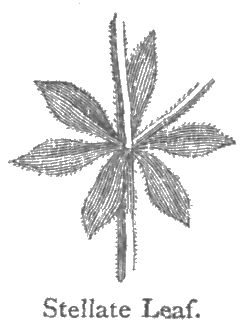
Stellar, stel′ar, Stellary, stel′ar-i, adj. relating to the stars: starry.—n. Stellā′ria, a genus of tufted plants of the pink family—the chickweeds or starworts.—adjs. Stell′āte, -d, like a star: radiated; Stelled (Milt.), starry: (Shak.) set or fixed; Stellif′erous, thickly abounding with stars; Stell′iform, star-shaped; Stell′ular, formed like little stars; Stell′ulate (bot.), like a little star. [L. stellaris—stella, a star.]
Stellion, stel′yun, n. an agamoid lizard.
Stelths, stelths, n.pl. (Spens.) thefts.
Stem, stem, n. the ascending axis of a plant, which usually bears leaves and flowers, and maintains communication between the roots and the leaves: the little branch supporting the flower or fruit: a race or family: branch of a family.—n. Stem′-leaf, a leaf growing from the stem.—adj. Stem′less (bot.), wanting a stem, or having it so little developed as to seem to be wanting.—ns. Stem′let, a little or young stem; Stem′ma, a pedigree or family tree: an ocellus.—adjs. Stem′matous; Stemmed. [A.S. stæfn, stefn, stemn, from stæf, a staff; Ger. stab.]
Stem, stem, n. the prow of a ship: a curved piece of timber at the prow to which the two sides of a ship are united.—v.t. to cut, as with the stem: to resist or make progress against: to stop, to check:—pr.p. stem′ming; pa.t. and pa.p. stemmed.—From stem to stern, from one end of a vessel to the other: completely, throughout. [Same word as above.]
Steme, stēm, v.t. an obsolete form of steam.
Stempel, stem′pel, n. a timber helping to support a platform.—Also Stem′ple.
Stemson, stem′sun, n. an arching piece of compass-timber behind the apron of a vessel, and supporting its scarfs.
Stench, stensh, n. stink: a strong bad odour or smell.—adj. Stench′y. [A.S. stenc; Ger. stank.]
Stencil, sten′sil, n. a plate of metal, &c., with a pattern cut out, which is impressed upon a surface by drawing a brush with colour over it.—v.t. to print or paint by means of a stencil:—pr.p. sten′cilling; pa.t. and pa.p. sten′cilled.—ns. Sten′ciller, one who does stencil-work; Sten′cilling, a method of printing letters or designs, the pattern cut out on a thin plate, and brushed over so as to mark the surface below. [O. Fr. estinceller, estincelle—L. scintilla, a spark.]
Stend, stend, v.i. (prov.) to rear, leap, walk with long strides.—n. a leap.
Stenochrome, sten′ō-krōm, n. a print from a series of pigment-blocks arranged.—n. Sten′ochromy, the art of printing in several colours at one impression. [Gr. stenos, narrow, chrōma, colour.]
Stenography, sten-og′ra-fi, n. art of writing very quickly by means of abbreviations: shorthand.—n. Sten′ograph, a character used in stenography: a stenographic machine.—v.i. to represent by means of stenography.—ns. Stenog′rapher, Stenog′raphist.—adjs. Stenograph′ic, -al. [Gr. stenos, narrow, graphein, to write.]
Stenopaic, sten-ō-pā′ik, adj. having a narrow opening. [Gr. stenos, narrow, opē, an opening.]
Stenosis, sten-ō′sis, n. constriction of the pores and vessels: constipation.—adjs. Stenosed′, contracted morbidly; Stenot′ic, abnormally contracted. [Gr., stenos, narrow.]
Stenotypy, sten′o-tīp-i, n. a system of shorthand representing by ordinary letters shortened signs of words or phrases.—n. Sten′otype, such a symbolic letter or combination of letters.—adj. Stenotyp′ic.
Stent, stent, v.t. (prov.) to stint, restrain.—n. extent, limit, amount of work required. [Stint.]
Stentor, stent′or, n. a very loud-voiced herald in the Iliad, hence any person with a remarkably loud voice: the ursine howler.—adj. Stentō′rian, very loud or powerful. [Gr.]
Step, step, n. a pace: the distance crossed by the foot in walking or running: a small space: degree: one remove in ascending or descending a stair: round of a ladder: footprint: manner of walking: proceeding: action: the support on which the lower end of a mast, or staff, or a wheel rests: (pl.) walk, direction taken in walking: a self-supporting ladder with flat steps.—v.i. to advance or retire by pacing: to walk: to walk slowly or gravely: to walk a short distance: to move mentally.—v.t. to set, as a foot: to fix, as a mast:—pr.p. step′ping; pa.t. and pa.p. stepped.—ns. Step′per, one who steps; Step′ping-stone, a stone for stepping on to raise the feet above the water or mud; Step′stone, a door-step.—Step aside, to walk to a little distance, as from company: to err; Step in, or into, to enter easily or unexpectedly; Step out, to go out a little way: to increase the length of the step and so the speed; Step short, to shorten the length of one's step. [A.S. stæpe—stapan, to go; Dut. stap, Ger. stapfe.]
Step-child, step′-chīld, n. one who stands in the relation of a child through the marriage of a parent—also Step′-bairn. So Step′-broth′er; Step′-daugh′ter; Step′-fa′ther; Step′-moth′er, or -dame; Step′-sis′ter; Step′-son.—n. Step′-coun′try, an adopted country. [A.S. steóp-, as in steóp-módor; Ger. stieb-; orig. an adj. sig. bereft.]
Stephane, stef′a-nē, n. an ancient Greek head-dress like a coronet. [Gr.,—stephein, to crown.]
Stephanite, stef′a-nīt, n. a metallic iron-black silver sulph-antimonite.—Also Brittle silver ore and Sulph-antimonite of silver.
Stephanotis, stef-a-nō′tis, n. a genus of shrubby twining plants of the milkweed family. [Gr. stephanos, a crown, ous, ōtos, the ear.]
Steppe, step, n. one of the vast uncultivated plains in the south-east of Europe and in Asia. [Russ. stepe.]
Stercoral, ster′ko-ral, adj. pertaining to excrement—also Ster′corary, Stercorā′ceous.—ns. Ster′coranist, Stercorā′rian, one who held that the sacramental bread was digested and evacuated like other food; Stercorā′rianism; Stercorā′rius, a genus of Laridæ, the dung-hunters or skuas.—v.t. Ster′corate, to manure.
Sterculia, ster-kū′li-a, n. the typical genus of Sterculiaceæ, a family of large trees and shrubs, with mucilaginous and demulcent properties—Gum-tragacanth, &c. [L. stercus, dung.]
Stere, stēr, n. a cubic unit of metric measure—a cubic mètre, equivalent to 35.3156 English cubic feet.—Decastère=10 steres; Decistère=1⁄10 stere. [Fr. stère—Gr. stereos, solid.]
Stereo, ster′ē-ō, adj. and n. a contr. of stereotype.
Stereobate, ster′ē-ō-bāt, n. the substructure on which a building is based.—adj. Stereobat′ic. [Gr. stereos, solid, batos, verbal of bainein, to go.]
Stereochromy, ster′ē-ō-krō-mi, n. a process of painting on stone or plaster-work, the colours rendered permanent by a solution of fluoric acid.—n. Stē′reochrome, a picture of this kind.—adj. Stereochrō′mic.—adv. Stereochrō′mically. [Gr. stereos, hard, chrōma, colour.]
Stereoelectric, ster′ē-ō-ē-lek′trik, adj. pertaining to electric currents produced when two solids are brought together at different temperatures.
Stereograph, stē′rē-ō-graf, n. a double photograph for viewing in a stereoscope—also Stē′rēōgram.—adjs. Sterēograph′ic, -al, pertaining to stereography: made according to stereography: delineated on a plane.—adv. Sterēograph′ically.—n. Sterēog′raphy, the art of showing solids on a plane. [Gr. stereos, hard, graphein, to write.]
Stereometer, stē-re-om′e-tėr, n. an instrument for measuring the specific gravity of bodies solid and liquid.—adjs. Sterēomet′ric, -al.—adv. Sterēomet′rically.—n. Sterēom′etry, the art of measuring the solid contents of solid bodies. [Gr. stereos, hard, metron, measure.]
Stereopticon, ster-ē-op′ti-kon, n. a double magic-lantern, by means of which the one picture appears to dissolve gradually into the other.
Stereoscope, ster′ē-ō-skōp, n. an instrument in which each of two pictures is examined by a separate lens, and the two lenses are inclined so as to shift the images towards one another, and thus to ensure or to facilitate the blending of the two images into one, standing out in relief with solidity.—adjs. Sterēoscop′ic, -al, pertaining to the stereoscope.—adv. Sterēoscop′ically.—ns. Stē′rēoscopist; Sterēos′copy. [Gr. stereos, solid, skopein, see.]
Stereotomy, ster-ē-ot′ō-mi, n. the art of cutting solids into figures by certain sections.—adjs. Sterēo tom′ic, -al. [Gr. stereos, solid, temnein, to cut.]
Stereotrope, ster′ē-ō-trōp, n. an optical contrivance by which an object is brought into relief and made to appear as if in motion. [Gr. stereos, solid, tropē, a turning.]
Stereotype, stē′rē-ō-tīp, n. a solid metallic plate for printing, cast from an impression of movable types, taken on some plastic substance: art of fabricating solid casts in type-metal from pages of movable type.—adj. pertaining to, or done with, stereotypes.—v.t. to make a stereotype of: to print with stereotypes.—p.adj. Stē′reotyped, transferred as letterpress from set-up movable type to a mould, and thence to a metal plate: fixed; unchangeable, as opinions.—ns. Stē′reotyper, Stē′reotypist, one who makes stereotype plates.—adj. Stēreotyp′ic.—ns. Sterēotypog′rapher, a stereotype printer; Stēreotypog′raphy, the art, practice, or business of printing from stereotype plates; Stē′reotypy, the art or employment of making stereotype plates. [Gr. stereos, solid, and type.]
Sterigma, stē-rig′ma, n. (bot.) a stalk or support.—adj. Sterigmat′ic. [Gr. stērigma, a prop.]
Sterile, ster′il, adj. unfruitful: barren: (bot.) producing no pistil, or no spores: destitute of ideas or sentiment.—n. Sterilisā′tion, act of sterilising.—v.t. Ster′ilise, to cause to be fruitless: to destroy bacteria or other micro-organisms in.—ns. Ster′iliser, anything which sterilises; Steril′ity, quality of being sterile: unfruitfulness, barrenness, in regard to reproduction. [O. Fr.,—L. sterilis, barren.]
Sterlet, stėr′let, n. a small sturgeon.
Sterling, stėr′ling, adj. a designation of British money—pure, genuine, of good quality—also generally, of value or excellence, authoritative. [Orig. the name of a penny; prob. from the Hanse merchants or Easterlings ('men from the east'), from North Germany, who had probably the privilege of coining money in England in the 13th century.]
Stern, stėrn, adj. severe of countenance, manner, or feeling: austere: harsh: unrelenting: steadfast.—adv. Stern′ly.—n. Stern′ness. [A.S. styrne.]
Stern, stėrn, n. the hind-part of a vessel: the rump or tail of an animal.—v.t. to back a boat, to row backward.—ns. Stern′age (Shak.), the steerage or stern of a ship; Stern′board, backward motion of a ship: loss of way in tacking; Stern′-chase, a chase in which one ship follows directly in the wake of another; Stern′-chās′er, a cannon in the stern of a ship.—adj. Sterned, having a stern of a specified kind.—ns. Stern′-fast, a rope or chain for making fast a ship's stern to a wharf, &c.; Stern′-frame, the sternpost, transoms, and fashion-pieces of a ship's stern.—adj. Stern′most, farthest astern.—ns. Stern′port, a port or opening in the stern of a ship; Stern′post, the aftermost timber of a ship which supports the rudder; Stern′sheets, the part of a boat between the stern and the rowers; Stern′son, the hinder extremity of a ship's keelson, to which the sternpost is bolted; Stern′way, the backward motion of a vessel; Stern′-wheel′er (U.S.), a small vessel with one large paddle-wheel at the stern. [Ice. stjórn, a steering.]
Sternum, stėr′num, n. the breast-bone.—adj. Ster′nal.—n. Sternal′gia, pain about the breast-bone, esp. angina pectoris.—adjs. Sternal′gic; Ster′nebral, pertaining to the Ster′nebra or serial segments of which the sternum of a vertebrate is composed.—n. Ster′nite, the ventral portion of the somite of an arthropod.—adjs. Sternit′ic; Sternocost′al, pertaining to, or connected with, the sternum and ribs: denoting those ribs and muscles attached to the sternum. [Gr. sternon, chest.]
Sternutation, stėr-nū-tā′shun, n. the act of sneezing.—adjs. Sternū′tātive, Sternū′tatory, that causes sneezing.—n. a substance that causes sneezing. [L. sternutatio—sternutāre, -ātum, inten. of sternuĕre, -utum, to sneeze.]
Stertorous, stėr′tō-rus, adj. snoring.—adv. Ster′torously.—n. Ster′torousness. [L. stertĕre, to snore.]
Sterve, stėrv, v.i. (Spens.) to starve, to die.—Also Ster′ven.
Stet, stet, v.t. to restore—generally on proof-sheets, in imperative, with a line of dots under the words to be retained. [L., 'let it stand,' 3d sing. pres. subj. of stāre, to stand.]
Stethiæum, steth-i-ē′um, n. the anterior half of a bird—opp. to Uræum.—n. Stethid′ium, in insects, the thorax. [Gr., stēthos, the breast.]
Stethometer, steth-om′e-tėr, n. an instrument for measuring the relative mobility of the different sides of the chest in respiration.—n. Steth′ograph, an instrument for marking the respiratory movements of the thorax.—adj. Stethograph′ic. [Gr. stēthos, chest, metron, measure.]
Stethoscope, steth′ō-skōp, n. an instrument for auscultation, consisting of a tubular piece of wood to be applied to the patient's body—in the binaural form with tubes of rubber, &c., to convey the sounds to the physician's ears.—adjs. Stethoscop′ic, -al, pertaining to, or performed by, the stethoscope.—adv. Stethoscop′ically.—ns. Steth′oscopist; Steth′oscopy. [Gr. stēthos, the breast, skopein, to see.]
Stevedore, stēv′e-dōr, n. one who loads and unloads vessels. [A corr. of Sp. estivador, a wool-packer—estivar, to stow—L. stipāre, to press.]
Steven, stē′vn, n. (Spens.) a cry, a loud clamour. [A.S. stefn, the voice.]
Stew, stū, v.t. to simmer or boil slowly with little moisture.—v.i. to be boiled slowly and gently: (slang) to be in a state of worry or agitation: to read hard for an examination.—n. meat stewed: mental agitation: worry: (slang) one who reads hard: a room for bathing purposes: (pl.) a brothel.—ns. Stew′-pan, -pot, a pan, pot, used for stewing. [O. Fr. estuve (étuve), a stove—Old High Ger. stupā (Ger. stube), a heated room.]
Stew, stū, n. an artificial oyster-bed: a vivarium.
Steward, stū′ard, n. one who manages the domestic concerns of a family or institution: one who superintends another's affairs, esp. an estate or farm: the manager of the provision department, &c., at sea: a manager at races, games, &c.: the treasurer of a congregation, a guild or society, &c.—ns. Stew′ardess, a female steward: a female who waits on ladies on shipboard; Stew′ardship, Stew′ardry, office of a steward: management; Stew′artry (Scot.), a stewardship, or the extent of a stewardship—still applied esp. to the county of Kirkcudbright.—Lord High Steward, one of the great officers of state, and anciently the first officer of the crown in England. [A.S. stíg-weard—stigo, a sty, weard, a ward.]
Sthenic, sthen′ik, adj. attended with increased action of the heart: strong, robust: inspiring.—n. Sthenī′a, strength. [Gr. sthenos, strength.]
Stibbler, stib′lėr, n. one who cuts the handfuls left by the reaper: a clerical locum tenens.
Stibium, stib′i-um, n. antimony.—adj. Stib′ial, like antimony.—n. Stib′ialism, poisoning by antimony.—adj. Stib′iāted, impregnated with antimony.—n. Stib′nite, native antimony trisulphide. [Gr.]
Stibogram, stib′ō-gram, n. a graphic record of footprints. [Gr. stibos, a track, gramma, a letter.]
Stich, stik, n. a verse or line of poetry, of whatever measure—used in composition: a row of trees.—ns. Stichā′rion, a Greek vestment like the Western alb; Stichē′ron, a troparion.—adj. Stich′ic, pertaining to a verse.—n. Stich′omancy, divination by the assumed meaning of a verse, text of Scripture, or literary passage taken at random.—adjs. Stichomet′ric, -al, pertaining to stichom′etry, stating the number of lines.—ns. Stichom′etry, measurement of manuscript by lines: a list stating such; Stichomyth′ia, dialogue in alternate lines; Stich′os, a line of ordinary length in measuring a manuscript: a verse or versicle in the usage of the Greek Church. [Gr. stichos, a row—steichein, to ascend.]
Stick, stik, v.t. to stab: to thrust in: to fasten by piercing: to fix in: to set with something pointed: to cause to adhere.—v.i. to hold to: to remain: to stop: to be hindered: to hesitate, to be embarrassed or puzzled: to adhere closely in affection:—pa.t. and pa.p. stuck.—ns. Stick′er, one who kills pigs, &c.: one who sticks to anything; Stick′ing, the act of stabbing; Stick′ing-place, the point at which a thing sticks or stays; Stick′ing-plas′ter, an adhesive plaster for closing wounds; Stick′-in-the-mud, an old fogy; Stick′it-min′ister (Scot.), a licentiate who never gets a pastoral charge.—Stick at, to hesitate: to persist at; Stick by, to be firm in supporting, to adhere closely to; Stick out, to be prominent, project; Stick pigs, to hunt wild hogs on horseback and transfix them with the spear; Stick to, to persevere in holding to; Stick up, to stand up: to waylay and plunder, as a mail-coach by bushrangers; Stick up for, to speak or act in defence of.—Be stuck on (U.S.), to be enamoured of; Stuck up, conceited. [A.S. stecan (assumed); Ger. stechen, Dut. steken; also A.S. stician, Ger. stecken, to set, stick fast.]
Stick, stik, n. a small shoot or branch cut off a tree: a staff or walking-stick: anything in the form of a stick, a cudgel: a piece of printers' furniture used to lock up a form in a chase, a printer's composing-stick: a stiff, stupidly obstinate person.—v.t. to furnish or set with sticks: to arrange in a composing-stick.—n. Stick′-in′sect, a walking-stick or phasmid insect. [A.S. sticca; Ice. stika.]
Stickle, stik′l, v.i. to interpose between combatants: to contend obstinately: to hesitate.—n. a sharp point, a prickle, a spine.—ns. Stick′leback, a small river-fish so called from the spines on its back; Stick′ler, a second or umpire in a duel: an obstinate contender, esp. for something trifling.—adj. Stick′ler-like (Shak.), in the manner of a stickler. [A dim. of stick (n.).]
Stickle, stik′l, adj. high, rapid.—n. a current below a waterfall. [A.S. sticol, steep.]
Sticky, stik′i, adj. that sticks or adheres: adhesive: glutinous.—n. Stick′iness. [Stick.]
Stie, stī, v.i. (Spens.) to ascend. [A.S. stígan.]
Stiff, stif, adj. not easily bent: rigid: not liquid: rather hard than soft: not easily overcome: obstinate: not natural and easy: constrained: formal: hard to overcome, difficult: firm, of prices, &c.: dead, rigid in death: (naut.) keeping upright.—n. (slang) a corpse: negotiable paper: forged paper.—v.t. Stiff′en, to make stiff.—v.i. to become stiff: to become less impressible or more obstinate.—ns. Stiff′ener, one who, or that which, stiffens; Stiff′ening, something used to make a substance more stiff.—adj. Stiff′-heart′ed (B.), obstinate, stubborn.—adv. Stiff′ly.—n. Stiff′-neck, cervical myalgia, true torticollis.—adj. Stiff′-necked, obstinate, hard to move.—ns. Stiff′-neck′edness; Stiff′ness.—Do a bit of stiff, to accept or discount a bill. [A.S. stíf, stiff; Dut. stijf, Dan. stiv.]
Stifle, stī′fl, v.t. to stop the breath of by foul air or other means: to suffocate, smother: to extinguish: to suppress the sound of: to destroy: to suppress, conceal.—v.i. to suffocate.—adj. Stī′fling, close, oppressive. [Scand., Ice. stífla, to choke up; Norw. stivla.]
Stifle, stī′fl, n. the knee-joint on a horse's hind-leg, a disease of his knee-pan. [Perh. stiff.]
Stigma, stig′ma, n. a brand: a mark of infamy: (bot.) the top of a pistil: any special mark: a place on the skin which bleeds periodically:—pl. Stig′mas or Stig′mata.—n. Stigmā′ria, the root of the fossil plant sigillaria, found in the coal-measures.—n.pl. Stig′mata, the marks of the wounds on Christ's body, or marks resembling them, claimed to have been miraculously impressed on the bodies of certain persons, as Francis of Assisi in 1224.—adjs. Stigmat′ic, -al, marked or branded with a stigma: giving infamy or reproach.—adv. Stigmat′ically.—adj. Stigmatif′erous (bot.), stigma-bearing.—n. Stigmatisā′tion, the operation or effect of producing bleeding spots upon the body, as by hypnotism.—v.t. Stig′matise, to brand with a stigma.—n. Stig′matist, one impressed with the stigmata.—adj. Stig′matose, stigmatic: stigmatised.—n. Stigmatō′sis, a form of inflammation of the skin, occurring in spots.—adj. Stigmatyp′ic, pertaining to the making of impressions by means of scorching-hot plates.—ns. Stig′matypy, a species of printing with points, that consists of their arrangement in pictures; Stig′mē (Gr. paleog.), a dot used as a punctuation mark, esp. at the top of the line, equivalent to a period. [L.,—Gr.,—stizein, to mark.]
Stilbite, stil′bīt, n. a pearly and foliated variety of zeolite. [Gr. stilbein, to shine.]
Stile, stīl, n. a step, or set of steps, for climbing over a wall or fence. [A.S. stigel, a step—stígan; cf. Ger. steigen, to mount.]
Stile, stīl, n. the pin of a dial. [Style.]
Stiletto, sti-let′ō, n. a dagger with a slender and narrow blade: a pointed instrument for making eyelet-holes:—pl. Stilett′os.—v.t. to stab with a stiletto:—pr.p. stilett′oing; pa.t. and pa.p. stilett′oed. [It., dim. of stilo, a dagger—L. stilus, a stake.]
Still, stil, adj. silent: motionless: calm, subdued: not sparkling or effervescing: constant.—v.t. to quiet: to silence: to appease: to restrain.—adv. always, constantly: nevertheless, for all that: even yet: after that.—n. calm.—n. Still′-birth, the state of being still-born: anything born without life.—adj. Still′-born, dead when born.—ns. Still′er, one who stills or quiets; Still′-life, the class of pictures representing inanimate objects; Still′ness; Still′-room, an apartment where liquors, preserves, and the like are kept, and where tea, &c., is prepared for the table: a housekeeper's pantry; Still′-stand (Shak.), absence of motion.—adj. Still′y, still: quiet: calm.—adv. silently: gently. [A.S. stille, firm; Dut. stil, Ger. still.]
Still, stil, v.t. to cause to fall by drops: to distil.—n. an apparatus for distillation, consisting essentially of a vessel in which the liquid to be distilled is placed, the vapour being conducted by means of a head or neck to the condenser or worm, where it is cooled by water or other means, and again forms liquid.—adj. Still′iform, drop-shaped. [L. stillāre, to cause to drop—stilla, a drop, or simply a contr. for distil, like sport from disport.]
Stillage, stil′āj, n. a frame on which things are laid.—n. Still′ing, a stand.
Stillicide, stil′i-sīd, n. an urban servitude among the Romans, where a proprietor was not allowed to build to the extremity of his estate, but must leave a space regulated by the charter by which the property was held, so as not to throw the eavesdrop on the land of his neighbour—same as Eavesdrip.—n. Stillicid′ium, a morbid trickling. [L.]
Stilp, stilp, v.i. (Scot.) to go on crutches.—n.pl. Stilp′ers, crutches.
Stilt, stilt, n. one of a pair of props or poles with steps or supports at a sufficient distance from the lower end to allow a man standing on the steps to walk clear of the ground and with longer strides: a widely distributed genus (Himantopus) of wading-birds belonging to the Snipe family, having long slender bills and very long wings and legs—also Stilt′-bird, -plov′er.—v.t. to raise on stilts: to elevate by unnatural means.—adjs. Stilt′ed, Stilt′y, elevated as if on stilts: pompous.—n. Stilt′edness.—Stilted arch, an arch that does not spring directly from the impost, but from horizontal courses of masonry resting on it. [Scand., Sw. stylta; Dut. stelt, a stilt.]
Stilton, stil′ton, n. a rich white cheese—from Stilton in Huntingdonshire.
Stime, stīm, n. (Scot.) a ray of light, a glimmer.—Also Styme. [A.S. scima, a light.]
Stimulant, stim′ū-lant, adj. stimulating: increasing or exciting vital action.—n. anything that stimulates or excites: a stimulating medicine that increases the activity of the vital functions generally, or of one system or organ.—v.t. Stim′ulāte, to prick with anything sharp: to incite: to instigate: (physiol.) to produce increased action in.—n. Stimulā′tion, act of stimulating, or condition of being stimulated.—adj. Stim′ulātive, tending to stimulate.—n. that which stimulates or excites.—ns. Stim′ulātor, one who stimulates:—fem. Stim′ulātress; Stim′ulism, the practice of treating diseases by stimulation; Stim′ūlus, a goad: anything that rouses the mind, or that excites to action: a stimulant:—pl. Stim′ulī. [L. stimulus (for stigmulus)—Gr. stizein, to prick.]
Sting, sting, v.t. to stick anything sharp into, to pain acutely.—v.i. to have a sting: to give pain:—pa.t. and pa.p. stung.—n. the sharp-pointed weapon of some animals: the thrust of a sting into the flesh: anything that causes acute pain: any stimulus or impulse: the point in the last verse of an epigram.—n. Sting′er, one who, or that which, stings.—adv. Sting′ingly, with stinging.—adj. Sting′less, having no sting.—n. Sting′-ray, a genus of cartilaginous fishes, of the order of Rays, and family Trygonidæ, the long tail bearing dorsally a long bi-serrated spine capable of giving an ugly wound. [A.S. stingan; Ice. stinga.]
Stingo, sting′gō, n. strong malt liquor.
Stingy, stin′ji, adj. niggardly: avaricious.—adv. Stin′gily.—n. Stin′giness, [Merely sting-y.]
Stink, stingk, v.i. to give out a strong, offensive smell: to have a bad reputation:—pa.t. stank; pa.p. stunk.—n. a disagreeable smell.—ns. Stink′ard, one who stinks: a base fellow: the stinking badger of Java; Stink′-ball, -pot, a ball or jar filled with a stinking, combustible mixture, used in boarding an enemy's vessel; Stink′er, one who, or that which, stinks; Stink′ing.—adv. Stink′ingly, in a stinking manner: with an offensive smell.—ns. Stink′stone, a variety of limestone remarkable for the fetid urinous odour which it emits when rubbed; Stink′-trap, a contrivance to prevent effluvia from drains; Stink′-wood, the wood of a Cape tree, remarkable for its strong offensive smell, durable, taking an excellent polish resembling walnut. [A.S. stincan.]
Stint, stint, v.t. to shorten: to limit: to restrain.—v.i. to cease, stop: to be saving.—n. limit: restraint, restriction: proportion allotted, fixed amount: one of several species of sandpiper, the dunlin.—adj. Stint′ed, limited.—ns. Stint′edness; Stint′er.—adv. Stint′ingly.—adjs. Stint′less; Stint′y. [A.S. styntan—stunt, stupid.]
Stipa, stī′pa, n. a genus of grasses, the feather-grasses. [L. stipa, tow.]
Stipe, stīp, n. (bot.) the base of a frond of a fern: also a stalk, as of a pistil, of a fungus or mushroom, of the leaf of a fern, or even the trunk of a tree.—n. Stī′pel, the stipule of a leaflet.—adj. Stī′pellate, having stipels.—n. Stī′pes, a stipe: a stalk or stem.—adjs. Stī′piform, Stip′itate, Stipit′iform. [Fr.,—L. stipes, a stem.]
Stipend, stī′pend, n. a salary paid for services, esp. to a clergyman in Scotland: settled pay.—adj. Stipend′iary, receiving stipend.—n. one who performs services for a salary, esp. a paid magistrate.—v.t. Stipen′diate, to provide with a salary. [L. stipendium—stips, donation, pendĕre, weigh.]
Stipple, stip′l, v.t. to engrave or form by means of dots or small points, as distinguished from line-engraving:—pr.p. stipp′ling; pa.p. stipp′led.—n. a mode of execution in engraving and miniature-painting, in which the effect is produced by dots instead of lines: in colour-decoration, a gradation or combination of tones or tints serving as a transition between decided colours.—adj. Stipp′led.—ns. Stipp′ler, one who stipples: a coarse brush for stippling; Stipp′ling, stippled work of any kind. [Dut. stippelen, dim. of stippen, to dot.]
Stipulate, stip′ū-lāt, v.i. to contract: to settle terms.—ns. Stipulā′tion, act of stipulating: a contract; Stip′ulātor. [L. stipulāri, -ātus, prob. from old L. stipulus, firm, conn. with stipāre, to press firm.]
Stipule, stip′ūl, n. (bot.) an appendage or lobe at the base of certain leaves, resembling a small leaf: also, a small appendage at the base of petioles, usually softer than the latter—also Stip′ūla.—adjs. Stip′ular, Stip′ūlary; Stip′ūlate, Stip′ūled. [L. stipula, a stalk, dim. of stipes.]
Stir, stėr, v.t. to move: to rouse: to instigate.—v.i. to move one's self: to be active: to draw notice:—pr.p. stir′ring; pa.p. and pa.t. stirred.—n. tumult: bustle.—n. Stir′about, one who makes himself active: oatmeal porridge.—adj. busy, active.—adj. Stir′less, without stir.—n. Stir′rer.—p.adj. Stir′ring, putting in motion: active: accustomed to a busy life: animating, rousing.—Stir up, to instigate the passions of: to put into motion or action: to enliven: to disturb. [A.S. styrian; Dut. storen, Ger. stören, to drive.]
Stir, stėr, v.t. (Spens.) to steer, to direct.
Stirk, stėrk, n. (Scot.) a yearling ox or cow. [A.S. stirc, a heifer—steór, a steer.]
Stirp, stėrp, n. (Bacon) a family, generation, or race:—pl. Stir′pes. [L. stirps, stirpis.]
Stirrup, stir′up, n. a ring or hoop suspended by a rope or strap from the saddle, for a horseman's foot while mounting or riding: a rope secured to a yard, having a thimble in its lower end for reeving a foot-rope.—ns. Stirr′up-cup, a cup taken by one who is departing on horseback; Stirr′up-ī′ron, the ring of iron attached to the stirrup-leather to receive the foot; Stirr′up-leath′er, -strap, the strap of leather that supports a stirrup. [A.S. stigeráp—stígan, to mount, ráp, a rope.]
Stitch, stich, n. a pass of a needle and thread, the part of the thread left in the fabric, a single loop or link: the kind of work produced by stitching—buttonhole-stitch, cross-stitch, &c.: the space between two double furrows: a fastening, as of thread or wire, through the back of a book to connect the leaves: an acute pain, a sharp spasmodic pain, esp. in the intercostal muscles: a bit of clothing, a rag.—v.t. to sew so as to show a regular line of stitches: to sew or unite.—v.i. to practise stitching.—ns. Stitch′er; Stitch′ery (Shak.), needle-work; Stitch′ing, the act of one who stitches: needle-work done in such a way that a continuous line of stitches appears on the surface; Stitch′wort, a genus of slender plants, including the chickweed, so called because once believed to cure 'stitch' in the side. [A.S. stice, a prick; Ger. sticken, to embroider; conn. with stick.]
Stithy, stith′i, n. an anvil: a smith's shop.—v.t. to forge on an anvil. [Ice. stethi; Sw. städ, an anvil.]
Stive, stīv, v.i. (prov.) to stew, to be stifled.—adj. Stī′vy, close, stuffy.
Stiver, stī′vėr, n. a Dutch coin, worth one penny sterling: any small coin. [Dut. stuiver.]
Stoa, stō′a, n. a portico or covered colonnade round a house, market-place, &c.
Stoat, stōt, n. a kind of weasel, called the ermine when in its winter dress.—Also Stote. [Stot.]
Stob, stob, n. a small post for supporting paling: a wedge in coal-mining. [A variant of stub.]
Stoccade, stok-ād′, Stoccado, stok-ā′do, n. a thrust in fencing—(Shak.) Stocca′ta. [It. stoccata, a thrust—stocco, a rapier—Ger. stock, a stick.]
Stock, stok, n. something stuck or thrust in: the stem of a tree or plant: the trunk which receives a graft: a post, a log: anything fixed solid and senseless: a stupid person: the crank-shaped handle of a centre-bit: the wood in which the barrel of a firearm is fixed: the cross-piece of timber into which the shank of an anchor is inserted: the part to which others are attached: the original progenitor: family: a fund, capital, shares of a public debt: store: the cattle, horses, and other useful animals kept on a farm: the liquor or broth obtained by boiling meat, the foundation for soup: a stiff band worn as a cravat, often fastened with a buckle at the back: (pl.) an instrument in which the legs of offenders were confined: the frame for a ship while building: the public funds.—v.t. to store: to supply: to fill: to supply with domestic animals or stock: to refrain from milking cows for 24 hours or more previous to sale.—adj. kept in stock, standing.—ns. Stock′breed′er, one who raises live-stock; Stock′broker, a broker who deals in stocks or shares; Stock′broking, the business of a stockbroker; Stock′-dove, the wild pigeon of Europe; Stock′-ep′ithet, any ordinary and conventional epithet; Stock′-exchange′, the place where stocks are bought and sold: an association of sharebrokers and dealers; Stock′-farm′er, a farmer who rears live-stock, as cattle, &c.; Stock′-feed′er, one who feeds or fattens live-stock; Stock′holder, one who holds stocks in the public funds, or in a company; Stock′-in-trade, the whole goods a shopkeeper keeps on sale: a person's mental resources; Stock′-job′ber; Stock′-job′bery, -job′bing, speculating in stocks; Stock′-list, a list of stocks and current prices regularly issued; Stock′man, a herdsman who has the charge of stock on a sheep-run in Australia; Stock′-mar′ket, a market for the sale of stocks, the stock-exchange; Stock′-pot, the pot in which the stock for soup is kept; Stock′-rid′er, a herdsman on an Australian station; Stock′-sadd′le, a saddle with heavy tree and iron horn; Stock′-stā′tion, a station where stock and cattle are reared; Stock′-whip, a whip with short handle and long lash for use in herding; Stock′work, a deposit in which the ore is distributed all over it; Stock′yard, a large yard with pens, stables, &c. where cattle are kept for slaughter, market, &c.—Take stock, to make an inventory of goods on hand: to make an estimate of; Take stock in, to take a share in, to put confidence in. [A.S. stocc, a stick; Ger. stock.]
Stock, stok, n. a favourite garden-flower. [Orig. called stock-gillyflower, to distinguish it from the stemless clove-pink, called the gillyflower.]
Stockade, stok-ād′, n. a breastwork formed of stakes fixed in the ground.—v.t. to fortify with such. [Fr. estocade—estoc—Ger. stock, stick.]
Stockfish, stok′fish, n, a commercial name of salted and dried cod and other fish of the same family, esp. ling, hake, and torsk.
Stock-gillyflower, stok′-jil′i-flow-ėr, n. a genus of herbaceous or half-shrubby plants of the natural order Cruciferæ, having their flowers in racemes, and generally beautiful and fragrant. [Stock, wood, and gillyflower.]
Stocking, stok′ing, n. a close covering for the foot and lower leg.—ns. Stockinet′, an elastic knitted fabric for under-garments; Stock′inger, one who knits stockings; Stock′ing-frame, a knitting-machine. [From stock, the stockings being the nether-stocks when the long hose came to be cut at the knee.]
Stockish, stok′ish, adj. (Shak.) like a stock, stupid.—n. Stock′ishness, stupidity.—adj. Stock′-still, still as a stock or post.
Stock-tackle, stok′-tak′l, n. tackle used in hoisting an anchor on board ship to keep its stock clear of the ship's side.
Stock-taking, stok′-tāk′ing, n. a periodical inventory made of the stock or goods in a shop or warehouse.
Stocky, stok′i, adj. short and stout, thick-set: having a strong stem.—adv. Stock′ily.
Stodgy, stoj′i, adj. heavy, lumpy: ill put together: indigestible.—v.t. Stodge, to stuff, cram.—n. Stodg′iness.
Stog, stog, v.t. (prov.) to plunge in mire: to probe a pool with a pole. [Related to stock.]
Stoic, stō′ik, n. a disciple of the philosopher Zeno (340-260 B.C.), who opened his school in a colonnade called the Stoa Poikilē ('painted porch') at Athens—later Roman Stoics were Cato the Younger, Seneca, Marcus Aurelius: one indifferent to pleasure or pain.—adjs. Stō′ic, -al, pertaining to the Stoics, or to their opinions; indifferent to pleasure or pain.—adv. Stō′ically.—ns. Stō′icalness; Stō′icism, the doctrines of the Stoics, a school of ancient philosophy strongly opposed to Epicureanism in its views of life and duty: indifference to pleasure or pain. [L. Stoicus—Gr. Stōïkos—stoa, a porch.]
Stoke, stōk, v.i. to stir or tend a fire.—ns. Stoke′-hole, the space about the mouth of a furnace: the space allotted to the stokers: a hole in a reverberatory furnace for introducing a stirring-tool; Stōk′er, one who, or that which, feeds a furnace with fuel. [Dut.,—stoken, to light a fire, stok, a stick.]
Stole, stōl, pa.t. of steal.
Stole, stōl, n. a long robe reaching to the feet: a narrow vestment, usually black silk, fringed at the ends, sometimes coloured according to the seasons, worn by bishops and priests in the Latin Church during mass.—n. Stō′la, the outer garment of the Roman matron: a chorister's surplice: (her.) a bearing showing a fringed scarf. [L. stola—Gr. stolē, a robe—stellein, to array.]
Stolen, stōl′en, pa.p. of steal.
Stolid, stol′id, adj. dull: heavy: stupid: foolish.—n. Stolid′ity, Stol′idness, state of being stolid: dullness of intellect.—adv. Stol′idly. [L. stolidus.]
Stolon, stō′lon, n. a shoot from the root of a plant: a sucker.—adjs. Stō′lonate, Stōlōnif′erous. [L. stolo, a twig.]
Stoma, stō′ma, n. (bot.) one of the minute openings in the epidermis of leaves and tender green stems of plants, subserving the purpose of respiration: (zool.) one of the breathing-holes in the bodies of certain of the articulata:—pl. Stō′mata.—adjs. Stomat′ic; Stomatif′erous.—n. Stomatī′tis, inflammation of the interior of the mouth.—adj. Stō′matode, having a stoma.—ns. Stomatol′ogy, the scientific knowledge of the mouth; Stō′matoscope, an instrument for examining the interior of the mouth. [Gr. stoma, a mouth.]
Stomach, stum′ak, n. the strong muscular bag into which the food passes when swallowed, and where it is principally digested: the cavity in any animal for the digestion of its food: appetite, relish for food, inclination generally: disposition, spirit, courage, pride, spleen.—v.t. to brook or put up with: to turn the stomach of: to resent.—adj. Stom′achal.—ns. Stom′acher, a part of the dress covering the front of the body, generally forming the lower part of the bodice in front, sometimes richly ornamented: a large brooch; Stomach′ic, a medicine for the stomach.—adjs. Stomach′ic, -al, pertaining to the stomach: strengthening or promoting the action of the stomach; Stom′achous (Spens.), angry, stout, obstinate.—ns. Stom′ach-pump, a syringe with a flexible tube for withdrawing fluids from the stomach, or injecting them into it; Stom′ach-stag′gers, a disease in horses due to a paralytic affection of the stomach. [O. Fr. estomac—L. stomachus—Gr. stomachos, the throat, stomach—stoma, a mouth.]
Stomatopod, stō′ma-to-pod, n. one of the Stomatop′oda, an order of marine crustaceans, having most of their seven or eight pair of legs near the mouth. [Gr. stoma, mouth, pous, podos, foot.]
Stond, stond, n. (Spens.) station: also=stound.
Stone, stōn, n. a hard mass of earthy or mineral matter, the hard material of which rock consists: a piece of rock of a certain size or form, or for a particular purpose, as grindstone, millstone, &c.: a precious stone or gem, a crystal mirror: a tombstone: a concretion formed in the bladder: a hard shell containing the seed of some fruits: a standard weight of 14 lb. avoirdupois (other stones occur, as that of 24 lb. for wool, 22 lb. for hay, 16 lb. for cheese, &c.): torpor and insensibility.—adj. made of stone, or of stoneware.—v.t. to pelt with stones: to free from stones: to wall with stones.—n. Stone′-age, the condition of a people using stone as the material for the cutting-tools and weapons which, in a higher condition of culture, were made of metals.—adj. Stone′-blind, as blind as a stone, perfectly blind.—ns. Stone′-boil′ing, a primitive method of making water boil by putting hot stones in it; Stone′-bow, a crossbow for shooting stones: a children's catapult; Stone′-brash, a soil made up of finely-broken rock; Stone′-break, the meadow-saxifrage; Stone′-break′er, one who, or that which, breaks stones, a stone-crushing machine; Stone′-bruise, a bruise caused by a stone, esp. on the sole of the foot from walking barefooted; Stone′-cast, Stone's′-cast, Stone′-shot, Stone's′-throw, the distance which a stone may be thrown by the hand; Stone′chat, Stone′chatter, Stone′clink, one of the most common of the British Turdidæ, smaller than the redbreast—the Wheat-ear is the true stonechat.—n.pl. Stone′-cir′cles, or Circles of Standing Stones, popularly but erroneously called Druidical Circles in Britain, and Cromlechs in France, consist of unhewn stones set up at intervals round the circumference of a circular area usually of level ground.—n. Stone′-coal, mineral coal, as opposed to charcoal: any hard coal, anthracite.—adj. Stone′-cold, cold as a stone.—n. Stone′-col′our, the colour of stone, grayish.—adj. Stone′-col′oured.—ns. Stone′-cor′al, massive coral, as distinguished from branching or tree coral; Stone′crop, the wall-pepper, Sedum acre; Stone′-curlew, a large species of plover; Stone′-cut′ter, one whose occupation is to hew stone; Stone′-cut′ting, the business of hewing and carving stones for walls, monuments, &c.—adjs. Stoned, containing stones; Stone′-dead, lifeless; Stone′-deaf, quite deaf.—ns. Stone′-dress′er, one who prepares stones for building; Stone′-fal′con, a species of hawk or falcon which builds its nest among the rocks; Stone′-fly, a genus of insects typical of the order Plecoptera—several species are native to Britain, and furnish good lures to anglers; Stone′-fruit, a fruit whose seeds are enclosed in a hard kernel; Stone′-ham′mer, a hammer for breaking stones.—adjs. Stone′-hard (Shak.), as hard as a stone; Stone′-heart′ed (Shak.), hard-hearted, cruel, pitiless.—ns. Stone′horse, a stallion; Stone′-lil′y, the popular name of an Encrinite; Stone′-mā′son, a mason who works with stone; Stone′-mill, a machine for breaking stone; Stone′-oil, rock-oil, petroleum; Stone′-pine, a Mediterranean nut-pine; Stone′-plov′er, the stone-curlew; Stō′ner, one who strikes or kills with stones; Stone′-rag, -raw, a lichen, Parmelia saxatilis; Stone′-snipe, the greater tell-tale or long-legged tattler, a common North American bird.—adj. Stone′-still (Shak.), as still as a stone, motionless.—ns. Stone′ware, a coarse kind of potter's ware baked hard and glazed; Stone′-work, mason-work.—adv. Stō′nily.—n. Stō′niness, the state of being stony or abounding with stones: hardness of heart or mind.—adjs. Stō′ny, made of, or resembling, stone: abounding with stones: hard: pitiless: obdurate: (B.) rocky; Stō′ny-heart′ed, hard-hearted, cruel, pitiless.—Leave no stone unturned, to do everything that can be done in order to secure the effect desired; Mark with a white stone, to mark as particularly fortunate. [A.S. stán; Ger. stein, Dut. steen.]
Stonied, ston′id, adj. (Spens.) astonished, alarmed.
Stood, stood, pa.t. and pa.p. of stand.
Stook, stook, n. (Scot.) a full shock of corn-sheaves, generally twelve, as set up in the field.—v.t. to set up in stooks, as sheaves—also Stouk.—n. Stook′er, one who sets up the corn in stooks. [Cf. Low Ger. stuke, a bundle.]
Stool, stōōl, n. a seat without a back: a low bench for the feet or for kneeling on: the seat used in evacuating the bowels: the act of evacuating the bowels, also that which is evacuated: a root of any kind from which sprouts shoot up: a portable piece of wood to which a pigeon is fastened as a decoy for wild birds.—n. Stool′-pi′geon, a decoy-pigeon: a gambler's decoy.—Stool of repentance, same as Cutty-stool (q.v.).—Fall between two stools, to lose both of two things between the choice of which one was hesitating. [A.S. stól, Ger. stuhl; cf. Ger. stellen, to place.]
Stoop, stōōp, v.i. to bend the body: to lean forward: to submit: to descend from rank or dignity: to condescend: to swoop down on the wing, as a bird of prey.—v.t. to cause to incline downward.—n. the act of stooping: inclination forward: descent: condescension: a swoop.—adj. Stooped, having a stoop, bent.—n. Stoop′er, one who stoops.—p.adj. Stoop′ing.—adv. Stoop′ingly. [A.S. stúpian; Old Dut. stuypen, Ice. stúpa.]
Stoop, stōōp, n. (Shak.) a vessel of liquor, a flagon: liquor for drinking: a basin for holy water. [A.S. stoppa, a cup—steáp, a cup; Low Ger. stoop.]
Stoop, stōōp, n. an open platform before the entrance of a house. [Dut. stoep.]
Stoop, stōōp, n. a prop, support, a patron.
Stoor, stōōr, adj. (obs.) great, formidable: stiff, harsh, austere.—Also Stour. [A.S. stór, great.]
Stoor, stōōr, n. dust in motion—hence commotion, bustle: a gush of water.—v.t. to stir up, to pour out.—adj. Stoor′y, dusty. [A.S. stýrian, to stir.]
Stop, stop, v.t. to stuff or close up: to obstruct: to render impassable: to hinder from further motion, progress, effect, or change: to restrain, repress, suppress, suspend: to intercept: to apply musical stops to: to regulate the sounds of a stringed instrument by shortening the strings with the fingers: (naut.) to make fast.—v.i. to cease going forward: to cease from any motion or action, to stay, tarry: to leave off: to be at an end: to ward off a blow:—pr.p. stop′ping; pa.t. and pa.p. stopped.—n. act of stopping: state of being stopped: hinderance: obstacle: interruption: (mus.) one of the vent-holes in a wind instrument, or the place on the wire of a stringed instrument, by the stopping or pressing of which certain notes are produced: a mark used in punctuation: an alphabetic sound involving a complete closure of the mouth-organs: a wooden batten on a door or window-frame against which it closes: a stop-thrust in fencing.—ns. Stop′-cock, a short pipe in a cask, &c., opened and stopped by turning a cock or key; Stop′-gap, that which fills a gap or supplies a deficiency, esp. an expedient of emergency; Stop′-mō′tion, a mechanical arrangement for producing an automatic stop in machinery, as for shutting off steam, &c.; Stop′page, act of stopping: state of being stopped: an obstruction; Stop′per, one who stops: that which closes a vent or hole, as the cork or glass mouthpiece for a bottle: (naut.) a short rope for making something fast.—v.t. to close or secure with a stopper.—ns. Stop′ping, that which fills up, material for filling up cracks, &c., filling material for teeth: Stop′ping-out, the practice in etching of covering certain parts with a composition impervious to acid, to keep the acid off them while allowing it to remain on the other parts to mark them more; Stop′-watch, a watch whose hands can be stopped to allow of time that has elapsed being calculated more exactly, used in timing a race, &c. [M. E. stoppen—O. Fr. estouper (Ice. stoppa, Ger. stopfen, to stuff); all from L. stupa, the coarse part of flax, tow.]
Stope, stōp, v.t. to excavate, to remove the contents of a vein.—n. an excavation for this purpose.—n. Stō′ping.
Stopple, stop′l, n. that which stops or closes the mouth of a vessel: a cork or plug.—v.t. to close with a stopple.
Storax, stō′raks, n. a resin resembling benzoin, obtained from the stem of Styrax officinalis, a native of Greece and the Levant, formerly used as a stimulating expectorant.—Liquid storax, liquidambar. [L.,—Gr. styrax.]
Store, stōr, n. a hoard or quantity gathered: abundance: a storehouse: any place where goods are sold: (pl.) supplies of provisions, ammunition, &c. for an army or a ship.—v.t. to gather in quantities: to supply: to lay up in store: to hoard: to place in a warehouse.—adj. Stō′rable, capable of being stored.—ns. Stō′rage, the placing in a store: the safe-keeping of goods in a store: the price paid or charged for keeping goods in a store; Store′-farm (Scot.), a stock-farm, a cattle-farm; Store′-farm′er; Store′house, a house for storing goods of any kind: a repository: a treasury; Store′-keep′er, a man who has charge of a store: one who owns a store: (U.S.) any unsaleable article; Stō′rer, one who stores; Store′room, a room in which things are stored: a room in a store; Store′-ship, a vessel used for transporting naval stores.—In store (Shak.), in hoard for future use, ready for supply; Set store by, to value greatly. [O. Fr. estor, estoire—L. instaurāre, to provide.]
Storey, stō′ri, n. Same as Story.
Storge, stor′jē, n. natural affection. [Gr.]
Storiated, Storied. See under Story.
Stork, stork, n. a long-necked and long-legged wading-bird nearly allied to the heron, spoonbill, and ibis—the Common stork or White stork (Ciconia alba) about 3½ feet long, migratory in habit, common in Holland and northern Germany, often semi-domesticated, nesting on the tops of houses, &c.—n. Stork's′-bill, any plant of the genus Erodium, esp. the heron's-bill: a plant of the genus Pelargonium. [A.S. storc; Ger. stork.]
Storm, storm, n. a violent commotion of the atmosphere producing wind, rain, &c.: a tempest: a fall of snow, a prolonged frost: an outbreak of anger, or the like: violent agitation of society: commotion: tumult: calamity: (mil.) an assault.—v.i. to raise a tempest: to blow with violence: to be in a violent passion.—v.t. to attack by open force: to assault.—n. Storm′-ā′rea, the area covered by a storm.—adjs. Storm′-beat, -beat′en, beaten or injured by storms.—ns. Storm′-belt, a belt of maximum storm frequency; Storm′-bird, a petrel.—adj. Storm′bound, delayed by storms.—ns. Storm′-card, a sailors' chart showing from the direction of the wind the ship's position in relation to a storm-centre, and accordingly the proper course to be shaped; Storm′-cen′tre, the position of lowest pressure in a cyclonic storm; Storm′-cock, the fieldfare: the mistle-thrush; Storm′-cone, a cone of canvas stretched on a frame 3 feet high as a storm-signal; Storm′-door, an outer supplementary door to shelter the interior of a building; Storm′-drum, a canvas cylinder extended on a hoop 3 feet high by 3 feet wide, hoisted in conjunction with the cone as a storm-signal.—adj. Storm′ful, abounding with storms.—ns. Storm′fulness; Storm′-glass, a tube containing a solution of camphor, the amount of the precipitate varying with the weather; Storm′-house, a temporary shelter for men working on a railway, &c.; Storm′iness; Storm′ing-par′ty, the party of men who first enter the breach or scale the walls in storming a fortress.—adj. Storm′less, without storms.—ns. Storm′-sail, a sail of the strongest canvas, for stormy weather; Storm′-sig′nal, a signal displayed on seacoasts, &c., to intimate the approach of a storm by the cone and drum, or by flags and lanterns in the United States; Storm′-stay, a stay on which a storm-sail is set.—adjs. Storm′-stayed, hindered from proceeding by storms; Storm′-tossed, tossed about by storms: much agitated by conflicting passions.—ns. Storm′-wind, a wind that brings a storm, a hurricane; Storm′-win′dow, a window raised above the roof, slated above and at the sides.—adj. Storm′y, having many storms: agitated with furious winds: boisterous: violent: passionate. [A.S. storm; Ice. stormr; from root of stir.]
Stornello, stor-nel′ō, n. an Italian kind of improvised folk-song:—pl. Stornell′i. [It.]
Storthing, stōr′ting, n. the legislative assembly of Norway. [Norw. stor, great, thing, assembly.]
Story, stō′ri, n. history or narrative of incidents in their sequence: an account, report, statement: an anecdote: the plot of a novel or drama: a lie, a fib, a fictitious narrative.—v.t. to tell or describe historically, to relate: to adorn with sculptured or painted scenes from history.—v.i. to relate.—adjs. Storiā′ted, decorated with elaborate ornamental designs; Stō′ried, told or celebrated in a story: having a history: interesting from the stories belonging to it: adorned with scenes from history.—ns. Storiol′ogist, one learned in the comparative study of folk-tales; Storiol′ogy, the scientific study of folk-tales; Stō′ry-book, a book of stories or tales true or fictitious; Stō′ry-tell′er, one who relates tales, a liar; Stō′ry-tell′ing, act of relating stories: lying. [A short form of history.]
Story, Storey, stō′ri, n. a division of a house reached by one flight of stairs: a set of rooms on the same floor.—The upper story, the brain. [O. Fr. estoree—estorer—L. instaurāre, to build.]
Stosh, stosh, n. fish-offal, pomace.
Stot, stot, n. a young ox, a steer. [Ice. stútr, a bull.]
Stot, stot, v.i. (prov.) to stumble.—Also Stot′ter.
Stound, stownd, n. (Spens.) a stunning influence, a blow, amazement: a shooting pain: a noise: sorrow, grief, mishap: effort.—v.t. to stun, astound. [A contr. of astound.]
Stound, stownd, n. (Spens.) a moment of time: time, season, hour. [A.S. stund.]
Stound, stownd (Spens.). Same as Stunned.
Stoup, stowp, n. (Spens.). Same as Stoop (2).
Stour, stowr, n. a tumult, battle, assault: a paroxysm. [O. Fr. estour, tumult.]
Stout, stowt, adj. strong: robust: corpulent: resolute: proud: (B.) stubborn.—n. extra strong porter.—adj. Stout′-heart′ed, having a brave heart.—adv. Stout′-heart′edly.—n. Stout′-heart′edness.—adv. Stout′ly.—n. Stout′ness (B.), stubbornness. [O. Fr. estout, bold—Old Dut. stolt, stout; Ger. stolz, bold.]
Stouthrief, stowth′rēf, n. (Scots law) theft attended with violence—also Stouth′rie.—n. Stouth′-and-routh (Scot.), plenty, abundance.
Stove, stōv, n. an apparatus with a fire for warming a room, cooking, &c.: a pottery-kiln: an oven for heating the blast of a blast-furnace: a drying-room.—v.t. to heat or keep warm.—ns. Stove′-pipe, a metal pipe for carrying smoke from a stove to a chimney-flue; Stove′pipe-hat, a high silk hat; Stove′-plant, a plant cultivated in a stove; Stove′-plate, a lid or plate covering one of the holes in a cooking-stove. [A.S. stofa; Ger. stube.]
Stove, stōv, pa.t. and pa.p. of stave.
Stover, stōv′ėr, n. (Shak.) fodder for cattle. [O. Fr. estover, necessity—estover, estoveir, to fit.]
Stow, stō, v.t. to place: to arrange: to fill by packing things in: (slang) to put away out of sight: to be silent about.—ns. Stow′age, act of placing in order: state of being laid up: room for articles to be laid away: money paid for stowing goods; Stow′away, one who hides himself in an outward-bound vessel in order to get a passage for nothing; Stow′down, the process of stowing down in a ship's hold; Stow′er, one who stows; Stow′ing, in mining, rubbish thrown into the cavities out of which the ore, coal, &c. have been taken. [M. E. stowen, to place—A.S. stów, a place; cf. Dut. stuwen, to stow, to push, Ger. stauen, to pack.]
Stow, stow, v.t. (Scot.) to cut off, crop.
Stowlins, stō′linz, adv. (Scot.) stealthily.
Stown, stown, a Scotch form of stolen.
Strabismus, strā-bis′mus, n. squint.—adjs. Strabis′mal, Strabis′mic, -al.—ns. Strabismom′eter, Strabom′eter, an instrument for measuring strabismus; Strabot′omy, the surgical operation for the cure of squinting, by the division of the muscle or muscles that distort the eyeball. [Gr.,—strabos, squinting—strephein, to twist.]
Straddle, strad′l, v.i. to stride or part the legs wide: to stand or walk with the legs far apart: to seem favourable to both sides in any question that divides opinion into parties, to trim with regard to any controversy.—v.t. to stand or sit astride of.—n. act of straddling: an attempt to fill a non-committal position: a stock-transaction in which the buyer obtains the privilege of either a put or a call: a vertical mine-timber supporting a set.—adv. astride.—adj. Stradd′le-legged, having the legs wide apart. [A freq. from A.S. strǽd, pa.t. of strídan, stride.]
Stradivarius, strad-i-vā′ri-us, n. a violin, esp. one made by the famous Antonio Stradivari (1649-1737) of Cremona.
Strae, strā, n. (Scot.) straw.—Strae death, death in one's bed from natural causes, as opposed to death by accident, by violence, by the rope, &c.
Straggle, strag′l, v.i. to wander from the course: to ramble: to stretch beyond proper limits: to be dispersed.—ns. Stragg′ler, one who straggles from the course: a wandering fellow: a vagabond: a migratory animal found away from its usual range; Stragg′le-tooth, a misshapen or misplaced tooth.—adv. Stragg′lingly, in a straggling manner.—n. Straggl′ing-mon′ey, money paid for apprehending deserters and men absent without leave: money deducted from the wages of such absentees.—adj. Stragg′ly, straggling, spread out. [For strackle, freq. of M. E. straken—A.S. strícan, to go.]
Stragulum, strag′ū-lum, n. the mantle or pallium in ornithology. [L., a cover.]
Straight, strāt, adj. direct: being in a right line: not crooked: nearest: upright: free from disorder: honourable, fair: unqualified, out-and-out: consisting of a sequence at poker: (slang) undiluted, neat, as a dram of whisky, &c., direct, authoritative, reliable.—adv. immediately: in the shortest time.—v.t. to straighten.—n. Straight′-arch, an arch in the form of two sides of an isosceles triangle.—adjs. Straight′away, straight forward; Straight′-cut, cut lengthwise of the leaf, of tobacco.—n. Straight′-edge, a narrow board or piece of metal having one edge perfectly straight for applying to a surface to ascertain whether it be exactly even.—v.t. Straight′en, to make straight.—ns. Straight′ener, one who, or that which, straightens; Straight′-face, a sober, unsmiling face.—adv. Straight′forth directly: henceforth.—adj. Straightfor′ward, going forward in a straight course: honest: open: downright.—adv. Straightfor′wardly.—n. Straightfor′wardness, direction in a straight course: undeviating rectitude.—adv. Straight′ly, tightly: closely.—n. Straight′ness, narrowness: tightness.—adjs. Straight′-out, out-and-out; Straight′-pight (Shak.), straight, erect.—adv. Straight′way, directly: immediately: without loss of time. [A.S. streht, pa.p. of streccan, to stretch.]
Straik, strāk, n. a Scotch form of stroke.
Strain, strān, v.t. to stretch tight: to draw with force: to exert to the utmost: to injure by overtasking: to make tight: to constrain, make uneasy or unnatural: to press to one's self, to embrace: to pass through a filter.—v.i. to make violent efforts: to filter.—n. the act of straining: a violent effort: an injury inflicted by straining, esp. a wrenching of the muscles: a note, sound, or song, stretch of imagination, &c.: any change of form or bulk of a portion of matter either solid or fluid, the system of forces which sustains the strain being called the stress: mood, disposition.—ns. Strain′er, one who, or that which, strains: an instrument for filtration: a sieve, colander, &c.; Strain′ing, a piece of leather for stretching as a base for the seat of a saddle.—Strain a point, to make a special effort: to exceed one's duty; Strain at, in Matt. xxiii. 24, a misprint for Strain out. [O. Fr. straindre—L. stringĕre, to stretch tight. Cf. String and Strong.]
Strain, strān, n. race, stock, generation: descent: natural tendency, any admixture or element in one's character.—n. Strain′ing-beam, a tie-beam uniting the tops of the queen-posts. [M. E. streen—A.S. gestréon, gain; confused in M. E. with the related M. E. strend—A.S. strynd, lineage.]
Straint, strānt, n. (Spens.) violent tension.
Strait, strāt, adj. difficult: distressful: (obs. strict, rigorous: narrow, so in B.).—n. a narrow pass in a mountain, or in the ocean between two portions of land: difficulty, distress.—v.t. to stretch, tighten: to distress.—v.t. Strait′en, to make strait or narrow: to confine: to draw tight: to distress: to put into difficulties.—adjs. Straight′-heart′ed, stingy; Strait′-laced, rigid or narrow in opinion.—adv. Strait′ly, narrowly: (B.) strictly.—ns. Strait′ness, state of being strait or narrow: strictness: (B.) distress or difficulty; Strait′-waist′coat, Strait′-jack′et, a dress made with long sleeves, which are tied behind, so that the arms are confined. [O. Fr. estreit, estrait (Fr. étroit)—L. strictus, pa.p. of stringĕre, to draw tight.]
Strake, strāk, obsolete pa.t. of strike.
Strake, strāk, n. one breadth of plank in a ship, either within or without board, wrought from the stem to the sternpost: the hoop or tire of a wheel; (obs.) a bushel: the place where ore is assorted on a mine floor.—Also Straik. [A variant of streak.]
Stramash, stra-mash′, n. (Scot.) a tumult, disturbance.—v.t. to beat, destroy.
Strammel, stram′el, n. straw.—adj. Stramin′eous, strawy, light like straw.
Stramonium, strā-mō′ni-um, n. a common narcotic weed of the Nightshade family, called also the Thorn-apple, Stink-weed, and Jimson-weed—Datura Stramonium: a drug prepared from its seeds and leaves, resembling belladonna, good in asthma.—Also Stram′ony.
Strand, strand, n. the margin or beach of the sea or of a lake: (Scot.) a rivulet, a gutter.—v.t. to run aground: to be stopped.—v.i. to drift or be driven ashore.—p.adj. Strand′ed, driven on shore: left helpless without further resource. [A.S. strand; Ger. strand, Ice. strönd, border.]
Strand, strand, n. one of the strings or parts that compose a rope.—v.t. to break a strand: to form by uniting strands. [Dut. streen, a skein; Ger. strähne.]
Strange, strānj, adj. foreign: belonging to another country: not formerly known, heard, or seen: not domestic: new: causing surprise or curiosity, marvellous: unusual, odd: estranged, reserved: unacquainted with, unversed: not lawfully belonging to one.—adv. Strange′ly.—ns. Strange′ness; Strān′ger, a foreigner: one from homed: one unknown or unacquainted: a guest or visitor: one not admitted to communion or fellowship: a popular premonition of the coming of a visitor by a bit of stalk in a cup of tea, guttering in a candle, &c.—Strange woman, a whore. [O. Fr. estrange (Fr. étrange)—L. extraneus—extra, beyond.]
Strangle, strang′gl, v.t. to compress the throat so as to prevent breathing and destroy life: to choke: to hinder from birth or appearance: to suppress.—n. Strang′ler.—n.pl. Strang′les, a contagious eruptive disorder peculiar to young horses.—n. Strang′le-weed, the dodder, the broom-rape.—v.t. Strang′ulate, to strangle: to compress so as to suppress or suspend function.—p.adj. Strang′ulated, having the function stopped by compression: constricted, much narrowed.—n. Strangulā′tion, act of strangling: compression of the throat and partial suffocation: the state of a part abnormally constricted. [O. Fr. estrangler (Fr. étrangler)—L. strangulāre, -ātum—Gr. strangaloein, to strangle, strangos, twisted.]
Strangury, strang′gū-ri, n. painful retention of, or difficulty in discharging, urine.—adj. Strangū′rious. [L. stranguria—Gr. strangx, a drop, from stranggein, to squeeze, ouron, urine.]
Strap, strap, n. a narrow strip of cloth or leather: a razor-strop: an iron plate secured by screw-bolts, for connecting two or more timbers: (naut.) a piece of rope formed into a circle, used to retain a block in its position: (slang) credit, esp. for liquor.—v.t. to beat or bind with a strap: to strop, as a razor: (Scot.) to hang:—pr.p. strap′ping; pa.t. and pa.p. strapped.—n. Strap′-game, the swindling game better known as Prick-the-garter, Fast-and-loose.—n.pl. Strap′-mounts, the buckles, &c., fitted on leather straps.—ns. Strap′-oil, a thrashing; Strap′per, one who works with straps, esp. one who harnesses horses: something big, a tall large person; Strap′ping, the act of fastening with a strap: materials for straps: a thrashing.—adj. tall, handsome.—adj. Strap′-shaped, shaped like a strap, ligulate.—n. Strap′-work (archit.), ornamentation consisting of crossed and interlaced fillets or bands. [Orig. strop, from A.S. stropp—L. struppus; cf. Gr. strophos, a twisted band.]
Strappado, strap-ā′do, n. (Shak.) a punishment which consisted in pulling the victim to the top of a beam and letting him fall so as to break his bones.—v.t. (Milt.) to torture or punish by the strappado. [It. strappata—strappare, to pull.]
Strass, stras, n. paste for making false gems. [J. Strasser.]
Strata, strā′ta, pl. of stratum.
Stratagem, strat′a-jem, n. an artifice, esp. in war: a plan for deceiving an enemy or gaining an advantage: any artifice generally.—adjs. Strateget′ic, -al, Strateg′ic, -al, pertaining to, or done by, strategy.—adv. Strateget′ically.—ns. Strateget′ics, Strat′egy, generalship, or the art of conducting a campaign and manœuvring an army: artifice or finesse generally.—adv. Strateg′ically.—n. Strat′egist, one skilled in strategy. [Fr.,—L. stratagema—Gr. stratēgēma—stratēgos, a general—stratos, an army, agein, to lead.]
Strath, strath, n. in Scotland, an extensive valley through which a river runs. [Gael. srath, a valley—L. strata, a street.]
Strathspey, strath′spā, n. a Scotch dance, allied to and danced alternately with the reel, differing from it in being slower, and abounding in the jerky motion of dotted notes and semiquavers (when the latter precede the former it constitutes the Scotch snap), while the reel is almost entirely in smooth, equal, gliding motion: the music for a strathspey, or its movement. [Strathspey, valley of the Spey.]
Stratify, strat′i-fī, v.t. to form or lay in strata or layers:—pr.p. strat′ifying; pa.t. and pa.p. strat′ifīed.—adj. Stratic′ulate, arranged in thin layers.—n. Stratificā′tion, act of stratifying: state of being stratified: process of being arranged in layers.—adj. Strat′iform, in the form of strata. [Fr. stratifier—L. stratum, facĕre, to make.]
Stratiotes, strat′i-ō-tēz, n. the water-soldier. See under Soldier. [Gr. stratiōtes, a soldier.]
Stratocracy, strā-tok′ra-si, n. military despotism. [Gr. stratos, an army, kratein, to rule.]
Stratography, strā-tog′ra-fi, n. description of an army and whatever pertains to it.—adjs. Stratograph′ic, -al.—adv. Stratograph′ically. [Gr. stratos, an army, graphein, to write.]
Stratum, strā′tum, n. a bed of earth or rock formed by natural causes, and consisting usually of a series of layers: any bed or layer:—pl. Strā′ta.—adj. Strat′iform, formed like strata.—ns. Stratig′rapher, Stratig′raphist, a student of stratigraphical geology.—adjs. Stratigraph′ic, -al, concerned with the relative position of the strata forming the earth's crust.—adv. Stratigraph′ically.—n. Stratig′raphy, the order and position of the stratified groups: the study or description of these, descriptive geology.—adj. Strā′tose, arranged in layers, stratified.—n.pl. Strat′ūla. thin layers in rock-strata. [L. stratum—sternĕre, stratum, to spread out.]
Stratus, strā′tus, n. the fall or night-cloud, the lowest of clouds, a widely-extended horizontal sheet, of varied thickness.—ns. Strā′to-cir′rus, better Cirro-stratus (see Cirrus); Strā′to-cū′mulus, better Cumulo-stratus (see Cumulus). [L. stratus, a coverlet—sternĕre, stratum, to spread.]
Straught, strawt, obsolete pa.t. and pa.p. of stretch.
Straunge, strawnj. adj. (Spens.), same as Strange: foreign, borrowed.
Stravaig, stra-vāg′, v.i. (Scot.) to wander about idly.—n. Stravaig′er. [Cf. Extravagant.]
Straw, straw, n. the stalk on which corn grows, and from which it is thrashed: a quantity of these when thrashed: anything worthless, the least possible thing.—ns. Straw′berry, the delicious and fragrant fruit of any of the species of the genus Fragaria, the plant itself; Straw′berry-leaf, a symbolic ornament on the coronets of dukes, marquises, and earls—in pl. a dukedom; Straw′berry-mark, a soft reddish nævus or birth-mark; Straw′berry-tree, a species of Arbutus, which produces a fruit resembling the strawberry; Straw′-board, a kind of mill-board or thick card-board, made of straw after it has been boiled with lime or soda to soften it; Straw′-col′our, the colour of dry straw, a delicate yellow.—adj. Straw′-col′oured, of the colour of dry straw, of a delicate yellowish colour.—ns. Straw′-cut′ter, an instrument for chopping straw for fodder; Straw′-embroi′dery, embroidery done by sewing straw on net; Straw′-house, a house for holding thrashed straw; Straw′ing (slang), the sale of straws on the streets in order to cover the giving to the purchaser of things forbidden to be sold, as indecent books, &c.; Straw′-plait, a narrow band of plaited wheat-straw, used in making straw hats, bonnets, &c.; Straw′-stem, the fine stem of a wine-glass pulled out from the material of the bowl, instead of being attached separately: a wine-glass having such a stem.—adj. Straw′y, made of, or like, straw.—Man of straw (see under Man). [A.S. streaw; Ger. stroh, from the root of strew.]
Strawed (B.), for strewed, pa.t. and pa.p. of strew.
Stray, strā, v.i. to wander: to go from the enclosure, company, or proper limits: to err: to rove: to deviate from duty or rectitude.—v.t. (Shak.) to cause to stray.—n. a domestic animal that has strayed or is lost: a straggler, a waif, a truant: the act of wandering.—adj. Strayed, wandering, astray.—ns. Stray′er, one who strays, a wanderer; Stray′ling, a little waif or stray. [O. Fr. estraier, to wander—estree, a street—L. strata, a street.]
Strayne, strān, v.t. (Spens.) to stretch out, to embody or express in strains. [Strain.]
Strayt, strāt, n. (Spens.) a street.
Streak, strēk, n. a line or long mark different in colour from the ground, a band of marked colour of some length, a stripe: a slight characteristic, a trace, a passing mood: (min.) the appearance presented by the surface of a mineral when scratched: a strake or line of planking: a short piece of iron forming one section of a pieced tire on the wheel of an artillery-carriage.—v.t. to form streaks in: to mark with streaks.—adj. Streaked, streaky, striped: (U.S.) confused.—n. Streak′iness.—adj. Streak′y, marked with streaks, striped: uneven in quality. [A.S. strica, a stroke—strícan, to go, Ger. strich; cf. Strike. Skeat makes it Scand., Sw. strek, Dan. streg, a dash.]
Streak, strēk, v.t. (Scot.) to lay out a corpse for burial.—v.i. to stretch out.
Streak, strēk, v.i. (U.S.) to run swiftly.
Stream, strēm, n. a current of water, air, or light, &c.: anything flowing out from a source: anything forcible, flowing, and continuous: drift, tendency.—v.i. to flow in a stream: to pour out abundantly: to be overflown with: to issue in rays: to stretch in a long line.—v.t. to discharge in a stream: to wave.—ns. Stream′er, an ensign or flag streaming or flowing in the wind: a luminous beam shooting upward from the horizon; Stream′-gold, placer-gold, the gold of alluvial districts; Stream′-ice, pieces of drift ice swept down in a current; Stream′iness, streamy quality; Stream′ing, the working of alluvial deposits for the ores contained.—adj. Stream′less, not watered by streams.—ns. Stream′let, Stream′ling, a little stream; Stream′-tin, disintegrated tin-ore found in alluvial ground.—adj. Stream′y, abounding in streams: flowing in a stream. [A.S. streám; Ger. straum, Ice. straumr.]
Street, strēt, n. a road in a town lined with houses, broader than a lane: those who live in a street: the part of the street for vehicles: the body of brokers.—ns. Street′age, toll for the use of a street; Street′car, a passenger-car on the streets of a city, drawn by horses, cable traction, or electricity; Street′-door, the door of a house which opens upon a street; Street′-rail′road, a railroad or tramway constructed on a public street; Street′-sweep′er, one who, or that which, sweeps the streets clean; Street′-walk′er, a whore who prowls about the streets; Street′-ward, an officer who formerly took care of the streets; Street′-way, the roadway. [A.S. strǽt (Dut. straat, Ger. strasse, It. strada)—L. strata (via), a paved (way), from sternĕre, stratum, to strew.]
Streight, strāt, adj. (Spens.) narrow, strict, close.—adv. strictly, closely.—n. same as Strait.—adv. Streight′ly=Straitly.—n. Streight′ness=Straitness.
Strelitz, strel′its, n. one of the ancient Muscovite guards, a kind of hereditary standing army, abolished by Peter the Great.
Strelitzia, strel-it′si-a, n. a genus of South African plants of the banana family, with large showy flowers—Strelitzia Reginæ, also Queen-plant, Bird-of-Paradise flower—with fine orange and purple flowers. [From Queen Charlotte, wife of George III., of the house of Mecklenburg-Strelitz.]
Strene, strēn, n. (obs.) race, offspring. [Strain.]
Strength, strength, n. quality of being strong: power of any kind, active or passive: force, vigour, violence: solidity or toughness: power to resist attack: excellence, boldness of conception or treatment: the required consistency or degree of the essential element in any compound: intensity: brightness: validity: vigour of style or expression: security: amount of force: potency of liquors: available force or support: a fortification, stronghold.—v.t. Strength′en, to make strong or stronger: to confirm: to encourage: to increase in power or security.—v.i. to become stronger.—n. Strength′ener, one who, or that which, supplies strength.—adjs. Strength′ening, invigorating; Strength′less, without strength.—On the strength, on the muster-rolls of; On, or Upon, the strength of, in reliance upon.—Proof-strength (see under Proof). [A.S. strengthu—strang, strong.]
Strenuous, stren′ū-us, adj. active: vigorous: urgent: zealous: bold: necessitating exertion.—n. Strenuos′ity, strenuousness: a straining after effect.—adv. Stren′uously.—n. Stren′uousness. [L. strenuus, akin to Gr. strēnēs, strong.]
Strepent, strep′ent, adj. (rare) noisy. [L. strepĕre, to make a noise.]
Strepera, strep′e-ra, n. an Australian genus of corvine passerine birds, the crow-shrikes.—adj. Strep′erine. [L. strepĕre, to make a noise.]
Strephon, stref′on, n. a love-sick shepherd in Sir Philip Sidney's Arcadia, hence a love-sick swain generally.—n. Streph′onade, a love-song.
Strepitant, strep′i-tant, adj. loud, noisy.
Strepitoso, strep-i-tō′zō, adv. (mus.) in a loud, boisterous manner.
Stress, stres, n. force: pressure: urgency: strain: violence, as of the weather: the relative loudness or emphasis with which certain syllables are pronounced, accent: weight, importance: (mech.) force exerted in any direction or manner between two bodies—the greatest stress which a substance will bear without being torn asunder being its ultimate strength.—v.t. to constrain: lay stress on: to emphasise. [O. Fr. estrecir, from L. strictus, stringĕre, to draw tight.]
Stress, stres, n. distress: legal distraining.
Stretch, strech, v.t. to extend: to draw out: to expand: to reach out: to exaggerate, strain, or carry further than is right: to cause to lie at full length: (slang) to hang.—v.i. to be drawn out: to be extended: to extend without breaking: to exaggerate.—n. act of stretching: effort: struggle: reach: extension: state of being stretched: utmost extent of meaning: course: one single uninterrupted sitting, turn, &c.: (slang) a year's imprisonment.—ns. Stretch′er, anything used for stretching, as gloves, hats, &c.: a frame on which a painter's canvas is stretched by means of wedges forced into the corners: a frame for carrying the sick or dead: a footboard for a rower; Stretch′er-bond, a method of building in which bricks or stones are laid lengthwise in successive courses, the joints of the one falling at the middle of that above and below; Stretch′ing-course, a course of bricks or stones having all the faces outward; Stretch′ing-frame, a machine for stretching cotton rovings before being spun into yarn: a frame on which starched fabrics are dried; Stretch′ing-ī′ron, a currier's tool for dressing leather.—adj. Stretch′y, apt to stretch too much: liable to stretch one's self from weariness. [A.S. streccan—strec, stræc, strong; cf. Ger. strack, straight.]
Strew, strōō, v.t. to spread by scattering: to scatter loosely:—pa.p. strewed or strewn.—ns. Strew′ing, act of scattering or spreading over: anything fit to be strewed: (Shak.) litter for cattle; Strew′ment (Shak.), anything strewed or scattered in decoration. [A.S. streowian; Ger. streuen, L. sternĕre.]
Stria, strī′a, n. a stripe or streak, a small channel or thread-like line running parallel to another: (archit.) one of the fillets between the flutes of columns, &c.:—pl. Strī′æ (ē).—v.t. Strīāte′, to score, stripe.—adjs. Strī′āte, -d, marked with striæ or small parallel channels.—ns. Strīā′tion; Strīā′tum, the corpus striatum, the great ganglion of the fore-brain; Strī′ature, mode of striation. [L. stria, a streak, striāre, -ātum, to furrow.]
Strich, Strick, strik, n. (Spens.) the screech-owl. [L. strix, strigis.]
Stricken, strik′n (B.), pa.p. of strike.—Stricken in years, advanced in years.—A stricken hour, an hour as marked by the clock.
Strickle, strik′l, n. a straight-edge for levelling the top of a measure of grain: a template.—Also Strick′ler.
Strict, strikt, adj. exact: extremely nice: observing exact rules, regular: severe: restricted, taken strictly: thoroughly accurate: tense, stiff: closely intimate: absolute, unbroken: constricted.—n. Stric′tion.—adv. Strict′ly, narrowly, closely, rigorously, exclusively.—ns. Strict′ness; Strict′ure (surg.), an unnatural contraction, either congenital or acquired, of a mucous canal, such as the urethra, œsophagus, or intestine: an unfavourable criticism: censure: critical remark. [L. strictus, pa.p. of stringĕre, to draw tight. Cf. Strain and Stringent.]
Striddle, strid′l, v.i. (prov.) to straddle.
Stride, strīd, v.i. to walk with long steps: to straddle.—v.t. to pass over at a step: to bestride, ride upon:—pa.t. strōde (obs. strid); pa.p. strid′den.—n. a long step, the space passed over in such. [A.S. strídan, to stride; Ger. streiten, strive.]
Strident, strī′dent, adj. creaking, grating, harsh.—adv. Strī′dently.—n. Strī′dor, a harsh sound.—adj. Strid′ūlant, strident.—n.pl. Stridūlan′tia, a group of hemipterous insects, the cicadas.—v.i. Strid′ūlate, to make a stridulous sound.—ns. Stridūlā′tion, the act of stridulating; Strid′ūlātor, an insect which emits such a sound.—adjs. Strid′ūlātory, stridulant; Strid′ūlous, emitting a harsh creaking sound. [L. stridens, -entis, pr.p. of stridēre, to creak.]
Strife, strīf, n. contention for superiority: struggle for victory: contest: discord.—adj. Strife′ful (Spens.), full of strife, contentious, discordant—also Strif′ful. [M. E. strif—O. Fr. estrif—Scand., Ice. strith, strife; Ger. streit, Dut. strijd, strife.]
Strig, strig, n. the footstalk of a flower or leaf.—v.t. to strip this off.
Striga, strī′ga, n. (bot.) a sharp bristle or hair-like scale: a stripe, stria: the flute of a column:—pl. Strī′gæ.—adjs. Strī′gate, Strī′gose, having strigæ: streaked; Strig′ilose, minutely strigose. [L. striga, a furrow—stringĕre, to contract.]
Striges, strī′jez, n.pl. the owls or Strigidæ, a sub-order of Raptores.—adj. Strig′ine, owl-like. [L. strix, strigis, an owl.]
Strigil, strij′il, n. a flesh-scraper. [L. strigilis, a scraper—stringĕre, to contract.]
Strigilis, strij′i-lis, n. an organ for cleaning the antennæ on the first tarsal-joint of a bee's foreleg.
Strigops, strī′gops, n. a genus containing the kakapo or nocturnal New Zealand parrot, the owl-parrots. [L. strix, strigis, owl, Gr. ōps, face.]
Strike, strīk, v.t. to give a blow to: to hit with force, to smite: to pierce: to dash: to stamp: to coin: to thrust in: to cause to sound: to let down, as a sail: to ground upon, as a ship: to punish: to affect strongly: to affect suddenly with alarm or surprise: to make a compact or agreement, to ratify: to take down and remove: to erase (with out, off): to come upon unexpectedly: to occur to: to appear to: to assume: to hook a fish by a quick turn of the wrist: (slang) to steal: (B.) to stroke.—v.i. to give a quick blow: to hit: to dash: to sound by being struck: to touch: to run aground: to pass with a quick effect: to dart: to take root: to lower the flag in token of respect or surrender: to give up work in order to secure higher wages or the redress of some grievance: (U.S.) to do menial work for an officer: to become saturated with salt: to run, or fade in colour:—pa.t. struck; pa.p. struck (obs. strick′en).—n. act of striking for higher wages: (geol.) the direction of the outcrop of a stratum—the line which it makes when it appears at the surface of the earth, always being at right angles to the dip of the bend: (U.S.) any dishonest attempt to extort money by bringing in a bill in the hope of being bought off by those interested: full measure, esp. of malt: the whole coinage made at one time: an imperfect matrix for type: the metal plate into which a door-latch strikes as the door closes: the crystalline appearance of hard soaps.—ns. Strike′-pay, an allowance paid by a trades-union to men on strike; Strīk′er, one who, or that which, strikes: a green-hand on shipboard.—adj. Strīk′ing, affecting: surprising: forcible: impressive: exact.—adv. Strīk′ingly.—n. Strīk′ingness, quality of being striking, or of affecting or surprising.—Strike a balance, to bring out the relative state of a debtor and creditor account; Strike a tent, to take it down; Strike down, to prostrate by a blow or by illness; Strike for, to start suddenly for; Strike from, to remove with a stroke; Strike hands (B.), to become surety for any one; Strike home, to strike right to the point aimed at; Strike in, to enter suddenly: to interpose; Strike into, to enter upon suddenly, to break into; Strike off, to erase from an account, to deduct: to print: to separate by a blow; Strike oil, to find petroleum when boring for it: to make a lucky hit; Strike out, to efface: to bring into light: to direct one's course boldly outwards: to strike from the shoulder: to form by sudden effort; Strike sail, to take in sail: to stop; Strike up, to begin to beat, sing, or play; Strike work, to cease work. [A.S. strícan; Ger. streichen, to move, to strike.]
String, string, n. a small cord or slip of anything for tying, small cord, twine: a ribbon: nerve, tendon, a vegetable fibre: the chord (slender piece of wire or catgut stretched) of a musical instrument: (pl.) stringed instruments collectively: a cord on which things are filed, a succession or series of things: a drove of horses: in billiards, the buttons strung on a wire by which the score is kept, the score itself: an expedient, object in view or of pursuit: the highest range of planks in a ship's ceiling.—v.t. to supply with strings: to put in tune: to put on a string: to make tense or firm: to take the strings off.—v.i. to stretch out into a long line: to form itself into strings: at billiards, to drive the ball against the end of the table and back, in order to determine which player is to open the game:—pa.t. and pa.p. strung.—ns. String′-band, a band composed chiefly of stringed instruments; String′-board, a board which faces the well-hole of a staircase, and receives the ends of the steps; String′-course, a projecting horizontal course or line of mouldings running quite along the face of a building.—adj. Stringed, having strings.—ns. String′er, one who, or that which, strings: a lengthwise timber on which a rail is fastened resting on a transverse cross-tie or sleeper: any main lengthways timber in a bridge or other building: a small screw-hook to which piano-strings are sometimes attached: (naut.) a shelf-piece, an inside horizontal plank, supporting beam-ends, any heavy timber similarly carried round a vessel to strengthen her for special heavy service, as whaling, &c.; String′iness.—adj. String′less, having no strings.—ns. String′-or′gan, a reed-organ having a graduated set of vibrators or free reeds connected by rods which cause to vibrate corresponding wires or strings stretched over a sounding-board; String′-pea, a pea with edible pods; String′-piece, a supporting timber forming the edge of the framework of a floor or staircase, &c.; String′-plate; a metal plate bearing the spring-block of a pianoforte.—adj. String′y, consisting of strings or small threads: fibrous: capable of being drawn into strings.—n. String′y-bark, one of a class of Australian gum-trees with very fibrous bark.—Harp upon one string (see under Harp); Have one on a string, to gain complete influence or control over some one: to place a person under great anxiety; Have two strings to one's bow, to have more than one expedient for attaining the object in view. [A.S. strenge, cord—strang, strong; Dut. streng, Ice. strengr, Ger. strang; conn. with L. stringĕre, to draw tight.]
Stringent, strin′jent, adj. binding strongly: urgent.—n. Strin′gency, state or quality of being stringent: severe pressure.—advs. Stringen′do (mus.) hastening the time; Strin′gently, in a stringent manner.—n. Strin′gentness. [L. stringens, -entis, pr.p. of stringĕre.]
Stringhalt, string′hawlt, n. a peculiar catching up of a horse's limbs, usually of one or both hind-limbs, a variety of chorea or St Vitus's dance.
Strinkle, string′kl, v.t. and v.i. (Scot.) to sprinkle sparingly.—n. Strink′ling. [Sprinkle.]
Strip, strip, v.t to pull off in strips or stripes: to tear off: to deprive of a covering: to skin, to peel, to husk: to make bare: to expose: to remove the overlying earth from a deposit: to deprive: to impoverish or make destitute: to plunder: to press out the last milk at a milking: to press out the ripe roe or milt from fishes, for artificial fecundation: to separate the leaves of tobacco from the stems.—v.i. to undress: to lose the thread, as a screw: to come off:—pr.p. strip′ping; pa.t. and pa.p. stripped.—n. a long narrow piece of anything (cf. Stripe).—ns. Strip′leaf, tobacco which has been stripped of the stalks before packing; Strip′per, one who, or that which, strips.—n.pl. Strip′pings, the last milk drawn from a cow at a milking.—Strip off, to pull or take off: to cast off. [A.S. strýpan; Ger. streifen.]
Stripe, strīp, n. a blow, esp. one made with a lash, rod, &c.: a wale or discoloured mark made by a lash or rod: a line, or long narrow division of a different colour from the ground: kind, particular sort: striped cloth.—v.t. to make stripes upon: to form with lines of different colours.—adjs. Strīped, having stripes of different colours; Strī′py, stripelike. [Old Dut. strijpe, a stripe in cloth; Dut. streep, Low Ger. stripe, Ger. streif.]
Stripling, strip′ling, n. a youth: one yet growing. [Dim. of strip.]
Strive, strīv, v.i. to make efforts (with with, against, for): to endeavour earnestly: to labour hard: to struggle, to fight: to contend: to aim:—pa.t. strōve; pa.p. striv′en.—ns. Strīv′er; Strīv′ing.—adv. Strīv′ingly, with striving, struggles, or earnest efforts. [O. Fr. estriver—estrif, strife—Scand., Ice. strídh, strife.]
Strix, striks, n. a genus typical of Strigidæ. [L. strix—Gr. strix, a screech-owl.]
Stroam, strōm, v.i. (prov.) to wander idly about.
Strob, strob, n. the angular velocity of one radian per second.—adj. Strob′ic, seeming to spin. [Gr. strobos—strephein, to twist.]
Strobila, stro-bī′la, n. a discomedusan at the stage succeeding the scyphistoma: a segmented tapeworm.—adj. Strobilā′ceous.—v.i. Strob′ilate.—n. Strobilā′tion. [Gr. strobilē, a twisted plug of lint.]
Strobile, strob′il, n. (bot.) a cone—also Strob′ilus.—adjs. Strobilif′erous; Strobil′iform; Strob′iline; Strob′iloid.
Stroboscope, strob′ō-skōp, n. an apparatus for observing periodic motion by throwing light at intervals on the rotating body.—adj. Stroboscop′ic. [Gr. strobos, a turning, skopein, to see.]
Strode, strōd, pa.t. of stride.
Stroke, strōk, n. a blow: a sudden attack: calamity: the sound of a clock: a dash in writing: the sweep of an oar in rowing, the aftmost oar of a boat: the movement of the piston of a steam-engine: the touch of a pen or pencil: any characteristic feature: an effective action, a feat, a masterly effort: a mental act, the action of any faculty of the mind.—v.t. and v.i. to act as stroke for, to row the stroke-oar of a boat.—n. Stroke′-oar, the aftmost oar in a boat, or its rower, whose stroke leads the rest. [A.S. strác, pa.t. of strícan, to strike.]
Stroke, strōk, v.t. to rub gently in one direction: to rub gently in kindness.—ns. Strōk′er; Strōk′ing. [A.S. strácian, a causal of strícan, as above; cf. Ger. streicheln, to stroke, from streichen, to rub.]
Stroke, strōk, obsolete pa.p. of strike.
Stroken, strōk′n (Spens.), struck. [Strike.]
Stroll, strōl, v.i. to ramble idly or leisurely: to wander on foot.—n. a leisurely walk: a wandering on foot.—n. Stroll′er. [Skeat explains as formerly stroule, stroyle, a contracted form, as if for strugle. Freq. of Dan. stryge, to stroll, Sw. stryka, to stroke, also to ramble. Allied to strike.]
Stroma, strō′ma, n. the subtentacular tissue or substance of an organ or cell: in fungi, the substance in which the perithecia are immersed: the solid mass left after all liquid is expressed from protoplasm.—adjs. Stromat′ic; Strō′matiform; Strō′matous. [Gr. strōma, a covering.]
Stromatology, strōm-a-tol′ō-ji, n. the history of the formation of the stratified rocks. [Gr. strōma, a covering, logos, discourse.]
Strombus, strom′bus, n. a genus of marine gasteropods, typical of the family Strombidæ, their shells, often called conch-shells, frequently used as decorative objects and in the manufacture of cameos. [Gr. strombos, a pine-cone.]
Strond, strond, n. (Shak.) the strand, beach.
Strong, strong, adj. firm: having physical power: hale, healthy: able to endure: solid: well fortified: having wealth or resources: moving with rapidity: impetuous: earnest: having great vigour, as the mind: forcible: energetic, determined, positive: affecting the senses, as smell and taste, forcibly offensive or intense in quality, pungent: loud, stentorian: hard, indigestible: having a quality in a great degree: intoxicating, rich in alcohol: bright: intense: well established, firm, steadily going upward without fluctuation: (gram.) inflecting by a change of radical vowel instead of by syllabic addition.—n. Strong′hold, a place strong to hold out against attack: a fastness or fortified place: a fortress.—adj. Strong′-knit, firmly jointed or compacted.—adv. Strong′ly.—adj. Strong′-mind′ed, having a vigorous mind: unfeminine, applied to women who unsex themselves to obtain the freedom of men.—ns. Strong′-mind′edness; Strong′-room, a firmly secured place where valuables are stored; Strong′-wa′ter, ardent spirits.—Strong escape (Shak.), an escape accomplished by strength. [A.S. strang, strong; Ice. strangr, Ger. streng, tight.]
Strongyle, stron′jil, n. a strongyloid nematode worm.—adj. Stron′gyloid. [Gr. strongylos, round.]
Strontium, stron′shi-um, n. a yellowish, ductile, malleable metal somewhat harder than lead, existing as a carbonate in the mineral Strontianite (first found in 1790 near Strontian in Argyllshire), and as a sulphate in the mineral known as Celestine.—ns. Stron′tia, the oxide of strontium—also Stron′tian; Stron′tianite, carbonate of strontia.
Strook, strōōk (Milt.) obsolete pa.t. and pa.p. of strike.
Strop, strop, n. a strip of leather, or of wood covered with leather, &c., for sharpening razors.—v.t. to sharpen on a strop:—pr.p. strop′ping; pa.t. and pa.p. stropped. [Older form of strap.]
Strophanthus, strō-fan′thus, n. a genus of tropical African and Asiatic plants of order Apocynaceæ, often climbers, the seeds of several species in Africa yielding arrow-poison, those of S. hispidus yielding an extremely poisonous bitter principle, Strophan′thin, whose medicinal action is very similar to that of Digitalis. [Gr. strophos, twisted band, anthos, flower.]
Strophe, strōf′e, n. in the ancient drama, the song sung by the chorus while dancing towards one side of the orchestra, to which its reverse, the antistrophe, answers.—adj. Stroph′ic. [Gr.]
Strophiole, strof′i-ōl, n. (bot.) an aril-like appendage growing from the raphe in the fruits of Viola, &c.—adjs. Stroph′iolate, -d. [Gr. strophion, dim. of strophos, a twisted band.]
Strossers, stros′ėrz, n. (Shak.) trousers. [A form of trossers=trousers.]
Strouding, strowd′ing, n. a coarse, warm cloth or blanketing.
Stroup, strōōp, n. (Scot.) a spout, nozzle.
Strout, strowt, v.t. (Bacon) to strut, to cause to project or swell out.
Strove, strōv, pa.t. of strive.
Strow, strō, same as Strew:—pa.p. strōwed or strōwn.
Stroy, stroi, v.t. (Shak.) to destroy.
Strub, strub, v.t. and v.i. (prov.) to rob.
Struck, Strucken, pa.t. and pa.p. of strike.
Structure, struk′tūr, n. manner of building: construction: a building, esp. one of large size: arrangement of parts or of particles in a substance: manner of organisation: an organic form.—adj. Struc′tūral, morphological.—n. Structūralisā′tion.—adv. Struc′tūrally, in a structural manner.—adjs. Struc′tured, having a certain structure; Struc′tureless.—adv. Struc′turely, in structure, by construction.—n. Struc′tūrist, one who rears structures. [L. structura—struĕre, structum, to build.]
Struggle, strug′l, v.i. to make great efforts with contortions of the body: to make great exertions: to contend: to labour in pain: to be in agony or distress.—n. a violent effort with contortions of the body: great labour: agony.—n. Strugg′ler, one who struggles, strives, or contends. [Skeat explains M. E. strogelen as a weakened form of an assumed strokelen, a freq. verb, from Ice. strok-, stem of strokinn, pa.p. of strjúka, to strike; cf. Ice. strokka, to churn, also Sw. stryka, to strike.]
Struldbrug, struld′brug, n. one of a class of immortals in Gulliver's Travels, born with a special mark in the forehead, kept by the public after eighty.
Strum, strum, v.t. to play on (as a musical instrument) in a coarse, noisy manner:—pr.p. strum′ming; pa.t. and pa.p. strummed. [A variant of thrum.]
Struma, strōō′ma, n. scrofula:—pl. Stru′mæ.—adjs. Strumat′ic, Stru′mous, having scrofula: scrofulous—also Strumōse′; Strumif′erous, bearing strumæ or swellings; Stru′miform, having the form of a struma.—ns. Strumī′tis, inflammation of the thyroid gland; Strumō′sis, production of struma; Stru′mousness. [L. strumosus—struma, scrofula.]
Strumpet, strum′pet, n. a whore.—adj. like a strumpet: inconstant: false.—v.t. to make a strumpet of: to call a strumpet. [O. Fr. strupe, stupre—L. stuprum, dishonour, struprāre, to debauch.]
Strung, strung, pa.t. and pa.p. of string.
Strunt, strunt, v.i. (Scot.) to strut.
Strunt, strunt, n. (Scot.) spirits, a dram of such: a sulky fit.
Strut, strut, v.i. to walk in a pompous manner: to walk with affected dignity:—pr.p. strut′ting; pa.t. and pa.p. strut′ted.—n. a proud step or walk: affectation of dignity in walking.—n. Strut′ter, one who struts.—adv. Strut′tingly, in a strutting manner. [Scand., Dan. strutte, to strut; Low Ger. strutt, rigid; Ger. strotzen, to be puffed up.]
Strut, strut, n. a support for a rafter: an instrument for adjusting the plaits of a ruff.—v.t. to brace.
Struthio, strōō′thi-ō, n. the sole genus of Struthionidæ, the African ostriches.—adjs. Stru′thionine, Stru′thious. [L.,—Gr. strouthiōn, an ostrich.]
Strychnine, strik′nin, n. a poisonous alkaloid occurring in crystals, intensely bitter, colourless and inodorous, obtained from the seeds of nux vomica—also Strych′nia.—adj. Strych′nic.—ns. Strych′ninism, the condition produced by a poisonous dose of strychnine; Strych′nism, the morbid state of the spinal cord produced by strychnine. [Gr. strychnos, a kind of nightshade.]
Stryde, strīd, n. (Spens.) stride.
Stub, stub, n. the stump left after a tree is cut down: anything short and thick, a stump or truncated end of anything, a worn horse-shoe nail, esp. in pl.: the counterfoil in a cheque-book, &c.—v.t. to take the stubs or roots of from the ground: to cut to a stub: to strike against a stub:—pr.p. stub′bing; pa.t. and pa.p. stubbed.—adj. Stubbed, short and thick like a stump: blunt: obtuse.—ns. Stub′bedness; Stub′biness, state of being stubby: stubbedness.—adj. Stub′by, abounding with stubs: short, thick, and strong.—ns. Stub′-ī′ron, that worked up from stubs for gun-barrels; Stub′-nail, a short thick nail. [A.S. styb; Dut. stobbe, Ice. stubbi.]
Stubble, stub′l, n. the stumps or root-ends of the stalks of corn left in the ground by the reaper or mower: anything like this, as a bristly beard, &c.: the sugar-cane in the field after the first year.—adjs. Stubb′led, covered with stubble; Stubb′le-fed, fed on the natural grass growing among stubble.—ns. Stubb′le-goose, or Harvest-goose, the greylag goose; Stubb′le-rake, a rake with long teeth for raking stubble together.—adj. Stubb′ly, stubbled: having stubble: covered with stubble. [O. Fr. estouble, prob. Teut. (Old High Ger. stupfila), or directly from L. stipula, dim. of stipes, a stalk.]
Stubborn, stub′orn, adj. immovably fixed in opinion: obstinate: persevering: steady: stiff: inflexible: hardy: not easily melted or worked.—v.t. (Keats) to make stubborn.—adv. Stubb′ornly.—n. Stubb′ornness.—adj. Stubb′orn-shaft′ed, having strong shafts or trunks. [A.S. styb, a stub.]
Stucco, stuk′ō, n. a plaster of lime and fine sand, &c., used as a coating for walls, for decorations, &c.: work done in stucco.—v.t. to face or overlay with stucco: to form in stucco.—n. Stucc′ōer, one who works or deals in stucco. [It. stucco; from Old High Ger. stucchi, a crust, a shell.]
Stuck, stuk, pa.t. and pa.p. of stick.—adj. Stuck′-up, affectedly vain, self-important.
Stuck, stuk, n. (Shak.) a thrust. [Stoccado.]
Stuckle, stuk′l, n. (prov.) several sheaves set together.
Stud, stud, n. a collection of breeding horses and mares, also the place where they are kept: a collection of horses for racing or hunting, also of other animals, even of dogs in America.—ns. Stud′-book, a record of the pedigrees of famous animals, esp. horses; Stud′-farm, a farm where horses are bred; Stud′-groom, a groom at a stud, esp. the head-groom; Stud′-horse, a stallion. [A.S. stód; Ger. gestüt.]
Stud, stud, n. a nail with a large head: an ornamental double-headed button worn in a cuff or shirt-front: one of the intermediate posts in a partition to which laths are nailed: a cross-piece in the links of a chain-cable for strengthening: a small pin in a watch: a trunk, stem.—v.t. to adorn with knobs: to set thickly, as with studs:—pr.p. stud′ding; pa.t. and pa.p. stud′ded.—ns. Stud′-bolt, a bolt with a thread on each end, screwed into a fixed part at one end, receiving a nut upon the other; Stud′ding-sail, a narrow sail set temporarily at the outer edges of a square sail when the wind is light—also Scudding-sail; Stud′dle, a prop supporting a platform in a mine; Stud′-work, brickwork walls between studs: studded leather armour. [A.S. studu, a post.]
Student, stū′dent, n. one who studies, a scholar at a higher school, college, or university: one devoted to the study of any subject: a man devoted to books.—ns. Stū′dentry, students collectively; Stū′dentship, an endowment for a student in a college.
Studio, stū′di-o, n. the workshop of an artist or photographer:—pl. Stū′dios. [It.]
Studious, stū′di-us, adj. given to study: thoughtful: diligent: careful (with of): studied: deliberately planned: favourable for study or meditation.—adv. Stū′diously.—n. Stū′diousness.
Study, stud′i, v.t. to bestow pains upon: to apply the mind to: to examine closely, in order to learn thoroughly: to form and arrange by thought: to con over.—v.i. to apply the mind closely to a subject: to try hard: to muse, meditate, reflect: to apply the mind to books:—pa.t. and pa.p. stud′ied.—n. a setting of the mind upon a subject, earnest endeavour, application to books, &c.: absorbed attention: contrivance: any object of attentive consideration: any particular branch of learning: a room devoted to study: a first sketch from nature, a drawing or painting hastily done to facilitate later and more elaborate work, a student's exercise in painting or sculpture: a composition in music intended to help in acquiring mechanical facility: in theatrical phrase, one who commits a part to memory.—adj. Stud′ied, qualified by, or versed in, study: learned: planned with study or deliberation: premeditated.—adv. Stud′iedly, in a studied or premeditated manner.—n. Stud′ier, one who studies. [O. Fr. estudie (Fr. étude)—L. studium, zeal; Gr. spoudē, zeal.]
Stufa, stōōf′a, n. a jet of steam issuing from a fissure in the earth. [It.]
Stuff, stuf, n. materials of which anything is made: that which fills anything: essence, elemental part: textile fabrics, cloth, esp. when woollen: something trifling, worthless, or contemptible: a melted mass of turpentine, tallow, &c. used for paying masts, planks, &c.: a medicinal mixture: boards for building: (slang) money: worthless matter: possessions generally, esp. household furniture, &c.—v.t. to fill by crowding: to fill very full: to press in: to crowd: to cram, as with nonsense or lies: to obstruct: to cause to bulge out by filling: to fill with seasoning, as a fowl: to fill the skin of a dead animal, so as to reproduce its living form.—v.i. to feed gluttonously: to practise taxidermy.—ns. Stuff′er, one who stuffs, esp. the skins of animals; Stuff′-gown, a gown of stuff, not silk, esp. that of a junior barrister; Stuff′ing, that which is used to stuff or fill anything—straw, sawdust, feathers, hair, &c.: relishing ingredients put into meat, poultry, &c. in cooking; Stuff′ing-box, a contrivance for keeping a piston-rod, &c., air-tight or water-tight by means of closely-fitting packing, while allowing it free motion. [O. Fr. estoffe (Fr. étoffe)—L. stuppa, tow.]
Stuffy, stuf′i, adj. badly ventilated, musty: causing difficulty in breathing: (Scot.) stout: sturdy: (slang) sulky.—n. Stuff′iness. [O. Fr. estouffer, to choke—estoffe, stuff.]
Stug, stug, n. (Scot.) a thorn.
Stuggy, stug′i, adj. (prov.) thick-set, stout.
Stull, stul, n. (prov.) in mining, a cross-timber in an excavation.
Stulm, stulm, n. a small shaft used to drain a mine.
Stulp, stulp, n. (prov.) a post.
Stultify, stul′ti-fī, v.t. to make a fool of: to cause to appear foolish: to destroy the force of one's argument by self-contradiction: (law) to allege or prove to be of unsound mind:—pa.t. and pa.p. stul′tified.—ns. Stultificā′tion, act of stultifying or making foolish; Stul′tifier, one who stultifies or makes a fool of; Stultil′oquence, Stultil′oquy, foolish talk or discourse, babbling.—adj. Stultil′oquent.—adv. Stultil′oquently. [L. stultus, foolish, facĕre, to make.]
Stum, stum, n. must, grape-juice unfermented: new wine used to revive dead or vapid wine: a mixture used to impart artificial strength, &c., to weak beer or wine: wine revived by the addition of stum or by a second fermentation.—v.t. to renew or doctor with stum: to fume, as a cask of liquor, with burning sulphur. [Dut. stom, must—stom, mute; Ger. stumm, dumb.]
Stumble, stum′bl, v.i. to strike the feet against something, to trip in walking: to light on by chance (with upon): to slide into crime or error.—v.t. to cause to trip or stop: to puzzle.—n. a trip in walking or running: a blunder: a failure.—ns. Stum′bler, one who stumbles; Stum′bling-block, -stone, a block or stone over which one would be likely to stumble: a cause of error.—adv. Stum′blingly.—adj. Stum′bly, apt to stumble. [Skeat explains the b as excrescent, the M. E. stomblen, stomelen, stumlen, also stomeren being from Ice. stumra, to stumble. It is thus a doublet of stammer.]
Stummel, stum′el, n. the bowl and stem of a pipe.
Stump, stump, n. the part of a tree left in the ground after the trunk is cut down: the part of a body remaining after a part is cut off or destroyed: (cricket) one of the three sticks forming a wicket.—v.t. to reduce to a stump, to truncate, to cut off a part of: to strike unexpectedly, as the foot against something fixed: (cricket) to knock down the wickets when the batsman is out of his ground: to bring to a stop by means of some obstacle or other, to defeat, ruin: (U.S.) to challenge to do something difficult: to make stump-speeches throughout a district, constituency, &c.: (slang) to pay down, hand over (with up).—v.i. to walk along heavily: to make stump-speeches.—ns. Stump′er, one who stumps; Stump′-or′ator, one who harangues the multitude from a temporary platform, as the stump of a tree: a speaker who travels about the country, and whose appeals are mainly to the passions of his audience; Stump′-or′atory; Stump′-speech, an impromptu speech delivered on any improvised platform, any speech made all round a district by some frothy agitator.—adj. Stump′y, full of stumps, short and thick.—n. (slang) cash.—Stump out (cricket), to put out by knocking down the stump or wicket. [Ice. stumpr; Ger. stumpf, nasalised form of stub.]