Front matter (continued 11)
Reading edition
Swastika, swäs′ti-ka, n. the same as Fylfot (q.v.).—Also Svas′tika and Gammadion. [Sans., 'fortunate.']
Swat, swot (Spens.), pa.t. of sweat.
Swatch, swach, n. a strip of cloth as a sample. [Swath.]
Swath, swawth, n. a line of grass or corn cut by the scythe: the sweep of a scythe.—adj. Swath′y. [A.S. swathu, a track; Dut. zwade, also a scythe.]
Swathe, swāth, v.t. to bind with a band or bandage.—n. a bandage. [A.S. swethian; cf. Swaddle.]
Swats, swats, n. (Scot.) new ale: thin sowens.
Swatter, swat′ėr, v.i. (prov.) to spill water about. [Cf. Dut. swaddren, to dabble in water.]
Sway, swā, v.t. to swing or wield with the hand: to incline to one side: to influence by power or moral force: to govern: to hoist, raise.—v.i. to incline to one side: to govern: to have weight or influence.—n. the sweep of a weapon: that which moves with power: preponderance: power in governing: influence or authority inclining to one side: a thatcher's binding-switch.—adj. Swayed (Shak.), bent down and injured in the back by heavy burdens—said of a horse. [Prob. Scand., as Ice. sveigja, Dan. svaie, to sway; akin to swing.]
Sweal, swēl, v.t. to scorch.—v.i. to melt and run down: to burn away slowly. [A.S. swelan.]
Swear, swār, v.i. to affirm, calling God to witness: to give evidence on oath: to utter the name of God or of sacred things profanely.—v.t. to utter, calling God to witness: to administer an oath to: to declare on oath:—pa.t. swōre; pa.p. sworn.—n. Swear′er.—Swear at, to aim profanity at: to be very incongruous with, esp. in colour; Swear by, to put complete confidence in; Swear in, to inaugurate by oath; Swear off, to renounce, promise to give up. [A.S. swerian; Dut. zweren, Ger. schwören.]
Sweard, swērd, n. (Spens.) sword.
Sweat, swet, n. the moisture from the skin, the state of one who sweats, diaphoresis: labour: drudgery.—v.i. to give out sweat or moisture: to toil, drudge for poor wages: to suffer penalty, smart.—v.t. to give out, as sweat: to cause to sweat: to squeeze money or extortionate interest from, to compel to hard work for mean wages: to wear away or pare down by friction or other means, as coins: to scrape the sweat from a horse.—ns. Sweat′er, one who sweats, or that which causes sweating, a diaphoretic: a heavy kind of jersey used by persons in training for athletic contests, to reduce their weight: one who sweats coins: a London street ruffian in Queen Anne's time who prodded weak passengers with his sword-point; Sweat′iness; Sweat′ing-bath, a bath to promote perspiration; Sweat′ing-house, -room, a house, room, for sweating persons: a room for sweating cheese and carrying off the superfluous juices; Sweat′ing-sick′ness, an extremely fatal epidemic disorder which ravaged Europe, and esp. England, in the 15th and 16th centuries—a violent inflammatory fever, with a fetid perspiration over the whole body; Sweat′ing-sys′tem, the practice of working poor people at starvation wages, esp. in making up clothes in their own houses.—adj. Sweat′y, wet with sweat: consisting of sweat: laborious. [A.S. swát, sweat, swǽtan, to sweat; Dut. zweet; Low Ger. sweet, Ger. schweiss.]
Sweath-band, swēth′-band, n. (Spens.) a swaddling-band. [Swathe.]
Swede, swēd, n. a native of Sweden; a Swedish turnip.—adj. Swēd′ish, pertaining to Sweden, to Swedish turnips, gloves of undressed kid, &c.
Swedenborgian, swē-dn-bor′ji-an, n. one who holds the religious doctrines of Emanuel Swedenborg, a Swedish philosopher (1688-1772), founder of the New Jerusalem Church.—n. Swedenbor′gianism.
Sweeny, swē′ni, n. atrophy of a muscle.
Sweep, swēp, v.t. to wipe or rub over with a brush or broom: to carry along or off by a long brushing stroke or force: to destroy or carry off at a stroke: to strike with a long stroke: to carry with pomp: to drag over: to pass rapidly over.—v.i. to pass swiftly and forcibly: to pass with pomp: to move with a long reach:—pa.t. and pa.p. swept.—n. act of sweeping: extent of a stroke, or of anything turning or in motion: prevalence, range: direction of a curve: the act of bringing into a general movement: rapid or wide-spread destructiveness: a curved approach before a building: a chimney-sweeper: (pl.) oars of great length used during a calm or in still water, either to assist the rudder or to propel the vessel.—n. Sweep′er.—adv. Sweep′ingly, in a sweeping manner.—n. Sweep′ingness.—n.pl. Sweep′ings, things collected by sweeping: rubbish.—ns. Sweep′-net, a net that embraces a large compass: Sweep′stake (Shak.), one who wins all—usually in pl. Sweep′stakes, a method of gambling by which several persons contribute each certain stakes, the whole of which fall to one in case of a certain event happening; Sweep′-wash′er, one who scrapes a little gold or silver from the sweepings of refineries.—adj. Sweep′y, swaying, sweeping, curving. [A.S. swápan; Ger. schweifen, Cf. Swoop.]
Sweer, Sweir, swēr, adj. (Scot.) lazy, unwilling. [A.S. swǽr, swár, heavy.]
Sweet, swēt, adj. pleasing to the taste or senses: tasting like sugar: fragrant: melodious: beautiful, grateful to the eye: fresh, as opposed to salt or to sour: pure: recent, not stale, sour, or putrid: mild, soft, gentle: kind, obliging.—n. a sweet substance: a term of endearment: (pl.) sweetmeats, confections: sweet dishes served at table, puddings, tarts, jellies, &c.—v.t. (obs.) to sweeten.—adj. Sweet′-and-twen′ty (Shak.), at once fair and young.—ns. Sweet′-bay, the laurel (Laurus nobilis); Sweet′bread, the pancreas of an animal used for food, both delicate and nutritious.—adj. Sweet′-breathed, sweet-smelling.—ns. Sweet′-brī′er, a thorny shrub of the rose kind resembling the brier, having a sweet smell; Sweet′-corn, a variety of maize.—v.t. Sweet′en, to make sweet: to make pleasing, mild, or kind: to increase the agreeable qualities of: to make pure and healthy.—ns. Sweet′ener, one who, or that which, sweetens; Sweet′ening, act of sweetening: that which sweetens; Sweet′-flag, -rush, an aromatic plant of the genus Acorus of the arum family; Sweet′heart, a lover or mistress.—n.pl. Sweet′ies, confections.—n. Sweet′ing, a sweet apple: (Shak.) a darling, a word of endearment.—adj. Sweet′ish, somewhat sweet to the taste.—ns. Sweet′ishness; Sweet′-john, a flower of the narrow-leaved varieties of a species of pink, Dianthus barbatus, as distinguished from other varieties called Sweet-william; Sweet′leaf, a small tree in the southern United States, having sweetish leaves relished by cattle and horses; Sweet′-lips, one whose lips are sweet—a term of endearment: the ballanwrasse, or Labrus maculatus.—adv. Sweet′ly.—ns. Sweet′-mar′joram, a fragrant species of marjoram; Sweet′meat, a confection made wholly or chiefly of sugar; Sweet′-nan′cy, the double-flowered variety of Narcissus poeticus; Sweet′ness; Sweet′-oil, olive-oil; Sweet′-pea, a pea cultivated for its fragrance and beauty; Sweet′-potā′to, a twining plant common in tropical and sub-tropical countries, having large sweetish edible tubers.—adj. Sweet′-scent′ed, having a sweet smell.—n. Sweet′-sop, a tropical American evergreen, also its pulpy fruit.—adj. Sweet′-tem′pered, having a mild, amiable disposition.—ns. Sweet′-wa′ter, a white variety of the European grape, with very sweet juice; Sweet′-will′iam, the bunch-pink, Dianthus barbatus, a garden flower of many colours and varieties; Sweet′wood, a name applied to various trees and shrubs of the laurel family found in South America and the West Indies.—Be sweet on, or upon, to be in love with. [A.S. swéte; Ger. süsz, Gr. hēdys, L. suavis, sweet, Sans. svad, to taste.]
Swell, swel, v.i. to grow larger: to expand: to rise into waves: to heave: to be inflated: to bulge out: to grow louder: to be bombastic, to strut: to become elated, arrogant, or angry: to grow upon the view: to grow more violent: to grow louder, as a note.—v.t. to increase the size of: to aggravate: to increase the sound of: to raise to arrogance: to augment the sound of:—pa.p. swelled or swollen (swōln).—n. act of swelling: a bulge or protuberance: increase in size: an increase and a succeeding decrease in the volume of a tone: a gradual rise of ground: a wave or billow or succession of them in one direction, as after a storm: a distinct set of pipes in an organ, enclosed in a case furnished with movable shutters which being more or less opened by means of a pedal, produce a swell of sound: (geol.) an upward protrusion of strata from whose central region the beds dip quaquaversally at a low angle: a strutting foppish fellow, a dandy.—adj. fashionable.—n. Swell′dom, the fashionable world generally.—adj. Swell′ing (B.), inflated, proud, haughty.—n. protuberance: a tumour: a rising, as of passion: (B.) inflation by pride.—adj. Swell′ish, foppish, dandified.—ns. Swell′-mob, well-dressed pickpockets collectively; Swell′-mobs′man, a well-dressed pickpocket. [A.S. swellan; Ger. schwellen.]
Swelt, swelt, v.i. (Spens.) to swelter.
Swelter, swelt′ėr, v.i. to be faint or oppressed with heat: to perspire copiously from heat.—v.t. to cause to faint, to overpower, as with heat.—p.adj. Swelt′ering.—adv. Swelt′eringly.—adj. Swelt′ry, sultry, oppressive with heat. [A.S. sweltan, to die; Ice. svelta, to hunger.]
Swept, swept, pa.t. and pa.p. of sweep.
Swerve, swėrv, v.i. to turn, depart from any line, duty, or custom: to incline: to rove, wander.—n. an act of swerving.—adj. Swerve′less, that does not swerve.—n. Swerv′er, one who swerves. [A.S. sweorfan; Dut. zwerven.]
Sweven, swē′vn, n. (obs.) a dream.—v.t. and v.i. to sleep, dream. [A.S. swefen, sleep, dream.]
Swift, swift, adj. moving quickly: fleet, rapid: speedy: ready.—n. a genus (Cypselus) and family (Cypselidæ) of picarian birds, resembling the swallows in general appearance and habits, but most closely allied by anatomical structure to the humming-birds—with long pointed wings, a short tail, and remarkable powers of rapid and prolonged flight: the common newt: a reel for winding yarn: the main cylinder of a carding-machine: the current of a stream.—n. Swif′ter, any rope temporarily used to tighten or keep a thing in its place.—adjs. Swift′-foot′ed; Swift′-hand′ed; Swift′-heeled.—adv. Swift′ly, with swiftness: rapidly.—n. Swift′ness, quality of being swift: quickness: fleetness: rapidity: speed.—adj. Swift′-winged. [A.S. swift, from same root as swoop.]
Swig, swig, n. a pulley with ropes not parallel.—v.t. to tighten a rope by hauling at right angles to its lead: to castrate by ligating the scrotum and making the testicles slough off. [Prob. swag.]
Swig, swig, n. a large draught: one who drinks deep.—v.t. to drink by large draughts, to gulp down. [Prob. conn. with A.S. swelgan, to swallow.]
Swill, swil, v.t. or v.i. to drink greedily or largely, to drink habitually, to drench one's self with: to wash, rinse.—n. a large draught of liquor: the liquid mixture given to swine.—ns. Swill′er; Swill′ing.—n.pl. Swill′ings, hog wash. [A.S. swilian, to wash; cf. Sw. sqvala, to gush.]
Swim, swim, v.i. to float, as opposed to sink: to move on or in water: to be borne along by a current: to glide along with a waving motion: to be dizzy: to be drenched: to overflow: to abound.—v.t. to pass by swimming: to make to swim or float:—pr.p. swim′ming; pa.t. swam; pa.p. swum or swam.—n. act of swimming: any motion like swimming: air-bladder of a fish.—adj. Swim′mable, capable of being swum.—ns. Swim′mer, one who swims: a web-footed aquatic bird; Swim′meret, one of the abdominal appendages which in the lobster and other Crustacea are used in swimming; Swim′ming, the act of floating or moving on or in the water: dizziness; Swim′ming-bath, a bath large enough for swimming in.—adv. Swim′mingly, in a gliding manner, as if swimming: smoothly, successfully.—ns. Swim′mingness, the state of swimming: a melting look, tearfulness; Swim′ming-pond, an artificial pond adapted for swimming in; Swim′ming-school, a place where swimming is taught; Swim′ming-stone, a cellular variety of flint—float-stone.—In the swim, in the main current, of affairs, business, &c. [A.S. swimman; Ger. schwimmen.]
Swinck, swingk, v.i. (Spens.). Same as Swink.
Swindge, swindj, v.t. (Milt.). Same as Swinge (1).
Swindle, swin′dl, v.t. to cheat under the pretence of fair dealing.—n. the act of swindling or defrauding: anything not really what it appears to be.—adj. Swin′dleable, capable of being swindled.—ns. Swin′dler, one who defrauds by imposition: a cheat or rogue; Swin′dlery, roguery, swindling practices.—adj. Swin′dling, cheating. [Ger. schwindler, a cheat—schwindeln, to be giddy, schwindenempty, to sink; A.S. swindan, to droop.]
Swine, swīn, n.sing. and pl. a well-known quadruped with bristly skin and long snout, fed for its flesh: a pig: pigs collectively.—ns. Swine′herd, a herd or keeper of swine; Swine′-pox, chicken-pox; Swin′ery, a place where pigs are kept; Swine's′-snout, the dandelion; Swine′-stone (same as Stink-stone); Swine′-sty, a pig-sty. [A.S. swín, a pig; Ger. schwein, L. sus, Gr. hys.]
Swing, swing, v.i. to sway or wave to and fro, as a body hanging in air: to move forward with swaying gait: to vibrate: to practise swinging: to turn round at anchor: to be hanged.—v.t. to move to and fro: to cause to wave or vibrate: to whirl, to brandish: to cause to wheel or turn as about some point: to fix up anything so as to hang freely:—pa.t. and pa.p. swung.—n. the act of swinging: motion to and fro: a waving motion: anything suspended for swinging in: the sweep or compass of a swinging body: the sweep of a golf-club when driving: influence or power of anything put in motion: free course, unrestrained liberty.—ns. Swing′-back, a device for adjusting the plate-holder of a camera at any desired angle; Swing′boat, a boat-shaped carriage swung from a frame, in use for swinging in at fairs, &c.; Swing′-bridge, a bridge that may be moved aside by swinging, at the mouth of docks, &c.; Swing′-churn, a churn-box so hung as to be worked by oscillation; Swing′er; Swing′-han′dle, a pivoted handle of any utensil, esp. a bail or other arched handle; Swing′ing, the act of moving back and forth, esp. the pastime of moving in a swing.—adj. having a free easy motion.—n. Swing′ing-boom, the spar which stretches the foot of a lower studding-sail.—adv. Swing′ingly, in a swinging-manner.—ns. Swing′ing-post, the post to which a gate is hung; Swing′ism, a form of intimidation common in England about 1830-33, which consisted mainly in sending letters signed 'Swing' or 'Captain Swing' to farmers, ordering them under threats to give up threshing-machines, &c.; Swing′-mō′tion, a mechanism in the truck of a railway carriage, &c., permitting swaying from side to side; Swing′-pan, a sugar-pan with spout, pivoted so that it may be emptied by tipping; Swing′-plough, a plough without a fore-wheel under the beam; Swing′-shelf, a hanging shelf; Swing′-stock, an upright timber, with a blunt edge at top over which flax was beaten by the swingle—also Swing′ing-block; Swing′-swang, a complete oscillation.—adj. swinging, drawling.—ns. Swing′-tā′ble, a moveable bed on which plate-glass is cemented for polishing; Swing′-tool, a holder swinging on horizontal centres, on which work is fastened so as to hold flat against the face of a file; Swing′-tree=Swingle-tree (q.v.); Swing′-trot, a swinging trot; Swing′-wheel, the wheel that drives a clock pendulum, corresponding to the balance-wheel in a watch. [A.S. swingan; Ger. schwingen, to swing; allied to wag, sway.]
Swinge, swinj, v.t. to beat, chastise: to forge, weld together: to wave to and fro.—n. a lash, a lashing movement.—n. Swinge′-buck′ler (Shak.), one who pretends to feats of arms, a blusterer.—adj. Swinge′ing, great, huge.—adv. Swinge′ingly.—n. Swinger (swinj′ėr), any person or thing great or astonishing, a bold lie, a whopper. [A.S. swengan, to shake, a causal form of swingan, to swing.]
Swinge, swinj, v.t. (Spens.). Same as Singe.
Swingle, swing′gl, v.t. to dress or separate the fibrous parts of flax from the woody substance by beating.—n. an implement for this purpose.—ns. Swing′le, the part of the flail which falls on the grain in threshing; Swing′le-tree, Sing′le-tree, the cross-piece of a carriage, plough, &c. to which the traces of a harnessed horse are fixed. [Swing.]
Swinish, swī′nish, adj. like or befitting swine: gross: brutal.—adv. Swin′ishly.—n. Swin′ishness.
Swink, swingk, v.i. (Spens.) to labour, to toil, to drudge.—v.t. to tire out with labour.—n. labour.—adj. Swink′ed (Milt.), wearied with labour, fatigued. [A.S. swincan, to labour; cf. swingan, swing.]
Swipe, swīp, n. a hard blow.—v.t. to give a strong blow to: to steal by snatching.—n. Swī′per, one who swipes. [A.S. swipe, a whip.]
Swipes, swīps, n. bad or spoilt beer, also small-beer.—adj. Swī′pey, fuddled with malt liquor.
Swire, swīr, n. a hollow between two hills. [Prob. A.S. swéora, the neck.]
Swirl, swėrl, v.i. to sweep along with a whirling motion.—n. whirling motion, as of wind or water: a curl or twist: the rush of a fish through the water in rising to a fly.—adj. Swirl′y. [Skeat explains as Scand., Norw. svirla, to whirl round, a freq. of sverra, to whirl, orig. to hum.]
Swish, swish, v.t. to cause to move or to cut with a whistling sound: to flog, thrash.—n. a swishing sound.—adv. in a swishing manner or with such a sound.—ns. Swish′er, one who swishes or flogs; Swish′-swash, a swishing action or sound: a washy drink. [Imit.]
Swiss, swis, adj. of or belonging to Switzerland.—n. a native of Switzerland: the language of Switzerland: a High German patois, spoken in fifteen of the cantons.—n. Swit′zer, a native of Switzerland: one of a hired bodyguard of a king or pope.—Swiss Guards, a celebrated corps or regiment of Swiss mercenaries in the French army of the old régime, constituted 'Gardes' by royal decree in 1616.
Swissing, swis′ing, n. the calendering of bleached cloth, after dampening, by passing between bowls or pairs of rollers.
Switch, swich, n. a small flexible twig: a movable rail for transferring a carriage from one line of rails to another: a device to make or break a circuit, or transfer an electric current from one conductor to another.—v.t. to strike with a switch: to swing, whisk: to transfer a carriage from one line of rails to another by a switch: to shift from one circuit to another, or in or out of circuit, as an electric current, to shunt.—ns. Switch′back, a term applied to a zigzagging, alternate back-and-forward mode of progression up a slope; Switch′back-rail′way, an apparatus for public amusement, consisting of a short length of elevated railway with a series of rounded inclines, so that the car gains enough of momentum descending the first steep incline to ascend one or more smaller inclines till it gradually and more slowly works its way to the original level at the far end of the course; Switch′ing, a beating with a switch: trimming; Switch′man, a pointsman. [Old Dut. swick, a whip.]
Switchel, swich′el, n. treacle-beer, molasses and water, &c.
Swith, swith, adv. (obs.) quickly: away! begone!
Swither, swith′ėr, v.i. (prov.) to doubt, hesitate.—n. hesitation: a fright, a sweat.
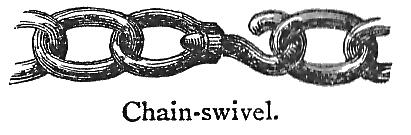
Swivel, swiv′l, n. something fixed in another body so as to turn round in it: a ring or link that turns round on a pin or neck: a small cannon turning on a swivel.—v.i. to turn on a pin or pivot.—ns. Swiv′el-eye, a squint-eye; Swiv′el-hook, a hook secured to anything by means of a swivel. [A.S. swífan, to move quickly, to turn round.]
Swizzle, swiz′l, v.i. to drink to excess.—n. a mixed or compounded drink.
Swollen, swōln, pa.p. of swell.
Swoon, swōōn, v.i. to faint: to fall into a fainting-fit.—n. the act of swooning: a fainting-fit.—Swoond′ed, obsolete pa.t. and pa.p. of swoon.—n. Swoon′ing.—adv. Swoon′ingly, [M. E. swounen, swoghenen—A.S. swógan, to resound.]
Swoop, swōōp, v.t. to sweep down upon: to take with a sweep: to catch while on the wing: to catch up.—v.i. to descend with a sweep.—n. the act of swooping: a seizing, as a bird on its prey. [A.S. swápan, to sweep; Ger. schweifen, to rove.]
Swop, swop, v.t. to exchange, to barter:—pr.p. swop′ping; pa.t and pa.p. swopped.—n. an exchange.—Also Swap. [Most prob. the same as obs. swap, swop, to beat, cog. with swoop.]
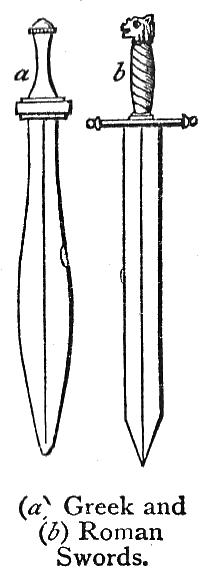
Sword, sōrd, n. an offensive weapon with a long blade, sharp upon one or both edges, for cutting or thrusting: destruction by the sword or by war, war, military force: the emblem of vengeance or justice, or of authority and power.—adj. Sword′-and-buck′ler, fought with sword and buckler, not the rapier: armed with sword and buckler.—ns. Sword′-arm, -hand, the arm, hand, that wields the sword; Sword′-bay′onet, a bayonet shaped somewhat like a sword, and used as one; Sword′-bear′er, a public officer who carries the sword of state; Sword′-belt, a military belt from which the sword is hung; Sword′bill, a South American humming-bird with a bill longer than its body; Sword′-break′er, an old weapon for grasping and breaking an adversary's sword; Sword′-cane, -stick, a cane or stick containing a sword; Sword′craft, skill with the sword; military power; Sword′-cut, a blow, wound, or scar caused by the edge of a sword; Sword′-dance, a dance in which the display of naked swords, or movements made with such, form a part; Sword′-doll′ar, a Scotch silver coin under James VI., worth 2s. 6d. in English money, having a sword on the reverse; Sword′er (Shak.), a swordsman; Sword′fish, a family of spiny-rayed Teleostean fishes, sometimes 12 to 15 feet in length, with a sword about 3 feet long, formed from a compressed prolongation of the upper jaw; Sword′-flag, the European water-flag or yellow iris; Sword′-grass, a kind of sedge; Sword′-guard, the part of a sword-hilt that protects the bearer's hand; Sword′-knot, a ribbon tied to the hilt of a sword; Sword′-law, government by the sword.—adj. Sword′less, destitute of a sword.—ns. Sword′play, fencing; Sword′player, a fencer.—adj. Sword′-proof, capable of resisting the blow or thrust of a sword.—n. Sword′-rack, a rack for holding swords.—adj. Sword′-shaped, ensiform.—ns. Swords′man, a man skilled in the use of a sword; Swords′manship. [A.S. sweord; Ice. sverdh, Ger. schwert.]
Swore, Sworn. See Swear.
Sworn, swōrn, pa.p. of swear.—Sworn broker, a London broker who swears before the court of aldermen to maintain honesty in dealing; Sworn enemies, enemies determined not to be reconciled; Sworn friends, fast or close friends.
Swote, swōt, adv. (Spens.) sweetly.
Swound, swownd, v.i. (Shak.) to swoon—also n.
Swum, swum, pa.p. of swim.
Swung, swung, pa.t. and pa.p. of swing.
Syb, sib, adj. (Spens.). Same as Sib.
Sybarite, sib′a-rīt, n. an inhabitant of Sybaris, a Greek city in ancient Italy, on the Gulf of Tarentum, noted for the effeminacy and luxury of its inhabitants: one devoted to luxury.—adjs. Sybarit′ic, -al.—n. Syb′aritism.
Sybo, sī′bō, n. a Scotch form of Cibol (q.v.):—pl. Sy′boes.
Sybotic, sī-bot′ik, adj. pertaining to a swineherd.—n. Sy′botism. [Gr. sybōtēs, swineherd.]
Sycamine, sik′a-mīn, n. (B.) supposed to be the black mulberry-tree (Morus nigra).
Sycamore, sik′a-mōr, n. a fruit-tree of the fig family, common in Palestine, &c.: a species of maple, in Scotland usually called plane-tree: in America, the native plane. [Gr. sykomoros—sykon, a fig, moron, black mulberry.]
Syce. Same as Sice (q.v.).
Sycophant, sik′ō-fant, n. a common informer: a servile flatterer.—n. Syc′ophancy, the behaviour of a sycophant: mean tale-bearing: obsequious flattery: servility—also Sycophant′ism.—adjs. Sycophant′ic, -al, Sycophant′ish, like a sycophant: obsequiously flattering: parasitic.—v.i. Syc′ophantise.—adv. Syc′ophantishly.—n. Syc′ophantry, the arts of the sycophant. [Gr. sykophantēs, usually said to mean one who informed against persons exporting figs from Attica or plundering the sacred fig-trees; but more prob. one who brings figs to light by shaking the tree, hence one who makes rich men yield up their fruit by informations and other vile arts—sykon, a fig, phainein, to show.]
Sycosis, sī-kō′sis, n. a pustular eruption on the scalp or bearded part of the face, due to ringworm, acne, or impetigo. [Gr.,—sykon, a fig.]
Syenite, sī′en-īt, n. a rock composed of feldspar and hornblende.—adj. Syenit′ic, relating to Syene in Egypt: pertaining to syenite. [From Gr. Syēnē, Syene in Egypt.]
Syker, sik′ėr, adv. (Spens.) surely. [Sicker.]
Syllable, sil′a-bl, n. several letters taken together so as to form one sound: a word or part of a word uttered by a single effort of the voice: a small part of a sentence.—v.t. to express by syllables, to utter.—n. Syll′abary, a list of characters representing syllables—also Syllabā′rium.—adjs. Syllab′ic, -al, consisting of a syllable or syllables.—adv. Syllab′ically.—vs.t. Syllab′icāte, Syllab′ify (pa.t. and pa.p. syllab′ified), to form into syllables—ns. Syllabicā′tion, Syllabificā′tion; Syll′abism, syllabic character, representation of syllables. [L. syllaba—Gr. syllabē—syn, with, lab-, lambanein, to take.]
Syllabub, sil′a-bub, n. Same as Sillibub.
Syllabus, sil′a-bus, n. an abstract: a table of contents: the catalogue of eighty heresies, annexed to the Encyclical Quanta Cura, addressed by Pius IX. to all Catholic bishops, 8th Dec. 1864. [L.]
Syllepsis, sil-lep′sis, n. substitution: a figure in rhetoric by which we take the sense of words rather by the intention of the author than by the strictness of grammar: the agreement of a verb or adjective, not with the word next it, but with some other word in the sentence.—adjs. Syllep′tic, -al.—adv. Syllep′tically. [Gr. syllēpsis—syn, together, lambanein, to take.]
Syllogism, sil′ō-jizm, n. logical form of every argument, consisting of three propositions, of which the first two are called the premises, and the last, which follows from them, the conclusion.—n. Syllogisā′tion.—v.i. Syll′ogise, to reason by syllogisms.—v.t. to deduce consequences from.—n. Syll′ogiser.—adjs. Syllogis′tic, -al, pertaining to a syllogism: in the form of a syllogism.—adv. Syllogis′tically. [Gr. syllogismos—syllogizesthai—syn, together, logizesthai, to reckon—logos, speech.]
Sylph, silf, n. one of the elemental spirits of the air, intermediate between immaterial and material beings, occasionally holding intercourse with human creatures: a fairy.—n. Sylph′id, a little sylph.—adjs. Sylph′ine, Sylph′ish. [Fr. sylphe, of Celtic origin; but cf. Gr. silphē, a kind of beetle.]
Sylva, Silva, sil′va, n. the forest trees of any region collectively.—adjs. Syl′van, Sil′van.—n. Sylvicul′ture, arboriculture, forestry. [L.]
Symbal, sim′bal, n. Same as Cymbal.
Symbiosis, sim-bi-ō′sis, n. a term introduced by De Bary to denote certain kinds of physiological partnership between organisms of different kinds—best restricted to such intimate and complementary partnerships as exist between algoid and fungoid elements in lichens, or between unicellular Algæ; and Radiolarians.—n. Sym′bion, an organism living in such a state.—adj. Symbiot′ic.—adv. Symbiot′ically. [Gr. syn, together, bios, life.]
Symbol, sim′bol, n. a sign by which one knows a thing: an arbitrary or other conventional mark, abbreviating methods of scientific expression, as in algebra, and esp. chemistry: an emblem: that which represents something else: a figure or letter representing something: (theol.) a creed, compendium of doctrine, or a typical religious rite, as the Eucharist.—adjs. Symbol′ic, -al, pertaining to, or of the nature of, a symbol: representing by signs: emblematic: figurative: typical.—adv. Symbol′ically.—ns. Symbol′icalness; Symbol′ics, the study of the history and contents of Christian creeds; Symbolisā′tion.—v.i. Sym′bolise, to be symbolical: to resemble in qualities.—v.t. to represent by symbols.—ns. Sym′boliser, Sym′bolist, one who uses symbols; Sym′bolism, representation by symbols or signs: a system of symbols: use of symbols: (theol.) the science of symbols or creeds.—adjs. Symbolist′ic, -al.—ns. Symbol′ogy, Symbolol′ogy, the art of representing by symbols; Symbolol′atry, undue veneration for symbols; Sym′bolry, the use of symbols generally. [Gr. symbolon, from symballein—syn, together, ballein, to throw.]
Symmetry, sim′e-tri, n. the state of one part being of the same measure with or proportionate to another: due proportion: harmony or adaptation of parts to each other.—adj. Symm′etral, commensurable, symmetrical.—n. Symmet′rian, one who is careful about symmetry.—adjs. Symmet′ric, -al, having symmetry or due proportion in its parts: harmonious.—adv. Symmet′rically, with symmetry.—ns. Symmet′ricalness; Symmetri′cian, Symm′etrist, one careful about symmetry; Symmetrisā′tion.—v.t. Symm′etrise, to make symmetrical.—n. Symmetrophō′bia, fear or strong dislike of mechanical symmetry. [L. and Gr. symmetria—syn, together, metron, a measure.]
Symmorph, sim′morf, n. a character different in form from another, but representing the same notion. [Gr. symmorphos, similar—syn, with, morphē, form.]
Sympathy, sim′pa-thi, n. like feeling: an agreement of inclination, feeling, or sensation: compassion: pity: tenderness: an agreement of affections or inclinations, or a conformity of natural temperament: mutual conformity of parts in the fine arts: correspondence of parts in similar sensations or affections, or the affection of the whole body or system, or some part of it, in consequence of local injury or disease: propensity of inanimate bodies to union or mutual action: the effective union of colours.—adjs. Sympathet′ic, -al, showing, or inclined to, sympathy: feeling with another: able to sympathise: compassionate: produced by sympathy: uniting viscera and blood-vessels in a nervous action common to them all: noting sounds induced by vibrations conveyed through air, &c., from a body already in vibration.—adv. Sympathet′ically.—n. Sympathet′icism, undue disipostion to be sympathetic.—v.i. Sym′pathise, to have sympathy: to feel with or for another: to be compassionate.—ns. Sym′pathiser; Sym′pathism; Sym′pathist.—Sympathetic ink (see Ink). [Gr. sympatheia—syn, with, pathos, suffering.]
Sympelmous, sim-pel′mus, adj. in birds, having the tendons of the deep flexors of the toes blended in one before separating to proceed one to each of the four digits—opp. to Nomopelmous. [Gr. syn, with, pelma, the sole of the foot.]
Sympetalous, sim-pet′a-lus, adj. having all the petals united.
Symphenomenon, sim-fē-nom′e-non, n. a phenomenon resembling others shown by the same object:—pl. Symphenom′ena.—adj. Symphenom′enal.
Symphony, sim′fō-ni, n. an agreeing together in sound: unison, consonance, or harmony of sound: a musical composition for a full band of instruments: an instrumental introduction or termination to a vocal composition.—n. Symphō′nia, concord in Greek music: a medieval name for the bagpipe, the virginal.—adj. Symphon′ic, relating to, or resembling, a symphony: symphonious.—n. Symphō′nion, a combination of pianoforte and harmonium, the precursor of the orchestrion.—adj. Symphō′nious, agreeing or harmonising in sound: accordant: harmonious.—n. Sym′phonist, a composer of symphonies. [Gr. symphōnia—syn, together, phōnē a sound.]
Symphoricarpous, sim-fō-ri-kar′pus, adj. bearing several fruits clustered together.
Symphyla, sim′fi-la, n.pl. an order or suborder of insects related to typical Thysanura, but resembling chilopods and having many abdominal legs.—adj. Sym′phyllous. [Gr. symphylos, of the same race—syn, with, phylon, a clan.]
Symphynote, sim′fi-nōt, adj. soldered together at the hinge, as the valves of some unios. [Gr. symphyēs, growing together, nōton, the back.]
Symphyogenesis, sim-fi-ō-jen′e-sis, n. (bot.) the forming of an organ or part by union of parts formerly separate.—adj. Symphyogenet′ic. [Gr. symphyesthai, to grow together, genesis, generation.]
Symphysis, sim′fi-sis, n. the union of two parts of the skeleton, either by confluence, by direct apposition, or by the intervention of cartilage or ligament: the union of parts normally separate, coalescence or growing together of parts.—adj. Symphys′ēal.—ns. Symphys′ia, a malformation produced by the union of parts properly separate; Sym′phytism, a coalescence of word-elements. [Gr. syn, with, phyein, to grow.]
Symphytum, sim′fi-tum, n. a genus of gamopetalous plants, of the natural order Boraginaceæ.
Sympiesometer, sim-pi-e-som′e-tėr, n. a barometer in which oil and hydrogen gas replace mercury and the Toricellian vacuum: an instrument for measuring the pressure of a current. [Gr. sympiesis, a pressing together—syn, with, piezein, to press, metron, a measure.]
Symplectic, sim-plek′tik, adj. placed in or among, as if woven together.—n. a bone in the Teleostean fishes which forms the lower ossification of the suspensorium, and which articulates below with the quadrate bone by which it is firmly held. [Gr. symplektikos—syn, together, plekein, to weave.]
Symplesite, sim′ple-sīt, n. a pearly, vitreous arseniate of ferrous iron. [Gr. syn, together, plēsios, near.]
Symploce, sim′plō-sē, n. (rhet.) the repetition of a word at the beginning and another at the end of successive clauses. [Gr. symplokē, an interweaving.]
Symplocium, sim-plō′si-um, n. (bot.) the annulus in the sporangium of ferns.
Sympodium, sim-pō′di-um, n. (bot.) an axis or stem morphologically made up of a series of superposed branches imitating a simple stem. [Gr. syn, with, pous, podos, foot.]
Symposium, sim-pō′zi-um, n. a drinking together: a banquet with philosophic conversation: a merry feast.—adjs. Sympō′siac, Sympō′sial.—ns. Sym-pō′siarch, the master of the feast, a toast-master; Sympō′siast, one who takes part in a symposium. [L.,—Gr. symposion—syn, together, posis, a drinking—pinein, to drink.]
Symptom, simp′tum, n. that which attends and indicates the existence of something else, not as a cause, but as a constant effect: (med.) that which indicates disease.—adjs. Symptomat′ic, -al, pertaining to symptoms: indicating the existence of something else: (med.) proceeding from some prior disorder.—adv. Symptomat′ically.—n. Symptomatol′ogy, the sum of knowledge concerning symptoms. [Gr. symptōma—syn, with, piptein, to fall.]
Symptosis, simp-tō′sis, n. the meeting of polars of the same point with reference to different loci.
Synacmy, sin-ak′mi, n. the simultaneous maturity of the anthers and stigmas of a flower.—adj. Synac′mic. [Gr. syn, with, akmē, maturity.]
Synacral, sin-ak′ral, adj. having a common vertex, as faces of a polyhedron. [Gr. syn, with, acros, top.]
Synadelphic, sin-a-del′fik, adj. acting together, as different members of an animal body. [Gr. syn, with, adelphos, a brother.]
Synadelphite, sin-a-del′fīt, n. an arseniate of manganese.
Synæresis. See Syneresis.
Synæsthesia, sin-es-thē′si-a, n. sensation produced at a point different from the point of stimulation.
Synagogue, sin′a-gog, n. an assembly of Jews for worship: a Jewish place of worship.—adjs. Syn′agogal, Synagog′ical. [Fr.,—Gr. synagōgē—syn, together, agein, to lead.]
Synalepha, sin-a-lē′fa, n. a contraction by suppressing a final vowel or diphthong before another vowel or diphthong, so that the final syllable of one word runs or melts into the first of the other.—Also Synalē′phe. [Gr. synaloiphē—synaleiphein, to melt together—syn, together with, aleiphein, to anoint.]
Synalgia, si-nal′ji-a, n. sympathetic pain. [Gr. syn, with, algos, pain.]
Synallagmatic, sin-a-lag-mat′ik, adj. mutually or reciprocally obligatory. [Gr. synallagmatikos—synallagma, a covenant.]
Synancia, si-nan′si-a, n. a genus of fishes with spines and poison-glands, of family Synanciidæ.—adj. Synan′cioid. [Gr. synangchos, quinsy.]
Synangium, si-nan′ji-um, n. an arterial trunk: the boat-shaped sorus of certain ferns. [Gr. syn, with, angeion, a vessel.]
Synantherous, si-nan′ther-us, adj. (bot.) having the anthers united.
Synanthous, si-nan′thus, adj. (bot.) denoting plants whose flowers and leaves appear together or at the same time.—n. Synan′thy. [Gr. syn, together, anthos, a flower.]
Synaphea, sin-a-fē′a, n. the metrical continuity between one colon and another, mutual connection of all the verses in a system, so that they are scanned as one verse, as in anapæstics: elision or synalepha, at the end of a line, of the final vowel of a dactylic hexameter before the initial vowel of the next.—Also Synaphei′a. [Gr.,—synaptein, to join together.]
Synapte, si-nap′tē, n. (Gr. Church) a litany. [Gr. synaptē (euchē, a prayer), joined together.]
Synarchy, sin′ar-ki, n. joint sovereignty. [Gr. synarchia—syn, with, archein, to rule.]
Synartesis, sin-ar-tē′sis, n. a fastening together, close union.—adj. Synartet′ic. [Gr. synartēsis—syn, with, artaein, to fasten to.]
Synarthrosis, sin-ar-thrō′sis, n. a joint permitting no motion, between the parts articulated.—adj. Synarthrō′dial.—adv. Synarthrō′dially. [Gr. syn-arthrōsis—syn, with, arthron, a joint.]
Synascete, sin′a-sēt, n. a fellow-ascetic.
Synastry, si-nas′tri, n. coincidence as regards stellar influences. [Gr. syn, together with, astron, a star.]
Synaxis, si-nak′sis, n. in the early Church, an assembly for worship, esp. for celebrating the Eucharist.—n. Synaxā′rion, in Greek usage, a lection containing an account of a saint's life. [Gr. synaxis, a bringing together—syn, together, agein, to lead.]
Syncarpous, sin-kär′pus, adj. (bot.) having the carpels consolidated into one. [Gr. syn, together, karpos, a fruit.]
Syncategorematic, sin-kat-ē-gor-ē-mat′ik, adj. denoting words that can only form parts of terms, as adverbs, &c.—adv. Syncategoremat′ically.
Synchondrosis, sing-kon-drō′sis, n. an articulation formed by the addition of a plate of cartilage.—n. Synchondrot′omy, the section of such. [Gr. syngchondrōsis—syn, with, chondros, a cartilage.]
Synchoresis, sing-kō-rē′sis, n. (rhet.) an admission made for the purpose of making a more effective retort. [Gr. synchōrēsis—syn, with, chōros, space.]
Synchronal, sing′krō-nal, adj. happening or being at the same time: simultaneous: lasting for the same time—also Synchron′ical, Syn′chronous.—adv. Synchron′ically.—n. Synchronisā′tion.—v.i. Syn′chronise, to be synchronal or simultaneous: to agree in time.—v.t. to cause to be synchronous: to regulate a clock, &c., by some standard.—ns. Syn′chroniser; Syn′chronism, concurrence of events in time: the tabular arrangement of contemporary events, &c., in history.—adj. Synchronis′tic, showing synchronism.—adv. Synchronis′tically.—n. Synchronol′ogy, chronological arrangement side by side.—adv. Syn′chronously.—ns. Syn′chronousness; Syn′chrony, simultaneity. [Gr. synchronismos—synchronizein, to agree in time—syn, together, chronos, time.]
Synchysis, sing′ki-sis, n. (rhet.) confusion of meaning due to unusual arrangement: fluidity of the vitreous humour of the eye. [Gr. syngchysis—syn, together with, chein, to pour.]
Synelastic, sin-klas′tik, adj. having the same kind of curvature in all directions—opp. to Anticlastic. [Gr. syn, together, klastos, broken.]
Synclinal, sin-klī′nal, adj. sloping downwards in opposite directions so as to meet in a common point or line: (geol.) denoting strata dipping toward a common central line or plane.—ns. Syn′cline, a synclinal flexure—also Synclī′nal; Synclinō′rium, a mountain with a synclinal structure. [Gr. syn, together, klinein, to bend.]
Syncopate, sing′kō-pāt, v.t. to contract, as a word, by taking away letters from the middle: (mus.) to unite by a slur the last note of a bar to the first note of the next.—adjs. Syn′copal, Syncop′ic, pertaining to syncope.—ns. Syncopā′tion, act of syncopating; Syn′cope, the omission of letters from the middle of a word, as ne'er for never: (med.) a fainting-fit, an attack in which the breathing and circulation become faint: (mus.) syncopation.—v.t. Syn′copise, to contract by syncope.—n. Syn′copist.—adj. Syncop′tic. [Low L. syncopāre, -ātum—L. syncope—-Gr. syn, together, koptein, to cut off.]
Syncretism, sin′kre-tizm, n. the attempted reconciliation of irreconcilable principles, theological compromise—between Catholics and Protestants, between Lutherans and Reformed.—adj. Syncret′ic, pertaining to syncretism, tending to blend opposing parties and speculative systems by minimising differences.—v.t. Syn′cretise.—n. Syn′cretist.—adj. Syncretis′tic. [Gr. synkrētismos—synkrētizein, to unite against.]
Syndactyl, sin-dak′til, adj. having the digits connected with a web, &c.—n. Syndac′tylism, union of digits.—adj. Syndac′tylous.
Syndesmosis, sin-des-mō′sis, n. the connection of bones by ligaments.—ns. Syndesmog′raphy, description of the ligaments and joints; Syndesmol′ogy, the knowledge of the ligaments.—adj. Syndesmot′ic.—n. Syndesmot′omy, the anatomy of the ligaments. [Gr. syndesmos—syn, together with, dein, to bind.]
Syndetic, -al, sin-det′ik, -al, adj. connecting by conjunctions, &c. [Gr. syndetikos, binding together—syn, together, dein, to bind.]
Syndic, sin′dik, n. the chief magistrate in Geneva, one of those officers delegated as agents by cities in France under the old régime, &c.: one chosen to transact business for others, esp. the accredited legal representative of a corporation, society, or company.—n. Syn′dicāte, a body of syndics: a council: the office of a syndic: a body of men chosen to watch the interests of a company, or to manage a bankrupt's property, esp. an association of merchants or others for the purpose of carrying through some great or important enterprise, or for securing a kind of artificial monopoly in the production or supply of some commodity.—v.t. to effect by means of a syndicate.—v.i. to join in a syndicate.—ns. Syndicā′tion; Syn′dicātor. [L. syndicus—Gr. syndikos—syn, with, dikē, justice.]
Syndrome, sin′drō-mē, n. concurrence. [Gr., syn, together, dramein, to run.]
Syndyasmian, sin-di-as′mi-an, adj. coupling, noting the sexual relation. [Gr. syndyasmos, coupling.]
Synecdoche, sin-ek′dō-kē, n. a figure of speech by which a part is made to comprehend the whole, or the whole is put for a part.—adj. Synecdoch′ical, expressed by, or implying, synecdoche. [Gr. synekdochē—syn, together, ekdechesthai, to receive.]
Synechia, sin-e-kī′a, n. morbid adhesion between the iris and the cornea.—n. Synechiol′ogy, the doctrine of the connection of things by causation.—adj. Synec′tic, bringing into connection things of different nature.—n. Synectic′ity. [Gr. synektikos, holding together, synechein—syn, together with, echein, to hold.]
Synecphonesis, si-nek-fō-nē′sis, n. syneresis.
Synedral, si-nē′dral, adj. (bot.) growing on the angle of a stem.—Also Synē′drous. [Gr. synedros, sitting together—syn, together, hedra, a seat.]
Synedrion, si-ned′ri-on, n. a judicial assembly, a sanhedrim—also Syned′rium.—adj. Syned′rial. [Sanhedrim.]
Synema, si-nē′ma, n. (bot.) the column of combined filaments in a monadelphous flower. [Gr. syn, together, nēma, a thread.]
Syneresis, Synæresis, si-ner′e-sis, n. the coalescence of two vowels or syllables—opp. to Diæresis. [Gr. syn, together, hairein, to take.]
Synergism, sin′ėr-jizm, n. the doctrine that the human will and the Divine Spirit are two efficient agents that co-operate in regeneration—ascribed to Melanchthon.—adj. Synerget′ic.—n. Syn′ergist, one maintaining the doctrine of synergism.—adj. Synergist′ic.—n. Syn′ergy, combined action. [Gr. synergia, co-operation—syn, together, ergein, to work.]
Synesis, sin′e-sis, n. a grammatical construction in harmony with the sense rather than with strict syntax. [Gr., 'understanding.']
Syngenesious, sin-je-nē′shus, adj. (bot.) cohering into a ring, as the anthers of Compositæ, &c.—those plants which show this forming the 19th class in the Linnean system, the Syngenē′sia. [Gr. syn, with, genesis, generation.]
Syngenesis, sin-jen′e-sis, n. the theory of reproduction which makes the embryo the product of both male and female by the union of spermatozoon and ovum: the theory that the germ so formed contains the germs of all future generations—opp. to Epigenesis.—adj. Syngenet′ic. [Gr. syn, with, genesis, generation.]
Syngraph, sing′graf, n. a writing signed by both or all the parties thereto. [Gr. synggraphē—syn, with, graphein, to write.]
Synizesis, sin-i-zē′sis, n. the union into one syllable of two vowels incapable of forming a diphthong: closure of the pupil of the eye, with loss of sight. [Gr. syn, with, hizein, to place.]
Synochus, sin′ō-kus, n. a continued fever—also Syn′ocha.—adjs. Syn′ochal, Syn′ochoid. [Gr. synochos, joined together—syn, with, echein, to hold.]
Synocil, sin′ō-sil, n. a filamentous formation of certain sponges, supposed to function as a sense-organ, probably an eye. [Gr. syn, with, L. cilium, an eyelid.]
Synocreate, si-nok′rē-āt, adj. (bot.) uniting together on the opposite side of the stem from the leaf, and enclosing the stem in a sheath—of stipules. [Gr. syn, with, and ocreate.]
Synod, sin′od, n. a meeting: an ecclesiastical council: among Presbyterians, a church court consisting of several presbyteries, intermediate between these and the General Assembly, also the supreme court of the United Presbyterian Church until its union with the Free Church in 1900.—adjs. Syn′odal, Synod′ic, -al, pertaining to a synod: done in a synod.-adv. Synod′ically.—n. Syn′odist. [L. synodus—Gr. synodos—syn, together, hodos, a way.]
Synœcious, si-nē′shi-us, adj. (bot.) having male and female flowers in one head as in the Compositæ: having antheridia and archegonia on the same receptacle, as in many mosses. [Gr. synoikia, a living together—syn, with, oikein, to dwell.]
Synomosy, sin′ō-mō-si, n. a body of political or other conspirators bound together by oath, a secret society. [Gr. synōmosia, a conspiracy—syn, with, omnynai, to take an oath.]
Synonym, sin′o-nim, n. a name or word having the same meaning with another: one of two or more words which have the same meaning.—adjs. Synonymat′ic, Synonym′ic, -al.—ns. Synonym′icon, a dictionary of synonymous words; Synonym′ics, synonymy.—v.t. Synon′ymise, to express by other words of the same meaning.—ns. Synon′ymist, one who studies synonyms, or the different names of plants and animals; Synonym′ity, the state of being synonymous.—adj. Synon′ymous, pertaining to synonyms: expressing the same thing: having the same meaning.—adv. Synon′ymously.—n. Synon′ymy, the quality of being synonymous: a rhetorical figure by which synonymous words are used. [Gr. synōnymon—syn, with, onoma, a name.]
Synopsis, si-nop′sis, n. a view of the whole together: a collective or general view of any subject:—pl. Synop′sēs.—adjs. Synop′tic, -al, affording a general view of the whole.—adv. Synop′tically.—n. Synop′tist, one of the writers of the Synoptic Gospels.—adj. Synoptis′tic.—The Synoptic Gospels, a name first used by Griesbach for the first three gospels, those of Matthew, Mark, and Luke, which present such a similarity in matter and form that they readily admit of being brought under one and the same combined view or synopsis. [Gr. synopsis—syn, with, together, opsis, a view.]
Synosteosis, si-nos-tē-ō′sis, n. union of different parts of the skeleton by means of bone, co-ossification—also Synostō′sis.—ns. Synosteol′ogy, the knowledge of the joints of the body; Synosteot′omy, the dissection of the joints.—adj. Synostot′ic. [Gr. syn, together, osteon, a bone.]
Synotus, si-nō′tus, n. a genus of long-eared bats having the rim of the ear produced in front of the eye, including the European Barbastel: a double monster united above the umbilicus, the head incompletely double. [Gr. syn, together, ous, ōtos, the ear.]
Synovial, sin-ō′vi-al, adj. relating to Synō′via, an unctuous albuminous fluid, secreted from certain glands in the joints.—adv. Synō′vially.—n. Synovī′tis, inflammation of a synovial membrane. [Gr. syn, with, ōon, an egg.]
Syntax, sin′taks, n. (gram.) the correct arrangement of words in sentences.—adjs. Syntac′tic, -al, pertaining to syntax: according to the rules of syntax.—adv. Syntac′tically. [Gr. syntaxis—syn, together, tassein, taxein, to put in order.]
Syntenosis, sin-te-nō′sis, n. the connection of bones by tendons. [Gr. syn, with, tenōn, a sinew.]
Synteresis, sin-tē-rē′sis, n. preventive treatment, prophylaxis.—adj. Synteret′ic.—n. Synteret′ics, hygiene. [Gr. syntērēsis, observation—syn, with, tērein, to watch over.]
Syntexis, sin-tek′sis, n. a wasting of the body.—adjs. Syntec′tic, -al. [Gr. syntēxis, a wasting away—syn, with, tēkein, to melt.]
Synthermal, sin-thėrm′al, adj. having the same degree of heat. [Gr. syn, together, thermē, heat.]
Synthesis, sin′the-sis, n. a term applied to the building up of compound substances from the elements they contain or from other compounds, usually of less complexity than themselves: a making a whole out of parts: the combination of separate elements of thought into a whole, or reasoning from principles previously established to a conclusion, as opposed to analysis: (gram.) the uniting of ideas into a sentence: (med.) the reunion of parts that have been divided: (chem.) the uniting of elements to form a compound:—pl. Syn′theses (-sēz).—v.t. Syn′thesīse, to unite by synthesis.—ns. Syn′thesist, Syn′thetist, one who synthetises.—adjs. Synthet′ic, -al, pertaining to synthesis: consisting in synthesis or composition.—adv. Synthet′ically.—n. Synthet′icism, the principles of synthesis, a synthetic system.—v.t. Syn′thetise.—Synthetic philosophy, the system of Herbert Spencer, so called by himself because conceived as a fusion of the different sciences into a whole. [Gr. synthesis—syn, with, together, thesis, a placing—tithēmi, I place.]
Synthronus, sin′thrō-nus, n. the seat of the bishop and his presbyters, behind the altar. [Gr. syn, together with, thronos, a throne.]
Syntonin, sin′tō-nin, n. a substance akin to fibrin, which is an important constituent of muscular tissue—also called Muscle Fibrin.
Syntonous, sin′tō-nus, adj. intense in quality.—Also Synton′ic. [Gr. syntonos, tightly drawn.]
Syntropic, sin-trop′ik, adj. turning or pointing in the same direction, as several vertebræ. [Gr. syn, together with, trepein, to turn.]
Syphilis, sif′i-lis, n. a markedly contagious, infective, and inoculable disease, capable of being transmitted to the offspring, propagated by direct contagion or by the transmission of the virus through some vessel or medium which has recently been contaminated—most commonly caused by impure sexual intercourse.—n. Syphilisā′tion.—v.t. Syph′ilise, to attempt to inoculate the system with the virus of syphilis as a preventive and curative measure.—adj. Syphilit′ic.—n. Syphilog′raphy, the description of syphilis.—adj. Syph′iloid, relating to syphilis.—ns. Syphilol′ogist, one versed in syphilology; Syphilol′ogy, the knowledge of syphilis; Syphilō′ma, a syphilitic tumour; Syphilophō′bia, a morbid dread of contracting syphilis. [The word is borrowed from the name of a figure in Fracastoro's poem, Syphilidis Libri III.]
Syphon, Syren. Same as Siphon, Siren.
Syriac, sir′i-ak, adj. relating to Syria, or to its language.—n. the language, esp. the ancient language of Syria, a western dialect of Aramaic (q.v.).—ns. Syr′iacism, Syr′ianism, a Syrian idiom.—adj. Syr′ian, relating to Syria.—n. a native of Syria.—n. Syr′iarch, the chief priest in the Roman province of Syria.
Syringa, sī-ring′ga, n. the mock-orange.
Syringe, sir′inj, n. a portable hydraulic instrument of the pump kind, used to draw in a quantity of liquid and eject it forcibly: a tube used by surgeons for injecting, &c.—v.t. to inject or clean with a syringe. [L. syrinx, (gen.) syringos—Gr. syringx, a reed.]
Syringotomy, sir-in-got′ō-mi, n. the operation of cutting for the fistula.—n. Syr′inx, a fistula or fistulous opening: a narrow gallery in the tombs of ancient Egypt. [Gr. syringx, a pipe, tomē, a cutting—temnein, to cut.]
Syrophœnician, sī-rō-fē-nish′an, adj. pertaining to Syro-Phœnicia or its people, of mixed Phœnician and Syrian descent.
Syrtis, sėr′tis, n. (Milt.) a quicksand—also Syrt.—adj. Syr′tic. [L.,—Gr.—syrein, to draw along.]
Syrup, sir′up, n. a saturated solution of sugar boiled to prevent fermentation: the juice of fruits saturated with sugar and many flavoured liquids, treated in the same way—also Sir′up.—adj. Syr′upy. [Fr. syrop—Sp. xarope, a drink—Ar. sharāb.]
Syssarcosis, sis-ar-kō′sis, n. the connection of one bone with another by intervening muscle.—adj. Syssarcō′sic. [Gr., syn, together, sarx, flesh.]
Syssitia, si-sit′i-a, n. the ancient Spartan custom of eating together in public the chief meal of the day. [Gr. syn, together with, sitos, food.]
Systaltic, sis-tal′tik, adj. alternately contracting and dilating, pulsatory. [Gr. systaltikos—syn, together, stellein, to place.]
Systasis, sis′tā-sis, n. a union or confederation.—adj. Systat′ic, introductory, recommendatory. [Gr. syn, with, histanai, to set up.]
System, sis′tem, n. anything formed of parts placed together or adjusted into a regular and connected whole: an assemblage of bodies as a connected whole: an orderly arrangement of objects according to some common law or end: regular method or order: a full and connected view of some department of knowledge: an explanatory hypothesis or theory: the universe.—adjs. Systemat′ic, -al, pertaining to, or consisting of, system: formed or done according to system: methodical.—adv. Systemat′ically.—ns. Systemati′cian; Systematisā′tion, Systemisā′tion.—vs.t. Sys′tematise, Sys′temise, to reduce to a system.—ns. Sys′tematiser; Sys′tematism; Sys′tematist; Systematol′ogy.—adjs. System′ic, systematic; pertaining to the human system; Sys′temless, without system: not exhibiting organic structure.—ns. Sys′tem-māk′er, -mon′ger, one unduly fond of constructing systems. [Gr. systēma—syn, together, histēmi, I place.]
Systole, sīs′tō-lē, n. the regular contraction of the heart for impelling the blood outward—opp. to Diastole: (gram.) the shortening of a long syllable.—adj. Systol′ic. [Gr. systolē—syn, together, stellein, to place.]
Systyle, sis′tīl, n. (archit.) the arrangement of columns so that they are only two diameters apart: a front or portico having columns so arranged.—adj. Sys′tylous (bot.), having the styles united into a single body. [Gr. syn, with, stylos, a column.]
Sythe=Scythe.
Syzygy, siz′i-ji, n. the relative position of a planet (esp. the moon) when either in conjunction or in opposition with the sun: the period of new or full moon:—pl. Syz′ygies.—n. Syz′ygant (-gant), a rational integral function of the invariants of a quantic that vanishes when expressed as a function of the coefficients.—adj. Syzyget′ic, pertaining to a linear relation.—adv. Syzyget′ically.—adj. Syzyg′ial, pertaining to a syzygy. [Gr. syzygia, union.]
the twentieth letter in our alphabet, its sound that of the hard dental mute, produced by the tip of the tongue being brought into contact with the base of the upper teeth: as a medieval numeral=160; T=160,000: something fashioned like a T, or having a cross section like a T—also written tee and sometimes tau.—ns. T′-band′age, a bandage composed of two strips fashioned in the shape of the letter T, as for use about the perineum; T′-cart, a four-wheeled pleasure-vehicle without top, having a T-shaped body; T′-cloth, a plain cotton made for the India and China market—stamped with a T; T′-cross, a tau-cross; T′-plate, a T-shaped plate, as for strengthening a joint in a wooden framework; T′-rail, a rail, as for a railway, having a T-like cross section; T′-square, a ruler shaped like the letter T, used in mechanical and architectural drawing.—To a T, with perfect exactness; Be marked with a T, to be branded as a thief.
Tab, tab, n. a small tag, flap, or strap, forming an appendage of something: reckoning, tally, check.
Tabanus, ta-bā′nus, n. a genus of flies, including the horse-flies. [L.]
Tabard, tab′ard, n. a military cloak of the 15th and 16th centuries, now a loose sleeveless coat worn by heralds.—n. Tab′arder, one who wears a tabard. [O. Fr.,—Low L. tabardum; perh. conn, with L. tapete, tapestry.]
Tabaret, tab′a-ret, n. an upholsterer's silk stuff, with alternate stripes of watered and satin surface. [Tabby.]
Tabasheer, Tabasbir, tab-a-shēr′, n. a substance, consisting chiefly of silica, sometimes found in the cavities or tubular parts of the stems of bamboos and other large grasses, and prized by the Hindus as a tonic, &c., prepared by imperfect calcination and trituration. [Hind. tabāshīr.]
Tabby, tab′i, n. a coarser kind of waved or watered silk: an artificial stone, a mixture of lime, shells, gravel, stones, and water: a female cat—also Tabb′y-cat.—adj. brindled: diversified in colour.—v.t. to water or cause to look wavy:—pa.t. and pa.p. tabb′ied.—n. Tabb′inet, a more delicate kind of tabby resembling damask, used for window-curtains. [Fr. tabis—Ar. 'attābī, a kind of rich, waved silk—'Attabiya, the quarter in Bagdad where first made.]
Tabefaction, tab-ē-fak′shun, n. a wasting away from disease.—v.t. Tab′efy, to emaciate.—v.i. to lose flesh, to waste away.—ns. Tā′bes, a gradual wasting away; Tabes′cence.—adjs. Tabes′cent; Tabet′ic; Tab′ic; Tab′id.—adv. Tab′idly.—n. Tab′idness.—adj. Tabif′ic, causing tabes.—n. Tab′itude, state of one affected with tabes.—Tabes dorsalis, the same as locomotor ataxia. [L. tabes, a wasting, tabēre, to waste away.]
Tabella, tā-bel′a, n. a medicated lozenge or hard electuary.—adj. Tab′ellary, tabular.—n. Tabell′ion, an official scrivener in the Roman empire, and in France down to 1761. [L. tabella, dim. of tabula, a table.]
Taber, v.i. (B.). Same as Tabour.
Taberd, tab′ėrd, n. Same as Tabard.
Tabernacle, tab′ėr-na-kl, n. (B.) the movable tent carried by the Jews through the desert, and used as a temple: a tent: the human body as the temporary abode of the soul: a place of worship or sacred place: (R.C.) the place in which the consecrated elements of the Eucharist are kept: a socket permitting a mast to be lowered beneath bridges.—v.i. to dwell: to abide for a time.—adj. Tabernac′ular.—Tabernacle work (archit.), ornamental work over niches, stalls, &c. with canopies and pinnacles, or any work in which such forms a characteristic feature.—Feast of tabernacles, a Jewish autumn festival, celebrating the sojourning of the children of Israel in the wilderness (Lev. xxiii. 43), and the gathering-in of all the fruits of the year (Ex. xxiii. 16). [L. tabernaculum, double dim. of taberna, a hut, shed of boards.]
Tablature, tab′la-tūr, n. something tabular: a painting on a wall or ceiling: a picture in general: a method of musical notation, principally employed in the 15th and 16th centuries for the lute: (anat.) a division of the skull into two tables. [Fr.,—L. tabula, a board.]
Table, tā′bl, n. a smooth, flat slab or board, with legs, used as an article of furniture: supply of food, entertainment: the company at a table: the board or table on which a game is played, as billiards, backgammon, draughts: a surface on which something is written or engraved: that which is cut or written on a flat surface: a flat gravestone supported on pillars: an inscription: a condensed statement: syllabus or index; (B.) a writing tablet.—adj. of or pertaining to a table, or the food partaken from the table.—v.t. to make into a table or catalogue: to lay (money) on the table: to pay down: to lay on the table—i.e. to postpone consideration of.—ns. Tā′ble-beer, light beer for common use; Tā′ble-book, a book of tablets, on which anything is written without ink: a note-book: a book of tables, as of weights, measures, &c.; Tā′ble-cloth, a cloth usually of linen, for covering a table, esp. at meals; Tā′ble-cov′er, a cloth for covering a table, esp. at other than meal-times; Table-d'hôte (ta′bl-dōt), a meal for several persons at the same hour and at fixed prices; Tā′bleful, as many as a table will hold; Tā′bleland, an extensive region of elevated land with a plain-like or undulating surface: a plateau; Tā′ble-leaf, a board at the side of a table which can be put up or down to vary the size of the table; Tā′ble-lin′en, linen table-cloths, napkins, &c.; Tā′ble-mon′ey, an allowance granted to general officers in the army, and flag-officers in the navy, to enable them to fulfil the duties of hospitality within their respective commands; Tā′ble-rap′ping, production of raps on tables by alleged spiritual agency.—n.pl. Tā′bles, the game of backgammon.—ns. Tā′ble-spoon, one of the largest spoons used at table; Tā′ble-spoon′ful, as much as will fill a table-spoon; Tā′ble-talk, familiar conversation, as that round a table, during and after meals; Tā′ble-turn′ing, movements of tables or other objects, attributed by spiritualists to the agency of spirits—by rational persons to involuntary muscular action—similarly Tā′ble-lift′ing, Tā′ble-rap′ping; Tā′ble-ware, dishes, spoons, knives, forks, &c. for table use.—adv. Tā′blewise, like a table—of the communion-table, with the ends east and west—opp. to Altar-wise.—ns. Tā′ble-work, the setting of type for tables, columns of figures, &c.; Tā′bling, the act of tabling or forming into tables: (carp.) a rude dove-tailing: (naut.) a broad hem on the skirts of sails.—The Lord's Table, the table at which the Lord's Supper is partaken, or on which the elements are laid: the Lord's Supper.—Fence the tables (see Fence); Lay on the table, to lay aside any proposed measure indefinitely, or for future discussion; Lie on the table, to be laid upon the table; Turn the tables, to bring about a complete reversal of circumstances. [O. Fr. table—L. tabula, a board.]
Tableau, tab′lō, n. a picture: a striking and vivid representation:—pl. Tableaux (tab′lōz).—Tableau vivant, a representation of a historical or other personage by a motionless living person dressed in suitable costume. [Fr.,—L. tabula, a painting.]
Tablet, tab′let, n. a small flat surface: something flat on which to write, paint, &c.: a confection in a flat square form.—n. Tab′loid, a small tablet containing a certain definite portion of some drug, a troche or lozenge. Registered trade mark. [Dim. of table.]
Taboo, Tabu, ta-bōō′, n. an institution among the Polynesians, forming a penal system based on religious sanctions, by which certain things are held sacred or consecrated, and hence prohibited to be used—by a natural transference of meaning by association of ideas becoming equivalent to 'unholy,' 'accursed'—also Tamboo′, Tambu′, and Tapu′: any prohibition, interdict, restraint, ban, exclusion, ostracism.—v.t. to forbid approach to: to forbid the use of:—pr.p. tabōō′ing; pa.t. and pa.p. tabōōed′. [Polynesian tapu—prob. ta, to mark, pu, expressing intensity.]
Tabor, tā′bor, n. a camp amongst the ancient nomadic Slavs and Turks, inside a ring of wagons.
Taborite, tā′bor-īt, n. one of the more extreme party of the Hussites, as opposed to the Calixtines or Utraquists, so named from their headquarters being at Mount Tabor, 24 miles N.E. of Pisek.
Tabour, Tabor, tā′bor, n. a small drum like the timbrel or tambourine without jingles, usually played with one stick, and in combination with a fife.—v.i. to play on a tabour: to beat lightly and often:—pr.p. tā′bouring: pa.p. tā′boured.—ns. Tā′borer (Shak.), one who beats the tabour; Tab′orine (Shak.), a tabour or small drum; Tab′ouret, Tab′ret, a small tabour or drum; Tab′rēre (Spens.), a labourer. [O. Fr. tabour (Fr. tambour)—Pers. tambūr, a kind of cithern.]
Tabouret, tab′ōō-ret, n. a cushioned seat, without arms or back, highly ornamented: a frame for embroidery: a needle-case.
Tabu. Same as Taboo.
Tabular, tab′ū-lar, adj. of the form of, or pertaining to, a table: having a flat surface: arranged in a table or schedule, computed from tables: having the form of laminæ or plates.—ns. Tab′ula, a writing-tablet, a legal record: a frontal: a dissepiment in corals, &c.; Tabularisā′tion, the act of tabularising or forming into tables: the state of being tabularised.—v.t. Tab′ularise, to put in a tabular form: to tabulate:—pr.p. tab′ūlarīsing; pa.p. tab′ūlarīsed.—adv. Tab′ularly.—v.t. Tab′ulāte, to reduce to tables or synopses: to shape with a flat surface.—n. Tabulā′tion, the act of forming into tables.
Tacahout, tak′a-howt, n. an Arab name for the small gall formed on the tamarisk-tree, and used as one source for obtaining gallic acid.
Tacamahac, tak′a-ma-hak, n. a gum-resin yielded by several tropical trees. [South American.]
Tac-au-tac, tak′-ō-tak′, n. in fencing, the parry combined with the riposte, also a series of close attacks and parries between fencers of equal skill. [Fr.]
Tace, tā′sē, be silent.—Tace is Latin for a candle, a phrase understood as requesting or promising silence. [L., imper. of tacēre, to be silent.]
Tache, tash, n. (B.) a fastening or catch. [Tack.]
Tache, tash, n. a spot, stain, or freckle: a moral blemish: a characteristic. [Fr.]
Tachometer, tā-kom′e-tėr, n. an instrument for measuring variations in the velocity of machines.—Also Tachym′eter. [Gr. tachos, speed, metron, a measure.]
Tachygraphy, tā-kig′ra-fi, n. stenography, the art of writing in abbreviations.—n. Tachyg′rapher.—adjs. Tachygrapn′ic, -al. [Gr. tachys, swift, graphein, to write.]
Tachylite, tak′i-līt, n. a black opaque natural glass, which results from the rapid cooling of molten basalt, occurring as a thin selvage to dikes and veins of intrusive basalt.—adj. Tachylit′ic.
Tachymeter, tā-kim′e-tėr, n. a surveying instrument—also Tacheom′eter.—n. Tachym′etry, scientific use of the tachymeter.
Tacit, tas′it, adj. implied, but not expressed by words: silent, giving no sound.—adv. Tac′itly.—n. Tac′itness.—adj. Tac′iturn, habitually tacit or silent: not fond of talking: reserved in speech.—ns. Tac′iturnist, one habitually taciturn; Taciturn′ity, habitual silence: reserve in speaking.—adv. Tac′iturnly. [L. tacitus, pa.p. of tacēre, to be silent.]
Tack, tak, n. a short, sharp nail with a broad head: a fastening, a long temporary stitch: the weather clew or foremost lower corner of any of the courses, or of any sail set with a boom or gaff, or of a flag, also the rope by which such clew or tack is confined or fastened: the course of a ship in reference to the position of her sails: a determinate course, the art of tacking, hence a change of policy, a strategical move: a shelf for drying cheese: term of a lease: adhesiveness, sticky condition, as of varnish, &c.—v.t. to attach or fasten, esp. in a slight manner, as by tacks.—v.i. to change the course or tack of a ship by shifting the position of the sails: to shift one's position, to veer.—adj. Tack′y, adhesive, viscous. [Most prob. Celt., Ir. taca, a pin, Bret. tach, a nail.]
Tack, tak, n. (prov.) any distinctive and permanent flavour.
Tack, tak, n. food generally, fare, esp. of the bread kind, as hard tack, soft tack, &c.
Tacket, tak′et, n. (Scot.) a hobnail in the soles of strong shoes.
Tackle, tak′l, n. the ropes, rigging, &c. of a ship: tools, weapons: ropes, &c., for raising heavy weights: a pulley.—v.t. to harness: (prov.) to seize or take hold of, attack, fasten upon.—v.i. to get a hold of.—adj. Tack′led, made of ropes tackled together.—ns. Tack′ling, furniture or apparatus belonging to the masts, yards, &c. of a ship: harness for drawing a carriage: tackle or instruments; Tacks′man, a tenant or lessee. [Scand., Sw. tackel—Ice. taka, to take.]
Tacky, tak′i, n. (U.S.) a poor ill-conditioned horse.
Tact, takt, n. adroitness in managing the feelings of persons dealt with: nice perception in seeing and doing exactly what is best in the circumstances: (mus.) the stroke in keeping time.—adjs. Tact′ful; Tac′tile, that may be touched or felt.—ns. Tactil′ity, state of being tactile: touchiness; Tac′tion, act of touching: sense of touch.—adj. Tact′less, without tact.—n. Tact′lessness.—adj. Tact′ūal, relating to, or derived from, the sense of touch.—adv. Tact′ūally.—n. Tact′us, the sense of touch. [L. tactus—tangĕre, tactum, to touch.]
Tactics, tak′tiks, n.sing. the science or art of manœuvring military and naval forces in the presence of the enemy: way or method of proceeding.—adjs. Tac′tic, -al, pertaining to tactics.—adv. Tac′tically.—n. Tacti′cian, one skilled in tactics. [Gr. taktikē (technē, art, understood), art of arranging men in a field of battle—tassein, taxein, to arrange.]
Tadpole, tad′pōl, n. a young toad or frog in its first state, before the tail is absorbed and the limbs pushed forth.—n. Tad (U.S.), a street-boy. [A toad with a poll.]
Tædium, tē′di-um, n. weariness, tediousness. [L.]
Tael, tāl, n. the Chinese liang or ounce, equal to 1⅓ oz. avoir.: a money of account in China, equivalent to a tael weight of pure silver, or to about 1250 of the copper coin known as 'cash.' The value of the Haikwan tael, or customs tael, is about 4s. 9d. English, varying with the price of silver.
Ta'en, tān, a contraction of taken.
Tænia, tē′ni-a, n. a ribbon or fillet: the fillet above the architrave of the Doric order: a tapeworm.—n. Tæ′nicide, a drug that destroys tapeworms.—adj. Tæ′niform, ribbon-like.—n. Tæ′nifuge, anything used to expel tapeworms.—adj. Tæ′nioid, ribbon-like. [L.,—Gr. tainia, a band.]
Tafferel, taf′ėr-el, Taffrail, taf′rāl, n. the upper part of a ship's stern timbers. [Dut. tafereel, a panel—tafel, a table—L. tabula, a table; cf. Ger. täfelei, flooring—tafel, a table.]
Taffeta, taf′e-ta, n. a thin glossy silk-stuff having a wavy lustre: (orig.) silk-stuff plainly woven.—Also Taff′ety. [It. taffetà—Pers. tāftah, woven—tāftan, to twist.]
Taffy, taf′i, n. Same as Toffy.
Taffy, taf′i, n. a Welshman—from Davy.
Tafia, taf′i-a, n. a variety of rum. [Malay.]
Taft, taft, v.t. in plumbing, to spread the end of a lead pipe outward so as to form a wide thin flange.
Tag, tag, n. a tack or point of metal at the end of a string: any small thing tacked or attached to another: any pendant or appendage, the tip of an animal's tail: the rabble collectively, anything mean.—v.t. to fit a tag or point to: to tack, fasten, or hang to: to dog or follow closely.—v.i. to make tags, to string words or ideas together: to go behind as a follower:—pr.p. tag′ging; pa.t. and pa.p. tagged.—ns. Tag′-end, a loosely connected end, the concluding part; Tag′ger, anything that tags, an appendage.—n.pl. Tag′gers, thin sheet-iron.—n. and adj. Tag′rag, a fluttering rag, a tatter: the rabble, or denoting it—the same as Rag-tag, often in phrase Tagrag and bobtail.—ns. Tag′-sore, a disease in sheep, in which, the tail is excoriated through diarrhœa; Tag′-tail, a worm with a tail like a tag: a hanger-on, parasite. [A weaker form of tack.]
Tag, tag, n. a children's game in which the object is for the player to chase the rest until he touches one, who then takes his place as Tagg′ger.—v.t. to touch or hit in this game.
Taghairm, tag′erm, n. an ancient mode of divination among the Scotch Highlanders, in which a man was wrapped in a fresh bullock's hide and left by a running stream to wait for inspiration. [Gael.]
Taglia, tal′ya, n. a rope and pulleys, tackle with a set of sheaves in a fixed block and another set in a movable block to which the weight is attached. [It.]
Taglioni, tal-yō′ni, n. a kind of overcoat, so called from the famous family of dancers, the most famous of whom was Maria Taglioni (1804-84).
Taha, tä′ha, n. an African weaver-bird of the family Ploceidæ.
Tahli, tä′li, n. a Hindu gold ornament worn by the wives of Brahmans.
Tahona, ta-hō′na, n. a crushing-mill for ores worked by horse-power. [Sp.,—Ar.]
Tai, tī, n. the Japanese bream.
Taic, tä′ik, adj. pertaining to the Tai, the chief race in the Indo-Chinese peninsula, including the Siamese, the Laos, &c.—n. the group of languages spoken by the Tai.
Taigle, tā′gl, v.t. (Scot.) to entangle, hinder.—v.i. to delay, tarry.
Tail, tāl, n. the posterior extremity of an animal, its caudal appendage: anything resembling a tail in appearance, position, &c.: the back, lower, or hinder part of anything: a retinue, suite: a queue or body of persons in single file: anything long and hanging, as a catkin, train of a comet, long curl of hair, &c.: in Turkey, a horse-tail, formerly carried before a pasha as an emblem of relative rank.—n. Tail′-board, the board at the hinder end of a cart or wagon, which can be let down or removed, for convenience in unloading.—adj. Tailed, having a tail of a specified kind.—ns. Tail′-end, the hind part of any animal, the tip of the tail: the end or finish of anything, the fag-end: (pl.) inferior corn sorted out from that of better quality; Tail′-feath′er, one of the rectrices or rudder-feathers of a bird's tail; Tail′-gate, the aft or lower gate of a canal lock.—n.pl. Tail′ings, refuse, dregs.—adj. Tail′less, having no tail.—ns. Tail′piece, a piece at the tail or end, esp. of a series, as of engravings; Tail′pipe, the suction pipe in a pump.—v.t. to fasten something to the tail of, as a dog, to fix something to one by way of joke.—ns. Tail′race, the channel in which water runs away below a mill-wheel; Tail′rope, in coal-mining, a rope extending from the hind part of a car or kibble in a slightly inclined passage, by means of which the empties are drawn 'inby,' while the loaded cars are drawn 'outby.'—Lay, or Put, salt on the tail of (see Salt); Make neither head nor tail of anything (see Head); Turn tail, to run away, to shirk a combat; Twist the lion's tail (U.S.), to goad or insult the pacific and long-suffering British public feeling for political purposes in America; With the tail between the legs, in a cowardly way, after the manner of a beaten cur when he sneaks away. [A.S. tægel; Ger. zagel; Goth. tagl, hair.]
Tail, tāl, n. (law) the term applied to an estate which is cut off or limited to certain heirs.—ns. Tail′āge, Tall′āge. [Fr. taille, cutting. Cf. Entail.]
Tailor, tāl′ur, n. one whose business is to cut out and make men's clothes:—fem. Tail′oress.—v.i. to work as a tailor.—v.t. to make clothes for.—ns. Tail′or-bird, one of several Oriental small passerine birds which sew leaves together to form a nest: Tail′oring, the business or work of a tailor.—adj. Tail′or-made, made by a tailor, esp. of plain, close-fitting garments for women, in imitation of men's. [Fr. tailleur—tailler, to cut.]
Tailzie, Tailye, tāl′yē, n. (law) a Scotch form of tail.
Taint, tānt, v.t. to tinge, moisten, or impregnate with anything noxious: to infect: to stain.—v.i. to be affected with something corrupting.—n. a stain or tincture: infection or corruption: a spot: a moral blemish.—adj. Taint′less, without taint, pure.—adv. Taint′lessly, without taint.—n. Taint′ure (Shak.), taint, tinge, stain. [O. Fr. taint (Fr. teint), pa.p. of teindre, to dye—L. tingĕre, tinctum, to wet.]
T'âi-p'ing, tī-ping′, n. the name given by foreigners to one of the followers of Hung Hsiû-ch'wan (S'eiw-tseuen), who raised the standard of rebellion in China in 1851, and whose enterprise was finally suppressed in 1865 mainly through the vigour of Colonel Charles ('Chinese') Gordon, the hero of Khartoum.
Taisch, tāsh, n. the sound of the voice of a person about to die heard by some one at a distance beyond the range of ordinary sounds.—Also Task. [Gael. taibhs, taibhse, an apparition.]
Taj, täj, n. a crown, a distinctive head-dress, esp. the tall conical cap worn by Mohammedan dervishes—applied as expressing pre-eminence to the Taj Mahal, the magnificent mausoleum of Shah Jehan (1628-58) at Agra. [Pers.]
Take, tāk, v.t. to lay hold of: to get into one's possession: to catch: to capture: to captivate: to receive: to choose: to use: to allow: to understand: to agree to: to become affected with.—v.i. to catch: to have the intended effect: to gain reception, to please: to move or direct the course of: to have recourse to:—pa.t. took; pa.p. tā′ken.—n. quantity of fish taken or captured at one time.—ns. Take′-in, an imposition, fraud: that by which one is deceived; Take′-off, a burlesque representation of any one; Tā′ker; Tā′king, act of taking or gaining possession: a seizing: agitation, excitement: (Spens. sickness: (Shak.) witchery: malignant influence.—adj. captivating: alluring.—adv. Tā′kingly.—n. Tā′kingness, quality of being taking or attractive.—adj. Tā′ky, attractive.—Take advantage of, to employ to advantage: to make use of circumstances to the prejudice of; Take after, to follow in resemblance; Take air, to be disclosed or made public; Take breath, to stop in order to breathe, to be refreshed; Take care, care of (see Care); Take down, to reduce: to bring down from a higher place, to lower: to swallow: to pull down: to write down; Take for, to mistake; Take French leave (see French); Take from, to derogate or detract from; Take heed, to be careful; Take heed to, to attend to with care; Take in, to enclose, to embrace: to receive: to contract, to furl, as a sail: to comprehend: to accept as true: to cheat: (Shak.) to conquer; Take in hand, to undertake; Take into one's head, to be seized with a sudden notion; Take in vain, to use with unbecoming levity or profaneness; Take in with, to deceive by means of; Take it out of, to extort reparation from: to exhaust the strength or energy of; Take leave (see Leave); Taken in, deceived, cheated; Take notice, to observe: to show that observation is made: (with of) to remark upon; Take off, to remove: to swallow: to mimic or imitate; Take on, to take upon: to claim a character: (coll.) to grieve; Take orders, to receive ordination; Take order with (Bacon), to check; Take out, to remove from within: to deduct: (Shak.) to copy; Take part, to share; Take place, to happen: to prevail; Take root, to strike out roots, to live and grow, as a plant: to be established; Take the field, to begin military operations; Take the wall of, to pass on the side nearest the wall: to get the advantage of; Take to, to apply to: to resort to: to be fond of; Take to heart, to feel sensibly; Take up, to lift, to raise: (Shak.) to borrow money, to buy on credit, to make up a quarrel: to employ, occupy or fill: to arrest: to comprise; Take up arms, to commence to fight; Take upon, to assume; Take up with, to be pleased or contented with, to form a connection with, to fall in love with: to lodge; Take with, to be pleased with. [M. E. taken—Scand.; Ice. taka pa.t. tók, pa.p. tekinn); conn. with L. tangĕre, tetig-i, to touch, and with Eng. tack.]
Talaria, tā-lā′ri-a, n.pl. the winged sandals of Hermes and other divinities.—adj. Talar′ic, pertaining to the ankles. [L.,—talus, the ankle.]
Talaunt, tal′awnt, n. (Spens.) talon.
Talbot, tal′bot, n. a broad-mouthed large-eared hound, usually white—apparently the same as the St Hubert's breed. [From the Talbot family.]
Talbotype, tal′bō-tīp, n. a photographic process invented by William Henry Fox Talbot (1800-77), a calotype.
Talc, talk, n. a mineral occurring in thin flakes, of a white or green colour and a soapy feel.—n. Tal′cite, a massive variety of talc.—adjs. Talc′ky, Tal′cose, Tal′cous, containing, consisting of, or like talc. [Fr. talc (Ger. talk)—Sp. talco—Ar. talq.]
Tale, tāl, n. a narrative or story: a fable: what is told or counted off: number: reckoning.—v.i. (obs.) to speak.—n. Tale′-bear′er, one who maliciously tells tales or gives information.—adj. Tale′-bear′ing, given to tell tales or give information officiously.—n. act of telling secrets.—adj. Tale′ful, abounding with stories.—n. Tale′-tell′er, one who tells stories, esp. officiously.—Be in a (or one) tale, to be in full accord; Old wives' tale, any marvellous story appealing to one's credulity; Tell one's (or its) own tale, to speak for one's self or itself; Tell tales, to play the informer; Tell tales out of school, to reveal confidential matters. [A.S. talu, a reckoning, a tale, also speech; Ger. zahl, a number.]
Talegalla, tal-e-gal′a, n. the brush-turkey, a genus of gallinaceous birds, in the same family as the mound-building Megapodes.—Also Talegall′us. [The latter part is probably from L. gallus, a cock.]
Talent, tal′ent, n. an ancient weight or denomination of money—in the Attic system of money (N.T.), 100 drachmæ made a mnâ (pound, Luke xix. 13), and 6000 made a talent; this talent weighed 57 lb. avoirdupois, and in value may be put roughly at about £213-£235, the mnâ at about £4: faculty: any natural or special gift: special aptitude: eminent ability: abundance.—adjs. Tal′ented, possessing mental gifts; Tal′entless, without talent. [L. talentum—Gr. talanton, a weight, a talent, from a root meaning to lift, as in tlēnai, to bear; akin to L. tollĕre, Ger. dulden, Scot. thole.]
Tales, tā′lēz, n.pl. a list of persons, apparently a selection from spectators in court, made by the sheriff or judge at a trial, to supply any defect in a jury or panel.—n. Tā′lesman, a bystander so chosen.—Pray a tales, to plead that the number of jurymen be completed in this way. [From the phrase 'tales de circumstantibus,' tales, pl. of L. talis, such.]
Taliacotian, tal-i-a-kō′shi-an, adj. pertaining to the rhinoplastic operation of Tagliacozzi or Taliacotius (1546-99), in which the skin for the new nose was taken from the arm of the patient, the arm requiring to be kept in apposition with the face for about twenty days.
Talian, tal′i-an, n. an old Bohemian dance, or its music.
Talion, tal′i-on, n. the law of retaliation.—adj. Talion′ic. [L. talio, like punishment—talis, of such kind.]
Taliped, tal′i-ped, adj. club-footed: walking like the sloth.—n. a club-footed person.—n. Tal′ipes, a club-foot: club-footedness: the distorted formation of the feet of the sloth. [L. talus, the ankle, pes, the foot.]
Talipot, tal′i-pot, n. an East Indian palm with fan-shaped leaves.—Also Tal′iput, Tal′ipat. [Hind. tālpāt.]
Talisman, tal′is-man, n. a species of charm engraved on metal or stone when two planets are in conjunction, or when a star is at its culminating point, and supposed to exert some protective influence over the wearer of it: (fig.) something that produces extraordinary effects:—pl. Tal′ismans.—adjs. Talisman′ic, -al, pertaining to, or having the properties of, a talisman: magical. [Fr.,—Ar. tilsam—Late Ger. telesma, consecration, incantation—Gr. telein, to consecrate.]
Talk, tawk, v.i. to speak familiarly: to prattle: to reason.—n. familiar conversation: that which is uttered in familiar intercourse: subject of discourse: rumour.—adjs. Talk′able, capable of talking, or of being talked about; Talk′ative, given to much talking: prating.—adv. Talk′atively.—ns. Talk′ativeness; Talk′ee-talk′ee, a corrupt dialect: incessant chatter—also adj. Talk′y-talk′y.—n. Talk′er.—adj. Talk′ing, given to talking.—Talk against time, to keep on talking merely to fill up time, as often in parliament: Talk big, to talk boastfully; Talk down, to argue down; Talk from the point, to wander away from the proper question; Talk Greek, to talk above the understanding of one's hearers; Talking of, apropos of, with regard to; Talk over, to persuade, convince: to discuss, consider together; Talk round, to exhaust the subject: to bring to one's way of thinking by persuasive talk; Talk shop (see Shop); Talk to, to address: to rebuke; Talk up, to speak impudently or boldly to. [Prof. Skeat takes the M. E. talken from Scand., and that from Lithuanian; Sw. tolka (Ice. túlka), to interpret—Lith. tulkas, an interpreter. Prob., however, the M. E. talken is talen, talien, to speak, with formative -k, giving a freq. or dim. force; cf. Tale.]
Tall, tawl, adj. high, esp. in stature: lofty: long: sturdy: bold: courageous: great, remarkable: demanding much credulity, hardly to be believed.—n. Tall′ness. [Ety. very dub.; perh. conn. with W. tal, large.]
Tallage, tal′āj, n. a name applied to those taxes to which, under the Anglo-Norman kings, the demesne lands of the crown and all royal towns were subject—also Tall′iage.—v.t. to lay an impost upon—also Tall′iate.—adj. Tall′iable, subject to tallage.
Tallat, tal′at, n. (prov.) a hay-loft.—Also Tall′ot, Tall′et.
Tallith, tal′ith, n. the mantle worn by the Jews at prayer. [Heb.]
Tallow, tal′ō, n. the fat of animals melted: any coarse, hard fat.—v.t. to grease with tallow.—ns. Tall′ow-can′dle, a candle made of tallow; Tall′ow-catch, -keech, (Shak.), a keech or lump of tallow: a low mean fellow; Tall′ow-chand′ler, a dealer in tallow, candles, &c.; Tall′ow-chand′lery, the trade or place of business of a tallow-chandler; Tall′ower, a tallow-chandler; Tall′ow-face, a yellow pasty-faced person.—adj. Tall′ow-faced.—n. Tall′ow-tree, the name given to trees of different kinds which produce a thick oil or vegetable tallow, or a somewhat resinous substance, capable of making candles.—adj. Tall′owy, like tallow, greasy. [Old Dut. talgh, talch; Low Ger. talq, Ice. tólgr, tólg.]
Tally, tal′i, n. a stick cut or notched to match another stick, used to mark numbers or keep accounts by—(down to the beginning of the 19th century these were used in England for keeping accounts in Exchequer, answering the double purpose of receipts and public records): anything made to suit another:—pl. Tall′ies.—v.t. to score with corresponding notches: to make to fit.—v.i. to correspond: to suit:—pa.t. and pa.p. tall′ied.—ns. Tall′ier, one who keeps a tally; Tall′yman, one who keeps a tally-shop: one who lives with a woman without marriage; Tall′yshop, a shop where goods are sold to be paid by instalments, the seller having one account-book which tallies with the buyer's; Tall′y-sys′tem, -trade, a mode of dealing by which dealers furnish certain articles on credit to their customers upon an agreement for the payment of the stipulated price by certain weekly or monthly instalments.—Live tally, to cohabit without marriage. [Fr. taille (It. taglia)—L. talea, a cutting. Cf. Tail (law).]
Tally-ho, tal′i-hō, interj. the huntsman's cry betokening that a fox has gone away: a four-in-hand pleasure-coach.—v.t. to urge on, as hounds.
Talma, tal′ma, n. a woman's loose cloak, generally hooded: a similar form of overcoat for men. [From F. J. Talma, the actor (1763-1826).]
Talmud, tal′mud, n. the name of the fundamental code of the Jewish civil and canonical law, comprising the Mishna and the Gemara, the former as the text, the latter as the commentary and complement.—There are two Talmuds, the one called the Talmud of the Occidentals, or the Jerusalem (Palestine) Talmud, which was closed at Tiberias in the end of the 4th century, and the other the Babylonian Talmud, emphatically styled 'our Talmud,' not completed till the end of the 5th century, and making use of the former.—adjs. Talmud′ic, -al.—n, Tal′mudist, one learned in the Talmud.—adj. Talmudist′ic, relating to, or contained in the Talmud. [Chaldee talmūd, instruction—lāmad, to learn.]
Talon, tal′on, n. the claw of a bird of prey.—adj. Tal′oned. [Fr. talon, through Low L., from L. talus, the heel.]
Talpa, tal′pa, n. the chief genus of the family Talpidæ, the moles: an encysted tumour on the head, a wen. [L., a mole.]
Taluk, ta-lōōk′, n. in south and western India, a subdivision of a district presided over as regards revenue matters by a tahsīldār—in Bengal, a tract of proprietary land.—n. Taluk′dar. [Hind.]
Talus, tā′lus, n. the ankle-bone: (arch.) a slope: (fort.) the sloping part of a work: (geol.) a sloping heap of fragments at the foot of a steep rock. [L.]
Tamal, tä-mal′, n. a dish of crushed Indian corn highly seasoned, sold on the streets in Mexico, Texas, &c.—Also Tama′le. [Sp.]
Tamandua, tä-man′dū-a, n. an arboreal ant-eater with prehensile tail.—n. Tamanoir (tam′a-nwor), the great ant-eater of tropical America. [Braz.]
Tamanu, tam′a-nōō, n. a lofty gamboge tree of the East Indies and Pacific Islands, its trunk yielding tacamabac. [East Ind.]
Tamara, tam′a-ra, n. a condiment much used in Italy, made of powdered cinnamon, cloves, coriander, &c. [East Ind.]
Tamarack, tam′a-rak, n. the American or black larch. [Amer. Ind]
Tamarin, tam′a-rin, n. a small South American squirrel-monkey.
Tamarind, tam′a-rind, n. a beautiful spreading East Indian tree, its pods filled with a pleasant, acidulous, sweet, reddish-black pulp, in which the seeds are embedded. [Tamarindus, Latinised from Ar. tamar-u'l Hind, 'date of India,' or perhaps rather, in Persian form, tamar-i-Hindī.]
Tamarisk, tam′ar-isk, n. a genus of Mediterranean evergreen shrubs with small white or pink flowers. [L. tamariscus.]
Tambac, tam′bak, n. agallochum or aloes-wood.—Also Tom′bac.
Tamboo, Tambu. See Taboo.
Tambour, tam′bōōr, n. a small, shallow drum: a frame on which muslin or other material is stretched for embroidering: a rich kind of gold and silver embroidery: silk or other stuff embroidered on a tambour: a cylindrical stone in the shaft of a column, a drum: a vestibule of timber-work serving to break the draught in a church-porch, &c.: a work formed of palisades, defending a gate, &c.—v.t. to embroider on a tambour.—v.i. to do tambour-work. [Fr. tambour. Cf. Tabour.]
Tambourine, tam-bōō-rēn′, n. a shallow drum with one skin and bells or jingles, and played on with the hand: a Provençal dance, also the music for such—(Spens.) Tam′burin. [Fr. tambourin, dim. of tambour.]
Tame, tām, adj. having lost native wildness and shyness: domesticated: gentle: spiritless: without vigour: dull, flat, uninspiring: wonted, accustomed.—v.t. to reduce to a domestic state: to make gentle: to reclaim: to civilise.—ns. Tāmabil′ity, Tāmeabli′ity, Tām′ableness, Tāme′ableness.—adjs. Tām′able, Tāme′able, that may be tamed; Tāme′less.—n. Tāme′lessness.—adv. Tāme′ly.—ns. Tāme′ness; Tā′mer, one who tames. [A.S. tam; cog. with Ger. zahm.]
Tamil, tam′il, n. one of the Dravidian languages spoken in south-eastern India and the northern half of Ceylon, possessing a rich and varied literature: one of the Dravidian inhabitants of southern India and Ceylon.—adjs. Tam′il, Tamil′lian, Tamil′ic, Tamul′ic.
Tamin, tam′in, n. a thin worsted stuff, highly glazed.—Also Tam′ine, Tam′iny, Tam′my.
Tamise, ta-mēz′, n. a trade name for various thin woollen fabrics.—n. Tam′is, a cloth for straining liquids.
Tammany, tam′a-ni, n. the Tammany Society, a Democratic organisation in New York, notorious for the corrupt influence it has exerted in city politics. [From the name of an Indian chief, Tammanend, who is said to have signed the treaty with Penn.]
Tammuz, tam′uz, n. a Syrian deity, same as the Phœnician Adonis, a sun-god, worshipped with peculiar naturalistic rites by women among the Chaldæans, and even in Jerusalem (Ezek. viii. 14).
Tammy-norie, tam′i-nō′ri, n. (Scot.) a sea-bird, the auk or puffin.
Tam-o'-shanter, tam-ō-shan′tėr, n. a broad bonnet. [From the hero of Burns's famous poem.]
Tamp, tamp, v.t. to fill up, as a hole bored in a rock for blasting: to pack earth, &c., round, as a mine, to prevent an explosion in a wrong direction.—n. Tam′ping, the act of filling up a hole in a rock for blasting: the material used. [Tampion (q.v.).]
Tamper, tam′pėr, v.i. to try the temper of: to try little experiments without necessity or authority: to meddle: to practise secretly and unfairly.—n. Tam′perer. [A by-form of temper.]
Tampion, tamp′i-un, n. the stopper used to close the mouth of a cannon or mortar.—Also Tom′pion. [O. Fr. tampon, tapon—tape, a tap—Dut. tap, a bung.]
Tampon, tamp′on, n. (surg.) a. plug inserted in a cavity of the body in order to arrest hæmorrhage.—v.t. to plug tightly.—ns. Tamponade′, Tam′ponage, Tam′poning, Tam′ponment. [Tampion.]
Tam-tam. See Tom-tom.
Tan, tan, n. bark of the oak, &c., bruised and broken for tanning: a yellowish-brown colour.—v.t. to convert skins and hides into leather by steeping in vegetable solutions containing tannin: to make brown or tawny: to take the freshness from: (coll.) to beat.—v.i. to become tanned:—pr.p. tan′ning; pa.t. and pa.p. tanned.—n.pl. Tan′-balls, the spent bark of the tanner's yard pressed into lumps, which harden on drying, and serve for fuel.—n. Tan′-bed (hort.), a bark-bed.—adj. Tan′-col′oured, of the colour of tan.—ns. Tan′ling (Shak.), one tanned or scorched by the heat of the sun; Tan′-liq′uor, -ooze, an aqueous extract of tan-bark.—adj. Tan′nable.—ns. Tan′nage, act of tanning: browning from exposure to the sun: the act of steeping cast slabs of artificial marble in a solution of potash alum to harden it and make it insoluble; Tan′ner, one who tans; Tan′nery, a place for tanning; Tan′ning, the art of tanning or converting into leather; Tan′-pit, -vat, a vat in which hides are steeped in liquor with tan; Tan′-yard, a yard or enclosure where leather is tanned. [A.S. tannian; cf. Dut. tanen, or prob. O. Fr. tan—Bret. tann, an oak. If the latter, then Old High Ger. tanna (Ger. tanne), fir, oak, is borrowed.]
Tana, tä′nä, n. a military or police station In India—also Tan′na, Than′nah.—ns. Tä′nadar, Tan′nadar, the commandant of a tana. [Hind. thāna.]
Tanager, tan′ā-jėr, n. any tanagrine bird, a member of the Tanagridæ, a family of the Passeriformes or perching birds, closely allied to the finches.—n. Tan′āgra, the name-giving genus of the family, now restricted to about a dozen species.—adjs. Tan′āgrine, Tan′āgroid. [Braz. tangara.]
Tandem, tan′dem, adv. applied to the position of horses harnessed singly one before the other instead of abreast.—n. a team of horses (usually two) so harnessed: a bicycle or tricycle on which two ride one before the other. [Originated in university slang, in a play on the L. adv. tandem, at length.]
Tane, tān, pa.p. ta'en, taken.
Tang, tang, n. seaweed. [Tangle.]
Tang, tang, n. a twang or sharp sound.—v.t. to cause to ring.—v.i. to ring. [Imit., like twang.]
Tang, tang, n. a strong or offensive taste, esp. of something extraneous: relish: taste: specific flavour.—adj. Tang′y. [A special use of tang, point.]
Tang, tang, n. a point, the tapering part of a knife or tool which goes into the haft. [Ice. tangi; cog. with tongs.]
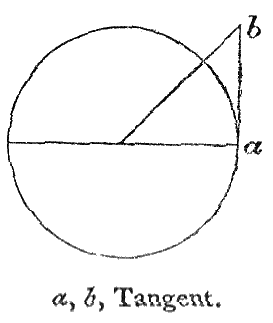
Tangent, tan′jent, n. a line which touches a curve, and which when produced does not cut it.—ns. Tan′gency, Tan′gence, state of being tangent: a contact or touching.—adj. Tangen′tial, of or pertaining to a tangent: in the direction of a tangent.—n. Tangential′ity.—adv. Tangen′tially, in the direction of a tangent.—Go off, or Fly off, at a tangent, to break off suddenly into a different line of thought, &c. [L. tangens, -entis, pr.p. of tangĕre, to touch.]
Tangerine, tan-je-rēn′, adj. relating to Tangiers on the Morocco coast.—n. a native of Tangiers: a Tangerine orange.
Tanghin, tang′gin, n. a vegetable poison of Madagascar, acting upon the heart like digitalis—formerly used for the judicial ordeal.
Tangible, tan′ji-bl, adj. perceptible by the touch: capable of being possessed or realised.—ns. Tangib′ilē, a tactile sensation or object; Tangibil′ity, quality of being tangible or perceptible to the touch; Tan′gibleness, the state or quality of being tangible.—adv. Tan′gibly. [L. tangibilis—tangĕre.]
Tangie, tang′i, n. an Orcadian water-spirit, appearing as a seahorse, or man covered with seaweed.
Tangle, tang′gl, n. a knot of things united confusedly: an edible seaweed: a perplexity, complication: (Scot.) any long hanging thing, even a lank person: an apparatus for dredging.—v.t. to unite together confusedly: to interweave: to ensnare, entangle.—n. Tang′lefoot (U.S.), whisky, &c.—adj. Tang′lesome (prov.), quarrelsome.—adv. Tang′lingly.—adj. Tang′ly, in a tangle: united confusedly: covered with tangle or seaweed. [Scand.; Dan. tang, Ice. thang, seaweed.]
Tangram, tan′gram, n. a Chinese puzzle, consisting of a square of wood cut into seven pieces of various shapes.
Tangum, tang′gum, n. the Tibetan piebald horse.
Tanist, tan′ist, n. the chief or holder of lands, &c., in certain Celtic races, also the chief's elective successor.—n. Tan′istry, an ancient Celtic mode of tenure, according to which the right of succession lay not with the individual, but with the family in which it was hereditary, and by the family the holder of office or lands was elected. [Ir. and Gael. tanaiste, lord—tan, country.]
Tanite, tan′īt, n. an emery cement.
Tanjib, tan′jib, n. a kind of figured muslin made in Oude.—Also Tan′zib.
Tank, tangk, n. a large basin or cistern: a reservoir of water.—v.t. to cause to flow into a tank: to plunge into a tank.—ns. Tank′age, the act of storing oil, &c., in tanks: the price charged for such storage: the capacity of a tank or series of tanks; Tank′-car, a railway-car for carrying petroleum in bulk in a long cylindrical tank; Tank′-en′gine, a locomotive that carries the water and coal it requires; Tank′-worm, a nematode worm in the mud of tanks in India. [Port. tanque (Sp. estanque, O. Fr. estang)—L. stagnum, a stagnant pool.]
Tanka, tan′ka, n. the boat population of Canton, inhabiting permanently the so-called tanka-boats, about 25 feet long.—Also Tan′kia.
Tankard, tangk′ard, n. a large vessel for holding liquors: a drinking-vessel with a lid. [O. Fr. tanquard, prob. from L. cantharus—Gr. kantharos.]
Tanner, tan′ėr, n. (slang) a sixpence. [Said to be Gipsy tano, little.]
Tannin, tan′in, n. an astringent substance found largely in oak-bark or gall-nuts, of great use in tanning.—n. Tann′ate, a salt of tannic acid.—adjs. Tann′ic; Tannif′erous, yielding tannin.—n. Tan′-ride, an enclosure spread with tan for riding.—Tannic acid, an acid forming the astringent principle of the bark of oak and other trees, used in tanning and in medicine. [Fr. tannin.]
Tanrec=Tenrec (q.v.).
Tansy, tan′zi, n. a genus of composite plants allied to Artemisia—Common tansy is a bitter, aromatic plant with small yellow flowers, common on old pasture: a pudding or cake flavoured with tansy, eaten at Easter. [O. Fr. tanasie, through Late L., from Gr. athanasia, immortality.]
Tantalise, tan′ta-līz, v.t. to torment by presenting something to excite desire, but keeping it out of reach.—ns. Tantalisā′tion, the act of tantalising: state of being tantalised; Tan′taliser, one who, or that which, tantalises.—adv. Tan′talisingly.—ns. Tan′talism, the punishment of Tantalus: a tormenting; Tan′talus, a spirit-case that locks; Tan′talus-cup, a philosophical toy, having a siphon within the figure of a man whose chin is on a level with its bend. [Tantalus, in Gr. mythology, who stood in Tartarus up to his chin in water, with branches of fruit over his head, the water receding when he wished to drink, and the fruit when he wished to eat.]
Tantalum, tan′tal-um, n. a very rare metal of no practical importance, discovered in 1801, closely allied to columbium or niobium.
Tantalus, tan′ta-lus, n. the wood-ibis, a genus of birds of the stork family, quite distinct from the true ibises.
Tantamount, tan′ta-mownt, adj. amounting to so much or to the same: equivalent: equal in value or meaning.—n. Tan′tity, the fact of being or having so much.—adv. Tan′to (mus.), so much or too much. [O. Fr., tant—L. tantum, so much, so great, and O. Fr. amonter, to amount.]
Tantara, tan-tar′a, n. a blast on a trumpet or horn. [Imit.]
Tantivy, tan-tiv′i, adv. with great speed.—adj. swift, hasty.—v.i. to hurry off.—n. a hunting cry: a rapid movement, a rush. [Imit.]
Tantony, tan′tō-ni, n. the smallest pig in the litter—also Tantony pig: a petted servant or follower. [From St Anthony, who was attended by a pig.]
Tantra, tan′tra, n. in Sanscrit literature, one of the religious text-books of the numerous sects of S'âktas—i.e. worshippers of the S'akti, or active divine energy, personified in some female deity, esp. in one of the many forms of Pârvatî, the wife of S'iva.—ns. Tan′trism, the doctrines of the tantras; Tan′trist, a devotee of tantrism. [Sans. tantra, thread, fundamental doctrine.]
Tantrum, tan′trum, n. a capricious fit of ill-temper without adequate cause. [Prob. W. tant, a passion.]
Tantum Ergo, tan′tum er′gō, n. the fifth stanza of the hymn 'Pange, lingua, gloriosi corporis mysterium,' written for the office of the Festival of Corpus Christi, which St Thomas of Aquino drew up in 1263. [From its opening words.]
Tanzimat, tan′zi-mat, n. an organic statute of the Turkish empire, introducing reforms and granting fuller personal liberty, esp. applied to the hatti-sherif of the sultan Abdul Medjid in 1839. [Turk.]
Tâoism, tä′ō-izm, or tow′izm, n. the religious system founded by the Chinese philosopher Lâo-tsze (born 604 B.C.), set forth in the Tâo Teh King.—n. Tâ′ōist, an adherent of Tâoism.—adj. Tâoist′ic.
Tao-tai, tä′ō-tī′, n. an officer presiding over a Chinese tao, or circuit, containing two or more fu, or departments.
Tap, tap, n. a gentle blow or touch, esp. with something small: a signal with a drum to put lights out.—v.t. to strike lightly, touch gently.—v.i. to give a gentle knock:—pr.p. tap′ping; pa.t. and pa.p. tapped. [O. Fr. tapper—Low Ger. tappen.]
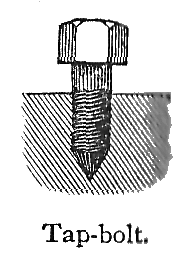
Tap, tap, n. a hole or short pipe through which liquor is drawn: a place where liquor is drawn: any particular liquor drawn through a tap.—v.t. to pierce, so as to let out fluid: to open a cask and draw off liquor: to broach a vessel.—v.i. to act as a tapster:—pr.p. tap′ping; pa.t. and pa.p. tapped.—ns. Tap′-bolt, a bolt with a head on one end and a thread on the other, to be screwed into some fixed part instead of passing through and receiving a nut; Tap′-cin′der, slag produced during puddling; Tap′-house, a tavern; Tap′lash, poor stale swipes; Tapote′ment, percussion; Tap′per, one who taps; Tap′ping, an operation frequently resorted to for the removal of fluid accumulations, particularly in the pleural and peritoneal cavities, consisting in the introduction of one end of a small tube into the cavity and withdrawing the fluid by siphon action, or by means of a vacuum: the act or art of tapping or drawing out fluid; Tap′room, a room where beer is served from the tap or cask; Tap′root, a root of a plant or tree striking directly downward without dividing, and tapering towards the end, as that of the carrot; Tap′ster, one who taps or draws off liquor, a publican, barman.—On tap, kept in cask—opp. to bottled: ready to be drawn upon. [A.S. tæppe, seen in tæppere, one who taps casks; Dut. tap, Ger. zapfen, a tap.]
Tap, tap, n. a Scotch form of top.
Tap, tap, n. an Indian malarial fever. [Hind.]
Tapa, tä′pä, n. the bark of the paper-mulberry, much used in the South Seas for mats, &c.—Also Tap′pa.
Tapadera, tap-a-dā′ra, n. a leather guard for the stirrup of the Californian saddle. [Sp., 'a cover'—tapar, to cover.]
Tape, tāp, n. a narrow fillet or band of woven work, used for strings, &c.: a strong flexible band rotating on pulleys for directing the sheets in a printing-machine: the strip of paper used in a printing-telegraph instrument, &c.: (slang) liquor.—v.t. to furnish, or tie up, with tape: to extend.—ns. Tape′-line, -meas′ure, a measuring-line of tape, marked with inches, &c.—adj. Tā′pen, made of tape.—n. Tā′pist, one who uses tape, an official formalist.—Breast the tape, in foot-racing, to touch with the breast the tape or ribbon held by the judge at the finish-line. [A.S. tæppe, a fillet—L. tapete—Gr. tapēs.]
Taper, tā′pėr, n. a small wax-candle or light: tapering form.—adj. narrowed towards the point, like a taper: long and slender.—v.i. to become gradually smaller towards one end.—v.t. to make to taper.—adj. Tā′pering, growing gradually thinner.—adv. Tā′peringly, in a tapering manner.—n. Tā′perness, state of being taper. [A.S. tapor, prob. Ir. tapar.]
Tapestry, tap′es-tri, n. an ornamental textile used for the covering of walls and furniture, and for curtains and hangings—divided into two classes, according as they are made in high-warp (haute lisse) or low-warp (basse lisse) looms.—v.t. to adorn with tapestry—n. Tap′et (Spens.). [O. Fr. tapisserie—tapis; a carpet—L. tapete, a carpet, tapestry—Gr. tapēs, -etis—Pers. tabsch.]
Tapeti, tap′e-ti, n. the Brazilian hare.
Tapetum, tā-pē′tum, n. (bot.) the cells on the outside of an archesporium: the pigmentary layer of the retina:—pl. Tā′peta. [L. tapete—Gr. tapēs, tapētos, a carpet.]
Tapeworm, tāp′wurm, n. a term sometimes used as a popular synonym for Cestoda or Cestoid Worms, but especially for those which belong to the families Tæniadæ and Bothriocephalidæ.
Tapioca, tap-i-ō′ka, n. a farinaceous substance obtained from cassava or manioc by drying it while moist on hot plates, so that the starch grains swell or burst, and the whole agglomerates in small lumps. [Braz. tipioka, the poisonous juice of the cassava.]
Tapir, tā′pir, n. a genus of Ungulata, of the section Perissodactyla, thick-skinned, short-necked, with a short flexible proboscis, found in South America.—adjs. Tapir′odont, having teeth like the tapir; Tap′iroid, related to the tapirs. [Braz.]
Tapis, tap′is, or ta-pē′, n. tapestry, carpeting: formerly, the cover of a council-table.—vs.i. (obs.) Tap′pish, Tap′pice, to hide.—Upon the tapis, on the table: under consideration. [Fr.]
Tappet, tap′et, n. (Spens.) tapestry.
Tappet, tap′et, n. a projecting arm, lever, &c. from any moving part of a machine supplying intermittent motion to some other part.—ns. Tapp′et-loom, -mo′tion, -ring, -rod, &c.
Tappit, tap′it, adj. (Scot.) having a top or crest.—n. Tapp′it-hen, a crested hen: a vessel for liquor holding about three quarts, a liberal allowance of drink generally.
Tapsalteerie, tap-sal-tē′ri, adj. (Scot.) topsy-turvy.—Also Tapsieteer′ie.
Tapsman, taps′man, n. (Scot.) a servant with principal charge, the chief of a company of drovers.
Tapu. See Taboo.
Tar, tär, v.t. to set on, incite to fight. [M. E. tarien, to irritate—A.S. tergan, to provoke.]
Tar, tär, n. a viscous, liquid, resinous substance of a dark colour, obtained from pine-trees: a sailor, so called from his tarred clothes.—v.t. to smear with tar:—pr.p. tar′ring; pa.t. and pa.p. tarred.—ns. Tar′heel, a North Carolinian; Tar′hood, sailors collectively.—Tar and feather, to smear with tar and then cover with feathers.—Be tarred with the same brush, or stick, to have the same faults as another; Have a touch of the tar-brush, to have an infusion of negro blood in the veins. [A.S. teoro, teru; Dut. teer.]