Front matter (continued 6)
Reading edition
Sixteenmo=Sexto-decimo (q.v.).
Sixty, siks′ti, adj. and n. six times ten.—adj. and n. Six′tieth, the sixth tenth: the ordinal of sixty. [A.S. sixtig.]
Sizar, sī′zar, n. the name of an order of students at Cambridge and Dublin—from the allowance of victuals made to them from the college buttery.—n. Sī′zarship. [Size, fixed quantity.]
Size, sīz, n. extent of volume or surface: magnitude: an allotted portion: (pl.) allowances (Shak.).—v.t. to arrange according to size: at Cambridge, to buy rations at a certain fixed rate: to measure.—v.i. to increase in size.—adjs. Sī′zable, Size′able, of suitable size: of considerable size or bulk; Sized, having a particular size.—ns. Sī′zer, one who, or that which, sizes or measures, a kind of gauge; Sī′zing, act of sorting articles according to size, esp. crushed or stamped ores in mining: an order for extra food from a college buttery.—Size up, to measure, consider carefully. [Contr. of assize (q.v.).]
Size, sīz, Sizing, sī′zing, n. a kind of weak glue, used as varnish: any gluey substance.—v.t. to cover with size.—adj. Sized, having size in its composition.—n. Sī′ziness.—adj. Sī′zy, size-like: glutinous.
Sizel=Scissel (q.v.).
Sizzle, siz′l, v.i. to make a sound as if frying.—n. a hissing sound; extreme heat.—n. Sizz′ling, a hissing.
Skain=Skein (q.v.).
Skainsmate, skānz′māt, n. (Shak.) a companion, a scapegrace.
Skald, n.=Scald, a poet.
Skat, skat, n. a game played with thirty-two cards as in Piquet, and said to have been invented in 1817 in Altenburg. Each of three players receives ten cards, the two others being laid aside (hence the name from O. Fr. escart, laying aside).
Skate, skāt, n. a kind of sandal or frame of wood on a steel blade for moving on ice.—v.i. to slide on, skates.—ns. Skā′ter; Skā′ting; Skā′ting-rink. [Dut. schaats; cf. also Dan. sköite.]
Skate, skāt, n. the popular name of several species of Ray, esp. those of the family Raiidæ and genus Raia, with greatly extended pectoral fins. [Ice. skata—Low L. squatus—L. squatina; cf. Shad.]
Skathe. Same as Scathe.
Skaw, skä, n. a promontory.—Also Scaw. [Ice. skagi—skaga, to jut out.]
Skean, skēn, n. a dagger.—n. Skean-dhu (skēn′-dōō), the knife stuck in the stocking of the Highland dress. [Gael, sgian, a knife.]
Skeary, skē′ri, a dial. form of scary.
Skedaddle, skē-dad′l, v.t. (prov.) to spill, scatter.—v.i. (coll.) to scamper off.—n. a scurrying off. [Ety. unknown. Prob. conn. somehow with shed—A.S. sceádan, to pour.]
Skee, skē, n. a wooden runner for sliding down a declivity.—v.i. to slide on skees. [Dan. ski—Ice. skídh.]
Skeel, skēl, n. (Scot.) a milking-pail, a washing-tub. [Scand., Ice. skjóla.]
Skeely, skē′li, adj. (Scot.) skilful.
Skeesicks, skē′ziks, n. (U.S.) a rascal.
Skeeter, skē′tėr, n. a mosquito.
Skeg, skeg, n. a stump, branch: the after-part of a ship's keel.
Skeg, skeg, n. a wild-plum.
Skein, skān, n. a knot or number of knots of thread or yarn. [O. Fr. escagne, from Celt.; cf. Ir. sgainne, a skein.]
Skelder, skel′dėr, v.i. and v.t. to practise begging: to swindle.
Skeleton, skel′e-tun, n. the bones of an animal separated from the flesh and preserved in their natural position: the framework or outline of anything: a very lean and emaciated person: a very thin form of light-faced type.—adj. pertaining to a skeleton—also Skel′etal.—ns. Skeletog′eny (-toj′-); Skeletog′raphy; Skeletol′ogy.—v.t. Skel′etonise, to reduce to a skeleton.—n. Skel′eton-key, a key for picking locks, without the inner bits.—Skeleton in the cupboard, closet, house, &c., some hidden domestic source of sorrow or shame. [Gr. skeleton (sōma), a dried (body)—skeletos, dried—skellein, to dry, to parch.]
Skelloch, skel′oh, v.i. (Scot.) to cry out with a shrill voice.—n. a squeal.
Skellum, skel′um, n. (Scot.) a ne'er-do-well. [Dut. schelm, a rogue.]
Skelly, skel′i, v.i. (Scot.) to squint. [Cf. Dan. skele, Sw. skela, Ger. schielen, to squint.]
Skelp, skelp, v.t. (Scot.) to slap.—v.i. to move briskly along, to bound along.—n. a slap: a heavy fall of pelting rain: a large portion.—adj. Skelp′ing, very big or full. [Gael. sgealp, a slap.]
Skelter, skel′tėr, v.i. to hurry or dash along.
Skep, skep, n. a grain-basket, or beehive made of straw or wicker-work.—n. Skep′ful, as much as a skep will hold. [A.S. scep—Scand., Ice. skeppa.]
Skeptic=Sceptic; Skepsis=Scepsis.
Skerry, sker′i, n. a rocky isle. [Ice. sker.]
Sketch, skech, n. a first draft of any plan or painting: an outline, a short and slightly constructed play, essay, &c.: a short dramatic scene for representation by two persons: an artist's preliminary study of a work to be elaborated.—v.t. to make a rough draft of: to draw the outline: to give the principal points of.—v.i. to practise sketching.—adj. Sketch′able, capable of being sketched effectively.—ns. Sketch′book, a blank book used for sketching by an artist or writer: a printed volume of literary sketches; Sketch′er, one who sketches.—adv. Sketch′ily.—n. Sketch′iness.—adj. Sketch′y, containing a sketch or outline: incomplete, slight. [Dut. schets, It. schizzo—L. schedium—schedius, made off-hand—Gr. schedios, sudden.]
Skew, skū, adj. oblique: intersecting a road, river, &c. not at right angles, as a bridge.—adv. awry: obliquely.—v.t. to turn aside.—n. a deviation, a mistake: a squint: (archit.) the sloping top of a buttress slanting off against a wall.—ns. Skew′-arch, an arch standing obliquely on its abutments; Skew′-back (archit.), the course of masonry on the top of an abutment with a slope for the base of the arch to rest against.—adj. Skew′-bald, spotted irregularly, piebald.—n. Skew′-bridge, a bridge having its arch or arches set obliquely on its abutments, as when a railway crosses a road, &c., at an oblique angle.—adjs. Skewed, distorted; Skew-gee′ (coll.), crooked.—n. Skew′-wheel, a bevel-wheel with teeth formed obliquely on the rim. [Old Dut. schūwen (Dut. schuwen); Ger. scheuen, to shun; cf. Shy.]
Skewer, skū′ėr, n. a pin of wood or iron for keeping meat in form while roasting.—v.t. to fasten with skewers. [Prov. Eng. skiver, prob. the same as shiver, a splinter of wood.]
Skiascopy, skī′a-skō-pi, n. the shadow-test for measuring the refraction of an eye.—Also Scī′ascopy. [Gr. skia, a shadow, skopein, to view.]
Skid, skid, n. a piece of timber hung against a ship's side to protect it from injury: a sliding wedge or drag to check the wheel of a wagon on a steep place: a slab put below a gun to keep it off the ground.—v.t. to check with a skid.—v.i. to slide along without revolving.—n. Skid′der, one who uses a skid. [Scand., Ice. skídh; A.S. scíd, a piece split off.]
Skiey, skī′i, adj. Same as Skyey.
Skiff, skif, n. a small light boat. [A doublet of ship.]
Skiff, skif, adj. (prov.) distorted: awkward.
Skill, skil, n. knowledge of anything: dexterity in practice.—v.i. to understand, to be dexterous in: to make a difference, to signify.—adj. Skil′ful, having or displaying skill: dexterous.—adv. Skil′fully.—n. Skil′fulness.—adjs. Skilled, having skill: skilful: expert; Skil′less (Shak.), wanting skill, artless. [Scand., as Ice. skil, a distinction, skilja, to separate.]
Skillet, skil′et, n. a small metal vessel with a long handle, used for boiling water, in cooking, &c. [Prob. from O. Fr. escuellette, dim of escuelle (Fr. écuelle)—L. scutella, dim. of scutra, a dish.]
Skilligalee, skil-i-ga-lē′, n. thin watery soup.—Also Skilligolee′, Skill′y. [Ety. dub.]
Skilling, skil′ing, n. a small coin formerly current in North Germany and Scandinavia, in value from ¼d. to 1d. [Dan.]
Skilts, skilts, n.pl. short loose trousers.
Skilvings, skil′vingz, n.pl. (prov.) the rails of a cart.
Skim, skim, v.t. to clear off scum: to take off by skimming: to brush the surface of lightly.—v.i. to pass over lightly: to glide along near the surface: to become coated over:—pr.p. skim′ming; pa.t. and pa.p. skimmed.—n. the act of skimming: what is skimmed off.—ns. Skim′mer, a utensil for skimming milk: a bird that skims the water; Skim′-milk, skimmed milk: milk from which the cream has been skimmed; Skim′ming, the act of taking off that which floats on the surface of a liquid, as cream: that which is taken off, scum.—adv. Skim′mingly, by skimming along the surface. [Scum.]
Skimble-skamble, skim′bl-skam′bl, adj. wandering, wild, rambling, incoherent.—adv. in a confused manner. [A reduplication of scamble.]
Skimmington, skim′ing-ton, n. a burlesque procession intended to ridicule a henpecked husband: a riot generally.—Also Skim′ington, Skim′merton, Skim′itry. [Ety. unknown.]
Skimp, skimp, v.t. to give scanty measure, to stint: to do a thing imperfectly.—v.i. to be parsimonious.—adj. scanty, spare.—adj. Skim′ping, sparing: meagre: done inefficiently.—adv. Skim′pingly.—adj. Skim′py. [A variant of scamp.]
Skin, skin, n. the natural outer covering of an animal body: a hide: the bark or rind of plants, &c.: the inside covering of the ribs of a ship: a drink of whisky hot.—v.t. to cover with skin: to cover the surface of: to strip the skin from, to peel: to plunder, cheat: to answer an examination paper, &c., by unfair means.—v.i. to become covered with skin: to sneak off:—pr.p. skin′ning; pa.t. and pa.p. skinned.—adj. Skin′-deep, as deep as the skin only: superficial.—ns. Skin′flint, one who takes the smallest gains: a very niggardly person; Skin′ful, as much as one can hold, esp. of liquor.—adj. Skin′less, having no skin, or a very thin one.—ns. Skin′ner; Skin′niness.—adjs. Skin′ny, consisting of skin or of skin only: wanting flesh; Skin′-tight, fitting close to the skin.—n. Skin′-wool, wool pulled from the skin of a dead sheep.—By, or With, the skin of one's teeth, very narrowly; Clean skins, unbranded cattle; Save one's skin, to escape without injury. [A.S. scinn; Ice. skinn, skin, Ger. schinden, to flay.]
Skink, skingk, n. drink.—v.i. and v.t. to serve drink.—n. Skink′er, one who serves drink, a tapster.—adj. Skink′ing (Scot.), thin, watery. [A.S. scencan, to pour out drink; Ger. schenken.]
Skink, skingk, n. an African lizard. [L. scincus—Gr. skingkos, the adda.]
Skink, skingk, n. (Scot.) a shin-bone of beef, soup made from such. [Cf. Dut. schonk, a bone; cf. Shank.]
Skio, skyō, n. in Orkney, a fisherman's hut.—Also Skeo. [Norw. skjaa, a shed.]
Skip, skip, v.i. to leap: to bound lightly and joyfully: to pass over.—v.t. to leap over: to omit:—pr.p. skip′ping; pa.t. and pa.p. skipped.—n. a light leap: a bound: the omission of a part: the captain of a side at bowls and curling: a college servant.—ns. Skip′jack, an impudent fellow: the blue-fish, saurel, &c.; Skip′-ken′nel, one who has to jump the gutters, a lackey; Skip′per, one who skips: a dancer: (Shak.) a young thoughtless person: a hesperian butterfly.—adj. Skip′ping, flighty, giddy.—adv. Skip′pingly, in a skipping manner: by skips or leaps.—n. Skip′ping-rope, a rope used in skipping. [Either Celt., according to Skeat, from Ir. sgiob, to snatch, Gael. sgiab, to move suddenly, W. ysgipio, to snatch away; or Teut., conn. with Ice. skopa, to run.]
Skip, skip, n. an iron box for raising ore running between guides, or in inclined shafts fitted with wheels to run on a track, a mine-truck.
Skipetar, skip′e-tär, n. an Albanian: the Albanian language. [Albanian skipetar, a mountaineer.]
Skipper, skip′ėr, n. the master of a merchant-ship.—Skipper's daughters, white-topped waves. [Dut. schipper; Dan. skipper.]
Skipper, skip′ėr, n. a barn, a shed in which to shelter for the night.—v.i. to shelter in such a place.—n. Skipp′er-bird, a tramp. [Prob. W. ysguber, a barn.]
Skippet, skip′et, n. (Spens.) a small boat. [Dim. of A.S. scip, ship.]
Skippet, skip′et, n. a round flat box for holding a seal, which used to be attached to the parchment by ribbons passing through the lid.
Skirl, skirl, v.t. and v.i. (Scot.) to shriek shrilly.—n. a shrill cry.—n. Skir′ling, a shrill sound.
Skirmish, skėr′mish, n. an irregular fight between two small parties: a contest.—v.i. to fight slightly or irregularly.—ns. Skir′misher, a soldier belonging to troops dispersed to cover front or flank, and prevent surprises; Skir′mishing. [O. Fr. escarmouche—Old High Ger. skerman, scirman, to fight.]
Skirr, skėr, v.t. (Shak.) to ramble over, to scour.—v.i. to run in haste. [Scurry.]
Skirret, skir′et, n. an edible water-parsnip: a perennial plant, native to China and Japan. [Sugar-root.]
Skirt, skėrt, n. the part of a garment below the waist: a woman's garment like a petticoat: the edge of any part of the dress: border: margin: extreme part.—v.t. to border: to form the edge of.—v.i. to be on the border: to live near the extremity.—ns. Skirt′-danc′ing, a form of ballet-dancing in which the flowing skirts are waved about in the hands; Skir′ter, a huntsman who dodges his jumps by going round about; Skir′ting, strong material made up in lengths for women's skirts: skirting-board; Skir′ting-board, the narrow board next the floor round the walls of a room.—Divided skirt, a skirt in the form of loose trousers. [Scand., Ice. skyrta, a shirt. A doublet of shirt.]
Skit, skit, n. any sarcastic squib, lampoon, or pamphlet. [Ice. skúti, a taunt.]
Skite, skīt, v.i. (Scot.) to glide or slip—also Skyte.—n. a sudden blow: a trick.—vs.i. Skit, to leap aside: to caper; Skit′ter, to skim lightly over: to void thin excrement: to draw a baited hook along the surface of water. [Scand., Sw. skutta, to leap, skjuta, to shoot.]
Skittish, skit′ish, adj. unsteady, light-headed, easily frightened: hasty, volatile, changeable: wanton.—adv. Skitt′ishly.—n. Skitt′ishness. [Skite.]
Skittles, skit′lz, n.pl. a game of ninepins in which a flattened ball or thick rounded disc is thrown to knock down the pins—played in a Skitt′le-all′ey, or -ground. In American Bowls, the game is played with ten pins arranged in the form of a triangle, the missile being rolled along a carefully constructed wooden floor.—v.t. Skitt′le, to knock down.—n Skitt′le-ball, the ball thrown in playing at skittles. [A variant of shittle or shuttle.]
Skiver, skī′vėr, n. a kind of leather made of split sheep-skins, used for bookbinding, &c.—n. a machine for skiving leather.—v.t. Skive, to cut, pare off.—n. Skī′ving, the act of skiving: a piece skived off—of leather, usually on the flesh side. [From root of shive, shiver.]
Skiver, skī′vėr, v.t. (prov.) to run through, to skewer.
Skivie, skiv′i, adj. (Scot.) deranged: askew.
Sklent, a Scotch form of slant.
Skoal, skōl, interj. hail! a friendly exclamation of salutation before drinking, &c. [Ice. skál; Norw. skaal, a bowl, Sw. skål.]
Skolion, skō′li-on, n. a short drinking-song in ancient Greece, taken up by the guests in turn:—pl. Skō′lia. [Gr.]
Skrimmage. Same as Scrimmage.
Skryer, skrī′ėr, n. one who uses the divining-glass.
Skua, skū′a, n. a bird of the family Laridæ, esp. the Great Skua (Stercorarius catarrhactes), a rapacious bird about two feet long, the plumage predominantly brown, breeding in the Shetlands.—n. Skū′a-gull. [Norw.]
Skue, skū, an obsolete form of skew.
Skug, Scug, skug, n. (prov.) shelter.—v.t. to shelter: to expiate.—n. Skug′gery, Scug′gery, secrecy.—adjs. Skug′gy, Scug′gy, shady. [Ice. skuggi, a shade.]
Skug, skug, n. (prov.) a squirrel.
Skulduddery. See Sculduddery.
Skulk, skulk, v.i. to sneak out of the way: to lurk.—ns. Skulk, Skulk′er, one who skulks.—adv. Skulk′ingly.—n. Skulk′ing-place. [Scand., as in Dan. skulke, to sneak; conn. with Ice. skjöl, cover, hiding-place; also with Eng. scowl.]
Skull, skul, n. the bony case that encloses the brain: the head, the sconce, noddle: a crust formed on the ladle, &c., by the partial cooling of molten metal: in armour, the crown of the head-piece: (Scot.) a shallow, bow-handled basket.—n. Skull′cap, a cap which fits closely to the head: the sinciput.—adj. Skull′-less.—Skull and cross-bones, a symbolic emblem of death and decay. [Ice. skál, a shell; conn. with shell and scale, a thin plate.]
Skulpin=Sculpin.
Skunk, skungk, n. a small North American carnivorous quadruped allied to the otter and weasel, defending itself by emitting an offensive fluid: a low fellow: (U.S.) a complete defeat.—v.t. to inflict such.—ns. Skunk′-bird, -black′bird, the male bobolink in full plumage. [Indian seganku.]
Skupshtina, skoopsh′ti-na, n. the national assembly of Servia, having one chamber and 178 deputies, three-fourths elected and one-fourth nominated by the crown.—Great Skupshtina, specially elected for discussing graver questions.
Skurry=Scurry.
Sky, skī, n. the apparent canopy over our heads: the heavens: the weather: the upper rows of pictures in a gallery.—v.t. to raise aloft, esp. to hang pictures above the line of sight.—adjs. Sky′-blue, blue like the sky; Sky′-born, of heavenly birth.—n. Sky′-col′our, the colour of the sky.—adjs. Sky′-col′oured, blue, azure; Skyed, surrounded by sky; Sky′ey, like the sky: ethereal; Sky′-high, very high; Sky′ish (Shak.), like or approaching the sky, lofty.—n. Sky′lark, a species of lark that mounts high towards the sky and sings on the wing.—v.i. to engage in any kind of boisterous frolic.—ns. Sky′larking, running about the rigging of a ship in sport: frolicking; Sky′-light, a window in a roof or ceiling towards the sky for the admission of light; Sky′line, the horizon; Sky′-par′lour, a lofty attic; Sky′-pī′lot, a clergyman.—adj. Sky′-plant′ed, placed in the sky.—n. Sky′-rock′et, a rocket that ascends high towards the sky and burns as it flies.—v.i. to move like a sky-rocket, to rise and disappear as suddenly.—ns. Sky′sail, the sail above the royal; Sky′scape, a view of a portion of the sky, or a picture of the same; Sky′-scrāp′er, a sky-sail of a triangular shape: anything shooting high into the sky.—adj. Sky′-tinc′tured, of the colour of the sky.—adv. Sky′ward, toward the sky. [Ice. ský, a cloud; akin to A.S. scúa, Gr. skia, a shadow.]
Skye, skī, n. for Skye terrier. [See Terrier.]
Skyr, skir, n. curds. [Ice.]
Skyrin, skī′rin, adj. (Scot.) shining, showy.
Slab, slab, n. a thin slip of anything, esp. of stone, having plane surfaces: a piece sawed from a log.—v.t. to cut slabs from, as a log.—adj. Slab′-sid′ed, having long flat sides, tall and lank.—n. Slab′stone, flagstone. [Scand., Ice. sleppa, to slip, Norw. sleip, a slab of wood.]
Slab, slab, adj. thick.—n. mud.—adj. Slab′by, muddy. [Celt., Ir., and Gael. slaib, mud.]
Slabber, slab′ėr, v.i. to slaver: to let the saliva fall from the mouth: to drivel.—v.t. to wet with saliva.—n. Slabb′erer.—adj. Slabb′ery.—n. Slabb′iness.—adj. Slabb′y. [Allied to Low Ger. and Dut. slabbern; imit. Doublet slaver.]
Slack, slak, adj. lax or loose: not firmly extended or drawn out: not holding fast, weak: not eager or diligent, inattentive: not violent or rapid, slow.—adv. in a slack manner: partially: insufficiently.—n. that part of a rope, belt, &c. which is slack or loose: a period of inactivity: a slack-water haul of a net.—vs.i. Slack, Slack′en, to become loose or less tight: to be remiss: to abate: to become slower: to fail or flag.—v.t. to make less tight: to loosen: to relax: to remit: to abate: to withhold: to use less liberally: to check: (B.) to delay.—v.t. Slack′-bake, to half-bake.—adj.—Slack′-hand′ed, remiss.—n. Slack′-jaw (slang), impudent talk.—adv. Slack′ly.—n. Slack′ness.—adj.—Slack′-salt′ed, insufficiently salted.—n. Slack′-wa′ter, ebb-tide: slow-moving water, as that above a dam.—adj. pertaining to slack-water.—Slack away, to ease off freely; Slack-in-stays, slow in going about, of a ship; Slack off, to ease off; Slack up, to ease off: to slow. [A.S. sleac; Sw. slak, Ice. slakr.]
Slack, slak, n. coal-dross. [Ger. schlacke.]
Slack, slak, n. (Scot.) a cleft between hills: a common: a boggy place. [Scand., Ice. slakki, a hill-slope.]
Slade, slād, n. a little valley or dell; a piece of low, moist ground. [A.S. slæd, a plain; prob. Celt., Ir. slad.]
Slade, slād, n. a peat-spade.
Slae, a Scotch form of sloe.
Slag, slag, n. vitrified cinders from smelting-works, &c.: the scoriæ of a volcano.—v.i. to cohere into slag.—adj. Slag′gy, pertaining to, or like, slag. [Sw. slagg; cf. Ger. schlacke, dross.]
Slain, slān, pa.p. of slay.
Slaister, slās′tėr, n. (Scot.) a slobbery mess, slovenly work.—v.t. to bedaub.—v.i. to slabber: to move about in a dirty, slovenly manner.—adj. Slais′tery. [Prob. Sw. slaska, to dabble, slask, wet.]
Slake, slāk, v.t. to quench: to extinguish: to mix with water: to make slack or inactive.—v.i. to go out: to become extinct.—adj. Slake′less, that cannot be slaked: inextinguishable. [A.S. sleacian, to grow slack—sleccan, to make slack—sleac, slack.]
Slake, slāk, n. a channel through a swamp or morass: slime. [Ice. slakki, a hill-slope.]
Slake, slāk, v.t. (Scot.) to besmear.—n. a slabbery daub. [Prob. conn. with Ice. sleikja, to lick; Ger. schlecken, to lick.]
Slam, slam, v.t. or v.i. to shut with violence and noise: to throw down with violence: to win all the tricks in a card-game:—pr.p. slam′ming; pa.t. and pa.p. slammed.—n. the act of slamming: the sound so made: the winning of all the tricks at whist, &c. [Scand., Norw. slemma, Ice. slamra.]
Slam, slam, n. an old card-game.
Slam, slam, n. a shambling fellow. [Cf. Dut. slomp, Ger. schlampe.]
Slamkin, slam′kin, n. a loose 18th-century women's morning-gown.—Also Slam′merkin.
Slander, slan′dėr, n. a false or malicious report: malicious defamation by words spoken: calumny.—v.t. to defame: to calumniate.—n. Slan′derer.—adj. Slan′derous, given to, or containing, slander: calumnious.—adv. Slan′derously.—n. Slan′derousness, the state or quality of being slanderous. [O. Fr. esclandre—L. scandalum—Gr. skandalon.]
Slang, slang, n. a conventional tongue with many dialects, which are, as a rule, unintelligible to outsiders, such as Gypsy, Canting or Flash, Back-slang, and Shelta or Tinkers' Talk: any kind of colloquial and familiar language serving as a kind of class or professional shibboleth.—adj. pertaining to slang.—v.i. to use slang, and esp. abusive language.—v.t. to scold.—adv. Slang′ily.—n. Slang′iness.—adj. Slang′ular, slangy.—v.i. Slang′-whang, to talk slangily or boisterously.—n. Slang′-whang′er, an abusive and wordy fellow.—adj. Slang′y. [Explained by Skeat as Scand., Norw. sleng, a slinging, a device, a burthen of a song, slengja, to sling. Leland boldly makes it Romany, and orig. applied to everything relating to shows—in Hindustani, Swangi, also often Slangi.]
Slang, slang, n. a narrow strip of land.—Also Slank′et. Slang, slang, n. (slang) a counterfeit weight or measure: a travelling show, or a performance of the same: a hawker's license: a watch-chain: (pl.) convicts' leg-irons.
Slant, slant, adj. sloping: oblique: inclined from a direct line—also Slan′ting.—n. a slope: a gibe: (slang) a chance.—v.i. to turn in a sloping direction.—v.i. to slope, to incline towards: (Scot.) to exaggerate, to lie.—adj. Slantendic′ūlar, oblique: indirect.—advs. Slan′tingly, in a slanting direction: with a slope or inclination; Slant′ly, Slant′wise, in a sloping, oblique, or inclined manner.—Slant-of-wind, a transitory breeze of favourable wind. [Scand., Sw. slinta, to slide.]
Slap, slap, n. a blow with the hand or anything flat.—v.t. to give a slap to:—pr.p. slap′ping; pa.t. and pa.p. slapped.—adv. with a slap: suddenly, violently.—adj. (slang) first-rate.—adv. Slap′-bang, violently, all at once.—adj. dashing, violent.—n. a cheap eating-house.—adv. Slap′-dash, in a bold, careless way.—adj. off-hand, rash.—n. rough-cast harling: carelessly done work.—v.t. to do anything in a hasty, imperfect manner: to rough-cast with mortar.—n. Slap′per (slang), anything big of its kind.—adjs. Slap′ping, very large; Slap′-up, excellent, very grand. [Allied to Low Ger. slapp, Ger. schlappe; imit.]
Slap, slap, n. (Scot.) a gap in a fence: a narrow cleft between hills.—v.t. to break an opening in.
Slape, slāp, adj. (prov.) slippery, crafty. [Ice. sleipr, sleppr, slippery—slípa, to be smooth.]
Slapjack=Flapjack (q.v.).
Slash, slash, v.t. to cut by striking with violence and at random: to make long cuts: to ornament by cutting slits in the cloth in order to show some fine material underneath.—v.i. to strike violently and at random with an edged instrument: to strike right and left: to move rapidly.—n. a long cut: a cut at random: a cut in cloth to show colours underneath: a stripe on a non-commissioned officer's sleeve: a clearing in a wood.—adj. Slashed, cut with slashes: gashed.—ns. Slash′er, anything which slashes; Slash′ing, a slash in a garment: the felling of trees as a military obstacle, also the trees so felled.—adj. cutting mercilessly, unsparing: dashing: very big, slapping. [O. Fr. eslecher, to dismember—Old High Ger. slīzan, to split.]
Slash, slash, v.i. (Scot.) to work in wet.—n. a large quantity of watery food, as broth, &c.—adj. Slash′y, dirty, muddy. [Sw. slaska, dabble—slask, wet.]
Slat, slat, v.t. to strike, beat.—v.i. to flap violently.—n. a sudden sharp blow. [Scand., Ice. sletta, to slap, Norw. sletta, to cast.]
Slat, slat, n. a thin piece of stone, a slate: a strip of wood.—adj. made of slats.—adj. Slat′ted, covered with slats. [O. Fr. esclat—Old High Ger. slīzan, to slit.]
Slatch, slach, n. the slack of a rope: an interval of fair weather: a short breeze. [Slack.]
Slate, slāt, n. a highly metamorphosed argillaceous rock, fine-grained and fissile, and of a dull blue, gray, purple, or green colour—used in thin slabs of small size for ordinary roofs, and in larger slabs for dairy-fittings, wash-tubs, cisterns, tables, &c., and when polished for writing-slates and 'black-boards:' a piece of slate for roofing, or for writing upon: a preliminary list of candidates before a caucus.—adj. bluish-gray, slate-coloured.—v.t. to cover with slate: to enter on a slate.—ns. Slate′-axe, a slater's tool, a sax; Slate′-clay, a fissile shale.—adjs. Slā′ted, covered with slates; Slate′-gray, of a light slate colour.—ns. Slate′-pen′cil, a cut or turned stick of soft slate, or of compressed moistened slate-powder, for writing on slate; Slā′ter; Slā′tiness, the quality of being slaty; Slā′ting, the act of covering with slates: a covering of slates: materials for slating.—adj. Slā′ty, resembling slate: having the nature or properties of slate. [O. Fr. esclat—Old High Ger. slīzan, Ger. schleissen, to split.]
Slate, slāt, v.t. to abuse, criticise severely: (prov.) to set a dog at.—n. Slā′ting, a severe criticism. [A.S. slítan, to slit.]
Slater, slā′tėr, n. a terrestrial oniscid isopod, as the common Porcellio scaber.
Slather, slath′ėr, n. (slang) a large quantity.
Slattern, slat′ėrn, n. a woman negligent of her dress: an untidy woman.—v.i. Slatt′er (prov.), to be untidy or slovenly.—n. Slatt′ernliness.—adj. Slatt′ernly, like a slattern: negligent of person: slovenly: dirty: sluttish.—adv. negligently: untidily.—adj. Slatt′ery (prov.) wet. [From slatter, a freq. of slat, to strike (q.v.).]
Slaughter, slaw′tėr, n. a killing: a great destruction of life: carnage: butchery.—ns. Slaugh′terer; Slaugh′terhouse, a place where beasts are killed for the market; Slaugh′terman, a man employed in killing or butchering animals.—adj. Slaugh′terous, given to slaughter: destructive: murderous.—adv. Slaugh′terously. [Prob. Ice. slátr, butchers' meat, whence slátra, to slaughter cattle. The A.S. is sleaht—sleán, to slay.]
Slav, Slave, släv, n. one belonging to any of the Slavonic groups of Aryans—Bulgarians, Czechs, Poles, Russians, Servians, Wends, &c.—adj. Slav′ic. [Slovene or Slovane, from Polish slovo, a word, thus meaning the people who spoke intelligibly, as distinguished from their neighbour, Niemets, the German, lit. the dumb man. Miklosich considers both to be tribal names.]
Slave, slāv, n. a captive in servitude: any one in bondage: a serf: one who labours like a slave: a drudge: one wholly under the will of another: one who has lost all power of resistance.—v.i. to work like a slave: to drudge.—adj. Slave′-born, born in slavery.—ns. Slave′-drī′ver, one who superintends slaves at their work; Slave′-fork, a long and heavy branch into the forked end of which a slave's neck is fixed to prevent his escaping from the slave-trader's gang.—adj. Slave′-grown, grown on land worked by slaves.—ns. Slave′-hold′er, an owner of slaves; Slave′-hold′ing; Slave′-hunt, a hunt after runaway slaves; Slā′ver, a ship employed in the slave-trade; Slā′very, the state of being a slave: serfdom: the state of being entirely under the will of another: bondage: drudgery; Slave′-ship, a ship used for transporting slaves.—n.pl. Slave′-states, those states of the American Union which maintained domestic slavery before the Civil War—Delaware, Maryland, Virginia, North and South Carolina, Georgia, Florida, Alabama, Mississippi, Louisiana, Texas, Arkansas, Missouri, Kentucky, and Tennessee.—ns. Slave′-trade, the trade of buying and selling slaves; Slave′-trā′der, a trader in slaves; Slā′vey (slang), a domestic drudge, a maid-servant.—adj. Slā′vish, of or belonging to slaves: becoming slaves: servile: mean: base: laborious.—adv. Slā′vishly.—ns. Slā′vishness; Slāvoc′racy, slave-owners collectively, or their interests, &c.; Slā′vocrat, a member of the slavocracy. [O. Fr. esclave—Mid. High Ger. slave (Ger. sclave), from Slav, above.]
Slaver, slav′ėr, n. spittle or saliva running from the mouth.—v.i. to let the saliva run out of the mouth.—v.t. to smear with saliva.—n. Slav′erer.—adv. Slav′eringly, in a slavering manner.—adj. Slav′ery, slabbery. [Slabber.]
Slavonic, sla-von′ik, adj. of or belonging to the Slavs, or their language—also Sclavon′ic, Slavō′nian, Sclavō′nian.—vs.t. Slavon′icise, Slav′onise, to render Slavonic in character, language, &c.—ns. Slav′ophil, one devoted to promoting the interests of the Slavonic peoples; Slav′ophilism, Slavophil feelings and aims; Slav′ophōbist, one who dreads the growth of Slav influence.
Slaw, slaw, n. sliced cabbage eaten as a salad. [Dut. slaa.]
Slay, slā, v.t. to strike: to kill: to put to death: to destroy:—pa.t. slew (slōō); pa.p. slain (slān).—n. Slay′er. [A.S. sleán; Ice. slá, Goth. slahan, Ger. schlagen, to strike.]
Sleave, slēv, n. the ravelled, knotty part of silk thread: (Shak.) floss-silk.—v.t. to separate, as threads:—pr.p. sleav′ing; pa.p. sleaved. [Cf. Dan. slöife, a loose knot, Sw. slejf, a knot of ribbon, Ger. schleife, a loop.]
Sleazy, slā′zi, or slē′zi, adj. thin and flimsy.—n. Slea′ziness. [Prob. Ger. schleissig, worn out, readily split—schleissen, to split.]
Sled, sled, Sledge, slej, n. a carriage with runners made for sliding upon snow: a sleigh: anything dragged without wheels along the ground.—v.t. and v.i. to convey, or to travel, in a sled.—p.adj. Sled′ded (Shak.), sledged.—ns. Sled′ding, the act of transporting on a sled; Sledge′-chair, a chair mounted on runners for ice. [Ice. sledhi; from a root seen in A.S. slídan, to slide.]
Sledge, slej, n. an instrument for striking: a large heavy hammer used chiefly by ironsmiths. [A.S. slecg—sleán, to strike, slay (cf. Ger. schlägel, a beater—schlagen).]
Sleek, slēk, adj. smooth: glossy: soft, not rough: insinuating, plausible: dexterous.—v.t. to make smooth or glossy: to calm or soothe.—v.i. to glide.—advs. Sleek, Slick, neatly.—v.t. Sleek′en, to make smooth or sleek.—ns. Sleek′er, Slick′er, a tool for dressing the surface of leather.—adj. Sleek′-head′ed, having a smooth head.—n. Sleek′ing, the act of making smooth.—adj. Sleek′it (Scot.), having a smooth skin: sly, cunning, fair-spoken.—adv. Sleek′ly.—ns. Sleek′ness; Sleek′-stone, a smooth stone used for polishing anything.—adj. Sleek′y, smooth: sly, untrustworthy. [Scand., Ice. slíkr, sleek; cf. Dut. slijk, Ger. schlick, grease.]
Sleep, slēp, v.i. to take rest by relaxation: to become unconscious: to slumber: to rest: to be motionless or inactive: to remain unnoticed: to live thoughtlessly: to be dead: to rest in the grave:—pa.t. and pa.p. slept.—n. the state of one who, or that which, sleeps: slumber: rest: the dormancy of some animals during winter: (bot.) nyctitropism.—n. Sleep′er, one who sleeps: a horizontal timber supporting a weight, rails, &c.—adv. Sleep′ily.—n. Sleep′iness.—p.adj. Sleep′ing, occupied with, or for, sleeping: dormant.—n. the state of resting in sleep: (Shak.) the state of being at rest or in abeyance.—ns. Sleep′ing-car, -carriage, a railway-carriage in which passengers have berths for sleeping in; Sleep′ing-draught, a drink given to bring on sleep; Sleep′ing-part′ner (see Partner).—adj. Sleep′less, without sleep: unable to sleep.—adv. Sleep′lessly.—ns. Sleep′lessness; Sleep′-walk′er, one who walks while asleep: a somnambulist; Sleep′-walking.—adj. Sleep′y, inclined to sleep: drowsy: dull: lazy.—n. Sleep′yhead, a lazy person.—On sleep (B.), asleep. [A.S. slǽpan—slǽp; Ger. schlaf, Goth. sleps.]
Sleet, slēt, n. rain mingled with snow or hail.—v.i. to hail or snow with rain mingled.—n. Sleet′iness.—adj. Sleet′y. [Scand., Norw. sletta, sleet.]
Sleeve, slēv, n. the part of a garment which covers the arm: a tube into which a rod or other tube is inserted.—v.t. to furnish with sleeves.—ns. Sleeve′-band (Shak.), the wristband; Sleeve′-butt′on, a button or stud for the wristband or cuff.—adjs. Sleeved, furnished with sleeves; Sleeve′less, without sleeves.—ns. Sleeve′-link, two buttons, &c., joined by a link for holding together the two edges of the cuff or wristband; Sleeve′-nut, a double-nut for attaching the joint-ends of rods or tubes; Sleeve′-waist′coat, Sleeved′-waist′coat, a waistcoat with long sleeves, worn by porters, boots, &c.—Hang on the sleeve, to be dependent on some one; Have in one's sleeve, to have in readiness for any emergency; Laugh in one's sleeve, to laugh behind one's sleeve, to laugh privately or unperceived; Leg-of-mutton sleeve, a woman's sleeve full in the middle, tight at arm-hole and wrist. [A.S. sléfe, sléf, a sleeve—slúpan, to slip; cog. with Ger. schlauf.]
Sleezy=Sleazy (q.v.).
Sleided, slād′ed, adj. (Shak.) unwoven. [Sley.]
Sleigh, slā, n. same as Sled.—ns. Sleigh′-bell, a small bell attached to a sleigh or its harness; Sleigh′ing, the act of riding in a sleigh or sled.
Sleight, slīt, n. cunning: dexterity: an artful trick.—n. Sleight′-of-hand, legerdemain. [Ice. slægth, cunning, slægr, sly.]
Slender, slen′dėr, adj. thin or narrow: feeble: inconsiderable: simple: meagre, inadequate, poorly furnished.—adv. Slen′derly.—n. Slen′derness. [Old Dut. slinder, thin, slinderen, to drag; cf. Ger. schlendern, to saunter.]
Slept, slept, pa.t. and pa.p. of sleep.
Sleuth-hound, slōōth′-hownd, n. a dog that tracks game by the scent, a blood-hound. [Slot.]
Slew, slōō, pa.t. of slay.
Sley, slā, n. the reed of a weaver's loom. [A.S. slǽ—sleán, to strike.]
Slice, slīs, v.t. to slit or divide into thin pieces.—n. a thin broad piece: a broad knife for serving fish.—n. Slī′cer, one who, or that which, slices: a broad, flat knife. [O. Fr. esclice—Old High Ger. slīzan, to split.]
Slick, slik, adj. smooth: smooth-tongued: dexterous in movement or action.—adv. in a smooth manner, deftly. [Sleek]
Slick, slik, n. ore finely powdered. [Ger. schlich.]
Slickensides, slik′en-sīdz, n. the smooth, polished, or striated, and generally glazed surfaces of joints and faults in rocks, considered to have been produced by the friction of the two surfaces during the movement of the rock.—adj. Slick′ensided. [Sleek.]
Slid, slid, pa.t. and pa.p. of slide.
Slidden, slid′n, pa.p. of slide.
Slidder, slid′ėr, v.i. to slip, slide.—adj. Slidd′ery, slippery. [A.S. sliderian, to slip, slidor, slippery:—slídan, to slide.]
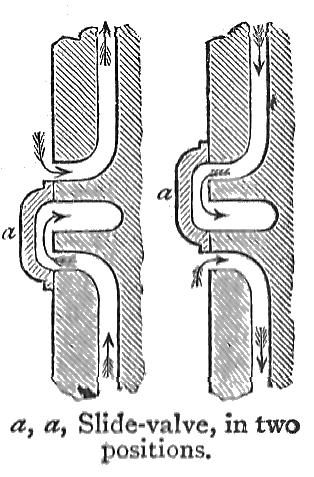
Slide, slīd, v.i. to slip or glide: to pass along smoothly: to fall: to slip away quietly, to disappear: (slang) to slope, slip away from the police, &c.—v.t. to thrust along: to slip:—pa.t. slid; pa.p. slid or slidd′en.—n. a smooth passage: the fall of a mass of earth or rock: a smooth declivity: anything, as a lid, that slides, a glass that slides in a frame in front of a magic-lantern, bearing the picture to be thrown on the screen, that part of a photographic plate-holder which serves to cover and uncover the negative: (mus.) a melodic embellishment, two notes sliding into each other: (slang) a biscuit covered with ice-cream.—adj. Slī′dable, capable of sliding or of being slid.—ns. Slī′der, one who, or that which, slides: the part of an instrument or machine that slides; Slide′-rest, an apparatus adapted to a turning-lathe for carrying the cutting-tool; Slide′-valve, a valve in a steam-engine, made to slide backward and forward to cover and uncover the openings through which steam enters the cylinder; Slī′ding, act of one who slides: falling: backsliding.—p.adj. slippery: movable, changing.—ns. Slī′ding-keel, an oblong frame let down vertically through the bottom of a vessel in order to deepen the draught and sustain against a side-wind; Slī′ding-rule (see Rule); Slī′ding-scale, a scale of duties which slide or vary according to the value or market prices: a sliding-rule; Slī′ding-seat, a kind of seat for racing-boats, moving with the swing of the rower's body; Slīdom′eter, an instrument indicating the strain put on a railway-carriage by sudden stoppage. [A.S. slídan, to slide; Dut. slidderen, to slip.]
Slight, slīt, adj. weak: slender: of little value: trifling: small: negligent: not decided, superficial, cursory: slighting, disdainful.—v.t. to disregard, as of little value: to neglect: (obs.) to demolish, smooth.—n. neglect: disregard, an act of discourtesy.—advs. Slight′ingly; Slight′ly.—n. Slight′ness. [Old Low Ger. slicht, plain; Dut. slecht, bad, Ger. schlecht, straight.]
Slight, slīt, n. (Spens.), sleight, device, trick.
Slily, slī′li, adv. See under Sly.
Slim, slim, adj. (comp. Slim′mer, superl. Slim′mest) very thin, weak, slender: slight, trivial, unsubstantial: delicate: crafty.—adv. Slim′ly.—adj. Slim′mish, somewhat slim.—n. Slim′ness.—adj. Slim′sy (U.S.), frail, flimsy. [Old Low Ger. slim, crafty; Dan. slem, worthless, Ger. schlimm, bad.]
Slime, slīm, n. glutinous mud: (B.) probably bitumen.—n. Slime′-pit, a pit of slime or viscous mire.—adv. Slīm′ily.—n. Slīm′iness.—adj. Slīm′y, abounding with, or consisting of, slime: glutinous. [A.S. slím; Ger. schleim.]
Sliness, slī′nes, n. Same as Slyness.
Sling, sling, n. a strap or pocket with a string attached to each end, for hurling a stone: a throw: a hanging bandage for a wounded limb: a rope with hooks, used in hoisting and lowering weights: a sweep or swing: a stroke as from a missile thrown from a sling.—v.t. to throw with a sling: to hang so as to swing: to move or swing by means of a rope: to cast.—v.i. to bound along with swinging steps: (slang) to blow the nose with the fingers:—pa.t. and pa.p. slung.—ns. Sling′er; Sling′stone, a stone to be thrown from a sling. [A.S. slingan, to turn in a circle; Ger. schlingen, to move or twine round.]
Sling, sling, n. toddy with grated nutmeg.
Slink, slingk, v.i. to creep or crawl away, as if ashamed: to sneak:—pa.t. and pa.p. slunk. [A.S. slincan, to creep; Low Ger. sliken, Ger. schleichen.]
Slink, slingk, v.t. to cast prematurely, as a calf.—v.i. to miscarry.—n. a calf prematurely born: the flesh of such: a bastard child.—adj. prematurely born: unfit for food: lean, starved: mean.—ns. Slink′-butch′er, one who kills and dresses for sale the carcasses of diseased animals; Slink′skin, the skin of a slink, or leather made from it.—adj. Slink′y, lean.
Slip, slip, v.i. to slide or glide along: to move out of place: to escape: to err: to slink: to enter by oversight.—v.t. to cause to slide: to convey secretly: to omit: to throw off: to let loose: to escape from: to part from the branch or stem:—pr.p. slip′ping; pa.t. and pa.p. slipped.—n. act of slipping: that on which anything may slip: an error, a fault, a slight transgression: an escape: a twig: a strip, a narrow piece of anything: a leash: a smooth inclined plane, sloping down to the water, on which a ship is built: anything easily slipped on: (print.) a long galley-proof before being made up into pages.—ns. Slip′-board, a board sliding in grooves; Slip′-dock, a dock having a floor that slopes so that the lower end is submerged; Slip′-knot, a knot which slips along the rope or line round which it is made; Slip′per, a loose shoe easily slipped on.—adj. (Spens.) slippery.—adj. Slip′pered, wearing slippers.—adv. Slip′perily, in a slippery manner.—ns. Slip′periness, Slip′piness.—adjs. Slip′pery, Slip′py, apt to slip away: smooth: not affording firm footing or confidence: unstable: uncertain; Slip′shod, shod with slippers, or shoes down at the heel like slippers: careless.—n. Slip′stitch.—Slip off, to take off noiselessly or hastily; Slip on, to put on loosely or in haste; Slip one's breath, or wind, to die; Slip the leash, to disengage one's self from a noose.—Give a person the slip, to escape stealthily from him. [A.S. slípan; Sw. slippa, Dut. slippen, to glide, Ger. schliefen.]
Slipe, slīp, n. in mining, a skip or sledge without wheels.
Slipslop, slip′slop, adj. slipshod, slovenly.—n. thin, watery food: a blunder.—v.i. to slip loosely about.—adj. Slip′sloppy, slushy, sloppy.
Slish, slish, n. (Shak.) a cut. [A corr. of slash.]
Slit, slit, v.t. to cut lengthwise: to split: to cut into strips:—pr.p. slit′ting; pa.t. and pa.p. slit.—n. a long cut: a narrow opening.—n. Slit′ter, anything which slits, a slitting-shears for sheet-metal.—adj. Slit′tered, cut into strips with square ends.—n. Slit′ting-mill, an establishment in which metal plates are cut into strips for nail-making: a rotating disc used by gem-cutters for slitting: a gang-saw used for resawing lumber for blind-slats, fence-pickets, &c. [A.S. slítan; Ger. schleissen.]
Slither, slith′ėr, v.i. to slide.—adj. slippery.—n. a limestone rubble.—adjs. Slith′ering, slow, deceitful; Slith′ery, slippery. [A variant of slidder.]
Sliver, sliv′ėr, or slī′vėr, v.t. to split, to tear off lengthwise, to slice.—n. a piece cut or rent off, a slice: a continuous strand of loose untwisted wool or other fibre.—v.i. Slive, to slide, skulk. [A.S. slífan, to cleave.]
Sloam, slōm, n. (prov.) in coal-mining, the under-clay.
Sloat, slōt, n. Same as Slot (1) and (2).
Slobber, slob′ėr, same as Slabber.—n. Slob, mire, muddy land.—adj. Slobb′ery, moist, wet.
Slocken, slok′n, v.t. to quench, extinguish.—Also Slok′en. [Ice. slokna, to go out.]
Sloe, slō, n. the blackthorn, producing white flowers before the leaves, the shoots making excellent walking-sticks: the austere fruit, a good preserve. [A.S. slá; Dut. slee, a sloe.]
Slog, slog, v.i. to hit hard.—n. Slog′ger, a hard hitter.
Slogan, slō′gan, n. a war-cry among the ancient Highlanders of Scotland. [Gael., contracted from sluagh-gairm, an army-cry.]
Sloid=Sloyd (q.v.).
Slombry, slom′bri, adj. (Spens.) sleepy.—v.i. Sloom (prov.), to slumber.—adj. Sloom′y, lazy, inactive.
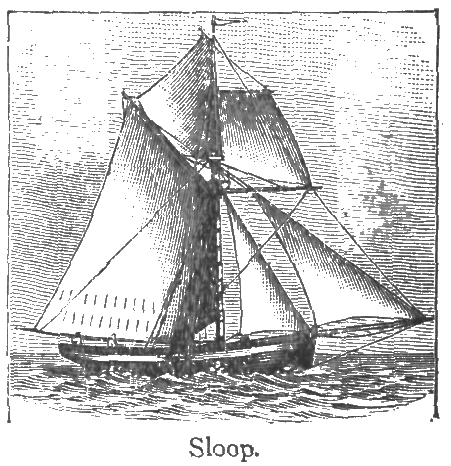
Sloop, slōōp, n. a light boat: a one-masted cutter-rigged vessel, differing from a cutter, according to old authorities, in having a fixed bowsprit and somewhat smaller sails in proportion to the hull.—n. Sloop′-of-war, formerly a vessel, of whatever rig, between a corvette and a gun-vessel, constituting the command of a commander, carrying from ten to eighteen guns. [Dut. sloep, prob. O. Fr. chaloupe, shallop.]
Slop, slop, n. water carelessly spilled: a puddle: mean liquor or liquid food: (pl.) dirty water.—v.t. to soil by letting a liquid fall upon:—pr.p. slop′ping; pa.p. slopped.—ns. Slop′-bā′sin, -bowl, a basin for slops, esp. for the dregs of tea and coffee cups at table; Slop′-dash, weak cold tea, &c.: Slop′-pail, a pail for collecting slops; Slop′piness.—adj. Slop′py, wet: muddy. [A.S. sloppe, slyppe, cow-droppings—slúpan, to slip.]
Slope, slōp, n. any incline down which a thing may slip: a direction downward.—v.t. to form with a slope, or obliquely.—v.i. to be inclined, to slant: (slang) to decamp, disappear.—adv. in a sloping manner.—adv. Slope′wise, obliquely.—p.adj. Slō′ping, inclining from a horizontal or other right line.—adv. Slō′pingly, in a sloping manner: with a slope.—adj. Slō′py, sloping, inclined: oblique. [A.S. slípan, pa.t. sláp, to slip.]
Slops, slops, n.pl. any loose lower garment that slips on easily, esp. trousers: ready-made clothing, &c.—ns. Slop′-sell′er, one who sells cheap ready-made clothes; Slop′-shop, a shop where ready-made clothes are sold; Slop′-work, the making of cheap cloth, any work superficially done; Slop′-work′er, one who does slop-work. [Scand., Ice. sloppr, a long robe—sleppa, to slip.]
Slosh, slosh, n. a watery mess.—v.i. to flounder in slush: to go about in an easy way.—adj. Slosh′y. [A form of slush.]
Slot, slot, n. a bar or bolt: a broad, flat, wooden bar which holds together larger pieces. [Allied to Low Ger. slot, Dut. slot, a lock.]
Slot, slot, n. a hollow, narrow depression, to receive some corresponding part in a mechanism: a ditch, the continuous opening between the rails in a cable tramway along which the shank of the grip moves.—n. Slot′ting-machine′, a machine for cutting slots or square grooves in metal. [Slit.]
Slot, slot, n. the track of a deer. [Ice. slóth, track, path; Scot. sleuth, track by the scent.]
Sloth, slōth, or sloth, n. laziness, sluggishness: a sluggish arboreal animal of tropical America, of two genera (Cholœpus, the two-toed sloth, and Bradypus, the three-toed sloth).—adj. Sloth′ful, given to sloth: inactive: lazy.—adv. Sloth′fully.—n. Sloth′fulness. [A.S. slǽwth—sláw, slow.]
Slotter, slot′ėr, n. filth.—v.t. to foul.—adj. Slott′ery, foul.
Slouch, slowch, n. a hanging down loosely of the head or other part: clownish gait: a clown.—v.i. to hang down: to have a clownish look or gait.—v.t. to depress.—n. Slouch′-hat, a soft broad-brimmed hat.—p.adj. Slouch′ing, walking with a downcast, awkward manner: hanging down.—adj. Slouch′y, somewhat slouching. [Scand., Ice. slókr, a slouching fellow; slakr, slack.]
Slough, slow, n. a hollow filled with mud: a soft bog or marsh.—adj. Slough′y, full of sloughs: miry. [A.S. slóh, a hollow place; perh. from Ir. sloc—slugaim, to swallow up.]
Slough, sluf, n. the cast-off skin of a serpent: the dead part which separates from a sore.—v.i. to come away as a slough (with off): to be in the state of sloughing.—v.t. to cast off, as a slough.—adj. Slough′y, like, or containing, slough. [Scand.; Sw. dial. slug; cf. Ger. slauch, a skin.]
Slovak, slō-vak′, adj. pertaining to the Slovaks, a branch of the Slavs in the mountainous districts of N.W. Hungary, their language little more than a dialect of Czech.—n. one of this race, or his language.—adjs. Slovak′ian, Slovak′ish.
Sloven, sluv′n, n. a man carelessly or dirtily dressed:—fem. Slut.—n. Slov′enliness.—adj. Slov′enly, like a sloven: negligent of neatness or cleanliness: disorderly: done in an untidy manner.—adv. negligently.—n. Slov′enry (Shak.), slovenliness. [Old Dut. slof, sloef, Low Ger. sluf, slow, indolent.]
Slovenian, slō-vē′ni-an, adj. pertaining to the Slovenes, a branch of the South Slavonic stock to which the Serbs and Croats belong.
Slow, slō, adj. not swift: late: behind in time: not hasty: not ready: not progressive.—v.t. to delay, retard, slacken the speed of.—v.i. to slacken in speed.—n. Slow′back, a lazy lubber.—p.adj. Slow′-gait′ed (Shak.), accustomed to walk slowly.—ns. Slow′-hound, sleuth-hound; Slow′ing, a lessening of speed.—adv. Slow′ly.—ns. Slow′-match, generally rope steeped in a solution of saltpetre and lime-water, used for firing guns before the introduction of friction tubes, and sometimes for firing military mines, now superseded by Bickford's fuse, a train of gunpowder enclosed in two coatings of jute thread waterproofed; Slow′ness.—adj. Slow′-sight′ed, slow to discern; Slow′-winged, flying slowly.—n. Slow′-worm, a scincoid lizard, same as Blind-worm—by popular etymology 'slow-worm,' but, according to Skeat, really 'slay-worm,' A.S. slá-wyrm. [A.S. sláw; Dut. slee, Ice. sljór.]
Sloyd, Sloid, sloid, n. the name given to a certain system of manual instruction which obtains in the schools of Finland and Sweden, the word properly denoting work of an artisan kind practised not as a trade or means of livelihood, but in the intervals of other employment. [Sw. slöjd, dexterity.]
Slub, slub, v.t. to twist after carding to prepare for spinning.
Slubber, slub′ėr, v.t. to stain, to daub, slur over.—n. Slubb′er-degull′ion, a wretch.—adv. Slubb′eringly. [Dut. slobberen, to lap, Low Ger. slubbern.]
Sludge, sluj, n. soft mud or mire: half-melted snow.—adj. Sludg′y, miry: muddy. [A form of slush.]
Slue, Slew, slū, v.t. (naut.) to turn anything about its axis without removing it from its place: to turn or twist about.—v.i. to turn round:—pr.p. slū′ing; pa.p. slūed.—n. the turning of a body upon an axis within its figure.—adj. Slued, tipsy. [Scand., Ice. snua, to turn.]
Slug, slug, n. a heavy, lazy fellow: a name for land-molluscs of order Pulmonata, with shell rudimentary or absent—they do great damage to garden crops: any hinderance.—ns. Slug′-a-bed (Shak.), one who is fond of lying in bed, a sluggard; Slug′gard, one habitually idle or inactive.—v.t. Slug′gardise (Shak.), to make lazy.—adj. Slug′gish, habitually lazy: slothful: having little motion: having little or no power.—adv. Slug′gishly.—n. Slug′gishness. [Scand., Dan. slug, sluk, drooping, Norw. sloka, to slouch; Low Ger. slukkern, to be loose; allied to slack.]
Slug, slug, n. a cylindrical or oval piece of metal for firing from a gun: a piece of crude metal. [Prob. from slug above, or slug=slog, to hit hard.]
Slugga, slug′a, n. a deep cavity formed by the action of subterranean streams common in some limestone districts of Ireland. [Ir. slugaid, a slough.]
Slughorn, slug′horn, n. a word used to denote a kind of horn, but really a corruption of slogan.
Sluice, slōōs, n. a sliding gate in a frame for shutting off or regulating the flow of water: the stream which flows through it: that through which anything flows: a source of supply: in mining, a board trough for separating gold from placer-dirt carried through it by a current of water: the injection-valve in a steam-engine condenser.—v.t. to wet or drench copiously: to wash in or by a sluice: to flush or clean out with a strong flow of water.—adj. Sluic′y, falling in streams, as from a sluice. [O. Fr. escluse (Fr. écluse)—Low L. exclusa (aqua), a sluice (water) shut out, pa.p. of L. ex-cludĕre, to shut out.]
Slum, slum, n. a low street or neighbourhood.—v.i. to visit the slums of a city, esp. from motives of curiosity.—ns. Slum′mer, one who slums; Slum′ming, the practice of visiting slums.
Slumber, slum′bėr, v.i. to sleep lightly: to sleep: to be in a state of negligence or inactivity.—n. light sleep: repose.—ns. Slum′berer; Slum′bering.—adv. Slum′beringly, in a slumbering manner.—n. Slum′berland, the state of slumber.—adjs. Slum′berless, without slumber: sleepless; Slum′berous, Slum′brous, inviting or causing slumber; sleepy; Slum′bery, sleepy: drowsy. [With intrusive b from M. E. slumeren—A.S. sluma, slumber; cog. with Ger. schlummern.]
Slump, slump, v.i. to fall or sink suddenly into water or mud: to fail or fall through helplessly.—n. a boggy place: the act of sinking into slush, &c., also the sound so made: a sudden fall or failure.—adj. Slump′y, marshy. [Cf. Dan. slumpe, to stumble upon by chance; Ger. schlumpen, to trail.]
Slump, slump, v.t. to throw into a lump or mass, to lump.—n. a gross amount, a lump.—n. Slump′-work, work in the lump. [Cf. Dan. slump, a lot, Dut. slomp, a mass.]
Slung, pa.t. and pa.p. of sling.—n. Slung′-shot, a weight attached to a cord, used as a weapon.
Slunk, pa.t. and pa.p. of slink.—adj. Slunk′en (prov.), shrivelled.
Slur, slur, v.t. to soil; to contaminate: to disgrace: to pass over lightly: to conceal: (mus.) to sing or play in a gliding manner.—v.i. (print.) to slip in making the impression, causing the printing to be blurred:—pr.p. slur′ring; pa.t. and pa.p. slurred.—n. a stain: slight reproach or disparagement: (mus.) a mark showing that notes are to be sung to the same syllable.—p.adj. Slurred (mus.), marked with a slur, performed in a gliding style like notes marked with a slur. [Old Dut. slooren, sleuren, Low Ger. slüren, to drag along the ground.]
Slurry, slur′i, n. any one of several semi-fluid mixtures, esp. of ganister, used to make repairs in converter-linings.
Slush, slush, n. liquid mud: melting snow: a mixture of grease for lubrication: the refuse of the cook's galley in a ship.—v.t. to apply slush to, to grease: to wash by throwing water upon: to fill spaces in masonry with mortar (with up): to coat with a mixture of white-lead and lime the bright parts of machinery.—adj. Slush′y. [Cf. Slosh.]
Slut, slut, n. (fem. of Sloven) a dirty, untidy woman: a wench, a jade: a bitch.—adj. Slut′tish, resembling a slut: dirty: careless.—adv. Slut′tishly.—ns. Slut′tishness, Slut′tery. [Scand., Ice. slöttr, a dull fellow—slota, to droop.]
Sly, slī, adj. dexterous in doing anything so as to be unobserved: cunning: wily: secret: done with artful dexterity: illicit.—n. Sly′boots, a sly or cunning person or animal.—advs. Sly′ly, Slī′ly.—ns. Sly′ness, Slī′ness.—On the sly, slyly, secretly. [Prob. from Ice. slæg-r; cf. Ger. schlau.]
Slype, slīp, n. a. covered passage from the transept of a cathedral to the chapter-house, &c. [Slip.]
Smack, smak, n. taste: flavour: a pleasing taste: a small quantity: a flavour of something.—v.i. to have a taste: to have a quality. [A.S. smæc.]
Smack, smak, n. a generic name for small decked or half-decked coasters and fishing-vessels, most rigged as cutters, sloops, or yawls. [Dut. smak; Ger. schmacke, Ice. snekja.]
Smack, smak, v.t. to strike smartly, to slap loudly: to kiss roughly and noisily.—v.i. to make a sharp noise with, as the lips by separation.—n. a sharp sound: a crack: a hearty kiss.—adv. sharply, straight.—p.adj. Smack′ing, making a sharp, brisk sound, a sharp noise, a smack. [Prob. imit., Dut. smakken, to smite, Ger. schmatzen, to smack.]
Small, smawl, adj. little in quantity or degree: minute: not great: unimportant: ungenerous, petty: of little worth or ability: short: having little strength: gentle: little in quality or quantity.—adv. in a low tone; gently.—ns. Small′-ale, ale with little malt and unhopped; Small′-and-earl′y (coll.) an informal evening-party.—n.pl. Small′-arms, muskets, rifles, pistols, &c., including all weapons that can be actually carried by a man.—n. Small′-beer, a kind of weak beer.—adj. inferior generally.—n.pl. Small′-clothes, knee-breeches, esp. those of the close-fitting 18th-century form.—ns. Small′-coal, coal not in lumps but small pieces; Small′-craft, small vessels generally.—n.pl. Small′-debts, a phrase current in Scotland to denote debts under £12, recoverable in the Sheriff Court.—n. Small′-hand, writing such as is ordinarily used in correspondence.—n.pl. Small′-hours, the hours immediately following midnight.—adj. Small′ish, somewhat small.—ns. Small′ness; Small′-pī′ca (see Pica); Small′pox, or Variola, a contagious, febrile disease, of the class known as Exanthemata, characterised by small pocks or eruptions on the skin; Smalls, the 'little-go' or previous examination: small-clothes; Small′-talk, light or trifling conversation.—n.pl. Small′-wares (see Ware).—In a small way, with little capital or stock: unostentatiously. [A.S. smæl; Ger. schmal.]
Smallage, smawl′āj, n. celery. [Small, Fr. ache—L. apium, parsley.]
Smalt, smawlt, n. glass melted, tinged blue by cobalt, and pulverised when cold.—n. Smal′tine, an arsenide of cobalt, often containing nickel and iron. [Low L. smaltum—Old High Ger. smalzjan (Ger. schmelzen), to melt.]
Smaragdine, sma-rag′din, adj. of an emerald green.—n. Smarag′dite, a peculiar variety of Amphibole, light grass-green in colour, with a foliated, lamellar or fibrous structure—occurring as a constituent of the rock called Eklogite. [L. smaragdinus—smaragdus—Gr. smaragdos, the emerald.]
Smart, smärt, n. quick, stinging pain of body or mind: smart-money: a dandy.—v.i. to feel a smart: to be punished.—adj. causing a smart: severe: sharp: vigorous, brisk: acute, witty, pert, vivacious: well-dressed, fine, fashionable: keen in business: creditable, up-to-the-mark.—v.t. Smart′en, to make smart, to brighten (with up).—adv. Smart′ly.—ns. Smart′-mon′ey, money paid by a recruit for his release before being sworn in: money paid for escape from any unpleasant situation or engagement: excessive damages: money allowed to soldiers and sailors for wounds; Smart′ness; Smart′-tick′et, a certificate granted to one entitled to smart-money; Smart′-weed, a name given to some of the Milkworts from their acrid properties, esp. Polygonum Hydropiper, or Waterpepper; Smart′y, a would-be smart fellow. [A.S. smeortan; Dut. smarten, Ger. schmerzen.]
Smash, smash, v.t. to break in pieces violently: to crush: to dash violently.—v.i. to act with crushing force: to be broken to pieces: to be ruined, to fail: to dash violently.—n. act of smashing, destruction, ruin, bankruptcy.—ns. Smash′er, one who smashes: (slang) one who passes bad money, bad money itself: anything great or extraordinary; Smash′ing.—adj. crushing: dashing.—n. Smash′-up, a serious smash. [Prob. Sw. dial. smaske, to smack.]
Smatch, smach, n. (Shak.) taste or tincture.—v.t. and v.i. to have a taste. [Smack.]
Smatter, smat′ėr, v.i. to talk superficially: to have a superficial knowledge.—ns. Smatt′erer; Smatt′ering, a superficial knowledge.—adv. Smatt′eringly, in a smattering manner. [M. E. smateren, to rattle, to chatter—Sw. smattra, to clatter; Ger. schnattern.]
Smear, smēr, v.t. to overspread with anything sticky or oily, as grease: to daub.—n. Smear′iness.—adj. Smear′y, sticky: showing smears. [A.S. smeru, fat, grease; Ger. schmeer, grease, Ice. smjör, butter.]
Smectite, smek′tīt, n. a greenish clay. [Gr. smēktis—smēchein, to rub.]
Smectymnuus, smek-tim′nū-us, n. a name compounded of the initials of the five Puritan divines—Stephen Marshall, Edmund Calamy, Thomas Young, Matthew Newcomen, and William Spurstow, joint authors of An Answer (1641) to Bishop Hall's Humble Remonstrance to the High Court of Parliament (1641) in defence of the liturgy and episcopal government.
Smeddum, smed′um, n. fine powder: sagacity, spirit, mettle: ore small enough to go through the sieve. [A.S. smedema, fine flour.]
Smee, smē, n. the pochard: widgeon: pintail-duck.—Also Smeath.
Smegma, smeg′ma, n. a sebaceous secretion, esp. that under the prepuce: an unguent.—adj. Smegmat′ic. [Gr. smēgma.]
Smell, smel, v.i. to affect the nose: to have odour: to use the sense of smell.—v.t. to perceive by the nose:—pa.t. and pa.p. smelled or smelt.—n. the quality of bodies which affects the nose: odour: perfume: the sense which perceives this quality.—ns. Smell′er; Smell′-feast, a greedy fellow; Smell′ing, the sense by which smells are perceived; Smell′ing-bott′le, a bottle containing smelling-salts, or the like; Smell′ing-salts, a preparation of ammonium carbonate with lavender, &c., used as a stimulant in faintness, &c.; Smell′-trap, a drain-trap.—adj. Smell′y, having a bad smell.—Smell a rat (see Rat); Smell out, to find out by prying. [Allied to Low Ger. smelen, Dut. smeulen, to smoulder.]
Smelt, smelt, n. a fish of the salmon or trout family, having a cucumber-like smell and a delicious flavour. [A.S. smelt.]
Smelt, smelt, v.t. to melt ore in order to separate the metal.—ns. Smel′ter; Smel′tery, a place for smelting; Smel′ting; Smel′ting-fur′nace, -house, -works. [Scand., Sw. smälta, to smelt.]
Smerky, smėrk′i, adj. (Spens.) neat. [Smirk.]
Smew, smū, n. a bird of the family Anatidæ, in the same genus as the goosander and mergansers.
Smicker, smik′ėr, v.i. (obs.) to look amorously.—n. Smick′ering, an inclination for a woman.—adv. Smick′ly, amorously.
Smicket, smik′et, n. a smock.
Smiddy, smid′i, n. a smithy.
Smidgen, smij′en, n. (U.S.) a small quantity, a trifle.
Smift, smift, n. a piece of touchwood, &c., formerly used to ignite the train in blasting.—Also Snuff.
Smight, smīt, v.t. (Spens.) to smite.
Smilax, smī′laks, n. a genus of liliaceous plants, type of the tribe Smilaceæ—the roots of several species yield sarsaparilla.
Smile, smīl, v.i. to express pleasure by the countenance: to express slight contempt: to look joyous: to be favourable.—n. act of smiling: the expression of the features in smiling: favour: (slang) a drink, a treat.—ns. Smī′ler, one who smiles; Smī′let (Shak.), a little smile.—adj. Smī′ling, wearing a smile, joyous.—adv. Smī′lingly, in a smiling manner: with a smile or look of pleasure.—n. Smī′lingness, the state of being smiling. [Scand., Sw. smila, to smile.]
Smirch, smirch, v.t. to besmear, dirty: to degrade in fame, dignity, &c.—n. a stain. [A weakened form of smer-k, from M. E. smeren, to smear.]
Smirk, smėrk, v.i. to smile affectedly: to look affectedly soft.—n. an affected smile.—adjs. Smirk (obs.), Smirk′y, smart. [A.S. smercian; akin to smile.]
Smit, smit, obsolete pa.t. and pa.p. of smite.
Smit, smit, v.t. (prov.) to infect.—n. a stain: infection.—v.t. Smit′tle, to infect.—adj. infectious.—n. infection. [A.S. smittian, to spot, smitta, a spot, an intens. of smítan, to smite.]
Smitch, smich, n. a particle: dust.—n. (dim.) Smitch′el.
Smite, smīt, v.t. to strike with the fist, hand, or weapon: to beat: to kill: to overthrow in battle: to affect with feeling: (B.) to blast: to afflict.—v.i. to strike:—pa.t. smōte; pa.p. smitt′en.—n. Smī′ter.—Smite off, to cut off; Smite out, to knock out; Smite with the tongue (B.), to reproach, to revile. [A.S. smítan; Dut. smijten, Ger. schmeissen.]
Smith, smith, n. one who forges with the hammer: a worker in metals: one who makes anything.—ns. Smith′ery, the workshop of a smith: work done by a smith—also Smith′ing; Smith′y, the workshop of a smith; Smith′y-coal, a kind of small coal much used by smiths. [A.S. smith; Ger. schmied.]
Smithereens, smith-ėr-ēnz′, n.pl. (coll.) small fragments.
Smithsonian, smith-sō′ni-an, adj. pertaining to James Macie Smithson (1765—1829), founder of a great institution at Washington for ethnological and scientific investigations, organised by Congress in 1846.
Smitten, smit′n, pa.p. of smite.
Smock, smok, n. a woman's shift: a smock-frock.—v.t. to clothe in a smock or smock-frock.—adj. Smock′-faced, pale-faced.—ns. Smock′-frock, an outer garment of coarse white linen worn over the other clothes in the south of England; Smock′-race, a race for the prize of a smock. [A.S. smoc, perh. from A.S. smeógan, to creep into.]
Smoke, smōk, n. the vapour from a burning body—a common term for the volatile products of the imperfect combustion of such organic substances as wood or coal.—v.i. to emit smoke: to smoke out instead of upward, owing to imperfect draught: to draw in and puff out the smoke of tobacco: to raise smoke by moving rapidly: to burn, to rage: to suffer, as from punishment.—v.t. to apply smoke to: to dry, scent, or medicate by smoke: to inhale the smoke of: to use in smoking: to try to expel by smoking: to scent out, discover: to quiz, ridicule: to thrash.—ns. Smoke′-black, lampblack; Smoke′-board, a board suspended before the upper part of a fireplace to prevent the smoke coming out into the room; Smoke′-box, part of a steam-boiler where the smoke is collected before passing out at the chimney; Smoke′-consū′mer, an apparatus for burning all the smoke from a fire.—adj. Smoke′-dried.—v.t. Smoke′-dry, to cure or dry by means of smoke.—ns. Smoke′-house, a building where meat or fish is cured by smoking, or where smoked meats are stored; Smoke′-jack, a contrivance for turning a jack by means of a wheel turned by the current of air ascending a chimney.—adj. Smoke′less, destitute of smoke.—adv. Smokel′essly.—ns. Smoke′lessness; Smō′ker, one who smokes tobacco: a smoking-carriage: one who smoke-dries meat: an evening entertainment at which smoking is permitted; Smoke′-sail, a small sail hoisted between the galley-funnel and the foremast when a vessel rides head to the wind; Smoke′-shade, a scale of tints ranging from 0 to 10, for comparison of different varieties of coal, according to the amount of unburnt carbon in their smoke; Smoke′-stack, an upright pipe through which the combustion-gases from a steam-boiler pass into the open air.—adj. Smoke′-tight, impervious to smoke.—ns. Smoke′-tree, an ornamental shrub of the cashew family, with long light feathery or cloud-like fruit-stalks; Smoke′-wash′er, an apparatus for removing soot and particles of unburnt carbon from smoke by making it pass through water; Smoke′-wood, the virgin's bower (Clematis Vitalba), whose porous stems are smoked by boys.—adv. Smō′kily.—ns. Smō′kiness; Smō′king, the act of emitting smoke: the act or habit of drawing into the mouth and emitting the fumes of tobacco by means of a pipe or cigar—a habit of great sedative value: a bantering; Smō′king-cap, -jack′et, a light ornamental cap or jacket often worn by smokers; Smō′king-carr′iage, -room, a railway-carriage, -room, supposed to be set apart for smokers.—adj. Smō′ky, giving out smoke: like smoke: filled, or subject to be filled, with smoke: tarnished or noisome with smoke: (obs.) suspicious.—On a smoke (B.), smoking, or on fire. [A.S. smocian, smoca; Ger. schmauch.]
Smolder=Smoulder (q.v.).
Smolt, smōlt, n. a name given to young river salmon when they are bluish along the upper half of the body and silvery along the sides. [Smelt.]
Smooth, smōōth, adj. having an even surface: not tough: evenly spread: glossy: gently flowing: easy: regular: unobstructed: bland: mild, calm.—v.t. to make smooth: to palliate: to soften: to calm: to ease: (Shak.) to exonerate.—v.i. to repeat flattering words.—n. (B.) the smooth part.—adj. Smooth′-bore, not rifled.—n. a gun with smooth-bored barrel.—adjs. Smooth′-browed, with unwrinkled brow; Smooth′-chinned, having a smooth chin: beardless; Smooth′-dit′tied, sweetly sung, with a flowing melody.—v.t Smooth′en, to make smooth.—n. Smooth′er, one who, or that which, smooths: in glass-cutting, an abrading-wheel for polishing the aces of the grooves cut by another wheel: (obs.) a flatterer.—adj. Smooth′-faced, having a smooth air, mild-looking.—ns. Smooth′ing-ī′ron, an instrument of iron for smoothing clothes; Smooth′ing-plane, a small fine plane used for finishing.—adv. Smooth′ly.—n. Smooth′ness.—adjs. Smooth′-paced, having a regular easy pace; Smooth′-shod, having shoes without spikes; Smooth′-spō′ken, speaking pleasantly: plausible: flattering; Smooth′-tongued, having a smooth tongue: flattering. [A.S. smóthe, usually sméthe; Ger. ge-schmeidig, soft.]
Smore, smōr, a Scotch form of smother.
Smote, smōt, pa.t. and pa.p. of smite.
Smother, smuth′ėr, v.t. to suffocate by excluding the air: to conceal.—v.i. to be suffocated or suppressed: to smoulder.—n. smoke: thick floating dust: state of being smothered: confusion.—ns. Smotherā′tion, suffocation: a sailor's dish of meat buried in potatoes; Smoth′eriness.—adv. Smoth′eringly.—adj. Smoth′ery, tending to smother: stifling. [M. E. smorther—A.S. smorian, to smother; cf. Ger. schmoren, to stew.]
Smouch, smowch, n. a smack, a hearty kiss.—v.t. to kiss, to buss.
Smouch, smowch, v.t. to take advantage of, to chouse.
Smouched, smowcht, adj. blotted, dirtied, smutched.
Smoulder, smōl′dėr, v.i. to burn slowly or without vent.—adjs. Smoul′dring, Smoul′dry. [M. E. smolderen—smolder=smor-ther, stifling smoke; cf. Smother.]
Smouse, Smous, smows, n. a peddler, a German Jew.
Smout, smowt, n. (slang) a printer who gets chance jobs in various offices.—v.i. to do occasional work.
Smudge, smuj, n. a spot, a stain: a choking smoke—v.t. to stifle: to fumigate with smoke.—n. Smud′ger, one who smudges: a plumber.—adj. Smud′gy, stained with smoke. [Scand., Sw. smuts, dirt, Dan. smuds, smut; Ger. schmutz.]
Smug, smug, adj. neat, prim, spruce: affectedly smart: well satisfied with one's self.—n. a self-satisfied person.—adj. Smug′-faced, prim or precise-looking.—adv. Smug′ly.—n. Smug′ness. [Dan. smuk, handsome; cf. Ger. schmuck, fine.]
Smug, smug, v.t. to seize without ceremony, to confiscate: (slang) to hush up.
Smuggle, smug′l, v.t. to import or export without paying the legal duty: to convey secretly.—ns. Smugg′ler, one who smuggles: a vessel used in smuggling; Smugg′ling, defrauding the government of revenue by the evasion of custom-duties or excise-taxes. [Low Ger. smuggeln, cog. with Ger. schmuggeln; Dut. smuigen, to eat secretly.]
Smuggle, smug′l, v.t. to fondle, cuddle.
Smur, smur, n. (Scot.) fine misty rain.—v.i. to drizzle.—adj. Smur′ry.
Smut, smut, n. a spot of dirt, soot, &c.: foul matter, as soot: Bunt, sometimes also Dust-brand, the popular name of certain small fungi which infest flowering land-plants, esp. the grasses, the name derived from the appearance of the spores, which are nearly black and very numerous: obscene language.—v.t. to soil with smut: to blacken or tarnish.—v.i. to gather smut: to be turned into smut:—pr.p. smut′ting; pa.t. and pa.p. smut′ted.—n. Smut′-ball, a fungus of genus Tilletia: a puff-ball.—adj. Smut′tied, made smutty.—adv. Smut′tily.—n. Smut′tiness.—adj. Smut′ty, stained with smut: affected with smut or mildew: obscene, filthy. [Scand., Sw. smuts; Ger. schmutz, prob. from root of smite.]
Smutch, smuch, v.t. to blacken, as with soot.—n. a dirty mark. [A form of smut.]
Smyrniot, -e, smėr′niot, -ōt, n. a native or inhabitant, of Smyrna.—adj. of or pertaining to Smyrna.
Smyterie, Smytrie, smit′ri, n. (Scot.) a large number of individuals of small size.
Snabble, snab′l, v.t. (prov.) to plunder: to kill.—v.i. to gobble up.
Snabby, snab′i, n. (Scot.) the chaffinch.
Snack, snak, n. a share: a slight, hasty meal.—v.t. to snatch, to bite: to share. [A form of snatch.]
Snaffle, snaf′l, n. a bridle which crosses the nose and has a slender mouth-bit without branches.—v.t. to bridle: to clutch by the bridle.—ns. Snaff′le-bit, a kind of slender bit; Snaff′ling-lay, the trade of highwayman. [Dut. snavel, the muzzle; cf. Snap.]
Snag, snag, n. a sharp protuberance: a short branch: a projecting tooth or stump: a tree lying in the water so as to impede navigation—hence any stumbling-block or obstacle.—v.t. to catch on a snag: to entangle: to fill with snags, or to clear from such.—n. Snag′boat, a steamboat with appliances for removing snags.—adjs. Snag′ged, Snag′gy, full of snags. [Akin to Gael. and Ir. snaigh, to cut.]
Snag, snag, v.t. to lop superfluous branches from a tree.—n. Snag′ger, the tool for this.
Snail, snāl, n. a term for the species of terrestrial Gasteropoda which have well-formed spiral shells—the more typical snails belonging to the genus Helix, of the family Helicidæ, having the shell of many whorls, globose, depressed, or conical.—ns. Snail′-clov′er, -trē′foil, a species of medic; Snail′-fish, a fish of genus Liparis, sticking to rocks; Snail′-flow′er, a twining bean.—adjs. Snail′-like (Shak.), in the manner of a snail, slowly; Snail′-paced (Shak.), as slow-moving as a snail; Snail′-slow, as slow as a snail.—n. Snail′-wheel, in some striking time-pieces, a rotating piece with a spiral periphery having notches so arranged as to determine the number of strokes made on the bell.—Snail's pace, a very slow pace. [A.S. snegl, snægl; Ger. schnecke.]
Snake, snāk, n. a serpent—Snakes (Ophidia) form one of the classes of reptiles, in shape limbless and much elongated, embracing tree-snakes, the water-snakes, and the very venomous sea-snakes (Hydrophidæ), the burrowing-snakes (Typhlopidæ) and the majority, which may be called ground-snakes.—ns. Snake′-bird, a darter: the wryneck; Snake′-eel, a long Mediterranean eel, its tail without a tail-fin.—adj. Snake′-like (Tenn.), like a snake.—ns. Snake′-root, the popular name of various plants of different genera, whose roots are considered good for snake-bites; Snake's′-head, the guinea-hen flower; Snake′-stone, a small rounded piece of stone or other hard substance, popularly believed to be efficacious in curing snake-bites; Snake′-weed, the bistort; Snake′wood (same as Letter-wood).—adjs. Snak′ish, having the qualities of a snake: cunning, deceitful; Snak′y (Spens.), belonging to, or resembling, a serpent: (Milt.) cunning, deceitful: covered with, or having, serpents. [A.S. snaca, prob. from snícan, to creep; Ice. snák-r.]
Snap, snap, v.t. to break short or at once: to bite, or catch at suddenly: to crack: to interrupt sharply (often with up): to shut with a sharp sound: to take an instantaneous photograph of, esp. with a hand camera.—v.i. to break short: to try to bite: to utter sharp words (with at): to flash:—pr.p. snap′ping; pa.t. and pa.p. snapped.—n. act of snapping, or the noise made by it: a small catch or lock: a hasty repast, a snack: a crack, the spring-catch of a bracelet, &c., an earring: a crisp kind of gingerbread nut or cake: crispness, pithiness, epigrammatic point or force: vigour, energy: (slang) a brief theatrical engagement, an easy and profitable place or task: a sharper, a cheat: a riveter's tool, also a glass-moulder's tool: the act of taking a snapshot.—adj. sudden, unpremeditated, without preparation.—ns. Snap′dragon, a plant, so called because the lower lip of the corolla when parted shuts with a snap like a dragon's jaw: a Christmas pastime in which raisins are snatched out of a dish in which brandy is burning, in a room otherwise dark—also the raisins so taken; Snap′per; Snap′per-up (Shak.), one who snaps up; Snap′ping-tur′tle, a large fresh-water tortoise of the United States—from its habit of snapping at things.—adjs. Snap′pish, Snap′py, inclined to snap: eager to bite: sharp in reply.—adv. Snap′pishly, in a snappish manner: peevishly: tartly.—ns. Snap′pishness; Snap′shot, an instantaneous photograph. [Dut. snappen, to snap; Ger. schnappen.]
Snaphance, snaf′ans, n. a term originally applied to the spring-lock of a gun or pistol, but afterwards applied to the gun itself, a Dutch firelock of the 17th century: a snappish retort.—Also Snaph′aunce. [Dut. snaphaan—snappen, to snap, haan, a cock.]
Snar, snär, v.i. (Spens.) to snarl.
Snare, snār, n. a running noose of string or wire, &c., for catching an animal: a trap: that by which any one is entrapped: a cord, esp. that stretched across the lower head of a drum: a surgical instrument for removing tumours, &c., by an ever-tightening loop.—v.t. same as Ensnare (q.v.).—v.i. to use snares.—n. Snār′er.—adj. Snār′y. [A.S. snear; Dut. snaar.]
Snarl, snärl, v.i. to growl, as a surly dog: to speak in a surly manner.—v.t. to utter snarlingly.—n. a growl, a jealous quarrelsome utterance.—n. Snar′ler.—adjs. Snar′ling, growling, snappish; Snar′ly. [Prob. imit.; Low Ger. snarren, Ger. schnarren; conn. with Eng. snore.]
Snarl, snärl, v.t. to twist, entangle, confuse.—v.i. to become entangled.—n. a knot or any kind of complication: a squabble.—adj. Snarled, twisted.—ns. Snar′ling-ī′ron, -tool, a curved tool for snarling or fluting hollow metal-ware, &c.
Snash, shash, n. (Scot.) insolence, abusive language.—v.i. to talk impudently.
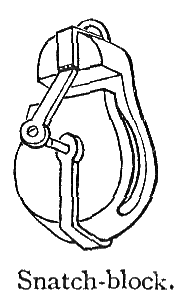
Snatch, snach, v.t. to seize quickly: to take without permission: to seize and carry away.—v.i. to try to seize hastily.—n. a hasty catching or seizing: a short time of exertion: a small piece or fragment: a catching of the voice: a hasty snack of food: a quibble.—ns. Snatch′-block, a kind of pulley-block, having an opening in the side to receive the bight of a rope; Snatch′er, one who snatches.—adv. Snatch′ingly.—adj. Snatch′y, irregular. [M. E. snacchen; cog. with Dut. snakken, Prov. Eng. sneck, a bolt; also conn. with snap.]
Snathe, snāth, n. the curved handle of a scythe. [A variant of snead.]
Snead, snēd, n. the handle of a scythe, a snathe. [A.S. snǽd—sníthan, to cut.]
Sneak, snēk, v.i. to creep or steal away privately or meanly: to behave meanly.—v.t. (slang) to steal.—n. a mean, servile fellow: a mean thief.—ns. Sneak′-cup (Shak.), one who balks his glass: a cowardly, insidious scoundrel; Sneak′er.—adj. Sneak′ing, mean, crouching: secret, underhand, not openly avowed.—adv. Sneak′ingly.—ns. Sneak′ingness, Sneak′iness, the quality of being sneaking: meanness; Sneaks′by (obs.), a sneak.—adj. Sneak′y, somewhat sneaking. [A.S. snícan, to creep; Dan. snige. Cf. Snake.]
Sneap, snēp, v.t. to check, to rebuke: to nip.—n. a check, a reprimand, taunt, sarcasm.—Also Snape.
Sneb, a form of snib, snub.
Sneck, snek, n. (Scot.) the catch of a door or a lid.—v.t. to latch or shut a door.—n. Sneck′-draw′er, one who lifts the latch for thievish ends, a mean thief.—adjs. Sneck′-draw′ing, Sneck′-drawn, crafty, cunning.—interj. Sneck-up′ (Shak.), go hang! [Prob. snack, to catch.]
Sneck, snek, v.t. (Scot.) to cut [Snick.]
Snee, snē, n. a large knife. [Dut. snee, snede, a slice; Ger. schneide, edge.]
Sneer, snēr, v.i. to show contempt by the expression of the face, as by turning up the nose: to insinuate contempt.—v.t. to utter sneeringly.—n. an indirect expression of contempt.—n. Sneer′er.—adj. Sneer′ing.—adv. Sneer′ingly. [Scand., Dan. snærre, to grin like a dog; cf. Snarl.]
Sneeshing, snēsh′ing, n. (Scot.) snuff, or a pinch of snuff.
Sneeze, snēz, v.i. to make a sudden and involuntary violent expiration, preceded by one or more inspirations, the fauces being generally closed so that the current of air is directed through the nose.—n. a sneezing.—ns. Sneeze′weed, any species of Helenium; Sneeze′wood, the durable wood of a small South African tree whose sawdust causes sneezing: Sneeze′wort, the white hellebore: the Achillea Ptarmica; Sneez′ing.—Not to be sneezed at, not to be despised, of very considerable value or importance. [M. E. snesen, fnesen—A.S. fneósan, to sneeze; Dut. fniezen.]
Snell, snel, adj. (Scot.) keen, sharp, severe. [A.S. snel, snell, active; Ger. schnell, swift.]
Snib, snib, n. (Spens.) a check or reprimand. [Snub.]
Snib, snib, n. (Scot.) the bolt of a door.—v.t. to bolt.
Snick, snik, v.t. to cut, snip, nick.—n. a small cut: a knot in yarn when too tightly twisted.—n. Snick′ersnee, a knife.—Snick and snee, a fight with knives, also a knife. [Ice. snikka, to nick, cut.]
Snicker, snik′ėr, v.i. to laugh, to giggle in a half-suppressed way.—v.t. to say gigglingly.—n. a giggle, a half-smothered laugh. [Low Ger. snukken, to sob, Dut. snikken, to gasp; cf. Neigh and Scot. nicker; all imit.]
Snide, snīd, adj. (slang) sharp, dishonest.—n. a sharper, a cheat.
Sniff, snif, v.t. to draw in with the breath through the nose.—v.i. to snuff or draw in air sharply through the nose: to snuff.—n. perception of smell: a short sharp inhalation, or the sound made by such.—v.i. Snif′fle, to snuffle.—n. Snif′fler, a slight breeze.—adj. Snif′fy, inclined to be disdainful.—vs.i. Snift, to sniff, snivel; Snift′er, to sniff.—n. a sniff: (pl.) stoppage of the nasal passages in catarrh: (slang) a dram: (U.S.) a severe storm.—n. Snift′ing-valve, an air-valve connecting with a steam-cylinder, as in a condensing engine—also Tail-valve, Blow-valve.—adj. Snift′y (slang), having a tempting smell. [Scand.; Dan. snive, snuff; Ger. schnieben.]
Snig, snig, v.t. (prov.) to cut.
Snigger, snig′ėr, v.i. to laugh in a half-suppressed, broken manner.—n. a half-suppressed laugh. [Imit.]
Sniggle, snig′l, v.i. to fish for eels by thrusting the bait into their hiding-places.—v.t. to catch by this means: to ensnare.—n. Snig (prov.), an eel.
Snip, snip, v.t. to cut off at once with scissors: to cut off the nib of: to cut off: to make signs with, as the fingers:—pr.p. snip′ping; pa.t. and pa.p. snipped.—n. a single cut with scissors: a clip or small shred: a share, snack: a tailor.—ns. Snip′per, one who snips, a tailor; Snip′per-snap′per, a little trifling fellow; Snip′pet, a little piece snipped off.—adj. Snip′pety, trivial, fragmentary.—n. Snip′ping, a clipping.—adj. Snip′py, fragmentary: stingy.—n.pl. Snips, a pair of strong hand-shears for sheet-metal.—n. Snip′-snap, tart dialogue with quick replies.—adj. (Shak.) quick, short. [Dut. snippen; Ger. schnippen; closely conn. with snap.]
Snipe, snīp, n. the name of a genus (Gallinago) and of a family (Scolopacidæ) of birds, order Grallæ, having a long straight flexible bill, frequenting marshy places all over Europe: a fool: a simpleton: (U.S.) a half-smoked cigar picked up on the street: a long bill or account. [Scand., Ice. snípa; Dut. snip, snep, Ger. schnepfe.]
Snipe, snīp, v.i. to pick off stealthily by a long rifle-shot, as from the surrounding hills into a camp, &c.—n. Snīp′ing, the foregoing practice.
Snirt, snirt, n. a smothered laugh.—v.i. Snirt′le, to snicker. [A variant of snortle.]
Snitcher, snich′ėr, n. (slang) an informer: a handcuff.
Snivel, sniv′l, v.i. to run at the nose: to cry, as a child:—pr.p. sniv′elling; pa.t. and pa.p. sniv′elled.—n. snot: cant, an affected tearful state.—n. Sniv′eller, one prone to snivelling: one who cries for slight causes.—adjs. Sniv′elling, snotty: weakly tearful; Sniv′elly, snotty, whining. [A.S. snofel, mucus from the nose; akin to sniff, snuff.]
Snob, snob, n. a vulgar person, esp. one who apes gentility, a tuft-hunter: a shoemaker: a workman who works for lower wages than his fellows, a rat, one who will not join a strike: a townsman, as opposed to a gownsman, in Cambridge slang.—n. Snob′bery, the quality of being snobbish.—adj. Snob′bish.—adv. Snob′bishly.—ns. Snob′bishness; Snob′bism.—adj. Snob′by.—ns. Snob′ling, a little snob; Snoboc′racy, snobs as a powerful class; Snobog′rapher; Snobog′raphy, the description of snobs and snobbery. [Prob. prov. snap, a boy, from Ice. snápr, a dolt; Sw. dial. snopp, a boy.]
Snod, snod, adj. (Scot.) neat, trim.—v.t. to trim, set in order (with up). [Conn. with A.S. snǽdan, to cut, prune.]
Snood, snōōd, n. the fillet which binds a maiden's hair: the hair-line, gut, &c. by which a fish-hook is fixed to the line.—adj. Snood′ed, having, or wearing, a snood. [A.S. snód; cf. Ice. snúa, Sw. sno, to twist.]
Snook, snōōk, v.i. to lurk, prowl about: to smell out—(Scot.) Snouk. [Low Ger. snoken, to search for; Ice. snaka, to snuff about.]
Snook, snōōk, n. one of several fishes—the cobia, a robalo, a garfish, a Cape carangoid fish. [Dut. snoek, a pike.]
Snooker, snōōk′ėr, n. a variety of the game of 'pool.'
Snool, snōōl, v.i. (Scot.) to submit tamely to wrong or oppression.—n. one who does so. [Contr. of snivel.]
Snoop, snōōp, v.i. to go about sneakingly. [Snook.]
Snooze, snōōz, v.i. to doze.—n. a nap.—n. Snooz′er. [Prob. the same as snore, influenced by sneeze.]
Snooze, snōōz, v.i. to doze: to slumber.—n. a quiet nap.—n. Snooz′er. [Prob. the same as snore, influenced by sneeze.]
Snore, snōr, v.i. to breathe roughly and hoarsely in sleep.—n. a noisy breathing in sleep.—ns. Snōr′er; Snō′ring, an abnormal and noisy mode of respiration produced by deep inspirations and expirations through the nose and open mouth, the noise being caused by the vibration of the soft palate and uvula. [A.S. snora, a snore; allied to snarl.]
Snort, snort, v.i. to force the air with violence and noise through the nostrils, as horses: to laugh boisterously.—v.t. to express by a snort: to force out, as by a snort.—ns. Snort′er; Snort′ing.—adv. Snort′ingly. [Scand., Dan. snorke, to snort; Dut. snorken, Ger. schnarchen.]
Snot, snot, n. mucus of the nose: a mean fellow.—v.i. to blow the nose.—v.i. Snot′ter, to breathe through an obstruction in the nostrils, to sob, cry.—n. the wattles of a turkey-cock: (Scot.) snot.—n. Snot′tery, snot, filthiness.—adv. Snot′tily.—n. Snot′tiness.—adjs. Snot′ty; Snot′ty-nosed. [M. E. snotte; cf. Dut. snot; allied to snout.]
Snotter, snot′ėr, n. (naut.) the lower support of the sprit.
Snout, snowt, n. the projecting nose of a beast, as of a swine: any similar projecting proboscis, beak, &c.—v.t. to furnish with a snout.—adjs. Snout′ed; Snout′y. [Scand., Sw. snut; Ger. schnauze, Dut. snuit.]
Snow, snō, n. the crystalline form into which the excess of vapour in the atmosphere is condensed when the temperature is below freezing: a snowfall: a winter: (her.) white argent.—v.i. and v.t. to fall in snow, to cover with snow.—n. Snow′ball, a ball made of snow pressed hard together: a shrub bearing a round white flower, the guelder-rose: a round pudding of rice with an apple in the centre, a mass of boiled rice shaped in a cup: white of egg beaten stiff and placed on the surface of a custard.—v.t. to throw snowballs at.—v.i. to throw snowballs.—ns. Snow′-ber′ry, a bushy, deciduous shrub, bearing white berries; Snow′-bird, a North American bird of the Finch family, the upper parts lead-colour, the lower parts white.—adj. Snow′-blind, affected with snow-blindness.—ns. Snow′-blind′ness, amblyopia caused by the reflection of light from snow; Snow′-blink, a peculiar reflection arising from fields of snow, like ice-blink; Snow′-boot, a boot made to protect the feet while walking in snow; Snow′-box, a theatrical apparatus for representing a snowfall; Snow′-break, a melting of snow; Snow′-broth, snow and water mixed, any very cold liquid; Snow′-bunt′ing, Snow′-flick, a bird of the Finch family, Bunting sub-family, abounding in the Arctic regions.—adjs. Snow′-capped, -capt, covered with snow; Snow′-cold, as cold as snow.—ns. Snow′-drift, a bank of snow drifted together by the wind; Snow′drop, a genus of plants of the natural order Amaryllis, with bell-shaped flower arising from a spathe, bulbous root, two leaves and one single-flowered leafless stem.—ns.pl. Snow′-eyes, -gogg′les, an Eskimo contrivance to prevent snow-blindness.—n. Snow′fall, a quiet fall of snow: the amount falling in a given time.—adj. Snow′-fed, begun or increased by melted snow, as a stream.—ns. Snow′field, a wide range of snow, esp. where permanent; Snow′-finch, the stone- or mountain-finch; Snow′flake, a feathery flake of snow: the snow-bunting: a bulbous-rooted garden flower, resembling the snowdrop, but larger; Snow′-fly, a perlid insect or kind of stone-fly found leaping on the snow; Snow′-ice, ice formed from freezing slush.—adv. Snow′ily.—n. Snow′iness.—adjs. Snow′ish, resembling snow; Snow′less; Snow′-like; Snow′-limbed, with limbs white as snow.—ns. Snow′line, the line upon a mountain that marks the limit of perpetual snow; Snow′-owl, the great white owl of northern regions; Snow′-plough, a machine for clearing roads and railways from snow; Snow′shoe, a great flat shoe worn to prevent sinking in the snow.—v.i. to walk or travel on such.—ns. Snow′-slip, a mass of snow which slips down a mountain's side; Snow′storm, a storm accompanied with falling snow.—adj. Snow′-white, as white as snow: very white.—n. Snow′-wreath (Scot.), a snowdrift.—adj. Snow′y, abounding or covered with snow: white, like snow: pure. [A.S. snáw; Ger. schnee, L. nix, nivis.]
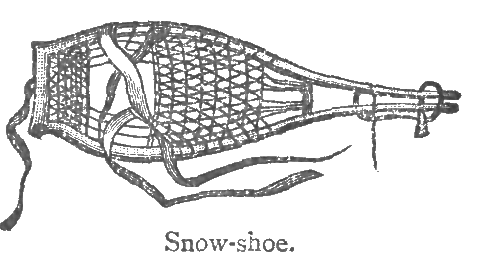
Snow, snō, n. a vessel once much in use, differing only from a brig in having the boom-mainsail traversing on the trysail-mast, instead of hooped to the mainmast. [Dut. snaauw, a boat.]
Snub, snub, v.t. to check, to reprimand: to slight intentionally, to rebuff by a cutting remark or retort:—pr.p. snub′bing; pa.t. and pa.p. snubbed.—n. an act of snubbing, any deliberate slight.—adjs. Snub, flat and broad, with the end slightly turned up; Snub′bish, inclined to snub or check; Snub′by, somewhat snub.—n. Snub′-nose, a short or flat nose.—adj. Snub′-nosed.—ns. Snub′-, Snub′bing-post, a post round which a rope is wound to check the motion of a horse or boat.—Snub a cable, to check it suddenly in running out. [Scand., Dan. snibbe, to reprove, Sw. snubba.]
Snudge, snuj, v.i. (obs.) to be snug and quiet.
Snudge, snuj, v.i. to save in a miserly way.—n. a mean stingy fellow.
Snuff, snuf, v.i. to draw in air violently and noisily through the nose: to sniff: to smell at anything doubtfully: to take snuff into the nose.—v.t. to draw into the nose: to smell, to examine by smelling.—n. a powdered preparation of tobacco or other substance for snuffing, a pinch of such: a sniff: resentment, huff.—ns. Snuff′-box, a box for snuff; Snuff′-dip′ping, the habit of dipping a wetted stick into snuff and rubbing it on the gums; Snuff′er, one who snuffs; Snuff′iness, state of being snuffy.—v.i. Snuf′fle, to breathe hard through the nose.—n. the sound made by such: a nasal twang: cant.—n. Snuf′fler, one who snuffles or speaks through his nose when obstructed.—n.pl. Snuf′fles, nasal catarrh and consequent stoppage of the nose.—ns. Snuff′ling; Snuff′-mill, a machine for grinding tobacco into snuff; Snuff′-mull, a snuff-box; Snuff′-spoon, a spoon for taking snuff from a snuff-box; Snuff′-tāk′er, one who snuffs habitually; Snuff′-tāking.—adj. Snuff′y, soiled with, or smelling of, snuff.—Take a thing in snuff (Shak.), to take offence; Up to snuff, knowing, not likely to be taken in. [Dut. snuffen, snuf; Ger. schnaufen, to snuff.]
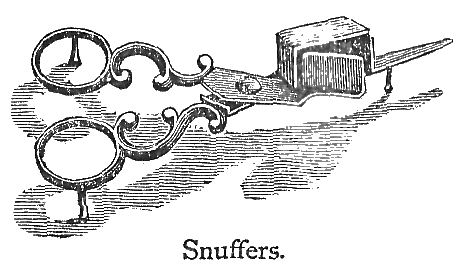
Snuff, snuf, v.t. to crop or pinch the snuff from, as a burning candle.—n. the charred portion of a candle or lamp-wick: a candle almost burnt out.—ns.pl. Snuff′-dishes (B.), dishes for the snuff of the lamps of the tabernacle; Snuff′ers, an instrument for taking the snuff off a candle.—Snuff out, to extinguish by snuffing, to end by a sudden stroke. [M. E. snuffen, for snuppen—Scand., Sw. dial. snóppa, to snip off, Dan. snubbe, to nip off.]
Snug, snug, adj. lying close and warm: comfortable: not exposed to view or notice: being in good order: compact: fitting close.—v.i. to move so as to lie close.—v.t. to make smooth.—n. Snug′gery, a cosy little room.—v.i. Snug′gle, to cuddle, nestle.—v.t. Snug′ify (Lamb), to make snug.—adv. Snug′ly.—n. Snug′ness. [Scand., Ice. snögg-r, smooth.]
Snuzzle, snuz′l, v.i. (prov.) to rub the nose against and snuff.
Sny, snī, n. a gentle bend in timber, curving upwards. [Prob. Ice. snúa, to turn.]
So, sō, adv. in this manner or degree: thus: for like reason: in such manner or degree: in a high degree: as has been stated: on this account: an abbrev. for Is it so? be it so.—conj. provided that: in case that.—interj. stand as you are! steady! stop! by way of command.—adj. So′-called, generally styled thus—usually implying doubt.—So and so, an undetermined or imaginary person; So as, in such a manner as, with such a purpose as: if only, on condition that; So far, to that extent, degree, or point; So forth, denoting more of the same or a like kind; So much, as much as is implied or mentioned: such an amount not determined or stated; So much as, to whatever extent; So on, so forth; So so, only thus, only tolerably; So that, with the purpose that: with the result that: if only; So then, thus then it is, therefore; So to say, or speak, to use that expression.—Or so, or thereabouts; Quite so, just as you have said, exactly. [A.S. swá; Ice. svá, Goth. swa, Ger. so.]
Soak, sōk, v.t. to steep in a fluid: to wet thoroughly: to drench: to draw in by the pores.—v.i. to be steeped in a liquid: to enter into pores: to drink to excess, to guzzle.—n. process or act of soaking: a hard drinker, a carouse.—ns. Soak′age, act of soaking: the amount soaked in; Soak′er, a habitual drunkard.—p.adj. Soak′ing, that wets thoroughly: drenching, as rain.—adv. Soak′ingly.—adj. Soak′y, steeped, wet. [A.S. súcan, to suck, pa.t. seác, pa.p. socen.]
Soap, sōp, n. a compound of oils or fats with soda (hard soaps) or potash (soft soaps), used in washing: (slang) soft words, flattery: (U.S. slang) money used for bribery and other secret political purposes.—v.t. to rub or wash with soap: to flatter.—ns. Soap′-ball, soap made into a ball, often with starch, as an emollient; Soap′berry, the fruit of several species of trees belonging to the genus Sapindus, containing a pulp useful as a substitute for soap in washing; Soap′-boil′er, one whose occupation is to make soap; Soap′-boil′ing, the occupation of making soap; Soap′-bub′ble, a bubble made from soap-suds by blowing through a pipe; Soap′iness; Soap′-lock, a lock of hair brushed apart from the rest: a rowdy; Soap′-pan, a large tank for boiling the ingredients in soap-making; Soap′-plant, a plant the bulb of which makes a thick lather when rubbed on clothes, and is used as soap; Soap′-stone, a soft kind of magnesian rock having a soapy feel, also called Steatite; Soap′-suds (s. and pl.), soapy water, esp. when worked into a foam; Soap′-test, a test for determining the degree of hardness of water; Soap′-works, a place where soap is made; Soap′wort, a genus of plants, some of the species of which have very beautiful flowers, and the root and leaves of which contain saponin, and hence are sometimes used in washing.—adj. Soap′y, like soap: having the qualities of soap: covered with soap: flattering, or pertaining to flattery. [A.S. sápe; Dut. zeep, Ger. seife.]
Soar, sōr, v.i. to mount into the air: to fly aloft: to rise to a height, also mentally or morally.—n. act of soaring: the height reached in soaring.—adjs. Soar′ant (her.), flying aloft; Soar′ing.—adv. Soar′ingly, having an upward direction. [O. Fr. essorer, to expose to air—L. ex, out of, aura, air.]
Sob, sob, v.i. to sigh in a convulsive manner, with tears: to weep with convulsive catchings of the breath, due to contractions of the diaphragm, accompanied by a closure of the glottis, preventing the entrance of air into the lungs.—v.t. to utter with sobs:—pr.p. sob′bing; pa.t. and pa.p. sobbed.—n. a short, convulsive sigh, any similar sound.—n. Sob′bing.—adv. Sob′bingly. [Conn. with A.S. seófian, to sigh; Ger. seufzen.]
Sobeit, sō-bē′it, conj. if it be so.
Sober, sō′bėr, adj. not wild or passionate: self-possessed: sedate: grave: calm: regular: simple in colour, sombre: not drunk: temperate, esp. in the use of liquors: (Scot.) poor, feeble.—v.t. to make sober: to free from intoxication.—adj. Sō′ber-blood′ed, cool.—v.t. Sō′berise, to make sober.—adv. Sō′berly.—adj. Sō′ber-mind′ed, habitually calm and temperate.—ns. Sō′ber-mind′edness, the state of being sober-minded: freedom from inordinate passion: calmness; Sō′berness; Sō′bersides, a sedate and solemn person.—adj. Sō′ber-suit′ed, dressed in a suit of sad-coloured clothes.—n. Sōbrī′ety, state or habit of being sober: calmness: gravity. [Fr. sobre—L. sobrius—se, apart, not, ebrius, drunk.]
Sobol, sō′bol, n. the Russian sable. [Polish.]
Soboles, sob′ō-lēz, n. (bot.) a shoot or sucker.—adj. Sobolif′erous. [L. suboles—sub, under, olēre, to grow.]
Sobranje, sō-brän′ye, n. the national assembly of Bulgaria.—Also Sobran′ye. [Bulg.]
Sobriquet, sō-brē-kā′, n. a contemptuous nickname: an assumed name.—Also Soubriquet′. [Fr.,—O. Fr. soubzbriquet, a chuck under the chin, soubz, sous—L. sub, under, briquet, breast; cf. Brisket.]
Socage, Soccage, sok′āj, n. the tenure of lands by service fixed and determinate in quality.—ns. Soc′ager, Soc′man, a tenant by socage; Soc′manry, tenure by socage. [A.S. sóc, a right of holding a court—sóc, pa.t. of sacan, to contend.]
So-called, sō′-kawld, adj. See under So.
Sociable, sō′sha-bl, adj. inclined to society: fit for company: companionable: affording opportunities for intercourse.—n. a four-wheeled open carriage with seats facing: a tricycle for two persons side by side: a couch with a curved S-shaped back: (U.S.) an informal party, a social church meeting.—ns. Sōciabil′ity, Sō′ciableness, quality of being sociable: good-fellowship.—adv. Sō′ciably.—adj. Sō′cial, pertaining to society or companionship: relating to men united in a society: inclined for friendly intercourse: consisting in mutual converse: convivial: associating together, gregarious: growing in patches.—v.t. Sō′cialise, to reduce to a social state: to render social.—ns. Sō′cialism, the name given to any one of various schemes for regenerating society by a more equal distribution of property, and esp. by substituting the principle of association for that of competition; Sō′cialist, an adherent of socialism.—adj. Socialist′ic.—ns. Social′ity, Sō′cialness.—adv. Sō′cially.—adjs. Sō′ciātive, expressing association; Societā′rian, Socī′etary, of or pertaining to society.—ns. Socī′ety, fellowship, companionship: a number of persons associated for a common interest: a community or partnership: the civilised body of mankind, those who are recognised as the leaders in fashionable life, the fashionable world generally: persons who associate: any organised association for purposes literary, scientific, philanthropic, or ecclesiastical; Socī′ety-house, a printing office which conforms to the rules of a trade-union; Socī′ety-verse, poetry light and entertaining, treating of the topics of society so called.—Social science, sociology, esp. the branch treating of the existing institutions of men as members of society, the science which treats of social relations; Social War, the war (90-88 b.c.) in which the Italian tribes known as the allies (Socii) fought for admission into Roman citizenship.—Socialism of the Chair, a term first applied about 1872 in ridicule to the doctrines of a school of political economists in Germany whose aim was mainly to better the condition of the working-classes through remedial state-legislation, by factory-acts, savings-banks, insurances against sickness and old age, shortening the hours of labour, sanitation, &c.—also called Professorial socialism, and having much the same ends and methods as the State socialism of Bismarck.—Christian socialism, a movement for applying Christian ethics to social reform, led by Maurice, Kingsley, and others about 1848-52.—The societies, bodies that began to be organised in 1681 for the maintenance of Presbyterian worship in the face of persecution—ultimately forming the Reformed Presbyterian Church. [Fr.,—L. sociabilis—sociāre, to associate—socius, a companion.]
Socinian, sō-sin′i-an, adj. pertaining to Socinus, the name of two celebrated heresiarchs, uncle and nephew, who in the 16th century denied the doctrine of the Trinity, the deity of Christ, &c.—n. a follower of Lælius and Faustus Socinus, one who refuses to accept the divinity of Christ, a Unitarian.—n. Socin′ianism, the doctrines of Socinus.
Sociology, sō-shi-ol′ō-ji, n. the science that treats of man as a social being, in the origin, organisation, and development of human society and human culture, esp. on the side of social and political institutions, including ethics, political economy, &c.—ns. Sociog′eny, the science of the origin of society; Sociog′raphy, the branch of sociology devoted to noting and describing the results of observation.—adjs. Sociolog′ic, -al.—adv. Sociolog′ically.—ns. Sociol′ogist, one devoted to the study of sociology; Sō′cius, an associate: a fellow of an academy, &c. [A hybrid from L. socius, a companion, and Gr. logia—legein, to speak.]
Sock, sok, n. a kind of half-stocking: comedy, originally a low-heeled light shoe, worn by actors of comedy. [A.S. socc—L. soccus.]
Sock, sok, n. a ploughshare. [O. Fr. soc—Celt., Bret. souc'h, Gael. soc.]
Sock, sok, v.t. (prov. and slang) to throw: to strike hard, to give a drubbing.
Sockdologer, sok-dol′ō-jėr, n. (Amer. slang) a conclusive argument: a knock-down blow: anything very big, a whopper: a form of fish-hook. [A corr. of doxology as the closing act of a service.]
Socket, sok′et, n. a hollow into which something is inserted, the receptacle of the eye, &c.: a hollow tool for grasping and lifting tools dropped in a well-boring: the hollow of a candlestick: a steel apparatus attached to the saddle to protect thighs and legs.—v.t. to provide with or place in a socket.—n. Sock′et-bolt, a bolt for passing through a thimble placed between the parts connected by the bolt.—p.adj. Sock′eted, provided with, placed in, or received in a socket. [A dim. of sock.]
Socle, sō′kl, n. (archit.) a plain, square, flat member used instead of a pedestal to support a column, &c.: a plain face or plinth at the foot of a wall. [Fr.—It. zoccolo—L. socculus, dim. of soccus, a high-heeled shoe, as if a support.]
Socratic, -al, sō-krat′ik, -al, adj. pertaining to Socrates, a celebrated Greek philosopher (469-399 B.C.), to his philosophy, or to his manner of teaching, which was an art of inducing his interlocutors to discover their own ignorance and need of knowledge by means of a series of simple questions.—adv. Socrat′ically.—ns. Soc′ratism, the philosophy of Socrates; Soc′ratist, a disciple of Socrates.
Sod, sod, n. any surface of earth grown with grass, &c.: turf.—adj. consisting of sod.—v.t. to cover with sod.—adj. Sod′dy, covered with sod: turfy.—The old sod, one's native soil. [Low Ger. sode; Ger. sode; perh. conn. with A.S. seáth, a well—seóthan (pa.p. soden), to boil.]
Sod, sod, obsolete pa.t. of seethe.
Soda, sō′da, n. oxide of sodium, or its hydrate: the alkali obtained from the ashes of marine vegetables, or by decomposing sea-salt: (coll.) soda-water.—ns. Sō′da-ash, sodium carbonate; Sō′da-crack′er, a biscuit made of flour and water, with salt, bicarbonate of soda, and cream of tartar; Sō′da-fount′ain, a metal or marble case for holding water charged with carbonic-acid gas.—adj. Sodā′ic, pertaining to, or containing, soda.—ns. Sō′da-lime, a mixture of caustic soda and quicklime; Sō′dalite, a mineral composed chiefly of soda, along with silica, alumina, and hydrochloric acid; Sō′da-pā′per, a paper saturated with sodium carbonate; Sō′da-salt, a salt having soda for its base; Sō′da-wa′ter, water containing soda charged with carbonic acid; Sō′dium, a yellowish-white metal, the base of soda. [It. soda—L. solida, firm.]
Sodality, sō-dal′i-ti, n. a fellowship or fraternity. [L. sodalitas—sodalis, a comrade.]
Sodden, sod′n, pa.p. of seethe, boiled: soaked thoroughly: boggy: doughy, not well baked: bloated, saturated with drink.—n. Sod′denness.—adj. Sod′den-wit′ted (Shak.), heavy, stupid.
Sodomy, sod′om-i, n. unnatural sexuality, so called because imputed to the inhabitants of Sodom.—n. Sod′omite, an inhabitant of Sodom: one guilty of sodomy.—adj. Sodomit′ical.—adv. Sodomit′ically.
Soever, sō-ev′ėr, adv. generally used to extend or render indefinite the sense of who, what, where, how, &c.
Sofa, sō′fa, n. a long seat with stuffed bottom, back and arms—formerly Sō′pha.—n. Sō′fa-bed, a piece of furniture serving as a sofa by day, capable of being made into a bed at night. [Fr.,—Ar. suffah—saffa, to arrange.]
Soffit, sof′it, n. a ceiling, now generally restricted to the ornamented under-sides of staircases, entablatures, archways, &c.; also the larmier or drip. [Fr.,—It.,—L. suffixa, pa.p. of suffigĕre, to fasten beneath—sub, under, figĕre, to fix.]
Sofi, Sofism. See Sufi, Sufism.
Soft, soft, adj. easily yielding to pressure: easily cut or acted upon: malleable: not rough to the touch: smooth: pleasing or soothing to the senses: easily yielding to any influence: mild: sympathetic: gentle: effeminate: gentle in motion: easy: free from lime or salt, as water: bituminous, as opposed to anthracitic, of coal: unsized, of paper: wet, rainy: warm enough to melt ice, thawing: (phon.) pronounced with a somewhat sibilant sound, not guttural or explosive: vocal or sonant: not bony, cartilaginous, not spinous: soft-rayed, soft-shelled: of silk, having the natural gum cleaned or washed off—opp. to Hard.—n. a silly person, a fool.—adv. gently: quietly.—interj. hold! not so fast!—adjs. Soft′-bod′ied, having a soft body; Soft′-con′scienced, having a sensitive conscience.—v.t. Soft′en, to make soft or softer: to mitigate: to tone down, make less glaring, make smoother in sound.—v.i. to grow soft or softer.—ns. Soft′ener; Soft′ening.—adjs. Soft′-eyed, having gentle or tender eyes; Soft′-finned, having no fin-spines.—n.pl. Soft′-goods, cloth, and cloth articles, as opposed to hardware, &c.—adjs. Soft′-hand′ed, having soft hands, unused to work, slack in discipline; Soft′-head′ed, of weak intellect; Soft′-heart′ed, kind-hearted: gentle: meek.—n. Soft-heart′edness.—adj. Soft′ish, rather soft.—adv. Soft′ly.—n. Soft′ness.—v.t. Soft′-saw′der (U.S.), to flatter, blarney.—n. flattery.—v.t. Soft′-soap, to flatter for some end.—n. flattery.—adj. Soft-spō′ken, -voiced, having a mild or gentle voice: mild, affable.—n. Soft′y, a silly person, a weak fool.—A soft thing, a snug place where the pay is good and the work light. [A.S. sófte, séfte; Dut. zacht, Ger. sanft.]
Softa, sof′ta, n. a Moslem theological student, attached to a mosque. [Turk.]
Soger, sō′jėr, n. (naut.) one who skulks his work.—v.i. to shirk one's work.
Soggy, sog′i, adj. soaked with water.—n. Sog, a bog.
So-ho, sō-hō′, interj. (Shak.) a form of call from a distance, a sportsman's halloo.
Soi-disant, swo-dē-zong′, adj. self-styled, pretended. [Fr.]
Soil, soil, n. the ground: the mould on the surface of the earth which nourishes plants: country.—adj. Soil′-bound, attached to the soil.—n. Soil′-cap, the covering of soil on the bed-rock.—adj. Soiled, having soil. [O. Fr. soel, suel, sueil—Low L. solea, soil, ground, L. solea, sole, allied to L. solum, ground, whence Fr. sol, soil.]
Soil, soil, n. dirt: dung: foulness: a spot or stain: a marshy place in which a hunted boar finds refuge.—v.t. to make dirty: to stain: to manure.—v.i. to take a soil: to tarnish.—n. Soil′iness, stain: foulness.—adj. Soil′less, destitute of soil.—ns. Soil′-pipe, an upright discharge-pipe which receives the general refuse from water-closets, &c., in a building; Soil′ure (Shak.), stain: pollution. [O. Fr. soil, souil (Fr. souille), wallowing-place—L. suillus, piggish—sus, a pig, a hog.]
Soil, soil, v.t. to feed at the stall for the purpose of fattening. [O. Fr. saouler—saol, saoul—L. satullus—satur, full.]
Soirée, swä-rā′, n. an evening party: an evening social meeting with tea, &c. [Fr.,—soir, evening (Prov. sera)—L. serus, late.]
Sojourn, sō′jurn, v.t. to stay for a day: to dwell for a time.—n. a temporary residence.—ns. Sō′journer; Sō′journing, Sō′journment, the act of dwelling in a place for a time. [O. Fr. sojourner—L. sub, under, diurnāre, to stay—Low L. jornus—L. diurnus, relating to day—dies, a day.]