Front matter (continued 13)
Reading edition
Thereology, ther-ē-ol′ō-ji, n. the art of healing, therapeutics.—n. Thereol′ogist, one versed in thereology. [Gr. therein=therapeuein, to tend the sick, logia—legein, to speak.]
Theriaca, thē-rī′a-ka, n. one of the various preparations of opium: a medicine in the form of an electuary, supposed to be an antidote to snakebites, &c.—also Thē′riac.—adjs. Thē′riac, -al, Thē′rial, medicinal. [L.,—Gr. thēriakē—thērion, a wild beast.]
Therianthropism, thē-ri-an′thrō-pizm, n. the representation of deities in combined man and beast forms.—adj. Therianthrop′ic, pertaining to super human beings of combined human and bestial forms, or their worship.—n. Thē′riomancy, divination by observation of beasts.—adjs. Theriomor′phic, Theriomor′phous, beast-like.—n. Theriot′omy, the dissection of beasts, zootomy.
Theriatrica, thē-ri-at′ri-ka, n. the art of veterinary medicine.
Thermal, thėr′mal, adj. pertaining to heat: warm.—n. Therm, a thermal unit.—n.pl. Ther′mæ, hot springs or baths.—adv. Ther′mally.—n. Thermatol′ogy, the science of the treatment of disease by heat, esp. by thermal mineral waters.—adj. Ther′mic, thermal.—adv. Ther′mically.—ns. Thermobarom′eter, an apparatus for measuring pressure of the atmosphere from the boiling-point of water; Thermochem′istry, that branch of chemistry which treats of the relations between chemical action and heat; Ther′mochrosy, the property possessed by rays of radiant heat of having varying wave-lengths and degrees of refrangibility; Ther′mo-curr′ent, a thermo-electric current.—adj. Ther′mo-dynam′ic.—n. Ther′mo-dynam′ics, the branch of physics which treats of heat as a mechanical agent.—adj. Ther′mo-elec′tric.—ns. Ther′mo-electric′ity, electricity developed by the unequal heating of bodies; Ther′mo-electrom′eter, an instrument for measuring the strength of a current of electricity by its effect in producing heat; Thermogen′esis, the production of heat, esp. in the body by physiological processes.—adjs. Thermogenet′ic, Thermogen′ic.—ns. Ther′mogram, the record made by a thermograph; Ther′mograph, an automatic self-registering thermometer; Thermog′raphy, any process of writing involving the use of heat; Ther′mo-mag′netism, magnetism as modified or produced by the action of heat on the body magnetised or on the medium surrounding it; Thermomet′rograph, a self-registering thermometer; Ther′mo-pile, a thermo-electric battery used as a thermometer; Ther′moscope, an instrument for detecting changes of temperature without measuring them accurately.—adj. Thermoscop′ic.—adv. Thermoscop′ically.—n. Ther′mostat, an appliance for showing temperatures automatically by the expansion of substances—used in regulating steam pressures, &c.—adj. Thermostat′ic.—adv. Thermostat′ically.—adjs. Thermot′ic, -al, pertaining to heat.—n. Thermot′ics, the science of heat. [Gr. thermos, hot—thermē, heat—therein, to heat.]
Thermidor, ther-mi-dōr′, n. the eleventh month in the calendar of the first French Republic, lasting from the 19th of July to the 18th of August. The 9th Thermidor of the Republican year 2 (July 27, 1794) is historically memorable as the date of Robespierre's fall and the termination of the Reign of Terror.—n. Thermidō′rian, one who took part in this fortunate coup d'état.
Thermometer, thėr-mom′e-tėr, n. an instrument for measuring the variations of sensible heat or temperature.—adjs. Thermomet′ric, -al, pertaining to, or made with, a thermometer.—adv. Thermomet′rically.—For the Centigrade and the Fahrenheit scale and their relations to each other, see Centigrade and Fahrenheit. In the Réaumur scale, still largely used in Russia and Germany, the freezing-point is marked zero, and the space between this and boiling-point is divided into 80 degrees. To reduce it to Fahrenheit, multiply by 2¼ and add 32; to Centigrade, increase the number by one-fourth of itself. Thus: F = 9⁄5 C + 32 = 9⁄4 R + 32; C = 5⁄9 (F - 32) = 5⁄4 R; R = 4⁄9 (F - 32) = 4⁄5 C.—Maximum thermometer, one that registers the maximum temperature to which it is exposed; Minimum thermometer, one that registers the minimum temperature to which it is exposed. [Gr. thermē, heat, metron, a measure.]
Thesaurus, thē-saw′rus, n. a treasury or repository, esp. of knowledge: a lexicon or cyclopædia. [L.,—Gr. thēsauros—tithēmi, I place.]
These, thēz, demons. pron., pl. of this. [A.S. thǽs, pl. of thes, this. Doublet those.]
Thesis, thē′sis, n. a position or that which is set down or advanced for argument: a subject for a scholastic exercise: an essay on a theme:—pl. Theses (thē′sēz).—adj. Thet′ic.—adv. Thet′ically. [L.—Gr. ti-thē-mi, I set.]
Thesmophoria, thes-mō-phō′ri-a, n.pl. an ancient Greek festival with mysteries, celebrated by married women in honour of Demeter (Ceres) five days about October.
Thesmothete, thes′mō-thēt, n. a lawgiver, esp. one of the six junior archons in ancient Athens.
Thespian, thes′pi-an, adj. pertaining to tragedy: tragic. [Gr. Thespis, founder of the Greek drama.]
Thetch, thech, n. (Spens.). Same as Thatch.
Thether, theth′ėr, adv. (Spens.). Same as Thither.
Theurgy, thē′ur-ji, n. that kind of magic which affects to work by supernatural agency, as distinguished from natural magic and necromancy.—adjs. Theur′gic, -al.—n. Theur′gist, a magician. [Gr. theourgia—theos, a god, ergein, to work.]
Thew, thū, n. (used chiefly in pl.) muscle or strength: sinews.—adjs. Thewed (Spens.), furnished with thews or sinews; Thew′less, weak; Thew′y, muscular, strong. [Perh. a form of thigh.]
Thewed, thūd, adj. (Spens.) mannered, behaved, educated. [A.S. théaw, manner, habit.]
They, thā, pers. pron., pl. of he, she, or it. [The form thei, tha, that came into use in the north of England in the 13th cent., replacing the older hi, heo. It is the A.S. þá, nom. pl. of the definite article, prob. modified by Scandinavian influence.]
Thible, thib′l, n. (prov.) a pot-stick.
Thick, thik, adj. dense: imperfectly mobile: compact: not transparent or clear: misty: dull, mentally clouded: crowded: closely set: abundant: frequent, in quick succession: having great depth or circumference: (coll.) in fast friendship.—n. the thickest part of anything: a stupid person.—adv. closely: frequently: fast: to a great depth.—adjs. Thick′-and-thin, thorough, completely devoted; Thick′-com′ing (Shak.), coming fast or close together.—v.t. Thick′en, to make thick or close: to strengthen.—v.i. to become thick or obscure: to crowd or press.—ns. Thick′ening, something put into a liquid or mass to make it more thick; Thick′et, a collection of trees or shrubs thickly or closely set: close wood or copse.—adjs. Thick′-head′ed, having a thick head or skull: stupid; Thick′ish, somewhat thick.—n. Thick′-knee, a stone-plover.—adj. Thick′-lipped (Shak.), having thick lips.—adv. Thick′ly.—n. Thick′ness.—adjs. Thick′-pleached (Shak.), closely interwoven; Thick′-set, closely planted: having a short, thick body.—n. Thick′-skin, a person wanting sensibility: a dull, stupid person, a blockhead.—adj. Thick′-skinned, having a thick skin: wanting sensibility: dull: obtuse.—n. Thick′-skull (same as Thick-skin).—adjs. Thick′-skulled, having a thick skull: dull: stupid; Thick′-sprung (Shak.), that have sprung up thick or close together.—n. Thick′un (slang), a sovereign: a crown.—Lay it on thick, to flatter or praise extravagantly; Through thick and thin, in spite of all obstacles, without any wavering. [A.S. thicce; cog. with Ger. dick.]
Thick, thik, n. (Spens.) a thicket.—v.i. (Spens.) to grow dense.
Thief, thēf, n. one who steals or takes unlawfully what is not his own.—ns. Thief′-catch′er, -tā′ker, one whose business is to detect thieves and bring them to justice: a detective. [A.S. theóf; Ice. thjóf-r, Ger. dieb.]
Thieve, thēv, v.i. to practise theft: to steal.—n. Thiev′ery, the practice of thieving.—adj. Thiev′ish, given to, or like, theft or stealing: acting by stealth: secret: sly.—adv. Thiev′ishly.—n. Thiev′ishness. [A.S. theófian.]
Thig, thig, v.i. to make supplication, to live on alms.—v.t. to beseech, beg.—n. Thig′ger, a beggar, a sorner. [A.S. thicgan, to take.]
Thigh, thī, n. the thick fleshy part of the leg from the knee to the trunk.—n. Thigh′-bone, the bone of the leg between the hip-joint and the knee. [A.S. theó, theóh; Ice. thjó, Old High Ger. deoh.]
Thilk, thilk, pron. (Spens.) the same. [A.S. thylc, thyllíc, the like, such—thí, instrumental case of thæt, that, and líc, like.]
Thill, thil, n. one of the shafts of a cart or other carriage.—ns. Thill′er, Thill′-horse (Shak.), the horse that goes between the thills or shafts of a carriage, or the last of a team. [A.S. thille, a board, a plank.]
Thimble, thim′bl, n. a metal cover for the finger, used in sewing.—ns. Thim′ble-case, a case for holding a thimble; Thim′bleful, as much as a thimble will hold: a small quantity; Thim′ble-rig, a sleight-of-hand trick in which the performer conceals, or pretends to conceal, a pea or small ball under one of three thimble-like cups.—v.i. to cheat by such means.—ns. Thim′ble-rig′ger; Thim′ble-rig′ging. [A.S. thýmel, a thumb-stall—thúma, a thumb. An extension of thumb.]
Thin, thin, adj. having little thickness: slim: lean: freely mobile: small: fine: not close or crowded: transparent, flimsy, shallow: not full or well grown, meagre, weak.—adv. not thickly or closely: in a scattered state.—v.t. to make thin: to make less close or crowded (with away, out, &c.): to make rare or less thick or dense.—v.i. to grow or become thin:—pr.p. thin′ning; pa.t. and pa.p. thinned.—adj. Thin′-faced (Shak.), having a thin face.—adv. Thin′ly.—n. Thin′ness.—adjs. Thin′nish, somewhat thin; Thin′-skinned, having a thin skin: sensitive: irritable.—n. Thin′-skinned′ness. [A.S. thynne; Ice. thunnr, Ger. dünn.]
Thine, thīn, pron. (poss. form of thou) belonging to thee: thy. [A.S. thín, thy—thín, gen. of thú, thou; Ger. dein.]
Thing, thing, n. an inanimate object: a living being (in tenderness or in contempt): an event: a part: (pl.) clothes, wraps.—ns. Thing′iness, reality, objectivity: disposition to take a materialistic view of things; Thing′-in-itself′, a noumenon, the Ger. ding an sich; Thing′umbob, Thing′ummy (coll.), a thing, anything, an indefinite name for some person whom one cannot be troubled to name distinctly.—adj. Thing′y, materialistic.—Do the handsome thing by, to treat generously; Know a thing or two, to be shrewd; Make a good thing of it, to reap a good advantage from; The thing, the proper or right thing. [A.S. thing, thinc; Ger. ding.]
Thing, ting, n. a parliament, or a court of law, in Scandinavian countries. [Ice. thing, an assembly.]
Think, thingk, v.i. to exercise the mind (with about, of, on): to revolve ideas in the mind: to judge: to form or hold as an opinion: to consider: to purpose or design.—v.t. to imagine: to judge: to believe or consider:—pa.t. and pa.p. thought.—adj. Think′able, capable of being thought.—n. Think′er.—p.adj. Think′ing, having the faculty of thought.—n. the act or state of one who thinks: (Shak.) thought, imagination, judgment.—adv. Think′ingly.—Think little of, to have a poor opinion of—opposite to Think much, or well, of; Think long, to yearn for: to become weary in waiting; Think out, to devise, project: to solve by a process of thought. [A.S. thencan, thencean; cog. with Ger. denken, from root of thank.]
Third, thėrd, adj. the last of three.—n. one of three equal parts: (golf) a handicap of a stroke every third hole.—ns. Third′-bor′ough (Shak.), an under-constable; Third′ing, the third part of anything.—adv. Third′ly, in the third place.—adj. Third′-rate, of the third order.—n. Thirds′man, a mediator.—Third estate, in England, the House of Commons; Third person in the Trinity, the Holy Spirit. [A.S. thridda—threó, three.]
Thirl, thėrl, n. (prov.) a hole: an opening: a short passage between two headings in a mine.—v.t. to pierce, wound: cause to quiver.—v.i. to vibrate, tingle, thrill.
Thirl, thėrl, n. a form of thrall.—v.t. to bind or subject.—n. Thirl′age, a form of servitude by which the grain produced on certain lands had to be ground at a certain mill and a certain proportion paid.
Thirst, thėrst, n. the uneasiness caused by want of drink: vehement desire for drink: eager desire for anything.—v.i. to feel thirst: to desire vehemently.—n. Thirst′er.—adv. Thirst′ily.—n. Thirst′iness.—adj. Thirst′y, suffering from thirst: dry: parched: vehemently desiring. [A.S. thurst, thyrst; Ger. durst; cf. Gr. tersesthai, L. torrēre, to dry.]
Thirteen, thėr′tēn, adj. and n. three and ten.—adj. and n. Thir′teenth, the last of thirteen: a thirteenth part. [A.S. threótýne—threó, three, týn, ten.]
Thirty, thėr′ti, adj. and n. three times ten.—adj. Thir′tieth, the last of thirty.—n. a thirtieth part. [A.S. thrítig—threó, three, -tig, suff. denoting ten.]
This, this, demons. pron. or adj. denoting a person or thing near, just mentioned, or about to be mentioned: (B.) the last past:—pl. These.—n. This′ness, hæccity. [A.S. this, the neut. of the adj. pron. thes (masc.), theós (fem.), this (neut.)—pl. thǽs (=these), thás (=those); Ice. thessi, Ger. dieser.]
Thistle, this′l, n. a genus of prickly plants.—n. This′tle-down, the tufted feathery bristles of the seeds of the thistle.—adj. This′tly, overgrown with thistles. [A.S. thistel; Ger. distel.]
Thither, thith′ėr, adv. to that place: to that end or result.—adv. Thith′erward, toward that place. [A.S. ðider.]
Thlipsis, thlip′sis, n. constriction of a blood-vessel by external compression. [Gr.,—thlibein, to press.]
Tho, thō, adv. (Spens.) then, also the sing. of those.
Tho'=Though.
Thoft, thoft, n. (prov.) a rowing-bench. [A.S. thofte.]
Thole, thōl, n. a pin in the side of a boat to keep the oar in place.—Also Thole′-pin, Thowl, Thowel. [A.S. thol; Dut. dol, Ice. thollr.]
Thole, thōl, v.t. to endure, to suffer: to yield.—v.i. to be patient, to wait. [A.S. tholian, to suffer; Goth. thulan, Ice. thola; Old High Ger. dolén, whence Ger, ge-duld, patience, dulden, to suffer.]
Tholobate, thō′lō-bāt, n. (archit.) the substructure on which a dome or cupola rests. [Gr. tholos, a dome, bainein, to go.]
Tholus, thō′lus, n. a round building, dome, cupola:—pl. Thō′li.—Also Thole. [Gr.]
Thomism, tō′mizm, n. the doctrines of the followers of the prince of scholastic theologians, Thomas Aquinas (1226-74), esp. as these are set forth in his Summa Theologiæ, which still represent, with few exceptions, the general teaching of the R.C. Church.—n. Thō′mist, a follower of Aquinas.—adjs. Thomist′ic, -al.
Thong, thong, n. a piece or strap of leather to fasten anything. [A.S. thwang.]
Thor, thōr, n. the second principal Scandinavian divinity, the god of thunder. [Ice. Thórr.]
Thorah=Torah.
Thoral, thō′ral, adj. nuptial. [L. torus, the bed.]
Thorax, thō′raks, n. the part of the body between the neck and belly: the chest.—adj. Thoracic (-ras′-), pertaining to the thorax or breast. [L.,—Gr.]
Thorium, thō′ri-um, n. a rare metal resembling aluminium, but taking fire below a red heat, and burning with great brilliancy.—Also Thorī′num.
Thorn, thorn, n. a sharp, woody spine on the stem of a plant: a spine: a plant having spines or thorns: anything prickly or troublesome.—ns. Thorn′-app′le, a plant of genus Datura: a haw, a thorn-tree; Thorn′back, a species of ray or skate which has nail-like crooked spines in its back; Thorn′bill, a variety of humming-bird with short, straight bill; Thorn′-bush, a shrub producing thorns; Thorn′-hedge, a hedge of hawthorn.—adjs. Thorn′less, without thorns; Thorn′set, set or beset with thorns; Thorn′y, full of thorns: prickly: troublesome: harassing (A.S. thorniht).—Thorn in the flesh, any cause of constant irritation, from 2 Cor. xii. 7. [A.S. thorn; Ice. thorn, Ger. dorn.]
Thorough, thur′ō, adj. passing through or to the end: complete: entire.—prep. (obs.) through.—n. that which goes through, a passage: the blind and obstinately tyrannical policy of Strafford and Laud in administering civil and ecclesiastical affairs without regard to opposite convictions.—n. Thor′ough-bass (mus.), a bass part all through a piece, with figures placed over the notes to indicate the harmony to be played to each.—adj. Thor′oughbred, thoroughly or completely bred: bred from a dam and sire of the best blood, as a horse, and having the qualities supposed to depend thereon.—n. an animal, esp. a horse, of pure blood—of race-horses, one all of whose ancestors for seven generations (five in America) are recorded in the stud-book.—n. Thor′oughfare, a fare or passage for going through: a public way or street: right of passing through.—adj. Thor′oughgō′ing, going through or to the end: going all lengths: complete.—adv. Thor′oughly.—n. Thor′oughness.—adj. Thor′ough-paced, thoroughly or perfectly paced or trained: complete. [The longer form of through.]
Thorp, Thorpe, thorp, n. a homestead: a hamlet. [A.S. thorp; Goth. thaurp, Ger. dorf.]
Those, thōz, pron., pl. of that. [From A.S. thás, the old pl. of thes, this. Cf. This. Doublet these.]
Thoth, thoth, n. the ancient Egyptian god of wisdom, and the inventor of art, science, letters, &c., ibis-headed, with a tau-cross in his hand.
Thou, thow, pron. of the second person sing., the person addressed (now generally used only in solemn address). [A.S. ðú; cog. with Goth. thu, Gr. tu, L. tu, Sans. tva-m.]
Though, thō, conj. admitting: allowing: even if notwithstanding. [Lit. 'on that' (condition), A.S. ðeáh, ðéh; cog. with Goth. thau-h, Ice. thó, Ger. doch; from the stem of the.]
Thought, thawt, pa.t. and pa.p. of think. [A.S. þoht—þencan, to think.]
Thought, thawt, n. the act of thinking: reasoning: deliberation: that which one thinks: idea: fancy: consideration: opinion: meditation: design: care.—adjs. Thought′ed, having thoughts; Thought′ful, full of thought: employed in meditation: attentive: considerate: promoting serious thought: favourable to meditation.—adv. Thought′fully.—n. Thought′fulness.—adj. Thought′less, without thought or care: careless: inattentive: stupid: dull.—adv. Thought′lessly.—ns. Thought′lessness; Thought′-read′er; Thought′-read′ing, the dubious act or art of discerning what is passing in another's mind by some direct and unexplained method, depending neither on gesture, facial expression, nor any articulate or other voluntary indication.—adj. Thought′-sick (Shak.), uneasy with reflection.—n. Thought′-trans′ference, telepathy.—adj. Thought′-transferen′tial, telepathic.—n. Thought′-wave, a supposed undulatory movement of a hypothetical medium by which the phenomena of thought-transference are explained.—Take thought (Shak.), to give way to grief. [A.S. ge-thóht; Ice. thóttr, Ger. bedacht. Cf. Think.]
Thous, thowz (Spens.), Thou art.
Thous, thō′us, n. a genus of canines, the African jackals, [L. thos—Gr. thōs, a wild dog.]
Thousand, thow′zand, adj. denoting ten hundred: proverbially, denoting any great number.—n. the number ten hundred: any large number.—adj. Thou′sandfold, folded a thousand times: multiplied by a thousand.—n. Thou′sand-legs, any one of the Myriapoda.—adj. Thou′sandth, the last of a thousand or of any great number.—n. one of a thousand or of any great number.—One in [of] a thousand, anything exceedingly rare, implying a high degree of rarity or excellence. [A.S. thúsend; Ger. tausend, Goth. thúsundi.]
Thowel, Thowl. See Thole (1).
Thowless, thow′les, adj. (Scot.) pithless: lazy. [Thew.]
Thrall, thrawl, n. a slave, serf: slavery, servitude: a shelf for barrels.—adj. (arch.) subject.—v.t. to enslave.—ns. Thral′dom, Thrall′dom, the condition of a thrall or slave: slavery: bondage.—adj. Thrall′-like (Milt.), resembling a thrall or slave: resembling slavery: slavish. [Old Northumbrian ðrǽl—Ice. þræll, a slave; cf. Old High Ger. drigil, a slave, one who runs errands. From root of A.S. þrægian, to run.]
Thrap, thrap, v.t. to fasten about. [Prob. frap.]
Thrapple, thrap′l, n. (Scot.) the windpipe.—Also Thropp′le. [Throttle.]
Thrash, thrash, v.t. to heat out grain from the straw, to beat soundly—also Thresh.—ns. Thrash′er, Thresh′er; Thrash′ing, Thresh′ing, the act of beating out grain from the straw: a sound beating or drubbing; Thrash′ing-floor, Thresh′ing-floor, a floor on which grain is thrashed; Thrash′ing-machine′, -mill, a machine or apparatus for thrashing corn. [A.S. therscan; cog. with Ger. dreschen.]
Thrash, thrash, n. (Scot.) a rush.—Also Thresh.
Thrasher, thrash′ėr, n. an American throstle or thrush, the brown thrush or sandy mocking-bird.—Also Thresh′er.
Thrasonical, thrā-son′ik-al, adj. resembling Thraso, a boastful soldier in Terence's Eunuchus: boastful, bragging.—adv. Thrason′ically.
Thratch, thrach, v.t. (Scot.) to gasp for breath.—n. laboured breathing.
Thrave, thrāv, n. twenty-four sheaves of grain set up in two stooks of twelve sheaves each: the number of two dozen, a good number.—Also Threave (thrēv). [Scand., Ice. þrefi—þrífa, to grasp.]
Thraw, thraw, v.t. (Scot.) to twist, wrench.—v.i. to writhe, to wriggle: to be perverse.—adjs. Thrä′ward, Thrä′wart, obstinate; Thrawn, twisted: perverse.—Heads and thraws, lying beside each other, the head of the one by the feet of the other; In the dead thraw, in the agony of death. [Throw.]
Thread, thred, n. a very thin line of any substance twisted and drawn out: a filament of any fibrous substance: a fine line of yarn: anything resembling a thread: the prominent spiral part of a screw: something continued in long course: the uniform tenor of a discourse.—v.t. to pass a thread through the eye of (as a needle): to pass or pierce through, as a narrow way: to furnish with a thread.—adj. Thread′bare, worn to the bare thread: having the nap worn off: hackneyed: used till its novelty or interest is gone.—n. Thread′bareness.—adj. Thread′en (Shak.), made of thread.—ns. Thread′er; Thread′iness, the state of being thread-like or slender: the quality of containing threads; Thread′-lace, lace made of linen thread; Thread′-pā′per, a piece of thin soft paper for wrapping up a skein of thread.—n.pl. Thread′-worms, a popular name for Nematoda, a class of more or less thread-like worms, many parasitic, others free-living.—adj. Thread′y, like thread: slender: containing, or consisting of, thread.—Thread and thrum, all, the good and bad together; Thread of life, the thread imagined to be spun and cut by the Fates.—Lisle thread, a fine hard-twisted linen thread originally made at Lille in France. [A.S. thrǽd—thráwan, to wind, to twist; Ger. drehen.]
Threap, Threep, thrēp, v.t. (Scot.) to maintain persistently: to contradict: to urge, to press eagerly.—v.i. to dispute.—n. stubborn insistence: contradiction: a freet. [A.S. threápian, to rebuke.]
Threat, thret, n. declaration of an intention to inflict punishment or other evil upon another: menace.—v.t. Threat′en, to declare the intention of inflicting punishment or other evil upon another: to terrify by menaces: to present the appearance of coming evil or of something unpleasant.—n. Threat′ener.—adj. Threat′ening, indicating a threat or menace: indicating something approaching or impending.—adv. Threat′eningly.—adj. Threat′ful (Spens.), full of threats, having a menacing appearance. [A.S. þreát—þreótan, to afflict; cog. with Ger. verdriessen, Goth. thriutan, to vex.]
Three, thrē, adj. and n. two and one.—adj. Three′-cor′nered, having three corners or angles: (bot.) having three prominent longitudinal angles, as a stem.—n. Three′-deck′er, ship of war carrying guns on three decks: an old-fashioned pulpit.—adjs. Three′fold, folded thrice: thrice repeated: consisting of three; Three′-foot, measuring three feet, or having three feet; Three′-leafed, -leaved (bot.), having three distinct leaflets: having the leaves arranged in threes; Three′-lobed (bot.), having three lobes; Three′-man (Shak.), worked by three men.—n. Three′-mas′ter, a ship with three masts.—adjs. Three′-nerved, having three nerves: (bot.) having three distinct nerves running longitudinally without branching, as a leaf; Three′-nooked (Shak.), three-cornered; Three′-part′ed, consisting of three parts: (bot.) divided into three parts down to the base, as a leaf.—n. Threepence (thrē′pens, coll. thrip′ens), three pennies: a silver coin of the value of threepence.—adj. Three′penny, worth threepence: of little worth: mean, vulgar.—ns. Three′-per-cents., bonds or other securities paying three per cent. interest, esp. a portion of the consolidated debt of Great Britain; Three′-pile (Shak.), the finest kind of velvet.—adjs. Three′-piled, set with a thick pile, as velvet: (Shak.) of the best quality: (Shak.) piled one on another; Three′ply, having three plies or folds; Three′score, three times a score, sixty (also n.); Three′-sid′ed, having three sides; Three′some, triple; Three′-suit′ed, having but three suits of clothes; Three′-valved, consisting of, or opening with, three valves.—Three F's, free sale, fixity of tenure, fair rent—the three demands of the Irish Land League; Three R's (see R); Three times three, three cheers thrice repeated. [A.S. þreó, þrý, þír; Ice. þrír, Gael. tri, Goth. threis, Ger. drei, L. tres, Gr. treis, Sans. tri.]
Thremmatology, threm-a-tol′ō-ji, n. the science of breeding or propagating animals and plants under domestication. [Gr. thremma—trephein, to nurse, logia—legein, to say.]
Threnody, thren′ō-di, n. an ode or song of lamentation.—n. Threne, a lament, lamentation.—adjs. Threnet′ic, -al; Threnō′dial, Threnod′ic.—n. Thren′odist, a writer of threnodies. [Gr. thrēnōdia—thrēnos, a lament, ōdē, a song.]
Threpsology, threp-sol′ō-ji, n. the science of the nutrition of living organisms, or a treatise thereon. [Gr. threpsis—trephein, to nourish, logia—legein, to say.]
Thresh, thresh (see Thrash).—ns. Thresh′el, a flail; Thresh′er, the fox-shark; Thresh′er-whale, the grampus.
Threshold, thresh′ōld, n. a piece of wood or stone under the door of a house: door: entrance: the place or point of entering. [M. E. threshwold—A.S. therscwald—therscan, to thresh, wald, wood.]
Threstle, thres′l, n. a three-legged stool. [Trestle.]
Thretty, thret′i, a dial. form of thirty.
Threw, thrōō, pa.t. of throw.
Thrice, thrīs, adv. three times. [M. E. thriës—A.S. þríwa, thrice—þrí, three.]
Thrid, thrid, n. (Spens.) a thread.—v.t. to slip through, as a narrow passage. [Thread.]
Thridacium, thri-dā′si-um, n. the inspissated juice of lettuce.—Also Thrid′ace. [L. thridax—Gr. thridax, lettuce.]
Thrift, thrift, n. state of thriving: frugality: prosperity: increase of wealth: gain: a plant of genus Armeria, order Plumbagineæ, the marsh-rosemary.—adv. Thrift′ily.—n. Thrift′iness.—adj. Thrift′less, not thrifty: extravagant: not thriving.—adv. Thrift′lessly.—n. Thrift′lessness.—adj. Thrift′y (comp. Thrift′ier, superl. Thrift′iest), showing thrift or economy: thriving by frugality. [Thrive.]
Thrill, thril, v.t. to pierce: to affect strongly.—v.i. to pierce, as something sharp: to cause a tingling, shivering feeling to run through the body: to feel a sharp, shivering sensation.—n. a thrilling sensation.—adjs. Thrill′ant (Spens.), thrilling, piercing; Thrill′ing, causing to thrill.—adv. Thrill′ingly, in a thrilling manner: with thrilling sensations.—n. Thrill′ingness. [A.S. thyrlian, to bore a hole—thyrel, a hole; Ger. drillen, to drill a hole.]
Thrips, thrips, n. a genus of the family Thripidæ, which is the sole family of the order Thysanoptera, any member of the same, the corn-thrips, the jassid, the grape-vine thrips. [Gr. thrips, a wood-worm.]
Thrist, thrist, v.i. (Spens.) same as Thirst.—adj. Thrist′y=Thirsty.
Thrive, thrīv, v.i. to prosper: to increase in goods: to be successful: to grow: to flourish:—pa.t. thrōve and thrīved; pa.p. thriv′en.—adj. Thrive′less, thriftless.—n. Thrī′ver, one who succeeds.—p.adj. Thrī′ving, flourishing, successful.—adv. Thrī′vingly, in a thriving or prosperous manner.—n. Thrī′vingness. [Ice. thrífa, to grasp.]
Thro′, Thro=Through.
Throat, thrōt, n. the forepart of the neck, in which are the gullet and windpipe: an entrance: a narrow part of anything: (naut.) the widened and hollowed end of a gaff next the mast—opp. to Peak, the outer end.—ns. Throat′-band, -strap, -latch, a band about the throat; Throat′-bolt, an eye-bolt to which to hook the throat-halyards.—n.pl. Throat′-brails, those which are attached to the gaff for trussing up the sail close to the gaff as well as the mast.—adj. Throat′ed, with a throat of a specified kind.—n.pl. Throat′-hal′yards, those for hoisting the throat of a gaff.—adj. Throat′y, formed in the throat, guttural in sound.—Clergyman's sore throat, an affection commonly arising from too prolonged or powerful exercise of the voice by persons in whom the mucous membrane of the throat is in a relaxed condition; Cut one's own, or another's, throat, to pursue some course ruinous to one's own or to another's interests; Give one the lie in his throat, to accuse one to his face of a lie. [A.S. throte; Dut. strot, Ger. drossel, the throat.]
Throb, throb, v.i. to beat or palpitate, as the heart or pulse, with more than usual force:—pr.p. throb′bing; pa.t. and pa.p. throbbed.—n. a beat or strong pulsation.—adv. Throb′bingly.—adj. Throb′less. [M. E. throbben; cf. L. trepidus, trembling.]
Throe, thrō, n. suffering, pain: agony: the pains of childbirth.—v.i. to be in agony.—v.t. to put in agony. [A.S. threá, threáw, suffering—threówan, to suffer.]
Thrombosis, throm-bō′sis, n. an affection of the blood—vessels (either veins or arteries), which essentially consists in a coagulation of blood, forming a true clot, at a certain fixed spot.—adjs. Throm′bosed, Thrombot′ic.—n. Throm′bus, the blood-clot formed in thrombosis.
Throne, thrōn, n. a chair of state richly ornamented and covered with a canopy: seat of a bishop in the cathedral-church of his diocese: sovereign power and dignity: (pl.) the third order of angels in the first triad of the celestial hierarchy.—v.t. to place on a royal seat: to exalt.—v.i. to sit in state, as on a throne:—pr.p. thrōn′ing; pa.t. and pa.p. thrōned.—adjs. Thrō′nal; Throne′less. [O. Fr.,—L. thronus—Gr. thronos, a seat.]
Throng, throng, n. a large number of people pressed or crowded together: a crowd: a great multitude.—v.t. to press or crowd: to annoy with numbers.—v.i. to crowd together: to come in multitudes.—adj. (prov.) crowded: busy.—adj. Throng′ful, thronged. [A.S. ge-thrang—thringan, to press.]
Thropple. Same as Thrapple.
Throstle, thros′l, n. the song-thrush or mavis: a machine for twisting and winding fibres from roves, consisting of a set of drawing-rollers with bobbins and fliers—also Water-frame.—n. Thros′tle-cook, the missel-thrush. [A.S. throstle; Ger. drossel, L. turdus, a thrush.]
Throstling, thros′ling, n. a swelling on the throat of cattle causing strangulation.
Throttle, throt′l, n. the throat or windpipe.—v.t. to choke by pressure on the windpipe: to shut off the steam from a steam-pipe, engine, &c.—v.i. to breathe hard, as when nearly suffocated.—ns. Thrott′le-pipe, the vertical pipe between the throttle-valve and dry-pipe of a locomotive; Thrott′ler, one who throttles; Thrott′le-valve, a valve regulating the supply of steam to the cylinder. [Dim. of throat.]
Through, thrōō, prep. from end to end, or from side to side of: between the sides of: over the whole extent of: among: from beginning to end: by means of: in consequence of.—adv. from one end or side to the other: from beginning to end: to the end or purpose.—adj. clear, unobstructed, serving for an entire route.—adv. Through′-and-through, thoroughly.—ns. Through′-bolt, a bolt which passes through from side to side of what it fastens; Through′fare (Shak.), same as Thoroughfare; Through′-gang (Scot.), a thoroughfare.—adj. Through′-gang′ing, thorough-going.—n. Through-gō′ing (Scot.), a scolding.—adj. active, energetic.—adv. Through′ly (obs.) same as Thoroughly.—prep. Throughout′, through to the outside: in every part of: from one end to the other.—adv. in every part: everywhere.—ns. Through′-stone, a bonder or bond-stone in building: a grave-stone made so as to lie flat; Through′-tick′et, a ticket for the whole of a journey; Through′-traff′ic, the traffic between two centres at a distance from each other—opp. to Local traffic; Through′-train, a train which goes the whole length of a long route.—Be through, to be finished; Carry through (see Carry); Go through (see Go). [A.S. þurh; Ger. durch, Sans. tiras.]
Throve, thrōv, pa.t. of thrive.
Throw, thrō, v.t. to hurl: to fling: to wind or twist together, as yarn: to form on a wheel, as pottery: to venture at dice: to put off: to put on or spread carelessly: to cast down in wrestling.—v.i. to cast or hurl: to cast dice:—pa.t. threw (thrōō); pa.p. thrōwn.—n. the act of throwing; a cast, esp. of dice: the distance to which anything may be thrown: a violent effort.—ns. Throw′er; Throw′ing-tā′ble, a potter's wheel.—adj. Thrown, twisted.—ns. Thrown′-silk, organzine, silk thread formed by twisting together two or more threads or singles; Throw′ster, one who throws silk: a gambler; Throw′-stick, a weapon thrown whirling from the hand, as the boomerang.—Throw about (Spens.), to cast about or try expedients; Throw away, to lose by neglect or folly, to spend in vain, to reject; Throw back, to retort, to refuse: to revert to some ancestral character, to show atavism; Throw by, to reject, to lay aside as of no use; Throw down, to destroy, to subvert: to depress; Throw in, to inject, as a fluid, to put in or deposit along with others, to add as an extra; Throw light on, to make clear; Throw off, to expel, to reject, to renounce: to give forth in an unpremeditated manner; Throw on, to put on hastily; Throw one's self into, to engage heartily in; Throw one's self on, or upon, to cast one's confidence upon, to resign one's self to; Throw open, to cause to swing wide open, to make freely accessible; Throw out, to cast out, to reject, to expel: to emit, to utter carelessly, to cause to project: to put into confusion, to confuse: to distance, leave behind; Throw over, to discard or desert; Throw up, to hoist or raise, to raise hastily: to enlarge, as a picture reflected on a screen: to give up, to resign: to vomit. [A.S. thráwan, to turn, to twist; Ger. drehen, to twist, L. torquēre.]
Thrum, thrum, n. the end of a weaver's thread, any loose thread or fringe: coarse yarn.—v.t. to furnish with thrums: to fringe: to insert short pieces of rope-yarn in a mat or piece of canvas:—pr.p. thrum′ming; pa.t. and pa.p. thrummed.—ns. Thrum′-cap, -hat (Shak.), a cap or hat made of thrums or of coarse, shaggy cloth.—adj. Thrum′my, made of, or like, thrums. [Ice. þrómr, the edge; Ger. trumm, a fragment.]
Thrum, thrum, v.i. to play rudely or monotonously on an instrument with the fingers.—n. a monotonous sound, as that made by unskilled fingers on a harp, &c.—n. Thrum′mer.
Thrush, thrush, n. a genus of Passerine birds of the family Turdidæ, specifically the throstle, song-thrush, or mavis of Europe. [A.S. þrysce, a thrush.]
Thrush, thrush, n. an inflammatory and suppurating affection of the sensitive surfaces within the frog of the horse: an infantile disease of the mouth and throat. [Scand., Ice. þurr, dry.]
Thrust, thrust, v.t. to push or drive with force: to stab, pierce.—v.i. to make a push, esp. with a pointed weapon: to squeeze in: to intrude:—pa.t. and pa.p. thrust.—n. a stab: an assault: the horizontal outward pressure of an arch against its abutments, or of rafters, beams, &c. against the walls or bearings: the white whey, the last to be squeezed from the curd.—ns. Thrust′er; Thrust′-hoe, a hoe worked by pushing.—Thrust aside, to push away, to reject; Thrust off, to push away; Thrust on, to urge or impel; Thrust one's self into, to intrude; Thrust out, to drive out or away; Thrust through (Shak.), to pierce, to stab; Thrust to (Spens.), to rush upon; Thrust together, to compress; Thrust upon, to force upon. [Ice. thrýsta, to press.]
Thrust, thrust, v.i. (Spens.) to thirst.—n. thirst.
Thud, thud, n. a dull, hollow sound, caused by a blow or a heavy body falling: a loud noise, concussion, or blast.—v.i. to make a thudding sound: (Scot.) to move quickly.—v.t. (Scot.) to beat, strike. [A.S. þóden, noise.]
Thug, thug, n. one of a class of professional robbers and assassins in India—a kind of secret religious fraternity, murdering stealthily by strangling or poisoning with datura, extirpated 1826-35: any cut-throat ruffian.—ns. Thuggee′, Thug′gery, Thug′gism, the practice and superstition of the Thugs. [Hind., thag, thug, cheat.]
Thule, thū′lē, n. the name generally given by the ancients to the most northerly part of Europe known to them, of which their want of knowledge was eked out by the imagination—the Orkney and Shetland groups, Iceland, &c. The usual Roman phrase was Ultima Thule. [L.,—Gr. thylē.]
Thumb, thum, n. the short, thick digit, consisting of two phalanges, on the radial side of the human hand: the corresponding member in other animals.—v.t. to handle awkwardly: to play or soil with the thumb or fingers.—v.i. to finger.—adj. Thumbed, having thumbs: marked by the thumb, worn.—ns. Thumb′kin, Thumb′screw, an old instrument of torture for compressing the thumb by means of a screw.—adj. Thumb′less.—ns. Thumb′-mark, a mark left by the impression of the thumb on the pages of a book, &c.; Thumb′piece, a piece serving as a support for the thumb: a knob or projection by means of which a spring is worked by pressure of the thumb; Thumb′pot, a very small pot used by florists for starting slips or seedlings; Thumb′-ring (Shak.), a ring worn on the thumb: a ring for the thumb fastened to the guard of a dagger or sword; Thumb′-stall, a covering or sheath for the thumb.—By rule of thumb, in a rough-and-ready practical manner, found by experience to be convenient; Under one's thumb, under one's influence. [With intrusive b from A.S. þuma; cog. with Ger. daumen.]
Thummim, thum′im, n.pl. perfection. [Heb., tummīm (pl. of tōm), perfection—tāmam, to be perfect. Cf. Urim.]
Thump, thump, n. a heavy blow.—v.t. to beat with something heavy.—v.i. to strike or fall with a dull, heavy blow.—n. Thump′er, one who, or that which, thumps: anything very big, a big lie, &c.—adj. Thump′ing, unusually big. [Prob. imit., like Ice. dumpa, to thump.]
Thunder, thun′dėr, n. the deep rumbling sound after a flash of lightning, a thunderbolt: any loud noise: an alarming denunciation.—v.i. to make thunder: to sound as thunder.—v.t. to give out with noise and terror: to publish a denunciation.—ns. Thun′derbolt, a bolt or shaft of lightning preceding a peal of thunder: anything sudden and irresistible: a daring or irresistible hero: ecclesiastical denunciation; Thun′der-clap, a sudden peal of thunder: the report of an explosion of electricity in the clouds; Thun′der-cloud, a cloud charged with electricity, which generally produces lightning and thunder; Thun′derer; Thun′dering, the report of a discharge of electricity in the clouds: thunder.—adj. unusually big, tremendous.—adv. Thun′deringly.—adjs. Thun′derless, without thunder; Thun′der-like (Shak.), like thunder, as a loud noise; Thun′derous, giving forth a sound like thunder, awful.—adv. Thun′derously.—ns. Thun′der-peal, a clap of thunder; Thun′der-plump, a heavy fall of rain in a thunder-storm; Thun′der-shower, a shower accompanied with thunder, or a short heavy shower from a thunder-cloud; Thun′der-stone (Shak.), a stone fabulously supposed to be hurled by thunder, and to do the damage of lightning, a thunderbolt: (geol.) a belemnite, so called from its dart-like shape; Thun′der-storm, continued discharges of electricity from the clouds, producing lightning and thunder, and generally accompanied with heavy rain.—v.t. Thun′der-strike, to strike as by lightning.—n. Thun′der-stroke (Shak.), a stroke or blast by lightning.—adjs. Thun′der-struck, struck by lightning: astonished: struck dumb; Thun′dery, indicative of thunder, or attended by it. [With intrusive d from A.S. þunor—þunian, to rattle; cog. with Ger. donner, Ice. þorr for þonr, L. tonāre.]
Thurible, thū′ri-bl, n. a censer of metal for burning frankincense.—n. Thū′rifer, the server who carries the thurible.—adjs. Thurif′erous, producing or bearing frankincense; Thurif′icate, having offered incense.—n. Thurificā′tion.—v.t. Thū′rify, to cense.—n. Thus, frankincense. [L. thuribulum—thus, thuris, frankincense; akin to Gr. thyos, a sacrifice.]
Thursday, thurz′dā, n. the fifth day of the week, so called because originally sacred to Thor, the old Teutonic god of thunder. [A.S. thunres dæg—thunres, gen. of thunor, thunder, dæg, day; Ice. Thórsdag-r, Thor's day, Ger. Donnerstag.]
Thus, thus, adv. in this or that manner: to this degree or extent.—n. Thus′ness, state of being thus.—adv. Thus′wise, in this manner. [A.S. ðus, prob. ðýs, instrumental case of ðes, this.]
Thwack, thwak, v.t. to strike with something blunt and heavy, to thrash.—n. a heavy blow. [A.S. thaccian, to stroke.]
Thwaite, thwāt, n. a piece of land reclaimed to tillage—common in place-names, as Bassenthwaite, Crossthwaite. [Ice. thveit.]
Thwart, thwawrt, adj. cross: being crosswise.—v.t. to cross: to oppose; to defeat.—n. the bench for rowers placed athwart the boat.—advs. Thwart; Thwar′tedly.—n. Thwar′ter.—adj. Thwar′ting, perverse.—advs. Thwar′tingly, perversely; Thwart′ly; Thwart′ships, across the ship. [Ice. thvert, neut. of thverr; perverse; cog. with A.S. thweorh, Ger. zwerch.]
Thy, thī, poss. adj. thine, of or pertaining to thee. [Short for thine, A.S. ðín, gen. of ðu, thou.]
Thyine-wood, thī′in-wōōd, n. a wood named in Rev. xviii. 12, probably that of the sandarac-tree. [Gr.]
Thylacine, thī′la-sēn, n. the largest of the extant predaceous marsupials, represented by one species, now restricted to Tasmania.
Thyme, tīm, n. a genus of humble half-shrubby plants of the natural order Labiatæ, the common garden-thyme, cultivated for its fragrance, wild-thyme, &c.—n. Thy′mol, an antiseptic phenol, obtained from oil of thyme by distillation.—adj. Thy′my. [Fr.,—L. L. thymum—Gr. thyein, to fill with sweet smells, to burn in sacrifice.]
Thymus, thī′mus, n. a ductless gland near the root of the neck, of no known function, vestigial in adult man—that of veal and lamb called neck-sweetbread. [Gr. thymos, sweet thyme.]
Thyroid, thī′roid, adj. in the form of a shield: denoting a cartilage constituting the anterior, upper part of the larynx, popularly called Adam's apple: denoting a vascular or ductless gland which arises in the earlier human embryo as an ingrowth from the lower part of the pharynx (see Myxœdema). [Gr. thyreos, a shield, eidos, form.]
Thyrsus, thėr′sus, n. (bot.) an inflorescence consisting of a panicle with the lower branches shorter than the middle ones: the wand of Bacchus, a staff wreathed with ivy—also Thyrse.—adjs. Thyr′soid, -al, having the form of a thyrsus. [Gr. thyrsos.]
Thysanura, this-a-nū′ra, n. an order of wingless insects of small size, undergoing no metamorphosis, the abdomen usually bearing peculiar structures which seem to be abortive limbs, the spring-tails or bristle-tails.—adjs. Thysanū′rian; Thysanū′riform. [Gr. thysanos, a fringe, oura, a tail.]
Thyself, thī-self, pron. thou or thee, in person—used for emphasis.
Ti, tē, n. a small Pacific tree of the lily family whose fleshy roots are eaten, and yield sugar and spirit.
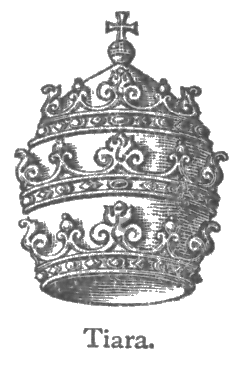
Tiara, tī-ā′ra, n. the lofty ornamental head-dress of the ancient Persians: a head-dress: the mitre of the Jewish high-priest: the pope's triple crown, the papal dignity—also (poet.) Tiar.—adj. Tiā′raed, wearing a tiara. [Fr. tiare—L. tiara—Gr. tiara.]
Tib, tib, n. (Shak.) a punk, whore.
Tibet, Thibet, ti-bet′, n. a woollen stuff generally printed in colours: a heavy fabric used for the same purposes as furs, made of goat's hair, black and finely curled—also Tibet cloth.—adj. Tib′etan, pertaining to Tibet, its language or people.—n. the language or people of Tibet.
Tibia, tib′i-a, n. the large shinbone.—adj. Tib′ial, pertaining to the tibia: pertaining to a pipe or flute.—ns. Tibiā′lis, a tibial muscle; Tibī′cen, a flute-player. [L., the shinbone, hence a flute.]
Tic, tik, n. a convulsive motion of certain muscles, esp. of the face.—n. Tic′-doul′oureux, painful convulsive motion of a nerve, usually in the face. [Fr. tic, a twitching; cf. Low Ger. tukken, to twitch.]
Tice, tīs, v.t. (Shak.) to entice.
Tick, tik, n. the popular name for several acaridan arachnids which infest dogs, sheep, &c. [M. E. teke; Dut. teek, Ger. zecke.]
Tick, tik, n. the case or cover in which feathers, &c., are put for bedding.—ns. Tick′en, Tick′ing, the cloth of which ticks are made. [L. theca—-Gr. thēkē, a case—tithēmi, I put.]
Tick, tik, v.i. to make a small, quick noise: to beat, as a watch.—ns. Tick′er, anything which ticks, a watch; Tick′-tack, a noise like that made by a clock: (Shak.) a game somewhat like backgammon—adv. with a recurring ticking sound. [Imit.; cf. Ger. ticken.]
Tick, tik, v.i. to get or give credit.—n. credit: trust.—n. Tick′-shop, a shop where goods are given on credit.—Buy on tick, to buy on credit. [Ticket.]
Tick, tik, v.i. to touch lightly.—n. a tap or light touch: a slight speck.—adj. Ticked, speckled.—v.t. Tick′le, to touch lightly and cause to laugh: to please by slight gratification.—v.i. to feel titillation or tickling.—ns. Tick′ler; Tick′ling. [Tickle is a dim. of tick, to touch lightly, M. E. teck, a touch; Dut. tik.]
Ticket, tik′et, n. a marked card: a token of any right or debt, as for admission, &c.: a list of candidates put forward by a party for election: (obs.) a visiting-card.—v.t. to mark by a ticket.—ns. Tick′et-day, the day before settling day on the Stock Exchange; Tick′et-of-leave, a license to be at large, granted to a convict for good conduct; Tick′et-por′ter, a licensed porter wearing a badge or ticket; Cou′pon-tick′et (see Coupon); Straight′-ticket, a ticket bearing the names of the nominees of a political party, and them only.—Season ticket, a ticket entitling the holder to admission to lectures, &c., or to travel between certain places on a line of railway, for a certain specified period; The ticket, the correct thing. [Short for O. Fr. etiquet, a label, from Teut.; Ger. stecken, to stick.]
Tickle, tik′l, adj. (Spens.) uncertain, insecure: (Shak.) tottering, insecure, easily tickled, ticklish.—n. Tick′ler, something difficult, a puzzle: a banker's memorandum-book: a dram of spirits.—adj. Tick′lish, easily tickled: easily affected: nice: critical.—adv. Tick′lishly.—n. Tick′lishness.—adj. Tick′ly, ticklish.—n. Tickly-bend′er, risky ice that bends under a skater: (pl.) any game, as tag, played on such ice. [M. E. tikel, unstable, tikelen, freq. of tick, to touch lightly.]
Tid, tid, n. (Scot.) fit time or condition.
Tidbit. Same as Titbit.
Tiddle, tid′l, v.t. to fondle—also Tid′der.—v.i. to potter, trifle.
Tiddlywink, tid′ly-wingk, n. (prov.) an unlicensed pawn-shop or beer-house.—n.pl. Tidd′ledywinks, a parlour-game in which small discs of ivory, &c., are snapped from the level of the table into a cup in the centre of it—also Tidd′ly-winks.
Tiddy, tid′i, n. (prov.) the European wren.
Tide, tīd, n. time: season: the regular flux and reflux or rhythmic ebb and flow of the sea: course: a tide, time, or season, a feast-day, festival, a certain time, a day of twelve hours: commotion: turning-point.—v.t. to drive with the stream.—v.i. to pour a tide or flood: to work in or out of a river or harbour with the tide.—adj. Tī′dal, pertaining to tides: flowing and ebbing periodically.—ns. Tide′-gate, a gate through which the water flows into a basin or dock with the tide, and which is shut to keep it from flowing out again when the tide ebbs: a place where the tide runs with great velocity; Tide′-gauge, an instrument for registering the state of the tide continuously.—adj. Tide′less, having no tides.—ns. Tide′-lock, a lock placed between an entrance-basin and a harbour, canal, or river, and furnished with double gates, so that vessels can pass either out or in at all times of the tide; Tide′mill, a mill moved by tide-water: a mill for clearing lands of tide-water; Tides′-man, Tide′-wait′er, an officer who waits the arrival of vessels, to secure the payment of the duties: one who watches public opinion before declaring his own; Tide′-tā′ble, a table giving the time of high-tide at any place; Tide′-wa′ter, the water of the portion of a river affected by the tide, the seaboard; Tide′-wave, the great wave which follows the apparent motion of the moon; Tide′-way, the channel in which the tide sets; Neap′-tide (see Neap); Spring′-tide (see Spring).—Tide over, to surmount difficulties, for the time at least, by favourable accidents or by skill. [A.S. tíd; Dut. tijd, Ger. zeit.]
Tidings, tī′dingz, n.pl. news: intelligence. [Ice. tiðindi—tið, time; cf. Ger. zeit-ung, news, from zeit.]
Tidy, tī′di, adj. neat: in good order: fairly large: (coll.) comfortable.—n. a cover for chairs, &c.: a child's pinafore.—v.t. to make neat: to put in good order:—pa.t. and pa.p. tī′died.—adv. Tī′dily, in a tidy manner.—n. Ti′diness, state or quality of being tidy: neatness.—Tid′ivate (coll.) (see Titivate). [M. E. tidy, seasonable—tid, tide, time: Ger. zeitig.]
Tie, tī, v.t. to bind: to fasten with a cord: to unite: to constrain: (mus.) to unite notes with a tie: to score equally with: to bind with a ligature.—v.i. to make an exactly equal number of points with:—pr.p. ty′ing; pa.t. and pa.p. tied (tīd).—n. a knot, bow, &c.: a bond: something for tying: a necktie: a member fastening parts together, one of a set of timbers laid crosswise: an equality in numbers, as of votes, or of points in a game: (mus.) a curved line drawn over two or more notes on the same degree of the stave, signifying that the second note is not to be sounded separately, but is to sustain the first.—ns. Tie′-beam, a beam resting on the walls and stretching across, keeping the rafters fast; Tī′er, one who ties: a child's apron; Tie′-rod, a rod serving as a tie between two pieces; Tie′-wig, a court-wig tied with ribbon at the back.—Play off a tie, to take part in a final contest to decide a tie in a game. [M. E. teyen—teye, a band—A.S. teág, teáh, týge, a rope.]
Tier, tēr, n. a row or rank, especially when several rows are placed one above another. [Fr. tire—tirer, to draw.]
Tierce, tērs, n. a cask containing one-third of a pipe—that is, 42 gallons: a sequence of three cards of the same colour: (mus.) a third: a thrust, in fencing: (her.) a field tripartitely divided in three different tinctures: the third hour of the day, or the office of that hour, the terce.—ns. Tier′ceron (archit.), in vaulting, a rib springing from the intersection of two other ribs; Tier′cet, a stanza of three rhymed verses, a triplet. [O. Fr. tiers, tierce—L. tertia (pars), a third (part)—tres, three.]
Tiercel, tērs′el, n. a male hawk.—Also Tierce′let. [O. Fr. tiercelet—tiers, tierce, third.]
Tiers état, tyārz ā-tä′, n. the third estate of the realm, the common people in relation to political power. See Estate. [Fr.]
Tiff, tif, v.t. to sip, quaff.—n. a dram.
Tiff, tif, v.t. (obs.) to dress, trick out. [O. Fr. tiffer, atiffer, to adorn; of Teut. origin.]
Tiff, tif, v.i. to be in a pet—-n: a display of irritation, a pet, huff.—Also Tift. [Orig. a sniff. Norw. tev, a drawing in of the breath, teva, to sniff.]
Tiffany, tif′a-ni, n. a silk-like gauze.—adj. made of tiffany, transparent. [Tiff, to adorn.]
Tiffin, tif′in, n. the East Indian name for luncheon.—v.i. Tiff, to take lunch—Tiff′in is less correct. [From Prov. Eng. tiff, a draught of beer.]
Tig, tig, n. a game in which one tries to tag or touch another.
Tig, tig, n. an old four-handed drinking-cup.
Tige, tīzh, n. a stalk: the shaft of a column. [Fr.—L. tibia, a pipe.]
Tigellus, tij-el′us, n. the internode of a stem. [Fr.]
Tiger, tī′gėr, n. a fierce and rapacious feline quadruped, nearly as large as a lion: the jaguar: a servant in livery who rides with his master: a swaggering bully, a low ruffian: (U.S.) one more cheer after a round of cheers: a tiger-beetle:—fem. Tī′gress.—ns. Ti′ger-bee′tle, a cicindela; Tī′ger-cat, a wild-cat: the margay, ocelot, and serval; Tī′ger-flow′er, a Mexican plant cultivated in flower-gardens for its streaked flowers.—adjs. Tī′ger-foot′ed (Shak.), hastening to devour, fierce and rapacious; Tī′gerish, like a tiger in disposition.—ns. Tī′gerism; Tī′ger-lil′y, a species of lily with spotted flowers; Tī′ger-moth, any one of the Arctiidæ, whose larvæ are called woolly bears; Tī′ger-wolf, a name given to the spotted hyena and to the Thylacine.—adj. Tī′grine, like a tiger. [Fr. tigre—L. tigris—Gr. tigris—Zend. tighri, an arrow, whence the river Tigris.]
Tight, tīt, adj. close: compact: rigid: hampered from want of money: snug, trim: not leaky: fitting closely, also too closely: scarce, not easily obtainable: (coll.) unwilling to part with money: tipsy: not loose or free in treatment.—v.t. Tight′en, to make tight or tighter: to straiten.—v.i. to grow tight or tighter.—n. Tight′ener, one who, or that which, tightens: (anat.) a tensor: (slang) a heavy meal.—adv. Tight′ly.—ns. Tight′ness; Tight′rope, a tightly-stretched rope on which rope-dancers perform.—n.pl. Tights, a garment often of silk, closely fitting the body, or at least the legs, worn by acrobats, dancers, &c. [Scand., Ice. þéitr; cf. Dan. tæt, Dut. digt, Ger. dicht.]
Tight, tīt (Spens.), pa.t. and pa.p. of tie.
Tike, tīk, n. (Shak.) a dog, a cur, a boor: an uncouth fellow: a Yorkshireman. [Ice. tík, a bitch.]
Tilbury, til′ber-i, n. a kind of gig for two. [Said to be so named from its first maker.]
Tilde, til′dē, n. the diacritical sign over n in Spanish—thus ñ. [Sp.,—L. titulus, a title.]
Tile, tīl, n. a piece of baked clay used for covering roofs, floors, &c.: a tube or pipe of baked clay used in drains: (slang) a tall cylindrical silk hat.—v.t. to cover with tiles: to drain by means of tiles: to secure against the intrusion of unauthorised persons by placing a person at the door of a lodge or close meeting.—ns. Tī′ler, one who makes or who lays tiles: the keeper of the door in a Freemasons' lodge—also Ty′ler; Tile′-red, a brownish-red, the colour of baked tiles; Tī′lery, a place where tiles are made; Tile′-stone, a tile: (pl., geol.) the uppermost group of the Silurian period, consisting of a reddish, thin-bedded, slightly micaceous sandstone; Tī′ling, a roof of tiles: tiles in general.—Dutch tiles, enamelled earthenware tiles, usually blue, with scriptural subjects, for chimney pieces, &c. [A.S. tigele—L. tegula—tegĕre, to cover.]
Tiliaceæ, til-i-ā′se-ē, n.pl. a natural order of exogenous trees and shrubs, mostly native to the tropics—the linden family. [L. tilia, a lime-tree.]
Tilka, til′ka, n. the caste-mark on the forehead of Hindus. [Sans.]
Till, til, n. a money-box or drawer in a desk, counter, or trunk. [M. E. tillen, to draw out—A.S. tyllan, in for-tyllan, to draw aside.]
Till, til, prep. to the time of.—adv. to the time when: to the degree that. [Old Northumbrian til—Scand., Ice. til.]
Till, til, v.t. to cultivate.—adj. Till′able, arable.—ns. Till′age, act or practice of tilling: husbandry: a place tilled; Till′er; Till′ing. [A.S. tilian, to till—til, good, a limit; Ger. zielen, to arrange.]
Till, til, n. the usual name in Scotland for Boulder-clay, a widely-distributed stony clay, usually tough and hard, unquestionably the result of glaciation, probably being merely the bottom-moraine or ground-moraine of extinct glaciers.
Tillandsia, ti-land′zi-a, n. a genus of mainly epiphytic plants of the pine-apple family (Bromeliaceæ). [From the Swedish botanist, Tillands.]
Tiller, til′ėr, n. the handle or lever for turning a rudder.—ns. Till′er-chain, -rope, the chain or rope uniting the fore-end of the tiller with the steering-wheel. [M. E. tillen, to draw out—A.S. tyllan. Cf. Till (1).]
Tilly-vally, til′i-val′i, n. (Shak.) an expression of contempt at what has been said.—Also Till′ie-vall′ie.
Tilt, tilt, n. the canvas covering of a cart or wagon: an awning in a boat.—v.t. to cover with an awning. [A.S. teld—teldan, to cover; cog. with Ger. zelt.]
Tilt, tilt, v.i. to ride against another and thrust with a lance: to thrust or fight with a lance or rapier: to fall into a sloping posture, to heel over.—v.t. to point or thrust with, as a lance: to slant: to raise one end of: to forge with a tilt-hammer.—n. a thrust: in the Middle Ages, an exercise in which combatants rode against each other with lances: inclination forward, dip, slant.—ns. Tilt′er; Tilt′-hamm′er, a heavy hammer used in ironworks, which is tilted or lifted by means of projections on the axis of a wheel; Tilt′ing; Tilt′-yard, a place for tilting. [A.S. tealt, tottering; Ice. tölta, to trot; Ger. zelter.]
Tilth, tilth, n. cultivation: cultivated land: the depth of soil turned up in cultivation. [From till (3).]
Timariot, ti-mä′ri-ot, n. a soldier of the Turkish feudal militia. [Turk. tīmār.]
Timbal, tim′bal, n. a kettledrum. [Fr.,—It. timballo.]
Timbale, tang-bal′, n. a dish of fowl or fish pounded and mixed with white of egg, sweet cream, &c., poured into a mould. [Fr.]
Timber, tim′bėr, n. wood for building purposes: the trunk of a tree: material for any structure: one of the larger pieces of the framework of a house, ship, &c.: one of the planks forming the sides and roof of a gallery in a mine.—v.t. to furnish with timber or beams.—p.adj. Tim′bered, furnished with timber: (Shak.) built, formed, contrived: (Spens.) made like timber, massive.—ns. Tim′bering, timber materials; Tim′ber-man, one responsible for the timbers in a mine; Tim′ber-toes, a person with a wooden leg; Tim′ber-tree, a tree suitable for timber; Tim′ber-yard, a yard or place where timber is stored. [A.S. timber, building, wood; Ger. zimmer, an apartment.]
Timbre, tim′bėr, n. tone, character, or quality of a musical sound. [O. Fr.,—L. tympanum, a drum.]
Timbrel, tim′brel, n. an ancient musical instrument, carried in the hand, apparently like a tambourine.—adj. Tim′brelled (Milt.), sung to the sound of the timbrel. [O. Fr. timbre—L. tympanum, a drum.]
Timbrology, tim-brol′ō-ji, n. the study of postage-stamps.—n. Timbroph′ily, love for this harmless pursuit. [Fr. timbre, postage-stamp, -ology.]
Time, tīm, n. a point at which, or period during which, things happen: a season or proper time: an opportunity: absolute duration: an interval: past time: the duration of one's life: allotted period: repetition of anything or mention with reference to repetition: musical measure, or rate of movement: a measured interval in verse: (gram.) the relation of a verb with regard to tense: the umpire's call in prize-fights, &c.: hour of travail: the state of things at any period, usually in pl.: the history of the world, as opposed to eternity: addition of a thing to itself.—v.t. to do at the proper season: to regulate as to time: (mus.) to measure.—v.i. to keep or beat time.—ns. Time′-ball, a ball arranged to drop from the summit of a pole at a particular time; Time′-bargain, a contract to buy or sell merchandise or stock at a certain time in the future.—adjs. Time′-beguil′ing, making the time pass quickly; Time′-bett′ering, improving the state of things as time goes on; Time′-bewast′ed (Shak.), wasted or worn by time.—ns. Time′-bill, a time-table; Time′-book, a book for keeping an account of the time men have worked; Time′-card, a card bearing a time-table: a card with blank spaces for workmen's hours, &c., being filled in; Time′-fuse, a fuse calculated to burn a definite length of time; Time′-gun, a gun which is fired by means of a mechanical contrivance and a current of electricity at a particular time.—adj. Time′-hon′oured, honoured for a long time: venerable on account of antiquity.—ns. Time′ist, Tim′ist, a musical performer in relation to his sense for time; Time′-keep′er, a clock, watch, or other instrument for keeping or marking time: one who keeps the time of workmen.—adj. Time′less, done at an improper time, unseasonable: (Shak.) done before the proper time.—adv. Time′lessly, before the proper time: unseasonably.—n. Time′liness.—adj. Time′ly, in good time: sufficiently early: (obs.) keeping time.—adv. early, soon.—adjs. Time′ly-part′ed (Shak.), having died in time—i.e. at a natural time; Time′ous, in Scot. legal phraseology, in good time: seasonable.—adv. Time′ously, in good time.—ns. Time′piece, a piece of machinery for keeping time, esp. a clock for a mantel-piece; Time′-pleas′er (Shak.), one who complies with prevailing opinions, whatever they be; Time′-serv′er, one who serves or meanly suits his opinions to the times.—adj. Time′-serving, complying with the spirit of the times or with present power.—n. mean compliance with the spirit of the times or with present power.—ns. Time′-tā′ble, a table or list showing the times of certain things, as trains, steamers, &c.; Time′-thrust, a thrust made in fencing at the moment the opponent draws breath for his thrust; Time′-work, labour paid for by the hour or the day—opp. to Piece-work.—adjs. Time′-worn, worn or decayed by time; Tim′ous (Bacon), timely.—Time out of mind, from time immemorial.—Apparent time, true solar time as shown by a carefully adjusted sun-dial; Astronomical time, the time past mean noon of that day, and reckoned on to twenty-four hours in mean time; At times, at distinct intervals: occasionally; Be master of one's time, to be free to do what one likes; Civil time, common time, or mean time, in which the day begins at midnight, and is divided into equal portions of twelve hours each; Fill time, to book vacant dates; In time, Time enough, in good season, sufficiently early; Keep time, to indicate the time correctly: to make any regular rhythmical movements at the same time with others; Lose time, to let time pass without making use of it: to run slow—of a watch, &c.; Make time, to recover lost time: to perform in a certain time; Mean time, the mean or average of apparent time, as shown by a good clock; Sidereal time, the portion of a sidereal day which has elapsed since the transit of the first point of Aries; Solar time, time as shown by the sun or sun-dial; The time being, the present time. [A.S. tíma; cf. Ice. tími; and Tide.]
Timenoguy, tī-men′ō-gī, n. (naut.) a rope stretched so as to prevent gear from getting fouled.
Timid, tim′id, adj. fearful: wanting courage: faint-hearted.—n. Timid′ity, quality or state of being timid: want of courage.—adv. Tim′idly.—n. Tim′idness.—adv. Timorō′so (mus.), timid, hesitating, to be so rendered.—adj. Tim′orous, timid: indicating fear.—adv. Tim′orously.—n. Tim′orousness.—adj. Tim′orsome (Scot.), easily frightened. [Fr.,—L. timidus—timēre, to fear.]
Timocracy, tī-mok′rā-si, n. a form of government in which a certain amount of property is a necessary qualification for office.—adj. Timocrat′ic. [Gr. timokratia—timē, honour, kratein, to rule.]
Timon, tī′mon, n. (obs.) a helm.—n. Timoneer′, a helmsman. [L. temo, a beam.]
Timonist, tī′mon-ist, n. a misanthrope—from Timon of Athens, the hero of Shakespeare's play so named which was based upon the story in Plutarch's Life of Alcibiades, as in North's translation.—v.i. Tī′monise, to play the misanthrope.
Timothy, tim′ō-thi, n. timothy-grass, the name commonly given to Phleum pratense, a grass much valued for feeding cattle—called also Cat's-tail grass or Meadow cat's-tail. [So named from Timothy Hanson, who introduced it to America about 1720.]
Timpano, tim′pa-nō, n. an orchestral kettledrum:—pl. Tim′pani.—Also Tym′pano. [It.]
Tim-whisky, tim′-hwis′ki, n. a kind of light one-horse chaise.
Tin, tin, n. a silvery-white, non-elastic, easily fusible, and malleable metal: (slang) money: a vessel of tin, a can, &c.—adj. made of tin.—v.t. to cover or overlay with tin or tinfoil: to pack in tins:—pr.p. tin′ning; pa.t. and pa.p. tinned.—ns. Tin′man, Tin′ner, a tinsmith; Tin′ning, the art of coating with tin, or of repairing tin-ware: the act of packing in tin cans for preservation.—adj. Tin′ny, like tin.—n. a small vessel of tin.—ns. Tin′-plate, thin sheet-iron coated with tin; Tin′-smith, a manufacturer of tin vessels: a worker in tin: a dealer in tin-ware; Tin′-type, a ferrotype; Tin′-ware, articles made of tin.—ns.pl. Tin′witts, dressed tin ore containing pyrites, &c.; Tin′-works, works for working tin. [A.S. tin; Ice. tin, Ger. zinn.]
Tinamou, tin′a-mōō, n. a South American genus of birds sometimes called partridges, but really more akin to bustards, and having affinities with the rhea and emu. [Fr.,—native name.]
Tincal, Tinkal, ting′kal, n. crude borax. [Malay.]
Tinchel, tin′chel, n. a circle of men who close in round a herd of deer.—Also Tin′chil. [Gael. timchioll, a circuit.]
Tincture, tingk′tūr, n. a tinge or shade of colour: a slight taste added to anything: (med.) a solution of any substance in or by means of spirit of wine: (her.) one of the metals, colours, or furs in achievements.—v.t. to tinge: to imbue: to mix with anything foreign.—adj. Tinct (Spens.), tinged, coloured.—n. (Tenn.) colour, stain, spot.—adj. Tinctō′rial, giving a tinge: colouring. [L. tinctura.]
Tind, tind, v.t. (Spens.) to kindle. [A.S. tendan.]
Tindal, tin′dal, n. a native petty-officer of lascars.
Tinder, tin′dėr, n. anything used for kindling fire from a spark.—n. Tin′der-box, a box in which tinder is kept.—adjs. Tin′der-like (Shak.), inflammable as tinder; Tin′dery, irascible. [A.S. tynder; Ice. tundr, Ger. zunder. The root is found in A.S. tendan, Ger. zünden, to kindle.]
Tine, tīn, n. the spike of a fork or harrow, or of a deer's antler.—adj. Tīned, furnished with spikes. [A.S. tind, a point; cog. with Ice. tind-r, a tooth, a prickle; and prob. conn. with tooth.]
Tine, tīn, v.t. (Spens.) same as Tind.—v.i. (Spens.) to rage, to smart.
Tine, tīn, n. (Spens.). Same as Teen.
Tine, tīn, v.t. (Scot.) to lose.—v.i. to be lost, to perish. [M. E. tinen, tynen—Scand., Ice. týna, to lose.]
Tine, tīn, v.t. and v.i. (prov.) to enclose. [A.S. týnan, to surround.]
Tine, tīn, n. (prov.) a wild vetch or tare.
Tinea, tin′ē-ä, n. the generic name of certain diseases of the skin caused by the growth of microscopic fungi: a genus of small moths of the family Tineidæ and superfamily Tineina.—adj. Tin′ēid, relating to these moths. [L., a worm.]
Tinewald=Tynewald (q.v.).
Tinfoil, tin′foil, n. tin in thin leaves for wrapping articles.—v.t. to cover with such.
Ting, ting, v.t. and v.i. to tinkle like a bell.—n. a sharp sound, a tinkling.—n. Ting′-a-ling, the sound of a bell tinkling—used adverbially.
Tinge, tinj, v.t. to tint or colour: to mix with something: to give in some degree the qualities of a substance.—n. a small amount of colour or taste infused into another substance. [L. tingĕre, tinctum; conn. with Gr. tenggein, to wet, to stain.]
Tingi, ting′gi, n. a Brazilian tree whose seeds yield soap.—Also Tin′guy.
Tingis, tin′jis, n. a genus of heteropterous insects.
Tingle, ting′gl, v.i. to feel a thrilling sensation, as in hearing a shrill sound: to feel a sharp, thrilling pain: to tinkle.—v.t. to cause to tingle, to ring.—n. a tingling sensation.—adj. Ting′lish, capable of tingling or thrilling. [M. E. tinglen, a variant of tinklen, itself a freq. of tinken, to tink.]
Tinker, tingk′ėr, n. a mender of brazen or tin kettles, pans, &c.—(Scot.) Tink′ler: the act of doing tinker's work: a botcher or bungler: a botch or bungle: a young mackerel.—v.t. to repair, esp. unskilfully.—v.i. to do tinker's work: to make a botch or mess of anything. [M. E. tinkere—tinken, to tink, to make a sharp, shrill sound; cf. Scot. tinkler, a worker in tin.]
Tinkle, tingk′l, v.i. to make small, sharp sounds: to clink: to jingle: to clink repeatedly or continuously.—v.t. to cause to make quick, sharp sounds.—n. a sharp, clinking sound.—ns. Tink′ler, a small bell; Tink′ling, a tinkling noise. [A freq. of M. E. tinken.]
Tinnitus, ti-nī′tus, n. a ringing in the ears. [L. 'a ringing'—tinnīre, to ring.]
Tinsel, tin′sel, n. something sparkling or shining: glittering metallic sheets, as of burnished brass, copper, or tin, almost as thin as foil, and used in discs, patches, strips, or threads, for giving clothing, &c., a striking appearance: anything showy, but of little value: anything having a false lustre.—adj. like tinsel: gaudy: superficial.—v.t. to adorn with, or as with, tinsel: to make glittering or gaudy:—pr.p. tin′selling: pa.t. and pa.p. tin′selled.—adj. Tin′selly, like tinsel, gaudy, showy.—n. Tin′selry, glittering and tawdry material. [O. Fr. estincelle—L. scintilla, a spark.]
Tint, tint, n. a slight tinge distinct from the principal colour: a series of parallel lines in engraving, producing a uniform shading.—v.t. to give a slight colouring to.—ns. Tin′tage, the colouring or shading of anything; Tint′-block, a surface prepared for printing a background; Tint′-draw′ing, drawing in a wash of uniform tint; Tin′ter, one who, or that which, tints: a special kind of slide used with the magic-lantern to give moonlight effects, &c.; Tin′tiness, state of being tinty; Tin′ting, the method of producing a uniform shading.—adj. Tint′less, having no tint or colour.—ns. Tintom′eter, an appliance for determining tints; Tint′-tool, an implement for producing a tint by parallel lines.—adj. Tin′ty, inharmoniously tinted. [L. tinctus.]
Tintinnabulation, tin-tin-ab-ū-lā′shun, n. the tinkling sound of bells.—adjs. Tintinnab′ulant, Tintinnab′ular, Tintinnab′ulary, Tintinnab′ulous.—n. Tintinnab′ulum, a bell:—pl. Tintinnab′ula. [L. tintinnabulum, a bell:—tintinnāre, to jingle, reduplicated from tinnīre, to jingle.]
Tiny, tī′ni, adj. (comp. Tī′nier, superl. Tī′niest) thin: very small. [Prob. teen, and therefore 'fretful,' 'peevish.']
Tip, tip, n. the top or point of anything small: the end, as of a billiard-cue, &c.—v.t. to form a point to: to cover the tip or end of:—pr.p. tip′ping; pa.t. and pa.p. tipped.—On the tip of the tongue, on the very point of being spoken. [A variant of top; cf. Dut. tip; Ger. zipf-el, point.]
Tip, tip, v.t. to strike lightly: to cause to slant: (slang) to communicate, give: (slang) to give private information to, about betting, &c.: (coll.) to give a small gift of money to, as a gratuity.—v.i. to slant: to give tips.—n. a tap or light stroke: a place for tipping any refuse into, a dump: a tram for expeditiously transferring coal: private information about horse-racing, stock speculations, &c.: a gratuity.—ns. Tip′-cart, a cart emptied by being canted up; Tip′-cat, a game in which a pointed piece of wood called a cat is made to rebound from the ground by being struck on the tip with a stick; Tip′-cheese, a boys' game in which a small stick is struck forward; Tip′per, a means of tipping, esp. an arrangement for dumping coal: one who tips: one who gives gratuities: one who gives private hints about speculation, racing, &c.; Tip′ping, act of tilting: the habit of giving gratuities to servants; Tip′ster, one whose business is to give private hints about racing, the rise and fall of stocks, &c.—adj. Tip′-tilt′ed, having the tip tilted up.—Tip off liquor, to turn up the vessel till quite empty; Tip one the wink, to wink as a caution, or in mutual understanding; Tip over, to overturn by tipping; Tip the scale, to depress one end of the scales.—Foul tip, a foul hit in baseball; Straight tip, a reliable hint about betting, &c. [Scand., Sw. tippa, to tap; Ger. tupfen.]
Tipper, tip′ėr, n. a kind of ale—from Thomas Tipper, who brewed it in Sussex.
Tippet, tip′et, n. the cape of a coat: a cape of fur, &c.: the stuff cape worn in the English Church by a literate or non-graduate: a bird's ruffle: one of the patagia, or pieces at the side of the pronotum of a moth.—ns. Tipp′et-grebe, -grouse, a ruffed grebe or grouse. [A.S. tæppet—L. tapete, cloth.]
Tipple, tip′l, v.i. to drink in small quantities: to drink strong liquors often or habitually.—v.t. to drink, as strong liquors, to excess.—n. liquor tippled.—ns. Tipp′ler, a constant toper; Tipp′ling-house.—adj. Tipp′y, unsteady: smart, fine. [A freq. of tip, to tilt up a vessel in drinking; Norw. tipla; Ger. zipfeln.]
Tipstaff, tip′staf, n. a staff tipped with metal, or an officer who carries it: a constable.
Tipsy, tip′si, adj. partially intoxicated.—v.t. Tip′sify, to fuddle.—adv. Tip′sily.—ns. Tip′siness; Tip′sy-cake, a cake made of pastry and almonds, with wine, served with custard-sauce; Tip′sy-key, a watch-key in which the head is released if an attempt is made to turn it backward. [Tipple.]
Tiptoe, tip′tō, n. the end of the toe.—adv. on tiptoe, literally or figuratively, through excitement, expectation, &c.—v.i. to walk on tiptoe, to go lightly and slyly.
Tiptop, tip′top, n. the extreme top: the height of excellence.—adj. first-rate.—adv. in a first-rate manner.
Tipula, tip′ū-la, n. a genus of crane-flies.—n. Tipulā′ria, a genus of fossil crane-flies: a genus of terrestrial orchids, including the American crane-fly orchis.—adj. Tipulā′rian. [L., a water-spider.]
Tirade, ti-rād′, n. a strain of censure or reproof; a long vehement reproof. [Fr.,—It. tirata—tirare, to pull.]
Tirailleur, ti-ra-lyėr′, n. a skirmisher, sharpshooter.
Tirasse, ti-ras′, n. a pedal-coupler in organ-building.
Tiraz, tē′raz, n. an ancient Moorish silk fabric.
Tire, tīr, n. attire, apparel: furniture: a head-dress.—v.t. to dress, as the head.—ns. Tire′-val′iant (Shak.), a kind of fanciful head-dress; Tire′-wom′an, a lady's-maid; Tir′ing-house, -room, the place where actors dress. [Short for attire.]
Tire, tīr, n. the hoop of iron that ties or binds the fellies of wheels.—ns. Tire′-meas′urer, -press, -roll′er, -set′ter, -shrink′er, -smith. [From tie.]
Tire, tīr, n. (Spens., Milt.) rank or row, esp. of guns, train. [Same as tier.]
Tire, tīr, v.i. (Shak.) to rend as a bird of prey: to feed: to dwell upon, gloat over:—pr.p. tīr′ing; pa.p. tīred. [O. Fr. tirer, to draw—Low L. tirāre, to draw; prob. Teut., Goth. tairan, to tear.]
Tire, tīr, v.t. to harass, to vex: to exhaust the strength of: to weary.—v.i. to become weary: to be fatigued: to have the patience exhausted.—adj. Tired, wearied: fatigued.—n. Tired′ness.—adj. Tire′less, untiring.—adv. Tire′lessly.—n. Tire′lessness.—adj. Tire′some, that tires: fatiguing: tedious.—adv. Tire′somely.—n. Tire′someness. [A.S. teorian, to be tired—teran, to tear.]
Tirl, tirl, v.i. (Scot.) to quiver, vibrate: to make a twirling noise.—v.t. to twist: to strip, unroof.—n. a twirl, vibration: a substitute for a trundle or lantern wheel in a mill.—n. Tir′lie-whir′lie, a whirligig: an ornamental combination of irregular lines.—adj. irregular, twisting. [A variant of twirl.]
Tiro. See Tyro.
Tirocinium, tī-rō-sin′i-um, n. the first service of a soldier, any novitiate. [L.,—tiro, a raw soldier.]
Tironian, tī-rō′ni-an, adj. pertaining to Tiro, Cicero's amanuensis.—Tironian notes, the shorthand signs of the ancient Romans.
Tirr, tir, v.t. (Scot.) to tear or strip off.
Tirra-lirra, tir′ra-lir′ra, n. (Shak., Tenn.) an imitation of a musical sound.
Tirret, tir′et, n. (her.) a manacle.
Tirrit, tir′it, n. (Shak.) Mrs Quickly's word for terror.
Tirrivee, tir′i-vē, n. (Scot.) a tantrum or fit of passion.—Also Tirr′ivie.
'Tis, tiz, a contraction of it is.
Tisane, tē-zan′, n. a medicinal decoction. See Ptisan.
Tisic, tiz′ik, n. (Shak.) an obsolete spelling of phthisic.
Tisiphone, ti-sif′ō-nē, n. one of the Furies. [Gr. tinein, to avenge, phonos, murder.]
Tisri, tiz′ri, n. the first month of the Jewish civil year, and the seventh of the ecclesiastical year, corresponding to part of September and October.
Tissue, tish′ū, n. cloth interwoven with gold or silver, or with figured colours: (anat.) the substance of which organs are composed: a connected series.—v.t. to form, as tissue: to interweave: to variegate.—n. Tis′sue-pā′per, a thin, soft, semi-transparent kind of paper. [Fr. tissu, woven, pa.p. of tistre—L. texĕre, to weave.]
Tit, tit, n. a teat.
Tit, tit, n. one of various small birds, a pipit, tomtit, or titmouse. [Ice. tittr, a little bird, Norw. tita.]
Tit, tit, n. in phrase Tit for tat, properly tip for tap, blow for blow.
Titan, tī′tan, Titanic, tī-tan′ik, adj. relating to the Titans, giants of mythology, sons and daughters of Uranus (heaven) and Gæa (earth), enormous in size and strength: gigantic, huge generally.—n. Tī′tan, any of the descendants of the Titans, as Prometheus: the sun personified: any one of commanding forces or ability:—fem. Tī′taness.—adj. Titanesque′, like the Titans, Titanic in character.—n. Titanom′achy, the battle of the Titans with the gods.
Titania, tī-tā′ni-a, n. the queen of Fairyland, wife of Oberon. [L., applied to Diana.]
Titanium, tī-tā′ni-um, n. a comparatively rare metal, occurring as a gray heavy iron-like powder, burning with brilliant scintillations in the air, forming titanium dioxide and nitride.—adjs. Titā′nian, Titan′ic, Titanit′ic; Titanif′erous, containing titanium.—n. Tī′tanite, or Sphene, a soft greenish mineral often present in syenite.
Titbit, tit′bit, n. a choice little bit.
Titely, tīt′li, adv. (Shak.) quickly—sometimes Tithe′ly, and erroneously Tightly. [M. E. tytly—Scand., Ice. tídhr, frequent.]
Tithe, tīth, n. a tenth part, hence any indefinitely small part: the tenth of the produce of land and stock allotted for the maintenance of the clergy and other church purposes: any rateable tax payable in kind or by commutation of its value in money.—v.t. to tax to a tenth.—adjs. Tī′thable, subject to the payment of tithes; Tithe′-free, exempt from paying tithes.—n. Tithe′-gath′erer, one who collects tithes.—adj. Tithe′-pay′ing, subjected to pay tithes.—ns. Tithe′-pig, one pig out of ten paid as a tithe; Tithe′-proc′tor, a levier or collector of tithes; Tī′ther, one who collects tithes; Tī′thing, an old Saxon district containing ten householders, each responsible for the behaviour of the rest; Tī′thing-man, the chief man of a tithing. [A.S. teóða, tenth—teón, or týn, ten; cog. with Ger. zehnte—zehn.]
Tithonic, ti-thon′ik, adj. denoting such rays of light as produce chemical effects.—n. Tithonic′ity, actinism.—adj. Tithonograph′ic, fixed by the tithonic rays of light.—n. Tithonom′eter, an instrument for measuring the tithonicity of light-rays.
Titianesque, tish-an-esk′, adj. in the manner of the Venetian painter Titian (Tiziano Vecellio), 1477-1576, a combination of the richest surface with the most magnificent colour.
Titillate, tit′il-lāt, v.t. to tickle.—n. Titillā′tion, act of titillating: state of being titillated: a pleasant feeling.—adj. Tit′illative. [L. titillāre, -ātum.]
Titivate, Tittivate, tit′i-vāt, v.i. and v.t. (slang) to smarten up, by dress or otherwise. [Most prob. a factitious word, perh. based on tidy.]
Titlark, tit′lärk, n. a titling, a pipit. [Tit and lark.]
Title, tī′tl, n. an inscription set over or at the beginning of a thing by which it is known, a title-page: a name of distinction: that which gives a just right to possession: ownership: the writing that proves a right: (B.) a sign: a fixed sphere of work required as a condition for ordination, a parish in Rome—of these fifty give titles to cardinal-priests: in bookbinding, the panel on the back on which the name of the book is printed.—adj. Tī′tled, having a title.—ns. Tī′tle-deed, a deed or document that proves a title or just right to exclusive possession; Tī′tle-leaf, the leaf on which is the title of a book.—adj. Tī′tleless (Shak.), wanting a title or name.—ns. Tī′tle-page, the page of a book containing its title and usually the author's name; Tī′tle-rôle, the part in a play which gives its name to it, as 'Macbeth;' Tī′tle-sheet, the first sheet of a book as printed, containing title, bastard-title, &c.; Tī′tling, the act of impressing the title on the back of a book; Tī′tlonym, a title taken as a pseudonym; Bas′tard-tī′tle (see Bastard). [O. Fr. title (Fr. titre)—L. titulus.]
Titling, tit′ling, n. the hedge-sparrow.—ns. Tit′man, a puny man; Tit′mouse, a genus of little birds, which feed on insects, &c.:—pl. Titmice (tit′mīs). [Obs. Eng. tit, anything small; A.S. máse; Ger. meise, a small bird.]
Titrate, tit′rāt, v.t. to subject to titration.—n. Titrā′tion, volumetric analysis, the process of ascertaining the quantity of any given constituent present in a compound by observing it under the application of standard solutions.
Ti-tree, tē′-trē, n. a palm-lily, a tea-tree or manuka.
Tit-tat-to, tit′-tat-tōō (or -tō), n. a child's game, same as Criss-cross (q.v.).
Titter, tit′ėr, v.i. to giggle, snicker, or laugh with the tongue striking the teeth: to laugh restrainedly.—n. a restrained laugh.—ns. Titterā′tion, a fit of giggling; Titt′erer, one who titters. [M. E. titeren, to tattle. Prob. imit.]
Tittle, tit′l, n. a small particle: an iota.—n. Titt′lebat, the stickleback. [O. Fr. title—titulus, a title.]
Tittle, tit′l, v.t. (Scot.) to chatter.—n. Titt′le-tatt′le, idle, empty talk.—v.i. to prate idly.—ns. Titt′le-tatt′ler, a trifling tattler; Titt′le-tatt′ling, the act of talking idly.
Tittup, Titup, tit′up, v.i. to skip about gaily.—n. a light springy step, a canter.—adjs. Titt′uppy, Tit′uppy, gay, lively: unsteady.
Titty, tit′i, n. a teat, the breast.
Titty, tit′i, n. (Scot.) sister.
Titubant, tit′ū-bant, adj. staggering, stumbling.—v.i. Tit′ūbate, to stagger, stumble.—n. Titubā′tion, reeling, stumbling; restlessness. [L. titubāre, -ātum, to stagger.]
Titular, tit′ū-lar, adj. existing in name or title only: nominal: having the title without the duties of an office.—n. one who enjoys the bare title of an office, without the actual possession of that office: a person invested with a title in virtue of which he holds a benefice, whether he performs its duties or not.—n. Titular′ity.—adv. Tit′ularly.—adj. Tit′ulary, consisting in, or pertaining to, a title.—n. one having the title of an office whether he performs its duties or not.—Titular bishop, in R.C. usage, a bishop without a diocese, taking his title from a place where there is no longer a bishop's see, as in the countries once conquered by Crusaders in the East—before 1882 called 'bishop in partibus infidelium;' Titular church, one of the parish churches of Rome supplying a title to cardinal-priests; Titular of a church, that from which a church takes its special name—distinguished from a patron, who must be a canonised person or an angel; Titulars of the tithes, laymen invested with church lands after the Reformation in Scotland.
Tiver, tiv′ėr, n. a kind of ochre for marking sheep.—v.t. to mark with such.
Tivy, tiv′i, adv. with speed.
Tizzy, tiz′i, n. (slang) a sixpence.
Tmesis, tmē′sis, n. (gram.) the separation of the parts of a compound word by one or more words inserted between them, as 'Saxo cere-comminuit-brum;' 'of whom be thou ware also' (2 Tim. iv. 15). [L.,—Gr. tmēsis—temnein, to cut.]
To, tōō, prep. in the direction of: in order to: as far as; in accordance with, in the character of: regarding, concerning, in connection with: expressing the end or purpose of an action, as in many uses of the gerundial infinitive, the sign of the infinitive mood: (B.) sometimes=for.—adv. to a place in view, forward: to its place, together.—To and fro, backwards and forwards. [A.S. tó; Ger. zu, Goth. du.]
Toad, tōd, n. a genus of amphibians, typical of the family Bufonidæ, represented in Britain by two species—the Common Toad and the Natterjack.—ns. Toad′-eat′er, a fawning sycophant—originally a mountebank's assistant, whose duty was to swallow, or pretend to swallow, any kind of garbage; Toad′-eat′ing, sycophancy.—adj. sycophantic.—ns. Toad′-fish, the sapo of the United States Atlantic coast; Toad′-flax, a genus of herbaceous plants, closely allied to the Snapdragon; Toad′-in-a-hole, a piece of beef baked in batter; Toad′-spit, cuckoo-spit.—adj. Toad′-spot′ted, thickly stained or spotted like a toad.—ns. Toad′-stone, a soft and earthy variety of trap-rock of a brownish-gray colour, looking like an argillaceous deposit; Toad′stool, a poisonous kind of mushroom; Toad′y, a mean hanger-on and flatterer.—v.t. to fawn as a sycophant:—pa.t. and pa.p. toad′ied.—adj. Toad′yish.—n. Toad′yism, the practice of a toady. [A.S. tádige, tádie, a toad.]
Toast, tōst, v.t. to dry and scorch at the fire: to name when a health is drunk: to drink to the health of.—v.i. to drink toasts.—n. bread toasted: a slice of such dipped in liquor: the person or thing named whose health is to be drunk.—ns. Toast′er, one who, or that which, toasts; Toast′ing-fork, -ī′ron, a long-handled fork for toasting bread: a sword; Toast′-mas′ter, the master and announcer of toasts at public dinners; Toast′-rack, a stand, with partitions for slices of toast, for setting on the table. [O. Fr. toster—L. tostus, roasted, pa.p. of torrēre.]
Tobacco, to-bak′ō, n. a plant of genus Nicotiana, order Solanaceæ, esp. one of several species, the most generally cultivated being the stately Nicotiana Tabacum, a native of America—the dried leaves used for the sedative effects for smoking in pipes, &c., and also in the form of snuff.—ns. Tobaccanā′lian, a smoker; Tobacc′o-heart, a functional disorder of the heart, due to excessive use of tobacco; Tobacc′onist, one who sells or manufactures tobacco; Tobacc′o-pipe, a pipe used for smoking tobacco; Tobacc′o-pouch, a small pouch for holding tobacco; Tobacc′o-stop′per, an instrument for pressing down the tobacco in a pipe. [Through Sp. tabaco, from the Haytian.]
Tobit, tō′bit, n. an apocryphal Old Testament book, containing the story of Tobit.
Toboggan, tō-bog′gan, n. a kind of sled turned up at the front, much used in Canada for sliding down snow-covered slopes.—v.i. to slide down over snow on such.—Earlier also Tobog′gin, Tabog′gan, Tarbog′gin.—ns. Tobog′ganer; Tobog′ganing; Tobog′ganist. [A native word.]
To-brake, tōō-brāk′, v.t. (Judges ix. 53) broke in pieces. [A.S. tóbrecan—pfx. tó-, asunder, and brecan, to break.]
Toby, tō′bi, n. a beer-mug shaped like an old man with three-cornered hat.
Toccata, tok-kä′tä, n. (mus.) a work primarily intended to display the performer's touch.—ns. Toccatel′la, Toccatina (-tē′na), a short toccata. [It.,—toccare, to touch.]
Tocher, toh′ėr, n. (Scot.) a woman's dowry.—v.t. to give a dowry to.—adj. Toch′erless, without a marriage portion. [Ir. tochar, Gael. tochradh.]
Toco, tō′kō, n. (slang) punishment.—Also Tō′ko. [Gr. tokos, interest.]
Tocology, tō-kol′ō-ji, n. obstetrics.—Also Tokol′ogy. [Gr. tokos, birth, logia—legein, to speak.]
Tocsin, tok′sin, n. an alarm-bell, or the ringing of it. [O. Fr. toquesin (Fr. tocsin)—toquer, to strike; O. Fr. sing (Fr. signe), a sign.]
Tod, tod, n. (Scot.), a fox.—n. Todlow′rie, a fox, a crafty fellow.
Tod, tod, n. an ivy-bush—(Spens.) Todde: an old weight of about 28 lb.—v.i. to weigh a tod.
To-day, too-dā′, n. this or the present day. [A.S. tó dæge.]
Toddle, tod′l, v.i. to walk with short feeble steps, as a child.—n. a toddling gait: an aimless stroll.—n. Todd′ler, one who toddles.—adj. Todd′ling. [Prob. a by-form of totter.]
Toddy, tod′i, n. the fermented juice of various palms of the East Indies: a mixture of whisky, sugar, and hot water.—ns. Todd′y-lā′dle, a small ladle like a punch-ladle for use in mixing or serving out toddy; Todd′y-palm, a palm yielding toddy, as the jaggery-palm; Todd′y-stick, a small stick used in mixing toddy. [Hind. tāri—tār, a palm-tree.]
To-do, tōō-dōō′, n. bustle: stir: commotion.
Tody, tō′di, n. a small West Indian insectivorous bird—the green sparrow, green humming-bird, &c.
Toe, tō, n. one of the five small members at the point of the foot: the corresponding member of a beast's foot: the front of an animal's hoof.—v.t. to touch or reach with the toes: to furnish with a toe, as a stocking.—v.i. to place the toes in any particular way.—n. Toe′-cap, a cap of leather, &c., covering the toe of a shoe.—adj. Toed (tōd), having toes.—ns. Toe′-nail; Toe′-piece. [A.S. tá (pl. tán); Ice. tá, Ger. zehe.]
Toff, tof, n. (slang) a dandy, a swell. [Ety. dub.]
Toffee, Toffy, tof′i, n. a hard-baked sweetmeat, made of sugar and butter.—Also Taff′y. [Ety. unknown.]
Tofore, tōō-fōr′, adv., prep. (Shak.) before: formerly. [A.S. tóforan.]
Toft, toft, n. a hillock: a messuage with right of common.—ns. Toft′man; Toft′stead. [Ice.]
Tog, tog, n. (slang) a garment—generally in pl.—v.t. to dress.—n. Tog′gery, clothes.—n.pl. Long′-togs (naut.), shore clothes. [Prob. through Fr. from L. toga, a robe.]
Toga, tō′ga, n. the mantle or outer garment of a Roman citizen.—adjs. Togā′ted, Tō′ged, dressed in a toga or gown.—n. Toge (Shak.), a robe.—Toga prætexta, the purple-hemmed toga worn by curule magistrates and censors, and by freeborn boys till fourteen; Toga virilis, the garb of manhood, put on by boys at fourteen. [L.,—tegĕre, to cover.]
Together, tōō-geth′ėr, adv. gathered to one place: in the same place, time, or company: in or into union: in concert. [A.S. tógædere—tó, to, geador, together.]
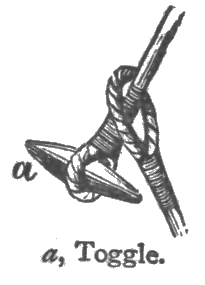
Toggle, tog′l, n. (naut.) a short bar of wood, tapering from the middle towards each end, placed in an eye at the end of a rope, to keep the end from passing through a loop or knot: an appliance for transmitting force at right angles to its direction.—v.t. to fix like a toggle-iron: to fix fast.—ns. Togg′le-ī′ron, a whaler's harpoon with movable blade instead of barbs; Togg′le-joint, an elbow or knee joint. [Conn. with tug and tow.]
Togue, tōg, n. the mackinaw or great lake-trout.
Toho, tō-hō′, interj. a call to pointers to stop.
Tohu bohu, tō′hōō bō′hōō, n. chaos. [From the Heb. words in Gen. i. 2, 'without form' and 'void.']
Toil, toil, n. a net or snare. [O. Fr. toile, cloth—L. tela, from texĕre, to weave.]
Toil, toil, v.i. to labour: to work with fatigue.—n. labour, esp. of a fatiguing kind.—n. Toil′er.—adjs. Toil′ful, Toil′some, full of fatigue: wearisome; Toil′less.—adv. Toil′somely.—n. Toil′someness.—adj. Toil′-worn, worn out with toil. [O. Fr. touiller, to entangle; of dubious origin—prob., acc. to Skeat, from a freq. form of Old High Ger. zucchen (Ger. zucken), to twitch; cf. Old High Ger. zocchón, to pull, zogón, to tear; all derivatives from Old High Ger. zíhan (Ger. ziehen), to pull.]
Toile, twol, n. cloth.—n. Toilinet′, -te′, a fabric with silk and cotton chain and woollen filling: a kind of German quilting. [Fr.]
Toilet, Toilette, toil′et, n. a dressing-table with a mirror: also a cover for such a table: the whole articles used in dressing: mode or operation of dressing: the whole dress and appearance of a person, any particular costume.—ns. Toil′et-cloth, -cov′er, a cover for a dressing-table.—adj. Toil′eted, dressed.—ns. Toil′et-glass, a mirror set on the dressing-table; Toil′et-set, -serv′ice, the utensils collectively used in dressing; Toil′et-soap, a fine kind of soap made up in cakes; Toil′et-tā′ble, a dressing-table.—Make one's toilet, to dress. [Fr. toilette, dim. of toile, cloth; cf. Toil (1).]
Toise, toiz, n. an old French lineal measure=6.395 Eng. feet. [Fr.,—L. tendĕre, tensum, to stretch.]
Toison, toi′zon, n. the fleece of a sheep.—Toison d'or, the golden fleece. [Fr.,—Low L. tonsion-em—L. tondēre, to shear.]
Toit, toit, n. (prov.) a cushion.
Tokay, tō-kā′, n. a sweetish and heavy wine with an aromatic flavour, produced at Tokay in Hungary: a variety of grape.
Token, tō′kn, n. a mark: something representing another thing or event: a sign: a memorial of friendship: a coin issued by a private person or civic authority redeemable in current money: in old Presbyterian use, a voucher of lead or tin, inscribed with the name of the church or parish, admitting a qualified communicant to the celebration of the Lord's Supper: a measure of press-work, 250 impressions on one form: a thin bed of coal showing the vicinity of a thicker seam.—v.t. (obs.) to set a mark upon.—By the same token, further in corroboration; More by token (see More). [A.S. tácen; Ger. zeichen, a mark.]
Tola, tō′la, n. the Indian unit of weight=180 grains troy. [Hind.]
Told, tōld, pa.t. and pa.p. of tell.
Tole, Toll, tōl, v.t. to draw as with a lure, to attract, entice.—ns. Tō′ling, Tō′lling, the use of toll-bait to allure fish: a method of decoying ducks. [See Toll (1).]
Toledo, tō-lē′dō, n. a sword-blade made at Toledo in Spain.—adj. Tol′letan, of Toledo. [L. Toletum.]
Tolerable, tol′ėr-a-bl, adj. that may be tolerated or endured: moderately good or agreeable: not contemptible.—ns. Tolerabil′ity, Tol′erableness.—adv. Tol′erably.—n. Tol′erance, the tolerating or enduring of offensive persons or opinions, charity, patience, indulgence.—adj. Tol′erant, tolerating: enduring: indulgent: favouring toleration.—adv. Tol′erantly.—v.t. Tol′erāte, to bear: to endure: to allow by not hindering.—ns. Tolerā′tion, act of tolerating: allowance of what is not approved: liberty given to a minority to hold and express their own political or religious opinions, and to be admitted to the same civil privileges as the majority; Tolerā′tionist; Tol′erator. [L. tolerāre, -ātum, from tollĕre, to lift up.]
Toll, tōl, n. a tax for the liberty of passing over a bridge or road, selling goods in a market, &c.: a portion of grain taken by a miller for grinding.—v.t. (Shak.) to exact as a tribute.—adj. Toll′able, subject to toll.—ns. Toll′age, payment of toll: the amount paid as toll; Toll′bar, a movable bar across a road, &c., to stop passengers liable to toll; Toll′booth, a booth where tolls are collected; Toll′bridge, a bridge where toll is taken; Toll′dish, a dish for measuring the toll in mills; Toll′er, Toll′-gath′erer; Toll′gate, a gate where toll is taken; Toll′house, the house of a toll-gatherer; Toll′man, the man who collects toll: a toll-gatherer; Tol′sey (obs.), a tollbooth: an exchange. [A.S. tol, toll; cf. Dut. tol, Ger. zoll; and tell, to count.]
Toll, tōl, v.i. to sound, as a large bell, esp. with a measured sound, as a funeral bell.—v.t. to cause to sound, as a bell: to strike, or signal by striking.—n. the sound of a bell when tolling.—n. Toll′er. [M. E. tollen, to pull—A.S. tyllan, in for-tyllan, to allure.]
Toll, tōl, v.t. (law) to take, annul. [L. tollĕre, to take away.]
Tol-lol, tol-lol′, adj. (slang) pretty good.—adj. Tol-lol′ish, tolerable.
Tolt, tōlt, n. an old English writ removing a court-baron cause to a county-court. [O. Fr. tolte—Low L. tolta—L. tollĕre, to take away.]
Toltec, tol′tek, n. a member of the earlier race who occupied Mexico, their power passing later into the hands of the Aztecs.—adj. Tol′tecan.
Tolter, tol′tėr, v.i. (prov.) to flounder about.
Tolu, tō′lū, n. Tolu balsam, yielded by Myroxylon Toluifera, a native of Venezuela, Ecuador, and Brazil, employed in medicine and perfumery.—n. Tol′ūēne, methyl benzene.—adj. Tol′ūic. [From Santiago de Tolu in Columbia.]
Tom, tom, n. a dim. of Thomas—used generically for man in 'tomfool,' &c.: a male, esp. a male cat: (prov.) a close-stool.—ns. Tom′-and-Jer′ry, a drink of hot rum and eggs, spiced and sweetened; Tom′-trot, a toffee made with treacle, sugar, and butter.—Tom, Dick, and Harry, any persons taken at random.—Long Tom, a long gun, as distinguished from a carronade, a gun carried amidships on a swivel-carriage.
Tomahawk, tom′a-hawk, n. a light war-hatchet of the North American Indians, either wielded or thrown.—v.t. to cut or kill with a tomahawk. [The Indian name.]
Tomalley, to-mal′i, n. the so-called liver of the lobster.—Also Tomall′y. [Prob. tourmalin, from the greenish colour.]
Toman, tō-män′, n. a Persian gold coin worth 7s. 2d.—Also Tomaun′. [Pers.]
Tomato, tō-mä′tō, or tō-mā′tō, n. the pulpy edible fruit of a plant of the Nightshade family (Solanaceæ), or the plant itself, native to South America, but now much cultivated in Europe—earlier called the 'love-apple':—pl. Toma′toes. [Sp. tomate—Mex. tomate.]
Tomb, tōōm, n. a pit or vault in the earth, in which a dead body is placed: a tombstone.—adjs. Tomb′ic; Tomb′less, without a tomb.—n. Tomb′stone, a stone erected over a tomb to preserve the memory of the dead. [Fr. tombe—L. tumba—Gr. tymbos.]
Tombac, tom′bak, n. a name given to an alloy of copper and zinc like Prince's metal, or to an alloy of copper and arsenic.—Also Tom′bak. [Malay tāmbaga, copper.]
Tomboc, tom′bok, n. a Javanese long-handled weapon.
Tombola, tom′bō-la, n. a kind of lottery game played in France and the southern United States. [It.,—tombolare, to tumble.]
Tomboy, tom′boi, n. a wild romping girl, a hoyden: (Shak.) a strumpet. [Tom and boy.]
Tomcat, tom′kat, n. a full-grown male cat. [Tom.]
Tome, tōm, n. part of a book: a volume of a large work: a book. [Fr.,—L. tomus—Gr. tomos—temnein, to cut.]
Tomentum, tō-men′tum, n. (bot.) a species of pubescence.—adjs. Tomen′tose, Tomen′tous. [L.]
Tomfool, tom′fōōl, n. a great fool: a trifling fellow.—v.i. to act foolishly.—n. Tomfool′ery, foolish trifling or jesting: buffoonery.—adj. Tom′foolish. [Tom.]
Tomium, tō′mi-um, n. the cutting edge of a bird's bill.—adj. Tō′mial. [Gr. tomos, temnein, to cut.]
Tommy, tom′i, n. a penny roll, bread, provisions: the system of giving food as part wages.—v.t. to oppress by the tommy or truck-system.—ns. Tomm′y-shop, a truck-shop; Tom′-nod′dy, the puffin or sea-parrot: a fool.—Tommy Atkins, or Tomm′y, a generic name for the English private soldier.—Soft tommy, soft bread, as opposed to hard tack or sea-biscuit.
To-morrow, tōō-mor′ō, n. the morrow after this.—adv. on the morrow. [A.S. tó morgen.]
Tompion, tom′pi-on, n. the inking-pad of the lithographic printer.—Also Tom′pon. [Tampion.]
Tompion, tom′pi-on, n. (obs.) a watch.
Tomtit, tom′tit, n. the titmouse. [Tom, a common name like Jack, and tit, as in titmouse.]
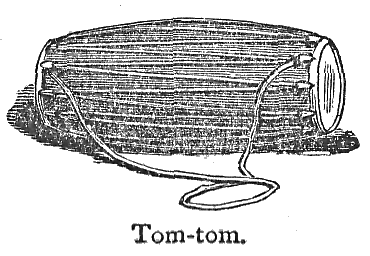
Tom-tom, tom′-tom, n. the drum used in India by musicians, jugglers, &c.: a gong.—v.i. Tam′-tam, to beat on a tom-tom.
Tomundar, to-mun′-dar, n. the head chief of a Baluchi tribe.
Ton, tun, n. a measure of capacity, varying with the substance measured—timber, wheat, gravel, lime, coke, &c.—in the carrying capacity of ships, 40 cubic feet: a measure of weight, equal to 20 cwt. or 2240 lb. avoirdupois. [A.S. tunne, a vat, tub; Ger. tonne, cask.]
Ton, ton, n. fashion, style.—adj. Ton′ish, stylish.—adv. Ton′ishly.
Tonalite, tō′nal-īt, n. an igneous rock having a granitic structure, and composed essentially of plagioclase, biolite, and quartzite.
To-name, tōō′-nām, n. a byname, nickname, or name in addition to Christian name and surname.
Tone, tōn, n. the character of a sound: quality of the voice: harmony of the colours of a painting, also its characteristic or prevailing effect as due to the management of chiaroscuro and to the effect of light upon the quality of colour: (phot.) the shade or colour of a finished positive picture: (gram.) syllabic stress, special accent given to a syllable: character or style: state of mind: mood: a healthy state of the body.—v.t. to utter with an affected tone: to intone, to utter in a drawling way: to give tone or quality to, in respect either of sound or colour: to alter or modify the colour.—adj. Tō′nal.—n. Tonal′ity.—adjs. Toned, having a tone (in compounds); Tone′less.—Tone down, to give a lower tone to, to moderate, to soften, to harmonise the colours of as to light and shade, as a painting. [L. tonus—Gr. tonos, a sound—teinō, to stretch.]
Tong, tung, n. (Spens.) the tongue of a buckle.
Tonga, tong′ga, n. a light two-wheeled cart for four, in use in Burma.
Tonga-bean, tong′ga-bēn, n. Same as Tonka-bean.
Tongs, tongz, n.pl. a domestic instrument, consisting of two jointed pieces or shafts of metal, used for lifting. [A.S. tange; Ice. töng, Ger. zange.]
Tongue, tung, n. the fleshy organ in the mouth, used in tasting, swallowing, and speech: power of speech: manner of speaking: speech: discourse: a language: anything like a tongue in shape: the catch of a buckle: the pointer of a balance: a point of land.—adjs. Tongued, having a tongue.; Tongue′less, having no tongue.—n. Tongue′let, a little tongue.—p.adj. Tongue′-shaped, shaped like a tongue: (bot.) linear and fleshy and blunt at the point, as a leaf.—n. Tongue′ster, a babbler.—adjs. Tongue′-tied, -tacked, having an impediment, as if the tongue were tied: unable to speak freely.—n. Tongue′-work, babble, chatter.—Hold one's tongue (see Hold). [A.S. tunge; Ice. tunga, Ger. zunge, the tongue; L. lingua (old form dingua).]
Tonic, ton′ik, adj. relating to tones or sounds: (med.) giving tone and vigour to the system: giving or increasing strength.—n. a medicine which gives tone and vigour to the system.—n. Tonic′ity, the healthy state of muscular fibres when at rest.—Tonic spasm (see Spasm).
Tonic solfa, ton′ik sōl-fä′, n. a modern system of musical notation, in which the notes are indicated by letters, and time and accent by dashes and colons.
To-night, tōō-nīt′, n. this night: the night after the present day.
Tonite, tō′nīt, n. an explosive made from pulverised gun-cotton.
Tonka-bean, tong′ka-bēn, n. the seed of a large tree of Guiana, used for flavouring snuff.—Also Ton′quin-bean.
Tonnage, tun′āj, n. in regard to ships, a measure both of cubical capacity and of dead-weight carrying capability—the freight ton simply means 40 cubic feet of space available for cargo, and is therefore two-fifths of a register ton: a duty on ships, estimated per ton.—Also Tun′nage.
Tonsil, ton′sil, n. one of two glands at the root of the tongue, so named from its shape.—n. Tonsilī′tis, inflammation of the tonsils.—adjs. Ton′sillar, Ton′silar, Tonsilit′ic. [L. tonsilla, a stake, a tonsil, dim. of tonsa, an oar.]
Tonsile, ton′sil, adj. that may be clipped.—n. Ton′sor, a barber.—adj. Tonsō′rial, pertaining to a barber or to shaving. [L. tonsilis—tondēre, tonsum, to clip.]
Tonsure, ton′shōōr, n. act of clipping the hair, or of shaving the head: a religious observance of the R.C. and Eastern Churches, which consists in shaving or cutting part of the hair of the head as a sign of the dedication of the person to the special service of God, and commonly to the public ministry of religion.—adj. Ton′sured, having the crown of the head shaven as a priest: shaven: bald. [L. tonsura, a shearing—tondēre.]
Tontine, ton-tēn′, n. a kind of life-annuity, increasing as the subscribers die: a loan raised with the benefit of survivorship—also adj.—n. Tontin′er. [From Lorenzo Tonti, a Neapolitan, its inventor.]
Tony, tō′ni, n. a simpleton. [Antony.]
Tony, tō′ni, adj. (U.S.) genteel, high-toned.
Too, tōō, adv. over: more than enough: extremely: likewise.—adj. Too-too, quite too: extreme, superlative: (slang) extravagantly and affectedly sentimental, gushing. [A form of to, sig. lit. 'added to.']
Tooart, tōō′art, n. a eucalyptus of south-western Australia, with remarkably heavy and durable wood.—Also Tu′art, Tew′art.
Took, tōōk, pa.t. and obsolete pa.p. of take.
Tool, tōōl, n. an instrument used by workmen: one who acts as the mere instrument of another.—v.t. to mark with a tool, esp. to ornament or imprint designs upon, of bookbinders: (slang) to drive, as a coach or other vehicle: to carry in a vehicle.—v.i. to travel in a vehicle, to drive.—n. Tool′ing, workmanship done with a tool. [A.S. tól, tohl; perh. from the root of tow.]
Tooley Street, tōōl′i strēt, n. a street in Southwark, at the foot of London Bridge, famous through Canning's story of its three tailors who began their petition to parliament with 'We, the people of England.'
Toom, tōōm, adj. empty.—n. a dumping-ground for rubbish. [Ice. tómr, empty.]
Toon, tōōn, n. a large tree of the bead-tree family, with red wood and astringent bark.—Also East Indian mahogany, Indian cedar.
Toot, tōōt, v.i. to pry or peep about: (obs.) to be prominent.—n. Toot′er, anything projecting. [A.S. totian, to elevate.]
Toot, tōōt, v.i. to make short unmusical sounds on a flute or horn.—v.t. to blow, as a horn, &c.—n. a sound, as of a horn, a blast: (U.S.) a spree.—n. Toot′er, one who toots, or that upon which he toots. [Old Dut. tuyten; cf. Ice. thjóta, to resound, A.S. theótan, to howl.]
Toot, tōōt, n. (slang) an idle worthless creature: the devil.
Tooth, tōōth, n. one of the hard bodies in the mouth, attached to the skeleton, but not forming part of it, developed from the dermis or true skin, their function primarily the mastication of the food: the taste or palate, relish: anything tooth-like: a prong: one of the projections on a saw or wheel:—pl. Teeth.—v.t. to furnish with teeth: to cut into teeth.—ns. Tooth′ache, an ache or pain in a tooth; Tooth′-brush, a brush for cleaning the teeth; Tooth′-draw′er (Shak.), one whose business is to extract teeth with instruments, a dentist; Tooth′-draw′ing, the act of extracting a tooth: the practice of extracting teeth.—adjs. Toothed, having teeth: (bot.) having tooth-like projections on the edge, as a leaf; Tooth′ful, full of teeth.—n. a small drink of spirits, &c.—adj. Tooth′less, having no teeth.—ns. Tooth′-ornament, a Romanesque and Early Pointed moulding, consisting of a square four-leaved flower pointed in the centre; Tooth′pick, an instrument for picking out anything in the teeth; Tooth′-pow′der, a powder used with a tooth-brush for cleaning the teeth.—adj. Tooth′some, pleasant to the taste.—ns. Tooth′someness; Tooth′-wash, a liquid preparation for cleansing the teeth; Tooth′wort, a name for Lathræa squamaria, one of the insectivorous plants, as well as for Dentaria bulbifera, one of the Cruciferæ, common in England, also known as 'coral-wort' and 'tooth-violet.'—adj. Tooth′y, having teeth: toothsome: biting.—Tooth and nail, with all possible vigour and fury.—A sweet tooth, a relish for sweet things; In spite of one's teeth, In the teeth of, in defiance of opposition; Show one's teeth, to threaten, to show one's anger and power to injure; Throw, Cast, in one's teeth, to fling at one, as a taunt, or in challenge; To the teeth (Shak.), in open opposition or defiance. [A.S. tóth (pl. téth, also tóthas); cog. with Goth. tunthus, L. dens, dent-is, Gr. o-dous, o-dont-os, Sans. danta.]