Front matter (continued 19)
Reading edition
Vision, vizh′un, n. the act or sense of seeing: sight: anything seen: anything imagined to be seen: a divine revelation: an apparition: anything imaginary.—v.t. to see as a vision: to present as in a vision.—n. (Scot.) Visie (viz′i), a close look at anything.—adj. Vis′ional, pertaining to a vision, not real.—adv. Vis′ionally.—n. Vis′ionariness.—adj. Vis′ionary, affected by visions: apt to see visions, imaginative: existing in imagination only: not real.—n. one who sees visions: one who forms impracticable schemes.—adj. Vis′ioned (rare), inspired so as to see visions: seen in a vision, spectral.—n. Vis′ionist, a visionary person, one who believes in visions.—adj. Vis′ionless, destitute of vision.—Beatific vision (see Beatify); Centre, Point, of vision, the position from which anything is observed, or represented as being seen. [Fr.,—L. visio, visionis—vidēre, visum, to see; cf. Gr. idein, Eng. wit.]
Visit, viz′it, v.t. to go to see or inspect: to attend: enter, appear in: to call on: (B.) to reward or punish.—v.i. to be in the habit of seeing or meeting each other: to keep up acquaintance.—n. act of visiting or going to see.—adjs. Vis′itable, subject to visitation: attractive to visitors; Vis′itant, paying visits, visiting.—n. one who visits: one who is a guest in the house of another: a migratory bird: one of an order of nuns founded by St Francis de Sales in 1610, also called Salesians, Order (also Nuns) of the Visitation—the order has done much in the education of young girls.—n. Visitā′tion, act of visiting: examination by authority: a dispensation, whether of divine favour or retribution: (rare) the object of a visit: the act of a naval commander in boarding the vessel of another state to ascertain her character and object: a visit of a herald to a district for the examination of its arms, pedigrees, &c.: an unusual and extensive irruption of a species of animals into another region: (eccles.) a festival to commemorate the visit of the Virgin Mary to Elizabeth, observed by the Roman and Greek Churches on 2d July.—adjs. Visitātō′rial, Visitō′rial.—n. Vis′iting, the act of paying visits: prompting, influence.—adj. that which visits.—ns. Vis′iting-book, a book recording the names of persons who have called or are to be called on; Vis′iting-card, a small card, on which the name, address, or title, may be printed, to be left in making calls or paying visits, and sometimes sent as an act of courtesy or in token of sympathy; Vis′iting-day, a day on which one is at home or ready to receive callers; Vis′itor, -er, one who visits, calls on, or makes a stay with a person: a person authorised to visit an institution to see that it is managed properly:—fem. Vis′itress.—Visitation of the sick, an office in the Anglican Church, used for the spiritual benefit of the sick, provision being also made for special confession and absolution. [Fr. visiter—L. visitāre, freq. of visĕre, to go to see, visit—vidēre, to see.]
Visite, vi-zēt′, n. a woman's close-fitting outer garment worn early in the 19th century. [Fr.]
Visive, vī′siv, adj. visual.
Visnomy, viz′no-mi, n. (Spens.), physiognomy.
Vison, vī′son, n. the American mink.
Visor, viz′ur, n. a part of a helmet covering the face, movable, and perforated to see through (see Armour): a mask.—adj. Vis′ored, wearing a visor: masked. [Fr. visière—vis, countenance.]
Vista, vis′ta, n. a view or prospect through or as through an avenue: the trees, &c., that form the avenue. [It. vista, sight, view—L. vidēre, to see.]
Visual, viz′ū-al, adj. belonging to vision or sight: visible: produced by sight: used in sight: used for seeing.—n. Visualisā′tion.—v.t. Vis′ualīse, to make visible or visual, externalise to the eye.—v.i. to call up a clear mental image.—ns. Vis′ualīser; Visual′ity.—adv. Vis′ually.
Vital, vī′tal, adj. belonging or contributing to life: containing or necessary to life: important as life: essential.—n. Vītalisā′tion.—v.t. Vī′talise, to make vital or alive: to give life to or furnish with the vital principle.—ns. Vī′talism, the doctrine that there is a vital principle distinct from the organisation of living bodies, which directs all their actions and functions; Vī′talist, one who holds this doctrine.—adj. Vītalis′tic.—n. Vītal′ity, quality of being vital: principle or power of life: capacity to endure and flourish.—adv. Vī′tally.—n.pl. Vī′tals, the interior organs essential for life: the part of any whole necessary for its existence.—n. Vītā′tiveness (phrenol.), the love of life, a faculty assigned to a protuberance under the ear.—Vital force, the principle of life in animals and plants; Vital functions, power, ability to continue living; Vital principle, that principle on which the life of an organism is thought to depend; Vital statistics, a division of statistics dealing with the facts and problems concerning population. [L. vitalis—vita, life—vivĕre, to live; cog. with Gr. bios, life.]
Vitellus, vī-tel′us, n. the yolk of an egg.—adjs. Vit′ellary, Vitell′ine, pertaining to the vitellus, or forming such.—n. Vitell′icle, a yolk-sac.—adj. Vitelligenous (-ij′-), producing yolk. [L., 'a yolk,' a transferred use of vitellus—vitulus, a calf.]
Vitex, vī′teks, n. a genus of trees or shrubs of the natural order Verbenaceæ. [L.]
Vitiate, vish′i-āt, v.t. to render faulty or defective: to make less pure: to deprave: to taint—earlier Vi′ciate.—ns. Vitiā′tion; Vi′tiātor; Vitios′ity, state or quality of being vicious. [L. vitiāre, -ātum—vitium. See Vice (2).]
Vitilitigation, vit-i-lit-i-gā′shun, n. vexatious litigation.—v.i. Vitilit′igate.
Vitis, vī′tis, n. a genus of plants, including the grape.—n. Vit′icide, a vine-destroyer, vine-pest.—adj. Vitic′olous, inhabiting, or produced upon, the vine.—ns. Vit′iculture, cultivation of the vine; Viticul′tūrist. [L. vitis, a vine—viēre, to twist.]
Vitreous, vit′rē-us, adj. glassy: pertaining to, consisting of, or like glass.—ns. Vitreos′ity, Vit′reousness; Vitres′cence.—adj. Vitres′cent, tending to become glass.—n. Vit′reum, the vitreous humour of the eye.—adj. Vit′ric.—ns. Vit′rics, glassy materials: the history of glass and its manufacture; Vitrifac′tion, Vitrificā′tion, act, process, or operation of vitrifying, or converting into glass; Vitrifac′ture, the manufacture of glass.—adjs. Vit′rifiable, that may be vitrified or turned into glass; Vit′rified.—ns.pl. Vit′rified-forts, -walls, certain ancient Scottish, French, &c. forts or walls in which the silicious stone has been vitrified by fire, whether by intention or accident is uncertain.—adj. Vit′riform, having the form of glass.—v.t. Vit′rify, to make into glass.—v.i. to become glass.—ns. Vitrī′na, a genus of land molluscs forming a connecting-link between the slugs and true snails—the glass-snail; Vit′rine, a show-case made of glass and used to protect delicate articles. [L. vitrum, glass—vidēre, to see.]
Vitriol, vit′ri-ol, n. the popular name of sulphuric acid: a soluble sulphate of a metal—green vitriol=sulphate of iron, blue vitriol=sulphate of copper, white vitriol=sulphate of zinc.—v.t. Vit′riolāte, to convert into vitriol.—n. Vitriolā′tion, the act or process of converting into vitriol.—adjs. Vitriol′ic, pertaining to or having the qualities of vitriol: biting, very severe; Vit′riolīsable.—n. Vitriolisā′tion.—v.t. Vit′riolise, to vitriolate: to poison with vitriol.—Elixir of vitriol, old name for the aromatic sulphuric acid of the Pharmacopœia; Oil of vitriol, concentrated sulphuric acid. [O. Fr.,—Low L. vitriolum—vitriolus—L. vitreus, of glass.]
Vitro-di-trina, vit′rō-di-trē′na, n. lacework glass. [It., 'glass of lace.']
Vitrophyre, vit′rō-fīr, n. a porphyritic variety of volcanic glass.—adj. Vitrophyr′ic. [L. vitrum, glass, porphyrites, porphyry.]
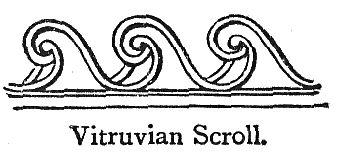
Vitruvian, vi-trōō′vi-an, adj. denoting a peculiar kind of convoluted scrollwork, so named from Vitruvius, a Roman architect under Augustus.
Vitta, vit′a, n. a fillet, or garland for the head:—pl. Vitt′æ (-ē). [L.]
Vitular, vit′ū-lar, Vituline, vit′ū-līn, adj. relating to a calf or to veal. [From L. vitulus, a calf.]
Vituperate, vī-tū′pe-rāt, v.t. to find fault with: to address with abuse: to rate soundly.—adj. Vitū′perable, deserving vituperation.—n. Vitūperā′tion, act of vituperating: censure: abuse.—adj. Vitū′perātive, containing vituperation or censure.—adv. Vitū′perātively.—n. Vitū′perātor, one who vituperates. [L. vituperāre, -ātum—vitium, a fault, parāre, to set out.]
Viure, vē′ūr, n. (her.) a thin ribbon crossing the field in any direction. [Fr.]
Viva, vē′va, interj. long live.—n. the exclamation Viva! [It., 'Let him live'—L. vivĕre, to live.]
Vivace, vē-vä′che, adj. (mus.) lively:—superl. Vivacis′simo. [It.]
Vivacious, vī-vā′shus, (or vi-), adj. lively or long-lived: active: sportive.—adv. Vivā′ciously.—ns. Vivā′ciousness; Vivac′ity, state of being vivacious: life: animation: liveliness or sprightliness of temper or behaviour: (rare) a vivacious act or saying. [L. vivax, vivacis—vivĕre, to live.]
Vivandière, vē-vong-di-ār′, n. in the French and some other Continental armies, a female attendant in a regiment, who sells spirits and other comforts, marching with the corps. [Fr., fem. of vivandier—It. vivandière, a sutler—vivanda, food.]
Vivarium, vī-vā′ri-um, n. an artificial enclosure for keeping or raising living animals, as a park, fish-pond, &c.—Also Vī′vary. [L. vivarium—vivus, alive—vivĕre, to live.]
Vivat, vī′vat, n. an exclamation of applause. [L., 'let him live.']
Viva voce, vī′va vō′sē, by word of mouth. [L., 'with living voice,'—vivus, living, vox, vocis, voice.]
Vive, vēv, interj. long live. [Fr., 'let him live.']
Vive, vīv, adj. (Bacon) lively, forcible. [Fr.,—L. vivus—vivĕre, to live.]
Viverrine, vī-ver′in, adj. pertaining to the Viverridæ, one of the four families of the Æluroidea section of Carnivora.—n. one of the Viverridæ, and esp. of the division of Viverrinæ, including the civets, genets, &c.
Vivers, vē′vėrz, n.pl. (Scot.) food, eatables. [Fr. vivres—L. vivĕre, to live.]
Vives, vīvz, n.pl. a disease of horses, &c., seated in the glands under the ear. [O. Fr. avives, vives—Sp. avivas—Ar. addhība—al, the, dhība, she-wolf.]
Vivid, viv′id, adj. lively or life-like: having the appearance of life: forming brilliant images in the mind: striking.—adv. Viv′idly.—ns. Viv′idness, Vivid′ity.—adj. Vivif′ic, vivifying.—ns. Vivificā′tion; Viv′ifier.—v.t. Viv′ify, to make vivid, endue with life. [L. vividus—vivĕre, to live.]
Viviparous, vī-vip′a-rus, adj. producing young alive: (bot.) germinating from a seed still on the parent plant.—ns. Vīvipar′ity, Vīvip′arousness.—adv. Vīvip′arously. [L., from vivus, alive, parĕre, to produce.]
Vivisection, viv-i-sek′shun, n. the practice of making operations or painful experiments on living animals, for the purposes of physiological research or demonstration.—v.t. Vivisect′, to practise vivisection on.—adj. Vivisec′tional.—ns. Vivisec′tionist, one who practises or defends vivisection; Vivisec′tor, one who practises vivisection; Vivisectō′rium, a place for vivisection. [L. vivus, alive, sectio—secāre, to cut.]
Vivisepulture, viv-i-sep′ul-tūr, n. burial alive.
Vixen, vik′sn, n. a she-fox: an ill-tempered woman.—adjs. Vix′en, Vix′enish, Vix′enly, ill-tempered, snarling. [Formerly also vixon; a form of fixen—A.S. fyxen, a she-fox.]
Viz. See Videlicet.
Vizament, viz′a-ment, n. (Shak.) advisement.
Vizard, viz′ard, Vizor, viz′ur. Same as Visor.
Vizir, Vizier, vi-zēr′, n. a minister or councillor of state in the Ottoman Empire and other Mohammedan states—also Visier′, Vezir′, Wizier′.—ns. Vizir′ate, Vizier′ate, Vizir′ship, Vizier′ship, the office of a vizir.—adjs. Vizir′ial, Vizier′ial.—Grand vizir, in Turkey, the prime-minister, and formerly also commander of the army. [Ar. wazīr, a porter—wazara, to bear a burden.]
Vly, vlī, or flī, n. a swamp, a shallow pond which is sometimes dry.—Also Vleij, Vlei. [A word of Dutch origin used in South Africa, prob. derived from Dut. vallei, a valley.]
Vocable, vō′ka-bl, n. that which is sounded with the voice: a word: a name.—ns. Vocab′ūlary, a list of vocables or words explained in alphabetical order: the words of a language: a dictionary: any list of words; Vocab′ūlist, a lexicographer, the harmless drudge who compiles a dictionary.—adjs. Vō′cal, having a voice: uttered or changed by the voice: (phon.) voiced, uttered with voice: having a vowel function; Vocal′ic, containing vowels.—n. Vocalisā′tion, act of vocalising.—v.t. Vō′calise, to make vocal: to form into voice: to insert the vowel points, as in Hebrew.—v.i. to speak, sing.—ns. Vō′calist, a vocal musician, a singer; Vocal′ity, Vō′calness, utterableness: vowel character.—adv. Vō′cally.—adj. Voc′ular (rare), vocal.—Vocal chords, two elastic membraneous folds of the larynx capable of being stretched or relaxed; Vocal music, music produced by the human voice alone, as opposed to Instrumental music. [L. vocabulum—vocāre, to call.]
Vocation, vō-kā′shun, n. call or act of calling: calling: occupation.—adj. Vocā′tional.—adv. Vocā′tionally. [L. vocatio—vocāre.]
Vocative, vok′a-tiv, adj. pertaining to the act of calling, applied to the grammatical case used in personal address.—n. the case of a word when a person or thing is addressed. [L. vocativus—vocāre.]
Vociferate, vō-sif′e-rāt, v.i. to cry with a loud voice.—v.t. to utter with a loud voice.—n. Vocif′erance, clamour.—adj. Vocif′erant, clamorous.—ns. Vociferā′tion, act of vociferating: a violent or loud outcry; Vocif′erātor.—v.t. Vocif′erise, to vociferate.—n. Vociferos′ity.—adj. Vocif′erous, making a loud outcry: noisy.—adv. Vocif′erously.—n. Vocif′erousness. [L.—vox, vocis, voice, ferre, to carry.]
Vocular, vok′ū-lar, adj. vocal.—n. Voc′ule, a slight sound of the voice.
Vodka, vōd′ka, n. a Russian spirit, properly distilled from rye, but sometimes from potatoes. [Russ., 'brandy,' dim. of voda, water.]
Voe, vō, n. in Shetland, a bay, creek.—Also Vo, Vae. [Ice. vágr, vogr, a creek.]
Vogie, vō′gi, adj. (Scot.) vain: merry.
Vogue, vōg, n. mode or fashion at any particular time: practice: popular reception. [Fr. vogue, course of a ship—voguer, to row, from Old High Ger. wagōn (Ger. wogen, to fluctuate, float)—waga, a waving, akin to wāg, a wave.]
Voice, vois, n. sound from the mouth: sound given out by anything: utterance or mode of utterance: language: expression: expressed opinion: one who speaks: (Shak.) reputation: sound uttered with resonance of the vocal chords: vote: (gram.) mode of inflecting verbs, as being active or passive.—v.t. to give utterance to, declare, announce: to fit for sounding: to regulate the tone of: to utter with voice or tone, as distinguished from breath.—adjs. Voiced, furnished with a voice; Voice′ful, having a voice: vocal.—n. Voice′fulness.—adj. Voice′less, having no voice or vote.—ns. Voice′lessness; Voic′er; Voic′ing, the regulating of the tone of organ pipes, ensuring proper power, pitch, and quality.—In my voice (Shak.), in my name; Inner voice, part, in music, a voice-part intermediate between the highest and the lowest; In voice, in good condition for singing or speaking.—With one voice, unanimously. [O. Fr. voix—L. vox, vocis; akin to Gr. epos, a word.]
Void, void, adj. unoccupied: empty: destitute (with of): having no binding force: wanting: unsubstantial.—n. an empty space.—v.t. to make vacant: to quit: to send out, emit, empty out: to render of no effect, to nullify: (Spens.) to lay aside, divest one's self of.—adj. Void′able, that may be voided or evacuated.—n. Void′ance, act of voiding or emptying: state of being void: ejection.—p.adj. Void′ed (her.), having the inner part cut away or left vacant—said of a charge or ordinary.—ns. Void′er, one who empties: a contrivance in armour for covering an unprotected part of the body: a tray for carrying away crumbs, &c.; Void′ing, the act of voiding: a remnant; Void′ness, emptiness: nullity. [O. Fr. voide, void, empty—L. viduus, bereft; others trace to Low L. form, akin to L. vacāre, to be empty.]
Voivode, Vaivode, voi′vōd, vā′vōd, n. the leader of an army: in Poland the title of the head of an administrative division, in Moldavia and Wallachia the former title of the princes, in Turkey an inferior administrative official—also Vay′vode, Wai′wode, Way′wode.—ns. Voi′vodeship, Vai′vodeship. [Russ. voevoda (Serv. vojvoda, Pol. wojewoda), a general.]
Vol, vol, n. (her.) two wings displayed and conjoined in base. [Fr.]
Volable, vol′a-bl, adj. (Shak.) nimble—willed. [L. volāre, to fly.]
Volant, vō′lant, adj. flying: nimble: (her.) represented as flying, or as in the air unsupported, or creeping.—n. Vō′lant-piece, a part of the helmet which could be removed at will.—adj. Vol′atile, evaporating very quickly: flighty: apt to change.—ns. Vol′atileness, Volatil′ity, quality of being volatile: disposition to evaporate rapidly: sprightliness: fickleness.—adj. Vol′atilisable.—ns. Volatilisā′tion, act or process of making volatile or evaporating.—v.t. Vol′atilise, to make volatile: to cause to evaporate.—n. Vol′ery, a large enclosure for birds in which they have room to fly.—adj. Vol′itant, flying.—n. Volitā′tion. [Fr.,—L. volans, antis, pr.p. of volāre, to fly.]
Volante, vō-lan′te, n. a two-wheeled covered vehicle with long shafts, with a chaise-body hung before the axle, driven by a postillion. [Sp.]
Volapük, vō-la-pük′, n. a name given to a universal language invented in 1879 by Johann Schleyer of Constance, Baden, the vocabulary being mainly based on English, and the grammar being simplified to the utmost.—n. Volapük′ist, one versed in Volapük: one who advocates the adoption of Volapük. [Lit. 'world-speech'—vol, shortened from Eng. world, pük, for Eng. speak.]
Volar, vō′lar, adj. pertaining to the palm, palmar.—n. Vō′la, the hollow of the hand or foot:—pl. Vō′læ. [L.]
Volcano, vol-kā′no, n. a more or less conical hill or mountain, usually truncated, and communicating with the interior of the earth by a pipe or funnel, through which issue hot vapours and gases, and frequently loose fragmentary materials and streams of molten rock: a form of firework.—adj. Volcan′ic, pertaining to, produced, or affected by a volcano.—adv. Volcan′ically.—n. Volcanisā′tion.—v.t. Vol′canise, to subject to the action of volcanic heat.—ns. Vol′canism, Volcanic′ity, phenomena connected with volcanoes; Vol′canist, a student of volcanic phenomena; Volcan′ity, state of being volcanic; Volcā′noism (rare), violent eruptiveness.—adj. Volcanolog′ical.—n. Volcanol′ogy.—Volcanic rocks, those formed by volcanic agency. [It. volcano—L. Volcanus, Vulcanus, god of fire.]
Vole, vōl, n. in card-playing, the winning of all the tricks in one deal.—v.i. to win such. [Fr.,—L. volāre, to fly.]
Vole, vōl, n. a genus of rodent quadrupeds of the subfamily Arvicolinæ, which also includes the lemmings, the musk-rats, &c., the Field-vole, the Water-vole, popularly called the water-rat, and the Bank-vole.
Volery. See under Volant.
Volet, vol′ā, n. a veil: one of the wings of a triptych picture. [O. Fr., 'a shutter'—L. volāre, to fly.]
Volitant, vol′i-tant, adj. having the power of flight.—n. Volitā′tion, act of flying.
Volition, vō-lish′un, n. act of willing or choosing: the exercise of the will: the power of determining.—adjs. Voli′tient (rare), willing; Voli′tional, Voli′tionary.—adv. Voli′tionally.—adjs. Voli′tionless; Vol′itive, having power to will: expressing a wish. [Low L. volitio—L. volo, velle, to will, be willing.]
Volkslied, fōlks′lēt, n. a folk-song. [Ger.]
Volksraad, fōlks′rät, n. the name of the legislative assembly of the Orange Free State before its final annexation by England in 1900.
Volley, vol′i, n. a flight of shot: the discharge of many small-arms at once: an outburst of many at once: in tennis and lawn-tennis, a hard return of the ball before it reaches the ground—half-volley is a return by striking the ball just as it touches or rises from the ground:—pl. Voll′eys.—v.t. to discharge in a volley.—v.i. to fly together, as missiles: to sound together: in lawn-tennis, to use the stroke so called. [Fr. volée, a flight—voler—L. volāre, to fly.]
Volsungs, vol′sungz, n.pl. a famous heroic race in old German legend, its founder Volsung or Wolsung, the grandson of Odin, and its brightest ornament Volsung's son, Siegmund.
Volt, vōlt, n. a turn or bound: a sudden movement or leap to avoid a thrust: a gait of two treads made by a horse going sideways round a centre.—n. Vol′tage. [Fr. volte—It. volta—L. volvĕre, volutum, to turn.]
Volt, vōlt, n. the unit of electro-motive force now in universal use among electricians, defined legally in terms of the ohm and ampere.—adj. Vol′ta-elec′tric, of or pertaining to galvanism.—n. Vol′ta-electrom′eter, an instrument for measuring electric currents.—adj. Vol′ta-electromō′tive.—n. Vōl′tage, electro-motive force reckoned in volts.—adj. Voltā′ic, pertaining to Alessandro Volta, an Italian scientist (1745-1826), who mainly developed the theory of current electricity along purely physical lines, discovered the electric decomposition of water, and invented a new electric battery, the electrophorus, and the electroscope.—ns. Vol′taism, that branch of electric science which treats of the production of an electric current from the chemical interaction of two immersed dissimilar metals (same as Galvanism); Voltam′eter, an instrument for measuring the decomposition produced by an electric current; Vōlt′-am′pere, the rate of activity in an electric circuit when the electro-motive force is one volt and the current one ampere; Volt′atype, an electrotype; Vōlt′meter, an instrument for measuring voltage.—Voltaic pile, a galvanic battery.
Volta, vōl′ta, n. an old dance: (mus.) turn, time:—pl. Vol′te (-te). [It.]
Voltairian, vol-tār′i-an, adj. pertaining to Voltaire, a famous French poet, dramatist, historian, and sceptic (1694-1778).—n. one who advocates the views and principles of Voltaire.—ns. Voltair′ianism, the spirit of Voltaire—i.e. a sceptical, incredulous, and sarcastic attitude, especially towards Christianity; Voltair′ism, incredulity, scepticism.
Voltigeur, vol-ti-zhėr′, n. a vaulter or tumbler: formerly in the French army, one of a light-armed company of picked men placed on the left of a battalion: under the Second Empire, a member of several special infantry regiments. [Fr.]
Voluble, vol′ū-bl, adj. easy to roll or move: flowing smoothly: fluent in speech.—adj. Vol′ubile (Milt.), rolling: revolving.—ns. Volubil′ity, Vol′ubleness, state or quality of being voluble: fluency of speech.—adv. Vol′ubly. [L. volubilis—volvĕre, volutum, to roll.]
Volucrine, vol′ū-krin, adj. pertaining to birds, bird-like. [L. volucris, a bird—volāre, to fly.]
Volume, vol′ūm, n. a roll or scroll, which was the form of ancient books: a book, whether complete in itself or part of a work: a rounded mass, convolution: cubical content: a quantity: dimensions: fullness of voice.—v.i. to swell.—adj. Vol′umed, having the form of a volume or roll: of volume or bulk.—ns. Volumenom′eter, an instrument for measuring the volume of a solid body by the quantity of fluid it displaces; Vol′umēter, an instrument for measuring the volumes of gases.—adjs. Volumet′ric, -al.—adv. Volumet′rically.—adjs. Volū′minal, pertaining to cubical content; Volū′minous, consisting of many volumes or books, or of many coils: of great bulk: having written much, as an author: in many volumes, capable of filling many volumes.—adv. Volū′minously.—ns. Volū′minousness, Voluminos′ity; Vol′ūmist (rare), an author.—Volumetric analysis, the analysis of a compound by determining the quantity of a standard solution required to satisfy a reaction in a known quantity of the compound.—Speak, Tell, volumes, to mean much, to be very significant. [Fr.,—L. volumen, a roll—volvĕre, volutum, to roll.]
Voluntary, vol′un-ta-ri, adj. willing: acting by choice: free: proceeding from the will: subject to the will: done by design or without compulsion: of or pertaining to voluntaryism.—n. one who does anything of his own free-will: a piece of music played at will: an upholder of voluntaryism.—adv. Vol′untarily.—ns. Vol′untariness; Vol′untaryism, the system of maintaining the Church by voluntary offerings, instead of by the aid of the State, as alone consistent with true religious liberty, involving freedom from State support, patronage, or control; Vol′untaryist.—adj. Vol′untātive, voluntary.—Voluntary school, in England, one of a number of elementary schools supported by voluntary subscriptions, and in many cases controlled by religious bodies. [L. voluntarius—voluntas, choice—volo, velle, to will.]
Volunteer, vol-un-tēr′, n. one who enters any service, esp. military, voluntarily or of his own free choice: a soldier belonging to any body other than the regular army.—adj. entering into service voluntarily.—v.t. to offer voluntarily.—v.i. to enter into any service of one's own free-will or without being asked. [Fr. volontaire—L. voluntarius.]
Voluptuary, vō-lup′tū-a-ri, n. a voluptuous person, or one excessively given to bodily enjoyments or luxury: a sensualist.—adj. promoting sensual pleasure. [L. voluptuarius—voluptas, pleasure.]
Voluptuous, vō-lup′tū-us, adj. full of pleasure: given to excess of pleasure, esp. sensual: contributing to sensual pleasure.—adv. Volup′tuously.—n. Volup′tuousness. [L. voluptuosus—voluptas, pleasure.]
Voluspa, vol-us-pä′, n. one of the poems of the Elder Edda: a sibyl or prophetess—a wrong use, though found in Scott's Pirate. [Ice. Völuspá, the song of the sibyl, völu, gen. of völva, a prophetess, spá, prophecy.]
Volute, vō-lūt′, n. a spiral scroll used in the Ionic and Corinthian capitals: a kind of spiral shell, chiefly tropical: whorl of a spiral shell.—adj. (bot.) rolled up in any direction.—adj. Volū′ted, having a volute.—n. Volū′tion, a convolution: a whorl.—adj. Vol′ūtoid, like a volute. [Fr.,—L. volvĕre, volutum, to roll.]
Volve, volv, v.t. (obs.) to turn over, ponder. [L. volvĕre, to turn.]
Volvox, vol′voks, n. a genus of simple organisms found in ponds, canals, &c., being fresh-water algæ, consisting of green flagellate cells, united by protoplasmic bridges in a hollow spherical colony. [Formed from L. volvĕre, to roll.]
Volvulus, vol′vū-lus; n. occlusion of the intestine through twisting.
Vomer, vō′mėr, n. the thin flat bone forming part of the middle partition of the nose, separating the nostrils. [L., 'a ploughshare.']
Vomit, vom′it, v.i. to throw up the contents of the stomach by the mouth, to spew.—v.t. to throw out with violence.—n. matter ejected from the stomach: something that excites vomiting.—adj. Vom′ic, purulent.—n. Vom′ica, a cavity in the lung containing pus; Vom′iting, act of one who vomits: matter vomited.—adjs. Vom′itive, Vom′itory, causing to vomit.—n. a vomit or emetic.—ns. Vom′ito, the worst form of yellow fever, usually attended with the black vomit; Vom′itory, a door of a large building by which the crowd is let out; Vomituri′tion, violent retching. [L. vomĕre, -ĭtum, to throw up; Gr. emein.]
Voodoo, Voudou, vōō-dōō, n. the name given in the southern United States to any practiser of witchcraft, or of any charm, incantation, &c., especially when tinctured with African rites or superstitions: the supreme evil spirit of the voodoos.—adj. pertaining to the rites or practices of the voodoo.—v.t. to affect by voodoo charms.—n. Voodoo′ism, voodoo superstitions. [Creole Fr. vaudoux, a negro sorcerer, prob. a form of Fr. Vaudois, a Waldensian—a heretic being capable of any kind of wickedness.]
Voracious, vō-rā′shus, adj. eager to devour: greedy: very hungry.—adv. Vorā′ciously.—ns. Vorac′ity, Vorā′ciousness, quality of being voracious. [L. vorax, voracis—vorāre, to devour.]
Voraginous, vō-raj′i-nus, adj. pertaining to a whirlpool.—n. Vorā′go (-gō), a gulf. [L. vorago.]
Vorant, vō′rant, adj. (her.) devouring. [L. vorans, pr.p. of vorare, to devour.]
Vortex, vor′teks, n. a whirling motion of a fluid forming a cavity in the centre: a whirlpool: an eddy having a rotational motion of the smallest visible portion in the centre:—pl. Vor′tices, Vor′texes.—ns. Vor′tex-ring (phys.), a vortical molecular filament or column forming a ring composed of a number of small rotating circles, placed side by side—e.g. the smoke-rings emitted by a skilful cigarette-smoker; Vor′tex-thē′ory, the theory that matter is ultimately composed of vortices in a fluid—a conception due to Lord Kelvin.—adj. Vor′tical, whirling.—adv. Vor′tically.—adjs. Vor′ticose, Vortic′ūlar, Vortiginal (-ij′-), Vortiginous (-ij′-). [L. vortex, vertex—vortĕre, vertĕre, to turn.]
Vorticella, vor-ti-sel′a, n. a genus of ciliated Infusorians belonging to the order Peritricha, in which the cilia are restricted to a fringe round the mouth. [From L. vortex, a whirl.]
Votary, vō′ta-ri, adj. bound or consecrated by a vow.—n. one devoted as by a vow to some service, worship, or way of life:—fem. Vō′taress.—n. Vō′tarist, a votary. [Low L. votarius—L. votum, to vow.]
Vote, vōt, n. expression of a wish or opinion, as to a matter in which one has interest: that by which a choice is expressed, as a ballot: decision by a majority: something granted by the will of the majority.—v.i. to express the choice by a vote.—v.t. to choose by a vote: to grant by a vote: (coll.) to declare by general consent.—adjs. Vō′table, capable of voting; Vote′less.—ns. Vō′ter; Vō′ting-pā′per, a balloting-paper, used in the election of members to Parliament.—Vote down, to put an end to by a vote, or otherwise; Vote straight, to give one's vote honestly.—Cumulative voting, that system of voting in which the voter has a right to as many votes as there are members to be elected, and may give all his votes or as many as he pleases to one candidate.—Split one's votes, to divide one's votes judiciously among several candidates so as to strengthen those one favours. [L. votum, a wish—vovēre, votum, to vow.]
Votive, vō′tiv, adj. given by vow: vowed.—adv. Vō′tively.—Votive offering, a tablet, picture, &c. dedicated in fulfilment of a vow. [L. votivus—votum, a vow.]
Vouch, vowch, v.t. to call upon to witness: to maintain by repeated affirmations: to warrant: to attest: to produce vouchers for: (Milt.) to second, support.—v.i. to bear witness: to give testimony.—n. confirmation, attestation.—ns. Vouchee′, the person vouched or summoned in a writ of right; Vouch′er, one who vouches or gives witness: a paper which vouches or confirms the truth of anything, as accounts: a mechanical contrivance used in shops for automatically registering the amount of money drawn; Vouch′ment, a solemn declaration. [O. Fr. voucher, vocher, to call to defend—L. vocāre, to call.]
Vouchsafe, vowch-sāf, v.t. to vouch or warrant safe: to sanction or allow without danger: to condescend to grant.—v.i. to condescend.—n. Vouchsafe′ment.
Voulge, vōōzh, n. a weapon carried by foot-soldiers in the 14th century, having a blade fixed on a long staff. [Fr.]
Voussoir, vōō-swär′, n. one of the wedge-like stones which form part of an arch.—v.t. to form with such. [Fr., through Low L., from L. volutus—volvĕre, to roll.]
Vow, vow, n. a voluntary promise made to God, and, as such, carrying with it the most stringent obligation to its fulfilment: a solemn or formal promise of fidelity or affection: (Shak.) a positive assertion.—v.t. to give by solemn promise: to devote: to threaten, to maintain solemnly.—v.i. to make vows.—n. Vow′-fell′ow (Shak.), one bound by the same vow.—Baptismal vows, the promises made at baptism by the person baptised, or by the sponsors or parents in his name; Monastic vows (see Monastery); Solemn, as opposed to Simple vows, such vows as the Church takes under her special charge, or is said in a solemn manner to accept, as those of poverty, obedience, and chastity, involving complete and irrevocable surrender. [O. Fr. vou (Fr. vœu)—L. votum—vovēre, to vow.]
Vowel, vow′el, n. a sound or tone produced by the unimpeded passage of the breath, when modified by the glottis into voice, through the tube of the mouth, which is made to assume different shapes by altering the form and position of the tongue and the lips—the letters a, e, i, o, u are called vowels, as being able to be sounded by themselves, with a continuous passage of the breath; but there are thirteen simple vowel sounds in English.—adj. vocal: pertaining to a vowel.—vs.t. Vow′el, Vow′elise, to insert vowel signs in words written primarily with consonants only.—ns. Vow′elism, the use of vowels; Vow′elist, one given to vowelism.—adjs. Vow′elled, furnished with vowels; Vow′elless, without vowels; Vow′elly, full of vowels.—Vowel points, marks inserted in consonantal word to indicate vowels. [Fr. voyelle—L. vocalis—vox, vocis, the voice.]
Vox, voks, n. voice: a voice or song part.—Vox angelica, or cælestis, in organ-building, a stop producing a wavy effect; Vox humana, in organ-building, a reed-stop producing tones resembling those of the human voice. [L.]
Voyage, voi′āj, n. passage by water: (Shak.) an enterprise.—v.i. to make a voyage, or to pass by water.—v.t. to traverse, pass over.—adj. Voy′age-able, navigable.—n. Voy′ager, one who voyages.—n.pl. Voyageurs (vwo-ya-zher′), name given in Canada to the men who in their bark canoes kept up communication between the stations, and effected transportation of men and supplies, in the North-west and Hudson's Bay territory. [Fr.,—L. viaticum, travelling-money—L. via, a way.]
Vraisemblance, vrā-song-blongs′, n. verisimilitude. [Fr., vrai, true, semblance, appearance.]
Vug, vug, n. a Cornish miner's name for a cavity in a rock.—adj. Vug′gy.
Vulcan, vul′kan, n. (Roman myth.) the god of fire.—n. Vulcanā′lia, an ancient Roman, festival in honour of Vulcan, held on 23d August.—adjs. Vulcā′nian, pertaining to Vulcan, or to one who works in iron; Vulcan′ic (same as Volcanic).—n. Vulcanic′ity, volcanicity.—adj. Vulcanī′sable.—n. Vulcanisā′-tion.—v.t. Vul′canise, to combine with sulphur by heat, as caoutchouc—v.i. to admit of such treatment.—ns. Vul′canism, volcanism; Vul′canist, a supporter of the Huttonian theory in geology which asserted the igneous origin of such rocks as basalt; Vul′canite, the harder of the two kinds of vulcanised india-rubber or caoutchouc, the softer kind being called soft-rubber. [L. Vulcanus.]
Vulgar, vul′gar, adj. pertaining to or used by the common people, native: public: common; national, vernacular: mean or low: rude.—n. the common people: the common language of a country.—ns. Vulgā′rian, a vulgar person: a rich unrefined person; Vulgarisā′tion, a making widely known: a making coarse or common.—v.t. Vul′garise, to make vulgar or rude.—ns. Vul′garism, a vulgar phrase: coarseness; Vulgar′ity, Vul′garness, quality of being vulgar: mean condition of life: rudeness of manners.—adv. Vul′garly.—n. Vul′gate, an ancient Latin version of the Scriptures, so called from its common use in the R.C. Church, prepared by Jerome in the fourth century, and pronounced 'authentic' by the Council of Trent.—Vulgar fraction, a fraction written in the common way.—The vulgar, the common people. [L. vulgaris—vulgus, the people.]
Vulnerable, vul′ne-ra-bl, adj. capable of being wounded: liable to injury.—v.t. Vuln (her.), to wound.—adj. Vulned (her.).—ns. Vulnerabil′ity, Vul′nerableness.—adj. Vul′nerary, pertaining to wounds: useful in healing wounds.—n. anything useful in curing wounds.—adj. Vul′nerose, with many wounds. [L. vulnerabilis—vulnerāre, to wound—vulnus, vulneris, a wound.]
Vulpine, vul′pin, adj. relating to or like the fox: cunning.—adj. Vulpec′ūlar, vulpine.—ns. Vul′picide, the killing of a fox: a fox-killer; Vul′pinism, craftiness. [L.,—vulpes, a fox.]
Vulsella, vul-sel′a, n. a forceps with toothed or clawed blades:—pl. Vulsell′æ (-ē). [L.]
Vulture, vul′tūr, n. a large rapacious bird of prey, feeding largely on carrion: one who or that which resembles a vulture.—adjs. Vul′tūrine, Vul′tūrish, Vul′tūrous, like the vulture: rapacious.—ns. Vul′turism, rapacity; Vul′turn, the Australian brush-turkey. [O. Fr. voutour (Fr. vautour)—L. vultur; perh. from vellĕre, to pluck, to tear.]
Vulva, vul′va, n. the orifice of the external organs of generation of the female.—adjs. Vul′var, Vul′vate; Vul′viform, oval.—ns. Vulvis′mus, vaginismus; Vulvī′tis, inflammation of the vulva.—adjs. Vulvo-ū′terine, pertaining to the vulva and the uterus; Vulvovag′inal, pertaining to the vulva and the vagina.—n. Vulvovaginī′tis, inflammation of both the vulva and the vagina.
Vum, vum, v.i. (U.S.) a corruption of vow, in phrase 'I vum.'
Vying, vī′ing, pr.p. of vie.

the twenty-third letter of our alphabet, like æ, a ligature rather than a letter, with a double value, as consonant and as vowel—when the sound is voiced we have w, as in 'we' or 'wen,' the corresponding unvoiced sound being wh, as in 'when,' 'what.' A final w is vocalic, as in 'few.' The A.S. hw has become wh; cw has become qu as in queen, from A.S. cwén; while w is occasionally intrusive, as in whole, from A.S. hál.
Wabble, Wobble, wob′l, v.i. to incline alternately to one side and the other: to rock, to vacillate.—n. a hobbling, unequal motion.—ns. Wabb′ler, Wobb′ler, one who or that which wabbles: a boiled leg of mutton.—adjs. Wabb′ly, Wobb′ly, shaky, given to wabbling.—adj. and n. Wobb′ling, vacillating. [Low Ger. wabbeln, to wabble; cog. with Eng. waver.]
Wabster, wab′stėr, n. (Scot.) a webster, weaver.
Wacke, wak′e, n. German miners' term for a soft, grayish kind of trap-rock.
Wad, wod, n. a mass of loose matter thrust close together for packing, &c., as hay, tow, &c.: a little mass of paper, tow, or the like to keep the charge in a gun.—v.t. to form into a mass: to pad, stuff out: to stuff a wad into:—pr.p. wad′ding; pa.t. and pa.p. wad′ded.—n. Wad′ding, a wad, or the materials for wads: a soft stuff, also sheets of carded cotton for stuffing garments, &c. [Skeat refers to Scand., Sw. vadd, wadding; cf. Ger. watte, wadding, wat, cloth (whence Fr. ouate); ult. allied to weed.]
Wad, wad, a Scotch form of wed, also of would.
Wad, Wadd, wod, n. an earthy ore of manganese.
Waddle, wod′l, v.i. to take short steps and move from side to side in walking.—n. a clumsy, rocking gait.—n. Wadd′ler.—adv. Wadd′lingly, with a waddling gait. [Perh. wade.]
Waddy, wad′i, n. a native Australian wooden war-club, a walking-stick—also Wadd′ie.—v.t. to strike with a waddy.
Wade, wād, v.i. to walk through any substance that yields to the feet, as water: to pass with difficulty or labour.—n. (coll.) a ford.—n. Wā′der, one who wades: a bird that wades, e.g, the heron: (pl.) high waterproof boots used by fishermen for wading. [A.S. wadan, to move; Ger. waten.]
Wadi, Wady, wod′i, n. the dry bed of a torrent: a river-valley. [Ar. wadī, a ravine (Sp. guad-, first syllable of many river-names).]
Wadmal, wod′mal, n. (Scot.) a thick woollen cloth.—Also Wad′moll. [Ice. vadhmál—vadhr, cloth, mál, a measure.]
Wadset, wod′set, n. a mortgage—also Wad′sett.—n. Wad′setter, a mortgagee. [Wad=wed, set.]
Wae, wā, n. (Spens.) woe.—adj. (Scot.) sorrowful.—adjs. Wae′ful, Wae′some, woeful, pitiful.—n. Wae′ness, sadness.—interj. Wae′sucks, alas!
Wafer, wā′fėr, n. a thin round cake of unleavened bread, usually stamped with a cross, an Agnus Dei, the letters I.H.S., &c., used in the Eucharist in the R.C. Church: a thin leaf of coloured paste for sealing letters, &c.: a thin cake of paste used to facilitate the swallowing of powders.—v.t. to close with a wafer.—n. Wā′fer-cake.—adj. Wā′fery, like a wafer. [O. Fr. waufre (Fr. gaufre)—Old Dut. waefel, a cake of wax; Ger. wabe, a honeycomb.]
Waff, waf, adj. (Scot.) weak, worthless, paltry.—n. a worthless person. [Waif.]
Waff, waf, n. (Scot.) a slight hasty motion: a quick light blow: a sudden ailment: a faint but disagreeable odour: a ghost.
Waff, waf, n. an obsolete form of wave.
Waff, waf, v.i. (prov.) to bark.—Also Waugh.
Waffle, wof′l, n. a kind of batter-cake, baked over the fire in an iron utensil of hinged halves called a Waff′le-ī′ron. [Dut. wafel, wafer.]
Waffle, wof′l, v.i. (prov.) to wave. [Waff (3).]
Waft, waft, v.t. to bear through a fluid medium, as air or water: (Shak.) to wave the hand, beckon, to turn.—v.i. to float.—n. a floating body: a signal made by moving something in the air, esp. an ensign, stopped together at the head and middle portions, slightly rolled up lengthwise, and hoisted at different positions at the after-part of a ship: a breath, puff, slight odour.—ns. Waf′tāge, act of wafting, transportation in air or water; Waf′ter, one who or that which wafts; Waf′tūre (Shak.), act of wafting or of waving, waving motion, beckoning. [Wave.]
Wag, wag, v.t. and v.i. to move from side to side: to shake to and fro: (coll.) to depart: (Shak.) to move on, make progress:—pr.p. wag′ging; pa.t. and pa.p. wagged.—n. a shaking, moving to and fro. [Referred by Skeat to Old Sw. wagga, to wag (Ice. vagga, a cradle); allied to A.S. wagian, to wag, Old High Ger. wagōn, to shake, A.S. wegan, to carry, move.]
Wag, wag, n. a droll, mischievous fellow: a man full of sport and humour: a wit: a fellow generally.—n. Wag′gery, mischievous merriment.—adjs. Wag′gish—(rare) Wag′some.—adv. Wag′gishly.—ns. Wag′gishness; Wag′-wit, a would-be wit. [Prob. waghalter, one who deserves hanging.]
Wage, wāj, v.t. to pledge: to engage in as if by pledge: to carry on, esp. of war: to venture: (prov.) to hire for pay: (Shak.) to pay wages to: (Spens.) to let out for pay.—v.i. (Shak.) to be equal in value, to contend, battle (with).—n. a gage or stake: that for which one labours: wages.—ns. Wage′-earn′er, one receiving pay for work done; Wage′-fund, Wā′ges-fund theory, the theory that there is at any given time in a country a determinate amount of capital available for the payment of labour, therefore the average wage depends on the proportion of this fund to the number of persons who have to share in it; Wā′ger, that which is waged or pledged: something staked on the issue of anything: a bet: that on which bets are laid: (law) an offer to make oath.—v.t. to hazard on the issue of anything.—v.i. to lay a wager.—n. Wā′gerer.—n.pl. Wā′ges (used as sing.), wage: that which is paid for services.—n. Wage′-work, work done for wages.—Wager of battle, trial by combat, an ancient usage which permitted the accused and accuser, in defect of sufficient direct evidence, to challenge each other to mortal combat, for issue of the dispute.—Living wage (see Living). [O. Fr. wager (Fr. gager), to pledge.]
Waggle, wag′l, v.i. and v.t. to wag or move from side to side. [Freq. of wag (1).]
Wagmoire, wag′moir, n. (Spens.) a quagmire.
Wagnerian, vag-nē′ri-an, adj. pertaining to or characterised by the ideas or style of Richard Wagner (1813-83), a famous German composer of music-dramas: pertaining to Rudolf Wagner (1805-64), a famous physiologist.—ns. Wag′nerism, Wagne′rianism, the art theory of Richard Wagner, its main object being the freeing of opera from traditional and conventional forms, and its one canon, dramatic fitness; Wag′nerist, an adherent of Wagner's musical methods.
Wagon, Waggon, wag′un, n. a four-wheeled vehicle for carrying heavy goods: (Shak.) a chariot.—v.t. to transport by wagon.—ns. Wag′onage, money, paid for conveyance by wagon; Wag′on-box, -bed, the carrying part of a wagon; Wag′oner, Wag′goner, one who conducts a wagon: (Shak.) a charioteer: (Spens.) the constellation Auriga; Wagonette′, a kind of open carriage built to carry six or eight persons, with one or two seats crosswise in front, and two back seats arranged lengthwise and facing inwards; Wag′onful, as much as a wagon will hold; Wag′on-load, the load carried by a wagon: a great amount; Wag′on-lock, a kind of iron shoe which is placed on the rear-wheel of a wagon to retard motion in going downhill; Wag′on-train, the machines used by an army for the conveyance of ammunition, provisions, sick, &c.; Wag′on-wright, a maker of wagons. [Dut. wagen; A.S. wægn, Eng., wain.] Wagtail, wag′tāl, n. any bird of the family Motacillidæ, so named from their constant wagging of the tail—the pipits or titlarks, &c.: (Shak.) a pert person.
Wahabee, Wahabai, wä-hä′bē, n. one of a sect of Puritan Moslems founded in Central Arabia about 1760 by Abd-el-Wahhab (1691-1787), whose aim was to restore primitive Mohammedanism—also Wahä′bite.—n. Wahä′biism, the doctrine and practices of the Wahabis.
Wahoo, wa-hōō′, n. the burning bush, a richly ornamental shrub: the bear-berry, which yields cascara sagrada: the winged elm, with valuable hard-grained wood.
Waid, Waide. Old spellings of weighed.
Waif, wāf, n. a stray article: anything found astray without an owner: a worthless wanderer.—adj. vagabond, worthless. [O. Fr. waif, wef—Ice. veif, any flapping or waving thing.]
Waift, wāft, n. (Spens.) a waif.
Wail, wāl, v.i. to lament or sorrow audibly.—v.t. to bemoan: to grieve over.—n. a cry of woe: loud weeping.—n. Wail′er.—adj. Wail′ful, sorrowful, mournful.—n. Wail′ing.—adv. Wail′ingly. [M. E. weilen—Ice. vaela, vála, to wail—væ, vei, woe.]
Wain, wān, n. a wagon.—v.t. (rare) to carry.—ns. Wain′age, the team and implements necessary for the cultivation of land; Wain′-rope, a rope for binding a load on a wain or wagon; Wain′wright, a wagon-maker.—The lesser wain, the constellation Ursa Minor. [A.S. wægen, wæn—wegen, to carry; cf. Ger. wagen, L. vehĕre.]
Wainscot, wān′skot, n. the panelled boards on the walls of apartments: a collector's name for certain noctuoid moths.—v.t. to line with, or as if with, boards or panels.—ns. Wain′scoting, Wain′scotting, the act of lining with boards or panels: materials for making a wainscot. [Orig. perh. wood used for a partition in a wagon—Dut. wagenschot, oakwood, beechwood—wagen, wagon, schot, partition. Skeat explains as a corr. of Old Dut. waegheschot, wall-hoarding, from Old Dut. waeg, a wall, schot, a partition.]
Waist, wāst, n. the smallest part of the human trunk, between the ribs and the hips: the bodice of a woman's dress: the middle part, as of a ship, of a musical instrument—(Shak.) of a period of time; (Shak.) something that surrounds.—ns. Waist′-anchor, an anchor stowed in the waist of a ship; Waist′band, the band or part of a garment which encircles the waist; Waist′belt, a belt for the waist; Waist′boat, a boat carried in the waist of a vessel; Waist′cloth, a piece of cloth worn around the waist, and hanging below it, in India; Waist′coat, a short coat worn immediately under the coat, and fitting the waist tightly; Waistcoateer′ (obs.), a strumpet; Waist′coating, material for men's waistcoats, usually of a fancy pattern and containing silk.—adjs. Waist′-deep, -high, as deep, high, as to reach up to the waist.—n. Waist′er, a green-hand on a whaler: an old man-of-war's-man who has not risen. [A.S. wæxt, growth (Ice. vöxtr); conn, with wæstme, growth, weaxen, to grow.]
Wait, wāt, v.i. to stay in expectation (with for): to remain: to attend (with on): to follow: to lie in ambush.—v.t. to stay for: to await: (coll.) to defer: (obs.) to accompany.—n. ambush, now used only in such phrases as 'to lie in wait,' 'to lay wait:' the: act of waiting or expecting: delay: (pl.) itinerant musicians, originally watchmen, who welcome-in Christmas.—ns. Wait′er, one who waits: an attending servant: a salver or tray: a custom-house officer: (obs.) a watchman; Wait′erage, service; Wait′ering, the employment of a waiter; Wait′ing, act of waiting: attendance.—adv. Wait′ingly.—ns. Wait′ing-maid, -wom′an, a female attendant; Wait′ing-room, a room for the convenience of persons waiting; Wait′ing-vass′al (Shak.), an attendant; Wait′ress, a female waiter.—Wait attendance (Shak.), to remain in attendance; Wait upon, on, to call upon, visit: to accompany, to be in the service of: (B.) to look toward, to attend to, do the bidding of.—Lie in wait, to be in hiding ready for attack or surprise.—Lords, or Grooms, in waiting, certain officers in the Lord Chamberlain's department of the royal household; Minority waiter, a waiter out of employment, as a political minority is out of office. [O. Fr. waiter (Fr. guetter), to watch, attend—waite, a sentinel—Old High Ger. wahta (Ger. wacht), a watchman; cog. with A.S. wacan, to watch.]
Waive, wāv, v.t. to relinquish for the present: to give up claim to: not to insist on a right or claim.—n. Wai′ver, the act of waiving: renouncement of a claim: process by which a woman was outlawed. [O. Fr. guever, to refuse, resign—perh. Ice. veifa, to move to and fro; cf. L. vibrāre.]
Waivode, Waiwode, Waiwodeship. Same as Voivode, &c.
Wake, wāk, v.i. to cease from sleep: to lie awake: (B.) to watch: to be roused up, active, or vigilant: to return to life: (Shak.) to hold a late revel: to keep vigil.—v.t. to rouse from sleep: to keep vigil over: to excite, disturb: to reanimate:—pa.t. and pa.p. waked or woke.—n. act of waking: feast of the dedication of a church, formerly kept by watching all night: sitting up of persons with a corpse.—adj. Wake′ful, being awake: indisposed to sleep: vigilant.—adv. Wake′fully.—n. Wake′fulness.—v.t. and v.i. Wā′ken, to wake or awake: to be awake.—ns. Wake′ner, one who or that which wakens; Wake′ning, act of one who wakens; (Scots law) revival of an action; Wā′ker, one who wakes.—adj. Wake′rife (Scot.), wakeful.—ns. Wake′-time, time during which one is awake; Wā′king.—adj. being awake: rousing from sleep: passed in the waking state. [A.S. wacan, to be born, also wacian, to waken (cf. weccan, Ger. wecken). Cf. Wait, Watch.]
Wake, wāk, n. the streak of smooth water left in the track of a ship: hence (fig.) 'in the wake of,' in the train of, immediately after. [Ice. vök, a hole in the ice, vökr, moist. The root is seen in L. humēre, to be moist, Gr. hugros, moist.]
Wake-robin, wāk′-rob′in, n. the cuckoo-pint, Arum maculatum: in America, any species of trillium.
Waldenses, wol-den′sēz, n.pl. a famous Christian community of austere morality and devotion to the simplicity of the Gospel, which originally grew out of an anti-sacerdotal movement originated by Peter Waldo of Lyons in the second half of the 12th century—long cruelly persecuted, but still flourishing in the valleys of the Cottian Alps.—adj. and n. Walden′sian.
Waldgrave, wold′grāv, n. an old German title of nobility, originally a head forest-ranger. [Ger. waldgraf.]
Waldhorn, wold′horn, n. a hunting-horn, a French horn without valves. [Ger.]
Wale, wāl, n. a raised streak left by a stripe: a ridge on the surface of cloth: a plank all along the outer timbers on a ship's side.—v.t. to mark with wales.—n. Wā′ler, one who chastises severely. [A.S. walu, the mark of a stripe or blow; Ice. völr, a rod.]
Wale, wāl, n. (Scot.) the choice or pick of anything.—v.t. to choose. [Ice. val, choice; Ger. wahl, choice; from the root of will.]
Waler, wā′lėr, n. in India, a horse imported from New South Wales, or from Australia generally.
Walhalla, wal-hal′la, n. Same as Valhalla.
Walk, wawk, v.i. to move along leisurely on foot with alternate steps: to pace: to travel on foot: to conduct one's self: to act or behave: to live: to be guided by: (coll.) to move off, depart: to be stirring, move about, go restlessly about (as of a ghost).—v.t. to pass through or upon: to cause to walk.—n. act or manner of walking: gait: that in or through which one walks: distance walked over: place for walking, promenade: place for animals to exercise: path: high pasture-ground: conduct: course of life, sphere of action, a hawker's district or round: (obs.) a hunting-ground: (pl.) grounds, park (obs.).—adj. Walk′able, fit for walking.—ns. Walk′-around′, a dancing performance by negroes in which a large circle is described, also the music for such; Walk′er, one who walks: (law) a forester: one who trains and walks young hounds: a gressorial bird; Walk′ing, the verbal noun of walk: pedestrianism; Walk′ing-beam, in a vertical engine, a horizontal beam, usually trussed, that transmits power to the crankshaft through the connecting-rod; Walk′ing dress, a dress for the street or for walking; Walk′ing-fan, a large fan used out of doors to protect the face from the sun; Walk′ing-leaf, a leaf-insect; Walk′ing-stick, -cane, -staff, a stick, cane, or staff used in walking; Walk′ing-stick, also a sort of long, slender-bodied bug; Walk′ing-toad, a natterjack; Walk′-ō′ver, a race where one competitor appears, who has to cover the course to be entitled to the prize: an easy victory.—Walk about, a former order of an officer to a sentry, waiving the customary salute; Walk away from, to distance easily; Walk′er! a slang interjection of incredulity (also Hookey Walker!); Walking gentleman, lady, a gentleman, lady, who plays ornamental but unimportant parts on the stage; Walk into (coll.), to beat: to storm at: to eat heartily of; Walk one's chalks, to quit, go away without ceremony; Walk tall, to behave haughtily; Walk the chalk, chalk-mark, to keep a correct course in manners or morals; Walk the hospitals, to be a student under clinical instruction at a general hospital or infirmary; Walk with, to attend as a sweetheart.—Heel-and-toe walk, a mode of walking in which the heel of one foot is put on the ground before the toe of the other leaves it. [A.S. wealcan, to roll, turn; cog. with Ger. walken, to full cloth.]
Walking, wawk′ing, n. the act or process of fulling cloth.—n. Walk′mill, a fulling-mill.
Walkyr, wol′kir. Same as Valkyr.
Wall, wawl, n. an erection of brick, stone, &c. for a fence or security: the side of a building: (fig.) defence, means of security: in mining, one of the surfaces of rock enclosing the lode: (anat.) a paries or containing structure or part of the body: (pl.) fortifications.—v.t. to enclose with, or as with, a wall: to defend with walls: to hinder as by a wall.—n. Wall′-clock, a clock hung on a walk.—adj. Walled, fortified.—ns. Wall′er, one who builds walls; Wall′-flower, a plant with fragrant yellow flowers, found on old walls: a woman at a ball who keeps her seat, presumably for want of a partner—applied sometimes to men; Wall′-fruit, fruit growing on a wall; Wall′ing, walls collectively: materials for walls; Wall′-knot, a nautical method of tying the end of a rope.—adj. Wall′-less.—ns. Wall′-liz′ard, -newt, a gecko; Wall′-moss, the yellow wall-lichen: the stone-crop; Wall′-paint′ing, the decoration of walls with ornamental painted designs; Wall′-pā′per, paper usually coloured and decorated, for pasting on the walls of a room; Wall′-piece, a gun mounted on a wall; Wall′-plate, a horizontal piece of timber on a wall, under the ends of joists, &c.; Wall′-space (archit.), a plain expanse of wall; Wall′-spring, a spring of water running between stratified rocks; Wall′-tow′er, a tower built into and forming part of a line of fortification or a fortified city-wall; Wall′-tree, a tree trained against a wall; Wall′-wort, the European dwarf elder; Hang′ing-wall, that wall of the vein which is over the miner's head while working, the opposite wall being called the Foot′-wall.—Wall a rope, to make a wall-knot on the end of a rope.—Drive to the wall, to push to extremities; Go to the wall, to be hard pressed: to be pushed to extremes; Hang by the wall, to hang up neglected: to remain unused; Push, or Thrust, to the wall, to force to give place; The wall, the right of taking the side of the road near the wall when encountering another person, as in the phrase to Give, or Take, the wall. [A.S. weall, wall; Ger. wall, both from L. vallum, a rampart—vallus, a stake.]
Walla, Wallah, wol′a, n. a worker, agent: fellow.—Competition wallah, a term applied in Anglo-Indian colloquial speech to a member of the Civil Service who obtained appointment by the competitive system instituted in 1856. [Yule explains wālā as a Hindi adjectival affix, corresponding in a general way to the Latin -arius. Its usual employment as affix to a substantive makes it frequently denote agent, doer, keeper, owner, &c.]
Wallaba, wol′a-ba, n. a Guiana tree with winged leaves and streaked reddish wood.
Wallaby, wol′ab-i, n. a small kangaroo.—On the wallaby, On the wallaby track, out of employment, a slang Australian phrase derived from the shy habits of the kangaroo.
Wallachian, wäl-ā′ki-an, adj. of or pertaining to Wallachia, a Danubian principality, since 1878 forming with Moldavia the kingdom of Roumania.—ns. Wall′ach, Wall′ack, a native or inhabitant of Wallachia. [From a Slavonic term represented by Pol. Wloch, an Italian, Woloch, a Wallach; all from Old High Ger. walh (A.S. wealh), a foreigner.]
Wallet, wol′et, n. a bag for carrying necessaries on a journey: a knapsack: a pocket-book: a bag for tools: (Shak.) anything protuberant. [M. E. walet, possibly from watel, a bag.]
Wall-eye, wawl′-ī, n. an eye in which the white part is very large: the popular name for the disease of the eye called glaucoma.—adj. Wall′-eyed, very light gray in the eyes, esp. of horses: (Shak.) glaring, fierce. [The adj. is the earlier, prob. from Ice. vald-eygthr—vagl, a disease of the eye, and eygthr, eyed—auga, an eye.]
Walloon, wal′ōōn, adj. of or pertaining to a population of mixed Celtic and Romanic stock akin to the French, occupying the tract along the frontiers of the Teutonic-speaking territory in the South Netherlands, from Dunkirk to Malmedy.—n. a native or inhabitant of that part of Flanders: the language of the Walloons, a patois or popular dialect of northern French, with a considerable infusion both of Old Celtic and Low German elements. [O. Fr. Wallon—Late L. Wallus—L. Gallus, a Gaul; cog. with Gael, Welsh, Wallachian, A.S. wealh, a foreigner.]
Wallop, wol′op, v.i. (dial.) to boil and bubble: to move clumsily, to waddle about, to kick about as one does for a little when hung up by the neck—also n. [O. Fr. galoper, to boil, gallop—Old Flem. walop, a gallop; perh. traceable to Old. Flem. wallen (A.S. weallan), to boil.]
Wallop, wol′op, v.t. (slang) to beat, flog.—n. a blow.—ns. Wall′oper, one that wallops; Wall′oping, a thrashing.—adj. (slang) great, bouncing. [Orig. dubious; most prob. a particular use of preceding word.]
Wallow, wol′ō, v.i. to roll about, as in mire: to live in filth or gross vice.—n. the place an animal wallows in.—n. Wall′ower. [A.S. wealwian—L. volvĕre.]
Wallow, wol′ō, v.i. (prov.) to fade away.
Wallsend, wawlz′end, n. a kind of coal originally dug at Wallsend on the Tyne.
Walnut, wawl′nut, n. a genus (Juglans) comprising seven or eight species of beautiful trees of natural order Juglandaceæ—the wood of the common walnut is much used for furniture and gunstocks; its ripe fruit is one of the best of nuts, and yields an oil used by artists, &c.—Black walnut, a North American walnut, the timber of which is more valuable than that of common walnut, though the fruit is inferior. [A.S. wealh, foreign, hnut, a nut; Ger. wallnuss.]
Walpurgis night, val-pōōr′gis nīt, the night before the first of May, during which German witches rode on broomsticks and he-goats to hold revel with their master the devil at the ancient places of sacrifice, esp. the Brocken in the Harz Mountains. [So called with reference to the day of St Walpurga, abbess of Heidenheim, who died about 778.]
Walrus, wol′rus, n. a genus of aquatic, web-footed (pinniped) Carnivores, representative of a family (Trichechidæ) intermediate between the sea-lions and the seals—the upper canine teeth developed into enormous tusks—also called the Morse or the Seahorse. [Dut.,—Sw. vallross (Ice. hross-hvalr)—vall, a whale, Ice. hross, a horse.]
Walty, wol′ti, adj. (naut.) inclined to lean or roll over.
Waltz, wawlts, n. a German national dance performed by two persons with a rapid whirling motion, introduced into England in 1813: the music for such.—v.i. to dance a waltz: (slang) to move trippingly.—ns. Waltz′er; Waltz′ing. [Ger. walzer—walzen, to roll.]
Waly, Walie, wä′li, adj. (Scot.) beautiful: strong, large. [Conn. with wale, choice, and perh. influenced by A. S. welig, rich—wel, well.]
Waly, wā′li, interj. (Scot.) alas! [Wellaway.]
Wamble, wom′bl, v.i. (prov.) to rumble, of the stomach.—n. a rumbling, a feeling of nausea.—adj. Wam′ble-cropped, sick at stomach.
Wame, wām, n. a provincial form of womb.—n. Wame′-tow, a belly-band, girth.
Wammus, wam′us, n. (U.S.) a warm knitted jacket.
Wampish, wom′pish, v.t. (Scot.) to brandish, flourish.
Wampum, wom′pum, n. the North American Indian name for shells or beads used as money.—Wampum peag (wom′pum pēg), lit. 'white strung beads,' strings of wampum.
Wan, won, adj. faint: wanting colour: pale and sickly: languid: gloomy, dark.—v.i. to become wan.—adv. Wan′ly.—n. Wan′ness.—adj. Wan′nish, somewhat wan. [A.S. wann, dark, lurid; but perh. conn, with A.S. wan, deficient.]
Wan, wan, old pa.t. of win.
Wanchancy, won-chan′si, adj. (Scot.) unlucky, wicked. [Old pfx. wan-, still Seen in wanton (q.v.).]
Wand, wond, n. a long slender rod: a rod of authority, or of conjurers.—adj. Wand′y, long and flexible. [Ice. vöndr, a shoot of a tree; Dan. vaand.]
Wander, won′dėr, v.i. to ramble with no definite object: (lit. or fig.) to go astray: to leave home; to depart from the subject: to be delirious: (coll.) to lose one's way.—v.t. to traverse: (coll.) to lead astray.—n. Wan′derer.—adj. Wan′dering.—adv. Wan′deringly, in a wandering, uncertain, or unsteady manner.—Wandering Jew, a legendary Jew in the folklore of north-western Europe who cannot die but must wander till the Day of Judgment, for an insult offered to Christ on the way to the Crucifixion—various names given him are Cartaphilus, Isaac Laquedom, and Buttadeus. [A.S. wandrian; Ger. wandern; allied to wend, and to wind, to turn round.]
Wanderoo, won-de-rōō′, n. a catarrhine monkey, a native of the Malabar coast of India. [Cingalese.]
Wandle, won′dl, adj. (prov.) supple, pliant, nimble.
Wandoo, won′dōō, n. the white-gum of Western Australia.
Wane, wān, v.i. to decrease, esp. of the moon—opp. to Wax: to decline, to fail.—n. decline: decrease. [A.S. wanian (Ice. vana), to decrease—wan, deficient, lacking.]
Wang, wang, n. (obs.) the jaw.—n. Wang′-tooth, a grinder. [A.S. wange, cheek.]
Wanhope, won′hōp, n. (obs.) despair.
Wanion, wan′yon, n. (obs. or Scot.) found only in phrases—e.g. With a wanion, bad luck to you: with a vengeance, vehemently. [Prob. conn. with wane, to decline.]
Wankle, wang′kl, adj. (prov.) unstable, not to be depended on.
Wannish, won′ish, adj. See Wan.
Wanrestful, won-rest′fool, adj. (Scot.) restless. [Wan-, negative pfx., and restful.]
Want, wont, n. state of being without anything: absence of what is needful or desired: poverty: scarcity: need.—v.t. to be destitute of: to need: to dispense with: to feel need of: to fall short: to wish for.—v.i. to be deficient: to fall short: to be in need.—n. Wan′tage, deficiency.—adj. Wan′ted, sought after, being searched for.—n. Wan′ter, one who wants.—adj. Wan′ting, absent: deficient: (obs.) poor.—prep. except.—n. Want′-wit (Shak.), a fool. [Scand., Ice. vant, neut. of vanr, lacking; cog. with wane.]
Wanthriven, won-thriv′n, adj. (Scot.) decayed.
Wanton, won′tun, adj. moving or playing loosely: roving in sport: frisky: wandering from rectitude: licentious: running to excess: unrestrained: irregular.—n. a wanton or lewd person, esp. a female: a trifler.—v.i. to ramble without restraint: to frolic: to play lasciviously.—adv. Wan′tonly.—n. Wan′tonness. [M. E. wantowen, from pfx. wan-, sig. want, A.S. togen, educated, pa.p. of teón, to draw, lead; cf. Ger. ungezogen, rude.]
Wanty, won′ti, n. (prov.) a leather strap, wagon-rope.
Wap, wop, v.t. (coll.) to strike, drub: to flap.—n. a smart blow. [Whop.]
Wap, wop, v.t. (obs.) to wrap, bind.—n. a bundle.
Wapacut, wop′a-kut, n. a large white American owl.
Wapenshaw, wap′n-shaw, n.=Wapinschaw.
Wapentake, wap′n-tāk, n. a name given in Yorkshire to the territorial divisions of the county, similar to the hundreds of southern counties and the wards of more northern counties, so called from the inhabitants being formerly taught the use of arms. [A.S. wæpen-getæc, lit. 'weapon-taking.']
Wapinschaw, wap′n-shaw, n. in ancient Scottish usage, a periodical gathering of the people within various areas for the purpose of seeing that each man was armed in accordance with his rank, and ready to take the field when required. The name is sometimes revived for volunteer meetings and shooting competitions.—v.i. to hold a wapinschaw.—ns. Wap′inschawing, Wap′enshawing. [Lit., 'weapon-show.']
Wapiti, wop′i-ti, n. a species of deer of large size, native to North America—often called elk and gray moose, though very different from the true elk or moose-deer.
Wappened, wop′nd, adj. (Shak.) a word of doubtful meaning—perh. a misprint for weeping.
Wapper, wap′ėr, n. a gudgeon.
Wapper, wap′ėr, v.i. to move tremulously.—adj. Wapp′er-eyed, blinking.
Wapper-jaw, wap′ėr-jaw, n. a projecting under-jaw.—adj. Wapp′er-jawed.
Wappet, wap′et, n. a yelping cur.
War, wawr, n. a state of opposition or contest: a contest between states carried on by arms: open hostility: the profession of arms: (rare) army, warlike preparations, warlike outfit.—v.i. to make war: to contend: to fight:—pr.p. war′ring; pa.t. and pa.p. warred.—ns. War′-cry, a cry or signal used in war; War′-dance, a dance engaged in by some savage tribes before going to war; War′fāre, armed contest, military life; War′fārer; War′fāring; War′-horse, a charger, a horse used in battle.—adj. War′like, fond of war, pertaining to or threatening war: martial, military.—ns. War′likeness; War′man (rare), a warrior.—adj. War′-marked (Shak.), experienced in war.—ns. War′-mong′er (Spens.), a mercenary soldier; War′-off′ice, the English military bureau or department; War′-paint, paint applied to the face and person by savages, indicating that they are going to war: (slang) full-dress, equipment; War′-path, among the Red Indians, the path followed on a military expedition, the expedition itself; War′-proof (rare), fitness to be a soldier; War′rior, a soldier, a veteran:—fem. War′rioress (rare); War′-ship, a vessel for war; War′-song, a song sung by men about to fight: a song celebrating brave deeds in war; War′-tax, a tax levied for purposes of war; War′-thought (Shak.), martial deliberation.—adjs. War′-wast′ed, laid waste or ravaged by war; War′-wea′ried, -worn, wearied, worn, with military service—of a veteran.—ns. War′-whoop, a cry uttered by savages on going into battle; War′-wolf, a medieval military engine used in defending fortresses; Man′-of-war (see Man).—War Department, in Great Britain, a department of the state under a Cabinet Minister, the Secretary of State for War, assisted by a permanent and a parliamentary under-secretary, having control of everything connected with the army; War of Liberation, the war of independence carried on by Prussia, with the help of Russia and Great Britain, against Napoleon in 1813.—Declaration of war, that public announcement of war by a duly organised state or kingdom which is necessary to constitute an enemy; Declare war, to announce war publicly; Holy war (see Holy); Make war, to carry on hostilities; Napoleonic Wars, a general name for the wars of France dating from the campaigns of Napoleon in Italy (1796) to his overthrow in 1815; Private war, warfare waged between persons in their individual capacity, as by duelling, family feuds, &c.; Sacred Wars, in ancient Greek history, wars against states judged guilty of sacrilege by the Amphictyonic Council; Seven weeks' war, or Seven days' war, the Austro-Prussian war of 1866. [A.S. werre, influenced by O. Fr. werre (Fr. guerre), which is from Old High Ger. werra, quarrel.]
War, wawr, adj. (Spens.) worse.—v.t. (Scot.) to defeat.
Warble, wawr′bl, v.i. to sing in a quavering way, or with variations: to chirp as birds do.—v.t. to sing in a vibratory manner: to utter musically: to carol.—n. a quavering modulation of the voice: a song.—n. War′bler, one that warbles: a songster: a singing-bird: any bird of the family Sylviidæ, the Fauvettes—nightingale, redbreast, stonechat, wheatear, whitethroat, &c., also the reed-warbler, &c.: in bagpipe music an ornamental group of grace-notes, introduced to glide from one passage to the other; War′bling.—adv. War′blingly. [O. Fr. werbler, to warble, make turns with the voice—Old High Ger. werban; cf. A.S. hweorfan, to turn (Ger. wirbeln), to make a turn.]
Warble, wawr′bl, n. a small hard swelling on a horse's back, caused by the galling of the saddle: a tumour caused by the gadfly, &c.—n. War′ble-fly, a fly causing warbles. [Other forms are wormil, wornal; ety. dub.]
Ward, wawrd, v.t. to guard or take care of: to keep in safety: to keep away, fend off (with off).—v.i. to act on the defensive.—n. act of warding, watch: those whose business is to ward or defend: state of being guarded: means of guarding: one who is under a guardian: a division of a city, hospital, county, (B.) army, &c.: that which guards a lock or hinders any but the right key from opening it: (B.) guard, prison: a defensive movement in fencing.—ns. Ward′en, one who wards or guards: a keeper, especially a public officer appointed for the naval or military protection of some particular district of country: the head of a school, college, &c.; Ward′enry (rare), the district in charge of a warden; Ward′enship, the office of a warden; Ward′er, one who wards or keeps: a staff of authority; Ward′-mote, a meeting of a ward, or of a court of a ward, which has power to inquire into and present defaults in matters relating to watch, police, &c.; Ward′robe, a room or portable closet for robes or clothes: wearing apparel; Ward′-room, a room used as a messroom by the officers of a war-ship; Ward′ship, the office of a ward or guardian: state of being under a guardian: in English feudal law, the guardianship which the feudal lord had of the land of his vassal while the latter was an infant or minor.—Ward in Chancery, a minor under the protection of the Court of Chancery.—Warden of the Cinque Ports, the governor of the Cinque Ports, having the authority of an admiral and the power to hold a court of admiralty; Warden of the Marches, officers formerly appointed to keep the districts of England adjoining Scotland and Wales in a state of defence; Warden of the Mint, formerly the official of the English Mint next in rank to the Master.—Port warden, the chief officer in a port. [A.S. weardian; Ger. warten, to watch in order to protect.]
Warden, wawr′dn, n. a kind of pear.—Warden pie, a pie made of warden pears. [Prob. 'a pear which may be kept long,' from the preceding word.]
Wardian, wawr′di-an, adj. denoting a kind of close-fitting glass case for transporting delicate ferns and other such plants, or for keeping them indoors—so named from Nathaniel Bagshaw Ward (1791-1868), the inventor.
Ware, wār, n. (used generally in pl.) merchandise: commodities: goods.—v.t. (obs.) to expend, lay out.—n. Ware′house, a house or store for wares or goods.—v.t. to deposit in a warehouse.—ns. Ware′houseman, a man who keeps, or is employed in, a warehouse or wholesale store; Ware′housing, the act of depositing goods in a warehouse; Ware′room, a room where goods are exposed for sale.—Warehousing system, the plan of allowing importers of dutiable goods to store them in a government warehouse without payment of duties until ready to bring the goods into market.—Benares ware, a fine ornamental metal-work made at Benares and other places in India; Delft ware (see Delf); Small ware, wares, textile articles of a small kind—e.g. tape, bindings and braids of cotton, silk, &c.; buttons, hooks, &c.: trifles; Tunbridge ware, inlaid or mosaic wood-work manufactured at Tunbridge; Wedgwood ware, a superior kind of pottery invented by Josiah Wedgwood (1730-1795), ornamented by white cameo reliefs on a blue ground and the like; Welsh ware, a yellowish-brown earthenware with a transparent glaze. [A.S. waru, wares; Ger. waare.]
Ware, wār, adj. aware.—v.t. to take care of. [Wary.]
Ware, wār, in B. pa.t. of wear.
Wareless, wār′les, adj. (Spens.) unwary, incautious: unperceived.
Warely, wār′li, adv. (Spens.) warily.
Warhable, wawr′a-bl, adj. (Spens.) fit for war.
Wariated, wā′ri-ā-ted, adj. (her.) varriated.
Warily, Wariness, Wareful, &c. See Wary.
Wariment, wār′i-ment, n. (Spens.) wariness.
Warison, Warrison, war′i-son, n. (obs.) healing: reward—used by Scott erroneously for a note of assault. [O. Fr.,—warir, to guard.]
Wark, wawrk, n. (Spens.) work.
Warlock, wawr′lok, n. a sorcerer, a wizard.—n. War′lockry, sorcery. [A.S. wǽrloga, a breaker of an agreement—wǽr, a compact, leógan, to lie.]
Warm, wawrm, adj. having moderate heat, hot: subject to heat: zealous: easily excited: violent: enthusiastic: intimate, close: fresh, of a scent: (coll.) comfortable, well-off: (coll.) indelicate.—v.t. to make warm: to interest: to excite: (coll.) to beat.—v.i. to become warm or ardent.—n. (coll.) a heating.—adj. Warm′-blood′ed, having warm blood: generous, passionate.—n. War′mer.—adj. Warm′-heart′ed, having warm affections: affectionate: hearty.—ns. Warm′-heart′edness; War′ming, act of warming: (slang) a beating; War′ming-pan, a covered pan, with a long handle, for holding live-coals to warm a bed: a person put into a situation to hold it till another is able to take it.—adv. Warm′ly.—ns. Warm′ness; Warmth, moderate heat: geniality: earnestness, moderate or growing anger: the bright effect of warm colours.—Warm colours (paint.), colours of which the basis is yellow or red. [A.S. wearm; Ger. warm.]
Warn, wawrn, v.t. to make wary or aware: to put on ward or guard: to give notice of danger: to caution against: to admonish: (Spens.) to defend.—ns. War′ner; War′ning, caution against danger, &c.: admonition: previous notice: notice to quit, notice of the termination of an engagement, &c.: summons, call.—adj. of threatening aspect.—adv. War′ningly. [A.S. warnian; cf. Ice. varna, to warn, forbid, Ger. warnen; allied to ward, beware, wary.]
Warp, wawrp, v.t. to turn: to twist out of shape: to turn from the right course: to pervert: to move a vessel by hauling on warps or ropes attached to buoys, other ships, anchors, &c.: to improve land by distributing on it, by means of embankments, canals, flood-gates, &c., the alluvial mud brought down by rivers: (rare) to change.—v.i. to be twisted out of a straight direction: to bend: to swerve: to move with a bending motion.—n. alluvial sediment: the threads stretched out lengthwise in a loom to be crossed by a woof: a rope used in towing.—adj. Warped, twisted by shrinking: perverted.—ns. War′per; War′ping; War′ping-bank, a bank to retain water in the process of warping land; War′ping-hook, a ropemakers' hook used in twisting rope-yarns; War′ping-post, a post in a rope-walk, used in warping rope-yarn. [A.S. weorpan, werpan; Ger. werfen, to cast; conn. with Ice. varpa, to throw—varp, a casting, a throw with a net.]
Warragal, war′a-gal, n. the Australian dingo: an Australian horse run wild.—Also War′ri-gal.
Warrant, wor′ant, v.t. to guarantee or make secure: to give assurance against harm to: to authorise: to maintain: to assure.—n. that which warrants or authorises: a commission giving authority: a writ for arresting a person or for carrying a judgment into execution: security: in the army and navy, a writ or authority inferior to a commission: in coal-mining, under-clay.—n. Warr′andice (Scot.), warranty, a clause in a deed by which the grantor binds himself to make good to the grantee the right conveyed.—adj. Warr′antable, authorised by warrant or right: justifiable: of sufficient age to be hunted.—n. Warr′antableness.—adv. Warr′antably.—adj. Warr′anted.—ns. Warr′antee, one to whom warrant is given; Warr′anter, -or, one who warrants; Warr′anting; Warr′antise (Shak.), warrant, authority: promise; Warr′ant-off′icer, in the army and navy, an officer holding a warrant, being the highest rank open to seamen and ordinary soldiers under ordinary circumstances; Warr′anty, a legal warrant or deed of security: a guarantee: authority.—Warrant of arrest, attachment, a writ authorising the arrest of a person or the seizure of property.—Distress warrant, warrant authorising distraining of goods; General warrant, a warrant directed against suspected persons generally; General warranty, a warranty against the claims of all and every person; Justice's warrant, warrant of a justice of the peace to arrest a suspected criminal; Special warranty, warrant against the claims of a particular person. [O. Fr. warantir (Fr. garantir), perh. conn. with warir, to defend—Old High Ger. warjan, werjan.]
Warray, wawr′ā, v.t. (Spens.) to make war upon.
Warre, wor, adj. (Spens.) worse.
Warren, wor′en, n. a piece of ground kept for breeding game or rabbits: (law) a right of enclosure (extending to hares, rabbits, partridges, &c.) by prescription or grant from the Crown.—n. Warr′ener, the keeper of a warren. [O. Fr. warenne (Fr. garenne)—warir, to defend.]
Wart, wawrt, n. a small, hard excrescence on the skin: a protuberance on trees.—adj. Wart′ed.—n. Wart′-hog, a kind of hog found in Africa, having a very large head and the cheeks furnished with large wart-like excrescences.—adj. Wart′less.—ns. Wart′weed, the sun-spurge; Wart′wort, a common name for certain lichens having a warty thallus: the wart-cress or swine-cress, the cud-weed.—adj. Wart′y, like a wart: overgrown with warts. [A.S. wearte; Ger. warze; prob. allied to L. verruca.]
Warth, wawrth, n. (prov.) a ford.
Wary, wā′ri, adj. warding or guarding against deception, &c.: cautious.—adj. Ware′ful, careful.—n. Ware′fulness.—adv. Wā′rily.—n. Wā′riness. [Longer form of ware (2). See Aware.]
Was, woz, used as pa.t. of be. [A.S. wæs, wǽre—wesan, to remain, be; Goth. wisan, pa.t. was, to remain; Ice. vera, pa.t. var.]
Wase, wāz, n. (prov.) a wisp of hay, straw, &c.: a pad on the head to ease the pressure of a burden.
Wase-goose. See Waygoose.
Wash, wosh, v.t. to cleanse with water: to overflow: to waste away by the action of water: to cover with a thin coat of metal or paint: in mining, to separate from earth by means of water.—v.i. to cleanse one's self, to cleanse clothes with water: to stand water, of clothes: (coll.) to stand the test.—n. a washing: the break of waves on the shore: the rough water left behind by a moving vessel: the shallow part of a river or arm of the sea: a marsh or fen: alluvial matter: waste liquor, refuse of food, &c.: that with which anything is washed: a lotion: a thin coat of paint, metal, &c.: (slang) a fictitious kind of sale of stock or other securities between parties of one interest, or by a broker who is at once the buyer and the seller, and who minds his own interest rather than that of his clients.—adj. Wash′able.—ns. Wash′-ball, a ball of toilet-soap; Wash′-bā′sin, -bowl, Wash′hand bā′sin, a bowl in which to wash face and hands; Wash′-board, a corrugated board for rubbing clothes on in washing: a thin plank placed on a boat's gunwale to prevent the sea from breaking over: a board round the bottom of the walls of a room; Wash′-bott′le, a bottle used by chemists for washing chemical preparations and instruments; Wash′-cloth, a piece of cloth used in washing; Wash′-dirt, earth rich enough in metal to pay for washing; Wash′er, one who washes: a flat ring of iron or leather between the nave of a wheel and the linch-pin, under the head of a screw, &c.—v.t to lift with washers; Wash′erman, a man who washes clothes, esp. for hire:—fem. Wash′erwoman; Wash′-gild′ing, a gilding made with an amalgam of gold from which the mercury is driven off by heat, leaving a coating of gold; Wash′-house, Wash′ing-house, a house for washing clothes in; Wash′iness, state of being watery, weakness, worthlessness; Wash′ing, the act of cleansing by water: the clothes washed, esp. at one time: what is washed; Was′hing-machine′, a machine for washing clothes; Wash′ing-pow′der, a powdered preparation used in washing clothes; Wash′ing-up, Wash′-up, cleaning up; Wash′-leath′er, split sheepskin prepared with oil in imitation of chamois, and used for household purposes: buff leather for regimental belts.—adj. Wash′-off, that will not stand washing.—ns. Wash′-out, an erosion of earth by the action of water, the hole made by such; Wash′-pot, a vessel for washing; Wash′-stand, Wash′hand stand, a piece of furniture for holding ewer, basin, and other requisites for washing a person; Wash′-tub, a tub for washing clothes.—adj. Wash′y, watery, moist: thin, feeble.—n. Rain′-wash, a washing away by the force of rain: a deposit formed by rain. [A.S. wascan; Ice. vaska, Ger. waschen.]
Washingtonia, wosh-ing-tō′ni-a, n. a Californian genus of palms, valued for ornament in lawns—from George Washington (1732-99).
Wasp, wosp, n. a popular name for Hymenopterous insects belonging to the family Vespidæ, or to closely related families—(Wasps are generally more slender and much less hairy than bees, and their stinging organ—an ovipositor—resembles that of bees in structure and mode of action): a petulant and spiteful person.—adjs. Was′pish, like a wasp: having a slender waist like a wasp: quick to resent an affront; Was′pish-head′ed (Shak.), passionate.—adv. Was′pishly.—n. Was′pishness.—adjs. Wasp′-tongued (Shak.), biting in tongue, shrewish; Wasp′-waist′ed, very slender waisted, laced tightly; Was′py, waspish. [A.S. wæsp, wæps; Ger. wespe, L. vespa.]
Wassail, wos′āl, n. the salutation uttered in drinking a person's health, a festive occasion: a drunken bout: a liquor consisting of ale with roasted apples, sugar, nutmeg, and toast, once much used on festive occasions.—v.i. to hold a wassail or merry drinking-meeting: to drink to the health of.—ns. Wass′ail-bout, a carouse; Wass′ail-bowl, -cup, a cup from which healths were drunk; Wass′ailer, one who wassails or drinks wassail: a reveller. [A.S. wes hál, 'may you be in health,' the salutation used in pledging another, which the Normans transferred to mean 'a carousal.']
Wasserman, wos′ėr-man, n. (Spens.) a sea-monster, shaped like a man. [Ger. wasser, water, mann, man.]
Wast, wost, pa.t. 2d pers. sing. of the verb be.
Waste, wāst, adj. empty, desert: desolate: useless, vain: stripped: lying unused: unproductive.—v.t. to lay waste or make desolate: to destroy: to wear out gradually: to squander: to diminish: to impair.—v.i. to be diminished: to dwindle: to be consumed.—n. act of wasting: useless expenditure: superfluous material, stuff left over: loss: destruction: that which is wasted or waste: uncultivated country: desert: refuse, as of coal, &c.: decay, decline: (law) natural but permanent injury to the inheritance.—ns. Wās′tage, loss by use, natural decay; Waste′-bas′ket, Waste′paper-bas′ket, a basket for holding useless scraps of paper; Waste′-book, a book in which merchants make entries of transactions in order as they occur, and for a temporary purpose.—adj. Waste′ful, full of waste: destructive: lavish: (Spens.) desolate.—adv. Waste′fully.—ns. Waste′fulness; Waste′-gate, a gate for discharging surplus water from a dam, &c.; Wās′ten (Spens.), a desert; Waste′ness (B.), devastation; Waste′-pipe, a pipe for carrying off waste or surplus water; Wās′ter, one who or that which wastes: a spendthrift: a destroyer: an article spoilt in the making.—adj. Wās′ting, devastating: enfeebling—(Wasting investments, stocks redeemable on a certain date at a fixed price, for which a premium above the redemption price is paid).—ns. Wās′ting, devastation; Wās′trel, refuse: anything neglected, a neglected child: (dial.) a profligate; Wās′try (Scot.), prodigality.—adj. improvident.—Waste lands, uncultivated and unprofitable tracts in populous and cultivated countries; Waste time, to employ time unprofitably or not at all.—Run to waste, to become incapable or useless.—Utilisation of waste products, the putting to other use of such material as is rendered either wholly or partially useless in the manufacture of articles and products—e.g. waste-silk is now a valuable raw material for a large spun-silk industry. [O. Fr. wast, gaste—L. vastus, waste; cf. A.S. wéste, Ger. wüst, desolate.]
Wastel-bread, wās′tel-bred, n. bread made from the finest of the flour. [O. Fr. wastel, pastry—Old High Ger. wastel, a cake, and bread.]
Waster, wās′tėr, n. a wooden sword for practising fencing with: (Scot.) a leister.—Play at wasters, to practise fencing. [Ety. dub.]
Wat, wot, n. (Shak.) a hare.
Wat, wot, adj. (Scot.) drunken. [Wet.]
Watch, woch, n. act of looking out: close observation: guard: one who watches or those who watch: a sentry: a pocket timepiece: the place where a guard is kept: a division of the night: time of watching, esp. in a ship, a division of a ship's crew into two or three sections, so that one set of men may have charge of the vessel while the others rest. (The day and night are divided into watches of four hours each, except the period from 4 to 8 P.M., which is divided into two dog-watches of two hours' duration each).—v.i. to look with attention: to keep guard: to look out: to attend the sick by night: to inspect, keep guard over (with over).—v.t. to keep in view: to give heed to: to have in keeping: to guard: to wait for, detect by lying in wait: (Shak.) to keep from sleep.—ns. Watch′-bill, a list of the officers and crew of a ship, as divided into watches, with their several stations; Watch′-box, a sentry-box; Watch′case, the outer case of a watch: (Shak.) a sentry-box; Watch′-clock, a watchman's clock; Watch′-dog, a dog kept to guard premises and property; Watch′er, one who watches; Watch′-fire, a night-fire acting as a signal: a fire for the use of a watching-party, sentinels, scouts, &c.—adj. Watch′ful, careful to watch or observe: attentive: circumspect: cautious.—adv. Watch′fully.—ns. Watch′fulness; Watch′-glass, a sand-glass: the glass covering of the face of a watch; Watch′-guard, a watch-chain of any material; Watch′-gun, a gun fired at the changing of the watch, as on a ship; Watch′-house, a house in which a guard is placed: a lock-up, detaining office; Watch′-jew′el, a jewel used in the works of a watch for lessening friction; Watch′-key, a key for winding a watch; Watch′-light, a light used for watching or sitting up in the night; Watch′-māk′er, one who makes and repairs watches; Watch′-māk′ing; Watch′man, a man who watches or guards, esp. the streets of a city at night; Watch′-meet′ing, a religious meeting to welcome in the New Year, held on the night before, called the Watch′-night; Watch′-off′icer, the officer in charge of the ship during a watch, also called Officer of the watch; Watch′-pā′per, a round piece of paper, often decorated, put inside the outer case of a watch to prevent rubbing; Watch′-pock′et, a small pocket for holding a watch; Watch′-spring, the mainspring of a watch; Watch′-tow′er, a tower on which a sentinel is placed to watch or keep guard against the approach of an enemy; Watch′word, the password to be given to a watch or sentry: any signal: a maxim, rallying-cry.—Watch and ward, the old custom of watching by night and by day in towns and cities: uninterrupted vigilance.—The Black Watch, the 42d and 73d Regiments, now the 1st and 2d Battalions of the Black Watch or Royal Highlanders. [A.S. wæcce—wacan, wake.]
Watchet, woch′et, adj. (Spens.) pale-blue. [M. E. wachet, perh. conn. ultimately with woad.]
Water, waw′tėr, n. in a state of purity, at ordinary temperatures, a clear transparent liquid, perfectly neutral in its reaction, and devoid of taste or smell: any collection of such, as the ocean, a lake, river, &c.: mineral water: tears: saliva: eye-water: urine: transparency, lustre, as of a diamond: (pl.) waves.—v.t. to wet, overflow, or supply with water: to wet and press so as to give a wavy appearance to: to increase the nominal capital of a company by the issue of new shares without a corresponding increase of actual capital.—v.i. to shed water: to gather saliva, noting strong craving: to take in water.—ns. Wa′terage, money paid for a journey by water; Wa′ter-bag, the bag-like compartment in which the camel stores water; Wa′ter-bail′iff, a custom-house officer who inspects ships on reaching or leaving a port: a person appointed to guard the fish in a protected piece of water; Wa′ter-barom′eter, a barometer in which water is substituted for mercury; Wa′ter-barr′el, -cask, a barrel, cask, for holding water; Wa′ter-bath, a bath composed of water: a vessel containing warm water used for chemical purposes; Wa′ter-batt′ery, a voltaic battery in which the electrolyte is water: (fort.) a battery nearly on a level with the water; Wa′ter-bear′er, one who carries water: (astron.) a sign of the zodiac; Wa′ter-bed, an india-rubber mattress filled with water, used by invalids to prevent bed-sores; Wa′ter-bell′ows, a form of blower used in gas-machines, and formerly to supply a blast for furnaces; Wa′ter-bird, a bird that frequents the water; Wa′ter-bis′cuit, a biscuit made of flour and water; Wa′ter-blink, a spot of cloud hanging over open water in arctic regions; Wa′ter-boat, a boat carrying water in bulk to supply ships; Wa′ter-boat′man, a kind of aquatic bug.—adj. Wa′ter-borne, conveyed in a boat.—ns. Wa′ter-bott′le, a glass, rubber, &c. bottle for carrying water; Wa′ter-brash, an affection consisting of a hot sensation in the stomach with eructations of an acrid burning liquid; Wa′ter-break, a ripple; Wa′ter-brose (Scot.), brose made of meal and water alone; Wa′ter-buck, an African water-antelope; Wa′ter-bug, a species of hemipterous insects found in ponds and still water; Wa′ter-butt, a large barrel for rain-water, usually kept out of doors; Wa′ter-carr′iage, carriage or conveyance by water; Wa′ter-cart, a cart for conveying water, esp. for the purpose of watering streets or roads; Wa′ter-cell, one of several small paunches in a camel used for storing water: a voltaic cell containing pure water; Wa′ter-cement′, hydraulic cement; Wa′ter-chest′nut (Marron d'eau), the name given in France to the edible seeds of the Trapa natans; Wa′ter-clock, a clock which is made to go by the fall of water; Wa′ter-clos′et, a closet used as a privy, in which the discharges are carried off by water; Wa′ter-cock, the kora, a large East Indian gallinule; Wa′ter-col′our, a colour or pigment diluted with water and gum, instead of oil: a painting in such a colour or colours; Wa′ter-col′ourist, a painter in water-colours; Wa′ter-cool′er, a machine for cooling water or for keeping water cool; Wa′ter-core, an apple with watery-looking core: in founding, a hollow core through which water may be passed; Wa′tercourse, a course or channel for water; Wa′ter-craft, boats plying on the water; Wa′ter-crane, a crane for turning water from a railway-tank into a locomotive tender; Wa′ter-cress, a small plant growing in watery places, much esteemed as a salad, and used as a preventive of scurvy; Wa′ter-cure, medical treatment by means of water; Wa′ter-deck, a decorated canvas cover for a dragoon's saddle; Wa′ter-deer, a small Chinese musk-deer of aquatic habits: in Africa, one of the chevrotains; Wa′ter-doc′tor, a hydropathist: one who divines diseases from the urine; Wa′ter-dog, a dog accustomed to the water: a variety of the common dog valuable to sportsmen in hunting water-fowl on account of its aquatic habits: (coll.) an experienced sailor: (pl.) small irregular floating clouds supposed to indicate rain; Wa′ter-drain, a channel through which water runs; Wa′ter-drain′age; Wa′ter-drink′er, a drinker of water: a teetotaler; Wa′ter-drop, a drop of water: a tear; Wa′ter-drop′wort, a genus of umbelliferous plants.—adj. Wa′tered, marked with wavy lines like those made by water—(Watered stocks, a term applied to securities whose nominal amount has been increased without any corresponding payment in cash).—ns. Wa′ter-el′evator, a device for raising water to a level: a lift that works by water; Wa′ter-en′gine, an engine for raising water: an engine for extinguishing fires; Wa′terer, one who waters: a vessel for watering with; Wa′terfall, a fall or perpendicular descent of a body of water: a cataract or cascade: (coll.) a neck-tie, a chignon; Wa′ter-flag, the yellow iris; Wa′ter-flea, the common name for minute aquatic crustaceans; Wa′ter-flood, an inundation; Wa′ter-flow, current of water.—adj. Wa′ter-flow′ing, streaming.—ns. Wa′ter-fly, an aquatic insect: (Shak.) an insignificant, troublesome person; Wa′ter-fowl, a fowl that frequents water; Wa′ter-frame, Arkwright's spinning-frame, which was driven by water; Wa′ter-gall, a watery appearance in the sky accompanying the rainbow: a pit or cavity made by a torrent of water; Wa′ter-gas, a gas partly derived from the decomposition of steam; Wa′ter-gate, a flood-gate: a gate admitting to a river or other body of water; Wa′ter-gauge, -gage, an instrument for gauging or measuring the quantity or height of water; Wa′ter-gilding=Wash-gilding; Wa′ter-glass, a water-clock: an instrument for making observations beneath the surface of water: soluble glass; Wa′ter-god, a deity presiding over some tract of water; Wa′ter-gru′el, gruel made of water and meal, &c., eaten without milk; Wa′ter-guard, river, harbour, or coast police; Wa′ter-hamm′er, the noise made by the sudden stoppage of moving water in a pipe: an air vacuum containing some water: (med.) a metal hammer heated in water and applied to the skin as a counter-irritant; Wa′ter-hen, the moorhen; Wa′ter-hole, a reservoir for water, a water-pool; Wa′teriness; Wa′tering, act of one who waters: the art or process of giving a wavy, ornamental appearance; Wa′tering-call, a cavalry trumpet-signal to water horses; Wa′tering-can, -pot, a vessel used for watering plants; Wa′tering-house, a place where cab-horses are watered; Wa′tering-place, a place where water may be obtained: a place to which people resort to drink mineral water, for bathing, &c.; Wa′tering-trough, a trough in which horses and cattle drink.—adj. Wa′terish, resembling, abounding in, water: somewhat watery: thin.—ns. Wa′terishness; Wa′ter-jack′et, a casing containing water placed around anything to keep it cool—also Wa′ter-box and Wa′ter-man′tle; Wa′ter-kel′pie, a malignant water-spirit, generally in the form of a horse, which delights to drown unwary travellers; Wa′ter-lem′on, a species of passion-flower; Wa′ter-lens, a simple lens formed by placing a few drops of water in a small brass cell with blackened sides and a glass bottom.—adj. Wa′terless, lacking water.—ns. Wa′ter-lev′el, the level formed by the surface of still water: a levelling instrument in which water is used; Wa′ter-lil′y, a name commonly given to the different species of Nymphæa and Nuphar, and also of Nelumbium, all genera of the natural order Nymphæaceæ, and indeed often extended to all the plants of that order—of the three British species all have heart-shaped leaves, floating on the water; Wa′ter-line, the line on a ship to which the water rises: a water-mark.—adj. Wa′ter-logged, rendered log-like or unmanageable from being filled with water.—ns. Wa′ter-lot, a lot of ground which is under water; Wa′ter-main, a great subterranean pipe supplying water in cities; Wa′terman, a man who plies a boat on water for hire: a boatman: a ferryman: a neat oarsman; Wa′termanship, oarsmanship; Wa′termark, a mark showing the height to which water has risen: a tide-mark: a mark wrought into paper, denoting its size or its manufacturer.—v.t. to mark with water-marks.—ns. Wa′ter-mead′ow, a meadow periodically overflowed by a stream; Wa′ter-mel′on, a plant having a spherical, pulpy, pleasantly flavoured fruit, the fruit itself; Wa′ter-me′ter, an instrument measuring the quantity of water passing through it: an instrument for measuring evaporation; Wa′ter-mill, a mill driven by water; Wa′ter-mole, the desman: a duck-mole or duck-billed platypus; Wa′ter-monk′ey, an earthenware jar for keeping drinking-water in hot climates, round, with narrow neck—also Monkey-jar; Wa′ter-mō′tor, any water-wheel or turbine, esp. any small motor driven by water under pressure; Wa′ter-nix′y, a spirit inhabiting water; Wa′ter-nymph, a Naiad; Wa′ter-ou′sel, the dipper; Wa′ter-pars′nip, a plant of the aquatic genus Sium—the skirret; Wa′ter-part′ing (same as Watershed); Wa′ter-phone, an instrument for detecting leaks in pipes; Wa′ter-pipe, a pipe for conveying water; Wa′ter-plane, a plane passing through a vessel when afloat; Wa′ter-plant, a plant which grows in water; Wa′ter-plate, a plate having a double bottom and a space for hot water, used to keep food warm; Wa′ter-pō′lo, an aquatic game played by swimmers in swimming-baths, at piers, &c., the sides numbering seven each—a goal-keeper, two backs, one half-back, and three forwards; Wa′ter-pot, a pot or vessel for holding water; Wa′ter-pow′er, the power of water, employed to move machinery, &c.; Wa′ter-pox, varicella; Wa′ter-priv′ilege, the right to the use of water, esp. for machinery.—adj. Wa′terproof, proof against water: not permitting water to enter.—n. anything with such qualities: a garment of some waterproof substance, like india-rubber.—ns. Wa′terproofing, the act of making any substance impervious to water: the material with which a thing is made waterproof, as caoutchouc; Wa′ter-pump, a pump for water, used humorously of the eyes; Wa′ter-pur′pie (Scot.), brook-lime, a species of Veronica; Wa′ter-rail, the common rail of Europe; Wa′ter-ram, a hydraulic ram; Wa′ter-rat, the popular name of the water-vole: the American musk-rat; Wa′ter-rate, a rate or tax for the supply of water; Wa′ter-route, a stream, lake, &c. used as a means of travel; Wa′ter-rug (Shak.), a kind of dog; Wa′tershed, the line which separates two river-basins: a district from which several rivers rise; Wa′ter-side, the brink of water: the sea-shore; Wa′ter-smoke, water evaporating as visible mist; Wa′ter-snake, a snake frequenting the water; Wa′ter-sol′dier, an aquatic plant (Stratiotes aloïdes) common in lakes and ditches in the east of England; Wa′ter-span′iel (see Spaniel); Wa′ter-spī′der, an aquatic spider; Wa′terspout, a pipe from which water spouts: a moving spout or column of water, often seen at sea, and sometimes on land; Wa′ter-sprin′kle (Spens.), a water-pot; Wa′ter-sprite, a spirit inhabiting the water.—adj. Wa′ter-stand′ing (Shak.), containing water, tearful.—ns. Wa′ter-strid′er, any aquatic heteropterous insect of the family Hydrobatidæ; Wa′ter-supply′, the obtaining and distribution of sufficient water to the inhabitants of a town: the amount of water thus distributed; Wa′ter-tā′ble, a moulding or other projection in the wall of a building to throw off the water; Wa′ter-tank, a tank or cistern for holding water; Wa′ter-tap, a tap or cock used for letting out water; Wa′ter-thermom′eter, a thermometer filled with water instead of mercury, and used for showing the point at which water acquires its greatest density; Wa′ter-thief (Shak.), a pirate.—adj. Wa′ter-tight, so tight as not to admit water nor let it escape—(Water-tight compartment, a division of a ship's hull or other sub-aqueous structure so formed that water cannot enter it from any other part; see Bulkhead).—ns. Wa′ter-tube, a pipe for rain-water; Wa′ter-twist, a kind of cotton-twist, first made by the water-frame; Wa′ter-vī′olet, a plant of the genus Hottonia; Wa′ter-vole, the common European water-rat; Wa′ter-wag′tail, a wagtail, the pied wagtail; Wa′ter-way (naut.) a series of pieces of timber, extending round a ship at the junction of the decks with the sides, pierced by scuppers to carry off the water: a water-route; Wa′terwheel, a wheel moved by water: an engine for raising water; Wa′terwork (mostly in pl.) any work or engine by which water is furnished, as to a town, &c.: a textile fabric, used like tapestry: (slang) used humorously of shedding tears.—adj. Wa′ter-worn, worn by the action of water.—n. Wa′ter-wraith, a water-spirit supposed to portend death.—adj. Wa′tery, pertaining to or like water: thin or transparent: tasteless: weak, vapid: affecting water (of the moon, as governing the tide): (Shak.) eager.—ns. High′-wa′ter, High′-wa′ter-mark (see High); Low′-wa′ter (see Low); Low′-wa′ter-mark, the limit of water at low tide: the lowest point of anything.—Water of life, spiritual refreshment: (Scot.) whisky; Water on the brain, knee, an accumulation of serous fluid in the cranial cavity, knee-joint; Watered silk, silk on which a changeable pattern has been worked by means of pressing and moistening.—Above water, out of trouble; Aerated water (see Aerate); Apollinaris water, an agreeable table-water, obtained in Rhenish Prussia; Bag of waters, the fœtal membranes, filled with liquor amnii, which dilate the mouth of the womb; Cast a person's water, to examine urine to aid in the diagnosis of disease; Deep water, or waters, water too deep for safety, sore trouble, distress; First water, the highest degree of fineness in a diamond, &c., hence the highest rank generally; Hold water, to be correct or well-grounded, to stand investigation; Holy water, water used symbolically as a means of purification; Like water, with the quick, full flow of water: extravagantly, recklessly; Make the mouth water, to arouse in any one a strong desire for a thing—from the gathering of saliva in the mouth at the prospect of a savoury morsel; Make water, to micturate; Mineral water (see Mineral); Oil on troubled waters, anything that allays or assuages, from the effect of pouring oil on rough water; Tread water, to keep the head above water by an up-and-down movement of the feet; Under water, below the surface; White water, breakers, foaming water. [A.S. wæter; Dut. water, Ger. wasser; Gr. hydōr, L. udus, wet, unda, a wave, Sans. udan, water.]
Watling Street, wat′ling strët, n. one of the great Roman highways of Britain, commencing at Dover, passing through Canterbury and Rochester to London, and thence to Chester and York, and northwards in two branches to Carlisle and the Wall in the neighbourhood of Newcastle.
Watt, wot, n. the practical unit of electrical activity or power—from James Watt (1736-1819).
Watteau bodice, wat′ō bod′is, n. a bodice with a square opening at the neck resembling the costumes in the paintings of the French artist Antoine Watteau (1684-1721).
Wattle, wot′l, n. a twig or flexible rod: a hurdle: the fleshy excrescence under the throat of a cock or a turkey: one of various Australian acacias.—v.t. to bind with wattles or twigs: to form by plaiting twigs.—n. Watt′le-bird, a wattled honey-eater of Australia.—adj. Watt′led, having wattles like a bird.—n. Watt′ling, a construction made by interweaving twigs. [A.S. watel, watul, a hurdle.]
Waught, Waucht, wāht, n. (Scot.) a large draught. [Gael. cuach, a cup.]
Waukrife. See Wake.
Waul, Wawl, wawl, v.t. to cry as a cat. [Imit.]
Wave, wāv, n. a ridge on the surface of water swaying or moving backwards and forwards: (poet.) the sea: a state of vibration propagated through a system of particles: inequality of surface: a line or streak like a wave: an undulation: a rush of anything: a gesture.—v.i. to move like a wave: to play loosely: to be moved, as a signal: to fluctuate.—v.t. to move backwards and forwards: to brandish: to waft or beckon: to raise into inequalities of surface.—p.adj. Waved, showing a wavelike form or outline: undulating: (her.) indented: (nat. hist.) having on the margin a succession of curved segments or incisions.—n. Wave′-length, the distance between the crests of adjacent waves.—adj. Wave′less, free from waves: undisturbed.—n. Wave′let, a little wave.—adj. Wave′like.—ns. Wave′-line, the outline, path, of a wave: the surface of the waves: the line made by a wave on the shore; Wave′-loaf, a loaf for a wave-offering; Wave′-mō′tion, undulatory movement; Wave′-mould′ing (archit.), undulating moulding; Wave′-off′ering, an ancient Jewish custom of moving the hands in succession towards the four points of the compass in presenting certain offerings—opposed to the Heave-offering, in which the hands were only lifted up and lowered.—v.t. Wā′ver, to move to and fro: to shake: to falter: to be unsteady or undetermined: to be in danger of falling.—ns. Wā′verer; Wā′vering.—adv. Wā′veringly, in a wavering or irresolute manner.—n. Wā′veringness.—adjs. Wā′verous, Wā′very, unsteady.—n. Wave′son, goods floating on the sea after a shipwreck.—adj. Wave′-worn, worn or washed away by the waves.—ns. Wā′viness, the state or quality of being wavy; Wā′ving.—adj. Wā′vy, full of or rising in waves: playing to and fro: undulating.—Hot wave, Warm wave, a movement of heat or warmth onwards, generally eastward. [A.S. wafian, to wave; cf. Ice. vafra, to waver.]
Wavey, Wavy, waw′vi, n. the snow-goose.
Wawe, waw, n. (Spens.) a wave.
Wax, waks, n. the name given to some animal and vegetable substances, and even to one or two mineral bodies (e.g. ozokerite), which more or less resemble beeswax both in their appearance and in their physical properties: the fat-like yellow substance produced by bees, and used by them in making their cells: any substance like it, as that in the ear: the substance used to seal letters: that used by shoemakers to rub their thread: in coal-mining, puddled clay: a thick sugary substance made by boiling down the sap of the sugar-maple, and cooling by exposure to the air: (coll.) a passion.—v.t. to smear or rub with wax.—ns. Wax′-bill, one of various small spermestine seed-eating birds with bills like sealing-wax; Wax′-chand′ler, a maker or dealer in wax candles; Wax′-cloth, cloth covered with a coating of wax, used for table-covers, &c., a popular name for all oil floorcloths; Wax′-doll, a child's doll having the head and bust made of hardened beeswax.—adj. Wax′en, made of wax, like wax, easily effaced.—ns. Wax′-end, better Waxed end, a strong thread having its end stiffened by shoemakers' wax, so as to go easily through the hole made by the awl; Wax′er, one who or that which waxes; Wax′-flow′er, a flower made of wax; Wax′iness, waxy appearance; Wax′ing, a method of putting a finish on dressed leather: the process of stopping out colours in calico-printing; Wax′-in′sect, an insect which secretes wax; Wax′-light, a candle or taper made of wax; Wax′-mod′elling, the process of forming figures in wax; Wax′-moth, a bee-moth; Wax′-myr′tle, the candle-berry tree; Wax′-paint′ing, a kind of painting, the pigments for which are ground with wax and diluted with oil of turpentine; Wax′-palm, either of two South American palms yielding wax; Wax′-pā′per, paper prepared by spreading over its surface a thin coating made of white wax and other materials.—adj. Wax′-red (Shak.), bright-red like sealing-wax.—ns. Wax′tree, a genus of plants of natural order Hypericaceæ, all whose species yield a yellow resinous juice when wounded, forming when dried the so-called American gamboge; Wax′-wing, a genus of small Passerine birds, so named from most of the species having small red horny appendages, resembling red sealing-wax, on their wings; Wax′work, work made of wax, esp. figures or models formed of wax: (pl.) an exhibition of wax figures; Wax′worker.—adj. Wax′y, resembling wax: soft: pallid, pasty: adhesive: (slang) irate, incensed.—Waxy degeneration, a morbid process in which the healthy tissue of various organs is transformed into a peculiar waxy albuminous substance—also amyloid or lardaceous degeneration. [A.S. weax; Ice. vax, Dut. was, Ger. wachs.]