Front matter (continued 8)
Reading edition
Spirket, spir′ket, n. a space forward and aft between floor-timbers.—n. Spir′ketting, quick-work.
Spirometer, spī-rom′e-tėr, n. an instrument for measuring the capacity of the lungs, or the quantity of air that one can breathe out after a forced inspiration.—n. Spī′rograph, an instrument for marking down the breathing movement.—adj. Spīromet′ric.—ns. Spīrom′etry; Spī′rophore, an apparatus for inducing artificial respiration by means of an air-tight case for the body and an air-pump; Spīroph′yton, a genus of fossil algæ found in the Devonian in New York state; Spīrozō′oid, the filamentous defensive zooid of certain hydroids, coiled spirally when not in action. [L. spirāre, to breathe, Gr. metron, a measure.]
Spirt, spėrt. Same as Spurt.
Spirtle=Spurtle (q.v.).
Spirula, spir′ū-la, n. a genus of sepioid cuttle-fishes. [L. spīra, a spire.]
Spirulate, Spiry. See under Spire.
Spissated, spis′ā-ted, adj. inspissated, thickened.—n. Spiss′itūde, density. [L. spissāre, -ātum, thicken.]
Spit, spit, n. an iron prong on which meat is roasted: a long piece of land or a narrow shoal running into the sea: a wire or spindle holding a spool in a shuttle.—v.t. to pierce with a spit: to string on a stick and hang up to dry:—pr.p. spit′ting; pa.t. and pa.p. spit′ted.—p.adj. Spit′ted, put upon a spit, impaled: shot out to a point.—n. Spit′ter, one who puts meat on a spit: a young deer whose antlers have shot out but not branched. [A.S. spitu; Dut. spit, Ger. spitze.]
Spit, spit, v.t. to throw out from the mouth: to eject with violence.—v.i. to throw out saliva from the mouth: to fall in scattered drops, as rain at the beginning of a shower: to make a spitting sound, like an angry cat:—pr.p. spit′ting; pa.t. spit, spat; pa.p. spit.—n. saliva, spume: a light fall of rain or snow.—ns. Spit′-box, a spittoon; Spit′-curl (coll.), a soap-lock; Spit′fire, a hot-tempered person; Spit′poison, a venomous calumniator.—pa.p. Spit′ted (B.), thrown out from the mouth.—ns. Spit′ter, one who spits; Spit′ting, the act of one who or that which spits: an appearance on the surface of melted silver or platinum allowed to cool slowly, jets of oxygen forming small cones and sometimes throwing up drops of molten metal—also called Sprout′ing; Spit′tle, the moist matter thrown from the mouth: saliva; Spittoon′, a vessel for the convenience of such smokers as spit. [A.S. spittan, also spǽtan; Ice. spýta, Ger. spützen.]
Spital, spit′al, n. Same as Hospital.
Spitch-cock, spich′-kok, n. an eel split and broiled.—v.t. to split and broil, as an eel. [Spatch-cock.]
Spite, spīt, n. grudge: lasting ill-will: hatred.—v.t. to vex: to thwart: to hate.—adj. Spite′ful, full of spite: desirous to vex or injure: malignant.—adv. Spite′fully.—n. Spite′fulness.—In spite of, in opposition to all efforts of, in defiance of, in contempt of. [Short for despite.]
Spitz, spitz, n. a Pomeranian dog. [Ger.]
Spiza, spī′za, n. a genus of fringilline birds, including the United States dickcissel or black-throated bunting, &c.—adj. Spiz′ine. [Gr., a finch.]
Spizella, spi-zel′a, n. a genus of small American finches or sparrows, the chipping-sparrows.—adj. Spizell′ine.
Splachnum, splak′num, n. a genus of bryaceous mosses. [Gr.]
Splanchnic, splangk′nik, adj. relating to the viscera, intestinal.—ns. Splanch′nocœle, a visceral cavity; Splanchnog′raphy, descriptive splanchnology; Splanchnol′ogy, the knowledge of the viscera; Splanch′no-skel′eton, the visceral skeleton; Splanchnot′omy, the anatomy of the viscera. [Gr. splangchnon (pl. splangchna), bowels.]
Splash, splash, v.t. to spatter with water or mud.—v.i. to dabble in water, to dash about water or any liquid.—n. water or mud thrown on anything: a spot of dirt, a daub: a complexion powder.—ns. Splash′board, a guard to keep those in a vehicle from being splashed with mud; Splash′er, one who, or that which, splashes.—adj. Splash′y, splashing: wet and muddy: full of dirty water. [Plash.]
Splatter, splat′ėr, v.i. to spatter water or the like about.—n. Splatt′er-dash, an uproar, commotion.—adj. Splatt′er-faced, flat-faced. [Spatter.]
Splay, splā, v.t. (archit.) to slope or slant: to dislocate, as the shoulder-bone.—adj. turned outward, as in splay-foot, awkward.—n. Splay′-foot, a flat foot turned outward.—adj. Splay′-footed.—n. Splay′-mouth, a wide mouth, a mouth stretched out in grinning.—adj. Splay′-mouthed. [Display.]
Spleen, splēn, n. a soft, pulpy, blood-modifying gland near the large extremity of the stomach, supposed by the ancients to be the seat of anger and melancholy—hence spite: ill-humour: melancholy.—adj. Spleen′ful, displaying spleen, angry, fretful.—adv. Spleen′fully.—adj. Spleen′ish, affected with spleen, fretful, peevish.—adv. Spleen′ishly, in a spleenish manner.—ns. Spleen′ishness, the state of being spleenish; Spleen′-stone, jade or nephrite; Spleen′wort, any fern of the genus Asplenium.—adj. Spleen′y (Shak.), spleenish.—ns. Splēnal′gia, pain in the region of the spleen; Splen′cule, Splen′cūlus, a supplementary spleen; Splēnec′tomist, one who excises the spleen; Splēnec′tomy, excision of the spleen; Splēnectō′pia, displacement of the spleen; Splēn′etic, a splenetic person.—adjs. Splēnet′ic, -al, affected with spleen: peevish: melancholy.—adv. Splēnet′ically.—adj. Splen′ic, pertaining to the spleen.—n. Splēnisā′tion, a diseased condition of the lung, in which its tissue resembles that of the spleen, in softness, &c.—adj. Splēnit′ic.—n. Splēnī′tis, inflammation of the spleen.—adj. Splen′itive, full of spleen, passionate, irritable.—ns. Splen′ocele, a splenic tumour; Splēnog′raphy, the description of the spleen.—adjs. Splē′noid, like the spleen; Splēnolog′ical.—ns. Splēnol′ogy, knowledge about the spleen; Splēnop′athy, disease of the spleen; Splēnot′omy, splenological anatomy.—Splenic fever (see Anthrax). [L. splen—Gr. splēn.]
Splendid, splen′did, adj. magnificent: famous: illustrious: heroic.—adj. Splen′dent, splendid, bright.—adv. Splen′didly.—ns. Splen′didness; Splen′dour, the appearance of anything splendid: brilliance: magnificence. [L. splendidus—splendēre, to shine.]
Splenial, splē′ni-al, adj. acting like a splint: pertaining to the splenium or the splenius.—ns. Splē′nium, the round pad-like posterior border of the corpus callosum; Splē′nius, a large thick muscle on the back of the neck. [Gr. splēnion, bandage.]
Splent=Splint (q.v.).
Spleuchan, splōōh′an, n. a pouch, a tobacco-pouch.—Also Spleugh′an. [Gael. spliuchan.]
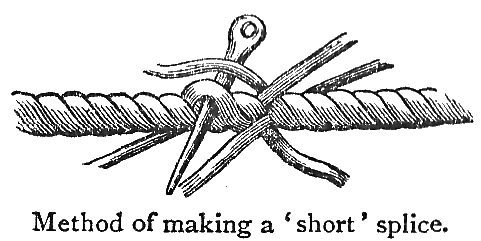
Splice, splīs, v.t. to unite two ends of a rope by interweaving the strands: to join together two pieces of timber by overlapping.—n. act of splicing: joint made by splicing.—Splice the mainbrace (nautical slang), to serve out an allowance of spirits, to fall to drinking. [Old Dut. splissen—splitsen, splijten; cf. Split, and Ger. splissen.]
Spline, splīn, n. in machines, the slot to receive a feather, the feather itself: a long flexible strip of wood or rubber used by draftsmen in laying out railway-curves, &c.—v.t. to fit with a spline.
Splint, splint, n. a small piece of wood split off: a thin piece of padded wood, &c., for keeping a fractured limb in its proper position: a bony enlargement on the horse's leg, between the knee and the fetlock, usually appearing on the inside of one or both forelegs, frequently situated between the large and small canon bones, depending upon concussion—also Splent.—v.t. to confine with splints.—ns. Splint′age, use of splints; Splint′-arm′our, armour made of splints or narrow overlapping plates; Splint′-coal, cannel-coal of slaty structure; Splint′er, a piece of wood, &c., split off.—v.t. and v.i. to split into splinters.—ns. Splint′er-bar, the cross-bar of a coach, supporting the springs; Splint′er-bone, the fibula.—adjs. Splint′er-proof, proof against the splinters of bursting shells; Splint′ery, made of, or like, splinters: apt to splinter. [Sw. splint—splinta, to splinter; cf. Split.]
Split, split, v.t. to cleave lengthwise: to tear asunder violently: to divide: to throw into discord.—v.i. to divide or part asunder: to be dashed to pieces: to divulge secrets: to vote for candidates of opposite parties: to burst with laughter:—pr.p. split′ting; pa.t. and pa.p. split.—n. a crack or rent lengthwise: a schism: a half-bottle of aerated water, a half-glass of spirits: (pl.) the acrobatic feat of going down to the floor with the legs spread out laterally.—adj. Split′-new (Scot.), brand-new.—n.pl. Split′-pease, husked pease split for making pea-soup, &c.—n. Split′ter, one who, or that which, splits: one who splits hairs in argument, &c.: (U.S.) a wheaten cake split and buttered when hot.—adj. Split′ting, very severe: very rapid.—Split on a rock, to meet some unforeseen and disastrous difficulty, to go to ruin; Split one's sides, to laugh immoderately; Split the difference, to divide equally the sum or matter in dispute, to take the mean. [Scand., Dan. splitte, to split; Dut. splijten; Ger. spleissen.]
Splore, splōr, n. (Scot.) a frolic, a spree.
Splotch, sploch, n. a large spot, a stain.—adj. Splotch′y.
Splurge, splurj, n. any boisterous display.—v.i. to make such a display.—adj. Splur′gy, given to such.
Splutter, splut′ėr, v.i. to eject drops of saliva while speaking: to scatter ink upon a paper, as a bad pen.—n. bustle.—n. Splutt′erer, one who splutters. [For sprutter, a freq. of sprout, orig. form of spout.]
Spodium, spō′di-um, n. a powder obtained from calcination, as ivory-black, &c.—n. Spode, animal or bone charcoal, of which ornaments may be made.
Spodogenous, spō-doj′e-nus, adj. caused by waste-products, applied esp. to an enlargement of the spleen caused by waste red blood-corpuscles. [Gr. spodos, ashes, genēs, producing.]
Spodomancy, spod′ō-man-si, n. divination by means of ashes.—adj. Spodoman′tic. [Gr. spodos, ashes, manteia, divination.]
Spodumene, spod′ū-mēn, n. a silicate of aluminium and lithium. [Gr. spodoun, to burn to ashes, spodos, ashes.]
Spoffish, spof′ish, adj. fussy, officious—also Spoff′y.—v.i. Spoff′le, to fuss or bustle.
Spoil, spoil, v.t. to take by force: to plunder.—v.i. to practise robbery.—n. prey, plunder: pillage: robbery.—n. Spoil′er, one who spoils, a plunderer.—n.pl. Spō′lia opī′ma, the most valued spoils—taken by a Roman commander from the enemy's commander in single combat; hence supreme rewards or honours generally. [O. Fr. espoille—L. spolium, spoil.]
Spoil, spoil, v.t. to corrupt: to mar: to make useless.—v.i. to decay: to become useless.—ns. Spoil′er, a corrupter; Spoil′-five, a round game of cards played with the whole pack, each one of the three to ten players receiving five cards.—adj. Spoil′ful (Spens.), wasteful, rapacious.—n. Spoils′man, one who looks for profit out of politics. [Same as above word.]
Spoke, spōk, pa.t. of speak.
Spoke, spōk, n. one of the bars from the nave to the rim of a wheel.—Put a spoke in one's wheel, to thwart a person by some impediment. [A.S. spáca; Dut. speek, Ger. speiche.]
Spoken, spōk′n, pa.p. of speak, used as adj. in 'civil-spoken,' &c.
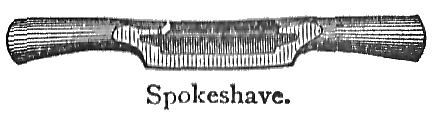
Spokeshave, spōk′shāv, n. a carpenter's tool having a plane-bit between two bandies for curved work, &c.
Spokesman, spōks′man, n. one who speaks for another, or for others, an advocate.
Spole, spōl, n. the small wheel near the distaff in the spinning-wheel. [A variant of spool.]
Spoliate, spō′li-āt, v.t. to spoil, to plunder, to pillage.—v.i. to practise robbery.—ns. Spō′liary, the place in a Roman amphitheatre where the bodies of slaughtered gladiators were dragged to be stripped; Spoliā′tion, act of spoiling: robbery.—adj. Spō′liātive, serving to take away or diminish.—n. Spō′liātor, one who spoliates.—adj. Spō′liātory, tending to spoil: destructive.—n. Spō′lium, the property of a beneficed ecclesiastic not transmissible by will. [L. spoliatus, pa.p. of spoliāre—spolium, spoil.]
Spondee, spon′dē, n. in classical poetry, a foot of two long syllables, as fātō.—adjs. Spondā′ic, -al, pertaining to, or consisting of, spondees. [Fr.,—L. spondēus (pes)—Gr. spondeios (pous), (a foot) of two syllables, so called because much used in the slow solemn hymns sung at a spondē or drink-offering—spendein, to pour out, make a libation.]
Spondyl, -e, spon′dil, n. a joint, joining.—ns. Spondylal′gia, pain in the spine; Spondylī′tis, arthritis of a vertebra.—adj. Spon′dylous, vertebral. [Gr. spondylos, a joint.]
Sponge, spunj, n. a fixed, usually marine, animal with pores in the body-wall and without tentacles: the fibrous framework of such, remarkable for its power of sucking up water: any sponge-like substance, as dough before it is kneaded and formed: any cringing hanger-on or parasite, a drunken fellow: an instrument for cleaning cannon after a discharge: the heel of a horse's shoe.—v.t. to wipe with a sponge: to wipe out, absorb up, with a sponge: to wipe out completely: to destroy.—v.i. to suck in, as a sponge: to gain by mean tricks, to live on others by some mean subterfuge or other.—ns. Sponge′cake, a very light sweet cake of flour, eggs, and sugar; Sponge′let, a little sponge.—adjs. Sponge′ous, Spon′giōse, Spongiolit′ic.—n. Spong′er, one who uses a sponge: a person or vessel engaged in fishing for sponges: an apparatus for sponging cloth by means of a perforated adjustable cylinder: a sponge or parasite.—adjs. Spongic′olous, inhabiting sponges; Spong′iform, resembling a sponge: porous.—ns. Spong′iness, porous quality; Spong′ing-house, a bailiff's lodging-house for debtors in his custody before their committal to prison; Spon′giōle, the spongy tissue of a root-tip; Spon′giolite, a fossil sponge spicule.—adj. Spongoid (spong′goid).—ns. Spongologist (spong-gol′ō-jist), one devoted to the study of sponges; Spongology (spong-gol′ō-ji), the knowledge about sponges.—adj. Spong′y, like a sponge, absorptive: of open texture, porous: wet and soft: drunken.—Set a sponge, to leaven a small mass of dough with which to leaven a large quantity; Throw up the sponge, to acknowledge defeat by throwing into the air the sponge with which a boxer is rubbed down between rounds: to give up any contest. [O. Fr. esponge—L. spongia—Gr. sponggia.]
Sponsal, spon′sal, adj. pertaining to a betrothal, a marriage, or a spouse.—n. Spon′sion, the act of becoming surety for another.—adj. Spon′sional. [L.,—spondēre, sponsum, to promise.]
Sponsible, spon′si-bl, adj. (Scot.) reliable: respectable.
Sponson, spon′son, n. the curve of the timbers and planking towards the outer part of the wing, before and abaft each of the paddle-boxes of a steamer.—Also Spon′sing. [Ety. dub.]
Sponsor, spon′sur, n. one who promises solemnly for another: a surety: a godfather or godmother.—adj. Sponsō′rial.—n. Spon′sorship. [L.,—spondēre, sponsum, to promise.]
Spontaneous, spon-tā′nē-us, adj. of one's free-will: involuntary: acting by its own impulse or natural law: produced of itself or without interference.—ns. Spontanē′ity, Spontā′neousness, the state or quality of being spontaneous.—adv. Spontā′neously.—Spontaneous combustion, a phenomenon that occasionally manifests itself in mineral and organic substances; Spontaneous generation, a term applied to the real or imaginary development of lowly organisms from non-living matter. [L. spontaneus—sponte, of one's own accord.]
Spontoon, spon-tōōn′, n. a weapon somewhat like a halberd, which used to be carried by certain officers of foot. [Fr. sponton—It. spontone—spuntare, to break off the point—puntone—punto, a point—L. pungĕre, punctum, to point.]
Spook, spōōk, n. a ghost.—v.i. to play the spook.—adjs. Spook′ish, Spook′y, like a ghost, haunted by ghosts: sensitive to the dread of ghosts, suggesting the presence of ghosts. [Dut. spook; Ger. (obs.) spuch, Sw. spöke; not related to puck.]
Spool, spōōl, n. a hollow cylinder for winding yarn, &c., upon.—v.t. to wind on spools. [Low Ger. spole, Dut. spoel; Ger. spule.]
Spoom, spōōm, v.i. to scud before the wind.—adj. Spoom′ing (Keats), foaming.
Spoon, spōōn, n. an instrument with a shallow bowl and handle for use in preparing, serving, or in eating food: anything like a spoon or its bowl, as an oar: in golf, a wooden-headed club of varying length, having the face more or less spooned, used in approaching the holes from varying distances.—v.t. to use a spoon upon: to lie spoon fashion with.—v.i. to fish with a spoon-hook: in croquet, to shove or scoop with the mallet: to be foolishly fond, to indulge in endearments openly.—ns. Spoon′-bait, a revolving metallic lure attached to a fishing-line by a swivel, used in trolling for fish; Spoon′bill, a family of birds (Plataleidæ) allied to the Ibididæ, and more distantly to the storks, with a bill long, flat, and broad throughout, and much dilated in a spoon form at the tip; Spoon′-drift, light spray borne on a gale; Spoon′ful, as much as fills a spoon: a small quantity:—pl. Spoon′fuls.—adv. Spoon′ily, in a spoony or silly way.—n. Spoon′meat, food taken with a spoon, such as is given to young children.—adv. Spoon′ways, applied to a way of packing slaves in ships very closely together.—adjs. Spoon′y, Spoon′ey, silly, weakly affectionate, foolishly fond.—n. a simple fellow: one foolishly fond of a sweetheart.—Apostle spoon (see Apostle); Dessert-spoon (see Dessert); Eucharistic spoon, the cochlear or labis; Tablespoon (see Table).—Be spoons on, to be silly in the manifestation of one's love for a woman. [A.S. spón; Ger. span, a chip, Ice. spánn, a chip, a spoon.]
Spoor, spōōr, n. track or trail of an animal, esp. when hunted as game.—n. Spoor′er, one who tracks game by the spoor. [Dut. spoor, a track; cf. Ger. spur, Ice. spor, a track, Scot. speir, to ask.]
Sporadic, -al, spō-rad′ik, -al, adj. scattered—a term specially applied to any disease usually epidemic or contagious, when it attacks only a few persons in a district and does not spread in its ordinary manner.—adv. Sporad′ically.—n. Sporad′icalness. [Gr. sporadikos—sporas, sporados, scattered—speirein, to sow.]
Spore, spōr, n. the reproductive body in flowerless plants like the fern, analogous to the seeds of ordinary flowering plants, but containing no embryo: a germ, a seed, a source of being generally.—adjs. Sporan′gial; Sporangif′erous; Sporan′giform; Sporan′gioid, like a sporangium.—ns. Sporangī′olum, a small sporangium; Sporan′giophōre, the receptacle which bears the sporangia; Sporan′giospōre, one of the peculiar spores of the Myxomycetes; Sporan′gium (pl. Sporan′gia), a spore-case, the sac in which the spores are produced endogenously—also Spore′-case; Spō′ridesm (bot.), a pluricellular body which becomes free like a simple spore, and in which every cell is capable of germinating; Sporidī′olum, a secondary sporidium; Sporid′ium, a secondary spore borne on a promycelium: an ascospore; Sporificā′tion, spore-production; Sporipar′ity, reproduction by means of spores.—adj. Sporip′arous.—ns. Spō′rocarp, a many-celled form of fruit produced in certain lower cryptogams in consequence of a sexual act; Spō′rocyst, the cyst or capsule developed in the process of sporular encystment.—adj. Sporocyst′ic.—ns. Spō′roderm, the wall or covering of a spore; Sporogen′esis, reproduction by means of spores—also Sporog′eny.—adj. Sporog′enous.—n. Sporogō′nium, the sporocarp, capsule or so-called 'moss-fruit' in mosses.—adj. Spō′roid, like a spore.—ns. Sporol′ogist, a botanist who emphasises the spores in classification; Spō′rophore, the part of the thallus which bears spores: the placenta in flowering plants: a sporophyte.—adjs. Sporophor′ic, Sporoph′orous.—ns. Spō′rophyl, the leaf bearing the spores or spore receptacles; Spō′rophyte, the spore-bearing stage in the life-cycle of a plant.—adj. Sporophyt′ic.—ns. Spō′rosac, one of the gonophores of certain hydrozoans in which the medusoid structure is not developed: a redia or spiro-cyst, in Vermes; Sporostē′gium, the so-called fruit of plants in the Characeæ, consisting of the hard brownish spirally-twisted shell or covering of the spore.—adjs. Spō′rous; Spō′rular.—ns. Sporulā′tion, conversion into spores or sporules—also Sporā′tion; Spō′rule, a small spore.—adjs. Sporulif′erous, Spor′uloid. [Gr. sporos, a sowing, seed—speirein, to sow.]
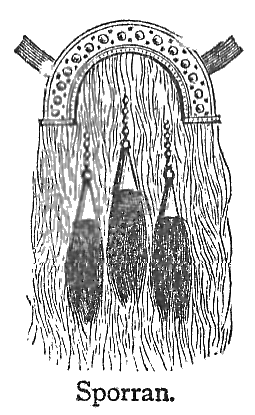
Sporran, spor′an, n. an ornamental pouch worn in front of the kilt by the Highlanders of Scotland. [Gael, sporan.]
Sport, spōrt, v.i. to play: to frolic: to practise field diversions: to trifle.—v.t. to amuse: to make merry: to represent playfully: to spend in sport or display.—n. that which amuses or makes merry: play: mirth: jest: contemptuous mirth: anything for playing with: a toy: idle jingle: field diversion: an animal or plant, or one of its organs, that varies singularly and spontaneously from the normal type.—n. Sport′er, one who sports: a sportsman.—adj. Sport′ful, full of sport: merry: full of jesting.—adv. Sport′fully.—n. Sport′fulness.—adj. Sport′ing, relating to, or engaging in, sports.—adv. Sport′ingly.—adj. Sport′ive, inclined to sport: playful: merry: amorous, wanton.—adv. Sport′ively.—n. Sport′iveness.—adj. Sport′less, without sport or mirth: sad.—n. Sports′man, one who practises, or one skilled in, field-sports.—adj. Sports′man-like.—ns. Sports′manship, practice or skill of a sportsman; Sports′woman, a she-sportsman.—Sport one's oak (see Oak). [Formed by aphæresis from disport.]
Sposh, sposh, n. slush.—adj. Sposh′y.
Spot, spot, n. a mark made by a drop of wet matter: a blot: a discoloured place: a small part of a different colour: a small extent of space: any particular place: one of the marked points on a billiard-table, from which balls are played (for Centre-spot, Pyramid-spot, &c., see Billiards): one of the dark places on the surface of the sun, &c.: something that soils: a stain on character or reputation.—v.t. to mark with drops of wet: to stain: to discolour: to taint: to tarnish, as reputation: to note or recognise by some point, to detect: to indicate, name:—pr.p. spot′ting; pa.t. and pa.p. spot′ted.—adj. Spot′less, without a spot: untainted: pure.—adv. Spot′lessly.—ns. Spot′lessness; Spot′-stroke, a stroke in billiards when the player pockets the red ball from the 'spot,' leaving his own ball in position to repeat the stroke.—adjs. Spot′ted, Spot′ty, marked with spots or discoloured places.—ns. Spot′tedness, the state of being spotted; Spot′ter, one who spots or detects; Spot′tiness, state of being spotty.—Spot-barred game, a game at billiards when the spot-stroke is forbidden to be played more than twice consecutively. [Cf. Dut. spat, Dan. spætte; prob. conn. with spit.]
Spouse, spowz, n. a husband or wife.—adj. Spous′al, pertaining to a spouse, or to marriage: nuptial: matrimonial.—n. usually in pl. nuptials: marriage.—adj. Spouse′less, destitute of a spouse: unmarried. [O. Fr. espouse (Fr. époux, fem. épouse)—L. sponsus, pa.p. of spondēre, to promise in marriage.]
Spout, spowt, v.t. to throw out, as from a pipe: to utter volubly: to pawn, pledge.—v.i. to issue with violence, as from a pipe: to speak volubly, to speechify.—n. the projecting mouth of a vessel from which a stream issues: a pipe for conducting a liquid: a term applied to the blowing or breathing of whales and other cetaceans.—ns. Spout′er, one who, or that which, spouts: a speechifier: a South Sea whale, a skilful whaler; Spout′-hole, an orifice for discharging a liquid, a whale's spiracle.—adj. Spout′less, wanting a spout. [Skeat explains that spout, like speak, has lost an r, thus standing for sprout, the r being preserved in spurt, with nearly the same sense as spout. Sw. sputa for spruta, to squirt; Dut. spuiten.]
Sprack, sprak, adj. vigorous, sprightly.—Also Sprag. [Ice. sprækr, sparkr, sprightly.]
Sprackle, sprak′l, v.i. (Scot.) to clamber up with difficulty.—Also Sprach′le, Sprauch′le. [Ice. spraukla, to sprawl.]
Sprad, sprad (Spens.). Same as Spread.
Sprag, sprag, n. a piece of wood used to lock a wheel: a punch-prop in mining.—v.t. to prop, or to stop, by a sprag.
Sprag, sprag, n. (prov.) a young salmon.
Spraich, sprāh, n. (Scot.) a shriek, cry.—v.i. to shriek.
Spraid, sprād, adj. (prov.) chapped with cold.—Also Sprayed.
Sprain, sprān, v.t. to overstrain the muscles of a joint.—n. a term employed in surgery to designate a violent stretching of tendinous or ligamentous parts with or without rupture of some of their fibres. [O. Fr. espreindre (Fr. épreindre), to press—L. exprimĕre, to press out.]
Spraint, sprānt, n. the dung of an otter.
Sprang, pa.t. of spring.
Sprangle, sprang′gl, v.i. to sprawl, struggle.
Sprat, sprat, n. a fish of the family Clupeidæ, like the herring, but much smaller.—n. Sprat′-weath′er, the dark days of November and December. [Dut. sprot; Ger. sprotte.]
Sprattle, sprat′l, v.i. (Scot.) to scramble.
Sprawl, sprawl, v.i. to toss or kick about the limbs: to stretch the body carelessly when lying: to spread ungracefully.—n. a sprawling posture.—n. Sprawl′er. [There is an A.S. spréawlian, to move convulsively; but the word is most probably for sprattle or sprottle—Sw. sprattla, to sprawl; cf. Dan. sprælle, to toss about the limbs.]
Spray, sprā, n. small particles of water driven by the wind, as from the top of waves, &c.—adj. Spray′ey, consisting of spray. [Skeat suggests that the word is from Dut. spreiden, to spread, scatter.]
Spray, sprā, n. a small shoot of a tree.—adj. Spray′ey, branching. [Akin to Ice. sprek, a twig, Dan. sprag; Doublet sprig.]
Spread, spred, v.t. to scatter abroad or in all directions: to stretch: to extend: to overlay: to shoot out, as branches: to circulate, as news: to cause to affect numbers, as a disease: to diffuse: to set with provisions, as a table.—v.i. to extend or expand in all directions: to be extended or stretched: to be propagated or circulated:—pa.t. and pa.p. spread.—n. extent: compass: expansion of parts: that which is spread out, a feast: a cover for a bed or a table.—adj. having a broad surface: shallower than the standard.—adj. Spread′-ea′gle, like an eagle with the wings stretched out, bombastic, boastful.—n. (naut.) a person seized in the rigging, a passenger thus made to pay his entrance forfeit.—ns. Spread′-ea′gleism, a bombastic and frothy patriotism; Spread′er, one who, or that which, spreads, one who publishes or extends: any machine or implement for helping to scatter.—p.adj. Spread′ing.—adv. Spread′ingly, increasingly.—Spread a fleet, to keep more open order. [A.S. sprǽdan; Dut. spreiden, Ger. spreiten.]
Spreagh, spreh, n. plunder.—n. Spreagh′ery, cattle-lifting. [Gael. spreidh, cattle.]
Spreckled, sprek′ld, adj. speckled.
Spred, spred, pa.p. and n. an obsolete form of spread.—Also Spred′den.
Spree, sprē, n. a merry frolic: a drunken bout.—v.i. to carouse. [Prob. Ir. spre, a spark, spraic, vigour.]
Sprent, sprent, adj. sprinkled. [M. E. sprengen (pa.t. sprente)—A.S. sprengan, to cause to spring.]
Sprig, sprig, n. a small shoot or twig: a scion, a young person: an ornament like a spray: one of various small pointed implements, a headless nail: one of the separate pieces of lace fastened on a ground in appliqué lace.—v.t. to embroider with representations of twigs:—pr.p. sprig′ging; pa.t. and pa.p. sprigged.—adj. Sprig′gy, full of sprigs or young branches. [Cf. Ice. sprek, a stick.]
Spright, sprīt, n. the same as Sprite (q.v.).—adj. Spright′ful (Shak.), full of spirit: brisk, gay.—adv. Spright′fully, in a sprightful manner, briskly, vigorously.—n. Spright′fulness, the quality of being sprightful, briskness, liveliness.—adj. Spright′less, destitute of spirit or life: dull: sluggish.—n. Spright′liness.—adj. Spright′ly, airy: full of life: lively: brisk. [Spright=sprite.]
Spring, spring, v.i. to bound: to leap: to rush hastily: to move suddenly by elastic force: to start up suddenly: to break forth: to appear: to issue: to come into existence: (B.) to rise, as the sun.—v.t. to cause to spring up: to start: to produce quickly, cause to act suddenly: to leap over: to explode, as a mine: to open, as a leak: to crack, as a mast: to bend by force, strain: (archit.) to start from an abutment, &c.: to set together with bevel-joints:—pa.t. sprang, sprung; pa.p. sprung.—n. a leap: a flying back with elastic force: elastic power: an elastic body: any active power: that by which action is produced: cause or origin: a source: an outflow of water from the earth: (B.) the dawn: the time when plants begin to spring up and grow, the vernal season—March, April, May: a starting of a plank in a vessel: a crack in a mast.—ns. Spring′al, Spring′ald, an active springy young man, a youth; Spring′-back, an inner false joint on a bound book, springing upward from the true or outer back when the book is opened flat; Spring′-bal′ance, an instrument for determining the weight of a body by the elasticity of a spiral spring; Spring′-beam, a beam of considerable span, without central support, the tie-beam of a truss; in a steamer, a fore-and-aft beam for connecting the two paddle-beams: an elastic bar at the top of a tilt-hammer, jig-saw, &c.; Spring′-beau′ty, the Claytonia Virginica; Spring′-bed, a mattress formed of spiral springs set in a wooden frame; Spring′-bee′tle, an elater; Spring′-board, a board fastened on elastic supports, used to spring from in performing feats of agility; Spring′bok, a beautiful South African antelope, larger than a roebuck [Dut.]; Spring′-box, a box or barrel in which a spring is coiled: the frame of a sofa, &c., in which the springs are set; Spring′-carr′iage, a wheel-carriage mounted on springs; Spring′-cart, a light cart mounted upon springs; Spring′er, a kind of dog of the spaniel class, useful for springing game in copses: one who springs: the bottom stone of an arch; Spring′-gun, a gun having wires connected with its trigger, and so fixed and planted as to be discharged when trespassers stumble against the wire; Spring′-halt, a jerking lameness in which a horse suddenly twitches up his leg or legs; Spring′-hamm′er, a machine-hammer in which the blow is delivered or augmented by the force of a spring; Spring′-head, a fountain-head, source: a head or end-piece for a carriage-spring.—adj. Spring′-head′ed (Spens.), having heads springing afresh.—ns. Spring′-heeled Jack, one supposed capable of leaping a great height or distance in carrying out mischievous or frolicsome tricks; Spring′-hook, an angler's snap-hook or spear-hook: a latch or door-hook with a spring-catch for keeping it fast in the staple: in a locomotive, a hook fixing the driving-wheel spring to the frame; Spring′-house, a house for keeping meat in, or a dairy, built for coolness over a spring or brook; Spring′iness; Spring′ing, the act of springing, leaping, arising, or issuing: (B.) growth, increase: (archit.) the lowest part of an arch on both sides; Spring′-jack, a device for inserting a loop in a main electric line-circuit, a plug being forced between two spring contacts; Spring′-latch, a latch that snaps into the keeper whenever the door is shut; Spring′let, a little spring: a small stream; Spring′-lig′ament, the inferior calcaneoscaphoid ligament of the sole of the foot; Spring′-lock, a lock which fastens by a spring; Spring′-mat′tress=Spring-bed; Spring′-net, a net that closes with a spring; Spring′-pad′lock, a padlock that snaps itself shut; Spring′-pole, a pole whose elasticity serves as a spring; Spring′-sad′dle, a bent iron bar of form on the top of a railway carriage journal-box, surrounding the arch-bar and supporting the spring; Spring′-search′er, a steel-pronged tool to search for defects in the bore of a gun; Spring′-shack′le, a shackle closed by a spring: a shackle joining one spring of a vehicle with another or with a rigid piece; Spring′-stay (naut.), a smaller stay, placed above the stays as a duplicate if needed; Spring′-stud, a rod passed through the axis of a coil-spring to keep it in place; Spring′-tail, one of an order of primitive wingless insects (Collembola), so called popularly from a peculiar springing fork usually present on the abdomen; Spring′-tide, the periodical excess of the elevation and depression of the tide, after new and full moon, when both sun and moon act in the same direction; Spring′-tide, -time, the season of spring; Spring′-tool, any tool bearing a spring, as a glass-blower's tongs; Spring′-trap, a trap worked by a spring, a mouse-trap, &c.; Spring′-valve, a valve fitted with a spring: a safety-valve connected with a spring-balance; Spring′-wa′ter, water issuing from a spring; Spring′-wheat, wheat sown in the spring, rather than autumn or winter; Spring′-wort, a plant which draws down lightning—perh. the caperspurge.—adj. Spring′y, pertaining to, or like, a spring, elastic, nimble: abounding with springs.—Spring a leak, to commence leaking; Spring a mine, to cause it to explode—often used figuratively; Spring a rattle, to cause a rattle to sound; Spring at, to leap at; Spring forth, to come forward with a leap: to shoot up rapidly; Spring on, or upon, to attack with violence. [A.S. springan; Ger. springen.]

Springe, sprinj, n. a snare with a spring-noose: a gin.—v.t. to catch in a springe. [Prov. Eng. springle—spring; cf. Ger. sprenkel—springen.]
Sprinkle, spring′kl, v.t. to scatter in small drops or particles: to scatter on: to baptise with a few drops of water: to purify.—v.i. to scatter in drops.—n. an aspersorium or utensil for sprinkling.—ns. Sprin′kle, Sprin′kling, a small quantity sprinkled: in book-binding, the mottling of the edges of trimmed leaves by scattering a few drops of colour on them; Sprin′kler. [Freq. formed from A.S. sprengan, the causal of springan, to spring; cf. Ger. sprenkeln.]
Sprint, sprint, n. a short-distance race at full speed.—v.i. to run at full speed—also Sprent.—ns. Sprin′ter, a short-distance runner in races; Sprin′ting; Sprint′-race; Sprint′-run′ner. [Cf. Spurt.]
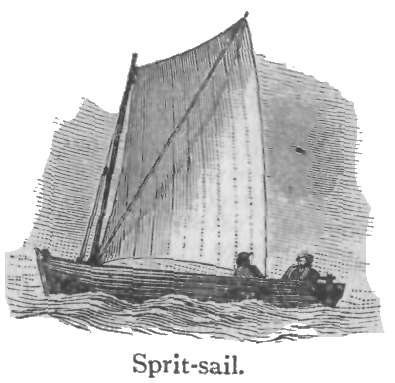
Sprit, sprit, n. (naut.) a spar set diagonally to extend a fore-and-aft sail. [A.S. spreót, a pole; Dut. and Ger. spriet, a bowsprit; conn. with sprout.]
Sprite, sprīt, n. a spirit: a shade: a ghost: (obs.) frame of mind, disposition.—Also Spright. [A doublet of spirit.]
Spriteful, Spritely, &c. Same as Sprightful, &c.
Sprocket, sprok′et, n. a projection on the periphery of a wheel or capstan for engaging the chain.
Sprod, sprod, n. (prov.) a second-year salmon.
Sprong, sprong (Spens.), pa.t. of spring.
Sprout, sprowt, n. a germ or young shoot: (pl.) young shoots from old cabbages.—v.i. to shoot: to push out new shoots.—adj. Sprout′ed, budded.—Brussels sprouts (see Brussels). [According to Skeat, not from A.S. spreótan, nor sprýtan, but from Old Friesic spruta, to sprout, Low Ger. spruten, Dut. spruiten, Ger. spriessen.]
Spruce, sprōōs, adj. smart: neat, dapper: over-fastidious, finical.—n. Prussian leather.—v.t. to smarten.—v.i. to become spruce or smart.—n. Spruce′-fir, or merely Spruce, any tree of the genus Picea of the pine family (Coniferæ), or the wood of such a tree.—adv. Spruce′ly.—n. Spruce′ness.—v.t. Spru′cify, to smarten. [O. Fr. Pruce—Late L. Prussia, Ger. Preussen.]
Spruce-beer, sprōōs′-bēr, n. beer flavoured with a decoction of the young shoots of the spruce-fir. [Ger. sprossen-bier, sprossen, young shoots, Englished as Pruce-beer, i.e. Prussian beer.]
Sprue, sprōō, n. in casting, one of the passages leading to the mould, also the metal which solidifies in it—deadhead.—n. Sprue′-hole, ingate or pouring-hole in a mould.
Sprug, sprug, v.t. and v.i. (prov.) to smarten, to dress neatly.
Sprug, sprug, n. (prov.) a sparrow.
Spruit, sprōō′it, n. a small head-stream, a stream flowing through a village, dry in summer. [S. Afr. Dut.]
Sprung, pa.t. and pa.p. of spring.—adj. (coll.) tipsy, tight.
Sprunny, sprun′i, adj. (prov.) neat.—n. a sweetheart.
Sprunt, sprunt, v.i. to spring up: sprout, germinate.—n. a steep bit in a road: a rebellious curl, &c.—adv. Sprunt′ly, gaily, bravely.—Sprunt up, to bristle up.
Spry, sprī, adj. vigorous, lively, gay, pert. [Scand.; Sw. prov. sprygg, very active.]
Spud, spud, n. a small narrow spade with a short handle: any short thick thing, a baby's hand, a potato, &c.—adj. Spud′dy, short and fat. [Prob. Scand., Dan. spyd, a spear.]
Spue. Same as Spew.
Spulzie, Spuilzie, spül′yē, n. (Scot.) spoil.—Also Spul′ye, Spul′yie. [Spoil.]
Spume, spūm, n. scum or froth thrown up by liquid: foam.—v.i. to throw up scum: to foam.—adj. Spū′mēous, frothy.—n. Spūmes′cence, frothiness.—adjs. Spūmes′cent, foaming; Spūmif′erous, producing foam.—n. Spū′miness, the quality of being spumy or frothy.—adjs. Spū′mous, Spū′my, consisting of froth: frothy: foamy. [L. spuma—spuĕre to spew.]
Spun, pa.t. and pa.p. of spin.—adj. Spun′-out, unduly lengthened.—n. Spun′-yarn, rope-yarn twisted into a cord.
Spunge, spunj, v. and n. a form of sponge.
Spunk, spungk, n. touchwood, tinder, a fungus from which tinder is made, punk, amadou: (Scot.) a small fire, a fiery spark, a lucifer-match: mettle, spirit, pluck.—v.i. to take fire, flame up.—adj. Spunk′y, spirited: fiery-tempered. [Cf. Ir. sponc, tinder, sponge—L. spongia, a sponge—Gr. sponggia.]
Spur, spur, n. an instrument on a horseman's heels, with sharp points for goading the horse: that which goads or instigates: something projecting: the hard projection on a cock's leg: a small range of mountains extending laterally from a larger range.—v.t. to urge on with spurs: to urge onward: to impel: to put spurs on.—v.i. to press forward: to travel in great haste:—pr.p. spur′ring; pa.t. and pa.p. spurred.—v.t. Spur′-gall (Shak.), to gall or wound with a spur.—ns. Spur′-gear, -gear′ing, gearing in which spur-wheels are used.—adj. Spur′-heeled, having a long straight hind-claw.—n. Spur′-leath′er, the strap by which the spur is fastened to the foot.—p.adj. Spurred, wearing spurs: having shoots like spurs: affected with ergot, as rye.—ns. Spur′rer, one who, or that which, spurs; Spur′rier, one who makes spurs; Spur′-roy′al, an ancient English coin, worth fifteen shillings, so called from having a star on one side resembling the rowel of a spur; Spur′-way, a bridle-road; Spur′-whang=Spur-leather; Spur′-wheel (mech.), a wheel with the cogs on the face of the edge like a spur.—adj. Spur′-winged, with a horny spur on the pinion, as with the plovers, &c. [A.S. spora; Ice. spori, Ger. sporn.]
Spurge, spurj, n. a genus of plants of the natural order Euphorbiaceæ, all the species containing a resinous milky juice mostly very acrid.—n. Spurge′-lau′rel, a European evergreen shrub, with yellowish-green flowers, thick leaves, and poisonous berries. [O. Fr. espurge (Fr. épurge)—L. expurgāre, to purge—ex, off, purgāre, to clear.]
Spuriæ, spū′ri-ē, n.pl. the bastard quills forming the alula in birds.
Spurious, spūr′i-us, adj. illegitimate: bastard: not genuine: false: resembling an organ, but without its function, or having the functions of an organ while morphologically different.—adv. Spūr′iously.—n. Spūr′iousness. [L. spurius, false.]
Spurling=Sparling (q.v.).
Spurn, spurn, v.t. to drive away as with the foot: to kick: to reject with disdain.—n. disdainful rejection.—n. Spurn′er, one who spurns. [A.S. speornan; cog. with spur.]
Spurne, spurn, v.t. (Spens.) to spur.
Spurry, spur′i, n. a plant of the genus Spergula. [O. Fr. sporrie, of Teut. origin; cf. Ger. spörgel.]
Spurt, spurt, v.t. to spout, or send out in a sudden stream, as water.—v.i. to gush out suddenly in a small stream: to flow out forcibly or at intervals.—n. a sudden or violent gush of a liquid from an opening: a jet: a sudden short effort, a special exertion of one's self for a short time, in running, rowing, &c. [Formerly spirt—Ice. sprettr, a spurt—spretta, to start, to sprout.]
Spurtle, spur′tl, n. (Scot.) a short stick for stirring porridge, broth, &c.—n. Spur′tle-blade, a sword.
Sputter, sput′ėr, v.i. to spit in small drops, as in rapid speaking: to throw out moisture in scattered drops: to speak rapidly and indistinctly, to jabber.—v.t. to throw out with haste and noise: to utter hastily and indistinctly.—n. moist matter thrown out in particles.—n. Sputt′erer, one who sputters. [The freq. of spout (q.v.).]
Sputum, spū′tum, n. spittle, the matter expectorated:—pl. Spū′ta. [L.,—spuĕre, to spit.]
Spy, spī, n. one sent into an enemy's country or camp to find out their strength, &c.: one who keeps a watch on others: one who secretly conveys information.—v.t. to see: to discover, generally at a distance: to discover by close search: to inspect secretly:—pa.t. and pa.p. spied.—ns. Spy′al=Spial; Spy′-craft, Spy′ism, the art or practice of spying; Spy′glass, a small hand-telescope; Spy′-hole, a peep-hole; Spy′-mon′ey, money paid for secret intelligence. [O. Fr. espier—Old High Ger. spehōn; L. specĕre.]
Spyre, spīr, v.i. (Spens.) to shoot forth. [L. spirāre, to sprout.]
Squab, skwob, adj. fat, clumsy: curt, abrupt: unfledged, newly hatched: shy, coy.—n. a young pigeon, the young of other animals before the hair or feathers are grown: a short stumpy person: a thickly-stuffed cushion, a sofa padded throughout, an ottoman.—v.t. to stuff thickly and sew through, the stitches being concealed by buttons, &c.—v.i. to fall heavily.—adv. flat: heavily, as a fall.—adjs. Squab′bish, thick, heavy; Squab′by, squat.—ns. Squab′-chick, a fledgling; Squab′-pie, a pie made of strips of mutton, onions, and slices of apple. [Prob. Scand.; cf. Sw. dial. sqvapp, a word imitative of a splash, sqvabb, loose flesh, sqvabbig, flabby.]
Squabash, skwa-bash′, v.t. to crush, smash.
Squabble, skwob′l, v.i. to dispute in a noisy manner: to wrangle.—n. a noisy, petty quarrel: a brawl.—n. Squabb′ler. [Scand., Sw. dial. skvabbel, a dispute.]
Squacco, skwak′ō, n. a small crested African heron.
Squad, skwod, n. a small body of men assembled for drill, any small group or company of men.—n. Squad′ron, a body of cavalry, consisting of two troops, or 120 to 200 men: a body of soldiers drawn up in a square: any regularly ranked body, or a group: section of a fleet, commanded by a flag-officer.—p.adj. Squad′roned, formed into squadrons.—Awkward squad, a body of recruits not yet competent in drill, &c. [O. Fr. esquadre—It. squadra, and L. exquadrāre, to make square.]
Squaddy, skwad′i, adj. squabby.
Squail, skwāl, n. a disc or counter used in the game of squails: (pl.) a parlour-game in which small discs are snapped from the edge of the table to a centre mark called the process: the game of ninepins.—v.i. to throw a stick, &c., at any object.—v.t. to pelt with sticks, &c.—n. Squail′er, a throwing-stick. [A variant of kail.]
Squalid, skwol′id, adj. filthy, foul.—n. Squalid′ity, the state of being squalid: filthiness.—adv. Squal′idly.—ns. Squal′idness; Squal′or, state of being squalid: dirtiness: filthiness. [L. squalidus—squalēre, to be stiff; akin to Gr. skellein, to dry.]
Squall, skwawl, v.i. to cry out violently.—n. a loud cry or scream: a violent gust of wind.—n. Squall′er.—adj. Squall′y, abounding or disturbed with squalls or gusts of wind: gusty, blustering: threatening a squall.—White squall, a tropical whirlwind, coming on without warning other than a small white cloud. [Scand., Sw. sqvala, to gush out.]
Squally, skwawl′i, adj. irregularly woven: having bare patches, of a field of corn, &c. [Prob. the same as scally. Cf. Scall.]
Squaloid, skwā′loid, adj. resembling a Squā′lus or shark.—n. Squā′lid, one of the Squalidæ, a family of sharks.—adj. Squā′liform, having the form of a shark. [L. squalus, a shark.]
Squama, skwā′ma, n. a scale: the bractea of a deciduous spike, any scaly bracted leaf:—pl. Squā′mæ.—n.pl. Squāmā′ta, a division of reptiles, including lizards and serpents.—adjs. Squā′mate, Squā′mous, Squamā′ceous, Squā′mose, covered with, or consisting of, scales: scaly.—ns. Squāme, a scale or squama; Squāmel′la, a small scale.—adjs. Squāmif′erous, Squāmig′erous, bearing squamæ or scales; Squā′miform, Squā′moid, like a scale.—ns. Squāmō′sal, the squamous portion of the temporal bone; Squam′ula, a very small scale—also Squam′ule.—adjs. Squam′ulate, Squam′uliform. [L. squamosus—squama, a scale.]
Squander, skwon′dėr, v.t. to spend lavishly or wastefully: to waste money or powers.—n. Squan′derer.—adv. Squan′deringly, in a squandering manner, by squandering. [Skeat explains as a nasalised form of Lowland Scotch squatter, to splash water about, prov. Eng. swatter, to throw water about. These are frequentatives from Dan. sqvatte, to splash, spurt, squander; Sw. sqvätta, to squirt, Ice. skvetta, to squirt out water.]
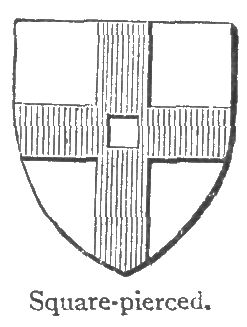
Square, skwār; adj. having four equal sides and angles: forming a right angle: having a straight front or an outline formed by straight lines: exact suitable, fitting: true, that does equal justice, fair, honest: even, leaving no balance, settled, as accounts: directly opposed, complete, unequivocal: solid, full, satisfying.—n. that which is square: a square figure: a four-sided space enclosed by houses: a square body of troops: the length of the side of any figure squared: an instrument for measuring right angles: (arith.) the product of a quantity multiplied by itself: due proportion, order, honesty, equity, fairness.—v.t. to form like a square: to form with four equal sides and angles: (arith.) to multiply by itself: to reduce to any given measure or standard, to adjust, regulate: (naut.) to place at right angles with the mast or keel.—v.i. to suit, fit: to accord or agree: to take an attitude of offence and defence, as a boxer.—adj. Square′-built, of a square build or shape.—adv. Square′ly, in a square form or manner.—ns. Square′-meas′ure, a system of measures applied to surfaces, of which the unit is the square of the lineal unit; Square′ness.—adj. Square′-pierced (her.), designating a charge perforated with a square opening so as to show the field.—n. Squā′rer, one who, or that which, squares: (Shak.) a fighting, quarrelsome person.—adj. Square′-rigged, having the chief sails square, and extended by yards suspended by the middle at right angles to the masts—opposed to Fore-and-aft.—ns. Square′-root, that root which being multiplied into itself produces the given number or quantity; Square′-sail, a four-sided sail extended by yards suspended by the middle at right angles to the mast.—adj. Square′-toed.—n. Square′-toes, an old-fashioned, punctilious person.—adj. Squā′rish.—Square the circle, to determine the area of a circle in square measure.—On the square, honestly. [O. Fr. esquarre (Fr. équerre)—L. ex-quadrāre, to square—quadrus, conn. with quatuor, four.]
Squarrose, skwär′ōs, adj. rough, with projecting or deflexed scales.—adj. Squarr′ulose, diminutively squarrose.
Squarson, skwär′sn, n. one who is both a beneficed clergyman and a squire or land-owner in a parish.—n. Squar′sonage, the residence of such.
Squash, skwosh, v.t. to press into pulp: to crush flat.—v.i. to form a soft mass as from a fall: to make a noise similar to such.—n. a sudden fall or shock of soft bodies: anything soft and easily crushed, anything soft or unripe, as a peascod.—ns. Squash′er; Squash′iness, state of being squashy.—adj. Squash′y, like a squash: muddy. [O. Fr. esquacher (Fr. écacher), to crush—L. ex, out, coactāre, to restrain—cogĕre, coactum, to drive together.]
Squash, skwosh, n. a term loosely used, esp. in the United States, for two or three kinds of gourd, including the pumpkin. [Amer. Ind. asquash (pl. of asq), green.]
Squat, skwot, v.i. to sit down upon the hams or heels: to cower, as an animal: to settle on new land without title:—pr.p. squat′ting; pa.t. and pa.p. squat′ted.—adj. short and thick, dumpy, clumsy.—ns. Squatoc′racy, the squatters of Australia collectively; Squat′ter, a settler on new land without title: one who leases pasture-land from the government; Squat′tiness.—v.i. Squat′tle (Scot.), to squat down.—adj. Squat′ty, very short and thick. [O. Fr. esquatir, to crush—L. ex-, coactus, pa.p. of cogĕre, to drive together.]
Squatter, skwot′ėr, v.i. to plunge through water.
Squaw, skwaw, n. an American Indian woman, esp. a wife.—n. Squaw′man, a white man with an Indian wife.
Squeak, skwēk, v.i. to utter a shrill and usually short cry.—n. a sudden, shrill cry.—v.i. Squawk, to utter a harsh cry: (U.S.) to back out in a mean way.—n. a loud squeak.—n. Squeak′er, one who squeaks: a young bird.—adv. Squeak′ingly.—A narrow squeak, a narrow escape. [Imit.; cf. Sw. sqväka, to croak, Ger. quieken, to squeak.]
Squeal, skwēl, v.i. to utter a shrill and prolonged sound: to turn informer.—n. a shrill loud cry.—n. Squeal′er, a young pigeon: an informer. [Scand.; Sw. dial. sqväla, to cry out.]
Squeamish, skwēm′ish, adj. sickish at stomach: easily disgusted or offended: fastidious in taste.—adv. Squeam′ishly.—n. Squeam′ishness. [Scand.; Ice. sveimr, stir; prob. also influenced by qualmish.]
Squeegee, skwē′jē, n. a wooden implement edged with rubber for clearing water away from decks, floors, windows, &c.: a photographer's roller for squeezing the moisture from a print—also Squil′gee.—v.t. to smooth down with a squeegee.
Squeeze, skwēz, v.t. to crush or press between two bodies: to embrace closely: to force through a small hole: to cause to pass: to extort, oppress, harass.—v.i. to push between close bodies: to press: to crowd.—n. act of squeezing: pressing between bodies: an impression of an inscription, &c., made by taking a rubbing.—n. Squeezabil′ity.—adj. Squeez′able.—ns. Squeez′er, one who, or that which, squeezes: (pl.) playing-cards having the number of spots marked in the right-hand corner of each; Squeez′ing, the act of exerting pressure.—adj. Squeez′y, suggesting squeezing, small, contracted. [M. E. queisen—A.S. cwísan.]
Squelch, skwelch, n. a heavy blow or a heavy fall.—v.t. to crush down.
Squib, skwib, n. a paper tube filled with combustibles, thrown up into the air burning and bursting: a petty lampoon.—v.t. to aim squibs at: to lampoon.—v.i. to write lampoons: to use squibs: to sound like a squib exploding. [Scand.; Ice. svipa, to flash.]
Squid, skwid, n. a kind of cuttle-fish or calamary: a lure used in trolling for fish.—v.i. to fish with a squid or spoon-bait.
Squiggle, skwig′l, v.i. (U.S.) to squirm, wriggle: (prov.) to rinse out the mouth with a liquid.
Squilgee. See Squeegee.
Squill, skwil, n. a genus of bulbous-rooted plants of order Liliaceæ, with radical leaves, and flowers in terminal racemes or loose corymbs—the officinal Squill is diuretic and expectorant.—adj. Squillit′ic. [Fr. squille—L. squilla, scilla—Gr. skilla.]
Squinch, skwinch, n. a small stone arch, or series of arches, across an interior angle of a square tower to support the sides of an octagonal spire.
Squinny, skwin′i, v.i. (Shak.) to look asquint.
Squint, skwint, adj. looking obliquely: having the vision distorted.—v.i. to look obliquely: to have the vision distorted.—v.t. to cause to squint.—n. act or habit of squinting: an oblique look: distortion of vision: a hagioscope, a narrow aperture cut in the wall of a church (generally about two feet wide) to enable persons standing in the side-chapels, &c., to see the elevation of the host at the high-altar.—n. Squint′-eye, an eye that squints.—adj. Squint′-eyed, looking obliquely: oblique, malignant.—n. Squint′ing, technically Strabismus, a common deformity which may be defined as a want of parallelism in the visual axes, when the patient endeavours to direct both eyes to an object at the same time.—adv. Squint′ingly. [Scand.; Sw. svinka, to shrink, a nasalised form of svika, to fail.]
Squire, skwīr, n. an esquire, a knight's attendant: a beau or gallant: a country gentleman, an owner of land in England, esp. if of old family: (U.S.) one who has been a justice of the peace, &c.—ns. Squire′age, Squire′archy, landed gentry collectively.—adj. Squire′archal.—ns. Squireen′, a gentleman farmer, one almost a squire; Squire′hood, the state or rank of a squire—also Squire′ship.—adjs. Squire′-like, Squire′ly, like or becoming a squire.—ns. Squire′ling, a squire of small possessions; Squireoc′racy, government by the landed classes; Squīr′ess, a squire's wife. [Esquire.]
Squire, skwīr, n. (Shak.) a square. [Square.]
Squirm, skwirm, v.i. to wriggle or writhe, to climb by wriggling up: to escape with any awkward evasion or lie. [A variant of squir=whir.]
Squirrel, skwir′el, n. a nimble, reddish-brown, rodent little animal with hairy tail and large eyes, mainly of arboreal habit.—ns. Squirr′el-fish, a holocentroid tropical fish; Squirr′el-tail, any one of several grasses of the genus Hordeum, with long hair-like awns: a cap of squirrel-skins, with a tail hanging down behind. [O. Fr. escurel—Low L. scurellus, dim. of L. sciurus—Gr. skiouros—skia, shade, oura, tail.]
Squirt, skwėrt, v.t. to throw out water in a stream from a narrow opening.—n. a small instrument for squirting: a small, quick stream.—n. Squirt′er. [Skeat says the r appears to be intrusive; allied to prov. Eng. squitter, to squirt, and squitter, diarrhœa. From Sw. dial. skvittär, to sprinkle all round, freq. of skwitta, to squirt, Sw. sqvätta, to squirt; cf. Dan. sqvatte, to splash.]
Squitch, skwich, n. quitch-grass.
Sraddha, srä′da, n. the offering of rice and flowers to the manes of a deceased ancestor. [Sans.]
Stab, stab, v.t. to wound with a pointed weapon: to wound: to injure secretly, or by slander: to roughen a brick wall with a pick so as to hold plaster: to pierce folded sheets, near their back edges, for the passage of thread or wire.—v.i. to give a stab or a mortal wound:—pr.p. stab′bing; pa.t. and pa.p. stabbed.—n. a wound with a pointed weapon: an injury given secretly.—n. Stab′ber, one who stabs.—adv. Stab′bingly. [Gael. stob, a stake.]
Stabat Mater, stā′bat mā′tėr, n. a Latin hymn on the seven dolours of the Virgin, ascribed to Jacopone da Todi, a 13th-cent. Minorite: a musical setting of this sequence. [Its opening words.]
Stable, stā′bl, adj. that stands firm: firmly established: durable: firm in purpose or character: constant, unchangeable.—ns. Stabil′ity, state of being stable: steadiness; Stā′bleness.—adv. Stā′bly. [Fr.,—L. stabilis—stāre, to stand.]
Stable, stā′bl, n. a building for horses and cattle.—v.t. to put or keep in a stable.—v.i. to dwell in a stable.—ns. Stā′ble-boy, -man, a boy, or man, who attends in a stable; Stā′bler, a stable-keeper; Stā′ble-room, room for stabling horses or cattle; Stā′bling, act of putting into a stable: accommodation for horses and cattle. [O. Fr. estable (Fr. étable)—L. stabulum—stāre, to stand.]
Stablish, stab′lish, v.t. old form of establish.—n. Stab′lishment=Establishment.
Staccato, stak-kä′to, adj. (mus.) with the notes to be played in an abrupt, disconnected manner—opp. to Legato: marked by abrupt emphasis: giving a clear distinct sound to each note.—adj. Staccatis′simo, as staccato as possible. [It., from staccare, for distaccare, to separate.]
Stachys, stā′kis, n. a genus of Labiatæ, containing the Hedge-nettle, the Woundwort, and according to some botanists the Common Betony or Wood Betony. [L.,—Gr. stachys, an ear of corn.]
Stack, stak, n. a large pile of bay, corn, wood, &c.: a number of chimneys standing together: a pyramid formed by a number of muskets with fixed bayonets interlocked and the stocks spread widely apart.—v.t. to pile into a stack: to make up cards for cheating.—ns. Stack′-stand, a frame of wood, iron, or stone, supported on short props, for building a stack upon; Stack′yard, a yard for stacks. [Scand.; Ice. stakkr, a stack of hay.]
Stacte, stak′te, n. a Jewish spice, liquid myrrh.
Stactometer, stak-tom′e-tėr, n. a tube with a small hole at the bottom for measuring a liquid in drops.—Also Stalagmom′eter. [Gr. staktos, dropping, metron, a measure.]
Stadda, stad′a, n. a double-bladed hand-saw for cutting the teeth of combs.
Staddle, stad′l, n. anything that serves for support: a staff or crutch: a stack-stand: a small tree. [A.S. stathol, foundation; Ger. stadel.]
Stade=Stadium (q.v.).
Stadia, stā′di-a, n. a temporary surveying station: an instrument for measuring distances.—n. Stadiom′eter, a self-recording theodolite.
Stadium, stā′di-um, n. a Greek measure of length, 600 podes=582 English feet, the Greek foot being .971 of an English foot:—pl. Stā′dia.
Stadtholder, stad-hōl′dėr, n. a barbarous English form of the Dutch Stadhouder, 'stead-holder,' of which the French lieu-tenant is a literal translation, Statthalter being the corresponding German.
Staff, staf, n. a stick carried for support or defence: a prop: a long piece of wood: pole: a flagstaff: the long handle of an instrument: a stick or ensign of authority: the five lines and spaces on which music is written: a stanza (the previous meanings have pl. Staffs or Staves, stāvz): a body of skilled officers whose duty it is, under orders from the commanding officers of various grades, to arrange the movements and supply of the various bodies which go to make up an army: a similar body of persons in any undertaking, acting under a manager or chief (the last two meanings have pl. Staffs, stafs).—ns. Staff′-captain, the senior grade in the navigating branch in the British navy; Staff′-coll′ege, a college where military officers are trained in the higher branches of professional knowledge, and prepared for holding staff-appointments; Staff′-corps, a body of intelligent officers and men who performed engineering and siege duties, made reconnaissances, &c. during the wars of Wellington; (Indian) a body of British officers serving on the permanent Indian establishment, appointed from it to do duty with native regiments, &c.; Staff′-dū′ty, the occupation of an officer who serves on a staff, having been detached from his regiment; Staff′-notā′tion, musical notation in which a staff is used, as opposed to the tonic-solfa system; Staff′-sur′geon, a navy surgeon of senior grade; Staff′-sys′tem, a block-system in use on single-line railways in which the station-master gives the engine-driver a staff authorising him to proceed over a given portion. [A.S. stæf; Ice. stafr, Ger. stab.]
Stag, stag, n. the male deer, esp. one of the red deer:—fem. Hind: a speculator who applies for shares or stock in new concerns quoted at a premium, hoping to obtain an allotment and secure a profit without holding the stock, one who sells new securities quoted at a premium before allotment.—v.t. to follow, to dog, to shadow.—v.i. to act as a stag on the stock-exchange.—ns. Stag′-bee′tle, a genus of Lamellicorn beetles, nearly allied to the Scarabees, the males with large projecting mandibles; Stag′-dance, -part′y, a dance or party of men only; Stag′hound, a name applied both to the buck-hound and the Scottish deer-hound. [Ice. steggr, a male animal, stiga, to mount.]
Stage, stāj, n. an elevated platform, esp. in a theatre: the theatre: theatrical representations, the theatrical calling: any place of exhibition or performance: a place of rest on a journey or road: distance between places: degree of progress.—v.t. to represent or place for representation on the stage.—ns. Stage′-coach, a coach that runs regularly with passengers from stage to stage; Stage′-craft, skill in putting a play on the stage; Stage′-door, the actors' entrance to a theatre; Stage′-driv′er, one who drives a stage; Stage′-effect′, theatrical effect; Stage′-fē′ver, a passion to go on the stage; Stage′-fright, nervousness before an audience, esp. for the first time; Stage′-man′ager, one who superintends the production of plays, and has general charge of everything behind the curtain; Stage′-play, a play for representation on a stage; Stage′-play′er, a player on the stage; Stā′ger, a stage-horse: one who has had much experience in anything.—adj. Stage′-struck, sorely smitten with stage-fever.—ns. Stage′-wag′on, a wagon for conveying goods and passengers at fixed times; Stage′-whis′per, a loud whisper, as that of an actor meant to be heard by the audience.—adjs. Stā′gey, Stā′gy, suggesting the stage, theatrical.—ns. Stā′giness; Stā′ging, a structure for workmen in building. [O. Fr. estage (Fr. étage), a story of a house, through a L. form staticus, from stāre, to stand.]
Stagger, stag′ėr, v.i. to reel from side to side: to begin to give way: to begin to doubt: to hesitate.—v.t. to cause to reel: to cause to doubt or hesitate: to shock.—adv. Stagg′eringly.—n. Stagg′ers, a popular term applied to several diseases of horses.—Grass, or Stomach, staggers, an acute indigestion; Mad, or Sleepy, staggers, an inflammation of the brain. [Ice. stakra, to push, freq. of staka, to push.]
Stagirite, Stagyrite, staj′i-rīt, adj. pertaining to Stageira in Macedonia.—n. a native or inhabitant thereof, esp. Aristotle (384-322 B.C.).
Stagnant, stag′nant, adj. stagnating: not flowing: motionless: impure from being motionless: not brisk: dull.—n. Stag′nancy, the state of being stagnant.—adv. Stag′nantly.—v.i. Stag′nate, to cease to flow: to become dull or motionless.—n. Stagnā′tion, act of stagnating: state of being stagnant or motionless: dullness. [L. stagnans, -antis, pr.p. of stagnāre.]
Stahlianism, stäl′i-an-izm, n. the doctrines of Georg Ernst Stahl, a German physician (1660-1734), who held that there exists a mysterious force residing in, but independent of, matter, not only forming the body, but directing it in all its functions—also Stahl′ism.—adj. Stahl′ian.
Staid, stād, adj. steady: sober: grave.—adv. Staid′ly.—n. Staid′ness. [For stayed—stay.]
Staig, stāg, n. (Scot.) a young horse, a stallion.
Stain, stān, v.t. to tinge or colour: to give a different colour to: to impregnate, as a tissue, with some substance whose reaction colours some parts but not others, thus making form or structure plainly visible: to dye: to mark with guilt or infamy: to bring reproach on: to sully: to tarnish.—v.i. to take or impart a stain.—n. a discoloration: a spot: taint of guilt: cause of reproach: shame.—n. Stain′er, one who stains or blots: a dyer.—adj. Stain′less, without or free from stain.—adv. Stain′lessly.—n. Stain′lessness.—Stained glass, glass painted with certain pigments fused into its surface. [Short for distain—O. Fr. desteindre—L. dis-, away, tingĕre, to dye.]
Stair, stār, n. a series of steps for ascending to a higher level: one of such steps: a flight of steps, only in pl.: (Spens.) a degree.—ns. Stair′-car′pet, carpet suitable for stairs; Stair′case, a flight of stairs with balusters, &c.; Stair′-rod, one of a number of metallic rods for holding a stair-carpet in its place.—adv. Down′stairs, in the lower part of a house—opp. to Upstairs.—Back-stairs, adjectively for secret, underhand; Below stairs, in a lower story, in the basement. [A.S. stǽager—stígan, to ascend; Ger. steigen, to climb, Ice. stegi, a step.]
Staith, Stathe, stāth, n. (prov.) the extremity of a line of rails laid on a platform, for discharging coals, &c., into vessels. [A.S. stæth, steth, bank.]
Stake, stāk, n. a strong stick pointed at one end: one of the upright pieces of a fence: a post to which an animal is tied, esp. that to which a martyr was tied to be burned: martyrdom: a tinsmith's anvil: anything pledged in a wager: a prize, anything to gain or lose.—v.t. to fasten, or pierce with a stake: to mark the bounds of with stakes (often with off and out): to wager, to hazard.—ns. Stake′-hold′er, the person with whom the stakes in a wager are deposited; Stake′-net, a form of fishing-net hung on stakes.—At stake, hazarded, in danger. [A.S. staca, a stake.]
Stalactite, sta-lak′tīt, n. a deposit of carbonate of lime, hanging like an icicle from the roof of a cavern, formed by the dripping of water.—adjs. Stalac′tic, -al, Stalactit′ic, -al, having the form or properties of a stalactite; Stalac′tiform, like a stalactite. [Gr. stalaktos—stalazein, to drip.]
Stalagmite, sta-lag′mīt, n. a deposit of carbonate of lime, &c., on the floor of a cavern, usually cylindrical or conical in form, caused by the dripping from the roof of water holding some substance in solution; it is the counterpart to a Stalactite, and both are often fused together, forming a Stalactitic column.—adjs. Stalagmit′ic, -al, having the form of stalagmites.—adv. Stalagmit′ically. [Gr. stalagmos, a dropping—stalazein, to drip.]
Stal'd, stāld, pa.p. (Spens.) stolen, taken. [Steal.]
Stalder, stal′dėr, n. (prov.) a pile of wood: a cask-stand.
Stale, stāl, adj. too long kept: tainted: vapid or tasteless from age, as beer: not new: worn out by age: decayed: no longer fresh, trite: in athletics, over-trained, hence unfit, as in 'gone stale.'—n. anything become stale: urine of cattle, &c.: (Shak.) a whore.—v.t. to render insipid, to make common.—v.i. to make water, as beasts.—adv. Stale′ly.—n. Stale′ness. [Prov. Eng. stale, conn. with Old Dut. stel, old. Skeat makes stale that which reminds one of the stable, tainted, &c.—Sw. stalla, to put into a stall, also to stale (as cattle)—Sw. stall, a stable.]
Stale, stāl, n. something offered or exhibited as an allurement to draw others to any place or purpose: (Spens.) a decoy, a gull: (Shak.) a dupe, laughing-stock.—n. Stall, a thief's assistant. [A.S. stalu, theft—stelan, to steal.]
Stale, stāl, n. the handle of anything, a stalk. [A.S. stæl, stel, a stalk.]
Stalemate, stāl′māt, n. in chess-playing, the position of the king when he cannot move without being placed in check.—v.t. to put into a condition of stalemate: to bring to a standstill.
Stalk, stawk, n. the stem of a plant: the stem on which a flower or fruit grows: the stem of a quill: the handle of anything, the stem: a tall chimney.—p.adj. Stalked, having a stalk.—adjs. Stalk′-eyed, podophthalmous, as a crustacean; Stalk′less, having no stalk; Stalk′y, hard as a stalk: resembling a stalk. [An extension of A.S. stæl, stel (cf. Ice. stilkr, Dan. stilk); cog. with Ger. stiel, which is allied to, perh. borrowed from, L. stilus, a stake.]
Stalk, stawk, v.i. to walk as on stilts: to walk with long, slow steps: to walk behind a stalking-horse: to pursue game by approaching behind covers.—v.t. to approach secretly in order to kill, as deer.—n. a stately step: the pursuit of game by stealthy approach.—ns. Stalk′er, one who stalks, as a deer-stalker: a kind of fishing-net: (pl.) the Gradatores; Stalk′ing, the act of approaching game warily or behind a cover; Stalk′ing-horse, a horse behind which a sportsman hides while stalking game: a mask or pretence. [A.S. stælcan, to walk cautiously, stealc, high; Dan. stalke, to walk with long steps.]
Stalkoes, staw′kōz, n.pl. walking gentlemen. [Ir. stalcaire, a bully.]
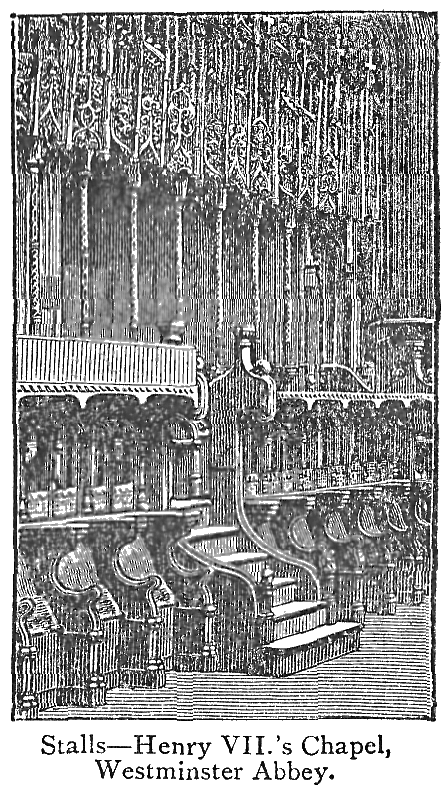
Stall, stawl, n. a place where a horse or other animal stands and is fed: a division of a stable for a single animal: a stable: a bench or table on which articles are exposed for sale: one of the seats in churches reserved for the clergy and choir, usually lining the choir or chancel on both sides, also an office entitling one to such a seat, or its stipend: a reserved seat in a theatre, usually one of those in the front division of the parquet—orchestra stalls.—v.t. to put or keep in a stall.—v.i. to inhabit.—n. Stall′age, liberty of erecting stalls in a fair or market: rent paid for this liberty.—adj. Stalled, kept or fed in a stall, fatted.—v.t. Stall′-feed, to feed and fatten in a stall or stable.—ns. Stall′ing (Tenn.) stabling; Stall′inger (prov.), a keeper of a stall; Stall′man, one who keeps a stall for the sale of any article; Stall′-reader, one who stands and reads books at a bookstall. [A.S. steal; Ice. stallr, Ger. stall.]
Stallion, stal′yun, n. an uncastrated male horse, esp. one kept for breeding. [O. Fr. estalon (Fr. étalon)—Late L. equus ad stallum, a horse at stall.]
Stalwart, stawl′wart, adj. stout, strong, sturdy: determined in one's partisanship.—n. a resolute person.—(arch.) Stal′worth.—adv. Stal′wartly.—n. Stal′wartness—(arch.) Stal′worthiness. [M. E. stalworth—A.S. stæl-wyrthe, serviceable. Prob. stathol,foundation, weorth, good, worth.]
Stam, stam, v.t. (prov.) to confound.—n. confusion.
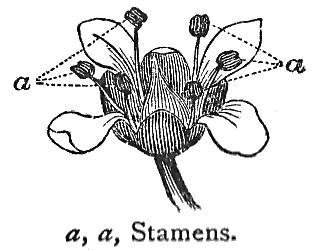
Stamen, stā′men, n. one of the male organs of a flower which produce the pollen:—pl. Stā′mens.—adj. Stā′mened, having stamens.—n. Stam′ina (prop. pl.), the principal strength of anything: the firm part of a body which supports the whole.—adjs. Stam′inal, Stamin′ēous, consisting of or possessing stamens: pertaining to, or attached to, the stamen: apetalous, as certain flowers; Stam′inate, -d, having or producing stamens; Staminif′erous, Staminig′erous, bearing or having stamens.—ns. Stam′inode, Staminō′dium, an abortive stamen; Stam′inody, a condition of flowers in which sepals, pistils, &c. are metamorphosed into stamens. [L. stamen (pl. stamina)—stāre, to stand.]
Stammel, stam′el, n. a kind of woollen cloth, dull red in colour: red colour.—adj. made of stammel, or like it in colour. [Earlier stamin—O. Fr. estamine—Low L. stamina—L. stamineus, stamen, a thread.]
Stammel, stam′el, n. (prov.) a stumbling horse: a bouncing girl.
Stammer, stam′ėr, v.i. to halt in one's speech, the result of failure in co-ordinate action of certain muscles and their appropriate nerves: to falter in speaking: to stutter.—v.t. to utter with hesitation.—n. hesitation in speech: defective utterance.—ns. Stamm′erer; Stamm′ering.—adv. Stamm′eringly. [A.S. stamor; Dut. stameren.]
Stamnos, stam′nos, n. an ancient Greek short-necked, two-handled wine-vase. [Gr.]
Stamp, stamp, v.t. to strike with the sole of the foot, by thrusting it down: to impress with some mark or figure: to imprint: to fix deeply: to coin: to form: to pound, bray, crush, bruise.—v.i. to step or plant the foot firmly down.—n. the act of stamping: the mark made by pressing something on a soft body: an instrument for making impressions on other bodies: that which is stamped: an official mark put on things chargeable with duty, as proof that the duty is paid: an instrument for cutting materials into a certain shape by a downward pressure: cast, form, character: distinguishing mark, imprint, sign, evidence: a species of heavy pestle, raised by water or steam power, for crushing and pulverising ores: (pl.) stamp-duties: (slang) money, esp. paper money.—ns. Stamp′-act, an act for regulating stamp-duties; Stamp′-collect′or, an officer who collects stamp-duties: one who makes a collection of postage or other stamps; Stamp′-dū′ty, a tax imposed on the paper on which legal documents are written; Stamp′er; Stamp′ing; Stamp′ing-machine′, a machine used for stamping coins, in the stamping of brass-work, or in crushing metallic ores; Stamp′-, Stamp′ing-mill, a crushing-mill for ores; Stamp′-note, a certificate from a custom-house officer for goods to be loaded as freight of a ship; Stamp′-off′ice, an office where stamp-duties are received and stamps issued.—Stamp out, to extinguish, extirpate. [A.S. stempan; Ger. stampfen.]
Stampede, stam-pēd′, n. a sudden fright seizing a herd of horses or other cattle, causing them to run: flight, or any sudden confused movement of a multitude, caused by panic.—v.i. to scamper off in panic. [Sp. estampido, a crash—estampar, to stamp.]
Stance, stans, n. (Scot.) a station, site, stand.
Stanch, stänsh, v.t. to stop the flowing of, as blood: to quench, allay.—v.i. (B.) to cease to flow.—adj. constant: trusty: zealous: sound, strong, firm.—n. Stanch′er.—adj. Stanch′less (Shak.), that cannot be stanched or stopped.—adv. Stanch′ly.—n. Stanch′ness. [O. Fr. estancher (Fr. étancher)—Low L. stancāre, to stanch—L. stagnāre, to be or make stagnant.]
Stanch, stänsh, adj. Same as Staunch.
Stanchion, stan′shun, n. an upright iron bar of a window or screen: (naut.) an upright beam used as a support.—v.t. to fasten by means of or to a stanchion.—A Scotch form is Stan′chel. [O. Fr. estançon—estancer, to stop, estance—Low L. stantia—L. stāre, to stand.]
Stand, stand, v.i. to cease to move: to be stationary: to occupy a certain position: to stagnate: to be at rest: to be fixed in an upright position, to be erect, to be on the feet—as opposed to sit, lie, kneel, &c.: to become or remain erect: to have a position or rank: to be in a particular state, to be with relation to something else: to maintain an attitude: to be fixed or firm: to keep one's ground: to remain unimpaired: to endure, to be consistent: to consist: to depend or be supported: to offer one's self as a candidate: to have a certain direction: to hold a course at sea.—v.t. to endure: to sustain: to suffer: to abide by: to be at the expense of, to offer and pay for:—pa.t. and pa.p. stood.—ns. Stand′er; Stand′er-by (Shak.), a spectator; Stand′er-up, one who stands up or who takes a side.—adj. Stand′ing, established: settled: permanent: fixed: stagnant: being erect.—n. continuance: existence: place to stand in: position in society: a right or capacity to sue or maintain an action.—n. Stand′ing-ground, a place on which to stand, any basis or principle on which one rests.—n.pl. Stand′ing-or′ders, the name given to permanent regulations made by either House of Parliament for the conduct of its proceedings, and enduring from parliament to parliament unless rescinded.—ns. Stand′ing-pool (Shak.), a pool of stagnant water; Stand′ing-rig′ging, the ropes in a ship that remain fixed; Stand′ing-room, place in which to stand.—n.pl. Stand′ing-stones, monoliths of unhewn stone, erected singly or in groups.—n. Stand′ish, a standing dish for pen and ink.—adj. Stand′-off, holding others off, reserved—also Stand′-off′ish.—ns. Stand′-off′ishness, a distant, reserved, and haughty manner; Stand′-pipe, a vertical pipe at a reservoir, into which the water is pumped up so as to give it a head: a small pipe inserted into an opening in a water-main: a pipe permitting expansion, as of hot water: a pipe sufficiently high for its contents to be forced into a boiler against the steam-pressure; Stand′-point, a station or position from which objects are viewed: a basis or fundamental principle according to which things are compared and judged; Stand′still, a standing without moving forward: a stop.—adj. Stand′-up, standing erect: done standing, noting a fair boxing-match.—Stand against, to resist; Stand by, to support; Stand fast, to be unmoved; Stand fire, to remain steady under the fire of an enemy—also figuratively; Stand for, to be a candidate for: (naut.) to direct the course towards; Stand from, to direct the course from; Stand in, to cost; Stand in with, to have a secret understanding with, as policemen with publicans; Stand low (print.), to fall short of the standard height; Stand off, to keep at a distance: to direct the course from: (Shak.) to forbear compliance or intimacy; Stand off and on, to sail away from shore and then towards it; Stand on, to continue on the same tack or course: (Shak.) to be satisfied or convinced of; Stand one's ground, to maintain one's position; Stand out, to project, to be prominent: not to comply, to refuse to yield; Stand to, to agree to, adhere to, abide by, maintain; Stand together, to agree, to be consistent with; Stand trial, not to give up without trial; Stand under (Shak.), to undergo, to sustain; Stand up, to rise from a sitting posture; Stand up for, to support or attempt to defend; Stand upon (B.), to attack; Stand up to, to meet face to face, to fulfil manfully; Stand up with, to dance with as a partner; Stand with, to be consistent. [A.S. standan; Goth. standan, Ger. stehen; cf. Gr. histanai, to place, L. stāre, to stand.]
Stand, stand, n. a place where one stands or remains for any purpose: a place beyond which one does not go, the highest or ultimate point: an erection for spectators at races, &c.: the place of a witness in court: something on which anything rests, a frame for glasses, &c.: a stop, obstruction, rest, quiescence: a state of cessation from action, motion, or business: a state of perplexity or hesitation: a difficulty, resistance.—Be at a stand, to stop on account of doubt or difficulty: to hesitate, to be perplexed; Make a stand, to halt and offer resistance; Put to a stand, to stop, arrest.
Standard, stand′ard, n. that which stands or is fixed, as a rule: the upright post of a truss: that which is established as a rule or model: a grade of classification in English elementary schools: a staff with a flag: an ensign of war: one of the two flags of a heavy cavalry regiment: (hort.) a standing shrub or tree, not supported by a wall.—adj. according to some standard: legal: usual: having a fixed or permanent value.—n. Stand′ard-bear′er, the soldier or junior officer who carries the colours: the spokesman or representative of a movement. [O. Fr. estandart—Old High Ger. standan, to stand, with suff. -art.]
Stang, stang, n. a wooden bar, a pole.—Riding the stang, a popular manner of punishing an unpopular man by carrying him astride of a stang. [A.S. stæng, a pole; Dut. stang.]
Stang, stang, v.i. (prov.) to throb with pain—also a Scotch form of sting.
Stanhope, stan′hōp, n. a light open one-seated carriage without a top, formerly with two wheels, now usually with four.
Staniel, stan′yel, n. the kestrel or windhover.—Also Stan′nel, Stan′yel. [A.S. stángella.]
Stank, stangk, pa.t. of stink.
Stank, stangk, n. (Scot.) a ditch, a pool, a tank. [O. Fr. estang, a pond—L. stagnum, a stagnant pool.]
Stannary, stan′ar-i, adj. of or relating to tin mines or works.—n. a tin-mine.—n. Stann′ate, a salt formed with stannic acid and a base.—adjs. Stann′ic, pertaining to, or procured from, tin; Stannif′erous, producing or containing tin.—n. Stann′ine, a mineral of a grayish-black colour, consisting chiefly of sulphur, tin, copper, and iron.—adj. Stann′ous, containing tin.—Stannary courts, courts in Cornwall for the tin-miners. [L. stannum, tin.]
Stanza, stan′za, n. a series of lines or verses connected with and adjusted to each other in a fixed order of sequence as regards length and metrical form: a division of a poem containing every variation of measure in the poem.—adj. Stanzā′ic. [It. stanza, a stop—Low L. stantia—L. stāre, stand.]
Stapelia, sta-pē′li-a, n. a genus of showy fleshy African plants of the milkweed family. [From J. B. van Stapel.]
Stapes, stā′pēz, n. the inmost of the three auditory ossicles, situated in the tympanum.—adjs. Stapē′dial, stirrup-shaped: pertaining to the stapes; Stapedif′erous, having a stapes.—n. Stapē′dius, a stapedial muscle. [Low L. stapes, a stirrup—Old High Ger. stapf, a step.]
Staphyline, staf′i-lin, adj. of the form of a bunch of grapes.—ns. Staph′yle, the uvula; Staphylō′ma, Staphylō′sis, a protrusion of any of the coats of the eye.—adjs. Staphylomat′ic; Staphylō′matous.—ns. Staph′yloplasty, the operation for replacing the soft palate; Staphylor′aphy, the operation of uniting a cleft palate; Staphylot′omy, the amputation of the uvula. [Gr. staphylē, a bunch of grapes, the uvula.]
Staple, stā′pl, n. a settled mart or market: the principal production or industry of a district or country: the principal element: the thread of textile fabrics: unmanufactured material.—adj. established in commerce: regularly produced for market.—n. Stā′pler, a dealer. [O. Fr. estaple—Low Ger. stapel, a heap.]
Staple, stā′pl, n. a loop of iron, &c., for holding a bolt, &c.: the metallic tube to which the reed is fastened in the oboe, &c. [A.S. stapel, a prop—stapan, step; cf. Ger. stapel.]
Star, stär, n. one of the bright bodies in the heavens, except the sun and moon: one of the heavenly bodies shining by their own light, and which keep the same relative position in the heavens: anything star-like or star-shaped: a representation of a star worn as a badge of rank or honour: a person of brilliant or attractive qualities: the chief actor or actress in a dramatic company: (print.) an asterisk (*).—v.t. to set with stars: to bespangle.—v.i. to shine, as a star: to attract attention: to appear as a star-actor (To Star it, esp. on a provincial tour):—pr.p. star′ring; pa.t. and pa.p. starred.—ns. Star′-ap′ple, the fruit of the West Indian tree Chrysophyllum Cainito; Star′-blast′ing, the noxious influence of the stars.—adjs. Star′-blind, so blind as not to see the stars: half-blind; Star′-broi′dered (Tenn.), embroidered with figures in the shape of stars.—ns. Star′-buzz′ard, an American goshawk; Star′-cat′alogue, a list of stars, with their places, magnitudes, &c.—adj. Star′-crossed, not favoured by the stars.—ns. Star′-drift, a common proper motion of a number of fixed stars in the same region of the heavens; Star′-dust, cosmic dust, matter in fine particles falling upon the earth from some outside source, like meteorites; Star′-finch, the redstart; Star′fish (Asteroidea), an Echinoderm, nearly allied to the Brittle-stars (Ophiuroidea) and to the Sea-urchins (Echinoidea); Star′-flow′er, one of various plants with bright star-shaped flowers, the Star-of-Bethlehem: chickweed; Star′-fort, a fort surrounded with projecting angles, like the points of a star; Star′-fruit, a small water-plant of southern Europe, with long-pointed radiating carpels; Star′-gāz′er, an astrologer: an astronomer; Star′-gāz′ing, astrology; Star′-grass, a grass-like plant, with star-shaped, yellow flowers; Star′-hy′acinth, a bulbous-rooted plant, a species of squill, with pinkish purple flowers, found on the coast in the south of England; Star′-jell′y, the common species of nostoc.—adj. Star′less, having no stars visible: having no light from stars.—n. Star′light, light or lustre of the stars.—adjs. Star′-like, resembling a star: radiated like a star: bright, illustrious; Star′lit, lighted by the stars.—ns. Star′-nose, a North American mole; Star′-of-Beth′lehem, a garden plant of the lily family, with bright white star-like flowers: the miraculous star of the Nativity (Matt. ii. 2, 9, 10).—adj. Star′-proof (Milt.), impervious to starlight.—n. Star′-read (Spens.), knowledge of the stars, astrology.—adj. Starred, adorned or studded with stars.—ns. Star′-reed, a South American plant used in Peru against dysentery, &c.; Star′riness.—adj. Star′ry, abounding or adorned with stars: consisting of, or proceeding from, the stars: like, or shining like, the stars.—n. Stars′-and-stripes, the flag of the United States of America, with thirteen stripes alternately red and white, and a blue field containing as many stars as there are states.—adj. Star′-spang′led, spangled or studded with stars.—n. Star′-stone, a variety of corundum which, when cut in a particular way, exhibits a reflection of light in the form of a star.—adj. Star′-strown (Tenn.), strewn or studded with stars.—ns. Star′-this′tle, a species of centaury, so called from its star-like flowers; Star′-wheel, a spur-wheel with V-shaped teeth; Star′wort, a genus of plants nearly allied to the Asters, with star-like flowers. [A.S. steorra; Ger. stern, L. stella (for sterula), Gr. astēr.]
Starboard, stär′bōrd, n. the right-hand side of a ship, to one looking toward the bow.—adj. pertaining to, or lying on, the right side of a ship. [A.S. steórbord—steór, a rudder, bord, a board, the side of a ship. Cf. Board and Larboard.]
Starch, stärch, n. the pure fecula or white farinaceous matter of vegetables, yielding a translucent jelly used for stiffening clothes in the laundry: stiffness, formality.—adj. stiff, rigid, formal.—adj. Starched, stiffened with starch: formal.—adv. Starch′edly.—ns. Starch′edness; Starch′er; Starch′-hy′acinth, a plant allied to the hyacinth, so called from the smell of the flower.—adv. Starch′ily, in a starch or stiff manner: formally.—ns. Starch′iness, the state or quality of being starchy: stiffness of manner: formality; Starch′-su′gar, glucose.—adj. Starch′y, consisting of, or like, starch: stiff: precise. [A special use of adj. stark; cf. Ger. stärke, starch—stark, strong.]
Star-chamber, stär′-chām′bėr, n. a tribunal with a civil and criminal jurisdiction, which met in the old council chamber of the palace of Westminster, abolished in the reign of Charles I. [Probably named from the gilt stars on the ceiling, hardly from the Jewish bonds (called starrs, from Heb. shetar) kept in the council-room.]
Stare, stār, v.i. to look at with a fixed gaze, as in horror, astonishment, &c.: to look fixedly.—v.t. to influence in some way by staring.—n. a fixed look.—ns. Stārēē′, one who is stared at; Stā′rer, one who stares or gazes; Stā′ring, the act of staring.—adv. Stā′ringly, in a staring manner: with a fixed look. [A.S. starian, from a Teut. root seen in Ger. starr, rigid; also in Eng. stern.]
Stark, stärk, adj. stiff: gross: absolute: entire: naked, an abbreviation of Stark′-nā′ked, quite naked, which is really a corr. of M. E. start-naked=tail-naked (A.S. steort, a tail).—adv. absolutely: completely.—v.t. to make stark, as in death.—v.t. Stark′en, to stiffen, to make obstinate.—adv. Stark′ly.—n. Stark′ness, the state or quality of being stark: stiffness; stoutness. [A.S. stearc, hard, strong; cog. Ice. sterk-r, Ger. stark.]
Starling, stärling, n. a genus Sturnus and family Sturnidæ of Passerine birds: (archit.) a ring of piles supporting the pier of a bridge. [Dim. from obs. stare—A.S. stær; Ger. staar, L. sturnus.]
Starost, stär′ost, n. a Polish noble holding a Star′osty or domain by grant of life-estate from the crown. [Pol. starosta, elder—stary, old.]
Starr. See under Star-chamber.
Start, stärt, v.i. to move suddenly aside: to wince: to deviate: to begin: to proceed: to give way somewhat.—v.t. to cause to move suddenly: to disturb suddenly: to rouse suddenly from concealment: to set in motion: to call forth: to invent or discover: to move suddenly from its place: to loosen: to empty: to pour out.—n. a sudden movement: a sudden motion of the body: a sudden rousing to action: an unexpected movement: a sally: a sudden fit: a quick spring: the first motion from a point or place: the outset.—n. Start′er, one who starts.—adj. Start′ful, apt to start.—adv. Start′ingly (Shak.), by fits or starts.—ns. Start′ing-point, the point from which anything starts, or from which motion begins; Start′ing-post, the post or barrier from which the competitors in a race start or begin the race.—adj. Start′ish, apt to start, skittish.—ns. Start′-up (Shak.), an upstart; Start′uppe (Spens.), a kind of high shoe or half-boot.—Start after, to set out after, to pursue; Start up, to rise suddenly, to come suddenly into notice.—Get, or Have, the start, to begin before another, to obtain an advantage over another. [M. E. sterten; closely akin to Dut. and Low Ger. storten, to plunge, Ger. stürzen.]
Startle, stärt′l, v.i. to start or move suddenly: to feel sudden alarm.—v.t. to excite suddenly: to shock: to frighten.—n. sudden alarm or surprise.—n. Start′ler.—adj. Start′ling, such as to strike with astonishment or alarm.—adv. Start′lingly.—adj. Start′lish, apt to start. [Extension of start.]
Starve, stärv, v.i. to die of hunger or cold: to suffer extreme hunger or want: to be in want of anything necessary, to deteriorate for want of anything essential.—v.t. to kill with hunger or cold: to destroy by want: to deprive of power.—n. Starvā′tion, act of starving: state of being starved.—adj. Starve′ling, hungry: lean: weak.—n. a thin, weak, pining animal or plant. [A.S. steorfan, to die; Dut. sterven, Ger. sterben, to die.]
Stasidion, sta-sid′i-on, n. a stall in a Greek church.
Stasimon, stas′i-mon, n. an ode sung by the whole chorus, after the parode:—pl. Stas′ima. [Gr.]
Stasimorphy, stas′i-mor-fi, n. any deviation from the normal form of a bodily organ due to arrested development [Gr. stasis, standing.]
Stasis, stā′sis, n. the arrest of the blood in its circulation: one of the sections of a cathisma or portion of the psalter. [Gr.]
Statant, stā′tant, adj. (her.) standing with all the feet on the ground. [L. stāre, to stand.]
State, stāt, n. position: condition: situation: circumstances at any time: the whole body of people under one government: the public: the civil power: estate, one of the orders or classes of men forming the body politic (as nobles, clergy, commonalty): a body of men united by profession: rank, quality: pomp: dignity: style of living: stability, continuance: (pl.) the bodies constituting the legislature of a country: (obs.) a seat of dignity: a stage, condition, as of an etched or engraved plate at one particular stage of its progress.—adj. belonging to the state: public: royal: ceremonial: pompous: magnificent.—v.t. to set forth: to express the details of: to set down fully and formally: to narrate: to set in order: to settle.—adj. Stāt′able, capable of being stated.—ns. State′-craft, the art of managing state affairs; State′-crim′inal, one who commits an offence against the state, as treason.—adj. Stāt′ed, settled: established: fixed: regular.—adv. Stāt′edly.—ns. State′-house, the building in which the legislature of a state holds its sittings; Stāte′liness.—adj. Stāte′ly, showing state or dignity: majestic: grand.—adv. majestically: (Milt.) loftily.—ns. Stāte′ment, the act of stating: that which is stated: a narrative or recital; State′-pā′per, an official paper or document relating to affairs of state; State′-pris′on; State′-pris′oner, a prisoner confined for offence against the state; State′-relig′ion, the establishment or endowment by the government of a country of some particular form of religion; State′room, a stately room in a palace or mansion: principal room in the cabin of a ship; States′-gen′eral, the name given to the representative body of the three orders (nobility, clergy, burghers) of the French kingdom; States′man, a man acquainted with the affairs of government: one skilled in government: one employed in public affairs: a politician: one who farms his own estate, a small landholder.—adj. States′man-like, like a statesman.—adv. States′manly, in a manner becoming a statesman.—n. States′manship.—State socialism, a scheme of government which would entrust to the state the carrying on of the great enterprises of private industry; States of the Church, the former temporal possessions of the popes. [O. Fr. estat (Fr. état)—L. status, from stāre, stātum, to stand.]
Stater, stā′tėr, n. the standard gold coin of ancient Greece.
Static, -al, stat′ik, -al, adj. pertaining to statics: pertaining to bodies at rest or in equilibrium: resting: acting by mere weight.—adv. Stat′ically.—n. Stat′ics, the science which treats of the action of force in maintaining rest or preventing change of motion. [Gr. statikē (epistēmē, 'science,' being understood)—histēmi.]
Station, stā′shun, n. the place where a person or thing stands: post assigned: position: office: situation: occupation, business: state: rank: condition in life: the place where railway trains come to a stand in order to take up and set down passengers and goods, the buildings erected at such a place for railway business: a regular stopping-place: a stock farm in Australia: a district or branch police-office: the place in India where the group of English officials or the officers of a garrison reside: a recess in a mine-shaft or passage for a pumping-machine: (pl.) in R.C. usage, applied to certain places of reputed sanctity, appointed to be visited as places of prayer, any one of the fourteen (fifteen, or even eleven) images or pictures ranged round a church, starting from one side of the high altar and ending at the other, representing the several stages of the Passion—the whole series the Way of Calvary.—v.t. to assign a station to: to set: to appoint to a post, place, or office.—adj. Stā′tional.—n. Stā′tionariness.—adj. Stā′tionary, pertaining to a station: standing: fixed: settled: acting from, or in, a fixed position (as an engine): not progressing or retrogressing: not improving.—n. Stā′tioner, one who sells paper and other articles used in writing.—adj. Stā′tionery, belonging to a stationer.—n. the articles sold by a stationer.—ns. Stā′tion-house, a temporary place of arrest; Stā′tion-mas′ter, one who has charge of a station, esp. on a railway.—Stationers' Hall, the hall in London belonging to the Company of the Stationers, who enjoyed until the passing of the Copyright Act in 1842 an absolute monopoly of printing and publishing; Stationery Office, an office in London for providing books, stationery, &c. to the government offices at home and abroad, and for making contracts for the printing of government reports and other public papers. [Fr.,—L. statio—stāre, to stand.]
Statist, stā′tist, n. a statesman, a politician.
Statistics, sta-tist′iks, n. a collection of facts and figures regarding the condition of a people, class, &c.: the science which treats of the collection and arrangement of facts bearing on the condition—social, moral, and material—of a people.—adjs. Statist′ic, -al, pertaining to, or containing, statistics.—adv. Statist′ically.—n. Statistic′ian, one skilled in statistics. [Coined (as if from a form statistikē) from Gr. statizein, to set up.]
Stative, stā′tiv, adj. standing still, pertaining to a permanent camp: indicating a physical state or reflex action, of certain Hebrew verbs.
Statue, stat′ū, n. a likeness of a human being or animal carved out of some solid substance: an image—(obs.) Stat′ua.—n. Stat′ūary, the art of carving statues: a statue or a collection of statues: one who makes statues: a dealer in statues.—adj. Stat′ued, furnished with statues.—n. Statuette′, a small statue. [Fr.,—L. statua—statuĕre, to cause lo stand—stāre.]
Statuesque, stat-ū-esk′, adj. like a statue.—adv. Statuesque′ly. [Fr.]
Stature, stat′ūr, n. the height of any animal.—adj. Stat′ured, having a certain specified stature. [L. statura.]
Status, stā′tus, n. state: condition: rank. [L.]
Statute, stat′ūt, n. a law expressly enacted by the legislature (as distinguished from a customary law or law of use and wont): a written law: the act of a corporation or its founder, intended as a permanent rule or law.—adj. Stat′ūtable, made by statute: according to statute.—adv. Stat′ūtably.—ns. Stat′ute-book, a record of statutes or enacted laws; Stat′ute-cap (Shak.), a kind of cap enjoined to be worn by a statute passed in 1571 in behalf of the cap-makers; Stat′ute-roll, an enrolled statute.—adj. Stat′ūtory, enacted by statute: depending on statute for its authority. [L. statutum, that which is set up—statuĕre.]
Staunch, stawnsh, adj. firm in principle, pursuit, or support: trusty, hearty, constant, zealous.—adv. Staunch′ly.—n. Staunch′ness. [Stanch.]
Staurolite, stawr′ō-līt, n. a silicate of alumina with ferrous oxide, magnesia, and water, crystallising in trimetric forms, common as twinned cruciform crystals in certain states.—adj. Staurolit′ic.
Stave, stāv, n. one of the pieces of which a cask is made: a staff or part of a piece of music: a stanza.—v.t. to break a stave or the staves of: to break: to burst: to drive off, as with a staff: to delay:—pa.t. and pa.p. stāved or stōve. [By-form of staff.]
Staves, stāvz, plural of staff and of stave.
Stavesacre, stāvz′ā-kėr, n. a tall larkspur whose seeds yield delphinin for destroying lice. [O. Fr. stavesaigre—Low L. staphisagria—Gr. staphis, dried grapes, agrios, wild.]
Staw, staw, v.i. (prov.) to stand still, become fixed.—v.t. (Scot.) to surfeit, to scunner at.—n. a surfeit.
Staw, staw, a Scotch form of stole.
Stay, stā, v.i. to remain: to abide for any time: to continue in a state: to wait: to cease acting: to dwell: to trust.—v.t. to cause to stand: to stop: to restrain: to delay: to prevent from falling: to prop: to support, rest, rely:—pa.t. and pa.p. stayed, staid.—n. continuance in a place: abode for a time: stand: stop: a fixed state: a standstill: suspension of a legal proceeding: prop, support: (pl.) a kind of stiff inner waistcoat worn by women.—ns. Stay′-at-home, one who keeps much at home—also adj.; Stay′-bolt, a bolt or rod binding together opposite plates; Stay′er, one who, or that which, stops, holds, or supports: a person or animal of good lasting or staying qualities for a race, &c.; Stay′-lace, a lace for fastening a bodice; Stay′-mā′ker, one whose occupation is to make stays.—Stay the stomach, to allay the cravings of hunger for the time. [O. Fr. estayer, estaye—Old Dut. stade, a stay.]
Stay, stā, n. a large strong rope running from the head of one mast to another mast ('fore-and-aft' stay), or to the side of the ship ('back'-stay): the transverse piece in a chain-cable link.—v.t. to support or to incline to one side by means of stays: to put on the other tack, to cause to go about.—v.i. to change tack, to go about, to be in stays.—ns. Stay′sail, a sail extended on a stay; Stay′-tack′le, a large hoisting tackle fixed by a pendant to the mainstay of a ship.—Miss stays (see Miss). [A.S. stæg; Dut. stag, Ger. stag.]
Stayed, stād, adj. (Spens.). Same as Staid, constant.
Stayne, stān, v.t. (Spens.) to dim, deface, or disparage. [A form of stain.]
Stayre, stār, n. (Spens.). Same as Stair, a step.
Stead, sted, n. the place which another had or might have: a fixed place of abode: use, help, service, as in 'To stand in good stead.'—n. Steading, the barns, stables, &c. of a farm. [A.S. stede, place; Ger. stadt, statt, place, Dut. stad, a town.]
Steadfast, sted′fast, adj. firmly fixed or established: firm: constant: resolute: steady.—adv. Stead′fastly.—n. Stead′fastness. [A.S. stedefæst, stede, a place, fæst, firm, fast.]
Steady, sted′i, adj. (comp. Stead′ier, superl. Stead′iest) firm in standing or in place: fixed: stable: constant: resolute: consistent: regular: uniform: sober, industrious.—v.t. to make steady: to make or keep firm:—pa.t. and pa.p. stead′ied.—n. a rest or support, as for the hand, a tool, or a piece of work.—adv. Stead′ily.—n. Stead′iness.—adj. Stead′y-gō′ing, of steady habits or action. [A.S. stæððig—stæð, stead, bank; Ger. stätig, continual.]
Steak, stāk, n. a slice of meat (esp. beef) broiled, or for broiling. [Prob. Ice. steik, steikja, to broil.]
Steal, stēl, v.t. to take by theft or feloniously: to take away without notice: to gain or win by address, insidiously, or by gradual means: to snatch: in golf, to hole a long putt by a stealthy stroke—the opposite of Gobble.—v.i. to practise theft: to take feloniously: to pass secretly: to slip in or out unperceived:—pa.t. stōle; pa.p. stōlen.—ns. Steal′er; Steal′ing, the act of taking another's property without his knowledge or consent: stolen property.—adv. Steal′ingly.—Steal a march on, to gain an advantage unperceived. [A.S. stelan; Ger. stehlen, Dut. stelen.]
Steal, stēl, n. (Spens.) a handle.
Stealth, stelth, n. the act of stealing: a secret manner of bringing anything to pass.—adv. Stealth′ily.—n. Stealth′iness.—adj. Stealth′y, done by stealth: unperceived: secret.
Steam, stēm, n. the vapour of water—when dry, invisible and transparent like air, and not to be confused with the semi-liquid cloud which comes from the chimney of a locomotive; when superheated, changing the characteristics of a vapour for those belonging to what is known as a 'perfect gas:' the mist formed by condensed vapour: any vaporous exhalation: energy, force, spirit.—v.i. to rise or pass off in steam or vapour: to move by steam.—v.t. to expose to steam.—ns. Steam′boat, Steam′ship, Steam′-vess′el, a boat, ship, or vessel propelled by steam; Steam′-boil′er, a boiler for generating steam; Steam′-carriage, a carriage moved by steam on common roads; Steam′-chest, -dome, a chamber above a steam-boiler serving as a reservoir for steam; Steam′-crane, a crane worked by a steam-engine; Steam′-dig′ger, a machine for digging the soil by means of steam-power, the soil being thereby much more thoroughly pulverised than by ploughing; Steam′-en′gine, an engine or machine which changes heat into useful work through the medium of steam; Steam′er, a vessel moved by steam: a road-locomotive, &c.: a vessel in which articles are steamed; Steam′-gauge, an instrument for measuring the pressure of steam in a boiler; Steam′-gov′ernor, the governor of a steam-engine; Steam′-gun, a gun projecting a missile by means of steam; Steam′-hamm′er, a hammer consisting of a steam cylinder and piston placed vertically over an anvil, the hammer moved by the action of the steam; Steam′iness, the quality of being vaporous or misty; Steam′-jack′et, a hollow casing surrounding any vessel and into which steam may be admitted; Steam′-launch (see Launch); Steam′-navigā′tion, the propulsion of vessels by steam; Steam′-nav′vy, an excavator operated by steam in the making of docks, canals, &c.; Steam′-pack′et, a steam-vessel plying between certain ports; Steam′-pipe, a pipe for conveying steam; Steam′-plough, a plough or gang of ploughs worked by a steam-engine; Steam′-pow′er, the force of steam when applied to machinery; Steam′-press, a printing-press worked by steam; Steam′-print′ing, printing in which the presses are operated by steam; Steam′-trap, a contrivance for allowing the passage of water while preventing the passage of steam; Steam′-tug, a small steam-vessel used in towing ships; Steam′-whis′tle, an apparatus attached to a steam-engine through which steam is discharged, producing a sound in the manner of a common whistle.—adj. Steam′y, consisting of, or like, steam: full of steam or vapour.—n. Steam′-yacht, a yacht propelled by steam. [A.S. steám; cog. with Dut. stoom.]
Stean, Steen, stēn, n. a stone or earthenware vessel.—n. Stean′ing, the stone or brick lining of a well, &c. [A.S. stæn, stone.]
Steare, stēr, n. (Spens.) a steer or ox.
Stearine, stē′a-rīn, n. one of the fats occurring in animals and plants, the chief constituent of the more solid fats, such as mutton suet.—n. Stē′arāte, a salt formed by the combination of stearic acid with a base.—adj. Stēar′ic, pertaining to, or obtained from, stearine.—n. Stēarrhē′a, an abnormal increase of secretion from the oil-glands of the skin.—Stearic acid, an acid abundant in fats. [Gr. stear, steatos, suet—histanai, to make to stand, to fix.]
Steatite, stē′a-tīt, n. soapstone, a compact or massive variety of talc, a hydrous silicate of magnesia, white or yellow, soft and greasy to the touch—used by tailors for marking cloth, and called Briançon Chalk, French Chalk, and Venice Talc.—adj. Stēatit′ic.—ns. Stēatī′tis, inflammation of the fatty tissue; Stē′atocele, a fatty tumour in the scrotum; Stēatō′ma, a fatty encysted tumour.—adj. Stēatom′atous.—n. Stēatop′yga, an accumulation of fat on the buttocks of the Bushmen women.—adj. Stēatop′ygous, fat-buttocked.—n. Stēatō′sis, fatty degeneration of an organ, as the heart. [Gr. steatitēs—stear, steatos, suet.]
Steboy, ste-boi′, interj. a cry in setting on a dog.—Also Hist′aboy.
Stedfast=Steadfast.
Steed, stēd, n. a horse or stallion, esp. a spirited horse. [A.S. stéda, from stód, a stud; Ger. stute, a stud-mare, ge-stüte, a stud.]
Steedy, stēd′i, adj. (Spens.) steady.
Steek, stēk, n. (Scot.) a stitch.—v.t. to pierce, to stitch: to close.
Steel, stēl, n. iron combined in varying proportions with carbon for making edged tools: any instrument or weapon of steel: an instrument of steel for sharpening knives on: a strip of steel for stiffening a corset: a piece of steel for striking fire from a flint: extreme hardness: a chalybeate medicine.—adj. made of steel: hard, unfeeling.—v.t. to overlay or edge with steel: to harden: to make obdurate.—adj. Steel′-clad, clad with steel-mail.—ns. Steel′-engraving, the art of engraving pictures on steel plates from which impressions may be taken, the impression or print so taken; Steel′iness, state of being steely, great hardness; Steel′ing, the welding of a steel edge on a cutting instrument; Steel′-pen, a pen-nib made of steel; Steel′-plate, a plate of steel: a plate of polished steel on which a design is engraved, the print taken from such.—adj. Steel′-plāt′ed, plated with steel.—n.pl. Steel′-toys, small articles of steel as buttons, buckles, &c.—n. Steel′-ware, articles made of steel collectively.—adj. Steel′y, made of steel: steel-like. [A.S. stýle; Ger. stahl.]
Steelbow, stēl′bō, n. (Scots law) a term for goods, such as corn, cattle, straw, and implements of husbandry delivered by the landlord to his tenant, by means of which the latter is enabled to stock and labour the farm, and in consideration of which he becomes bound to return articles equal in quantity and quality at the expiration of the lease.
Steelyard, stēl′yärd, n. the Roman balance, an instrument for weighing, consisting of a lever with unequal arms, in using which a single weight or counterpoise is employed, being moved along a graduated beam. [Orig. the yard in London where steel was sold by German merchants.]
Steem, stēm (Spens.). Same as Esteem.
Steen. See Stean.
Steenbok, stān′bok, n. one of several small African antelopes. [Dut., steen, stone, bok, buck.]
Steenkirk, stēn′kerk, n. a lace cravat loosely worn, so named from the defeat of William III. by Luxembourg at Steenkerke, August 3, 1692.
Steep, stēp, adj. rising or descending with great inclination: precipitous: difficult, excessive, exorbitant.—n. a precipitous place: a precipice.—adj. Steep′-down (Shak.), deep and precipitous.—v.i. Steep′en, to become steep.—ns. Steep′iness, Steep′ness, the state or quality of being steep.—adv. Steep′ly.—adj. Steep′y, steep. [A.S. steáp; Ice. steypthr.]
Steep, stēp, v.t. to dip or soak in a liquid: to imbue.—n. something steeped or used in steeping: a fertilising liquid for seed: rennet.—n. Steep′er, a vessel in which articles are steeped. [Scand., Ice. steypa, to make to stoop, pour out, causal of stúpa, to stoop.]