Front matter (continued 2)
Reading edition
Sassorol, sas′ō-rol, n. the rock-pigeon.—Also Sassorol′la.
Sat, sat, pa.t. and pa.p. of sit.
Satan, sā′tan, n. the enemy of men: the devil: the chief of the fallen angels.—adjs. Sātan′ic, -al, pertaining to, or like, Satan: devilish.—adv. Sātan′ically, diabolically: with malice or wickedness suiting the devil.—ns. Sātan′icalness, the quality of being fiendishly malicious or wicked; Sā′tanism, the devilish disposition; Sātanoph′any, an appearance or incarnation of Satan; Sātanophō′bia, fear of the devil; Sāth′anas, Satan; Sātan′ity. [O. Fr. Sathan, Sathanas—Low L. Satan, Satanas—Heb. sātān, enemy—sātan, to be adverse.]
Satara, sat′a-ra, n. a ribbed, hot-pressed, and lustred woollen cloth.
Satchel, sach′el, n. a small sack or bag, esp. for papers, books, &c. [Older form sachel—O. Fr. sachel—L. saccellus, dim. of saccus.]
Sate, sāt, v.t. to satisfy or give enough: to glut.—adj. Sate′less, insatiable. [L. satiāre, -ātum—satis, enough.]
Sate, sat. Same as Sat, pa.t. of sit.
Sateen, sa-tēn′, n. a glossy worsted, cotton, or even woollen fabric.—Also Satteen′.
Satellite, sat′el-līt, n. an obsequious follower: one of the small members of the solar system, attendant on the larger planets, by which their motions are controlled.—ns. Sat′ellite-sphinx, a large hawk-moth; Sat′ellite-vein, a vein accompanying an artery; Satelli′tium, an escort. [Fr.,—L. satelles, satellitis, an attendant.]
Satiate, sā′shi-āt, v.t. to satisfy or give enough: to gratify fully: to glut.—adj. glutted.—n. Sātiabil′ity.—adj. Sā′tiable, that may be satiated.—ns. Sātiā′tion; Sātī′ety, state of being satiated: surfeit. [L. satiāra, -ātum—satis, enough.]
Satin, sat′in, n. a closely woven silk with a lustrous and unbroken surface, sometimes figured.—adj. made of satin: resembling satin.—v.t. to make smooth and glossy like satin.—ns. Sat′in-bird, the satin bower-bird; Sat′in-car′pet, a particular kind of moth; Sat′in-dam′ask, a satin with an elaborate flower or arabesque pattern, sometimes raised in velvet pile; Sat′in-de-laine′, a thin glossy woollen fabric, a variety of cassimere; Sat′inet, a thin species of satin: a cloth with a cotton warp and woollen weft; Sat′inet-loom, a loom used for heavy goods, as twills, satinets, &c.; Sat′in-fin′ish, a finish resembling satin: a lustrous finish produced on silver by the scratch-brush, by the process called Satining; Sat′ining-machine′, a machine for giving a smooth surface to paper; Sat′in-leaf, the common alum-root; Sat′in-lisse, a cotton dress-fabric with satiny surface, usually printed with delicate patterns; Sat′in-pā′per, a fine, glossy writing-paper; Sat′in-sheet′ing, twilled cotton fabric with a satin surface; Sat′in-spar, a variety of calcite with a pearly lustre when polished; Sat′in-sparr′ow, an Australian fly-catcher; Sat′in-stitch, an embroidery stitch, flat or raised, repeated in parallel lines, giving a satiny appearance and making both sides alike; Sat′in-stone, a fibrous gypsum used by lapidaries; Sat′inwood, a beautiful ornamental wood from East and West Indies, having a smooth, satiny texture.—adj. Sat′iny, like, or composed of, satin. [Fr. satin (It. setino)—Low. L. setinus, adj.—L. seta, hair.]
Satiné, sat-i-nā′, n. a reddish hard wood of French Guiana.
Satire, sat′īr, or sat′ir, n. a literary composition, orig. in verse, essentially a criticism of man and his works, whom it holds up either to ridicule or scorn—its chief instruments, irony, sarcasm, invective, wit and humour: an invective poem: severity of remark, denunciation: ridicule.—adjs. Satir′ic, -al, pertaining to, or conveying, satire: sarcastic: abusive.—adv. Satir′ically.—n. Satir′icalness, the state or quality of being satirical.—v.t. Sat′irīse, to make the object of satire: to censure severely.—n. Sat′irist, a writer of satire. [Fr.,—L. satira, satura (lanx, a dish), a full dish, a medley.]
Satisfy, sat′is-fī, v.t. to give enough to: to supply fully: to please fully: to discharge: to free from doubt: to convince.—v.i. to give content: to supply fully: to make payment:—pa.t. and pa.p. sat′isfied.—n. Satisfac′tion, state of being satisfied: gratification: comfort: that which satisfies: amends: atonement: payment, quittance: conviction: repairing a wrong, as by a duel.—adj. Satisfac′tive (obs.).—adv. Satisfac′torily.—n. Satisfac′toriness.—adjs. Satisfac′tory, satisfying: giving contentment: making amends or payment: atoning: convincing; Satisfī′able, capable of being satisfied.—n. Sat′isfīer.—adj. Sat′isfying, satisfactory.—adv. Sat′isfyingly.—Satisfaction theory (of the Atonement), the ordinary theory of Catholic orthodoxy that Christ made satisfaction to Divine justice for the guilt of human sin by suffering as the human representative, and that thus Divine forgiveness was made possible. [Fr. satisfaire—L. satisfacĕre, satis, enough, facĕre, to make.]
Sative, sā′tiv, adj. sown as in a garden. [L. sativus—serĕre, to sow.]
Satrap, sā′trap, or sat′rap, n. a Persian viceroy or ruler of one of the greater provinces:—fem. Sā′trapess.—adjs. Sat′rapal, relating to a satrap or to a satrapy; Sā′trap-crowned, crested, like the golden-crested wren of North America.—n. Sat′rapy, the government of a satrap. [Gr. satrapēs, from Old Pers. khshatrapā or Zend shōithra-paiti—ruler of a region—shōithra, a region, paiti, a chief.]
Saturate, sat′ū-rāt, v.t. to fill: to unite with till no more can be received: to fill to excess: to soak: (opt.) to render pure, or of a colour free from white light.—adjs. Sat′ūrable, that may be saturated; Sat′ūrant, saturating; Sat′ūrate, saturated: (entom.) very intense, as 'saturate green.'—ns. Sat′ūrāter; Satūrā′tion, act of saturating: state of being saturated: the state of a body when quite filled with another. [L. saturāre, -ātum—satur, full, akin to satis, enough.]
Saturday, sat′ur-dā, n. the seventh or last day of the week, dedicated by the Romans to Saturn: the Jewish Sabbath. [A.S. Sæter-dæg, Sætern-dæg, day of Saturn—L. Saturnus.]
Satureia, sat-ū-rē′i-a, n. a genus of gamopetalous plants of the order Labiatæ—savory.
Saturn, sat′urn, or sā′-, n. the ancient Roman god of agriculture: one of the planets: (her.) a tincture, in colour black.—n.pl. Saturnā′lia, the annual festival in honour of Saturn, a time of unrestrained license and enjoyment.—adjs. Saturnā′lian, pertaining to the Saturnalia: riotously merry: dissolute; Satur′nian, pertaining to Saturn, whose fabulous reign was called 'the golden age:' happy: pure: simple: denoting the verse in which the oldest Latin poems were written; Sat′urnine, grave: gloomy: phlegmatic—those born under the planet Saturn being so disposed: pertaining to lead.—n. Sat′urnist (obs.), a gloomy person.—Saturn's ring, a ring round and near the planet; Saturn's tree, an arborescent deposit of lead from a solution of lead acetate. [Saturnus—serĕre, satum, to sow.]
Saturnia, sā-tur′ni-a, n. a genus of bombycid moths.
Saturnia, sā-tur′ni-a, n. lead poisoning, plumbism.
Saturnite, sat′ur-nīt, n. a mineral substance containing lead.
Satyr, sat′ėr, or sā′tėr, n. a silvan deity, represented as part man and part goat, and extremely wanton: a very lecherous person: a species of butterfly.—ns. Sat′yral (her.), a monster with a human head and the limbs of different animals; Satyrī′asis, morbid lasciviousness in men, corresponding to nymphomania in women—also Satyromā′nia.—adjs. Satyr′ic, -al, pertaining to satyrs.—ns. Satyrī′næ, the argus butterflies; Satyr′ium, a genus of small flowered orchids; Sat′yrus, the genus of orangs—simia. [L. satyrus—Gr. satyros.]
Sauba-ant, saw′ba-ant, n. a South American leaf-carrying ant.
Sauce, saws, n. a liquid seasoning for food, consisting of salt, &c.: fruit stewed with sugar: a relish: impudence.—v.t. to put sauce in to relish: to make poignant: to gratify the palate: to treat with bitter or pert language: to make suffer.—ns. Sauce′-alone′, a cruciferous plant with a strong garlic smell, Jack-by-the-hedge; Sauce′-boat, a vessel with a spout for holding sauce; Sauce′-box, an impudent person; Sauce′-cray′on, a soft, black pastel used for backgrounds; Sauce′pan, a pan in which sauce or any small thing is boiled; Sauce′pan-fish, the king-crab.—Poor man's sauce, hunger; Serve one with the same sauce, to requite one injury with another, to make to suffer. [Fr. sauce—L. salsa, neut. pl. of salsus, pa.p. of salīre, salsum, to salt—sal, salt.]
Saucer, saw′sėr, n. the shallow platter for a tea or coffee cup: anything resembling a saucer, as a socket of iron for the pivot of a capstan: (orig.) a small vessel to hold sauce.—adj. Sau′cer-eyed, having large round eyes. [O. Fr. saussiere—Low L. salsarium—L. salsa, sauce.]
Sauch, Saugh, sawh, n. (Scot.) the willow. [Sallow.]
Saucisse, sō-sēs′, n. a bag filled with powder for use in mines.—Also Saucisson′. [Fr.]
Saucy, saw′si, adj. (comp. Sau′cier, superl. Sau′ciest) sharp: pungent: insolent: overbearing: wanton: impudent, pert.—adv. Sau′cily.—n. Sau′ciness. [Sauce.]
Sauer-kraut, sour′-krout, n. a German dish consisting of cabbage sliced fine and suffered to ferment in a cask with salt, juniper-berries, cumin-seed, caraway-seeds, &c. [Ger.]
Saufgard, sawf′gärd, n. (Spens.). Safeguard.
Sauger, saw′gėr, n. the smaller American pike-fish.
Saul, a Scotch form of soul.
Saulge, sawlj, adj. (Spens.) sage.
Saulie, saw′li, n. (Scot.) a hired mourner.—Also Sall′ie.
Sault, sawlt, n. (obs.) a leap: an assault.
Sault, sō, n. a rapid in some Canadian rivers. [Fr.]
Saunt, a Scotch form of saint.
Saunter, sawn′tėr, v.i. to wander about idly: to loiter: to lounge: to stroll: to dawdle.—n. a sauntering: a place for sauntering: a leisurely ramble.—ns. Saun′terer; Saun′tering.—adv. Saun′teringly. [M. E. saunteren—Anglo-Fr. sauntrer, to adventure out. Cf. Adventure. Sometimes erroneously explained as from Fr. sainte terre, holy land, from pilgrimages.]
Saurian, saw′ri-an, n. a reptile or animal covered with scales, as the lizard.—adj. pertaining to, or of the nature of, a saurian.—n.pl. Sau′ria, a division of reptiles formerly including lizards, crocodiles, dinosaurians, pterodactyls, &c.: a scaly reptile with legs, a lacertilian: one of the sauropsida.—n. Sauran′odon, a genus of toothless reptiles, whose fossil remains are found in the Rocky Mountains.—adj. Sauran′odont.—ns. Saurich′nite, the fossil track of a saurian; Saur′ōdon, a genus of fossil fishes of the Cretaceous age.—adj. Saur′oid, resembling the lizard: reptilian.—n. Saurom′alus, a genus of plump lizards, including the alderman-lizard.—n.pl. Saurop′oda, an order of lizards containing gigantic dinosaurs.—adj. Saurop′odous.—n.pl. Saurop′sida, the monocondyla, including birds and reptiles.—adj. Saurop′sidan.—n.pl. Sauropteryg′ia, an order of fossil saurians, usually called Plesiosauria.—adj. Sauropteryg′ian. [Gr. saura, sauros, the lizard.]
Saurless, sawr′les, adj. (Scot.) savourless: tasteless.
Saurognathæ, saw-rog′nā-thē, n.pl. a family of birds containing the woodpeckers and their allies.—n. Saurog′nāthism, the peculiar arrangement of the bones of their palates.—adj. Saurog′nāthous. [Gr. sauros, a lizard, gnathos, the jaw.]
Saurophagous, saw-rof′a-gus, adj. feeding on reptiles. [Gr. sauros, a lizard, phagein, to eat.]
Saurotherinæ, saw-rō-thē-rī′nē, n.pl. the ground-cuckoos, a sub-family of Cuculidæ, the typical genus Saurothē′ra. [Gr. sauros, a lizard, thēr, a beast.]
Saururæ, saw-rōō′rē, n.pl. a sub-class or order of Aves, of Jurassic age, based upon the genus Archæopteryx—also called Sauror′nithes.—adj. Sauru′rous, lizard-tailed, as the foregoing birds.
Saururus, saw-rōō′rus, n. a genus of apetalous plants of the order Piperaceæ.—n.pl. Sauru′rēæ, a family of these. [Gr. sauros, a lizard, oura, a tail.]
Saurus, saw′rus, n. the genus of lizard-fishes.
Saury, saw′ri, n. the skipper, a species of the family Scomberesocidæ, with elongated body and head, the jaws produced into a sharp beak.
Sausage, saw′sāj, n. a gut stuffed with chopped meat salted and seasoned.—n. Sau′sage-poi′soning, poisoning by spoiled sausages. [Fr. saucisse—Low L. salcitia—L. salsus, salted.]
Saussurea, saw-sū′rē-a, n. a genus of composite plants of the order Cynaroideæ. [Named after the Swiss botanists, H. B. de Saussure (1740-99), and his son, Nic. Théodore de Saussure (1767-1845).]
Saussurite, saw-sū′rīt, n. a fine-grained compact mineral, of grayish colour.—adj. Saussurit′ic.
Saut, sawt, a Scotch form of salt.
Sauter, sō-tā′, v.t. to fry lightly and quickly. [Fr.]
Sautereau, sō-te-rō′, n. the jack or hopper of a pianoforte, &c. [Fr.]
Sauterelle, sō-te-rel′, n. an instrument for tracing angles. [Fr.]
Sauterne, sō-tėrn′, n. an esteemed white wine produced at Sauterne, in the Gironde, France.
Sautoire, Sautoir, sō-twor′, n. (her.) a ribbon worn diagonally. [Saltier.]
Sauvagesia, saw-vā-jē′si-a, n. a genus of polypetalous plants of the violet family. [Named from the French botanist P. A. Boissier de la Croix de Sauvages (1710-95).]
Sauvegarde, sōv′gärd, n. a monitor-lizard: a safeguard. [Fr.]
Savage, sav′āj, adj. wild: uncivilised: fierce: cruel: brutal: (her.) nude: naked.—n. a human being in a wild state: a brutal, fierce, or cruel person: a barbarian.—v.t. and v.i. to make savage, to play the savage.—n. Sav′agedom, a savage state: savages collectively.—adv. Sav′agely.—ns. Sav′ageness; Sav′agery, fierceness: ferocity: wild growth of plants; Sav′agism. [O. Fr. salvage—L. silvaticus, pertaining to the woods—silva, a wood.]
Savanna, Savannah, sa-van′a, n. a tract of level land, covered with low vegetation: a treeless plain.—ns. Savann′a-flow′er, a genus of the milk-weed family, West Indies; Savann′a-sparr′ow, the sparrow common through North America; Savann′a-watt′le, a name of certain West Indian trees, also called Fiddlewood. [Sp. savana, sabana, a sheet, a meadow—Low L. sabanum—Gr. sabanon, a linen cloth.]
Savant, sav-ang′, n. a learned man. [Fr., pr.p. of savoir, to know.]
Save, sāv, v.t. to bring safe out of evil: to rescue: to reserve: to spare: to deliver from the power of sin and from its consequences: to husband: to hoard: to be in time for: to obviate, to prevent something worse.—v.i. to be economical.—prep. except.—adjs. Sav′able, Save′able.—ns. Sav′ableness; Save′-all, a contrivance intended to save anything from being wasted.—v.t. Save′guard (Spens.), to protect.—ns. Sā′ver, one who saves; Save′-rev′erence, or Sir-reverence, an apologetic phrase in conversation to cover anything offensive.—adj. Sā′ving, disposed to save or be economical: incurring no loss: preserving from wrong: frugal: implying a condition, as a saving clause: exceptional: (theol.) securing salvation.—prep. excepting.—n. that which is saved: (pl.) earnings.—adv. Sā′vingly, so as to secure salvation.—ns. Sā′vingness; Sā′vings-bank, a bank for the receipt of small deposits by poor persons, and their accumulation at compound interest.—Save appearances, to keep up an appearance of wealth, comfort, or propriety. [Fr. sauver—L. salvāre—salvus, safe.]
Saveloy, sav′e-loi, n. a kind of sausage made of meat chopped and seasoned, orig. of brains. [Fr. cervelat, cervelas, a saveloy—It. cervelata—cervello, brain—L. cerebellum, dim. of cerebrum, the brain.]
Savigny, sa-vē′nyi, n. a red wine of Burgundy.
Savin, Savine, sav′in, n. a low much-branched and widely-spreading shrub (Juniperus Sabina), with very small imbricated evergreen leaves, its fresh tops yielding an irritant volatile oil, anthelmintic and abortifacient: the American red cedar. [O. Fr. sabine—L. sabina (herba), Sabine herb.]
Saviour, sā′vyur, n. one who saves from evil: a deliverer, a title applied to Jesus Christ, who saves men from the power and penalty of sin.
Savoir-faire, sav-wor-fār′, n. the faculty of knowing just what to do and how to do it: tact. [Fr.]
Savoir-vivre, sav-wor-vē′vr, n. good breeding: knowledge of polite usages. [Fr.]
Savonette, sav-ō-net′, n. a kind of toilet soap: a West Indian tree whose bark serves as soap.
Savory, sā′vor-i, n. a genus of plants of the natural order Labiatæ, nearly allied to thyme. The Common Savory gives an aromatic pungent flavour to viands. [Savour.]
Savour, Savor, sā′vur, n. taste: odour: scent: (B.) reputation: characteristic property: pleasure.—v.i. to have a particular taste or smell: to be like: to smack.—v.t. to smell: to relish: to season.—adv. Sā′vourily.—n. Sā′vouriness.—adjs. Sā′vourless, wanting savour; Sā′vourly, well seasoned: of good taste; Sā′voury, having savour or relish: pleasant: with gusto: morally pleasant. [Fr. saveur—L. sapor—sapĕre, to taste.]
Savoy, sa-voi′, n. a cultivated winter variety of cabbage, forming a large close head like the true cabbage, but having wrinkled leaves—originally from Savoy.—ns. Savoy′ard, a native of Savoy, since 1860 part of France; Savoy′-med′lar, a tree related to the June-berry or shad-bush.
Savvy, Savvey, sav′i, v.t. to know: to understand.—v.i. to possess knowledge.—n. general ability. [Sp. sabe—saber, to know—L. sapĕre, to be wise.]
Saw, saw, pa.t. of see.
Saw, saw, n. an instrument for cutting, formed of a blade, band, or disc of thin steel, with a toothed edge.—v.t. to cut with a saw.—v.i. to use a saw: to be cut with a saw:—pa.t. sawed; pa.p. sawed or sawn.—ns. Saw′-back, the larva of an American bombycid moth; Saw′-bones, a slang name for a surgeon; Saw′dust, dust or small pieces of wood, &c., made in sawing; Saw′er; Saw′-file, a three-cornered file used for sharpening the teeth of saws; Saw′-fish, a genus of cartilaginous fishes distinguished by the prolongation of the snout into a formidable weapon bordered on each side by sharp teeth; Saw′-fly, the common name of a number of hymenopterous insects, injurious to plants; Saw′-frame, the frame in which a saw is set; Saw′-grass, a marsh plant of the southern states of the American Union, with long slender leaves; Saw′-horn, any insect with serrate antennæ; Saw′mill, a mill for sawing timber; Saw′pit, a pit where wood is sawed; Saw′-set, an instrument for turning the teeth of saws alternately right and left; Saw′-sharp′ener, the greater titmouse; Saw′-tā′ble, the platform of a sawing-machine; Saw′-tem′pering, the process by which the requisite hardness and elasticity are given to a saw.—adj. Saw′-toothed, having teeth like those of a saw: (bot.) having tooth-like notches, as a leaf.—ns. Saw′-whet, the Acadian owl; Saw′-whet′ter, the marsh titmouse; Saw′yer, one who saws timber: a stranded tree in a river in America: any wood-boring larva: the bowfin fish. [A.S. saga; Ger. säge.]
Saw, saw, n. a saying: a proverb: a degree: a joke. [A.S. sagu—secgan, to say.]
Saw, saw, n. (Scot.) salve.
Sawder, saw′dėr, n. flattery, blarney.
Sawney, Sawny, saw′ni, n. a Scotchman. [For Sandy from Alexander.]
Sax, saks, n. a knife, a dagger: a slate-cutter's hammer. [A.S. seax, a knife.]
Sax, a Scotch form of six.
Saxatile, sak′sa-til, adj. rock inhabiting. [L. saxatilis—saxum, a rock.]
Saxe, saks, n. (phot.) a German albuminised paper.
Saxhorn, saks′horn, n. a brass wind-instrument having a long winding tube with bell opening, invented by Antoine or Adolphe Sax, of Paris, about 1840.
Saxicava, sak-sik′a-va, n. a genus of bivalve molluscs.—adj. Saxic′avous. [L. saxum, a rock, cavus, hollow.]
Saxicola, sak-sik′ō-la, n. the stone-chats: the wheat-ear.—adjs. Saxic′ōline, Saxic′ōlous, living among rocks. [L. saxum, a rock, colĕre, inhabit.]
Saxifrage, sak′si-frāj, n. a genus of plants of the natural order Saxifrageæ or Saxifragaceæ, its species chiefly mountain and rock plants.—adjs. Saxifragā′ceous, Saxif′rāgal, Saxif′rāgant, Saxif′rāgous.—n. Saxif′rāgine, a gunpowder in which barium nitrate takes the place of sulphur.—adj. Saxig′enous, growing on rocks.—Burnet saxifrage, the Pimpinella Saxifraga, whose leaves are eaten as a salad; Golden saxifrage, a low half-succulent herb with yellow flowers. [Fr.,—L. saxum, a stone, frangĕre, to break.]
Saxon, saks′un, n. one of the people of North Germany who conquered England in the 5th and 6th centuries: the language of the Saxons: one of the English race: a native or inhabitant of Saxony in its later German sense: a Lowlander of Scotland: modern English.—adj. pertaining to the Saxons, their language, country, or architecture.—n. Sax′ondom, the Anglo-Saxon world.—adj. Saxon′ic.—v.t. Sax′onise, to impregnate with Saxon ideas.—ns. Sax′onism, a Saxon idiom; Sax′onist, a Saxon scholar.—Saxon architecture, a style of building in England before the Norman Conquest, marked by the peculiar 'long and short' work of the quoins, the projecting fillets running up the face of the walls and interlacing like woodwork, and the baluster-like shafts between the openings of the upper windows resembling the turned woodwork of the period; Saxon blue, a deep liquid blue used in dyeing; Saxon green, a green colour; Saxon shore (Litus Saxonicum), in Roman times, the coast districts of Britain from Brighton northwards to the Wash, peculiarly exposed to the attacks of the Saxons from across the North Sea, and therefore placed under the authority of a special officer, the 'Count of the Saxon Shore.' [A.S. Seaxe—seax, Old High Ger. sahs, a knife, a short sword.]
Saxony, sak′sni, n. a woollen material: flannel.
Saxophone, sak′sō-fōn, n. a brass wind-instrument, with about twenty finger-keys, like the clarinet. [Sax, the inventor—Gr. phōnē, the voice.]
Say, sā, v.t. to utter in words: to speak: to declare: to state: to answer: to rehearse: to recite: to take for granted.—v.i. to speak: to relate: to state:—pa.t. and pa.p. said (sed).—n. something said: a remark: a speech: a saw.—ns. Say′er, one who says: a speaker: one who assays; Say′ing, something said: an expression: a maxim; Say′-so, an authoritative declaration: a rumour, a mere report.—Say to, to think of.—It is said, or They say, it is commonly reputed; It says, equivalent to 'it is said;' That is to say, in other words. [A.S. secgan (sægde, gesægd); Ice. segja, Ger. sagen.]
Say, sā, n. (Spens.) assay, proof, temper (of a sword): (Shak.) taste, relish: a sample: trial by sample.—v.t. to assay, to try.—n. Say′master, one who makes proof. [A contr. of assay.]
Say, sā, n. a thin kind of silk: a kind of woollen stuff.—adj. (Shak.) silken. [O. Fr. saie—Low L. seta, silk—L. seta, a bristle.]
Say, sā, n. (Scot.) a strainer for milk.
Sayette, sā-et′, n. a kind of serge: a woollen yarn. [Fr. sayette, dim. of saye, serge.]
Saynay, sā′nā, n. a lamprey.
Sayon, sā′on, n. a medieval peasant's sleeveless jacket. [O. Fr.,—saye, serge.]
Sayornis, sā-or′nis, n. the pewit fly-catchers. [Thomas Say, an American ornithologist.]
Sbirro, sbir′rō, n. an Italian police-officer:—pl. Sbirri (sbir′rē). [It.]
'Sblood, sblud, interj. an imprecation. [God's blood.]
Scab, skab, n. a crust formed over a sore: a disease of sheep resembling the mange: a disease of potatoes, or a fungous disease of apples, &c.: a mean fellow: a workman who refuses to join a trades-union or to take part in a strike, or who takes the place of a man out on strike.—v.i. to heal over, to cicatrise: to form a new surface by encrustation.—n. (print.) a scale-board.—adj. Scab′bed, affected or covered with scabs: diseased with the scab: vile, worthless.—ns. Scab′bedness; Scab′biness.—adj. Scab′by, scabbed: injured by the attachment of barnacles to the carapace of a shell: (print.) of matter that is blotched or uneven.—n. Scab′-mite, the itch-mite. [A.S scæb (Dan. scab, Ger. schabe)—L. scabies—scabĕre, to scratch.]
Scabbard, skab′ard, n. the case in which the blade of a sword is kept: a sheath.—v.t. to provide with a sheath.—n. Scabb′ard-fish, a fish of the family Lepidopodidæ. [M. E. scauberk, prob. an assumed O. Fr. escauberc—Old High Ger. scala, a scale, bergan, to protect.]
Scabble, skab′l, v.t. to hew a stone to a level surface without making it smooth.—Also Scapp′le. [Prob. A.S. scafan, to shave.]
Scabellum, skā-bel′um, n. an ancient musical appliance, consisting of plates of metal, &c., fastened to the feet to be struck together. [L., also scabillum, dim. of scamnum, a bench.]
Scaberulous, skā-ber′ū-lus, adj. (bot.) slightly roughened. [Scabrous.]
Scabies, skā′bi-ēz, n. the itch. [L.,—scabĕre, to scratch.]
Scabiosa, skā-bi-ō′sa, n. a genus of herbaceous plants of the teasel family, as the Devil's-bit scabious, the Sweet scabious, &c.—the former long thought efficacious in scaly eruptions.
Scabious, skā′bi-us, adj. scabby: scurfy: itchy.—n. Scabred′ity, roughness: ruggedness.—adj. Scā′brid, rough.—n. Scabrit′ies, a morbid roughness of the inner surface of the eyelid.—adj. Scā′brous, rough to the touch, like a file: rugged: covered with little points: harsh: unmusical.—n. Scā′brousness. [L. scabiosus—scabies, the itch.]
Scad, skad, n. a carangoid fish, also called Horse-mackerel: (Scot.) the ray. [Prob. shad.]
Scad, a Scotch form of scald.
Scaddle, skad′l, adj. (prov.) mischievous, hurtful.—n. hurt.—Also Scath′el, Skadd′le. [Scathe.]
Scæan, sē′an, adj. western, from the Scæan gate in Troy. [Gr. skaios, left.]
Scaff, skaf, n. (Scot.) food of any kind.
Scaffold, skaf′old, n. a temporary platform for exhibiting or for supporting something, and esp. for the execution of a criminal: a framework.—v.t. to furnish with a scaffold: to sustain.—ns. Scaff′oldage (Shak.), a scaffold, a stage, the gallery of a theatre; Scaff′older, a spectator in the gallery: one of the 'gods;' Scaff′olding, a scaffold of wood for supporting workmen while building: materials for scaffolds: (fig.) a frame, framework: disposing of the bodies of the dead on a scaffold or raised platform, as by the Sioux Indians, &c. [O. Fr. escafaut (Fr. échafaud, It. catafalco); from a Romance word, found in Sp. catar, to view—L. captāre, to try to seize, falco (It. palco), a scaffold—Ger. balke, a beam. Doublet catafalque.]
Scaff-raff, skaf′-raf, n. (Scot.) refuse: riff-raff.
Scaglia, skal′ya, n. an Italian calcareous rock, corresponding to the chalk of England.
Scagliola, skal-yō′la, n. a composition made to imitate the more costly kinds of marble and other ornamental stones.—Also Scal′iola. [It. scagliuola, dim. of scaglia, a scale, a chip of marble or stone.]
Scaith, skāth, n. (Scot.) damage.—adj. Scaith′less. [Scathe.]
Scala, skā′la, n. (surg.) an instrument for reducing dislocation: a term applied to any one of the three canals of the cochlea:—pl. Scā′læ.—adj. Scā′lable, that may be scaled or climbed.—ns. Scālade′, an assault, as an escalade—also Scalä′do; Scā′lar (math.), in the quaternion analysis, a quantity that has magnitude but not direction.—adj. of the nature of a scalar.—n.pl. Scalā′ria, the ladder-shells or wentle-traps.—adjs. Scālar′iform, shaped like a ladder; Scā′lary, formed with steps. [L., a ladder.]
Scalawag, Scallawag, skal′a-wag, n. an undersized animal of little value: a scamp: a native Southern Republican, as opposed to a carpet-bagger, during the period of reconstruction after the American Civil War. [From Scalloway in the Shetland Islands, in allusion to its small cattle.]
Scald, skawld, v.t. to burn with hot liquid: to cook slightly, as fruit, in hot water or steam: to cleanse thoroughly by rinsing with very hot water.—n. a burn caused by hot liquid.—ns. Scald′er, one who scalds vessels: a pot for scalding; Scald′-fish, a marine flat fish; Scald′ing, things scalded; Scald′-rag, a nickname for a dyer.—Scalding hot, so hot as to scald. [O. Fr. escalder (Fr. échauder)—Low L. excaldāre, to bathe in warm water—ex, from, calidus, warm, hot.]
Scald, Skald, skald, n. one of the ancient Scandinavian poets.—adj. Scald′ic, relating to, or composed by, the Scalds. [Ice. skáld.]
Scald, skawld, n. scurf on the head.—adj. scurfy, paltry, poor.—ns. Scald′berry, the blackberry; Scald′-crow, the hooded crow; Scald′-head, a fungous parasitic disease of the scalp, favus. [Scall.]
Scaldino, skal-dē′nō, n. an Italian earthenware brazier:—pl. Scaldi′ni. [It.]
Scale, skāl, n. a ladder: series of steps: a graduated measure: (mus.) a series of all the tones ascending or descending from the keynote to its octave, called the gamut: the order of a numeral system: gradation: proportion: series.—v.t. to mount, as by a ladder: to ascend: to draw in true proportion: to measure logs: to decrease proportionally, as every part.—v.i. to lead up by steps: (Scot.) to disperse, to spill, to spread as manure.—ns. Scale′-board (print.), a thin slip of wood for extending a page to its true length, making types register, securing uniformity of margin, &c.; Scale′-pipette′, a tubular pipette with a graduated scale for taking up definite quantities of liquid; Scal′ing-ladd′er, a ladder used for the escalade of an enemy's fortress: a fireman's ladder: (her.) a bearing representing a ladder, with two hooks and two ferrules. [L. scala, a ladder—scandĕre, to mount.]
Scale, skāl, n. one of the small, thin plates on a fish or reptile: a thin layer: a husk: the covering of the leaf-buds of deciduous trees: a piece of cuticle that is squamous or horny: a flake: an encrustation on the side of a vessel in which water is heated.—v.t. to clear of scales: to peel off in thin layers.—v.i. to come off in thin layers.—ns. Scale′-arm′our, armour consisting of scales of metal overlapping each other: plate-mail; Scale′-back, a marine worm covered with scales.—adjs. Scale′-bear′ing, having scales, as the sea-mice; Scaled, having scales: covered with scales.—ns. Scale′-dove, an American dove having the plumage marked as with scales; Scale′-fish, a dry cured fish, as the haddock; Scale′-foot, the scabbard-fish; Scale′-in′sect, any insect of the homopterous family Coccidæ.—adj. Scale′less, without scales, as the scaleless amphibians.—n. Scale′-moss, certain plants which resemble moss.—adj. Scale′-patt′ern, having a pattern resembling scales.—ns. Scale′-quail, an American quail having scale-like markings of the plumage; Scā′ler, one who makes a business of scaling fish: an instrument used by dentists in removing tartar.—adjs. Scale′-tailed, having scales on the under side of the tail; Scale′-winged, having the wings covered with minute scales, as a butterfly.—ns. Scale′-work, scales lapping over each other; Scale′-worm, a scale-back: Scal′iness, the state of being scaly: roughness; Scal′ing, the process of removing scales from a fish, or encrustations from the interior of a boiler; Scal′ing-fur′nace, a furnace in which plates of iron are heated for the purpose of scaling them, as in tinning.—adj. Scal′y, covered with scales: like scales: shabby: (bot.) formed of scales. [A.S. sceale, scale, the scale of a fish; Ger. schale, shell.]
Scale, skāl, n. the dish of a balance: a balance, as to turn the scale—chiefly in pl.: (pl.) Libra, one of the signs of the zodiac.—v.t. to weigh, as in scales: to estimate.—ns. Scale′-beam, the beam or lever of a balance; Scale′-microm′eter, in a telescope, a graduated scale for measuring distances; Scāl′ing, the process of adjusting sights to a ship's guns.—Beam and scales, a balance; Gunter's scale, a scale for solving mechanically problems in navigation and surveying. [A.S. scále, a balance; Dut. schaal, Ger. schale; allied to preceding word.]
Scalene, skā-lēn′, adj. (geom.) having three unequal sides; (anat.) obliquely situated and unequal-sided.—n. a scalene triangle: one of several triangular muscles.—ns. Scālenohē′dron, a pyramidal form under the rhombohedral system, enclosed by twelve faces, each a scalene triangle; Scālē′num, a scalene triangle; Scālē′nus, a scalene muscle. [Fr.,—L. scalenus—Gr. skalēnos, uneven.]
Scaliola=Scagliola (q.v.).
Scall, skawl, n. (B.) a scab: scabbiness: in mining, loose ground.—adj. mean.—adjs. Scalled, Scald, scabby: mean. [Ice. skalli, bald head.]
Scallion, skal′yun, n. the shallot: the leek: the onion. [L. Ascalonia (cæpia), Ascalon (onion).]
Scallop, skol′up, n. a bivalve having a sub-circular shell with sinuous radiating ridges: one of a series of curves in the edge of anything: a shallow dish in which oysters, &c., are cooked, baked, and browned.—v.t. to cut the edge or border into scallops or curves: to cook in a scallop with crumbs of bread, &c.—p.adj. Scall′oped, having the edge or border cut into scallops or curves.—ns. Scall′op moth, a name applied to several geometrid moths; Scall′op-shell, a scallop, or the shell of one, the badge of a pilgrim. [O. Fr. escalope—Old Dut. schelpe, a shell; cf. Ger. schelfe, a husk.]
Scalma, skal′ma, n. a disease of horses. [Old High Ger. scalmo, pestilence; cf. Schelm.]
Scalops, skā′lops, n. a genus of American shrew-moles. [Gr. skalops, a mole—skallein, to dig.]
Scalp, skalp, n. the outer covering of the skull or brain-case, including the skin, the expanded tendon of the occipito-frontalis muscle, with intermediate cellular tissue and blood-vessels: the skin on which the hair grows: the skin of the top of the head, together with the hair, torn off as a token of victory by the North American Indians: the skin of the head of a noxious wild animal: (her.) the skin of the head of a stag with the horns attached: a bed of oysters or mussels (Scot. Scaup).—v.t. to cut the scalp from: to flay: to lay bare: to deprive of grass: to sell at less than recognised rates: to destroy the political influence of.—ns. Scal′per, one who scalps; a machine for removing the ends of grain, as wheat or rye, or for separating the different grades of broken wheat, semolina, &c.: one who buys and sells railroad tickets, &c., at less than the official rates, a ticket-broker: an instrument used by surgeons for scraping carious bones (also Scal′ping-ī′ron); Scal′ping-knife, a knife, formerly a sharp stone, used by the Indians of North America for scalping their enemies; Scal′ping-tuft, a scalp-lock.—adj. Scalp′less, having no scalp, bald.—n. Scalp′-lock, a long tuft of hair left by the North American Indians as a challenge. [Old Dut. schelpe, a shell; cf. Ger. schelfe, a husk; a doublet of scallop.]
Scalpel, skalp′el, n. a small surgical knife for dissecting and operating.—n. Scalpel′lum, one of the four filamentous organs in the proboscis of hemipterous insects:—pl. Scalpel′la.—adj. Scal′priform, chisel-shaped, specifically said of the incisor teeth of rodents. [L. scalpellum, dim. of scalprum, a knife—scalpĕre, to cut.]
Scamble, skam′bl, v.i. (obs.) to scramble: to sprawl.—v.t. to mangle: to squander.—ns. Scam′bler, a meal-time visitor; Scam′bling, a hasty meal.—n.pl. Scam′bling-days, days in which meat is scarce.—adv. Scam′blingly, strugglingly. [Ety. dub.; prob. related to shamble.]
Scamel, Scammel, skam′el, n. a bar-tailed godwit.
Scamillus, skā-mil′us, n. a second plinth under a column:—pl. Scamill′i (ī). [L.]
Scammony, skam′o-ni, n. a cathartic gum-resin obtained from a species of convolvulus in Asia Minor.—adj. Scammō′niate, made with scammony. [Fr.,—L.,—Gr. skammōnia; prob. Persian.]
Scamp, skamp, n. a vagabond: a mean fellow.—v.i. Scam′per, to run with speed and trepidation.—n. a rapid run.—adj. Scam′pish, rascally. [O. Fr. escamper, to flee—It. scampare, to escape—L. ex, out, campus, a battlefield.]
Scamp, skamp, v.t. to do work in a dishonest manner without thoroughness—also Skimp.—n. Scam′per. [Prob. Ice. skamta, to dole out, to stint.]
Scan, skan, v.t. to count the feet in a verse: to examine carefully: to scrutinise.—v.i. to agree with the rules of metre:—pr.p. scan′ning; pa.t. and pa.p. scanned.—ns. Scan′ning; Scan′sion, act of counting the measures in a verse. [Fr. scander, to scan—L. scandĕre, scansum, to climb.]
Scand, skand, pa.t. of v.i. (Spens.) climbed.
Scandal, skan′dal, n. something said which is false and injurious to reputation: disgrace: opprobrious censure.—v.t. to defame, to aspire.—ns. Scan′dal-bear′er, a propagator of malicious gossip; Scandalisā′tion, defamation.—v.t. Scan′dalise, to give scandal or offence to: to shock: to reproach: to disgrace: to libel.—n. Scan′dal-mong′er, one who deals in defamatory reports.—adj. Scan′dalous, giving scandal or offence: calling forth condemnation: openly vile: defamatory.—adv. Scan′dalously.—ns. Scan′dalousness; Scan′dalum-magnā′tum, speaking slanderously of high personages, abbrev. Scan. Mag. [Fr. scandale—L. scandalum—Gr. skandalon, a stumbling-block.]
Scandalise, skan′da-līz, v.t. to trice up the tack of the spanker in a square-rigged vessel, or the mainsail in a fore-and-aft rigged one. [Scantle.]
Scandent, skan′dent, adj. climbing, as a tendril.
Scandinavian, skan-di-nā′vi-an, adj. of Scandinavia, the peninsula divided into Norway and Sweden, but, in a historical sense, applying also to Denmark and Iceland.—n. a native of Scandinavia. [L. Scandinavia, Scandia.]
Scandium, skan′di-um, n. an element discovered in 1879 in the Scandinavian mineral euxenite.
Scandix, skan′diks, n. a genus of umbelliferous plants, including shepherd's purse, Venus's comb, &c. [L.,—Gr., chervil.]
Scansion. See Scan.
Scansores, skan-sō′rēz, n.pl. an old order of birds generally characterised by having two toes before opposed by two behind, by which they are enabled to climb.—adj. Scansō′rial, habitually climbing, as a bird: formed for climbing.—n. Scansō′rius, a muscle passing from the ilium to the femur in some vertebrata. [Low L., pl. of scansor, scansoris, a climber—L. scandĕre, scansum, to climb.]
Scant, skant, adj. not full or plentiful; scarcely sufficient: deficient.—n. scarcity: lack.—adv. scarcely: scantily.—v.t. and v.i. to limit: to stint: to begrudge.—adv. Scan′tily.—ns. Scan′tiness; Scan′-tity (obs.).—adv. Scant′ly, not fully or sufficiently, scarcely: narrowly: penuriously: scantily.—ns. Scant′ness, the condition or quality of being scant: smallness: insufficiency; Scant′-of-grace, a good-for-nothing fellow: a scapegrace.—adj. Scant′y, scant, not copious or full: hardly sufficient: wanting extent: narrow: small. [Ice. skamt, short, narrow, neut. of skammr, short.]
Scantle, skan′tl, v.t. to divide into pieces: to partition.—ns. Scant′let, a small pattern; Scant′ling, a little piece: a piece or quantity cut for a particular purpose: a certain proportion.—Scantling number, a number computed from the known dimensions of a ship. [O. Fr. eschantillon, a small cantle, escanteler, to break into cantles—es—L. ex, out, cantel, chantel, a cantle.]
Scantle, skan′tl, v.i. to fail: to be deficient.—n. a gauge by which slates are measured. [Prob. scant.]
Scapanus, skap′a-nus, n. a genus of North American shrew-moles. [Gr. skapanē, a mattock.]
Scape, skāp, n. an escape: a freak or fault.—v.t. to escape from: to miss: to shun.—ns. Scape′gallows, one who deserves hanging: a villain; Scape′grace, a graceless hare-brained fellow. [A contr. of escape.]
Scape, skāp, n. (bot.) a long, naked, radical peduncle: (entom.) the basal joint of antennæ: (ornith.) the stem of a feather: (archit.) the shaft of a column.—adjs. Scape′less (bot.), wanting a scape; Scap′iform, scape-like; Scapig′erous, scape-bearing. [L., scapus, Gr. skapos, a shaft; cf. skēptron, a staff.]
Scape, skāp, n. the cry of the snipe when flushed: the snipe itself. [Prob. imit.]
Scapegoat, skāp′gōt, n. a goat on which, once a year, the Jewish high-priest laid symbolically the sins of the people, and which was then allowed to escape into the wilderness (Levit. xvi.): one who is made to bear the misdeeds of another. [Escape and goat.]
Scapement, skāp′ment, n. the same as Escapement.—n. Scape′-wheel, the wheel which drives the pendulum of a clock. [Escapement.]
Scapha, skā′fa, n. the scaphoid fossa of the helix of the ear. [L., a skiff.]
Scaphander, skā-fan′dėr, n. a diver's water-tight suit; a genus of gasteropods. [Gr. skaphē, a boat, anēr, andros, a man.]
Scapharca, skā-far′ka, n. a genus of bivalve molluscs. [L. scapha, a skiff.]
Scaphidium, skā-fid′i-um, n. a genus of clavicorn beetles. [Gr. skaphidion, dim. of skaphē, a skiff.]
Scaphiopod, skaf′i-ō-pod, adj. spade-footed.—n. a spade-footed toad. [Gr. skaphion, a spade, pous, podos, a foot.]
Scaphirhynchus, skaf-i-ring′kus, n. a genus of tyrant-flycatchers: the shovel-heads or shovel-nosed sturgeons. [Gr. skaphē, a skiff, rhyngchos, snout.]
Scaphism, skaf′izm, n. a Persian punishment by which the victim was fastened in a hollow tree, and smeared over with honey to attract wasps, &c. [Gr. skaphē, anything hollowed out.]
Scaphites, skā-fī′tez, n. a genus of fossil cephalopods of the ammonite family. [Gr. skaphē, a boat.]
Scaphium, skā′fi-um, n. the keel of papilionaceous flowers: a genus of coleopterous insects. [L.,—Gr. skaphion, a basin.]
Scaphocephalic, skaf-ō-se-fal′ik, adj. boat-shaped, a term applied to a certain kind of deformed skull. [Gr. skaphē, a boat, kephalē, a head.]
Scaphoid, skaf′oid, adj. boat-like in form, noting two bones, one in the wrist and the other in the foot. [Gr. skaphē, a boat, eidos, form.]
Scaphopod, skaf′ō-pod, adj. having the foot fitted for burrowing, as a mollusc. [Gr. skaphē, a boat, pous, podos, a foot.]
Scapinade, skap-i-nād′, n. a process of trickery—from the name of the tricky valet in Molière's comedy, Les Fourberies de Scapin.
Scap-net, skap′-net, n. a net for catching minnows, &c. [Same as scoop-net.]
Scapolite, skap′ō-līt, n. a silicate of alumina and lime, occurring in long rod-like crystals. [Gr. skapos, a rod, lithos, a stone.]
Scapple, skap′l, v.t. to work without finishing, as stone before leaving the quarry. [Scabble.]
Scapula, skap′ū-la, n. the shoulder-blade.—adj. Scap′ūlar, pertaining to the shoulder.—n. a bandage for the shoulder-blade: (ornith.) the shoulder feathers: a long strip of cloth worn by some orders: two little pieces of cloth tied together by strings passing over the shoulders, worn by lay persons in token of devotion: a short cloak with a hood, a monastic working dress.—adj. Scap′ūlary, in form like a scapular.—n. a scapular.—adj. Scap′ūlated, having the scapular feathers notable in size or colour, as the scapulated crow.—n. Scap′ūlimancy. divination by means of shoulder-blades.—adj. Scapuliman′tic. [L. scapulæ, the shoulder-blades, prob. cog. with scapus, a shaft.]
Scapus, skā′pus, n. (archit.) the shaft of a column: (ornith.) the scape of a feather: a genus of Cœlenterates:—pl. Scā′pi (ī). [L., a shaft.]
Scar, skär, n. the mark left by a wound or sore: any mark or blemish: a cicatrice: (fig.) any mark resulting from injury, material or moral: (bot.) a mark on a stem after the fall of a leaf: in shells, an impression left by the insertion of a muscle: in founding, an imperfect place in a casting: a disfigurement.—v.t. to mark with a scar.—v.i. to become scarred:—pr.p. scar′ring; pa.t. and pa.p. scarred.—adjs. Scar′less, without scars: unwounded; Scarred. [O. Fr. escare—L. eschara—Gr. eschara, a scar produced by burning.]
Scar, skär, n. a precipitous bank or rock: a bare rocky place on the side of a hill.—n. Scar′-lime′stone, a mass of calcareous rock crowded with marine fossils. [Scand., Ice. sker—skera, to cut.]
Scarab, skar′ab, n. an insect with wing-sheaths, a beetle: a gem, usually emerald, cut in the form of a beetle—also Scarabæ′us, Scar′abee.—n. Scar′aboid, an imitation scarab.—adj. like a scarab. [L. scarabæus; Gr. karabos.]
Scaramouch, skar′a-mowch, n. a buffoon: a bragging, cowardly fellow. [Fr.,—It. Scaramuccia, a famous Italian zany of the 17th century.]
Scarbroite, skär′brō-īt, n. a hydrous silicate of aluminium—from Scarborough.
Scarce, skārs, adj. not plentiful: not equal to the demand: rare: not common: parsimonious: deficient: short: scanty.—adj. Scarce′-beard′ed (Shak.), having a scanty beard.—adv. Scarce′ly, Scarce (B.), hardly, barely.—ns. Scarce′ment (archit.), a plain set-off or projection in a wall; Scarce′ness; Scarc′ity, state of being scarce: deficiency: rareness: niggardliness: want: famine.—Make one's self scarce, to decamp. [O. Fr. escars (Fr. échars), niggardly—Low L. scarpsus=ex-carpsus, for L. excerptus, pa.p. of excerpēre—ex, out of, carpēre, to pick.]
Scard, skärd, n. a shard or fragment.
Scardafella, skär-da-fel′a, n. an American genus containing the ground-doves.
Scare, skār, v.t. to drive away by frightening: to strike with sudden terror: to startle, to affright.—n. an imaginary alarm: a sudden panic.—adj. lean, scanty.—ns. Scare′-babe, a bugbear; Scare′-bug; Scare′crow, anything set up to scare away crows or other birds: a vain cause of terror: a person meanly clad: the black tern; Scare′-fire, a fire-alarm: a conflagration. [M. E. skerren—skerre, frightened—Ice. skjarr, timid.]
Scarf, skärf, n. a light decorative piece of dress worn loosely on the shoulders or as a band about the neck: a light handkerchief for the neck: a cravat:—pl. Scarfs, Scarves (obs.).—v.t. to cover, as if with a scarf.—adj. Scarfed, decorated with pendants.—ns. Scarf′-pin, an ornamental pin worn in a scarf; Scarf′-ring, an ornamental ring through which the ends or a scarf are drawn. [A.S. scearfe, a piece; Dut. scherf, a shred.]
Scarf, skärf, v.t. to join two pieces of timber endwise, so that they may appear to be used as one: to flay the skin from a whale.—n. in carpentry, a joint whose ends are united so as to form a continuous piece.—ns. Scar′fing; Scarf′ing-machine′, a machine for shaving the ends of leather belting to a feather edge; Scarf′-joint, a joint made by overlapping two pieces of timber that will fit each other; Scarf′-loom, a figure loom for weaving fabrics. [Scand., Sw. skarf, Norw. skarv, a joint; cf. Ger. scherben, to cut small; conn. with shear, v.]
Scarf, skärf, n. the cormorant—(Scot.) Scart, Skart. [Ice. skarfr.]
Scarfskin, skärf′skin, n. the surface skin. [Scurf.]
Scaridæ, skar′i-dē, n.pl. a family of fishes including the parrot-fish.—Also Scā′rus. [Gr. skaros.]
Scarify, skar′i-fī, v.t. to scratch or slightly cut the skin, to make small cuts with a lancet, so as to draw blood: to loosen and stir together the soil: to harrow the feelings:—pa.t. and pa.p. scar′ifīed.—ns. Scarificā′tion, act of scarifying; Scarificā′tor, an instrument with several lancets for scarifying or making slight incisions in the operation of cupping; Scar′ifier, one who scarifies: an instrument used for scarifying the soil, esp. a grubber with prongs. [Fr. scarifier—L. scarificāre, -ātum—Gr. skariphasthai—skariphos, an etching tool.]
Scarious, skā′ri-us, adj. (bot.) thin, dry, membranaceous: (zool.) scaly, scurfy.
Scaritid, skär′i-tid, adj. pertaining to carabid beetles of Scarites or related genera.
Scarlatina, skär-la-tē′na, n. a dangerous and highly-contagious fever, so named from the scarlet rash or eruption which accompanies it—also Scar′let-fēver.—adjs. Scarlati′nal, Scarlati′nous.
Scarlet, skär′let, n. a bright-red colour: scarlet cloth.—adj. of the colour called scarlet: dressed in scarlet.—v.t. to redden.—ns. Scar′let-ad′miral, the red-admiral, a butterfly; Scar′let-bean, the scarlet-runner; Scar′let-fē′ver, a contagious febrile disease (see Scarlatina); Scar′let-hat, a cardinal's hat; Scar′let-light′ning, the scarlet lychnis: the red valerian; Scar′let-run′ner, a bean with scarlet flowers which runs up any support; Scar′let-snake, a bright-red harmless snake of the southern states of the American Union; Scar′let-tī′ger, a British moth; Scar′let-wom′an, the woman referred to in Rev. xvii. 4, 5—Pagan Rome, Papal Rome, or a personification of the World in its anti-Christian sense. [O. Fr. escarlate (Fr. écarlate), through Low L. scarlatum—Pers. saqalāt, scarlet cloth.]
Scarmage, skär′māj, n. (Spens.) same as Skirmish.—Also Scar′moge.
Scarn-bee, skärn′-bē, n. (prov.) a dung-beetle. [Sharn.]
Scarp, skärp, n. (her.) a diminutive of the bend sinister, half its width: (obs.) a shoulder-belt. [O. Fr. escarpe, escharpe: cf. Scarf (1).]
Scarp, skärp, n. (fort.) any steep slope (same as Escarp).—v.t. to cut down a slope so as to render it impassable.—adj. Scarped. [O. Fr. escarpe—It. scarpa—Old High Ger. scharf; cf. Sharp.]
Scarpines, skär′pinz, n.pl. an instrument of torture resembling the boot. [Fr. escarpins, shoes.]
Scarred, skärd, adj. marked by scars.—n. Scar′ring, a scar: a mark.—adj. Scar′ry, bearing or pertaining to scars: having scars.
Scart, skärt, v.t. (Scot.) to scratch: to scrape.—n. a slight wound: a dash or stroke: a niggard: a poor-looking creature.—adj. Scart′-free.
Scarus, skā′rus, n. a genus of fishes including the parrot-wrasses. [Scaridæ.]
Scary, skār′i, adj. causing fright: timid: fluttered.
Scat, Scatt, skat, n. a tax in the Shetland Islands.—ns. Scat′hold, open ground for pasture; Scat′land, land which paid duty for rights of pasture and peat. [A.S. sceat, a coin; Dut. schat, Ger. schatz.]
Scat, skat, interj. be off!—v.t. to scare away.
Scat, skat, n. (prov.) a brisk shower of rain.—adj. Scat′ty, showery. [Prob. conn. with scud.]
Scatch, skach, n. a bit for bridles. [Fr. escache.]
Scatches, skach′ez, n.pl. stilts used for walking in dirty places. [O. Fr. eschace—Old Flem. schætse, a high shoe; Dut. schaats, pl. schaatsen, skates.]
Scate. Same as Skate, a fish.
Scath, Scathe, skāth, n. damage, injury: waste.—v.t. to injure.—adj. Scathe′ful, destructive.—n. Scathe′fulness, disadvantage: destructiveness.—adj. Scā′thing, damaging; blasting: scorching.—adv. Scā′thingly.—adjs. Scāth′less, without injury; Scā′thy (Scot.), mischievous: dangerous. [A.S. sceathu; Ger. schade, injury.]
Scatology, skā-tol′ō-ji, n. the knowledge of fossil excrement or coprolites: knowledge of the usages of primitive peoples about excrements, human and other.—adj. Scatolog′ical.—ns. Scat′omancy, Scatos′copy, divination of disease by inspection of excrement; Scatoph′aga, the dung-flies.—n.pl. Scatophag′idæ, a family of acanthopterygian fishes.—adj. Scatoph′agous, feeding on excrement. [Gr. skōr, skatos, dung, logia—legein, to speak; manteia, divination; skopein, to view; phagein, to eat.]
Scatter, skat′ėr, v.t. to disperse in all directions: to throw loosely about: to strew: to sprinkle: to dispel: to put to flight: to drop: to throw shot too loosely.—v.i. to be dispersed or dissipated.—n. Scatt′erbrain, a thoughtless, giddy person.—adjs. Scatt′er-brained, giddy; Scatt′ered, widely separated: wandering: distracted: irregular.—ns. Scatt′erer, one who or that which scatters; Scatt′er-good, a spendthrift; Scatt′er-gun, a shot-gun; Scatt′ering, something scattered: dispersion: that which has been scattered: the irregular reflection of light from a surface not perfectly smooth.—adj. dispersing: rare, sporadic: diversified.—adv. Scatt′eringly, in a dispersed manner: here and there.—ns. Scatt′erling (Spens.), one who has no fixed abode: a vagabond; Scatt′ermouch, any Latin or Levantine, in Pacific slang.—adj. Scatt′ery, dispersed: sparse: few and far between. [A.S. scateran, scaterian; cf. Shatter.]
Scaturient, skā-tū′ri-ent, adj. gushing like water from a fountain. [L. scaturīre, to gush out.]
Scaud, skäd, v.t. (Scot.) to scald: to scold.
Scaup, skawp, n. a sea-duck of genus Aythya, of northern regions, related to the pochard. [Ice. skálp—in skálp-hæna.]
Scauper, skaw′pėr, n. a tool with semicircular face, used by engravers. [Prob. scalper.]
Scaur, skär, a Scotch form of scare.
Scaur, skawr, n. a precipitous bank or rock.—Also Scar. [Scar.]
Scaury, skä′ri, n. a young gull in Shetland. [Scand., Sw. skiura.]
Scavage, skav′āj, n. a duty or toll anciently exacted by mayors, &c., on goods exposed for sale.
Scavenger, skav′en-jėr, n. one who cleans the streets: an animal which feeds on carrion: a child employed to pick up loose cotton from the floor in a cotton-mill.—ns. Scav′agery, street-cleansing; Scav′aging.—v.t. Scav′enge, to cleanse.—ns. Scav′enger-bee′tle, a beetle which acts as a scavenger; Scav′enger-crab, any crab which feeds on decaying animal matter; Scav′engering; Scav′engerism; Scav′engery.—Scavenger's daughter, an instrument of torture by pressure with an iron hoop, invented by Sir W. Skevington, Lieutenant of the Tower under Henry VIII. [Orig. scavager, an inspector of goods for sale, and also of the streets; from scavage, duty on goods for sale—A.S. sceawian, to inspect; cf. Show.]
Scavernick, skav′ėr-nik, n. (Cornish) a hare.
Scavilones, skav′i-lōnz, n.pl. men's drawers worn in the sixteenth century under the hose.
Scazon, skā′zon, n. in ancient prosody, a metre, the rhythm of which is imperfect toward the close of the line or period. [Gr. skazōn, limping.]
Scelerate, sel′e-rāt, adj. (obs.) wicked, villainous.—n. a villain—also Scel′erat.—adjs. Scel′erous, Sceles′tic. [O. Fr.—L. sceleratus—scelus, crime.]
Scelides, sel′i-dēz, n.pl. the posterior limbs of a mammal.—n. Scel′idosaur, a dinosaur of the genus Scelidosaurus.—adjs. Scelidosau′rian; Scelidosau′roid.—n.pl. Scelidosau′ridæ, a family of mailed dinosaurs.—ns. Scelidosau′rus, the typical genus of Scelidosauridæ; Scelio (sē′li-ō), a genus of hymenopterous insects parasitic in the eggs of grasshoppers and locusts; Scelop′orus (U.S.), the common brown fence-lizard. [Gr. skelis, skelidos, a leg.]
Scelp, skelp, n. long strips of iron used in forming a gun-barrel.—Also Skelp.
Scena, sē′na, n. the stage of an ancient theatre (pl. Scenæ, sē′nē): an elaborate dramatic solo (It., pron. shā′nä; pl. Sce′ne).—n. Scenario (she-nä′ri-ō), a skeleton libretto of a dramatic work. [L.]
Scend, send, n. the upward angular displacement of a vessel—opposed to Pitch, the correlative downward movement.—v.i. to heave upward. [A corr. of send, influenced by ascend.]
Scene, sēn, n. a picture of the place of an action: a large painted view: place of action, occurrence, or exhibition: the part of a play acted without change of place: (orig.) the stage of a theatre on which the actors perform: a series of landscape events connected and exhibited: a number of objects presented to the view at once: spectacle: view: any unseemly or ill-timed display of strong feeling between persons.—v.t. to exhibit: to display.—ns. Scene′-dock, the space in a theatre adjoining the stage, where scenery is stored when not in use; Scene′-man, one who manages the scenery in a theatre; Scene′-paint′er, one whose employment it is to paint scenery for theatres; Scē′nery, the painted representation on a stage: the appearance of anything presented to the eye: general aspect of a landscape; Scene′-shift′er (same as Scene-man).—adjs. Scē′nic, -al, pertaining to scenery: dramatic: theatrical.—adv. Scē′nically.—adjs. Scēnograph′ic, -al, drawn in perspective.—adv. Scēnograph′ically.—n. Scēnog′raphy, the art of perspective: representation in perspective.—Behind the scenes, at the back of the visible stage; Make a scene, to make a noisy or otherwise unwelcome exhibition of feeling. [L. scena—Gr. skēnē, a covered place, a stage.]
Scent, sent, v.t. to discern by the sense of smell: to perfume: to have some suspicion of.—v.i. to become odoriferous: to smell.—n. a perfume: odour: sense of smell: chase followed by the scent: course of pursuit: scraps of paper strewed on the ground by the pursued in the boys' game of hare and hounds.—ns. Scent′-bag, the pouch of an animal which secretes an odoriferous substance; Scent′-bott′le, a small bottle for holding perfume; Scent′-box.—adjs. Scent′ed, perfumed; Scent′ful, highly odoriferous: quick of scent: having a good nose, as a dog.—n. Scent′-gland, a glandular organ which secretes such substances as musk or castoreum.—adv. Scent′ingly, allusively: not directly.—adj. Scent′less, having no scent or smell: destructive of scent.—ns. Scent′-or′gan, a scent-gland; Scent′-vase, a vessel with a pierced cover designed to contain perfumes. [Fr. sentir—L. sentīre, to feel.]
Sceptic, -al, Skeptic, -al, skep′tik, -al, adj. pertaining to the philosophical school in ancient Greece of Pyrrho and his successors: doubting: hesitating to admit the certainty of doctrines or principles: (theol.) doubting or denying the truth of revelation.—ns. Scep′sis, Skep′sis, philosophic doubt; Scep′tic, one who is sceptical: (theol.) one who doubts or denies the existence of God or the truths of revelation.—adv. Scep′tically.—n. Scep′ticalness.—v.i. Scep′ticise, to act the sceptic.—n. Scep′ticism, that condition in which the mind is before it has arrived at conclusive opinions: doubt: the doctrine that no facts can be certainly known: agnosticism: (theol.) doubt of the existence of God or the truth of revelation. [L. scepticus—Gr. skeptikos, thoughtful, skeptesthai, to consider.]
Sceptre, sep′tėr, n. the staff or baton borne by kings as an emblem of authority: royal power.—v.t. to invest with royal power.—adjs. Scep′tral, regal; Scep′tred, bearing a sceptre: regal.—n. Scep′tredom, reign.—adjs. Scep′treless, powerless, as a sceptreless king; Scep′try, bearing a sceptre, royal. [L. sceptrum—Gr. skēptron—skēptein, to lean.]
Scerne, sėrn, v.t. (obs.) to discern. [Discern.]
Sceuophylacium, skū-ō-fi-lā′shi-um, n. (Gr. Church) the repository of the sacred vessels.—n. Sceuoph′ylax, a sacristan, church treasurer. [Gr. skeuos, a vessel, phylax, a watcher.]
Schæfferia, shef-fē′ri-a, n. a genus of polypetalous plants, the yellow-wood. [Named from Schaeffer, an 18th-cent. German botanist.]
Schalenblende, shä′len-blend, n. a variety of native zinc-sulphide. [Ger., schale, shell, blende, blende.]
Schappe, shap′pe, n. a fabric woven from spun silk.
Schediasm, skē′di-azm, n. cursory writing on a loose sheet. [Gr. schediasma—schedon, near.]
Schedule, shed′ūl, n. a piece of paper containing some writing: a list, inventory, or table.—v.t. to place in a schedule or list. [O. Fr. schedule (Fr. cédule)—L. schedula, dim. of scheda, a strip of papyrus—L. scindĕre, to cleave; or from Gr. schedē, a leaf.]
Scheelite, shē′līt, n. native calcium tungstate. [From the Swedish chemist, K. W. Scheele (1742-86).]
Scheik. Same as Sheik.
Schelly, shel′i, n. a white fish.
Schelm, skelm, n. (Scot.) a rascal.—Also Schel′lum, Shelm, Skel′lum. [O. Fr. schelme—Old High Ger. scalmo, plague; cf. Ger. schelm, a rogue.]
Scheltopusik, shel′to-pū-sik, n. a Russian lizard.
Schema, skē′ma, n. the image of the thing with which the imagination aids the understanding in its procedure: scheme, plan, outline generally: a diagrammatic outline or synopsis of anything: (Gr. Church) the monastic habit.—adj. Schemat′ic.—v.t. Schē′matise, to arrange in outline.—v.i. to make a plan in outline.—ns. Schē′matism, form or outline of a thing: (astrol.) the combination of the heavenly bodies; Schē′matist, a projector.
Scheme, skēm, n. plan: something contrived to be done: purpose: plot: a combination of things by design: a specific organisation for some end: an illustrative diagram: a system: a statement in tabular form: a representation of the aspect of the heavenly bodies at a given time.—v.t. to plan: to contrive.—v.i. to form a plan.—n. Scheme′-arch, an arch less than a semicircle.—adj. Scheme′ful.—n. Schē′mer.—adj. Schē′ming, given to forming schemes: intriguing.—adv. Schē′mingly, by scheming.—n. Schē′mist, a schemer: an astrologer.—adj. Schē′my, cunning: intriguing. [L. schema—Gr. schēma, form—echein, schēsein, to hold.]
Schepen, skā′pen, n. a Dutch magistrate. [Dut.]
Scheroma, ske-rō′ma, n. inflammation of the eye without discharge. [Gr. xēros, dry.]
Scherzo, sker′tsō, n. (mus.) a passage or movement of a lively character, forming part of a musical composition of some length, as a symphony, quartette, or sonata.—adj. Scherzan′do, playful. [It. scherzo, a jest, scherzare, to play—Teut.; Mid. High Ger. scherz (Ger. scherz, Dut. scherts), jest.]
Schesis, skē′sis, n. habitude.—adj. Schet′ic, constitutional: habitual. [Gr.,—echein, to have.]
Schiavone, ski-a-vō′ne, n. a backed, hilted broadsword of the 17th century. [It., the Doge's bodyguard, the Schiavoni or Slavs being armed with it.]
Schiedam, skē-dam′, n. Hollands gin, named from the town near Rotterdam where it is chiefly made.
Schiller, shil′ėr, n. the peculiar bronze-like lustre observed in certain minerals, as hypersthene, &c., due to internal reflection.—ns. Schillerisā′tion, the process by which microscopic crystals have been developed in other minerals so as to give a submetallic sheen by internal reflection; Schill′erite, or Schill′er-spar rock, enstatite schillerised. [Ger.]
Schindylesis, skin-di-lē′sis, n. an articulation formed by the fitting of one bone into a groove in another, as in the sphenoid bone and vomer.—adj. Schindylet′ic. [Gr.,—schindylein; to cleave, schizein, to cleave.]
Schinus, skī′nus, n. a genus of South American trees, of order Anacardiaceæ, the leaves yielding abundantly a fragrant, resinous, or turpentine-like fluid. [Gr. schinos, the mastic-tree.]
Schipperke, ship′pėr-ke, n. a breed of dogs of the same group as the Eskimo and Pomeranian dog, but with almost no tail, favourites of the Belgian bargees. [Flem., 'little skipper.']
S-chisel, es-chiz′el, n. a cutting tool in well-boring.
Schisiophone, skiz′i-ō-fōn, n. an induction balance for detecting flaws in iron rails. [Gr. schisis, a cleaving, phōnē, sound.]
Schism, sizm, n. a separation in a church, from diversity of opinion or discipline, breach of unity without justifiable cause, also the tendency towards such.—ns. Schis′ma (mus.), the difference between a pure and an equally tempered fifth; Schismat′ic, one who separates from a church on account of difference of opinion.—adjs. Schismat′ic, -al, tending to, or of the nature of, schism.—adv. Schismat′ically.—n. Schismat′icalness.—v.i. Schis′matise, to practise schism: to make a breach in the communion of the church:—pr.p. schis′matīsing; pa.p. schis′matīsed.—Great, or Greek, schism, the separation of the Greek Church from the Latin, finally completed in 1054; Western schism, the division in the Western Church on the appointment by the Romans of Urban VI. to the papal chair in 1378, while the French cardinals elected Clement VII.—healed on the election of Martin V. by the Council of Constance in 1417. [L. schisma—Gr. schizein, to split.]
Schist, shist, n. a term properly applied to crystalline rocks with a foliated structure, as mica-schist, hornblende-schist, &c.—indurated clay-rocks with a fissile structure are sometimes erroneously described as schists.—adjs. Schistā′ceous, slate-gray; Schist′ic, Schist′ous, Schist′ose, like schist: slaty.—n. Schistos′ity, quality of being schistose. [Fr. schiste—Gr. schistos—schizein, to split.]
Schizæa, skī-zē′a, n. a genus of ferns, with sporangia ovate, sessile, and arranged in spikes or panicles. [Gr. schizein, to split.]
Schizocarp, skiz′ō-kärp, n. a dry fruit which splits at maturity into several closed one-seeded portions.—adj. Schizocar′pous. [Gr. schizein, to cleave, karpos, fruit.]
Schizocephaly, skiz-ō-sef′a-li, n. the practice of preserving the heads of warriors among Maoris, &c. [Gr. schizein, to cleave, kephalē, the head.]
Schizocœle, skiz′ō-sēl, n. a term applied to the perivisceral cavity of the Invertebrata, when formed by a splitting of the mesoblast.—adj. Schizocœ′lous. [Gr, schizein, to cleave, koilia, a hollow.]
Schizodon, skiz′ō-don, n. a genus of South American octodont rodents. [Gr. schizein, to cleave, odous, odontos, a tooth.]
Schizogenesis, skiz-ō-jen′e-sis n. reproduction by fission.—adjs. Schizogen′ic, Schizogenet′ic.—n. Schizog′ony. [Gr. schizein, to cleave, genesis, production.]
Schizognathous, skī-zog′nā-thus, adj. having the maxillo-palatine bones separate from each other and from the vomer, as in the gulls, plovers, &c.—n.pl. Schizog′nāthæ, a subdivision of the carinate birds.—n. Schizog′nāthism. [Gr. schizein, to cleave, gnathos, the jaw.]
Schizomycetes, skiz-ō-mī-sē′tēz, n. a botanical term for Bacteria, in reference to their commonest mode of reproduction—by transverse division. [Gr. schizein, to cleave, mykēs (pl. mykētes), a mushroom.]
Schizonemertea, skiz-ō-nē-mer′tē-a, n.pl. the sea-worms which have the head fissured.—adjs. Schizonemer′tean, Schizonemer′tine.
Schizoneura, skiz-ō-nū′ra, n. a genus of plant lice. [Gr. schizein, to cleave, neuron, a nerve.]
Scizophora, skī-zof′ō-ra, n.pl. a division of dipterous insects. [Gr. schizein, cleave, pherein, bear.]
Schizopoda, skī-zop′ō-da, n.pl. a group of crustaceans, having the feet cleft or double, including the opossum-shrimps and their allies.—adj. and n. Schiz′opod. [Gr. schizein, to cleave, pous, podos, the foot.]
Schizorhinal, skiz-ō-rī′nal, adj. having the nasal bones separate: having the anterior nostrils prolonged in the form of a slit. [Gr. schizein, to cleave, rhis, rhinos, the nose.]
Schizothecal, skiz-ō-thē′kal, adj. having the tarsal envelope divided, as by scutella—opp. to Holothecal. [Gr. schizein, to cleave, thēkē, a case.]
Schizotrochous, skī-zot′rō-kus, adj. with a divided disc, as a rotifer.—n.pl. Schizot′rocha. [Gr. schizein, to cleave, trochos, a wheel.]
Schläger, shlā′gėr, n. the modern duelling-sword of German university students. [Ger.,—schlagen, to beat.]
Schegalia, shle-gā′li-a, n. a genus of birds of Paradise. [Named from the Dutch ornithologist Hermann Schlegel (1805-84).]
Schlich, shlik, n. the finer portions of crushed ore, separated by water. [Ger.]
Schmelze, schmel′tse, n. glass used in decorative work. [Ger. schmelz, enamel.]
Schnapps, Schnaps, shnaps, n. Holland gin, Hollands. [Ger. schnapps, a dram.]
Schneiderian, shnī-dē′ri-an, adj. pertaining to the mucous membrane of the nose—first described by the German anatomist C. V. Schneider (1614-80).
Schœnus, skē′nus, n. a genus of monocotyledonous plants of the sedge family. [Gr. schoinos, a rush.]
Scholar, skol′ar, n. a pupil: a disciple: a student: one who has received a learned education: a man of learning: a savant: in the English universities, an undergraduate partly supported from the revenues of a college.—ns. Schol′arch, the head of a school of philosophy; Schol′arism, the affectation of scholarship.—adjs. Schol′ar-like, Schol′arly, like or becoming a scholar.—n. Schol′arship, the character of a scholar: learning: maintenance for a scholar, a benefaction, the annual proceeds of a bequest permanently invested for this purpose.—adj. Scholas′tic, pertaining to a scholar or to schools: scholar-like: pertaining to the schoolmen: excessively subtle: pedantic.—n. one who adheres to the method or subtleties of the schools of the middle ages.—adv. Scholas′tically, in a scholastic manner: according to the methods of the schools of philosophy.—n. Scholas′ticism, the aims, methods, and products of thought which constituted the main endeavour of the intellectual life of the middle ages: the method or subtleties of the schools of philosophy: the collected body of doctrines of the schoolmen. [Low L. scholaris—L. schola.]
Scholiast, skō′li-ast, n. one of a class of ancient grammarians, mostly anonymous, who wrote short notes on the margins of the MSS. of ancient Greek and Roman classics, a writer of scholia: an annotator: a commentator.—adj. Scholias′tic, pertaining to a scholiast or to scholia.—ns. Schō′lion, Schō′lium, one of the marginal notes of the old critics on the ancient classics: (math.) an explanation tion added to a problem:—pl. Schō′lia, Schō′liums. [Gr. scholiastēs—scholion, a scholium.]
School, skōōl, n. a place for instruction: an institution of learning, esp. for children: the pupils of a school: exercises for instruction: the disciples of a particular teacher, or those who hold a common doctrine: a large number of fish migrating together, a shoal: a system of training: any means of knowledge, esp. (mus.) a treatise teaching some particular branch of the art: a large hall in English universities, where the examinations for degrees, &c., are held—hence, one of these examinations (gen. pl.) also the group of studies taken by a man competing for honours in these: a single department of a university: (pl.) the body of masters and students in a college.—v.t. to educate in a school: to instruct: to admonish, to discipline.—adj. School′able, of school age.—ns. School′-board, a board of managers, elected by the ratepayers, whose duty it is to see that adequate means of education are provided for the children of a town or district; School′-boy, a boy attending a school: one learning the rudiments of a subject; School′-clerk, one versed in the learning of schools; School′-craft, learning; School′-dame, a schoolmistress.—n.pl. School′-days, the time of life during which one goes to school.—ns. School′-divine′; School′-divin′ity, scholastic or seminary theology; School′-doc′tor, a schoolman; School′ery (Spens.), something taught, precepts; School′-fell′ow, one taught at the same school: an associate at school; School′girl a girl attending school.—n.pl. School′-hours, time spent at school in acquiring instruction.—ns. School′-house, a house of discipline and instruction: a house used as a school: a schoolmaster's house; School′ing, instruction in school: tuition: the price paid for instruction: reproof, reprimand; School′-inspec′tor, an official appointed to examine schools; School′-ma'am, a schoolmistress; School′-maid, a school-girl; School′man, one of the philosophers and theologians of the second half of the middle ages; School′master, the master or teacher of a school, a pedagogue:—fem. School′mistress, a woman who teaches or who merely governs a school; School′-mate, one who attends the same school; School′-name, an abstract term, an abstraction; School′-pence, a small sum paid for school-teaching; School′-point, a point for scholastic disputation; School′-room, a room for teaching in: school accommodation; School′-ship, a vessel used for teaching practical navigation.—adj. School′-taught, taught at school or in the schools.—ns. School′-teach′er, one who teaches in a school; School′-teach′ing; School′-time, the time at which a school opens; School′-whale, one of a school of whales; Board′-school, a school under the control of a school-board.—Grammar school, High school, a school of secondary instruction, standing between the primary school and the university; National schools, those schools in Ireland which are under the commissioners of national education; Oxford school, a name given to that party which adopted the principles contained in the Tracts for the Times (cf. Tractarianism); Parochial schools, in Scotland, schools in every parish for general education; Primary school, a school for elementary instruction; Public school, an elementary or primary school: a school under the control of a school-board: an endowed classical school for providing a liberal education for such as can pay high for it—Eton, Harrow, Rugby, Winchester, Westminster, Shrewsbury, Charterhouse, St Paul's, and Merchant Taylors′, &c.; Ragged school, a free school for destitute children's education and often maintenance, supported by voluntary efforts; Sunday school, a school held on Sunday for religious instruction; Tübingen school, a rationalistic school of theologians founded by F. C. Baur (1792-1860), which explained the origin of the Catholic Church as due to the gradual fusion of an antagonistic Judaistic and Gentile party, the various stages of fusion being capable of being traced in the extant documents.—The schoolmaster is abroad, a phrase of Brougham's implying that education and intelligence are now widely spread. [L. schola—Gr. scholē, leisure, a school.]
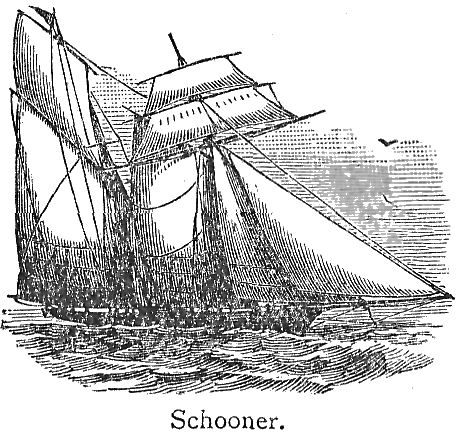
Schooner, skōōn′ėr, n. a sharp-built, swift-sailing vessel, generally two-masted, rigged either with fore-and-aft sails on both masts, or with square top and topgallant sails on the foremast: an old form of covered emigrant-wagon: a large drinking-glass.—n. Schoon′er-smack, a sharp-bowed schooner. [Coined in New England from the prov. Eng. scoon (Scot. scon), to make a flat stone skip along the surface of water; A.S. scúnian.]
Schorl, shorl, n. black tourmaline—also Shorl.—adjs. Schorlā′ceous, Schor′lous, Schor′ly. [Ger. schörl, prob. from Sw. skör, brittle.]
Schottische, sho-tēsh′, n. a dance resembling a polka, danced by a couple: music adapted for the dance.—Also Schottish′. [Ger., 'Scottish.']
Schout, skout, n. a municipal officer in the North American Dutch colonies. [Dut.]
Schrankia, shrang′ki-a, n. a genus of leguminous plants, whose six species are all American—including the sensitive-briar. [Named from the German naturalist F. von Paula Schrank (1747-1835).]
Schuchin, skuch′in, n. an obsolete form of escutcheon.
Schweinitzia, shwī-nit′zi-a, n. a genus of gamopetalous plants of the Indian-pipe family, including the sweet pine-sap or Carolina beech-drops. [The Amer. botanist L. D. von Schweinitz (1780-1834).]
Schwenkfelder, shwengk′fel-dėr, n. a member of a religious sect, founded by Caspar von Schwenkfeld (1490-1561), still found in Pennsylvania.—Also Schwenk′feldian.
Sciadiaceæ, sī-ad-i-ā′sē-ē, n. a family of fresh-water algæ, its typical genus Sciadium.
Sciagraphy, sī-ag′ra-fi, n. the art of casting and delineating shadows as they fall in nature: (archit.) the vertical section of a building to show its interior structure: the art of dialling.—ns. Scī′agraph; Scīag′rapher.—adjs. Scīagraph′ic, -al.—adv. Scīagraph′ically. [Gr. skiagraphia—skia, a shadow, graphein, to write.]
Sciamachy, sī-am′a-ki, n. Same as Sciomachy.
Sciametry, sī-am′e-tri, n. the doctrine of eclipses. [Gr. skia, shadow, metrein, to measure.]
Sciara, sī′a-ra, n. a genus of gnats or midges. [Gr. skiaros, shady—skia, a shadow.]
Sciath, sī′ath, n. an oblong shield of wicker-work formerly used in Ireland. [Ir. sciath.]
Sciatheric, -al, sī-a-ther′ik, -al, adj. pertaining to a sundial. [Gr. skiathēron—skia, shadow, theran, catch.]
Sciatica, sī-at′i-ka, n. a neuralgic affection of the great sciatic nerve.—adjs. Sciat′ic, -al, pertaining to, or affecting, the hip, ischiac.—adv. Sciat′ically. [Low L. sciatica—Gr. ischion.]
Science, sī′ens, n. knowledge systematised: truth ascertained: pursuit of knowledge or truth for its own sake: knowledge arranged under general truths and principles: that which refers to abstract principles, as distinguished from 'art:' pre-eminent skill: trade: a department of knowledge.—n. Scib′ile, something capable of being known.—adjs. Scī′enced, versed, learned; Scī′ent, knowing; Scien′tial (Milt.), producing science: skilful; Scientif′ic, -al (obs.), producing or containing science: according to, or versed in, science: used in science: systematic: accurate.—adv. Scientif′ically.—ns. Scī′entism, the view of scientists; Scī′entist, one who studies science, esp. natural science.—adjs. Scientis′tic.—adv. Scī′ently, knowingly.—n. Scient′olism, false science, superficial knowledge.—Scientific frontier, a term used by Lord Beaconsfield in 1878 in speaking of the rectification of the boundaries between India and Afghanistan, meaning a frontier capable of being occupied and defended according to the requirements of the science of strategy, in opposition to 'a hap-hazard frontier.'—Absolute science, knowledge of things in themselves; Applied science, when its laws are exemplified in dealing with concrete phenomena; Dismal science, political economy; Gay science, a medieval name for belles-lettres and poetry generally, esp. amatory poetry; Inductive science (see Induct); Liberal science, a science cultivated from love of knowledge, without view to profit; Mental science, mental philosophy, psychology; Moral science, ethics, the science of right and wrong, moral responsibility; Occult science, a name applied to the physical sciences of the middle ages, also to magic, sorcery, witchcraft, &c.; Sanitary science (see Sanitary); The exact sciences, the mathematical sciences; The science, the art of boxing; The seven liberal sciences, grammar, logic, rhetoric, arithmetic, music, geometry, and astronomy—these were the seven Terrestrial sciences, as opposed to the seven Celestial sciences, civil law, Christian law, practical theology, devotional theology, dogmatic theology, mystic theology, and polemical theology. [Fr.,—L. scientia—sciens, -entis, pr.p. of scīre, to know.]
Scil, an abbreviation of scilicet.
Scilicet, sil′i-set, adv. to wit, namely, videlicet.
Scilla, sil′a, n. a genus of liliaceous plants, as the squill. [L.,—Gr. skilla, a sea-onion.]
Scillocephalus, sil-ō-sef′a-lus, n. a person with a conical cranium.—adjs. Scilloceph′alous. [Gr. skilla, a squill, kephalē, a head.]
Scimitar, sim′i-tar, n. a short, single-edged curved sword, broadest at the point end, used by the Turks and Persians.—n. Scim′itar-pod, a strong, shrubby climber of the tropics. [O. Fr. cimeterre—Old It. cimitara—Turk.,—Pers. shimshīr (perh. 'lion's claw,' sham, a claw, shīr, sher, a lion); or perh. through Sp. cimitarra, from Basque cimeterra, something 'with a fine edge.']
Scincoid, sing′koid, n. one of a family of saurian reptiles, the typical genus of which is the Scin′cus or skink.—adjs. like a skink. [L. scincus—Gr. skingkos, a kind of lizard, eidos, form.]
Scindapsus, sin-dap′sus, n. a genus of climbing plants.
Scintilla, sin-til′a, n. a spark: a glimmer: the least particle: a trace: a genus of bivalve molluscs: a genus of lepidopterous insects.—adjs. Scin′tillant; Scin′tillante (mus.), brilliant.—v.i. Scin′tillate, to throw out sparks: to sparkle.—n. Scintillā′tion, act of throwing out sparks: shining with a twinkling light.—adj. Scintilles′cent, scintillating feebly.—n. Scintillom′eter, an instrument for measuring the intensity of scintillation of the stars. [L., a spark.]
Sciography, sī-og′ra-fi, n. Same as Sciagraphy.
Sciolism, sī′ō-lizm, n. superficial knowledge.—n. Scī′olist, one who knows anything superficially: a pretender to science.—adjs. Scīolis′tic, pertaining to, or partaking of, sciolism: pertaining to, or resembling, a sciolist; Scī′olous. [L. sciolus, dim. of scius, knowing—scīre, to know.]
Sciolto, shi-ol′tō, adj. (mus.) free, unrestrained. [It.]
Sciomachy, sī-om′a-ki, n. a battle or fighting with shadows: imaginary or futile combat.—Also Sciam′achy. [Gr. skiamachia, skiomachia—skia, shadow, machē, battle.]
Sciomancy, sī′ō-man-si, n. divination by means of the shades of the dead.
Scion, sī′on, n. a cutting or twig for grafting: a young member of a family: a descendant. [O. Fr. sion, cion—L. section-em, a cutting—secāre, to cut.]
Scioptic, sī-op′tik, adj. noting a certain optical arrangement for forming images in a darkened room, consisting of a globe with a lens fitted to a camera, and made to turn like the eye—also Sciop′tric.—ns. Sciop′ticon; Sciop′tics. [Gr. skia, shadow, optikos, pertaining to sight.]
Sciotheism, sī′ō-thē-izm, n. ancestor-worship.
Sciotheric. Same as Sciatheric (q.v.).
Scious, scī′us, adj. (obs.) knowing.
Scire facias, sī′re fā′shi-as, n. (law) a writ to enforce the execution of judgments, or to quash them.
Scirpus, sir′pus, n. a genus of monocotyledonous plants, including the bulrushes. [L., a rush.]
Scirrhus, skir′us, or sir′us, n. (med.) a hardened gland forming a tumour: a hardening, esp. that preceding cancer.—adjs. Scirr′hoid, resembling scirrhus; Scirr′hous, hardened, proceeding from scirrhus. [L.,—Gr. skirros, skiros, a tumour.]
Scirtopod, sir′tō-pod, adj. having limbs fitted for leaping.—n.pl. Scirtop′oda, an order of saltatorial rotifers. [Gr. skirtan, leap, pous, foot.]
Sciscitation, sis-i-tā′shun, n. (obs.) the act of inquiry: demand. [L.,—sciscitāri, to inquire—sciscĕre, to seek to know—scīre, to know.]
Scissel, sis′el, n. the clippings of various metals: scrap—also Sciss′il. [O. Fr. cisaille—ciseler—cisel, a chisel (q.v.). The spelling has been adapted in the interests of a fancied connection with L. scindĕre, scissum, to divide.]
Scissors, siz′orz, n.pl. a cutting instrument consisting of two blades fastened at the middle: shears.—v.i. Scise, sīz (obs.), to cut: to penetrate.—adjs. Sciss′ible, Sciss′ile, capable of being cut.—ns. Scis′sion, the act of cutting: division: splitting; Scissipar′ity, reproduction by fission.—v.t. Sciss′or, to cut with scissors.—ns. Sciss′or-bill, a skimmer; Sciss′or-tail, an American bird, the scissor-tailed fly-catcher; Sciss′or-tooth, the sectorial tooth of a carnivore which cuts against its fellow; Scissū′ra (anat.), a fissure, a cleft; Scis′sure, a cleft: a fissure: a rupture: a division; Scissurel′la, a genus of gasteropods with a shell deeply cut. [Formerly written cisors—O. Fr. cisoires, conn. with Fr. ciseaux, scissors, from Late L. cisorium, a cutting instrument—L. cædĕre, cæsum, to cut.]
Sciuridæ, sī-ū′ri-dē, n. a family of rodent mammals containing the squirrels and their allies.—adjs. Scī′ūrine, Scī′ūroid.—ns. Sciūrop′terus, one of two genera of flying squirrels; Sciū′rus, a genus of Sciuridæ, the arboreal squirrels. [Gr. skiouros.]
Sclate, sklāt, n. an obs. or prov. form of slate.
Sclave, Sclavonian, &c. See Slav, Slavonic.
Sclera, sklē′ra, n. the sclerotic coat of the eye-ball.—n. Sclē′ragogy, severe discipline.—adj. Sclē′ral.—ns. Sclēran′thus, a genus of apetalous plants, including the knawel or German knot-grass; Sclere, in sponges, a skeletal element; Sclērench′yma, the hard parts of corals or plants.—adj. Sclerenchym′atous.—ns. Sclē′ria, a genus of monocotyledonous plants, of the sedge family; Sclerī′asis, sclerodermia; Sclē′rite, any hard part of the integument of arthropods.—adj. Sclerit′ic.—n. Sclē′robase, a dense corneous mass, as in red coral.—adj. Sclerobā′sic.—ns. Sclērobrā′chia, an order of brachiopods; Sclē′roderm, hardened integument or exo-skeleton, esp. of a coral: a madrepore.—n.pl. Scleroder′mata, the scaly reptiles: the madrepores.—n. Sclēroder′mia, a chronic non-inflammatory affection of the skin, which becomes thick and rigid.—adjs. Scleroder′mic, Scleroder′mous, Sclerodermit′ic.—ns. Scleroder′mite; Sclē′rogen, the thickening matter of woody cells, as in walnut-shells, &c.—adjs. Sclerog′enous, producing sclerous tissue: mail-cheeked, as a fish; Sclē′roid, hard, scleritic.—ns. Sclērō′ma, sclerosis; Sclēromē′ninx, the dura mater; Sclērom′eter, an instrument for measuring the hardness of a mineral.—adjs. Sclērō′sal, Sclē′rosed.—ns. Sclērō′sis, a hardening: (bot.) the induration of a tissue; Sclēros′toma, a genus of nematode worms; Sclērō′tal, a bone of the eye-ball.—adj. relating to such.—adj. Sclērot′ic, hard, firm, applied esp. to the outer membrane of the eye-ball: pertaining to sclerosis: relating to ergot.—n. the outermost membrane of the eye-ball.—ns. Sclērotī′tis, inflammation of the sclerotic; Sclērō′tium, a hard, multicellular tuber-like body formed towards the end of the vegetative season by the close union of the ordinary mycelial filaments of Fungi.—adjs. Sclē′rous, hard or indurated: ossified or bony; Sclērur′ine, having stiff, hard tail-feathers, as a bird of the genus Sclerurus. [Gr. sklēros, hard.]
Scoat, skōt, v.t. to prop, to block, to scotch, as a wheel.—Also Scote. [O. Fr. ascouter—ascot, a branch—Teut., Old High Ger. scuz, a shoot; Ger. schuss.]
Scobby, skob′i, n. the chaffinch.—Also Scō′by.
Scobs, skobz, n. sawdust: shavings: dross of metals.—adj. Scob′iform, resembling sawdust or raspings.—n. Scobī′na, the pedicle of the spikelets of grasses. [L. scobis—scabĕre, to scrape.]
Scoff, skof, v.t. to mock: to treat with scorn.—v.i. to show contempt or scorn: to deride, taunt, gibe.—n. an expression of scorn or contempt: an object of scoffing.—n. Scoff′er.—adv. Scoff′ingly, in a scoffing manner: with mockery or contempt. [Old Fris. schof; Ice. skaup, cf. Old Dut. schoppen, to scoff.]
Scoganism, skō′gan-izm, n. a scurrilous jesting. [From Scogan, the name of a famous jester.]
Scogie, skō′ji, n. (Scot.) a kitchen drudge.
Scold, skōld, v.i. to rail in a loud and violent manner: to find fault.—v.t. to chide rudely: to rebuke in words.—n. a rude, clamorous woman: a termagant.—ns. Scold′er; Scold′ing, railing: a rating; Scold′ing-stool, a cucking-stool. [Old Dut. scheldan; Ger. schelten, to brawl, to scold.]
Scolecida, skō-les′i-da, n. a class of worms consisting of the wheel-animalcules, turbellarians, trematode worms, &c.—adj. Scolec′iform.—ns. Scolecī′na, a group of annelids typified by the earth-worm—also Scoleī′na; Scol′ecīte, a hydrous silicate of aluminium and calcium.—adjs. Scolē′coid, like a scolex; Scolēcoph′agous, worm-eating, as a bird.—n. Scolecoph′agus, a genus of birds including the maggot-eaters or rusty grackles.—n.pl. Scolecophid′ia, a division of angiostomous serpents.—adj. Scolecophid′ian, worm-like, as a snake.—n. Scō′lex, the embryo of an entozoic worm. [Gr. skōlēx, a worm.]
Scolia, skō-li-a, n. a genus of fossorial hymenopterous insects. [Gr. skōlos, a prickle.]
Scoliodon, skō-lī′ō-don, n. the genus containing the oblique-toothed sharks. [Gr. skolios, oblique, odous, odontis, a tooth.]
Scolisois, skol-i-ō′sis, n. lateral curvature of the spinal column.—adj. Scoliot′ic. [Gr.,—skolios, oblique.]
Scolite, skō′līt, n. a fossil worm or its trace. [Gr. skolios, oblique.]
Scollop. Same as Scallop.
Scolopaceous, skol-ō-pā′shi-us, adj. resembling a snipe.—n.pl. Scolopac′idæ, a family of wading-birds containing snipes, &c.—adjs. Scol′opacine, Scol′opacoid.—n. Scol′opax. [L. scolopax, a snipe.]
Scolopendra, skol-ō-pen′dra, n. a genus of Myriapoda, having a long, slender, depressed body, protected by coriaceous plates, and having at least twenty-one pairs of legs: (Spens.) an imaginary fish or sea-monster.—adj. Scolopen′driform, Scolopen′drine.—n. Scolopen′drium, a genus of asplenioid ferns, generally called Hart's-tongue. [L.,—Gr. skolopendra, a milliped.]
Scolytus, skol′i-tus, n. typical genus of Scolyt′idæ, a family of bark beetles.—adj. Scol′ytoid. [Gr. skolyptein, to strip.]
Scomber, skom′bėr, n. a genus of acanthopterygian fishes typical of the family Scombridæ, to which belong mackerel, tunnies, bonitos, &c.—ns. Scomber′esox, the mackerel pikes, saury pikes, or sauries; Scomberom′orus, the Spanish mackerel and related species.—adjs. Scom′briform, Scom′brid, -al, Scom′broid. [L.,—Gr. skombros, a mackerel.]
Scomfish, skom′fish, v.t. (Scot.) to suffocate by bad air: to nauseate: to discomfit.—v.i. to be suffocated. [A corr. of obs. scomfit=discomfit.]
Scomm, skom, n. (obs.) a flout: a buffoon. [L. scomma—Gr. skōmma, a jest.]
Sconce, skons, n. a bulwark: a small fort: a protective headpiece, hence the head, the skull, brains, wits: a covered stall: a fine: a seat in an old-fashioned open chimney-place, a chimney-seat: a fragment of an icefloe.—v.t. to fortify: to tax, to fine lightly, at Oxford and Cambridge, for some irregularity. [O. Fr. esconcer, to conceal—L. abscondĕre, absconsum.]
Sconce, skons, n. the part of a candlestick for the candle: a hanging candlestick with a mirror to reflect the light: a lantern. [O. Fr. esconse—Low L. absconsa, a dark-lantern—abscondĕre, to hide.]
Sconcheon. Same as Squinch.
Scone, skōn, n. (Scot.) a soft cake fired on a griddle. [Perh. Gael. sgonn, a shapeless mass.]
Scoon, skōōn, v.t. to skim along like a vessel: (Scot.) to skip flat stones on the surface of water. [Scun.]
Scoop, skōōp, v.t. to lift up, as water, with something hollow: to empty with a ladle: to make hollow: to dig out: to dredge for grain: to get before a rival newspaper in publishing some important piece of news.—n. anything hollow for scooping: a large hollow shovel or ladle: a banker's shovel: a coal-scuttle: a haul of money made in speculation: a place hollowed out: a sweeping stroke: (Scot.) the peak of a cap: the act of beating another newspaper in publishing some news.—ns. Scoop′er, an engraver's tool; Scoop′ing, the action of the right whale in feeding; Scoop′-net, a hand-net; Scoop′-wheel, a wheel having buckets attached to its circumference, used for raising water. [Prob. Scand., Sw. skopa, a scoop; or Old Dut. schœpe, a shovel, Ger. schüppe, a shovel.]
Scoot, skōōt, v.i. to make off with celerity.—v.t. (Scot.) to squirt.—n. a sudden flow of water: a squirt. [A variant of shoot.]
Scopa, skō′pa, n. (entom.) a mass of stiff hairs like a brush.—n. Scopā′ria, a genus of pyralid moths: a genus of gamopetalous plants—the West Indian sweet bromweed.—adjs. Scopā′rious, scopiform; Scō′pate, covered with stiff hairs; Scōpif′erous, brushy; Scō′piform, broom-shaped.—ns. Scop′ula (entom.), a small brush-like organ; Scopulā′ria, in a sponge, the besom-shaped spicule.—adjs. Scop′ūlate, broom-shaped; Scop′ūliform, scopiform; Scop′ūliped, Scō′piped, having brushy feet, as solitary bees. [L. scopa, twigs.]
Scope, skōp, n. that which one sees, space as far as one can see: room or opportunity for free outlook: space for action: the end before the mind: intention: length of cable at which a vessel rides at liberty: a target.—adjs. Scope′ful, with a wide prospect; Scope′less, purposeless, useless. [It. scopo—Gr. skopos—skopein, to view.]
Scope, skōp, n. (obs.) a bundle, as of twigs. [L. scopa, twigs.]
Scopelidæ, skō-pel′i-dē, n.pl. a family of deep-water teleostean fishes, the typical genus Scop′elus. [Gr. skopelos, a rock.]
Scopidæ, skop′i-dē, n.pl. an African family of wading-birds, as the shadow-birds, the typical genus Scō′pus.
Scopious, skō′pi-us, adj. (obs.) spacious.
Scopperil, skop′e-ril, n. a top: teetotum: the bone-foundation of a button. [Ice. skoppa, to spin.]
Scops, skops, n. the screech-owl. [Gr. skōps.]
Scoptic, skop′tik, adj. mocking: jesting. [Scomm.]
Scopulous, skop′ū-lus, adj. full of rocks. [L. scopulus—Gr. skopelos, a high rock.]
Scorbutic, -al, skor-bū′tik, -al, adj. pertaining to, resembling, or diseased with scurvy. [Low L. scorbutus, scurvy, prob. from Old Low Ger. schorbock, scurvy, Old Dut. scheurbuyck, scurvy. Prob. orig. meaning 'rupture of the belly,' for Old Dut. scheuren, to tear, buyck (mod. Dut. buik), the belly.]
Scorch, skorch, v.t. to burn slightly: to roast highly: to affect painfully with heat: to singe: to attack with virulence.—v.i. to be burned on the surface: to be dried up: (slang) to ride a bicycle furiously on a public highway.—ns. Scorched′-car′pet, -wing, British geometrid moths; Scorch′er, anything that scorches, a very caustic rebuke, criticism, &c.: one who rides a bicycle furiously on a road; Scorch′ing.—p.adj. burning superficially: bitterly sarcastic, scathing.—adv. Scorch′ingly.—n. Scorch′ingness. [O. Fr. escorcher, from Low L. excorticare—L. ex, off, cortex, corticis, bark; or prob. Scand., Norw. skrekka, to shrink.]
Scordato, skōr-dä′tō, adj. (mus.) put out of tune.—n. Scordatū′ra, in stringed musical instruments, an intentional departure from the normal tuning. [It.]
Score, skōr, n. a mark or notch for keeping count: a line drawn: the number twenty, once represented by a larger notch: a reckoning: a debt: the register of the various points of play in a game: account: reason: the original draught of a musical composition with all the parts, or its transcript.—v.t. to mark with notches or lines: to furrow: to set down: to charge: to engrave: to braid: to note: to enter: to make points, &c., in certain games.—v.i. to keep, or to run up, a score: to succeed in making points, &c., in a game.—ns. Scōr′er, one who keeps the marks in a game; Scōr′ing, the act of one who, or that which, scores: a deep groove made by glacial action: the act of repeatedly bringing a racer and his rider to the starting-point, so as to get a fair start.—Go off at score, to make a spirited start; Pay off old scores, to repay old grudges; Run up a score, to run up a debt. [A.S. scor—sceran (pa.p. scoren), to shear.]
Scoria, skō′ri-a, n. dross or slag left from metal or ores after being under fire: a genus of geometrid moths:—pl. Scō′riæ, volcanic ashes.—adjs. Scō′riac, Scoriā′ceous.—ns. Scorificā′tion, the act or operation of reducing a body to scoria: a method of assaying by fusing the ore with metallic lead and borax in a scorifier; Scor′ifīer, a flat dish used in such a form of assaying.—adj. Scō′riform, like scoria.—v.t. Scō′rify, to reduce to slag.—adj. Scō′rious. [L.,—Gr. skōria.]
Scorn, skorn, n. disdain caused by a mean opinion of anything: extreme contempt: object of contempt.—v.t. to hold in extreme contempt: to disdain: to make a mock of.—v.i. to scoff: to jeer.—n. Scor′ner, one who scorns: (B.) one who scoffs at religion: a scoffer.—adj. Scorn′ful, full of scorn: contemptuous: disdainful.—adv. Scorn′fully.—ns. Scorn′fulness; Scor′ning.—Laugh to scorn (B.), to deride; Think scorn, to disdain or despise. [O. Fr. escarn, mockery—Old High Ger. skern, mockery.]
Scorodite, skor′ō-dīt, n. a hydrous arseniate of iron.—Also Skor′odite. [Gr. skorodon, skordon, garlic.]
Scorpæna, skor-pē′na, n. a genus of fishes, the typical genus of Scorpæ′nidæ, a family including the rose-fish, the Californian rock-fish, and their allies. [L.,—Gr. skorpaina, a fish.]
Scorper, skor′pėr, n. a gouging-chisel [For scauper.]
Scorpion, skor′pi-un, n. a name applicable to any member of the family Scorpionidæ, included along with spiders, mites, &c. in the heterogeneous class Arachnida—they have an elongated body, claws like the lobster, and a poisonous sting in the tail: one of the signs of the zodiac: (B.) a whip with points like a scorpion's tail: an old military engine: any person of virulent hatred or animosity.—n. Scor′pio, a scorpion: (astron.) a constellation and the eighth sign of the zodiac.—adj. Scor′pioid, curled like the tail of a scorpion.—n. Scor′pion-bug, a large predacious water-beetle.—n.pl. Scorpiō′nes, true scorpions, a sub-order of Arachnida.—ns. Scor′pion-fish, a sea-scorpion; Scor′pion-fly, an insect having its abdomen curled like a scorpion; Scor′pion-grass, the forget-me-not: the mouse-ear; Scorpion′ida, an order of Arachnida, containing the Scorpiones or true scorpions; Scor′pion-lob′ster, a long-tailed crustacean; Scor′pion-plant, a Javan orchid with large creamy flower supposed to resemble a spider; Scor′pion-shell, a gasteropod distinguished by long, channelled spines; Scor′pion-spī′der, a whip-scorpion; Scor′pion-wort, a leguminous plant native of southern Europe; Scorpiū′rus, a genus of leguminous plants named scorpion's tail. [Fr.,—L. scorpio—Gr. skorpios.]
Scorse. Same as Scourse (2).
Scortatory, skor′ta-tō-ri, adj. pertaining to lewdness. [L. scortator, a fornicator—scortum, a whore.]
Scorza, skor′za, n. a variety of epidote. [It.]
Scorzonera, skor-zō-nē′ra, n. a genus of Old World herbs of the Aster family—Viper's Grass. [It., scorza, bark, nera, black, fem. of nero—L. niger, black.]
Scot, skot, n. a payment, esp. a customary tax—also Shot.—adj. Scot′-free, free from scot or payment: untaxed: unhurt, safe.—Scot and lot, an old legal phrase embracing all parochial assessments for the poor, the church, lighting, cleansing, and watching. [A.S. scot, sceot—scéotan, to shoot.]
Scot, skot, n. a native of Scotland: one of the Scoti or Scots, a Celtic race who migrated from Ireland—the original Scotia—before the end of the 5th century.—n. Scō′tia, Scotland.—Scots Greys, a famous regiment of dragoons, established in 1683; Scots Guards, the Scottish force which served the kings of France from 1418 down to the battle of Minden (1759), nominally retained, however, down to 1830: a well-known regiment of Guards in the British army, formerly Scots Fusiliers.—Pound Scots, 1s. 8d. [A.S. Scottas, the Scots. Further ety. quite uncertain, whether Gael. sguit, a wanderer, Gr. Skythēs, a Scythian, &c.]
Scotch, skoch, adj. pertaining to Scotland, its people, language, customs, products, &c.—also Scot′tish, Scots.—n. the dialect of English spoken in Lowland Scotland: (coll.) Scotch whisky.—ns. Scotch′-hop, a child's game: hop-scotch; Scotch′man, Scots′man, a native of Scotland.—Scotch amulet, a British geometrid moth; Scotch and English, the boys' game of prisoner's base; Scotch barley, pot or hulled barley; Scotch bluebell, the harebell; Scotch bonnets, the fairy-ring mushroom; Scotch broth, broth made with pot-barley and plenty of various vegetables chopped small; Scotch cap, the wild black raspberry; Scotch catch, or snap, the peculiarity in Scotch music of the first of two tones played to the same beat being the shorter; Scotch curlies, a variety of kale; Scotch fir, or pine, the only species of pine indigenous to Britain, valuable for its timber, turpentine, tar, &c.; Scotch kale, a variety of kale; Scotch mist, a mist like fine rain; Scotch pebbles, varieties of agate and jasper; Scotch thistle, the national emblem of Scotland.
Scotch, skoch, v.t. to cut or wound slightly: to notch.—n. a notch, scratch.—n. Scotch′ing, a method of dressing stone with a pick.—Scotched-collops, or (erroneously) Scotch-collops, beef-steaks fried with onions. [Related to scutch, scratch.]
Scotch, skoch, n. a strut or drag for a wheel.—v.t. to prop or block with such.—n. Scote, a prop.—v.t. to stop or block.
Scoter, skō′tėr, n. a genus of northern sea-ducks, with bill gibbous at the base. [Prob. Ice. skoti—skjóta, to shoot.]
Scotia, skō′ti-a, n. a concave moulding, as the base of a pillar. [Gr. skotia,—skotos, darkness.]
Scotice, skot′i-sē, adv. in the Scotch language or manner.—n. Scot′icism=Scotticism.
Scotism, skō′tizm, n. the metaphysical system of Johannes Duns Scotus, a native of Dunstane in Northumberland, Dun or Down in the north of Ireland, or Dunse in Berwickshire (1265 or 1274-1308), the great assailant of the method of Aquinas in seeking in speculation instead of in practice the foundation of Christian theology—his theological descendants were the Franciscans, in opposition to the Dominicans, who followed Aquinas.—n. Scō′tist, a follower of Duns Scotus.—adj. Scotis′tic.
Scotograph, skot′ō-graf, n. an instrument for writing in the dark, or for the use of the blind.—ns. Scotō′ma, a defect in the vision (obs. Scot′omy); Scot′ophis, a genus of carinated serpents of North America; Scotor′nis, a genus of African birds with very long tails; Scot′oscope, a night-glass. [Gr. skotos, darkness, graphein, to write.]
Scotticism, skot′i-sizm, n. a Scotch idiom.—v.t. Scott′icise.—n. Scottificā′tion.—v.t. Scott′ify (coll.), to give Scotch character to.
Scoundrel, skown′drel, n. a low worthless fellow: a rascal: a man without principle.—ns. Scoun′dreldom, scoundrels collectively; Scoun′drelism, baseness, rascality.—adv. Scoun′drelly. [For scunner-el, one who scunners, or who causes scunnering—A.S. scunian, to shun.]
Scoup, skowp, v.i. (Scot.) to run: to scamper. [Related to skip.]
Scour, skowr, v.t. to clean by rubbing with something rough: to cleanse from grease or dirt: to remove by rubbing: to cleanse by a current: to search thoroughly by scrubbing: to cleanse by brushing: to purge drastically.—n. the action of a strong current in a narrow channel: violent purging.—ns. Scour′age, refuse water after scouring; Scour′er, drastic cathartic; Scour′ing, in angling, the freshening of angle-worms for bait by putting them in clean sand; Scour′ing-ball, a ball composed of soap, &c., for removing stains of grease.—n.pl. Scour′ing-drops, a mixture of oil of turpentine and oil of lemon used for removing stains.—ns. Scour′ing-rush, one of the horse-tails; Scour′ing-stock, in woollen manufacture, an apparatus in which cloths are treated to remove the oil and to cleanse them in the process of manufacture. [O. Fr. escurer—L. excurāre, to take great care of.]
Scour, skowr, v.i. to run with swiftness: to scurry along.—v.t. to run quickly over.—n. Scour′er, a footpad. [O. Fr. escourre—L. excurrĕre, to run forth.]
Scourge, skurj, n. a whip made of leather thongs: an instrument of punishment: a punishment: means of punishment.—v.t. to whip severely: to punish in order to correct.—n. Scour′ger, a flagellant. [O. Fr. escorgie (Fr. écourgée)—L. (scutia) excoriata, (a whip) made of leather—corium, leather.]
Scourse, skōrs, v.i. (Spens.) to run: to hurry. [O. Fr. escourser—L. excurrĕre, excursum, to run out.]
Scourse, skōrs, v.t. to barter, exchange.—v.i. to make an exchange.—n. (Spens.) discourse.—Also Scorse, Scoss. [Prob. discourse.]
Scout, skowt, n. one sent out to bring in tidings, observe the enemy, &c.: a spy: a sneak: in cricket, a fielder: the act of watching: a bird of the auk family: a college servant at Oxford, the same as gyp in Cambridge and skip in Dublin.—v.t. to watch closely.—n. Scout′-mas′ter, an officer who has the direction of army scouts. [O. Fr. escoute—escouter (It. ascoltare)—L. auscultāre, to listen—auris, the ear.]
Scout, skowt, v.t. to sneer at: to reject with disdain.—adv. Scout′ingly, sneeringly. [Scand.,—Ice. skúta, skúti, a taunt—skjóta, to shoot.]
Scout, skowt, v.i. (Scot.) to pour forth a liquid forcibly, esp. excrement.—n. the guillemot.
Scouter, skowt′ėr, n. a workman who uses jump-drills, wedges, &c. to scale off large flakes of stone.
Scouth, skowth, n. (Scot.) room: scope, plenty.
Scouther, skow′thėr, v.t. (Scot.) to scorch: to fire hastily, as on a gridiron.
Scovan, skō′van, n. a Cornish name for a vein of tin.
Scove, skōv, v.t. to cover with clay so as to prevent the escape of heat in burning.
Scoved, skōvd, adj. (prov.) smeared or blotched.—Also Scō′vy.
Scovel, skuv′l, n. (prov.) a mop for sweeping ovens.
Scow, skow, n. a flat-bottomed boat: a ferry-boat. [Dut. schouw.]
Scowl, skowl, v.i. to wrinkle the brows in displeasure: to look sour or angry: to look gloomy.—n. the wrinkling of the brows when displeased.—p.adj. Scow′ling.—adv. Scow′lingly. [Scand., Dan. skule, to scowl; Low Ger. schulen, to look slyly.]
Scowl, skowl, n. (prov.) old workings of iron ore.
Scowther, Scouther, skow′thėr, n. (prov.) a flying shower.
Scrab, skrab, n. a crab-apple.
Scrabble, skrab′l, v.i. to scrape or make unmeaning marks, to scrawl: to scramble or crawl along with difficulty.—v.t. to gather hastily.—n. a scramble.—v.t. Scrab, to scratch, to scrape.—Scrabbed eggs, a dish of hard-boiled eggs chopped up and seasoned. [A form of scrapple, freq. of scrape.]
Scraffle, skraf′l, v.i. to scramble: to wrangle: to be industrious: to shuffle. [A form of scrabble or scramble.]
Scrag, skrag, n. anything thin or lean and rough: the bony part of the neck.—v.t. to put to death by hanging.—adjs. Scrag′ged, Scrag′gy, lean and rough: uneven, rugged.—ns. Scrag′gedness, Scrag′giness.—adv. Scrag′gily.—adjs. Scrag′gly, rough-looking; Scrag′-necked, having a long, thin neck.—n. Scrag′-whale, a finner whale, having the back scragged. [Scand., Sw. prov. shraka, a tall tree or man, shrokk, anything shrivelled—Norw. skrekka, to shrink.]
Scraich, Scraigh, skrāh, v.i. (Scot.) to scream hoarsely: to screech, to shriek.—n. Scraich. [Gael. sgreach.]
Scramb, skramb, v.t. (prov.) to scrape together with the hands. [A variant of scramp.]
Scramble, skram′bl, v.i. to struggle to seize something before others: to catch at or strive for rudely: to wriggle along on all-fours.—v.t. to throw down to be scrambled for: to advance or push.—n. act of scrambling: a struggle for office.—n. Scram′bler.—adj. Scram′bling, confused and irregular.—adv. Scram′blingly, in a scrambling manner: irregularly: unceremoniously. [Prov. Eng. scramb, to rake together with the hands, or scramp, to snatch at; nearly allied to scrabble and scrape.]
Scramp, skramp, v.t. to catch at, snatch. [Scramble.]
Scran, skran, n. broken victuals: refuse—also Skran.—n. Scran′ning, the act of begging for food.—Bad scran to you! bad fare to you! an Irish imprecation. [Prob. Ice. skran, rubbish.]
Scranch, skransh, v.t. to grind with the teeth: to crunch.—Also Scraunch, Scrunch. [Prob. Dut. schransen, to eat heartily.]
Scranky, skrank′i, adj. (Scot.) scraggy: lank.
Scrannel, skran′l, adj. (Milt.) producing a weak, screeching noise: thin: squeaking.
Scranny, skran′i, adj. (prov.) lean and thin.
Scrap, skrap, n. a small piece: a remnant: a picture suited for preservation in a scrap-book: wrought-iron clippings: an unconnected extract.—v.t. to consign to the scrap-heap.—ns. Scrap′-book, a blank book for scraps or extracts, prints, &c.; Scrap′-heap, a place where old iron is collected; Scrap′-ī′ron, old iron accumulated for reworking; Scrap′-met′al, scraps or fragments of any kind of metal, which are only of use for remelting.—adv. Scrap′pily, in fragments, desultorily.—n. Scrap′piness, fragmentariness, disconnectedness.—adj. Scrap′py.—Go to the scrap-heap, to go to ruin. [Scand., Ice. skrap, scraps—skrapa, to scrape.]
Scrap, skrap, n. (slang) a fight, scrimmage.
Scrap, skrap, n. a snare for birds.
Scrape, skrāp, v.t. to make a harsh or grating noise on: to rub with something sharp: to remove by drawing a sharp edge over: to collect by laborious effort: to save penuriously: to erase.—v.i. to grub in the ground: to rub lightly: to draw back the foot in making obeisance: to play on a stringed instrument.—n. a perplexing situation: difficulty: a shave.—adj. Scrape′-good, miserly, stingy.—ns. Scrape′-penn′y, a miser; Scrap′er, an instrument used for scraping, esp. the soles of shoes outside the door of a house: a hoe: a tool used by engravers and others: a fiddler; Scrap′ing, that which is scraped off, as the scrapings of the street: shavings, hoardings; Scrap′ing-plane, a plane used by workers in metal and wood.—Scrape acquaintance with, to get on terms of acquaintance. [Scand., Ice. skrapa, to scrape; Dut. schrapen; A.S. scearpian.]
Scrapple, skrap′l, v.i. to grub about.—n. a mixture of meat-scraps, herbs, &c. stewed, pressed in cakes, sliced and fried. [Dim. of scrap.]
Scrat, skrat, n. a devil.—Also Old Scratch, the devil. [Cf. Ger. schratt, Ice. skratti, a goblin.]
Scratch, skrach, v.t. to mark the surface with something pointed, as the nails: to tear or to dig with the claws: to write hurriedly: to erase.—v.i. to use the claws in tearing or digging: to delete a name on a voting-paper.—n. a mark or tear made by scratching: a slight wound: the line in a prize-ring up to which boxers are led—hence test, trial, as in 'to come up to the scratch:' (pl.) a disease in horses: the time of starting of a player: in billiards, a chance stroke which is successful: a kind of wig, a scratch-wig: a scrawl.—adj. taken at random, as a 'scratch crew:' without handicap, or allowance of time or distance.—ns. Scratch′-back, a kind of toy, which, when drawn over a person's back, makes a sound as if his coat was torn; Scratch′-brush, a name given to various forms of brushes; Scratch′-coat, the first coat of plaster; Scratch′er, a bird which scratches for food.—adv. Scratch′ingly.—n.pl. Scratch′ings, refuse matter strained out of fat when melted.—ns. Scratch′-weed, the goose-grass; Scratch′-wig, a wig that covers only part of the head; Scratch′-work, a kind of wall decoration.—adj. Scratch′y, ragged: scratching: of little depth.—Scratch out, to erase. [Explained by Skeat as due to the confusion of M. E. skratten, to scratch, with M. E. cracchen, to scratch: skratten standing for skarten, an extended form from Ice. sker-a, to shear; cracchen, again, stands for kratsen—Sw. kratsa, to scrape.]
Scrattle, skrat′l, v.i. (prov.) to scuttle.
Scraw, skraw, n. a turf, a sod. [Gael. scrath.]
Scrawl, skrawl, n. (U.S.) brushwood.
Scrawl, skrawl, v.t. and v.i. to scrape, mark, or write irregularly or hastily.—n. irregular or hasty writing: bad writing: a broken branch of a tree: the young of the dog-crab.—n. Scrawl′er.—adj. Scrawl′y, ill-formed. [A contr. of scrabble.]
Scrawm, skrawm, v.t. (prov.) to tear, to scratch. [Prob. Dut. schrammen, schram, a rent.]
Scrawny, skraw′ni, adj. wasted: raw-boned.—n. Scraw′niness. [Scranny.]
Scray, skrā, n. the sea-swallow. [W. ysgräell.]
Screak, skrēk, v.t. to scream: to creak.—n. a screech.
Scream, skrēm, v.i. to cry out with a shrill cry, as in fear or pain: to shriek.—n. a shrill, sudden cry, as in fear or pain: a shriek.—n. Scream′er, one who screams: a genus of South American birds about the size of the turkey, with loud, harsh cry: (U.S. slang) a bouncer.—Screaming farce, one highly ludicrous. [Scand., Ice. skræma, Sw. skrämma, to fear; cf. Screech, Shriek.]
Scree, skrē, n. débris at the base of a cliff.—Also Screes. [Ice. skritha, a landslip—skrítha, creep.]
Scree, skrē, n. (Scot.) a coarse sieve.
Screech, skrēch, v.i. to utter a harsh, shrill, and sudden cry.—n. a harsh, shrill, and sudden cry.—ns. Screech′er, the swift; Screech′-hawk, the night-jar; Screech′-mar′tin, the swift; Screech′-owl, a kind of screeching owl: the missel-thrush: the barn-owl; Screech′-thrush, the missel-thrush.—adj. Screech′y, shrill and harsh, like a screech: loud-mouthed. [M. E. scriken—Scand., Ice. shrækja, to shriek; cf. Gael. sgreach, to shriek.]
Screed, skrēd, n. a piece torn off: a shred: a long tirade: (Scot.) a strip of mortar: a rent, a tear.—v.t. to repeat glibly. [A.S. screáde, a shred.]
Screen, skrēn, n. that which shelters from danger or observation, that which protects from heat, cold, or the sun: (Scot.) a large scarf: an enclosure or partition of wood, stone, or metal work, common in churches, shutting off chapels from the nave, separating the nave from the choir, &c.: a coarse riddle for sifting coal, &c.—v.t. to shelter or conceal: to pass through a coarse riddle.—n. Screen′ing-machine′, an apparatus for sifting coal.—n.pl. Screen′ings, the refuse matter after sifting. [O. Fr. escren (Fr. écran), from Old High Ger. scranna, a court; Ger. schranne, a bench.]
Screever, skrēv′ėr, n. one who writes begging letters.—v.t. Screeve, to write such.—n. Screev′ing, the writing of begging letters: drawing with coloured chalks on the pavement for coppers.
Screw, skrōō, n. a cylinder with a spiral groove or ridge on either its outer or inner surface, used as a fastening and as a mechanical power: a screw-propeller: a turn or twist to one side: a penny packet of tobacco put up in a paper twisted at both ends: a stingy fellow, an extortioner, a skinflint: a broken-winded horse: pressure: (U.S. slang) a professor who requires students to work hard: salary, wages.—v.t. to apply a screw to: to press with a screw: to twist: to oppress by extortion: to force: to squeeze.—ns. Screw′-bolt, a bolt threaded at one end for a nut; Screw′-cut′ter, a hand-tool for cutting screws; Screw′-driv′er, an instrument for driving or turning screw-nails.—adj. Screwed (slang), tipsy, tight.—ns. Screw′-el′evator, a dentist's instrument: a surgeon's instrument for forcing open the jaws; Screw′er.—adj. Screw′ing, exacting: close.—ns. Screw′-jack (same as Jackscrew); Screw′-key, a lever for turning the nut of a screw; Screw′-machine′, a machine for making screws; Screw′-nail, a nail made in the form of a screw; Screw′-pile, a pile forced into the ground, and held there by a peculiar kind of screw at the lower extremity; Screw′-pine, a plant of the tropical genus Pandanus, or of the screw-pine family—from the screw-like arrangement of the clustered leaves; Screw′-plate, a plate of steel in which are a graduated series of holes, with internal screws used in forming external screws; Screw′-pod, the screw-bean Screw′-press, a press in which the force is applied by means of a screw; Screw′-propel′ler, a screw or spiral-bladed wheel at the stern of steam-vessels for propelling them: a steamer so propelled; Screw′-rudd′er, an application of the screw for the purpose of steering; Screw′-stair, a spiral staircase: a hanging stair; Screw′-steam′er, a steamer propelled by a screw; Screw′stone, a wheelstone: a fossil screw; Screw′-thread, the spiral ridge on the cylinder of a male screw, or on the inner surface of a female screw; Screw′-valve, a stop-cock opened and shut by means of a screw instead of a spigot; Screw′-ven′tilator, a ventilating apparatus; Screw′-worm, the larva of a blow-fly; Screw′-wrench, a tool for grasping the flat sides of the heads of large screws.—adj. Screw′y, exacting: close: worthless.—A screw loose, something defective. [Earlier scrue. O. Fr. escrou, prob. L. scrobem, accus. of scrobs, a hole; or Low Ger. schruve, Dut. schroef, Ice. skrufa, Ger. schraube.]