Front matter (continued 7)
Reading edition
Soke, sōk, n. the same as Soc (q.v.).—ns. Soke′man=Socman; Sō′ken, a district held by tenure of socage: a miller's right to the grinding of all the corn within a certain manor.
Sol, sol, n. the sun, Phœbus: (her.) a tincture, the metal or, or gold, in blazoning by planets. [L.]
Sol, sol, n. an old French coin, 1⁄20th of a livre, equal to 12 deniers, now superseded by the sou. [O. Fr. sol—L. solidus, solid.]
Sola, sō-lä′, interj. a cry to a person at a distance.
Sola, sō′lä, n. the hat-plant or sponge-wood, also its pith.—Also Sō′lah. [Hind. sholā.]
Solace, sol′ās, n. consolation, comfort in distress: relief: (obs.) pleasure, amusement.—v.t. to comfort in distress: to console: to allay.—n. Sol′acement, the act of solacing: the state of being solaced.—adj. Solā′cious (obs.), affording pleasure. [O. Fr. solas—L. solatium—solāri, -ātus, to comfort in distress.]
Solander, sō-lan′dėr, n. a case or box, usually in the form of a book, opening on the side or front with hinges, for holding prints, drawings, or pamphlets—named from the inventor, Daniel Solander (1736-81).
Solan-goose, sō′lan-gōōs, n. the gannet.—Also Sō′land. [Ice. súla.]
Solano, sō-lä′no, n. a hot south-east wind which occasionally visits Spain. [Sp.,—L. solanus (ventus), the east wind—sol, the sun.]
Solanum, sō-lā′num, n. a genus of plants of the order Solanaceæ or Solaneæ, the nightshade family—almost all the species containing a poisonous alkaloid, Sol′anine.—adjs. Solanā′ceous, belonging to the Solanaceæ; Sol′anoid, potato-like, said of cancers. [L. solanum, the nightshade.]
Solar, sō′lar, adj. pertaining to the sun: measured by the progress of the sun: produced by the sun.—n. Sōlarisā′tion, exposure to the action of the sun's rays: the effect in photography of over-exposure.—v.t. Sō′larise, to injure by exposing too long to the sun's light in a camera.—v.i. to take injury by too long exposure to the sun's light in a camera:—pr.p. sō′larīsing; pa.p. sō′larīsed.—ns. Sō′larism, excessive use of solar-myths in the explanation of mythology; Sō′larist, one addicted to solarism; Sōlā′rium, a sun-dial: a place suited to receive the sun's rays—in a hospital or sanatorium; Sō′lar-mī′croscope, an apparatus for projecting upon a screen by means of sunlight an enlarged view of any object—essentially the same as the combination of lenses used in the magic-lantern taken in conjunction with a heliostat; Sō′lar-myth, a myth allegorising the course of the sun, by some mythologists constantly invoked to explain the problems of mythology; Sō′lar-print, a photographic print made in a solar camera from a negative; Sō′lar-sys′tem, the planets and comets which circle round the sun—also called Planetary-system.—Solar flowers, flowers which open and shut daily at certain hours; Solar spots=Sun-spots (see Sun); Solar time (see Time); Solar year (see Year). [L. sol, the sun, solaris, pertaining to the sun.]
Solaster, sō-las′tėr, n. the typical genus of Solasteridæ, a family of star-fishes, having more than five rays. [L. sol, the sun, aster, a star.]
Solatium, sō-lā′shi-um, n. any compensation, a sum legally awarded, over and above actual damages, by way of compensation for wounded feelings. [L.]
Sold, sōld, pa.t. and pa.p. of sell.
Sold, sold, n. (Spens.) pay, remuneration. [Fr. solde—L. solidus, a piece of money.]
Soldado, sōl-dä′dō, n. a soldier. [Sp.]
Soldan, sōl′dan, n. (Milt.). Same as Sultan.
Soldanel, sol′da-nel, n. a plant of the genus Soldanella, of the order Primulaceæ—the blue moonwort.
Soldatesque, sol-da-tesk′, adj. soldier-like, [Fr.,—soldat, a soldier.]
Solder, sod′ėr, or sol′dėr, v.t. to unite two metallic surfaces by a fusible metallic cement: to cement.—n. a fusible alloy for uniting metals.—ns. Sol′derer; Sol′dering; Sol′dering-bolt, -ī′ron, a tool with pointed or wedge-shaped copper bit for use in soldering. [O. Fr. soudre, souldure—souder, soulder, to consolidate—L. solidāre, to make solid.]
Soldier, sōl′jėr, n. a man engaged in military service: a private, as distinguished from an officer: a man of much military experience or of great valour: a soldier-ant, beetle, hermit-crab, &c.: (slang) a red herring.—v.i. to serve as a soldier: to bully: to shirk one's work or duty: (slang) to take a mount on another man's horse.—ns. Sol′dier-crab, a hermit-crab; Sol′diering, the state of being a soldier: the occupation of a soldier.—adjs. Sol′dier-like, Sol′dierly, like a soldier: martial: brave.—ns. Sol′dier-of-for′tune, one ready to serve anywhere for pay or his own advancement; Sol′diership, state or quality of being a soldier: military qualities: martial skill; Sol′diery, soldiers collectively: the body of military men; Fresh′water-sol′dier, the Stratiotes aloides, a European aquatic plant with sword-shaped leaves.—Come the old soldier over one, to impose on any one.—Old soldier, a bottle emptied at a sitting: a cigar-stump. [O. Fr. soldier (Fr. soldat)—L. solidus, a piece of money, the pay of a soldier.]
Soldo, sol′dō, n. an Italian coin, 1⁄20th of the lira, a sol or sou:—pl. Sol′di. [It.]
Sole, sōl, n. the lowest part or under-side of the foot: the foot: the bottom of a boot or shoe: the bottom of anything.—v.t. to furnish with a sole.—adj. Solē′iform, slipper-shaped.—ns. Sole′-leath′er, strong leather for the soles of boots and shoes; Sole′-tile, a form of tile for the bottoms of sewers, &c.; Sōlē′us, a flat muscle of the calf of the leg beneath the gastrocnemius. [A.S. sole—L. solea—solum, bottom.]
Sole, sōl, n. a genus (Solea) of flat-fish, elongate-oval in form, with flesh firm, white, and excellently flavoured. [Fr. sole—L. solea.]
Sole, sōl, adj. alone: only: being or acting without another: single: (law) unmarried.—advs. Sole; Sole′ly, alone: only: singly.—n. Sole′ness. [Fr.,—L. solus, alone.]
Solecism, sol′ē-sizm, n. a breach of syntax: any absurdity or impropriety: any incongruity, prodigy.—v.i. Sol′ēcise, to commit solecisms.—n. Sol′ēcist, one who commits solecisms.—adjs. Solēcist′ic, -al, pertaining to, or involving, a solecism: incorrect: incongruous.—adv. Solēcist′ically. [Fr. solécisme—L. solœcismus—Gr. soloikismos—soloikos, speaking incorrectly, awkward; dubiously said to come from the corruption of the Attic dialect among the Athenian colonists of Soloi in Cilicia.]
Solein, sol′ān, adj. (Spens.) sad. [Sullen.]
Solemn, sol′em, adj. attended with religions ceremonies, pomp, or gravity, originally taking place every year, said esp. of religious ceremonies: impressing with seriousness: awful: devout: having the appearance of gravity: devotional: attended with an appeal to God, as an oath: serious: sober, gloomy, black.—n. Solemnisā′tion.—v.t. Sol′emnise, to perform religiously or solemnly once a year, or periodically: to celebrate with due rites: to render grave.—ns. Sol′emniser; Solem′nity, a solemn religious ceremony: a ceremony adapted to inspire with awe: reverence: seriousness: affected gravity.—adv. sol′emnly.—n. Sol′emnness. [O. Fr. solempne, solemne (Fr. solennel)—L. sollemnis, solennis—sollus, all, every, annus, a year.]
Solen, sō′len, n. a genus of bivalve molluscs—Razor-shell and Razor-fish.—adjs. Solanā′cean, Solanā′ceous.—n. Sol′enite, a fossil razor-shell. [Gr. sōlēn, a channel.]
Solenoid, sō-lē′noid, n. a helix of copper wound in the form of a cylinder, longitudinally magnetised with an intensity varying inversely as the area of the normal section in different parts.—adj. Solēnoi′dal.—adv. Solēnoi′dally. [Gr. sōlēn, a pipe, eidos, form.]
Solenostomous, sol-ē-nos′tō-mus, adj. having a tubular or fistulous snout.—n. Solenos′tomus, the typical genus of the Solenostomidæ, a family of solenostomous lophobranchiate fishes. [Gr. sōlēn, a pipe, stoma, mouth.]
Solert, sol′ert, adj. (obs.) subtle.—n. Soler′tiousness. [L. sollers, crafty, sollertia, skill.]
Soleus. See Sole (1).
Sol-fa, sol′-fa, v.i. to sing the notes of the scale in their proper pitch, using the syllables do (or ut), re, mi, fa, sol, la, si;—pr.p. sol-faing (sol′-fa-ing); pa.p. sol-faed (sol′-fad).—ns. Sol′faïsm, singing by syllables, solmisation; Sol′faïst, a teacher or advocate of solmisation; Solfeg′gio, an exercise on the notes of the scale, as represented by do, re, mi, &c. [It.]
Solfatara, sol-fä-tä′ra, n. a volcanic region no longer violently active, but emitting from crevices gases, steam, and chemical vapours, chiefly of sulphurous origin—Fr. soufrière, Ger. schwefelgrube or schwefelsee. [It.,—solfo, sulphur.]
Solferino, sol-fe-rē′nō, n. the colour of rosaniline—from the French victory at Solferino in Italy (1859).
Solicit, sō-lis′it, v.t. to ask earnestly: to petition: to seek or try to obtain: to disturb.—n. solicitation.—ns. Solic′itant, one who solicits; Solicitā′tion, a soliciting: earnest request: invitation; Solic′iting (Shak.), solicitation; Solic′itor, one who asks earnestly: one who is legally qualified to act for another in a court of law, esp. a court of equity: a lawyer who prepares deeds, manages cases, instructs counsel in the superior courts, and acts as an advocate in the inferior courts; Solic′itor-gen′eral, in England, the law-officer of the crown next in rank to the attorney-general—in Scotland, to the lord-advocate; Solic′itorship.—adj. Solic′itous, soliciting or earnestly asking or desiring: very desirous: anxious: careful.—adv. Solic′itously.—ns. Solic′itousness, Solic′itude, state of being solicitous: anxiety or uneasiness of mind: trouble. [Fr. solliciter—L. sollicitāre—sollicitus—sollus, whole, citus, aroused—ciēre, to cite.]
Solid, sol′id, adj. having the parts firmly adhering: hard: compact: full of matter: not hollow: strong: having length, breadth, and thickness (opposed to a mere surface): cubic: substantial, reliable, worthy of credit, satisfactory: weighty: of uniform undivided substance: financially sound, wealthy: unanimous, smooth, unbroken, unvaried.—n. a substance having the parts firmly adhering together: a firm, compact body—opp. to Fluid.—ns. Solidā′go, a genus of composite plants, the goldenrods; Solidare, sol′idār (Shak.), a small piece of money; Solidar′ity, the being made solid or compact: the being bound: a consolidation or oneness of interests.—adj. Sol′idary, marked by solidarity, jointly responsible.—v.t. Sol′idate, to make solid or firm.—adj. Solid′ifiable.—n. Solidificā′tion, act of making solid or hard.—v.t. Solid′ify, to make solid or compact.—v.i. to grow solid: to harden:—pa.p. solid′ified.—ns. Sol′idism, the doctrine that refers all diseases to alterations of the solid parts of the body; Sol′idist, a believer in the foregoing; Solid′ity, the state of being solid: fullness of matter: strength or firmness, moral or physical: soundness: (geom.) the solid content of a body.—adv. Sol′idly.—n. Sol′idness.—Solid colour, a colour covering the whole of an object: a uniform colour; Solid matter (print.), matter set without leads between the lines.—Be solid for (U.S.), to be hearty or unanimous in favour of; Be solid with (U.S.), to have a firm footing with. [Fr.,—L. solidus, solid.]
Solidum, sol′i-dum, n. (archit.) the die of a pedestal: (Scots law) a complete sum. [L.]
Solidungular, sol-id-ung′gū-lar, adj. having hoofs solid, that are not cloven, denoting a certain tribe of mammalia.—Also Solidung′ulous, Solidung′ulate. [L. solidus, solid, ungula, a hoof.]
Solidus, sol′i-dus, n. a Roman gold coin introduced by Constantine in place of the aureus, known later as the bezant: a sign (/) denoting the English shilling, representing the old lengthened form of s—£ s. d. (libræ, solidi, denarii), pounds, shillings, pence.
Solifidian, sol-i-fid′i-an, n. one who holds that faith alone is what is necessary for justification.—adj. holding this view.—n. Solifid′ianism. [L. solus, only, fides, faith.]
Soliloquy, sō-lil′ō-kwe, n. a talking when solitary or to one's self: a discourse of a person, not addressed to any one.—v.i. Solil′oquise, to speak to one's self or utter a soliloquy. [L. soliloquium—solus, alone, loqui, to speak.]
Soliped, sol′i-ped, n. an animal with a single or uncloven hoof on each foot.—adjs. Sol′iped, Solip′edous. [L. solus, alone, pes, pedis, a foot.]
Solipsism, sol′ip-sizm, n. the theory that self-existence is the only certainty, absolute egoism—the extreme form of subjective idealism.—n. Sol′ipsist, one who believes in this.—adj. Solipsis′tic. [L. solus, alone, ipse, self.]
Solisequious, sol-i-sē′kwi-us, adj. following the sun, as the sunflower. [L. sol, the sun, sequi, to follow.]
Solitaire, sol-i-tār′, n. a recluse or one who lives alone: a game played by one person with a board and balls: a card-game for one—patience: an ornament worn singly on the neck or wrist: a black silk tie fixed to the bag of the wig behind, worn in the 18th century.
Solitary, sol′i-tar-i, adj. being the sole person present: alone or lonely: single, separate, simple: living alone, not social or gregarious: without company: remote from society: retired, secluded: gloomy.—n. one who lives alone: a recluse or hermit—(obs.) Solitā′rian.—adv. Sol′itarily.—n. Sol′itariness. [Fr. solitaire—L. solitarius—solus, alone.]
Solito, sol′i-tō, adv. (mus.) in the usual manner. [It.]
Solitude, sol′i-tūd, n. a being alone: a lonely life: want of company: a lonely place or desert. [Fr.,—L. solitudo—solus, alone.]
Solivagous, sō-liv′a-gus, adj. wandering alone.—Also Soliv′agant. [L., solus, alone, vagus, wandering.]
Solive, so-lēv′, n. a joist or beam of secondary importance. [Fr.,—L. sublevāre, to support.]
Sollar, sol′ar, n. a platform in a mine: an upper gallery or balcony, a garret, loft.—Also Soll′er. [O. Fr. soler, solier—L. solarium, a terrace or flat roof—sol, the sun.]
Solleret, sol′ėr-et, n. the steel shoe worn in medieval armour. [O. Fr. soler, a slipper, sole, a sole.]
Sol-lunar, sol′-lū′nar, adj. pertaining to, or due to the influence of, both sun and moon. [L. sol, sun, luna, moon.]
Solmisation, sol-mi-zā′shun, n. sol-faïng: a recital of the notes of the gamut, do, re, mi, &c.
Solo, sō′lō, n. a musical piece performed by only one voice or instrument:—pl. Sō′lōs.—adj. Sō′lō, unconcerted.—n. Sō′lōist. [It.,—L. solus, alone.]
Solograph, sol′ō-graf, n. a sun-print. [L. sol, the sun, Gr. graphein, to write.]
Solomon, sol′o-mon, n. a person of unusual wisdom, from Solomon, king of Israel (see 1 Kings, iii. 5-15).—adj. Solomon′ic.—n. Sol′omon's-seal, any one of several species of perennial herbs, of the lily family, genus Polygonatum, with simple stems bearing small greenish flowers: a symbol formed of two triangles interlaced or superposed, forming a six-pointed star.
So-long, sō-long′, interj. good-bye! [Not salaam.]
Solonian, sō-lō′ni-an, adj. pertaining to the Athenian lawgiver Solon (c. 640-c. 558 B.C.), or to his legislation.—Also Solon′ic.
Solpuga, sol-pū′ga, n. the typical genus of Solpugida, an order of arachnids.
Solstice, sol′stis, n. that point in the ecliptic at which the sun is farthest from the equator, and where it is consequently at the turning-point of its apparent course—the summer solstice, where it touches the tropic of Cancer; the winter solstice, where it touches that of Capricorn: the time when the sun reaches these two points in its orbit, 21st June and about 21st December.—adj. Solsti′tial, pertaining to, or happening at, a solstice, esp. at the north one. [Fr.,—L. solstitium—sol, the sun, sistĕre, to make to stand—stāre, to stand.]
Soluble, sol′ū-bl, adj. capable of being solved or dissolved in a fluid.—ns. Solubil′ity, Sol′ubleness, capability of being dissolved in a fluid. [L. solubilis—solvĕre, to solve.]
Solum, sō′lum, n. ground, a piece of ground. [L., the ground.]
Solus, sō′lus, adj. alone, in dramatic directions—feminine form Sō′la. [L., alone.]
Solution, sol-ū′shun, n. act of solving or dissolving, esp. a solid by a fluid: the separating of the parts of any body: the preparation resulting from dissolving a solid in a liquid: explanation: removal of a doubt: construction or solving of a problem: the crisis of a disease.—adj. Solūte′, loose, free: merry, cheerful: (bot.) not adhering.—v.t. (Bacon) to dissolve.—adj. Sol′ūtive, tending to dissolve: loosening.—Solution of continuity (surg.), the separation of parts normally continuous, by fracture, &c. [L. solutio—solvĕre, solutum, to loosen.]
Solve, solv, v.t. to loosen or separate the parts of: to clear up or explain: to remove.—ns. Solvabil′ity, Sol′vableness, capacity of being solved.—adj. Sol′vable, capable of being solved or explained: capable of being paid.—n. Sol′vency, state of being solvent, or able to pay all debts.—adj. Sol′vent, having power to solve or dissolve: able to pay all debts.—n. anything that dissolves another.—n. Sol′ver, one who solves. [O. Fr. solver—L. solvĕre, to loosen, prob. from se-, aside, luĕre, to loosen.]
Soma, sō′ma, n. a certain plant, most prob. of the milkweed family, and its juice used for the preparation of an intoxicating drink—personified and worshipped, esp. in connection with the god Indra, the Jupiter pluvius of the Vedic pantheon. [Sans. soma (Zend haoma, juice)—root su (cf. Gr. ὕω), to press out, distil, extract.]
Somatist, sō′ma-tist, n. one who admits the existence of corporeal beings only.—n. Sō′ma, the trunk of an animal: the body as distinguished from the psyche or soul and the pneuma or spirit.—adjs. Sōmat′ic, -al, physical, corporeal: parietal: pertaining to the body cavity.—n. Sō′matism, materialism.—adjs. Sōmatolog′ic, -al, pertaining to somatology, corporeal, physical.—ns. Sōmatol′ogy, the doctrine or science of bodies or material substances, human anatomy and physiology; Sō′matome, one of the homologous serial segments of which the body of a vertebrate is theoretically composed.—adj. Sōmatopleu′ral, pertaining to the Somat′opleure, the outer one of two divisions of the mesoderm of a four-layered germ.—n. Sōmatot′omy, the dissection of a body.—adj. Sōmatotrop′ic, showing Somatot′ropism, any stimulative influence exerted upon growing organs by the substratum on which they grow. [Gr. sōma, the body.]
Sombre, som′bėr, adj. dull: gloomy: melancholy—also Som′brous.—adv. Som′brely, in a sombre or gloomy manner.—n. Som′breness.—adv. Som′brously.—n. Som′brousness. [Fr. sombre (Sp. sombra, a shade)—L. sub, under, umbra, a shade. So Diez; others explain, on analogy of O. Fr. essombre, a shady place, as from L. ex, out, umbra, a shade.]
Sombrerite, som-brā′rīt, n. a hard impure calcium phosphate—called also Rock-guano, Osite, and loosely Apatite. [Sombrero in the Antilles.]
Sombrero, som-brā′rō, n. a broad-brimmed hat, generally of felt, much worn in Mexico and the south-western United States. [Sp.,—sombre, a shade.]
Some, sum, adj. denoting an indefinite number or quantity: certain, in distinction from others: moderate or in a certain degree: about.—adv. (prov.) somewhat, in some degree.—n. Some′body, some or any body or person: a person of importance.—advs. Some′deal, Some′dele (Spens.), in some degree, somewhat; Some′gate (Scot.), somewhere, somehow; Some′how, in some way or other.—adj. Some′-such, somewhat of that kind.—n. Some′thing, an indefinite thing or event: a portion, an indefinite quantity.—adv. in some degree.—advs. Some′time, at a time not fixed: once: at one time or other; Some′times, at certain times: now and then: at one time: (B.) once, formerly.—n. Some′what, an unfixed quantity or degree.—adv. in some degree.—advs. Some′when, some time or other; Some′where, in some place: in one place or another; Some′while, sometimes, at times; Some′whither, to some place. [A.S. sum; Goth. sums, Ice. sumr.]
Somersault, sum′ėr-sawlt, n. a leap in which a person turns with his heels over his head.—Also Som′erset. [Corr. of Fr. soubresaut (It. soprasalto)—L. supra, over, saltus, a leap—salīre, to leap.]
Somite, sō′mīt, n. a segment of the body of an articulated or vertebrate animal: an arthromere or metamere.—adjs. Sō′mital, Somit′ic.
Somnambulate, som-nam′bū-lāt, v.i. to walk in sleep.—adj. Somnam′būlant, sleep-walking.—n. Somnambūlā′tion.—adj. Somnam′būlic.—ns. Somnam′bulism, act or practice of walking in sleep; Somnam′būlist, Somnam′būlator, a sleep-walker.—adj. Somnambūlis′tic, pertaining to a somnambulist or to somnambulism: affected by somnambulism. [L. somnus, sleep, ambulāre, -ātum, to walk.]
Somniferous, som-nif′ėr-us, adj. bringing or causing sleep.—adjs. Som′nial, pertaining to dreams; Som′niātive, Som′niātory, relating to, or producing, dreams.—n. Somnifā′cient, a soporific.—adjs. Somnifā′cient, Somnif′ic, causing, or tending to induce, sleep.—ns. Somnil′oquence, Somnil′oquism, the act of talking in sleep; Somnil′oquist, one who talks in his sleep.—adj. Somnil′oquous, apt to talk in sleep.—ns. Somnil′oquy, a talking in one's sleep; Somnip′athy, a hypnotic sleep; Somniv′olency, any soporific. [L. somnus, sleep, ferre, to bring, loqui, to speak, velle, to will.]
Somnolence, som′nō-lens, n. sleepiness: inclination to sleep—also Som′nolency.—adj. Som′nolent, sleepy or inclined to sleep.—adv. Som′nolently, in a somnolent or sleepy manner: drowsily.—adj. Somnoles′cent, half-asleep.—ns. Som′nolism, the state of mesmeric sleep; Som′nus, sleep personified. [L. somnolentia—somnus, sleep.]
Son, sun, n. a male child or descendant: any young male person spoken of as a child: a term of affection generally: a disciple: a native or inhabitant: the produce of anything.—n. Son′-in-law, the husband of one's daughter.—adj. Son′less, without a son.—ns. Son′ny, a little son; Son′ship, state or character of a son.—Son of man, Christ as the promised Messiah, the ideal man; The Son, Christ, as the second person in the Trinity. [A.S. sunu; Dut. zoon, Ger. sohn.]
Sonant, sō′nant, adj. sounding: pertaining to sound: uttered with sound, instead of breath alone, as certain alphabetic sounds.—ns. Sō′nance (Shak.), a call; Sō′nancy, sonant character. [L. sonans, -antis, pr.p. of sonāre, to sound.]
Sonata, sō-nä′ta, n. a musical composition usually of three or more movements or divisions, designed chiefly for a solo instrument.—n. Sonatina (sō-nä-tē′na), a short or simplified sonata. [It.,—L. sonāre, to sound.]
Sondeli, son′de-li, n. the musk-rat, or rat-tailed shrew of India.
Song, song, n. that which is sung: a short poem or ballad, adapted for singing, or set to music: the melody to which it is adapted: a poem, or poetry in general: the notes of birds: a mere trifle: (B.) an object of derision.—ns. Song′-bird, a bird that sings; Song′book, a collection of songs: a hymn-book; Song′craft, the art of making songs, skill in such.—adjs. Song′ful, full of song: disposed to sing; Song′less, wanting the power of song.—ns. Song′man (Shak.), a singer; Song′-sparr′ow, the hedge-sparrow; Song′ster, a singer, or one skilled in singing, esp. a bird that sings:—fem. Song′stress; Song′-thrush, the mavis or throstle.—Song of Songs, or of Solomon, Canticles; Songs of degrees (see Degree).—Old song (see Old). [A.S. sang—singan, to sing; Dut. zang, Ger. gesang, Goth. saggws, Ice. söngr.]
Song, song (Spens.), pa.t. of sing.
Soniferous, son-if′ėr-us, adj. giving or conveying sound. [L. sonus, sound, ferre, to bring.]
Sonned, sund (Spens.). Same as Sunned.
Sonnet, son′et, n. a poem in a stanza mostly iambic in movement, properly decasyllabic or hendecasyllabic in metre, always in fourteen lines—originally composed of an octave and a sestet—properly expressing two successive phases of one thought.—v.t. and v.i. to celebrate in sonnets.—adj. Sonn′etary.—n. Sonneteer′, a composer of sonnets.—v.i. Sonn′etise, to compose sonnets.—v.t. to celebrate in a sonnet.—n. Sonn′etist (Shak.), a sonneteer. [Fr.,—It. sonetto, dim. of sonāre, a sound, song—L. sonus, a sound.]
Sonnite=Sunnite (q.v.).
Sonometer, sō-nom′e-tėr, n. an instrument for measuring sounds or their intervals by means of a sounding-board with strings stretched above it, movable bridges, and weights for varying the tension. [L. sonus, a sound, Gr. metron, a measure.]
Sonorous, sō-nō′rus, adj. sounding when struck: giving a clear, loud sound: high-sounding.—n. Sōnōres′cence, the property possessed by hard rubber of emitting sound under intermittent radiant heat or light.—adj. Sōnōrif′ic, making sound.—ns. Sōnor′ity, sonorousness; Sōnō′rōphone, a kind of bombardon.—adv. Sōnō′rously.—n. Sōnō′rousness, sonorous quality or character. [L. sonorus—sonor, sonus, a sound—sonāre, to sound.]
Sonsy, Soncy, son′si, adj. (Scot.) plump, buxom, good-natured.—Also Son′sie, Son′cie.
Sontag, son′tag, n. a woman's knitted cape, tied down round the waist. [From the famous German singer, Henrietta Sontag (1806-54).]
Sonty, son′ti, n. (Shak.) sanctity—generally in plural, as in the oath, 'By God's sonties!'
Soochong=Souchong (q.v.).
Soon, sōōn, adv. immediately or in a short time: without delay: early: readily, willingly.—adj. Soon′-believ′ing (Shak.), believing readily.—Soon at (Shak.), about; Sooner or later, at some time in the future.—As soon as, immediately after; No sooner than, as soon as. [A.S. sóna; Goth. suns.]
Soop, sōōp, v.t. (Scot.) to sweep.—n. Soop′ing, sweeping.
Soot, soot, n. the black powder condensed from smoke.—ns. Soot′erkin, a fabulous birth induced by the Dutch women sitting huddled over their stoves—hence anything fruitless or abortive; Soot′flake, a smut of soot; Soot′iness.—adj. Soot′y, consisting of, or like, soot. [A.S. sót; Dan. sod.]
Soote, sōōt. adv. (Spens.) sweetly.
Sooth, sōōth, n. truth, reality.—adj. true: pleasing.—adv. indeed.—adj. Sooth′fast, truthful, honest, faithful.—adv. Sooth′fastly.—n. Sooth′fastness.—advs. Sooth′ly, Sooth′lich (Spens.), truly, indeed.—v.i. Sooth′say, to foretell, to divine.—ns. Sooth′sayer, one who divines, esp. a pretender to the power; Sooth′saying, divination, prediction. [A.S. sóth, true; Ice. sannr, true.]
Soothe, sōōth, v.t. to please with soft words: to flatter: to soften, allay.—ns. Sooth′er, one who, or that which, soothes: (Shak.) one who gains by blandishments, a flatterer; Sooth′ing (Shak.), flattery (also adj.).—adv. Sooth′ingly. [A.S. gesóthian, to confirm as true—sóth, true.]
Sop, sop, n. anything dipped or soaked, esp. in soup, to be eaten: anything given to satisfy or quieten.—v.t. to steep in liquor: to take up by absorption (with up).—v.i. to soak in, percolate: to be soaked:—pr.p. sop′ping; pa.t. and pa.p. sopped.—n. Sop-, Sops-, in-wine (Spens.), a flower resembling a carnation. [A.S. sop (in sópcuppa, a dish), from súpan, to sip; Ice. soppa, soup.]
Soph, sof, n. an abbreviation of sophister (q.v.)—also of sophomore (q.v.).
Sopherim, sō′fe-rim, n.pl. the scribes, the expounders of the Jewish oral law.—adj. Sō′pheric. [Heb.]
Sophi, sō′fi, n. (Milt.) a title of the king of Persia. [Pers. sufi, wise, pious.]
Sophic, -al, sof′ik, -al, adj. teaching wisdom, pertaining to wisdom.—adv. Soph′ically.
Sophism, sof′izm, n. a specious fallacy..—n. Soph′ist, one of a class of public teachers of rhetoric, philosophy, &c. in Greece in the 5th century B.C.: a captious or fallacious reasoner—also Soph′ister (Shak.): a student at an English university in his second or third year, the students in these years being called junior and senior sophister respectively.—adjs. Sophis′tic, -al, pertaining to a sophist or to sophistry: fallaciously subtle.—adv. Sophis′tically.—n. Sophis′ticalness, the state or quality of being sophistical.—v.t. Sophis′ticāte, to render sophistical or unsound: to corrupt by mixture.—adj. Sophis′ticāted, adulterated: impure: not genuine.—ns. Sophisticā′tion, act of sophisticating, adulterating, or injuring by mixture; Sophis′ticātor, one who sophisticates or adulterates; Sophis′ticism, the philosophy or the methods of the sophists; Soph′istress, a she-sophist; Soph′istry, specious but fallacious reasoning. [Fr. sophisme—Gr. sophisma—sophizein, to make wise—sophos, wise.]
Sophoclean, sof-ō-klē′an, adj. pertaining to Sophocles, Athenian tragic poet (496-405 B.C.).
Sophomore, sof′ō-mōr, n. (U.S.) a second-year student.—adj. pertaining to such.—adjs. Sophomor′ic, -al, [Gr. sophos, wise, mōros, foolish.]
Sophora, sō-fō′ra, n. a genus of leguminous plants, natives of warm regions of both the Old and New World, with highly ornamental white, yellow, or violet flowers—Sophora Japonica is the Japanese or Chinese pagoda-tree. [Ar. sofāra—asfar, yellow.]
Sophrosyne, sō-fros′i-nē, n. soundness of mind. [Gr.]
Sopient, sō′pi-ent, n. a soporific.
Sopite, sō′pīt, v.t. to put to rest: to quash.—n. Sopi′tion, lethargy.
Soporific, sō-pō-rif′ik, adj. making or causing sleep.—n. anything that causes sleep.—adj. Soporif′erous, bringing, causing, or tending to cause sleep: sleepy.—adv. Soporif′erously.—n. Soporif′erousness.—adjs. Sō′porōse, Sō′porous, sleepy, causing sleep. [Fr. soporifique—L. sopor, sleep, facĕre, to make.]
Soppy. sop′i, adj. sopped or soaked in liquid.
Sopra, sō′pra, adv. (mus.) above. [It.]
Soprano, sō-prä′no, n. the highest variety of voice, treble: a singer with such a voice:—pl. Sopra′nos, Sopra′ni.—n. Sopra′nist, a singer of soprano. [It., from sopra—L. supra or super, above.]
Sora, sō′ra, n. a North American short-billed rail.—Also Sō′ree.
Sorage, sōr′āj, n. the time between a hawk's being taken from the aerie and her mewing her feathers. [See Sore (2).]
Sorastrum, sō-ras′trum, n. a genus of fresh-water algæ. [Gr. sōros, a heap; astron, a star.]
Sorb, sorb, n. the mountain-ash or service-tree.—ns. Sorb′-apple, the fruit of the service-tree; Sor′bāte, Sor′bin or Sor′bine, Sor′bite.—adj. Sor′bic, pertaining to, or from, the sorb. [Fr.,—L. sorbus.]
Sorb, sorb, n. one of a Slavonic race in Saxony and the neighbouring parts of Prussia.—Also Wend, or Lusatian Wend.—adj. Sor′bian, pertaining to the Sorbs or their language.—n. a Sorb, or the Sorbian tongue.—adj. and n. Sor′bish.
Sorbefacient, sor-be-fā′shent, adj. producing absorption.—n. a medicine which produces absorption.—n. Sor′bent, an absorbent. [L. sorbĕre, to suck in, faciens, -entis, pr.p. of facĕre, to make.]
Sorbet, sor′bet, n. sherbet: water-ice.
Sorbonne, sor-bon′, n. the earliest and the most famous of all the colleges of the medieval university of Paris, founded in 1253 by Robert of Sorbon, in the diocese of Rheims. Exclusively devoted to theology, till the close of the 15th century it controlled by its teaching and its dogmatic decisions the intellectual life of Europe.—adj. Sorbon′ical.—n. Sor′bonist, a doctor of the Sorbonne.
Sorcery, sor′sėr-i, n. divination by the assistance of evil spirits: enchantment: magic: witchcraft.—n. Sor′cerer, one who practises sorcery: an enchanter: a magician:—fem. Sor′ceress, a witch.—adj. Sor′cerous, using sorcery. [O. Fr. sorcerie—Low L. sortiarius, one who tells fortunes by lots—L. sortīri, to cast lots—sors, sortis, a lot.]
Sord, sōrd, n. (Milt.) a form of sward.
Sordamente, sor-da-men′te, adv. (mus.) in a muffled manner, softly. [It.]
Sordid, sor′did, adj. dirty, squalid: of a dull colour: morally foul, vile: mean: meanly avaricious.—n. Sor′des, filth, foul accretions on the teeth in low forms of fever.—adv. Sor′didly.—ns. Sor′didness, state of being sordid; Sor′dor, filth, dregs. [Fr. sordide—L. sordidus—sordēre, to be dirty.]
Sordine, sor′din, n. a mute, damper, or other device to soften or deaden the sound of a stringed instrument.—advs. Sor′do, Sor′da, damped with a mute.—n. Sordō′no, a musical instrument of the oboe family. [It. sordina—L. surdus, deaf.]
Sore, sōr, n. a wounded or diseased spot on an animal body: an ulcer or boil: (B.) grief, affliction.—adj. wounded: tender: susceptible of pain: easily pained or grieved: bringing sorrow or regret: severe, violent, intense: wretched.—adv. painfully: grievously: severely, thoroughly.—n. Sore′head (U.S.), a person discontented with the reward for his political services.—adj. Sore′headed.—adv. Sore′ly, in a sore manner: grievously.—n. Sore′ness. [A.S. sár; Ger. sehr, very, Ice. sárr, sore.]
Sore, sōr, n. (Spens.) a hawk of the first year: (Shak.) a buck of the fourth year. [O. Fr. saur, sor, sorrel, reddish.]
Soredium, sō-rē′di-um, n. one or more algal cells in a lichen with enveloping fungus-threads, a brood-bud:—pl. Sorē′dia.—adjs. Sorē′dial, Sorē′diate, Soredif′erous.
Sorehon, sōr′hon, n. an ancient Irish exaction of a lord from a freeholder or tenant.
Sorex, sō′reks, n. the typical genus of the family Soricidæ and sub-family Soricinæ, one of this genus, a shrew.—adjs. Soric′ident, having teeth like the shrew; Sor′icine, pertaining to the shrew-mouse; Sor′icoid, soricine. [L.,—Gr. hyrax, a shrew-mouse.]
Sorghum, sor′gum, n. a genus of grasses, also called Durra millet and Indian millet, or Sorgho grass. It is closely allied to sugar-cane and beard-grass. [Sp. sorgo—Low L. sorgum, surgum, suricum, prob. an East Ind. word.]
Sorites, sō-rī′tēz, n. an argument composed of an indeterminate number of propositions, so arranged that the predicate of the first becomes the subject of the second, and so on till the conclusion is reached, which unites the subject of the first with the predicate of the last. [Gr.,—sōros, a heap.]
Sorn, sorn, v.i. (Scot.) to obtrude one's self on another as an uninvited guest.—n. Sor′ner, one who takes food and lodging by force or threats. [Prob. sojourn.]
Sororicide, sor-or′i-sīd, n. the murder, or the murderer, of a sister. [L. soror, a sister, cædĕre, to kill.]
Sororise, sō′ror-īz, v.i. to associate as sisters.—adj. Sorō′ral.—adv. Sorō′rially, in a sisterly manner.
Sorosis, sō-rō′sis, n. a compound fleshy fruit, resulting from many flowers, as the pine-apple. [Gr. sōros, a heap.]
Sorotrochous, sō-rot′rō-kus, adj. having the wheel-organ compound, as a rotifer. [Gr. sōros, a heap, trochos, a wheel.]
Sorrel, sor′el, n. one of several species of the genus Rumex, allied to the dock, the leaves impregnated with oxalic acid—the Scotch Sourock. The Wood-sorrel belongs to the genus Oxalis. [O. Fr. sorel (Fr. surelle)—sur, sour; from Old High Ger. sūr (Ger. sauer), sour.]
Sorrel, sor′el, adj. of a reddish-brown colour.—n. a reddish-brown colour. [O. Fr. sor (Fr. saure), sorrel, from Low Ger. soor, dried, withered.]
Sorrow, sor′ō, n. pain of mind: grief: affliction: lamentation: the devil (Irish Sorra).—v.i. to feel sorrow or pain of mind: to grieve.—p.adj. Sorr′owed. (Shak.), accompanied with sorrow.—adj. Sorr′owful, full of sorrow: causing, showing, or expressing sorrow: sad: dejected.—adv. Sorr′owfully.—n. Sorr′owfulness.—adj. Sorr′owless, free from sorrow. [A.S. sorg, sorh; Ger. sorge, Ice. sorg.]
Sorry, sor′i, adj. grieved for something past: melancholy: poor: worthless.—adj. Sorr′iest (Shak.), most sorrowful.—adv. Sorr′ily.—n. Sorr′iness. [A.S. sárig, wounded—sár, pain; Dut. zeerig.]
Sort, sort, n. a number of persons or things having like qualities: class, kind, or species: order or rank: manner.—v.t. to separate into lots or classes: to put together: to select: to procure, adapt: to geld: (Scot.) to adjust, put right, dispose, fix: to punish.—v.i. to be joined with others of the same sort: to associate: to suit.—adj. Sort′able, capable of being sorted: (Bacon) suitable, befitting.—ns. Sort′ance (Shak.), suitableness, agreement; Sort′er, one who separates and arranges, as letters; Sort′es, lots used in divination by passages selected by hazard from the Bible, Homer, Virgil, &c.; Sort′ilege, the act or practice of divination by drawing lots; Sorti′tion, the casting of lots; Sort′ment, act of sorting.—In a sort (Shak.), in a manner; In sort, inasmuch as; Out of sorts, out of order, unwell: (print.) with some sorts of type in the font exhausted. [O. Fr. sorte—L. sors, sortis, a lot—serĕre, to join.]
Sortie, sor′tē, n. the issuing of a body of troops from a besieged place to attack the besiegers. [Fr.,—sortir, to go out, to issue—L. surgĕre, to rise up.]
Sorus, sō′rus, n. a heap:—pl. Sō′ri.—adj. Sō′rose, bearing sori. [Gr. sōros, a heap.]
So-so, sō′-sō, adj. neither very good nor very bad: tolerable: indifferent.
Soss, sos, n. a mess, a puddle: a heavy fall.—v.t. to dirty: to throw carelessly about.—v.i. to tumble into a chair, &c.—adv. plump.—v.t. and v.i. Sos′sle, to dabble. [Prob. Gael. sos, a mixture.]
Sostenuto, sos-te-nōō′tō, adj. (mus.) sustained, prolonged. [It.]
Sostrum, sos′trum, n. a reward given for saving one's life, a physician's fee. [Gr., sōzein, to save.]
Sot, sot, n. one stupefied by drinking: a habitual drunkard.—v.i. to play the sot, to tipple.—adj. Sot′tish, like a sot: foolish: stupid with drink.—adv. Sot′tishly.—n. Sot′tishness. [O. Fr. sot, perh. of Celt. origin; Bret. sod, stupid.]
Sotadean, sot-a-dē′an, adj. pertaining to Sotades, a lascivious Greek poet at Alexandria about 276 B.C. His Cinœdi were malicious and indecent satires and travesties of mythology written in Ionic dialect and in a peculiar metre.—n. Sotad′ic, a sotadean verse.
Soteriology, sō-tē-ri-ol′ō-ji, n. (theol.) the doctrine of salvation by Jesus Christ.—adjs. Sotē′rial, pertaining to redemption; Sotēriolog′ical. [Gr. sōtērios, saving—sōtēr, saviour, logia—legein, to speak.]
Sothic, sō′thik, adj. of or pertaining to the dog-star Sothis or Sirius.—Sothic cycle, or period, a period of 1460 years; Sothic year, the ancient Egyptian fixed year, according to the heliacal rising of Sirius.
Sotto, sot′tō, adv. under, below, as in Sotto voce, in an undertone, aside. [It.,—L. subter, under.]
Sou, sōō, n. a French copper coin, the five-centime piece=1⁄20th of a franc. [Fr. sou (It. soldo)—L. solidus, a coin.]
Souari, sow-ä′ri, n. a tree of British Guiana yielding a durable timber and edible nuts.
Soubise, sōō-bēz′, n. an 18th-cent. men's cravat. [Fr.]
Soubrette, sōō-bret′, n. a maid-servant in a comedy, conventionally pert, coquettish, and intriguing. [Fr.]
Souchong, sōō-shong′, n. a fine sort of black tea. [Fr.,—Chin. siao, small, chung, sort.]
Souffle, sōō′fl, n. a murmuring sound. [Fr.]
Soufflé, sōō-flā′, n. a light dish, consisting of the whites of eggs, with chocolate, cheese, vanilla, &c., whisked into a creamy froth.—adj. prepared in this way. [Fr., souffler, to blow—L. sufflāre, to blow.]
Sough, sow, suf, or, as Scot., sōōh, v.i. to sigh, as the wind.—v.t. to whine out cantingly.—n. a sighing of the wind: a vague rumour: a whining tone of voice.—Keep a calm sough, to keep quiet. [Prob. Ice. súgr, a rushing sound, or A.S. swógan, to rustle.]
Sough, suf, n. a drain, sewer, mine-adit.—n. Sough′ing-tile, a drain-tile. [Prob. W. soch, a drain.]
Sought, sawt, pa.t. and pa.p. of seek.
Soul, sōl, n. that part of man which thinks, feels, desires, &c.: the seat of life and intellect: life: essence: internal power: energy or grandeur of mind: a human being, a person.—ns. Soul′-bell, the passing bell; Soul′-cūr′er (Shak.), a parson.—adjs. Souled, full of soul or feeling; Soul′-fear′ing (Shak.), soul-terrifying; Soul′ful, expressive of elevated feeling.—adv. Soul′fully.—n. Soul′fulness.—adj. Soul′less, without nobleness of mind, mean, spiritless.—ns. Soul′lessness; Soul′-shot, -scot, a funeral payment.—adj. Soul′-sick, morally diseased.—All-souls' Day, the 2d November, when the souls of the faithful departed are commemorated. [M. E. saule—A.S. sáwol; Ger. seele.]
Soum, Sowm, sowm, n. (Scot.) the proportion of sheep or cattle suitable for any pasture: pasture for a certain number of sheep or cattle.—v.i. to determine such. [A form of sum.]
Sound, sownd, adj. safe, whole, entire: perfect: healthy, strong: profound: correct: orthodox: weighty.—adv. soundly, completely fast, as in sleep.—adv. Sound′ly.—n. Sound′ness. [A.S. gesund; Ger. gesund, and perh. L. sanus, sound.]
Sound, sownd, n. a narrow passage of water: a strait. [A.S. sund, a narrow arm of the sea, from swimman, to swim; Ger. sund, a strait.]
Sound, sownd, n. the air or swimming bladder of a fish. [A.S. sund, swimming.]
Sound, sownd, v.i. to make a noise: to utter a voice: to spread or be spread: to appear on narration.—v.t. to cause to make a noise: to utter audibly: to direct by a sound or audible signal: to examine by percussion: to publish audibly.—n. the impression produced on the ear by the vibrations of air: noise, particular quality of tone: report, hearing-distance: empty or meaningless noise.—p.adj. Sound′ing, making a sound or noise: having a magnificent sound.—ns. Sound′ing-board, Sound′-board, the thin plate of wood or metal which increases and propagates the sound of a musical instrument: the horizontal board or structure over a pulpit, reading-desk, &c., carrying the speaker's voice towards the audience; Sound′ing-post, Sound′-post, a support set under the bridge of a violin, for propagating the sounds to the body of the instrument.—adj. Sound′less, without sound, silent: not capable of being sounded, unfathomable. [M. E. sounen—O. Fr. soner—L. sonāre, to sound, sonus, a sound.]
Sound, sownd, v.t. to measure the depth of, esp. with a line and plummet: to probe: to try to discover a man's secret thoughts, wishes, &c.: to test: to introduce an instrument into the bladder to examine it.—v.i. to use the line and lead in ascertaining the depth of water.—n. a probe, an instrument to discover stone in the bladder.—ns. Sound′ing, the ascertaining the depth of water: (pl.) any part of the ocean where a sounding-line will reach the bottom; Sound′ing-lead, the weight at the end of a sounding-line; Sound′ing-line, a line with a plummet at the end for soundings; Sound′ing-rod, a rod for measuring water in a ship's hold. [O. Fr. sonder, to sound; acc. to Diez, from Low L. subundāre—L. sub, under, unda, a wave.]
Sound, sownd, n. (Spens.) swoon.
Sounder, sown′dėr, n. a herd of swine, a young boar. [A.S. sunor, a herd of swine.]
Soup, sōōp, n. the nutritious liquid obtained by boiling meat or vegetables in stock—named from the chief ingredient, as pea-, tomato-, vermicelli-, hare-, oxtail-soup, &c.—ns. Soup′er, a convert for the sake of material benefits; Soup′-kitch′en, a place for supplying soup to the poor gratis or at a nominal price; Soup′-mai′gre, a thin fish or vegetable soup, originally for fast-days; Soup′-tick′et, a ticket authorising the holder to receive soup at a soup-kitchen.—adj. Soup′y. [O. Fr. soupe—Old Dut. sop, zop, broth, soppe, zoppe, a sop.]
Soupçon, soop-song′, n. a suspicion—hence a very small quantity, as of spirits. [Fr.]
Souple, sōōp′l, adj. a provincial form of supple—denoting raw silk deprived of its silk-glue.
Sour, sowr, adj. having a pungent, acid taste: turned, as milk: rancid: crabbed or peevish in temper: bitter: cold and wet, as soil.—v.t. to make sour or acid: to make cross, peevish, or discontented.—v.i. to become sour or acid: to become peevish or crabbed.—n. Sour′-crout (see Sauer-kraut).—adj. Sour′-eyed, morose-looking.—ns. Sour′-gourd, the cream-of-tartar tree; Sour′ing, vinegar: the crab-apple: the process in bleaching fabrics that follows the treatment with bleaching-powder, consisting in treatment of the fabric with hydrochloric or sulphuric acid, so as to wash out the lime.—adj. Sour′ish, somewhat sour.—adv. Sour′ly, in a sour manner: with acidity: with acrimony: discontentedly.—ns. Sour′ness, the state of being sour: acidity: peevishness: discontent; Sour′-sop, a tree of tropical America and its fruit, closely allied to the custard-apple: (prov.) an ill-natured person. [A.S. súr; Ger. sauer, Ice. súrr.]
Source, sōrs, n. that from which anything rises or originates: origin: the spring from which a stream flows. [O. Fr. sorse (Fr. source), from sourdre (It. sorgere)—L. surgĕre, to raise up, to rise.]
Sourdeline, sōōr′de-lēn, n. a small bagpipe. [Fr.]
Sourdine, sōōr-dēn′, n. a stop on the harmonium. [Fr.,—It. sordino, sordo, deaf—L. surdus, deaf.]
Sourock, sōō′rok, n. (Scot.) the common sorrel.
Sous. Same as Sou.
Souse, sows, v.t. to strike with sudden violence, as a bird its prey.—v.i. to rush with speed, as a bird on its prey.—n. violent attack, as of a bird striking its prey.—adj. (Shak.) sudden, violent.—adv. with sudden violence, with swift descent downwards.
Souse, sows, n. pickle made of salt: anything steeped in pickle: the ear, feet, &c. of swine pickled.—v.t. to steep in pickle: to plunge into water. [Written also souce, a form of sauce.]
Sout, sowt, n. (Spens.). Same as Soot.
Soutache, sōō-tash′, n. a narrow braid. [Fr.]
Soutane, sōō-tān′, n. a cassock. [Fr.,—Low L. subtana—L. subtus, beneath.]
Souter, sōō′tėr, n. (Scot.) a shoemaker, a cobbler—also Sow′ter, Sou′tar.—adv. Sou′terly. [A.S. sútere (Ice. sútari)—L. sutor—suĕre, to sew.]
South, sowth, n. the direction in which the sun appears at noon to the people north of the Tropic of Cancer: any land opposite the north: the Southern States in U.S. history: the side of a church on the right hand of one facing the altar.—adj. lying towards the south.—adv. towards the south.—v.i. to veer towards the south: to cross the meridian of a place.—n. South′-east′, the direction equally distant from the south and east.—adjs. South′-east′, South′-east′erly, South′-east′ern, pertaining to, in the direction of, or coming from the south-east.—n. South′-east′er, a wind from the south-east.—advs. South′-east′ward, -ly, toward the south-east.—n. Souther (sowth′-), a wind from the south.—v.i. to veer toward the south.—adj. Southering (suth′-), turned toward the south, having a southern exposure.—n. Southerliness (suth′-), the condition of being southerly.—adjs. Southerly (suth′-), Southern (suth′-), pertaining to, situated in, or proceeding from or towards the south:—superls. Southermost (suth′-), Southernmost (suth′-), South′most, most southern, farthest towards the south.—n. Southerner (suth′-), an inhabitant of the south, esp. of the Southern States of America.—v.t. and v.i. Southernise (suth′-), to render southern in qualities or character, or to become such.—n. Southernism (suth′-), a form of expression peculiar to the south, esp. the Southern States of America.—adv. Southernly (suth′-), towards the south.—ns. Southernwood (suth′-), an aromatic plant of southern Europe, closely allied to wormwood; Southing (sowth′-), tendency or motion to the south: the time at which the moon passes the meridian; South′land, the south (also adj.).—adv. South′ly.—n. South′ness, tendency of a magnetic needle to point toward the south.—adj. Southron (suth′-), southern, esp. English.—n. a native or inhabitant of a southern country or district: an Englishman.—advs. South′ward (also suth′ard), toward the south (also n. and adj.); South′wardly (also adj.); South′wards.—n. South′-west′, the direction equally distant from the south and west—adjs. South′-west′, South′-west′erly, South′-west′ern, pertaining to, proceeding from, or lying in the direction of the south-west.—n. South′-west′er, a storm or gale from the south-west: a painted canvas hat with a broad flap behind for the neck (often Sou′west′er).—South Sea, the Pacific Ocean. [A.S. súth; Ger. süd, Ice. sudhr.]
Southcottian, sowth′kot-i-an, n. a follower of Joanna Southcott (1750-1814), whose dropsy was taken by many, and perhaps herself, for the gestation of a second Shiloh or Prince of Peace.
Southdown, sowth′down, adj. pertaining to the South Downs in Hampshire, the famous breed of sheep so named, or their mutton.—n. this breed of sheep, a sheep of the same, or its mutton.
Southsay, Southsayer, sōōth′-. Same as Soothsay, &c.
Souvenir, sōō-ve-nēr′, n. a remembrancer, a keepsake.—n. Souv′enance (Spens.), remembrance, memory. [Fr.,—L. subvenīre, to come up, to come to mind—sub, under, venīre, to come.]
Sovereign, suv′rān, or sov′e-rān, adj. supreme: possessing supreme power or dominion: superior to all others: utmost: most efficacious—(Milt.) Sov′ran.—n. a supreme ruler: a monarch: a gold coin=20s.—v.t. to rule over as a sovereign.—adj. Sov′ereignest (Shak.), most effectual.—adv. Sov′ereignly, in a sovereign manner: in the highest degree: supremely.—n. Sov′ereignty, supreme power: dominion. [O. Fr. sovrain—Low L. superanus—L. super, supra, above.]
Sow, sow, n. a female pig: the metal solidified in parallel grooves or pigs, the iron of these being pig-iron: a movable shed for protecting the men using a battering-ram.—ns. Sow′back, a low ridge of sand or gravel; Sow′-bread, a genus of plants, allied to the primrose, natives of the south of Europe, the tubers of which are eaten by swine; Sow′-bug, an air-breathing oniscoid isopod, a pill-bug, slater.—adj. Sow′-drunk (prov.), beastly drunk.—ns. Sow′-geld′er, one who spays sows; Sow′-this′tle, a genus of plants, the tender tops of which are used in the north of Europe as greens. [A.S. sú, sugu; Ger. sau, Ice. sýr; L. sus, Gr. hys.]
Sow, sō, v.t. to scatter seed that it may grow: to plant by strewing: to scatter seed over: to spread, disseminate.—v.i. to scatter seed for growth:—pa.p. sown and sowed.—ns. Sow′er; Sow′ing; Sow′ing-machine′, a hand or horse-power seed-planting machine: a broadcast sower. [A.S. sáwan; Ger. säen, Ice. sá, Goth. saian.]
Sowar, sō-är′, n. a native horse-soldier in the British Indian army, a mounted attendant. [Hind. sawār, a horseman.]
Sowens, sō′enz, n.pl. (Scot.) a dish made from the farina remaining among the husks of oats, flummery.—Also Sow′ans.
Sowl, Sowle, sowl, v.t. (Shak.) to pull by the ears.
Sownd, sownd, v.t. (Spens.) to wield.
Sownd, sownd, n. (Spens.)=swound, the same as Swoon.
Sowne, sown, n. (Spens.). Same as Sound.
Sowse, sows, v. and n. (Spens.). Same as Souse, to strike.
Sowth, sowth, v.i. and v.t. (Scot.) to whistle softly, to whistle over a tune.
Soy, soi, n. a thick and piquant sauce made from the seeds of the soy bean or pea, a native of China, Japan, and the Moluccas.—Also Soo′ja. [Jap. si-yan, Chin. shi-yu.]
Soyle, soil, n. (Spens.) prey.
Sozzle, soz′l, v.t. to make wet or muddy.—n. disorder.—adj. Sozz′ly, sloppy.
Spa, spaw, n. a place where there is a mineral spring of water. [From Spa in Belgium.]
Space, spās, n. extension as distinct from material substances: room: largeness: distance between objects: interval between lines or words in books: quantity of time: distance between two points of time: opportunity, leisure: a short time: interval.—v.t. to make or arrange intervals between.—ns. Spā′cer, one who, or that which, spaces: an instrument by which to reverse a telegraphic current, esp. in a marine cable, for increasing the speed of transmission: a space-bar; Space′-writ′er, in journalism, one paid for his articles according to the space they occupy when printed; Spā′cing, the act of dividing into spaces, placing at suitable intervals, as in printing, &c.: the space thus made: spaces collectively.—adj. Spā′cious, having large space: large in extent: roomy: wide.—adv. Spā′ciously.—n. Spā′ciousness. [Fr. espace—L. spatium; Gr. spān.]
Spacial=Spatial (q.v.).
Spadassin, spad′a-sin, n. a swordsman, a bravo. [Fr.,—It. spadaccino—spada, a sword.]
Spade, spād, n. a broad blade of iron with a handle, used for digging: a playing-card of one of the two black suits, shaped like a heart with a triangular handle.—v.t. to dig with a spade.—ns. Spade′-bone, the scapula; Spade′-foot, a scaphiopod or spade-footed toad; Spade′ful, as much as a spade will hold; Spade′-guin′ea, a guinea coined 1787-99, so called from the shield on the reverse side having the shape of the spade in playing-cards.—Call a spade a spade, to call things by their plain names, without softening: to speak out plainly. [A.S. spadu, spædu; L. spatha—Gr. spathē, any broad blade.]
Spade, spād, n. a eunuch: a gelding.—Also Spā′do. [Gr. spadōn, a eunuch.]
Spadille, spa-dil′, n. the ace of spades in the games of ombre and quadrille.—Also Spadil′io. [Fr.,—Sp. espadilla, dim. of espada, the ace of spades.]
Spadix, spā′diks, n. (bot.) a fleshy spike of flowers, usually covered by a leaf called a spathe:—pl. Spādī′ces.—adjs. Spādic′eous, Spad′icose. [Gr.]
Spadone, spa-dō′nē, n. a long heavy sword for both hands.—Also Spadroon′. [It.]
Spae, spā, v.i. and v.t. (Scot.) to foretell, divine—also Spay.—ns. Spae′man; Spā′er; Spae′wife, [Scand., Ice. spá; Ger. spähen, to spy.]
Spaghetti, spa-get′ti, n. an Italian cord-like paste intermediate in size between macaroni and vermicelli. [It., pl. of spaghetto, dim. of spago, a cord.]
Spagiric, -al, spa-jir′ik, -al, adj. chemical, according to the chemistry of Paracelsus and his followers.—n. Spagir′ist, a follower of Paracelsus. [Gr. span, to tear, ageirein, to bring together.]
Spahi, spä′hē, n. one of the irregular cavalry of the Turkish armies before the reorganisation of 1836.—Also Spa′hee. [Sepoy.]
Spairge, spārj, v.t. (Scot.) a form of sparge, to sprinkle.
Spake, spāk, old pa.t. of speak.
Spalax, spā′laks, n. the typical genus of mole-rats. [Gr., spalax, sphalax, a mole.]
Spale, spāl, n. (Scot.) a splinter of wood—also Spail: in shipbuilding, a temporary brace, cross-band—also Spā′ling.
Spall, spawl, n. (Spens.) the shoulder.—Also Spald. [O. Fr. espaule—L. spatula, a broad blade.]
Spall, spawl, v.t. and v.i. to split, splinter, to chip.—n. a chip or splinter thrown off.—v.t. and v.i. Spalt, to split off splinters.—adj. brittle.
Spalpeen, spal′pēn, n. a rascal, a mischievous fellow. [Ir. spailpīn.]
Spalt, spalt, n. a scaly whitish mineral, used as a flux for metals. [Ger. spalt-stein—spalten, to split.]
Span, span, n. the space from the end of the thumb to the end of the little-finger when the fingers are extended: nine inches: the spread of an arch between its abutments: a space of time, the full duration of anything: extent of stretch, as the spread of a man's arms, in measuring trees, &c.—v.t. to measure by spans: to measure: to embrace:—pr.p. span′ning; pa.t. and pa.p. spanned.—ns. Span′-coun′ter, Span′-far′thing, a game played by one throwing a coin or counter on the ground, and another trying to throw his so near it that he can span the distance between the two.—adjs. Span′less, that cannot be spanned or measured; Span′-long, of the length of a span.—n. Span′ner, one who spans: an iron tool or lever used to tighten the nuts of screws. [A.S. span—spannan; Ger. spanne—spannen.]
Span, span, n. a yoke of horses or oxen. [Borrowed from Dut.; from the same root as above word.]
Span, span, adv. wholly—in Span′-new, Spick′-and-span.
Spancel, span′sel, n. a tether for a cow's legs.—v.t. to fasten a cow with such.—adj. Span′celed (her.), hobbled. [Old Dut. spansel.]
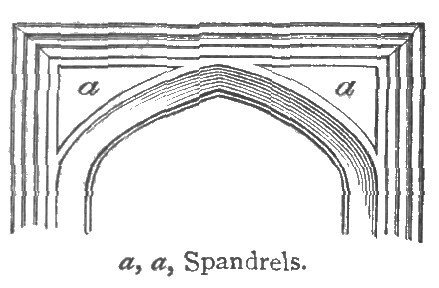
Spandrel, span′drel, n. the irregular triangular space between the curve of an arch and the enclosing right angle.—Also Span′dril. [Ety. dub.; prob. conn. with span.]
Spandy, span′di, adv. Same as Span (3).
Spane, Spean, spān, v.t. (Scot.) to wean. [A.S. spanan; Ger. spänen.]
Spanemia, spa-nē′mi-a, n. poverty of blood—also Spanæ′mia.—adjs. Spanē′mic, Spanæ′mic. [Gr. spanos, scarce, haima, blood.]
Spang, spang, n. a spangle, shining ornament.
Spang, spang, v.i. (Scot.) to leap.—v.t. to set in violent motion, to hurl.—n. a springing up: a sudden blow.
Spangle, spang′gl, n. a small, thin plate or boss of shining metal: anything sparkling and brilliant, like a spangle.—v.t. to adorn with spangles.—v.i. to glitter.—adjs. Spang′led, Spang′ly.—n. Spang′ler. [A.S. spange; Ger. spange, Ice. spöng.]
Spangolite, spang′gō-līt, n. a rare mineral found in hexagonal green crystals along with cuprite in Arizona. [Norman Spang of Pittsburg.]
Spaniard, span′yard, n. a native of Spain.
Spaniel, span′yel, n. a kind of dog, usually liver-and-white coloured, or black-and-white, with large pendent ears.—adj. (Shak.) like a spaniel, fawning, mean.—n. Span′ielship, obsequious attention.—Blenheim Spaniel, red-and-white, established by the Duke of Marlborough; Clumber Spaniel, handsome lemon-and-white, short in leg, long in body, with a coat like a setter, and massive head with large, drooping ears; King Charles spaniel, black-and-tan, first brought into notice by Charles II.; Sussex spaniel, like the Clumber, golden-liver or brown. [O. Fr. espagneul (Fr. épagneul)—Sp. Español, Spanish.]
Spanish, span′ish, adj. of or pertaining to Spain.—n. the language of Spain.—n. Span′iard, a native or citizen of Spain.—Spanish bayonet, any one of several species of yucca with straight sword-shaped leaves; Spanish broom, a hardy deciduous Mediterranean shrub with showy yellow fragrant flowers; Spanish chalk, a variety of talc; Spanish cress, a species of peppergrass; Spanish fly, a blister-beetle, a cantharid possessing a strong blistering principle, cantharidine: a preparation of cantharides used as a vesicant; Spanish fowl, a breed of the domestic hen—also White-faced black Spanish; Spanish grass, esparto; Spanish juice, extract of liquorice-root; Spanish Main, a name given to the north coast of South America from the Orinoco to Darien, and to the shores of the former Central American provinces of Spain contiguous to the Caribbean Sea—the name is often popularly applied to the Caribbean Sea itself: Spanish sheep, a merino; Spanish soap, Castile soap.—Walk Spanish, to be compelled to walk on tiptoe through being lifted up by the collar and the seat of the trousers—hence to proceed or act under compulsion.
Spank, spangk, v.i. to move with speed or spirit.—n. Spank′er, one who walks with long strides: a fast-going horse: any person or thing particularly striking, a dashing person.—adj. Spank′ing, spirited, going freely: striking, beyond expectation, very large. [Cf. Dan. spanke, to strut.]
Spank, spangk, v.i. to strike with the flat of the hand, to slap.—n. a loud slap, esp. on the backside.
Spanker, spang′kėr, n. the after-sail of a ship or barque, so called from its flapping in the breeze.
Span-roof, span′-rōōf, n. a roof having two equal inclined planes or sides.
Spar, spär, n. a rafter: a general term for masts, yards, booms, and gaffs, &c.—n. Spar′-deck, the upper deck of a vessel. [The A.S. spearra is assumed from the verb sparrian, to fasten with a bar; cf. Ice. sparri, Dut. spar.]
Spar, spär, n. a term applied by miners to any bright crystalline mineral, and adopted by mineralogists in the names of a number of minerals—calcareous spar, fluor spar, Iceland spar, &c.—adj. Spar′ry, resembling spar, spathic. [A.S. spær(-stán), gypsum; cf. Ger. spar(-kalk).]
Spar, spär, v.i. to box with the hands: to fight with showy action: to dispute:—pr.p. spar′ring; pa.t. and pa.p. sparred.—n. a preliminary sparring, boxing-match, or cock-fight.—ns. Spar′rer; Spar′ring. [O. Fr. esparer (Fr. éparer), to kick out, most prob. Teut.; Low Ger. sparre, a struggling.]
Sparable, spar′a-bl, n. a small nail used by shoemakers.—Also Sper′rable. [Sparrow-bill.]
Sparadrap, spar′a-drap, n. a cerecloth, a plaster. [Fr.]
Spare, spār, v.t. to use frugally: to do without: to save from any use: to withhold from: to forbear from harming, to treat tenderly: to part with willingly.—v.i. to be frugal: to forbear: to be tender: to be forgiving.—adj. sparing: frugal: scanty: lean: superfluous.—n. that which has been saved or stored away: in American bowling, a point made by overturning all the pins with the first two balls.—adv. Spare′ly, in a spare manner: sparingly.—ns. Spare′ness; Spār′er, one who spares or avoids expense; Spare′rib, a piece of pork consisting of ribs with the meat adhering to them.—adj. Spā′ring, scarce: scanty: saving: merciful, forgiving.—adv. Spār′ingly, frugally: not abundantly: with abstinence: seldom: cautiously.—n. Spār′ingness, the quality of being sparing: want of liberality: caution. [A.S. sparian, to spare—spær, spare; Ger. spärlich, frugal.]
Sparganium, spär-gā′ni-um, n. a genus of plants of the order Typhaceæ:, the bur-reeds. [Gr.]
Sparge, spärj, v.t. to sprinkle—(Scot.) Spairge.—n. Spar′ger, a sprinkler. [L. spargĕre, to sprinkle.]
Spargosis, spär-gō′sis, n. great distention of the breasts with milk.—Also Sparganō′sis. [Gr. spargōsis—spargan, to swell.]
Spar-hawk, spär′-hawk, n.=Sparrow-hawk.
Spark, spärk, n. a small ignited particle shot off from a burning body: any small shining body or light: a small portion of anything active or vivid: a gay sprightly person, a lover, a beau.—v.i. to emit sparks: to play the gallant.—adj. Spark′ish, gay, jaunty, showy. [A.S. spearca, a spark; Dut. spark.]
Sparke, spärk, n. (Spens.) a battle-axe. [Perh. an error for sparthe.]
Sparkle, spärk′l, n. a little spark: lustre, brilliance: the presence of carbon dioxide, as in a wine, causing effervescence: the emission of sparks.—v.i. to emit sparks: to shine, glitter: to effervesce with glittering bubbles, or to contain much carbon dioxide, as certain wines.—v.t. to throw out sparklingly.—n. Spark′ler, one who, or that which, sparkles.—adj. Spark′less, not giving out sparks.—adv. Spark′lessly.—n. Spark′let, a small spark.—adj. Spark′ling, giving out sparks: glittering: brilliant: lively.—adv. Spark′lingly, in a sparkling manner: with vivid and twinkling lustre.—n. Spark′lingness, the quality of being sparkling: vivid and twinkling lustre. [A freq. of spark.]
Sparling, spär′ling, n. the smelt.—Also Spir′ling.
Sparre, spär, n. (Spens.) a bolt, a bar. [Spar.]
Sparrer. See under Spar (3).
Sparrow, spar′ō, n. an Old World genus of birds of fringilline family.—ns. Sparr′ow-bill, a small shoe-nail, so called from its shape—also Spar′able; Sparr′ow-grass, asparagus; Sparr′ow-hawk, a genus of long-legged, short-winged falcons, like the goshawks, but smaller.—adj. Sparr′ow-tail (see Swallow-tail). [A.S. spearwa; Goth. sparwa, Ice. spörr, Ger. sper-ling.]
Sparry, spär′i, adj. consisting of, or like, spar.—n. Sparr′y-ī′ron, a carbonite of iron, siderite.
Sparse, spärs, adj. thinly scattered: scanty.—adv. Sparse′ly.—n. Sparse′ness.—adj. Spar′sile.—n. Spar′sity. [L. sparsum, pa.p. of spargĕre, to scatter; Gr. speirein, to sow.]
Spartan, spär′tan, adj. of or pertaining to Sparta in Greece: hardy, rigorously severe: fearless.
Sparterie, spär′tėr-i, n. articles made from esparto—mats, nets, ropes, &c.
Sparth, -e, sparth, n. a halberd, mace.
Spasm, spazm, n. an irregular and violent contraction of muscular parts—involuntary even when the voluntary muscles are concerned. When persistent it is tonic spasm or cramp, catalepsy, tetanus; when the relaxations alternate with the contractions, it is clonic spasm, as in epilepsy, convulsive hysteria, chorea, &c.—n. Spasmod′ic, a medicine for removing spasms.—adjs. Spasmod′ic, -al, relating to, or consisting in, spasms: convulsive.—adv. Spasmod′ically, in a spasmodic manner: in fits.—ns. Spas′modist; Spasmol′ogy, scientific knowledge of spasms.—adj. Spas′tic, relating to spasms, spasmodic.—adv. Spas′tically.—n. Spastic′ity, tendency to spasm.—Spasmodic school, a group of English poets, including P. J. Bailey, Sydney Dobell, and Alexander Smith, marked by overstrained and unnatural sentiment and expression. [Fr. spasme—L. spasmus—Gr. spasmos—spaein, to draw.]
Spat, spat, pa.t. of spit, to throw from the mouth.
Spat, spat, n. the spawn of shellfish.—v.i. to shed spawn. [From root of spit.]
Spat, spat, n. a slap: a large drop, as of rain: a petty quarrel.—v.t. to slap, to strike lightly.—v.i. to engage in a petty quarrel.
Spat, spat, n. a gaiter or legging—usually in pl. [Spatter-dashes.]
Spatangus, spā-tang′gus, n. the typical genus of Spatangidæ, a family of irregular sea-urchins, the heart-urchins.—n.pl. Spatang′ida, the spatangoid sea-urchins.—adj. Spatang′oid, like a cordate urchin.—n. one of these.—ns.pl. Spatangoi′da, Spatangoi′dēa, the Spatangidæ, an order of petalostichous sea-urchins, generally excluding the clypeastroids or flat sea-urchins. [Gr. spatangēs, a sea-urchin.]
Spatch-cock, spach′-kok, n. a fowl killed and immediately roasted or broiled for some sudden occasion. [Prob. a corr. of despatch and cock.]
Spate, Spait, spāt, n. a sudden flood, as in a stream after heavy rain. [Prob. Ir. speid.]
Spathe, spāth, n. (bot.) a sheathing bract, which encloses one or more flowers, as in the narcissus.—adjs. Spathā′ceous, spathe-bearing; Spāthed, having a spathe.—n. Spathil′la, a secondary or diminutive spathe.—adjs. Spā′those, Spā′thous (bot.), having a spathe or sheath-like bract, bursting longitudinally. [L. spatha—Gr. spathē, a broad blade.]
Spathic, spath′ik, adj. (min.) foliated, lamellar.—adj. Spath′iform, spathic. [Ger. spath, spar.]
Spathura, spā-thū′ra, n. a genus of humming-birds with peculiar tail-feathers expanding into a spatule at the end, and leg-muffs. [Gr. spathē, a blade, oura, a tail.]
Spatial, spā′shal, adj. relating to space.—n. Spātial′ity.—adv. Spā′tially.
Spatilomancy, spā-til′ō-man-si, n. divination by means of animal excrements. [Gr. spatilē, excrement, manteia, divination.]
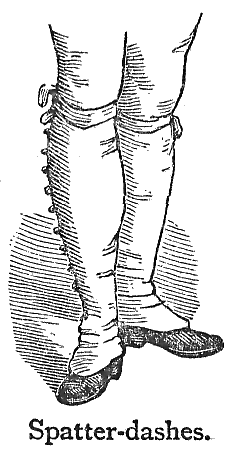
Spatter, spat′ėr, v.t. to throw out or scatter upon: to scatter about: to sprinkle with dirt or anything moist: to defame.—n. the act of spattering: what is spattered.—n.pl. Spatt′er-dash′es, coverings for the legs, to keep them clean from water and mud, a kind of gaiters.—n. Spatt′er-work, a method of producing designs by covering the surface with the pattern and then spattering colouring matter on the parts exposed. [A freq. of spot.]
Spatula, spat′ū-la, Spattle, spat′l, n. a little spade: a broad kind of knife for spreading plasters.—n. Spat′ulamancy, a method of divination by a sheep's shoulder-blade.—adj. Spat′ulāte, shaped like a spatula.—n. Spat′ule, a spatulate formation.—adjs. Spat′uliform, Spatulig′erous. [L. spatula, spathula, dim. of spatha—Gr. spathē.]
Spavin, spav′in, n. a disease of horses occurring under two different forms—bog-spavin, in which the hock-joint is distended with dark-coloured synovia or joint-oil, and bone-spavin, in which a bony enlargement occurs towards the inside of the hock, at the head of the shank-bone, or between some of the small bones of the hock.—adj. Spav′ined, affected with spavin. [O. Fr. esparvain (Fr. éparvin)—Old High Ger. sparo, sparwe, a sparrow.]
Spawl, spawl, n. spittle, slaver.—v.i. to eject saliva.
Spawn, spawn, n. the eggs of fish or frogs when ejected: offspring.—adj. containing spawn.—v.t. to produce, as fishes and frogs do their eggs: to bring forth.—v.i. to deposit eggs, as fishes or frogs: to issue, as offspring.—ns. Spawn′er, the female fish from which the spawn is ejected; Spawn′ing; Spawn′ing-bed, -ground, a bed made in the bottom of a stream on which fish deposit their spawn. [O. Fr. espandre, to shed—L. expandĕre, to spread out.]
Spay, spā, v.t. to make an animal barren by destroying its ovaries.—Also Spāve. [L. spado—Gr. spadōn, a eunuch—Gr. spaein, draw out.]
Speak, spēk, v.i. to utter words or articulate sounds: to say: to talk: to converse: to sound: to give expression by any means, to intimate, to hint.—v.t. to pronounce: to converse in: to address: to declare: to express by signs:—pa.t. spoke or spāke; pa.p. spō′ken.—adj. Speak′able, capable of being spoken: (Milt.) having the power of speech.—ns. Speak′-eas′y (U.S.), an illicit dram-shop, shebeen; Speak′er, one who speaks or proclaims: the person who presides in a deliberative or legislative body, as the House of Commons; Speak′ership, the office of Speaker; Speak′ing, the act of expressing ideas in words: discourse.—adj. seeming to speak: natural: used to assist the voice.—adv. Speak′ingly.—ns. Speak′ing-trum′pet, an instrument for enabling the sound of the voice to be conveyed to a greater distance; Speak′ing-tube, a tube communicating from one room to another for speaking through; Speak′ing-voice, the kind of voice used in speaking.—Speak a ship, to hail and speak to some one on board her; Speak fair, to address one in conciliatory terms; Speak for, to speak on behalf of: to be a proof of: to bespeak, engage; Speaking terms, a relationship between two persons not extending beyond the courtesy of verbal salutation, &c.; Speak of, to talk about: to mention, or to be worth mentioning; Speak one's mind, to say frankly what one thinks; Speak out, to assert boldly or loudly; Speak to, to reprove: to attest, testify to; Speak up, to speak out; Speak well for, to witness favourably to.—So to speak, as one might put it, as it were. [A.S. specan (for sprecan); Dut. spreken, Ger. sprechen.]
Speal-bone, spēl′-bōn, n. the shoulder-blade.
Spear, spēr, n. a long weapon used in war and hunting, made of a pole pointed with iron: a lance with barbed prongs used for catching fish.—v.t. to pierce or kill with a spear.—ns. Spear′-fish, a kind of carp-sucker—also Sail-fish and Skimback: the bill-fish, a histiophoroid fish related to the swordfish; Spear′-foot, the off or right hind-foot of a horse; Spear′-grass, a name applied to various grasses, esp. those known as meadow-grass, the Kentucky blue-grass: either of two New Zealand plants of the parsley family with long spinous leaflets; Spear′-head, the iron point of a spear; Spear′-lil′y, a plant of one of the species of the Australian genus Doryanthes of the Amaryllideæ, with sword-shaped leaves; Spear′man, a man armed with a spear; Spear′mint, the common garden-mint; Spear′-this′tle, the common thistle; Spear′-wood, one of two Australian trees whose wood makes good spear-shafts; Spear′-wort, the name of several species of Ranunculus with lance-shaped leaves. [A.S. spere; Ger. speer, L. sparus; cf. Spar.]
Spec, a colloquial abbrev. of speculation.
Special, spesh′al, adj. of a species or sort; particular: distinctive: uncommon: designed for a particular purpose: confined to a particular subject or application.—n. any special or particular person or thing: any person or thing set apart for a particular duty—a constable, a railway-tram, &c.: a newspaper extra, a despatch from a special correspondent.—n. Specialisā′tion, the act or process of specialising: differentiation, as of organs, functions, &c.—v.t. Spec′ialise, to make specifically distinct, to limit to a particular kind of action or use.—v.i. to act in some particular way, to take a particular direction, as to devote one's self especially to some particular branch of study.—ns. Spec′ialism, devotion to some particular study or pursuit; Spec′ialist, one who devotes himself to a special subject.—adj. Specialist′ic.—n. Special′ity, the particular characteristic of a person or thing: a special occupation or object of attention.—adv. Spec′ially.—ns. Spec′ialty, something special or distinctive: any special product, article of sale or of manufacture: any special pursuit, department of study, &c.: a special contract for the payment of money; Specie (spē′shi), gold and silver coin, metallic money (abl. of L. species, kind); Spē′cies, a group of individuals having common marks or characteristics, specialised from others of the same genus to which it is subordinate: a group under a higher class, a kind or sort, a distinct constituent part, an element: an appearance to the senses, an image of an external object presented to the eye or the mind; Spē′cies-mong′er, one who busies himself with classifications only, indifferent to wider biological relations, one who makes distinctions for distinction's sake; Spēcif′ic, a remedy which has a special power in a particular disease: an infallible remedy.—adjs. Spēcif′ic, -al, pertaining to, or constituting, a species: that specifies: peculiar to: produced by some special cause: precise: infallible.—adv. Spēcif′ically.—ns. Spēcif′icalness, Spēcif′icness, the state or quality of being specific.—Special constable (see Constable); Special license (see License); Special pleading (see Plead); Special verdict (see Verdict).—Specific density, the mass of any given substance contained in unit volume; Specific gravity, the weight of any given substance as compared with the weight of an equal bulk or volume of water or other standard substance at the same temperature and pressure; Specific heat (see Heat).
Specify, spes′i-fī, v.t. to mention particularly: to set down as a requisite:—pa.t. and pa.p. spec′ifīed.—v.t. Specif′icate, to specify.—n. Specificā′tion, the act of specifying: any point or particular specified: the description of his invention presented by an applicant for a patent.—Logical specification is the counterpart of generalisation—implying that beings the most like or homogeneous disagree or are heterogeneous in some respect. [O. Fr.,—Low L. specificāre—L. species, kind, facĕre, to make.]
Specillum, spē-sil′um, n. a surgical probe: a lens, eyeglass. [L.,—specĕre, to look.]
Specimen, spes′i-men, n. a portion of anything to show the kind and quality of the whole: a sample, a typical individual: a preparation in natural history, &c., exemplifying anything noticeable in a species or other group. [L. specimen—specĕre, to see.]
Specious, spē′shus, adj. that looks well at first sight: showy: plausible: appearing actual, not merely imaginary.—ns. Spēcios′ity, Spē′ciousness, plausible appearance.—adv. Spē′ciously. [Fr.,—L. speciosus, showy—species, form—specĕre, to see.]
Speck, spek, n. a spot: a blemish: a mark betokening decay: a separate piece or particle, an atom, the least morsel or quantity: a percoid fish of the United States, a darter.—v.t. to spot. [A.S. specca; Low Ger. spakig, spotted with wet.]
Speck, spek, n. fat, lard.—n. Specktioneer′, the chief harpooner in whale-fishing. [A.S. spic, bacon; Ger. speck, Dut. spek, fat.]
Speckle, spek′l, n. a little speck or spot in anything different in substance or colour from the thing itself: (Scot.) kind, sort.—v.t. to mark with speckles.—adj. Speck′led, variegated, piebald.—n. Speck′ledness.—adjs. Speck′less, spotless, perfectly clean; Speck′y, partially spotted.
Spectacle, spek′ta-kl, n. a sight: show, a pageant, exhibition: (pl.) a pair of lenses mounted in frames to assist the sight, aids to mental vision: a marking resembling spectacles, as in the cobra.—adjs. Spec′tacled, wearing spectacles: marked like spectacles, as the bear, cobra, &c.; Spectac′ular, marked by display.—n. Spectacular′ity.—adv. Spectac′ularly. [L. spectaculum—spectāre, -ātum, intens. of specĕre, to look at.]
Spectant, spek′tant, adj. looking forward.—v.t. Spec′tāte, to survey.—n. Spec′tātion. [L. spectans, -antis, pr.p. of spectāre.]
Spectator, spek-tā′tor, n. one who looks on:—fem. Spectā′tress, Spectā′trix.—adj. Spectatō′rial.—n. Spectā′torship, the office or quality of a spectator: (Shak.) the act of beholding.
Spectre, spek′tėr, n. a ghost.—adj. Spec′tral, relating to, or like, a spectre.—n. Spectral′ity, the state of being spectral, a spectral object.—adv. Spec′trally.—n. Spec′tre-bat, a South American leaf-nosed bat or vampire. [L. spectrum, a vision—specĕre, to see.]
Spectrum, spek′trum, n. the image of something seen continued after the eyes are closed: the colours of light separated by a prism, and exhibited as spread out on a screen:—pl. Spec′tra.—n. Spec′trograph, an apparatus for photographing a spectrum.—adjs. Spectrograph′ic, -al.—n. Spectrog′raphy, the art of using the spectrograph.—adj. Spectrolog′ical.—adv. Spectrolog′ically.—ns. Spectrol′ogy, the division of physical science that embraces spectrum analysis: demonology; Spectrom′eter, an instrument like a spectroscope, by means of which the angular deviation of a ray of light in passing through a prism can be accurately measured.—adj. Spectromet′ric.—n. Spec′trophōne, an adaptation of the spectroscope, in which, on the principle of the radiophone, perception of a succession of sounds takes the place of observation by the eye.—adj. Spectrophon′ic.—ns. Spec′tro-polar′iscope, a polariscope combined with a spectroscope; Spec′troscope, an instrument for forming and examining spectra of luminous bodies, so as to determine their composition.—adjs. Spectroscōp′ic, -al.—adv. Spectroscōp′ically.—ns. Spec′troscōpist, one skilled in spectroscopy; Spec′troscōpy, the use of the spectroscope and the study of spectrum analysis. [L.,—specĕre, to see.]
Specular, spek′ū-lar, adj. resembling a speculum: having a smooth reflecting surface: assisting vision, serving for inspection.—Specular iron ore, a variety of hematite, with a brilliant metallic lustre. [L.]
Specularia, spek-ū-lā′ri-a, n. a genus of plants of the bellwort family (Campanulaceæ), including the Venus's-looking-glass.
Speculate, spek′ū-lāt, v.i. to look at or into with the mind: to consider: to theorise: to traffic for great profit.—ns. Speculā′tion, act of speculating: mental view: contemplation: theory: the buying goods, &c., to sell them at an advance, any more or less risky investment of money for the sake of unusually large profits; Spec′ulātist, a speculative philosopher.—adj. Spec′ūlātive, given to speculation or theory: ideal: pertaining to speculation in business, &c.—adv. Spec′ulātively.—ns. Spec′ulātiveness, the state of being speculative; Spec′ulātor, one who engages in mental speculations, or who practises speculation in trade or business of any kind.—adj. Spec′ūlātory, exercising speculation: adapted for spying or viewing.—n. Spec′ulātrix, a female speculator. [L. speculatus, pa.p. of speculāri—specula, a lookout—specĕre, to look.]
Speculum, spek′ū-lum, n. (opt.) a reflector usually made of polished metal: (surg.) an instrument for bringing into view parts otherwise hidden: an ocellus or eye-spot, the mirror of a wing: a lookout place:—pl. Spec′ula. [L.,—specĕre, to look.]
Sped, sped, pa.t. and pa.p. of speed.
Speech, spēch, n. that which is spoken: language: the power of speaking: manner of speech, oration: any declaration of thoughts: mention: colloquy: conference.—ns. Speech′-craft, the science of language: the gift of speech; Speech′-crī′er, one who hawked the broadsides containing the dying speeches of persons executed, once common; Speech′-day, the public day at the close of a school year.—adj. Speech′ful, loquacious.—ns. Speechificā′tion, the act of making harangues; Speech′ifīer.—v.i. Speech′ify, to make speeches, harangue (implying contempt).—adj. Speech′less, destitute or deprived of the power of speech.—adv. Speech′lessly.—ns. Speech′lessness; Speech′-māk′er, one accustomed to speak in public; Speech′-māk′ing, a formal speaking before an assembly; Speech′-read′ing, the art of following spoken words by observing the speaker's lips, as taught to deaf-mutes. [A.S. spǽc, sprǽc; Ger. sprache.]
Speed, spēd, n. quickness, velocity: success.—v.i. to move quickly, to hurry: to succeed, to fare.—v.t. to despatch quickly: to hasten, as to a conclusion: to cause to advance, to push forward: to give a certain speed to, regulate the speed of: to send off, to put forth, to rid of, to kill: to cause to be relieved (only in passive): to execute: to aid: to make prosperous:—pr.p. speed′ing; pa.t. and pa.p. sped.—n. Speed′er, one who, or that which, promotes speed.—adj. Speed′ful, speedy.—advs. Speed′fully; Speed′ily.—ns. Speed′iness, speed, haste; Speed′-pull′ey, a pulley having different faces of different diameters giving various speeds according to the face the belt passes over; Speed′well (Veronica), a genus of plants of the natural order Scrophulariaceæ, with blue, white, or pink flowers, the leaves of some species used medicinally.—adj. Speed′y, hasty: quick: nimble. [A.S. spéd; Dut. spœd.]
Speir, Speer, spēr, v.t. and v.i. (Scot.) to ask. [A.S. spyrian, to inquire after, spor, a trace.]
Speiss, spīs, n. the product first obtained (an arsenide of the metal) when arsenical ores are smelted. [Ger. speise.]
Spekboom, spek′bōm, n. a large South African shrub of the purslane family. [Dut.]
Spelæan, Spelean, spē-lē′an, adj. cave-dwelling. [L. spelæum—Gr. spēlaion, a cave.]
Speld, speld, n. a chip, splinter.—Also Spel′der.
Spelding, spel′ding, n. (Scot.) a small fish split and dried in the sun.—Also Spel′drin, Spel′dron.
Spelin, spe-lin′, n. an artificial linguistic system devised by G. Bauer in 1888 for universal use.
Spelk, spelk, n. (prov.) a rod, switch.—v.t. to use a spelk in or upon.
Spell, spel, n. any form of words supposed to possess magical power: fascination.—v.t. to tell or name the letters of: to name, write, or print the proper letters of.—v.i. to form words with the proper letters: to study:—pr.p. spell′ing; pa.t. and pa.p. spelled, spelt.—adjs. Spell′able, capable of being spelled; Spell′-bound, Spell′-stopped (Shak.), entranced, fascinated.—ns. Spell′er, one who spells: one skilled in spelling; Spell′ing, act of spelling or naming the letters of words: orthography; Spell′ing-bee, a competition in spelling; Spell′ing-book, a book for teaching to spell; Spell′-work, that which is wrought by spells or charms: power of magic.—Spell backward, to spell, repeat, or arrange in reverse order: to understand in a contrary sense: to turn wrong-side out, misconstrue one's qualities; Spell baker, to do something difficult, that word being one of the earliest dissyllables in children's books. [A.S. spell, a narrative; Goth. spill, Ice. spjall, a tale.]
Spell, spel, v.t. to take another's place at work:—pr.p. spell′ing; pa.t. and pa.p. spelled.—n. a turn at work: a short period indefinitely: an interval of rest: a bad turn. [A.S. spelian, to act for another; cf. Dut. spelen, Ger. spielen, to play.]
Spelt, spelt, n. a kind of wheat, probably only a race of common wheat, still grown in the mountainous parts of Europe and elsewhere—also called German wheat. [A.S. spelt—Low L. spelta.]
Spelter, spel′tėr, n. zinc. [Allied to Dut. spiauter.]
Spence, spens, n. (prov.) a place where provisions are kept: a larder: a pantry.—Also Spense. [O. Fr. despense, a buttery—despendre—L. dispendĕre.]
Spencer, spens′ėr, n. a short over-jacket worn by men or women, named after Earl Spencer (1782-1845).
Spencer, spens′ėr, n. (in ships and barques) a fore-and-aft sail abaft the fore and main masts.
Spencerian, spen-sē′ri-an, adj. pertaining to the philosophy of Herbert Spencer (b. 1820).—n. a follower of Spencer.—n. Spencē′rianism, the system of evolutionary cosmology propounded by Herbert Spencer—the so-called synthetic philosophy.
Spend, spend, v.t. to expend or weigh out: to give for any purpose: to consume: to waste: to pass, as time.—v.i. to make expense: to be lost, wasted, or dissipated: to emit milt, semen, &c.:—pr.p. spend′ing; pa.t. and pa.p. spent.—adj. Spen′dable, that may be spent.—ns. Spend′all, a spendthrift; Spen′der; Spen′ding; Spense=Spence (q.v.).—adj. Spent, exhausted: impotent: of fish, exhausted by spawning. [A.S. spendan—L. expendĕre or dispendĕre, to weigh out.]
Spendthrift, spend′thrift, n. one who spends the savings of thrift: a prodigal.—adj. excessively lavish. [Spend and thrift.]
Spenserian, spen-sē′ri-an, adj. pertaining to Edmund Spenser (1552-1599) or his versification, esp. his stanza in The Faerie Queene, a strophe of eight decasyllabic lines and an Alexandrine, having three rhymes, the 1st and 3d, the 2d, 4th, 5th, and 7th, and the 6th, 8th, and 9th.
Spent, spent, pa.t. and pa.p. of spend.
Speos, spē′os, n. a grotto-temple or tomb. [Gr.]
Sper, spėr, v.t. (Spens.) to bolt, to shut, as a gate.
Sperable, spē′ra-bl, adj. (Bacon) that may be hoped.—adj. Spē′rate, hoped for. [L. sperabilis—sperāre, to hope.]
Spergula, sper′gū-la, n. a genus of polypetalous annuals belonging to the Caryophyllaceæ, with small white or pink flowers—spurry or sandweed.—n. Spergulā′ria, an allied genus, the sand-spurry. [L. spargĕre, to scatter.]
Sperket, spėr′ket, n. a hooked peg for hanging harness upon.—Also Spir′ket.
Sperm, spėrm, n. animal seed: spawn of fishes or frogs: spermaceti.—ns. Sper′maduct, a spermatic duct; Sper′maphore (bot.), a placenta; Sper′mary, the male germ-gland; Spermathē′ca, a spermatic case or sheath—also Spermatothē′ca.—adjs. Spermathē′cal; Spermat′ic, -al, pertaining to, or consisting of, sperm or seed, seminal: connected with the male function, testicular.—v.i. Sper′matise, to yield or to discharge semen.—ns. Sper′matism=Spermism; Sper′matist=Spermist; Spermā′tium, a minute spore within a spermogonium:—pl. Spermā′tia.—adj. Spermatō′al, pertaining to a spermatoon.—n. Sper′matoblast, the germ of a spermatozoon.—adj. Spermatoblas′tic.—ns. Sper′matocele, swelling of the testicle; Sper′matocyst, a seminal vesicle; Spermatocys′tis, inflammation of the seminal vesicles.—adj. Spermatocy′tal.—ns. Sper′matocyte, a mother-cell from which spermatozoids are developed; Spermatogem′ma, a mass of spermatocytes; Spermatogen′esis, the formation of spermatozoa.—adjs. Spermatogenet′ic, Spermatog′enous.—ns. Spermatog′eny, the generation of spermatozoa; Spermatogō′nium, one of the primitive seminal cells that by division form the spermatocytes.—adjs. Sper′matoid, sperm-like; Spermatolog′ical, pertaining to spermatology.—ns. Spermatol′ogist, one versed in spermatology; Spermatol′ogy, the knowledge of the facts about semen; Spermatō′on, the nucleus of a spermatozoon; Spermat′ōphōre, a case which in some Invertebrata encloses the spermatozoa.—adj. Spermatoph′orous.—ns. Spermatorrhē′a, involuntary seminal discharge; Spermatō′vum, a fecundated ovum; Spermatozō′id, Spermatozō′on, one of the male reproductive cells of animals, the physiological complements of the egg-cells or ova:—pl. Spermatozō′a; Sperm′-cell, a spermatozoon: a spermatoblast or a spermatocyte.—adj. Sper′mic=Spermatic—ns. Sper′mism, a seminal discharge: the theory that the male sperm holds the whole germ of the future animal; Sper′mist, one who holds the theory of spermism; Sperm′-nū′cleus, the nucleus of a spermatozoon; Sper′moderm, the whole integument of a seed; Spermogō′nium, the cavity in which, spermatia are produced; Sperm′-oil, oil from the sperm-whale; Spormol′ogy=Spermatology; Spermoph′ōrum, a seminal vesicle.—n.pl. Spermoph′yta, one of the four divisions of the vegetable kingdom including flowering plants.—ns. Sperm′ūle, a sperm-cell; Sperm′-whale, the cachalot, a species of whale from which spermaceti is obtained. [Fr.,—L. sperma—Gr. sperma, spermatos—speirein, to sow.]
Spermaceti, sper-ma-set′i, or-sē′tī, n. a waxy matter obtained mixed with oil from the head of the sperm-whale—purified by draining off the oil and repeatedly washing with hot water and weak boiling potash-lye.—adj. derived from, or yielding, spermaceti.—n. Spermacet′i-whale, the sperm-whale. [L. sperma, cētus, a whale—Gr. kētos.]
Spermophile, sper′mō-fīl, n. a rodent of the genus Spermophilus, a ground-squirrel. [Gr. sperma, seed, philein, to love.]
Sperre, sper, v.t. (Spens.). Same as Sper. [Spar.]
Sperrylite, sper′i-līt, n. an arsenide of platinum discovered in 1888 in the province of Ontario, Canada.
Sperse, spėrs, v.t. (Spens.) to disperse.
Spet, spet, v.i. (Milt.) a form of spit.
Spetch, spech, n. a piece of skin used in making glue. [Speck.]
Spew, Spue, spū, v.t. and v.i. to vomit: to eject with loathing.—ns. Spew′er; Spew′iness, moistness.—adj. Spew′y, boggy. [A.S. spíwan; Dut. spuwen, Ger. speien; also L. spuĕre, Gr. ptyein.]
Sphacelus, sfas′e-lus, n. gangrene.—adjs. Sphac′elate, -d, necrosed.—ns. Sphacelā′tion, Sphacelis′mus, necrosis; Sphacelō′ma, a genus of fungi containing anthracnose. [Gr. sphakelos.]
Sphæridium, sfē-rid′i-um, n. one of the minute spheroidal bodies attached to the ambulacral plates of sea-urchins:—pl. Sphærid′ia. [Gr. sphairidion, dim. of sphaira, a sphere.]
Sphæristerium, sfē-ris-tē′ri-um, n. a tennis-court. [Gr.,—sphaira, a ball.]
Sphærite, sfē′rīt, n. a hydrous phosphate of aluminium.
Sphagnum, sfag′num, n. a genus of mosses—peat or bog-moss, belonging to the order Sphagnaceæ.—ns. Sphagnol′ogist, one who has studied the foregoing; Sphagnol′ogy, the study of the same.—adj. Sphag′nous. [Gr. sphagnos, moss.]
Sphecius, sfē′shi-us, n. a genus of digger-wasps. [Gr. sphēx, a wasp.]
Sphendone, sfen′dō-nē, n. an ancient Greek form of women's head-band: an elliptical or semi-elliptical auditorium. [Gr., a sling.]
Sphene, sfēn, n. titanite. [Fr.,—Gr. sphēn, wedge.]
Sphenic, sfē′nik, adj. wedge-like. [Gr. sphēn, a wedge.]
Spheniscus, sfē-nis′kus, n. a genus of penguins, of the family Spheniscidæ, the jackass-penguins.
Sphenodon, sfē′nō-don, n. a genus of South American fossil sloths; a genus of extinct New Zealand lizards.—adj. Sphē′nodont. [Gr. sphēn, a wedge, odous, odontos, a tooth.]
Sphenoid, -al, sfē′noid, -al, adj. wedge-shaped: inserted like a wedge, denoting a bone at the base of the skull.—adjs. Spheneth′moid, pertaining to the sphenoid and the ethmoid bone; Sphē′nō-fron′tal, -mā′lar, -pal′atine, -parī′etal, -tem′poral, pertaining to the sphenoid and frontal, malar, palatine, parietal, and temporal bones respectively.—n. Sphē′nogram, a cuneiform character.—adjs. Sphēnograph′ic, -al.—n. Sphēnog′raphy, the art of writing or deciphering cuneiform inscriptions.—adjs. Sphēnot′ic, pertaining to the sphenoid bone and the otic capsule; Sphē′no-tur′binal, sphenoidal and turbinated or whorled. [Gr. sphēn, sphēnos, a wedge, eidos, form.]
Sphere, sfēr, n. a ball or globe: an orb or circle: circuit of motion: province or duty: definite range: rank, position in society: (geom.) a surface every point of which is equidistant from one and the same point, called the centre.—adjs. Sphēr′al; Sphere′less.—ns. Sphere′-met′al (Milt.), metal like that of which the celestial spheres were anciently supposed to be made; Sphere′-mū′sic, the music of the spheres.—adjs. Spher′ic, -al, pertaining to, or like, a sphere.—n. Spherical′ity.—adv. Spher′ically.—ns. Spher′icalness, Spheric′ity, state or quality of being spherical: roundness; Spher′icle, a little sphere; Spher′ics, the geometry and trigonometry of the sphere; Sphē′roid, a body or figure nearly spherical, but not quite so—a species of ellipsoid (prolate spheroid, a slightly lengthened sphere; oblate spheroid, a slightly flattened sphere).—adj. Sphēroi′dal, having the form of a spheroid.—ns. Sphēroidi′city, Sphēroid′ity, the state of being spheroidal; Sphē′romēre, one of the symmetrical segments of a radiate; Sphērom′eter, an instrument for measuring the sphericity of portions of spherical surfaces—for example, lenses; Sphē′rosid′erite, the name given to impure or earthy and frequently concretionary varieties of carbonate of iron.—adj. Spher′ūlar.—ns. Spher′ūle, a little sphere; Spher′ūlite, a radiating spherical group of minute acicular crystals common in silicious volcanic rocks.—adjs. Spherūlit′ic; Sphē′ry, spherical, round: belonging to the celestial spheres. [Fr.,—L. sphæra—Gr. sphaira.]
Sphex, sfeks, n. a genus of hymenopterous insects of the family Sphegidæ, closely allied to the true wasps (Vespidæ). [Gr. sphēx, a wasp.]
Sphincter, sfingk′tėr, n. (anat.) a muscle that contracts or shuts an orifice or opening which it surrounds—around the anus, &c.—adjs. Sphinc′terāte, provided with a sphincter, contracted as if by a sphincter; Sphinctē′rial, Sphincter′ic, relating to a sphincter or its function.—n. Sphincterot′omy, the operation of cutting a sphincter. [Gr. sphingktēr,—sphinggein, to bind tight.]
Sphinx, sfingks, n. a monster of Greek mythology, with the head of a woman and the body of a lioness, that proposed riddles to travellers, and strangled those who could not solve them: an enigmatic or inscrutable person: a hawk-moth: the Guinea baboon. [Gr.,—sphinggein, to throttle.]
Sphragistics, sfrā-jis′tiks, n. knowledge about seals, their age, history, &c. [Gr. sphragistikos, pertaining to seals—sphragis, a seal.]
Sphrigosis, sfri-gō′sis, n. in fruit-trees, excessive growth in wood and leaves at the expense of fruit. [Gr. sphrigan, to be vigorous.]
Sphygmograph, sfig′mō-graf, n. an instrument for ascertaining and recording the form, force, and frequency of the pulse-beat, and the changes it undergoes in certain morbid states.—adj. Sphyg′mic, pertaining to the pulse.—n. Sphyg′mogram, the record made by a sphygmograph.—adj. Sphygmograph′ic.—n. Sphygmog′raphy, the act of taking pulse-tracings.—adj. Sphyg′moid, pulse-like.—ns. Sphygmol′ogy, the science of the pulse; Sphygmōmānom′eter, Sphygmom′eter, an instrument for measuring the tension of blood in an artery; Sphyg′mophone, an instrument by means of which a pulse-beat makes a sound: Sphyg′mōscōpe, an instrument for making arterial pulsations visible; Sphyg′mus, the pulse. [Gr. sphygmos, the pulse, graphein, to write.]
Sphyrna, sfėr′na, n. a genus of hammer-headed sharks.—adj. Sphyr′nine. [Gr. sphyra, a hammer.]
Spial, spī′al, n. (obs.) espial: a spy, a scout.
Spica, spī′ka, n. a spiral bandage with reversed turns: (ornith.) a spur.—adjs. Spī′cal, Spī′cāte, -d, arranged in, or having the form of, a spike.—n. Spicā′tum, in ancient masonry, herring-bone work. [L. spicatus, pa.p. of spicāre—spica, ear.]
Spice, spīs, n. an aromatic and pungent vegetable substance used as a condiment and for seasoning food—pepper, cayenne pepper, pimento, nutmeg, mace, vanilla, ginger, cinnamon, cassia, &c.: a characteristic touch or taste, smack, flavour: anything that adds piquancy or interest: an aromatic odour.—v.t. to season with spice: to tincture, vary, or diversify.—ns. Spice′-box, an ornamental box for keeping spices: (coll.) a hot-tempered person; Spice′-bush, an aromatic American shrub of the laurel family; Spice′-cake, a cake flavoured with spice of some kind.—adjs. Spiced, impregnated with a spicy odour: over-scrupulous; Spice′ful, aromatic.—ns. Spī′cer, one who seasons with spice; Spī′cery, spices in general: a repository of spices: spiciness; Spice′-tree, an evergreen tree of the Pacific United States, yielding a fine hard wood—the Mountain-laurel, California-laurel, Olive- or Bay-tree, and Cajeput; Spice′-wood, the spice-bush. [O. Fr. espice (Fr. épice)—Late L. species, kinds of goods, spices—L. species, a particular kind, &c.]
Spiciferous, Spiciform, Spicous, &c. See Spike.
Spick, spik, n. a nail, a spike.—adj. tidy, fresh.—adj. Spick′-and-span, new and fresh, brand-new.—Spick-and-span new, i.e. as new as a spike just made and a chip just split. [Spike, nail.]
Spicknel, spik′nel, n. the baldmoney.—Also Spig′nel. [Prob. spike-nail.]
Spicy, spī′si, adj. producing or abounding with spices: fragrant: pungent: piquant, pointed, racy: showy.—adv. Spī′cily.—n. Spī′ciness.
Spider, spī′dėr, n. an arachnid of the order Araneida, the body divided into two distinct parts—an unsegmented cephalo-thorax, bearing six pairs of appendages, and a soft unsegmented abdomen, at the end of which are the spinnerets from each of which numerous 'spinning-spools' ooze forth the viscid fluid which hardens into the silken thread: a frying-pan with feet, a trivet.—ns. Spī′der-catch′er, the wall-creeper; Spī′der-crab, a spider-like crab, or sea-spider with long thin legs; Spī′der-dīv′er, the little grebe, or dabchick; Spī′derdom, spiders collectively.—adj. Spī′dered, cobwebbed.—n. Spī′der-fly, a pupiparous fly, as a bird-louse, &c.—adj. Spī′der-like, like a spider.—ns. Spī′derling, a young spider; Spī′der-mon′key, an American platyrrine monkey, with long slender legs and tail; Spī′der-stitch, a stitch in lace or netting in which threads are carried diagonally and parallel to each other; Spī′der-wasp, a pompilid wasp which fills its nest with spiders for its young; Spī′der-web, the snare spun by the spider; Spī′der-wheel, in embroidery, a circular pattern with radiating lines; Spī′der-work, lace worked by spider-stitch; Spī′der-wort, any plant of the genus Tradescantia, esp. T. virginica, an American perennial with deep-blue or reddish-violet flowers.—adj. Spī′dery, spider-like. [M. E. spither—A.S. spinnan, to spin; cf. Dan. spinder, Ger. spinne.]
Spie, spī, n. (Spens.) a keen glance, the eye. [Spy.]
Spiegeleisen, spē′gl-ī-zen, n. a white cast-iron containing from eight to fifteen per cent. of manganese, largely used in the manufacture of steel by the Bessemer process. [Ger.,—spiegel—L. speculum, a mirror, Ger. eisen, iron.]
Spiffy, spif′i, adj. (slang) smart, spruce, well-dressed.
Spiflicate, spif′li-kāt, v.t. (slang) to suffocate, kill: to beat severely, to confound.—n. Spiflicā′tion.
Spigelia, spī-jē′li-a, n. a genus of plants of the natural order Loganiaceæ, containing the Worm-grass and Carolina-pink, the root—Pink-root—being purgative, narcotic, and poisonous, a powerful vermifuge.—adj. Spigē′lian, denoting the lobulus spigelii, one of the lobes of the liver. [From the Belgian Ad. van der Spiegel (1558-1625).]
Spight, spīt, v. and n. (Spens.). Same as Spite.
Spigot, spig′ut, n. a plug for stopping a small hole in a cask. [Gael. spiocaid, W. ysbigod—L. spica.]
Spike, spīk, n. an ear of corn: (bot.) an inflorescence in which sessile flowers, or flowers having very short stalks, are arranged around an axis: a small pointed rod: a large nail.—v.t. to set with spikes: to stop the vent of with a cast-iron spike driven in hard and then broken off, as by soldiers obliged to abandon their own guns or unable to remove those of the enemy which they have captured.—adjs. Spī′cate, Spī′cose, Spī′cous, having spikes or ears, like corn; Spicif′erous, bearing spikes: having spurs; Spī′ciform, having the form of a spike.—n. Spicos′ity, state of being spicous or eared.—adjs. Spic′ūlar, resembling a dart: in the shape of, or having, sharp points; Spic′ūlate, covered with, or divided into, minute points.—n. Spic′ūle (bot.), a little spike—also Spic′ūla: a minute, slender granule or point.—adjs. Spic′ulīform; Spicūlig′enous, Spicūlif′erous, producing spicules; Spic′ūlōse, Spic′ūlous, having spicules.—ns. Spic′ūlum, a spicule; Spike′bill, a merganser, a sawbill: the marbled godwit.—p.adj. Spiked, furnished, fastened, or stopped with spikes.—ns. Spike′-extract′or, an apparatus for drawing out spikes, as from railway-ties; Spike′-fish, a kind of sail-fish; Spike′-grass, one of several American grasses with conspicuous spikelets of flowers; Spike′let, a little spike; Spike′-nail, a spike; Spike′-oil, the oil of spike, a species of lavender; Spike′-plank, a platform before the mizzen-mast of a vessel, used in Arctic voyages.—adj. Spī′ky, furnished with spikes: having a sharp point. [L. spica, an ear of corn.]
Spikenard, spīk′närd, n. an aromatic oil or balsam yielded by an Indian plant, the Nardus, closely allied to valerian: the plant itself. [L. spica nardi.]
Spile, spīl, n. a wooden plug serving as a spigot, a wooden pin or wedge: a spout driven into a sugar-maple tree, a tapping-gouge: a pile, or large timber driven into the ground for a foundation.—v.t. to pierce and provide with a spile: to drive piles into.—n. Spī′ling, building-piles: the edge-curve of a plank or of a strake in a vessel's hull. [Cf. Spill (2).]
Spill, spil, v.t. to allow to run out of a vessel: to shed: to waste: (coll.) to throw from a vehicle or the saddle: to empty the belly of a sail of wind for reefing.—v.i. to be shed: to be allowed to fall, be lost, or wasted:—pa.t. and pa.p. spilled, spilt.—n. a fall, a throw: a downpour.—ns. Spill′er; Spill′ing-line, a rope for spilling the wind out of a square sail to facilitate reefing or furling; Spill′-stream, a stream formed by overflow water, a bayou; Spill′way, a passage for overflow-water from a dam. [A.S. spillan; Dut. spillen, Ice. spilla, to destroy.]
Spill, spil, n. a small peg or pin to stop a hole: a thin strip of wood or twisted paper for lighting a candle, a pipe, &c.—n. Spill′ikin, one of a number of small pieces of wood, ivory, &c. for playing a game with: the game played—also Spil′kin. [A.S. speld, a torch; cf. Ger. spalten, to cleave, Dut. speld, a splinter.]
Spiloma, spi-lō′ma, n. a birth-mark, a nævus. [Gr.]
Spilosite, spil′o-sīt, n. a greenish schistose rock spotted with chlorite, occurring in the Harz—the German Fleckenschiefer. [Gr. spilos, a spot.]
Spilotes, spī-lō′tēz, n. a genus of colubrine serpents.
Spilt, spilt, p.adj. (Spens.) pieced, inlaid.
Spilth, spilth, n. spilling, anything spilt or poured out lavishly, excess of supply.
Spilus, spī′lus, n. a nævus or birth-mark. [Gr. spilos, a spot.]
Spin, spin, v.t. to draw out and twist into threads: to draw out a thread as spiders do: to draw out tediously: to cause to whirl rapidly: to fish with a swivel or spoon-bait: to reject at an examination.—v.i. to practise the art or trade of spinning, to perform the act of spinning: to issue in a small or thread-like current: to whirl, to go fast:—pr.p. spin′ning; pa.t. and pa.p. spun.—n. a rapid revolving motion, a spurt at high speed.—ns. Spin′ner, one who spins: (Shak.) a spider: a spinneret;
Spin′neret, an organ, or one of the organs, with which insects form their webs.—adj. Spinner′ular.—ns. Spin′nerule, one of the tubules of a spinneret; Spin′nery, a spinning-mill.—adj. Spin′ning, used in spinning.—ns. Spin′ning-house, a place of correction where lewd and incorrigible women were made to spin; Spin′ning-jenn′y, a machine by which a number of threads can be spun at the same time; Spin′ning-mill, a factory where thread is spun; Spin′ning-wheel, a machine for spinning yarn, consisting of a wheel driven by the hand or by a treadle, which drives one or two spindles.—Spin a yarn, to tell a long story; Spin out, to prolong tediously. [A.S. spinnan; Ger. spinnen.]
Spinach, Spinage, spin′āj, n. an esculent vegetable whose thick succulent young leaves are boiled and seasoned, or fried with butter, forming a wholesome dish.—adj. Spinā′ceous. [It. spinace—Low L. spināceus—spina, a thorn.]
Spinal, spīn′al, adj. pertaining to the spine or backbone.—n. Spī′na, a spine, the backbone: one of the quills of a spinet: a barrier dividing the Roman hippodrome longitudinally.—adj. Spin′āte, covered with spines or spine-like processes.—Spinal column, the backbone; Spinal cord, marrow, the main neural axis of every vertebrate.
Spindle, spin′dl, n. the pin from which the thread is twisted: a pin on which anything turns: the fusee of a watch: anything very slender.—v.i. to grow long and slender.—adjs. Spin′dle-legged, -shanked, having long slender legs, like spindles.—ns.pl. Spin′dle-legs, -shanks, long slim legs—hence an over-long and slender person.—adj. Spin′dle-shaped, shaped like a spindle: thickest in the middle and tapering to both ends.—ns. Spin′dle-shell, a spindle-shaped shell; Spin′dle-tree, a shrub whose hard-grained wood was formerly used for making musical instruments and for spindles, and is now for skewers, &c.; Spin′dling, a person or thing too long and slender: a slender shoot.—adj. long and slender.—adj. Spin′dly, disproportionally long and slender. [A.S. spinl—spinnan, to spin; Ger. spindel.]
Spindrift, spin′drift, n. the spray blown from the crests of waves.—Also Spoon′drift.
Spine, spīn, n. a thorn: a thin, pointed spike, esp. in fishes: the backbone of an animal: any ridge extending lengthways: the heart-wood of trees.—adjs. Spined, having spines; Spine′less, having no spine, weak; Spines′cent, somewhat spiny; Spīnif erous, bearing spines or thorns; Spī′niform, shaped like a spine or thorn; Spīnig′erous, bearing spines, as a hedgehog; Spī′nigrade, moving by means of spines, as an echinoderm.—n. Spī′niness.—adjs. Spīnirec′tor, erecting the spine of the muscles of the back; Spīnispir′ular, spiny and somewhat spiral.—ns. Spīnī′tis, inflammation of the spinal cord in the horse, &c; Spin′ney, Spin′ny, a small thicket with underwood.—adjs. Spī′nose, Spī′nous, full of spines: thorny.—ns. Spinos′ity, thorniness; Spin′ūla, Spin′ūle, a minute spine.—adjs. Spin′ūlāte, Spin′ūlōse, Spin′ūlous, covered with spinules or minute spines; Spī′ny, full of spines: thorny: troublesome: perplexed. [O. Fr. espine (Fr. épine)—L. spina, a thorn.]
Spinel, spin′el, or spi-nel′, n. a mineral composed chiefly of magnesia and alumina, and crystallising in octahedra—ruby, or magnesia spinel, reddish; pleonaste, dark green to black; picotite, or chrome spinel, black; gahnite, or zinc spinel, green to brown; hercynite, or iron spinel, black. [Low L. spinellus, dim. of spina, a thorn.]
Spinet, spin′et, n. (mus.) an old-fashioned keyed instrument like the harpsichord. [O. Fr. espinette—It. spinetta, dim. of spina—L. spina, a thorn.]
Spinifex, spin′i-feks, n. porcupine-grass, a very coarse, hard, and spiny grass which grows in tussocks, and in some interior parts of Australia covers hundreds of square miles together.
Spink, spingk, n. the chaffinch.
Spink, spingk, n. the primrose, the lady's-smock.
Spinnaker, spin′ā-kėr, n. a jib-headed sail sometimes carried on the side opposite the mainsail by racing yachts. [Prob. formed from spin.]
Spinney. See under Spine.
Spinode, spī′nōd, n. (geom.) a cusp or stationary point of a curve.
Spinozism, spi-nōz′izm, n. the doctrine of Benedict Spinoza (1632-1677), who taught that God is not only the creator, but also the original matter of the universe, which consists of and is a development of Himself.—n. Spinō′zist, a follower of Spinoza.—adj. Spinōzis′tic.
Spinster, spin′stėr, n. an unmarried female: an old maid: (obs.) a woman of loose character, fit for the spinning-house.—ns. Spin′sterdom, the world of old maids collectively; Spin′sterhood, Spin′stership, the state of being a spinster; Spin′stress, one who spins. [Orig. one who spins.]
Spintext, spin′tekst, n. a lengthy preacher.
Spiracle, spir′a-kl, n. a breathing-hole: any minute passage.—adjs. Spirac′ular; Spirac′ulate; Spiraculif′erous; Spirac′uliform.—n. Spirac′ulum:—pl. Spirac′ula. [L. spiraculum, formed as a double dim. from spirāre, to breathe.]
Spiræa, spī-rē′a, n. a genus of plants of the natural order Rosaceæ, containing many species of herbaceous plants and low deciduous shrubs—Dropwort, Meadow-sweet, &c. [L.,—Gr. speiraia, meadow-sweet—speira, a coil.]
Spiral, spī′ral, adj. pertaining to, or like, a spire: winding like the thread of a screw.—n. a spiral line: a curve which continually recedes from a centre about which it revolves: a screw.—n. Spiral′ity.—adv. Spī′rally, in a spiral form or direction.—adj. Spirā′ted, spiral, whorled.
Spirant, spī′rant, n. a consonant which is fricative or continuable—opp. to explosive, esp. v and f, th, dh; by others made to include the sibilants, and the semi-vowels w and y.
Spiranthy, spī-ranth′i, n. the spiral distortion sometimes occurring in the parts of a flower.—adj. Spiranth′ic. [Gr. speira, a spire, anthos, a flower.]
Spiraster, spī-ras′tėr, n. in sponges, a short curved axial rod-like spicule with thick spines. [Gr. speira, spire, astēr, star.]
Spiration, spī-rā′shun, n. a breathing: (theol.) the procession of the Holy Ghost.
Spire, spīr, n. a winding line like the threads of a screw: a curl: a wreath: a tapering body, a slender stalk, a shoot or sprout: any one of various tall grasses, rushes, or sedges—the Marram, Reed canary-grass, &c.: the top or summit of anything: a very acute pyramidal roof in common use over the towers of churches.—v.i. to sprout, shoot up.—v.t. to furnish with a spire.—adjs. Spīred, having a spire; Spir′ulate, spiral in form or arrangement; Spī′ry, of a spiral form: wreathed: tapering like a spire or a pyramid: abounding in spires. [Fr.,—L. spira; Gr. speira, anything wound round or upon a thing; akin to eirein, to fasten together in rows.]
Spiric, spī′rik, adj. like a tore or anchor-ring.—n. a curve, the plane section of a tore.—n. Spir′icle, one of those threads in the hairs on the surface of certain seeds and achenes which uncoil when wet.
Spirifer, spir′i-fėr, n. a brachiopod of the Carboniferous system.—adjs. Spīrif′erine; Spīrif′eroid; Spīrif′erous. [L. spira, a spire, ferre, to bear.]
Spirillum, spī-ril′um, n. a genus of bacteria with cylindrical spirally twisted cells:—pl. Spirill′a.
Spirit, spir′it, n. vital force: the soul: a ghost: mental disposition: enthusiasm, animation, courage, mettle: real meaning: essence, chief quality: a very lively person: any volatile, inflammable liquid obtained by distillation, as brandy: (pl.) intellectual activity: liveliness: persons with particular qualities of mind: mental excitement: spirituous liquors.—v.t. to inspirit, encourage, cheer: to convey away secretly, to kidnap.—ns. Spir′it-blue, an aniline blue obtained from coal-tar; Spir′it-duck, the buffle-head, from its rapid diving.—adj. Spir′ited, full of spirit, life, or fire: animated.—adv. Spir′itedly.—n. Spir′itedness.—adj. Spir′itful.—n. Spir′iting, the office of a spirit or sprite; Spir′itism=Spiritualism; Spir′itist=Spiritualist; Spir′it-lamp, a lamp in which alcohol is burned, generally used for heating.—adj. Spir′itless, without spirit, cheerfulness, or courage: dejected: dead.—adv. Spir′itlessly.—ns. Spir′itlessness, the state of being spiritless: want of animation or energy; Spir′it-lev′el, in surveying, a cylindrical glass tube, slightly convex on one side, and so nearly filled with alcohol that only a small bubble of air remains inside—from the position of the bubble the amount of variation from perfect levelness is determined.—adj. Spir′itous, of the nature of spirit, pure: ardent, spirituous.—ns. Spir′itousness; Spir′it-rap′per, one to whom spirits convey intelligence by raps or knocks; Spir′it-rap′ping.—adjs. Spir′it-stir′ring, rousing the spirit; Spir′itūal, consisting of spirit: having the nature of a spirit: immaterial: relating to the mind: intellectual: pertaining to the soul: holy: divine: relating to sacred things: not lay or temporal.—n. Spiritualisā′tion.—v.t. Spir′itūalise, to make spiritual: to imbue with spirituality: to refine: to free from sensuality: to give a spiritual meaning to.—ns. Spir′itualiser; Spir′itualism, a being spiritual: the philosophical doctrine that nothing is real but soul or spirit: the doctrine that spirit has a real existence apart from matter: the name applied to a varied series of abnormal phenomena purporting to be for the most part caused by spiritual beings acting upon specially sensitive persons or mediums; Spir′itūalist, one who has a regard only to spiritual things: one who holds the doctrine of spiritualism or spiritism.—adj. Spiritūalist′ic, relating to, or connected with, spiritualism.—n. Spiritūal′ity, state of being spiritual: essence distinct from matter.—adv. Spir′itūally.—ns. Spir′itūal-mind′edness, the state of having holy affections; Spir′itūalness, the state or quality of being spiritual.—adj. Spi′ritūelle, showing great grace and delicacy.—n. Spiritūos′ity, spirituous character: immateriality.—advs. Spirit-uō′so, Spiritō′so (mus.), with spirit or animation.—adj. Spir′itūous, possessing the qualities of spirit: containing much alcohol: volatile.—ns. Spir′itūousness, the quality of being spirituous: stimulating quality: ardour: activity; Spir′itus, a breathing, an aspirate: any spirituous preparation; Spir′itworld, the world of disembodied spirits.—adj. Spir′ity (Scot.), full of spirit, spirited.—Spirit of wine, alcohol; Spiritual court, an ecclesiastical court; Spiritus asper, a rough breathing; Spiritus lenis, a soft or smooth breathing.—Animal spirits, constitutional liveliness of spirits; Holy Spirit (see under Holy); The Spirit, the Holy Spirit: the human spirit under the influence of the Holy Spirit. [L. spiritus, a breath—spirāre, to breathe.]