S
Reading edition
SABAL, see Palmetto.
SAGE (Salvia).
When sage is mentioned, we of the east are likely to think of the common garden sage (Salvia officinalis), which for at least three centuries has been cultivated for its aromatic leaves. Of this there are several varieties, some with broad and some with narrow leaves. The garden sages are good honey plants, but seldom sufficiently abundant to amount to much as honey producers. The honey from the garden sage is said to be nice and white like that from catnip or motherwort.
The name sage is derived from its supposed power to make people wise by strengthening the memory, for which it was used in ancient medicine.
There are upwards of five hundred species of sages, widely distributed in the temperate and warmer regions of both hemispheres. Probably most of the species yield honey, although but few are known to be important. Rayment mentions the wild sage (Salvia verbenacea) as introduced into Australia from Europe, but now yielding honey during the dry months of the year. (Money in bees in Australasia.) There are more than two hundred species known to occur in Mexico and Central America and it is very probable that when beekeeping is developed on a commercial scale in those countries, the sages will be found to be very important honey plants.
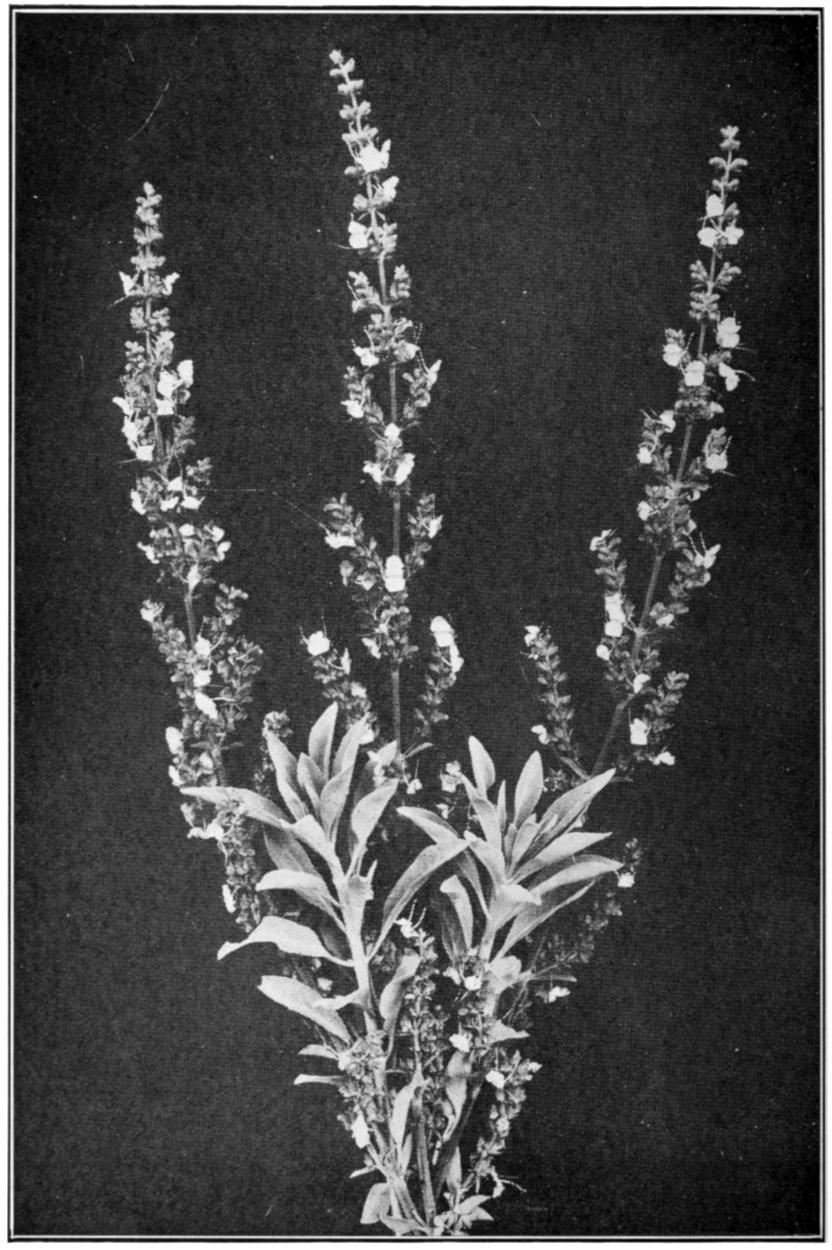
Fig. 121. White sage is uncertain in its yield.
Since practically all sage honey that goes to market in America is from California, the sages from that State are of first importance. Sage is known to occur in other Western States and the question is sometimes asked whether any honey is secured from this source elsewhere. In answer to this question Mr. J. E. Miller, of Caldwell, Idaho, writes, in Gleanings in Bee Culture (September 15, 1908), as follows:
“My neighbor, Mr. Garfield, experimented with one colony of bees by taking it eight or nine miles away from alfalfa or other cultivated fields, and setting it among the white sage. He went out to look after it every week and took fresh water. We do not know the exact amount of honey the bees gathered, but they did fully as well as those left at home near the alfalfa. The honey was of that water-white color peculiar to California sage honey. Mr. Garfield sent samples to California and it was pronounced A-1 white sage; so we are convinced that the white sage of Idaho does yield just as much and just as good honey as that of any other State.”
It is probable that one or more species of sage occur in nearly every State, but they increase in abundance westward. In the arid country west of the Missouri River they become sufficiently common so that an appreciable amount of honey might be expected in many localities. It is quite likely that sage honey in small amounts is mixed with honey from other sources, and so not detected, in many many localities outside of California. The fact remains, nevertheless, that sage, as an important source of surplus, is not reported outside of that State.
The quality of sage honey is of the best, being water-white in color, of a heavy body and delightful flavor. Since it does not granulate, it is much sought for by bottlers in the east, who blend it with clover or alfalfa. There are many who regard sage honey as the finest in the market. In this connection A. I. Root, in an early edition of his A B C of Bee Culture, wrote:
“I well remember the first taste I had of the mountain sage honey. Mr. Langstroth was visiting me at the time, and his exclamations were much like my own, only that he declared that it was almost identical in flavor with the famed honey of Hymettus, of which he had received a sample some years ago. Well, this honey of Hymettus, which has been celebrated both in prose and poetry for ages past, was gathered from the mountain thyme, and the botany tells us that thyme and sage are closely related.”
Although there are several species of sage which yield honey in California, the quality does not differ materially, as far as can be ascertained from printed reports. It is all described as “water-white, unexcelled flavor, of heavy body and does not granulate.”
Prof. A. J. Cook wrote to the American Bee Journal (June 21, 1906) concerning the sage as follows:
“Chief among the honey-bearing mints are the incomparable sages of California. These are not excelled even by the clovers or linden. The honey is white, delicate of flavor, and must ever rank among the best in appearance and quality. Not only this, but the quantity is often phenomenal. This comes from the fact that flowers are borne in long racemes of compact heads, and as the separated flowerets do not bloom all at once, but in succession, the plants are in bloom for weeks. The sages, then, are marvelous honey producers, first, because of the generous secretions of each flowerlet, and second, because of the immense number of these flowerlets and the long period of bloom.”
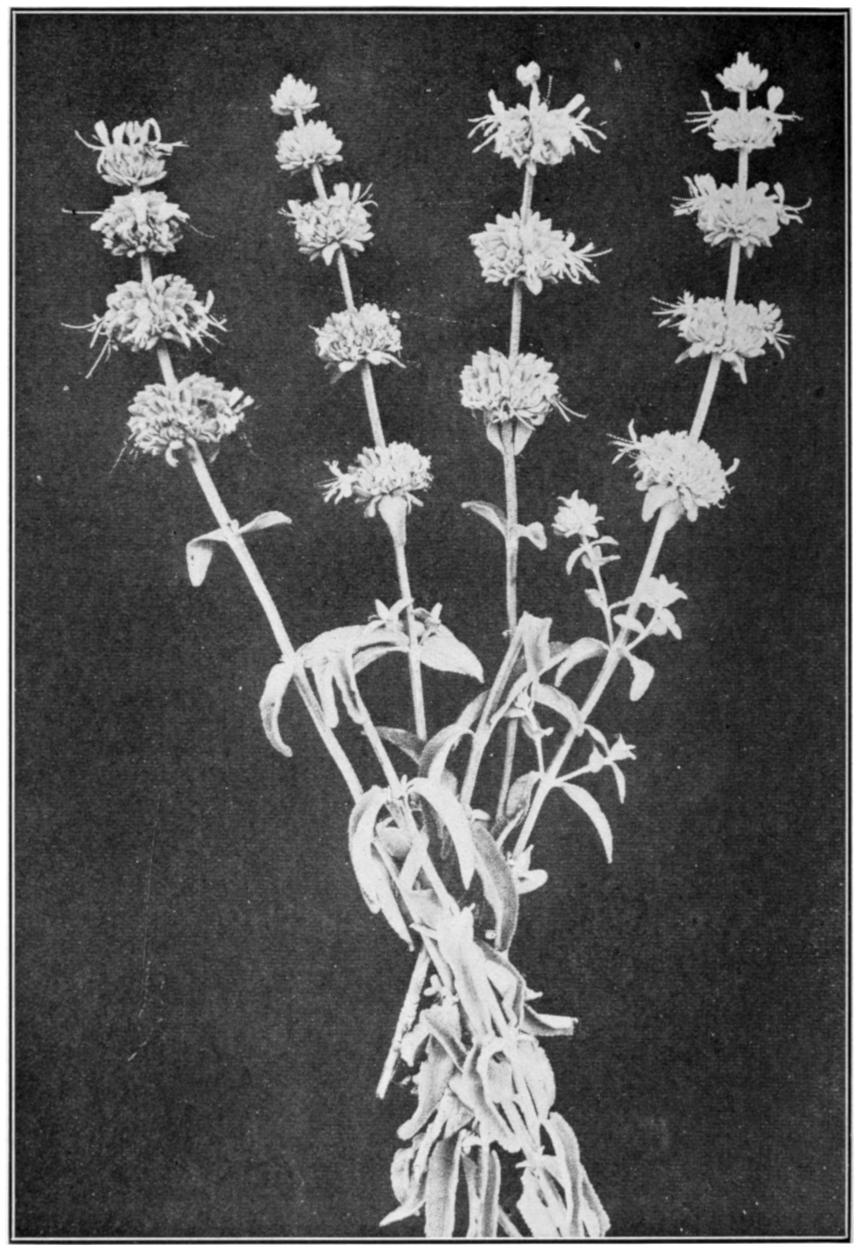
Fig. 122. Black sage is the finest honey plant on the Pacific Coast.
At another time Mr. Cook wrote that the honey from all sages is so much alike that it would be indistinguishable.—American Bee Journal, August 3, 1905.
Richter, in his Honey Plants of California, speaks of the white sage (Salvia apiana) Jep., as “very common on the dry plains toward the foothills, and ascending these to about 3,000 feet.” (Fig. 121).
Writing in Gleanings in Bee Culture, P. C. Chadwick describes a journey which he made in the San Bernardino Mountains with the intent to find out the highest elevation at which bloom could be found in sufficient quantities to support bees. Up to an elevation of 7,000 feet he found white sage in abundance, and all alive with bees. (Western Honey Bee, September, 1914.) Richter gives its range as common from Santa Barbara County southward, blooming from April to July. “As abundant as the black sage, but not as good a yielder, nor has the honey as fine a flavor.”
Black sage (Salvia mellifera), Greene, also known as ball sage, or button sage (Fig. 122), is generally credited as being the principal source of sage honey, most of the honey which goes to market under the name of white sage being produced from this plant. Quite probably it is the best honey plant on the Pacific Coast. Richter says of it: “As a general rule, every fifth year an excellent crop is obtained, and every third or fourth year a total failure is experienced, the flow being dependent upon winter rains, with warm spring quite free from cold winds and fog. When in bloom a certain amount of warm weather is required before it produces nectar.”
The range of black sage is given as “Mt. Diablo, Los Trampas Ridge, near Hayward, San Mateo County, Glenwood and Brieta, southward to southern California. April-May.” (Jepson). “Coast ranges and ascending to 5,000 feet in the San Bernardino Mountains. March to June. San Diego County, February to May.”
Mr. J. E. Pleasants, of Orange, California, writing in American Bee Journal (June, 1914) describes the peculiarities of the sages as follows:
“The black sage is king of them all. When climatic conditions are favorable I think black sage can be relied upon to produce more ‘gilt edge’ than any other plant in the West, and for body and flavor it is hard to excel. It blooms for weeks. The blossom is small and inconspicuous, but what a flow of nectar it can yield.
“The white sage is a much prettier plant. Its soft, grey leaves and tall blossom spikes make it quite showy, while its pleasing aromatic odor breathes the very essence of wild perfumes. But this queenly plant is much more inconstant than its plainer sister. Some years it produces a good harvest, others very light.
“The silver or purple sage, which has silvery leaves and brilliant light purple blossoms, is usually a good producer, but is much restricted as to locality.”
The purple sage (Salvia leucophylla) (Fig. 123), also called white-leaved sage, or silver sage, is reported as a good yielder, although not as abundant as either of the foregoing species. The Richter catalog gives the range as occasional in the foothills of the Santa Monica and San Fernando Mountains, April to July, and from San Luis Obispo to San Diego Counties and not extending inland beyond the coast ranges.
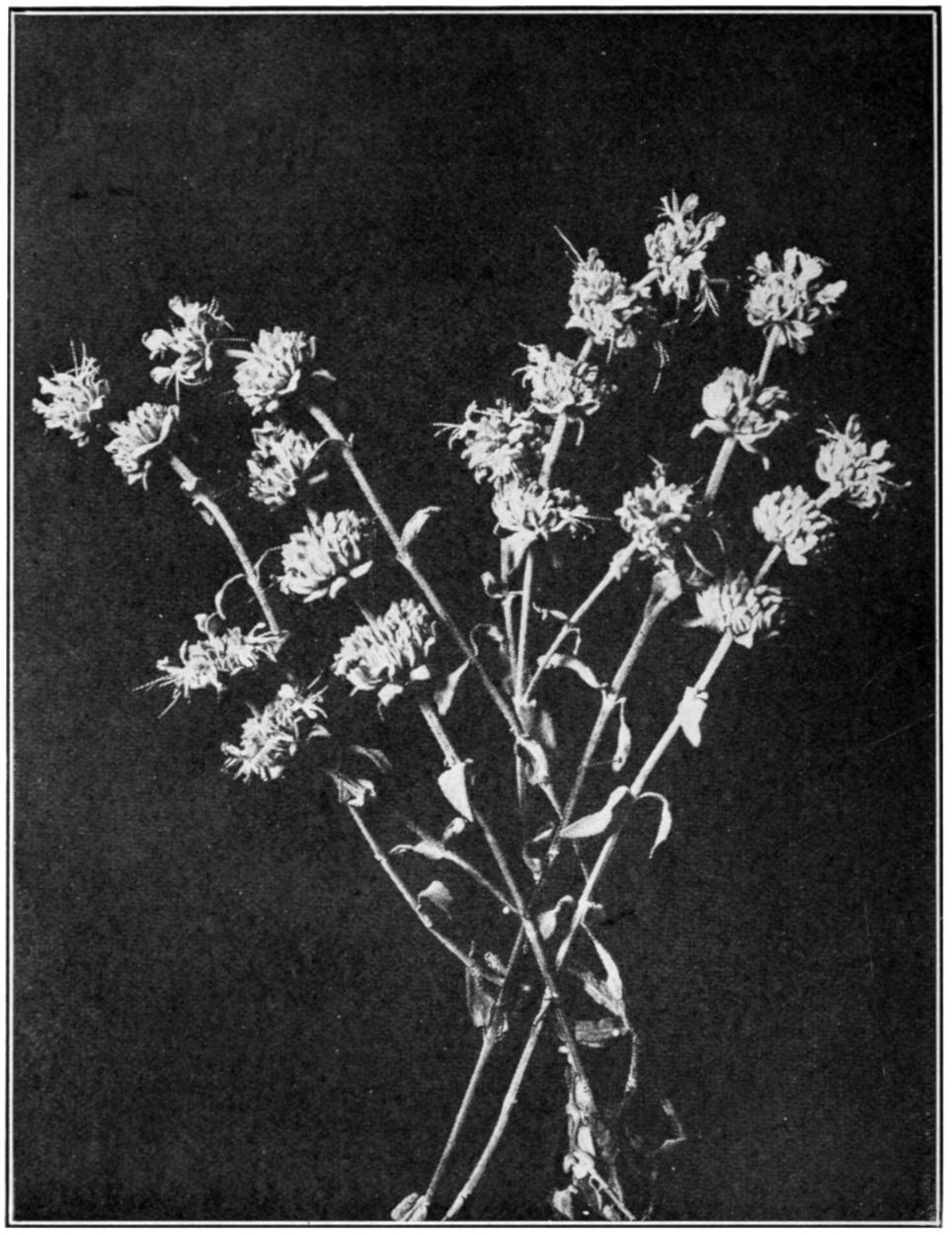
Fig. 123. The purple sage.
Salvia amabilis, loving sage, is reported from Santa Barbara, March-June, but probably not important.
Salvia carduacea, thistle or annual sage. “Inner coast range valleys and throughout the San Joaquin Valley, southern California, June.” (Jepson). “A well-known honey plant.” (Richter).
Salvia columbariae, annual sage. “Throughout the coast ranges, Sierra Nevada and southern California, on hill and mountain slopes.” (Jepson).
Salvia sonomensis, Greene, creeping sage. “Montana species at middle altitudes. Ramona Mountains west of Calistoga, Mt. Shasta, Calaveras and Mariposa Counties, San Diego County. May.” (Jepson). “Also June, Sierra foothills from Sierra to Inyo Counties, main source of honey in many districts.” (Richter).
Concerning the regularity of yield from sage, Mr. P. C. Chadwick wrote in Gleanings in Bee Culture (January 1, 1911), as follows:
“South of the Tehachapi Mountains lies practically the entire sage of our State, notwithstanding eastern people and many of our westerners term every form of small growth on the vast slopes of the Rocky Mountains “sage brush.” There is no denying that the button (or black) sage is, of all honey plants, our chief surplus producer. Neither does it average a crop more often than every other year, regardless of rainfall, for it seems necessary, from its semi-arid nature, to be dried out or rested before it comes back to its prime yielding condition. I have seen it return some surplus for three consecutive seasons; but the middle season was not what could be considered a crop, even after a sufficient rainfall.”
Again he writes to the same journal to the effect that the sage ranges soon give place to other crops (Dec. 15, 1911):
“If I should predict that thirty years hence the sage ranges of California would be almost a thing of the past there would doubtless be criticism of my views; but I firmly believe that we shall face such a condition, for emigration to this part of California is increasing rapidly. Hillsides are yielding to the plow, where twenty years ago it would have been thought almost impossible.”
Some writers give two hundred pounds per colony as a fair average in a good sage year, so that with even one good year in three it comes well up with the yield of many plants more constant in their production.
SAINFOIN or ESPARCET (Onobrychis sativa).
Sainfoin is grown to a limited extent in Canada, and although given numerous trials in various parts of the United States, has not, till the present, succeeded in establishing itself successfully. It is a splendid forage crop, somewhat similar to alfalfa, and is an important source of nectar in Italy and other parts of Europe.
Several years ago it was given an enthusiastic endorsement as a honey plant for America by John Fixter, at that time apiarist at the Central Experiment Farms at Ottawa, Canada. A test plot at the Farms proved so attractive to the bees that it attracted much attention on the part of eastern beekeepers. He reported that it yielded nectar in the morning and that the bees began work upon it fully an hour before they did on alsike or white clover. A further advantage was stated to be that the first bloom came between fruit bloom and white clover and the later bloom at a time when there was a dearth from other sources. On plots side by side he reported that there would be something like a hundred bees on the sainfoin to ten on the white clover.
In spite of the glowing accounts of its value and a general attempt to boom the plant, it failed to succeed. It should be remembered, however, that there was a general failure with alfalfa when first attempts were made to grow it in America, and it would seem worthy of further trial to see whether there are not sections better adapted to its growth.
The following article by C. P. Dadant, reprinted from the American Bee Journal, page 790, 1904, will give some information about the value of the plant in European countries:
“Sainfoin, otherwise called esparcet, is widely cultivated in Europe, especially in France. Its name, “sainfoin,” is French, and literally means “healthy hay”—sain-foin. It is a perennial, gives a splendid hay crop, and in some sections of the European continent it is a first-class honey-producer.
“The small province of France, formerly called “Gatinais,” is the leading producer of sainfoin honey. According to the best authorities, the honey of Gatinais has the reputation of being of the whitest color and sweetest taste, and is said to be in no way surpassed by white clover honey.
“Gaston Bonnier, the eminent professor who was President of the International congress of beekeepers at Paris in 1900, says in his book, the ‘Cours Complet d’Apiculture,’ that sainfoin honey is one of the best appreciated grades. He ranks it next only to the honey of the Alpine hills of eastern France and Switzerland.
“From immemorial times the honey crops of Gatinais have been considered as leading in the amount of production, and this was all credited to the sainfoin, which is grown there in immense quantities, somewhat as alfalfa is grown in the irrigated plains of the West. It was in Gatinais that the custom of inverting hives began, in order to secure the largest possible quantity of honey from the bees, regardless of future consequences. For that reason the beekeepers of Gatinais were compelled to replenish apiaries every season with bees brought from away, as their only aim was to secure the largest possible quantity of sainfoin honey during the short period of the bloom, and many of their bees perished the following winter.
“Although sainfoin has already been tried in the United States with unfavorable results, I believe it is worth while to try it again, especially in the countries where alfalfa succeeds so well. It might prove a useful honey plant.
“We must, however, not close our eyes to the fact that honey plants do not yield honey in the same proportion in all localities. White clover, which is the source of so large a crop of white honey in this country, is absolutely useless as a honey producer in some other countries. Edouard Bertrand, the editor of the Revue Internationale, told me positively that there never had been any white clover honey harvested in Switzerland by any of his friends, although it is quite common in the Swiss meadows.”
SALAD-TREE, see Red-Bud.
SALAL (Gaultheria shallon).
Salal is an evergreen shrub, one to five feet high, common from central California north to Washington. It grows abundantly in the redwood forests commonly covering the ground. The flowers occur in racemes three to six inches long and are pink or pinkish white.
It blooms with salmon-berry, wild blackberry and chittam, so the honey is seldom secured unmixed.
SALIX, see Willow.
SALMON BERRY or THIMBLE BERRY (Rubacer parviflorus).
The salmon berry or Thimble berry, also known as flowering raspberry, shown at Figure 124, is a well known honey plant on the Pacific Coast. It occurs along the coast from Alaska to Mexico. It also occurs in the mountains as far south as Colorado and New Mexico. It is a shrub with erect stem and red fruit. It is known to some extent in Ontario west to Dakota.
Salmon berry is frequently mentioned as a source of honey in the Pacific Northwest, especially in Washington, Oregon and British Columbia.
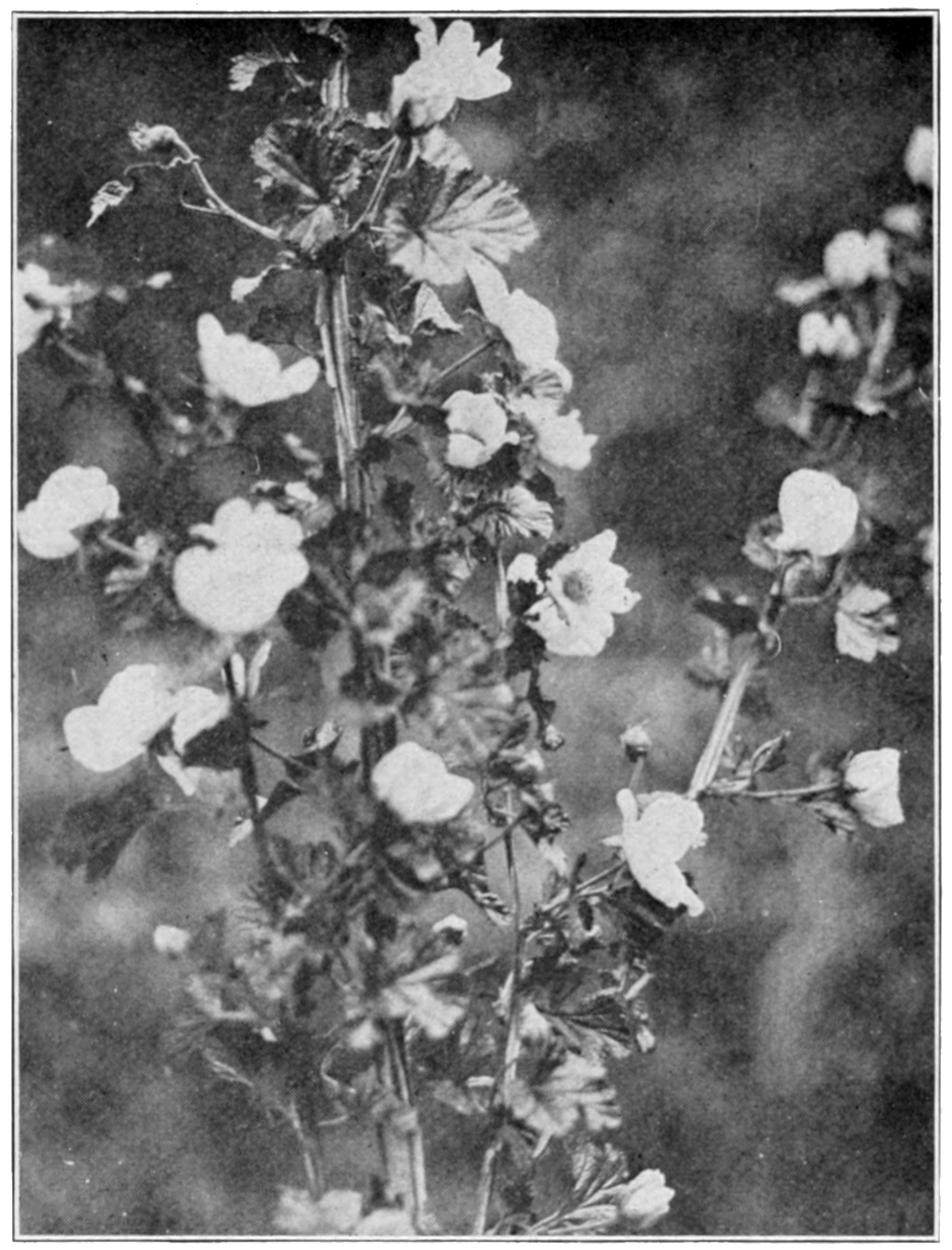
Fig. 124. Salmon berry, or thimble berry.
SALT CEDAR (Tamarix gallica).
Scholl’s Bulletin lists the salt cedar as a source of honey in Texas. “Common European shrub which seems to have escaped in many places in Texas.” (Coulter). “On roadsides, in thickets and waste places in warmer parts of southern United States, naturalized from southern Europe.” (Small.) The author has reports of this plant being common in the vicinity of Corpus Christi, Texas. Reported also as a honey plant in places in California.
SANDVINE, see Bluevine.
SAPINDUS, see Wild China.
SASKATCHEWAN—Honey Sources of.
The sources of nectar, in the order of their importance, are fireweed, wolfberry, prairie flowers, alsike and white clover and Siberian pea-tree. Willows and maples for early brood rearing are important.—F. W. L. Sladen.
SASSAFRAS (Sassafras officinale).
Sassafras is an exceedingly well-known tree in the Southwestern States. It is known occasionally as far north as Ontario and Massachusetts southward to southeastern Iowa, eastern Kansas and south to the Brazos Valley in Texas. It is a conspicuous feature of the old fields of the southern plantations. It has spicy aromatic bark and mucilaginous buds and leaves which many people enjoy chewing. Oil of sassafras is distilled from the roots.
The flowers are small, yellow and inconspicuous, but are attractive to the bees. The writer has found occasional reports of bees working on sassafras in the Southern States. At Buffalo, Texas, it is reported as blooming about two weeks. H. B. Parks reports that it yields well in Missouri. The blooming period is early and short, hence its principal value is for spring brood rearing. It was blooming with willow on March 20, 1918, in Leon County, Texas, when the author visited that section, and the bees were apparently getting considerable nectar from sassafras at that time.
SATUREJA, see Wild Pennyroyal.
SAW PALMETTO, see Palmetto.
SCILLA.
The Scilla siberica, or Siberian squill, is an early blooming old world flower commonly naturalized in the grass of lawns, parks, etc., for ornamental purposes. It has small blue flowers which appear as soon as the ground is free from frost in the spring. The bees seek them eagerly and, coming at a time when little is to be had, they keep the bees busy on the few sunny days of early spring. Flower lovers will find this plant a desirable addition to their garden list. Aside from planting the bulbs no care is necessary. It will thrive in a stiff bluegrass sod, where few other plants would grow. It is only necessary to avoid cutting the grass till the plants have matured.
SCROPHULARIA, see Figwort.
SCRUB PALMETTO, see Palmetto.
SENSITIVE PEA, see Partridge Pea.
SHEEP LAUREL, see Laurel.
SHITTIM-WOOD, see Gum Elastic.
SHOESTRING VINE, see Bluevine.
SHRUBBY TREFOIL, see Hop-Tree.
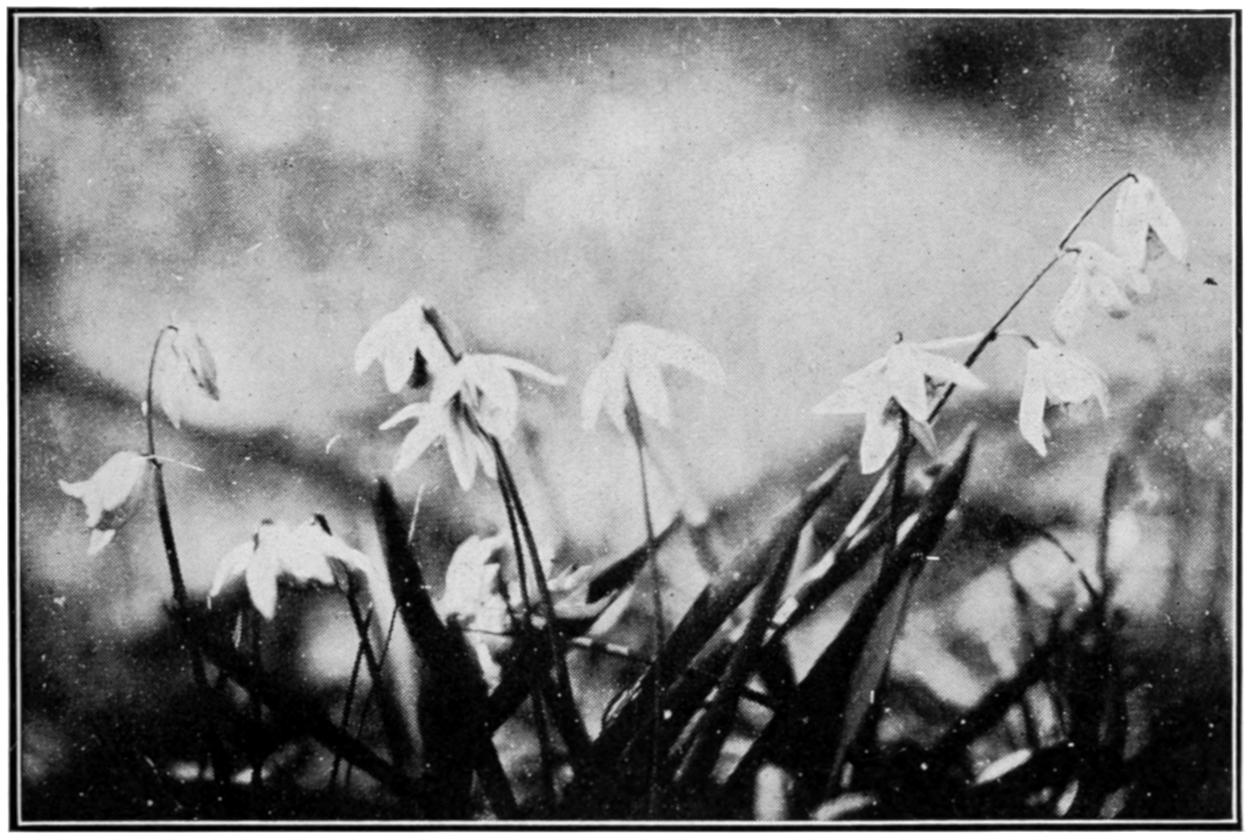
Fig. 125. The blossoms of Siberian squill are attractive to the bees in early spring.
SIBERIAN SQUILL, see Scilla.
SILKWEED, see Milkweed.
SILPHIUM, see Cup Plant.
SILVERBERRY, see Oleaster.
SIMPSON’S HONEY PLANT, see Figwort.
SKUNK CABBAGE (Symplocarpus foetidus).
The skunk cabbage is found in wet places from Nova Scotia to North Carolina and west to Iowa. It receives its name from the strong odor which it gives off. Skunk cabbage is one of the very first plants to bloom as frost is leaving the ground in spring, and its principal value to the beekeeper comes from this early appearance. The late G. M. Doolittle wrote (Gleanings, 1909, page 200) that he had seen the bees gathering pollen from this plant when the temperature stood at 42 degrees. He stated further that he valued it more highly than any other pollen-yielding plant or tree, and that there was nothing with which he was familiar so eagerly sought by the bees, nor any source of pollen which so greatly stimulated brood rearing.
SMARTWEED, see Heartsease.
SNEEZEWEED, see Bitterweed.
SNOWBERRY (Symphoricarpos racemosus). WAXBERRY.
The snowberry is a low branching shrub with conspicuous white berries which hang on through most of the winter. It is of wide distribution in the Northern States from New England and Pennsylvania to the North Pacific Coast. It is also common in the hill country of much of California, in the White Mountains of New Mexico and in parts of Colorado and other mountain States. The blossoms are small and inconspicuous, but they are attractive to the bees, nevertheless. The snowberry is a valuable plant in many localities in the West, but is of special importance in Washington and British Columbia. There it is reported as blooming during the last half of June and well into July and as furnishing an important secondary flow. According to H. A. Scullen it is very important in northern Idaho and in Stevens County, Washington, the bees work upon it in preference to white clover.
Snowberry is a close relative of Indian currant and is illustrated in connection with that plant. (See Indian Currant).
SNOW-ON-THE-MOUNTAIN (Euphorbia marginata). SPURGE.
Snow-on-the-Mountain is a showy plant easily recognized by the white margined leaves. It is native from Minnesota to Montana and south to New Mexico and Texas. It is also cultivated for the peculiar foliage. It is probably nowhere important as a honey plant, and is of special interest from the fact that its nectar is so often reported as poisonous. (See Poisonous Honey.)
SNOWVINE or PEPPER-VINE (Cissus arborea).
The snowvine is a climbing vine with heart-shaped leaves, and berries the size of a pea, and which are edible. It is common in the low borders of woods and along streams from Virginia to southern Illinois and southward to Florida and eastern Texas. It is a relative of the cowitch. (See Cowitch). It is common in Alabama and Georgia from the central belt to the coast plain, where it begins to bloom in June. It is reported as being the source of considerable honey of fair quality.
SOAPBERRY, see Wild China.
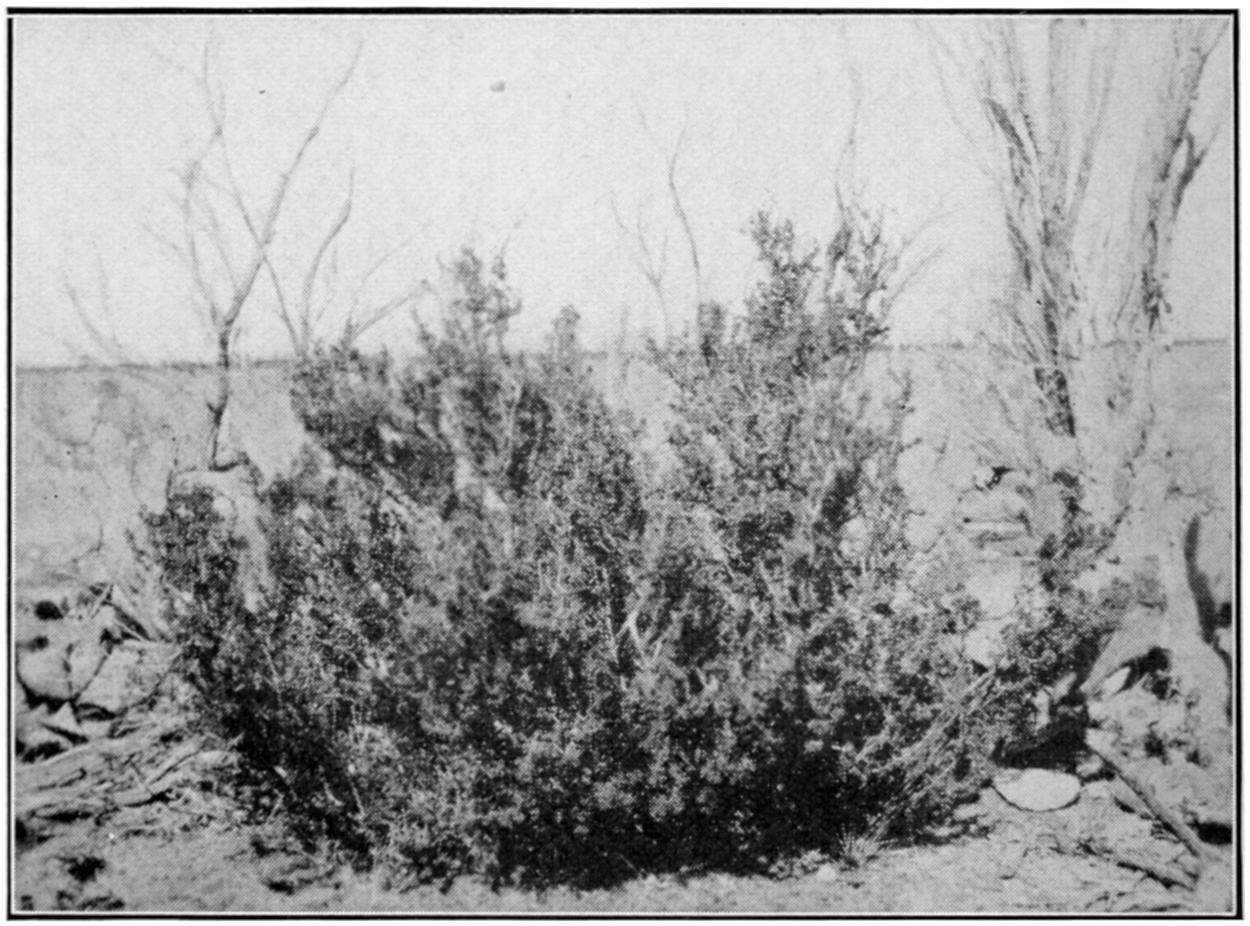
Fig. 126. Soapbush (Guaiacum angustifolium).
SOAPBUSH (Guaiacum angustifolium).
The soapbush is native to the dry lands of south Texas and northern Mexico. It blooms after rains in both spring and fall. At Crystal City, Texas, it is reported as the source of the first honey in spring, coming in March. Beekeepers report that with very little moisture soapbush can be depended upon for honey and that it yields nectar every time it blooms. The honey is of fine quality, mild flavor and light color. The flow lasts from ten to fifteen days. (Fig. 126.) The soapbush has very hard wood, crooked and knotty branches and in places becomes a small tree and is known as lignum-vitae.
SOLIDAGO, see Goldenrod.
SORGHUM.
The sorghums are widely planted as forage crops. They yield pollen in great abundance and at times honeydew is gathered from this source, also.
SORREL-TREE, see Sourwood.
SOULARD CRAB APPLE, see Crab Apple.
SOUR-GUM, see Tupelo.
SOUR-TOP, see Blueberry.
SOURWOOD (Oxydendrum arboreum).
The sourwood tree reaches a height of thirty to forty feet and a diameter of twelve inches, on high lands, but seldom exceeds twenty feet in height on the low lands. It is a common tree from West Virginia to north Georgia and west to Arkansas. The white flowers grow in racemes and appear in July. It is sometimes called sorrel tree, because of the acidity of its leaves. The wood is soft and is not of much value except for light fuel.
Sourwood honey ranks high, both in quality and in quantity of yield. Many people regard it as the finest honey produced in America. It is light in color, of heavy body, fine flavor and slow to granulate. The bloom lasts from two to three weeks and comes in mid-summer, when bees have ample time to build up to maximum strength for the flow. Although sourwood honey is produced in limited areas in several States, North Carolina and eastern Tennessee probably contain the finest forests and remarkable yields are sometimes reported in this region. The crop from this source seldom fails and it is regarded as one of the most dependable sources of nectar. A lady beekeeper, writing from North Carolina, stated in the American Bee Journal that she had never known it to fail. An average of as high as 75 pounds per colony from sourwood has been reported and the local demand usually takes it all at prices above the open market.
SOUTH CAROLINA—Honey Sources of.
Willows, fruit blossoms, including such wild fruits as hawthorne, huckleberry and blackberry, furnish abundant nectar for early spring. Tulip-tree, sourwood and clover, persimmon, black-gum and holly are all good sources of nectar. Cotton may be expected to yield also on suitable soils. (See also North Carolina and Georgia for a longer list of plants likely to be of value in this State.)
SOUTH DAKOTA—Honey Sources of.
The best beekeeping territory in South Dakota is in the sweet clover districts in the southeastern part of the State. In this region large crops of fine honey are secured.
Maples and willows, dandelions and fruit blossoms start the bees off in the spring. White clover and alsike both yield well in the eastern part of the State. Sweet clover is important wherever grown and alfalfa is valuable in some localities. Heartsease is the principal source of honey in late fall. There are also many minor sources, such as are common to the Middle West.
SOUTHERN BUCKTHORN, see Coma.
SOUTHERN CRAB APPLE, see Crab Apple.
SOW THISTLE (Sonchus).
The sow thistles are weeds which are widely distributed from eastern Canada to Florida and from British Columbia to California. They are reported as valuable in east Texas, and Richter lists two species as yielding nectar in California. Probably seldom important.
SPANISH BAYONET, see Yucca.
SPANISH DAGGER, see Yucca.
SPANISH NEEDLE (Bidens).
The Spanish needles, also known as bootjacks, beggar ticks, stick tights and marigolds, are very widely distributed plants, and are of interest to the beekeepers from Nova Scotia to California. Most of the species are weeds growing commonly on low and swampy lands. Not all of them produce honey in appreciable quantity, and possibly some of them are not sought by the bees at all. Figure 128 shows Bidens aristosa, which has an attractive yellow flower and is most frequently mentioned as a source of honey. This is particularly valuable on the lowlands along the Mississippi and Missouri Rivers. During the seasons of 1915 and 1919 much honey was gathered from it.
Two species are reported among the honey plants of California by Richter, B. frondosa and B. pilosa. The former is one of the most widely-distributed species and closely resembles the one shown, but has a wider leaf. Frondosa is seldom reported as yielding nectar, and it is of doubtful value to the beekeeper.
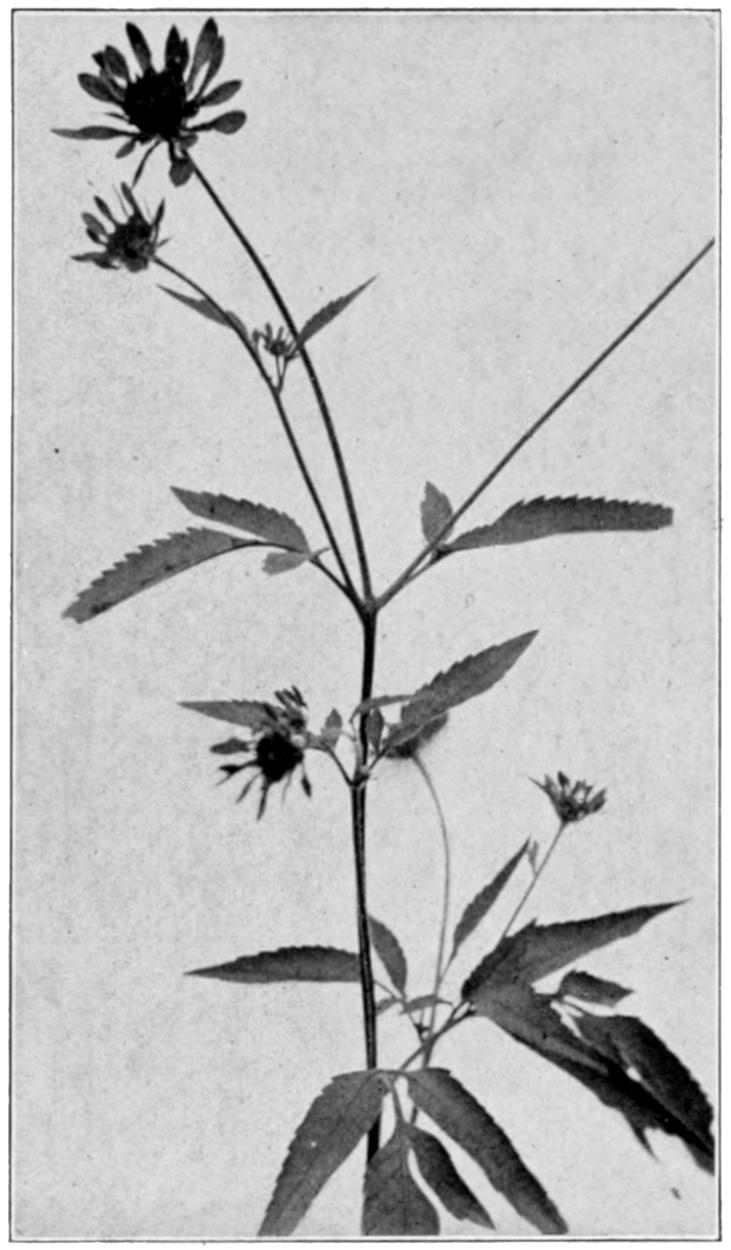
Fig. 127. Western bur marigold.
Figure 127 shows the western bur-marigold (B. involucrata), which occurs from Illinois and Iowa south to Texas and Louisiana. This is reported as a good honey plant. This flower has no colored corolla, but is surrounded by greenish rays. August is the month of flowering with this species. The Spanish needles are all late bloomers, and where they occur yield nectar, and add something to the fall honey flow.
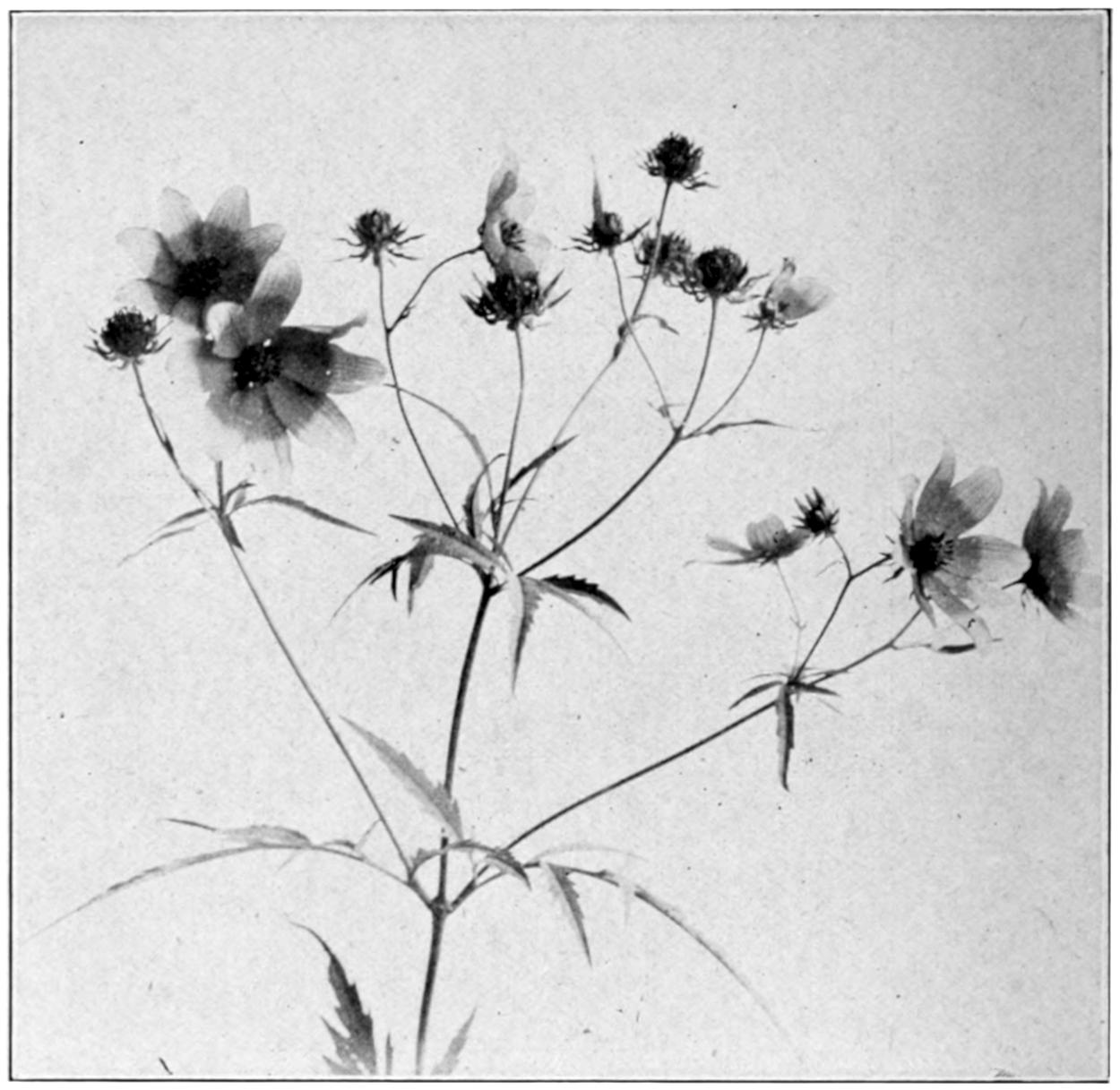
Fig. 128. Spanish needle (Bidens aristosa).
SPARKLE-BERRY, see Farkle-Berry.
SPICEWOOD, see Dogwood.
SPIDER PLANT (Cleome spinosa).
The spider plant is a close relative of the Rocky Mountain bee plant and very similar in habit. The spider plant had quite a boom among beekeepers of a few years ago. The seed was sold quite generally and planted in gardens, but as it is of no value except for honey and as an ornamental, its popularity soon declined and it is seldom mentioned of late. It secretes nectar abundantly and the bees work upon it freely just at nightfall, and again in early morning. It is a native of the tropics and has escaped and run wild in many places from North Carolina to Arkansas and Louisiana.
Much has been written about the remarkable secretion by this plant and the excitement it causes among the bees. Under favorable conditions it is one of the very best of honey plants and, if sufficiently common, would no doubt be the source of large quantities of surplus honey. There are reports to the effect that spider plant grows abundantly in neglected fields in some localities in southeastern Missouri and is there important. It is said to require a rich soil for best results in nectar secretion. A single blossom secretes nectar so freely that a bee often finds a drop larger than it can carry at one load.
SPIKEWEED (Centromadia pungens).
Spikeweed is a common plant in California, where its range is given by Jepson as follows:
“Abundant on the plains of the lower San Joaquin southward to southern California and westward to Walnut Creek and Alameda. On the alkaline plains of the upper San Joaquin this species covers tens of thousands of acres and often forms thickets four or five feet high. It is abundant in the low, more or less alkaline plains of Solano County and forms extensive colonies in summer fields. Extermination is often accomplished by means of bands of sheep, which leave the fields perfectly clean and destitute of this spikeweed pest.”—Flora of Western Middle California.
According to Richter, carloads of honey from spikeweed are shipped annually from Fresno County, the honey being of amber color, good quality and quick to granulate. He states that other plants are replacing spikeweed to such an extent that it is no longer of the importance which it was in the past.
SPOON-WOOD, see Laurel.
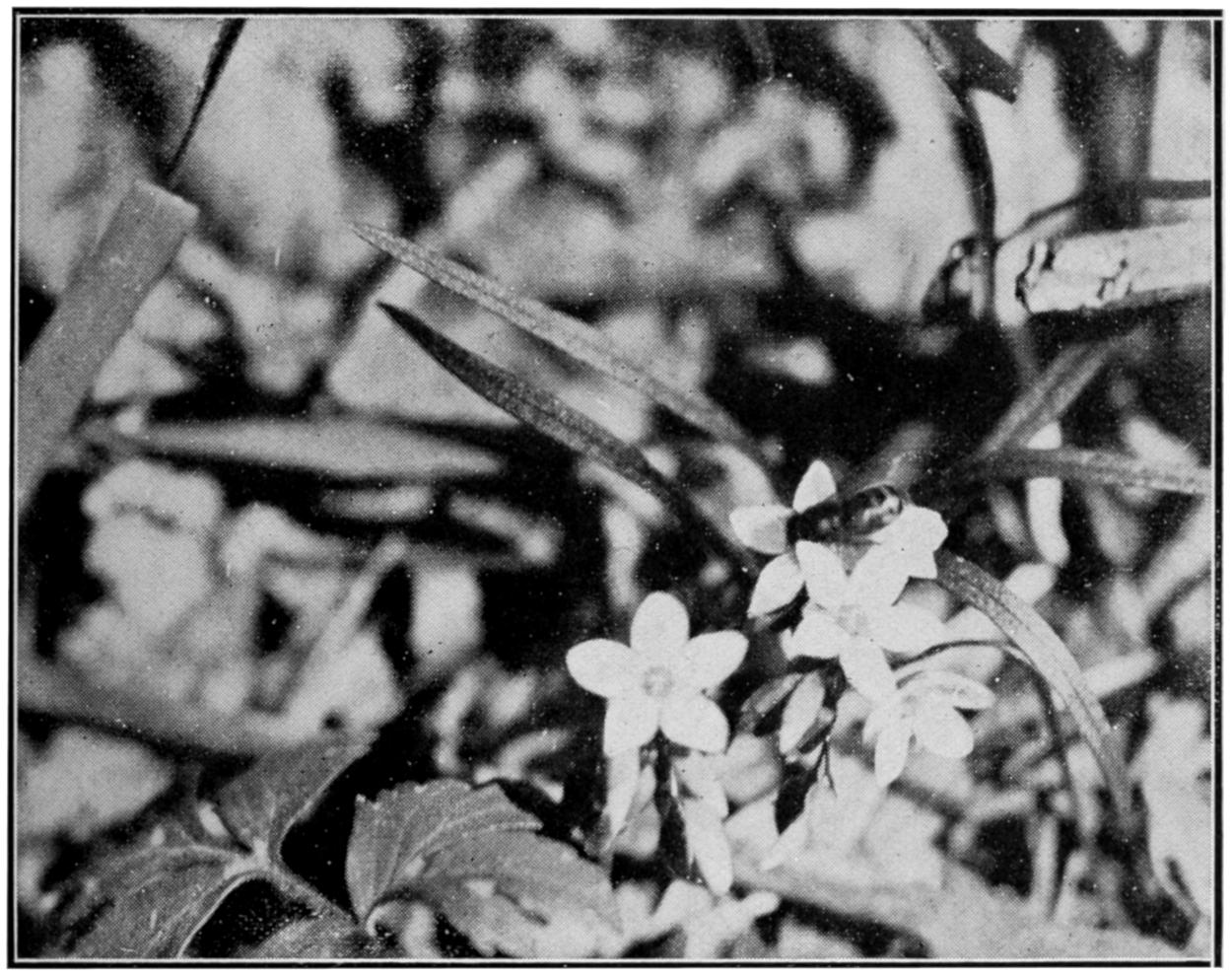
Fig. 129. The bees seek the spring beauty in early spring.
SPRING BEAUTY (Claytonia Virginica).
The spring beauty is one of the early spring flowers common in open woodlands from Nova Scotia and New Brunswick to Ontario, Saskatchewan and Alaska and from New England west to Minnesota and Nebraska and south to Georgia and Arkansas. Appearing so early in spring it is much sought by the bees at a time when there is little of either nectar or pollen available. At a later season it would be of such slight value as to be hardly worthy of notice on the part of the beekeeper. Figure 129 shows a bee on the blossom of a spring beauty.
SPRUCE (Picea abies).
For years past there has been an occasional mention in our beekeeping literature of spruce honey, or of bees working on spruce. As far as the writer has been able to ascertain this is true only of the Norway spruce. Since the Norway spruce is not a native of this country, it is seldom found in considerable numbers except in the vicinity of cities, where it is planted freely for ornament. (Fig. 130.)
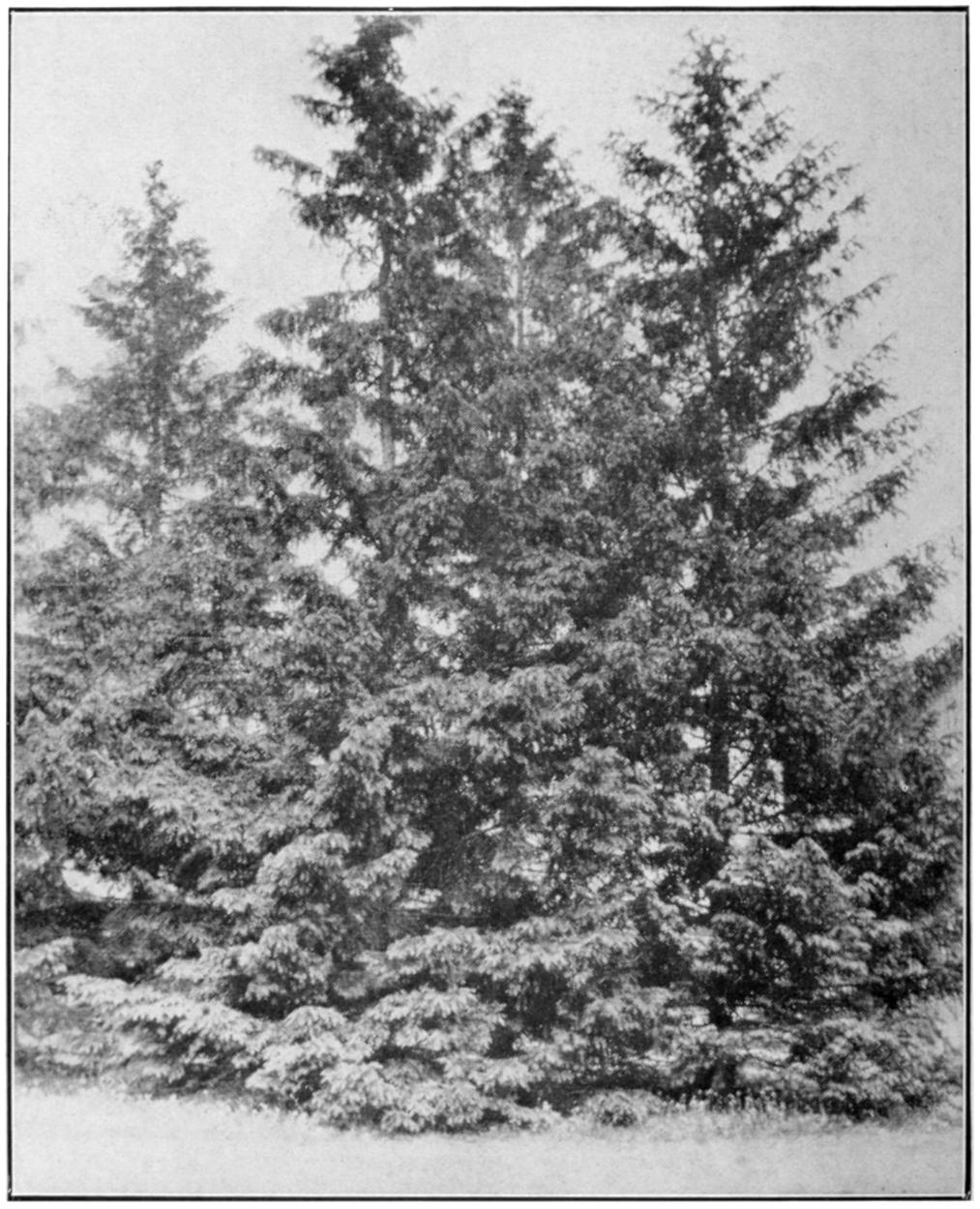
Fig. 130. The Norway spruce is the source of honeydew.
It was at the Ontario Agricultural College at Guelph that the writer first saw the bees working on spruce to any extent. It was about June 12, and the bees were humming through these trees in large numbers. There are hundreds of these trees about the college grounds, and considerable honeydew seemed to be coming to the college apiary from this source. Honeydew is seldom desirable, as it is usually of poor quality and only serves to spoil the quality of good honey. However, this spruce honeydew seemed to be of rather better quality than is generally the case with honeydew, and, as it came ahead of the clover flow, was probably nearly all consumed for brood rearing.
For a time the writer was puzzled to know whether the bees were getting an exudation of sap from the tree, or were in fact getting honeydew. They were working on what appeared at first sight to be buds at the base of the new growth, but which under the microscope proved to be insects identified as Physokermes picea.
SPURGE, see Snow-on-the-Mountain.
SQUASH (Curcurbita maxim), also (C. moschata).
Squashes are widely cultivated for food. There are numerous varieties, but all are valuable sources of pollen and nectar. They secrete nectar freely, and where sufficiently abundant, a considerable quantity of honey is stored.
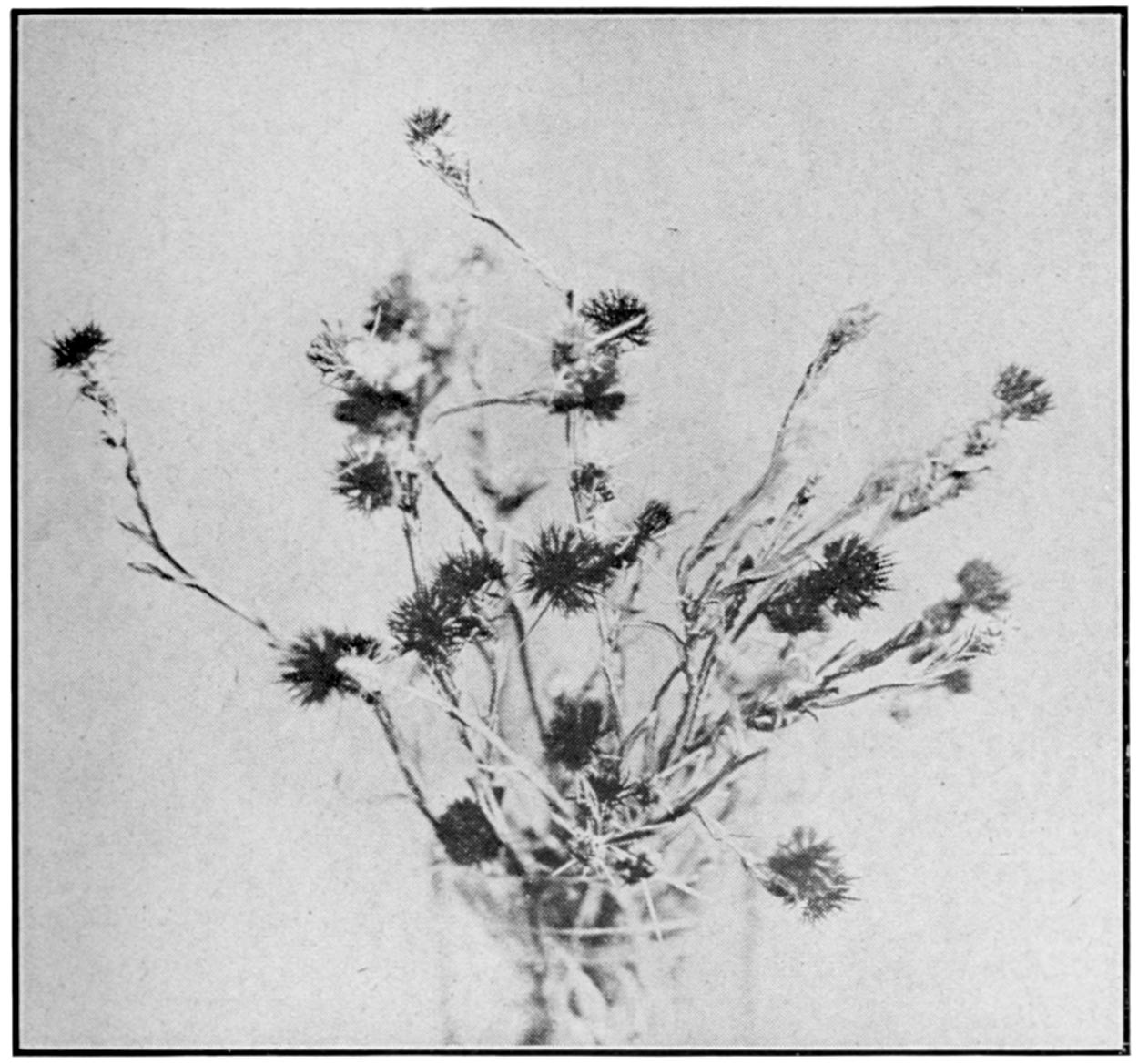
Fig. 131. Yellow star thistle.
STAR THISTLE or KNAPWEED (Centaurea). BARNABY’S THISTLE.
There are several species of star thistles or knapweeds widely distributed. The yellow star thistle (Centaurea solstitialis) (Fig. 131) is an introduced species from Europe that occurs from Massachusetts and Ontario, west to Iowa. It is also common in parts of California. It is only from the latter State that it is reported as an important honey plant. According to C. D. Stuart (American Bee Journal, page 340, October, 1918), it furnishes from one-third to one-half of Butte County, California’s honey crop, an average of about sixty tons. Concerning the plant he writes as follows:
“Star thistle begins to bloom about the first of July and continues till frost, which usually comes between October 1 and November 1. The yield of nectar is slow but continuous. If it is stopped by drought it will start yielding nectar again after a rain. The plant has the faculty of existing in arid soils for long periods of drought, and when apparently dried up, it will start to grow and blossom after a rain. Some cattle growers find that thistle hay can be fed profitably when cut and dried like other hay, if it is moistened before feeding. The dampening of the fodder takes the sting out of the leaves and blossoms.
“Star-thistle honey is heavy-bodied, white, almost cloying in its sweetness as orange, and has a greenish yellow tinge, like olive oil. It is considered by large buyers equal in quality to any white honey in the State, and with the price at two cents a pound more than light amber of the alfalfa type, and still rising, beemen in northern California should worry.”
Richter lists Napa-thistle or tocalote (Centaurea melitensis) as yielding light amber honey of good flavor and fair body in Sacramento County, from May 15 to June 15. It is regarded as a bad weed and is abundant everywhere in fields and pastures. Like the foregoing, it has been disseminated with seed grain and grass seed. According to Richter, it does not yield nectar in southern California. Scholl lists American knapweed (Centaurea Americana) as not important in Texas.
STICKLEAF, see Mentzelia.
STICK-TIGHT, see Spanish Needle.
STINKING CLOVER, see Rocky Mountain Bee Plant.
STINKWEED, see Jackass Clover.
STONECROP (Sedum pulchellum).
Stonecrop is common from Virginia to Arkansas and south to Georgia. It is abundant in many localities and is reported to be a valuable honey plant in the South.
STORK’S BILL, see Pin Clover.
STRAWBERRY (Fragaria).
The wild strawberries are seldom sufficiently abundant to be of much value to the bees, but the cultivated varieties are grown in large plantations and are the source of both pollen and nectar. They bloom in early spring, for the most part, although some of the everbearing varieties continue to blossom through the summer. Strawberries, like most other fruits are of principal value to stimulate early brood rearing.
The bees are very important to the strawberry growers, as many varieties of strawberries are not self-pollinating or are deficient in stamens. The bees carry the pollen from the staminate blossoms to the pistils of the incomplete flowers.
STRINGY BARK, see Eucalyptus.
SUGAR GUM, see Eucalyptus.
SWEET CLOVER (Melilotus).
There are probably twenty species of melilotus native to the temperate regions of Europe and western Asia. Several have been introduced into America. Of these, two species, the white sweet clover (Melilotus alba) and the yellow sweet clover (Melilotus officinalis) are valuable plants and are widely distributed. The yellow variety blooms about two weeks earlier than the white and where both are present a long honey flow may be expected.
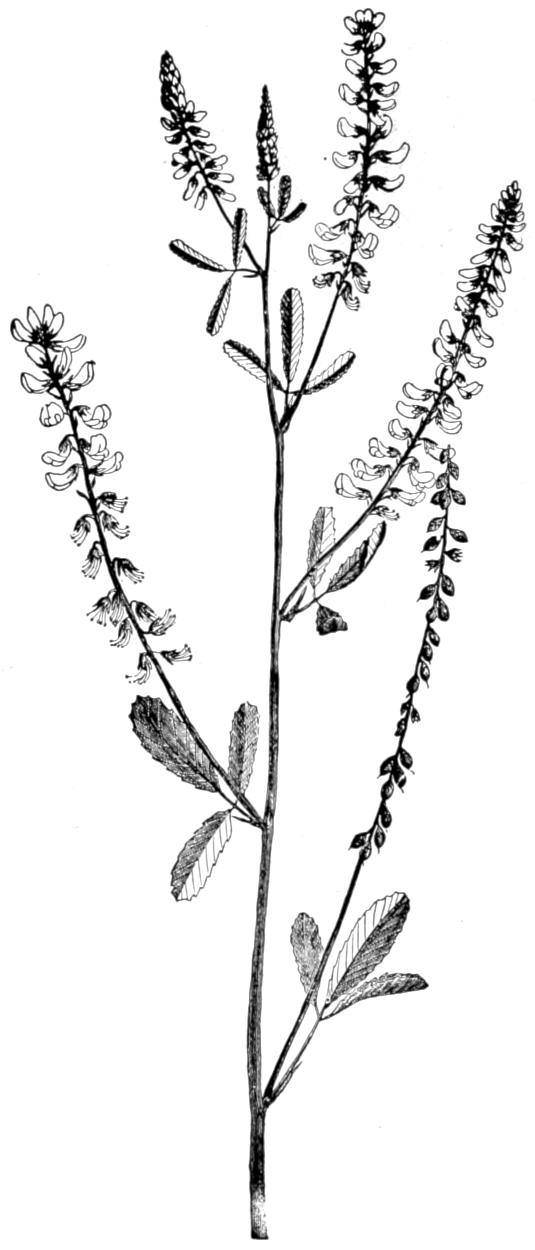
Fig. 132. Blossoms of white sweet clover (Melilotus alba).
Sweet clover reaches the highest development in the secretion of nectar in the hot, dry summer climate of the plains region between the Mississippi River and the Rocky Mountains. In the East, the surplus secured from this plant has been disappointing, and eastern men insist that sweet clover is overrated as a honey plant. However, those who have seen the big flows that are frequent along the Missouri River and westward are enthusiastic in its praise. In the region about Sioux City, Iowa, it is grown extensively as a farm crop. In this section an average of 200 pounds surplus per colony from sweet clover is not uncommon. On the limestone soils of Alabama and Mississippi it also yields freely and large yields are reported. In the irrigated regions of the West it is of great importance and beekeepers who ship sweet clover honey in carlots are not uncommon.
The quality of the honey is excellent. It is light in color and mild in flavor, although slightly peppery to the taste. It granulates more readily than white clover, but is regarded as of number one quality in the principal markets.
Sweet Clover as a Farm Crop
When our older readers were beginners in the beekeeping business it was a popular thing for the beekeepers to buy sweet clover seed and stealthily sow it along the roadsides. So general was this practiced that whenever the plant appeared in a new locality it was generally charged up to the beekeepers living nearby. So great was the prejudice against the plant that much ill-feeling developed in some places because of it. It even went so far that in some States it was placed on the list of noxious weeds and its eradication required by law. When Frank Coverdale, well-known Iowa farmer who did so much to popularize sweet clover, first sowed it in his own fields, neighbors called on the county attorney to enquire whether he could not be prosecuted for sowing weed seed. For a generation the beekeepers kept up the fight, and constantly preached that sweet clover was not a weed, but a valuable forage plant. It remained for men like Coverdale, who were both beekeepers and farmers, to prove the assertion and convince the unwilling public, by making as much profit from sweet clover pasture for forage as the neighbors could make from other farm crops.
It was on poor lands which had been worn out by bad tillage, that the plant made the best showing. When lands which had been lying idle, because no other crop could be raised profitably, were made to produce good yields of milk, butter and beef from sweet clover, the neighbors were inclined to give it a trial on their own poor lands. The change in sentiment has been very marked during the past few years and now the demand for sweet clover seed is greater than the supply, and will continue so for several years, since the area where it is being grown is constantly being enlarged. There are large areas where sweet clover is grown generally as a farm crop, in Kentucky, Nebraska and Kansas. The increased acreage of this plant will double the possibilities of honey production in most any locality, and in numerous instances will treble and quadruple it. In the early years of his experience, Coverdale kept bees in several outapiaries, so that much travel back and forth was necessary. Since sweet clover has become so generally grown in his locality, he is able to keep three hundred colonies in one yard in his orchard, where they are under his immediate care at all times. After traveling over much of the Central West, it has become apparent to the author that within a few years the beekeeping possibilities of parts of Kansas, Nebraska and South Dakota will be almost inexhaustible because of the increase of this plant. On visiting Falmouth, Ky., I was amazed at the stories they told of what sweet clover had done for that region. One of the pioneer growers was E. E. Barton, and his experience with it sounded like a fairy tale. Mr. Barton said that following the civil war, most of Pendleton County was given over to tobacco growing, with little live stock, and not much rotation of crops. It was a hill country, and although it had a fertile soil over a clay subsoil, the heavy rains soon washed away the shallow surface soil, and one farm after another was abandoned. Hundreds of farms were abandoned, and many of them were sold for taxes, because no buyers could be found. More than a third of the population left the county, and the farmers who remained had hard lines to make ends meet. Sweet clover was stealthily sowed, probably by beekeepers intent on increasing the bee pasturage. At first it was regarded with disfavor and fought as a dangerous weed.
Mr. Barton came into possession of a farm, somewhat against his will, because the owner could not pay the mortgage. He tried renting it, and the tenant was unable to make a living, much less pay the rent. After it had been abandoned, he went to great trouble to keep down the weeds, especially sweet clover. Then came a year of drought, when there was very little feed for the cattle, and they were turned into the roads to graze. Even there there was but little except the sweet clover, which was by this time rather common along the roadsides. It was soon noticed that the cows were eating the sweet clover with relish and doing well. Then somebody tried an experiment by sowing it in a field. It thrived, the cows liked it, and the milk flow was increased. Mr. Barton by this time was quite ready to profit by the experience, and within five years the farm which would not grow grass was producing good crops. He bought more abandoned farms and sowed them to sweet clover, and his neighbors began to do likewise. One by one the farmers came back to their abandoned farms, new settlers came in, and everybody began to grow sweet clover. Now there are fifty thousand acres of it in that county. Ask any farmer you meet on the streets of Falmouth what he thinks of sweet clover and he will tell you such tales of rebuilt fortunes from a combination of dairy cows and sweet clover as you never expect to hear. There are now shipped from the county about half a million pounds of seed yearly, besides thousands of dollars’ worth of dairy products every week. They find that an average of 300 to 600 pounds of hulled seed per acre can be secured from the white variety and 500 to 700 pounds of the yellow. An average yield of from $40 to $100 per acre is the return from the sweet clover, according to local reports picked up on the streets. Now one finds evidences of prosperity on every hand. The farmers have fine homes, automobiles, and money in the bank.
Soil Requirements.
There is no forage plant that will succeed on such a wide range of soil conditions as will sweet clover. It will succeed under unfavorable conditions on the heaviest clays and on light sand. It will grow on hardpan and on gravelly and stony land unsuited for general cultivation. It does well on soils too wet for either alfalfa or red clover and on soils so dry that neither of these will succeed. It will grow on land so poor and devoid of humus that no other clover or grass will grow. It is the greatest soil builder known, and now that the public has finally accepted the fact that it is not a noxious weed, it will shortly be used to redeem untold thousands of acres of otherwise waste land. It grows all the way from sea level to the mountain sides, and is spreading in the semi-arid sections of Colorado and other Western States, where the annual rainfall is very light.
In the October, 1917, number of the American Bee Journal has been told the story of the sweet clover region of Alabama and Mississippi. In those States sweet clover has spread over thousands of acres of land which had been abandoned for agricultural purposes; and it is not only furnishing abundant pasturage to the bees, but is restoring the fertility of these worn-out plantations.
The growth of the plant, however, is no longer confined to the roadsides and worn-out fields, but farmers are growing it successfully and profitably on lands worth $300 per acre in Iowa and Illinois, because it pays them to do so. In some cases the railroad companies have discovered that sweet clover growing along the right of way is the best possible insurance against erosion of the roadbed. A heavy growth of sweet clover protects the banks from the washing of heavy rains, as no other plant will do. In places, one can see a continuous strip of sweet clover for miles and miles along the railroads. It would seem the part of wisdom for the beekeepers’ associations to bring this fact to the attention of the men in charge of keeping the lines in repair wherever possible. Once established along the railroads, it is bound to spread more or less along the byroads and into the fields, thus increasing the supply of forage within reach of the bees.
One of the most useful purposes which sweet clover serves is to smother out obnoxious weeds. So persistent is the plant where sowed in waste places that there are few weeds which can compete with it. Where bad weeds are present in old lots, along roadsides, etc., the easiest way to eradicate them is by sowing sweet clover freely. Within a few years the sweet clover will generally crowd them out. In spite of this fact, sweet clover itself is one of the easiest plants to destroy. Since it only lives two years and must come again from the seed after that time, all that is necessary to clear the ground of sweet clover is to cut it low when in blossom and before the seeds are formed.
Where there is difficulty in establishing alfalfa, sweet clover is often grown in advance to establish the nitrogen-gathering bacteria, which are peculiar to the leguminous plants. Following sweet clover, there is usually little difficulty in getting the alfalfa to grow, if the seed bed is carefully prepared. However, many farmers who have been growing both plants, are of the opinion that sweet clover is the more profitable of the two, and that it can be handled successfully with less difficulty.
There is no pasture crop which will support as many cattle or other live stock as will sweet clover during the second season of its growth. A small experimental plot of little more than an acre yielded two big loads of hay. The plants were permitted to get a good start after the hay was cut before pasturing, then two cows and a horse were turned in for the rest of the season. In addition to furnishing an abundant pasture for three, more than twenty bags of seed were secured. Allowing $15 per ton for hay, $1 a month per head for pasture, and $3 a bag for the seed, all very conservative figures, the crop returned about $96 per acre. While this small plot was experimental, there are numerous farmers who have received more than $100 an acre for seed alone.
Cultural Requirements.
It frequently happens that, having seen sweet clover growing along the roadsides, on gravelly banks and other unpromising situations, we are surprised to fail in getting a stand in a well prepared field. Sweet clover requires a firm seed bed, and will not succeed on land where the soil has been deeply stirred and left in a loose condition. It is well to scratch the surface with a tool that does not penetrate deeply, leaving the surface loose for an inch or so, and compact below. While it will succeed on a great variety of soils, it requires that they be in a well settled condition and not freshly plowed to a depth of several inches, such as best suits many forage plants. This condition probably accounts for more failures in getting a stand of sweet clover than any other cause.
Sowing the seed on top of the ground or on the snow in winter, will often secure a good stand with no cultivation at all. Good results often come from sowing it with small grain in spring, on land that has been cultivated the previous season. Some succeed by sowing after the last cultivation of corn, the seed germinating to some extent the same season, while some does not sprout until the following spring. The ideal condition is to cover the seed from half an inch to an inch with finely pulverized soil, with a firm soil underneath.
Time of Sowing.
Sweet clover may be sowed in the winter or early spring, as above stated, or at any time from March until August. It should not be seeded when it is likely to start so late that it will not have time to establish itself firmly before winter. Under the different conditions of soil and climate of this great country, it is difficult to give general directions that will apply everywhere.
The time of sowing will depend much upon the manner in which the crop is to be handled. Where it is desired to sow the seed on old meadows or pastures without plowing, it will probably be best to scatter it in winter or early spring. The freezing and thawing have a tendency to soften the hard coat of the seed, as well as to cover it with earth. As a field crop, the writer’s limited experience would indicate that spring sowing, with a nurse crop that can be cut early, will be best, though winter seeding on stubble should bring good results.
There is a great diversity of opinion as to the proper amount of seed to sow. Where it is used to thicken up meadows or pastures a smaller amount is needed than where sown as a field crop on newly prepared land. Some growers say that 4 pounds of good unhulled seed per acre is sufficient to sow on grass lands. As high as 20 pounds of hulled seed per acre is advocated by some for a field crop. The seed covering is very hard, and, unless treated, only about half of it will grow the first year. If the seed is scarified, the hard coat is scratched until it germinates readily, and much less seed is necessary to secure a stand than otherwise. Ten pounds of hulled and scarified seed per acre should be sufficient on good land.
It is often difficult to get a stand on old land which is deficient in lime, for lack of the nitrogen-gathering bacteria that thrive on the roots of clovers. It is sometimes necessary to treat a small area with a good coat of manure, and sometimes with crushed lime. After the sweet clover is growing well on this land the area can be gradually extended.
Utilizing the Crop.
Probably there is no forage crop which will furnish as much pasture per acre as will sweet clover in its second year of growth. It should be allowed to get a good start in spring before stock is turned in, and the area should be sufficiently large for the animals thus kept. Cattle, hogs and horses all eat it with relish after they become familiar with it, and thrive equally on it. It is a common practice to pasture the crop during the first part of the second season and then to turn the stock off and harvest a seed crop. The writer has harvested a very good crop of seed from a limited area, which was pastured lightly through the entire summer until the crop was cut. Of course, it is not possible to pasture heavily after midsummer, and still secure a good crop of seed.
Sweet clover makes a good quality of hay if cut at the proper time and well cured. If a seed crop is to be cut, the first crop of the second season may be cured for hay by cutting high enough to leave some of the small branches on the lower part of the stem. If cut too low at this time the plants will die. Sweet clover hay requires more time to cure properly than the clovers with small stems, but if piled in small cocks it is little damaged, even though some rain falls on it. If properly cured it makes a very good winter feed. When cut for hay it should be mown before it begins to bloom to any extent. When it is about two feet high is the right time. The first year it may be cut at almost any time the grower finds convenient.
Some practice sowing sweet clover with early oats, cutting the oats with a high stubble and later getting a crop of hay.
Saving the Seed.
The seed crop sometimes fails because the plants are too thick on the ground. They spread or branch widely as they grow, and where they are too thick the blossoms may drop off without setting a full crop of seed. Usually best results are obtained where a first crop is cut for hay or is pastured until mid-summer. The second crop does not grow as high as the first would do if permitted to seed, thus making it easier to handle. Seed is obtained only the second year, and if the first growth of that year is permitted to seed, the plants will die when cut, so that only the one crop can be obtained.
The seed ripens so irregularly that it is not always easy to tell just when it should be cut in order to save the largest amount of seed. At best, much of it will shatter off and be lost, since the first to ripen will be ready while there is still a large amount of bloom. The most seed will be secured by cutting when about three-fourths of the seed pods have turned brown. If cut sooner there will be too many blossoms and immature seeds; if cut later too much of the ripe seed will shatter in the harvesting. Usually enough seeds shatter off to reseed the land. Some growers have been able to continue the same land in sweet clover for fifteen or twenty years by sowing two years in succession to begin with. After the first year a crop of seed will ripen every year.
It is something of a problem to harvest the seed without losing a large portion of it. The writer has cut a small field with an ordinary mower when the plants were wet with dew, and immediately raked it into windrows. This method is hardly to be advised where the seed is to be hauled to a threshing machine, since more of the seed will be wasted than where it is bound into bundles. This small field was threshed by hand with forks. A large sheet of canvas was laid on the ground and the sweet clover carefully lifted on it, after it was fully dried. By beating with the forks the seed was readily separated from the stalks.
The ordinary grain binder is generally used for this purpose. Where much seed is to be harvested, it is necessary to provide some special pans to catch the seed that shatter off. Corn binders have been used in some cases.
When threshed with a grain separator, the straw is broken up so much that it makes a fair forage for wintering cattle or horses. They will not eat it readily when threshed by hand, since the straw is not broken up to any extent and the dry stalks are too coarse otherwise.
Those interested in this subject will do well to write to the U. S. Department of Agriculture for Farmer’s Bulletins which deal with different phases of the culture of sweet clover. They give in much greater detail information that space will not permit here.
SWEET FENNEL (Foeniculum vulgare).
The cultivated fennel from Europe has become naturalized in some places along the Atlantic Coast in Maryland and Virginia and other Eastern States. It is often cultivated in gardens in many localities. Lovell lists it as the source of a light amber honey.
SUMAC (RHUS).
There are about one hundred and twenty species of rhus found in Asia, South America and North America. There are fourteen species common to North America. The red or scarlet sumac, shown in Figure 133 (Rhus glabra) is most common, being found from New England west to Saskatchewan, Colorado and Arizona, and south to Florida and Louisiana. This species is a well-known source of nectar and is especially important in New England.
In Texas, Scholl lists the dwarf sumac (Rhus copallina) as yielding surplus throughout eastern and south Texas. He also lists green sumac (Rhus virens) as attracting the bees in west Texas.
In California, Richter lists poison oak (Rhus diversiloba) as yielding a superior grade of white honey which granulates readily. He also reports laurel sumac (Rhus laurina) as yielding amber honey of marked odor but fine flavor.
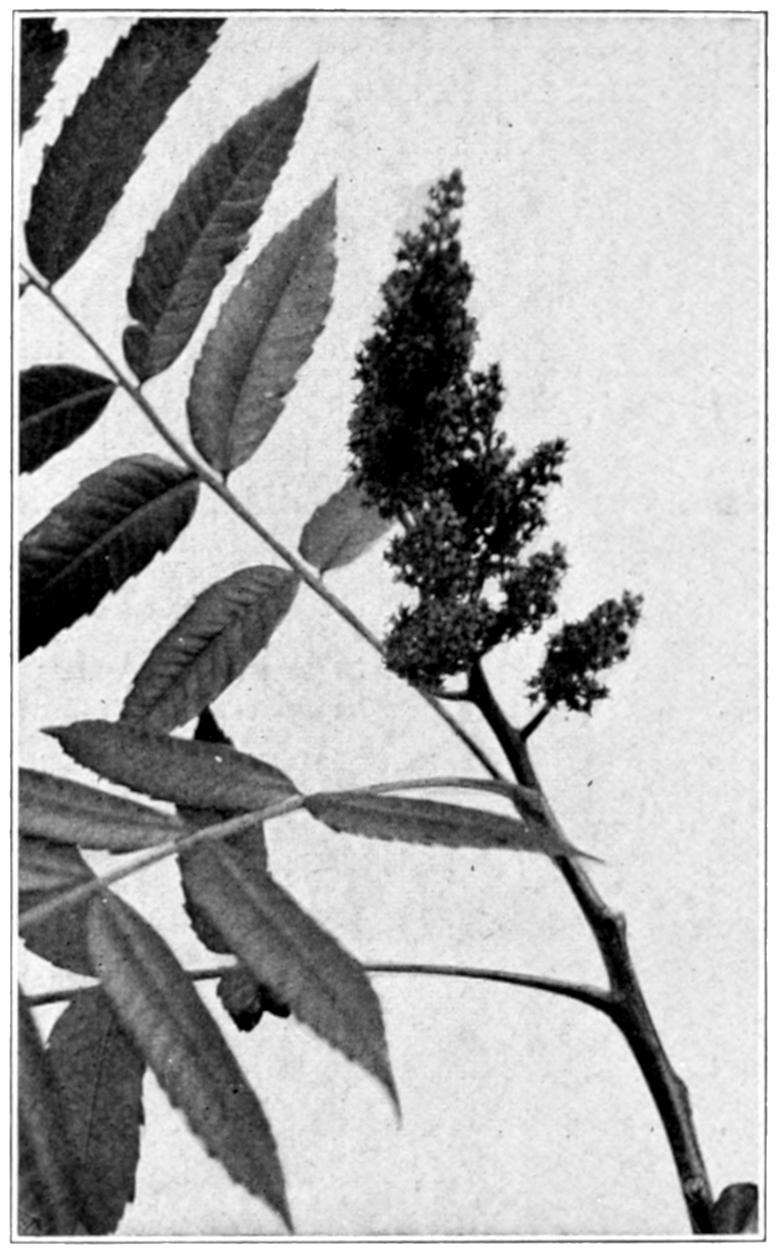
Fig. 133. Leaves and berries of red sumac.
The poison ivy (Rhus Toxicodendron), common to the Eastern States from Nova Scotia to Wisconsin and south to Arkansas and Florida, is a vigorous vine, climbing by means of aerial rootlets. The flowers are inconspicuous, but secrete nectar freely. Where sufficiently abundant, surplus may be expected from this source.
Some species of sumac may be expected in almost every section of the country where woodlands are common. Nearly all species seem to be attractive to the bees, although it is only in limited localities that honey in surplus quantity is reported. The honey is reputed of good quality, with mild flavor. In the east the honeyflow from sumac is sometimes very rapid and a liberal quantity of surplus secured, at times as high as 100 pounds per colony. New honey from this source is somewhat bitter to the taste, but this characteristic soon disappears. The blooming period usually comes in July and lasts for two or three weeks.
The dwarf sumac is a widely distributed species, known in some localities as mountain sumac. It is common in the Gulf States and is the source of honey in favored localities.
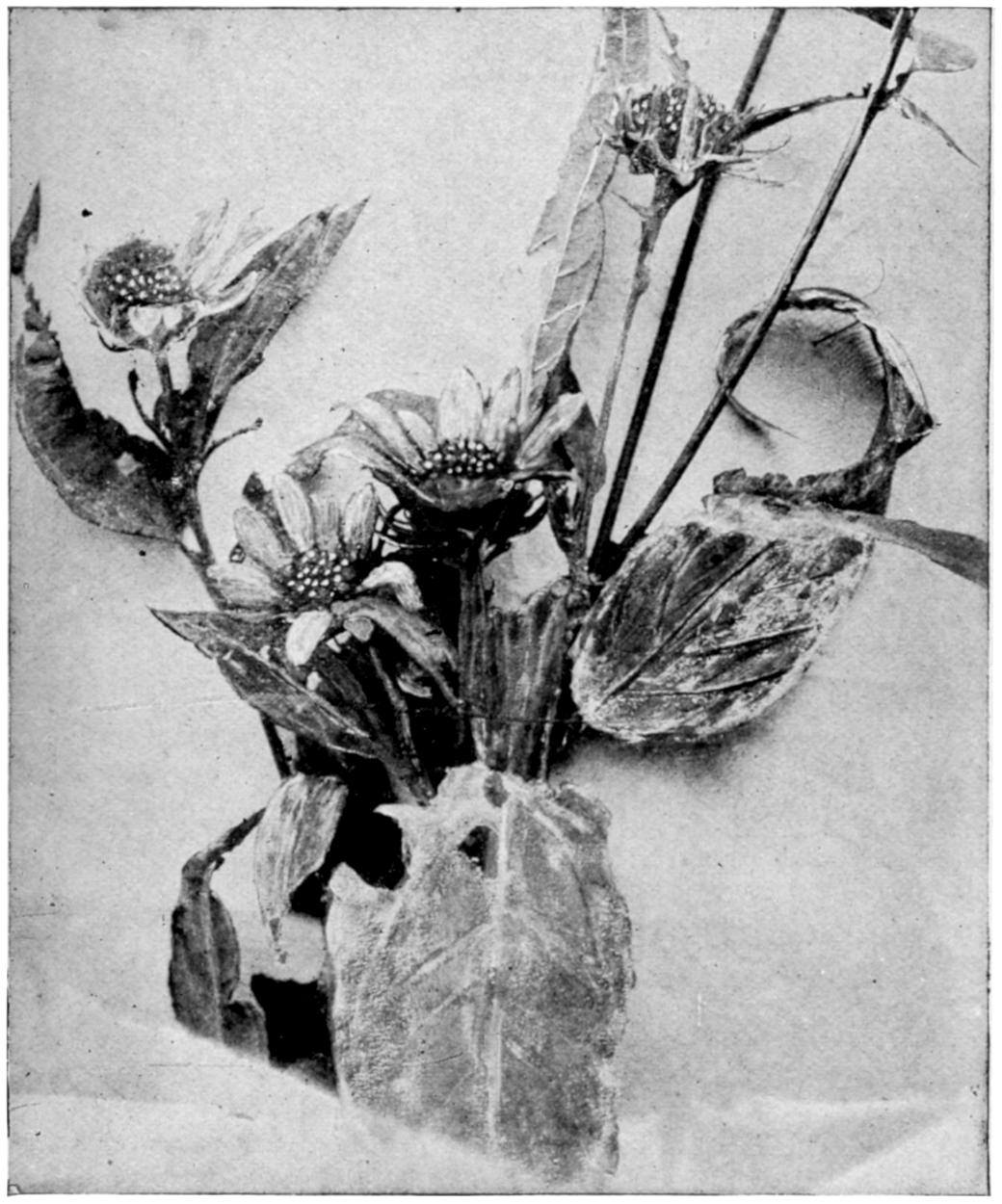
Fig. 134. Wild sunflower.
SUNFLOWER (Helianthus).
There are many species of the sunflowers, some of which may be found from the Atlantic Coast to California, and from Canada to the Gulf. (Fig. 134.) They are tall, coarse weeds, with yellow flowers. Large numbers of insects of many species may be found on the sunflower blossoms in search of the nectar. Whenever these plants are sufficiently abundant they are the source of large quantities of honey. M. H. Mendleson, of Ventura, California, reports that one year, following a wet winter, he secured a carload of surplus honey from sunflowers, although such yields are extremely rare in his locality.
The cultivated sunflowers are of little if any value for honey, but produce seed in large quantity, which is valued as poultry food. The Jerusalem artichoke is a variety of sunflower grown for the tubers. A variety of this plant grows wild in the upper Mississippi Valley States, where it is regarded as a bad weed. It is frequently reported as a good honey plant.
Many of the wild sunflowers are perennials, persisting for many years when once established. They are commonly to be found along wagon roads, railroads and other waste places. The honey is amber in color and strong in flavor.