M
Reading edition
MADRONA (Arbutus menziesii). THE ARBUTE TREE.
Jepson describes the madrona tree as evergreen with glossy, leathery leaves, widely branching, 20 to 125 feet high; bark polished, crimson or terra cotta, on old trunks dark brown, and fissured into small scales. Coast ranges of California, oak hills, etc. Grows on high ridges, mountain slopes and in gravelly valleys.
According to Richter it yields both nectar and pollen from the flowers.
MAGNOLIA or BULL BAY TREE (Magnolia grandiflora).
The magnolia is native to moist soils from North Carolina to Florida and west to Texas. It is the largest leaved tree of the evergreens. It is a magnificent tree when uncrowded and is a favorite shade tree in the South. The thick, leathery leaves persist over winter until the new ones have appeared. The flowers are large and showy and the blooming period is from spring till midsummer.
The sweet bay (Magnolia virginiana), known also as laurel magnolia, swamp laurel and beaver tree, grows in swamps from Massachusetts to southern Florida and west to Arkansas and Texas. In Texas it is reported as yielding very dark honey of poor flavor.
Magnolia is not often mentioned as important, though an occasional report of surplus in the South is received. One beekeeper reports that in Mississippi the honey is so dark and strong as to be unpalatable.
“We had three days of cool, damp, cloudy weather last year in August. During that time I visited my magnolia apiary, and on approaching it I heard the heavy roar of bees. I first thought that wholesale robbing was in full force, and I soon saw that they were gathering honey, and on looking at the alighting boards I saw particles of magnolia blooms. This told the tale. I went a few rods into the swamp, which was decorated with the large, rich magnolia blooms. I examined a bloom and there was the nectar visible, and all the bees had to do was to alight, fill themselves and return. The weather soon cleared off and the magnolia honey was no more. Those three days of damp, cool and cloudy weather saved many old style gums from being turned bottom up, in the spring, in this section.”—J. J. Wilder, Cordele, Georgia. American Bee Journal, Feb. 15, 1906.
MAGUEY, see Century Plant.
MAHOGANY GUM, see Eucalyptus.
MAINE—The Honey Flora of.
A large number of plants produce both pollen and nectar, but in Maine comparatively few yield a surplus of honey—the most important being white clover, alsike clover, fruit bloom, raspberry, fireweed and goldenrod.
Aster (Aster). The asters are of some value in this State, and in late fall bees may be seen frequently on the flowers. Aster paniculatus appears to be the most important. In some localities in the Middle States the ground is white with the blossoms of field asters. Pure honey, white or perhaps sometimes light amber. It is gathered so late that often it may not be fully ripened.
Apple (Pyrus malus). Yields a small surplus occasionally in this State. Honey of fine quality, light amber with aromatic flavor.
Basswood (Tilia americana). So rare in this State as to be of little importance.
Blackberry (Rubus). Yields little nectar in the Northern States; but a surplus is reported in Georgia and California.
Boneset (Eupatorium perfoliatum). Visited by insects in large numbers, but not common enough to yield a surplus.
Buckwheat (Fagopyrum esculentum). Not extensively grown in Maine, but fields of it are cultivated in many localities. A dark, purplish honey.
Button-bush (Cephalanthus occidentalis). Common in swamps, but not important.
Canada Thistle (Cirsium arvense). Not very important in this State, but more common westward. Honey light and well flavored.
Carrot (Daucus Carota). Naturalized from Europe, common in fields.
Clover, white (Trifolium repens). A fine white honey of delicious flavor. Alsike clover (T. hybridum) is an equally good honey plant, honey similar. Both are abundant in Maine, especially northward. In dry seasons bees are able to gather nectar from red clover, a bumblebee flower.
Cucumber (Cucumis sativus). A good honey plant in the neighborhood of pickle factories. Honey with flavor of the fruit, but improves with age.
Currant (Ribes). The various species of currants and gooseberries, both wild and cultivated, are of some importance.
Dandelion (Taraxicum officinale). More valuable for pollen than nectar in this State. Honey golden yellow, thick, strong-flavored, crystallizing in a few weeks.
Goldenrod (Solidago). A most valuable honey plant in New England. In southern Maine it never fails to give a large surplus, the main dependence of the beekeeper for winter stores. Honey golden yellow, fine flavored, candying with a coarse grain in a few months. Solidago graminifolia and S. rugosa are the most important species in this State.
Heartsease (Polygonum persicaria). This plant, so valuable in Illinois and Nebraska, is of no importance in Maine; a bee is rarely seen on the flowers.
Horse-chestnut (Aesculus Hippocastanum). Not common, bees gather both nectar and pollen. Bumblebee flowers.
Locust, black (Robinia pseudo-acacia). Yields a surplus of white honey further south, but not abundant in Maine. Often cultivated.
Maple (Acer saccharum). The rock maple blooms in spring before the leaves appear and the flowers are visited by bees in great numbers. The red maple also yields nectar.
Milkweed (Asclepias syriaca). Where the milkweed is abundant it is a great help to the beekeeper. In Michigan it is increasing, and perhaps also in Maine. The honey is excellent, with a fruity flavor.
Mayweed (Anthemis cotula). Common by the roadside, a bitter honey, apparently not important in this State.
Mustard (Brassica). Very abundant in grain fields, where the flowers often present an unbroken sheet of yellow. Probably never yields a surplus in Maine.
Pear (Pyrus communis). Not of much importance, but has been known to yield nectar very freely under suitable conditions.
Plums and cherries (Prunus). All the species secrete nectar. The choke-cherry, which is common in thickets, attracts many insects.
Raspberry (Rubus idaeus, variety aculeatissimus). One of the best honey plants, where the forest has been lumbered. A splendid honey of finest flavor, suggestive of the berry.
Sumac (Rhus typhina). This common shrub has the staminate and pistillate flowers on different individual plants; not common enough in Maine to yield a surplus. Honey bright amber, with a bitter flavor at first, which later disappears.
Sweet clover (Melilotus alba). Does not grow well on the clay soil of this State; requires a limestone soil.
Willow (Salix). Valuable in spring for both pollen and nectar, a great help in building up the colonies and bridging over backward springs. The pussy willow (Salix discolor) is most important. It could be planted to advantage in useless wet land.
Willow-herb (Epilobium angustifolium). Also called greweed, since it springs up abundantly on land which has been burned over. An excellent honey plant; honey water-white; flowers red purple.—John H. Lovell, Bulletin of the Maine Department of Agriculture, Vol. xvii, No. 4.
MAIZE, see Indian Corn.
MALLOW (Malva).
Several lists of honey plants contain some mention of the mallows. The bees visit the flowers for both nectar and pollen, but the author can find no record to indicate that they are anywhere important.
MANCHINEEL (Hippomane mancinella).
The manchineel is an evergreen tree common to the beaches and marshes of southern Florida and the Keys; also found in the Bahamas and Tropical America. It is very poisonous, and Britton credits it with being the most poisonous of our American trees. He states that the milky juice was used by the Caribs to poison their arrows.
It yields nectar abundantly some seasons and is the source of surplus honey. According to E. G. Baldwin, it blooms with pigeon cherry and with dogwood, and the late O. O. Poppleton was the only man to attempt to harvest a crop from the tree, growing as they do on the Keys, where not easily accessible. He credits Poppleton with a yield of 28,000 pounds from the three together in 1910.—Gleanings, April 1, 1911.
MANGROVE, see Black Mangrove.
MANITOBA—Honey Sources of.
In eastern Manitoba the blueberry yields some surplus. The main sources of nectar for the Province are white clover, alsike, fireweed, snowberry, perennial sow thistle, Canada thistle, wolfberry, mustard, goldenrod, aster and numerous prairie and weed plants. To these are added willows and maples as sources of early nectar.—F. W. L. Sladen.
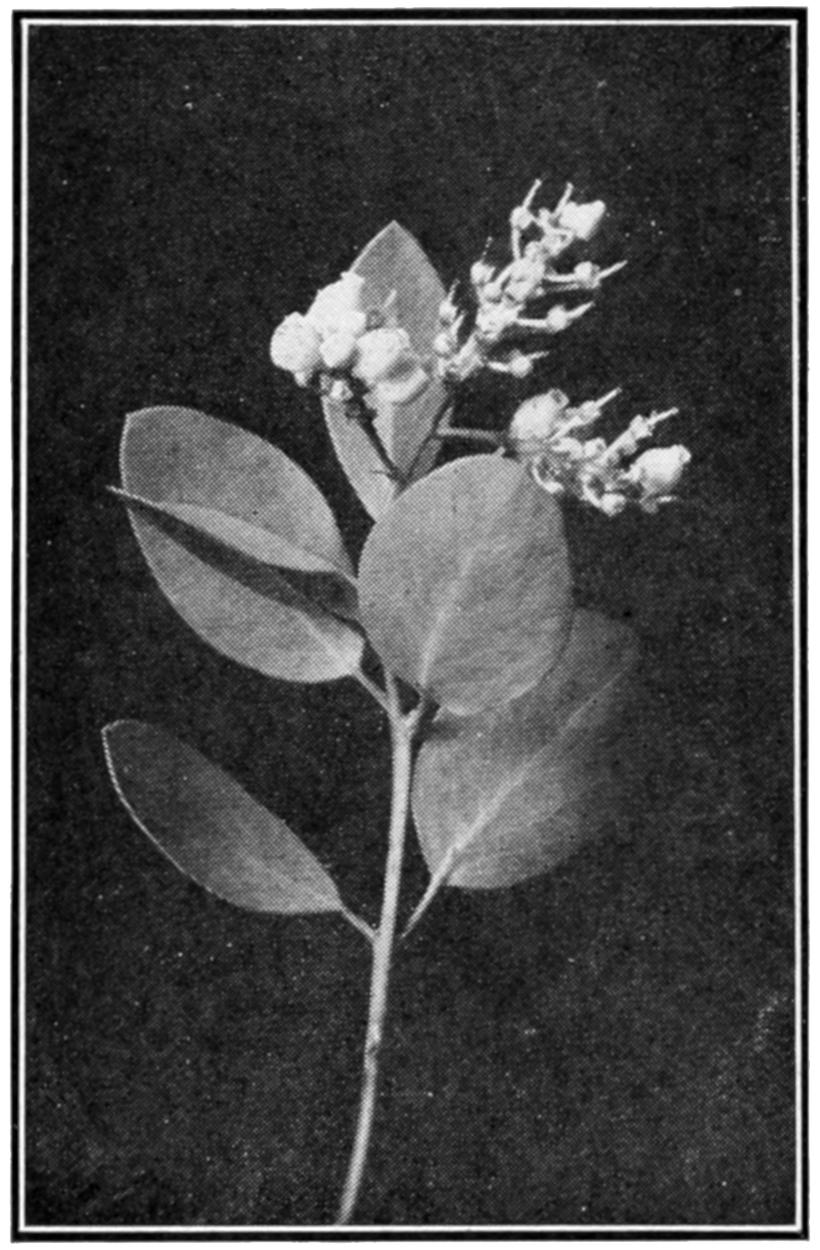
Fig. 90. Manzanita.
MANZANITA or BEARBERRY (Arctostaphylos).
Figure 90 shows the blossoms and leaves of the manzanita, which is seldom heard of as a honey plant east of California. The following information is copied from Richter’s “Honey Plants of California”:
“Arctostaphylos, manzanita, bearberry. Throughout coast ranges, Sierra Nevada foothills and San Bernardino Mountains (2,000 to 9,000 feet), November to February.
“The honey is amber and of excellent flavor, much like manzanita itself (Colusa County); pollen. San Diego County reports a white honey from the manzanita. One of the most important honey plants to induce bees to early breeding. In some parts of Monterey, Colusa and Eldorado Counties, a 20 to 40 pound surplus is obtained, and on very warm days (Monterey County) nectar can be shaken from the bloom. A beekeeper from Applegate reports it to be his best honey yielder.”
The Arctostaphylos uva ursi, bearberry or bear grape, according to Gray, occurs on the rocks and bare hills from New Jersey and Pennsylvania to Missouri and far north and westward. It is also said to be common in Europe and Asia. It is recorded in the local lists of plants of Connecticut and Ontario, although, probably because nowhere abundant, it is not known as a source of honey. Although Richter’s list does not give the species from which their honey is secured, it is probably A. manzanita or A. tomentosa, or other species peculiar to the West Coast.
The leaves of the eastern species are much used in medicine. It is said to be an astringent tonic, used in diseases of the liver.
MAPLE (Acer).
Almost all of the early pollen and nectar comes from trees, and most of the trees bloom early. The maples are mostly large trees confined to North America and temperate regions of the old world. Two species are commonly planted for shade and ornament—the sugar maple or hard maple (Acer saccharinum) and the red maple or soft maple (Acer rubrum). The photographs show the blossoms of the soft maple. (Fig. 91.)
Maple lumber is commonly used in the manufacture of furniture, flooring and finishings. The blossoms come very early, when especially valuable in building up colonies for the main honey flow. If the bees were as numerous as later, the nectar stored from maple blossoms would make a creditable yield. Mr. C. L. Pinney, of Iowa, reports that one year his scale hive showed a gain of from one to two pounds daily from soft maple, when the ground was still covered with snow.
If it were possible to have colonies come through the winter with as many bees as they have at the beginning of winter, beekeeping would be a bonanza. Instead of having one or two flows, there would be first a flow from maple and willow, followed by one from dandelion and fruit bloom, ahead of the big clover flow. However, the beekeeper whose apiary is situated near plenty of such trees as willow, maple, elm and box-elder is fortunate, indeed, for the bees get a splendid stimulation very early, and should be in prime condition for business when clover comes on.
The big-leaf maple of the Pacific Coast (Acer macrophyllum), also known as Oregon maple, California maple, water maple or white maple, is reported as of special importance in Oregon and British Columbia, its yield is usually cut short by rains. It is found in the Sierra Nevada and coast ranges of mountains in California, north to southern Alaska. (See also Box-elder).
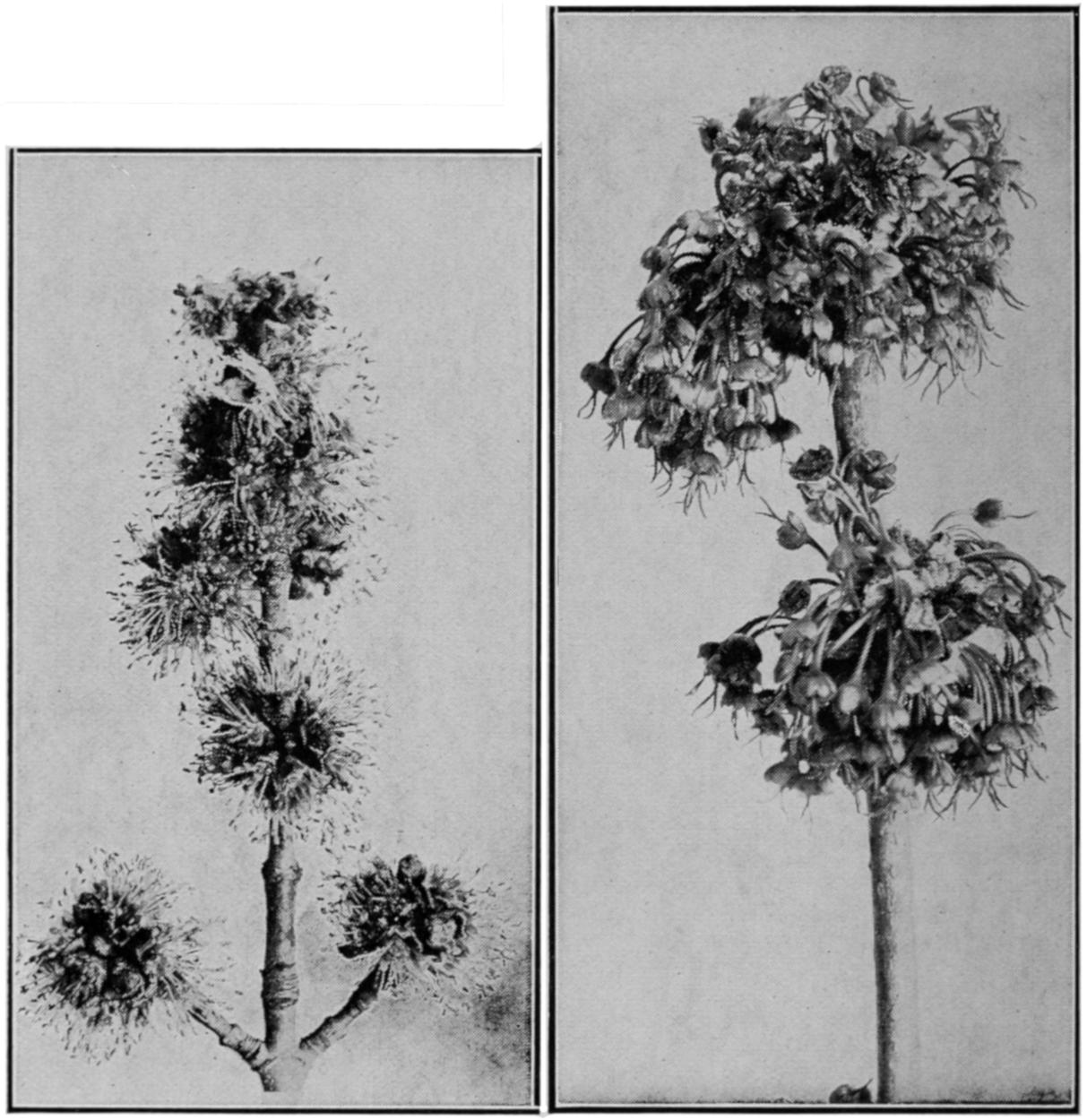
Fig. 91. At left staminate blossoms and at right pistillate blossoms of red maple. Both yield nectar.
MARIGOLD (Gaillardia pulchella).
There are several species of Gaillardia common to a wide scope of country. This particular species ranges from Louisiana west to New Mexico and Arizona. It is the source of large quantities of yellow honey in Texas, where it is highly regarded as a honey plant. It is reported as yielding surplus occasionally as far south as Brownsville, though not frequently.
Scholl lists it as “a main source of surplus; honey dark amber and of good quality. May and June.” (See also Spanish needle.)
MARJORAM (Origanum vulgare).
The marjoram is an European plant, cultivated in gardens, which has become naturalized along roadsides in the Atlantic Coast States. According to Lovell, it is a favorite of honeybees; not sufficiently common to be of much value.
MARRUBIUM, see Hoarhound.
MARYLAND—Honey Sources of.
Willows, maples, fruit blossoms and dandelion furnish nectar and pollen for spring brood rearing. Tulip-poplar is probably the most important source of surplus where the bees are prepared to gather it. Coming so early, few beekeepers have their colonies ready for this flow. Clover, locust, sumac, holly, laurel, clethra, heartsease, Spanish needle, asters and goldenrod are valuable. Tupelo and black-gum are also to be found in the State. There is a long list of minor sources similar to those listed for New Jersey.
MASSACHUSETTS—Honey Flora of.
White clover, found in nearly all quarters of the State.
Alsike clover. Under favorable conditions it yields not only a good quality of nectar but large quantities of it.
Red clover. The second flowering is somewhat accessible to bees.
Sweet clover. Two species, neither abundant in Massachusetts.
Goldenrod and asters. Rank close to clovers in nectar production.
Fruit bloom. Apple, pear, cherry, plum, peach, etc., source of early stores, upon which the colonies build up for the clover harvest. The body is heavy, the color clear and light and the flow comes with a rush, which insures handsome sections; but best of all is the exquisite aroma of the apple blossom, which places fruit bloom honey in a class by itself.
Linden or basswood. Doubtless the most valuable tree honey plant in Massachusetts.
Buckwheat. Reported from all counties in Massachusetts.
Wild raspberry and blackberry. The nectar flow is of long duration, beginning after fruit bloom has ceased.
Several species of sumac are important honey sources which are greatly underestimated.
Locust. A valuable forage for bees. Reported as sporadic in yield.
Maple. Probably of less importance as a honey plant than the mints, strawberry and milkweed.
Clethra. Known also as black alder and sweet pepper bush. A valuable honey secreting plant, largely confined to a belt paralleling the eastern coast.
Milkweed. Where milkweed occurs in large quantities it is a valuable honey plant. Reported as important from Berkshire County.
Wild cherry, knotweed, dandelion, strawberry, chestnut, mints, gill-over-the-ground and mustard also reported occasionally as valuable.
Willow and skunk cabbage valuable for early pollen as well as some nectar.—Burton N. Gates. Bulletin 129, Mass. Ag. Ex. Sta.
MAT GRASS, see Carpet Grass.
MATRIMONY VINE (Lycium vulgare).
Matrimony vine is a low, spiny shrub, with very long, lithe and almost climbing branches. It came originally from the Mediterranean region and was very generally planted for ornament about American homes a generation ago. It is very persistent, and has run wild about many deserted home sites. The small flowers clustered in the axils of the leaves are very attractive to the bees, and, where sufficiently common, the plant is probably of considerable importance.
MAYWEED (Anthemis Cotula).
The mayweed or dog fennel is an old-world weed extensively naturalized from Canada to the Gulf of Mexico and west to Texas. It is common along roadsides, in barn lots and waste places generally. Lovell credits it with yielding a honey that is light yellow in color and very bitter. It is seldom mentioned as a source of nectar.
Richter states that because of its blooming between spring and summer it is of considerable value to many Sacramento Valley beekeepers.
MEDICAGO, see Alfalfa.
MELIA, see China Tree.
MELILOTUS, see Sweet Clover.
MELISSA, see Bee Balm.
MELONS (Cucumis melo).
Melons are valuable sources of honey. In locations where they are grown in large acreage, as in the Rocky Ford district of Colorado, considerable quantities of honey are stored from them. There are numerous varieties of muskmelons, canteloupes, etc., but apparently there is not much difference in the value of the various sorts to the beekeeper.
As with cucumbers and pumpkins, the male and female blossoms are on different parts of the stem. Bees and insects carry the pollen from one to another, if in close proximity, and often cause hybridization.
MENTZELIA.
Mentzeli speciosa is a conspicuous plant along roadsides and waste places in Colorado. Its large white blossoms are closed during the heat of the day, but beekeepers report that the bees work upon it freely in early morning and late evening. It is probably not important.
In Oregon the stickleaf (Mentzelia albicaulis) grows freely on dry, stony land. It has a spreading habit and its pale orange colored flowers are very attractive to the bees.
MESQUITE (Prosopis glandulosa).
The mesquite, or mezquit, is the most important plant of the arid regions from central Texas to New Mexico and eastern California. At a distance it has much the appearance of an aged peach tree. A northern man riding through the mesquite region on the train, for the first time, remarked that he had never seen such extensive peach orchards in his life. The tree is much branched and spreading in habit and is the source of fuel for the inhabitants of the region. Live stock also are fond of the leaves and pods and the Indians of the Southwest eat the seeds, first grinding them into meal and baking them.
The same or a closely related species is common in Hawaii, where it is known as algaroba. There it is one of the most important sources of honey. (See Hawaii). This species is sometimes called honey-pod or honey-locust, although the true honey-locust is a very different tree.
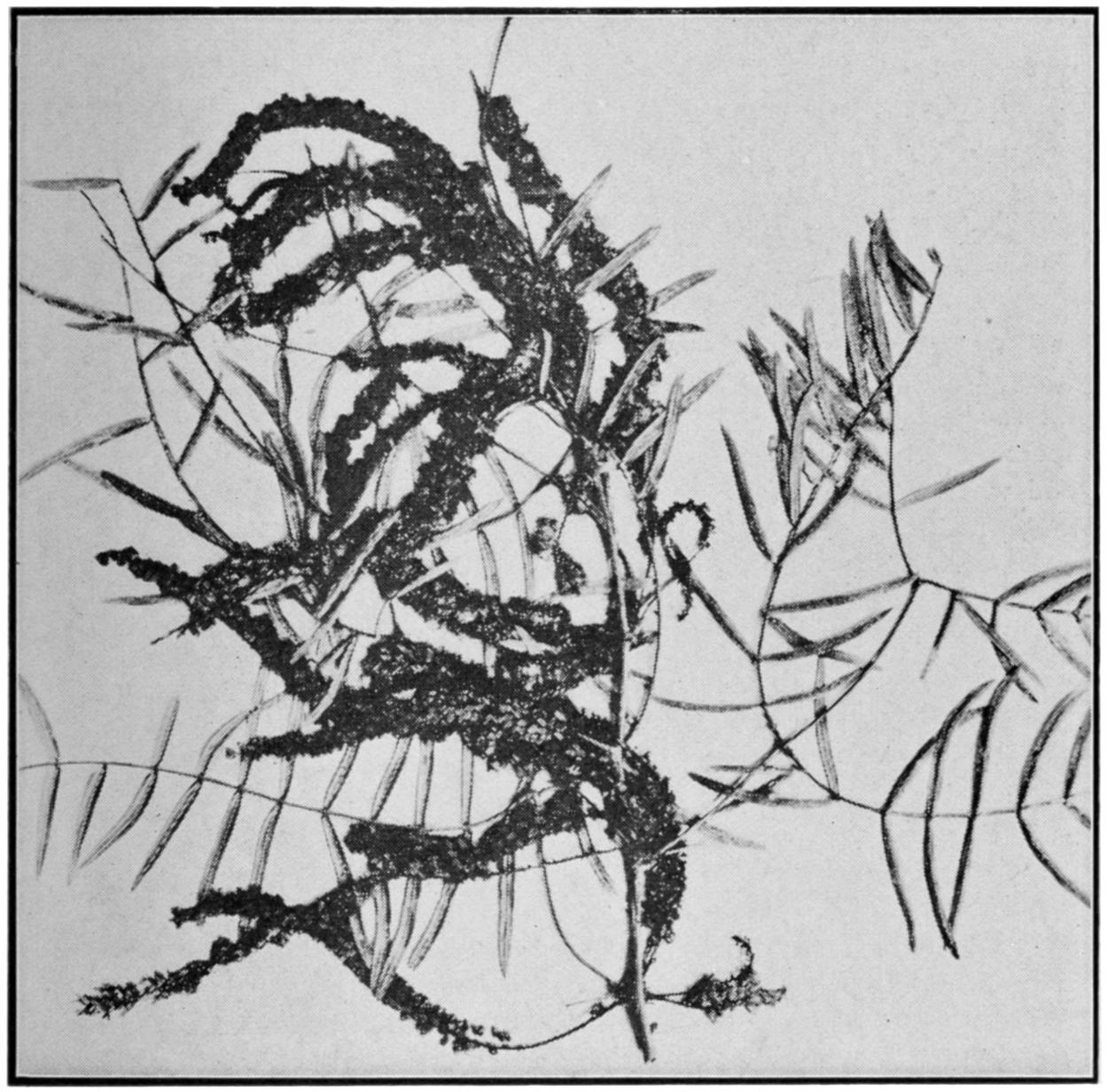
Mesquite is one of the most important sources of honey in the Southwest.
In the desert regions of California it is an important source of large quantities of honey, as it is in Arizona, New Mexico and Texas. In southwest Texas mesquite is the principal source. The honey is light amber and of good quality. Beekeepers report that it is lighter in color some years than others, even though nothing is blooming at the same season, so the difference cannot be laid to a mixture of honey from different sources. The quality of mesquite honey is good. It is reported to yield more regularly on sandy land than on heavy soil.
There are two blooming periods, the first in spring, usually in April, and the second in July. If there has been plenty of moisture previously the mesquite blooms profusely, due to the fact that it roots very deeply and can reach any moisture that is available in the soil.
MEXICAN CLOVER (Richardia scabra).
The name clover is a misnomer, for this plant does not belong to the clovers but to an entirely different group. It is a luxuriant annual weed growing to a height of two feet or more. The bees are reported as working upon it quite late in the season.
The plant was introduced from the tropics and has become naturalized in Georgia, Florida, Alabama and Mississippi.
MICHIGAN—Honey Sources of.
While Michigan is within the clover belt, there are a greater variety of sources of surplus honey than in most nearby States. In spring, willows, maples, fruit bloom and dandelion have the usual importance. Both white and alsike clover yield surplus in Michigan. To these may be added wild raspberry, fireweed or willow herb and milkweeds, all of which are important sources of surplus honey in the northern part of the State. Basswood was formerly important and still produces surplus in some sections, though many of the basswood forests have been cut. Buckwheat is also a source of surplus in some parts of Michigan, though according to E. D. Townsend surplus from buckwheat is only to be expected on “a rather poor quality of sandy soil.” Townsend says, further, that alsike is worth all other sources put together in the southern two-thirds of the lower peninsula, and that aster yields surplus in Sanilac County.—Gleanings, page 1184, 1908.
MIGNONETTE (Reseda odorata). COMMON MIGNONETTE.
The mignonette of our gardens is a native of Egypt which came to America by way of Europe. It is frequently mentioned as a honey plant, especially in older literature. Some extravagant claims have been made for it, but perhaps it has never been given a fair test on a sufficiently large scale to demonstrate fully its value. The following extract from an article which appeared in the American Bee Journal, Page 47, 1878, is of interest in this connection:
“After being started under diligent cultivation it was astonishing to see the rapid progress which they made. The plants soon covered the ground, where soil was good, and were out in blossom in a short time, and from that time forward the bees were working on them by the thousand from morning till late afternoon. I have seen them thick on it by 8 o’clock. It yields pollen as well as honey. * * *
“I have found that on account of the spikes of the blossom being so much longer, the bees must work on the larger varieties. I have some sorts which stand two feet high, the spikes being from eight to ten inches long. * * *
“A correspondent from California stated that he thought an acre of mignonette would be adequate for a hundred colonies. * * *
“When you give them this in addition to what they would otherwise have, it will certainly secure an immense addition to the honey produced. There is no plant within the range of our knowledge as valuable for bee forage as mignonette. It will bloom year after year if not disturbed by frost and gives a longer period of bloom than any other plant. It gives more blossoms in a given space and more forage than any plant we have ever seen. Honey from this plant has the most delicious fragrance of any we have ever tasted.”—William Thompson.
It was later tested at the Michigan Agricultural College, but Professor Cook failed to bear out the above claims. He reported as follows:
“I expected great things of this plant, as the bee papers were very high in their praise of its qualities. June 23 it began to blossom, and it was not till the 27th that the bees began their work upon it. They did not seem to take to it very readily, for on every occasion that I made observations, I found very few bees present. With us it proved a failure. Others have corroborated this statement. * * * It is rather a delicate plant for this climate.”—Page 83, A. B. J., 1878.
It is listed by Richter in Bulletin 217, “Honey Plants of California,” with the statement that it is “very much visited by bees whenever in bloom.”
MILK VETCH (Astragalus).
The milk vetch is a close relative of the loco (see Loco), and like the loco is visited by the bees. Some species are of some value for honey, especially in the plains region west of the Missouri River.
MILKWEED (Asclepias).
The milkweeds are a large family of plants common to the temperate and tropical regions of many parts of the world. North America alone has 55 recognized species. These plants are also known as butterfly weeds and milkweeds. The blossoms are borne in large ball-shaped clusters as shown in Figure 92. The seeds are attached to silken parachutes, on which they are carried by the wind. It is these silky attachments that give rise to the name “silkweed.” Remarkable yields of honey are sometimes secured from milkweeds. An average yield of 100 pounds per colony from this source is occasionally reported through the bee magazines.
Much has been written about the entangling of bees in the pollen masses of milkweed. It frequently happens that bees thus entangled are unable to free themselves and die as a result. Some species of milkweed is included in nearly every list of honey plants which the author has consulted. Apparently it may be regarded as of some value almost everywhere. The honey is said to be light in color and of good quality.
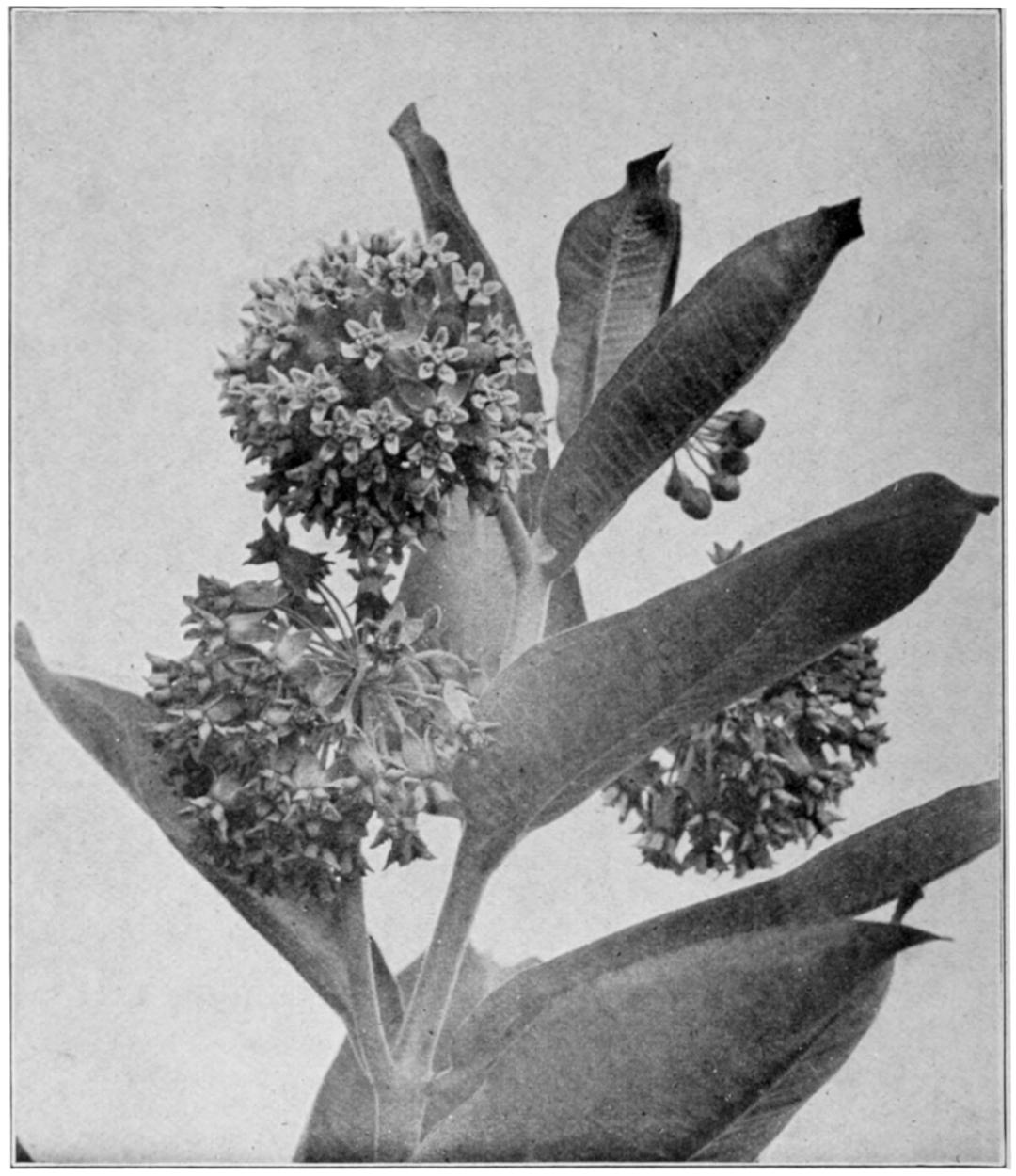
Fig. 92. Blossoms of the milkweed.
It is of special importance in northern Michigan, where it grows in great abundance, as shown by Figure 93. In some locations beekeepers report an average per colony production of 50 pounds, year after year, from milkweed.
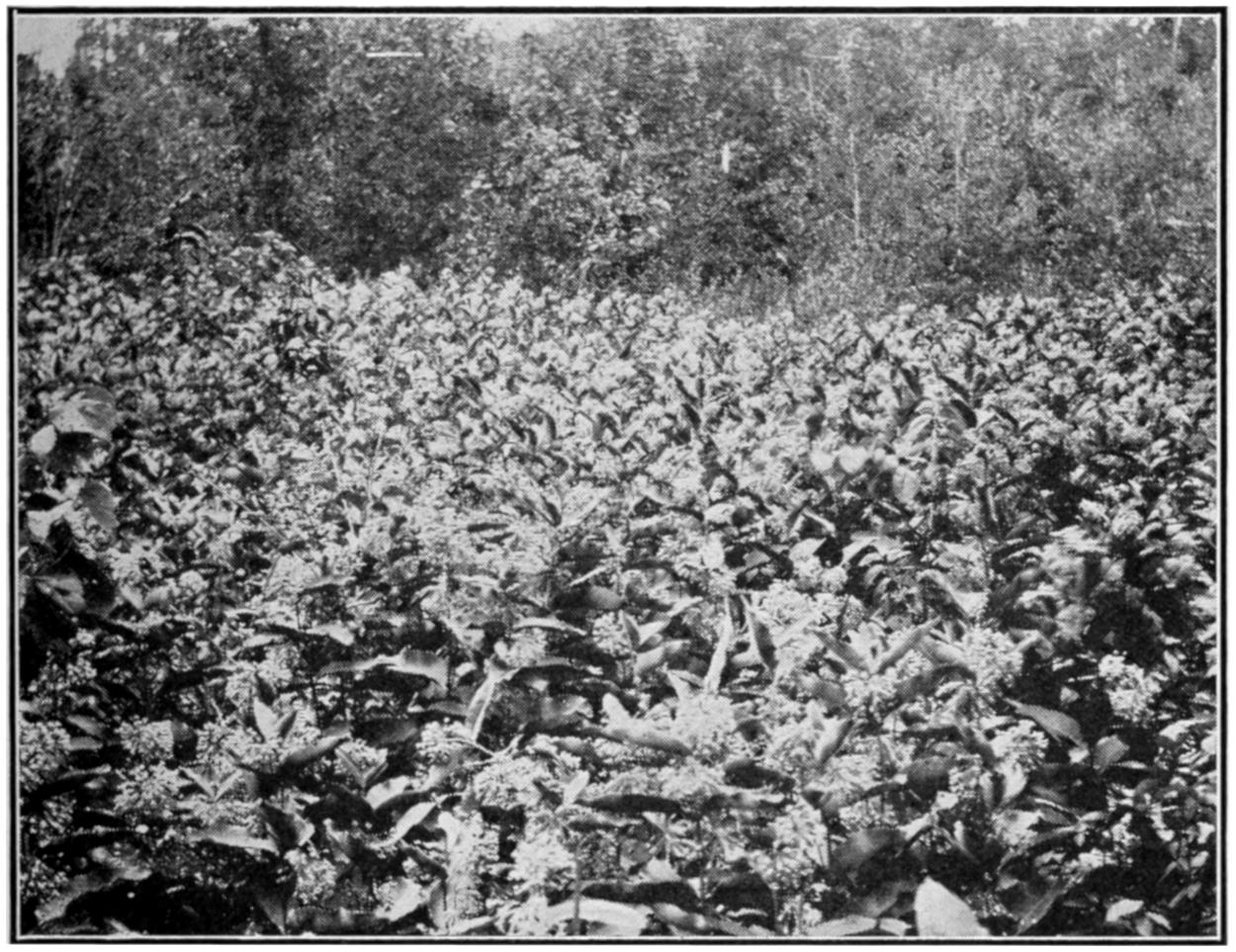
Fig. 93. In Northern Michigan milkweeds grow abundantly over large areas and are the source of much surplus honey.
MILKWEED VINE, see Bluevine.
MINNESOTA—Honey Sources of.
In early spring the willows and maples, followed by dandelions are important for spring brood rearing. Fruit bloom is also valuable in spring. White clover and alsike are the most important sources of surplus. Probably there is no place in the world where these clovers yield nectar more abundantly than in Minnesota. Sweet clover is also important in some sections of the State. Willow herb or fireweed, basswood, goldenrod and asters may be mentioned.
MINT (Mentha).
Richter lists the spearmint, or peppermint, (Mentha spicata), as yielding a great abundance of amber colored honey in Sacramento County, California and southward. Spearmint was introduced from Europe and has escaped from cultivation and become naturalized in many places, both east and west.
He also lists the tule mint (Mentha canadensis) as yielding honey from July to October. The mints belong to an important group of honey plants and where sufficiently common are valuable. They should not be confused with hedge nettle, which is locally called mint in many places. (See Hedge Nettle).
MISSISSIPPI—Honey Sources of.
Along the eastern border of the State there is a large area where sweet clover is widely disseminated. In this section large yields of surplus honey from this source are reported. An average yield of 140 pounds per colony of surplus from 700 colonies in one yard near Prairie Point has been reported to the author by a prominent Mississippi apiarist.
Willow, maple, fruit bloom and elm are reported as important for early pollen and nectar. White clover yields some honey in the northern part of the State. Persimmon is given as an important source of dark honey. Bitterweed yields freely, but the quality is so poor as to be of little value. Tupelo and cotton are valuable in some sections of the State. There is some fall honey from asters and goldenrod.
The coast region offers a vast area of gallberry and there is much titi along the streams. There are some very good unoccupied locations in Mississippi which offer great possibilities for honey production.
MISSOURI CURRANT, see Buffalo Currant.
MISSOURI—Honey Sources of.
White clover is the one principal source of honey in Missouri. Sweet clover yields surplus in some localities. In the low lands along the Mississippi River, heartsease, Spanish needle and boneset are also important. In many places south of the Missouri River, bitterweed yields some nectar, which is often mixed with the better honey and spoils the quality. Bluevine (Gonolobus laevis) yields surplus in a few localities. In the vicinity of Brunswick as much as 100 pounds of surplus per colony has been reported.
Only a small portion of Missouri is well suited to commercial beekeeping, owing to uncertainty of the honey flows. With the extension of the growth of sweet clover as a farm crop conditions are improving.
MISTLETOE (Phoradendron flavescens).
The mistletoe is too well known to need description. It occurs as a parasite on trees from southern New Jersey and Missouri south to Florida and Texas. It is a yellowish-green shrub, much branched, which grows on the branches of the trees to which it attaches itself. It flowers early, usually in February and March, and is frequently mentioned as a honey plant in the Southern States. Scholl lists it as the first source of nectar and pollen in Texas, blooming there in January and February. Many Texas beekeepers regard it as valuable for spring stimulation.
MONARDA, see Horsemint.
MONTANA—Honey Sources of.
The principal sources of nectar in Montana are alfalfa and white sweet clover in Yellowstone, Sun River, Missouri, Gallatin and Flat-Head Valleys; yellow sweet clover in Bitterroot Valley, White clover in Bitterroot and Gallatin Valleys, and fireweed in northwestern timbered region. Minor plants are willow, dandelion, Grindelia (gum-weed), etc.—H. A. Scullen.
MONUMENT PLANT (Frasera).
The monument plant is variously known as columbo, deer’s ears (a translation of the Navaho name), and Frasera. It grows in high altitudes from 7,000 to 10,000 feet, from South Dakota westward to Montana and Oregon and south to New Mexico and California.
It has large, creamy blossoms, about two inches in diameter, on tall flower stalks growing to a height of three feet. (Fig. 94.) It is common in the Rocky Mountains and is much sought by the bees. According to Wesley Foster it is an important source of honey in May. It is a striking plant which once seen is not likely to be forgotten.
MORNING-GLORY (Convolvulus).
The morning-glory is a twining perennial vine of wide distribution throughout the United States. It has a large bell-shaped corolla and is often grown for ornament. Originally it was introduced from Europe as an ornamental and has escaped and become naturalized in waste places, old fields and along fences everywhere. It is probably not important to the beekeeper anywhere, but Richter lists it as a honey plant at Sacramento, California, and Scholl lists it as yielding some honey and pollen in Texas.
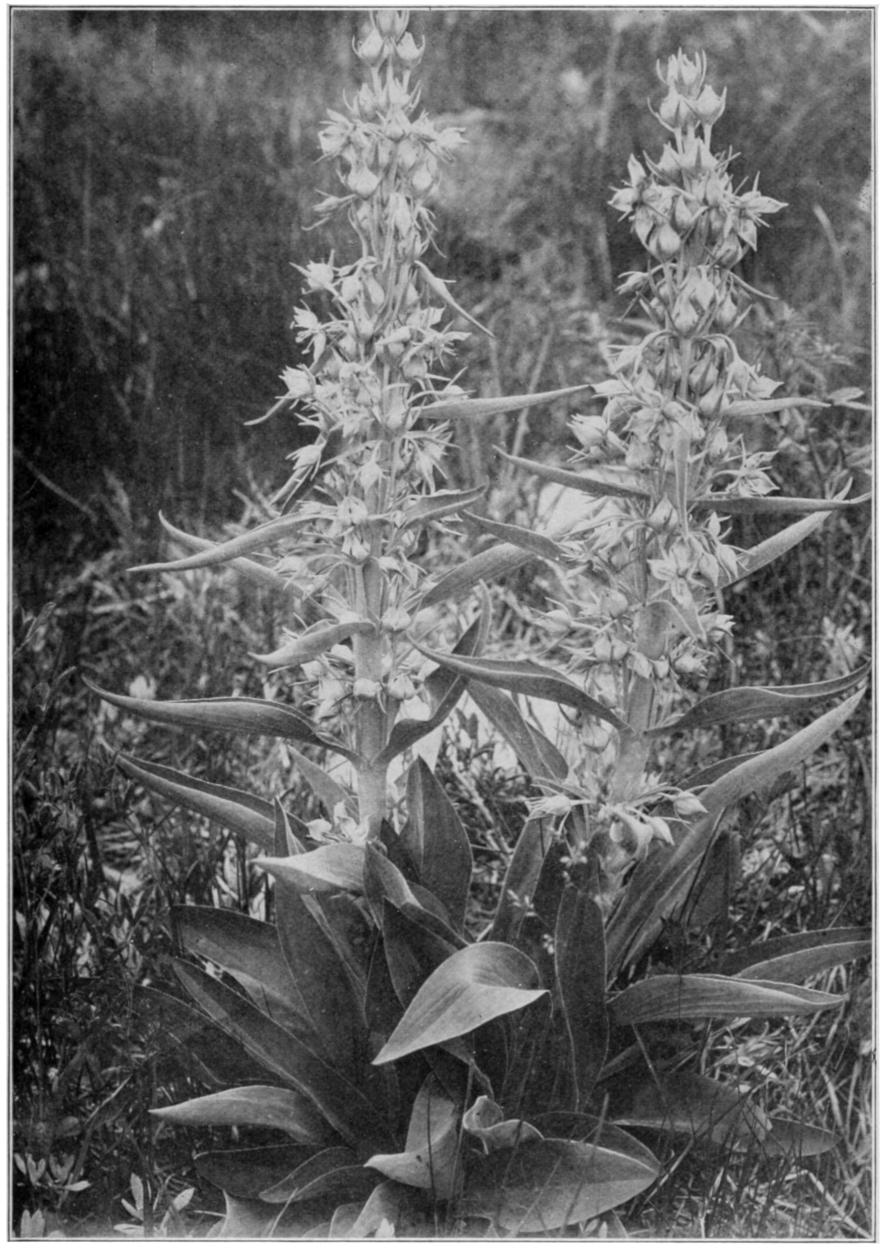
Fig. 94. The monument plant (Frasera speciosa) is a striking plant which, once seen, is not likely to be forgotten.
At Victoria, Texas, according to M. B. Talley, morning glory yields surplus honey of fine quality in September. There it is called tievine.
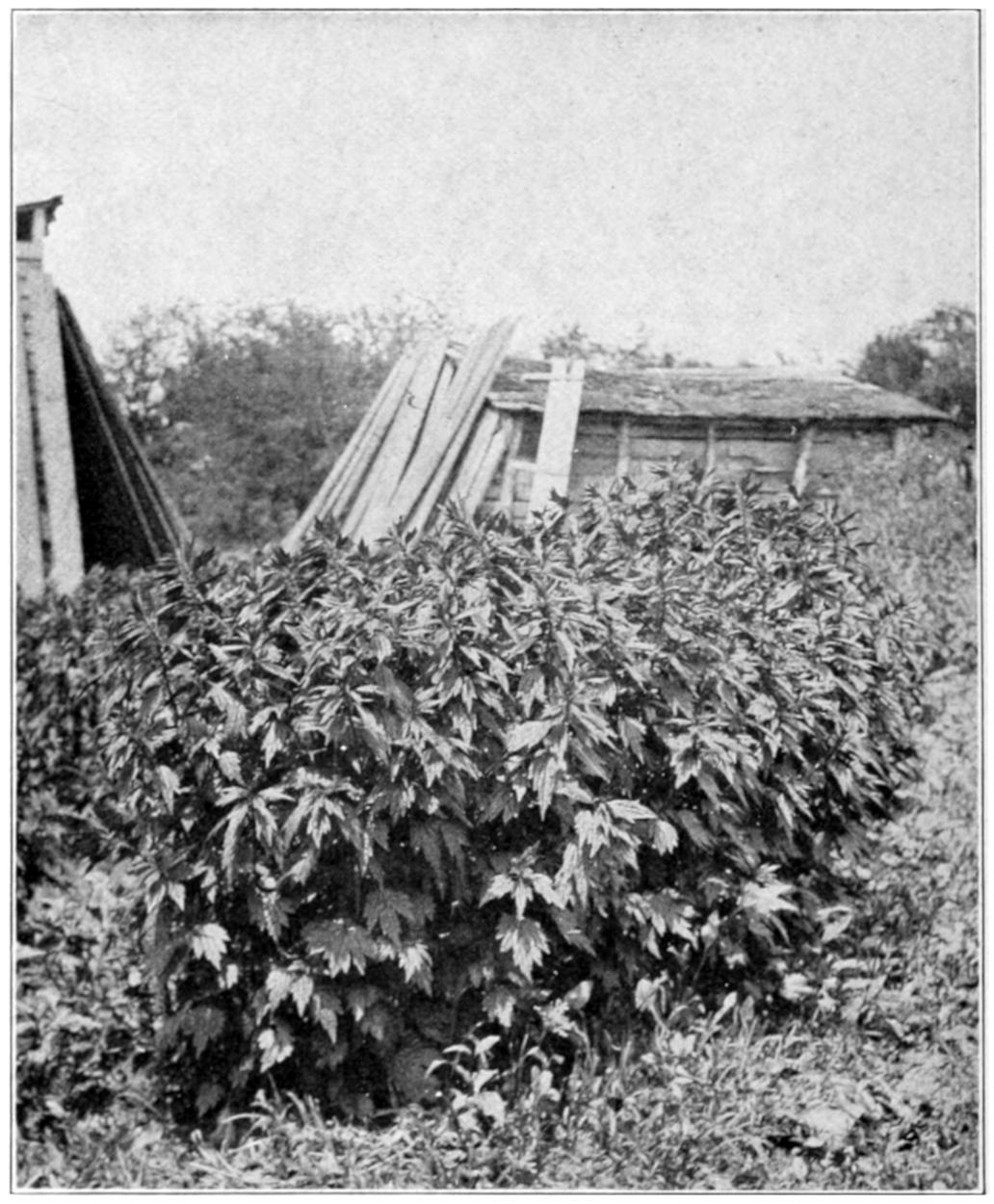
Fig. 95. Clump of motherwort in barnyard.
MOTHERWORT (Leonurus Cardiaca).
The common motherwort is a weed introduced from Europe and Northern Asia. It is now quite generally naturalized from Canada to Florida and west to Louisiana. For some reason, it is seldom included in lists of honey plants, although it is said to be an excellent source of nectar. Reports of bees working on this plant very freely, in 1914, when most other plants failed to yield anything, were frequent.
The motherwort grows in clumps in waste places in old barn lots, along railroads, in factory grounds, etc. It grows from two to six feet high, with small flower clusters in the axils of the leaves. It is a relative of the catnip, and apparently equally attractive to the bees. This plant was formerly used to some extent in medicine, especially for diseases of women. It is also known as lion’s tail.
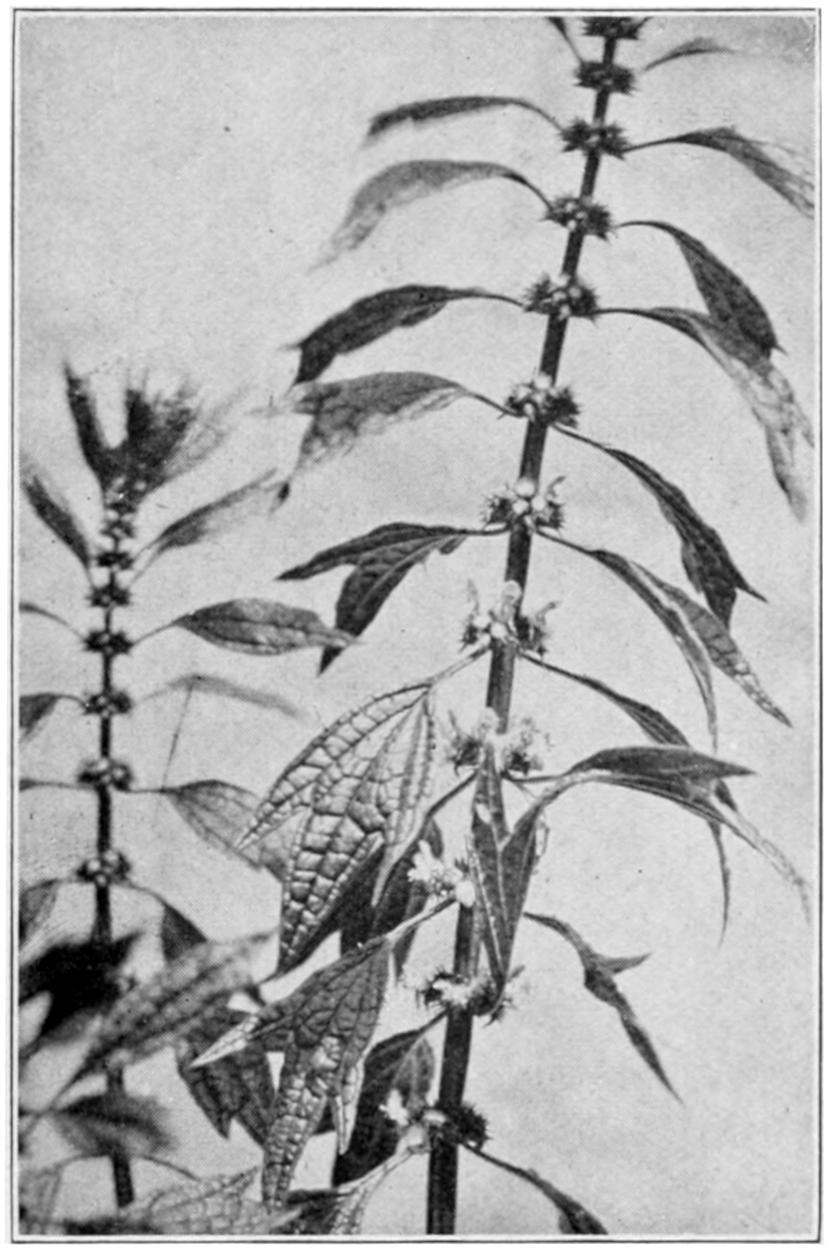
Fig. 96. Motherwort in bloom.
Figure 96 shows the blossoms and leaves, and Figure 95 a clump of the plants.
MOUNTAIN LAUREL, see Laurel.
MOUNTAIN LILAC (Ceanothus).
There are several species of mountain lilac common to California and the Western States. They are closely related to the buckthorns. (See Buckthorn). New Jersey tea belongs to this group. (See New Jersey tea).
Jepson lists fourteen species of Ceanothus common to California. They are shrubs or small trees with small but showy flowers, borne in umbels or panicles. The California species are mostly evergreen.
They are known by various names, as deer-brush, California lilac, mountain lilac, etc. One species is called buckbrush.
Some species are common to the Mountain States from Wyoming and Colorado to Arizona and west to Texas. Both honey and pollen are secured from this source, though there are probably not many places where surplus yields may be expected.
MOUNTAIN MINT, see Basil.
MOUNTAIN QUEEN, see Yucca.
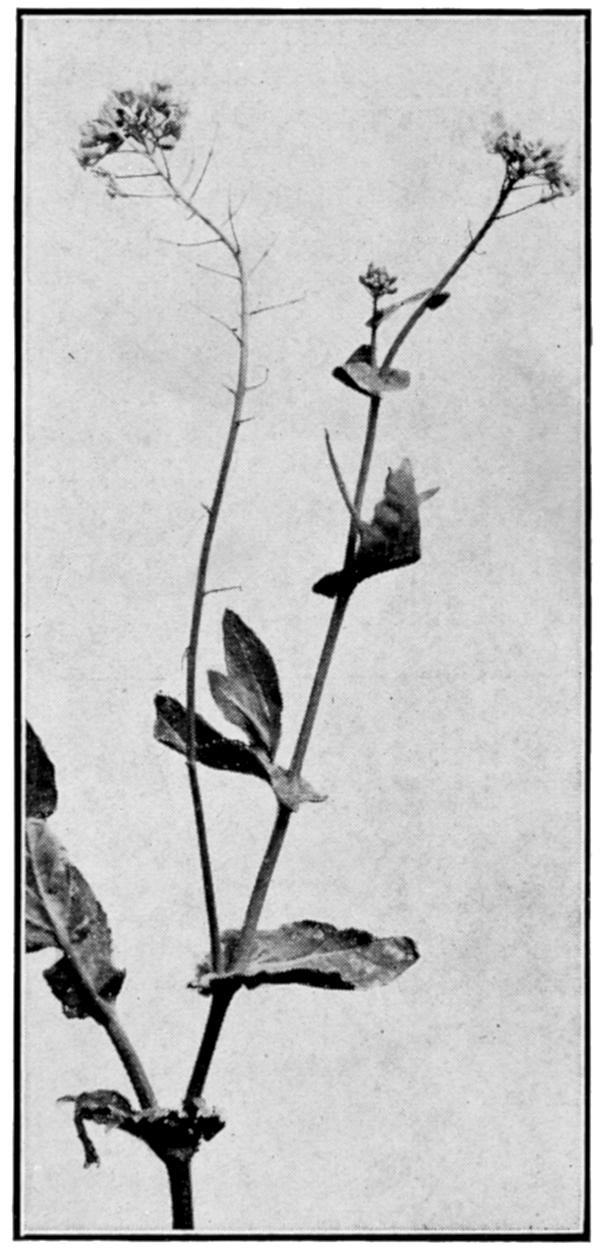
Fig. 97. Mustard in bloom.
MUSTARD (Brassica campestris).
Figure 97 shows the common yellow mustard (Brassica campestris), which is common all over North America and in Europe. The black mustard (B. nigra) also has a very wide distribution in Europe and America. There are about 50 species, including the closely related cultivated varieties of cabbage, turnips, rutabagas and mustard. All produce some nectar, and in some localities they are an important source of honey. In parts of California, notably the Lompoc Valley, mustard is grown commercially for seed; much honey is stored from this source. The honey is said to be light in color and mild in flavor. Apparently there is much variation in the amount of nectar, according to climatic conditions. In any locality where it is sufficiently abundant, mustard can be expected to add something to the product of the apiary.
The late J. S. Harbison wrote, in his “Beekeepers’ Directory,”:
“Mustard affords a larger amount of valuable pasturage to the acre than almost any other plant. It blooms throughout the month of May, and part of June. During this time, bees increase in numbers, and store from it large quantities of honey of a clear yellowish color, but partaking slightly of the taste of the plant.”