J
Reading edition
JACKASS CLOVER or STINKWEED (Wislizenia refracta).
Jackass clover or stinkweed is a rank scented annual plant with yellow flowers, growing two to six feet high. It is common from Sacramento to Lathrop and southward in the San Joaquin Valley, according to Jepson.—Flora of Middle Western California.
It is an important honey plant in the interior valleys, where it is reported as blooming freely only every other year. The blooming period is from August to December. C. R. Snyder, of Selma, regards it as a main source. He reports as high as 100 pounds of surplus per colony. He usually extracts two or three times from this source in September, and has extracted as late as December. A heavy rain or a frost will stop the flow. The honey is light and of good quality. A sample presented to the author is a light amber with a peculiar flavor, unlike our eastern honey. The flavor reminds one somewhat of butter-scotch candy. It is rather strong, but agreeable.
Richter comments on this plant as follows:
“Honey water white, mild in flavor and of good body; granulates in three to six months, when it resembles a paste made from powdered sugar. The very fact that it is spreading so rapidly over the poor lands of the San Joaquin Valley, and that it produces the only water-white honey, with the exception of blue-curls, as far as the writer knows, that is produced in the late fall, has led to the conclusion that jackass clover will be one of the greatest honey-producing plants of the State, and may in future rank next to sage and alfalfa. During the fall of 1909 a Fresno beekeeper reported that he extracted thirty pounds per colony each week for six weeks from this source. Another beekeeper of the San Joaquin Valley relates that during the jackass clover flow the noise was terrific, and that home-coming bees flew so slowly that they could be picked out of the air. It was Henry T. Christman, of Colinga, who first became aware of its value as a honey plant and gave it its present name.”
JASMINE, See Yellow Jasmine.
JERUSALEM ARTICHOKE, see Sunflower.
JEWEL-WEED or Touch-Me-Not (Impatiens).
The jewel-weed (Fig. 85) is common in wet places and along small streams in shady situations. Some are to be found from Alaska to New England and south to Florida and Louisiana. The plant has an odd hanging blossom, as shown in the picture. It is often called touch-me-not, from the sudden bursting of the seed pod when touched.
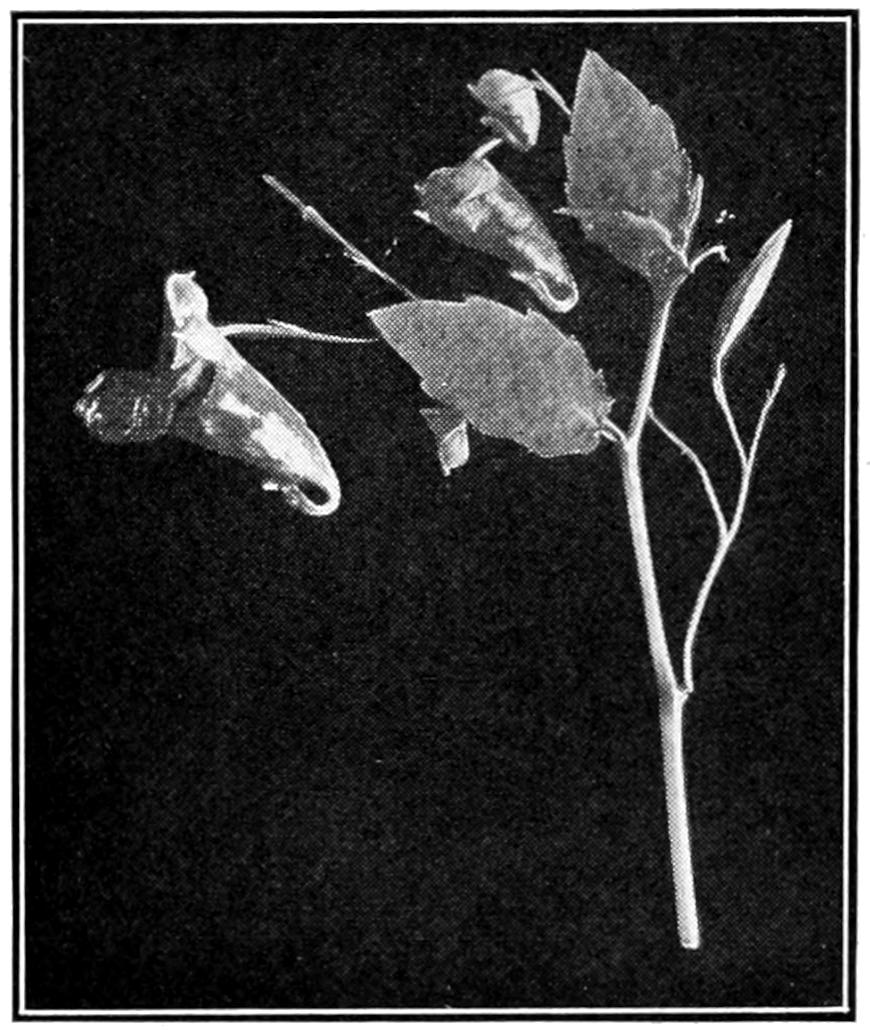
Fig. 85. Jewel weed, or touch-me-not.
It is usually regarded as a bumblebee flower rather than a bee flower, but is reported as a source of honey in both Michigan and Wisconsin, where it is quite common in places.