N
Reading edition
NAPA THISTLE, see Star Thistle; also Centaurea.
NEBRASKA, Honey Sources of.
Most of Nebraska’s surplus honey is secured from clover, though alfalfa is important in the western part of the State, especially under irrigation. White clover, alsike and sweet clover are all important honey plants in Nebraska. Cottonwood furnishes an important source of pollen in spring. Willows and maples furnish both nectar and pollen, while fruit bloom and dandelions are usually sufficient to enable the bees to build up for the clover flow. There is a great variety of minor sources which are not sufficiently abundant to yield much surplus. Among these may be mentioned, milkweeds, catalpa, Rocky Mountain bee plant, buffalo bur, vervain, Spanish needles, etc.
Heartsease yields abundant surplus some years and basswood was formerly important in some places in eastern Nebraska.
NECTAR AND NECTAR SECRETION.
The great Swedish botanist, Linnaeus, nearly two hundred years ago, basing his classification of plants on their flowers, found it necessary to name and account for all of the parts of a flower. In many cases he found structures that were neither sepals, petals, stamens nor pistils, and as these contained, or were wet with, a sweet fluid, he gave this the fanciful name “nectar”—the drink of the gods, and called the parts of the flower that produced or contained it, “nectaries.”
As these nectaries were different from stamens and pistils, which Linnaeus recognized as the sexual organs of flowers, though they are sometimes connected with them, and as they were different from ordinary sepals and petals, though sometimes connected with them, they presented something of a question to the men of that day, who were curious to know what the parts of a plant really are and what they do. For this reason the study of nectaries became something of a popular diversion for a generation or two; and a general idea that they are organs for secreting sugar became established; not necessarily an idea of secretion, though, for just as animals excrete various organic substances that are by-products, or waste, from some of their functions, so it was thought by some students that the sugar or nectar might really be an excreted waste or surplus rather than a substance secreted because it is to become useful to the plant.
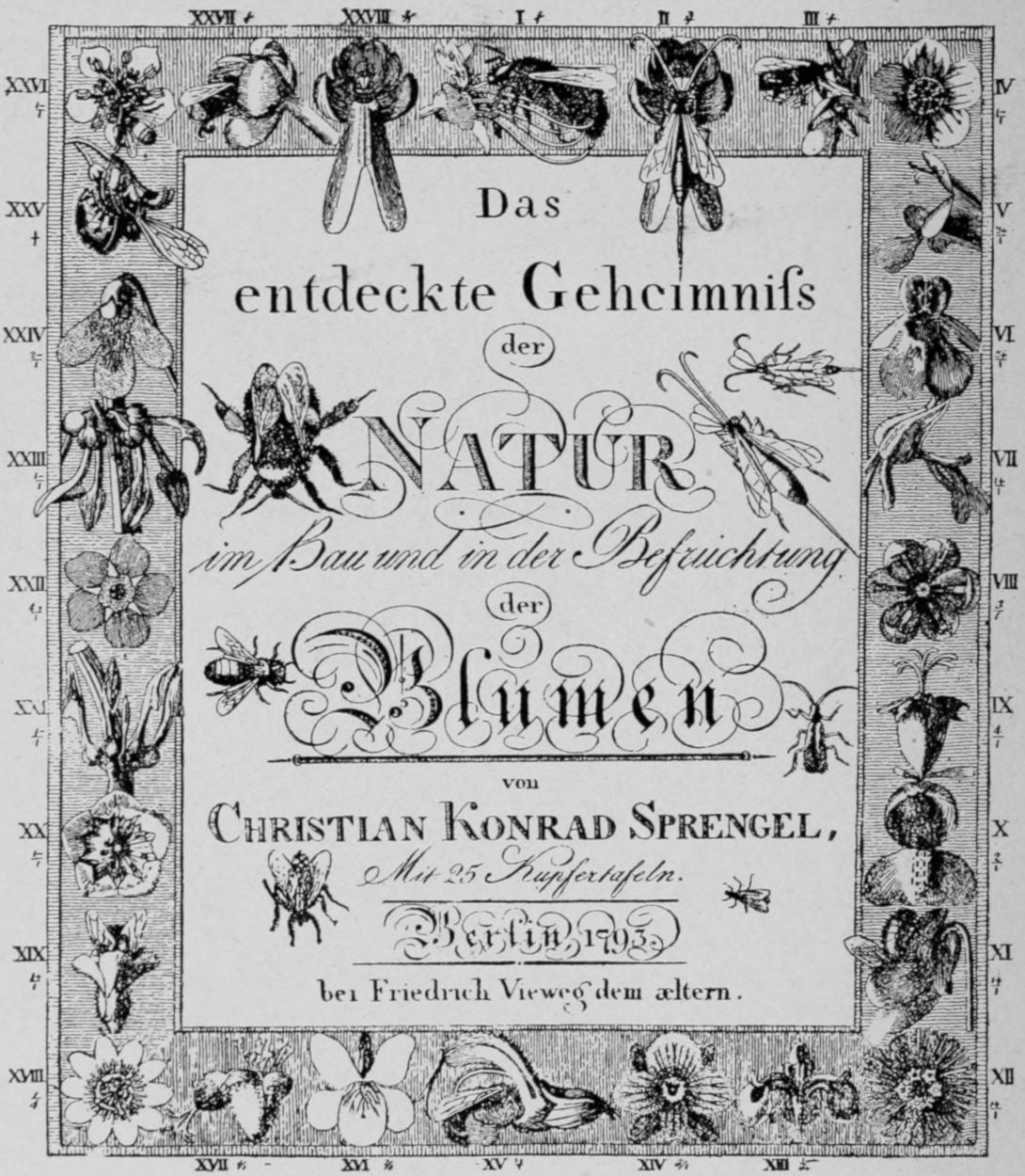
Fig. 98. Sprengel’s title page.
Das entdeckte Geheimniſs der NATUR im Bau und in der Befruchtung der Blumen von Christian Konrad Sprengel, Mit 25 Kupfertafeln. Berlin, 1793. bei Friedrich Vieweg dem æltern.
Toward the end of the eighteenth century a German rector, Sprengel, who seems to have found in nature a good deal of inspiration that he failed to “put over,” noticed that the petals of the common German wild geranium were fringed with hairs at their bases. That was in the day before men believed in evolution, but when they did believe in a purposeful creation. Sprengel was convinced that an all-wise Creator would not have made a single hair in vain, and he set about discovering what these hairs were for, much as a sensible person, seeing the governor on an engine today would try to find out what it is for. Below the break between the petals, he found a nectar gland, producing its sugary fluid; and he saw the hairs would prevent the nectar from being diluted or washed away by rain or dew. This brought him back to the original question—what nectaries and nectar are for. He got his answer to this by watching the plant and seeing that bees visited the flowers and removed the nectar as what might be called the raw materials of the honey industry.
In Sprengel’s day the general impression was not only that things have been created just as we find them, but created for our own ultimate good. So Sprengel found an answer in discovering that the hair fringe of the geranium petals protects the nectar of the flowers and so preserves it for bees to use in manufacturing honey for our breakfast table.
When you stop to think about it, Sprengel could hardly have had the curiosity to study out his geranium question to an answer without being spurred to look at other flowers to see if they might not have something interesting of the same sort to offer. He yielded to the impulse to look at other flowers, and he found his geranium to be a very drab specimen compared with some of the irregular and painted flowers that he studied out in the same way. He must have felt no common pride when, in 1793, he published the results of his studies, with simple but effective illustrations, under a title that meant revealing to mankind the newly discovered secret of nature in the structure and fertilization of flowers.
But Sprengel seems not to have been the sort of man to whom such an answer really was an answer, and he looked further. It does not seem to have taken him long to see that while gathering their own store of honey, and obviously without consciousness that they were doing anything else, the bees became dusted with pollen from geranium stamens and rubbed it off on geranium stigmas while going their rounds of the flowers. This conclusion evidently answered two questions—what the hairs are for, and what nectar is for.
It is not necessary to walk down Michigan Boulevard on a windy day to realize that we belong to an imitative race. The corner grocery and the drug store show it as well as the windows of milliners and dressmakers, shoe shops and news stands, or as the sights that issue from a barber shop in a college town.
Fashions run in fads and interests quite as much as in dress. Linnaeus was a great botanist; perhaps none has been greater. He not only reduced a chaotic science to order, but interested men in its study to a remarkable extent. It is rather unfairly charged against him that because his service was somewhat one-sided, those whose interest he awakened were extremely one-sided, in that they did not see or care for much in botany beyond finding, describing and classifying new plants. This was well enough worth doing; it is not finished yet, and will not be finished for many years to come; but it had become so fascinating and workable through the genius of the Swedish master that his followers seized on it with eagerness, and it was a long time before a mind of original habits and impulses broke loose from the train.
The man who possessed this originality was Darwin, the promulgator of the now universally accepted idea of organic evolution. To him has been ascribed the introduction of a new teleology into natural science, recognizing that structures and functions are because they are or have been of use—not of use to man necessarily, though man may turn them to account—but to their possessor.
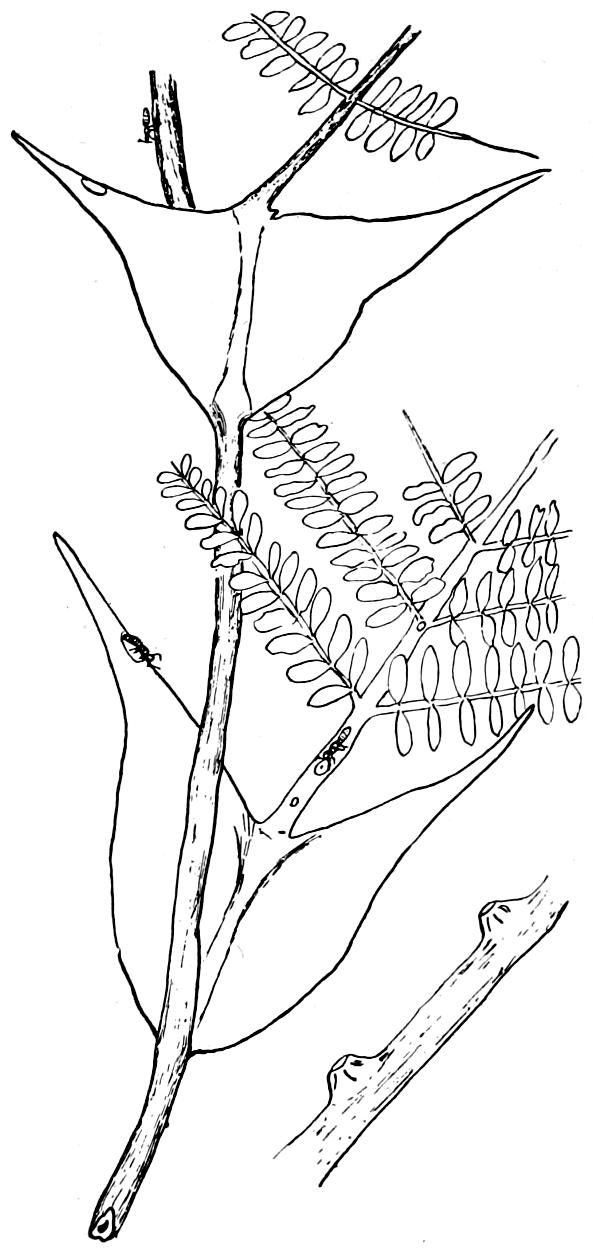
Fig. 99. Ant acacia.
This was Sprengel’s conclusion as to the nectar of geranium flowers, which he found led to their fertilization. The essential difference between his way of seeing it and Darwin’s is that he thought the entire mechanism has been specially made by the Creator as a means to an end, while Darwin saw in it the gradual modification of earlier structures because the new were helpful in the struggle of life and their possessors for this reason were likely to survive and pass them on to their offspring.
There is a German country saying that the honeybee was forbidden the red clover because she didn’t keep Sunday. Beekeepers know that her tongue is a little too short for the honey tube of the red clover flower and that she doesn’t waste time in trying to get what is out of her reach. They know, too, that some races of honeybees really can suck the red clover nectar because they have longer tongues, and if beekeepers ever want to do it they can probably set an expert plant breeder to work at breeding a race of red clover with a tube short enough so that even the German honeybee can get at its nectar. Natural evolution hasn’t done this. Where red clover is at home bumblebees are found, and bumblebees have no difficulty in reaching its nectar much as hawk-moths get that of a moon flower, which is far beyond the reach of any kind of bee. But in the South Seas, where there are no long-tongued bees, red clover finds itself as unable to set seed as the German honeybee is to get at its nectar. Bee and flower have evolved together, where both are at home, into a harmony of structure that is helpful to them both.
Nothing was more suggestive to Darwin in his search for evidences of evolution, or modification through descent, than this sort of harmony of structure and habit in flowers and insects; and one of his earliest and most effective books in bringing his views to the comprehending notice of others was one dealing with the mutual relations between those freaks in flowers, the orchids, and their insect visitors.
For Sprengel’s teleology, Sprengel’s explanation of nectar as a means of securing fertilization was sufficient. For Darwin’s teleology, it carried another question: Why? The geranium flower has both stamens and pistil, standing in its middle. The one might fertilize the other just as well as not, apparently; and yet this does not happen, for the pollen-bearing anthers of the stamens drop off before the stigmas of the pistils come to maturity. The same thing may be seen on any single-flowered geranium in a bay window or a greenhouse or a summer window box or flower bed, only this geranium does not belong to the genus Geranium of the botanists, but to the related African genus Pelargonium.
Looking for a further reason, Darwin saw a step further into the mystery when he found that these and many other flowers that ought to get on without any help are as dependent upon insects through their own failure to bring pollen and stigma together as those are in which stamens and pistils are borne in separate flowers—often on separate plants. To him, nectar and its attendants—flower fragrance, color, variegation, bizarre shape, long tubes, nectar guards of hairs or some other structure—meant what they had meant to Sprengel, fertilization through insect aid; but they meant something more, fertilization of one flower by pollen from another flower—crossing.
And still the questions multiply. Why do not all flowers have stamens and pistil side by side? Why, when they have this structure, do they not time the maturity of these essential parts so as to secure effective functioning without all the nectar machinery? In other words, why is crossing so commonly necessitated and provided for?
Science of every kind has been advanced by three methods—reasoning, observation, experimentation. Sprengel’s answer was reached by the first two; the new answer sought by Darwin was to be obtained through the third. For eleven years he put the question direct to the plants themselves, fertilizing them by their own pollen, crossing them, raising and requestioning their offspring. More and stronger progeny from crossing was the answer.
The popularity that Linnaeus had given to characterizing and classifying living things, was transferred by Darwin to studying their structure and doings. Sprengel’s idea fell upon barren soil; Darwin’s was cultivated with care and skill.
Two men—Mueller, a German, and Delpino, an Italian, stand out most prominently among a multitude who observed and wrote and pictured the marvels of flower and insect harmonies for a generation. All did excellent work in furnishing details and corroborations; but Darwin had answered the question as to the what and the why of the nectar of flowers.
But there is nectar that is not produced in flowers. Look at the queer spots in the angles between the veins on the under side of a catalpa leaf, when it is young; or at the little goblets on the stalk of a cherry or peach or snowball leaf, or at the pin-head spots on a trumpet-creeper or paeony calyx, and you may see glands there that secrete a sweet fluid. Bees may not care for it, but wasps or ants do. The cotton plant has such sweet nectar glands on the outside of the cluster of bracts about each blossom, and on the back of its leaves.
In a very few cases such “extrafloral” nectar serves the same purpose as that within the flowers; but generally it does not lead to fertilization. Delpino called the nectar that leads to fertilization “nuptial” nectar, and the other “extranuptial.”
In the seventies of the last century an English mining engineer, Belt, well known in the ore regions of Colorado, was marooned by his profession on a mining property in Nicaragua. Using his eyes took the place with him of tennis, or of dissipation, which is the white man’s bane in the tropics. He saw that a certain kind of ants cut the leaves of trees into bits which they take into their nests, and that roses and other introduced plants fared hard with these leaf cutters, unless they were protected by aromatic oils, as various kinds of citrus leaves are, or in some other way.
Belt did not fail to notice that ants visited extrafloral nectaries in numbers. In the case of those on some acacias he found the ants very pugnacious. I confess that in Guatemala I have preferred, myself, to go around a bush or a grove of such acacias with their ant guards. As with Sprengel’s geranium hairs, these nectaries unfolded question after question.
In Belt’s case, the tips of the acacia leaflets ripen also into little fruit-like bodies that the ants gather and take into their nests; and they make these nests in the stipules that flank each leaf and sometimes are shaped like a pair of small buffalo horns. It is an interesting undertaking to get the ant census of an acacia twig of this sort. The danger may not be as great, but it is as real and perhaps as painful as in taking the census of a mountain valley noted for moonshine traffic.
Belt drew the conclusion that extranuptial nectar, sometimes supplemented by solid food and shelter, is of use to the plant that provides it by maintaining a bodyguard of ants on plants that otherwise would be defoliated and injured by leaf cutters or grazing animals, much as Sprengel and Darwin found an explanation of nuptial nectar in the benefit of insect pollinization of the flowers.
This is the simple story of nectar, simply told, as it has been seen by observing and thinking men. But it is not a story free from complications. Our blue violets rarely set fruit from their showy nectar-bearing flowers, but their main reliance for seed is on flowers produced below the leaves, and these do not open, but are self-fertilized. The beautiful Poinsettia, with its brilliant red bracts and large cups overflowing with thick nectar, does not fruit in West Indian gardens any more than it does in our greenhouses at Christmas time. And irresistibly pugnacious as the acacia ants are, those that visit our paeonies and cassias and other plants do not usually more than protest mildly if we molest the plants that they are on.
Are the explanations of Sprengel and Darwin, and of Belt wrong? No other that are at all satisfactory have been offered.
When one stops to think of it, the secretion of nectar is an unusual phenomenon. Sugar is made within plants and it does not leak from them unless they have been injured. The sugar beet takes various substances out of the soil water, but it does not permit the passage of sugar into the soil water. And yet nectar, essentially sugar, is passed out of the plant, within which it was manufactured. This is because it is secreted—or excreted—through specialized glands. Everyone who grows plants in a bay window has seen young clover or grass leaves with a drop of water on their tips at some time or other. A few grains of bird seed in a flower pot covered by a pane of glass will show this as quickly as the seedlings come up.
These drops pass out finally through pores; but they are drops of water and not of nectar. If we can imagine a gland behind such a water pore, secreting sugar—letting it really get out of the cells with or into the water, we can picture a nectar gland. Such glands occur in some flowers. Some botanists believe that extranuptial nectar glands were originally water glands that have acquired the habit of secreting sugar.
This habit is a very unusual and a very peculiar one. It is not really understood except as it may be connected with usefulness to the plant. If this usefulness is not indirect, in the ways suggested by Darwin and Belt or otherwise, it must be direct. Water glands relieve over-pressure when absorption is high and evaporation low; in some of the calla family the water even spurts from the tips of the leaves at times. But sugar is not like water, taken in in quantity and to spare; it is manufactured, and in the case of nectar glands it is manufactured where it is secreted. Nobody has yet suggested any physiological function of plants calling for sugar safety valves situated in the queer positions occupied by extranuptial nectar glands, and no satisfactory direct physiological explanation of the nuptial glands has been suggested.
The actual status of nectar in botanical science is about this: When it is produced in flowers, and in some cases when it is outside of them, but near them, it demonstrably serves to secure cross-pollinization through the aid of insects, or humming birds and their like, when the flowers are long, tubular and red, as in the trumpet creeper, the trumpet honeysuckle and the scarlet salvia. It is then “nuptial nectar.” When it does not serve the plant in this way and so is “extranuptial,” it occurs in the neighborhood of the flowers, as in cotton, sweet potato, trumpet creeper and paeony, where it attracts numbers of ants, which are often very pugnacious, and to the extent of their activities it prevents injury to the flower buds and flowers, especially in their early stages; or it occurs on developing leaves during the period of their greatest need. More rarely, as in the acacias, the leaves continue to secrete it through the season, so that those that are mature add to the protection of the younger leaves and the flowers and the young fruit.
That neither of these functions is served in exceptional cases, and that some flowers rely on the wind for effective pollination, or have lapsed into self-fertilization; or that really pugnacious ants do not commonly frequent the extranuptial glands of most plants in temperate regions, and that some plants get along very well without such help, mark questions that will continue to stimulate observation and experiment. But nothing now known of the physiology of plants offers an alternative explanation for that which connects nectar with either pollination or defense; and until such an explanation can be found nectar will continue to be regarded as connected indirectly with these services through insect or bird relations.—William Trelease, Botanist, University of Illinois. American Bee Journal, Dec., 1919. (See also Physiology of Nectar Secretion).
NEGUNDO, see Box Elder.
NEVADA—Honey Sources of.
Much of Nevada is mountain and desert country. Alfalfa is the principal source of surplus honey, though sweet clover also yields. There are numerous minor sources, as willows along the streams and many of the desert plants.
NEW BRUNSWICK—Honey Sources of.
In New Brunswick the principal sources of nectar are alsike and white clover, fireweed, goldenrod and aster. Willows and maples stimulate early brood rearing.—F. W. L. Sladen.
NEW HAMPSHIRE—Honey Sources of.
The honey flora of New Hampshire is very similar to that of other New England States. In spring, willows, maples, fruit blossoms and dandelions keep the bees busy in preparation for the main flow, which comes from the clovers. Goldenrod is also important. Sumac, laurel, blueberries and asters are worthy of mention, also.
NEW JERSEY—Honey Sources of.
Plants from which nectar is gathered in less than surplus quantities:
Maples, mid-March-early April.
Peach early April.
Pear, mid-April.
Apple, late April early May.
Willows, late April.
Dandelion, early May.
Wild strawberry, May.
Lupine, May.
Raspberry, May.
Grape, late May-early June.
Huckleberry, blueberry, late May-late June.
Persimmon, mid-June-late June.
Vervain, late June-early September.
Virginia creeper, late June-late July.
Milkweed, silkweed, July.
False indigo, July.
Button bush, July.
Burdock, July-October.
Tree of Heaven, pride of China, July.
Catnip, July.
Motherwort, August.
Smartweed, heartsease, late August-mid-September.
Horsemint, August-September.
Boneset, mid-August-September.
Surplus honey plants:
Crimson clover, mid-May.
Locust, May 20-June 1.
Tulip-poplar, May 26-June 10.
Poison ivy, mid-May-mid-June.
Holly, late May-late June.
Mountain laurel, late May-late June.
Sheep laurel, late May-late June.
Swedish clover, alsike clover, June 1-July 10.
White clover, early June-mid-July.
Dogbane, Indian hemp, early June-late August.
Basswood, linden, late June-early July.
California privet, mid-July-late July.
Sumac, mid-June-mid-July.
White sweet clover, June-November.
Cranberry, June 15-August 15.
August flower, soap bush, sweet pepper bush, late July-late August.
Rose mallow, swamp mallow, late July-early September.
Burdock, July-November.
Spanish needle, mid-August into October.
Heartsease, smartweed or blackheart, August-September.
Heath aster, white aster or St. Michaelmas daisy, late August-mid-October.
Bushy goldenrod, late August-mid-October.
Buckwheat, early August.
Surplus Honey Regions
We may divide the State of New Jersey into three sections on the basis of surplus honey production.
The first section includes all of the southern and middle counties and the southern part of Middlesex, Somerset and Hunterdon. As a rule, the surplus honey in this district comes from clover. There are, of course, occasional places, such as low-lying land along large streams where a second flow is harvested in late summer and early autumn.
The second district includes all north of the first, with the exception of Hudson County and a part of Bergen, Passaic, Essex and Union. In this district there are generally two distinct, heavy honey flows, the first from clover and the last from buckwheat and fall flowers, such as goldenrod, aster, etc.
The third division, which roughly includes the Passaic and Hackensack Valleys, and the Raritan Valley below New Brunswick, rarely produces any surplus honey except in the fall, and that comes from goldenrod, aster and mallows.
The presence or absence of a single kind of plant will often decide whether the fall flow will be worth consideration. This principle applies more particularly to the second district. Should the amount of buckwheat sown be very small in some parts of this region the fall surplus would be missing. In certain parts of this second district white sweet clover is found in great abundance and furnishes surplus throughout the late summer and early fall.—Elmer G. Carr, Manual of Bee Husbandry.
NEW JERSEY TEA or RED-ROOT (Ceanothus americanus).
New Jersey tea grows from one to three feet high from a dark red root, hence the name “red-root.” It is a shrubby plant with flowers in white clusters. The leaves were used for tea during the revolutionary war. It is common in woodlands from Ontario to Manitoba and south to Arkansas, Texas and Florida.
It is not often mentioned as a source of honey, but according to H. B. Parks, is regarded as valuable in northwestern Missouri. (See Mountain lilac.)
NEW MEXICO—Honey Sources of.
Alfalfa is the chief source of surplus honey in the irrigated regions of New Mexico. There are some districts where the bloom of orchard fruits is important, especially for spring stimulation. The desert flora offers a wide variety of minor sources, with a few of surplus importance. Among the latter may be mentioned mesquite, catsclaw and cactus. (See Arizona and Texas.) Sweet clover is also important.
NEW YORK—Honey Sources of.
W. D. Wright, in Bulletin 49 of the New York Department of Agriculture, only lists a few plants as important in that State. He mentions basswood as formerly one of the principal sources now rapidly passing away. Alfalfa is mentioned as a source of honey in central New York. Alsike is spoken of as abundant and a splendid honey producer. Good yields are frequently gathered from buckwheat in sections where it is grown extensively and it seldom fails entirely. Fruit blossoms and black locust bloom before the colonies are sufficiently strong to store much surplus, but are valuable for early brood rearing. Sweet clover, sumac, blue thistle and goldenrod are the other sources mentioned. The failure to mention white clover is evidently an oversight, since it is one of the most important sources of nectar in the State.
NORTH CAROLINA, Honey Flora of.
Taking the State as a whole, sourwood, poplar, sometimes called tulip tree, and the clovers, are the three leaders. Of these three leaders the poplar is the most widely distributed and is prominently mentioned in all sections, from east to west. The sourwood is principally confined to the Piedmont section, though reported also from the lower mountain localities and from the western border of the eastern region. The clovers are found in all parts, though more abundant in the mountain and Piedmont sections. Next to these we find the gallberry (Vaccinium sp.) and black gum, both taking high rank and both found principally in the east. Persimmon ranks sixth and is reported principally from the east, several mentioning it as irregular in yield and lasting but a short time, but doing well for a short period. The basswood or linden comes seventh and is reported only from the west. Holly and huckleberry (low and high) are next in order, both being in the east. Buckwheat follows and is confined to the west.
Twenty-four leading bee pasturage plants:
Sourwood, Piedmont; little east and west.
Poplar (tulip tree), all sections.
Clovers (all varieties), west and Piedmont; little in east.
Gallberry, east.
Black gum, east.
Persimmon, east and Piedmont.
Basswood (linden, linn), west.
Holly, east.
Huckleberry, east.
Buckwheat, west.
Ironweed (aster), Piedmont.
Locust (black locust), west and Piedmont.
Aster, all sections.
Cotton, east and Piedmont.
Stickweed (Bidens).
Fruit trees, all kinds, all sections.
Peas (cow peas), Piedmont and east.
Sumac.
Nut trees (including oak), all sections.
Goldenrod, all sections.
Rattan, east.
Blackberry, all sections.
Maple, all varieties, all sections.
Alfalfa, locally grown.
—Franklin Sherman, Jr., Bul. North Carolina Department of Agriculture, Vol. 29, No. 1.
NORTH DAKOTA—Honey Sources of.
Beekeeping is, as yet, but little developed in North Dakota. Willows and cottonwoods furnish early pollen, dandelion and fruit bloom assist the bees with both nectar and pollen for early brood rearing. The clovers are the principal sources of surplus honey.
NOVA SCOTIA—Honey Sources of.
Willows and maples are important for spring brood rearing. The sources of surplus are alsike and white clover, goldenrod, aster, apple, fall dandelion (T. autumnale), wild radish (R. Raphanistrum), blueberry and Kalmia angustifolia.—F. W. L. Sladen.